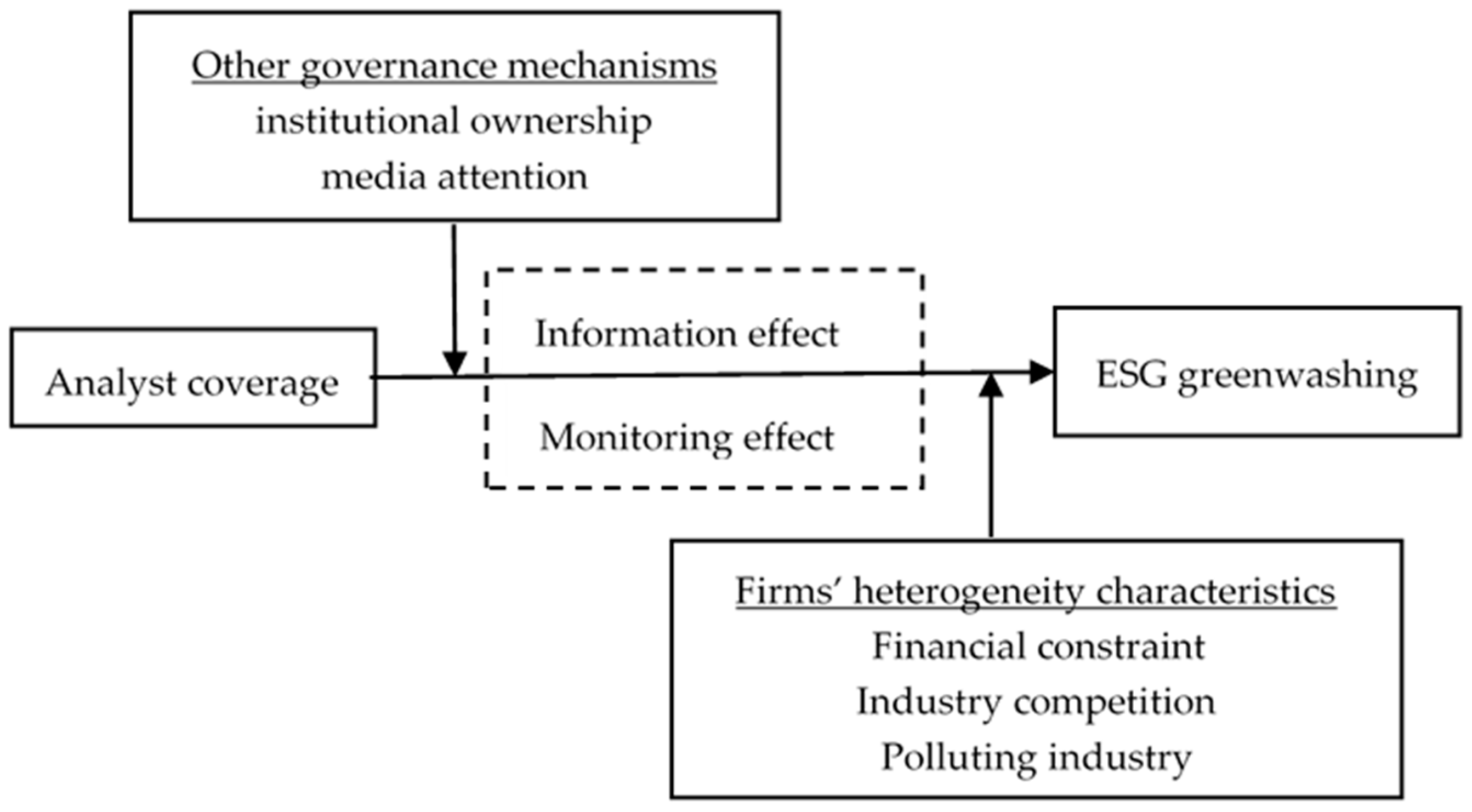
Can Analyst Coverage Reduce Corporate ESG Greenwashing? Evidence from China

Abstract
1. Introduction
2. Theoretical Background and Research Hypotheses
2.1. Literature Review of Corporate ESG Greenwashing Research
2.2. Research Hypothesis
3. Sample and Model Development
3.1. Sample and Data Sources
3.2. Variables Definition
3.2.1. Explained Variable
3.2.2. Dependent Variable
3.2.3. Control Variables
3.3. Empirical Model Design
3.4. Summary Statistics
4. Empirical Results
4.1. Baseline Regression Results
4.2. Addressing Endogeneity
4.2.1. Two-Stage Least Squares Regression with Instrumental Variables
4.2.2. A Quasi-Natural Experiment
4.2.3. Heckman Selection Model
4.2.4. Entropy Balance Test
4.3. Tests for Robustness
4.3.1. Change Measurement of Analyst Coverage
4.3.2. Change Measurement of ESG Greenwashing
4.3.3. Eliminate Samples Without Analyst Coverage
4.3.4. Placebo Test
5. Further Research
5.1. Mechanism Tests
5.1.1. Information Effect
5.1.2. Monitoring Effect
5.2. Moderating Effects of Other Governance Mechanisms
5.2.1. Institutional Ownership
5.2.2. Media Attention
5.3. Heterogeneity Tests
5.3.1. Financial Constraints
5.3.2. Industry Competition
5.3.3. Polluting Industry
6. Conclusions and Implications
6.1. Conclusions
6.2. Implications
6.3. Reflections on Limitations and Future Directions
Author Contributions
Funding
Data Availability Statement
Acknowledgments
Conflicts of Interest
References
- Shen, H.; Feng, H.; Xiao, Q.; Ma, S.; Guo, H. Research on the Dual Effects of Corporate Physical and Transition Climate Risks on Total Factor Productivity. Emerg. Mark. Financ. Trade 2025, 61, 4247–4265. [Google Scholar] [CrossRef]
- Ren, X.; Zeng, G.; Zhao, Y. Digital finance and corporate ESG performance: Empirical evidence from listed companies in China. Pac.-Basin Financ. J. 2023, 79, 102019. [Google Scholar] [CrossRef]
- Christensen, D.M.; Serafeim, G.; Sikochi, A. Why is Corporate Virtue in the Eye of The Beholder? The Case of ESG Ratings. Account. Rev. 2022, 97, 147–175. [Google Scholar] [CrossRef]
- Husted, B.W.; de Sousa-Filho, J.M. Board structure and environmental, social, and governance disclosure in Latin America. J. Bus. Res. 2019, 102, 220–227. [Google Scholar] [CrossRef]
- Siew, R.Y.J. A review of corporate sustainability reporting tools (SRTs). J. Environ. Manag. 2015, 164, 180–195. [Google Scholar] [CrossRef]
- Raghunandan, A.; Rajgopal, S. Do socially responsible firms walk the talk? J. Law. Econ. 2024, 67, 767–810. [Google Scholar] [CrossRef]
- Yu, E.P.-y.; Van Luu, B.; Chen, C.H. Greenwashing in environmental, social and governance disclosures. Res. Int. Bus. Financ. 2020, 52, 101192. [Google Scholar] [CrossRef]
- Zhang, D. Environmental regulation and firm product quality improvement: How does the greenwashing response? Int. Rev. Financ. Anal. 2022, 80, 102058. [Google Scholar] [CrossRef]
- Aboud, A.; Saleh, A.; Eliwa, Y. Does mandating ESG reporting reduce ESG decoupling? Evidence from the European Union’s Directive 2014/95. Bus. Strateg. Environ. 2024, 33, 1305–1320. [Google Scholar] [CrossRef]
- Riedl, A.; Smeets, P. Why do investors hold socially responsible mutual funds? J. Financ. 2017, 72, 2505–2550. [Google Scholar] [CrossRef]
- Janney, J.J.; Gove, S. Reputation and Corporate Social Responsibility Aberrations, Trends, and Hypocrisy: Reactions to Firm Choices in the Stock Option Backdating Scandal. J. Manag. Stud. 2011, 48, 1562–1585. [Google Scholar] [CrossRef]
- Ferrón-Vílchez, V.; Valero-Gil, J.; Suárez-Perales, I. How does greenwashing influence managers’ decision-making? An experimental approach under stakeholder view. Corp. Soc. Responsib. Environ. Manag. 2021, 28, 860–880. [Google Scholar] [CrossRef]
- Li, W.; Li, W.N.; Seppanen, V.; Koivumaki, T. How and when does perceived greenwashing affect employees’ job performance? Evidence from China. Corp. Soc. Responsib. Environ. Manag. 2022, 29, 1722–1735. [Google Scholar] [CrossRef]
- Robertson, J.L.; Montgomery, A.W.; Ozbilir, T. Employees’ response to corporate greenwashing. Bus. Strateg. Environ. 2023, 32, 4015–4027. [Google Scholar] [CrossRef]
- Eliwa, Y.; Aboud, A.; Saleh, A. Board gender diversity and ESG decoupling: Does religiosity matter? Bus. Strateg. Environ. 2023, 32, 4046–4067. [Google Scholar]
- Liu, Y.P.; Li, W.A.; Meng, Q.K. Influence of distracted mutual fund investors on corporate ESG decoupling: Evidence from China. Sustain. Account. Manag. Policy J. 2023, 14, 184–215. [Google Scholar] [CrossRef]
- Chen, T.; Harford, J.; Lin, C. Do analysts matter for governance? Evidence from natural experiments. J. Financ. Econ. 2015, 115, 383–410. [Google Scholar] [CrossRef]
- Yu, F.F. Analyst coverage and earnings management. J. Financ. Econ. 2008, 88, 245–271. [Google Scholar] [CrossRef]
- Irani, R.M.; Oesch, D. Analyst coverage and real earnings management: Quasi-experimental evidence. J. Financ. Quant. Anal. 2016, 51, 589–627. [Google Scholar] [CrossRef]
- Dyck, A.; Morse, A.; Zingales, L. Who blows the whistle on corporate fraud? J. Financ. 2010, 65, 2213–2253. [Google Scholar] [CrossRef]
- Wan-Hussin, W.N.; Qasem, A.; Aripin, N.; Ariffin, M.S.M. Corporate Responsibility Disclosure, Information Environment and Analysts’ Recommendations: Evidence from Malaysia. Sustainability 2021, 13, 3568. [Google Scholar] [CrossRef]
- Jing, C.; Keasey, K.; Lim, I.; Xu, B. Analyst Coverage and Corporate Environmental Policies. J. Financ. Quant. Anal. Forthcom. 2022, 59, 1586–1619. [Google Scholar] [CrossRef]
- Bradley, D.; Mao, C.X.; Zhang, C. Does Analyst Coverage Affect Workplace Safety? Manag. Sci. 2022, 68, 3464–3487. [Google Scholar] [CrossRef]
- Thomas, J.; Yao, W.; Zhang, F.; Zhu, W. Meet, beat, and pollute. Rev. Account. Stud. 2022, 27, 1038–1078. [Google Scholar] [CrossRef]
- Delmas, M.A.; Burbano, V.C. The drivers of greenwashing. Calif. Manag. Rev. 2011, 54, 64–87. [Google Scholar] [CrossRef]
- Chang, X.; Dasgupta, S.; Hilary, G. Analyst coverage and financing decisions. J. Financ. 2006, 61, 3009–3048. [Google Scholar] [CrossRef]
- Chen, T.; Xie, L.; Zhang, Y. How does analysts’ forecast quality relate to corporate investment efficiency? J. Corp. Financ. 2017, 43, 217–240. [Google Scholar] [CrossRef]
- To, T.Y.; Navone, M.; Wu, E. Analyst coverage and the quality of corporate investment decisions. J. Corp. Financ. 2018, 51, 164–181. [Google Scholar] [CrossRef]
- Kim, J.B.; Kim, Y.; Lee, J. Analyst reputation and management earnings forecasts. J. Account. Public. Policy 2021, 40, 106804. [Google Scholar] [CrossRef]
- Zhang, M.; Tong, L.; Su, J.; Cui, Z. Analyst coverage and corporate social performance: Evidence from China. Pac.-Basin Financ. J. 2015, 32, 76–94. [Google Scholar] [CrossRef]
- He, J.J.; Tian, X. The dark side of analyst coverage: The case of innovation. J. Financ. Econ. 2013, 109, 856–878. [Google Scholar] [CrossRef]
- Ren, L.; Zhong, X.; Wan, L. Missing analyst forecasts and corporate fraud: Evidence from China. J. Bus. Ethics 2021, 181, 171–194. [Google Scholar] [CrossRef]
- Zeng, L.; Li, H.; Lin, L.; Hu, D.J.J.; Liu, H. ESG standards in China: Bibliometric analysis, development status research, and future research directions. Sustainability 2024, 16, 7134. [Google Scholar] [CrossRef]
- Innes, R.; Sam, A.G. Voluntary Pollution Reductions and the Enforcement of Environmental Law: An Empirical Study of the 33/50 Program. J. Law Econ. 2008, 51, 271–296. [Google Scholar] [CrossRef]
- Broadstock, D.C.; Chan, K.; Cheng, L.T.; Wang, X. The role of ESG performance during times of financial crisis: Evidence from COVID-19 in China. Financ. Res. Lett. 2021, 38, 101716. [Google Scholar] [CrossRef] [PubMed]
- Feng, J.W.; Goodell, J.W.; Shen, D.H. ESG rating and stock price crash risk: Evidence from China. Financ. Res. Lett. 2022, 46, 102476. [Google Scholar] [CrossRef]
- He, F.; Du, H.Y.; Yu, B. Corporate ESG performance and manager misconduct: Evidence from China. Int. Rev. Financ. Anal. 2022, 82, 102201. [Google Scholar] [CrossRef]
- Zhan, H.; Shen, H.; Guo, H. Research on the impact of ESG scores on corporate substantive and strategic green innovation. Innov. Green. Dev. 2025, 4, 100194. [Google Scholar] [CrossRef]
- Houston, J.F.; Shan, H.Y. Corporate ESG Profiles and Banking Relationships. Rev. Financ. Stud. 2022, 35, 3373–3417. [Google Scholar] [CrossRef]
- Eliwa, Y.; Aboud, A.; Saleh, A. ESG practices and the cost of debt: Evidence from EU countries. Crit. Perspect. Account. 2021, 79, 102097. [Google Scholar] [CrossRef]
- Yu, E.P.Y.; Guo, C.Q.; Luu, B.V. Environmental, social and governance transparency and firm value. Bus. Strateg. Environ. 2018, 27, 987–1004. [Google Scholar] [CrossRef]
- Xie, J.; Nozawa, W.; Yagi, M.; Fujii, H.; Managi, S. Do environmental, social, and governance activities improve corporate financial performance? Bus. Strateg. Environ. 2019, 28, 286–300. [Google Scholar] [CrossRef]
- Chen, S.; Han, X.Y.; Zhang, Z.L.; Zhao, X.J. ESG investment in China: Doing well by doing good. Pac.-Basin. Financ. J. 2023, 77, 101907. [Google Scholar] [CrossRef]
- Li, Y.W.; Gong, M.F.; Zhang, X.Y.; Koh, L. The impact of environmental, social, and governance disclosure on firm value: The role of CEO power. Br. Account. Rev. 2018, 50, 60–75. [Google Scholar] [CrossRef]
- Qian, K.; Shi, B.J.; Song, Y.L.; Wu, H. ESG performance and loan contracting in an emerging market. Pac.-Basin Financ. J. 2023, 78, 101973. [Google Scholar] [CrossRef]
- Qureshi, M.A.; Kirkerud, S.; Theresa, K.; Ahsan, T. The impact of sustainability (environmental, social, and governance) disclosure and board diversity on firm value: The moderating role of industry sensitivity. Bus. Strateg. Environ. 2020, 29, 1199–1214. [Google Scholar] [CrossRef]
- Kim, E.H.; Lyon, T.P. Strategic environmental disclosure: Evidence from the DOE’s voluntary greenhouse gas registry. J. Environ. Econ. Manag. 2011, 61, 311–326. [Google Scholar] [CrossRef]
- Haque, F.; Ntim, C.G. Environmental Policy, Sustainable Development, Governance Mechanisms and Environmental Performance. Bus. Strateg. Environ. 2018, 27, 415–435. [Google Scholar] [CrossRef]
- Arvidsson, S.; Dumay, J. Corporate ESG reporting quantity, quality and performance: Where to now for environmental policy and practice? Bus. Strateg. Environ. 2022, 31, 1091–1110. [Google Scholar] [CrossRef]
- Schiemann, F.; Tietmeyer, R. ESG Controversies, ESG Disclosure and Analyst Forecast Accuracy. Int. Rev. Financ. Anal. 2022, 84, 102373. [Google Scholar] [CrossRef]
- Cheng, Q.; Du, F.; Wang, X.; Wang, Y.T. Seeing is believing: Analysts’ corporate site visits. Rev. Account. Stud. 2016, 21, 1245–1286. [Google Scholar] [CrossRef]
- Cheng, Q.; Du, F.; Wang, B.Y.T.; Wang, X. Do Corporate Site Visits Impact Stock Prices? Contemp. Account. Res. 2019, 36, 359–388. [Google Scholar] [CrossRef]
- Hong, H.; Lim, T.; Stein, J.C. Bad news travels slowly: Size, analyst coverage, and the profitability of momentum strategies. J. Financ. 2000, 55, 265–295. [Google Scholar] [CrossRef]
- Krueger, P.; Sautner, Z.; Starks, L.T. The Importance of Climate Risks for Institutional Investors. Rev. Financ. Stud. 2020, 33, 1067–1111. [Google Scholar] [CrossRef]
- Gentry, R.J.; Shen, W. The impacts of performance relative to analyst forecasts and analyst coverage on firm R&D intensity. Strateg. Manag. J. 2013, 34, 121–130. [Google Scholar]
- Bradley, D.; Gokkaya, S.; Liu, X.; Xie, F. Are all analysts created equal? Industry expertise and monitoring effectiveness of financial analysts. J. Account. Econ. 2017, 63, 179–206. [Google Scholar] [CrossRef]
- Healy, P.M.; Palepu, K.G. Information asymmetry, corporate disclosure, and the capital markets: A review of the empirical disclosure literature. J. Account. Econ. 2001, 31, 405–440. [Google Scholar] [CrossRef]
- Graham, J.R.; Harvey, C.R.; Rajgopal, S. The economic implications of corporate financial reporting. J. Account. Econ. 2005, 40, 3–73. [Google Scholar] [CrossRef]
- Qian, C.L.; Lu, L.Y.; Yu, Y.X. Financial analyst coverage and corporate social performance: Evidence from natural experiments. Strateg. Manag. J. 2019, 40, 2271–2286. [Google Scholar] [CrossRef]
- Ali, U.; Hirshleifer, D. Shared analyst coverage: Unifying momentum spillover effects. J. Financ. Econ. 2020, 136, 649–675. [Google Scholar] [CrossRef]
- Zhang, C.; Wu, X. Analyst coverage and corporate ESG performance. Sustainability 2023, 15, 12763. [Google Scholar] [CrossRef]
- Liu, G.R.; Qian, H.; Wu, Q.Q.; Han, F. Research on the masking effect of vertical interlock on ESG greenwashing in the context of sustainable Enterprise development. Corp. Soc. Responsib. Environ. Manag. 2023, 31, 196–209. [Google Scholar] [CrossRef]
- Zhang, D. Can environmental monitoring power transition curb corporate greenwashing behavior? J. Econ. Behav. Organ. 2023, 212, 199–218. [Google Scholar] [CrossRef]
- Zhang, Y. Analyst coverage and corporate social responsibility decoupling: Evidence from China. Corp. Soc. Responsib. Environ. Manag. 2022, 29, 620–634. [Google Scholar] [CrossRef]
- Hong, H.; Kacperczyk, M. The price of sin: The effects of social norms on markets. J. Financ. Econ. 2009, 93, 15–36. [Google Scholar] [CrossRef]
- Lei, Z.; Guo, X.M.; Fu, X.F. How Does Analyst Coverage Affect Corporate Social Responsibility? Evidence from China. Emerg. Mark. Financ. Trade 2022, 58, 2036–2049. [Google Scholar] [CrossRef]
- Zhang, P.; Wang, Y.R. The bright side of analyst coverage on corporate innovation: Evidence from China. Int. Rev. Financ. Anal. 2023, 89, 102791. [Google Scholar] [CrossRef]
- Chen, Y.C.; Hung, M.Y.; Wang, Y.X. The effect of mandatory CSR disclosure on firm profitability and social externalities: Evidence from China. J. Account. Econ. 2018, 65, 169–190. [Google Scholar] [CrossRef]
- Hainmueller, J. Entropy Balancing for Causal Effects: A Multivariate Reweighting Method to Produce Balanced Samples in Observational Studies. Political Anal. 2012, 20, 25–46. [Google Scholar] [CrossRef]
- Frankel, R.; Li, X. Characteristics of a firm’s information environment and the information asymmetry between insiders and outsiders. J. Account. Econ. 2004, 37, 229–259. [Google Scholar] [CrossRef]
- Ellul, A.; Panayides, M. Do financial analysts restrain insiders’ informational advantage? J. Financ. Quant. Anal. 2018, 53, 203–241. [Google Scholar] [CrossRef]
- Derrien, F.; Kecskés, A. The real effects of financial shocks: Evidence from exogenous changes in analyst coverage. J. Financ. 2013, 68, 1407–1440. [Google Scholar] [CrossRef]
- Kelly, B.; Ljungqvist, A. Testing asymmetric-information asset pricing models. Rev. Financ. Stud. 2012, 25, 1366–1413. [Google Scholar] [CrossRef]
- Dechow, P.M.; Sloan, R.G.; Sweeney, A.P. Detecting earnings management. Account. Rev. 1995, 70, 193–225. [Google Scholar]
- Hartzell, J.C.; Starks, L.T. Institutional investors and executive compensation. J. Financ. 2003, 58, 2351–2374. [Google Scholar] [CrossRef]
- Yang, B.; Guo, C.; Fan, Y. Institutional investor networks and ESG performance: Evidence from China. Emerg. Mark. Financ. Trade 2024, 60, 113–137. [Google Scholar] [CrossRef]
- Chen, T.; Dong, H.; Lin, C. Institutional shareholders and corporate social responsibility. J. Financ. Econ. 2020, 135, 483–504. [Google Scholar] [CrossRef]
- Dyck, A.; Lins, K.V.; Roth, L.; Wagner, H.F. Do institutional investors drive corporate social responsibility? International evidence. J. Financ. Econ. 2019, 131, 693–714. [Google Scholar] [CrossRef]
- Safiullah, M.; Alam, M.S.; Islam, M.S. Do all institutional investors care about corporate carbon emissions? Energ. Econ. 2022, 115, 106376. [Google Scholar] [CrossRef]
- Ang, J.S.; Hsu, C.; Tang, D.; Wu, C. The role of social media in corporate governance. Account. Rev. 2021, 96, 1–32. [Google Scholar] [CrossRef]
- Miller, G.S. The press as a watchdog for accounting fraud. J. Account. Res. 2006, 44, 1001–1033. [Google Scholar] [CrossRef]
- Liu, B.X.; McConnell, J.J. The role of the media in corporate governance: Do the media influence managers’ capital allocation decisions? J. Financ. Econ. 2013, 110, 1–17. [Google Scholar] [CrossRef]
- Dyck, A.; Volchkova, N.; Zingales, L. The corporate governance role of the media: Evidence from Russia. J. Financ. 2008, 63, 1093–1135. [Google Scholar] [CrossRef]
- Sun, J.; Zhou, Y.; Wang, J.G.; Guo, J. Influence of media coverage and sentiment on seasoned equity offerings. Account. Financ. 2020, 60, 557–585. [Google Scholar] [CrossRef]
- Guest, N.M. The Information Role of the Media in Earnings News. J. Account. Res. 2021, 59, 1021–1076. [Google Scholar] [CrossRef]
- Shipilov, A.V.; Greve, H.R.; Rowley, T.J. Is all publicity good publicity? The impact of direct and indirect media pressure on the adoption of governance practices. Strateg. Manag. J. 2019, 40, 1368–1393. [Google Scholar] [CrossRef]
- Jia, M.; Tong, L.; Viswanath, P.; Zhang, Z. Word power: The impact of negative media coverage on disciplining corporate pollution. J. Bus. Ethics 2016, 138, 437–458. [Google Scholar] [CrossRef]
- Bednar, M.K. Watchdog or lapdog? A behavioral view of the media as a corporate governance mechanism. Acad. Manag. J. 2012, 55, 131–150. [Google Scholar] [CrossRef]
- Burke, J.J. Do Boards Take Environmental, Social, and Governance Issues Seriously? Evidence from Media Coverage and CEO Dismissals. J. Bus. Ethics 2022, 176, 647–671. [Google Scholar] [CrossRef]
- Xu, Q.; Kim, T. Financial constraints and corporate environmental policies. Rev. Financ. Stud. 2022, 35, 576–635. [Google Scholar] [CrossRef]
- Goetz, M.R. Financing conditions and toxic emissions. In SAFE Working Paper Series; Leibniz Institute for Financial Research SAFE: Frankfurt am Main, Germany, 2019. [Google Scholar]
- Moyer, R.C.; Chatfield, R.E.; Sisneros, P.M. Security analyst monitoring activity: Agency costs and information demands. J. Financ. Quant. Anal. 1989, 24, 503–512. [Google Scholar] [CrossRef]
- Derrien, F.; Kecskés, A.; Mansi, S.A. Information asymmetry, the cost of debt, and credit events: Evidence from quasi-random analyst disappearances. J. Corp. Financ. 2016, 39, 295–311. [Google Scholar] [CrossRef]
- Hadlock, C.J.; Pierce, J.R. New Evidence on Measuring Financial Constraints: Moving Beyond the KZ Index. Rev. Financ. Stud. 2010, 23, 1909–1940. [Google Scholar] [CrossRef]
- Leong, C.K.; Yang, Y.C. Market competition and firms’ social performance. Econ. Model. 2020, 91, 601–612. [Google Scholar] [CrossRef]
- Campello, M. Capital structure and product markets interactions: Evidence from business cycles. J. Financ. Econ. 2003, 68, 353–378. [Google Scholar] [CrossRef]
- Hu, X.; Hua, R.; Liu, Q.; Wang, C. The green fog: Environmental rating disagreement and corporate greenwashing. Pac-Basin Financ. J. 2023, 78, 101952. [Google Scholar] [CrossRef]


| Variable Type | Variable Symbol | Construct |
|---|---|---|
| Explained variable | ESGgreenwashing | As shown in Formula (1) |
| Independent variables | Cov1 | Quantified by the annual count of analysts issuing earnings forecasts |
| Cov2 | The yearly count of earnings forecasts issued for firm i in fiscal year t | |
| Control variables | Size | Total assets transformed using the natural logarithm |
| Lev | Calculated as the ratio of total liabilities to total assets | |
| Growth | The annual revenue growth rate | |
| Inst | The percentage of a firm’s total shares owned by institutional investors | |
| State | Coded as 1 if the firm is state-owned, and 0 if non-state-owned | |
| Age | The natural logarithm of firm age as of year t | |
| ROA | The ratio of net income to total assets in year t | |
| Big4_auditor | 1 if four audit office, otherwise 0 | |
| CEO_chair_duality | 1 if the chairman and CEO is the same, otherwise 0 | |
| Top1_ownership | The ownership percentage of the largest shareholder | |
| Board_Independence | The proportion of independent directors |
| Variable | Num | Mean | SD. | Min | Median | Max |
|---|---|---|---|---|---|---|
| ESG greenwashing | 10,246 | −0.022 | 1.149 | −2.389 | −0.128 | 3.238 |
| Cov1 | 10,246 | 11.578 | 12.286 | 0.000 | 7.000 | 50.000 |
| Cov2 | 10,246 | 25.436 | 30.950 | 0.000 | 13.000 | 138.000 |
| Size | 10,246 | 23.235 | 1.310 | 20.484 | 23.116 | 26.961 |
| Lev | 10,246 | 0.478 | 0.199 | 0.067 | 0.490 | 0.886 |
| Growth | 10,246 | 0.166 | 0.370 | −0.498 | 0.106 | 2.238 |
| Inst | 10,246 | 0.505 | 0.217 | 0.001 | 0.523 | 0.885 |
| State | 10,246 | 0.509 | 0.500 | 0.000 | 1.000 | 1.000 |
| Age | 10,246 | 13.396 | 7.122 | 0.000 | 14.000 | 27.000 |
| ROA | 10,246 | 0.044 | 0.059 | −0.184 | 0.038 | 0.219 |
| Big4_auditor | 10,246 | 0.123 | 0.329 | 0.000 | 0.000 | 1.000 |
| CEO_chair_duality | 10,246 | 0.781 | 0.413 | 0.000 | 1.000 | 1.000 |
| Top1_ownership | 10,246 | 0.370 | 0.162 | 0.084 | 0.356 | 0.774 |
| Board_Independence | 10,246 | 0.375 | 0.055 | 0.333 | 0.364 | 0.571 |
| (1) | (2) | |
|---|---|---|
| ESG Greenwashing | ESG Greenwashing | |
| Cov1 | −0.004 *** | |
| (−3.645) | ||
| Cov2 | −0.001 ** | |
| (−2.420) | ||
| Size | 0.116 *** | 0.112 *** |
| (8.928) | (8.579) | |
| Lev | 0.449 *** | 0.452 *** |
| (5.621) | (5.655) | |
| Growth | 0.151 *** | 0.151 *** |
| (4.575) | (4.569) | |
| Inst | 0.023 | 0.005 |
| (0.342) | (0.081) | |
| State | −0.196 *** | −0.195 *** |
| (−7.361) | (−7.286) | |
| Age | 0.013 *** | 0.013 *** |
| (6.663) | (6.967) | |
| ROA | −1.032 *** | −1.142 *** |
| (−4.098) | (−4.559) | |
| Big4_auditor | 0.669 *** | 0.670 *** |
| (16.626) | (16.620) | |
| CEO_chair_duality | −0.116 *** | −0.113 *** |
| (−4.105) | (−4.021) | |
| Top1_ownership | −0.070 | −0.050 |
| (−0.811) | (−0.583) | |
| Board_Independence | −1.399 *** | −1.398 *** |
| (−6.916) | (−6.909) | |
| Constant | −2.134 *** | −2.054 *** |
| (−7.493) | (−7.204) | |
| N | 10,246 | 10,246 |
| Year and Ind FE | YES | YES |
| Adj_R2 | 0.085 | 0.084 |
| (1) | (2) | (3) | (4) | (5) | (6) | |
|---|---|---|---|---|---|---|
| Cov1 | ESG Greenwashing | Cov2 | ESG Greenwashing | Cov1 | ESG Greenwashing | |
| Cov1 | −0.053 ** | −0.012 ** | ||||
| (−2.413) | (−2.026) | |||||
| Cov2 | −0.021 ** | |||||
| (−2.401) | ||||||
| HS300 | 2.362 *** | 5.936 *** | ||||
| (6.303) | (6.105) | |||||
| Exp_cov | 0.074 *** | |||||
| (59.947) | ||||||
| Size | 3.869 *** | 0.140 | 8.719 *** | 0.119 | 2.145 *** | 0.150 *** |
| (19.318) | (1.535) | (16.780) | (1.425) | (21.714) | (5.181) | |
| Lev | 0.067 | 0.518 *** | 2.865 | 0.575 *** | −0.762 | 0.375 ** |
| (0.075) | (4.115) | (1.225) | (4.439) | (−1.235) | (2.395) | |
| Growth | 0.043 | 0.067 ** | 1.086 ** | 0.088 *** | 0.106 | 0.177 *** |
| (0.210) | (2.349) | (2.053) | (2.886) | (0.467) | (4.582) | |
| Inst | 8.914 *** | 0.225 | 21.756 *** | 0.212 | 6.734 *** | 0.016 |
| (14.937) | (1.052) | (14.053) | (1.008) | (13.658) | (0.147) | |
| State | −2.152 *** | −0.355 *** | −6.958 *** | −0.388 *** | −0.788 *** | −0.193 *** |
| (−3.633) | (−3.689) | (−4.529) | (−3.714) | (−3.732) | (−3.387) | |
| Age | −0.799 | 0.062 | −2.467 * | 0.052 | −0.193 *** | 0.011 ** |
| (−1.512) | (0.813) | (−1.800) | (0.672) | (−13.203) | (2.539) | |
| ROA | 43.829 *** | 2.120 ** | 113.658 *** | 2.194 ** | 53.825 *** | −0.897 ** |
| (23.835) | (2.074) | (23.825) | (2.076) | (25.770) | (−2.049) | |
| Big4_auditor | 0.311 | 0.402 *** | −0.249 | 0.380 *** | −0.150 | 0.662 *** |
| (0.531) | (4.896) | (−0.164) | (4.621) | (−0.543) | (7.719) | |
| CEO_chair_ duality | 0.072 | −0.044 | 0.207 | −0.044 | −0.811 *** | −0.077 |
| (0.277) | (−1.211) | (0.305) | (−1.190) | (−3.806) | (−1.554) | |
| Top1_ownership | −7.442 *** | −0.169 | −17.236 *** | −0.138 | −8.198 *** | 0.008 |
| (−5.746) | (−0.698) | (−5.129) | (−0.586) | (−12.996) | (0.046) | |
| Board_Independence | −0.783 | −1.460 *** | 0.614 | −1.405 *** | 2.304 | −1.275 *** |
| (−0.378) | (−5.044) | (0.114) | (−4.835) | (1.524) | (−3.455) | |
| Constant | −70.016 *** | −3.618 * | −149.406 *** | −3.053 | −34.117 *** | −2.779 *** |
| (−6.816) | (−1.694) | (−5.606) | (−1.543) | (−15.703) | (−4.510) | |
| N | 10,246 | 10,246 | 10,246 | 10,246 | 8477 | 8477 |
| Year and Ind FE | Yes | Yes | Yes | Yes | Yes | Yes |
| Adj-R2 | 0.406 | 0.070 | 0.378 | 0.069 | 0.619 | 0.094 |
| (1) | (2) | |
|---|---|---|
| ESG Greenwashing | ESG Greenwashing | |
| DID | 0.065 ** | |
| (2.074) | ||
| Treated | −0.075 | |
| (0.146) | ||
| Post | 0.014 | |
| (0.074) | ||
| Treated × Pre2 | −0.081 | |
| (−0.352) | ||
| Treated×Pre1 | −0.101 | |
| (−0.550) | ||
| Treated × Time0 | 0.189 | |
| (0.938) | ||
| Treated × Post1 | 0.282 * | |
| (1.776) | ||
| Treated × Post2 | 0.298 ** | |
| (2.538) | ||
| Size | −0.057 | 0.193 *** |
| (−0.671) | (5.345) | |
| Lev | 0.791 | 0.220 |
| (1.560) | (0.922) | |
| Growth | −0.522 * | 0.017 |
| (−1.767) | (0.153) | |
| Inst | −0.723 | 0.075 |
| (−1.445) | (0.414) | |
| State | −0.490 *** | −0.153 ** |
| (−3.034) | (−1.982) | |
| Age | 0.031 ** | 0.008 |
| (2.089) | (1.481) | |
| ROA | −2.416 * | −1.166 * |
| (−1.713) | (−1.815) | |
| Big4_auditor | 0.904 *** | 0.699 *** |
| (3.682) | (6.998) | |
| CEO_chair_duality | −0.308 ** | −0.045 |
| (−2.098) | (−0.637) | |
| Top1_ownership | 1.748 ** | −0.060 |
| (2.292) | (−0.258) | |
| Board_Independence | −5.851 *** | −1.885 *** |
| (−4.161) | (−3.416) | |
| Constant | 3.633 * | −2.922 *** |
| (1.884) | (−3.203) | |
| N | 297 | 1459 |
| Year and Ind FE | Yes | Yes |
| Adj_R2 | 0.261 | 0.143 |
| (1) | (2) | (3) | (4) | |
|---|---|---|---|---|
| Heckman Two-Stage | Entropy Balance | |||
| ESG Greenwashing | ESG Greenwashing | |||
| Cov1 | −0.006 *** | |||
| (−4.772) | ||||
| Cov2 | −0.002 *** | |||
| (−3.966) | ||||
| IMR | 0.674 *** | 0.680 *** | ||
| (5.980) | (6.002) | |||
| Treat1 | −0.123 *** | |||
| (−3.359) | ||||
| Treat2 | −0.075 * | |||
| (−1.959) | ||||
| Size | 0.251 *** | 0.248 *** | 0.146 *** | 0.141 *** |
| (11.479) | (11.284) | (6.250) | (6.119) | |
| Lev | 0.261 *** | 0.262 *** | 0.638 *** | 0.638 *** |
| (2.689) | (2.704) | (4.462) | (4.453) | |
| Growth | 0.199 *** | 0.201 *** | 0.123 *** | 0.123 *** |
| (5.534) | (5.576) | (2.702) | (2.703) | |
| Inst | 0.189 ** | 0.179 ** | 0.039 | 0.023 |
| (2.472) | (2.338) | (0.336) | (0.204) | |
| State | −0.231 *** | −0.231 *** | −0.111 *** | −0.109 *** |
| (−7.342) | (−7.334) | (−2.714) | (−2.660) | |
| Age | 0.003 | 0.003 | 0.005 * | 0.005 * |
| (1.164) | (1.345) | (1.735) | (1.879) | |
| ROA | 0.676 * | 0.596 * | 0.070 | −0.063 |
| (1.879) | (1.647) | (0.155) | (−0.143) | |
| Big4_auditor | 0.647 *** | 0.648 *** | 0.735 *** | 0.735 *** |
| (16.195) | (16.190) | (12.130) | (12.128) | |
| CEO_chair_duality | −0.100 *** | −0.098 *** | −0.204 *** | −0.203 *** |
| (−3.155) | (−3.088) | (−4.114) | (−4.085) | |
| Top1_ownership | −0.121 | −0.103 | −0.096 | −0.075 |
| (−1.294) | (−1.092) | (−0.688) | (−0.539) | |
| Board_Independence | −1.443 *** | −1.448 *** | −1.073 *** | −1.070 *** |
| (−6.200) | (−6.217) | (−3.174) | (−3.169) | |
| Constant | −4.994 *** | −4.965 *** | −3.269 *** | −3.166 *** |
| (−10.250) | (−10.129) | (−6.548) | (−6.445) | |
| N | 10,246 | 10,246 | 10,246 | 10,246 |
| Year and Ind FE | Yes | Yes | Yes | Yes |
| Adj-R2/Wald chi2 | 878.212 *** | 870.090 *** | 0.122 | 0.120 |
| (1) | (2) | (3) | (4) | (5) | (6) | (7) | (8) | |
|---|---|---|---|---|---|---|---|---|
| Changed Coverage Measure | Using Wind ESG Data | Eliminate Samples | Placebo Test | |||||
| ESG Greenwashing | ||||||||
| Cov1 | −0.055 *** | −0.006 *** | −0.005 *** | −0.001 | ||||
| (−4.656) | (−3.374) | (−4.429) | (−0.879) | |||||
| Cov2 | −0.037 *** | −0.002 *** | −0.002 *** | 0.000 | ||||
| (−3.959) | (−2.724) | (−3.348) | (0.829) | |||||
| Size | 0.125 *** | 0.122 *** | 0.106 *** | 0.101 *** | 0.157 *** | 0.153 *** | 0.102 *** | 0.103 *** |
| (9.313) | (9.079) | (4.709) | (4.492) | (10.376) | (10.092) | (8.227) | (8.234) | |
| Lev | 0.432 *** | 0.436 *** | 0.619 *** | 0.620 *** | 0.377 *** | 0.378 *** | 0.455 *** | 0.455 *** |
| (5.390) | (5.439) | (4.104) | (4.109) | (4.026) | (4.034) | (5.692) | (5.681) | |
| Growth | 0.154 *** | 0.154 *** | 0.172 *** | 0.173 *** | 0.174 *** | 0.175 *** | 0.148 *** | 0.148 *** |
| (4.669) | (4.679) | (2.648) | (2.662) | (4.759) | (4.785) | (4.490) | (4.482) | |
| Inst | 0.029 | 0.021 | −0.008 | −0.031 | 0.047 | 0.031 | −0.025 | −0.026 |
| (0.440) | (0.325) | (−0.059) | (−0.242) | (0.659) | (0.429) | (−0.393) | (−0.402) | |
| State | −0.201 *** | −0.200 *** | −0.422 *** | −0.419 *** | −0.197 *** | −0.197 *** | −0.189 *** | −0.189 *** |
| (−7.516) | (−7.491) | (−8.336) | (−8.289) | (−6.612) | (−6.572) | (−7.110) | (−7.097) | |
| Age | 0.012 *** | 0.013 *** | 0.013 *** | 0.014 *** | 0.010 *** | 0.010 *** | 0.014 *** | 0.014 *** |
| (6.320) | (6.498) | (3.925) | (4.119) | (4.533) | (4.782) | (7.554) | (7.519) | |
| ROA | −0.959 *** | −1.013 *** | −2.044 *** | −2.150 *** | −0.570 * | −0.680 ** | −1.345 *** | −1.346 *** |
| (−3.792) | (−4.002) | (−4.482) | (−4.722) | (−1.942) | (−2.322) | (−5.678) | (−5.681) | |
| Big4_auditor | 0.665 *** | 0.666 *** | 0.539 *** | 0.539 *** | 0.669 *** | 0.670 *** | 0.668 *** | 0.668 *** |
| (16.516) | (16.530) | (8.603) | (8.581) | (15.669) | (15.671) | (16.604) | (16.581) | |
| CEO_chair_duality | −0.118 *** | −0.117 *** | −0.070 | −0.068 | −0.080 *** | −0.078 ** | −0.110 *** | −0.110 *** |
| (−4.182) | (−4.141) | (−1.350) | (−1.298) | (−2.617) | (−2.537) | (−3.900) | (−3.893) | |
| Top1_ownership | −0.068 | −0.058 | −0.472 *** | −0.448 *** | −0.052 | −0.030 | −0.015 | −0.014 |
| (−0.791) | (−0.681) | (−2.948) | (−2.800) | (−0.548) | (−0.319) | (−0.178) | (−0.168) | |
| Board_Independence | −1.421 *** | −1.416 *** | −1.827 *** | −1.828 *** | −1.247 *** | −1.247 *** | −1.405 *** | −1.408 *** |
| (−7.029) | (−7.002) | (−4.886) | (−4.885) | (−5.609) | (−5.609) | (−6.938) | (−6.949) | |
| Constant | −2.253 *** | −2.204 *** | 0.817 | 0.921 * | −2.878 *** | −2.826 *** | −1.877 *** | −1.895 *** |
| (−7.820) | (−7.650) | (1.536) | (1.734) | (−8.782) | (−8.574) | (−6.794) | (−6.843) | |
| N | 10,246 | 10,246 | 4505 | 4505 | 8550 | 8550 | 10,246 | 10,246 |
| Year and Ind FE | Yes | Yes | Yes | Yes | Yes | Yes | Yes | Yes |
| Adj_R2 | 0.086 | 0.085 | 0.176 | 0.175 | 0.094 | 0.093 | 0.084 | 0.084 |
| (1) | (2) | (3) | (4) | |
|---|---|---|---|---|
| ESG Greenwashing | ESG Greenwashing | ESG Greenwashing | ESG Greenwashing | |
| Opaque × Cov1 | −0.011 * | |||
| (−1.888) | ||||
| Opaque × Cov2 | −0.004 *** | |||
| (−2.755) | ||||
| ABDA × Cov1 | −0.301 * | |||
| (−1.806) | ||||
| ABDA × Cov2 | −0.258 * | |||
| (−1.943) | ||||
| Cov1 | −0.002 | −0.050 *** | ||
| (−1.405) | (−3.022) | |||
| Cov2 | −0.001 | −0.034 ** | ||
| (−0.905) | (−2.471) | |||
| Opaque | 0.305 *** | 0.284 *** | ||
| (3.156) | (3.398) | |||
| ABDA | 0.791 ** | 0.874 ** | ||
| (2.119) | (2.278) | |||
| Size | 0.127 *** | 0.123 *** | 0.143 *** | 0.140 *** |
| (9.018) | (8.731) | (8.675) | (8.473) | |
| Lev | 0.467 *** | 0.468 *** | 0.307 *** | 0.312 *** |
| (5.415) | (5.426) | (3.225) | (3.276) | |
| Growth | 0.151 *** | 0.151 *** | 0.182 *** | 0.183 *** |
| (4.257) | (4.248) | (4.358) | (4.375) | |
| Inst | 0.024 | 0.009 | 0.085 | 0.076 |
| (0.330) | (0.119) | (1.092) | (0.966) | |
| State | −0.181 *** | −0.180 *** | −0.153 *** | −0.152 *** |
| (−6.172) | (−6.116) | (−4.716) | (−4.704) | |
| Age | 0.010 *** | 0.010 *** | 0.015 *** | 0.015 *** |
| (4.733) | (4.957) | (6.184) | (6.328) | |
| ROA | −1.084 *** | −1.186 *** | −0.768 ** | −0.844 *** |
| (−4.080) | (−4.486) | (−2.434) | (−2.691) | |
| Big4_auditor | 0.623 *** | 0.623 *** | 0.670 *** | 0.671 *** |
| (14.480) | (14.482) | (13.467) | (13.483) | |
| CEO_chair_duality | −0.096 *** | −0.093 *** | −0.136 *** | −0.134 *** |
| (−3.158) | (−3.082) | (−4.038) | (−3.982) | |
| Top1_ownership | −0.080 | −0.059 | 0.003 | 0.019 |
| (−0.838) | (−0.623) | (0.033) | (0.184) | |
| Board_Independence | −1.423 *** | −1.420 *** | −1.357 *** | −1.354 *** |
| (−6.479) | (−6.464) | (−5.660) | (−5.648) | |
| Constant | −2.585 *** | −2.496 *** | −2.730 *** | −2.674 *** |
| (−8.407) | (−8.138) | (−7.750) | (−7.605) | |
| N | 8464 | 8464 | 7482 | 7482 |
| Year and Ind FE | Yes | Yes | Yes | Yes |
| Adj-R2 | 0.088 | 0.088 | 0.090 | 0.089 |
| (1) | (2) | (3) | (4) | |
|---|---|---|---|---|
| ESG Greenwashing | ESG Greenwashing | ESG Greenwashing | ESG Greenwashing | |
| Inst × Cov1 | 0.084 * | |||
| (1.952) | ||||
| Inst × Cov2 | 0.078 ** | |||
| (2.246) | ||||
| Media attention × Cov1 | 0.004 ** | |||
| (2.315) | ||||
| Media attention × Cov2 | 0.001 * | |||
| (1.868) | ||||
| Media attention | −0.026 | −0.014 | ||
| (−0.858) | (−0.495) | |||
| Cov1 | −0.096 *** | −0.007 *** | ||
| (−3.903) | (−4.398) | |||
| Cov2 | −0.076 *** | −0.002 *** | ||
| (−3.831) | (−3.121) | |||
| Size | 0.125 *** | 0.121 *** | 0.117 *** | 0.112 *** |
| (9.261) | (9.012) | (8.805) | (8.434) | |
| Lev | 0.434 *** | 0.438 *** | 0.441 *** | 0.445 *** |
| (5.417) | (5.472) | (5.514) | (5.559) | |
| Growth | 0.155 *** | 0.156 *** | 0.151 *** | 0.151 *** |
| (4.712) | (4.736) | (4.582) | (4.574) | |
| Inst | −0.138 | −0.170 | 0.023 | 0.005 |
| (−1.326) | (−1.639) | (0.350) | (0.080) | |
| state | −0.198 *** | −0.197 *** | −0.195 *** | −0.193 *** |
| (−7.423) | (−7.387) | (−7.293) | (−7.241) | |
| Age | 0.012 *** | 0.012 *** | 0.013 *** | 0.013 *** |
| (6.195) | (6.359) | (6.550) | (6.875) | |
| ROA | −0.953 *** | −1.005 *** | −1.042 *** | −1.153 *** |
| (−3.768) | (−3.971) | (−4.134) | (−4.598) | |
| Big4_auditor | 0.662 *** | 0.662 *** | 0.668 *** | 0.669 *** |
| (16.412) | (16.415) | (16.548) | (16.573) | |
| CEO_chair_duality | −0.118 *** | −0.117 *** | −0.115 *** | −0.113 *** |
| (−4.183) | (−4.140) | (−4.101) | (−4.003) | |
| Top1_ownership | −0.056 | −0.045 | −0.066 | −0.048 |
| (−0.650) | (−0.525) | (−0.771) | (−0.555) | |
| Board_Independence | −1.432 *** | −1.428 *** | −1.395 *** | −1.393 *** |
| (−7.083) | (−7.065) | (−6.898) | (−6.887) | |
| Constant | −2.164 *** | −2.100 *** | −2.142 *** | −2.062 *** |
| (−7.417) | (−7.201) | (−7.438) | (−7.147) | |
| N | 10,246 | 10,246 | 10,246 | 10,246 |
| Year and Ind FE | Yes | Yes | Yes | Yes |
| Adj-R2 | 0.0858 | 0.0854 | 0.0853 | 0.0845 |
| (1) | (2) | (3) | (4) | (5) | (6) | |
|---|---|---|---|---|---|---|
| ESG Greenwashing | ESG Greenwashing | ESG Greenwashing | ESG Greenwashing | ESG Greenwashing | ESG Greenwashing | |
| SA × Cov1 | −0.005 ** | |||||
| (−2.377) | ||||||
| SA × Cov2 | −0.002 ** | |||||
| (−2.163) | ||||||
| HHI × Cov1 | −0.005 ** | |||||
| (−2.395) | ||||||
| HHI × Cov2 | −0.002 ** | |||||
| (−2.529) | ||||||
| Polluting_Ind × Cov1 | −0.004 * | |||||
| (−1.768) | ||||||
| Polluting_Ind × Cov2 | −0.002 * | |||||
| (−1.937) | ||||||
| SA | 0.073 ** | 0.065 ** | ||||
| (2.146) | (1.994) | |||||
| H | 0.043 | 0.040 | ||||
| (1.018) | (0.981) | |||||
| Polluting_Ind | 0.175 *** | 0.175 *** | ||||
| (3.951) | (4.100) | |||||
| Cov1 | −0.002 * | −0.003 ** | −0.002 | |||
| (−1.718) | (−2.177) | (−1.545) | ||||
| Cov2 | −0.000 | −0.001 | −0.000 | |||
| (−0.923) | (−1.026) | (−0.357) | ||||
| Size | 0.120 *** | 0.116 *** | 0.116 *** | 0.111 *** | 0.093 *** | 0.087 *** |
| (8.822) | (8.501) | (8.865) | (8.511) | (6.200) | (5.864) | |
| Lev | 0.447 *** | 0.451 *** | 0.448 *** | 0.452 *** | 0.583 *** | 0.590 *** |
| (5.586) | (5.640) | (5.607) | (5.652) | (6.973) | (7.053) | |
| Growth | 0.150 *** | 0.150 *** | 0.151 *** | 0.151 *** | 0.001 *** | 0.001 *** |
| (4.564) | (4.562) | (4.585) | (4.582) | (3.726) | (3.699) | |
| Inst | 0.027 | 0.010 | 0.026 | 0.009 | 0.019 | 0.000 |
| (0.407) | (0.158) | (0.397) | (0.136) | (0.282) | (0.005) | |
| State | −0.196 *** | −0.194 *** | −0.198 *** | −0.196 *** | −0.200 *** | −0.198 *** |
| (−7.336) | (−7.270) | (−7.407) | (−7.345) | (−7.276) | (−7.186) | |
| Age | 0.012 *** | 0.012 *** | 0.013 *** | 0.014 *** | 0.013 *** | 0.013 *** |
| (5.316) | (5.519) | (6.726) | (7.048) | (6.312) | (6.633) | |
| ROA | −1.020 *** | −1.123 *** | −1.007 *** | −1.114 *** | −0.638 *** | −0.710 *** |
| (−4.048) | (−4.473) | (−3.993) | (−4.438) | (−3.328) | (−3.726) | |
| Big4_auditor | 0.664 *** | 0.664 *** | 0.671 *** | 0.671 *** | 0.739 *** | 0.737 *** |
| (16.454) | (16.448) | (16.665) | (16.654) | (17.609) | (17.538) | |
| CEO_chair_duality | −0.116 *** | −0.113 *** | −0.116 *** | −0.115 *** | −0.117 *** | −0.115 *** |
| (−4.114) | (−4.027) | (−4.135) | (−4.063) | (−4.033) | (−3.961) | |
| Top1_ownership | −0.065 | −0.047 | −0.074 | −0.054 | −0.028 | −0.009 |
| (−0.753) | (−0.546) | (−0.868) | (−0.627) | (−0.322) | (−0.102) | |
| Board_Independence | −1.407 *** | −1.402 *** | −1.402 *** | −1.403 *** | −1.259 *** | −1.262 *** |
| (−6.939) | (−6.912) | (−6.929) | (−6.930) | (−6.369) | (−6.382) | |
| Constant | −2.248 *** | −2.168 *** | −2.127 *** | −2.048 *** | −1.756 *** | −1.658 *** |
| (−7.492) | (−7.221) | (−7.467) | (−7.180) | (−5.463) | (−5.167) | |
| N | 10,246 | 10,246 | 10,246 | 10,246 | 10,246 | 10,246 |
| Year and Ind FE | Yes | Yes | Yes | Yes | Yes | Yes |
| Adj-R2 | 0.085 | 0.085 | 0.085 | 0.085 | 0.080 | 0.080 |
Disclaimer/Publisher’s Note: The statements, opinions and data contained in all publications are solely those of the individual author(s) and contributor(s) and not of MDPI and/or the editor(s). MDPI and/or the editor(s) disclaim responsibility for any injury to people or property resulting from any ideas, methods, instructions or products referred to in the content. |
© 2025 by the authors. Licensee MDPI, Basel, Switzerland. This article is an open access article distributed under the terms and conditions of the Creative Commons Attribution (CC BY) license (https://creativecommons.org/licenses/by/4.0/).
Share and Cite
Zhang, C.; Wu, X. Can Analyst Coverage Reduce Corporate ESG Greenwashing? Evidence from China. Sustainability 2025, 17, 11138. https://doi.org/10.3390/su172411138
Zhang C, Wu X. Can Analyst Coverage Reduce Corporate ESG Greenwashing? Evidence from China. Sustainability. 2025; 17(24):11138. https://doi.org/10.3390/su172411138
Chicago/Turabian StyleZhang, Chunying, and Xiaohui Wu. 2025. "Can Analyst Coverage Reduce Corporate ESG Greenwashing? Evidence from China" Sustainability 17, no. 24: 11138. https://doi.org/10.3390/su172411138
APA StyleZhang, C., & Wu, X. (2025). Can Analyst Coverage Reduce Corporate ESG Greenwashing? Evidence from China. Sustainability, 17(24), 11138. https://doi.org/10.3390/su172411138