Article

Fourteen-Year-Old Students’ Understanding of Problems Related to Microplastics in the Environment

by
Luka Ribič
*,
Iztok Devetak
* and
Irena Hergan
Faculty of Education, University of Ljubljana, 1000 Ljubljana, Slovenia
*
Authors to whom correspondence should be addressed.
Sustainability 2025, 17(24), 11139; https://doi.org/10.3390/su172411139
Submission received: 4 November 2025 / Revised: 1 December 2025 / Accepted: 9 December 2025 / Published: 12 December 2025

Abstract

In the Slovenian school system, the topic of microplastics is not included in the curriculum of science subjects such as science, biology, chemistry, physics, geography or environmental studies. Students encounter this topic only through optional activities, such as science days or field work, depending on individual teachers’ initiatives, or through informal education. This study aimed to investigate students’ understanding of microplastics in relation to their final grades in chemistry, biology, and physics, as well as their gender, personal interest, and self-esteem related to learning about this topic. A total of 279 lower secondary students (147 boys and 127 girls), all around 14 years old, took part in this quantitative research. Data was obtained using a four-tier achievement test together with a paper-based questionnaire. The results indicated that students with higher final grades in science subjects achieved significantly better scores on the test. Several misconceptions regarding microplastics were also identified. Moreover, students with greater individual interest and self-esteem for learning about microplastics scored significantly higher. No significant gender differences were found. The findings highlight the need to strengthen students’ understanding of microplastics-related environmental issues, suggesting that teachers should include this topic into science instruction even if it is not explicitly included in the national curriculum.

1. Introduction

Human activities have profoundly altered Earth’s ecosystems, making environmental degradation one of the most pressing social challenges of our time. In response, efforts to build a sustainable society, aligned with UNESCO’s goals for intergenerational equity, have become central to 21st-century life. Environmental education plays a decisive role in promoting sustainability by implementing different educational approaches that enhance scientific literacy, foster engagement and behavioral activation, and support systems thinking and respect for the environment [1,2]. Moreover, creative pedagogies, such as game based learning [3], design thinking [4] and environmental education courses [5], that are also supported by different digital tools [6,7], have been found to stimulate students to develop stronger connections between knowledge of environmental problems and actionable solutions.
Microplastics pollution is one of the most significant emerging environmental problems, with effects on organisms still under investigation. Plastics introduced into the environment break down into smaller fragments, and particles smaller than 5 mm are classified as microplastics [8]. Microplastics have been detected in air, oceans, soil, ponds, rivers, and other ecosystems [9]. The rapid increase in microplastic waste poses serious environmental risks, highlighting the urgent need for sustainable consumption policies [10]. Addressing microplastic pollution aligns with several Sustainable Development Goals, including the goals for good health and well-being, clean water and sanitation, responsible production, and life on land [11]. Equipping individuals with adequate knowledge about such environmental issues is essential to fostering responsible behavior and promoting environmental literacy, which encompasses the knowledge, skills, attitudes, personal investment and responsibility required to address ecological challenges effectively [12,13].
Environmental education is essential for developing environmental literacy among younger generations, with teachers having a central role in guiding students understanding and responsible behavior [14]. Comprehensive environmental education programs are necessary to integrate environmental topics, such as microplastics, into school curricula [15,16]. In Slovenia, environmental education is delivered across multiple subjects, including science, biology, chemistry, and geography, with the content progressively addressing human impacts on the environment [17]. However, specific coverage of microplastics is absent, and physics curricula do not include explicit learning objectives related to environmental issues [18].
Although prior studies have assessed Slovenian lower secondary school students’ environmental knowledge [19,20], microplastics remain largely unaddressed. Similar gaps exist internationally; for example, Czech schools also inadequately cover microplastic pollution [12]. Research indicates that secondary school students possess moderate environmental literacy, with mixed findings regarding gender differences [21,22]. While university students show some basic knowledge of microplastics [12,23], awareness of microplastics in households and groundwater is limited. Oleksiuk et al. (2022) [24] similarly found that although people can define microplastics, they are generally unaware of their environmental distribution.
Laboratory based environmental chemistry education has been proposed as an effective method to improve understanding and engagement with topics such as microplastics [23,25]. Nevertheless, environmental education remains underutilized in raising students’ awareness and addressing misconceptions [17,26]. Until now, research exploring the knowledge and misconceptions of Slovenian lower secondary students about microplastics has been lacking. Consequently, this study seeks to evaluate students’ understanding of microplastics and to identify the factors that may shape their knowledge.

Theoretical Background

Students’ interest plays a critical role in the learning process, defined as a psychological state characterized by heightened attention, effort and engagement in an activity [27]. Individual interest arises from a person’s psychological state in relation to their preferences for a particular activity and promotes the assimilation of new knowledge into students’ long-term memory [28]. Higher individual interest in a subject is associated with increased focus and a more relaxed approach to learning new content [29] and better performance on written tests [30]. Interest Development Theory [31] emphasizes the importance of interest in the learning process. In the initial phase, temporary curiosity, triggered by external factors (e.g., engaging activities or surprising facts) sparks situational interest. Continued exposure or relevance to personal experiences can than maintain this interest, and positive feelings toward the topic. The final phase of well-developed individual interest represents a strong, long-term commitment to learning and engagement over time.
Despite its importance, students’ interest in science learning is generally low, negatively impacting performance [32]. Individual interest is a key predictor of learning achievement and attitudes toward specific science topics, including environmental education [33,34].
Gender has been found to be a significant predictor of students’ achievements in science [35]. Also, gender was recognized as situational factor that can influence students’ level of interest for learning science topics [36]. However, in some previous studies, it was shown that gender has a non-significant effect on individual interest and self-esteem [37].
In science education, self-esteem plays an important role by promoting continued participation and persistence in learning activities [38]. Higher self-esteem is generally associated with improved learning outcomes and can be enhanced by teachers. Therefore it is important to facilitate students’ self-esteem in order to improve their learning in science [39]; however, findings remain mixed. Some studies report a modest correlation between self-esteem and academic performance [40,41], while others find no significant effect [42]. Gender differences in self-esteem have also been reported [43]. In science learning specifically, higher self-esteem has been linked to better performance [44], though some studies on lower secondary students report no effect [45,46]. Conversely, Miriam Mamah et al. (2022) [47] found self-esteem significantly predicted science achievement, independent of gender, whereas Ribič et al. (2024) [19] observed no impact of self-esteem on a specific environmental knowledge in the context of lithosphere pollution. Results on the effect of self-esteem on learning achievements are very diverse, probably due to the fact that the influence of self-concept on academic achievement is best described as a reflection of a shared set of prior causes, background factors, abilities, and past school performance [46].
Prior knowledge is a critical factor in learning new content. Misconceptions are persistent cognitive structures based on inaccurate or non-scientific explanations that can hinder students’ ability to learn effectively [48,49]. Identifying potential misconceptions in students’ pre-knowledge before introducing new topics, that build knowledge on pre-knowledge, is therefore essential [50]. Misconceptions may pertain to the topic itself or the nature of the task, such as interpreting mathematical data, graphs [51] visualizing cross-sections or making observations from images [52].
In previous research, Raab and Bogner (2021) [23] found that university students generally recognize microplastics as small plastic particles associated with negative environmental consequences. Students often identify plastic packaging as the primary household source of microplastics, but are unaware of their presence in groundwater, and they classify microplastics as dangerous or very dangerous. In a similar vein, Henderson and Green (2020) [9] reported that people often struggle to associate plastic consumption with microplastic pollution and possess a weak understanding of the underlying science.
The COVID-19 pandemic led to a surge in single-use plastic consumption, underscoring the shortcomings of existing environmental policies designed to encourage sustainable use [10]. Young people possess considerable potential to drive change within their communities [53]. Hence, it is essential that environmental education fulfills its potential by providing young people with the knowledge and skills needed to act sustainably and protect the environment. As Lee et al. (2023) [10] emphasize, emerging environmental topics should be integrated into educational programs, promoting new paradigms such as sustainability. School curriculum must incorporate contemporary environmental issues, such as microplastics, that is an emerging environmental problem that has gained considerable attention in media and environmental campaigns [54]. Despite its growing relevance, the topic of microplastics is still absent from Slovenian curriculum, and insufficient attention has been given to studying its impact or updating educational programs to address critical issues relevant to younger generations.
This research seeks to investigate the level of understanding microplastics in the environment problems among Slovenian lower secondary school students and examine how their knowledge correlates with variables such as gender, academic performance in biology, chemistry and physics as well as individual interest and self-esteem regarding the topic. Given that Slovenian natural science and chemistry curriculums do not include learning goals related to microplastics, it is expected that students may hold misconceptions due to exposure primarily to informal information. Therefore, this study also aims to identify students’ misconceptions about microplastics. Understanding lower secondary school students’ level of knowledge on this topic can inform the development of effective environmental education strategies that address microplastic-related issues. In line with this research problem, six research questions have been formulated:
  • RQ1: Do students achieve more than 50% of all points at the microplastics achievement test?
  • RQ2: Do students show low incidence of misconceptions about microplastics and what is the nature of the identified misconceptions?
  • RQ3: Are there statistically significant differences between female and male students in their achievements on the microplastics test?
  • RQ4: Are there statistically significant differences between students with different levels of individual interest and self-esteem in their achievements on the microplastics test?
  • RQ5: Are there statistically significant differences between female and male students in their individual interest and self-esteem for learning about microplastics?
  • RQ6: Are there statistically significant differences between students with different biology, chemistry and physics final grade in 8th grade and their achievements on the microplastics test?

2. Materials and Methods

To examine students’ knowledge regarding microplastics as an environmental concern, a quantitative, descriptive, non-experimental research approach was adopted.

2.1. Participants

A total of 279 Slovenian lower secondary students (147 males and 127 females), all aged 14 and enrolled in the 9th grade during the 2023/2024 school year, participated in this study. Using their final grades in chemistry, biology, and physics from the previous year (8th grade), students were categorized into four groups according to the evaluation system commonly applied in most Slovenian lower secondary schools, which follows a numerical grading scale (a) students with final grade of excellent (5); (b) students with final grade of very good (4); (c) students with final grade of good (3); and (d) students with final grade of sufficient (2). No students received the final grade of insufficient (1). This classification reflects the standard assessment framework used to evaluate students’ performance in these schools.
Prior to administering the achievement test, information letters were sent to the schools and to students’ parents or caregivers informing them about the study and requesting consent. Participation was voluntary and anonymous. Schools were selected based on the practical considerations, such as accessibility, willingness to participate and logistical constraint at the time of the study. Consequently, the sample may not fully represent a random or comprehensive selection of schools but reflects those feasible to include given available resources and circumstances.

2.2. Instruments

Data were collected using two paper-based instruments: (1) a four-tier Microplastics achievement test (4t-MPAT) and (2) a paper-based questionnaire on individual interests and self-esteem developed by Juriševič et al. (2010) [55]. Both instruments were administered in the official language of the country where the research was conducted. The 4t-MPAT was developed by the research team specifically for this study.
At the beginning of the 4t-MPAT, students provided demographic information including their gender and final grades in chemistry, physics, and biology from the previous school year. The 4t-MPAT consists of eight tasks designed to assess students’ knowledge and misconceptions about microplastics. Each task includes four tiers. The first tier comprises a multiple-choice question with one correct alternative (answer tier). In the second tier, students assessed their own confidence in selecting the answer they chose in the first tier. The third tier asked them to identify the correct explanation or reasoning for their initial answer from four possible options. In the fourth tier, students rated how confident they were in the accuracy of their explanation from the third tier. Confidence was measured on a 6-point Likert-type scale, ranging from 1 (just guessing) to 6 (absolutely sure), with intermediate points labeled as 2 (not sure), 3 (pretty sure), 4 (sure), and 5 (very sure) (Figure 1). The validity of the achievement tests was ensured through the development of four-tier tasks based on a specification table constructed from carefully selected concepts. These concepts were identified through discussion among three independent researchers specializing in chemistry education, organic and environmental chemistry, and geography. The 4t-MPAT was subsequently subjected to an in-depth review by two additional independent experts in chemistry education and environmental chemistry from the Faculty of Education, University of Ljubljana. To ensure objectivity, all students received identical instructions and were allocated the same amount of time to complete the tasks. Student performance was evaluated according to predefined assessment criteria. Cronbach’s alpha indicated an internal consistency of 0.53 for the first and third tiers (knowledge) and 0.90 for the second and fourth tiers (confidence), suggesting that the achievement test demonstrated acceptable reliability.
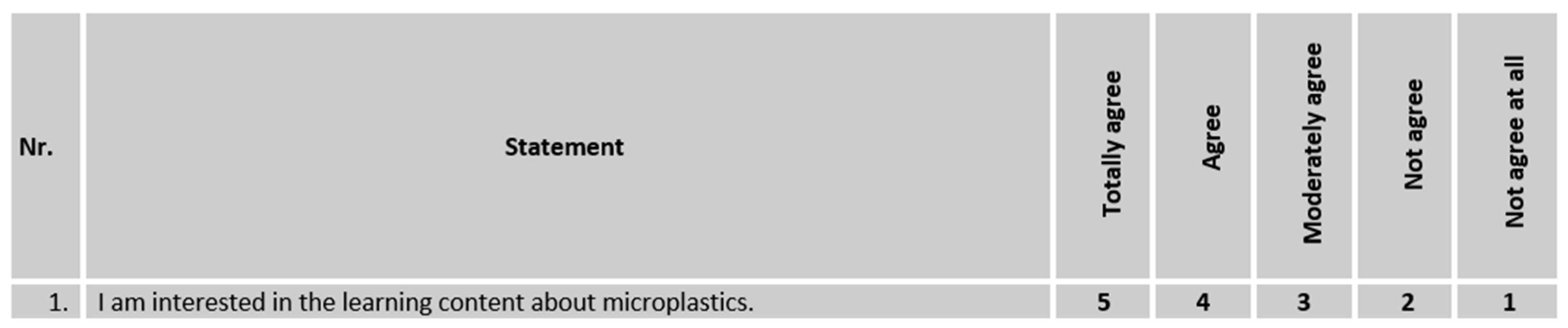
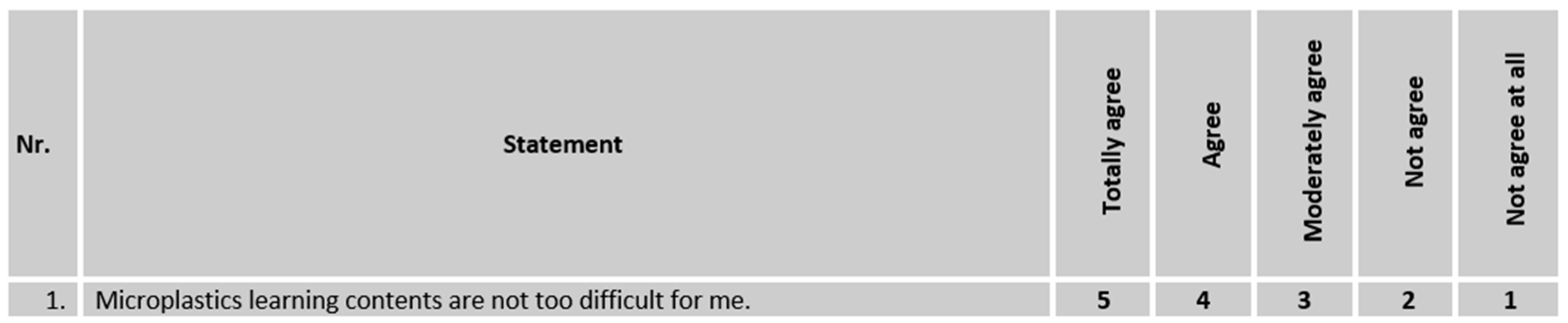
The questionnaire assessing individual interest (Figure 2) and self-esteem (Figure 3) related to microplastics comprised 16 items. Participants rated their agreement with each statement using a 5-point Likert-type scale. The self-esteem subscale included 4 items, with responses ranging from 1 (completely disagree) to 5 (completely agree), including intermediate points: 2 (disagree), 3 (moderately agree), and 4 (agree).
Cronbach’s alpha was computed for both instruments. Following Pallant (2016) [56], alpha values of 0.70 or higher are considered acceptable. In this study, the individual interest scale had a Cronbach’s alpha of 0.89, while the self-esteem scale scored 0.77, indicating satisfactory reliability. The validity of the instruments was established during their development [55].

2.3. Research Design

Students’ performance on the 4t-MPAT was calculated based on their scores in the first and third tiers. One was awarded for each correct answer, with an incorrect answer receiving zero points. Therefore, the maximum possible score on the 4t-MPAT was 16, and the average percentage of points achieved was calculated. Gilbert’s (1977) [57] knowledge level scale was used to assess the students’ level of knowledge about microplastics (Table 1).
Students’ levels of individual interest and self-esteem were determined based on their responses to the respective questionnaire items. Scores were assigned as follows: 1 point for completely disagree, 2 for disagree, 3 for somewhat agree, 4 for agree, and 5 for strongly agree. This scoring allowed a maximum of 55 points for the Individual Interest scale and 20 points for the Self-Esteem scale, with higher scores reflecting greater interest or self-esteem related to learning about microplastics. Participants were then categorized into three groups based on their total scores in each scale (Table 2).
The Individual Interest scale had a maximum possible score of 55 points. Students’ average score (M) was 26.7, with a standard deviation (SD) of 8.3. Based on these scores, participants were divided into three groups (Table 2). For the Self-Esteem scale, the mean score was 11.0, with an SD of 3.4, and students were similarly categorized into three groups (Table 2).
To identify students’ misconceptions about microplastics, the classification system developed by Kaltakci Gurel et al. (2015) [58] was applied. Misconceptions were assessed using both the correctness of responses in the first and third tiers and the confidence ratings from the second and fourth tiers (Table 3).
The proportion of misconceptions regarding microplastics was determined for each task based on students’ responses. These percentages were then categorized into three levels: high, moderate, and low (Table 4).

2.4. Data Analysis

Data from the 4t-MPAT and the questionnaire on individual interest and self-esteem were entered into Excel for processing and analyzed using IBM SPSS Statistics 29.0.2.0. The internal consistency and reliability of the instruments were evaluated using Cronbach’s alpha, which measures the extent to which items within a scale are correlated and consistently assess the intended construct. The Kolmogorov–Smirnov test was applied to examine the distribution of the data. Results indicated that 4t-MPAT scores were not normally distributed, whereas data from the questionnaire followed a normal distribution. Consequently, non-parametric tests (Mann–Whitney and Kruskal–Wallis) were employed to assess statistically significant differences in students’ performance on the 4t-MPAT, while independent-sample t-tests were used to analyze gender differences in individual interest and self-esteem related to learning about microplastics. Levene’s test was applied to check the homogeneity of variances, and, where necessary, an approximate t-test was conducted. For the Kruskal–Wallis test, post hoc multiple comparisons were performed. Statistical significance was set at p < 0.05. Descriptive statistics, including the median and interquartile range, were calculated to describe central tendency and variability, and effect sizes were reported for statistically significant differences.

3. Results and Discussions

Results are presented according to research questions.

3.1. RQ1: Students’ Knowledge About Microplastics

The first research question dealt with students’ achievements at the microplastics achievement test. Results indicate that students scored an average score of 6.3 points (SD = 2.1) out of 16 possible points at 4t-MPAT. This corresponds to 39.3% of the total score, which is below the 50% passing threshold established in the Slovenian school system. According to Gilbert’s (1977) [57] knowledge level scale, these results indicate an inadequate level of knowledge regarding the topic of microplastics. This finding is consistent with the fact that the topic of microplastics is not included in the Slovenian science curriculums [18]. The results further support the argument by Janouškova et al. (2020) [12] that schools are lagging behind in educating students about environmental issues. These findings are aligned with previous studies, such as those by Janouškova et al. (2020) [12] and Raab & Bogner (2021) [23], which also reported only partial knowledge of microplastics among students. However, it is important to note that different studies employ varying knowledge assessment scales, which may lead to minor discrepancies in results. Additionally, when compared to previous research on other environmental topics, such as atmospheric pollution [20] and lithosphere/pedosphere pollution [26], Slovenian students performed slightly better on topics unrelated to microplastics. This suggests that environmental education may not be sufficiently addressing emerging issues such as microplastic pollution.

3.2. RQ2: Students’ Misconceptions About Microplastics

The analysis of the four-tier multiple choice test designed to identify students’ misconceptions revealed that students hold misconceptions regarding the topic of microplastics (Table 5).
As shown in Table 5, the percentage of misconceptions was generally low across the tasks in the four-tier achievement test on the topic of microplastics. This low percentage may be explained by the fact that the topic of microplastics is not yet integrated into the Slovenian curriculum. Consequently, students lack prior knowledge about this topic. Their unfamiliarity may have prevented the formation of misconceptions, as misconceptions typically arise from misleading explanations and oversimplified concepts [48]. A higher percentage of misconceptions was observed in task 4, 5 and 8. One possible explanation for the increased number of misconceptions in task 4 is that it included a picture. Students may have had difficulty interpreting and analyzing the visual evidence, as they often struggle to derive meaning from graphical presentations [52]. The same reasoning applies to task 8, which also contained an image illustrating the process of secondary microplastics formation. In task 5, students were asked to identify which among the following: animals, plastic, plants, buildings and infrastructure, accounts for the largest share of the planet’s total mass. A plausible explanation for the higher proportion of misconceptions in this task is that widespread discussion about excessive microplastic pollution may have distorted students’ perceptions of other forms of anthropogenic pollution. Nonetheless, according to Pratama et al. (2021) [59], the total percentage of misconceptions in the three tasks is still comparatively low.

3.3. RQ3: Male and Female Students’ Knowledge on Microplastics

The second research question addresses the statistically significant differences between female and male students in their achievements on the microplastics test. Regarding gender differences, the Mann–Whitney test revealed no statistically significant difference between male (Md = 6.0; IQR = 5.0–8.0; N = 147) and female students (Md = 6.0; IQR = 5.0–8.0; N = 127) in their performance on the 4t-MPAT (U = 8360.0; p = 0.132). According to the reviewed literature, no previous studies have examined gender differences in knowledge about microplastics. However, several studies in the broader field of environmental education have reported gender related differences in environmental knowledge and attitudes [21,22]. Given that microplastics represent a specific and emerging topic within environmental education, the present findings suggest that gender may not be a major factor influencing students’ knowledge in this area. Therefore, the absence of statistically significant differences between male and female students is noteworthy.

3.4. RQ4: Students’ Individual Interest and Self-Esteem and Their Knowledge on Microplastics

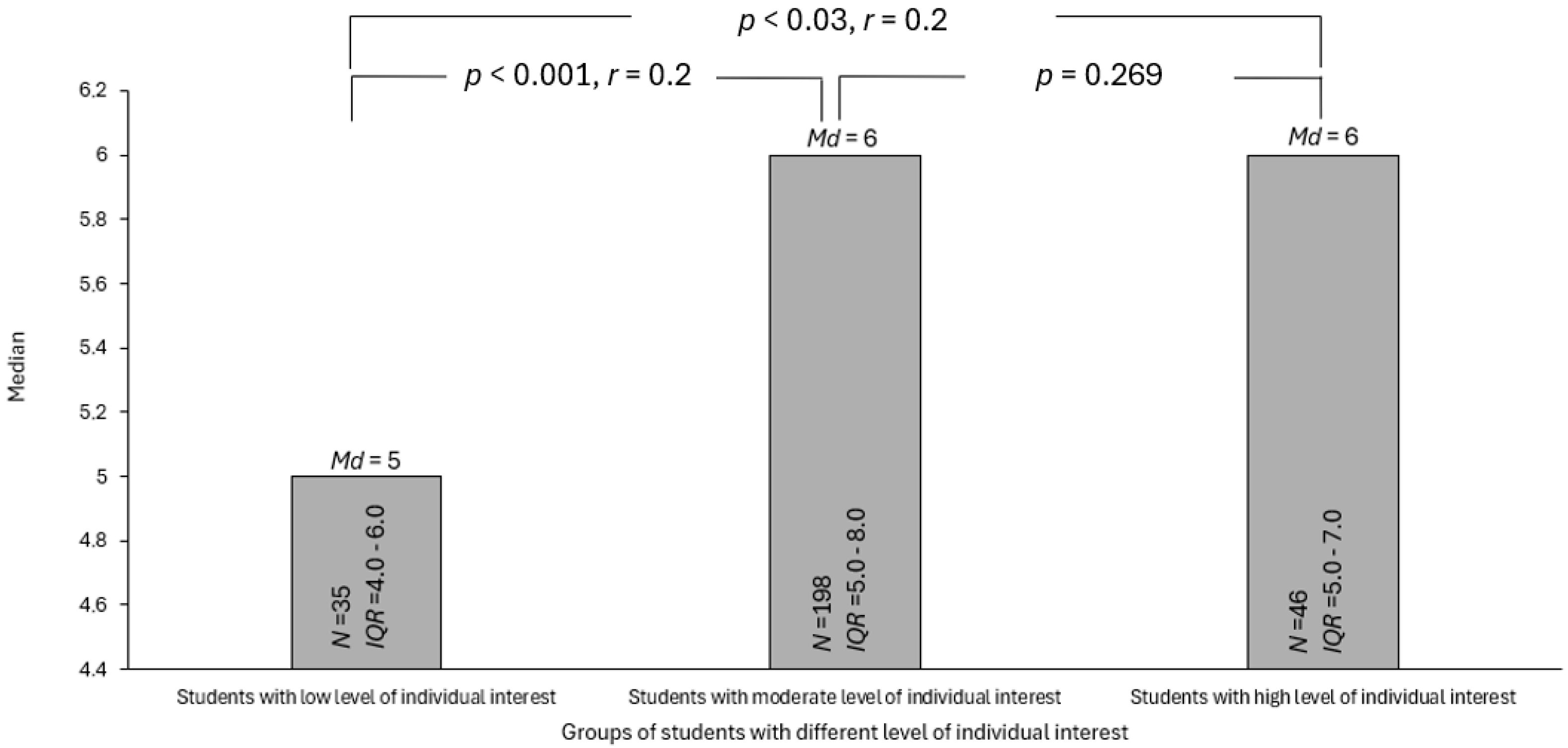
The next research question examined whether students with varying levels of individual interest and self-esteem differed significantly in their performance on the microplastics test. Individual interest in learning about microplastics was identified as a significant factor affecting student achievement. The Kruskal–Wallis test indicated statistically significant differences among students with different levels of individual interest (Gp1, N = 35: < 17.7 points; Gp2, N = 198: 16.80–34.3 points; Gp3, N = 46: > 34.3 points) in their performance on the 4t-MPAT (H = 11.2; p = 0.004), with students’ exhibiting higher interest achieving higher scores. Post hoc analysis indicated significant differences between groups with varying levels of individual interest. Specifically, students with a moderate level of individual interest scored significantly higher than those with a low level of interest in learning about microplastics (Figure 4).
While previous research has not specifically explored the relationship between students’ individual interest and their learning outcomes regarding microplastics, the results of this study are consistent with broader findings on the impact of individual interest in science education. Prior studies have shown that individual interest significantly affects students’ academic performance in science. For instance, Boukayoua et al. (2021) [32] and Alhadabi (2021) [33] found that students with higher levels of interest in science subjects generally achieve better results and demonstrate greater engagement in learning activities. Similarly, Rotgans and Schmid (2017) [29], emphasized that students who are personally invested in a topic are more likely to develop deeper conceptual understanding and acquire more comprehensive knowledge of the subject matter.
Although these studies primarily addressed general science topics, the underlying principle remains applicable to the present research on microplastics. The positive association between individual interest and students’ learning achievements observed in this study may mirror patterns identified in other areas of science education. Consequently, it can be inferred that fostering individual interest in environmental topics such as microplastics could enhance students’ learning outcomes, thereby aligning with the broader body of evidence in science education research.
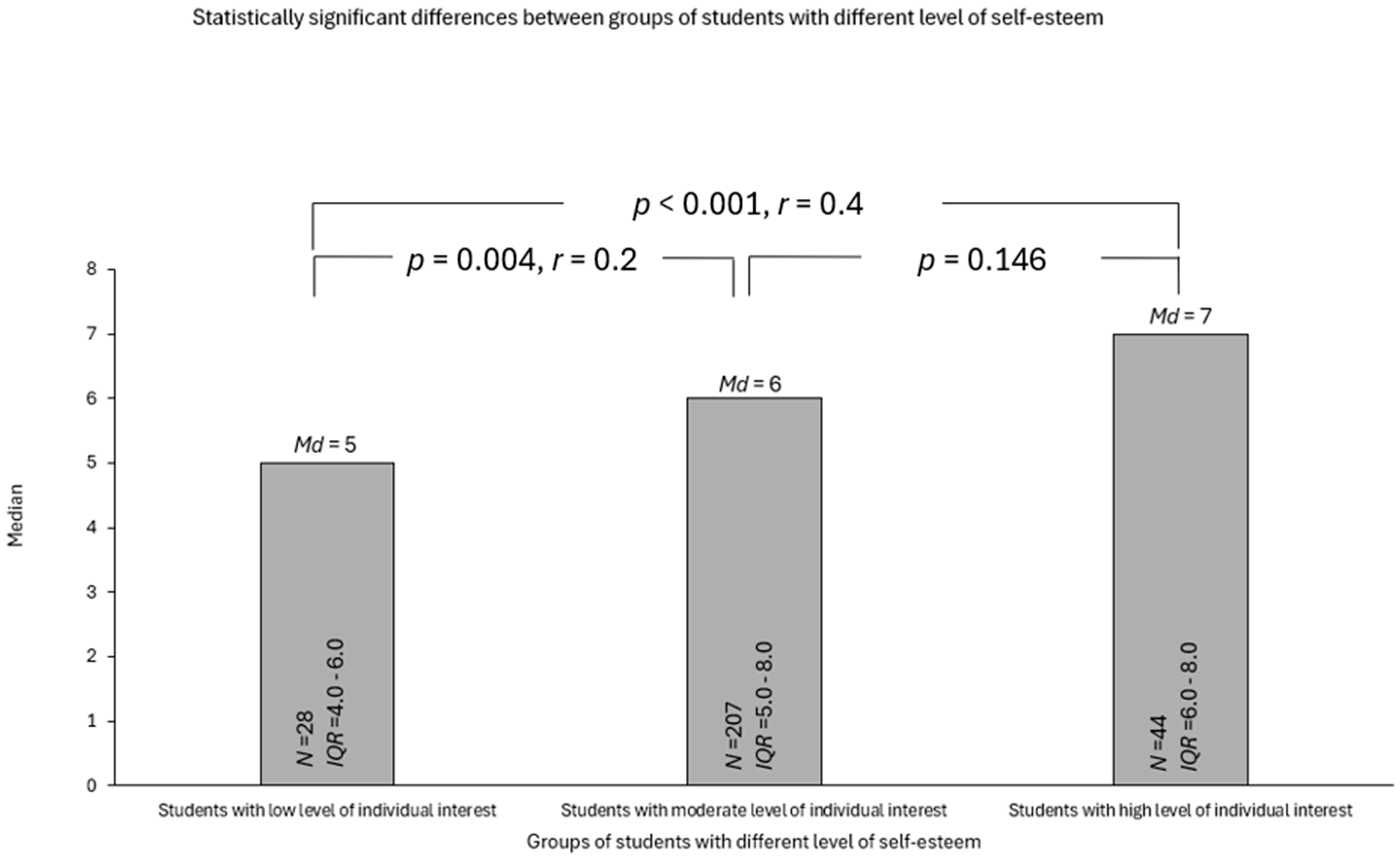
Similarly, self-esteem was found to influence students’ knowledge acquisition. The Kruskal–Wallis test showed significant differences in performance among students with different levels of self-esteem (Gp1, N = 28: >7.6 points; Gp2, N = 207: 7.6–14.4 points; Gp3, N = 44: <14.4 points) in learning about microplastics (H = 11.8; p = 0.003). A Mann–Whitney post hoc test was then conducted to examine pairwise comparisons, revealing statistically significant differences between students with high versus low self-esteem and between those with moderate versus low self-esteem in their performance on the microplastics test (Figure 5).
These findings are consistent with those reported by Rosenberg et al. (1995) [39], Bailey & Phillips (2003) [40] and Peixoto & Almeida (2010) [41]. However, they contradict the results of Zuffiano et al. (2013) [42], who found that self-esteem was not a significant predictor of student achievement. It is important to note that these earlier studies were not conducted within the domains of science learning or environmental education, which encompass topics such as microplastics. In contrast, research focusing specifically on science and environmental education suggests that self-esteem plays a more prominent role in students’ academic performance in these areas. When comparing the results of the present study with similar research in these fields, the findings align with those of Abdulghani et al. (2020) [44] and Miriam Mamah et al. (2022) [47], who identified self-esteem as a key factor influencing students’ academic success. Nevertheless, the results differ from those of Sahranavard & Hassan (2012) [46], whose findings indicated that self-esteem does not affect students’ science performance. The inconsistency across studies may stem from differences in the specific topics investigated or the age groups of participants. Moreover, it is plausible that the influence of self-esteem on learning outcomes is more pronounced in science and environmental education contexts, where student engagement and personal connection to the subject matter play a more substantial role.

3.5. RQ5: Students Gender and Their Individual Interest and Self-Esteem for Learning the Topic of Microplastics

The fourth research question examined whether there were statistically significant differences between female and male students in their individual interest and self-esteem related to learning about microplastics. An independent samples t-test indicated that male students (Md = 28.0; SD = 3.2; N = 147) reported slightly higher levels of individual interest than female students (Md = 25.0; SD = 2.9; N = 127). The difference between male and female students in their individual interest in learning about microplastics was statistically significant (t = 2.2; df = 272; p = 0.03). However. the magnitude of this difference was small (mean difference = 2.1, 95%; η2 = 0.02). These findings contrast with those of Laine (2020) [37], who reported no significant gender differences in individual interest. Despite the small effect size [60], the present results suggest that gender may play a minor role in shaping students’ interest in learning about microplastics, which is consistent with the finding of Alexander et al. (2012) [36] and Evans et al. (2002) [35], where both studies confirmed that gender can have a significant impact on students individual interest for science learning and can be recognized as situational factor.
In addition, students’ self-esteem scores related to learning about microplastics were analyzed by gender. An independent-samples t-test compared male students (Md = 28.0; IQR = 22.0–33.0; N = 147) with female students (Md = 25.0; IQR = 8.2; N = 127). The analysis revealed no statistically significant difference between males and females on the self-esteem measure (t = 1.6; p = 0.11). These results align with those of Miriam Mamah et al. (2022) [47], who found that gender did not significantly influence students’ self-esteem in science learning. However, they differ from the findings of Naderi et al. (2009) [43], which suggested a gender-based difference in self-esteem; this discrepancy may be due to the fact that Naderi et al.’s study was not conducted specifically in the context of science education.

3.6. RQ6: Students’ Final Grades and Their Knowledge on Microplastics

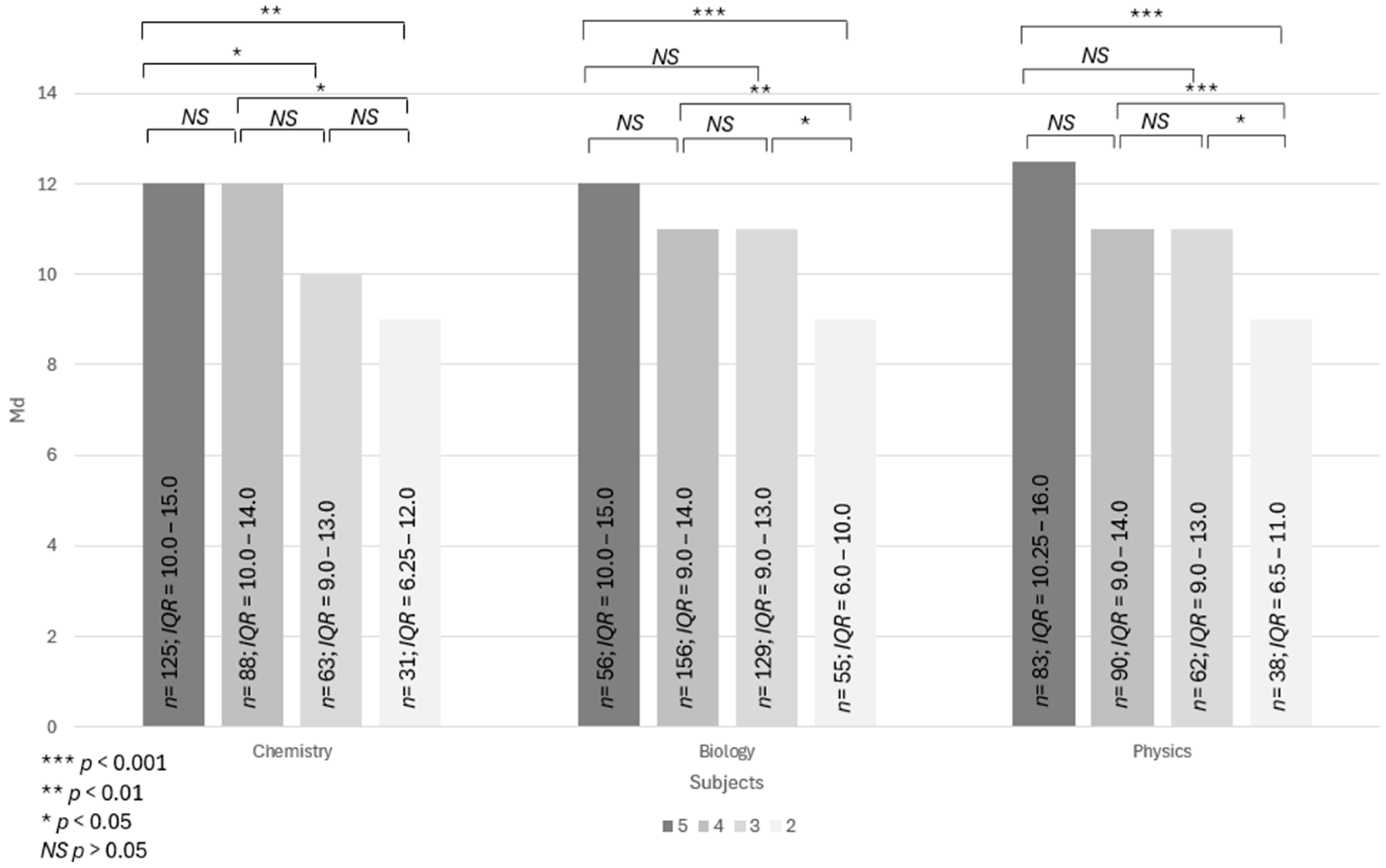
The results addressing the final research question examined whether students’ achievements on the microplastics test differed according to their final grades in biology, chemistry, and physics from 8th grade. The Kruskal–Wallis test revealed statistically significant differences in performance across groups with varying grades in biology (H = 18.5; p < 0.001), chemistry (H = 10.3; p = 0.02), and physics (H = 18.2; p < 0.001). To explore pairwise differences between the groups, a Mann–Whitney post hoc test was subsequently performed (Figure 6).
These results indicate that students’ final grades in biology, chemistry and physics significantly influenced their knowledge on the topic of microplastics, as this topic is partly related to the content covered in these subjects [12]. However, the science curriculum for grades 6 and 7 (11- and 12-year-old students) in the Slovenian school system introduces environmental topics and human-induced environmental problems [18]. More specifically, the topic of microplastics is not explicitly included in the curriculum content for general science, chemistry, biology and physics, rather, its inclusion depends on teachers’ individual decision to address microplastics as a consequence of plastic waste accumulation on land and water. Thus, it is noteworthy that students’ final grades in these subjects emerged as a significant factor influencing their performance on the microplastics achievement test. This effect was particularly evident in comparisons between high-achieving students (final grades of excellent or very good) and low-achieving students (final grade of sufficient). Additionally, the Kruskal–Wallis test was used to examine whether students’ levels of individual interest differed according to their final grades. That analysis revealed statistically significant differences in chemistry (p = 0.004; H = 13.3), biology (p = 0.019; H = 9.9) and physics (p = 0.005; H = 12.8). These findings suggest that high-achieving students tend to show greater interest in science topics, engage more deeply with the content and consequently broader environmental knowledge, including a higher level of understanding of microplastics.

4. Conclusions

The results showed that students did not reach the threshold for a positive evaluation in the Slovenian school system (50% of total points), indicating that their knowledge about microplastics is generally inadequate. This low level of knowledge is likely due to the absence of microplastics-related content in the Slovenian national curriculum. The 4-tier test for detecting misconceptions showed that Slovenian lower-secondary school students possess very few misconceptions about the topic of microplastics. This low level of misconceptions may be explained by the absence of this topic in the Slovenian curriculum. Because the topic is not included, students have not been exposed to it and therefore have not had the opportunity to develop misconceptions about it. Students’ performance on the test was not influenced by gender, as no statistically significant differences were found between male and female students in their achievement on the microplastics test. Individual interest and self-esteem emerged as important factors influencing students’ knowledge of microplastics. Students with higher levels of individual interest or self-esteem performed significantly better than those with lower levels of these characteristics. Gender was found to significantly influence individual interest but not self-esteem; however, the magnitude of this difference was small, suggesting that gender does not play a major role in shaping these factors. When students’ performance on the microplastics achievement tests was compared with their final grades, it was found that grades in all three subjects (biology, chemistry and physics) had a significant impact on their knowledge of microplastics. These subjects naturally integrate scientific and environmental content, which conceptually relates to the topic of microplastics. Nevertheless, because the topic of microplastics is not explicitly included in the curriculum for these subjects, it can be inferred that students with stronger science backgrounds also possess greater general environmental awareness and may obtain additional information from informal or non-formal learning sources. Furthermore, a comparison between students’ individual interest and their final grades in biology, chemistry and physics revealed that high-achieving students demonstrated significantly higher levels of individual interest. This suggest that these students are more engaged with science topics, study them in greater depth and consequently achieve broader understanding of environmental issues such as microplastics. These results underscores the need to include the topic of microplastics in Slovenian lower secondary education, even though it is not currently specified in the curriculum. Students should understand where microplastics are found, how pervasive and hidden this form of pollution is, what causes it, and why it represents an important global issue. There are numerous opportunities to integrate this topic across school subjects if teachers recognize its relevance. Although it is not explicitly included in the learning objectives, it can be addressed through related content. For example, in chemistry, students could perform experiments such as filtering microplastics from water or observing synthetic fibers under a microscope. In biology, they could examine how microplastics accumulate in the food chain and affect animal and human health. In geography, they could explore case studies of environmental threats caused by microplastics across different regions and oceans. Teachers should also use real-world examples to help students understand that proper waste separation and the use of sustainable materials (such as glass, wood, metal, and cotton) are not simply fashionable trends but essential practices with growing importance for the future sustainability. Encouraging interdisciplinary approaches allow students to see the connections between everyday behaviors and global environmental sequences. Finally, the way in which this topic is introduced is crucial for maintaining students’ individual interest and self-esteem. By integrating microplastics education through engaging, cross-curricular, and inquiry-based approaches, educators can foster both environmental awareness and personal motivation, empowering students to think critically and act responsibly toward a more sustainable future.

4.1. Limitations and Future Research

Efforts were made to ensure objectivity throughout the various phases of this investigation. However, several limitations should be acknowledged. First, the participants were not randomly selected from the accessible population and achieving a sample size sufficient for generalization to all 9th grade students was challenging. Data collection took place in regular classroom during standard class time, which likely provided similar environmental conditions across participants, yet it is difficult to guarantee that all participants were fully engaged and took the study seriously. Additionally, the study was limited by the absence of information regarding students’ knowledge of other environmental topics. Finally, the selection of appropriate questions for the assessment may also be considered a limitation, as determining which content to emphasize for a specific topic at a given student age is inherently subjective and represents a common challenge for educators.

4.2. Guidelines for Further Research

This study also raises many questions, highlighting the need for further research. Comprehensive investigations are required to evaluate the quality of environmental education in Slovenia schools and to determine the extent to which teachers address topics such as microplastics with their students. Additionally, integrating environmental topics, including microplastics, into university programs for pre-service teachers’ is essential to maximize the effectiveness of environmental education and support progress toward sustainable development. Investing in the professional development of both pre-service and in-service teachers is crucial. Universities should provide targeted courses within teacher education programs, while continuous professional development initiatives should be accessible to practicing teachers. Such efforts are likely to play pivotal role in fostering environmental awareness among students and advancing the broader goal of a more sustainable future.

Author Contributions

Conceptualization, I.D., I.H. and L.R.; methodology, L.R.; validation, L.R.; formal analysis, L.R.; investigation, I.D., I.H. and L.R.; resources, I.D.; data curation, I.H.; writing—original draft preparation, L.R.; writing—review and editing, I.D. and I.H.; visualization, I.D.; supervision, I.H.; project administration, I.D.; funding acquisition, I.D. All authors have read and agreed to the published version of the manuscript.

Funding

This research received no external funding.

Institutional Review Board Statement

The study was conducted in accordance with the Declaration of Helsinki and was reviewed and approved by the Ethics Commission of the Faculty of Education of the University of Ljubljana. Approval code 4/2024, on 26 January 2024.

Informed Consent Statement

Informed consent was obtained from all subjects involved in the study. Participation was voluntary and anonymous.

Data Availability Statement

The data used in this study are available from the corresponding authors upon reasonable request.

Acknowledgments

ULTRA University of Ljubljana for a Sustainable Society, co-financed by Republic of Slovenia, the Ministry of Education, Science and Sport and the European Union—NextGenerationEU.

Conflicts of Interest

The authors declare no conflicts of interest.

References

  1. Zárate Rueda, R.; Beltrán Villamizar, Y.I.; Becerra Ardila, L.E. A Retrospective Approach to Pro-Environmental Behavior from Environmental Education: An Alternative from Sustainable Development. Sustainability 2023, 15, 5291. [Google Scholar] [CrossRef]
  2. Hanisch, S.; Eirdosh, D. Behavioral Science and Education for Sustainable Development: Towards Metacognitive Competency. Sustainability 2023, 15, 7413. [Google Scholar] [CrossRef]
  3. Bradač Hojnik, B. Integrating Playful Learning to Enhance Education for Sustainability: Case Study of a Business School in Slovenia. Sustainability 2024, 16, 9953. [Google Scholar] [CrossRef]
  4. Ardila Echeverry, M.P.; Gauthier, A.; Hartikainen, H.; Vasalou, A. Designing for Digital Education Futures: Design Thinking for Fostering Higher Education Students’ Sustainability Competencies. Sustainability 2025, 17, 4289. [Google Scholar] [CrossRef]
  5. Ma, L.; Shahbaz, P.; Haq, S.u.; Boz, I. Exploring the Moderating Role of Environmental Education in Promoting a Clean Environment. Sustainability 2023, 15, 8127. [Google Scholar] [CrossRef]
  6. Hajj-Hassan, M.; Chaker, R.; Cederqvist, A.M. Environmental Education: A Systematic Review on the Use of Digital Tools for Fostering Sustainability Awareness. Sustainability 2024, 16, 3733. [Google Scholar] [CrossRef]
  7. Dittrich, L.; Aagaard, T.; Wiig, A.C. Highlighting Practices and Dialogic Moves: Investigating Simulation-Based Learning in Online Teacher Education. Learn. Cult. Soc. Interact. 2025, 51, 100889. [Google Scholar] [CrossRef]
  8. Zhang, K.; Hamidian, A.H.; Tubić, A.; Zhang, Y.; Fang, J.K.H.; Wu, C.; Lam, P.K.S. Understanding Plastic Degradation and Microplastic Formation in the Environment: A Review. Environ. Pollut. 2021, 274, 116554. [Google Scholar] [CrossRef]
  9. Henderson, L.; Green, C. Making Sense of Microplastics? Public Understandings of Plastic Pollution. Mar. Pollut. Bull. 2020, 152, 110908. [Google Scholar] [CrossRef]
  10. Lee, M.; Yang, J.E.; Kim, H.; Moon, J.; Ryu, H.S.; Lee, J.Y. Effective Environmental Education for Sustainable Development beyond the Plastic Age in South Korea. Environ. Educ. Res. 2023, 29, 1328–1345. [Google Scholar] [CrossRef]
  11. Walker, T.R. (Micro)Plastics and the UN Sustainable Development Goals. Curr. Opin. Green Sustain. Chem. 2021, 30, 100497. [Google Scholar] [CrossRef]
  12. Janouškova, S.; Teplý, P.; Fatka, D.; Teplá, M.; Cajthaml, T.; Hák, T. Microplastics—How and What Do University Students Know about the Emerging Environmental Sustainability Issue? Sustainability 2020, 12, 9220. [Google Scholar] [CrossRef]
  13. Sukma, E.; Ramadhan, S.; Indriyani, V. Integration of Environmental Education in Elementary Schools. J. Phys. Conf. Ser. 2020, 1481, 012136. [Google Scholar] [CrossRef]
  14. Torkar, G.; Debevec, V.; Johnson, B.; Manoli, C. Assessing Children’s Environmental Worldviews and Concerns. CEPS J. 2021, 11, 49–65. [Google Scholar] [CrossRef]
  15. Spork, H. Environmental Education: A Mismatch Between Theory and Practice. Aust. J. Environ. Educ. 1992, 8, 147–166. [Google Scholar] [CrossRef]
  16. Cutter-Mackenzie, A.; Smith, R. Ecological Literacy: The ‘Missing Paradigm’ in Environmental Education (Part One). Environ. Educ. Res. 2003, 9, 497–524. [Google Scholar] [CrossRef]
  17. Šorgo, A.; Kamenšek, A. Implementation of a Curriculum for Environmental Education as Education for Sustainable Development in Slovenian Upper Secondary Schools. Energy Educ. Sci. Technol. Part B Soc. Educ. Stud. 2012, 4, 1067–1076. [Google Scholar]
  18. Government of Slovenia. Predmetnik za Osnovno šolo [Curriculum for Elementary School]; Ministry of Education, Science, and Sport: Ljubljana, Slovenia, 2023. Available online: https://www.gov.si/assets/ministrstva/MVI/Dokumenti/Osnovna-sola/Ucni-nacrti/Predmetnik-OS/Predmetnik-za-osnovno-solo.pdf (accessed on 11 November 2024).
  19. Ribič, L.; Devetak, I.; Vošnjak, M. Students’ Understanding of Lithosphere and Pedosphere Concepts at the End of Lower Secondary School in Slovenia. Int. Res. Geogr. Environ. Educ. 2024, 1–18. [Google Scholar] [CrossRef]
  20. Majer, J.; Slapničar, M.; Devetak, I. Assessment of the 14- And 15-Year-Old Students’ Understanding of the Atmospheric Phenomena. Acta Chim. Slov. 2019, 66, 659–667. [Google Scholar] [CrossRef]
  21. Abd Wahab, A.; Mapa, M.T. Profil Literasi Alam Sekitar: Perspektif Pelajar Sekolah Menengah Di Tawau, Sabah. Malaysian J. Soc. Space. 2020, 16, 62–79. [Google Scholar] [CrossRef]
  22. Örs, M. A Measurement of the Environmental Literacy of Nursing Students for a Sustainable Environment. Sustainability 2022, 14, 11003. [Google Scholar] [CrossRef]
  23. Raab, P.; Bogner, F.X. Conceptions of University Students on Microplastics in Germany. PLoS ONE 2021, 16, e0257734. [Google Scholar] [CrossRef] [PubMed]
  24. Oleksiuk, K.; Krupa-Kotara, K.; Wypych-Ślusarska, A.; Głogowska-Ligus, J.; Spychała, A.; Słowiński, J. Microplastic in Food and Water: Current Knowledge and Awareness of Consumers. Nutrient 2022, 14, 4857. [Google Scholar] [CrossRef] [PubMed]
  25. Rowe, L.; Kubalewski, M.; Clark, R.; Statza, E.; Goyne, T.; Leach, K.; Peller, J. Detecting Microplastics in Soil and Sediment in an Undergraduate Environmental Chemistry Laboratory Experiment That Promotes Skill Building and Encourages Environmental Awareness. J. Chem. Educ. 2019, 96, 323–328. [Google Scholar] [CrossRef]
  26. Ribič, L.; Devetak, I.; Slapničar, M. Assessing 15-Year-Olds’ Understanding of Chemical Concepts in the Context of the Lithosphere and Pedosphere. Acta Chim. Slov. 2024, 71, 84–90. [Google Scholar] [CrossRef]
  27. Hidi, S.; Renninger, K.A.; Krapp, A. Interest, A Motivational Variable That Combines Affective and Cognitive Functioning. In Motivation, Emotion, And Cognition: Integrative Perspectives on Intellectual Functioning and Development; Routledge: Oxfordshire, UK, 2004. [Google Scholar]
  28. Krapp, A. Entwicklung Und Förderung von Interessen Im Unterricht. Psychol. Erzieh. Unterr. 1998, 45, 186–203. [Google Scholar]
  29. Rotgans, J.I.; Schmidt, H.G. The Relation between Individual Interest and Knowledge Acquisition. Br. Educ. Res. J. 2017, 43, 350–371. [Google Scholar] [CrossRef]
  30. Roure, C.; Lentillon-Kaestner, V.; Pasco, D. Students’ Individual Interest in Physical Education: Development and Validation of a Questionnaire. Scand. J. Psychol. 2021, 62, 64–73. [Google Scholar] [CrossRef]
  31. Hidi, S.; Ann Renninger, K. The Four-Phase Model of Interest Development. Educ. Psychol. 2006, 41, 111–127. [Google Scholar] [CrossRef]
  32. Boukayoua, Z.; Kaddari, F.; Bennis, N. Students’ Interest in Science Learning and Measurement Practices. Questions for Research in the Moroccan School Context. SHS Web Conf. 2021, 119, 05006. [Google Scholar] [CrossRef]
  33. Alhadabi, A. Science Interest, Utility, Self-Efficacy, Identity, and Science Achievement Among High School Students: An Application of SEM Tree. Front. Psychol. 2021, 12, 634120. [Google Scholar] [CrossRef]
  34. Uitto, A.; Juuti, K.; Lavonen, J.; Byman, R.; Meisalo, V. Secondary School Students’ Interests, Attitudes and Values Concerning School Science Related to Environmental Issues in Finland. Environ. Educ. Res. 2011, 17, 167–186. [Google Scholar] [CrossRef]
  35. Evans, M.E.; Schweingruber, H.; Stevenson, H.W. Gender differences in interest and knowledge acquisition: The United States, Taiwan and Japan. Sex Roles 2002, 47, 153–167. [Google Scholar] [CrossRef]
  36. Alexander, J.M.; Johnson, K.E.; Kelley, K. Longitudinal analysis of the relations between opportunities to learn about science and the development of interests related to science. Sci. Educ. 2012, 96, 763–786. [Google Scholar] [CrossRef]
  37. Laine, E.; Veermans, M.; Gegenfurtner, A.; Veermans, K. Individual Interest and Learning in Secondary School Stem Education. Frontline Learn. Res. 2020, 8, 90–108. [Google Scholar] [CrossRef]
  38. Cast, A.D.; Burke, P.J. A Theory of Self-Esteem. Soc. Forces 2002, 80, 1041–1068. [Google Scholar] [CrossRef]
  39. Rosenberg, M.; Schooler, C.; Schoenbach, C.; Rosenberg, F. Global Self-Esteem and Specific Self-Esteem: Different Concepts, Different Outcomes. Am. Sociol. Rev. 1995, 60, 141. [Google Scholar] [CrossRef]
  40. Bailey, T.H.; Phillips, L.J. The Influence of Motivation and Adaptation on Students’ Subjective Well-Being, Meaning in Life and Academic Performance. High. Educ. Res. Dev. 2016, 35, 201–216. [Google Scholar] [CrossRef]
  41. Peixoto, F.; Almeida, L.S. Self-Concept, Self-Esteem and Academic Achievement: Strategies for Maintaining Self-Esteem in Students Experiencing Academic Failure. Eur. J. Psychol. Educ. 2010, 25, 157–175. [Google Scholar] [CrossRef]
  42. Zuffiano, A.; Alessandri, G.; Gerbino, M.; Luengo Kanacri, B.P.; Di Giunta, L.; Milioni, M.; Caprara, G.V. Academic Achievement: The Unique Contribution of Self-Efficacy Beliefs in Self-Regulated Learning beyond Intelligence, Personality Traits, and Self-Esteem. Learn. Individ. Differ. 2013, 23, 158–162. [Google Scholar] [CrossRef]
  43. Naderi, H.; Abdullah, R.; Hamid, T.A.; Jamaluddin, S.; Aizan, H.T.; Sharir, J.; Kumar, V. Self Esteem, Gender and Academic Achievement of Undergraduate Students. Am. J. Sci. Res. 2009, 3, 26–37. [Google Scholar]
  44. Abdulghani, A.H.; Almelhem, M.; Basmaih, G.; Alhumud, A.; Alotaibi, R.; Wali, A.; Abdulghani, H.M. Does Self-Esteem Lead to High Achievement of the Science College’s Students? A Study from the Six Health Science Colleges. Saudi J. Biol. Sci. 2020, 27, 636–642. [Google Scholar] [CrossRef]
  45. Rubin, R.A.; Dorle, J.; Sandige, S. Self-esteem and school performance. Psychol. Sch. 1977, 14, 503–507. [Google Scholar] [CrossRef]
  46. Sahranavard, M.; Hassan, S.A. The Relationship Betweenself-Concept, Self-Efficacy, Self-Esteem, Anxietyand Science Performance among Iranian Students. Middle East J. Sci. Res. 2012, 12, 1190–1196. [Google Scholar] [CrossRef]
  47. Miriam Mamah, I.; Ezugwu, I.J.; Ezeudu, F.O.; Christian, S. Self-Esteem as a Predictor of Science Students’ Academic Achievement in Enugu State, Nigeria: Implication for Educational Foundations. Webology 2022, 19, 3. [Google Scholar]
  48. Dolenc-Orbanič, N.; Batteli, C. With appropriate approaches to transforming alternative concepts. Vodenje Vzgoji Izobr. 2011, 13, 25–37. [Google Scholar]
  49. Helm, H. Misconceptions in physics amongst South African students. Phys. Educ. 1980, 15, 92–105. [Google Scholar] [CrossRef]
  50. Borghini, A.; Pieraccioni, F.; Bastiani, L.; Bonaccorsi, E.; Gioncada, A. Geoscience Knowledge at the End of Upper-Secondary School in Italy. Rev. Sci. Math. ICT Educ. 2019, 16, 77–103. [Google Scholar]
  51. Fertika Putri, C.; Sutiarso, S.; Koestoro, B.; Fertika, C. Student Difficulties Based on Literacy Skills and Interpreting Social Problems or Mathematical Data Using Graphs. IOSR J. Math. 2018, 14, 7–10. [Google Scholar] [CrossRef]
  52. Dove, J.E. Students’ Alternative Conceptions in Earth Science: A Review of Research and Implications for Teaching and Learning. Res. Pap. Educ. 1998, 13, 183–201. [Google Scholar] [CrossRef]
  53. Torres, H.R.; Reynolds, C.J.; Lewis, A.; Muller-Karger, F.; Alsharif, K.; Mastenbrook, K. Examining Youth Perceptions and Social Contexts of Litter to Improve Marine Debris Environmental Education. Environ. Educ. Res. 2019, 25, 1400–1415. [Google Scholar] [CrossRef]
  54. Rudman, S.; Rudman, L. Reconfiguring the Everyday: Plastic Waste as Performance Art in Addressing the Incongruity between the ‘Talk’ and the ‘Walk’ in the Plastic Crisis. Environ. Educ. Res. 2021, 27, 1487–1501. [Google Scholar] [CrossRef]
  55. Juriševič, M.; Vogrinc, J.; Glažar, S.A. Targeted Research Project: Analysis of Factors Affecting More Permanent Knowledge Through Understanding of Natural Science and Technical Content; Faculty of Education: Ljubljana, Slovenia, 2010. [Google Scholar]
  56. Pallant, J. SPSS Survival Manual; McGraw-Hill Education: New York, NY, USA, 2016. [Google Scholar]
  57. Gilbert, J.K. The study of student misunderstandings in the physical sciences. Res. Sci. Educ. 1977, 7, 165–171. [Google Scholar] [CrossRef]
  58. Kaltakci Gurel, D.; Eryilmaz, A.; McDermott, L.C. A Review and Comparison of Diagnostic Instruments to Identify Students’ Misconceptions in Science. Eurasia J. Math. Sci. Technol. Educ. 2015, 11, 989–1008. [Google Scholar] [CrossRef]
  59. Pratama, R.; Indriyanti, D.R.; Mindyarto, B.H. Development of a Diagnostic Test for Student Misconception Detection of Coordination System Material Using Four-Tier Multiple Choice. J. Innov. Sci. Educ. 2021, 10, 251–258. [Google Scholar]
  60. Cohen, J. Statistical Power Analysis for the Behavioral Sciences, 2nd ed.; Routledge: Oxfordshire, UK, 1988. [Google Scholar]
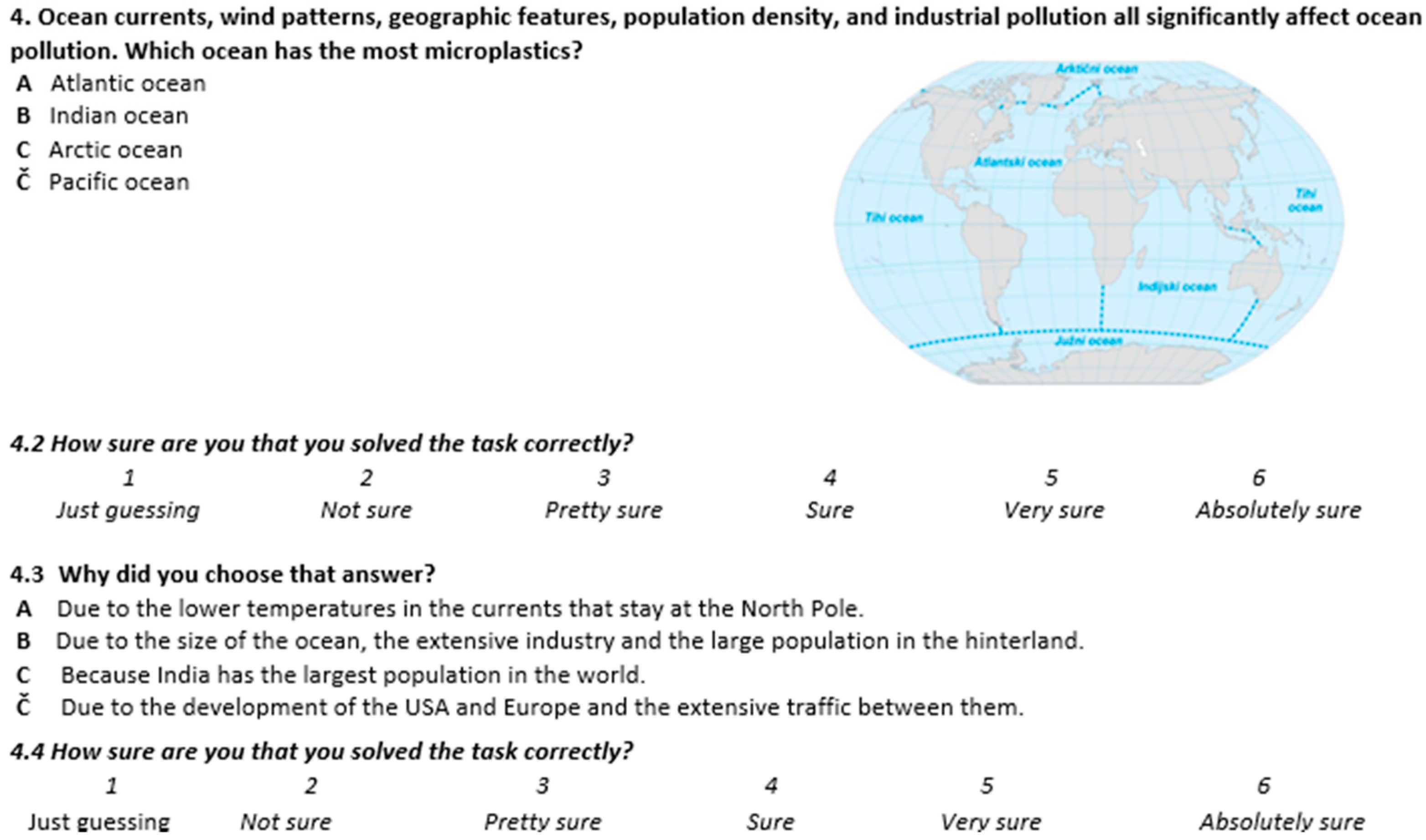
Figure 1. Example of the task from 4t-MPAT.
Sustainability 17 11139 g001
Figure 2. Example of the statement from individual interest questionnaire.
Sustainability 17 11139 g002
Figure 3. Example of the statement from the self-esteem questionnaire.
Sustainability 17 11139 g003
Figure 4. Statistically significant differences between students with different level of individual interest for learning about microplastics and their performance on 4t-MPAT.
Sustainability 17 11139 g004
Figure 5. Statistically significant differences between students with different level of self-esteem for learning about microplastics and their performance on 4t-MPAT.
Sustainability 17 11139 g005
Figure 6. Students’ final grade achievement in biology, chemistry and physics and their performance on 4t-MPAT.
Sustainability 17 11139 g006
Table 1. Knowledge level scale adopted from Gilbert (1977) [57].
Percentage of Correctly Solved TasksLevel of Knowledge
75–100%Adequate knowledge
74–50%Roughly adequate knowledge
49–25%Inadequate knowledge
24–0%Completely inadequate knowledge
Table 2. Criteria for dividing students in three groups.
Number of PointsLevel of Individual Interest/Self-Esteem
<MSDLow level of individual interest/self-esteem
<M ± SD> Middle level of individual interest/self-esteem
>M + SDHigh level of individual interest/self-esteem
<17.7Low level of individual interest (Gp1)
17.7–34.3Middle level of individual interest (Gp2)
>34.3High level of individual interest (Gp3)
<7.6Low level of self-esteem (Gp1)
7.6–14.4Middle level of self-esteem (Gp2)
>14.4High level of self-esteem (Gp3)
Table 3. Determining the level of knowledge and misconceptions with 4t-MPAT using Kaltakci Gurel et al. (2015) [58] classification.
1. Tier: Answer2. Tier: Confidence in the Answers *3. Tier: Reason4. Tier: Confidence in the Reason *Level of Knowledge About Microplastics
Correct>3Correct>3Adequate knowledge
Correct>3Wrong>3False positive knowledge
Wrong>3Correct>3False negative knowledge
Wrong>3Wrong>3Misconception
All other combinationsLack of knowledge
* Level of confidence is >3: 4—sure, 5—very sure, 6—absolutely sure.
Table 4. Incidence of misconceptions about microplastics according to Pratama et al. (2021) [59].
Percentage (%)Category
0–30Low incidence of misconceptions about microplastics
31–70Moderate incidence of misconceptions about microplastics
71–100High incidence of misconceptions about microplastics
Table 5. Percentage of each knowledge category on four-tier achievement test.
Number of the TaskTask ContentKnowledge (f, f%)Lack of Knowledge (f, f%)False Positive
(f, f%)
False Negative
(f, f%)
Misconceptions
(f, f%)
1.Consuming of microplastics8
2.9
203
72.7
2
0.7
22
7.9
16
5.8
2.Microplastics removal from water42
15.1
222
79.5
3
1.1
3
1.1
9
3.2
3.Drink water pollution with microplastics38
13.6
190
68.1
50
17.9
1
0.4
00
4.Ocean pollution with microplastics18
6.5
217
77.7
2
0.7
13
4.7
29
10.4
5.Life on land and microplastics17
6.1
212
76.0
2
0.7
4
1.4
44
15.8
6.Formation of microplastics and its impact79
28.3
177
63.5
4
1.4
12
4.3
7
2.5
7.River pollution with microplastics26
9.3
240
86.1
6
2.1
2
0.7
5
1.8
8.Formation of microplastics9
3.2
236
84.6
3
1.1
4
1.4
27
9.7
Disclaimer/Publisher’s Note: The statements, opinions and data contained in all publications are solely those of the individual author(s) and contributor(s) and not of MDPI and/or the editor(s). MDPI and/or the editor(s) disclaim responsibility for any injury to people or property resulting from any ideas, methods, instructions or products referred to in the content.