Article

Integrating Remote Sensing, GIS, and Citizen Science to Map Illegal Waste Dumping Susceptibility in Dakar, Senegal


1
Faculty of Social Sciences, University of Geneva, Bd du Pont-d’Arve 40, CH-1211 Geneva, Switzerland
2
Laboratory of Applied Geomatic (LAG), Department of Geoscience and Environment, Polytech Diamniadio, Université Amadou Mahtar Mbow, Rue 21x20, 2ème Arrondissement, Pôle Urbain de Diamniadio, Dakar 15258, Senegal
3
Société Nationale de Gestion Intégrée des Déchets (SONAGED S.A.), Cité Keur Gorgui, Immeuble Y2, Dakar 11000, Senegal
4
EnviroSPACE Laboratory, Institute for Environmental Sciences, University of Geneva, Bd Carl-Vogt 66, CH-1205 Geneva, Switzerland
5
GRID-Geneva, Institute for Environmental Sciences, University of Geneva, Bd Carl-Vogt 66, CH-1205 Geneva, Switzerland
*
Author to whom correspondence should be addressed.
These authors contributed equally to this work.
Sustainability 2025, 17(24), 11137; https://doi.org/10.3390/su172411137
Submission received: 1 November 2025 / Revised: 1 December 2025 / Accepted: 9 December 2025 / Published: 12 December 2025

Abstract

Solid waste management remains a critical challenge in rapidly urbanizing regions of the Global South, where limited infrastructure and informal disposal practices compromise environmental and public health. This study addresses the issue of illegal waste dumping in Dakar, Senegal, by integrating remote sensing, geographic information systems, and citizen science into a multi-criteria framework to identify areas most susceptible to dumping. Using Landsat 8 and Sentinel-2 imagery, indicators such as land surface temperature, vegetation, soil, and water indices were combined with demographic and infrastructural data. A citizen survey involving local university students provided social perception scores and criterion weights through the Analytic Hierarchy Process. The resulting susceptibility maps revealed that high and very high dumping probabilities are concentrated around the Mbeubeuss landfill and densely populated areas of Keur Massar, while Malika showed lower susceptibility. Sensitivity analysis confirmed the model’s robustness but highlighted the influence of thermal and social perception variables. The results show that 28–35% of the study area falls under high or very high susceptibility, with hotspots concentrated near wetlands, informal settlements, and poorly serviced road networks. The weighted model demonstrates stronger spatial coherence compared to the unweighted version, offering improved interpretability for waste monitoring. These findings provide actionable insights for the Société Nationale de Gestion Intégrée des Déchets (SONAGED) and for municipal planners to prioritize interventions in high-susceptibility zones. Rather than being entirely novel, this study builds on existing remote sensing, geographic information systems and citizen science approaches by integrating them within a multi-criteria framework specifically adapted to a West African context.

1. Introduction

1.1. Context

Solid waste management poses major challenges in the rapidly urbanizing regions of the Global South. In West Africa for example, population growth and urban expansion have increased demands on public services [1,2]. Limited infrastructure, variations in service coverage, and informal dumping are common in many cities [3,4]. Beyond the technical aspects, factors like limited resources, governance arrangements, and shifting policies influence the performance of waste management systems [5].
Dakar, the capital of Senegal, illustrates these dynamics. Since the 1970s the waste sector has repeatedly shifted between privatization and re-publicization, reflecting changing political and financial conditions [4,6]. These efforts have not produced a sustainable system, and service gaps remain. In many cases, the informal sector, especially waste pickers, helps compensate for limitations in formal services [7]. Social perceptions and gender dynamics reveal that waste management is not merely a technical or economic issue. Marginalized groups including women and other vulnerable actors are affected disproportionately. This highlights the need for participatory and socially inclusive approaches.
In Dakar, municipal solid waste generation is estimated at approximately 1200–1400 tons per day, consistent with projections from the JICA Dakar Urban Master Plan 2035 [8] which anticipate up to 2796 tons/day by 2025. However, collection services remain uneven across the metropolitan area. Studies by the International Institute for Environment and Development [9] report persistent inefficiencies in several peri-urban municipalities, including Keur Massar, Malika, and Djiddah Thiaroye, where irregular collection contributes to recurrent illegal dumping along roadsides, wetlands, and vacant parcels. Moreover, rapid demographic growth—approximately 770,000 inhabitants in Keur Massar according to the ANSD [10]—continues to outpace existing waste management infrastructure, exacerbating the accumulation of unmanaged waste.

1.2. Recent Findings

Addressing these challenges requires not only social awareness but also innovative technical approaches. In this context, researchers have increasingly relied on spatial technologies. Geographic information systems (GISs) and remote sensing are widely used in high-income contexts for tasks such as landfill siting, route optimization, and monitoring of waste flows. In sub-Saharan Africa, applications remain more limited, often focusing on landfill detection or the geolocation of informal dumping sites [11,12]. Remote sensing can detect large landfills through thermal signatures or vegetation impacts, but urban complexity and the spectral variability of waste materials limit accuracy [13,14]. Small or scattered dumpsites often escape detection, and remote sensing alone cannot distinguish legal from illegal sites, making field validation essential [15,16].
Citizen science has emerged as a complementary tool to overcome these limitations. By using mobile devices, participatory mapping, and local surveys, citizen science enables residents to contribute data in contexts where official systems are weak or absent [17,18]. Projects in Kinshasa and Indonesia focusing on waste management and urban sanitation demonstrate that citizen science can generate new spatial datasets and strengthen trust between institutions and communities [19,20]. Challenges persist, especially concerning data reliability, inclusivity, and long-term participation [21,22], but citizen science offers valuable ground-level insights that can complement the quantitative strengths of GIS and remote sensing.
For example, large-scale citizen science projects in sub-Saharan Africa report participation drop rates exceeding 40% after three months, and error rates in volunteered observations ranging from 8% to 22% depending on training level [23,24].
Unlike previous work, this study operationalizes an integrated approach based on remote sensing, GIS, citizen science and the analytical hierarchy process (AHP) specifically tailored to data-scarce West African cities, providing a framework that links local perceptions with spatial indicators.

1.3. Gaps and Research Question

While GIS and remote sensing are established tools for solid waste management, their use to anticipate illegal dumping is still limited. Most applications focus on mapping known dumpsites [25,26]. Multicriteria analysis has shown potential in high-income contexts such as Canada, Italy, and Australia, where spatial indicators including population density, infrastructure, and environmental features were combined to identify areas at risk [27,28,29]. However, these methods often exclude qualitative, community-based knowledge and have rarely been adapted to African cities. In data-scarce, informally organized contexts like Dakar, integrating local knowledge is crucial for actionable results.
This study proposes an integrated framework to identify areas susceptible to illegal dumping in Dakar. It combines remote sensing and GIS indicators with multicriteria analysis and citizen science data. By linking quantitative geospatial analysis with local knowledge, the approach addresses existing methodological gaps and adapts proven techniques to the realities of low-resource urban contexts.

1.4. Research Objectives and Manuscript Workplan

The main objective of this study is to identify areas in Dakar that are most susceptible to illegal waste dumping by integrating remote sensing and GIS indicators with multicriteria analysis and citizen science data. Specifically, the research seeks to generate a susceptibility map that can support waste collection services and urban planning efforts. In addition to combining geospatial and participatory data, the study examines how land surface temperature (LST) and other environmental variables influence dumping patterns, thereby enhancing the understanding of spatial drivers of illegal waste disposal in a rapidly urbanizing African context.
The remainder of this article is organized as follows. Section 2 presents the data and methods used for the analysis, while Section 3 outlines the main results. Section 4 discusses these findings in relation to existing literature, identifies opportunities for improvement, and highlights perspectives. Section 5 concludes with key insights and an outlook.

2. Materials and Methods

2.1. Study Area

This research focuses on three municipalities—Yeumbeul Nord, Malika, and Keur Massar—located in the Department of Keur Massar, on the northeastern fringe of the Dakar region (Figure 1). The department, officially established in 2021, covers approximately 100 km2 and is home to an estimated 770,314 residents [10], making it one of the most densely populated administrative units in Senegal. The area forms part of Dakar’s peri-urban expansion corridor, which has experienced rapid and largely unregulated urbanization over the past two decades [30,31,32].
Keur Massar’s growth is driven by both demographic pressure and urban displacement dynamics, as thousands of households have been relocated from flood-prone areas such as Pikine and Guédiawaye following recurrent flood events since the early 2000s [33,34]. The area’s urban fabric thus exhibits a mosaic of formal housing developments and informal settlements, often established without adequate infrastructure for water, sanitation, or waste collection [35].
Topographically, Keur Massar lies within low-lying sandy plains draining toward the Niayes depression system, with altitudes rarely exceeding 20 m [36]. These geomorphological and hydrological features amplify the impacts of seasonal flooding, surface runoff, and poor waste disposal, especially in densely inhabited zones with limited drainage infrastructure [37].
Solid waste management represents one of the most pressing urban environmental challenges in the area. Despite the national reform of waste governance under the Programme National de Gestion des Déchets (PNGD) [38,39], local municipalities still face severe logistical constraints, including insufficient waste collection vehicles, limited coverage of formal collection services, and weak institutional coordination [38,40]. As a result, illegal dumping practices proliferate along roadsides, wetlands, and unoccupied parcels [9,41].
Another defining feature of the study area is the proximity of the Mbeubeuss landfill, located within the commune of Malika. As the largest open dump in Senegal—receiving over 1500 tons of waste per day from the Dakar region [42]—Mbeubeuss has become a central node of the informal recycling economy, providing livelihoods for over 2000 waste pickers while simultaneously posing serious health and environmental risks [33,43]. The landfill’s influence extends beyond its boundaries, shaping local perceptions and practices of waste management across Keur Massar’s communes.
In this context, Keur Massar constitutes a strategic and representative laboratory for analyzing the spatial patterns and governance mechanisms of urban waste management in West Africa. The coexistence of formal collection systems, informal waste economies, and spontaneous dumping sites offers a unique opportunity to test spatial and participatory approaches aimed at improving waste governance and environmental sustainability [40,41]. The area’s diversity—in terms of land use, socio-economic profiles, and environmental pressures—makes it particularly suitable for examining the interactions between urban growth, infrastructure inequality, and waste exposure [44].

2.2. Analytical Framework

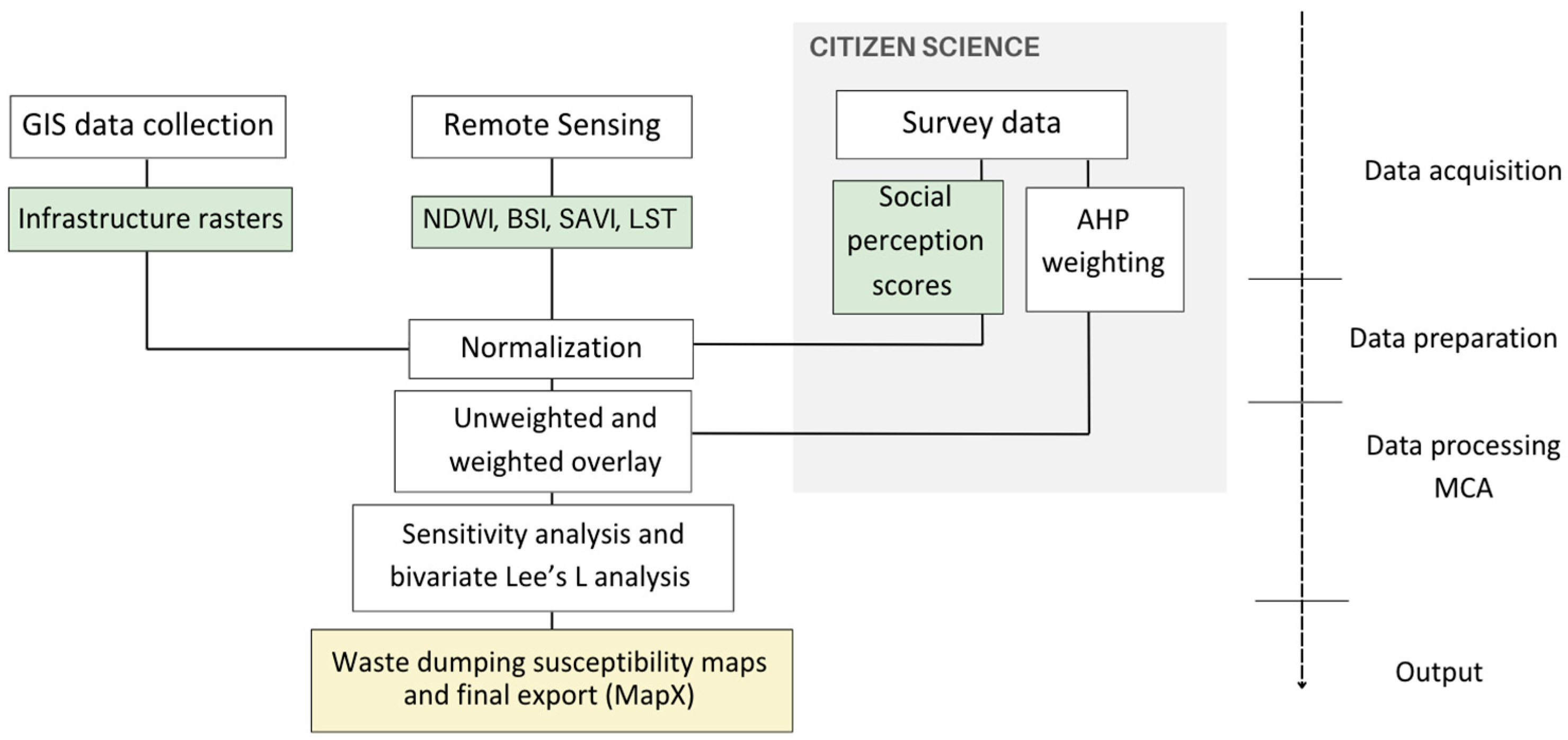
To overcome gaps in comprehensive datasets and limited access to high-resolution imagery, we developed a hybrid framework, combining GIS, remote sensing and citizen science to address illegal dumping in Dakar, which is illustrated in Figure 2.
The approach aims to enhance data availability, public participation, and coordination between institutions and communities. The methodology was designed to address gaps in comprehensive datasets and limited access to high-resolution imagery. It offers a practical tool to identify neighbourhoods most vulnerable to illegal dumping and support waste management planning. The goal is to identify urban zones most vulnerable to waste accumulation, such as attempted in previous studies [27,28,29,45]. A multi-criteria analysis was implemented in ArcGIS Pro (3.4.3) to integrate and analyze diverse datasets. Criteria (detailed later) were selected for relevance and data availability. The analysis identifies broad susceptibility zones rather than precise sites, guiding field verification, community engagement, and service planning. The framework balances rigour and feasibility, offering municipal authorities a flexible tool for waste management in data-limited contexts.

2.3. Criteria and Data Sources

The identification of areas susceptible to illegal dumping relied on a set of complementary criteria derived from both literature and local knowledge. Four main categories were considered: infrastructure, environmental indicators, demographic pressure, and social perception.
Accessibility strongly shapes disposal practices. Distance from official collection circuits was used as a proxy for service availability, while highways, markets, and waste collection points were considered additional susceptibility factors. Markets generate continuous waste with limited management, and collection points can attract overflow dumping in surrounding areas [43,46].
Remote sensing was used to derive spatial and thermal indicators. LST highlights heat from organic decomposition, while indices capture surface conditions linked to dumping [16,47].
In this study, Landsat 8 Thermal Infrared Sensor (TIRS) data were used to compute LST, following standard radiometric conversion procedures:
Lλ = ML × Qcal +AL
where Lλ is the top-of-atmosphere (TOA) spectral radiance (W·m−2·sr−1·µm−1), ML is the band-specific multiplicative rescaling factor, Qcal is the quantized and calibrated pixel value, and AL is the additive rescaling factor.
Atmospheric correction was performed using the single-channel algorithm, integrating near-surface air temperature and relative humidity extracted from ERA5 reanalysis. Surface emissivity was estimated using NDVI-based classification following Sobrino et al. [48]. Band 10 was selected due to calibration issues in band 11.
All rasters were resampled to 10 m resolution using bilinear interpolation. Temporal harmonization was ensured by selecting images from the same dry-season period (January–April 2025) to reduce seasonal variability.
In Keur Massar, Sentinel-2 Level-1C imagery was used to compute vegetation, soil, and water indices to detect potential dumping sites:
Soil Adjusted Vegetation Index (SAVI) [49] was calculated as:
SAVI = [(NIR − RED)/(NIR + RED + L)] × (1 + L)
where L = 0.5 minimizes soil brightness effects. SAVI was used to reduce soil background influence and improve vegetation detection. Vegetated areas were considered as potential risk zones, since illegal dumping frequently occurs in such environments [46].
The Normalized Difference Water Index (NDWI) [50] was computed as:
NDWI = (GREEN − NIR)/(GREEN + NIR)
NDWI identifies surface bodies that are frequently exposed to waste disposal activities.
The Bare Soil Index (BSI) [51] was derived as:
BSI = [(SWIR + RED) − (NIR + BLUE)]/[(SWIR + RED) + (NIR + BLUE)]
BSI helps detect bare or disturbed soils.
All indices were computed from Sentinel-2 bands (B2—BLUE, B3—GREEN, B4—Red, B8—NIR, B11—SWIR1), resampled to a spatial resolution of 10 m.
Population density reflects both waste generation and demand for collection services. High densities, especially in informal settlements, often surpass the capacity of formal systems, leading to unmanaged accumulation [52,53,54]. In Dakar, density is largely shaped by informal urban growth extending beyond existing service networks.
Citizen science was integrated using a short online survey distributed in the study districts. Respondents reported observed dumpsites and estimated volume. This information grounds spatial analysis in lived experience, ensuring that local knowledge complements technical indicators [17,21,22].
Together, these criteria provide a multi-dimensional framework linking demographic, environmental, infrastructural, and social factors to spatial patterns of illegal dumping.
Highways and markets datasets were obtained from the open data GéoSénégal portal and municipal authorities. Two internal datasets from the Société Nationale de Gestion Intégrée des Déchets (SONAGED) provided waste collection points and official collection circuits. Environmental indices (SAVI, BSI, NDWI, LST) were calculated from Sentinel-2 and Landsat-8 imagery at, respectively, 10–20 m and 100 m resolution. Population density was derived from the GHS-POP R2023A product of the Global Human Settlement Layer (GHSL), providing gridded population estimates at 100 m resolution for the year 2025 [55]. This integration of open-access and institutional data addressed gaps in coverage and resolution, while supporting participatory and coordinated waste management in Dakar. All datasets and their sources are detailed in Table 1.

2.4. Citizen Science Component

The citizen science component was conducted through a survey involving Master’s students from Amadou Mahtar Mbow University in Dakar, who were required to live within the study area and possess prior knowledge of waste-related issues. The questionnaire included 12 items covering frequency of observed dumping, perceived severity, proximity to dumpsites, satisfaction with collection services, and ranking of environmental and infrastructural drivers using a five-point Likert scale. The survey collected 45 responses over three weeks, with the complete questionnaire and answers provided in the data repository referenced at the end of the manuscript. Responses were assigned numerical values, averaged, and normalized using the standard formula ((value − min)/(max − min)) to yield values between 0 and 1 (Table 2). These results were then spatialized by linking aggregated scores to the municipal district shapefile in ArcGIS Pro, ready for computation in the multicriteria analysis.

2.5. Weighting and Analytic Hierarchy Process

In addition to generating a social perception index, survey responses were used to assign weights to the different criteria, incorporating residents’ insights on factors influencing waste accumulation. AHP, developed by Saaty [56], was chosen for this step. AHP combines quantitative and qualitative data through pairwise comparisons, enabling systematic ranking of criteria by relative importance. This approach supports stakeholder collaboration with non-governmental organizations and SONAGED, enhancing the relevance of results for policymaking. It is also suitable for data-scarce contexts, as expert judgement can complement missing information [57,58,59]. In this study, AHP was applied in two steps: first, pairwise comparison matrices were constructed, and second, relative weights were derived.
Six criteria, proximity to vegetation, bare soils, water bodies, collection points, markets, and highways, were ranked based on residents’ perceptions. The remaining four, LST, population density, collection roads, and social perception, were ranked using literature and observed dynamics. Rankings followed Saaty’s scale, where 1 denoted equal importance and 9 extreme importance. Weights were computed manually using the eigenvector method in Microsoft Excel, ensuring full transparency and reproducibility. The normalized matrix produced weights ranging from 0.29 (social perception) to 0.02 (LST). The consistency ratio was 0.06, below the 0.10 threshold, confirming the reliability of the ranking (Table 3).

2.6. Sensitivity Analysis

To assess the robustness of the weighting scheme and evaluate the model’s response to changes in input parameters, a sensitivity analysis was carried out. This involved removing the LST criterion from the model, which modified the weighting scheme and provided insight into how the model reacts to changes in its structure and how the resulting values are affected (Table 4.). In addition, a bivariate spatial association analysis using Lee’s L statistic [60] was conducted to compare the criteria-weighted and criteria-unweighted susceptibility maps, to assess the degree of spatial correlation between both models, and to evaluate how the weighting process influenced the spatial distribution of illegal dumping susceptibility.

2.7. Dissemination on a Cartographic Application

MapX, an open-source cartographic application for environmental data developed by UNEP/GRID-Geneva, was used to visualize and disseminate spatial data interactively and transparently [61,62]. All datasets used and generated during the study were published on MapX, accompanied by metadata for each layer. This ensured centralized access, traceability, and availability for stakeholders, while supporting data consultation and analysis.

3. Results

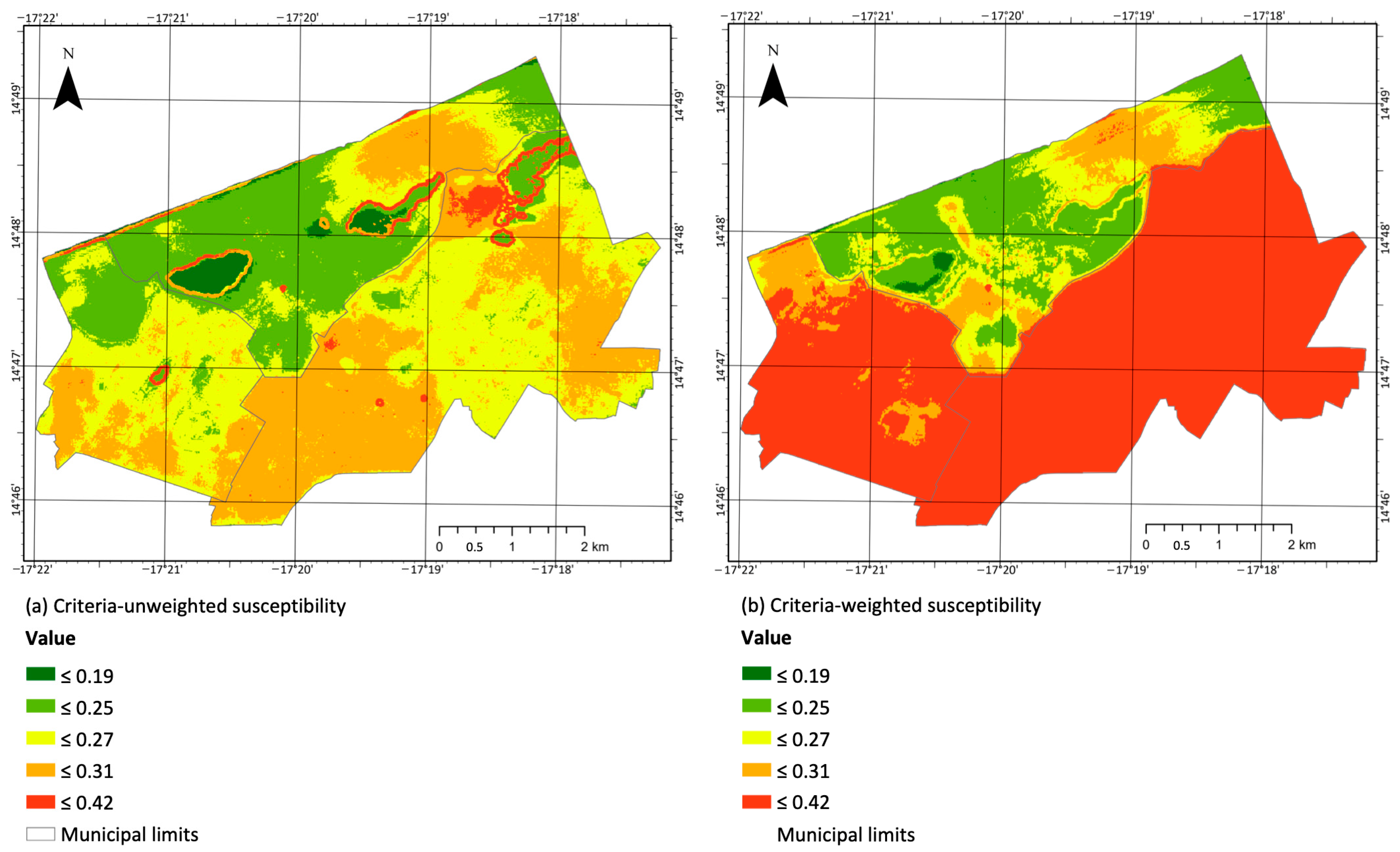
The criteria-unweighted susceptibility map was generated by averaging normalized criteria, assigning equal influence to all indicators. Five susceptibility classes were distinguished (Figure 3a). High and very high values were concentrated around the Mbeubeuss landfill, near lakes, major markets, collection points, and coastal areas. Overall, a limited share of the study area fell into the “very high” class, representing 2.83% of the area, and the “very low” class, covering 2.06% of the area. In contrast, the “high” and “medium” categories dominated, covering 34.24% and 37.04% of the area, respectively, while the “low” class accounted for 23.83%. This distribution reflects both the equal weighting scheme and the smoothing effect of the normalization process.
The criteria-weighted susceptibility map incorporated criterion weights derived from the AHP based on citizen science through survey results (Figure 3b). Each normalized criterion was multiplied by its weight, and the weighted values were summed. Keur Massar appeared almost entirely in the “very high” categories, Yeumbeul Nord fell mostly within “very high” and “high” classes, whereas Malika was dominated by “low” to “medium” classes, reflecting both lower population density and weaker social perception scores. The influence of social perception significantly shaped the spatial distribution of susceptibility as the criterion was ranked as the most important factor. In total, 65.05% of the territory was classified as “very high”, compared to only 0.41% as “very low”. The “low”, “medium” and “high” classes shared similar proportions, as they, respectively, cover 15.09%, 10.13% and 9.32% of the studied area.
Introducing weights reshaped the susceptibility patterns by emphasizing contrasts and enlarging extreme classes. Areas previously classified as “medium” or “high,” particularly in Keur Massar, shifted into the “very high” category, while northern Malika showed reduced susceptibility. These changes highlight the ability of weighting to sharpen the identification of vulnerable zones and refine intervention priorities. In practical terms, the criteria-weighted susceptibility map provides a more targeted basis for action planning, particularly for SONAGED and municipal waste services.
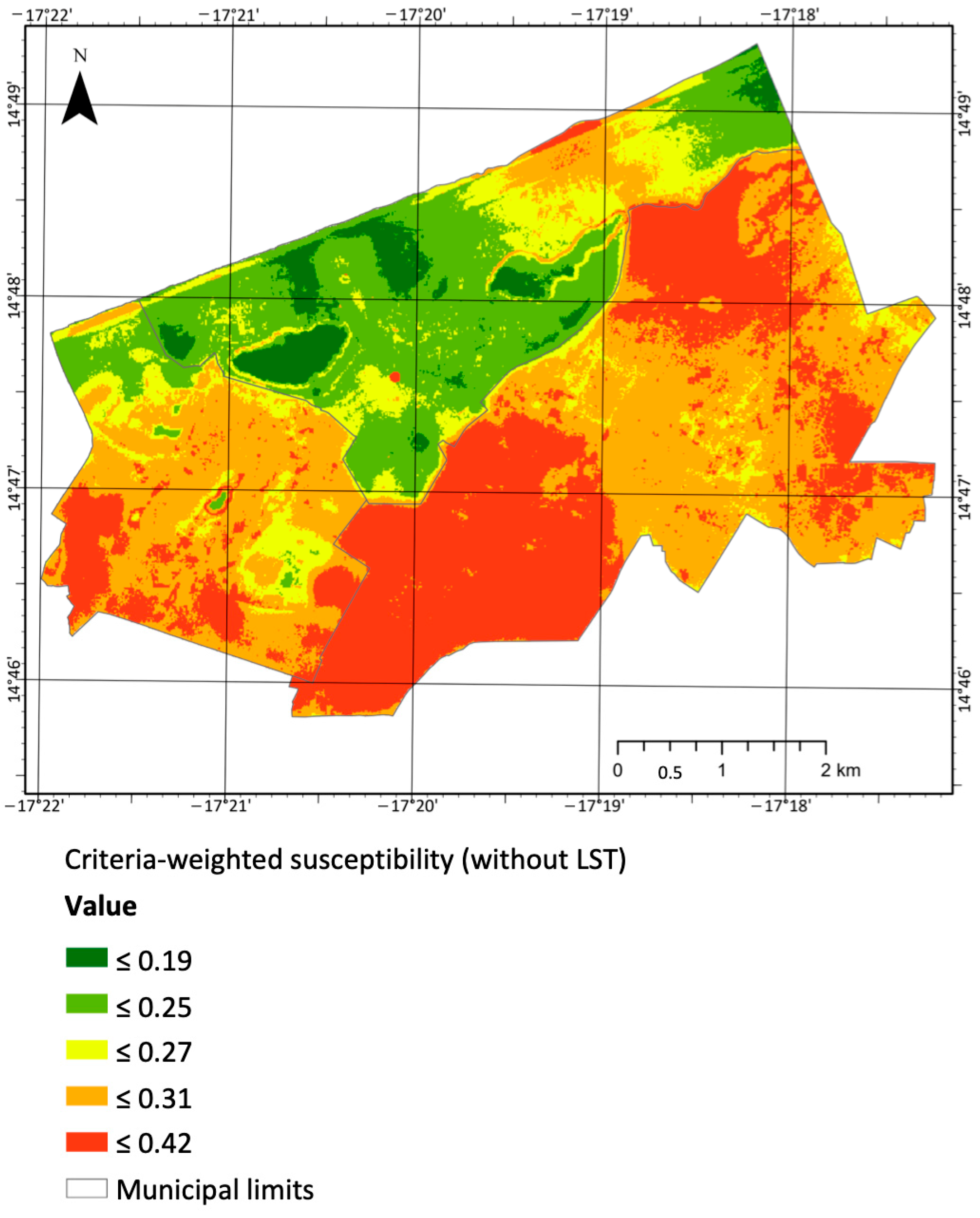
To assess the robustness of the model and its sensitivity to variable selection, a scenario was tested by removing the LST criterion (Figure 4). The resulting map displays clear variations in susceptibility values, highlighting the influence of LST on the overall model. The most evident spatial changes occur in the districts of Keur Massar and Yeumbeul Nord, where the “very high” class was previously dominant. Although LST was the least-weighted criterion, its exclusion led to less distinct susceptibility hotspots and a reduction in the “very high” class, now covering 29.78% of the study area and mainly located in the Keur Massar district. While the “very low” class increased to 3.89% of the area, the three intermediate classes “low”, “medium” and “high” gained importance, covering, respectively, 19.24%, 11.83% and 35.26% of the territory.
Removing LST also affected the weighting balance of the remaining variables. The weight assigned to social perceptions decreased markedly, from 29% to 20%, while the importance of other criteria increased slightly. This adjustment highlights the interdependence of criteria and the dynamic nature of multi-criteria weighting.
Overall, the sensitivity analysis demonstrates the model’s sensitivity to variable inclusion. Excluding LST modified susceptibility patterns and shifted the weighting balance, confirming the interdependence of multi-criteria models. These variations highlight the need for transparent weighting, as they influence spatial interpretation and policy outcomes. The results also show that even low-weighted variables can affect classification thresholds, underscoring the importance of careful calibration during model construction.
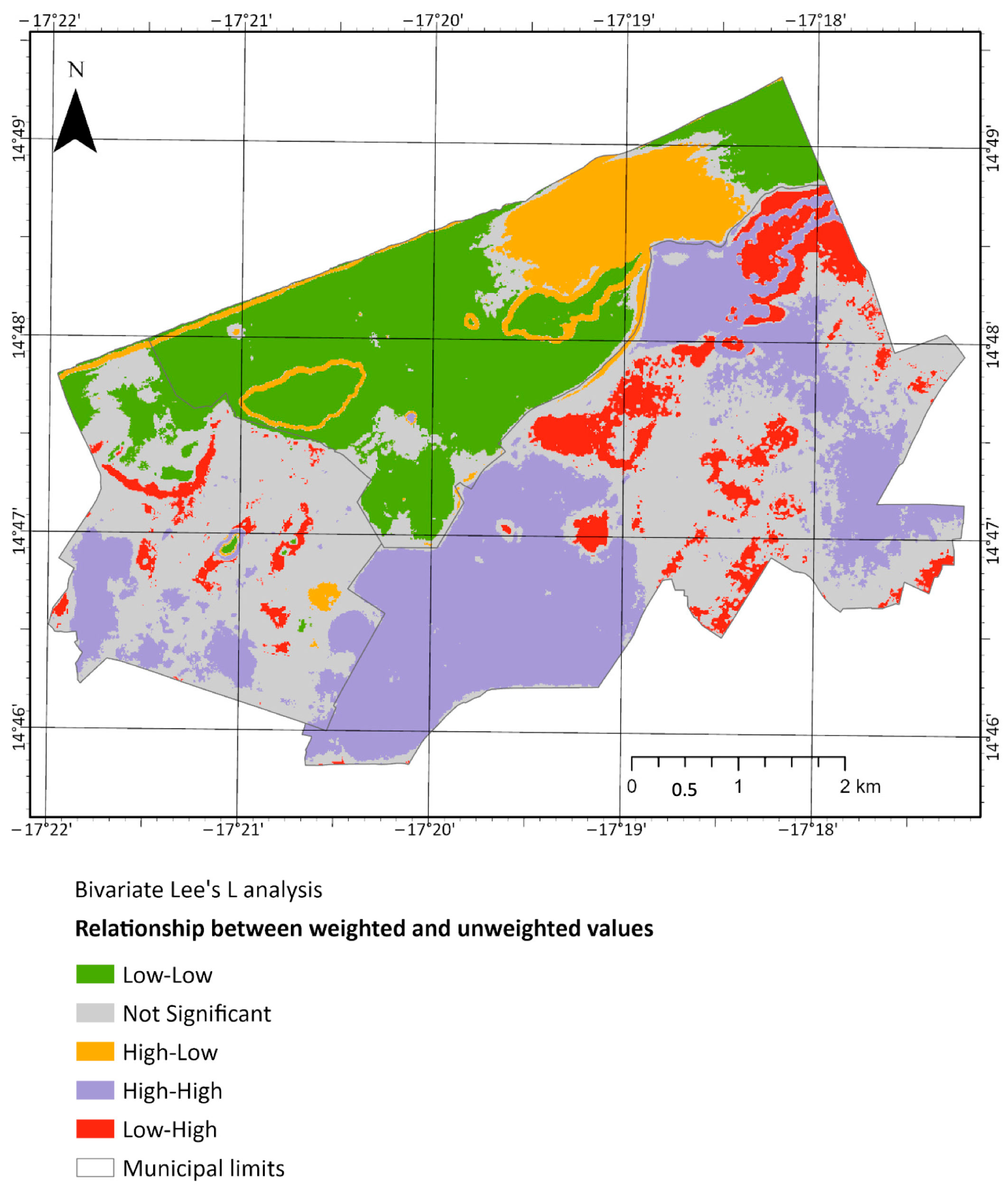
The bivariate Lee’s L map (Figure 5) identifies the spatial correlation between the criteria-unweighted and criteria-weighted susceptibility maps by measuring the relationship between their respective classes. Strong positive spatial associations are observed across the study area with a global Lee’s L index reaching 0.71 (p < 0.01), indicating that both maps share similar spatial structures and that weighting did not substantially alter general susceptibility patterns. Notably, approximately 48.75% of the total area is characterized by positive correlation.
However, localized areas of weaker or negative correlation (representing about 14.60% of the total surface) reveal where the weighting process introduced significant spatial shifts. These zones, mainly in eastern Keur Massar and Malika, show where certain criteria had stronger local effects. The ‘not significant’ class, covering approximately 36.66% of the territory, shows where weighting had minimal impact on susceptibility patterns. The spatial shifts are likely driven by the strong influence of the social perception criterion, which locally modified the susceptibility hierarchy. Moreover, the winding lake-edge features, visible in the criteria-unweighted map, disappeared in the criteria-weighted map due to the low NDWI weight, but reappeared on the bivariate map, reflecting differences between the two maps.
The weighted model provides clearer spatial contrasts and stronger alignment with population density and observed dumping reports, suggesting better interpretability for operational use.
Among the three configurations, the criteria-weighted model exhibits the strongest spatial coherence, aligning better with reported dumping locations and socio-environmental gradients. The model without LST produces more diffuse patterns, suggesting that surface temperature contributes meaningful variability. Therefore, the weighted model is considered the most robust for operational use.
Such patterns provide valuable insights into how the weighting of variables affects spatial outcomes, reinforcing the importance of sensitivity analysis in multi-criteria evaluations.
The comparative Table 5 highlights how our results align with patterns observed in other rapidly urbanizing African cities. Across the three model variants, Keur Massar and Yeumbeul Nord consistently exhibit the highest susceptibility, reflecting dense populations and limited waste collection services. Weighted models, particularly those including LST, further emphasize hotspots of vulnerability, whereas Malika shows a more heterogeneous distribution. While some benchmark studies, such as those from Mthatha and Cape Town in South Africa, do not provide exact “very high” susceptibility percentages, their qualitative findings consistently indicate that low-income, densely populated, or poorly serviced neighbourhoods are disproportionately affected by illegal dumping. This comparison demonstrates that the spatial patterns revealed by our approach based on remote sensing, GIS, citizen science and AHP are broadly consistent with observed trends in other sub-Saharan African contexts, supporting the relevance and robustness of our methodology.
MapX enables the interactive visualization, layering, and manipulation of multiple vector and raster datasets through web map services (WMSs). The datasets published on MapX include both the input data used in the susceptibility model and the resulting analytical layers. Input datasets comprise the environmental, infrastructural, and demographic indicators used in the multi-criteria analysis, such as population density, accessibility networks, vegetation, bare soil, and water indices, as well as waste collection circuits and points obtained from SONAGED. Section 3 includes the criteria-unweighted and criteria-weighted susceptibility maps, the criteria-weighted susceptibility map without the LST criterion, and the bivariate Lee’s L map comparing both models. These layers are accompanied by standardized metadata describing their source, processing steps, and relevance for waste management planning. MapX already hosts a range of complementary datasets, including land use, hydrological, and administrative layers for the Dakar region, enabling users to contextualize illegal dumping susceptibility within broader environmental and urban dynamics. By aggregating and superimposing these diverse datasets, the cartographic application enables further spatial analysis and supports waste management governance.

4. Discussion

4.1. Spatial Patterns of Illegal Dumping Susceptibility

The analysis of the criteria-weighted susceptibility map reveals clear spatial disparities in illegal dumping susceptibility across municipalities. The municipality of Keur Massar falls almost entirely within the “very high” susceptibility class, affecting 99.88% of its population. Yeumbeul Nord presents important zones of “high” and “very high” susceptibility, corresponding to, respectively, 2.25% and 97.67% of its inhabitants. These results reflect dense populations, limited infrastructure, and uneven waste collection in both Keur Massar and Yeumbeul Nord. Malika is more mixed, with intermediate and lower susceptibility areas scattered across the municipality. These patterns highlight how socio-economic conditions shape vulnerability, with areas of lower income or weaker service provision corresponding to higher susceptibility. A similar trend has been observed in other rapidly urbanizing contexts, such as the city of Mthatha in South Africa, where it was demonstrated that neighbourhoods with lower socio-economic status and limited waste services exhibited higher environmental vulnerability, including increased reliance on informal waste management practices [63]. Quantitative analysis of the weighted approach scores confirms that neighbourhoods with lower income or weaker service provision exhibit average susceptibility scores of 0.68–0.82, compared to 0.34–0.49 in better-served areas, highlighting the influence of socio-economic conditions on vulnerability to illegal dumping.

4.2. Role of Social Perception and Participatory Weighting

Social perception, identified as the most influential criterion in the AHP weighting, played a decisive role in these outcomes. Lower awareness or dissatisfaction with waste management is associated with higher perceived risk, reinforcing susceptibility in certain neighbourhoods. However, participatory weighting may partly overestimate risk in some zones, as citizen assessments reflect perceptions rather than strictly measured conditions. Such over- or under-estimation has already been demonstrated in flood-prone areas [66]. Despite this, the criteria-weighted model enhances spatial contrasts and captures the dominant drivers of illegal dumping, demonstrating the value of integrating socio-economic and citizen-based information into waste management planning while acknowledging its limitations.

4.3. Integration with MapX and Transparency Data

The integration of the results within the MapX platform represents a major step toward transparent and collaborative waste management in Dakar. MapX facilitates the interactive visualization and dissemination of spatial information related to illegal dumping susceptibility. Beyond simple map display, the platform enables users to superimpose multiple data layers, such as population density, collection networks, infrastructure, and administrative boundaries, thereby situating waste management challenges within their broader territorial context. This capacity to combine environmental, social, and infrastructural information enhances the interpretability of spatial patterns and supports evidence-based decision-making. Through compliance with Open Geospatial Consortium (OGC) web services and ISO metadata standards, MapX ensures full interoperability with other GIS environments, allowing data to be reused, compared, and integrated into existing monitoring tools [67]. By offering open access to datasets and clear metadata documentation, the platform fosters data transparency and dialogue among municipal authorities, national agencies, researchers, and citizens. Such interoperability and openness are key to transforming spatial analyses into operational insights and to promoting co-production of knowledge between institutions and communities in support of sustainable waste governance.

4.4. Transferability and Replicability of the Methodological Framework

The methodological framework developed in this study is designed to be transferable to other urban contexts, provided that comparable spatial and socio-environmental data are available. Because it integrates open-access datasets, standardized remote sensing indicators, and a participatory weighting approach, the model can be replicated with relative ease in other regions facing similar waste management challenges. The multi-criteria analysis structure is flexible: criteria can be adapted to local realities, and their weights adjusted according to stakeholder priorities or expert judgement. In contexts where institutional or participatory data are limited, open data sources and citizen science tools can serve as practical substitutes, ensuring continuity of analysis. However, successful replication depends on contextual calibration, particularly regarding population density, urban morphology, and service infrastructure. Thus, while the framework offers a generalizable structure for identifying illegal dumping susceptibility, it must be locally validated through field verification and community engagement to ensure relevance and reliability across different territories.

4.5. Supporting Evidence from Comparative Studies

This approach aligns with findings from studies such as Beutler et al. [68], who demonstrated the effectiveness of participatory multi-criteria decision analysis in identifying sustainable wastewater management solutions in non-grid urban areas. Similarly, research by Masi et al. [69] highlights the adaptability of multi-criteria decision-making frameworks in optimizing infrastructure placement, emphasizing the importance of local context in decision-making processes. Furthermore, the integration of open-access datasets and citizen science tools has been advocated by scholars like Ferla et al. [70], who reviewed multi-criteria approaches for sustainability assessments, underscoring the role of accessible data in enhancing participatory governance. These studies collectively support the notion that while the proposed framework is adaptable and replicable, its success hinges on contextual calibration and active community involvement, ensuring that the model remains relevant and effective across diverse urban settings.

4.6. Integration of Remote Sensing, GIS and Citizen Science

The integration of remote sensing, GIS, and citizen science represents a key methodological innovation of this study, addressing the lack of comprehensive and up-to-date spatial data in Dakar. Remote sensing provides consistent environmental indicators, while GIS enables the combination and spatial analysis of heterogeneous datasets such as infrastructure, population, and accessibility networks. However, these quantitative approaches alone cannot fully capture local realities, especially in informal or rapidly changing urban areas. Citizen science complements them by incorporating residents’ knowledge and perceptions, adding qualitative insights that enrich the interpretation of geospatial data. This hybrid integration enhances territorial representativeness by merging objective spatial information with community-based observations and helps reveal discrepancies between perceived and measured conditions. The combined remote sensing, GIS and citizen science framework thus bridges the gap between technical precision and local relevance, offering a more inclusive and context-sensitive tool for urban waste management planning in data-scarce environments.

4.7. Methodological Limitations

This study provides an innovative multi-criteria methodology for mapping illegal dumping susceptibility in Dakar, but several methodological aspects limit its precision and applicability.
First, the results are sensitive to the weighting of individual criteria. Strong influence from indicators such as social perception can create artificial discontinuities at municipal boundaries. Seven out of ten criteria were weighted using participatory data, while the remaining three relied on literature and expert judgement [71]. However, integrating local experts could further strengthen the robustness of the model.
Second, the citizen science survey was limited to 45 student respondents, all Master’s students, which does not fully represent the broader population. Subjective perceptions may over- or underestimate susceptibility. This educational and socio-economic homogeneity may bias perceptions and reduce representativeness. Expanding participation to more diverse demographic groups and finer spatial scales would improve representativeness and precision.
Furthermore, the interpretation of the susceptibility map remains approximate: high values indicate areas more likely to experience illegal dumping, but not precise locations. Some indicators may reflect artificial surfaces, and recently cleaned areas may appear less susceptible. Integrating field validation and repeated observations would refine results and enhance operational relevance. Although no independent field validation was conducted due to limited resources and restricted site accessibility, several modern validation approaches could strengthen future analyses. GPS-based ground verification, UAV imagery, and geo-tagged photo collection, combined with participatory mapping and time-series inspection of high-resolution satellite or street-level imagery, would allow more rigorous confirmation of susceptibility patterns. Integrating these methods would reduce classification uncertainties and enhance the operational relevance of the model for municipal waste management planning.

4.8. Unaddressed Systemic Drivers and Future Perspectives

Finally, broader systemic drivers such as rising waste generation, limited recycling infrastructure, and rapid urbanization remain unaddressed. Considering these factors would allow future analyses to link geospatial mapping with actionable policy and planning interventions.

5. Conclusions and Outlook

This study demonstrates the potential of integrating remote sensing, GIS, and citizen science within a multi-criteria decision framework to map the susceptibility to illegal waste dumping across three municipalities of Dakar. By combining environmental, infrastructural, and socio-economic factors, the approach provides a more nuanced understanding of the spatial drivers that concentrate illegal dumping in vulnerable areas. The weighted model, in particular, highlights critical zones where limited waste collection services, high population density, and proximity to informal settlements jointly contribute to higher susceptibility. This analysis also highlights the strong sensitivity of the susceptibility map to the weighting scheme, underscoring the need for transparent and well-justified criteria.
Beyond its methodological contribution, the findings offer practical insights for municipal planners and waste management institutions such as SONAGED. The susceptibility maps can support the prioritization of monitoring efforts, the optimization of collection routes, and the design of targeted interventions in high-risk neighbourhoods. They also provide a replicable and cost-effective tool for other West African cities facing similar challenges but lacking consistent field data.
However, the study also reveals key limitations. The absence of field validation and the non-representativeness of the citizen science sample constrain the generalizability of the results. The integration of thermal data, while promising, requires further refinement through higher-resolution imagery and ground measurements. Addressing these limitations will be essential for strengthening the operational use of susceptibility maps.
Future research should therefore focus on three directions: (i) expanding citizen science participation to include diverse socio-economic groups; (ii) validating susceptibility predictions with systematic field surveys and GPS-based inventories of dumping sites; and (iii) testing machine-learning models that could complement AHP-based weighting and improve predictive performance. Such developments would enhance the robustness and scalability of the approach, contributing to more sustainable and data-driven waste management strategies across rapidly urbanizing African contexts.

Author Contributions

Conceptualization, B.S., P.L., B.D. and N.S.; Data curation, B.D. and N.S.; Formal analysis, B.D. and N.S.; Methodology, B.D., N.S., B.S. and P.L.; Supervision: B.S. and P.L.; Visualization, B.D., N.S. and P.L.; Writing—original draft preparation, B.D. and N.S.; Writing—review and editing, B.S., P.L. and A.D. All authors have read and agreed to the published version of the manuscript.

Funding

This article was supported by the institutional Open Access fund of the University of Geneva; no specific funding number is associated with this institutional support.

Institutional Review Board Statement

According to the regulations of Amadou Mahtar Mbow University (Dakar, Senegal), research activities involving anonymous surveys without the collection of personal or sensitive data do not require prior approval from an Institutional Review Board. Ethical review and approval were therefore waived for this study. The study was conducted in accordance with the ethical principles outlined in the Declaration of Helsinki (1975, revised in 2013).

Informed Consent Statement

Participation in this study was entirely voluntary and anonymous. All participants were informed about the purpose of the research, and their submission of the questionnaire was considered as informed consent.

Data Availability Statement

The source data are openly available at: https://owncloud.unepgrid.ch/index.php/s/RFfSqNygTcB1YyZ (accessed on 15 October 2025). The datasets and the illegal dumping maps can be accessed at: https://app.mapx.org/?theme=color_light&project=MX-WFG-EH9-CLQ-6XV-BES&language=en (accessed on 15 October 2025). Data from SONAGED (collection and sweeping routes, and waste collection points) are available upon request directly from SONAGED. The source code is openly available at: https://git.unepgrid.ch/dakar-waste-management/PySTAC-LST (accessed on 8 August 2025).

Acknowledgments

The authors would like to thank GRID-Geneva for providing software support and technical resources that facilitated this study. We thank Bruno Chatenoux (GRID-Geneva) for his contribution to the development of the code used to calculate the LST and Thomas Piller (GRID-Geneva) for supporting the publication of data on MapX. We would like to thank Mark Mason from the Education University of Hong Kong for reviewing the manuscript, improving the English, and providing valuable comments. We also acknowledge the Société Nationale de Gestion Intégrée des Déchets (SONAGED S.A.) and its Director, Khalifa Ababacar Sarr, for providing key datasets essential for the analysis.

Conflicts of Interest

Abdoulaye Djim is an employee of SONAGED S.A., the Senegalese national agency for integrated waste management, which provided access to institutional datasets used in this study. SONAGED S.A. had no role in the study design, data analysis, interpretation of results, or manuscript preparation. The other authors confirm that they have no known competing financial interests or non-financial interests that could have appeared to influence the work reported in this paper.

References

  1. Debrah, J.K.; Teye, G.K.; Dinis, M.A.P. Barriers and Challenges to Waste Management Hindering the Circular Economy in Sub-Saharan Africa. Urban Sci. 2022, 6, 57. [Google Scholar] [CrossRef]
  2. Ofoezie, E.I.; Eludoyin, A.O.; Udeh, E.B.; Onanuga, M.Y.; Salami, O.O.; Adebayo, A.A. Climate, Urbanization and Environmental Pollution in West Africa. Sustainability 2022, 14, 15602. [Google Scholar] [CrossRef]
  3. Kemajou, A.; Chenal, J.; Meylan, F.; Naji, S.; Felder, N. Villes Africaines et Technologies Numériques: Entre Risques et Potentiels; EPFL|Centre Excellence in Africa (EXAF): Dakar, Senegal, 2023; p. 35. [Google Scholar]
  4. Myers, G. The Politics and Technologies of Urban Waste. In The Routledge Handbook on Cities of the Global South; Routledge: London, UK, 2014. [Google Scholar]
  5. Miraftab, F. Neoliberalism and Casualization of Public Sector Services: The Case of Waste Collection Services in Cape Town, South Africa. Int. J. Urban Reg. Res. 2004, 28, 874–892. [Google Scholar] [CrossRef]
  6. Fredericks, R. Disorderly Dakar: The Cultural Politics of Household Waste in Senegal’s Capital City. J. Mod. Afr. Stud. 2013, 51, 435–458. [Google Scholar] [CrossRef]
  7. Fredericks, R. Anthropocenic Discards: Embodied Infrastructures and Uncanny Exposures at Dakar’s Dump. Antipode 2021, 57, 1663–1684. [Google Scholar] [CrossRef]
  8. JICA. Ministry of Urban Renewal, Housing and Living Environment. In Project for Urban Master Plan of Dakar and Neighboring Area for 2035; Final Report Summary; Department of Urbanization and Architecture (DUA): Tokyo, Japan, 2016. [Google Scholar]
  9. IIED. Improving Solid Waste Management Practices and Addressing Associated Health Risks in Dakar, Senegal. In Urban Africa: Risk Knowledge; International Institute for Environment and Development: London, UK, 2018. [Google Scholar]
  10. ANSD. Rapport National Recensement Général de la Population et de l’Habitat (RGPH-5, 2023); Agence Nationale de la Statistique et de la Démographie: Dakar, Senegal, 2024. [Google Scholar]
  11. Aslam, B.; Maqsoom, A.; Tahir, M.; Ullah, F.; Rehman, M.; Albattah, M. Identifying and Ranking Landfill Sites for Municipal Solid Waste Management: An Integrated Remote Sensing and GIS Approach. Buildings 2022, 12, 605. [Google Scholar] [CrossRef]
  12. Faye, M.; Sarr, K.A.; Toure, M.N. Système d’Information Géographique (SIG) et Gestion des Déchets Ménagers dans la Commune de Malika (Région de Dakar, Sénégal). Rev. ACAREF 2024, 3, 349–380. [Google Scholar]
  13. Lavender, S. Detection of Waste Plastics in the Environment: Application of Copernicus Earth Observation Data. Remote Sens. 2022, 14, 4772. [Google Scholar] [CrossRef]
  14. Vambol, S.; Vambol, V.; Sundararajan, M.; Ansari, I. The Nature and Detection of Unauthorized Waste Dump Sites Using Remote Sensing. Ecol. Quest. 2019, 30, 43–55. [Google Scholar] [CrossRef]
  15. Fraternali, P.; Morandini, L.; Herrera González, S.L. Solid Waste Detection, Monitoring and Mapping in Remote Sensing Images: A Survey. Waste Manag. 2024, 189, 88–102. [Google Scholar] [CrossRef]
  16. Shatnawi, N.; Al-Sharif, M.; Briezat, M.A. Mapping the Thermal Footprint of a Municipal Solid Waste Landfill Using Remote Sensing and Artificial Intelligence. Appl. Geomat. 2024, 16, 499–513. [Google Scholar] [CrossRef]
  17. Sy, B.; Frischknecht, C.; Dao, H.; Consuegra, D.; Giuliani, G. Flood Hazard Assessment and the Role of Citizen Science. J. Flood Risk Manag. 2018, 12, e12519. [Google Scholar] [CrossRef]
  18. Craglia, M.; Shanley, L. Data Democracy—Increased Supply of Geospatial Information and Expanded Participatory Processes in the Production of Data. Int. J. Digit. Earth 2015, 8, 679–693. [Google Scholar] [CrossRef]
  19. Ananta, M.T.; Rohidah, S.; Brata, K.C.; Abidin, Z. Mobile Crowdsourcing App Design: Managing Waste Through Waste Bank in Rural Area of Indonesia. In Proceedings of the 8th International Conference on Sustainable Information Engineering and Technology, Badung, Indonesia, 24–25 October 2023; pp. 664–672. [Google Scholar] [CrossRef]
  20. Frigo, G.; Zurbrügg, C.; Juwana, I.; Binder, C.R. Where Does Plastic Waste Go? Local Dynamics of Waste Flows in Indonesian Neighbourhoods. Environ. Chall. 2025, 19, 101135. [Google Scholar] [CrossRef]
  21. Choplin, A.; Lozivit, M. Mapping a slum: Learning from participatory mapping and digital innovation in Cotonou (Benin): Questioning participatory approaches and the digital shift in southern cities. Cybergeo Eur. J. Geogr. 2019, 23. [Google Scholar] [CrossRef]
  22. Elias, P.; Shonowo, A.; De Sherbinin, A.; Hultquist, C.; Danielsen, F.; Cooper, C.; Mondardini, M.; Faustman, E.; Browser, A.; Minster, J.-B.; et al. Mapping the Landscape of Citizen Science in Africa: Assessing Its Potential Contributions to Sustainable Development Goals 6 and 11 on Access to Clean Water and Sanitation and Sustainable Cities. Citiz. Sci. Theory Pract. 2023, 8, 33. [Google Scholar] [CrossRef]
  23. Asingizwe, D.; Poortvliet, P.M.; Koenraadt, C.J.M.; Van Vliet, A.J.H.; Ingabire, C.M.; Mutesa, L.; Leeuwis, C. Why (Not) Participate in Citizen Science? Motivational Factors and Barriers to Participate in a Citizen Science Program for Malaria Control in Rwanda. PLoS ONE 2020, 15, e0237396. [Google Scholar] [CrossRef]
  24. Eisma, J.A.; Schoups, G.; Davids, J.C.; Van De Giesen, N. A Bayesian Model for Quantifying Errors in Citizen Science Data: Application to Rainfall Observations from Nepal. Hydrol. Earth Syst. Sci. 2023, 27, 3565–3579. [Google Scholar] [CrossRef]
  25. Kosako, A.; Miyazaki, S.; Inoue, U.; Tasaki, T.; Osako, M.; Tamura, M. Detection of Illegal Dumping Sites by Using Vegetation Index and Land Surface Feature from High Resolution Satellite Images. J. Remote Sens. Soc. Jpn. 2009, 29, 497–514. [Google Scholar] [CrossRef]
  26. Devesa, M.R.; Brust, A.V. Mapping Illegal Waste Dumping Sites with Neural-Network Classification of Satellite Imagery. arXiv 2021, arXiv:2110.08599. [Google Scholar] [CrossRef]
  27. Biotto, G.; Silvestri, S.; Gobbo, L.; Furlan, E.; Valenti, S.; Rosselli, R. GIS, Multi-criteria and Multi-factor Spatial Analysis for the Probability Assessment of the Existence of Illegal Landfills. Int. J. Geogr. Inf. Sci. 2009, 23, 1233–1244. [Google Scholar] [CrossRef]
  28. Glanville, K.; Chang, H.-C. Mapping Illegal Domestic Waste Disposal Potential to Support Waste Management Efforts in Queensland, Australia. Int. J. Geogr. Inf. Sci. 2015, 29, 1042–1058. [Google Scholar] [CrossRef]
  29. Karimi, N.; Ng, K.T.W.; Richter, A. Development and Application of an Analytical Framework for Mapping Probable Illegal Dumping Sites Using Nighttime Light Imagery and Various Remote Sensing Indices. Waste Manag. 2022, 143, 195–205. [Google Scholar] [CrossRef]
  30. World Bank. International Development Association Project Paper on a Proposed Additional to the Republic of Senegal for the Credit Stormwater Management and Climate Change Adaptation Project 2; World Bank Group: Washington, DC, USA, 2023. [Google Scholar]
  31. Ndour, M.M.M.; Ndao, M.L.; Ndonky, A. Urban Dynamics and Emergence of New Centers in the Dakar Region (Senegal). J. Geogr. Inf. Syst. 2024, 16, 227–243. [Google Scholar] [CrossRef]
  32. Faty, A.; Diop, C.; Faye, W. Rainwater and Wastewater Management: A Case Study of Dakar’s Built-up Area, Senegal. Preprints 2023, 1–13. [Google Scholar] [CrossRef]
  33. Cissé, O.; Sèye, M. Flooding in the Suburbs of Dakar: Impacts on the Assets and Adaptation Strategies of Households or Communities. Environ. Urban. 2016, 28, 183–204. [Google Scholar] [CrossRef]
  34. World Bank. Implementation Completion and Results Report to the Republic of Senegal for the Stormwater Management and Climate Change Adaptation Project; World Bank Group: Washington, DC, USA, 2020. [Google Scholar]
  35. UN-Habitat. Breaking Cycles of Risk Accumulation in African Cities. In United Nations Human Settlements Programme; UN-Habitat, in collaboration with Urban Africa Risk Knowledge: Nairobi, Kenya, 2020. [Google Scholar]
  36. Sy, B.; Mbow, M.; Aw, S. Cartographie de La Susceptibilité d’inondation En Utilisant l’analyse Multicritère Basée Sur La Procédure d’analyse Hiérarchique Dans Les Départements de Pikine et de Keur Massar, Sénégal. In VertigO—la Revue Électronique en Sciences de L’environnement; VertigO: Montréal, QC, Canada, 2025. [Google Scholar]
  37. Diémé, L.P.M.; Bouvier, C.; Bodian, A.; Sidibé, A. Modelling Urban Stormwater Drainage Overflows for Assessing Flood Hazards: Application to the Urban Area of Dakar (Senegal). Nat. Hazards Earth Syst. Sci. 2025, 25, 1095–1112. [Google Scholar] [CrossRef]
  38. Deutsche Gesellschaft für Internationale Zusammenarbeit (GIZ) GmbH. Sector Brief Senegal: Solid Waste Management and Recycling; GIZ: Bonn, Germany., 2018. [Google Scholar]
  39. World Bank. International Development Association Project Appraisal Document on a Proposed Credit to the Republic of Senegal for a Senegal Municipal Solid Waste Management Project; World Bank Group: Washington, DC, USA, 2020; p. 65. [Google Scholar]
  40. IIED. Practices and Perceptions around Solid Waste Management in Dakar. In Urban Africa: Risk Knowledge; International Institute for Environment and Development: London, UK, 2017. [Google Scholar]
  41. APHRC. Solid Waste Management and Risks to Health in Urban Africa; African Population and Health Research Center: Nairobi, Kenya, 2019. [Google Scholar]
  42. PROMOGED. “You Only See Garbage. We See a Treasure”, or Why Waste Management in Senegal Is a Key Issue for Sustainable Development. Available online: https://www.promoged.sn/en/fr/node/124?utm (accessed on 8 August 2025).
  43. Walker, S. Dakar Has Lost Its Lungs: What the Spatialised Inequalities of Waste Can Tell Us about Climate (Im)Mobilities. Environ. Plan. C Polit. Space 2024, 42, 958–973. [Google Scholar] [CrossRef]
  44. Abizaid, O.; Diop, M.; Soumaré, A.; Wilson, E.; Institute of Development Studies. Waste Pickers Are Part of the Solution to Solid Waste Management in Senegal; Institute of Development Studies: Brighton, UK, 2023. [Google Scholar]
  45. Jordá-Borrell, R.; Ruiz-Rodríguez, F.; Lucendo-Monedero, Á.L. Factor Analysis and Geographic Information System for Determining Probability Areas of Presence of Illegal Landfills. Ecol. Indic. 2014, 37, 151–160. [Google Scholar] [CrossRef]
  46. Pierrat, A. Les lieux de l’ordure de Dakar et d’Addis Abeba. In Territoires Urbains et Valorisation Non Institutionnelle des Déchets Dans Deux Capitales Africaines; Université Paris 1 Panthéon Sorbonne: Paris, France, 2014. [Google Scholar]
  47. Gill, J.; Faisal, K.; Shaker, A.; Yan, W.Y. Detection of Waste Dumping Locations in Landfill Using Multi-Temporal Landsat Thermal Images. Waste Manag. 2019, 37, 386–393. [Google Scholar] [CrossRef] [PubMed]
  48. Sobrino, J.A.; Jiménez-Muñoz, J.C.; Paolini, L. Land Surface Temperature Retrieval from LANDSAT TM 5. Remote Sens. Environ. 2004, 90, 434–440. [Google Scholar] [CrossRef]
  49. Huete, A.R. A Soil-Adjusted Vegetation Index (SAVI). Remote Sens. Environ. 1988, 25, 295–309. [Google Scholar] [CrossRef]
  50. McFeeters, S.K. The Use of the Normalized Difference Water Index (NDWI) in the Delineation of Open Water Features. Int. J. Remote Sens. 1996, 17, 1425–1432. [Google Scholar] [CrossRef]
  51. Rikimaru, A.; Roy, P.S.; Miyatake, S. Tropical Forest Cover Density Mapping. Trop. Ecol. 2002, 43, 39–47. [Google Scholar]
  52. Karimi, N.; Ng, K.T.W. Mapping and Prioritizing Potential Illegal Dump Sites Using Geographic Information System Network Analysis and Multiple Remote Sensing Indices. Earth 2022, 3, 1123–1137. [Google Scholar] [CrossRef]
  53. Blevins, C.; Karanja, E.; Omojah, S.; Chishala, C.; Oniosun, T.I. Wastesites.io: Mapping Solid Waste to Meet Sustainable Development Goals. In Open Mapping towards Sustainable Development Goals: Voices of YouthMappers on Community Engaged Scholarship; Springer International Publishing: Cham, Switzerland, 2022; pp. 231–239. [Google Scholar] [CrossRef]
  54. Shabani, T.; Defe, R.; Mavugara, R.; Mupepi, O.; Shabani, T. Application of Geographic Information Systems (GIS) and Remote Sensing (RS) in Solid Waste Management in Southern Africa: A Review. SN Soc. Sci. 2024, 4, 39. [Google Scholar] [CrossRef]
  55. Carioli, A.; Schiavina, M.; Melchiorri, M.; Kemper, T. GHSL Country Statistics by Degree of Urbanization: Public Release of GHS COUNTRY STATS R2024A; European Commission, Joint Research Centre, Publications Office: Luxembourg, 2024. [Google Scholar]
  56. Saaty, T.L.; Wind, Y. Marketing Applications of the Analytic Hierarchy Process. Manag. Sci. 1980, 26, 641–658. [Google Scholar] [CrossRef]
  57. Banda, W. An Integrated Framework Comprising of AHP, Expert Questionnaire Survey and Sensitivity Analysis for Risk Assessment in Mining Projects. Int. J. Manag. Sci. Eng. Manag. 2019, 14, 180–192. [Google Scholar] [CrossRef]
  58. Mujtaba, M.A.; Munir, A.; Imran, S.; Nasir, M.K.; Muhayyuddin, M.G.; Javed, A.; Mehmood, A.; Habila, M.A.; Fayaz, H.; Qazi, A. Evaluating Sustainable Municipal Solid Waste Management Scenarios: A Multicriteria Decision Making Approach. Heliyon 2024, 10, e25788. [Google Scholar] [CrossRef]
  59. Qureshi, M.E.; Harrison, S.R.; Wegener, M.K. Validation of Multicriteria Analysis Models. Agric. Syst. 1999, 62, 105–116. [Google Scholar] [CrossRef]
  60. Lee, S.-I. Developing a Bivariate Spatial Association Measure: An Integration of Pearson’s r and Moran’s I. J. Geogr. Syst. 2001, 3, 369–385. [Google Scholar] [CrossRef]
  61. Lacroix, P.; Moser, F.; Benvenuti, A.; Piller, T.; Jensen, D.; Petersen, I.; Planque, M.; Ray, N. MapX: An Open Geospatial Platform to Manage, Analyze and Visualize Data on Natural Resources and the Environment. SoftwareX 2019, 9, 77–84. [Google Scholar] [CrossRef]
  62. UNEP/GRID-Geneva. Global Resource Information Database (GRID) Geneva. Available online: https://www.unepgrid.ch (accessed on 8 August 2025).
  63. Tsheleza, V.; Nakin, M.D.V.; Ndhleve, S.; Kabiti, H.M.; Musampa, C.M. Vulnerability of Growing Cities to Solid Waste-Related Environmental Hazards: The Case of Mthatha, South Africa. Jamba J. Disaster Risk Stud. 2019, 11, 1–10. [Google Scholar] [CrossRef]
  64. Ntlangula, L.; Xelelo, Z.; Chitongo, L. Evaluating Enforcement Strategies for Curbing Illegal Waste Dumping: A Case Study of King Sabata Dalindyebo Local Municipality, South Africa. IRASD J. Manag. 2025, 7, 41–57. [Google Scholar] [CrossRef]
  65. Jakeni, Y.; Maphanga, T.; Madonsela, B.S.; Malakane, K.C. Identification of Illegal Dumping and Community Views in Informal Settlements, Cape Town: South Africa. Sustainability 2024, 16, 1429. [Google Scholar] [CrossRef]
  66. Sy, B. Approche Multidisciplinaire de l’Évaluation de l’Aléa D’inondation à Yeumbeul Nord, Dakar, Sénégal: La Contribution de la Science Citoyenne; Université de Genève: Geneva, Switzerland, 2019. [Google Scholar]
  67. Antofie, T.; Doherty, B.; Marin Ferrer, M. Mapping of Risk Web-Platforms and Risk Data: Collection of Good Practices; Publications Office of the European Eunion: Luxembourg, 2018; ISBN 978-92-79-80171-6. [Google Scholar]
  68. Beutler, P.; Larsen, T.A.; Maurer, M.; Staufer, P.; Lienert, J. A Participatory Multi-Criteria Decision Analysis Framework Reveals Transition Potential towards Non-Grid Wastewater Management. J. Environ. Manag. 2024, 367, 121962. [Google Scholar] [CrossRef] [PubMed]
  69. Masi, M.; Arrighi, C.; Piragino, F.; Castelli, F. Participatory Multi-Criteria Decision Making for Optimal Siting of Multipurpose Artificial Reservoirs. J. Environ. Manag. 2024, 370, 122904. [Google Scholar] [CrossRef]
  70. Ferla, G.; Mura, B.; Falasco, S.; Caputo, P.; Matarazzo, A. Multi-Criteria Decision Analysis (MCDA) for Sustainability Assessment in Food Sector. A Systematic Literature Review on Methods, Indicators and Tools. Sci. Total Environ. 2024, 946, 174235. [Google Scholar] [CrossRef]
  71. Stander, H.-M.; Cohen, B.; Harrison, S.T.L.; Broadhurst, J.L. Validity of Using Expert Judgements to Inform Multiple Criteria Decision Analysis: Selecting Technologies for Sulfide-Enriched Fine Coal Waste Reuse. J. Clean. Prod. 2023, 415, 137671. [Google Scholar] [CrossRef]
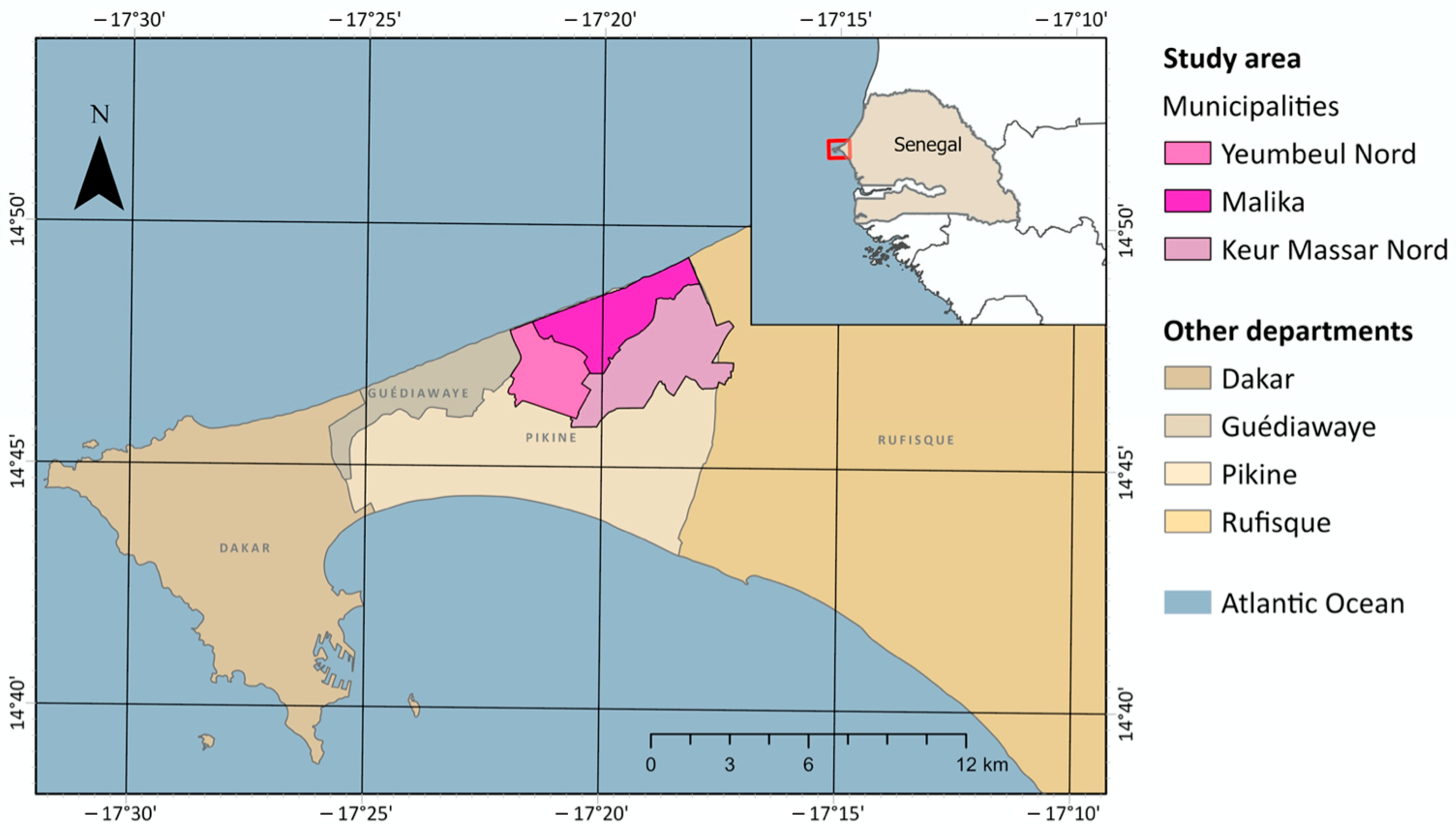
Figure 1. Location map of the study area.
Sustainability 17 11137 g001
Figure 2. Analytical framework of the study.
Sustainability 17 11137 g002
Figure 3. Stacked maps of (a) criteria-unweighted and (b) criteria-weighted illegal dumping susceptibility.
Sustainability 17 11137 g003
Figure 4. Criteria-weighted susceptibility map without the LST criterion.
Sustainability 17 11137 g004
Figure 5. Bivariate map showing the spatial relationship between weighted and unweighted susceptibility values.
Sustainability 17 11137 g005
Table 1. Datasets and sources.
DataSourceFormatData
Population densityGHS-POP R2023A Global Human Settlement LayerGeoTIFF, 100 m raster2025
Satellite imageryCopernicus Browser, Sentinel-2 Level-1CJP2 file, 10–20 m rasterApril 2025
Land surface temperature (LST)Landsat product Planetary Computer, Landsat 8GeoTIFF, 100 m rasterJanuary 2025–June 2025
Collection and sweeping routesSONAGEDVector layer, polyline2025
Waste collection pointsSONAGEDVector layer, points2025
Markets of Keur Massar, Malika and Yeumbeul NordDakar municipal authoritiesVector layer, pointsN/A
HighwaysGéoSénégal, “Dakar, Voirie”Vector layer, polyline2019
Social perceptionCitizen responses to waste-related surveyGoogle Forms Survey, CSVJuly 2025
Table 2. Social perception scores.
MunicipalityAggregated Scores
Yeumbeul Nord0.59
Malika0.33
Keur Massar0.79
Table 3. Criteria weighting scheme.
CriteriaDerived Weights
Social perception0.29
Population density0.21
Vegetation index0.15
Collection circuits0.11
Markets0.08
Waste collection points0.06
Bare soil0.04
Water index0.03
Highways0.02
LST0.02
Table 4. Criteria weighting scheme—without LST.
CriteriaDerived Weights
Social perception0.20
Population density0.18
Vegetation index0.16
Collection circuits0.13
Markets0.11
Waste collection points0.09
Bare soil0.07
Water index0.04
Highways0.02
Table 5. Comparison of susceptibility patterns across model variants and benchmark studies in sub-Saharan African cities.
Study/ModelModel Type% Population/Areas of Highest VulnerabilityInterpretationReference
Unweighted criteriaUnweightedKeur Massar: 98.5%, Yeumbeul Nord: 94.2%, Malika: 35.7%Very high susceptibility in densely populated/poorly serviced zonesThis study
Weighted criteria (with LST)WeightedKeur Massar: 99.88%, Yeumbeul Nord: 97.67%, Malika: 28.4%LST (Land Surface Temperature) increases weights in hot/urbanized zonesThis study
Weighted criteria (without LST)WeightedKeur Massar: 98.7%, Yeumbeul Nord: 95.3%, Malika: 31.5%Variant to test effect of excluding LSTThis study
Mthatha, South AfricaUnweighted (socio-economic vulnerability)High vulnerability in informal/dense settlements (~not exactly “very high %” map, but strong risk)Low-density informal and high-density formal settlements face higher waste and environmental risk[63]
King Sabata Dalindyebo municipality, South AfricaWeighted-like (spatial + socio-economic analysis)The study finds illegal dumping is over-represented in low-income/informal areas (no exact % “very high” susceptibility map)Combines GIS, survey, and enforcement analysis but lacks a classic LST-based susceptibility map.[64]
Cape Town, South Africa (informal settlements)Weighted (spatial + community-based)~52 dumpsites identified within high-risk buffer zones near populated areas (43.18% of residents lacked proper refuse containers)Uses GIS and community surveys to map vulnerability to illegal dumping[65]
Disclaimer/Publisher’s Note: The statements, opinions and data contained in all publications are solely those of the individual author(s) and contributor(s) and not of MDPI and/or the editor(s). MDPI and/or the editor(s) disclaim responsibility for any injury to people or property resulting from any ideas, methods, instructions or products referred to in the content.