1. Introduction
The Internet of Things (IoT) has emerged as a critical driver of digital transformation, reshaping industries, economies, and societies worldwide. IoT refers to the network of interconnected devices that communicate and exchange data to optimize operations, enhance efficiency, and improve decision-making [
1]. With the rise in smart technologies, IoT has been increasingly integrated across sectors such as healthcare, manufacturing, transportation, and finance, leading to significant economic benefits [
2].
In the case of Saudi Arabia, the adoption of IoT technologies is central to the country’s Vision 2030 initiative, which aims to diversify the economy and foster a globally competitive digital infrastructure [
3]. The Saudi government has prioritized investments in emerging technologies, allocating over
$24.8 billion in digital infrastructure over the past six years [
4]. These investments have significantly improved digital connectivity, with 99% internet penetration and one of the fastest mobile internet speeds globally, averaging 215 Mbps, nearly double the global average [
4].
The Saudi IoT market is witnessing exponential growth. In 2022, the market was valued at approximately
$2.7 billion, with projections indicating a surge to
$6.9 billion by 2030, growing at a Compound Annual Growth Rate (CAGR) of 12.5%. This growth is driven by rising IoT demand across various industries, including smart cities, logistics, healthcare, and energy. The Saudi smart city initiative, which includes projects such as NEOM, The Red Sea Project, and Qiddiya, has significantly accelerated the deployment of IoT solutions for urban development, sustainability, and infrastructure optimization [
5].
Globally, IoT has been linked to significant economic contributions. Studies indicate that IoT adoption can enhance economic productivity by up to 25% and contribute over
$11 trillion to the global economy by 2030 [
5]. However, the extent to which IoT demand influences the digital economy in emerging markets such as Saudi Arabia remains an open question. Understanding this relationship is particularly crucial as the country shifts towards a knowledge-based, digitally driven economy.
Previous studies have analyzed the role of digital transformation and technology adoption in economic growth. For instance, ref. [
6] remarked that productivity gains with IoT-based industrial automation are remarkable in developed countries. Similarly, ref. [
7] showed that, through the integration of IoT, the quality and efficiency of public works will improve, and the economy will contribute to the building of environmentally friendly cities. However, limited empirical research has examined the direct economic effects of IoT demand in emerging economies such as Saudi Arabia.
In addition, current research conducted in Saudi Arabia addresses digital transformation in general [
8] or examines the technological preparedness of firms [
9] and does not further explore the quantitative demand for IoT in the context of economic growth and diversification. To policymakers and industry stakeholders alike, understanding the short- and long-term economic effects of IoT demand is important in light of the Kingdom’s ambitions for its digital agenda and investments in smart infrastructure, artificial intelligence, and IoT-driven solutions.
Under this premise, the investigation on how the demand generated by the IoT influences Saudi Arabia’s economy, along with its technological upgrade and diversification of the economy, as well as its effect on GDP. Previous studies have analyzed the effect of digital transformation on the economic performance, but few have explicitly focused on the influence of IoT demand in the Saudi Arabian economy. The purpose of this research is to examine the influence of IoT demand on Saudi Arabia’s digital economy using both linear regression and ARDL analysis. In particular, it aims to measure the short- and long-term impacts of IoT adoption on economic growth and diversification in the Kingdom.
In addition, this research fills an important gap in the literature by supplying empirical evidence regarding the association between IoT demand and the digital economy in Saudi Arabia. With the Kingdom steering its strategic focus towards digital transformation to realize economic diversification, the insights from this research can guide policy differentiation and direct investment objectives. They can also help identify developmental gaps in the Kingdom’s strategic efforts to integrate IoT.
Existing literature has examined the general implications of digitalization for economic growth; this study is unique in that it investigates the impact of the demand for IoT technologies on Saudi Arabia specifically. The study employs the Panel ARDL methodology, which accounts for both short- and long-term effects of IoT demand on the digital economy, providing a more holistic overview of the relationship between these technologies. Such methodological implementation is novel in the context of Saudi Arabia’s economic conditions.
The structure of this paper is as follows:
Section 2 provides the theoretical review, and
Section 3 examines the empirical literature.
Section 4 formulates the research hypotheses, while
Section 5 describes the methodology and data sources.
Section 6 presents the empirical results, followed by the discussion in
Section 7. Policy implications are introduced in
Section 8, and the conclusion is offered in
Section 9.
Section 10 outlines the study’s limitations, and
Section 11 proposes avenues for future research.
2. Background Theory
This study adopts an integrated theoretical approach to examine how demand for IoT technologies influences the development of Saudi Arabia’s digital economy. Rather than treating theoretical models as isolated concepts, this framework combines four complementary perspectives the Diffusion of Innovations (DOI) theory, the Technology–Organization–Environment (TOE) framework, the Resource-Based View (RBV), and the Unified Theory of Acceptance and Use of Technology (UTAUT) to provide a multi-level analysis of IoT adoption and its economic implications.
The Diffusion of Innovations (DOI) theory [
10] offers the macro-level foundation by explaining how technological innovations spread within a social system. Its core attributes relative advantage, compatibility, complexity, trialability, and observability help explain why adoption rates differ across industries within Saudi Arabia’s digital transformation landscape. In a national context where Vision 2030 initiatives actively promote technological modernization, DOI helps clarify how institutional support, perceived benefits, and sectoral characteristics shape the pace and direction of IoT diffusion.
Building on this societal-level perspective, the Technology–Organization–Environment (TOE) framework [
11] focuses on organizational decision-making. While DOI explains the broader diffusion process, TOE addresses the internal and external conditions that influence whether firms adopt IoT. Technological readiness, organizational capabilities, and environmental pressures such as competition, regulatory requirements, and governmental digitalization efforts are particularly pronounced in Saudi Arabia’s rapidly evolving ICT ecosystem. TOE therefore provides a structured lens for assessing cross-industry variation in IoT adoption, linking national digital policies with firm-level adoption behavior.
Whereas DOI and TOE explain adoption determinants, the Resource-Based View (RBV) [
12] explains adoption outcomes. IoT technologies, when supported by complementary resources such as skilled human capital, data analytics infrastructure, and effective organizational processes, function as strategic assets that contribute to enhanced performance and competitiveness. In the context of Saudi Arabia, where digital economy development is a strategic national priority, RBV clarifies how IoT demand translates into firm-level advantages that cumulatively strengthen the digital economy.
Finally, the Unified Theory of Acceptance and Use of Technology (UTAUT) [
13] adds a micro-level behavioral dimension. While DOI and TOE focus on societal and organizational determinants, UTAUT explains how perceptions at the user level performance expectancy, effort expectancy, social influence, and facilitating conditions influence actual acceptance and use of IoT technologies. This is particularly relevant in Saudi Arabia, where digital literacy, workforce capabilities, and organizational culture play crucial roles in translating IoT availability into effective utilization.
3. Empirical Review
Empirical studies on the link between IoT adoption and economic growth have reported a positive association. For instance, refs. [
14,
15] found that Total Factor Productivity (TFP) growth increases by 0.23% for an increase of 10% in inhabitants to IoT connections in an analysis of data from 82 countries in the period from 2010 to 2018. This finding underscores the IoT’s potential to increase productivity, a key driver of economic growth.
While the growth of internet access is generally regarded as a key driver of economic development, one that promotes the spread of information, the growth of markets, and innovation [
16,
17]. Many studies confirm that internet penetration had a positive effect on GDP growth [
18]. According to a World Bank study, broadband penetration increased GDP per capita growth rate by between 0.9 and 1.5 percentage points for every 10% increase in coverage. Again, with an estimated 10-percentage-point increase, broadband access could add over 875,000 jobs and
$186 billion in economic output over five years [
19].
This effect is likely to decline as penetration rates become more saturated. Studies on the digital economy and urban-rural integration in China point out that the promotional effect of the digital economy on integration is nonlinear, presenting a declining trend, but does not reach an ‘inflection point’, when the effect of the digital economy switches from promotion to inhibition [
20]. This suggests that (i) robust initial investments in internet infrastructure deliver outstanding economic returns, but that (ii) it appears likely that incremental returns will decline and reach zero or even negative levels when penetration rates are already very high.
Moreover, widespread implementation of 5G technology is expected to have large-scale economic repercussions, with estimates indicating that 5G may account for trillion-dollar contributions to global and national GDPs. For example, studies predict that 5G could contribute about $1.3 trillion to global gross domestic product (GDP) by 2030. In the United States, projections range from $1.4 trillion to $1.7 trillion by 2030, accompanied by the creation of millions of jobs.
Nevertheless, there are critical attitudes about the empirical validation of these optimistic projections. The actual economic impact of 5G deployment will depend on many factors, such as the effectiveness of implementation strategies considerations for spectrum allocation, and regulatory frameworks [
21,
22]. Additionally, the expected gains might not be uniformly shared across sectors and regions, as they are influenced by existing infrastructure and technological preparedness [
23].
In addition, empirical research suggests a positive link between R&D spending and economic growth [
24]. For example, a 1% increase in R&D spending is associated with a 0.039% increase in per capita GDP [
25]. In similarities, research shows that R&D investment is highly correlated with economic growth in developing countries, allowing them to move towards the developed labor market. However, the extent to which R&D investments translate into economic growth varies across economies, often depending on technological readiness, institutional quality, and absorptive capacity [
26]. For instance, high-tech industrial R&D expenditure positively affects GDP per capita, but this effect amplifies at higher levels of economic development. Moreover, research has shown that investments in public and private R&D are complementary, with the most significant economic returns arising from investments in both sectors [
27].
There is existing literature that highlights the positive relationship (i.e., correlation) between digital technologies, including IoT adoption, internet penetration, 5G deployment, and Research and Development (R&D) investment in digital technologies and economic growth. For instance, ref. [
28] found evidence from IoT, and [
29] found strong evidence that increases in the per-inhabitant IoT connections were positively correlated with the growth of total factor productivity, especially in the early phase of IoT diffusion. Importantly, these studies are generalist, based on aggregate data and projections that neglect sectoral differences and the quality of technology implementation, and therefore should be taken with a pinch of salt. The economic benefits become nonlinear, so a country with high internet penetration may experience diminishing marginal returns as it approaches saturation, which future studies should account for [
30].
Furthermore, while research and development investments generally correlate with economic growth, the quality of those investments can vary depending on factors such as technological readiness and institutional quality. Ref. [
31] document that a 1% higher gov. Research and Development (R&D) spending is associated with a 0.025% higher productivity. These findings highlight the need for more research on the conditions that enable the efficiency of R&D investments. In the face of these deficiencies, the current research aims to address them by providing a granular understanding of sectoral saturation effects alongside internet saturation, an empirically grounded understanding of 5G rollout, and broader support for the determinants of R&D investment returns. Through this multidisciplinary approach, the research aims to shed light on the interplay between digitalization and economic growth, ultimately providing policymakers and decision-makers with actionable insights and tools to maximize the impact of digital technologies on long-term growth prospects.
4. Hypothesis Development
4.1. IoT Adoption and Digital Economic Growth
The rapid growth of the IoT in the aggregate is expected to be a significant source of productivity and economic growth. Technological change is widely regarded as a primary driver of productivity. Ref. [
28] argue that Technological Change, Organizing, and the IoT have become central to the process of productivity augmentation. Based on data available until October 2021, empirically, a 10-percentage-point increase in the number of cellular IoT connections per head is linked to a 0.23-percentage-point rise in total factor productivity growth, representing USD 197 billion in contribution at the 2018 world GDP. This association is stronger in the early stage of IoT diffusion. The effect of IoT uptake on economic development, however, differs by sector: growth impacts depend on the quality of implementation, sector-specific characteristics, and existing technological infrastructure. Specific industries may accrue significant benefits from IoT integration depending on these variables, whereas others may be less affected. Therefore, a nuanced analysis is essential to understand the sector-specific effects of IoT adoption on economic performance. Based on this context, accordingly, the following hypothesis is formulated:
H1. Increased IoT adoption leads to significant and positive growth in the digital economy.
4.2. Internet Penetration and Digital Economic Growth
Numerous studies affirm the positive impact of increased internet penetration on GDP growth [
32,
33]. For instance, a World Bank study reported that a 10% increase in broadband penetration could raise GDP per capita growth by 0.9 to 1.5 percentage points. Similarly, Deloitte’s analysis indicated that a 10-percentage-point increase in broadband access could result in over 875,000 additional jobs and
$186 billion more to economic output over five years. However, the magnitude of this effect may diminish as penetration rates approach saturation levels. Research on China’s digital economy and urban–rural integration suggests a nonlinear relationship, in which the digital economy’s promotive effect on integration shows a marginal decline without yet reaching an ‘inflection point’ at which the effect shifts from promotion to inhibition [
34]. Therefore, the following hypothesis is proposed:
H2. The relationship between internet penetration and digital economic growth is positively significant.
4.3. Fifth-Generation Deployment and Economic Growth
Projections suggest that 5G could add approximately
$1.3 trillion to global GDP by 2030. In the United States, estimates indicate that 5G will contribute over
$1.5 trillion to GDP from 2021 to 2023, with significant impacts in states like California, New York, and Texas [
35]. These projections underscore the transformative potential of 5G technology to enhance economic performance by improving mobile broadband, mission-critical services, and massive IoT applications. However, the actual economic impact of 5G deployment depends on several factors, including implementation strategies, spectrum allocation, regulatory frameworks, and existing infrastructure. Therefore, accordingly, the following hypothesis is formulated:
H3. The deployment of 5G networks significantly promotes the advancement of the digital economy.
4.4. R&D Investment and Economic Growth
Investment in Research and Development (R&D) serves as a central engine of innovation and economic growth [
36]. Research shows that a 1% increase in R&D spending results in a 0.039% increase in per capita GDP [
37]. Analogously, results show a significant association between R&D investment and economic growth in emerging economies, helping them upgrade to developed economies [
24]. However, the conversion of R&D investment to economic growth is not uniform, with technology readiness, institutional quality, and economies’ absorptive capacity affecting its efficacy. For instance, although the relationship between high-tech industrial R&D expenditure and GDP per capita is positive, it becomes stronger as economic development increases. So, the below hypotheses are offered:
H4. The effectiveness of R&D has a significant positive impact on digital economic growth.
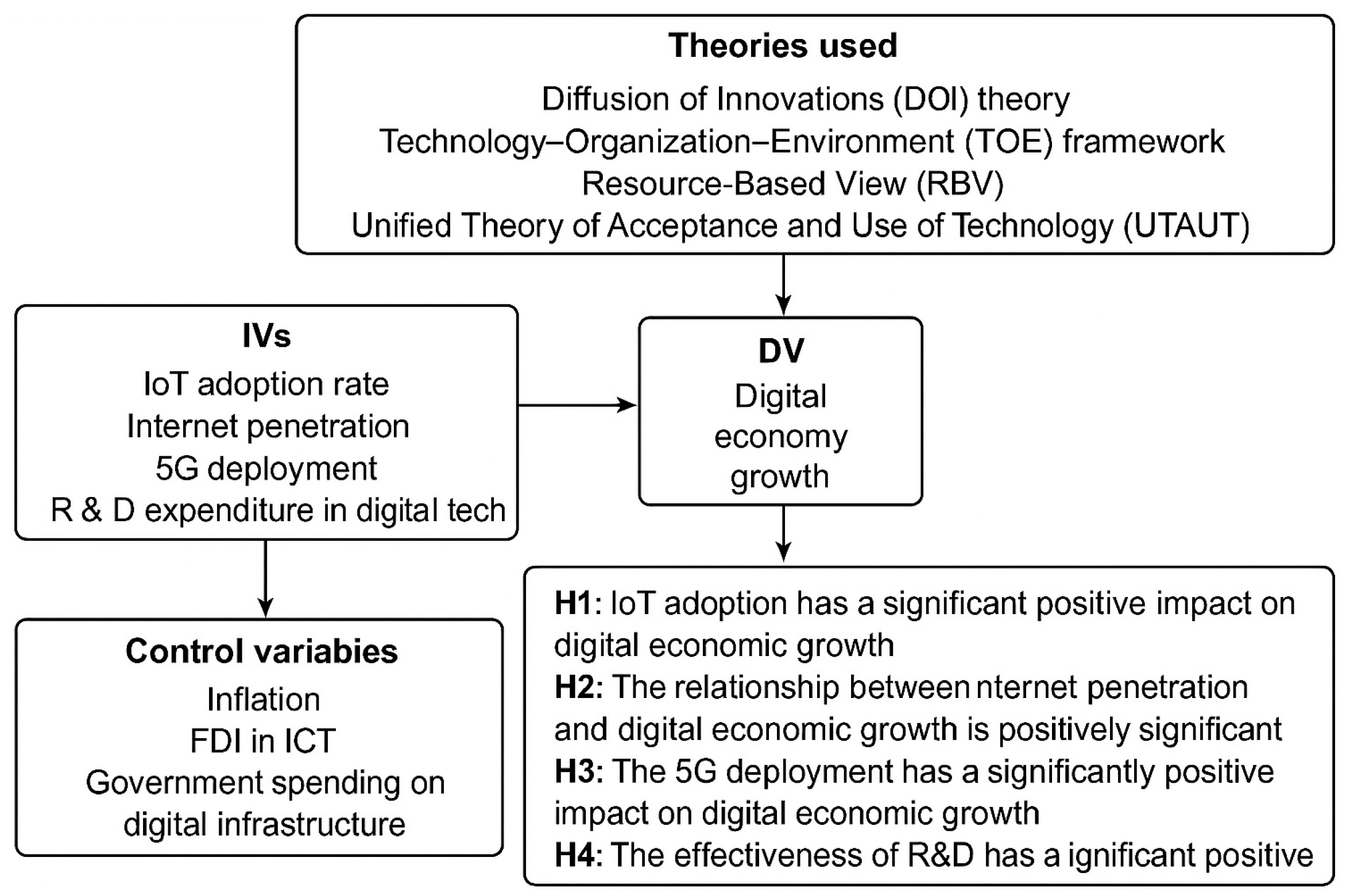
Figure 1 conceptual framework illustrates how four major theories Diffusion of Innovations (DOI), Technology–Organization–Environment (TOE), Resource-Based View (RBV), and the Unified Theory of Acceptance and Use of Technology (UTAUT) collectively explain the drivers of digital economy growth. The independent variables (IoT adoption, internet penetration, 5G deployment, and R&D expenditure in digital technologies) are positioned as key technological and organizational enablers that directly influence the dependent variable, digital economy growth.
Control variables such as inflation, FDI in ICT, and government spending on digital infrastructure help isolate these effects by accounting for macroeconomic and policy-related influences. The hypotheses (H1–H4) articulate the expected positive relationships between each technological factor and digital economy growth, reinforcing the theoretical assumptions that technological readiness, innovation diffusion, organizational capabilities, and user acceptance all contribute to accelerating digital economic development.
5. Methodology and Data Source
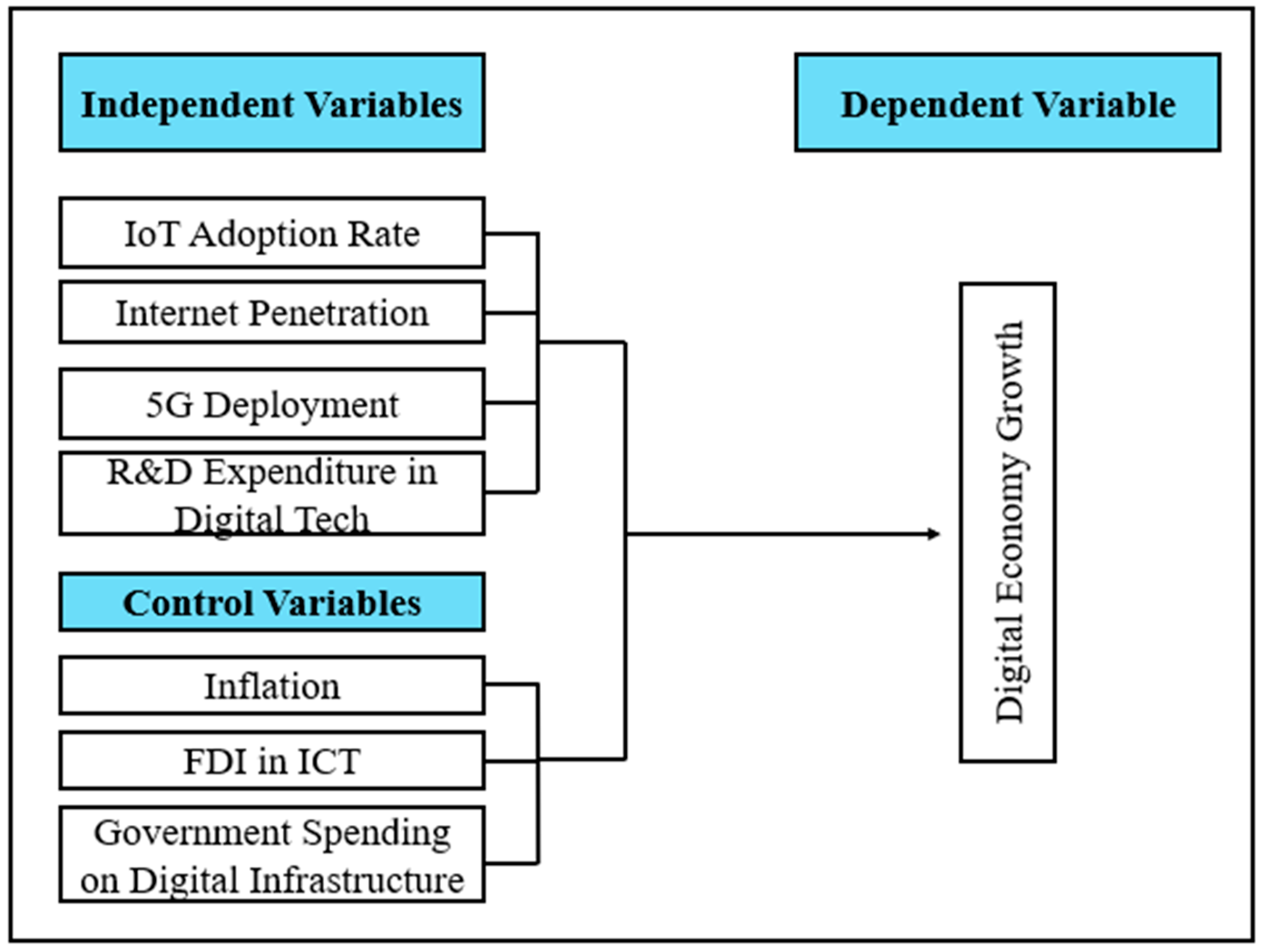
This study explores the influence of Internet of Things demand, internet penetration, 5G, and R&D from 2015 to 2023, utilizing linear regression analysis. To check the long and short-run impact further, the study has used panel ARDL [
38]. The research framework of the study is shown in
Figure 2.
For this study, data were collected from authoritative and standardized sources to ensure accuracy and reliability. The Digital Economy Growth data, measured in billion SAR, were obtained from the General Authority for Statistics (GASTAT), which provides comprehensive insights into the economic contributions of the digital sector. The IoT adoption rate percentages were taken from reports published by the Communications, Space, and Technology Commission (CST) that indicate the percentage of IoT adoption by industry. Data on Internet Penetration rates were also retrieved from CST, which reported a 99% penetration rate in Saudi Arabia in its 2023 report. Fifth-Generation Deployment percentage data were compiled from CST publications regarding the deployment and coverage of 5G throughout the country. GASTAT’s Consumer Price Index reports were used to obtain inflation rates. Data on Foreign Direct Investment (FDI) in the Information and Communications Technology (ICT) sector were collected from the Ministry of Investment and show the value of FDI in ICT in billion SAR. Lastly, Government Spending on Digital Infrastructure (in billion SAR) was obtained from GASTAT and illustrates the state’s financial investments in developing digital infrastructure.
5.1. Description of Variables
The dependent variable, Digital Economy Growth (DEG), measures the expansion of the digital sector within the economy, encompassing activities such as e-commerce, digital services, and information technology, and reflects the sector’s contribution to overall economic development [
39]. The independent variables include the IoT adoption rate. The IoT refers to a network of interconnected physical devices such as sensors, machines, and digital systems that collect, transmit, and process data through the internet with minimal human intervention. IoT enables real-time monitoring, automation, and intelligent decision-making across industries [
1,
40]. In this study, IoT represents the percentage of IoT adoption across industries in Saudi Arabia, reflecting the extent to which organizations utilize IoT technologies to support digital transformation and economic development. Data for the IoT were collected from official reports published by the Communications, Space, and Technology Commission (CST) of Saudi Arabia. These reports provide annual IoT adoption rates by industry, expressed as percentages, which indicate the degree to which different sectors have implemented IoT technologies [
41]. Internet Penetration, which denotes the proportion of the population with internet access [
42], and has reached 99% in Saudi Arabia as of 2023; 5G Deployment, measuring the extent of 5G technology implementation within the region [
43] and Research and Development (R&D) Expenditure in Digital Technology, indicating the financial resources allocated to digital technology research and development [
44]. In order to account for other economic influences, the study utilizes additional controls including Inflation, Foreign Direct Investment (FDI) associated with Information and Communications Technology (ICT), i.e., the sum of the foreign investment in the ICT industry (which would include technology-oriented businesses, such as telecommunications providers); and Government Spending on Digital Infrastructure (to date, Saudi Arabia has invested a total of SAR 93.7 billion into building its digital infrastructure).
5.2. Model Specification and Analytical Techniques
In this study, linear regression is used to examine the relationship between the digital economy and economic growth [
45]. Linear regression is a basic statistical analysis that finds the relationship between the dependent and independent variables and fits the best linear line over the observed data [
46]. It was one of the most commonly used models in economic research, as it was simple, interpretable, and therefore practical for modeling outcomes and making predictions. By using linear regression, we can measure the degree and direction of the relationship between digital economy parameters and economic growth, thereby providing insight into how changes in digital infrastructure and adoption rates may affect aggregate economic activity. The structure of the linear regression model is:
where;
α0 is the intercept term, indicating the expected value of DEG when all independent variables are zero. μᵢ is the error term, accounting for unobserved factors and random noise affecting digital economy growth for entity i.
The panel Autoregressive Distributed Lag (ARDL) model is employed to investigate further the short- and long-run effects of the variables on the growth of the digital economy [
47]. This panel ARDL approach allows variables to have mixed orders of integration, such as I(0) or I(1), making it appropriate for datasets with mixed orders of integration. Furthermore, the panel ARDL model can estimate short-run dynamics and long-run relationships simultaneously [
38], making it more convenient for comprehensively examining the economic growth of the digital economy and the time effects of related factors. It is particularly beneficial for examining the effects of fast-moving variables on digital economic growth, as well as for exploring how these short-run effects persist over time, providing decision-makers and stakeholders with a rounded view of the pathway of digital-led economic growth. Drawing on the framework presented in
Figure 1, the ARDL model employed to analyze the link between the digital economy and economic growth is formulated as follows:
The main motivation for employing panel data in this study is its capacity to capture effects at the population level rather than the individual level [
48]. Panel data also offers advantages in addressing heteroscedasticity and is particularly valuable in situations where long-term time-series data are limited—a common challenge in developing countries and in datasets comprising repeated cross-sectional observations [
49]. To estimate both short- and long-run dynamics, this study adopts a panel Autoregressive Distributed Lag (panel ARDL) model, an econometric technique well-suited for analyzing relationships across time and entities [
50]. As highlighted by [
51], the ARDL approach is especially relevant because it accommodates lagged values of both dependent and independent variables, consistent with the Granger causality inherent in economic relationships. This is particularly advantageous when examining persistent variables and their long-term outcomes. Moreover, the ARDL methodology is widely preferred in empirical economic research due to its flexibility in handling co-integration, dynamic interactions, endogeneity, and non-stationarity among variables [
52].
The simplified ARDL (p, q, q, …, q) model is specified as:
Yit is the dependent variable, as (Xit) is a vector of r independent variables (Xit) where the vector should consist of (r = 0), (r = 1) process of [AR(0)] [AR(1)] and cointegration. Where δi is the coefficient of the lagged dependent variable, scalar. The coefficients βij correspond to the independent variable vector. The term ϕi captures unit-specific fixed effects, where i = 1, …, N is the cross-sectional dimension and t = 1, 2, 3, …, T is the time dimension. p and q indicate the optimal lag orders, and εit is the residual term, reflecting unobserved disturbances in the model.
The revised ARDL (p, q, q, q, …, q) error correction model is specified as
In the preceding equation, represents digital economic growth (DEG) as the dependent variable, incorporating both lagged and differenced terms to capture short- and long-run effects. Conversely, denotes the set of independent variables, which also include lagged and differenced values to account for dynamic interactions within the model.
6. Results and Analysis
The results of the linear regression presented in
Table 1 show that the IoT has a positive effect on the DEG of Saudi Arabia. It indicates that with the growth and proliferation of IoT technology, the digital economy makes a prominent advancement. The result aligns with the studies by [
53,
54], which show that IoT delivers automation, data analytics, and real-time decision-making critical elements that are essential to propelling digital transformation and improving economic efficiency. For example, within Saudi Arabia, growing IoT adoption fuels smart city initiatives such as NEOM and Vision 2030, and encourages progress toward digital economic growth.
The findings also suggest that internet penetration positively influences DEG in Saudi Arabia. This is in line with evidence from [
55,
56] that shows that while increasing internet penetration improves access to information and broadens participation in the digital economy, digital trade gets a boost. This finding in Saudi Arabia supports national initiatives during Vision 2030 to expand internet infrastructure and inclusion.
Moreover, it provides evidence that 5G development (5GD) has an adverse effect on Saudi Arabia’s DEG. This implies that, despite its promise, the present phase of 5G rollout may involve short-term challenges with negative results that exceed short-term economic gains. Although counterintuitive, this finding aligns with other studies [
57,
58] that suggest that during the early phases of 5G deployment, high infrastructure costs and low short-term returns may temporarily clash with some economic benefits. Regarding Saudi Arabia, it is believed that the negative influence on DEG can be attributed to the fact that 5G is still being rolled out in the country, and the costs investors incur outweigh the benefits.
Research and Development (R&D) also positively affects Saudi Arabia’s DEG. It means that higher investment in R&D activities will foster digital economy development through Measuring Investment in R&D activities. Such observation aligns with the literature, which concludes that R&D investment begets innovation, develops technological capabilities, and boosts productivity [
59,
60]. For instance, in Saudi Arabia, R&D contributes to the shift away from oil-based revenues toward knowledge-based economic activity.
Additionally, results show that inflation adversely affects Saudi Arabia’s DEG while FDI and government spending on digital infrastructure (GSDI) positively influence it. DEG negatively correlates with inflation, and high inflation may lower consumer purchasing power, increase the cost of doing business, and some also argue that this will depress investment in digital technologies. On the other hand, the positive nature of FDI indicates that foreign investment has a major influence on the development of the digital economy. Foreign Direct Investment (FDI) brings not only capital but also new technologies, expertise, and business practices that support the growth of digital sectors. Likewise, the positive effect of government spending on digital infrastructure highlights the importance of public investment in creating the foundational systems, such as broadband networks, data centers, and smart technologies, that enable digital services and innovation.
6.1. Diagnostic Tests
Table 2 presents the diagnostic tests. The Wooldridge test for autocorrelation reports an F-statistic of 1.94 with a
p-value of 0.186, indicating that the null hypothesis of no first-order autocorrelation cannot be rejected. This suggests that the residuals are not serially correlated, and the dynamic structure of the panel ARDL model is appropriately specified. However, the Modified Wald test for groupwise heteroscedasticity yields a χ
2 value of 27.58 with a
p-value of 0.000, providing strong evidence of heteroscedasticity across the panel. This implies that the variance of the error terms differs across units or years, a common occurrence in macroeconomic and technological datasets. Additionally, the Pesaran cross-sectional dependence test produces a CD statistic of 3.21 and a
p-value of 0.001, indicating significant cross-sectional dependence. This means that the variables across the panel units are interrelated and influenced by common shocks or shared national-level policies.
6.2. Unit Root Test
Table 3 presents the results of the ADF and PP unit root tests for all variables under consideration. The results indicate that the variables InP and R&D are stationary at the level, as both the ADF and PP test statistics are significant at conventional levels. This implies that these variables are integrated of order zero, I(0). On the other hand, the variables DEG, IoT, and 5GD are non-stationary at the level but become stationary after first differencing. Both ADF and PP tests show statistically significant results at the first difference, confirming that these variables are integrated of order one, I(1).
The unit root test results suggest a mixed order of integration among the variables: InP and R&D are I(0), while DEG, IoT, and 5GD are I(1). This combination of integration orders is suitable for applying techniques such as the ARDL bounds testing approach to examine long-run relationships among the variables.
6.3. Cointegration
Table 4 reports the results of the panel cointegration tests, including both panel and group statistics, to assess whether the variables are co-integrated, indicating a stable long-run equilibrium relationship. The tests include the v-statistic, rho-statistic, t-statistic, and ADF-statistic, based on the Pedroni cointegration testing framework. The results show that the rho, t, and ADF statistics for both the panel and group dimensions are significantly negative, indicating the rejection of the null hypothesis of no cointegration. Although the panel v-statistic is negative and not significant, the remaining test statistics particularly the panel t-statistic (−7.102), group t-statistic (−8.215), panel ADF (−8.356), and group ADF (−9.124) all provide strong evidence in favor of cointegration.
Therefore, the overall findings support the existence of a long-run cointegration relationship among the model’s variables. This justifies the use of further long-run estimation techniques, such as the Panel ARDL, to explore the dynamic relationships among the variables.
6.4. Post-Estimation Results for Short-Term and Long-Term
In
Table 5, the results reveal that IoT has a positive, statistically significant impact on long-run DEG, indicating that increased adoption of IoT technologies contributes to sustained digital economic development. However, in the short run, IoT exhibits a negative and statistically insignificant effect on DEG, suggesting that short-term fluctuations in IoT implementation may not immediately translate into economic benefits, possibly due to initial adaptation costs or lagged effects. The ECT is negative and statistically significant at the 7% level, confirming an adjustment process. This means any short-run imbalance returns to the long-run path over time, and the system gradually reverts to it.
In addition, the positive impact of IoT on DEG aligns with the research in [
61,
62], which shows that IoT adoption positively influences productivity, innovation, and digital infrastructure, thereby promoting long-term economic development. On the contrary, these insignificant negative effect findings in the short run dispute the relatively optimistic perception of [
63], who argue that IoT adoption has the potential to deliver immediate improvements in operational performance. It aligns with [
64], which argues that high implementation costs and adaptation difficulties might delay near-term benefits. The negative error correction term also aligns with [
65], suggesting a slow adjustment process that corrects short-term deviations from equilibrium while establishing a stable long-run equilibrium.
The results in
Table 6 show that Internet penetration (InP) has a positive, statistically significant effect on the growth of DEG in both the short- and long-run. This means that the more immediate access and use of the internet are offered, the faster a digital economy builds, supporting digital transactions, communication, innovation, and access to digital services. The short-run effect suggests that the benefits of improvements to internet infrastructure can materialize quickly. In contrast, the long-run effect underscores the infrastructure’s significance for the continued digitalization and transformation of the economy. Furthermore, negative and statistically significant ECT at the 8% level suggests that deviations from the long-run equilibrium are being appropriately corrected over time.
The finding that Internet penetration (InP) positively and statistically significantly affects DEG both in the long run and short run is consistent with the study of [
66,
67], which found that better internet access stimulates economic growth by building connectivity, information flow, and the adoption of digital services. Other recent works, however, support the idea that internet infrastructure brings immediate, and often sustainable, benefits to digital transformation and economic performance, particularly in developing and emerging economies, a phenomenon previously noted by [
68,
69]. In other words, the presence of the negative and significant error correction term is consistent with dynamic models [
70], which postulate that short-run fluctuations in economies adjust to long-run equilibrium through this hysteretic adjustment, thereby strengthening the stability of the internet-DEG dynamics in the long run.
Moreover, the results in
Table 7 suggest that the implementation of 5G positively and significantly affects the growth of the DEG in both the short and long run. It can be concluded that the introduction of 5G significantly improves digital economic activities immediately and in the long run. This suggests that investments in 5G infrastructure enhance connectivity, support advanced technologies, and improve digital services, thereby boosting the digital economy at all stages. The error correction term (ECT) is negative and statistically significant at the 6% level, which aligns with theoretical expectations for a stable long-run relationship. A negative and significant ECT indicates that any short-run deviations from the long-run equilibrium are gradually corrected over time. This implies that the system exhibits convergence toward its long-run path, and the adjustment mechanism works effectively to restore equilibrium following a shock.
The finding aligns with the studies by [
71,
72], which emphasize that 5G technology enhances digital connectivity, drives innovation, and supports the adoption of advanced digital applications, all of which contribute directly to economic growth. These studies argue that 5G creates immediate efficiency gains (short-run effects) and lays the foundation for long-term digital transformation. Similarly, refs. [
73,
74] report highlight that early investments in 5G infrastructure lead to measurable improvements in digital productivity and economic competitiveness. Nonetheless, the observed negative and significant ECT is consistent with the standard behavior anticipated in dynamic models, where a negative ECT indicates convergence toward the long-run equilibrium. This finding suggests that deviations from the long run path are corrected over time, aligning with previous studies such as [
70], who also reported stable and converging long-run relationships in similar models examining digital infrastructure.
Additionally, the results in
Table 8 show a positive short- and long-run effect of research and development (R&D) on DEG, indicating that higher investment in R&D significantly contributes to economic growth, both in the short and long run. In addition, the error correction term (ECT) is negative and significant at the 8% threshold level, indicating a stable adjustment process in which short-term deviations from the long-run equilibrium are gradually corrected over time.
This result is in line with [
75] endogenous growth theory and [
76] work on research and development, and it supports the investment in research and development, which leads to innovation and sustained long-term growth. Ultimately, OECD reports and Cohen and [
77] show that R&D leads to better economic performance, increased innovation, and enhanced absorptive capacity. This view is also supported by the short-run and long-run positive effects observed in this study. Results differ from those of [
78,
79], who find R&D benefits concentrated in or conditioned by institutional and absorptive capacity in developed economies. Therefore, while the findings broadly support established theories linking R&D to economic growth, they may offer a contrasting view to studies that highlight regional or institutional limitations on R&D’s effectiveness.
7. Discussion
The results demonstrate a robust positive effect of IoT adoption on Saudi Arabia’s DEG, providing empirical support for the Technology–Organization–Environment (TOE) framework. From a technological perspective, IoT enables automation, real-time analytics, and intelligent decision-making [
53,
54], directly enhancing productivity and operational efficiency. Organizationally, the ability to integrate IoT depends on internal capabilities such as digital infrastructure, skilled workforce, and managerial support factors emphasized by TOE as critical for effective technology deployment. In Saudi Arabia, the Vision 2030 agenda acts as a macro-level facilitator, creating an institutional environment that mitigates adoption barriers and encourages alignment between organizational readiness and national digital objectives. Thus, the positive IoT effect is not only a reflection of technological capabilities but also of systemic coordination between policy, firms, and technology ecosystems.
Internet penetration similarly exhibits a significant positive impact on DEG, consistent with the Diffusion of Innovations (DOI) theory. Beyond simply increasing connectivity, greater Internet access reduces transaction costs, accelerates information flows, and enhances the visibility of digital solutions, effectively lowering the adoption threshold for both firms and consumers. This mechanism underlines a feedback loop: higher Internet access leads to broader digital engagement, which stimulates further technological diffusion and reinforces long-term digital economic expansion.
Conversely, early-stage adoption of technologies such as 5G demonstrates initial negative or limited short-run effects, consistent with DOI’s recognition that innovations initially face structural and economic constraints. Implementation barriers including high infrastructure costs, limited interoperability, and organizational unpreparedness [
57,
58] slow diffusion. Over time, however, as complementary technologies and skills mature, these constraints diminish, allowing 5G and IoT to jointly amplify productivity and digital service delivery. This dynamic highlights the importance of considering adoption as a phased process, where long-run benefits emerge after short-term integration challenges are overcome.
Empirical evidence also emphasizes the strategic role of internal resources. R&D investment consistently exhibits a positive effect on DEG, reflecting the Resource-Based View (RBV) perspective that innovation capabilities constitute key strategic assets. R&D enhances absorptive capacity, enabling firms to identify, assimilate, and leverage new technologies for competitive advantage [
59]. Similarly, foreign direct investment (FDI) introduces advanced technologies, managerial expertise, and best practices, reinforcing RBV’s assertion that external knowledge inflows can complement internal resources to drive sustainable economic outcomes. These mechanisms suggest that Saudi Arabia’s digital growth is not only technology-driven but also knowledge-driven, where the generation, transfer, and effective utilization of knowledge form the core of economic transformation.
Macroeconomic conditions, however, can mediate these effects. Inflation negatively affects DEG, consistent with the environmental dimension of TOE. Higher prices increase uncertainty, raise operational costs, and reduce the expected return on technological investments, slowing adoption. This indicates that even with advanced technology and strong institutional support, environmental stability is crucial for translating adoption into measurable economic gains. In contrast, government expenditure on digital infrastructure exerts a positive effect, highlighting the role of public institutions in reducing technological friction, subsidizing network externalities, and enhancing the absorptive capacity of firms and consumers alike.
The ARDL analysis further provides nuanced insights into the temporal dynamics of these effects. While IoT’s short-run impact may be muted or even slightly negative due to integration costs and learning curves, the long-run effect is strongly positive, reflecting cumulative gains from efficiency, innovation, and digital infrastructure development. The negative and significant error correction term (ECT) confirms that deviations from the long-run equilibrium are gradually corrected, illustrating a self-stabilizing system where initial shocks or adoption delays do not derail long-term growth. This aligns with DOI theory’s diffusion logic, showing that technological systems eventually converge toward stability as adoption networks expand.
Furthermore, the long-run significance of Internet penetration and 5G demonstrates the reinforcing interaction between connectivity and technology adoption. Enhanced networks facilitate IoT deployment, while IoT applications create incentives for further network expansion, producing a virtuous cycle of technological and economic growth. This interaction highlights the nonlinear nature of digital economic transformation, where short-term disruptions coexist with structural forces that amplify long-term benefits.
Finally, the persistent positive effect of R&D emphasizes the centrality of knowledge creation and absorption, consistent with Romer (1990) and Cohen and Levinthal (1989) [
75,
77]. Saudi Arabia’s increasing institutional maturity, improved innovation policies, and human capital investments suggest that the country is progressively strengthening the mechanisms through which R&D and technology adoption translate into sustainable digital economic growth. While studies like [
79] caution that institutional deficiencies can limit R&D effectiveness, the observed convergence dynamics and robust long-run effects indicate that Saudi Arabia’s digital innovation ecosystem is maturing and capable of sustaining growth.
8. Policy Implications
Based on the empirical findings and theoretical interpretations, several policy implications emerge to support and sustain Saudi Arabia’s DEG. First, the positive long-run impact of IoT suggests that policymakers should continue to prioritize investments in IoT infrastructure, particularly through initiatives like Vision 2030 and NEOM. However, to address the observed short-run inefficiencies, government and industry stakeholders must support businesses in overcoming initial adaptation barriers through financial incentives, technical training, and standardized integration frameworks. Similarly, the strong short- and long-run influence of internet penetration calls for continued expansion of high-speed internet access, particularly in rural and underserved areas. Policies should focus on affordability, digital literacy programs, and public–private partnerships to accelerate the diffusion of digital tools and ensure inclusive participation across all segments of society, as framed by the DOI theory.
Furthermore, in addition to demonstrating the co-integration between 5G and DEG, it is also revealed that the error correction term (ECT) behaves in an unusual manner, suggesting structural instability and underlying economic risk. Policymakers thus need to put in place policies to steer solutions to first-order challenges, such as 5G infrastructure roll-out subsidies, regional equitable distribution, and user readiness, thereby smoothing the transition to a 5G-enabled economy. The positive effect of R&D on DEG was consistent across models, suggesting significant room to improve innovation policy, such as by increasing public and private R&D investment, stimulating interaction between academia and business, and incentivizing entrepreneurship in knowledge-intensive industries. Alongside this, we must attract FDI into sectors conducive to technology transfer and innovation. Finally, the negative effect of inflation on DEG underscores the need to ensure macroeconomic stability. Policymakers must take proactive steps to put in place sound fiscal and monetary policies to insulate the digital economy from inflation, while continuing to invest in digital infrastructure. By employing the TOE framework and RBV theory to guide the implementation of government initiatives, the current research will contribute to strengthening the institutions of the economy, thereby fostering innovation capabilities and a resilient digital economy.
9. Conclusions
The primary objective of this study was to investigate the impact of IoT demand on Saudi Arabia’s digital economy. Using linear regression and panel ARDL, the empirical results highlight the role of digital technologies and innovation-related factors in driving Saudi Arabia’s DEG, underpinned by theoretical insights from the TOE framework, the DOI theory, and the Resource-Based View (RBV). The long-run positive impact of the IoT and internet penetration emphasizes the importance of technological readiness, organizational support, and widespread connectivity in fostering digital transformation. These findings reinforce the TOE and DOI perspectives, suggesting that institutional commitment, such as through national projects like Vision 2030, and increased access to digital infrastructure, create an enabling environment for economic growth. However, short-run limitations, such as the delayed impact of IoT and unexpected divergence in 5G adoption, signal that innovative outcomes are not always immediate and may face structural or transitional barriers, especially in the early stages of deployment. Moreover, the empirical finding of substantial and long-run contributions of R&D and FDI to DEG supports the RBV’s proposition that a competitive and resilient digital economy depends on the productivity of its internal capabilities and strategic resources. Simultaneously, the negative impacts of inflation highlight the fragility of digital transformation processes to context and macroeconomic volatility, which, in line with TOE’s environmental dimension, cannot be controlled at the organizational level. The differences in ECT results stemming from 5G adoption and related industries call for future research and consideration of their associated businesses, as the shock to 5G implementation in developing countries requires a better approach to infrastructure and organizational readiness for new technologies.
10. Limitations of the Study
Although this study provides important insights into the impact of IoT demand on the digital economy of Saudi Arabia by applying linear regression and panel ARDL models, a few limitations should be noted. While the methodology used captures both short- and long-run effects, it may not do justice to the complex, nonlinear interactions underlying digital technology adoption, especially for all-seeing technologies like 5G. The limitations of existing data will likely hinder the accuracy and extent of these results. Moreover, the study relies on macroeconomic indicators and does not address micro-level or firm-specific dynamics, which could yield valuable insights into organizational readiness and user adoption patterns.
11. Future: Research Directions
Future studies need to investigate sector-level effects of IoT adoption, use firm-level datasets to assess organizational readiness, and employ advanced modeling techniques to gain deeper insights. Studies can also integrate TOE, DOI, and RBV frameworks, investigate structural challenges to 5G adoption, and regional comparisons to position Saudi Arabia’s digital agenda within the GCC.