1. Introduction
As global challenges intensify, from climate change and resource scarcity to social inequality and digital disruption, educators are increasingly expected to prepare students not just for professional success, but for meaningful contributions to a sustainable future. In the Gulf region, where rapid economic development intersects with ambitious national visions such as the UAE’s Centennial 2071 and Qatar’s National Vision 2030, integrating sustainability into higher education has become both a strategic imperative and a pedagogical challenge [
1,
2,
3]. In response, higher education institutions (HEIs) across the Gulf region are aligning their curricula with national visions and global frameworks such as the United Nations (UN) Sustainable Development Goals (SDGs). However, embedding sustainability into teaching and learning requires more than content revision; it demands pedagogical transformation, cultural contextualization, and educator development.
This paper presents a multiple case study of two Gulf-based universities, the American University of Sharjah (AUS) in the United Arab Emirates (UAE) and Northwestern University in Qatar (NUQ), to explore how educators across disciplines are integrating sustainability into their courses while fostering their own professional growth. The cases span a range of fields, including information systems, digital marketing, business analytics, and the social sciences, reflecting the need for sustainability education that is both interdisciplinary and contextually grounded. Each course incorporates AI-creative tools, digital tools, project-based learning, and experiential strategies to cultivate students’ sustainability competencies, while also enabling educators to reimagine their roles as designers of transformative learning environments.
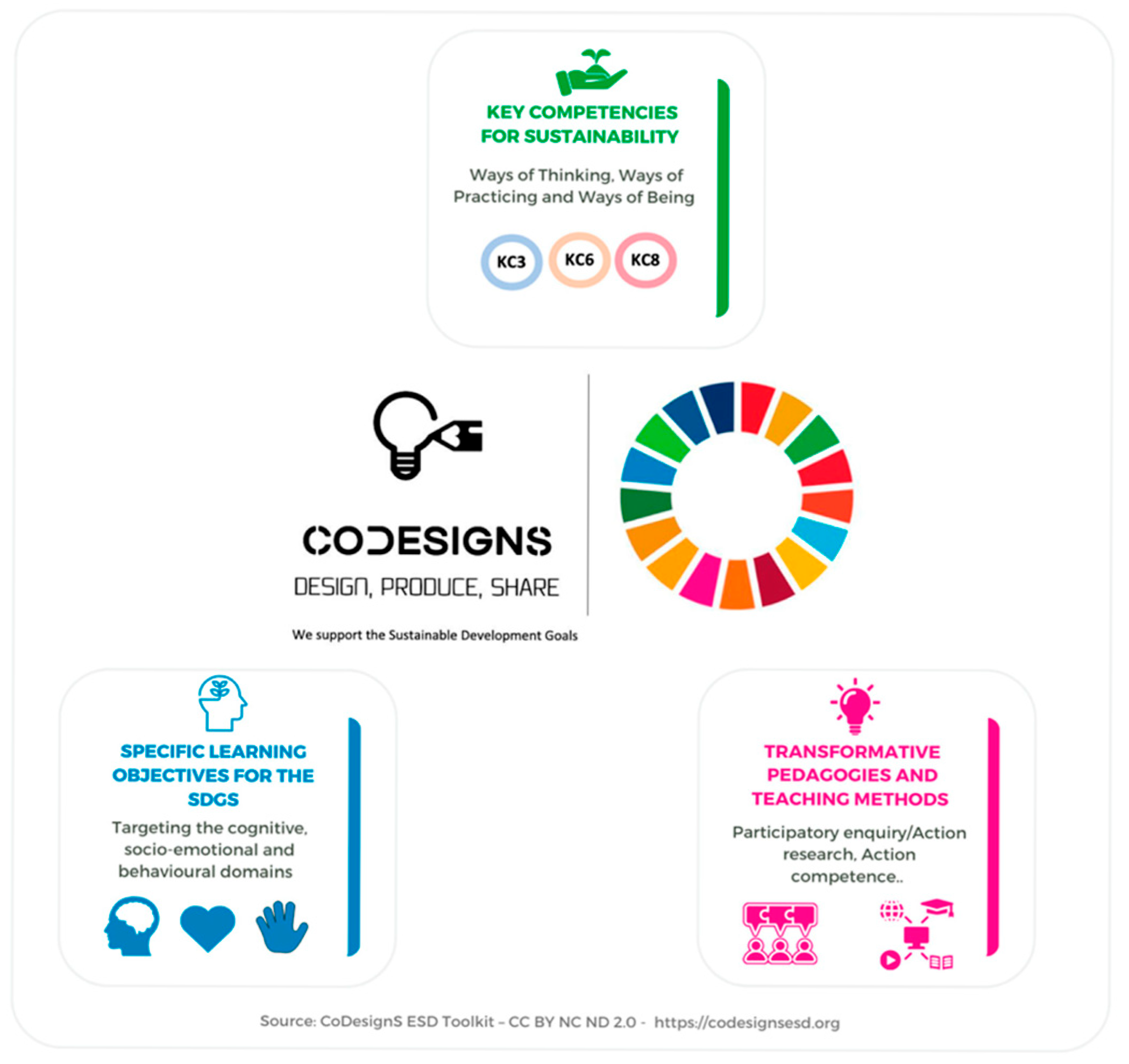
To guide this study, we apply the CoDesignS Education for Sustainable Development (ESD) Framework [
4], which supports curriculum innovation through three core pillars: (1) development of key sustainability competencies such as systems thinking, critical thinking, and collaboration; (2) alignment with specific learning objectives tied to the SDGs; and (3) implementation of transformative pedagogies including culturally responsive, problem-based, and experiential learning. By analyzing how these pillars manifest within course design and instructional practice, this study sheds light on how educators themselves evolve as they work to embed sustainability meaningfully into their teaching.
As higher education institutions worldwide grapple with their role in responding to sustainability and climate challenges, the expectations placed on educators are evolving. Educators are increasingly expected to transcend traditional content delivery roles, taking on responsibilities as facilitators of transformative learning within increasingly internationalized, interdisciplinary contexts [
5,
6]. In the Gulf, this shift intersects with national development agendas and global aspirations. By investigating how sustainability is embedded in the classroom using the CoDesignS ESD framework, this study asks: How can embedding sustainability in curriculum design catalyze changes in educators’ teaching identity, method, and agency? In doing so, it contributes to emerging literature on sustainability pedagogy, educator development, and transformative practice [
7,
8].
3. Conceptual Framework
This study is guided by the CoDesignS ESD Framework [
4], which offers a structured and adaptable approach to embedding sustainability meaningfully into curriculum design. Developed through interdisciplinary research and tested in diverse teaching contexts, the CoDesignS ESD Framework (see
Figure 1) is particularly suited to internationalized higher education institutions where educators are challenged to integrate global priorities like the SDGs into locally relevant pedagogical practices. The framework’s holistic model comprises three core pillars: (1) Key Sustainability Competencies, (2) Specific Learning Objectives (SLOs) for the SDGs, and (3) Transformative Pedagogies and Teaching Methods.
3.1. Key Sustainability Competencies
The first pillar emphasizes the development of core sustainability competencies, including systems thinking, anticipatory thinking, critical thinking, collaboration, and self-awareness [
1,
5]. These competencies are essential for equipping students to navigate complex, interdependent global challenges such as climate change, social inequality, and technological disruption. For educators, integrating these competencies requires rethinking not just course content but also learning outcomes, assessments, and instructional strategies. In Gulf-based classrooms, where students often come from diverse cultural and educational backgrounds, the emphasis on collaborative and critical engagement helps foster inclusive and globally oriented learning environments [
6,
8]. At the same time, educators themselves build capacity as they develop strategies for embedding abstract competencies into concrete learning activities.
3.2. Specific Learning Objectives (SLOs) for the SDGs
The second pillar focuses on aligning curriculum design with explicit learning objectives drawn from the SDGs, particularly those relevant to each course’s disciplinary focus and social context. This pillar ensures that sustainability integration is not symbolic or superficial but tied directly to measurable and meaningful outcomes. By working toward defined sustainability targets, educators are able to articulate clear goals, track student progress, and reflect on their own growth in designing impactful learning experiences. Recent literature emphasizes the need for such intentionality to move from awareness-raising to transformative action in higher education [
7,
15].
3.3. Transformative Pedagogies and Teaching Methods
The third pillar of the CoDesignS ESD Framework is the use of transformative teaching methods that support deep learning and personal engagement with sustainability. These include problem-based learning, experiential learning, culturally responsive teaching, and digital pedagogy. In the context of Gulf higher education, where classrooms are often multilingual and multicultural, these approaches empower students to connect sustainability content with their lived realities and cultural contexts. For faculty, adopting these pedagogies requires a shift from traditional, content-heavy teaching to more facilitative, reflective, and learner-centered approaches. This pedagogical shift is itself a form of professional development, as educators expand their repertoire, experiment with innovative tools, and deepen their awareness of student diversity [
9,
13].
In applying the CoDesignS ESD Framework, this study explores how these three pillars are actualized within classroom environments in two universities, one in the UAE and one in Qatar, across disciplines including information systems, media, business analytics, and the social sciences. Each case reveals a unique trajectory of sustainability integration, shaped by institutional contexts, instructor positionalities, student demographics, and curricular constraints. Yet across all cases, the framework enables a shared language and structure for evaluating both student learning and educator development.
Furthermore, by positioning educators not merely as implementers of sustainability curricula but as co-designers and reflexive practitioners, the framework offers a lens through which professional growth can be examined. As instructors adapt their teaching strategies, reconfigure learning outcomes, and experiment with new technologies and partnerships, they engage in a dynamic process of transformation that parallels the changes they seek to inspire in their students.
This conceptual framework thus bridges the dual focus of this study: embedding sustainability into higher education curricula and understanding the accompanying professional development of educators. It provides a coherent scaffold for analyzing diverse pedagogical practices while acknowledging the cultural and institutional specificity of sustainability education in the Gulf region.
4. Methodology
This study adopts a qualitative multiple case study approach [
18] to explore how embedding sustainability in course design supports faculty development. It draws on reflective practitioner inquiry, in which the authors, who are also the course instructors, engage in systematic analysis of their own pedagogical practices. Data sources include course syllabi, lesson plans, student assignments, reflective journals, and curriculum design documentation.
The study was conducted across two institutions: AUS in the UAE and NUQ in Qatar. Both institutions were purposefully selected for their stated institutional commitments to sustainability and education innovation. AUS has integrated sustainability into its institutional strategy through its Office of Sustainability and the Center for Innovation in Teaching and Learning (CITL), which supports faculty in redesigning courses aligned with the UN SDGs. NUQ, as a liberal arts branch campus of a major U.S. university, promotes curricular innovation and interdisciplinary collaboration through its educational development office and its support for integrating global challenges into coursework.
The contrasting institutional contexts, AUS with a stronger focus on science, technology, and engineering and NUQ emphasizing communication, media, and liberal arts, offered a valuable opportunity to explore how diverse disciplinary and institutional contexts shape educators’ engagement with sustainability. At the same time, both institutions are globally oriented, internationally accredited, and explicitly engaged with sustainability education strategies. These shared commitments and differing pedagogical environments allowed for comparative insight into how sustainability design frameworks enhance educator learning and agency.
The multiple case study design was chosen for its capacity to capture contextual dynamics across institutional and disciplinary settings, while enabling in-depth examination of teaching practices [
18]. The integration of reflective practitioner inquiry complemented this approach by situating the educators as active agents in their own professional learning, consistent with the study’s constructivist epistemology. Methodologically, this alignment allowed for both descriptive and interpretive analysis of teaching processes, while ensuring that pedagogical choices, such as the use of project-based learning, digital tools, and sustainability-focused assessment, were explicitly connected to the study’s theoretical grounding in the CoDesignS ESD Framework. Together, these methodological and didactic decisions provided a coherent structure to examine how sustainability integration operates as both an instructional and developmental process.
4.1. Case Selection
Purposeful sampling was used to select the two institutions based on their active engagement in sustainability-related teaching and their faculty members’ willingness to participate in reflective course-based inquiry. In total, six course iterations were analyzed: three from AUS and three from NUQ. The AUS courses included ISA405 (Information Systems Strategy), ISA383 (Python 3.13 for Business Analytics), and ISA301 (Fundamentals of Database). The NUQ courses included STRATCOM 307 (Digital, Social, and Mobile Marketing), STRATCOM 311 (Applied Research Methods) and STRATCOM 307 (Digital, Social, and Mobile Marketing). These courses span disciplines including information systems, business analytics, communication, journalism, and interdisciplinary general education, providing a broad base for comparative analysis.
4.2. Participants
The study includes two faculty members, one from each institution, who served as both instructors and co-researchers. Participants were purposefully selected based on their demonstrated experience in teaching interdisciplinary courses, their commitment to sustainability education, and their active engagement in pedagogical innovation. Both faculty members had a minimum of ten years of university teaching experience and held terminal degrees in their respective fields, Information Systems and Communication. Their teaching backgrounds include designing and delivering courses that integrate real-world problem-solving, digital tools, and experiential learning methods. Each participant, familiar with the CoDesignS ESD Framework, designed and taught courses that explicitly embedded sustainability learning outcomes aligned with the UN SDGs, incorporating approaches such as project-based learning, community-based activities, and digital storytelling.
Given their dual role as educator and investigator, the authors approached this study through the lens of reflexive practitioner inquiry. Both hold strong commitments to sustainability education and view teaching as a transformative practice. One author is based at a STEM-focused institution emphasizing business analytics and digital transformation, while the other works at a liberal arts campus with a strong communication and global challenges orientation. These differing institutional settings enriched the dialogue and enabled cross-contextual insights. Throughout the study, both maintained reflective teaching journals and engaged in analytic dialogue to surface assumptions, question biases, and ensure trustworthiness in interpretation.
To mitigate potential bias stemming from the dual role of instructor-researchers, multiple strategies were employed. First, we engaged in collaborative coding and theme validation between the two researchers to reduce subjectivity and ensure intersubjective agreement. Second, data triangulation was applied by integrating multiple sources, course materials, reflective memos, and debriefing sessions, allowing cross-verification of emerging themes. Third, given the dual role of the instructor-researchers, member checking involved cross-reviewing each other’s interpretations to minimize individual bias and reinforce the validity of the findings. These measures, combined with reflexive journaling and transparent documentation of decision-making processes, strengthened the credibility and trustworthiness of the findings [
19].
4.3. Data Collection
Data for this study were gathered through a combination of teaching artifacts and instructor reflections over the course of a full academic term. As the researchers were also the instructors of the selected courses, the data collection process was embedded within the teaching practice itself. Materials analyzed included course syllabi, weekly lesson plans, assessment briefs, and in-class learning activities. These documents provided insight into how sustainability concepts were framed and operationalized within the curriculum.
In addition to instructional materials, each educator maintained a reflective teaching journal throughout the semester. These journals served as an introspective tool to record pedagogical decisions, moments of student engagement, challenges encountered, and evolving understandings of sustainability integration. The reflections enabled the instructors to track their own professional learning in parallel with course delivery.
Student artifacts, such as submitted projects and discussion board contributions, were also reviewed to understand how learners engaged with sustainability themes. While individual students were not the focus of the analysis, these outputs helped illustrate the instructional impact and the alignment between pedagogical intent and learning outcomes. Finally, the two instructors engaged in collaborative dialogue through a series of analytic memos, where they compared teaching strategies, contextual constraints, and emergent insights across institutional settings.
Student work was not subjected to formal qualitative coding. Instead, these artifacts were used to provide illustrative examples that contextualized and supported the instructors’ reflective analyses. The aim was not to analyze student outputs as primary data, but to better understand how students engaged with sustainability themes and how instructional approaches may have influenced that engagement.
4.4. Data Analysis
The analysis followed a qualitative, interpretive approach, drawing on Braun and Clarke’s thematic analysis method [
19] to identify recurring patterns across course materials, reflections, and student outputs. Student artifacts were examined only to corroborate and illustrate instructors’ reflections, not as independently coded data, ensuring the analytic focus remained on educator development.
Each instructor first conducted an independent review of their own course artifacts, coding the data inductively to capture emerging ideas related to sustainability integration, digital pedagogy, and professional learning. For instance, initial codes included phrases such as “student-led SDG exploration,” “use of local context,” “student-centered assessment,” and “reflection on educator identity.” These were subsequently grouped into broader themes such as “curriculum co-creation,” “localization of sustainability,” and “professional transformation.” They were then mapped into the three pillars of the CoDesignS ESD Framework: key sustainability competencies, SDG-aligned learning objectives, and transformative pedagogies.
After individual coding, the two instructors engaged in collaborative sensemaking sessions to compare findings and discuss how their pedagogical approaches and institutional contexts influenced the implementation of sustainability-oriented teaching practices. This cross-case dialogue served both as an analytical and reflexive exercise, allowing the researchers to interrogate their assumptions, highlight contextual distinctions between institutions, and refine the overarching themes.
Thematic patterns were then interpreted through the lens of the CoDesignS ESD Framework, situating each finding within its conceptual dimensions while also connecting back to broader discussions in the literature on sustainability education and educator development. This process allowed the analysis to move beyond descriptive accounts of practice toward a deeper understanding of how teaching for sustainability simultaneously fosters student engagement and educator professional growth.
To ensure that these interpretations were credible and transparent, additional procedures were implemented to establish trustworthiness and mitigate potential researcher bias, as described in the following sub-section.
4.5. Trustworthiness
To ensure trustworthiness, the study employed triangulation of data sources (documents, journals, and student outputs), peer debriefing between co-authors, and member checking through revisiting interpretations with each other iteratively. The collaborative nature of the study also supported reflexivity, as both authors reflected critically on their assumptions and evolving roles as educators.
In addition, this study advances current understandings of faculty development in sustainability education by foregrounding the dynamic interplay between institutional context, pedagogical design, and educator reflexivity. While much of the existing literature emphasizes prescriptive competencies or programmatic interventions, our approach demonstrates how sustainability-oriented curriculum redesign can itself function as an iterative process of faculty learning. By embedding sustainability through the CoDesignS ESD Framework and engaging in reflective practitioner inquiry, instructors moved beyond content delivery to reframe their professional identities and teaching philosophies. This reflexive engagement, combined with methodological triangulation and cross-institutional comparison, contributed to the overall credibility and interpretive depth of the findings.
5. Context of the Study
5.1. Course Cases from the American University of Sharjah
To explore how sustainability can be meaningfully integrated into undergraduate education, this study examines three undergraduate courses offered at AUS, each led by the first author and situated within the Department of Information Systems and Business Analytics. While differing in their technical focus, ranging from strategic IT planning to data analytics and database design, all three courses exemplify the principles of the CoDesignS framework and demonstrate how digital, and sustainability pedagogies can be cohesively embedded in mainstream curricula.
The first course, ISA405: Information Systems Strategy, is the capstone course for Information Systems majors and is typically taken in the final year. In both Spring and Fall semesters of 2024, students in this course engaged in a semester-long project developed in partnership with one of the largest regional e-commerce platforms. The project challenged students to address sustainability-related business problems such as excessive product returns, inefficient packaging, unsustainable supply chains, and rising carbon emissions from logistics. Students worked directly with industry mentors to propose IS-based solutions that incorporated advanced technologies such as AI-driven analytics to reduce return rates, blockchain for ethical sourcing transparency, and green data center initiatives. Using scenario planning and technology road mapping, students developed strategic recommendations aligned with SDG 12 (Responsible Consumption and Production). The course foregrounded sustainability competencies, including systems thinking, anticipatory thinking, and integrated problem-solving, all of which are central to the CoDesignS framework. Through interdisciplinary collaboration and mentorship-based learning, students developed a deeper understanding of the strategic role of information systems in driving sustainable transformation and responsible global citizenship.
The second course, ISA383: Python for Business Analytics, is an intermediate-level programming course that introduces students to Python for real-world data analysis. In the Spring 2024 offering of the course, a special project theme titled “Coding for Sustainability” was introduced, allowing students to apply their technical skills to globally and regionally relevant sustainability topics. Project themes included climate change, fashion industry waste, and water scarcity, with many students selecting issues rooted in the Gulf context. Using tools such as Pandas 3.13, Matplotlib 3.10, and GitHub 3.15.2, students developed data-driven stories that highlighted current sustainability challenges and offered evidence-based recommendations. By drawing on trend interpretation and predictive analysis, students were able to apply anticipatory thinking to envision sustainable interventions. These projects cultivated data literacy and critical thinking, while also supporting the development of sustainability competencies within the CoDesignS framework. The course primarily contributed to SDG 12 and SDG 13 (Climate Action), showcasing how programming can serve as both a technical and ethical tool for sustainable change.
The third course, ISA301: Fundamentals of Database Systems, is a required course for Information Systems and Business Analytics students and a common elective for majors in Data Science and Finance. The course integrated technical skills in relational database design with sustainability themes. Students were tasked with designing databases for real or hypothetical organizations committed to the UN SDGs. Projects included database solutions for entities like Masdar (renewable energy), Bee’ah (waste management), and other regional actors, with thematic focus areas such as water conservation, emissions tracking, and responsible consumption. Deliverables included stakeholder analysis, entity-relationship (ER) diagrams, and normalized relational schemas. Through this hands-on and contextualized approach, students developed not only technical competencies but also a deeper appreciation of the role data infrastructure plays in achieving sustainability outcomes. The course reinforced SDG 12 and SDG 11 (Sustainable Cities and Communities) and exemplified the problem-based learning and authentic assessment elements highlighted in the CoDesignS framework.
Together, these three courses illustrate how diverse digital competencies, strategic planning, coding, and database development can be embedded with sustainability principles in ways that are pedagogically sound and culturally responsive. By leveraging real-world challenges, interdisciplinary approaches, and digital tools, each course moved beyond content delivery to foster meaningful engagement with the values and practices of sustainable development. These case studies provide the foundational context for the findings that follow, which examine how the CoDesignS framework facilitated this pedagogical transformation across different technical domains.
5.2. Course Cases from Northwestern University in Qatar
To explore how sustainability competencies can be embedded within communication-focused curricula, this study also examines three undergraduate courses offered at Northwestern University in Qatar (NUQ), each taught by the second author and situated within the Journalism and Strategic Communication program. While distinct in their emphasis on digital campaigns, applied research, and audience engagement strategies, these courses demonstrate how the CoDesignS framework can be adapted beyond technical or STEM-focused disciplines to advance ESD through media and communication disciplines.
The first course, STRATCOM 307: Digital, Social, and Mobile Marketing, was offered in Fall 2023 and centered on the theme of digital sustainability campaigns. Students developed digital-first communication strategies to promote sustainable behaviors within the NUQ campus community, addressing issues such as food waste, sustainable fashion, and plastic use. The projects were guided by Specific Learning Objectives (SLOs) aligned with SDG 12 (Responsible Consumption and Production) and SDG 13 (Climate Action), and were framed through the CoDesignS framework. Students engaged in digital simulations prior to campaign execution and applied scenario planning and digital content design to craft persuasive messaging across platforms like Instagram and TikTok. The course fostered anticipatory thinking, systems thinking, and ethical communication competencies. Campaigns incorporated culturally relevant storytelling strategies and gamified participation to maximize impact. By blending theory with digital practice, this course illustrated how social media can be leveraged as a tool for sustainability education and student-led activism.
The second course, STRATCOM 311: Applied Research Methods, was offered in Summer 2024 and integrated sustainability themes into its core research design. Students conducted team-based, mixed-methods research on sustainability communication within Gulf-based aviation companies. Their investigations focused on corporate messaging, environmental claims, and consumer perceptions of green initiatives, drawing upon frameworks such as Situational Crisis Communication Theory (SCCT). Research outputs included structured surveys, stakeholder interviews, and content analysis of airline branding and sustainability reports. Learning objectives were aligned with SDG 9 (Industry, Innovation and Infrastructure) and SDG 13 (Climate Action), and projects encouraged students to apply critical thinking, collaboration, and research ethics. The course enabled students to connect communication theory to real-world sustainability practices, deepening their understanding of the role of messaging in environmental behavior change and corporate accountability. It also reinforced how applied learning can be a powerful vehicle for sustainability competencies in non-STEM disciplines.
The third course, a later offering of STRATCOM 307: Digital, Social, and Mobile Marketing in Fall 2025, built upon the earlier campaign design efforts but shifted the focus from awareness-raising to behavior change. Titled “From Awareness to Action,” the course encouraged students to revise and refine previous campaign strategies to address long-term engagement and measurable campus impact. Teams conducted participatory research to co-design interventions with different campus segments, students, faculty, and staff, ensuring contextual sensitivity and relevance. Campaigns included live activations, digital scavenger hunts, and short-form video content, aligned with CoDesignS principles of problem-based learning and authentic assessment. Students demonstrated strong anticipatory and integrated problem-solving skills while applying data analytics to track campaign effectiveness. The instructor also used iterative design and feedback loops to model reflective pedagogical practice, emphasizing the educator’s role as a sustainability co-learner and facilitator. This advanced iteration of the course showed how digital marketing education can evolve to meet both learner needs and sustainability goals over time.
Together, these three NUQ courses showcase how strategic communication education can embrace sustainability through the CoDesignS framework. By aligning course objectives with the SDGs, applying interdisciplinary digital methods, and promoting global and local awareness, the courses demonstrate that ESD can thrive in diverse academic contexts. These case studies complement the AUS examples by illustrating how sustainability can be translated into powerful, community-driven narratives, supporting both the cognitive and affective dimensions of sustainable development.
6. Findings and Discussion: Embedding Sustainability Through Practice and Reflection
This section examines how the design and implementation of the AUS and NUQ courses aligned with the CoDesignS ESD Framework and supported both student and educator growth. Drawing on course materials, instructor reflections, and teaching documentation, three major themes emerged across the two institutions:
intentional alignment with sustainability competencies,
integration of digital and experiential pedagogies, and,
evolving identity of the educator as a co-designer of learning.
To synthesize the cross-case findings,
Table 1 presents a summary of how the three key themes identified were demonstrated across the six course cases. The table highlights examples from both AUS and NUQ, offering comparative insights into how these themes were enacted within different disciplinary and institutional contexts. Each row also maps the themes back to the pillars of the CoDesignS Framework, reinforcing how the framework served as a scaffold for both curriculum development and educator transformation. The discussion that follows expands on each theme, drawing on illustrative examples from the cases to analyze how sustainability integration shaped both pedagogy and educator development.
6.1. Aligning Course Design with Sustainability Competencies
Across both AUS and NUQ, courses demonstrated deliberate alignment with key sustainability competencies such as systems thinking, anticipatory thinking, and critical thinking. At AUS, ISA405 required students to explore the interdependencies in e-commerce logistics and propose long-term, ethical, and digitally driven sustainability strategies. Similarly, ISA383 encouraged students to extract insights from environmental datasets and anticipate future sustainability challenges through programming. ISA301 reinforced systems thinking through database design projects aligned with real sustainability use cases.
At NUQ, courses situated within the Media and Communication program took a humanities-driven approach to the same competencies. One course focused on environmental journalism, where students analyzed case studies of climate change reporting in the Global South and developed their own investigative multimedia packages. These assignments encouraged critical and anticipatory thinking, with an emphasis on equity and storytelling. Another NUQ course engaged students in designing public communication campaigns around SDG-aligned initiatives in Qatar, developing systems maps to understand audience engagement, stakeholder interests, and policy dynamics.
In both institutions, instructors used the CoDesignS framework to intentionally map learning outcomes and assessments to broader sustainability objectives. Rather than treating sustainability as an add-on, it became an integrated anchor for curriculum design, challenging students to connect their disciplinary training to urgent real-world needs. These findings underscore that sustainability integration, when supported by intentional frameworks and institutional alignment, can act as a catalyst for faculty growth, agency, and transformation, challenging the notion that faculty development must always be externally driven [
11,
15].
6.2. Integrating Digital and Experiential Pedagogies
Digital tools and experiential learning served as enablers of deeper engagement across both AUS and NUQ courses. At AUS, students used scenario planning, AI, and blockchain simulations (ISA405), as well as Python-based visualizations (ISA383), to frame sustainability as both a technological and social challenge. Database projects (ISA301) were grounded in authentic organizational contexts, reinforcing practical application.
At NUQ, digital media production tools were central to both learning and assessment. Students in the environmental journalism course (STRATCOM 307) employed open-source platforms for geospatial mapping, podcast editing, and data visualization, while those in the applied research methods (STRATCOM 311) course collaborated with real-world NGOs and government entities to produce communication strategies tailored for sustainability awareness. These activities enabled students to experience the intersection of digital fluency, audience understanding, and sustainability messaging.
Both institutions demonstrated a commitment to experiential authenticity. Whether through mentorship at AUS or stakeholder interviews and campaign prototyping at NUQ, students engaged in learning environments that extended beyond the classroom and mirrored professional practice. These pedagogies embody the transformative principles outlined in the CoDesignS ESD framework, enabling students to move from knowledge acquisition to participatory action.
6.3. Instructor Development and the Role of Reflective Practice
A shared outcome across all five case studies was the evolving role of the instructor. Faculty at both AUS and NUQ described a pedagogical shift from being content experts to becoming facilitators and co-designers of learning experiences. Integrating sustainability into domain-specific courses, whether in information systems or media, required reflection, experimentation, and iterative adaptation.
At AUS, instructors noted the need to balance technical learning objectives with open-ended inquiry and ethical deliberation. The CoDesignS ESD framework offered a scaffold to explore interdisciplinary integration while maintaining rigor. At NUQ, instructors emphasized the challenge of bridging communication theory with applied sustainability narratives. Their reflections pointed to the value of reflexivity, especially when navigating contested social and environmental issues in multicultural classrooms.
Most importantly, faculty at both institutions reported personal and professional growth through this process. Designing for sustainability competencies, aligning with SDGs, and embedding cultural relevance became not just teaching goals but also pathways for academic renewal. The reflective cycles embedded in the CoDesignS ESD Framework enabled faculty to continuously refine their pedagogical approaches while engaging with students as partners in knowledge co-creation.
These findings reaffirm the utility of the CoDesignS ESD Framework, while also revealing new layers of complexity. For example, the inclusion of culturally responsive projects and locally anchored SDG themes by faculty in both cases extended the framework’s emphasis on contextualization. Faculty reflections also emphasized a reciprocal process. While the framework was designed to transform student learning, it also transformed educators themselves, prompting shifts in mindset, teaching philosophy, and sense of purpose. However, tensions around time constraints, institutional silos, and student readiness underscored the limits of individual innovation within static systems. These empirical insights both validate and enrich the theoretical foundations of the framework, suggesting future refinements that account for faculty development and institutional scaffolding as parallel pillars of transformative sustainability education.
6.4. Limitations
This study is subject to several limitations that should be acknowledged. First, the small sample size (N = 2), while allowing for in-depth qualitative exploration, limits the breadth of perspectives captured and constrains the generalizability of the findings. Second, the dual role of the participants as both instructors and researchers raises the potential for bias, despite efforts to incorporate reflexivity and collaborative validation throughout the analysis. Third, while the study draws on rich student artifacts and reflections, it provides limited direct evidence of measurable student competency development aligned with the SDGs, which may require further longitudinal or mixed-method studies. Finally, the findings are rooted in two specific institutional and cultural contexts, which may affect their transferability to other settings. Nonetheless, these limitations are balanced by the study’s contributions to practice-based knowledge and the development of actionable frameworks for sustainability pedagogy.
7. Conclusions
This multiple case study examined the dual transformation that occurs when educators embed sustainability into higher education curricula through a structured and reflective framework. By applying the CoDesignS ESD Framework across diverse courses at AUS and NUQ, this paper explored not only how sustainability is integrated into teaching practice but also how this process catalyzes faculty professional growth.
Our findings confirm that the CoDesignS ESD Framework offers a robust framework for aligning course design with key sustainability competencies, such as systems thinking, anticipatory thinking, and collaboration, while facilitating the integration of transformative digital and experiential pedagogies. The case studies, spanning disciplines from information systems and business analytics to digital marketing and applied research, demonstrate that technically oriented and professionally focused fields offer fertile ground for embedding sustainability, extending ESD beyond its traditional association with environmental science.
The central contribution of this study lies in its response to the guiding research question: when sustainability is approached as a design challenge, it becomes a powerful catalyst for changes in an educator’s identity, method, and agency. Our reflective analysis revealed that the iterative process of designing, implementing, and adapting sustainability-infused courses prompted a shift in our professional roles, from content transmitters to co-designers and facilitators of transformative learning. Practice itself emerged as the site of professional growth, underscoring the pedagogical value of experiential curriculum development.
For higher education in the Gulf region, this study offers a contextually grounded, educator-led model for change that resonates with national agendas such as the UAE Centennial 2071 and Qatar National Vision 2030. It suggests that institutional sustainability goals are most effectively realised not through top-down compliance, but by empowering faculty with flexible frameworks that cultivate agency and support pedagogical innovation.
We acknowledge the limitations of this study. As a qualitative inquiry rooted in the reflective practice of the authors, its strength lies in depth and contextual richness rather than generalisability. Future research should expand this inquiry across a broader range of disciplines and institutions, both within the Gulf region and globally, to further validate and adapt the CoDesignS framework. Longitudinal studies that trace the evolution of faculty identity over time, alongside rigorous assessments of student competency development, would offer valuable extensions to this research.
Ultimately, this paper argues that embedding sustainability in higher education is not a technical exercise in content addition, but a transformative professional journey. By equipping educators with the structure and agency to co-design curriculum, institutions can unlock a powerful, organic, and self-sustaining engine for pedagogical innovation and meaningful faculty development.
Beyond the two Gulf-based universities examined, the findings carry broader implications for global ESD practice. They highlight the importance of empowering educators as agents of change through participatory design frameworks like CoDesignS ESD, which can be adapted across institutional contexts and disciplines. The approach demonstrated here offers a transferable pathway for universities worldwide seeking to move from sustainability rhetoric to tangible, classroom-level transformation. By fostering a culture of reflective curriculum co-design, higher education institutions can advance both educator professionalization and systemic progress toward the UN SDGs.