1. Introduction
With the rapid development of the global economy and the continuous improvement in industrialization, environmental problems are becoming increasingly prominent. How to reduce carbon dioxide emissions and maintain sustainable economic development is a critical issue of global concern. After signing the Paris Agreement, China formally put forward its “dual carbon” goals at the 75th United Nations General Assembly in September 2020: “striving to peak carbon dioxide emissions before 2030 and achieve carbon neutrality before 2060”. In 2022, the Chinese government issued the “Implementation Plan for Further Improving the Market-Oriented Green Technology Innovation System (2023–2025)”, emphasizing the key role of green technology in low-carbon development and proposing to strengthen enterprises’ principal position in innovation and build a green technology innovation system. In 2025, the Chinese government issued the “Opinions on Promoting Voluntary Disclosure of Greenhouse Gas Information by Enterprises”, which also provides guidance on the carbon information disclosure of enterprises.
Green technology innovation, as a key engine of sustainable development, emphasizes the integration of environmental friendliness and development efficiency. It achieves ecological protection through reducing pollution, improving resource utilization, and has a positive driving force on economic and social development. On the one hand, from the perspective of enterprise development, green technology innovation enhances production efficiency, reduces costs, and enables companies to gain green premiums [
1]. It also enhances enterprises’ market competitiveness [
2] and improves their financial performance [
3]. On the other hand, from an environmental protection perspective, green technology innovation not only improves urban carbon emission performance [
4] but also significantly enhances industrial enterprises’ ESG ratings and social value. This broader impact is corroborated by studies on clean-energy technology pathways, including research on hydrogen production systems. For example, the green technology approach of integrating hydrogen energy at wind farms can convert unstable wind power into storable hydrogen energy, effectively resolving wind curtailment issues while significantly reducing carbon emissions and environmental pollution through clean energy substitution [
5]. Additionally, emerging green technologies and end-of-pipe treatment technologies can help industrial enterprises reduce CO
2 emissions [
6].
In the era of rapid digital economy development, digital transformation has become the core driving force for enterprise growth. Existing research indicates that digital transformation significantly improves resource allocation efficiency [
7,
8]. It also enhances the competitive advantage of manufacturing enterprises [
9], boosts operational performance by increasing firms’ efficiency and effectiveness [
10], and exerts a significant positive impact on total factor productivity [
11]. In 2023, the Chinese government released the “Overall Layout Plan for the Construction of Digital China”, emphasizing the digital transformation as a key driver for high-quality development. It advocates for the coordinated development and deep integration of industrial digitalization, intellectualization, and greening, aiming to leverage digital technologies to enable green transformation. Tang et al. (2023) [
12] found that digital transformation enhances corporate green technology innovation through technological innovation effects, collaborative innovation networks, and the alleviation of financing constraints; similarly, Liu et al. (2025) [
13] demonstrated that it fosters enterprise innovation capability by cultivating cooperative and innovative cultures. Meanwhile, Song et al. (2025) [
14] revealed that digital transformation drives green transition by improving the quality of environmental information disclosure.
However, existing research also indicates that digital transformation can yield certain negative effects. For instance, Sang and Huang (2025) [
15] suggested that while digital transformation enhances efficiency, it may simultaneously undermine operational flexibility. Furthermore, studies have identified a spatial spillover effect of digital transformation on green technology innovation. Specifically, Du et al. (2024) [
16] found that regions with advanced digital development tend to attract enterprises from neighboring areas, thereby inhibiting green technology innovation in those neighboring regions. Given these complex implications, clarifying the impact and internal mechanisms of digital transformation on green innovation is crucial for advancing corporate sustainability and formulating effective environmental policies.
Since enterprises are the primary entities responsible for carbon emissions, their carbon information disclosure is not only a requirement for a green economy but also a social responsibility they must fulfill. Wang et al. (2024) [
17] found that carbon information disclosure can promote green technology innovation through internal governance mechanisms such as reducing agency costs and enhancing human capital. Ma (2025) [
18] pointed out that carbon information disclosure helps companies improve transparency and boost investor confidence, thereby lowering the financing costs of corporate green innovation. Furthermore, they also indicated that corporate green innovation can reduce pollution, improve resource utilization efficiency, and ultimately enhance corporate performance.
Meanwhile, the media, as a highly credible information intermediary, can leverage rich expressions to improve the transparency of environmental information and enhance stakeholders’ understanding, thereby reducing information asymmetry [
19]. Research has found that media attention can help reduce financing costs, alleviate financing constraints, and change the situation of insufficient green investment in enterprises [
20]. In addition, by thrusting companies into the public spotlight, media incentivizes them to build a green reputation and strengthen environmental protection efforts. This greater public visibility elevates the importance of green technology innovation, allowing firms to demonstrate their commitment to responsible and sustainable growth.
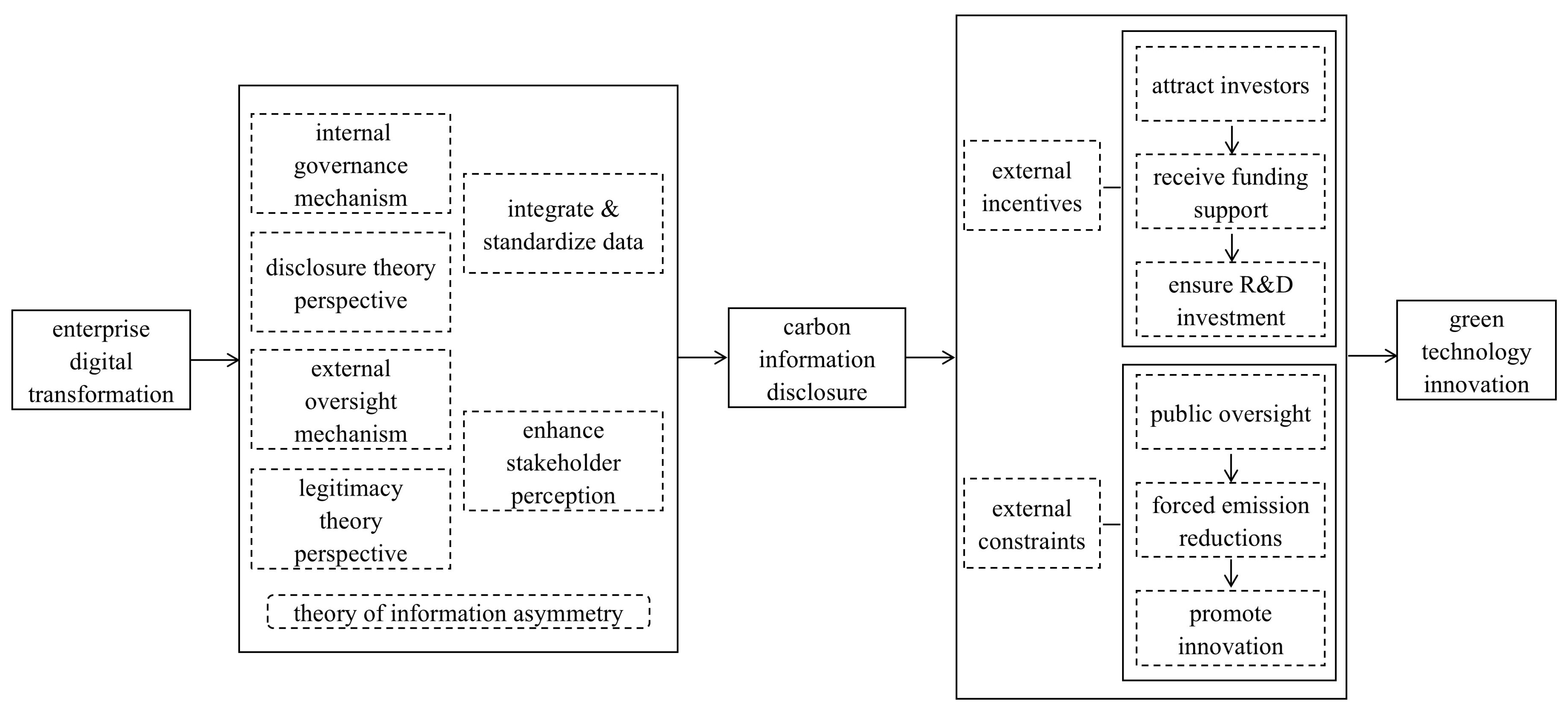
Current studies on how enterprise digital transformation affects green technology innovation leave critical gaps in explaining the underlying integrated mechanisms. First, the mediating role of carbon information disclosure remains underexplored, particularly within a broader causal chain. Previous studies have seldom positioned carbon disclosure as a critical transmission channel. In this mechanism, digital transformation enhances monitoring and management capabilities, which improves carbon transparency. This transparency, in turn, creates external incentives and regulatory pressure that foster green innovation. Second, the moderating effect of media attention has been largely overlooked, especially its potential to amplify existing mechanisms. In the digital era, media serves as both cognitive infrastructure and a meaning-making framework, significantly lowering the public’s costs for interpreting information. However, research has not systematically investigated how media attention might strengthen the relationship between digital transformation and green innovation. Third, the research on heterogeneity needs to be improved in terms of methodology. Most current heterogeneity studies primarily rely on grouped regression followed by a simple comparison of coefficient differences. However, they often lack formal tests for these differences across groups, thus leaving it uncertain whether the observed disparities are statistically significant [
21].
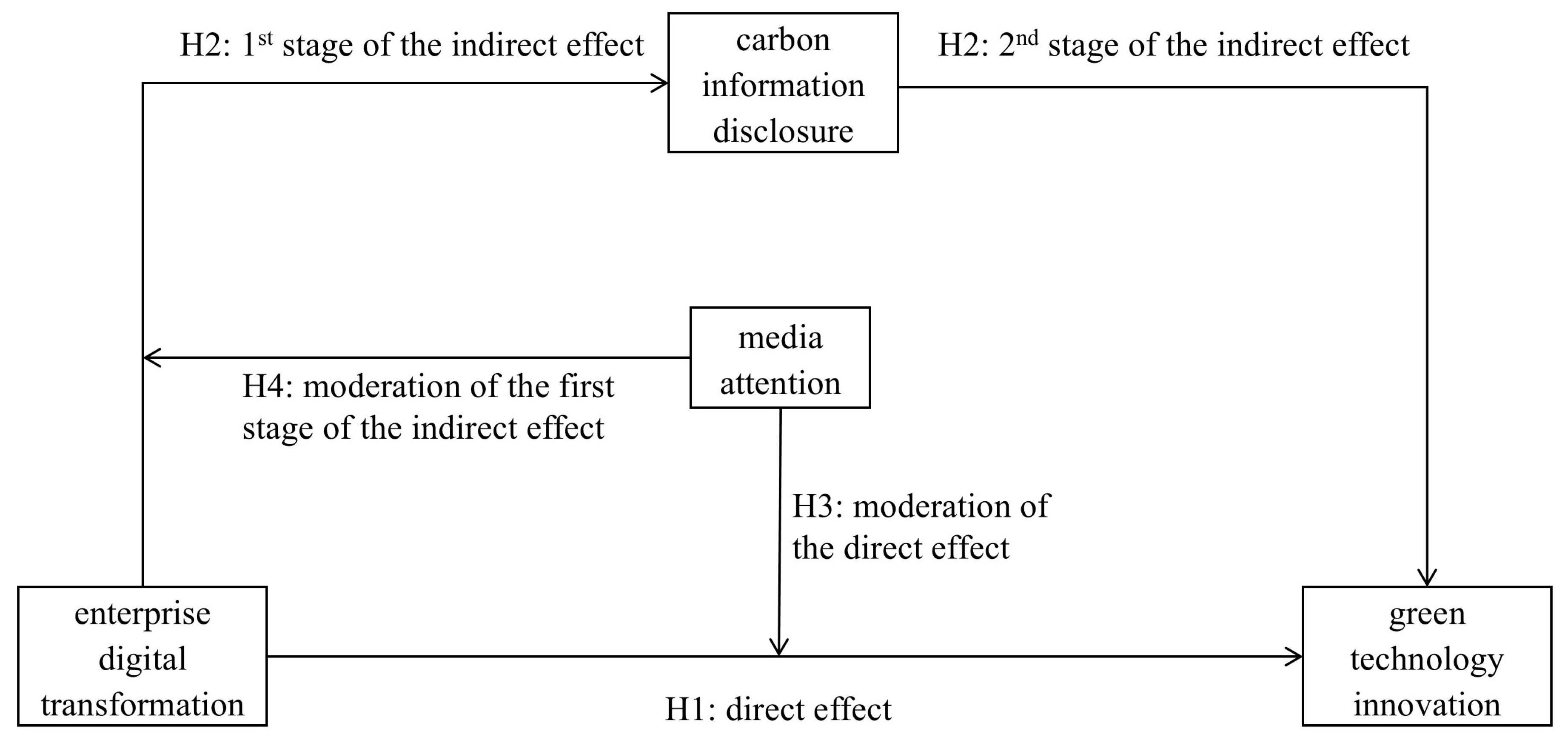
In order to fill these research gaps, this paper constructs a joint framework of the mediating role of carbon information disclosure and the moderating effect of media attention, so as to better reveal the impact mechanism of enterprise digital transformation on green technology innovation. In this study, the inter-group difference test will also be carried out in the grouped regression on heterogeneity studies, so as to obtain statistically reliable conclusions. Our framework centered on “information” as the core nexus to systematically elucidate the intrinsic mechanisms among corporate digital transformation, carbon information disclosure, media attention, and green innovation. The framework’s logic unfolds as follows: digital transformation serves as the technological foundation, enhancing a firm’s information processing capacity to efficiently and accurately generate and account for carbon data, thereby enabling high-quality carbon information disclosure. Carbon information disclosure acts as a critical bridge, transforming internal information into external signals and managerial pressure. This, on one hand, compels management to address environmental costs through green innovation, and on the other hand, attracts external resource support, thereby driving green innovation. Throughout this process, media attention plays a pivotal contextual moderating role. By amplifying public scrutiny through agenda-setting, it not only strengthens the firm’s willingness to disclose carbon information but also ensures that disclosure commitments translate into substantive green innovation actions, preventing greenwashing.
In measuring carbon information disclosure, this study builds upon text analysis by introducing the entropy weight method to determine dimensional weights, aiming to provide a potential pathway for optimizing traditional carbon disclosure indicator construction through a data-driven, objective weighting approach. The framework reveals the transmission path from digital technology to information behavior and finally to green innovation. By simultaneously examining the mediating effect of carbon information disclosure and the moderating effect of media attention, it expands the research perspective from a singular technological determinism to a systemic level of technology-governance-environment interaction. This reveals the mechanisms through which digital transformation drives green innovation and deepens the understanding of how digital technology promotes green innovation by reshaping corporate information governance models and responding to external institutional pressures.
The potential contributions of this paper are as follows: First, this study verifies mediating role of carbon information disclosure on the relationship between enterprise digital transformation and green technology innovation. Digital transformation can reduce information asymmetry, thereby improve the carbon information disclosure, and then create a more complete resource allocation environment and innovation incentive mechanism for green technology innovation. Our study contributes to the mechanistic understanding of this topic. Second, this study confirms the moderating role of media attention, which strengthens both the direct effect of digital transformation on green technology innovation and its indirect effect through carbon information disclosure, thereby supporting its role as an important external governance force in corporate low-carbon development. Third, this study analyzes the heterogeneity from the perspectives of ownership, region, and enterprise size, and employs Fisher’s Permutation test method to assess the significance of inter-group differences. Chinese state-owned enterprises possess greater resources and stronger government connections due to their unique political status; and firms in western China often benefit from greater policy support; additionally, firm size also plays an important role in shaping a firm’s ability to control and utilize resources. Our research reveals statistically significant differences in all three aspects, thereby confirming prior findings.
The paper proceeds as follows. In
Section 2, we review the literature on how digital transformation drives green technology innovation, as well as on carbon information disclosure and media attention; based on this, we develop the hypotheses for this paper.
Section 3 is the research methodology, where we describe the data and variables and establish regression models.
Section 4 is the empirical results, where we conduct heterogeneity analysis, and analyze the influence mechanism from the perspectives of mediating and moderating effects.
Section 5 summarizes the analysis of this study, presents recommendations at the enterprise and government levels, and also addresses the research limitations and potential future research.
4. Empirical Results and Analysis
4.1. Descriptive Statistics
Descriptive statistics of key variables are presented in
Table 2. The value of
GTI is between 0 and 4.83, with a mean of 0.888 and a standard deviation of 1.182. The data range is large and the mean is small, indicating that there is a significant gap in the number of green patent applications between enterprises. Most enterprises have deficiencies in green research and development innovation activities, and green innovation among enterprises is in an unbalanced state. The value of
DIG ranges from 0 to 5.20, with a mean of 1.582 and a standard deviation of 1.423. This indicates that although digitalization has developed rapidly in recent years and top enterprises have undergone significant digital transformation, most enterprises are still in the early stages of transformation. The value of
CID ranges from 0 to 2.22, with a mean of 0.573 and a standard deviation of 0.580. The difference between the mean and extreme values shows that listed companies generally exhibit the characteristics of “low coverage and high differences”, which is in line with the current situation of China’s voluntary carbon information disclosure policy; and the level of carbon information disclosure needs to be improved by various companies. The value of
Media ranges from 2.94 to 7.94, with a mean of 4.990 and a standard deviation of 0.963, indicating substantial variation in media coverage across firms. From the data of other control variables, it can also be seen that there are obvious differences among enterprises.
To test for multicollinearity, this study employs Variance Inflation Factors (VIF). As presented in
Table 3, all VIF values remain well below the critical threshold of 10, with a mean value of 1.33, which indicates the absence of severe multicollinearity issues in the model.
4.2. Benchmark Regression Analysis
Table 4 reports the benchmark regression results of enterprise digital transformation on green technology innovation. To mitigate potential heteroscedasticity issues, robust standard errors clustered at the firm level are employed in the regressions. Column (1) presents the results without control variables and without controlling for fixed effects. Column (2) builds on Column (1) by incorporating control variables. In both cases, the coefficient for
DIG is statistically significant at the 1% level and positive, indicating that digital transformation has a positive promoting effect on green technology innovation. Column (3) incorporates a two-way fixed effects specification, controlling for both firm- and year-level unobserved heterogeneity. The two-way fixed effects model effectively controls for time-invariant firm heterogeneity and aggregate time trends. Specifically, it captures common time shocks, such as those stemming from nationwide policies implemented simultaneously across all firms and regions. Although the model does not account for firm-specific linear trends, it fully absorbs the influence of all time-invariant firm characteristics on the outcomes. In this case, the coefficient of
DIG is 0.0445, which is still significant at the 1% level. Since
GTI is the logarithm of the number of patent applications, this result indicates that for every one-unit increase in
DIG, the expected number of green patent applications increases by 4.45%. Overall, the regression results support the promotion effect of enterprise digital transformation on green technology innovation, and H1 is verified.
4.3. Robustness Tests
4.3.1. Lagged Explanatory Variable
Due to the long-term nature of green technology innovation, the impact of enterprise digital transformation on it may experience a lag. Therefore, following the approach of Du and Zhang (2020) [
56], this study tests for lagged effects by incorporating the explanatory variable
DIG with lags of one, two, and three periods into Model (1).
As a robustness check, this study separately examines the independent impact of
DIG on green innovation at lags of one to three periods (t − 1, t − 2, t − 3). This specification is grounded, first and foremost, in the theory of the dynamic innovation process: the short-term effect of digital transformation (t − 1) primarily stems from its role in enhancing the efficiency of existing R&D processes (exploitative innovation), whereas its deeper impact in driving fundamental technological change (exploratory innovation) requires a longer cycle of knowledge absorption and recombination (t − 2, t − 3). In terms of empirical strategy, to avoid the multicollinearity problems that arise when multiple lagged terms are included simultaneously and to unbiasedly identify the independent effect at each lag, this paper follows standard practice in empirical research by estimating the lagged terms in separate models [
57]. This approach is also consistent with the classic finding in the economics of innovation that the impact of R&D investment exhibits a lag of 1 to 3 years [
58].
The results are shown in
Table 5. Columns (1) to (3) report the estimated results of lagged periods one, two, and three, respectively, with coefficients of 0.0400, 0.0385, and 0.0212 for
DIG. Among them, the coefficients of
DIG in Columns (1) and (2) are significant at the 1% level, and that in Column (3) is significant at the 5% level. This indicates that even considering the cyclical delays in innovation activities, the enterprise digital transformation still has a significant positive impact on green technology innovation.
Together, the findings here lead to two key observations: first, compared to the baseline results in Column (3) of
Table 4, the estimated coefficient of
DIG here is significantly smaller; second, the promoting effect of corporate digital transformation on green innovation markedly weakens as the lag period increases. This finding confirms that the incentivizing effect of digital technology on green innovation is time-sensitive, with a more direct impact in the short term. The reason for this is that the initial dividends of digital transformation are quickly absorbed over time. Subsequent deeper levels of green innovation (such as the development of disruptive environmental technologies) often require substantially larger investments, longer cycles, and may encounter multiple obstacles including technological bottlenecks, financial constraints, and organizational inertia, thereby demonstrating a diminishing marginal effect of digital transformation.
4.3.2. Replace the Explained Variable
Drawing on the approach of Li and Xiao (2020) [
59], this study uses the number of green patent authorizations as a proxy for green technology innovation. This variable (
GTIchange) is measured as the natural logarithm of (1 + the total number of green patents granted to the enterprise in a given year). The regression results are shown in Column (1) of
Table 6. The coefficient of
DIG is 0.0142, which is significant at the 1% level. This indicates that the promotion effect of enterprise digital transformation on green technology innovation still holds true.
As shown in
Table 6, the impact of
DIG diminishes when patent grants are used as the dependent variable. This result suggests that enterprise digitalization plays divergent roles at different stages of the innovation process. The transition from patent applications to grants involves a rigorous screening mechanism. This indicates that digitalization may be more effective in expanding the pipeline of innovation (applications) than in enhancing the quality or compliance necessary for grant approval.
4.3.3. Exclude Some City Samples
According to the “Digitalization Evolution Index (2024)” [
60], Shanghai, Hangzhou, Beijing, Shenzhen, and Chengdu rank among the top five. These cities have achieved significant results in digital development, with obvious geographic advantages and strong innovation capabilities. Enterprises located in these cities may face more complete environmental infrastructure, more active green technology trading markets, and stricter government environmental regulations. These factors may lead to a lack of representativeness of enterprises in these cities. Therefore, this article conducts regression analysis on the remaining enterprise samples from the five cities mentioned above. As shown in Column (2) of
Table 6, the coefficient of
DIG is 0.0365, which is significantly positive at the 1% level, and the conclusion of the benchmark regression remains unchanged.
A similar pattern is also evident from the results here, which shows that the impact of DIG on GTI diminishes in the subsample that excludes top-tier cities in terms of digital development. This reveals that the effect of enterprise digitalization is not isolated but deeply embedded within the broader external environment. The observed attenuation suggests a complementary relationship between firm-level digital transformation and the city-level digital ecosystem. When advanced urban digital infrastructures are absent, the efficacy of corporate digital initiatives in fostering green innovation is significantly reduced.
4.3.4. Negative Binomial Regression
Considering that green technology innovation data are count variables and may exhibit potential over-dispersion, this study further employs negative binomial regression for empirical analysis to more accurately capture the distribution characteristics of corporate green technology innovation activities and ensure the robustness of the research findings. The results are shown in Column (1) of
Table 7. The estimated coefficient for
DIG is 0.0388, statistically significant at the 1% level, reaffirming the positive relationship between digital transformation and green technology innovation established in the baseline analysis. The regression results show that the coefficient estimates from the negative binomial regression are smaller than those from the OLS regression. This difference primarily stems from the inherent characteristics of corporate green technology innovation data, which typically contain numerous zeros and exhibit a right-skewed distribution. By introducing a dispersion parameter, the negative binomial regression better captures the over-dispersed nature of the data. Compared to OLS regression, the negative binomial approach is less sensitive to extreme values, resulting in more conservative coefficient estimates.
4.3.5. Accounting for Potential Path Dependence
We further examined the potential path dependence in enterprise green technology innovation by including its lagged term (
LGTI) as a control variable in the model. The results are shown in Column (2) of
Table 7. The empirical results demonstrate that even after accounting for this dynamic pattern, the estimated coefficient for
DIG is 0.0376, statistically significant at the 1% level. The positive impact of digital transformation on green technology innovation remains statistically significant, though its magnitude shows a moderate decrease compared to the baseline model. This result indicates that for every one-unit increase in
DIG, the expected number of green patent applications increases by 3.76%, after controlling for potential path dependence. It is reasonable to posit that the lagged term now accounts for some portion of the sustained innovation previously captured by the digital transformation variable in the static specification. This finding supports the robustness of our core conclusions from a dynamic perspective, confirming that the promoting effect of digital transformation on green innovation is persistent and stable, unaffected by accounting for the historical accumulation of innovation activities.
4.4. Endogeneity Test
To mitigate potential endogeneity concerns, this paper constructs an instrumental variable (IV) calculated as follows: first, we compute the annual average of the digitalization indicators of other firms within the same industry (i.e., excluding the firm itself), and then take the logarithm of this average value plus one. This instrumental variable effectively captures common industry trends that are exogenous to the firm. By excluding information specific to the firm itself, it significantly reduces the risk of correlation with unobserved firm-level characteristics in the error term, thereby providing a more reliable basis for accurately identifying the causal effect of digitalization on firm performance.
A two-stage least squares (2SLS) regression is then applied, and the results are shown in
Table 8. In the first-stage regression results, the coefficient of the
IV is 0.8688, which is statistically significant at the 1% level, indicating that the instrumental variable satisfies the relevance assumption; the underidentification test, the Kleibergen–Paap rk LM statistic is 118.92, significant at the 1% level, indicating no statistical issue of underidentification. In the weak instrument test, the Kleibergen–Paap Wald rk F statistic is 170.72, substantially exceeding the critical value of 16.38 at the 10% significance level based on the Stock–Yogo test, thus confirming the absence of a weak instrument problem. In the second-stage regression results, the coefficient of
DIG is 0.1758, which is significantly positive at the 1% level. Therefore, the conclusion that enterprise digital transformation promotes green technology innovation remains unchanged.
The significantly larger estimated coefficient from the instrumental variable (IV) approach compared to the OLS estimate suggests that conventional methods may have underestimated the true effect of digital transformation. This discrepancy can be largely attributed to a “resource crowding-out” effect arising from bidirectional causality: when firms channel substantial resources into green innovation projects, it may delay or crowd out investments in digital transformation. This reverse inhibitory effect introduces bias in OLS regression, diluting the observed positive correlation between digital transformation and green innovation and consequently leading to a downward bias in the estimated coefficient. In contrast, the IV method addresses this by constructing an exogenous shock, effectively isolating this interference and thereby uncovering a more genuine and pronounced promoting effect.
4.5. Heterogeneity Analysis
Recognizing that the impact of digital transformation on green technology innovation may vary by firm characteristics, this study examines heterogeneity across three dimensions: ownership, region, and firm size.
4.5.1. Ownership Heterogeneity Analysis
In China, state-owned enterprises possess a unique political status and distinct governance structures compared to non-state-owned enterprises. These inherent distinctions fundamentally shape their governance mechanisms, resource acquisition, business objectives, and risk tolerance. This study divides enterprises into two groups based on their ownership: state-owned enterprises and non-state-owned enterprises. The results of grouped regression are shown in
Table 9.
In both groups, the coefficients of DIG are significant at the 1% level, and the coefficient of the state-owned enterprises group (0.0743) is larger than that of the non-state-owned enterprises group (0.0304). To examine whether this difference is statistically significant, this study further employs Fisher’s Permutation test method to conduct an inter-group coefficient difference test. The results show that the p-value corresponding to the inter-group difference in the coefficient of DIG is 0.004, which is significant at the 1% level, confirming that the regression coefficients between these two groups indeed exhibit statistically significant difference. This indicates that the promoting effect of digital transformation on green technology innovation varies across companies with different ownership, with state-owned enterprises demonstrating a stronger promotional effect compared to non-state-owned enterprises.
The underlying mechanism for this divergence can be attributed to the fundamental differences in the “resource-institution” dual-driver logic between state-owned and non-state-owned enterprises. From the resource-based view, state-owned enterprises (SOEs), leveraging their political connections and institutional advantages, enjoy privileged access to specialized fiscal subsidies, low-cost policy loans, and critical data resources required for digital transformation. This not only alleviates financial constraints on technological innovation but also significantly reduces the uncertainties associated with long-term R&D, creating a unique resource buffer effect. From the perspective of institutional theory, their digitalization behaviors are often deeply embedded in national-level strategic initiatives (such as the “dual carbon” goals), generating strong institutional isomorphism pressures. Consequently, digital transformation is no longer merely an efficiency tool but evolves into a pursuit of legitimacy through fulfilling policy-driven social responsibilities, thereby giving rise to a targeted and resource-concentrated policy-induced green innovation pathway.
In contrast, non-state-owned enterprises are primarily driven by market competition and survival pressures. Facing severe financing constraints and disadvantages in accessing policy resources, their technological investments are often prioritized for short-term profitability and market responsiveness. As a result, their empowerment of green innovation tends to exhibit stronger characteristics of cost sensitivity and path dependency. Thus, the stronger promoting effect of digital transformation on green technology innovation in SOEs is essentially shaped by their unique institutional resource redundancy and policy-oriented objective function.
4.5.2. Regional Heterogeneity Analysis
China’s significant geographical disparities, coupled with varying levels of economic development and regional government macro-policies across different areas, may lead to divergent impacts of digital transformation on green technology innovation depending on enterprises’ regional locations. Following the economic zone classification criteria issued by the National Bureau of Statistics of China in 2021, this study categorizes 12 provincial-level regions—including Inner Mongolia, Guangxi, and Chongqing—as the western region, while classifying the remaining areas as the central-eastern region. The grouped regression results are presented in
Table 10.
The coefficients of DIG in both regression groups are statistically significant at the 1% level, and the coefficient of the western region group (0.0766) is larger than that of the central-eastern region group (0.0398). To examine whether this difference is statistically significant, this study further employs Fisher’s Permutation test method to conduct an inter-group coefficient difference test. The results show that the p-value corresponding to the inter-group difference in the coefficient of DIG is 0.052, which is significant at the 10% level; this indicates a statistically significant difference between the regression coefficients of the two groups; the promoting effect of digital transformation on green technology innovation is more pronounced in the western region.
The underlying mechanism of this phenomenon stems from the unique developmental context in Western China, shaped by the interplay of resource endowment and policy orientation. At the resource-technology alignment level, the abundance of renewable energy sources such as wind and solar power, along with mineral resources in the region, provides distinctive application scenarios for digital transformation. Through digital technologies like the Internet of Things and big data, enterprises can deeply integrate these resource advantages with specific fields such as smart grid construction and green mining, achieving effective coupling between resource conditions and technological pathways. This high degree of alignment not only reduces the implementation barriers to green technology innovation but also significantly enhances the practical benefits of digital transformation at the regional level.
At the institution-resource synergy level, national policy support for Western development systematically complements the local resource structure. By employing policy instruments such as fiscal subsidies and tax incentives, the government alleviates the costs of corporate transformation while steering digital investments toward green industries that align with the region’s comparative advantages. Such institutional arrangements strengthen both the willingness and capability of enterprises to apply digital technologies in green innovation. Ultimately, the resource foundation and supporting policies in Western China form a synergistic force that collectively amplifies the driving effect of digital transformation on green technology innovation.
4.5.3. Firm Size Heterogeneity Analysis
Firm size reflects an enterprise’s resource allocation and market position in economic activities, serving as a critical indicator for evaluating its growth stage and economic strength. Based on the median firm size of sample enterprises each year, this study categorizes enterprises into groups, with the regression results presented in
Table 11.
The coefficients of DIG in both regression groups are statistically significant at the 1% level, and the coefficient of large-size enterprises group (0.0602) is bigger than that of the small & medium-size enterprises group (0.0281). This study further employs Fisher’s Permutation test method to examine the inter-group coefficient difference. The p-value corresponding to the DIG coefficient difference between groups is 0.022, which is statistically significant at the 5% level, indicating a statistically significant difference between the coefficients of the two groups. Thus, the positive impact of digital transformation on green technology innovation varies with firm size, with the effect being stronger in large enterprises.
The differential impact of firm size on the green innovation effects of digital transformation may be attributed to the systemic advantages enjoyed by large enterprises. In terms of resources and financing, large firms’ substantial capital reserves, stable cash flows, and highly skilled workforce enable them to simultaneously support infrastructure investments for digital transformation and long-term research and development for green innovation. Their higher credit ratings facilitate access to low-cost financing, creating sustainable capital protection. At the organizational and market level, their mature governance structures, professional risk management, and extensive market networks not only enhance the efficiency and robustness of digital implementation but also accelerate the large-scale conversion of digital technologies into green products and services. This composite advantage, formed by resource redundancy, financing convenience, organizational resilience, and market integration, systematically strengthens large enterprises’ capacity to drive green technology innovation through digital transformation, resulting in a significantly more pronounced promoting effect compared to small and medium-sized enterprises, which face resource constraints and weaker risk resistance capabilities.
4.6. Mediating Effect Analysis
To examine the mediating effect of carbon information disclosure in the relationship between enterprise digital transformation and green technology innovation, this study draws on the approach of Wen and Ye (2014) [
54] and conducts a stepwise regression analysis using Models (1), (2) and (3). In
Table 12, Column (1) presents the benchmark regression results discussed earlier, where the coefficient of
DIG reflects the total effect of digital transformation on green technology innovation. Column (2) examines the impact of enterprise digital transformation on carbon information disclosure. The results show that the coefficient of
DIG is 0.0151, which is statistically significant at the 1% level, indicating that digital transformation has a statistically significant positive effect on carbon information disclosure. Column (3) presents the regression results with both digital transformation and carbon information disclosure included in Model (3). The results show that the coefficient of
CID is 0.1144, statistically significant at the 1% level, indicating a positive impact of carbon information disclosure on green technology innovation. Based on the findings from Columns (2) and (3), it can be concluded that digital transformation influences green technology innovation through its effect on carbon information disclosure, meaning carbon information disclosure plays a mediating role. Thus, H2 is validated.
In addition, the coefficient of DIG (0.0428) in Column (3) represents the direct effect of digital transformation on green technology innovation, which is significantly positive at the 1% level and smaller than that in Column (1); therefore, carbon information disclosure plays a partial mediating role between digital transformation and green technology innovation.
Following the preliminary analysis using the stepwise regression approach, this study subsequently applied Sobel test to further validate the statistical significance of the mediating effect. The results of the Sobel test are presented in
Table 13. The test demonstrates a statistically significant mediating effect, with an indirect effect of 0.00173 (
p < 0.001).
Furthermore, this study employed the Bootstrap sampling method for verification. Based on 5000 random samples, the results presented in
Table 14 also shows an indirect effect of 0.00173 with a 95% confidence interval of [0.0010, 0.0025] excluding zero, while the direct effect remains significant. This finding aligns with the conclusions from both the stepwise regression method and Sobel test, collectively confirming that carbon information disclosure quality plays a significant partial mediating role between digital transformation and green technology innovation.
The relatively weaker mediating effect of CID, compared to the direct effect, merits a forward-looking interpretation. This “weakness” largely mirrors the early-stage development of carbon disclosure practices in China, where disclosure levels are generally low and its institutional power is not fully unleashed. We argue that this does not negate the substantive role of CID but rather highlights its untapped potential. As the regulatory environment evolves, potentially culminating in mandatory disclosure mandates, the informational and governance functions of CID will be significantly amplified. Consequently, what is currently a supplementary pathway could evolve into a central conduit through which digital transformation fuels green innovation. Acknowledging this pathway now is critical for a comprehensive understanding of corporate green transition dynamics.
4.7. Moderating Effect Analysis
Drawing on the testing approach for moderated mediation effects proposed by Wen and Ye (2014) [
55], as shown in Models (4)–(6) (Equations in
Section 3.3.3), this study verifies the presence of moderating effects by constructing interaction terms between the moderating variable
Media and
DIG. To mitigate the impact of multicollinearity on model estimation, we performed mean-centering on the moderating variable
Media. Specifically,
Media was transformed into deviation score form by subtracting its sample mean before constructing interaction terms. This approach effectively reduces multicollinearity among variables and enhances the stability of model estimation while preserving the substantive nature of the moderating effects between variables. The regression results are presented in
Table 15.
First, we examine the directly moderating effect between enterprise digital transformation and green technology innovation. In both Column (1) and Column (3), the coefficients of DIG show statistically significant positive coefficients at the 1% level, and the coefficients of DIG × Media are significantly positive at the and 1% and 5% level, respectively. This indicates that media attention plays a positive moderating role and amplifies the impact of enterprise digital transformation on green technology innovation. H3 is validated.
Then, we investigate the moderating effect on the pathway from digital transformation to carbon information disclosure. In Column (2), the coefficient of DIG is 0.0140, significant at the 1% level, and the coefficient of DIG × Media is 0.028, significant at the 1% level. This indicates that media attention positively moderates the relationship between digital transformation and carbon information disclosure. Specifically, under the pressure of media, digital transformation exerts a stronger effect on improving corporate carbon information disclosure, thus validating H4.
5. Research Conclusions and Recommendations
5.1. Research Conclusions
To achieve the “dual carbon” goal, China regards green technology innovation as a key engine for sustainable development and promotes the coordinated development of digital transformation and green innovation in enterprises. By introducing carbon information disclosure as a mediating variable and media attention as a moderating variable, this study explores the mechanism of the relationship between enterprise digital transformation and green technology innovation. In addition, to account for heterogeneity among firms, this study performs regressions on groups stratified by ownership, region, and firm size, with tests for inter-group coefficient differences across these groups. The main conclusions are as follows:
(1) Enterprise digital transformation significantly promotes green technology innovation. This conclusion remains robust after conducting a series of tests including using lagged explanatory variables, replacing the dependent variable, excluding specific city samples, estimation with a negative binomial regression, and addressing endogeneity through the 2SLS method. The results indicate that a one-unit increase in the digitalization index is associated with a 4.45% rise in green patent applications; after controlling for potential path dependence, this effect remains stable at 3.76%.
(2) Heterogeneity analysis reveals that the promoting effect of digital transformation on green technology innovation is more pronounced in state-owned enterprises, large firms, and enterprises located in western China. Fisher’s Permutation Test statistically confirms significant differences in this effect across enterprises with different ownership types, regional locations, and scales.
(3) Mediation effect tests demonstrate that carbon information disclosure plays a partial mediating role in the relationship between digital transformation and green technology innovation. Results from both the stepwise regression method and the Sobel test and the Bootstrap approach consistently indicate that digital transformation enhances green technology innovation capability by improving the level of corporate carbon information disclosure.
(4) Moderating effect analysis indicates that media attention positively moderates both the direct impact of digital transformation on green technology innovation and the pathway from digital transformation to carbon information disclosure. Enterprises with greater media exposure show a significantly stronger correlation between digital transformation and green innovation outcomes, as well as between digital transformation and carbon disclosure levels. These results demonstrate that media attention effectively amplifies the role of digital transformation in driving green technology innovation and enhancing carbon information disclosure.
5.2. Recommendations
5.2.1. Enterprise Level
(1) Enterprises should integrate digital transformation into their core strategic planning. The study robustly demonstrates that digital transformation significantly promotes green technology innovation, with particularly pronounced effects in state-owned enterprises, large firms, and those located in western China. Relevant enterprises should advance digital transformation according to their specific characteristics to build a technological foundation for green innovation.
(2) Enterprises should enhance carbon information disclosure mechanisms through digital tools. The mediation effect tests confirm that carbon information disclosure serves as a critical pathway through which digital transformation drives green technology innovation. Beyond basic data such as carbon emissions, companies should disclose substantive information including emission reduction technical pathways and green R&D investments to convey clear green innovation signals to the market.
(3) Enterprises should recognize the enabling role of media attention. The moderation analysis reveals that media attention strengthens both the direct impact of digital transformation on green technology innovation and its effect on carbon information disclosure. Companies can proactively disclose their progress in digital transformation and green innovation, thereby transforming media supervision into a driving force for green development.
5.2.2. Government Level
(1) Establish a targeted fiscal support system focusing on digital transformation and green innovation. Special funds should be created to subsidize digital technology R&D and green process upgrades, particularly for non-state-owned and small-to-medium enterprises where financial constraints are more binding. Tax incentives should be expanded, including super-deductions for innovation R&D expenses and tax reductions for enterprises that demonstrate high-quality carbon information disclosure, directly building on the finding that carbon disclosure mediates green innovation.
(2) Implement differentiated policies based on enterprise characteristics. Given the stronger effects observed in state-owned enterprises and western regions, policy should leverage state-owned and large enterprises as demonstration cases while providing targeted subsidies for digital equipment purchases to non-state-owned and small-to-medium enterprises. Regional collaboration platforms should be established to harness the western region’s clean energy resources and the advanced digital capabilities of central and eastern regions, addressing the identified regional disparities.
(3) Develop media-based monitoring mechanisms to amplify digital transformation effects. Building on the moderating role of media attention, government should create platforms regularly disclosing corporate digital transformation progress, carbon disclosure quality, and green innovation outcomes. Third-party verification and objective reporting of these metrics will enhance transparency, while public oversight mechanisms will help transform media scrutiny into sustained drivers for green development.
5.3. Policy Implications for Developing Economies
This study is situated within China’s specific institutional context, yet its core findings hold significant implications for other developing and transition economies. The transmission mechanism through which digital transformation promotes green technology innovation via carbon information disclosure, along with the amplifying effect of media attention on this process, remains applicable in economies facing similar challenges in digitalization and green development. The particularly strong effects observed in state-owned enterprises, large firms, and western regions demonstrate the universal need to account for enterprise heterogeneity and regional development disparities in policy formulation.
Countries can draw upon this study’s conclusions to adopt differentiated pathways in promoting the coordinated transition of digitalization and green development. By establishing synergistic mechanisms between digital technology and environmental information disclosure, effective progress in green transition can be achieved even during stages when carbon markets are not yet fully developed. Simultaneously, attention should be given to the role of media supervision in strengthening corporate environmental governance, constructing a multi-stakeholder oversight system. These measures provide actionable references for transition pathways across economies at different development stages.
5.4. Limitations
(1) This study focuses on Chinese A-share listed companies, excluding unlisted small and micro enterprises due to data constraints. As listed firms benefit from stronger governance, financing capacity, and regulatory oversight, the identified pathway from digital transformation to green innovation via carbon disclosure may represent an optimal scenario. In contrast, unlisted firms face greater resource constraints and typically prioritize basic operational efficiency in digitalization, making it difficult to replicate this innovation pathway. Consequently, these findings should be interpreted as an upper-bound effect primarily applicable to well-established firms, requiring downward adjustment when generalizing to the broader enterprise population.
(2) This study treats media attention as an exogenous factor serving as both external pressure and information amplifier, without adequately addressing potential endogeneity concerns. The relationship may be influenced by reverse causality, as enterprises with advanced green innovation capabilities tend to attract greater media coverage, while media exposure concurrently shapes corporate environmental behavior. Future research should employ instrumental variables, natural experiments, or other robust identification strategies to better establish causal relationships in this complex interaction.
(3) There are two main limitations in the measurement of green technology innovation. On one hand, the green patent data used in this study are drawn directly from the existing classification of a commercial database, which does not provide the specific criteria or methodology used to identify green patents. This situation may somewhat affect the understanding of the green patent screening process. On the other hand, the study relies primarily on quantitative measures of patent counts, which do not capture qualitative aspects of green patents such as novelty, technological advancement, or forward citations. Future research that incorporates indicators of patent quality would contribute to a more comprehensive evaluation system for green technology innovation.
(4) This study’s measurement of carbon information disclosure relies exclusively on textual analysis of corporate financial reports, as China has not yet implemented mandatory ESG disclosure requirements. This methodological constraint means our current measurement may not fully capture the breadth of corporate carbon reporting practices. The forthcoming mandatory ESG disclosure regime, scheduled to take effect in 2026, will create significant opportunities for future research. Once implemented, scholars will be able to incorporate comprehensive ESG reports into their analysis, enabling more robust and multidimensional assessment of corporate carbon disclosure practices.
(5) This study has certain limitations in its assessment of environmental impacts. First, while focusing on the positive environmental benefits of digital transformation, we have not adequately considered its potential negative environmental externalities, such as digital resource misallocation, cybersecurity risks, and additional industrial waste generated from the disposal of obsolete digital equipment. Second, similar to most existing research, this paper primarily focuses on carbon dioxide emissions as main environmental indicator, failing to comprehensively examine changes in other important pollutants during the digital transformation process. Future research needs to establish a more comprehensive environmental assessment framework that incorporates multidimensional pollution indicators and considers the full lifecycle environmental impacts of digital transformation.
5.5. Future Research
(1) Future research could develop more systematic approaches for assessing digital transformation. By integrating textual analysis of corporate annual reports with field survey data, a comprehensive evaluation framework could be established across technological infrastructure, organizational adaptation, and business innovation. This would enable quantitative measurement of digital infrastructure development, digital talent acquisition, data utilization capabilities, and digital business outcomes. Multi-source data cross-validation could produce assessment methods that balance applicability and analytical depth.
(2) Future studies could establish more comprehensive frameworks for assessing the environmental impacts of digital transformation. Such frameworks should consider both positive effects like energy efficiency improvements and carbon emission reductions, and negative externalities including electronic waste, server energy consumption, and resource depletion from equipment upgrades. Life cycle assessment methods could help create environmental audit tools for digital projects, quantifying environmental footprints across implementation stages. Expanding pollutant monitoring to include sulfur dioxide, nitrogen oxides, and heavy metal emissions would clarify digital transformation’s varying impacts on different pollutants.
(3) Research on carbon information disclosure could focus on opportunities presented by China’s mandatory ESG disclosure policy implementation. Starting in 2026, the compulsory disclosure requirements will provide standardized corporate carbon data sources, enabling development of more reliable carbon information measurement indicators suited to China’s context. Comparative studies before and after policy implementation could analyze how mandatory disclosure affects corporate carbon information quality and the role of digital technologies in this process within China’s regulatory framework.