1. Introduction
The increasing penetration of renewable energy sources (RESs), particularly solar photovoltaic (PV) inverters, is transforming conventional power systems into inverter-dominated grids with reduced inertia and limited reactive power support. In such environments, preserving voltage stability and controlling reactive power become critical challenges, especially under dynamic conditions such as load variations, renewable power changes, and grid perturbations [
1]. Conventional synchronous generators (SGs), which inherently support voltage and frequency control, are gradually being replaced by inverter-based resources (IBRs) that lack these intrinsic capabilities unless specifically designed for grid-forming (GFM) operation [
2,
3].
Conventional reactive power compensators, including synchronous condensers and shunt capacitor banks, provide steady-state voltage support but do not have the quick dynamic operation needed in low-inertia grids. However, despite their superior dynamic control, power electronic solutions like static synchronous compensators (STATCOMs) are restricted by their reactive power capacity [
4,
5,
6,
7,
8]. In [
4] proposes a hybrid shunt compensator topology combining a static VAR compensator (SVC) and a STATCOM for EHV transmission systems to prevent voltage collapse caused by reactive power imbalance. The use of SVC for improving power system stability is discussed in [
5], while STATCOM-based enhancement is presented in [
6]. Furthermore, the coordination of D-STATCOM and SVC for improving the voltage stability and reactive power control in AC grids is reported in [
7]. However, these approaches are limited in addressing stability challenges of low-inertia, inverter-dominated grids with high renewable penetration. Hybrid VAR compensators that combine VSC-based STATCOMs with thyristor-switched capacitors (TSCs) have shown promise in addressing these complementary shortcomings. The STATCOM combines the advantages of both technologies by providing continuous fine-tuning, while the TSC gives high-capacity, discrete reactive power steps [
8]. Most hybrid VAR compensation techniques currently in use, however, were not specifically designed to address the difficulties faced by inverter-dominated grids; rather, they were designed for traditional grids with adequate inertia.
Meanwhile, the progression of newly discovered GFM control strategies has enabled PV and BESS inverters to provide inertia, frequency control, and voltage support, making them effectual participants in grid stability [
9]. Compared to the grid-following controller, GFM-controlled inverters can set up voltage and frequency references like SGs, thereby contributing to system strength and resilience under varied operating environments. Integrating GFM-enabled PV and BESS units with hybrid VAR compensators presents a novel opportunity for coordinated voltage and reactive power management in low-inertia grids [
10,
11]. In [
12], a flexible AC power flow control system is proposed for medium-voltage distribution networks, demonstrating through simulations that coordinated control of BESS and solar PV can optimize power flow, enhance grid stability, and support multiple grid services. In [
13] presents a real-time, model-driven controller that effectively coordinates BESS and grid devices for voltage regulation in PV-integrated distribution grids, achieving fast and accurate voltage support without disrupting the BESS charging cycle. In [
14], a self-adaptive voltage controller is proposed for large-scale solar PV plants, accounting for real-life factors such as ambient conditions, thereby enhancing grid code compliance and voltage support. A reactive power flow control strategy is introduced in [
15] for PV inverters in low-voltage distribution networks, enabling effective RMS voltage regulation and seamless transitions between grid-connected and islanded modes using localized control. Reference [
16] presents a dynamic voltage support scheme that enables single-phase grid-connected PV systems to meet low-voltage ride-through requirements during voltage sags by regulating active and reactive power. The studies in [
12,
13,
14,
15,
16] focus on the reactive power support capabilities of IBRs in grid-connected and grid-following modes, where PV units operate at maximum power Point.
Furthermore, a synchronverter-based PV-STATCOM is introduced in [
17], which enhances voltage and reactive power regulation by emulating system inertia, thereby offering improved stability and low-voltage ride-through (LVRT) performance compared to conventional PV-STATCOMs, particularly under weak grid conditions. A large PV farm operating as a smart PV-STATCOM with intelligent MPPT-based DC-link voltage control is presented in [
18], effectively mitigating power system oscillations and sub-synchronous resonance during both power generation and non-generation periods. A hybrid power system comprising parabolic trough solar, Dish-Stirling, and diesel generation is investigated in [
19], demonstrating improved voltage stability and transient performance through dynamic voltage restorer-based compensation and the integration of FACTS devices, especially under dynamic load conditions. In [
20], a PV-STATCOM control strategy is proposed in which a solar PV system suspends real power generation to function as a STATCOM for power oscillation damping, thereby enhancing power transfer capability and providing continuous 24/7 grid support, including during the nighttime. In [
21] presents a novel frequency regulation scheme based on reactive power control for large-scale solar PV systems, which enhances frequency stability by manipulating active power demand through voltage variation without compromising voltage stability. An improved mathematical methodology is proposed in [
22] to derive the P–Q capability curve of grid-integrated PV systems operating under maximum power Point conditions, facilitating effective reactive power management.
Main features of the proposed work and review of the recent literature are given in
Table 1. IBRs typically work with limited or no reactive power capability unless specially controlled through modern GFM control strategies. Even with GFM inverters that emulate voltage source behavior, there remains a need for rapid and bulk reactive power compensation to maintain voltage profiles and support fault ride-through. To address this, a hybrid VAR compensator, consisting of a STATCOM and a TSC, offers a balanced and cost-effective solution. VSC-based STATCOM provides continuous and rapid dynamic reactive power regulation. It is efficacious for diminishing voltage sags, stabilizing voltage during transients, and providing fine-tuned voltage control under different operating grid situations. However, it is costly for handling utility-scale reactive power compensation. TSC, composed of thyristor-controlled capacitor banks, offers high-capacity reactive support in discrete steps. It is cost-effective and energy-efficient but slower and less precise in its response compared to STATCOM. By combining these two control strategies, the hybrid VAR compensator leverages the strengths of both: (a) high-speed control and fine regulation from the STATCOM, (b) high reactive power capacity and cost efficiency from the TSC. This hybrid arrangement is especially crucial in IBR-dominated and low-inertia power grids where SGs inertia and excitation systems are absent, voltage variations are more pronounced and require speedy correction, renewable intermittency demands coordinated voltage support, and reactive power is not inherently accessible from IBRs. Moreover, coordinating the hybrid VAR compensator with GFM-controlled PV and BESS allows for improved voltage recovery during and after faults, enhanced dynamic response during load and irradiance changes, and reliable support during system islanding or black-start conditions. Thus, the integration of a VSC-based STATCOM–TSC hybrid VAR compensator into such systems is not only profitable but increasingly necessary for reliable and stable grid operation in the context of high renewable energy penetration.
This paper proposes a novel VSC-based hybrid VAR compensator comprising one STATCOM and one TSC, coordinated with GFM-enabled PV and BESS units for enhanced voltage and reactive power regulation in inverter-dominated modern power systems. The STATCOM provides fine-grained, fast-reactive power control, while the TSC delivers discrete reactive compensation during high demand periods. A coordinated control strategy is developed to integrate the VAR compensator with GFM-controlled PV and BESS resources, ensuring stable operation across various disturbances.
The main contributions of this paper are as follows:
This work introduces the first coordinated control strategy that integrates a VSC-based STATCOM and a TSC with GFM-controlled PV and BESS units for improving voltage and reactive power regulation in inverter-dominated grids.
A GFM control framework is implemented for both solar PV and BESS, enabling them to contribute actively to voltage and frequency stabilization while the solar PV operates at maximum power Point (MPP).
The dynamic performance of the BESS and PV plant integrated with the hybrid VAR compensator is assessed under both normal operating conditions and different disturbances, including a significant drop in PV generation, large load variations, grid outages, and fault events as a large disturbance. This paper verifies the effectiveness of the proposed coordinated control strategy using FPGA-based real-time simulator.
The remainder of the paper is organized as follows:
Section 2 describes the proposed hybrid VAR compensator, including the mathematical modeling of the VSC-based STATCOM and TSC.
Section 3 presents the GFM-controlled PV and BESS units along with their control strategies.
Section 4 details the test system.
Section 5 discusses the results obtained from various case studies. Finally,
Section 6 concludes the paper.
2. Proposed Hybrid VAR Compensator
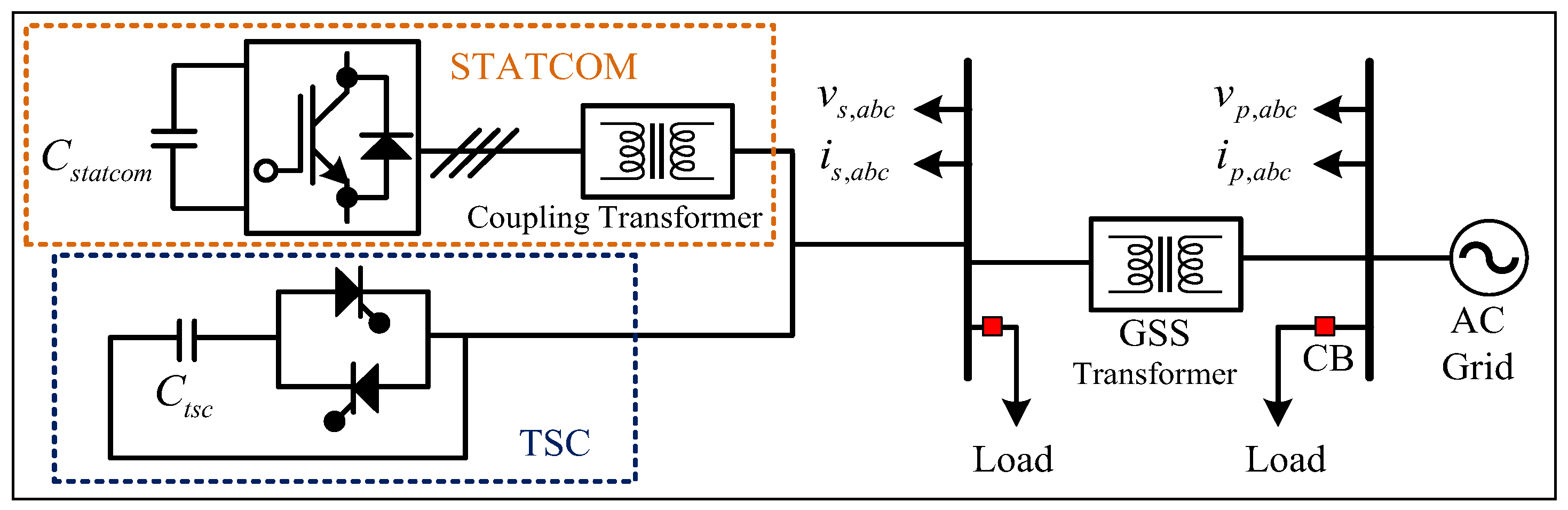
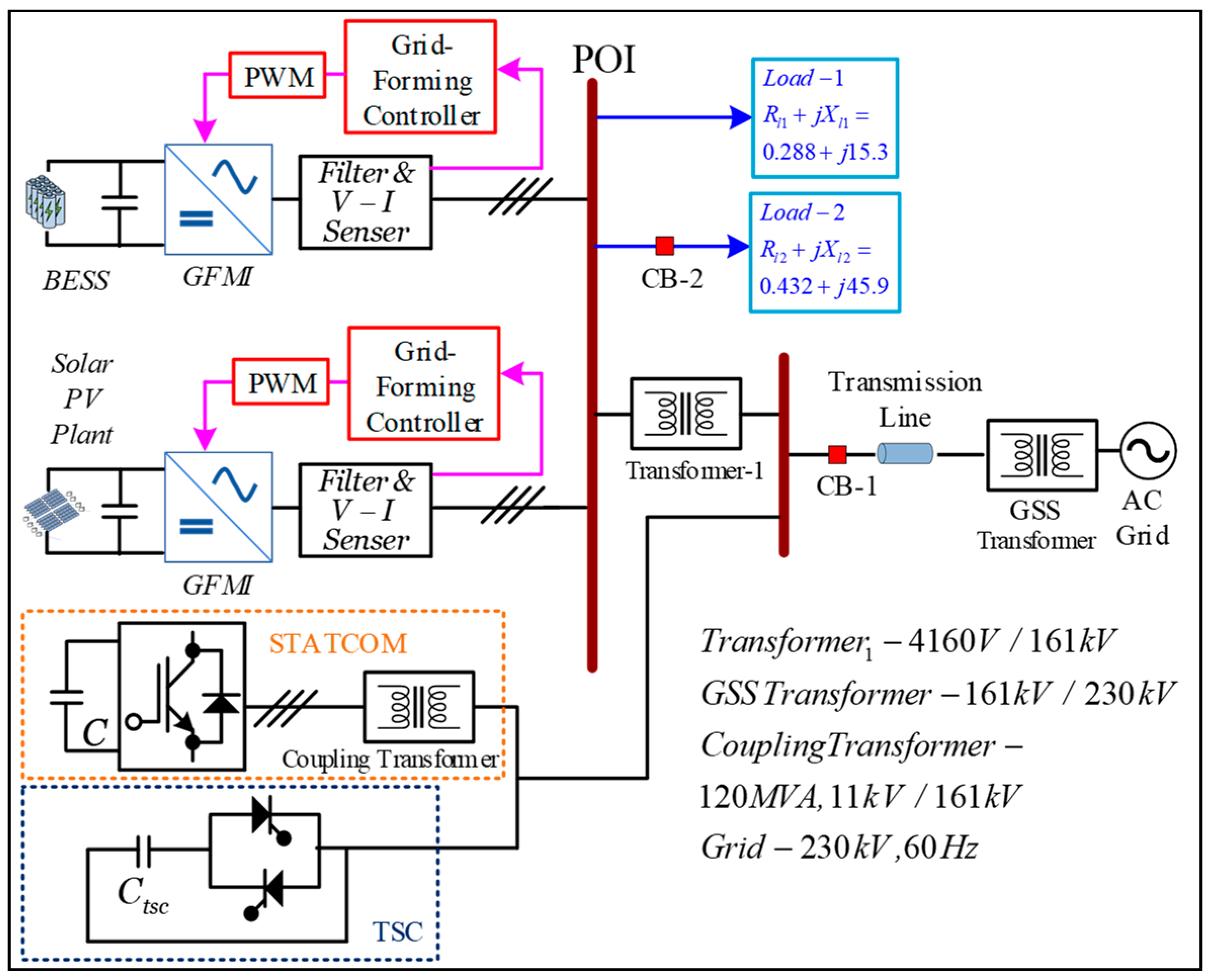
The proposed coordinated hybrid VAR compensator model consists of a STATCOM and a TSC, as shown in
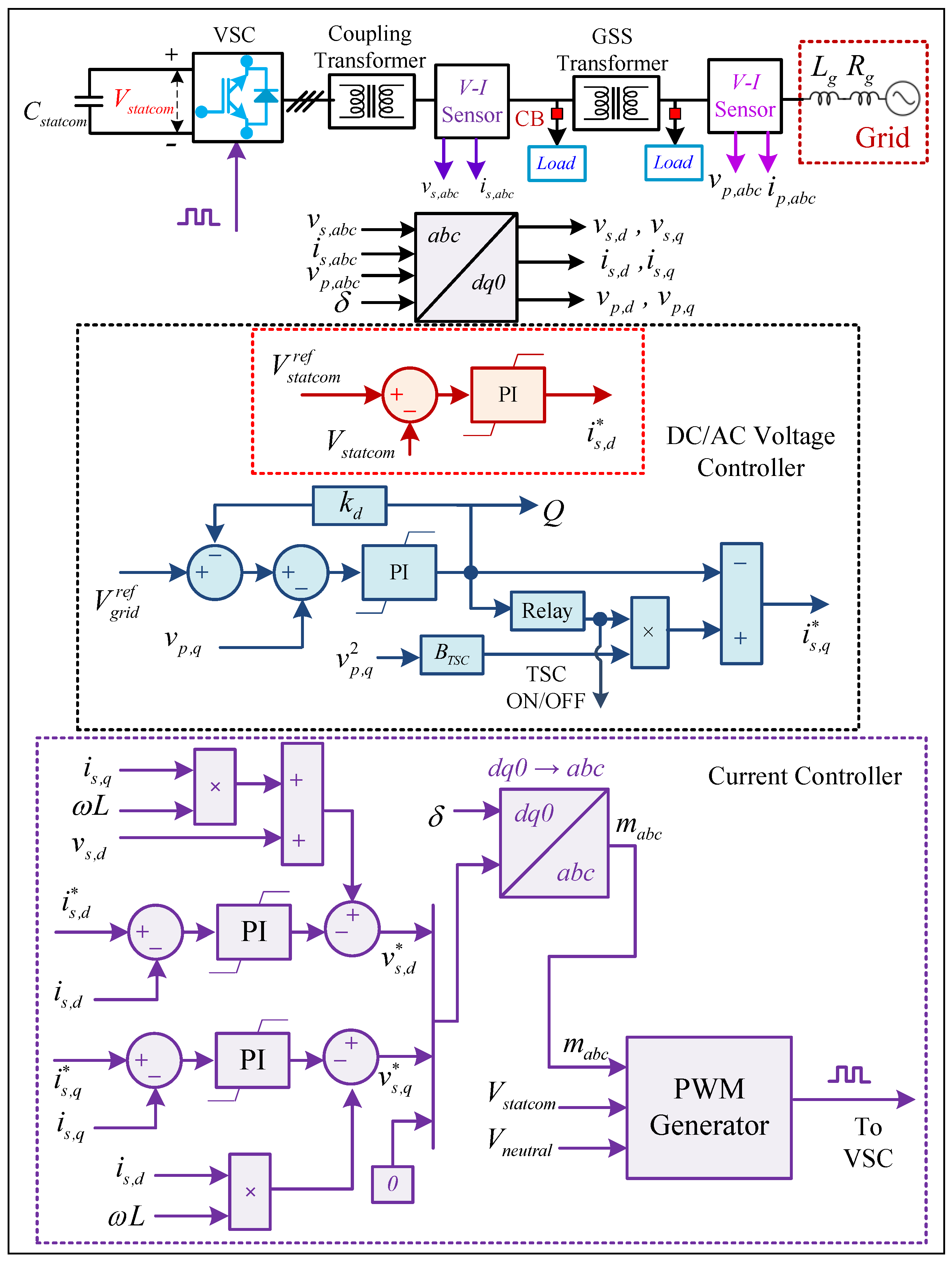
Figure 1. The basic configuration of a VSC-based STATCOM comprises a voltage source converter (VSC), a DC-link capacitor, and a coupling transformer, as illustrated in
Figure 2. In this study, a balanced three-phase system is considered, and the STATCOM is modeled using the synchronous rotating reference frame (
dq-frame). Switching harmonics are neglected in control-level modeling to simplify the analysis.
The differential equations for STATCOM dynamics in the
abc-frame are [
26]
Here, is STATCOM output currents, is converter output voltages, is grid substation (GSS) voltage, and are coupling transformer resistance and inductance.
The STATCOM dynamics (AC-side) in the
dq-frame are expressed by the following equations:
Here, are dq-axis components of STATCOM output current, are dq-axis converter output voltages, are dq-axis GSS voltages, and ω is angular frequency of the rotating frame.
The DC-link dynamics are expressed by the following equation (ignore loss):
In steady state, the reactive power
injected by the STATCOM is
Hence, controlling the component allows reactive power regulation, while the component can be used for active power flow or DC-link voltage regulation.
- A.
Control Strategy of VSC-Based STATCOM
To regulate voltage and reactive power in an inverter-dominated power system, a vector control strategy is implemented for the VSC-based STATCOM using a synchronous reference frame (dq-frame). The control system includes voltage and current control loops, implemented through the following sequential stages:
- i.
Signal Measurement and Synchronization
The control process begins with the measurement of three-phase voltages and currents at the point of common coupling (PCC). A phase-locked loop (PLL), specifically the sinusoidal measurement (PLL, three-phase), is used to extract the frequency and phase angle (θ) of the GSS voltage. This ensures synchronization with the grid and facilitates transformation into the rotating reference frame. Using the Park transformation, the measured three-phase quantities in the abc-frame are converted into the dq-frame.
- ii.
Voltage Control Loops
The reference currents
are generated
through DC voltage and AC voltage control loops, respectively, as follows:
Here, and are STATCOM reference and measured DC-link voltage, respectively, and are grid reference and measured voltage, respectively, and , , and are PI controller gain. is reactive
drop gain and is reactive
power flowing into the AC grid.
- iii.
Inner Current Control Loops
The reference voltages
for the VSC are
generated using current controllers that compare the measured
dq-currents
with their references:
Here, , , and are PI controller gain. is grid angular frequency and is coupling transformer inductance.
The reference voltages in the dq-frame are transformed back to the abc-frame using the inverse Park transformation.
- iv.
PWM Generation
The three-phase reference voltages are fed into a three-phase, three-level sinusoidal PWM generator, which produces the corresponding gating signals for the power semiconductor switches (IGBT) in the VSC. This generator modulates the switching pattern to synthesize the desired output voltage waveform. The switching frequency is 10 kHz.
- B.
TSC Model
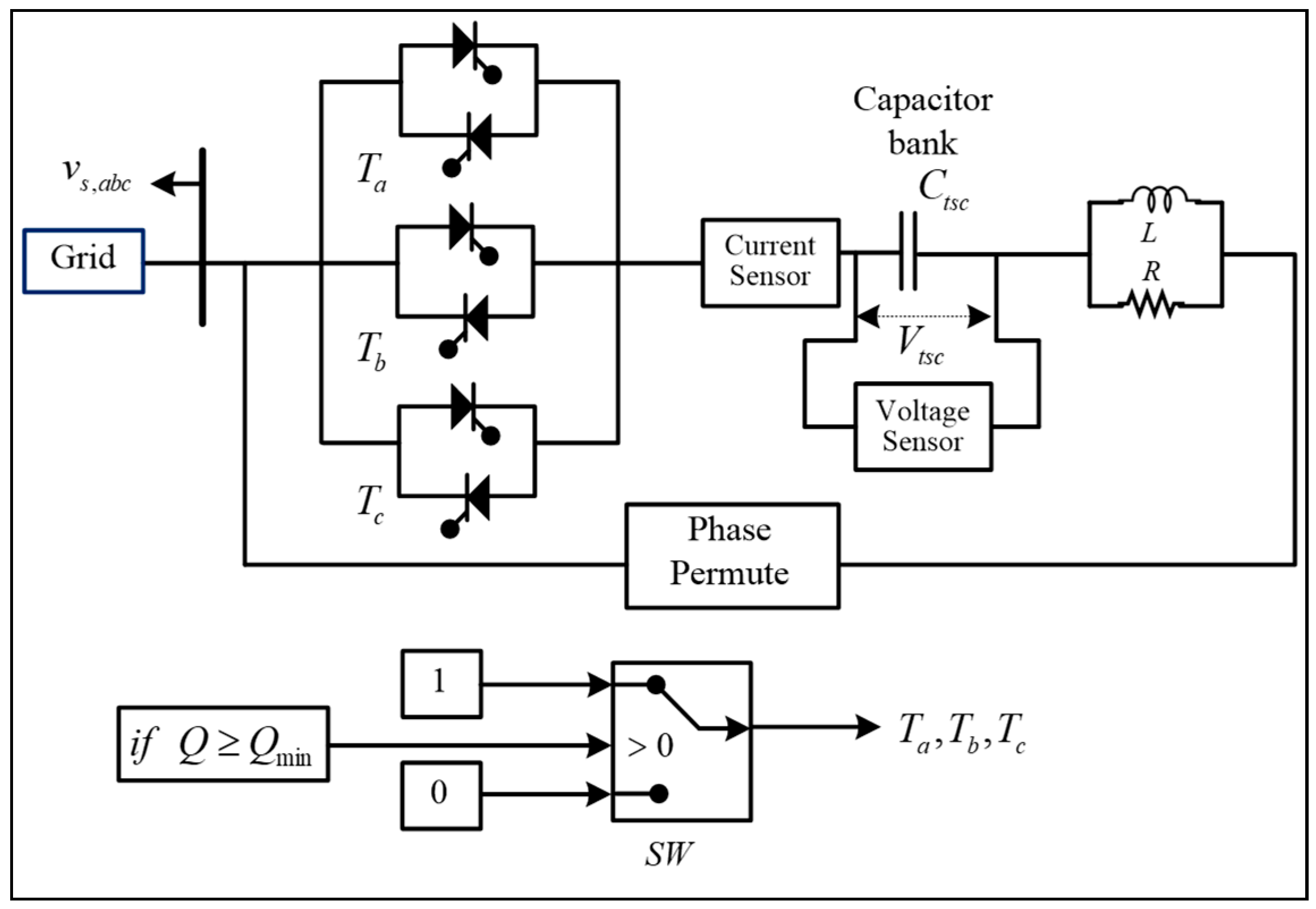
A TSC is a shunt-connected reactive power compensator used in power systems to provide discrete capacitive VAR support. It consists of a capacitor bank connected in series with an anti-parallel thyristor pair, allowing the capacitor to be switched in or out of the system without mechanical switching. The TSC operates in steps depending on the firing angle of the thyristors, providing dynamic voltage and reactive power support.
When the thyristors are gated at the zero crossing of the AC voltage (i.e., firing angle
α = 90°), the entire capacitor bank is connected to the system and provides maximum reactive power. The instantaneous current through the capacitor is given by
Here, is the capacitor current, is the capacitance, and is the voltage across the capacitor.
In sinusoidal steady state, the reactive power
provided by the TSC is expressed as
Here, is the RMS voltage across the capacitor and is the angular frequency of the system.
Thyristors are controlled by their firing angle (
α). In TSC, the thyristors are either fully conducting (switched ON at zero crossing) or not conducting (OFF), providing stepwise changes in reactive power, not continuous. The equivalent susceptance
of the TSC is
Thus, the TSC behaves as a stepwise variable susceptance. For control purposes,
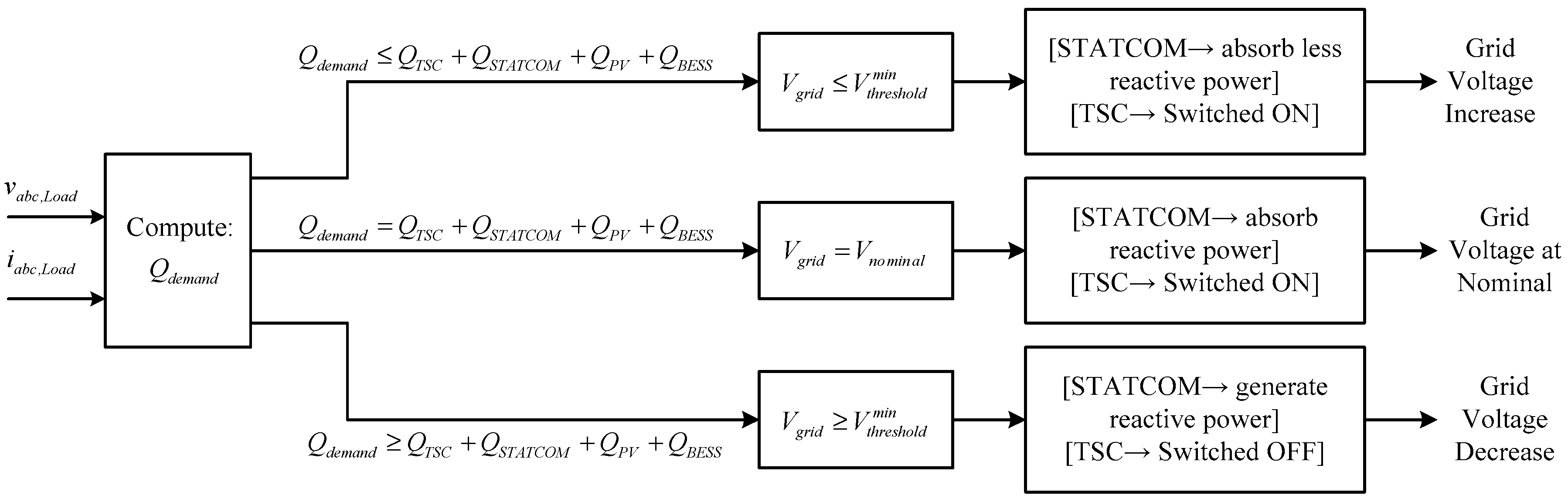
where switching is based on control logic, as shown in
Figure 3. When reactive power flowing into the AC grid is greater than
then TSC is switched on; otherwise, TSC is switched off.
The capacitor bank is designed by following the expression
Here, is the rated reactive power of capacitor bank, is rms line-to-line primary rated voltage of
coupling transformer, and n is harmonic order of the tuned frequency. L
and R are designed using and . is quality factor capacitor bank.
- C.
Proposed coordinated hybrid VAR compensator
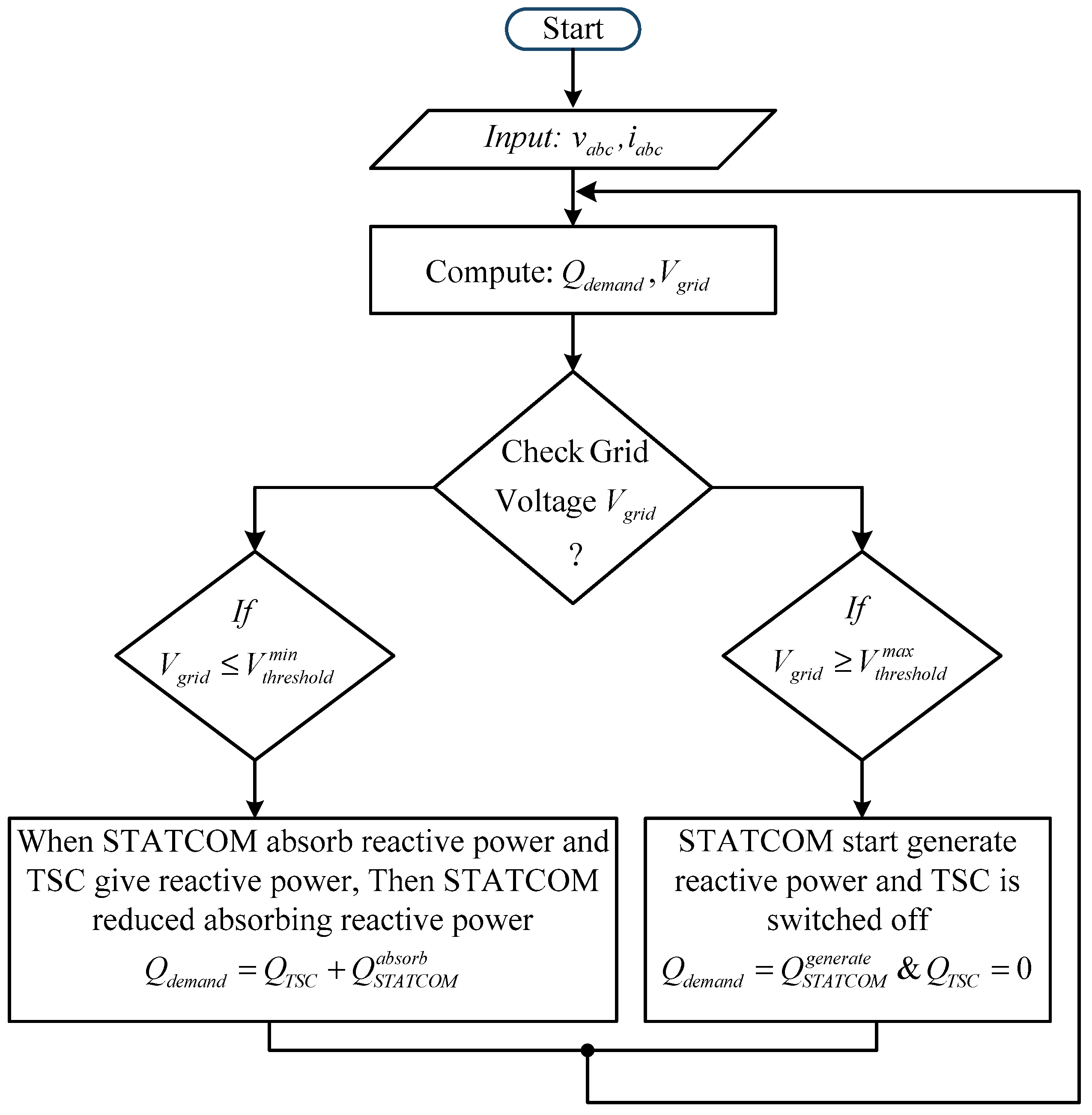
A TSC and a VSC-based STATCOM are used in the coordinated hybrid VAR compensator to provide the best possible balance between high-capacity reactive power supply and quick dynamic response. The coordinated strategy is shown in
Figure 4. In this set up, the STATCOM ensures fine voltage regulation under dynamic and transient operating situations by providing quick and continuous reactive power control. On the other hand, in steady-state conditions, the TSC, which is made up of banks of capacitors controlled by thyristors, effectively provides large-step reactive power compensation with low switching losses. While the TSC manages the bulk reactive demand and the STATCOM corrects for rapid voltage fluctuations, the two systems work in tandem to provide smooth reactive power management across a broad working range. In addition to improving transient response and system voltage stability, this hybrid coordination lowers converter stress and boosts overall efficiency. As a result, in contemporary low-inertia, inverter-dominated power systems, the coordinated STATCOM + TSC structure provides a practical and affordable means of preserving voltage and reactive power balance. The coordinated hybrid VAR compensator works according to the following cases:
- D.
VSC–STATCOM Controller Design and Tuning
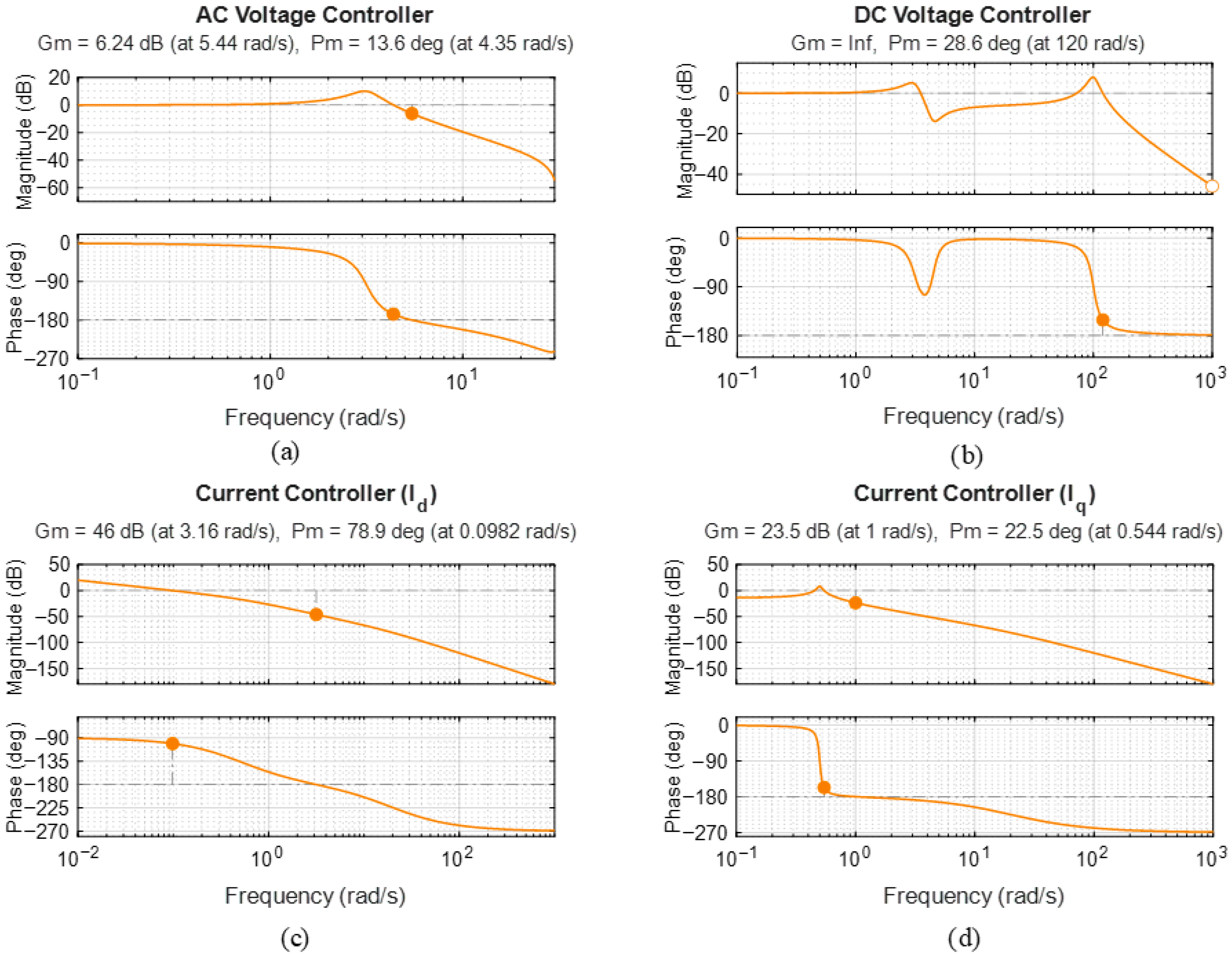
All proportional–integral (PI) controllers for the STATCOM voltage loops, STATCOM current loops, and GFM PV/BESS units were tuned using MATLAB’s (R2023) Model Linearizer tool based on frequency–response analysis. The Bode plots were used to verify the adequate gain margin (GM), phase margin (PM), and crossover frequencies to ensure robust stability while maintaining a fast transient response.
Figure 5a shows the Bode response of the STATCOM AC voltage controller with a gain margin of 6.24 dB and a phase margin of 13.6° at 5.44 rad/s. These values indicate stable operation with a relatively high bandwidth suitable for dynamic voltage regulation during fast grid disturbances.
Figure 5b illustrates the DC-link voltage controller response, which exhibits an infinite gain margin and a phase margin of 28.6° at 120 rad/s, demonstrating a highly stable response with sufficient damping and rapid DC voltage recovery.
The inner current control loops, shown in
Figure 5c,d, exhibit significantly higher stability margins compared to voltage loops, as expected due to their faster dynamic response. The
id current controller achieves a gain margin of 46 dB at 3.16 rad/s and a phase margin of 78.9° at 0.09 rad/s, while the
iq controller shows a gain margin of 23.5 dB at 1 rad/s and a phase margin of 22.5° at 0.54 rad/s. The positive and sufficiently large gain and phase margins across all loops confirm that the designed controllers provide stable operation across a wide range of operating conditions, including variations in solar irradiance, load changes, and reactive power demand.
Overall, the frequency–response-based tuning ensures well-damped STATCOM dynamics, strong current loop stability, and coordinated performance with GFM-controlled PV and BESS units, facilitating reliable voltage support in inverter-dominated grids.
- E.
Test of proposed coordinated hybrid VAR compensator
The proposed coordinated hybrid VAR compensator model is tested on a conventional high voltage transmission grid. STATCOM and TSC are integrated into the transmission system, as illustrated in
Figure 1. The model is implemented and simulated using MATLAB/Simulink (R2023) and validated through FPGA-based real-time simulation on the OPAL-RT platform. The system parameters, including STATCOM, grid, transmission line, and transformer, are given in
Appendix A.
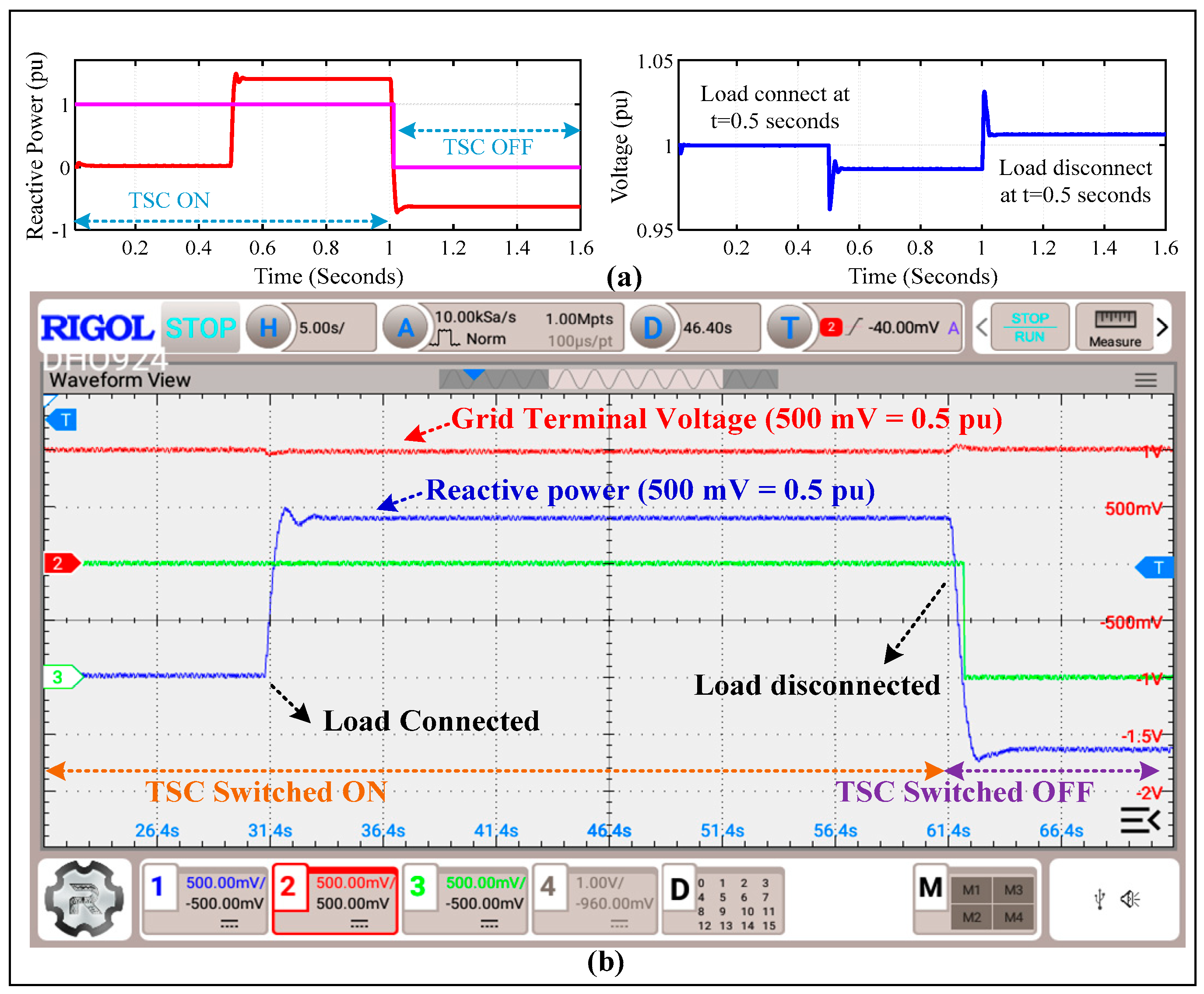
An 1100 MW load is initially connected to the GSS. The grid voltage is maintained at 1.0 per unit (nominal voltage). The proposed controller regulates the STATCOM to absorb the reactive power while the TSC operates simultaneously, ensuring that the combined reactive power absorbed by the STATCOM and supplied by the TSC meets the system’s reactive power demand, as shown in
Figure 6. At 0.5 s into the simulation, an additional 450 MW load is connected, causing the grid voltage to drop below 0.97 per unit, as shown in
Figure 6a,b. In response, the reactive power absorption by the STATCOM decreases, resulting in a voltage recovery to approximately 0.985 per unit and increased reactive power injection into the AC grid. Subsequently, an 850 MW load is disconnected at 1.0 s of simulation time, leading to a voltage rise above 1.02 per unit. In response, the TSC is deactivated and the STATCOM starts injecting reactive power. This action stabilizes the grid voltage, bringing it down to approximately 1.006 per unit.
Figure 6a,b shows the results of the reactive power flowing into the AC grid, and the grid voltage using the MATLAB Simulink and FPGA real-time simulator, respectively.
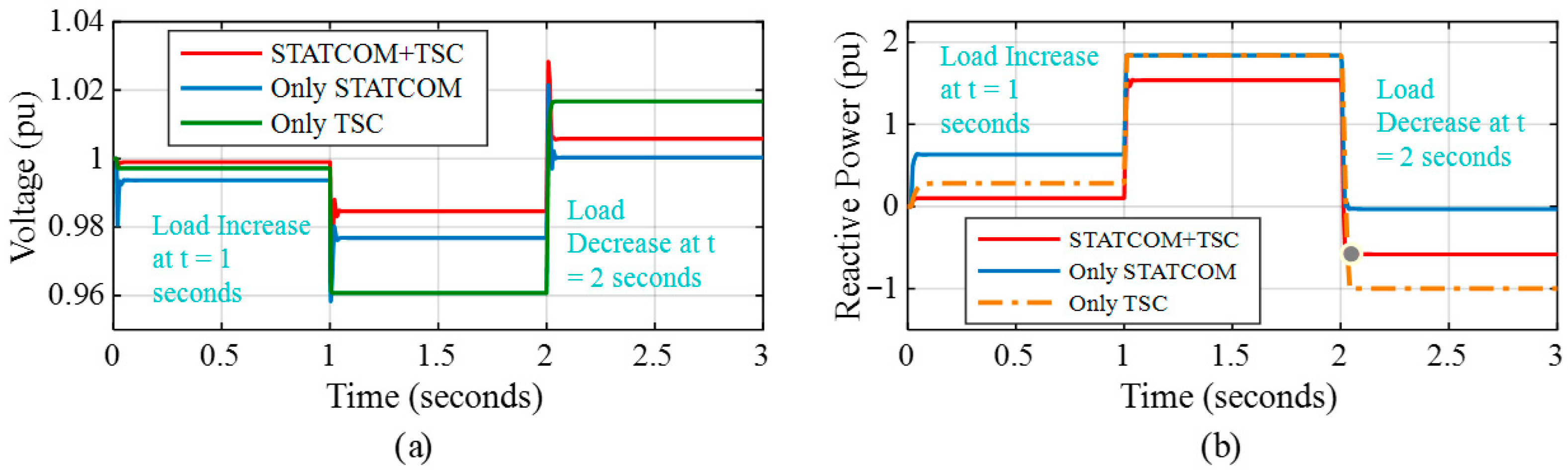
Figure 7 presents a comparative analysis of grid voltage and reactive power flow under three operational scenarios: (i) coordinated hybrid VAR compensation using both STATCOM and TSC, (ii) STATCOM-only operation, and (iii) TSC-only operation. When both STATCOM and TSC operate in coordination, the system exhibits superior voltage regulation and dynamic response. At
t = 1 s, the connection of a 450 MW load on the secondary side causes the grid voltage to drop below 0.97 p.u.; in response, the STATCOM reduces reactive absorption and the reactive power flow into the grid increases, enabling a rapid voltage recovery to approximately 0.985 p.u. Subsequently, at
t = 2 s, the disconnection of the 400 MW primary-side load and the 450 MW secondary-side load causes the grid voltage to rise above 1.02 p.u.; the TSC is switched out and the STATCOM begins injecting reactive power, stabilizing the grid voltage at about 1.006 p.u. In contrast, when only the STATCOM is in operation, the system exhibits faster transient response but insufficient reactive capacity during large disturbances, leading to deeper voltage dips and slower post-disturbance voltage recovery. Conversely, when only the TSC is connected, the system maintains adequate reactive support during steady-state conditions but suffers from slower dynamic stabilization, increased overshoot, and reduced damping capability due to its limited fast-response characteristics. Overall, the coordinated operation effectively combines the rapid dynamic performance of the STATCOM with the bulk reactive support of the TSC, ensuring improved voltage stability, reduced overshoot, and enhanced reactive power management compared to standalone cases.
The coordinated operation of the STATCOM and TSC effectively regulates voltage under dynamic load conditions. The hybrid VAR compensator maintains voltage within acceptable limits by adaptively managing reactive power exchange. The proposed hybrid VAR compensator is further validated on a renewable-integrated power system comprising a grid-connected or islanded utility-scale BESS and PV power plant.
3. Grid-Forming PV and BESS
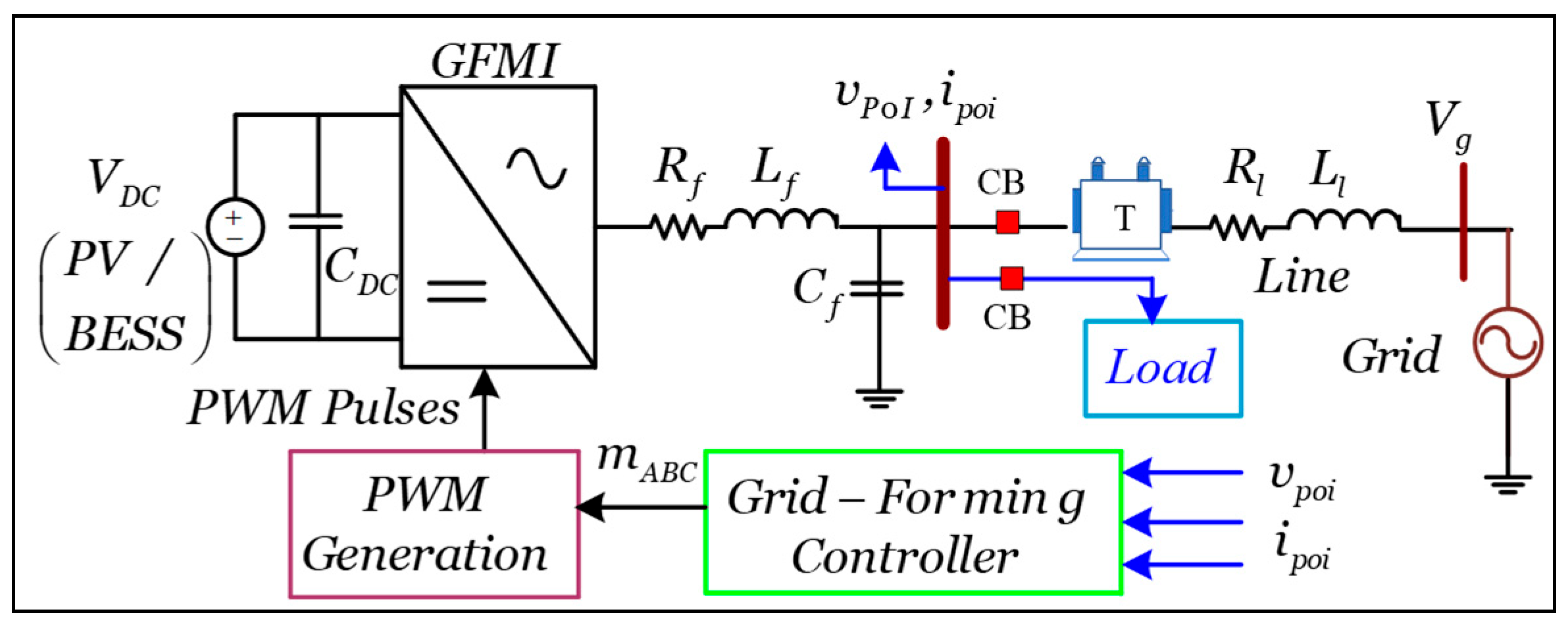
A topology of a grid-connected IBRs system with GFM control is illustrated in
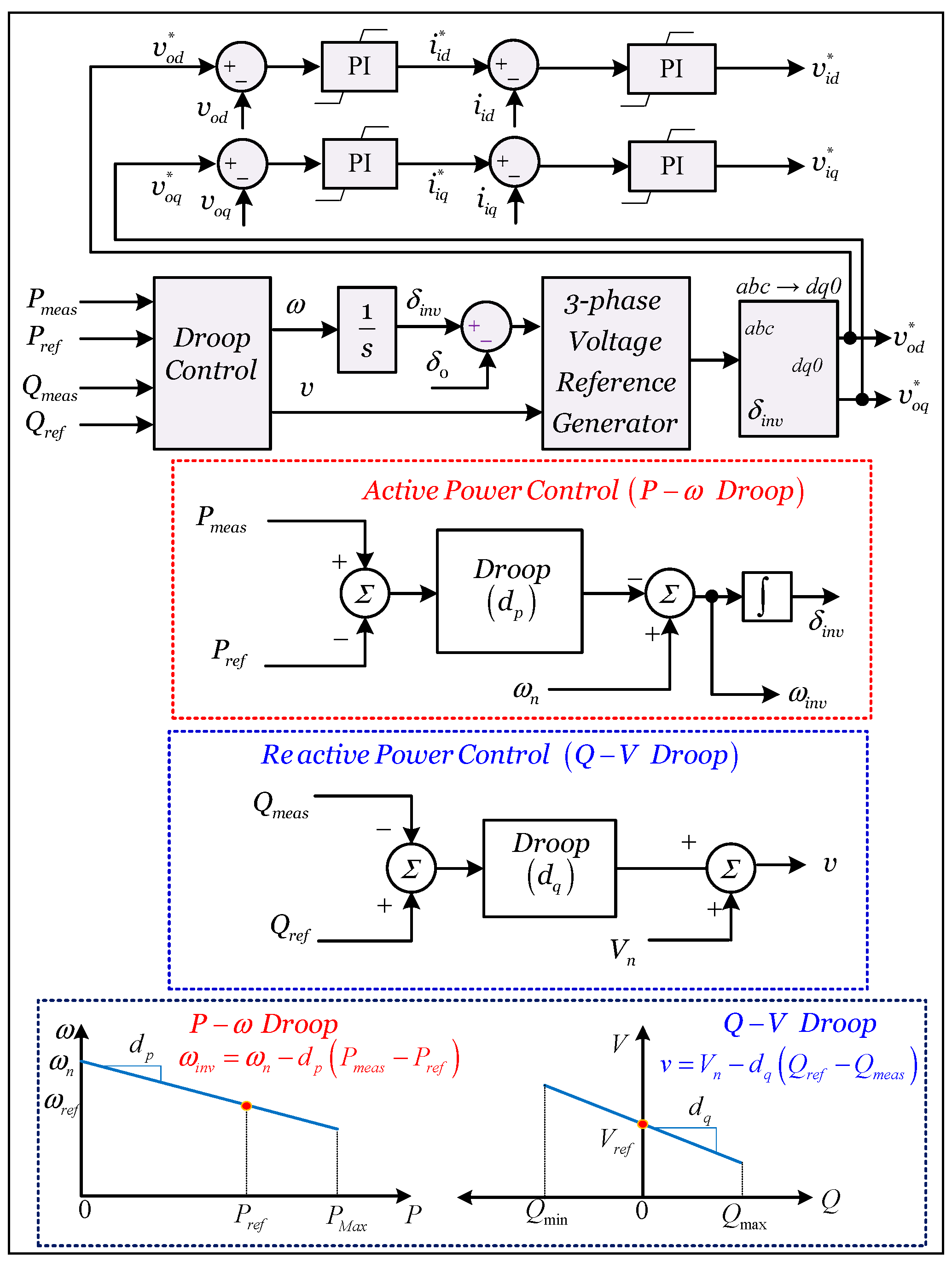
Figure 8. In this configuration, the IBRs, comprising a PV system and a BESS, are connected to the grid via a circuit breaker. The GFM-controlled IBRs and the grid are interfaced at the point of interconnection (POI). A three-phase voltage source inverter (VSI), governed by a droop-based GFM control scheme, is employed to regulate the power exchange and maintain system stability.
are filter
resistance, inductance, and capacitance, and
are grid resistance and inductance. The load is connected at the POI.
- A.
Proposed Grid-forming Inverter Control Model
As shown in
Figure 9, a multi-loop control diagram is developed for the GFMI, incorporating an inner current control loop, a voltage control loop, and a droop control loop. When the voltage quantity is aligned with the
d-axis for the GFMI, it produces
As a result, the following sums up the appropriate illustrations for
δinv,
Pmeas, and
Qmeas:
Here, .
The PI regulators in the
dq-axis are modeled for the voltage control process using intermediate parameters
φd and
φqAs a result, the voltage regulator loop’s expression is
Lastly, the GFMI’s entire model is written as follows:
Here, .
- B.
Networks and Load Model
GFMI IBRs and loads are connected at the POI, as shown in
Figure 6. Modeling the network and the loads is performed with fixed R-L impedance, whereas local load on the GFMI ends is performed with fixed impedance load. The expressions are given as
Here,
vDQ are the POI voltages, where load is connected. The simplified model is given as
Here,
,
Therefore, the overall system model (GFMI IBRs, networks, and load) is expressed as
Here, .
Furthermore, the operational point that is provided for the dynamical modeling examination is derived from the power flowing estimation.
5. Results and Discussion
To verify the effectiveness of the proposed hybrid VAR compensator and assess the capabilities of the GFMI-BESS and GFMI-PV, a series of case studies were conducted. These case studies included the following: (i) variation in solar irradiance, (ii) changes in load demand, (iii) grid outage or islanding conditions, and (iv) three-phase faults on the transmission line. Each scenario represents a critical operating condition to evaluate the voltage regulation, reactive power management, and dynamic support provided by the coordinated control of the hybrid VAR compensator and GFMI units. The entire model, including the GFMI-PV, GFMI-BESS, STATCOM, and TSC, was implemented and simulated using an FPGA-based real-time simulator to ensure accurate evaluation of the control response and transient performance under real-time operational constraints. These real-time simulations validate the robustness and effectiveness of the proposed system in maintaining voltage stability and system resilience in inverter-dominated power systems. The coordinated control operation of STATCOM + TSC, GFMI-PV, and GFMI-BESS is shown in
Figure 11.
- A.
Case Study 1: Change in Solar Irradiation
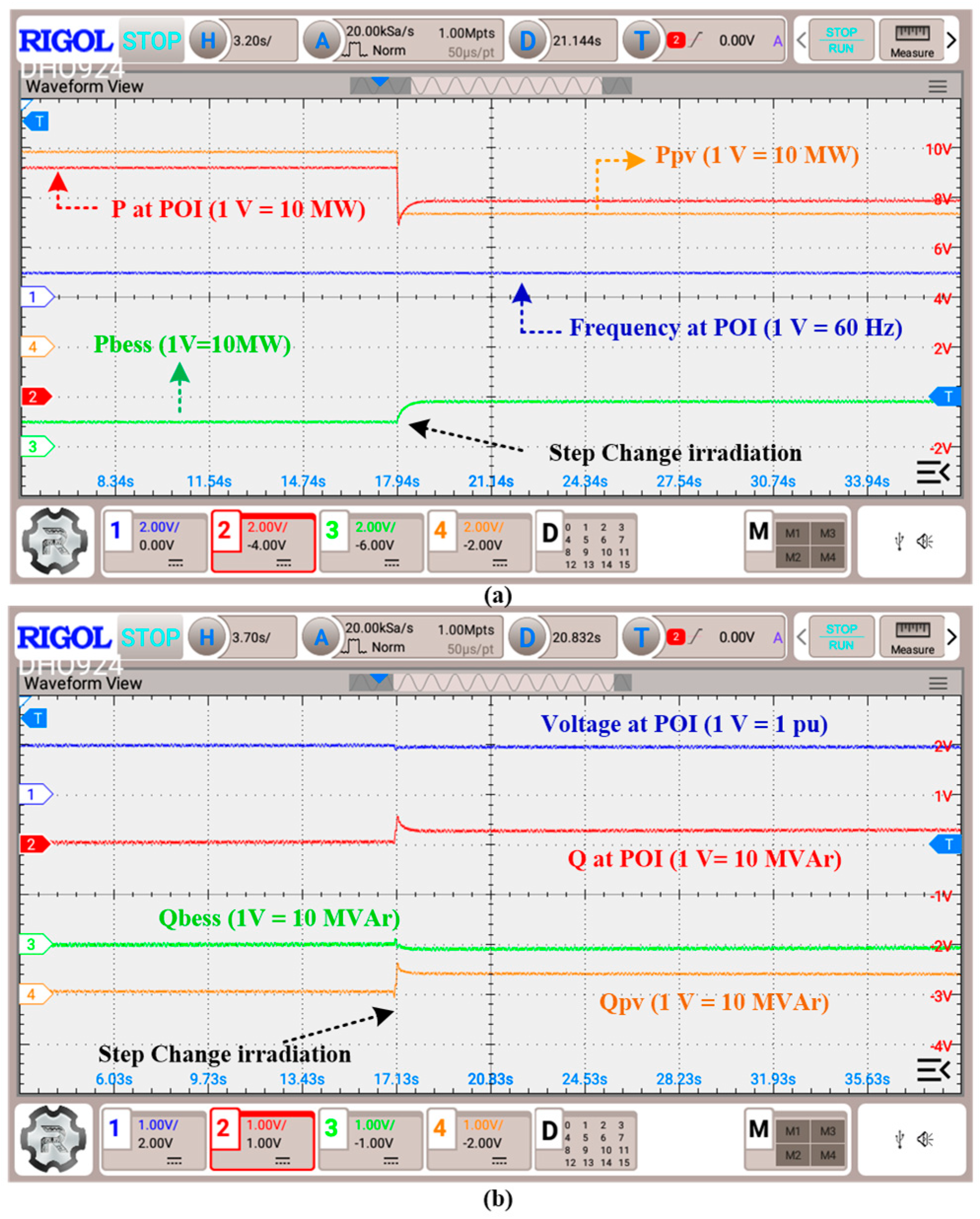
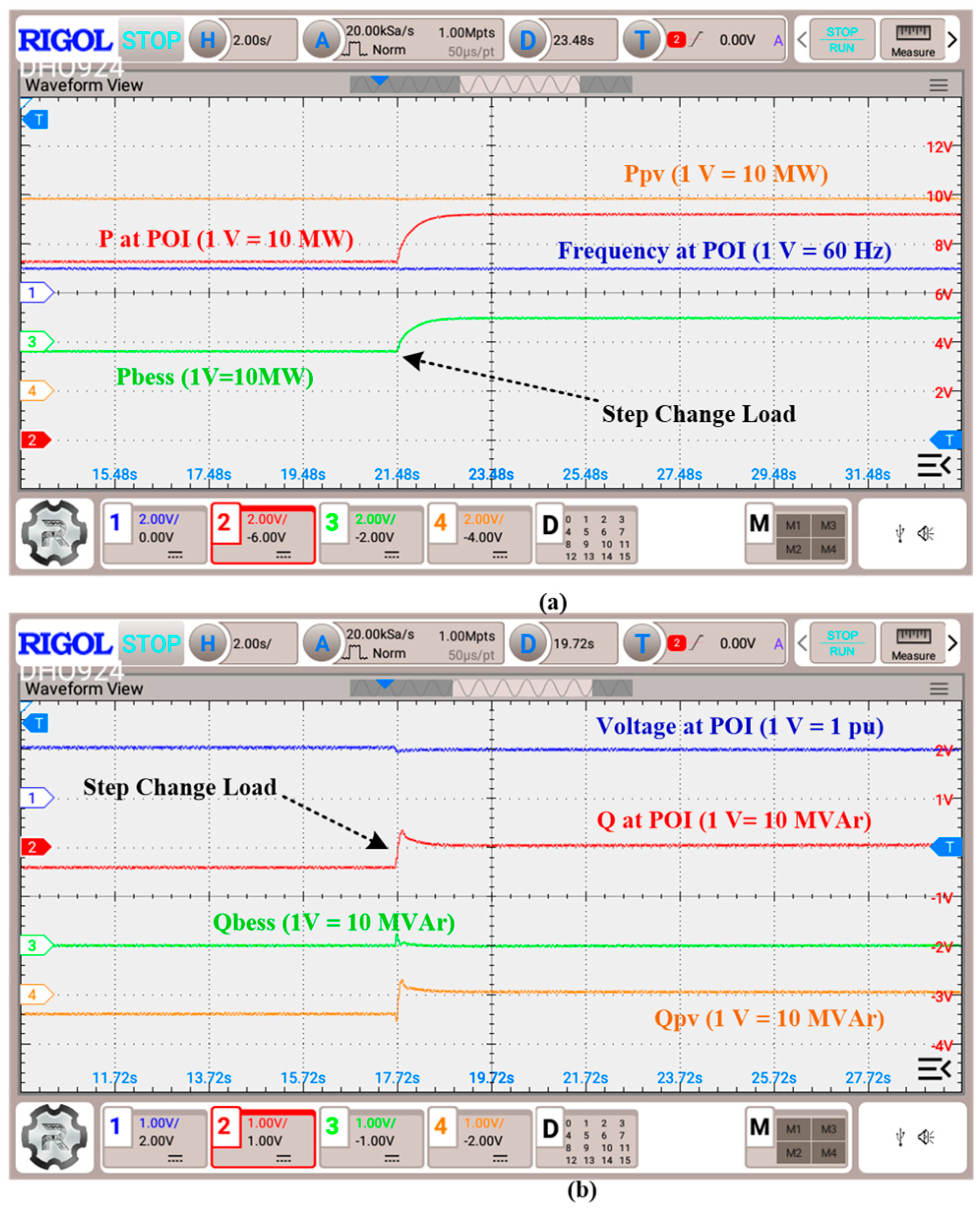
The results of the first case study, which examines the system’s response to a sudden reduction in solar irradiance, are illustrated in
Figure 12a,b.
Figure 12a depicts the real power output of the GFMI-PV and GFMI-BESS, the total real power delivered at the point of interconnection (POI), and the corresponding frequency variation at the POI. Under normal irradiance conditions, the GFMI-PV plant operates in MPPT mode and delivers approximately 78.4 MW of power. The connected load at the POI is initially met by the PV generation and the GFMI-BESS, which discharges during this period. A step change in solar irradiance from 800
to 560
is introduced, while the connected loads remain unchanged and are supplied continuously throughout the simulation.
Following the reduction in solar irradiance, the output power of the GFMI-PV
drops below the total load demand. In response, the GFMI-BESS discharges more
to compensate for the power shortfall and maintains power balance at the POI.
This active power support from
the BESS effectively mitigates the frequency dip caused by the sudden power
imbalance. Although a temporary frequency reduction is observed immediately
after the drop in irradiance, the frequency is restored to its nominal value
within a short time frame, demonstrating the effectiveness and responsiveness
of the proposed grid-forming control strategy implemented in the GFMI-BESS and
GFMI-PV units.
Figure 12b illustrates the voltage at the POI, the total reactive power
at the POI, and
the individual reactive power
contributions
from the GFMI-PV and GFMI-BESS. When solar irradiance is reduced, a voltage
drop at the POI
is observed. However, the proposed hybrid VAR compensator responds effectively
by dynamically adjusting its reactive power exchange. Specifically, both the
GFMI-PV and GFMI-BESS reduce their reactive power absorption, which results in
a net increase in reactive power injection into the grid
. At the same
time, STATCOM starts absorbing less reactive power and TSC provides reactive
power. Consequently, the voltage
at the POI
begins to rise and stabilizes near its nominal value.
. The steady-state
outputs are given in
Table 2.
These results validate the efficacy of the proposed hybrid VAR compensator and the coordinated control of the GFMI-PV and GFMI-BESS in maintaining both voltage and frequency stability under varying solar generation conditions. The system’s ability to transition smoothly between charging and discharging modes and to modulate reactive power exchange highlights its robustness and suitability for grid-forming applications in low-inertia, high-penetration renewable energy scenarios.
- B.
Case Study 2: Change in Load
The second case study investigates the performance of the proposed hybrid VAR compensator and the coordinated control of GFMI-BESS and GFMI-PV under a sudden step change in load. An additional load (load-2) is connected at the POI using a circuit breaker as shown in
Figure 10, to simulate a sudden increase in demand. The corresponding results are shown in
Figure 13a,b.
Figure 13a illustrates the real power contributions from the GFMI-PV
and GFMI-BESS
, the total real
power
at the POI, and
the frequency at the POI. Before the load is switched in, the system is
operating under steady-state conditions with the GFMI-PV supplying real power
at its MPPT output, and the GFMI-BESS is in charging mode. When the additional
load is suddenly connected, the total load demand at the POI exceeds the power
generated by the PV system, resulting in an immediate power imbalance. In
response, the GFMI-BESS quickly transitions from its prior state to discharge
mode, injecting real power into the grid to support the increased load. This
immediate injection of real power helps to mitigate the frequency dip that
occurs due to the increased load demand. Although a transient frequency
deviation is observed, the system frequency is rapidly restored to its nominal
value, highlighting the capability of the proposed control strategy to provide
fast frequency support and maintain system stability.
Figure 13b presents the voltage
at the POI, the
total reactive power
at the POI, and
the individual reactive power contributions from the GFMI-PV and GFMI-BESS. The
step increase in load introduces an additional reactive power demand, which
causes an initial voltage dip at the POI. The hybrid VAR compensator responds
dynamically to this voltage deviation. Both the GFMI-PV and GFMI-BESS increase
their reactive power injection (or reduce absorption) to compensate for the
increased demand. As a result, the voltage at the POI begins to recover and
stabilizes close to its nominal value. The steady-state outputs are given in
Table 2.
The effective sharing of reactive power between the GFMI-PV and GFMI-BESS, along with the contribution from the VSC-based STATCOM and TSC, ensures that the voltage deviation is quickly corrected. The coordinated control of the hybrid compensator under a step change in load confirms its robustness and adaptability in responding to sudden changes in power system operating conditions.
These results demonstrate that the proposed control strategy and hybrid compensator not only support real power balancing through BESS but also dynamically regulate reactive power to maintain voltage stability. This makes the system highly effective for grid-forming applications in weak or dynamic distribution networks with high penetration of IBRs.
- C.
Case Study 3: Grid Outage or Islanded Mode
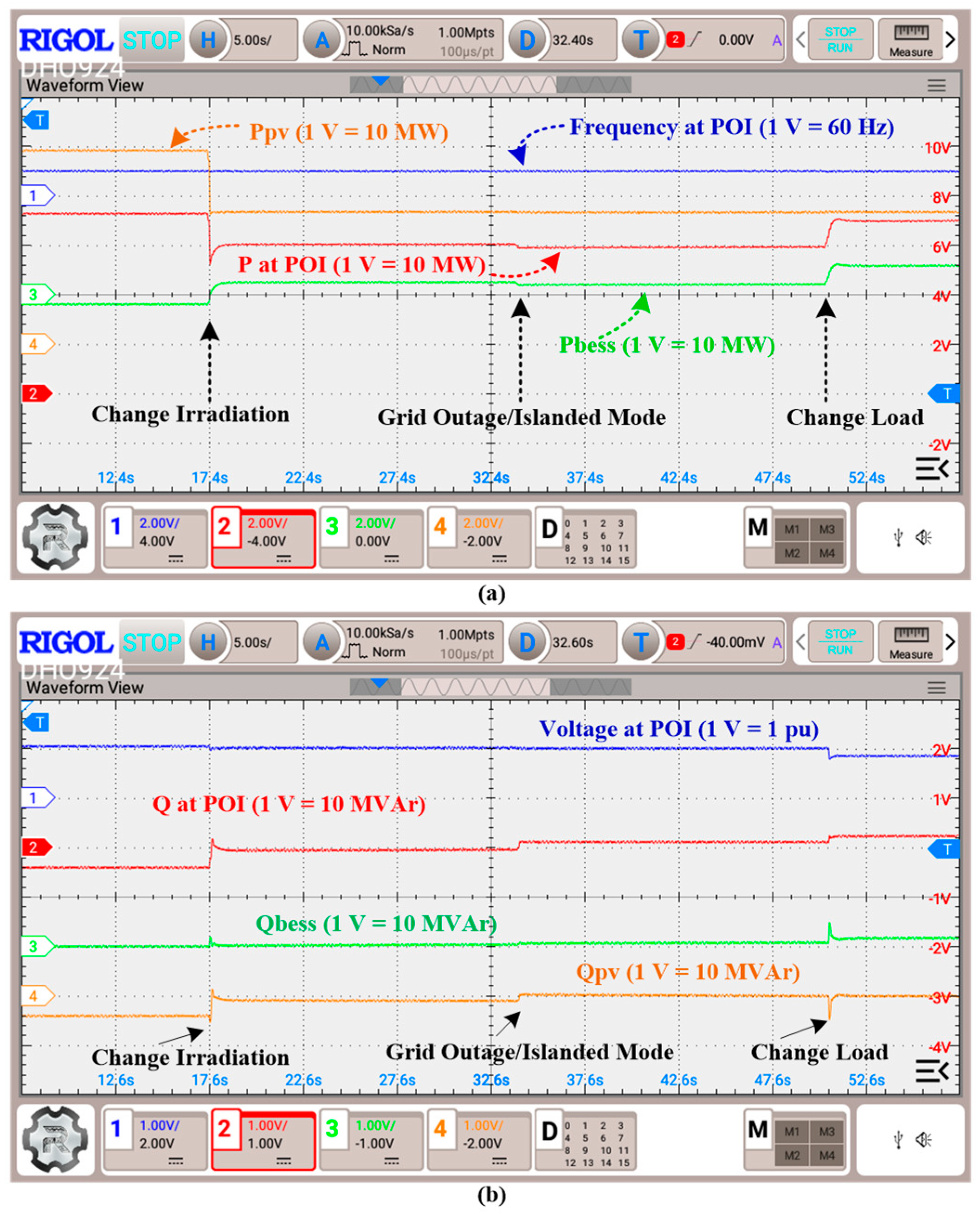
This case study evaluates the performance of the proposed GFMI-based control and hybrid VAR compensator under a sequence of critical disturbances: solar irradiance variation, grid outage, and load changes in the islanded mode. The results are presented in
Figure 14a,b.
Initially, the system operates under normal conditions with the GFMI-PV generating power at MPPT. A step change in solar irradiance is then introduced, reducing the available solar resource. As a result, the output power from the GFMI-PV decreases accordingly. To maintain power balance at the POI, the GFMI-BESS responds by discharging to compensate for the power deficit and support the connected load.
Following the irradiance reduction, a grid outage is simulated by opening a circuit breaker, effectively transitioning the system into islanded operation. The system’s ability to remain stable during this transition is critical, as GFMIs must now assume the role of maintaining voltage and frequency in the absence of the main grid. After entering islanded mode, an additional load change is introduced. Despite the disturbance, both GFMI-PV and GFMI-BESS coordinate seamlessly to maintain voltage and frequency stability. The GFMI-BESS plays a key role by adjusting its power output to counteract the effects of the load variation, while the hybrid VAR compensator dynamically regulates the reactive power to stabilize the POI voltage.
Figure 14a shows the real power outputs of the PV
and BESS
units, the
total power at the POI
, and the frequency (
f) in Hz. A temporary dip in frequency is observed following the irradiance reduction and load change, but the system recovers quickly, demonstrating effective frequency support and inertial response from the GFMI-based controllers.
Figure 14b illustrates the POI voltage
, reactive power
exchanged at the POI
, and
contributions from both the PV and BESS in terms of reactive power. Upon grid
outage, the hybrid VAR compensator adjusts its behavior to ensure voltage
stability. The reactive power injection is managed such that the POI voltage
remains within acceptable limits throughout the islanded operation, even under
fluctuating load conditions. The steady-state outputs are given in
Table 2.
Overall, this case study confirms that the proposed control scheme, incorporating GFMI-PV, GFMI-BESS, and the hybrid VAR compensator, provides robust and stable operation under multiple challenging scenarios. The system successfully maintains voltage and frequency within safe margins, demonstrating strong potential for autonomous microgrid operation during grid contingencies.
- D.
Case Study 4: Three-Phase Fault in Transmission Line
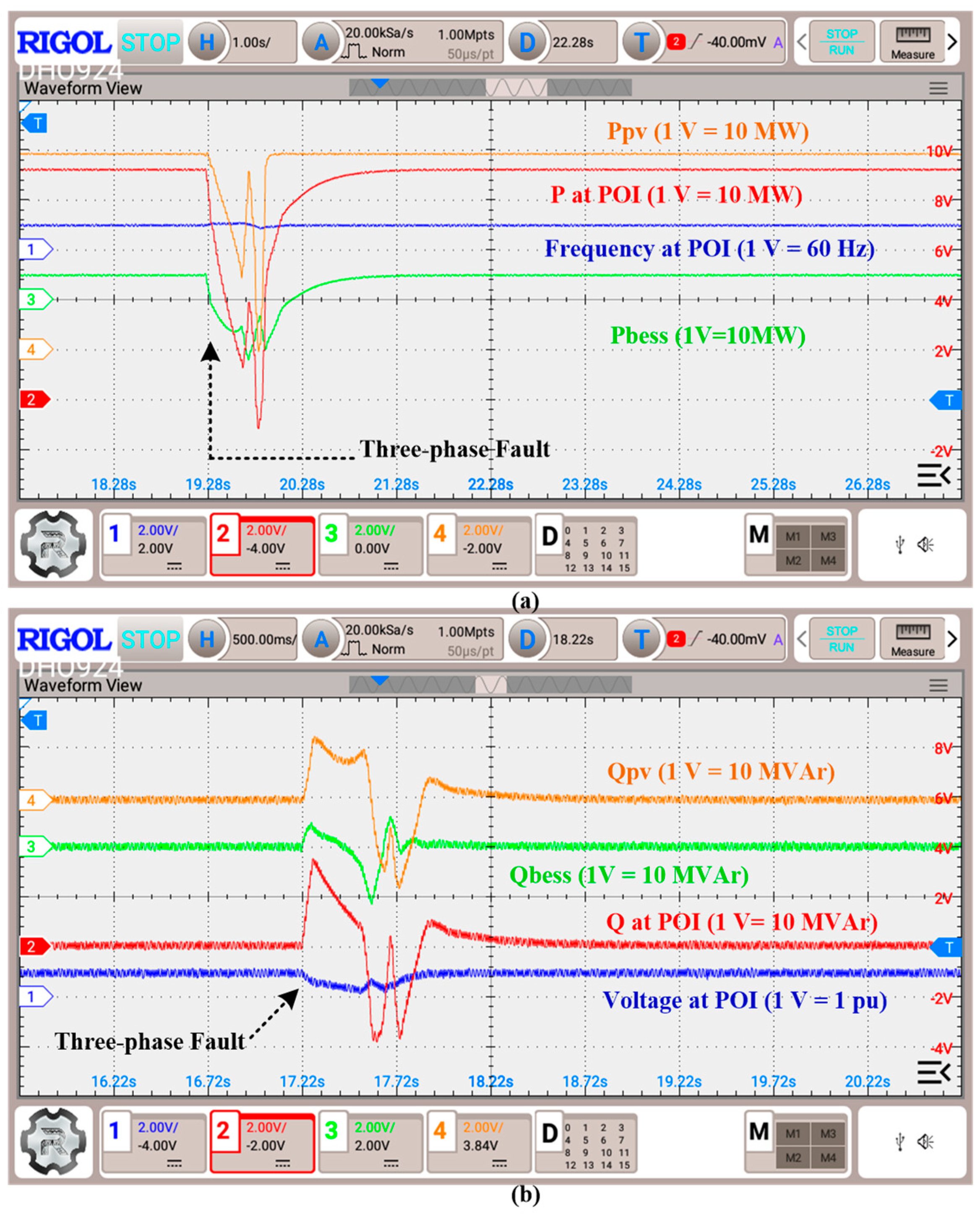
This case study investigates the dynamic response and fault-handling capabilities of the proposed hybrid VAR compensator and GFMI-based PV and BESS during a severe grid disturbance, namely, a three-phase fault on the transmission line. The objective is to assess the system’s voltage and frequency stability, power-sharing capability, and fault ride-through performance under extreme fault conditions. The simulation results are presented in
Figure 15a,b. At the start of the case study, the system operates under normal conditions with the GFMI-PV generating power at the MPP, and the GFMI-BESS operating in support mode to balance any fluctuations in demand and generation. A three-phase fault is then introduced on the transmission line.
Figure 15a shows the real power outputs from the GFMI-PV
and GFMI-BESS
, the total real
power
at the POI, and
the system frequency. Immediately after fault inception, a sharp drop in real
power output is observed due to the sudden voltage depression and protective
action of the inverter-based resources. The fault causes a temporary reduction
in the power delivered to the POI. However, once the fault is cleared, the
GFMI-PV and GFMI-BESS controllers rapidly stabilize their outputs. The BESS
contributes significantly to frequency support during and after the fault by
injecting or absorbing active power as needed. Although there is a brief
deviation in frequency, the proposed grid-forming control strategies ensure a
fast and stable frequency recovery.
Figure 15b presents the POI voltage
, total reactive
power
exchanged, and
individual contributions from the PV and BESS units. As expected, the POI
voltage drops sharply during the fault due to the sudden increase in fault
current and the voltage sag in the faulted line. The hybrid VAR compensator
dynamically responds by supplying a substantial amount of reactive power to
mitigate the voltage dip. The reactive power contribution from both the GFMI-PV
and GFMI-BESS increases significantly during the fault and remains elevated
briefly after the fault is cleared, ensuring smooth voltage recovery.
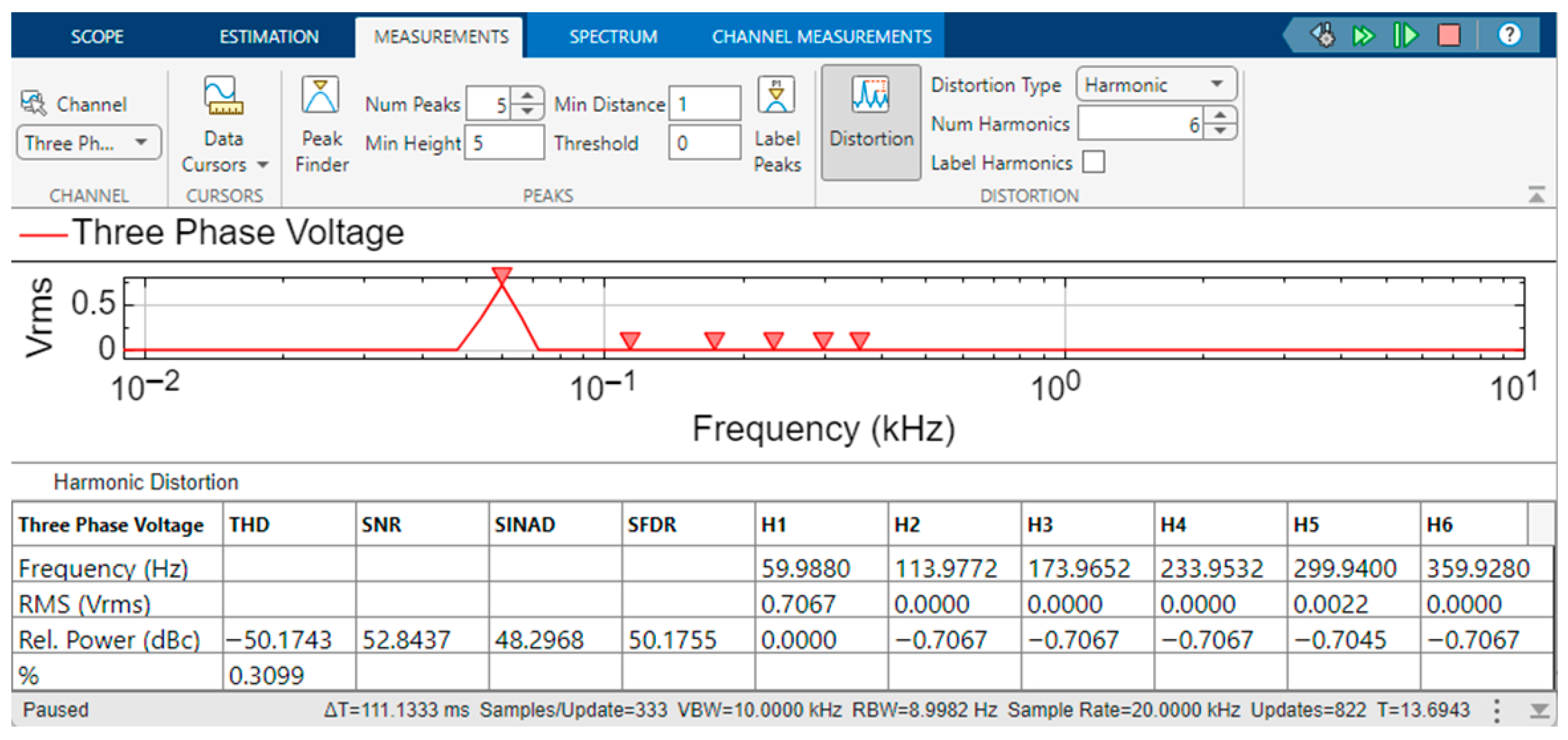
Figure 16 and
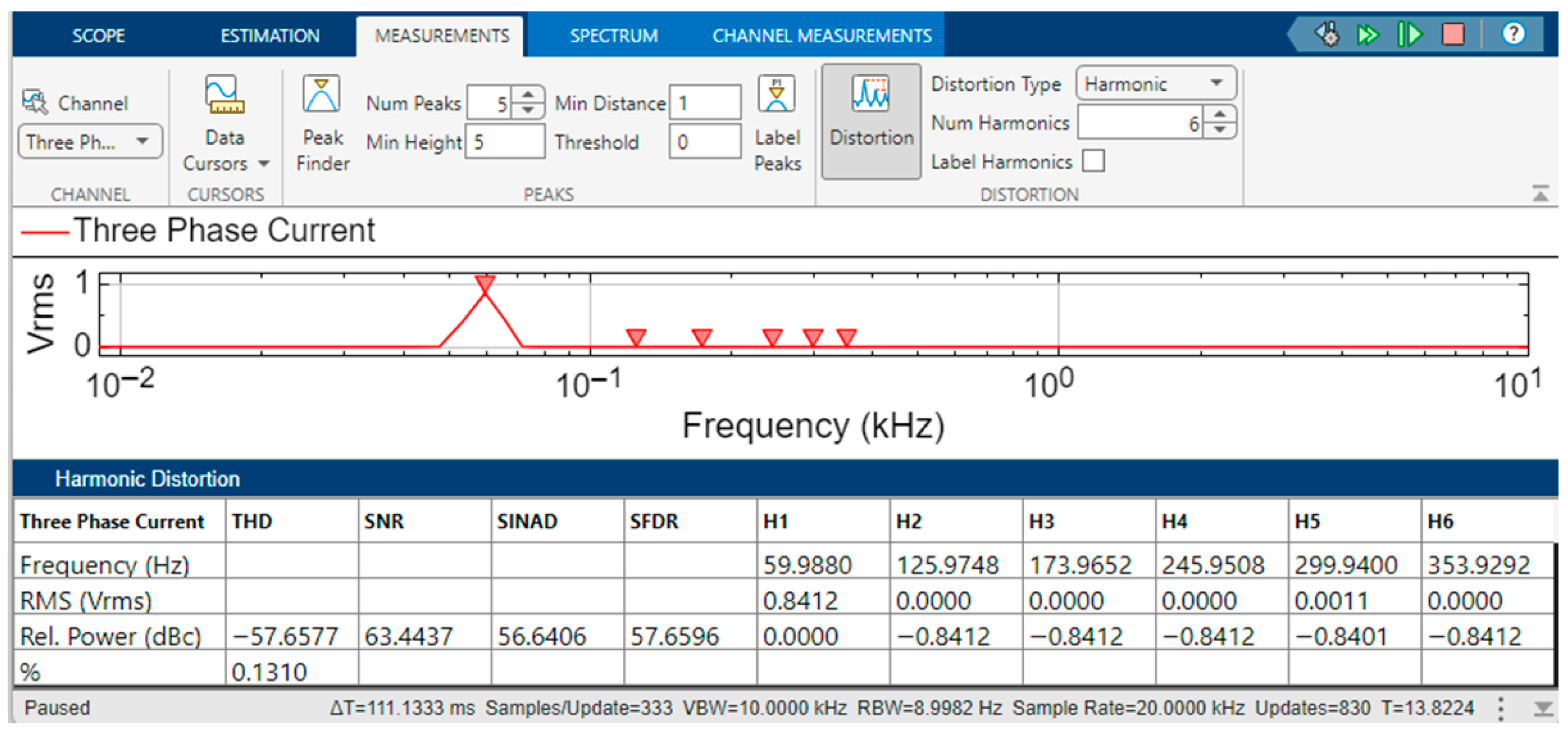
Figure 17 present the harmonic analysis of the three-phase grid voltage and current at the POI. The measured total harmonic distortion (THD) values are 0.3% for voltage and 0.13% for current, respectively. These values are significantly lower than typical grid code limits (e.g., IEEE-519), which generally permit voltage THD up to 5% and current THD up to 8% for distribution-level systems. The low harmonic content confirms that the coordinated operation of the STATCOM, TSC, and GFM-controlled PV/BESS does not introduce adverse switching or resonance effects into the network despite the high-power converter switching activity.
The results also demonstrate that the STATCOM’s current-regulated control loops, combined with GFM droop control in PV and BESS, effectively suppress harmonic components during steady-state and dynamic conditions. Even when TSC switching occurs or the system undergoes load changes, the voltage waveform remains nearly sinusoidal with minimal harmonic distortion. This verifies that the proposed hybrid VAR compensator can enhance reactive power support and voltage stability without compromising power quality, making it suitable for deployment in sensitive renewable-rich and inverter-dominated grids.
This case study demonstrates the fault ride-through capability of the proposed GFMI-based PV and BESSs in conjunction with the hybrid VAR compensator. Despite the three-phase fault, the system maintains operational stability and rapidly recovers post-fault voltage and frequency to nominal values. The results validate the effectiveness of the coordinated control strategy in enhancing system resilience and ensuring uninterrupted power quality during severe grid disturbances.
6. Conclusions
- (a)
Technical Findings
In order to improve voltage regulation and dynamic reactive power support in inverter-dominated power systems, this study proposed a coordinated hybrid VAR compensation strategy that combines grid-forming inverter-controlled PV and BESS units with a thyristor-switched capacitor (TSC) and a VSC-based STATCOM. The suggested compensator provides both quick dynamic support and long-term voltage regulation by fusing the large steady-state reactive power capacity of the TSC with the quick transient reaction capability of the STATCOM. By offering independent voltage and frequency support without depending on traditional synchronous generation, the grid-forming function of PV and BESS significantly enhances system stability.
Using FPGA-based execution, extensive real-time validation was performed under a variety of operational conditions, including variations in solar irradiation, load fluctuations, grid-connected to islanded transitions, and severe fault disruptions. The outcomes showed greater low-frequency oscillation damping, quicker voltage recovery, less overshoot, robust fault ride-through capabilities, and improved transient performance while preserving power quality. Coordinated operation achieves greater stability through the efficient distribution of dynamic and steady-state VAR support, according to comparative assessments versus STATCOM-only and TSC-only systems.
- (b)
Practical and Future Outlook
Practical deployment considerations were also looked at in addition to technical performance. The coordinated control greatly reduces continuous converter loading and minimizes frequent TSC switching operations, thereby lowering the thermal stress on semiconductor devices and extending capacitor bank lifespan, even though the hybrid STATCOM–TSC architecture requires a larger initial investment than standalone compensators. For large-scale renewable-rich grids where steady VAR demand and transient events coexist, this results in lower long-term maintenance costs and better lifespan performance, making the strategy economically advantageous.
Due to hardware limitations and the high-power requirements of multi-source GFM implementation, the current work is restricted to MATLAB/Simulink modeling and FPGA-based real-time simulations. In order to assess controller performance under real-world nonlinearities, communication delays, and switching interactions, future work will concentrate on hardware-in-the-loop (HIL) tests using OPAL-RT/RTDS platforms, followed by a scaled laboratory prototype. A thorough techno-economic analysis utilizing actual utility deployment scenarios will also be the focus of future research.
All things considered, the suggested coordinated hybrid VAR compensation framework provides a reliable, scalable, and cost-effective solution for next-generation low-inertia power systems, facilitating utility-scale renewable integration, microgrids, and smart grid applications while opening the door for realistic field-level implementation.




 ,
,