1. Introduction
The rapid advancement of digital technologies and the deepening of globalization have positioned digital service trade as a critical driver of global economic growth. According to international statistics, the global digital service trade has expanded from $2.1 trillion in 2008 to $6.8 trillion in 2023, with an annual growth rate of 8.3%. Digital service trade has not only redefined the spatial and temporal boundaries of traditional service trade but has also fostered new business models and competitive advantages through cross-border data flows. However, the development of digital service trade exhibits significant disparities: advanced economies dominate due to their technological edge and robust digital infrastructure, while developing countries face challenges such as the digital divide, institutional heterogeneity, and policy barriers.
The expansion of digital service trade has been propelled by the widespread adoption of information and communication technologies (ICT) and the globalization of digital platforms. Technologies such as cloud computing, artificial intelligence, and big data have enhanced the tradability of services, facilitating cross-border transactions in high-value sectors like telecommunications, finance, and intellectual property [
1]. Studies have shown that the technological gap has a significant promoting effect on digital service trade, which is manifested in the complementary division of labor between technologically leading economies and late-developing economies [
2]. Meanwhile, the deepening of digital trade rules in regional agreements (e.g., RCEP, CPTPP) has further reduced transaction costs and promoted liberalization. Nevertheless, policy divergences in data governance, privacy protection, and market access continue to pose significant barriers [
3]. For instance, stringent cross-border data flow restrictions may hinder ICT service exports [
4], while disparities in digital infrastructure exacerbate regional trade imbalances [
5].
Current studies predominantly focus on traditional goods trade or single digital service sectors (e.g., ICT services), while lacking systematic analysis of the overall structural characteristics of global digital service trade networks [
6]. Although prior research has identified “small-world” properties [
7] and “core–periphery” stratification in these networks, quantitative investigations of key evolutionary drivers—such as technological gaps and geographical distance—remain insufficient. Furthermore, existing findings on the policy effects of digital trade present contradictions. Some studies demonstrating that digital trade rules enhance trade in value-added [
8], while others indicate that digital service trade restrictions suppress export efficiency [
9]. These controversies necessitate deeper empirical examination.
The rapid growth of digital service trade has transformed global economic interactions, yet systematic research on its networked structure and underlying determinants remains limited. Although existing literature has examined traditional trade flows or specific digital sectors in isolation, this study addresses a critical gap by analyzing the global digital service trade network as an interconnected system. Therefore, we intend to answer four significant questions in this study as follows: What are the structural characteristics and evolutionary trends of the global digital service trade network? What are the differences in the status of different countries and regions in the global digital service trade network and their formation mechanisms? What factors affect the trade relations between countries and regions in the network? What policy approaches could foster more equitable and efficient participation in global digital service trade?
This study makes several key contributions to the existing literature. Theoretically, it provides a systematic analysis of the global digital service trade as an interconnected network rather than an isolated examination of traditional trade flows or single sectors. Methodologically, it demonstrates the value of combining Social Network Analysis (SNA) and the Quadratic Assignment Procedure (QAP) to simultaneously capture the network’s topological architecture and unravel the complex relational determinants that drive its evolution. This approach effectively addresses the interdependencies which traditional econometric methods often fail to handle. Empirically, it offers a detailed portrayal of the network’s core–periphery structure, community dynamics, and the divergent trajectories of both advanced and emerging economies. Finally, in terms of policy, the findings provide concrete, evidence-based insights for constructing a more inclusive and efficient global digital economy framework.
2. Literature Review
The scope of digital service trade has dynamically expanded alongside rapid technological advancements. Early scholars focused primarily on digital content products and related services [
10]. International organizations have played a leading role in defining this field, with OECD and UNCTAD pioneering comprehensive frameworks that include all services delivered across borders via electronic networks [
11,
12]. Contemporary research characterizes digital service trade as a new form of commerce enabled by the digital economy, where data serves as a key factor and digital technologies provide fundamental support [
13]. The emergence of this trade modality stems from continuous innovations in communication technologies and infrastructure upgrades [
14], which are reshaping the spatial and temporal boundaries of traditional service trade. Scholars have analyzed its features from multiple perspectives, including technical attributes like virtualization [
15], to economic characteristics such as scale economies [
16]. Existing research has extensively examined the conceptual foundations of digital service trade through qualitative approaches. Building on this theoretical groundwork, the present study advances the field by introducing quantitative network analysis to systematically investigate the structural patterns and relational dynamics of global digital service trade networks.
Social network analysis has become an essential tool for examining international trade interdependencies. The approach traces back to Snyder and Kick’s [
17] pioneering work analyzing trade system structures. Subsequent methodological advances include Fagiolo’s [
18] weighted network framework and Chaney’s (2014) [
19] incorporation of temporal dimensions. Domestic researchers have applied this methodology to various trade networks, including petroleum [
19], iron ore [
20], agricultural products [
21], and manufacturing [
22]. Yao and Chen [
23] systematically analyzed global service trade networks using traditional accounting frameworks, while Yao et al. [
24] further examined their spatial architecture from a global value chain perspective. Building on this foundation, we extend social network analysis to digital service trade, aiming to reveal new patterns emerging from global trade digitalization.
The Quadratic Assignment Procedure (QAP) has emerged as a pivotal analytical tool in network research, demonstrating extensive applicability across multiple disciplines. Within international trade studies, Wang et al. [
25] employed QAP regression to elucidate the compound effects of industrial linkages, geographical proximity, and political-economic factors on cultural printed material trade networks, while Deng and Di [
26] utilized QAP analysis to identify the determinant role of economic scale and resource endowment in global grain virtual water trade networks. Similarly, Zhang et al. [
27] applied QAP methodology to establish the significant impacts of population disparities and institutional distance on palm oil trade networks, with Xu and Cheng [
28] making notable methodological innovations through their development of QAP-weighted network analysis to examine synergistic effects among service trade categories. These applications collectively demonstrate QAP’s versatility in analyzing both conventional merchandise trade networks and emerging network types, with its core strengths lying in the capacity to simultaneously process attribute and relational data while controlling for network autocorrelation. As research progresses, QAP continues to expand its application boundaries, showing growing potential in emerging fields such as digital economy and environmental trade studies through its unique ability to address critical network analysis challenges including autocorrelation issues, multidimensional network examination, nonparametric testing robustness, and accommodation of diverse network structures.
The gravity model, with economic scale and geographical distance as core variables, provides the theoretical basis for analyzing bilateral trade flows. Recent extensions incorporate additional factors like language, institutions and culture [
29]. Studies identify several key determinants of digital service trade: ICT infrastructure, economic openness, internet penetration, income convergence, currency integration and common language positively influence trade, while geographical distance remains a significant barrier [
30]. Drawing on Lyu et al.’s [
31,
32] expanded framework, we employ QAP methodology to analyze digital service trade networks, overcoming limitations of conventional approaches and providing new analytical perspectives.
While existing research extensively examines goods and traditional service trade networks, systematic studies focusing on digital service trade networks remain limited, despite their growing economic significance. To address this gap, we leverage OECD data (2008–2023) to analyze the spatial distribution and structural evolution of digital service trade flows across countries. By applying social network analysis (SNA), we map the centrality, clustering, and connectivity patterns within the global digital service trade network. Furthermore, we employ Quadratic Assignment Procedure (QAP) regression to identify key determinants. Our findings contribute to a deeper understanding of the dynamics governing digital service trade, offering insights for policymakers and stakeholders in an increasingly digitalized global economy.
3. Methodology and Data
3.1. Theoretical Foundation and Research Hypotheses
The analytical framework of this study is built upon a synthesis of economic and network theories that collectively explain the structure and dynamics of digital service trade. The foundational principle of comparative advantage [
6] is extended to the digital realm, positing that national specialization stems from relative advancements in technology, innovation, and human capital. This is complemented by new trade theory [
33] and models of firm heterogeneity [
34], which account for the roles of increasing returns to scale and product differentiation. Furthermore, transaction cost theory [
35,
36] suggests that digitization reduces cross-border coordination costs, facilitating dense network structures. To analyze these structures, network theory [
37,
38] provides the conceptual tools of “small-world” and “scale-free” properties, while global value chain (GVC) theory [
39] explains the emergence of core and peripheral positions.
Based on this integrated theoretical framework, we formulate the following research hypotheses:
H1. The global digital service trade network exhibits scale-free and small-world properties characterized by high clustering coefficients and short average path lengths.
H2. Bilateral digital service trade flows are positively influenced by the technological capabilities, human capital endowment, and digital infrastructure development of trading partners.
H3. Geographical distance exerts a significant negative effect on digital service trade volumes, while shared language serves as a positive determinant of trade relationships.
H4. The network maintains a stable core–periphery structure where technologically advanced economies persistently occupy central positions in the global digital service trade landscape.
3.2. Network Model Specification
Based on the bilateral trade data of 65 major economies from 2008 to 2023 in the OECD database, covering six core areas of digital services including communication, computer and information services, financial services, personal, cultural and entertainment services, intellectual property fees, insurance and pension services, and other business services, we construct the following global digital service trade directed weighted network model (G):
The node set V = {
represents the countries participating in digital service trade. The edge set E = {
represents the trade flow direction, from the exporting country
to the importing country
. The weight set W = {−
} represents the trade volume, where wij represents the digital service trade volume exported by country i to country j.
Table 1 specifically lists the calculation formulas and economic meanings of each network indicator. The subsequent analysis will utilize these calculated metrics to examine the structural characteristics and evolution of the digital service trade network.
3.3. QAP Methodology and Variable Specification
The selection of determinants in this study is grounded in established economic theories of international trade. The empirical model builds upon the classic gravity model of trade [
40], which conceptualizes bilateral trade flows as a function of economic mass and geographical distance. To adapt this framework to the distinctive features of digital services, we incorporate insights from new trade theory [
41], which emphasizes the roles of increasing returns to scale and product differentiation—characteristics inherent to many digital service sectors. Furthermore, the pivotal role of technology and innovation is informed by the conceptual framework of the knowledge-based economy [
42], which posits knowledge and information as fundamental drivers of competitiveness in modern trade [
43,
44].
Building upon this integrated theoretical foundation and considering the specific industrial characteristics of digital service trade, we screen the following six indicators to investigate the factors affecting the global service trade network.
Economic Factors: It is generally believed that countries with smaller disparities in economic size are more likely to engage in trade. We adopt the absolute difference in per capita GDP to measure the divergence in economic development levels.
Geographical Distance: The weighted geographical distance between two countries is selected to examine its impact on digital service trade.
Cultural Factors: A binary variable is assigned (1 if two countries share an official language, 0 otherwise) to assess the influence of cultural similarity on digital service trade.
Internet-Related Factors: Here, we employ two indicators. The first is the difference in internet user penetration rates between countries, and second is the gap in fixed broadband subscription rates. These indicators effectively reflect how disparities in digital infrastructure affect trade flows.
Technological Factors: The number of patent applications is used as a direct proxy for a country’s technological innovation capacity. The technological gap between two countries is measured by the absolute difference in their patent application counts.
The dependent variable W denotes the value of digital service exports, represented by the directed weighted matrix of global digital service trade networks. We conduct QAP analysis with digital service export value as the dependent variable, incorporating six explanatory variables: PGDP, DIST, TEC, LAN, RATE, and FIX. The definitions of the key variables and their data sources in this study are presented in
Table 2. Based on the variable selection, the model is set as follows:
All variables are formatted into 65 × 65 matrices for the QAP analysis. The dependent matrix W is a directed, weighted adjacency matrix where each element
represents the digital services export volume from country i to country j. The independent variable matrices are constructed to align dimensionally and conceptually with W, with their specific constructions and data sources detailed in
Table 2. A critical step in this network analysis is the treatment of self-loops: the diagonal elements of all matrices are set to zero as they are economically meaningless in the context of international trade. The QAP method is specifically chosen for its ability to handle the inherent autocorrelation in network data by using a non-parametric permutation test, which provides robust significance levels. Our QAP regression was performed using UCINET software (version 6.771) with 2000 random permutations to ensure statistical reliability.
The model employs natural logarithm transformations for PGDP, DISW and TEC to address right-skewed distributions and facilitate elasticity interpretation of coefficients. These economic variables commonly exhibit skewed characteristics in their original form. For LAN, a binary indicator, and RATE with FIX as percentage measures, the original scales are preserved since they already meet model assumptions regarding distribution and scale. This selective transformation approach aligns with conventional econometric practice when handling explanatory variables of mixed types.
4. Results and Discussion
4.1. Global Digital Service Trade Network Characteristics
4.1.1. Network Scale and Density
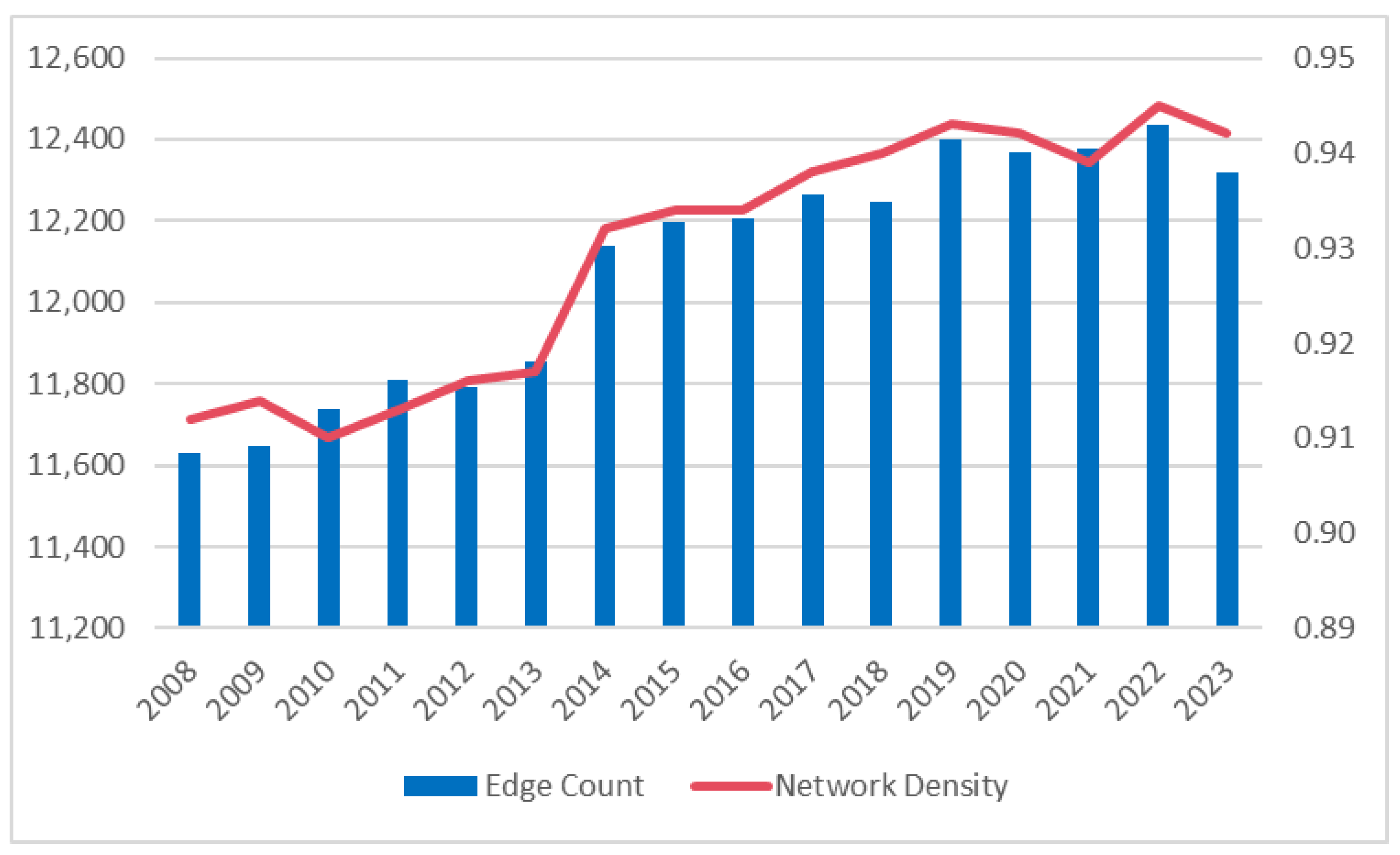
We systematically analyzed the structural evolution of global digital service trade networks from 2008 to 2023 through edge count and network density measurements, as shown in
Figure 1. The left
Y-axis represents number of edge count, and the right
Y-axis represents network density. The edge count shows consistent growth from 11,200 to 12,600 during this period, indicating steady network expansion. This expansion reflects the network-enlarging effects of digital technology proliferation and trade barrier reduction, driven by the continuous integration of emerging economies and global diffusion of digital infrastructure.
Regarding network architecture, network density exhibits a gradual decline from 0.95 to 0.89 alongside a steady increase in edge count from 11,200 to 12,600 between 2008 and 2022. This pattern suggests that while total trade connections increase, newly added nodes initially establish relatively sparse linkages. The observed inverse relationship between network expansion and density reduction can be attributed to two complementary mechanisms: first, latecomers to digital service trade tend to form preferential attachments with existing hubs before developing peripheral connections; second, the maturation of digital infrastructure enables direct node-to-node transactions that bypass traditional intermediaries. Consequently, the overall network structure transitions from a centralized configuration to a distributed one, revealing the transformation from a core–periphery model towards a multipolar architecture in digital service trade networks. These structural changes align with fundamental patterns of global value chain restructuring in the digital economy era.
From 2008 to 2023, the density of the global digital service trade network showed a steady upward trend, climbing from an initial of 0.912 to a peak of 0.945 in 2022, and then slightly declining to 0.942 in 2023. This evolution was accompanied by periodic fluctuations in the rate of change, with a significant acceleration around 2014 and a negative growth of 0.003 in 2023. After the 2008 financial crisis, major economies reconstructed the global value chain through digital transformation, and the rise of cloud computing and cross-border e-commerce drove the continuous increase in network density. Between 2014 and 2019, with the popularization of 4G technology and the global expansion of digital platforms, the growth rate of network density significantly accelerated, reflecting the trade facilitation effect brought by the improvement of digital infrastructure. Under the impact of the pandemic in 2020, the surge in demand for remote services pushed network density to accelerate its increase, reaching an all-time high in 2022. Overall, the global digital service trade network maintained consistently high connectivity levels throughout this period, with density fluctuations primarily reflecting phased technological adoption and shifting demand patterns in the digital economy.
4.1.2. Analysis of Small-World Indicators
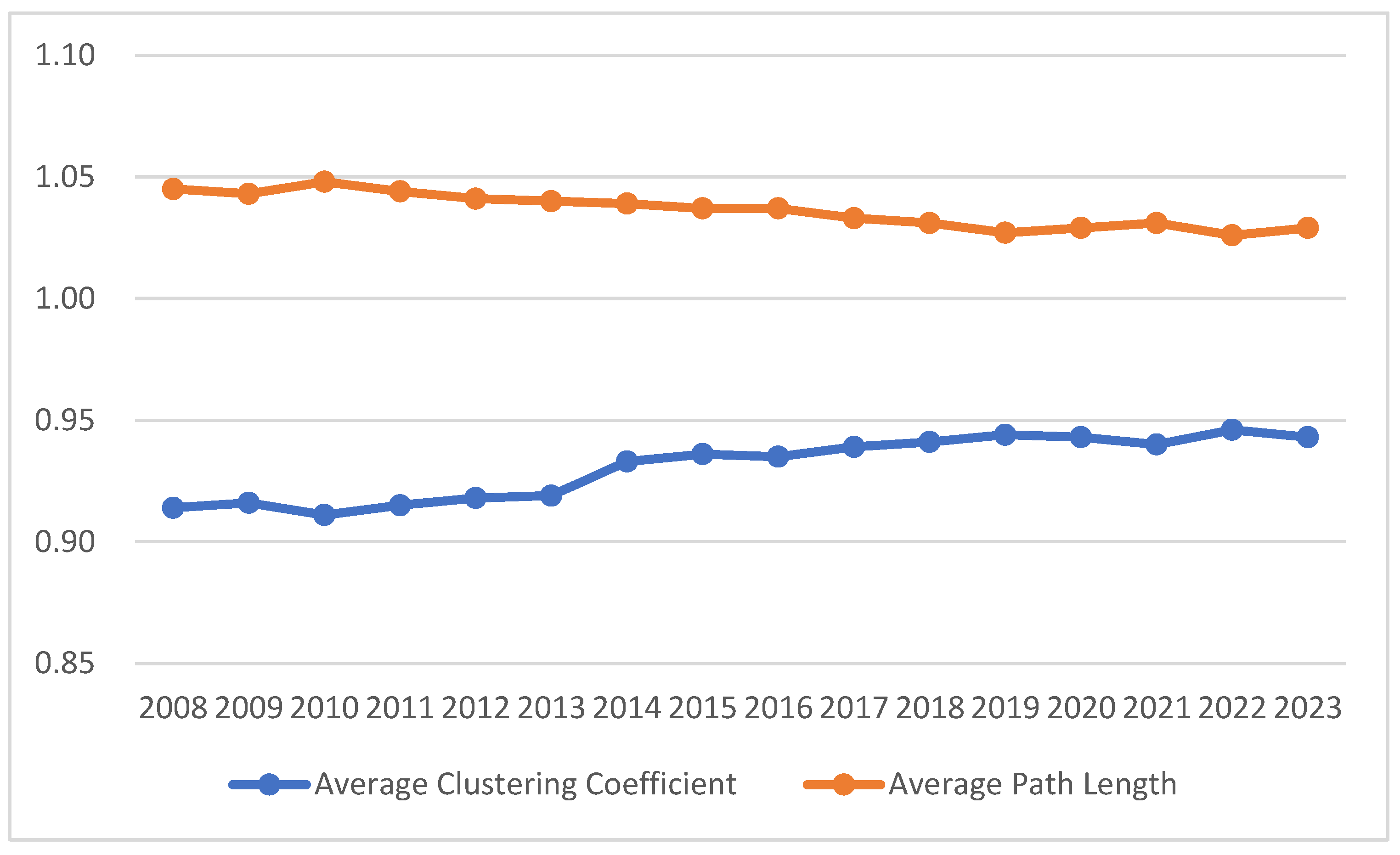
A network is confirmed to have small-world characteristics when it simultaneously meets two conditions: short information transmission paths between nodes and an obvious clustering tendency of the network as a whole. This structural feature means that the network maintains both local close connections and efficient global information transmission. We calculated and integrated two key indicators of the global digital service trade network from 2008 to 2023: the average clustering coefficient and the average path length, as shown in
Figure 2.
From the perspective of the changes in small-world indicators shown in
Figure 2, the digital service trade network exhibited obvious evolutionary characteristics from 2008 to 2023. The average clustering coefficient showed an overall upward trend, increasing from 0.914 in 2008 to 0.943 in 2023. A more significant growth rate after 2014 indicates that the degree of aggregation between nodes within the network continued to increase, and the connections between countries in digital service trade became increasingly close.
The average path length showed a slow downward trend, decreasing from 1.045 in 2008 to 1.029 in 2023, indicating that the trade accessibility between any two economies in the network was gradually improving. The shortening of the path length means that the efficiency of information or service transmission across countries was improved, and the overall connectivity of the network was optimized.
Comprehensive analysis of the dynamic changes in the two indicators shows that the digital service trade network gradually evolved toward a more efficient small-world network structure during this period. The continuous increase in the clustering coefficient reveals the formation of local dense connections in digital service trade among countries with close geographical or economic relations, while the shortening of the path length reflects the reduction in digital service trade barriers and the improvement of cooperation mechanisms on a global scale. This structural evolution not only improves the overall efficiency of the network but also enhances its robustness in the face of local disturbances, laying a structural foundation for the globalization of digital service trade.
4.1.3. Node-Level Characteristics in the Global Digital Service Trade Network
Using the Centrality analysis module of Gephi software (version 0.10.1), we systematically measured the overall and sub-industry networks of digital service trade from 2008 to 2023, focusing on three indicators: closeness centrality, betweenness centrality, and eigenvector centrality.
Table 3 presents the top 10 countries in terms of the three centrality indicators in the overall digital service trade network in 2008 and 2023.
From the perspective of closeness centrality, the UK and Latvia consistently ranked top two from 2008 to 2023. The UK serves as the EU’s digital service gateway with advanced infrastructure and talent, while Latvia leverages its Baltic location to connect global markets via e-commerce. The Czech Republic and Switzerland maintain stable rankings, supported by their digital manufacturing bases and financial service digitization, respectively. Kazakhstan’s entry into the top five in 2023 signals the rise of emerging markets, driven by national broadband construction and government digitization policies.
In terms of betweenness centrality, the UK and Switzerland act as core hubs. The UK’s digital finance networks handle massive cross-border transactions, while Switzerland’s neutrality attracts regional headquarters of global digital firms. This structural power is derived from the UK’s complex financial networks and Switzerland’s status as a hub for global tech headquarters and intellectual property management. France has improved its rankings through digital cultural exports and Ireland by hosting data centers of tech giants. Emerging economies like India and Pakistan join the list, with India’s IT outsourcing and Pakistan’s e-commerce driving multi-polarization.
Eigenvector centrality shows the UK and Switzerland retaining dominance by connecting with core nodes. The UK collaborates closely with the US in cloud services, while Switzerland has partnerships with global leaders through high-end digital solutions. France and Ireland have expanded influence in core trade circles via cultural digital integration and tech innovation.
Overall, the network exhibits a strengthened “core–periphery” structure. This hierarchy reflects underlying economic realities where developed countries leverage mature digital ecosystems, deep capital markets, and established regulatory frameworks to consolidate their dominance. Developed countries lead with mature ecosystems, while emerging economies like Kazakhstan and Pakistan push for multi-centralization. The selective upward mobility of these emerging economies demonstrates that targeted national strategies in digital infrastructure or specialized services can create new hubs, challenging the static core–periphery model. The network is reconstructing: traditional powers ensure stability, and new forces reshape the landscape, driving continuous global digital service trade evolution.
4.1.4. Meso-Level Community Structure in the Global Digital Service Trade Network
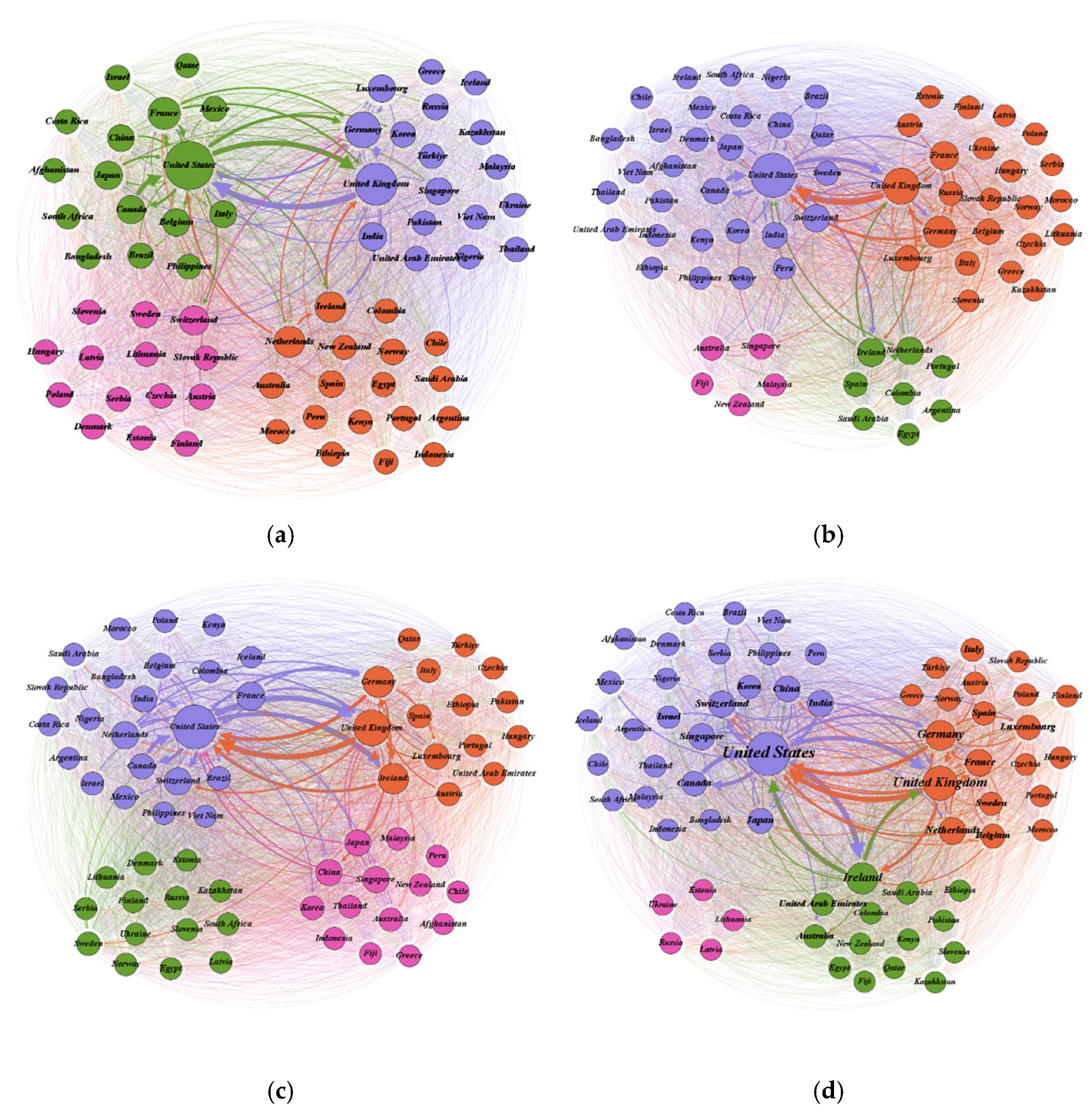
Gephi software (version 0.10.1) was used to identify the community distribution characteristics of the global digital service trade network in 2008, 2013, 2018, and 2023, as shown in
Figure 3. In the figure, nodes represent countries engaged in digital service trade, and the size of a node is positively correlated with the criticality of the corresponding country within the trade network. Edges represent digital service trade relationships between countries. The thickness of an edge corresponds to the scale of trade value, and arrows indicate the direction of trade flow. The denser the connections, the closer the trade ties between countries. Nodes concentrated in the same color form a community. From the perspective of overall evolution, the global digital service trade network shows multi-dimensional and multi-level structural change characteristics.
Overall, the number of communities remained stable, but the scale and composition of each community underwent systematic adjustments. The first community always took the U.S. as the core node and continued to absorb emerging economies. The inclusion of India, Indonesia, and Thailand in 2013 marked the deepening of the globalization process of digital service trade. At the same time, the proportion of European countries in the second community significantly increased, and the concentrated distribution of Germany, France, and Nordic countries in 2018 reflected the accelerated promotion of digital service trade integration within Europe. The scale of the third and fourth communities fluctuated significantly, and the fourth community was reduced to 5 countries in 2023, indicating the marginalization trend of digital service trade connections in some regions.
In terms of regions, the community membership of European countries showed significant agglomeration characteristics. The fourth community in 2008 was mainly composed of Eastern and Northern European countries, and most of these countries were incorporated into the second community in 2018, forming closer network connections with developed Western European economies. This change was directly related to the implementation of the EU’s Digital Single Market Strategy in 2015, and the promotion of which effectively promoted regional data flow and service trade liberalization. The Asia-Pacific region showed a differentiated development trend: developed countries such as Singapore and Australia gradually shifted from the third community to the fourth community after 2013, while economies such as China and South Korea entered the first community in 2023, indicating an evolving restructuring of the hierarchical dynamics underpinning digital service trade within the Asia-Pacific region. African and Latin American countries were mainly distributed in the third community with limited changes, reflecting the constraints of inadequate infrastructure and policy restrictions on their participation in global digital service trade.
In terms of individual countries, the status evolution of core economies showed significant differences. The U.S. has always maintained a dominant position in the first community, with an advantage derived from its long-accumulated competitive edge in digital technology and service trade. The UK, as the leader of the second community in 2008, together with Germany and France, constituted the core nodes of the European block after 2018. The transformation is directly related to the adjustment of the UK’s digital trade policy after Brexit. China’s status improvement was the most prominent, developing from an ordinary member of the first community in 2008 to a key hub of the community in 2023, which corresponded to the implementation of the “Digital Silk Road” initiative and the rapid development of the domestic digital economy. Russia’s status also changed significantly, retreating from a core member of the second community in 2013 to the edge of the fourth community in 2023. This decline was precipitated by Western technology export controls and digital infrastructure sanctions implemented following the 2014 annexation of Crimea and 2022 invasion of Ukraine, which systematically disrupted Russia’s digital trade linkages. Concurrently, European digital autonomy initiatives, including the GAIA-X cloud infrastructure project, accelerated strategic decoupling from Russian data services, reflecting the substantive impact of geopolitical factors on the structure of the digital service trade network.
4.2. Determinants of Digital Service Trade Network: A QAP Approach
Following the comprehensive analysis of the structural characteristics of the global digital service trade network, we intend to further investigate its underlying formation mechanisms and determinants. The network feature analysis reveals topological properties, nodal centrality disparities, and community differentiation patterns, yet the driving forces behind these macro-level structural traits remain unexamined. By employing the QAP method, this study quantitatively assesses how economic disparities, geographical distance, technological gaps, and other variables shape network connectivity patterns, thereby bridging macro-level network morphology with micro-level determinants.
4.2.1. QAP Correlation Analysis
The QAP correlation analysis was performed on 2023 global digital service trade data using UCINET software, with 5000 matrix random permutations generating the results presented in
Table 4. The empirical findings demonstrate that all explanatory variables significantly influence trade network formation at statistically meaningful levels.
Results indicate that disparities in digital infrastructure and internet development levels exert significant negative effects on digital service trade, with correlation coefficients of −0.383 and −0.330, respectively, both statistically significant at the 1% level. Technological differences show positive correlation with trade flows, evidenced by a coefficient of 0.434, suggesting complementary effects between technologically divergent economies. Per capita GDP differences positively correlate with trade volume at 0.191. Geographic distance maintains its traditional negative influence with a coefficient of −0.295, though its impact appears moderated compared to conventional trade patterns. Shared language characteristics demonstrate a positive correlation of 0.133, with statistically significant at the 1% level, indicating its facilitative role in trade relations.
These findings collectively confirm the significant explanatory power of selected variables in shaping digital service trade networks. To further investigate the underlying mechanisms and relative importance of these factors, subsequent analysis employs QAP regression methodology for more comprehensive examination.
4.2.2. QAP Regression Analysis
The MR-QAP linear regression analysis was conducted on the 2023 global digital service trade network using UCINET software. To ensure the robustness of regression results, 2000 random permutations were performed. As shown in
Table 5, the adjusted R-squared of the regression model reaches 0.508, indicating that the selected explanatory variables collectively explain 50.8% of the structural variation in the digital service trade network, demonstrating satisfactory explanatory power. All independent variables show statistical significance at
p < 0.01, confirming their substantial influence on network formation. The analysis incorporates 4160 observations, ensuring sufficient sample size for reliable results.
- (1)
Economic Distance
The standardized coefficient for per capita GDP differences is 0.2363, with statistically significant at the 1 percent level, indicating that economic disparity exerts a positive influence on digital service trade. The findings reveal a complementary trade pattern where advanced economies export high-tech digital solutions like industrial IoT platforms and cloud computing services, while developing countries specialize in labor-intensive services such as IT outsourcing and mobile payment systems. This comparative advantage dynamically enhances trade potential. Conversely, economies at similar development levels experience reduced trade flows due to technological convergence, as evidenced in standardized EU digital markets. Moderate economic disparities instead foster beneficial specialization. For example, U.S. AI innovation complements Vietnam’s blockchain testing capabilities, driving trade expansion through diversified supply-demand structures.
- (2)
Geographic Distance
The standardized coefficient for weighted geographic distance is −0.3642, significant at the 1 percent level, indicating that although digital service trade has reduced the relevance of physical distance, geographic proximity remains a statistically significant barrier. This persistence indicates that geographic distance serves as a proxy for fundamental non-physical frictions, such as regulatory divergence and deeply embedded cultural-linguistic differences, which are not easily overcome by digital technology alone. These latent frictions are compounded by tangible obstacles inherent in long-distance transactions, including time-zone misalignment that disrupts real-time collaboration and network latency that degrades the performance of latency-sensitive services. Collectively, these factors underscore that geographic proximity continues to shape digital trade dynamics through a combination of cultural and technical channels.
- (3)
Cultural Distance
The standardized coefficient of the common language variable is 0.1465, exhibiting high significance at the 1 percent level, which demonstrates a notable positive impact. This finding indicates that digital service trade is notably more active between countries that share common official languages. Linguistic compatibility effectively reduces communication costs and mitigates information asymmetry, thereby facilitating the localized adaptation of digital service products to meet specific market needs. Meanwhile, a common language serves as a reflection of cultural similarity, which helps strengthen trust between trading parties and creates a more conducive environment for promoting the development of digital service trade. Such cultural and linguistic alignment not only streamlines transaction processes but also enhances the overall efficiency and sustainability of cross-border digital service exchanges.
- (4)
Technological Gap
Technological distance demonstrates a significantly positive impact on digital service trade, with a standardized coefficient of 0.4693 that passes the 1% significance level test. This positive correlation manifests through complementary trade patterns where technological leaders export high-value solutions while less advanced economies rely on imports to bridge capability gaps. For instance, Israel’s cybersecurity firms like Check Point Software export advanced threat detection systems to Southeast Asian nations with less developed digital infrastructure, while India imports German SAP’s enterprise cloud solutions to modernize its manufacturing sector. Another compelling example is China’s import of U.S.-designed AI chips from NVIDIA to power its domestic cloud computing platforms, despite developing competing domestic alternatives. These cases illustrate how technological disparities create mutually beneficial trade dependencies-advanced economies monetize their R&D investments through exports, while importing nations accelerate their digital transformation through technology adoption. Such complementarity explains the observed trade-expanding effect of technological distance in digital services markets.
- (5)
Internet Development Level Disparity
The disparity in internet development levels is measured by cross-country internet user penetration rates, reflecting the breadth of digital service coverage. Disparities in internet development levels have a significant inhibitory effect on digital service trade, with a standardized coefficient of −0.1785 passing the 1% significance test. This indicates that larger gaps in internet penetration between countries lead to more pronounced trade restrictions. Such disparities affect supply-demand matching in three aspects: first, countries with low penetration rates have weak user bases and limiting market size; second, technological backwardness causes slow transmission and poor stability, increasing technical barriers; third, uneven penetration creates digital skill gaps, hindering enterprises and consumers from participating in trade activities.
- (6)
Digital Infrastructure Disparity
Digital infrastructure disparity is gauged by fixed broadband subscription rates, indicating the depth of high-quality network access. Digital infrastructure disparities have a significant negative impact on digital service trade, with a standardized coefficient of −0.1937 passing the test at the 1% significance level. This shows that larger gaps in digital infrastructure development between countries result in smaller trade volumes. This impact is manifested in three ways: first, weak infrastructure reduces the efficiency and quality of digital service transmission; second, infrastructure disparities lead to imbalanced operating costs for service providers, requiring additional investment to conduct business in backward regions; third, infrastructure gaps are often accompanied by imperfect supporting institutions, exacerbating trade institutional barriers.
4.2.3. Robustness Check: Binary Network Analysis
To further verify the robustness of our findings, we supplemented the primary analysis based on the weighted network with an additional test using a binary network. This approach allows us to examine whether the identified determinants influence the very existence of significant digital service trade relationships, irrespective of their volume.
The original directed weighted matrix was transformed into a binary matrix B. A directed link from to was coded as 1 ( = 1) if the digital services export volume exceeded a threshold θ of 367.79 (the 75th percentile of all non-zero trade flows in 2023), indicating an economically significant trade relationship. All other links, including the diagonal elements (self-trade), were coded as 0.
We then re-estimated the QAP regression model using this binary matrix as the new dependent variable. The results, presented in
Table 6, demonstrate remarkable consistency with our main findings from the weighted network analysis (
Table 5).
The robustness check confirms the stability of our primary findings. All coefficients retain their original signs, with technological gaps and economic disparities acting as enablers, while geographical distance remains the strongest barrier. The core drivers—technological gap, geographical distance, common language, and economic disparity—maintain statistical significance at the 1% level, with digital infrastructure and internet development disparities remaining significant at the 5% level.
The lower adjusted R2 (0.235) is expected due to the binary transformation, yet the model remains highly significant overall. This confirms that the identified factors are not mere artifacts of trade volume but fundamentally shape the existence of significant trade linkages, underscoring the robustness of our conclusions.
5. Conclusions and Policy Implications
In this paper, we systematically examine the structural evolution and key determinants of the global digital service trade network in the context of accelerating digital transformation. The research employs social network analysis to map network topology and the quadratic assignment procedure to identify influencing factors, utilizing comprehensive OECD bilateral trade data spanning 2008 to 2023 across six core digital service sectors. Our empirical findings not only describe the network’s architecture but also validate our initial theoretical framework, confirming that its evolution is driven by a combination of economic geography, technological capability, and institutional factors. The structural characteristics analysis of the global digital service trade network reveals distinct scale-free properties. Empirical results show that network connection density has continuously increased over time, with the average shortest path between nodes significantly shortened and the average clustering effect becoming increasingly prominent. The coexistence of high clustering and short paths in this network topology confirms that digital service trade activities globally maintain both regional agglomeration and efficient connectivity, marking a new stage in its globalization process. Meanwhile, the network’s centralization trend is also intensifying, with core countries continuing to consolidate their control and peripheral countries exhibiting more pronounced dependency characteristics. This structural pattern directly corresponds to our hypothesis (H1) and reveals a core policy tension: the network’s efficiency is built upon a hierarchy that risks perpetuating global digital inequality.
In terms of individual country performance, nations demonstrate distinct differences in their evolutionary paths within the global digital service trade network. The United States, as a core network node, has shown remarkable stability, consistently maintaining the highest network influence. China, however, has experienced a unique spiral development trajectory, transitioning from an early core member to a regional hub in the middle period and then reclaiming a core position. Traditional hub countries represented by the United Kingdom are undergoing a gradual weakening of their intermediary functions, while emerging economies like India have steadily enhanced their network status by cultivating specific digital service competitive advantages. These divergent trajectories confirm the persistent core–periphery structure (H4) while also showing that targeted national strategies can enable selective upward mobility.
Regarding community differentiation, the global digital service trade network exhibits an evolutionary trend of coexisting regional agglomeration and dynamic adjustment. European countries have formed a highly stable and closely connected sub-network, fully reflecting the significant effectiveness of the EU’s Digital Single Market construction. The Asia-Pacific region, by contrast, demonstrates more dynamic adjustment characteristics, with major economies experiencing multiple changes in community affiliation, which reflects the strategic balance in the region between global participation and autonomous regional development. In comparison, African and Latin American countries generally remain on the network’s periphery, though obvious differentiation trends have started to emerge within these regions. Middle Eastern countries have formed a unique digital corridor model, playing a special bridging role in connecting the European-American and Asia-Pacific networks.
Analysis of influencing factors indicates that technological and economic differences have significantly promoted the development of digital service trade, highlighting the important driving role of complementary division of labor. Geographical distance, internet development level disparities, and digital infrastructure gaps constitute major barriers. The significant positive impact of shared language factors suggests that cultural similarity plays a key role in reducing transaction costs. These QAP results provide robust empirical support for our hypotheses about trade determinants (H2, H3), moving beyond theoretical postulation to identify precise leverage points for policy intervention. The strong negative effects of digital infrastructure and internet development disparities, in particular, quantify the severe trade costs imposed by the digital divide.
To promote a more equitable and efficient global digital service trade network, we propose the following recommendations for policymakers. These recommendations are directly derived from our empirical findings and are structured across global, regional, and national levels to address the specific barriers and opportunities identified in our analysis.
First, at global level, international cooperation on digital governance should be strengthened interoperability. Based on our finding that geographical distance remains a significant barrier partly due to regulatory divergence, multilateral organizations should prioritize developing mutual recognition frameworks for digital standards and certifications. It might face geopolitical headwinds but can be advanced through “coalitions of the willing” among like-minded countries as a first step.
Second, at regional level, digital infrastructure integration and policy harmonization need to be accelerated. Our community analysis showed that regions with integrated policies form stronger clusters. Regional blocs should establish shared digital infrastructure funds and harmonize data governance rules to overcome the infrastructure disparities identified as major trade barriers. This is highly achievable as demonstrated by the EU’s Digital Single Market, though requires strong political commitment and resource pooling.
Third, at national level, targeted digital development strategies based on comparative advantage should be implemented. Emerging economies like India and Kazakhstan demonstrated in our node-level analysis that niche specialization enables network advancement. Developing countries should identify strategic digital sectors where they can build competitive advantage, directly addressing the technological and economic gaps. This requires stable governance and education investments but represents the most immediately actionable path for individual countries.
The global digital service trade network stands at a critical juncture, with its future trajectory depending on how these challenges and opportunities are addressed. While technological change will continue to reshape the network, proactive policy measures can help ensure more widely shared benefits. Future research should explore the evolving role of non-state actors, the network effects of emerging technologies, and the long-term impacts of geopolitical realignments on digital trade patterns. By fostering inclusive digital governance aligned with the Sustainable Development Goals, and using evidence-based approaches that directly address the structural and determinant patterns revealed in this study, the international community can work towards a digital economy that supports sustainable development for all nations.


_Li.png)