


Abstract
The conceptual foundation of this study is that a country’s exposure to risk when using green bonds as a mechanism for financing sustainable development is shaped by a combination of macroeconomic, market, and social factors. This paper develops and empirically validates a fuzzy-set model to assess national-level risks associated with green financing projects within the Water–Energy–Food (WEF) Nexus in BRICS countries. Building on established theoretical frameworks and empirical evidence, the study conceptualises risk as a function of economic development, the scale of the domestic green bond market, institutional trust, and performance on the Multidimensional Poverty Index (MPI). The study employs fuzzy-set modelling to integrate these heterogeneous indicators into a unified quantitative risk score. This approach enables cross-country comparison and captures the non-linear nature of relationships between socio-economic and institutional factors. The country sample includes Brazil, Russia, India, and China, which have successively chaired the BRICS association between 2021 and 2025, thereby ensuring methodological consistency and representativeness. The empirical results reveal a clear stratification of green-finance risk levels across the four economies: China demonstrates the lowest risk (Y = 0.243), followed by Russia with a below-average risk (Y ≈ 0.41), while India (Y = 0.53) and Brazil (Y = 0.51) exhibit the highest relative risks. These outcomes highlight the critical role of institutional trust and market maturity in reducing financing uncertainty within the WEF nexus. The study contributes to the literature by integrating macroeconomic, social, and institutional indicators into a unified fuzzy-logic model of green-finance risk; offering a transparent methodology for country-level comparison; and providing policy insights for improving the enabling environment for green bond markets in emerging economies.
1. Introduction
The member states of the BRICS coalition face a common set of complex challenges in advancing the integrated Water–Energy–Food (WEF) Nexus framework. These challenges are manifested in persistent water scarcity, heightened vulnerability to climate-related disruptions, and the unequal allocation of essential resources across economic sectors. A pervasive constraint that amplifies these environmental and structural pressures is the systemic financing gap for projects situated at the intersection of the WEF nexus. In this context, the strategic use of green bonds emerges as a particularly effective and innovative mechanism for mobilising sustainable investment.
This study addresses this gap by developing a fuzzy-set model that quantifies and compares the country-level risks of using green bonds to finance WEF nexus projects across BRICS economies. The model integrates four key dimensions (macroeconomic strength (GDP PPP), development of the green securities market, institutional trust, and multidimensional poverty) into a single composite risk index. By employing fuzzy logic, the analysis captures the gradual, non-binary nature of risk, allowing for more nuanced cross-country comparisons.
The BRICS group provides a particularly relevant empirical context due to its shared sustainability challenges, high development heterogeneity, and growing role in global green finance. The analysis covers Brazil, Russia, India, and China, whose recent leadership of the BRICS association (2021–2025) ensures a representative sample of the bloc’s economic and geographic diversity. The development of green finance markets across the BRICS countries demonstrates substantial potential for advancing the Water–Energy–Food (WEF) Nexus. China holds a global leadership position in green bond issuance, with a total value of USD 76.25 billion in 2022, while the country’s green credit portfolio reached 28.58 trillion yuan by 2023 [1]. Brazil, with USD 9 billion in green bond issuance as of 2021, represents the largest market for such instruments in Latin America. India exhibits notable institutional diversity in its green financing ecosystem, encompassing green bonds, sustainability bonds, and green deposits.
In contrast to the rapidly expanding markets of other BRICS members, South Africa continues to face a pronounced financing gap, where domestic stock exchanges play a crucial role in attracting sustainable investment. The Johannesburg Stock Exchange (JSE), the largest in Africa, has listed green instruments since 2017, yet overall financing volumes remain limited. The Cape Town Stock Exchange (CTSE) currently lacks a dedicated platform for sustainable instruments, while the Egyptian Exchange has only recently initiated the creation of a carbon market, becoming the first in Africa to do so. A more detailed examination of the theoretical foundations and empirical studies addressing the determinants of green financing risk in emerging economies is presented in the Literature Review.
2. Literature Review
The Water–Energy–Food Nexus concept is becoming particularly relevant for countries with rapidly growing economies and intensive use of natural resources. For the BRICS countries, this approach is critically important due to their significant share of global water resource consumption, which is approximately 42% [2]. The complex nature of the interdependencies between key sectors creates systemic challenges that require an integrated approach to resource management and the development of effective financial instruments. While numerous studies examine the interdependence of these sectors, fewer have explored how financial mechanisms, particularly green bonds, can mitigate nexus-related risks.
In Brazil, the challenges of the Water–Energy–Food (WEF) Nexus are closely linked to the dominance of the agricultural sector, which often hinders integrated resource management and the achievement of environmental goals such as zero deforestation [3]. This tension is particularly evident within Brazil’s development model, where the conversion of natural ecosystems into agricultural land has not consistently translated into improved socio-economic outcomes [4].
India ranks among the most water-stressed countries in the world, facing severe overexploitation of its water resources. This situation poses a threat to national security and undermines key sectors such as agriculture—already highly vulnerable to climate change—as well as energy and industry. Projections indicate that worsening water scarcity by 2050 will necessitate a fundamental transformation of water management practices, particularly in agriculture [5]. Current approaches include the adoption of water-saving technologies and improved drainage systems to protect groundwater resources. Equally important are the implementation of sustainable agricultural methods, waste-to-energy initiatives, strengthened environmental education, and increased investment in clean technologies and green infrastructure [6].
China faces a pronounced imbalance in the distribution of water resources across its provinces, with severe shortages in the north and relative abundance in the south. Moreover, the energy-water nexus exhibits greater inequality and variability than the food-water nexus. These disparities are shaped by a combination of factors, including natural resource endowment, regional economic differences, and government policy [7]. Within this system, the water subsystem plays a dominant role in the integrated development of the Water–Energy–Food framework. Persistent water scarcity makes it a slow-moving variable that can jeopardise the stability of the entire WEF system. Consequently, improving water management has the potential to generate systemic benefits and enhance overall resilience [8].
In South Africa, climate change has intensified the frequency of extreme weather events, aggravating shortages of water, food, and energy. A projected 20% decline in precipitation by 2080 is expected to exacerbate the region’s socio-economic challenges, leading to reduced agricultural output, limited access to clean water and energy, and a higher incidence of vector-borne and enteric diseases [9]. Strengthening resilience to these climate impacts requires investment in education and professional training related to water, energy, and food resource management, along with the adoption of Fourth Industrial Revolution technologies. The application of blockchain systems for transparent accounting, decentralised trading platforms, and smart contracts in resource management is gaining particular importance [10].
In the Russian Federation, the objectives of green bond issuance extend beyond environmental concerns and are closely tied to broader strategic, economic, regulatory, and reputational goals. While the global green bond market continues to grow rapidly, in Russia, this instrument functions primarily as a means of integrating into international sustainable finance systems, diversifying investment portfolios, and attracting socially responsible investors. Compliance with evolving regulatory standards—such as the Bank of Russia’s recommendations on ESG integration—plays a critical role. Additionally, green bond issuance enables companies to enhance their corporate image, demonstrate commitment to sustainability principles, and strengthen management discipline through the targeted use of proceeds and improved transparency in reporting. In this context, the environmental component serves as a mechanism for achieving wider economic and governance objectives, including building stakeholder trust, accessing green capital, and advancing national sustainable development priorities.
Overall, existing country-focused studies reveal significant heterogeneity in the maturity of green finance markets and institutional environments across the BRICS.
Empirical evidence demonstrates that intelligent manufacturing significantly enhances corporate ESG performance by fostering green innovation and improving financial resource efficiency [11]. Fiscal policy reforms, such as China’s VAT reform, have been shown to increase total factor carbon emission efficiency through industrial upgrading and technological advancement [12]. The expansion of digital trade, particularly through cross-border e-commerce pilot zones, contributes to urban emission reductions and supports green economic growth [13]. Additionally, studies reveal that climate policy uncertainty can impede the renewable energy transition by exacerbating resource misallocation and weakening institutional incentives, highlighting the importance of stable and forward-looking climate governance frameworks [14].
However, they tend to analyse these determinants in isolation rather than within an integrated framework that captures their combined effect on financing risk. Prior studies rarely address how macroeconomic, institutional, and social dimensions jointly determine the risk of green financing. Moreover, empirical models often assume linear relationships, overlooking the fuzzy and uncertain nature of sustainability investment environments. To bridge this gap, the present study applies a fuzzy-set modelling approach that integrates economic development, green market maturity, institutional trust, and multidimensional poverty into a unified risk-assessment framework. The fuzzy-set methodology directly addresses the need for an integrated, non-linear framework by quantifying the complex interplay between the macroeconomic, institutional, and social dimensions. This approach inherently accounts for the uncertain and “fuzzy” boundaries of risk, allowing it to model the combined effect of these factors in a way that traditional linear models cannot.
3. Materials and Methods
A fuzzy-set modelling approach was employed to assess the level of country-specific risk in attracting green financing instruments. Four variables were selected as model inputs: (1) GDP per capita based on purchasing power parity (PPP), (2) cumulative green bond volume, (3) institutional trust index, and (4) the Multidimensional Poverty Index (MPI).
- Step 1. Definition and justification of input variables
A set of four input variables was defined to model country-level risk in attracting green financing instruments. The selection of countries is justified by their sequential leadership roles within the BRICS association over the past five years: Brazil (2025), Russia (2024), China (2022), and India (2021). To quantify this risk, the study employs a fuzzy-set modelling approach based on the principles of fuzzy logic. This method transforms quantitative input variables into qualitative linguistic categories using membership functions. The subsequent aggregation of membership degrees and defuzzification yields an integrated quantitative assessment of the overall risk level. The rationale for selecting the input variables is detailed below.
Gross domestic product based on purchasing power parity (GDP PPP) was chosen as the first variable due to its critical role in assessing a country’s overall economic strength and its capacity to finance sustainable development initiatives. Macroeconomic indicators directly influence the size and capitalisation of national green bond markets [15,16]. GDP PPP, in particular, provides a more accurate representation of real economic activity and purchasing power while reducing the impact of short-term fluctuations [17]. GDP PPP also reflects a country’s ability to absorb long-term capital-intensive WEF infrastructure projects, which typically have delayed returns and require stable investment climates. Economies with higher purchasing power tend to demonstrate stronger fiscal resilience, lower probability of sovereign default, and better-developed capital markets.
The second variable, the level of development of the green securities market expressed through the cumulative volume of green bonds, serves as an indicator of the effectiveness of government policy in advancing sustainable development and climate goals. Growth in this measure reflects not only financial activity but also tangible progress toward environmental and social objectives. Studies [18] show that countries with higher levels of green bond issuance achieve better outcomes in reducing CO2 emissions and expanding renewable energy capacity. Increased issuance volumes are also linked to greater investment in renewable energy, clean water, low-carbon transportation, and other projects aligned with the Paris Agreement and the UN Sustainable Development Goals [19]. Accordingly, the total issuance volume directly represents the scale of financing for green projects and must be considered when assessing the risk of using green bonds. In the context of WEF investments, green market maturity also reduces verification costs and improves the credibility of environmental reporting.
The third variable, institutional trust, reflects public confidence in the main issuers of green bonds–banks, large corporations, and government agencies. As a key socio-cultural characteristic, trust plays a critical role in facilitating investment in environmentally responsible projects. It shapes investors’ willingness to finance green technologies and initiatives, influences attitudes toward the sustainable development agenda, and reflects the underlying value systems that drive economic behaviour [20]. High institutional quality, defined by transparency, efficiency, and reliability, enhances the positive impact of green financing on sustainable development by ensuring effective capital allocation and increasing the social and environmental returns of investments [21]. Institutional trust affects WEF-related green finance more strongly than traditional infrastructure finance because water, energy, and food systems require long-term multi-stakeholder cooperation and state coordination. At the same time, it is important to consider the multifaceted nature of the relationship between trust and the green bond market, as well as the need to account for other factors influencing investment decisions.
A composite index was developed to quantify the level of trust in key institutions issuing green bonds, based on data from international sociological surveys. The institutional trust variable was derived from Wave 7 of the World Values Survey (2017–2022), based on three questions on confidence in financial and governmental institutions. While cross-cultural bias cannot be entirely excluded, the data are the only harmonised cross-national source available for the BRICS, and the potential measurement limitations are acknowledged in the Section 6.
The composite confidence index was calculated as a weighted average of three components:
- Confidence in banks (Db),
- Confidence in large companies (Dc),
- Confidence in the government (Dg).
For each institution, a relative confidence indicator was computed in comparison to the global average:
where
- “A great deal”—the ratio of respondents expressing the highest level of confidence;
- “Quite a lot”—the ratio of respondents indicating a significant level of confidence.
The composite indicator of institutional confidence, Dtotal, was determined as a weighted sum of the normalised confidence values for the individual institutions:
where
- wi—the weight of the i-th institution;
- Di—the relative confidence indicator for the i-th institution (banks, large companies, government).
Within this study, equal weights were assigned to each component, corresponding to an arithmetic mean calculation.
The selection of these institutional groups is justified by their pivotal role in green bond issuance. Banks serve as key financial intermediaries, channelling savings into green investments through specialised debt instruments. The corporate sector comprises the main initiators of environmentally oriented projects, whose implementation directly depends on accessing targeted financing via green bonds. Government institutions fulfil a dual role: they are major issuers of sovereign green bonds while also establishing the regulatory framework and incentive systems for this financial market segment. The composite index, integrating three institutional groups, provides a comprehensive assessment of the investment climate, where confidence in different financial system actors collectively influences investor willingness to finance green projects.
The Multidimensional Poverty Index (MPI) was selected as the fourth variable. This indicator captures living standards and well-being across multiple dimensions, including education, healthcare, and housing conditions. It significantly affects the ability of low- and middle-income countries to develop sustainable financial mechanisms, such as green bond markets, by influencing both the availability of domestic capital and the prioritisation of social versus environmental investment goals. Countries with higher poverty levels face competing fiscal priorities, weaker administrative capacity, and greater political sensitivity to tariff reforms in water and energy sectors. This increases project-level uncertainty and may reduce the government’s ability to guarantee or co-finance WEF-related green investments.
The analysis utilised data for 2022. The year was selected as it was the most recent period with the most complete and reliable data available across all indicators at the time of our analysis. Using earlier periods was considered less relevant, particularly for accurately capturing the state of green bond markets, which were insufficiently developed in prior years to allow for a meaningful comparative assessment.
Specifically, the level of economic development is based on World Bank data on gross domestic product per capita based on purchasing power parity (PPP) in constant 2021 international dollars. Data on green financing market development were obtained from the International Monetary Fund (IMF) database. The World Bank’s Multidimensional Poverty Measure was applied to assess multidimensional poverty. Cultural aspects and the level of institutional confidence were evaluated based on World Values Survey data, which reflect the socio-cultural characteristics and values of the population.
- Step 2. Data normalisation
To enable a robust comparative analysis among countries at different stages of economic development, all input data were normalised. Each variable was standardised relative to its corresponding global average to reduce scale disparities and ensure direct, unit-free comparability across the sample.
We conducted a sensitivity analysis in which the indicators were assigned several alternative sets of weights. The results demonstrated that the overall risk rankings of the countries remained stable across the different scenarios, while the equal-weight configuration produced the most coherent and interpretable outcomes. For the final model, all variables were treated as equally important in the aggregation process, following the approach most frequently applied in the literature on green finance risk modelling, where economic, institutional, and social factors are considered to have comparable significance for sustainable development outcomes. This decision is further supported by expert consultations, including opinions from analysts of Public Joint-Stock Company «SPB Exchange».
The fuzzy modelling procedure included three key stages: (1) fuzzification of input variables using five linguistic categories (Y1—“low”, Y2—“below-average”, Y3—“medium”, Y4—“above-average”, Y5—“high”); (2) aggregation of membership degrees across indicators; (3) defuzzification of the composite output variable Y, which represents the overall green-financing risk level.
- Step 3. Fuzzification of variables
Because most indicators (economic development, green bond volume, and institutional trust) are inversely related to risk, their membership functions were inverted prior to aggregation. In other words, as these indicators increase, the national risk associated with green financing decreases. Therefore, their fuzzy membership values were adjusted to reflect this opposite direction of influence before combining them into the composite index. In contrast, the Multidimensional Poverty Index (MPI) directly contributes to higher risk: countries with greater multidimensional poverty face more pronounced constraints on investment and institutional capacity.
Following normalisation, the quantitative indicators were translated into a qualitative framework by converting the standardised values into predefined linguistic variables. This transformation represents a key step in applying fuzzy-set logic, as it allows the characterisation of attributes such as “high economic development” or “low market volume” as degrees of membership within a set rather than as fixed numerical thresholds. To operationalise the linguistic categories, membership functions were defined according to the value intervals summarised in Table 1.
Table 1.
Factor Level Classification.
The output variable Y was subsequently classified into five fuzzy categories—ranging from “low” to “high” risk based on the membership functions shown in Table 2.
Table 2.
Level Classification.
Triangular membership functions were applied to represent smooth transitions between adjacent fuzzy sets. The value intervals reflect the continuous scaling of the composite risk index Y from 0 (least risk) to 1 (highest risk).
4. Results
The membership function Y will characterise the integral risk level of attracting green bonds to finance sustainable development projects in the BRICS countries. To determine the degree of membership of the risk level to the set ranging from “low” to “high”, a scale of Y intervals was formed. The linguistic categories and their corresponding membership functions are presented in Table 3, which defines the fuzzy value scale used for all subsequent calculations.
Table 3.
Fuzzy Value Scale for Variable Y in BRICS Countries.
In this study, the term “risk” refers to the relative level of structural and institutional vulnerability affecting the use of green bonds to finance WEF nexus projects. It represents a composite, comparative measure derived from economic, market, and social indicators rather than a causal or time-dependent relationship. Accordingly, lower risk values indicate more favourable macro-institutional environments for green financing.
Unlike project-level financial risk, which captures uncertainties specific to individual assets, the present approach focuses on macro-institutional risk, determined by the broader economic, regulatory, and social environment. This conceptualisation is particularly relevant for WEF nexus projects, which require stable, long-term financial commitments and strong governance capacity.
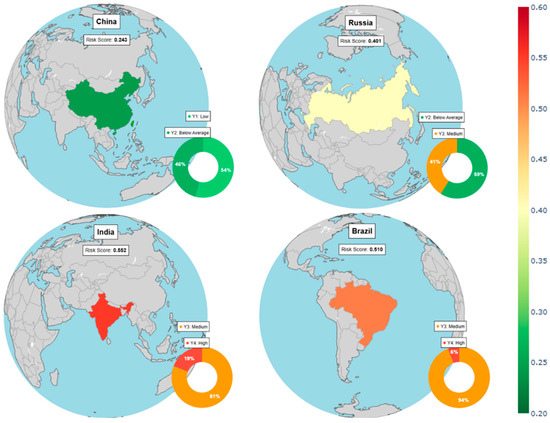
The application of the fuzzy logic methodology produced distinct national risk profiles for the use of green bonds in financing sustainable development initiatives across the BRICS countries, as illustrated in Figure 1.
Figure 1.
Risk Assessment Results for Green Bond Utilisation in BRICS Countries. The colour bar denotes the composite risk score (Y), increasing from green (low risk) to red (high risk).
This study conducts a comparative analysis of four key BRICS member states—Brazil, Russia, India, and China. The selection of these countries is strategically justified by their sequential leadership of the BRICS association from 2021 to 2025: India (2021), China (2022), Russia (2024), and Brazil (2025).
The Republic of South Africa, which held the BRICS chairmanship in 2023, was excluded from the final comparative model due to the absence of consistent and reliable statistical data for several key indicators. Nonetheless, the inclusion of the remaining four countries provides comprehensive and representative coverage of the major geographical and economic regions of the BRICS bloc, encompassing Latin America, Eastern Europe, and South and East Asia.
Table 4 summarises the resulting composite risk scores (Y) and their membership distributions across fuzzy categories. These results complement Figure 1, providing detailed numerical transparency.
Table 4.
Country Risk Profiles Derived from the Fuzzy Logic Model.
The detailed outcomes of the fuzzy-set assessment are summarised in Table 4, while Figure 1 provides a visual comparison of risk levels across the BRICS countries.
China falls predominantly within the “low risk” category (54%), with an additional 46% classified as “below-average risk.” China demonstrates the lowest composite risk among the BRICS countries, reflecting its relatively advanced green bond market, strong institutional trust, and consistent policy environment. These findings indicate a favourable configuration of economic and institutional factors that correlate with lower financing uncertainty.
China was among the first nations to develop a national green finance taxonomy [22] and to establish a comprehensive legislative and institutional framework that has facilitated the attraction of substantial financial resources and enhanced market transparency. Empirical evidence demonstrates that the expansion of green finance in China has had a pronounced positive impact on economic performance: it fosters productivity growth [23], significantly reduces industrial emissions [24], and improves energy efficiency both locally and in surrounding regions [25].
Cross-country analyses further indicate that the advancement of green finance serves as a key determinant in reducing environmental impact across other BRICS economies as well [26], highlighting the importance of exchanging best practices within the bloc. The Chinese model, characterised by its resilience to socio-economic fluctuations, represents the most successful case within the BRICS framework, offering transferable elements that could help other member states accelerate their transition toward low-carbon and sustainable development.
The primary factor underpinning China’s low risk level is the advanced development of its green bond market, with a total issuance volume of USD 99.43 billion (PPP), substantially exceeding that of other BRICS countries. High GDP per capita (USD 21,011) and a low Multidimensional Poverty Index value (3.9%) indicate both economic stability and social sustainability, which together help mitigate investment risks. Moreover, the exceptionally high level of public trust in the Chinese government (over 90%) fosters a supportive environment for implementing state-led environmental programmes and stimulating the growth of the green bond market, amplifying the positive influence of macroeconomic conditions.
For Russia, the analysis indicates predominant membership in the “below-average risk” category (59%), with a considerable share (41%) trending toward the “medium risk” group. Although the country’s GDP per capita (USD 38,263 PPP) is relatively high, Russia’s total green bond volume remains modest at USD 0.86 billion, and its multidimensional poverty rate (4.8%) exceeds that of China, potentially constraining the expansion of green financing and heightening investment risk. Public confidence in the government is also notably lower than in China—only 13.2% of respondents report “a great deal” of trust and 38.6% “quite a lot”—which may limit the effectiveness of state initiatives aimed at promoting green finance and stimulating demand for green instruments.
Nevertheless, Russia remains within the below-average risk category. Despite the adoption of a national green taxonomy and the establishment of related regulatory standards, the domestic market continues to lag global leaders in both issuance volume and the diversity of financial instruments. As Sannikova [27] notes, a major obstacle is the underdeveloped institutional infrastructure, particularly in the field of verification. The Russian market also faces a shortage of digital solutions to enhance transparency and strengthen investor confidence.
Brazil and India exhibit comparatively higher risk levels, with strong membership in the “medium risk” category—94% for Brazil and 81% for India. India’s composite indicator (0.532) reflects a relatively low GDP per capita (USD 8544 PPP) and a high multidimensional poverty rate (11.28%), despite a considerable volume of issued green bonds (USD 1.24 billion). Brazil’s indicator (0.510) is associated with a higher GDP per capita (USD 18,554) and a lower poverty level (4.10%); however, its total green bond issuance (USD 0.45 billion) is the smallest among all countries analysed, which serves as a key limiting factor. The structure of institutional trust also differs: in India, aggregate confidence in the government (63.7%) and banks (86.9%) is offset by lower trust in large corporations (48.3%), whereas in Brazil, confidence in the government (22.5%) lags that in banks (50%) and companies (52.3%).
The findings suggest that for Brazil, the main policy priority is to stimulate both demand and supply in the green bond market. This requires the creation of economic incentives for private issuers and investors to offset the relatively low level of public trust in state institutions. Key drivers of market expansion include the standardisation of procedures, transparency in the use of proceeds, and the establishment of a credible verification system for the “green” attributes of bonds. Previous research indicates that, despite favourable market forecasts, development in emerging economies is constrained by structural barriers such as high transaction costs and the absence of uniform disclosure standards [28,29]. Empirical evidence confirms that macroeconomic fundamentals and national climate commitments (Nationally Determined Contributions) exert the strongest positive influence on green bond issuance volumes [19]. In an environment of limited state credibility, national and multilateral development banks can play a critical intermediary role by providing risk-mitigation guarantees, an approach that has already proven effective in Brazil through the issuance of the first sustainable bonds [30,31]. Such institutional support is particularly valuable for developing the municipal-level market and key national sectors such as agriculture.
In the case of India, the results indicate that high multidimensional poverty remains a systemic barrier that offsets the benefits of green bond market growth and strong confidence in the banking sector. However, recent studies show that expanding access to financial instruments, including bonds, contributes to poverty reduction at the household level [32]. These findings highlight the importance of enhancing financial inclusion as a driver of economic development and as a mechanism for improving the effectiveness of green finance initiatives. Consequently, it is essential to promote financial products that integrate environmental and social objectives. A notable example is the Green Credit Programme, which has been shown to simultaneously reduce emissions, support GDP growth, and improve social welfare [33]. Furthermore, institutional transformation aimed at increasing capitalisation must be accompanied by commitments to environmental sustainability [34]. Therefore, for India, the deep integration of environmental initiatives within national poverty alleviation programmes represents a strategic pathway toward lowering investment risk and achieving inclusive green growth.
5. Discussion
The results of the fuzzy-set analysis reveal a clear differentiation of green-financing risk levels among the BRICS countries. China demonstrates the lowest composite risk (Y = 0.243), reflecting its mature green bond market and high institutional trust. Russia’s position (Y = 0.401) corresponds to a below-average risk level, primarily due to moderate financial-market development and institutional stability. India (Y = 0.533) and Brazil (Y = 0.512) show medium risk profiles, driven by persistent social inequalities and less diversified green-finance instruments. The comparative results highlight that the level of risk is determined not only by macroeconomic capacity but also by institutional maturity and social inclusion. Countries with stronger institutional trust and more diversified green-bond markets, such as China and Russia, show lower perceived risks, whereas India and Brazil face medium risk due to social and structural constraints.
To further evaluate the robustness of our results, we compared the country rankings generated by our fuzzy-set model with several existing international indices that assess macro-institutional vulnerabilities and investment conditions. Although most available frameworks focus primarily on climate-related risks (e.g., the ND-GAIN Index, the Climate Risk Index) or broader ESG performance (e.g., the Environmental Performance Index, the Global Innovation Index), their structure and purpose differ substantially from the objectives of this study. The Global Investment Risk and Resilience Index is most comparable to our approach, developed by AlphaGeo, a geospatial analytics company specialising in climate and geopolitical risk modelling, in partnership with international advisory firm Henley & Partners. This index integrates 13 indicators capturing macroeconomic stability, governance quality, climate risk exposure, and adaptive capacity, making it one of the closest available analogues to our conceptualisation of national-level structural and institutional vulnerability. The relative ordering of BRICS countries in the Global Investment Risk and Resilience Index closely aligns with the distribution observed in our model. Specifically, China ranks highest among the countries in our sample (37th globally, Score 68.49), followed by the Russian Federation (69th, Score 60.76), while Brazil (99th, Score 55.09) and India (104th, Score 54.42) fall into less favourable categories. This correspondence supports the internal validity of the fuzzy-set results and indicates that the risk profiles identified in this study are consistent with broader patterns captured by comprehensive global assessments.
Within the BRICS economies, the renewable energy sector attracts the largest share of green bond financing [35,36,37,38]. In Brazil, the national development bank BNDES serves as a central institution, issuing green bonds to fund large-scale wind and solar energy projects. Private companies such as CPFL Energia, the first green bond issuer in South America, also direct proceeds toward renewable energy development and energy efficiency improvements.
In India, the State Bank of India (SBI) issued USD 250 million in green bonds in 2024 to finance solar and wind power plants. Major private issuers, including the Greenko Group, have implemented extensive hydroelectric, solar, and wind energy projects. In South Africa, commercial banks such as Nedbank, Standard Bank, and Investec actively issue green bonds to support the construction of renewable energy facilities; for example, in 2023, Nedbank issued bonds totalling more than ZAR 1.65 billion to finance solar and wind generation infrastructure [19].
In China, the country’s largest financial institutions, such as the Industrial and Commercial Bank of China (ICBC) and China Everbright Bank, provide funding for renewable energy projects through both green credit and green bond mechanisms [39]. Whereas in Brazil and South Africa, both public and private banks drive green finance, in India and China, the dominant role is played by major state-owned financial institutions, underscoring the central importance of government policy in structuring and expanding national green finance markets.
From a sectoral perspective, the dominance of the energy segment reflects the relative maturity of investment pipelines and the lower perceived risk compared to agriculture and water infrastructure. This pattern also supports the conclusion that policy and institutional frameworks significantly influence the allocation of green-finance resources within the WEF nexus.
The adoption of green technologies, coupled with the enhancement of institutional quality, enables a significant reduction in environmental degradation, particularly through the control of energy consumption and the advancement of renewable energy sources [40,41]. The water-related dimension of the WEF nexus is more developed in countries with a strong dependence on agriculture [42]. In Brazil, public agricultural credit programmes promote the adoption of water-saving technologies, pasture restoration, and the creation of integrated systems, thereby supporting efficient water use and enhancing food security. Private companies are also engaged in ecosystem conservation projects. For example, Suzano, a pulp and paper producer, allocates green bond proceeds to water resource management and sustainable forestry initiatives [43]. In India, funding for water projects such as the development of water supply systems and the management of aquatic ecosystems is mainly provided by state-owned enterprises, including the Rural Electrification Corporation Limited and the Power Finance Corporation, which issue green bonds to support rural communities. In China, companies such as China Chengxin Green Finance Technology implement projects in water resource management, including water purification and ecological restoration. Despite these individual success stories, projects in the water and agricultural sectors often struggle to attract large-scale investment compared with those in the energy sector. This challenge is particularly acute in South Africa, where funding shortages remain one of the main obstacles.
Comparative interpretation of these sectoral patterns suggests that green-finance risk is lowest in countries where institutional and regulatory stability enables the scaling of renewable energy and water management initiatives. Conversely, where governance fragmentation or fiscal constraints persist, investors face higher uncertainty and limited diversification opportunities. Overall, these results emphasise that institutional trust, policy coherence, and inclusive financial mechanisms are key to lowering the risk of green financing in the WEF nexus.
6. Conclusions
This study contributes to the scholarly discourse in three ways. First, it extends fuzzy-set methodology to the analysis of green-financing risk at the macroeconomic level, offering a transparent and replicable approach for cross-country comparison. Second, it empirically demonstrates that risk differentiation among emerging economies is driven not only by economic capacity but also by institutional trust and social inclusion that are often neglected in quantitative sustainability finance models. Third, it provides a conceptual link between the WEF nexus and green financial systems, thereby enriching the understanding of integrated sustainability governance.
The study, employing fuzzy-set modelling, yielded quantitative assessments of the risk level associated with using green bonds to finance projects implementing the Water–Energy–Food (WEF) nexus in BRICS countries and identified the key determining factors. Measures aimed at expanding green bond issuance and improving financial instruments correspond to the market maturity variable, while initiatives focused on enhancing transparency and digital infrastructure are associated with institutional trust. Strategies addressing poverty reduction and social inclusion relate to the multidimensional poverty dimension, and macroeconomic stabilisation efforts correspond to the economic development indicator.
The following key results can be highlighted:
- A significant differentiation in risk levels among the BRICS countries was established. China (0.243) demonstrates a low-risk green financing model, attributable to a combination of high performance across all four factors: macroeconomic development, market volume, institutional confidence, and quality of life.
- For the Russian system, the analysis revealed that despite having one of the highest GDP per capita figures in the sample, its risk level approaches the medium category due to the small volume of its green bond market and a relatively low level of confidence in state institutions. This indicates that a high degree of economic development is not a sufficient condition for the natural mitigation of green financing risks without the targeted development of the institutional environment and market mechanisms.
Based on the analysis of factors influencing the risk level of attracting green financing, several recommendations can be formulated aimed at mitigating the risks of using green bonds as a tool for ensuring sustainable development. From a policy perspective, the findings suggest that reducing green-financing risk requires strengthening institutional reliability, diversifying financial instruments, and aligning green investment with social policy objectives.
For India, the modelling results show that the primary factor driving investment risk is the high level of multidimensional poverty. Therefore, policy efforts should focus on comprehensive socio-economic measures aimed at poverty reduction. The strategy should not be limited to increasing the volume of green financing but should prioritise the creation of tailored financial products that generate both environmental and social benefits. Effective implementation of this approach requires enabling conditions such as improved access to financial instruments, government support for small and medium-sized enterprises, and the expansion of digital financial infrastructure, particularly in rural and remote regions. In the long term, sustainable development will depend on institutional quality, regulatory transparency, and the establishment of reliable market infrastructure.
To enhance the effectiveness of green bonds as a tool for sustainable development, India must strengthen its national financial system with particular attention to local institutions and market infrastructure, including specialised platforms such as India INX and NSE IFSC. The experience of major banks, including the State Bank of India and IndusInd Bank, demonstrates the importance of developing customised financial products while improving transparency through collaboration with independent verifiers. The introduction of targeted programmes in key sectors such as renewable energy, affordable housing, and rural electrification is essential, as these initiatives can generate combined environmental and social benefits. This approach, centred on mobilising domestic resources and reinforcing national institutions, will contribute to reducing investment risks and ensuring the long-term sustainability of green finance in the Indian economy.
For Brazil, the risk mitigation strategy should prioritise addressing the structural barriers that hinder the development of the green bond market. A key priority is the establishment of a comprehensive system of economic incentives supported by the standardisation of verification principles and full transparency in the use of proceeds. Public and international development banks have a crucial role in facilitating these processes. This approach would not only expand market volume but also create an institutional foundation for the long-term mobilisation of green investment, helping to shift Brazil’s commodity-dependent economy toward one that places greater emphasis on environmental and social responsibility.
The experience of BNDES and Banco do Brasil demonstrates that even with a relatively modest green bond issuance volume (USD 0.45 billion), effective sustainable financing mechanisms can be developed. The introduction of specialised financial instruments such as the FIDC “Sustainable Energy” fund, which helps overcome the limitations of traditional capital markets, is becoming particularly important. However, unlike India—where high public trust in state institutions helps partially offset economic risks—in Brazil, confidence in government structures (22.5%) is significantly lower than in the private sector. Therefore, initiatives such as Renovagro and FNE Verde should not merely replicate state programmes but should generate tangible economic incentives for private investors, compensating for the weaknesses of the institutional environment.
China represents the most resilient green financing model among the BRICS countries, as reflected by its composite risk score of 0.243 and the stability of its broader socio-economic indicators. China’s experience illustrates that maintaining a low risk level in green finance depends on a systemic approach that combines a robust national taxonomy with a comprehensive regulatory framework. The effectiveness of implementation has been driven by strong state involvement, particularly from the People’s Bank of China and the China Banking and Insurance Regulatory Commission, which have established regulations harmonised with international standards.
The example of the Shanghai Stock Exchange, which lists 610 green bonds with a total value of 269 billion yuan, highlights the success of this model: compliance with the Climate Bonds Taxonomy has significantly strengthened investor confidence. A distinctive feature of the Chinese system is its balanced integration of state regulation and market mechanisms. State-owned banks such as the China Development Bank ensure market stability, while private institutions like Ping An Insurance promote innovation through instruments such as tokenised bonds and ESG deposits. China’s model, which has proven effective in stimulating the green economy, reducing emissions, and improving energy efficiency, serves as a benchmark for other BRICS members. Its resilience to external shocks and capacity to generate positive spillover effects make it a strong foundation for harmonising green finance standards and developing shared infrastructure for sustainable investment within international cooperation frameworks.
The key development priority for the Russian green finance market should extend beyond merely increasing issuance volumes and focus instead on the systemic integration of green finance principles—such as disclosure, verification, and environmental impact assessment—into a broader range of financial instruments. This approach would help establish a comprehensive, sustainable financing ecosystem. Digitalisation plays a particularly promising role in this transformation, as it can significantly reduce investment risks and enhance transparency in the long term.
Although the current volume of Russia’s green bond market remains modest (USD 0.86 billion), the sector holds considerable potential for structural transformation. The main opportunity lies not simply in expanding the issuance of specialised green bonds but in embedding their underlying principles across the entire financial system. This would enable the gradual creation of an integrated framework for sustainable finance.
Successful examples already exist. The city of Moscow has issued sub-federal green bonds worth 70 billion roubles to finance the purchase of electric buses, while DOM.RF has introduced green mortgage-backed bonds, demonstrating how environmental principles can be effectively incorporated into diverse financial products. This approach should be expanded by applying clear standards for environmental disclosure, project verification, and impact monitoring to other instruments, including corporate bonds, project finance mechanisms, and derivatives.
Institutional trust remains a crucial factor. One effective solution could involve harmonising Russian standards with international best practices, particularly within the BRICS framework, and establishing a unified and transparent reporting system for all financial instruments, not only specialised green issues. The ongoing digitalisation of these processes—such as the SPB Exchange’s introduction of green certificates—shows significant promise. Developing digital platforms for the accounting and trading of sustainable assets would make it possible to scale green finance principles across the financial market as a whole, fostering growth without fragmenting the market into isolated segments.
At the same time, this research has certain limitations. Digitalisation is an increasingly important factor influencing green finance and institutional efficiency, but it was not included in the present fuzzy-set framework. The method requires a limited number of input variables to maintain clarity and comparability of results. For this study, we selected the most fundamental indicators that are available for all BRICS countries: economic capacity, market maturity, institutional trust, and multidimensional poverty. Future research may extend the model by incorporating digitalisation and technological readiness to provide a more comprehensive assessment. In subsequent work, we will also expand the indicator set to better capture vulnerabilities specific to the Water–Energy–Food (WEF) nexus, since the current variables predominantly reflect macro-institutional context. We are going to retain the existing four macro-level indicators and add a WEF-specific measure, such as a composite Water–Energy–Food Security Index and individual metrics: water-stress indicators, energy-intensity of GDP, and food-security indices. Introducing such indicators would allow the model to incorporate sectoral pressures that could materially influence the composite risk score.
Author Contributions
Conceptualization, M.E., S.G., D.R. and A.Z.; methodology, M.E. and S.G.; software, M.E.; validation, M.E., S.G. and D.R.; formal analysis, M.E., S.G. and D.R.; investigation, M.E.; resources, M.K.B., A.Z., S.G. and D.R.; data curation, M.E.; writing—original draft preparation, M.E.; writing—review and editing, S.G., A.Z. and D.R.; visualisation, M.E.; supervision, S.G. and A.Z.; project administration, D.R. and M.K.B.; funding acquisition, D.R. All authors have read and agreed to the published version of the manuscript.
Funding
This research was conducted with the financial support of the Russian Federation, represented by the Ministry of Science and Higher Education of the Russian Federation, as part of the project “Managing the Sustainable Development of Industrial Structures within the Water–Energy–Food Nexus Framework” (Agreement No. 075-15-2024-673).
Institutional Review Board Statement
Not applicable.
Informed Consent Statement
Not applicable.
Data Availability Statement
The original contributions presented in this study are included in the article. Further inquiries can be directed to the corresponding author.
Conflicts of Interest
The authors declare no conflicts of interest.
References
- Nikonorov, S.M.; Eliseev, E.A. ATTRACTION OF “GREEN” INVESTMENTS IN THE WASTE PROCESSING INDUSTRY. Management in Russia and abroad. No. 5. 2024, pp. 91–99. Available online: https://elibrary.ru/item.asp?id=44073228 (accessed on 26 November 2025).
- Singh, V.P.; Su, Q. Water-environment-energy-food nexus: Challenges and opportunities under climate change. Indian J. Soil Conserv. 2022, 50, 177–189. [Google Scholar]
- Paim, M.A.; Salas, P.; Lindner, S.; Pollitt, H.; Mercure, J.F.; Edwards, N.R.; Viñuales, J.E. Mainstreaming the Water–Energy–Food Nexus through nationally determined contributions (NDCs): The case of Brazil. Clim. Policy 2020, 20, 163–178. [Google Scholar]
- Arcoverde, G.F.B.; Menezes, J.A.; Paz, M.G.A.; Barros, J.D.; Guidolini, J.F.; Branco, E.A.; De Andrade, P.R.; Pulice, S.M.P.; Ometto, J.P.H.B. Sustainability assessment of Cerrado and Caatinga biomes in Brazil: A proposal for collaborative index construction in the context of the 2030 Agenda and the Water–Energy–Food Nexus. Front. Phys. 2023, 10, 1060182. [Google Scholar] [CrossRef] [Scilit]
- Kholod, N.; Evans, M.; Khan, Z.; Hejazi, M.; Chaturvedi, V. Water–Energy–Food nexus in India: A critical review. Energy Clim. Change 2021, 2, 100060. [Google Scholar]
- Ogwu, M.; Kosoe, E. Integrating Green Infrastructure into Sustainable Agriculture to Enhance Soil Health, Biodiversity, and Microclimate Resilience. Sustainability 2025, 17, 3838. [Google Scholar] [CrossRef] [Scilit]
- Li, Y.; Zhang, L.; Zhang, P.; Li, X.; Hao, Y. Water–Energy–Food nexus in China: An interregional comparison. Agric. Water Manag. 2024, 301, 108964. [Google Scholar]
- Huang, D.; Wen, F.; Li, G.; Wang, Y. Coupled development of the urban Water–Energy–Food nexus: A systematic analysis of two megacities in China’s Beijing-Tianjin-Hebei area. J. Clean. Prod. 2023, 419, 138051. [Google Scholar]
- Mpandeli, S.; Naidoo, D.; Mabhaudhi, T.; Nhemachena, C.; Nhamo, L.; Liphadzi, S.; Hlahla, S.; Modi, A.T. Climate change adaptation through the Water–Energy–Food nexus in southern Africa. Int. J. Environ. Res. Public Health 2018, 15, 2306. [Google Scholar]
- Esan, O.; Nwulu, N.; Adepoju, O.O. A bibliometric analysis assessing the Water–Energy–Food nexus in South Africa. Heliyon 2024, 10, e37651. [Google Scholar] [CrossRef] [Scilit]
- Gao, D.; Tan, L.; Chen, Y. Smarter is greener: Can intelligent manufacturing improve enterprises’ ESG performance? Humanit. Soc. Sci. Commun. 2025, 12, 529. [Google Scholar] [CrossRef] [Scilit]
- Gao, D.; Mo, X.; Xiong, R.; Huang, Z. Tax policy and total factor carbon emission efficiency: Evidence from China’s VAT reform. Int. J. Environ. Res. Public Health 2022, 19, 9257. [Google Scholar] [CrossRef] [Scilit] [PubMed]
- Gao, D.; Tan, L.; Chen, Y. Unlocking carbon reduction potential of digital trade: Evidence from China’s comprehensive cross-border e-commerce pilot zones. Sage Open 2025, 15, 21582440251319966. [Google Scholar] [CrossRef] [Scilit]
- Gao, D.; Zhang, T.; Liu, X. The Urban Renewable Energy Transition: Impact Assessment and Transmission Mechanisms of Climate Policy Uncertainty. Energies 2025, 18, 2089. [Google Scholar] [CrossRef] [Scilit]
- Konnikov, E.A.; Gutman, S.S.; Egorova, M.M. Analyzing the factors influencing the green bond market’s development. Financ. Anal. Probl. Solut. 2024, 17, 322–334. [Google Scholar] [CrossRef] [Scilit]
- Lyeonov, S.; Pimonenko, T.; Bilan, Y.; Štreimikienė, D.; Mentel, G. Assessment of green investments’ impact on sustainable development: Linking gross domestic product per capita, greenhouse gas emissions and renewable energy. Energies 2019, 12, 3891. [Google Scholar] [CrossRef] [Scilit]
- Houssam, N.; Ibrahiem, D.M.; Sucharita, S.; El-Aasar, K.M.; Esily, R.R.; Sethi, N. Assessing the role of green economy on sustainable development in developing countries. Heliyon 2023, 9, e17306. [Google Scholar] [CrossRef] [Scilit]
- Pang, H.; Wu, C.; Zhang, L. The impact of green bond issuance on carbon emission intensity and path analysis. PLoS ONE 2024, 19, e0304364. [Google Scholar] [CrossRef] [Scilit]
- Taghizadeh-Hesary, F.; Zakari, A.; Alvarado, R.; Tawiah, V. The green bond market and its use for energy efficiency finance in Africa. China Financ. Rev. Int. 2022, 12, 241–260. [Google Scholar] [CrossRef] [Scilit]
- Tolliver, C.; Keeley, A.R.; Managi, S. Drivers of green bond market growth: The importance of Nationally Determined Contributions to the Paris Agreement and implications for sustainability. J. Clean. Prod. 2020, 244, 118643. [Google Scholar] [CrossRef] [Scilit]
- Creed, G. Family values” and domestic economies. Annu. Rev. Anthropol. 2000, 29, 329–355. [Google Scholar] [CrossRef] [Scilit]
- Sun, X.; Meng, Z.; Zhang, X.; Wu, J. The role of institutional quality in the nexus between green financing and sustainable development. Res. Int. Bus. Financ. 2025, 73, 102531. [Google Scholar] [CrossRef] [Scilit]
- Escalante, D.; Choi, J.; Larsen, M.L. Green Banking in China–Emerging Trends: With a Spotlight on the Industrial and Commercial Bank of China (ICBC). Climate Policy Initiative. 2020. Available online: https://www.climatepolicyinitiative.org/wp-content/uploads/2020/08/Green-Banking-in-China-Emerging-Trends-1.pdf (accessed on 26 November 2025).
- Lee, C.C.; Lee, C.C. How does green finance affect green total factor productivity? Evidence from China. Energy Econ. 2022, 107, 105863. [Google Scholar] [CrossRef] [Scilit]
- Muganyi, T.; Yan, L.; Sun, H.P. Green finance, fintech and environmental protection: Evidence from China. Environ. Sci. Ecotechnol. 2021, 7, 100107. [Google Scholar] [CrossRef] [Scilit] [PubMed]
- Guo, Q.T.; Dong, Y.; Feng, B.; Zhang, H. Can green finance development promote total-factor energy efficiency? Empirical evidence from China based on a spatial Durbin model. Energy Policy 2023, 177, 113523. [Google Scholar] [CrossRef] [Scilit]
- Sahoo, M.; Bhujabal, P.; Gupta, M.; Islam, M.K. Empowering BRICS economies: The crucial role of green finance, information and communication technology and innovation in sustainable development. Sustain. Dev. 2024, 32, 7292–7308. [Google Scholar] [CrossRef] [Scilit]
- Sannikova, L.V. Legal framework for green finance in the EU and Russia. Finans. Žhurnal Financ. J. 2021, 5, 29–43. [Google Scholar] [CrossRef] [Scilit]
- Banga, J. The green bond market: A potential source of climate finance for developing countries. J. Sustain. Financ. Invest. 2019, 9, 17–32. [Google Scholar] [CrossRef] [Scilit]
- Lins, A.P.K. Análise Propositiva do Processo de Emissão de Títulos Verdes para Financiamento do Agronegócio no Brasil-CRA Verde. 2020. Available online: https://hdl.handle.net/10438/28998 (accessed on 26 November 2025).
- Lima, R.C.; Ferreira, R.; Faria, M.G.; Moura, A.A.P.; Prado, G. Developing the Thematic Bond Market in Latin America and the Caribbean: Brazil’s First Sustainable Bond by a Public Financial Institution; Inter-American Development Bank: Washington, DC, USA, 2021. [Google Scholar]
- Gasparotto, T.; Ambrosano, J.; Brakarz, B. Opportunities for Sustainable Infrastructure Investments at City Level in Brazil; Inter-American Development Bank: Washington, DC, USA, 2020. [Google Scholar]
- Churchill, S.A.; Marisetty, V.B. Financial inclusion and poverty: A tale of forty-five thousand households. Appl. Econ. 2020, 52, 1777–1788. [Google Scholar] [CrossRef] [Scilit]
- Pant, H.; Swaroop, D.; Singh, M.K.; Verma, J.; Pandey, P.R. Environment and Agriculture: New Technological Applications; Society of Biological Sciences and Rural Development Prayagraj: Uttar Pradesh, India, 2024. [Google Scholar]
- Hunjra, A.I.; Tayachi, T.; Chani, M.I.; Verhoeven, P.; Mehmood, A. The moderating effect of institutional quality on the financial development and environmental quality nexus. Sustainability 2020, 12, 3805. [Google Scholar] [CrossRef] [Scilit]
- Mahfooz, A.; Qazi, F. Does Green Finance Affect Renewable Energy Development: Evidence from BRICS Countries. J. Asian Dev. Stud. 2025, 14, 161–173. [Google Scholar] [CrossRef] [Scilit]
- Chen, J.M.; Umair, M.; Hu, J. Green finance and renewable energy growth in developing nations: A GMM analysis. Heliyon 2024, 10, e33879. [Google Scholar] [CrossRef] [Scilit]
- Dong, C.; Wu, H.; Zhou, J.; Lin, H.; Chang, L. Role of renewable energy investment and geopolitical risk in green finance development: Empirical evidence from BRICS countries. Renew. Energy 2023, 207, 234–241. [Google Scholar] [CrossRef] [Scilit]
- Fu, J.; Ng, A.W. Scaling up renewable energy assets: Issuing green bond via structured public-private collaboration for managing risk in an emerging economy. Energies 2021, 14, 3076. [Google Scholar] [CrossRef] [Scilit]
- Zhang, J.; Yasin, I. Greening the BRICS: How Green Innovation Mitigates Ecological Footprints in Energy-Hungry Economies. Sustainability 2024, 16, 3980. [Google Scholar] [CrossRef] [Scilit]
- Zheng, S.; Yang, J.; Chen, C.; Wu, B. Embodied Carbon Accounting for Forest Industry Trade in BRICS Countries: An MRIO Modeling Approach. Sustainability 2023, 15, 12503. [Google Scholar] [CrossRef] [Scilit]
- Pinto, V.M.; de Borja Reis, A.F.; de Melo, M.L.A.; Reichardt, K.; Santos, D.; van Lier, Q.D.J. Sustainable irrigation management in tropical lowland rice in Brazil. Agric. Water Manag. 2023, 284, 108345. [Google Scholar] [CrossRef] [Scilit]
- Parreira Perin, V. Sustainability for Finance: Situating Green Bonds in the Assetization of Brazilian Agriculture. J. Agrar. Change 2025, 25, e70004. [Google Scholar] [CrossRef] [Scilit]

Disclaimer/Publisher’s Note: The statements, opinions and data contained in all publications are solely those of the individual author(s) and contributor(s) and not of MDPI and/or the editor(s). MDPI and/or the editor(s) disclaim responsibility for any injury to people or property resulting from any ideas, methods, instructions or products referred to in the content. |
© 2025 by the authors. Licensee MDPI, Basel, Switzerland. This article is an open access article distributed under the terms and conditions of the Creative Commons Attribution (CC BY) license (https://creativecommons.org/licenses/by/4.0/).