2.1. The Essence and Efficiency Dimensions of Green Agricultural Product Supply Chains
Research on green agricultural product supply chains logically originates from a critical reexamination of traditional supply chain theory. Traditional theories, often grounded in Porter’s value chain concept [
3], tend to view supply chains as linear value-transfer pipelines centered on cost minimization and speed [
4]. However, the strong environmental externalities inherent in the production process of green agricultural products, the information asymmetry surrounding their quality attributes (trust goods), and the complexity arising from multi-stakeholder participation have driven a fundamental epistemological shift in academic understanding of their essence. Current scholarship posits that the green agricultural product supply chain is fundamentally a collaborative value network aimed at maximizing the integrated economic, environmental, and social value [
5,
6]. This conceptual evolution is reflected in the expansion and integration across three dimensions.
First, full-chain greening serves as the fundamental prerequisite for ensuring the quality attributes of green agricultural products. Its essence lies in embedding environmentally friendly principles throughout every stage from production to consumption, thereby guaranteeing that final products meet “green” standards. This process relies on green technology investments at the production end [
7], innovative reuse of byproducts at the processing end [
8,
9], low-carbon intensive distribution models [
10], and information traceability systems at the consumption end [
11].
Second, multi-stakeholder coordination serves as the governance structure sustaining the stable operation of green agricultural product value networks. The complexity of green agricultural production and its quality-trust attributes have driven supply chains to evolve into networked systems encompassing governments, core enterprises, farmers, and platforms. Within this network, core enterprises play a pivotal role in standard-setting and technology diffusion, while government regulation and platform empowerment provide indispensable support, collectively upholding the order and efficiency of value creation [
12,
13,
14].
Third, the diversification of efficiency dimensions serves as a comprehensive benchmark for measuring the value realization of green agricultural products. Evaluations of supply chain efficiency for green agricultural products often pursue the goal of maximizing overall value. This has driven the evolution of supply chain efficiency assessment systems from early single-dimensional perspectives based on the SCOR model and focused on finance and operations [
15] toward integrated frameworks encompassing economic, environmental, and social dimensions [
16,
17,
18], moving beyond traditional metrics of cost and speed. Recent research has further expanded from the enterprise level to regional coordination, examining the influence of macro and regional factors such as policy systems, the digital economy [
19,
20] and geographical indication products [
21,
22]. Greater emphasis has been placed on supply-demand alignment and the enabling effects of digitalization on overall value [
23,
24], signaling the increasing maturity and refinement of evaluation systems in this field.
2.2. Methods for Measuring Supply Chain Efficiency and Research Findings
In the empirical measurement of green agricultural product supply chain efficiency, two mainstream paradigms have emerged: multi-indicator comprehensive evaluation and frontier analysis. While addressing the limitations of each approach, a frontier trend toward combined models is emerging. The multi-indicator comprehensive evaluation model constructs a multidimensional indicator system encompassing economic, environmental, and social dimensions. It employs subjective weighting methods such as the Analytic Hierarchy Process (AHP) or objective weighting methods like entropy weighting to determine weights, and combines techniques like TOPSIS and grey relational analysis for comprehensive ranking [
25]. While these approaches enable multidimensional efficiency assessment, the objectivity of their outcomes heavily depends on weighting methodologies. Subjective weighting may introduce expert bias, while objective weighting may overlook intrinsic conversion efficiencies between inputs and outputs due to data distribution characteristics [
26]. Consequently, they inherently fall short in revealing the relative effectiveness of resource allocation.
To more directly measure resource allocation efficiency, frontier analysis models emerged and diverged into two paths: parametric and nonparametric. Parametric Stochastic Frontier Analysis (SFA) can separate random errors from managerial inefficiency and incorporate environmental variables to analyze their impact, making it suitable for analyzing segments significantly influenced by exogenous factors such as nature and policy [
27]. Non-parametric Data Envelopment Analysis (DEA), however, has gained widespread application in this field due to its unique advantages of not requiring a predefined production function form and its ability to handle multiple inputs and outputs [
28]. Its practicality has been thoroughly validated in agricultural eco-efficiency research. For instance, Golas et al. (2020) integrated traditional inputs and environmental variables into the DEA framework, effectively quantifying agricultural eco-efficiency [
29]. However, traditional DEA models have inherent limitations: they cannot directly address undesirable outputs such as environmental pollution, and their discriminative power significantly diminishes under the “curse of dimensionality” when evaluation indicators are excessive or highly correlated [
30]. This restricts their direct application in complex green supply chain contexts.
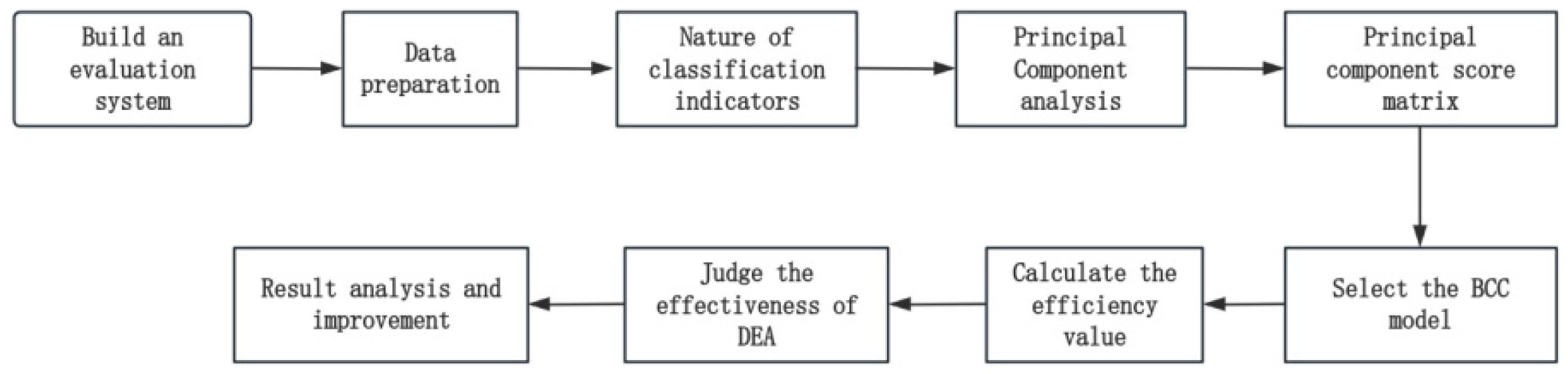
To overcome the limitations of single methodologies, combined evaluation models have emerged as a leading trend in current research innovation. Researchers are committed to integrating methods to leverage their respective strengths and address weaknesses. For instance, addressing the identification capability issue of DEA models in high-dimensional data, researchers combined Principal Component Analysis (PCA) with DEA. By applying PCA to reduce the dimensionality and eliminate multicollinearity among highly correlated original indicators, the extracted principal components were then used as input-output variables in DEA. This approach significantly enhanced the robustness and interpretability of evaluation results [
31]. Similarly, to address undesirable outputs, scholars have introduced models such as the Directional Distance Function (DDF) and Slackness Measure (SBM) to refine DEA [
32]. This “methodological combination” approach preserves the objective core of frontier analysis models in efficiency measurement while enhancing their capacity to handle real-world complexity through the incorporation of other statistical or modeling techniques. It represents the mainstream direction of methodological development in this field.
2.3. Technical Efficiency and Scale Efficiency: Decomposition and Synergy of Efficiency Sources
Within the framework of cutting-edge analytical methods, the exploration of efficiency has deepened to diagnose its sources—specifically, distinguishing between technical efficiency and scale efficiency. This decomposition is crucial for understanding efficiency bottlenecks in green agricultural product supply chains: Does inefficiency stem from inadequate technical management capabilities, or from improper industrial organization scale? Answering this question is a prerequisite for formulating precise optimization strategies.
At the theoretical level, both are components of overall efficiency. Banker et al. (1984) pioneered research by introducing the variable returns to scale (VRS) hypothesis, successfully decomposing the comprehensive technical efficiency proposed by Charnes et al. (1978) into the product of pure technical efficiency (PTE) and scale efficiency (SE), i.e., TE = PTE × SE [
33,
34]. Pure technical efficiency reflects the ability to allocate and manage resources effectively at a given scale, while scale efficiency measures the gap between actual production scale and optimal scale [
35]. In green agricultural product supply chain research, pure technical efficiency manifests as the application level of green production technologies such as precision fertilization [
36] and the operational management capabilities of the supply chain. Scale efficiency relates to factors like the concentration of land management, the capacity utilization rate of processing enterprises, and the service coverage radius of logistics networks.
In terms of their mechanisms of action, the two exhibit a complex dynamic synergy. On one hand, improvements in technical efficiency can facilitate the realization of scale efficiency [
37]. For instance, the application of advanced technologies such as digital twins and the Internet of Things (which enhance PTE) can reduce the management complexity of large-scale production, thereby enabling larger-scale operations. On the other hand, moderate-scale operations (which enhance SE) can spread the costs and pool resources for the research, development, and application of new technologies [
38], thereby creating conditions for pure technical efficiency gains. However, extensive empirical research indicates that this synergy is not linear, particularly in agriculture, where an inverted U-shaped relationship is commonly observed [
39]. This implies the existence of an “optimal operating scale” range: scales too small fail to realize economies of scale, while scales too large may exceed management capacity boundaries [
40], thereby inhibiting the realization of pure technical efficiency.
In recent years, with the evolution of technology and business models, our understanding of their relationship has entered a more profound and dialectical phase. The interaction between technological efficiency and economies of scale is far from a simple complementarity or substitution; its core mechanism lies in the dynamic equilibrium between capability building and resource allocation.
On the one hand, leaps in technological efficiency can transcend the boundaries of traditional economies of scale, reshaping their pathways to realization. Technological advances represented by digital technologies and precision agriculture derive their revolutionary significance not from directly expanding production scale, but from fostering “non-scale economies of scale” [
41] by enhancing the precision of resource allocation and utilization. This enables small and medium-sized enterprises or smallholder farmers to achieve exceptionally high operational efficiency through technological empowerment despite physical limitations, thereby reducing path dependence on pure scale expansion and redefining the concept of scale efficiency.
However, the realization of technical efficiency is not unconditional; it is highly dependent on the application scenarios and cost-sharing foundations provided by economies of scale [
42]. Particularly in heterogeneous agricultural supply chains, government green subsidy policies can create a more favorable scale environment for technological efficiency by adjusting the relationship between scale thresholds and technological investment costs [
43], further validating the necessity of scale support. This constitutes the other side of the interactive relationship: the support and constraints of scale efficiency on technological efficiency. Empirical studies consistently validate the existence of a threshold effect: the economic viability of any technology depends on a minimum scale threshold. Below this threshold, fixed inputs cannot be sufficiently amortized, and the technology’s efficiency potential is stifled by insufficient scale. Thus, scale efficiency provides an indispensable stage for technological efficiency. Conversely, however, overly rapid scale expansion that outpaces management capabilities creates knowledge gaps, thereby inhibiting the release of technological potential [
44].
The net effect of their interactive relationship is moderated by key variables such as technological attributes, institutional environments, and management capabilities [
45,
46,
47]. Different technology types exhibit varying degrees of scale dependence. Mechanization technologies typically demonstrate significant scale preferences, whereas biochemical and digital technologies may exhibit greater scale neutrality [
48]. Concurrently, robust regional infrastructure and agricultural extension services can compensate for insufficient land scale through service scaling, achieving external synergies between technological efficiency and scale efficiency [
49]). General-purpose technologies are more likely to drive scale boundary expansion [
50], whereas specialized technologies rely more heavily on scale support. Robust digital infrastructure, collaborative platforms, and policy support can effectively lower scale thresholds. Thus, pursuing synergies between technical efficiency and scale efficiency fundamentally involves precisely aligning the pace of technological iteration with the trajectory of scale expansion. The optimal strategy lies not in blindly pursuing cutting-edge technology or massive scale, but in constructing context-specific adaptive models where technological capabilities and scale configurations mutually empower each other while sharing costs [
51]. This provides more refined guidance for efficiency optimization in theory and practice, and offers a core theoretical lens for analyzing regional disparities within Hebei Province in this study.
In summary, while existing literature has made significant progress in conceptual definitions and measurement methodologies, systematic empirical evidence remains lacking regarding the specific interaction patterns between technical efficiency and scale efficiency within regional green agricultural product supply chains, as well as how to formulate differentiated “technical-scale” matching strategies based on regional heterogeneity. This study aims to construct an improved combined DEA model to delve into the underlying mechanisms driving regional efficiency disparities.