Achieving Environmental Sustainability in Turkey: The Role of Green Production Processes, Trade Globalization, Renewable Energy Consumption and Economic Growth

Abstract
1. Introduction
- First, very limited studies have used Turkey as a case study, which necessitates future research.
- Second, while TGLO has received little attention, other forms of globalization notions, such as financial and social globalization [16,17], have been examined. Thus, the TGLO variable is used. Considering TGLO is significant because it shapes the global economy, influences domestic policies and has a direct impact on individuals and societies.
- Fourth, rather than using patent from residence and non–residence, this research uses a more captivating variable called GRPP to capture the ecological effects of green technologies. In addition, the use of this variable in existing literature is very scanty.
- Fifth, as a deviation from other studies, this research confirms that GRPP reduce the quality of the environment, while TGLO improves it.
- Lastly, rather than using CO2 as a proxy for ecological sustainability, this research uses ECOF because it is the sole indicator that contrasts the need for resources by people, governments and corporations with the ability of the planet to regenerate biologically [3]. It takes into account a variety of ecological factors, such as farmland, grazing land, forest area, carbon footprint, fishing grounds and built-up land.
2. Literature Review
2.1. GRPP and ECOF Association
2.2. TGLO and ECOF Association
2.3. RECN and ECOF Association
2.4. GDP and ECOF Association
2.5. Gap in the Literature
3. Theoretical Framework, Data and Methodology
3.1. Theoretical Framework
3.2. Data
3.3. Methodology
4. Analysis and Discussion
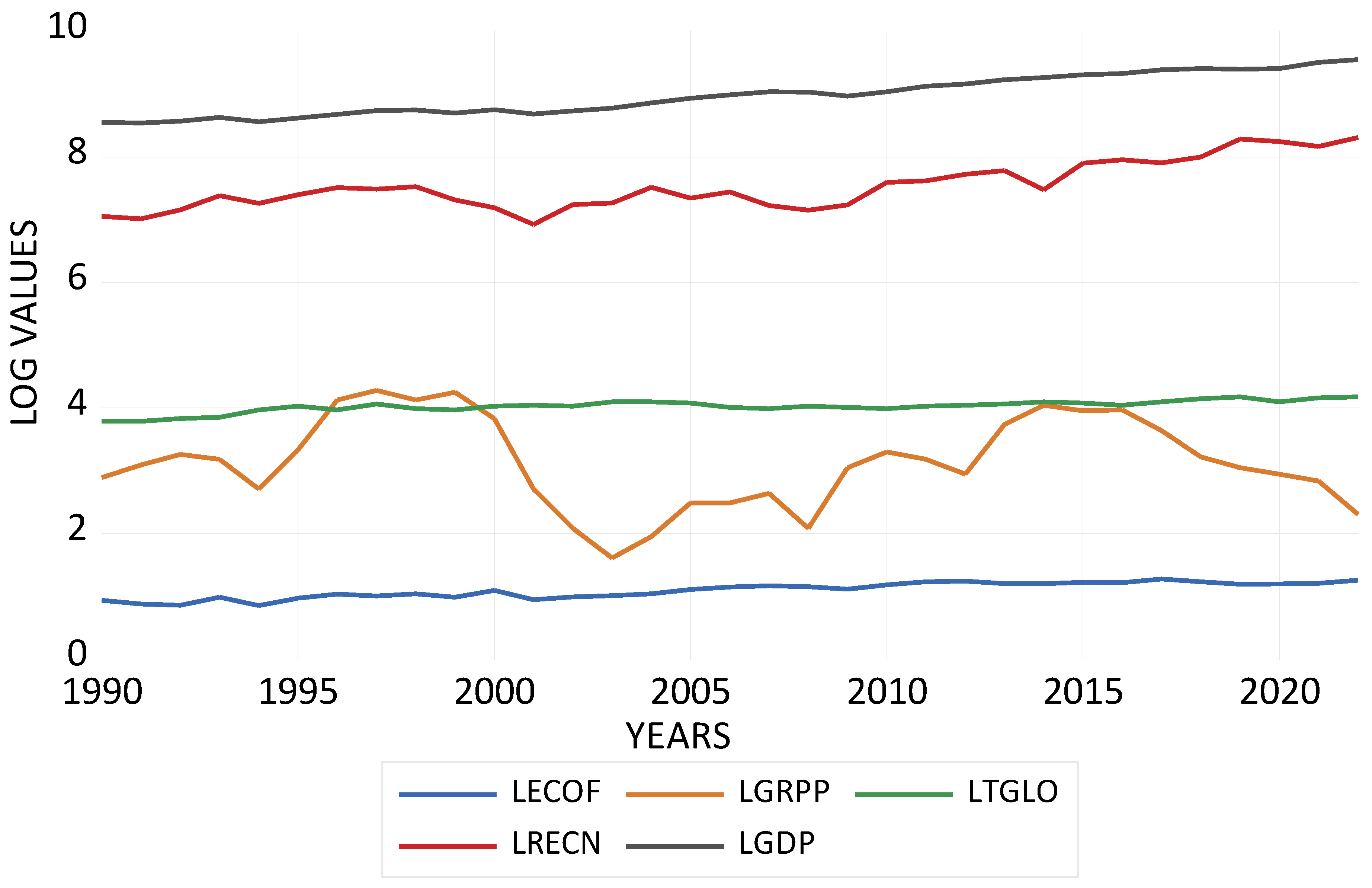
4.1. Descriptive Statistics
4.2. Unit Root Analysis
4.3. Bounds Test
4.4. ARDL Long- and Short-Run Outcomes
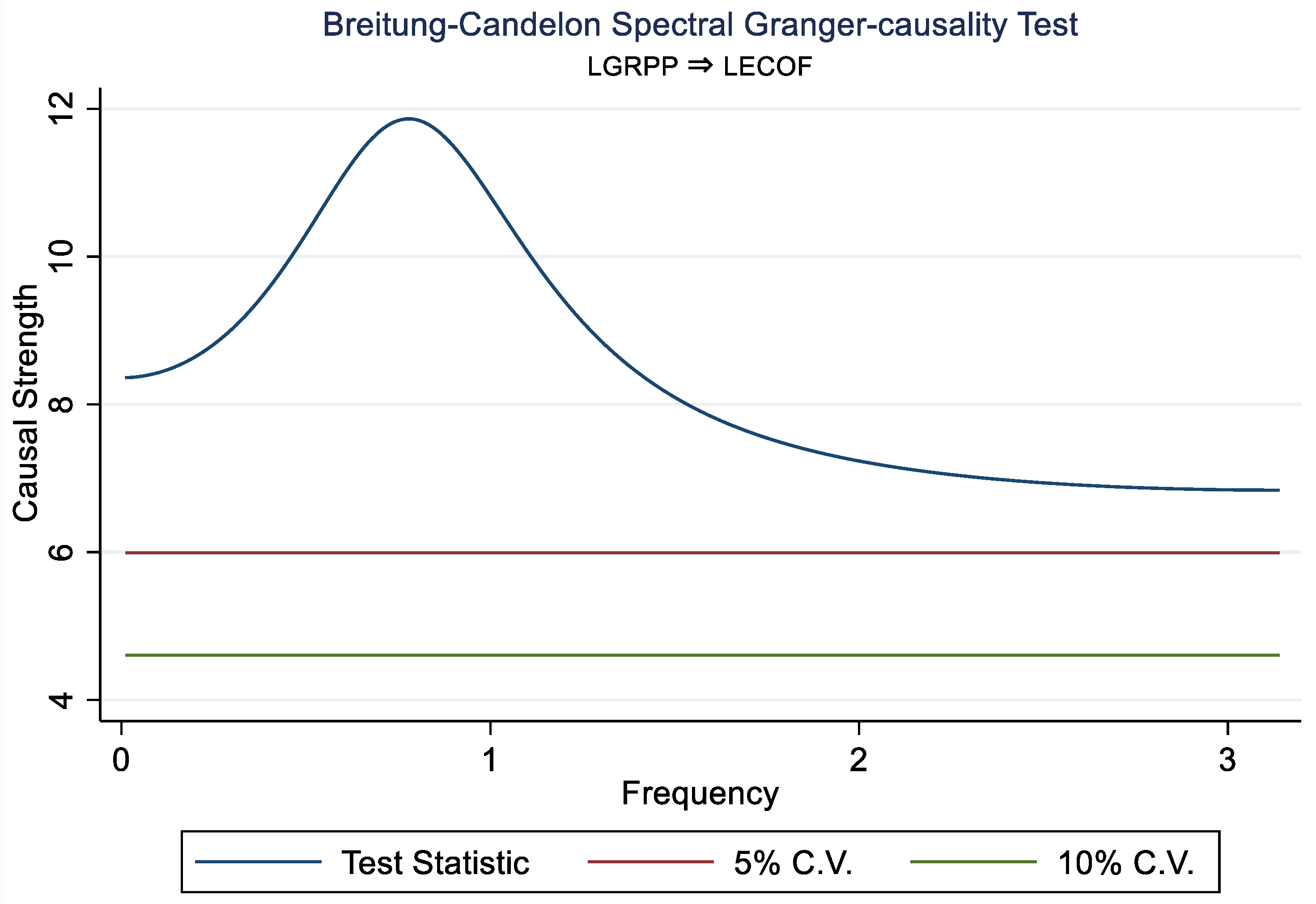
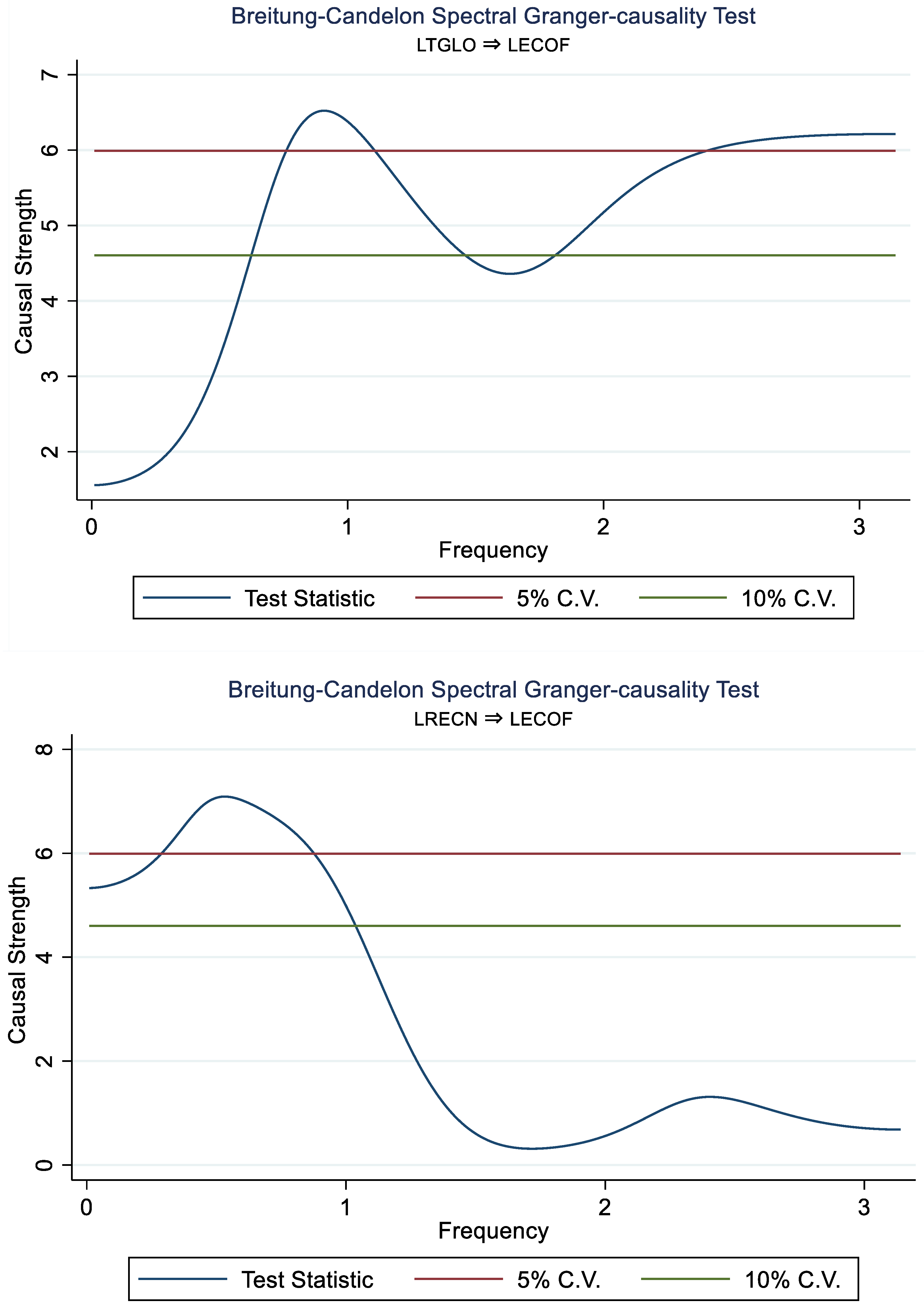
4.5. Frequency Domain Causality
4.6. Discussion
5. Conclusions and Policy Recommendations
5.1. Conclusions
5.2. Policy Recommendations
- Firstly, to prevent the negative impact of GDP on the environment, Turkey should incorporate ecological considerations into its economic expansion policies from the outset. Policies such as environmental levies, incentives for green technologies, and support for sustainable companies are essential. With these steps, economic progress will be positively correlated with ecological sustainability, especially in the early stages of development. This highlights the necessity of Turkey undergoing a sustainable energy transition, wherein the nation’s energy needs are met by producing energy using clean energy resources. The authors of [29] stated that investors and businesses suffer financially because of environmental taxes. Businesses are likely to implement cutting-edge eco-friendly technologies to reduce their environmental impact and avoid these costs.
- Secondly, investments in solar (roof top solar panels for residential and commercial buildings), wind (onshore and offshore) and geothermal energy infrastructure (geothermal power plants) must be given top priority in Turkey. This shift can be sped up with the help of policy instruments including tax breaks for investments in clean energy, subsidies for clean energy projects and funding for renewable technology R&D. Increasing the use of clean energy would help Turkey achieve its carbon neutrality objectives by lowering its reliance on fossils and improving ecological integrity.
- Thirdly, Turkey needs to offer specific assistance to sectors implementing environmentally friendly technologies. This entails PPPs, grants for energy-saving tools, and technical support for carrying out practices that are sustainable. This will drive innovation in environmentally friendly processes. This will also hasten the shift to sustainable industrial practices.
- Fourthly, for the purpose of strategically coordinating ecological and trade strategies, Turkey ought to continue to foster the commerce of green technologies, impose more strict ecological regulations on imports and exports, and push enterprises to obtain international environmental certifications. Turkey can guarantee that globalization promotes ecological quality and sustainable development by coordinating trade policy with environmental objectives. In addition, this coordination can occur if it is examined from the perceptive of green industrial policy, aligning its SDGs with the EU’s Green Deal. It is important to note that the EU is Turkey’s largest trading partner.
5.3. Limitations and Future Research Suggestions
Author Contributions
Funding
Institutional Review Board Statement
Informed Consent Statement
Data Availability Statement
Conflicts of Interest
Abbreviations
| 2SLS | Two-Stage Least Squares |
| BSQR | Bootstrap Quantile Regression |
| CS–ARDL | Cross-Sectional–Autoregressive Distributed Lag |
| CO2 | Carbon Dioxide Emissions |
| DOLS | Dynamic Ordinary Least Square |
| EKC | Environmental Kuznets Curve |
| EU | European Union |
| FGLS | Feasible Least Squares Generalized |
| GDP | Gross Domestic Product |
| GFN | Global Footprint Network |
| GLO | Globalization |
| GRPP | Green Production Process |
| ICT | Information and Communication Technology |
| MMQR | Methods of Moment Quantile Regression |
| NARDL | Nonlinear Autoregressive Distributed Lag |
| OWD | Our World in Data |
| PPP | Public–Private Partnership |
References
- Soto, G.H.; Martinez-Cobas, X. Nuclear energy generation’s impact on the CO2 emissions and ecological footprint among European Union countries. Sci. Total Environ. 2024, 945, 173844. [Google Scholar] [CrossRef] [Scilit]
- Jia, L.; Yu, Y.; Li, Z.; Qin, S.; Guo, J.; Zhang, Y.; Wang, J.; Zhang, J.; Fan, B.; Jin, Y. Study on the Hg0 removal characteristics and synergistic mechanism of iron-based modified biochar doped with multiple metals. Bioresour. Technol. 2021, 332, 125086. [Google Scholar] [CrossRef] [Scilit] [PubMed]
- GFN. Global Footprint Network. 2025. Available online: https://data.footprintnetwork.org/#/countryTrends?cn=223&type=BCpc,EFCpc (accessed on 1 October 2025).
- Numan, U.; Ma, B.; Sadiq, M.; Bedru, H.D.; Jiang, C. The role of green finance in mitigating environmental degradation: Empirical evidence and policy implications from complex economies. J. Clean. Prod. 2023, 400, 136693. [Google Scholar] [CrossRef] [Scilit]
- Fakher, H.A.; Ahmed, Z.; Acheampong, A.O.; Nathaniel, S.P. Renewable energy, nonrenewable energy, and environmental quality nexus: An investigation of the N-shaped Environmental Kuznets Curve based on six environmental indicators. Energy 2023, 263, 125660. [Google Scholar] [CrossRef] [Scilit]
- Degirmenci, T.; Erdem, A.; Aydin, M. The nexus of industrial employment, financial development, urbanization, and human capital in promoting environmental sustainability in E7 economies. Int. J. Sustain. Dev. World Ecol. 2025, 32, 242–258. [Google Scholar] [CrossRef] [Scilit]
- Tanveer, A.; Song, H.; Faheem, M.; Daud, A. Caring for the environment. How do deforestation, agricultural land, and urbanization degrade the environment? Fresh insight through the ARDL approach. Environ. Dev. Sustain. 2024, 27, 11527–11562. [Google Scholar] [CrossRef] [Scilit]
- Almulhim, A.A.; Inuwa, N.; Chaouachi, M.; Samour, A. Testing the Impact of Renewable Energy and Institutional Quality on Consumption-Based CO2 Emissions: Fresh Insights from MMQR Approach. Sustainability 2025, 17, 704. [Google Scholar] [CrossRef] [Scilit]
- Boussaidi, R.; Hakimi, A. Financial inclusion, economic growth, and environmental quality in the MENA region: What role does institution quality play? Nat. Resour. Forum 2025, 49, 425–444. [Google Scholar] [CrossRef] [Scilit]
- Al-Zubairi, A.; AL-Akheli, A.; ELfarra, B. The impact of financial development, renewable energy and political stability on carbon emissions: Sustainable development prospective for arab economies. Environ. Dev. Sustain. 2024, 27, 15251–15273. [Google Scholar] [CrossRef] [Scilit]
- Bilgili, F.; Alsanusi, M.; Kabir, M.M.; Awan, A. Quantile dynamics of control of corruption, political stability, and renewable energy on environmental quality in the MENA region. Environ. Dev. Sustain. 2024, 27, 14001–14021. [Google Scholar] [CrossRef] [Scilit]
- Rehman, A.; Batool, Z.; Ain, Q.U.; Ma, H. The renewable energy challenge in developing economies: An investigation of environmental taxation, financial development, and political stability. Nat. Resour. Forum 2025, 49, 699–724. [Google Scholar] [CrossRef] [Scilit]
- Magazzino, C.; Gattone, T.; Madaleno, M. The impact of socio-economic factors on the ecological footprint in Turkey: A comprehensive analysis using machine learning approaches. J. Environ. Manag. 2025, 387, 125861. [Google Scholar] [CrossRef] [Scilit]
- Turkish Statistical Institute. Greenhouse Gas Emissions Statistics, 1990–2021. 2023. Available online: https://data.tuik.gov.tr (accessed on 1 October 2025).
- TRT. Türkiye Commits to Net Zero Emissions by 2053, Expand Renewables at COP29. 2024. Available online: https://trt.global/world/article/18231341 (accessed on 1 October 2025).
- World Bank. World Bank Open Data. 2025. Available online: https://data.worldbank.org/ (accessed on 1 October 2025).
- Destek, M.A. Investigation on the role of economic, social, and political globalization on environment: Evidence from CEECs. Environ. Sci. Pollut. Res. 2020, 27, 33601–33614. [Google Scholar] [CrossRef] [Scilit]
- Le, H.-C.; Le, T.-H. Effects of economic, social, and political globalization on environmental quality: International evidence. Environ. Dev. Sustain. 2023, 25, 4269–4299. [Google Scholar] [CrossRef] [Scilit]
- Awosusi, A.A.; Xulu, N.G.; Ahmadi, M.; Rjoub, H.; Altuntaş, M.; Uhunamure, S.E.; Akadiri, S.S.; Kirikkaleli, D. The Sustainable Environment in Uruguay: The Roles of Financial Development, Natural Resources, and Trade Globalization. Front. Environ. Sci. 2022, 10, 875577. [Google Scholar] [CrossRef] [Scilit]
- Usman, M.; Jahanger, A.; Radulescu, M.; Balsalobre-Lorente, D. Do Nuclear Energy, Renewable Energy, and Environmental-Related Technologies Asymmetrically Reduce Ecological Footprint? Evidence from Pakistan. Energies 2022, 15, 3448. [Google Scholar] [CrossRef] [Scilit]
- Sadiq, M.; Wen, F.; Dagestani, A.A. Environmental footprint impacts of nuclear energy consumption: The role of environmental technology and globalization in ten largest ecological footprint countries. Nucl. Eng. Technol. 2022, 54, 3672–3681. [Google Scholar] [CrossRef] [Scilit]
- Koseoglu, A.; Yucel, A.G.; Ulucak, R. Green innovation and ecological footprint relationship for a sustainable development: Evidence from top 20 green innovator countries. Sustain. Dev. 2022, 30, 976–988. [Google Scholar] [CrossRef] [Scilit]
- Chu, L.K. Determinants of ecological footprint in OCED countries: Do environmental-related technologies reduce environmental degradation? Environ. Sci. Pollut. Res. 2022, 29, 23779–23793. [Google Scholar] [CrossRef] [Scilit]
- Hussain, M.; Arshad, Z.; Bashir, A. Do economic policy uncertainty and environment-related technologies help in limiting ecological footprint? Environ. Sci. Pollut. Res. 2022, 29, 46612–46619. [Google Scholar] [CrossRef] [Scilit] [PubMed]
- Ozkan, O.; Khan, N.; Ahmed, M. Impact of green technological innovations on environmental quality for Turkey: Evidence from the novel dynamic ARDL simulation model. Environ. Sci. Pollut. Res. 2023, 30, 72207–72223. [Google Scholar] [CrossRef] [Scilit]
- Lu, W.-C.; Wang, K.-H. Effects of economic globalization, environment-related technology innovation, and industrial structure change on the ecological footprint of top 10 Asian technological innovation countries. J. Environ. Stud. Sci. 2024, 14, 789–802. [Google Scholar] [CrossRef] [Scilit]
- Rao, A.; Sharma, G.D.; Radulescu, M.; Usman, M.; Balsalobre-Lorente, D. Environmental apprehension under COP26 agreement: Examining the influence of environmental-related technologies and energy consumption on ecological footprint. Int. J. Environ. Sci. Technol. 2024, 21, 7999–8012. [Google Scholar] [CrossRef] [Scilit]
- Zaidi, S.A.H.; Zafar, M.W.; Shahbaz, M.; Hou, F. Dynamic linkages between globalization, financial development and carbon emissions: Evidence from Asia Pacific Economic Cooperation countries. J. Clean. Prod. 2019, 228, 533–543. [Google Scholar] [CrossRef] [Scilit]
- Yasir Mehboob, M.; Ma, B.; Sadiq, M.; Mehboob, M.B. How do nuclear energy consumption, environmental taxes, and trade globalization impact ecological footprints? Novel policy insight from nuclear power countries. Energy 2024, 313, 133661. [Google Scholar] [CrossRef] [Scilit]
- Destek, M.A.; Oğuz, İ.H.; Okumuş, N. Do Trade and Financial Cooperation Improve Environmentally Sustainable Development: A Distinction Between de facto and de jure Globalization. Eval. Rev. 2024, 48, 251–273. [Google Scholar] [CrossRef] [Scilit]
- Dai, J.; Hiung, E.Y.T.; Destek, M.A.; Ahmed, Z. Green policymaking in top emitters: Assessing the consequences of external conflicts, trade globalization, and mineral resources on sustainable development. Int. J. Sustain. Dev. World Ecol. 2024, 31, 653–667. [Google Scholar] [CrossRef] [Scilit]
- Du, J.; Rasool, Y.; Kashif, U. Asymmetric Impacts of Environmental Policy, Financial, and Trade Globalization on Ecological Footprints: Insights from G9 Industrial Nations. Sustainability 2025, 17, 1568. [Google Scholar] [CrossRef] [Scilit]
- Li, Q.; Zhang, S. Impact of globalization and industrialization on ecological footprint: Do institutional quality and renewable energy matter? Front. Environ. Sci. 2025, 13, 1535638. [Google Scholar] [CrossRef] [Scilit]
- Sadekin, M.N. Analyzing the impact of remittance and electricity consumption on ecological footprint in South Asia: The role of globalization using panel ARDL and MMQR method. Discov. Sustain. 2025, 6, 301. [Google Scholar] [CrossRef] [Scilit]
- Abdi, A.H.; Siyad, S.A.; Sugow, M.O.; Omar, O.M. Approaches to ecological sustainability in sub-Saharan Africa: Evaluating the role of globalization, renewable energy, economic growth, and population density. Res. Glob. 2025, 10, 100273. [Google Scholar] [CrossRef] [Scilit]
- Akash, M.A.; Riaz, M.H.; Uddin, M.N.; Ridwan, M.; Akinpelu, A.A.; Akter, R. Analyzing the Drivers of Ecological Footprint Toward Sustainability in BRICS+. Environ. Innov. Manag. 2025, 01, 2550017. [Google Scholar] [CrossRef] [Scilit]
- Kizilkaya, O.; Polat, M.A.; Babacan, A. The Effect of Globalization on Environmental Pollution in Turkey: A Fourier Cointegration Analysis. In Community Climate Justice and Sustainable Development; Roy, P.K., Hamidi, M.B., Wahab, H.A., Eds.; IGI Global: Hershey, PA, USA, 2025; pp. 615–634. [Google Scholar] [CrossRef] [Scilit]
- Celik, A.; Güriş, B. Unveiling the Impact of GDP, Population, Energy Consumption, and Trade Globalization on the Load Capacity Factor in Türkiye: Nonlinear Approaches. Ekonomika 2025, 104, 84–102. [Google Scholar] [CrossRef] [Scilit]
- Adebayo, T.S. Transforming environmental quality: Examining the role of green production processes and trade globalization through a Kernel Regularized Quantile Regression approach. J. Clean. Prod. 2025, 501, 145232. [Google Scholar] [CrossRef] [Scilit]
- Danish; Ulucak, R.; Khan, S.U.-D. Determinants of the ecological footprint: Role of renewable energy, natural resources, and urbanization. Sustain. Cities Soc. 2020, 54, 101996. [Google Scholar] [CrossRef] [Scilit]
- Li, R.; Wang, X.; Wang, Q. Does renewable energy reduce ecological footprint at the expense of economic growth? An empirical analysis of 120 countries. J. Clean. Prod. 2022, 346, 131207. [Google Scholar] [CrossRef] [Scilit]
- Çakmak, E.E.; Acar, S. The nexus between economic growth, renewable energy and ecological footprint: An empirical evidence from most oil-producing countries. J. Clean. Prod. 2022, 352, 131548. [Google Scholar] [CrossRef] [Scilit]
- Wang, Q.; Ge, Y.; Li, R. Does improving economic efficiency reduce ecological footprint? The role of financial development, renewable energy, and industrialization. Energy Environ. 2025, 36, 729–755. [Google Scholar] [CrossRef] [Scilit]
- Özbek, S.; Naimoğlu, M. The effectiveness of renewable energy technology under the EKC hypothesis and the impact of fossil and nuclear energy investments on the UK’s Ecological Footprint. Energy 2025, 322, 135351. [Google Scholar] [CrossRef] [Scilit]
- Liu, C.; Niu, H.; Hayyat, M.; Hao, V. Understanding the relationship between ecological footprints and renewable energy in BRICS nations: An economic perspective. Int. J. Hydrogen Energy 2025, 118, 46–57. [Google Scholar] [CrossRef] [Scilit]
- Joof, F.; Samour, A.; Ali, M.; Abdur Rehman, M.; Tursoy, T. Economic complexity, renewable energy and ecological footprint: The role of the housing market in the USA. Energy Build. 2024, 311, 114131. [Google Scholar] [CrossRef] [Scilit]
- Dogan, M.; Georgescu, I.; Çeştepe, H.; Sarıgül, S.S.; Tatar, H.E. Renewable Energy Consumption and the Ecological Footprint in Denmark: Assessing the Influence of Financial Development and Agricultural Contribution. Agriculture 2025, 15, 835. [Google Scholar] [CrossRef] [Scilit]
- Nan, Y.; Sun, R.; Mei, H.; Yue, S.; Yuliang, L. Does renewable energy consumption reduce energy ecological footprint: Evidence from China. Environ. Res. Ecol. 2023, 2, 015003. [Google Scholar] [CrossRef] [Scilit]
- Bulut, U. Environmental sustainability in Turkey: An environmental Kuznets curve estimation for ecological footprint. Int. J. Sustain. Dev. World Ecol. 2021, 28, 227–237. [Google Scholar] [CrossRef] [Scilit]
- Sharif, A.; Baris-Tuzemen, O.; Uzuner, G.; Ozturk, I.; Sinha, A. Revisiting the role of renewable and non-renewable energy consumption on Turkey’s ecological footprint: Evidence from Quantile ARDL approach. Sustain. Cities Soc. 2020, 57, 102138. [Google Scholar] [CrossRef] [Scilit]
- Topcu, B.A. The impact of export, import, and renewable energy consumption on Turkey s ecological footprint. Pressacademia 2021, 8, 31–38. [Google Scholar] [CrossRef] [Scilit]
- Kahia, M.; Omri, A.; Jarraya, B. Green Energy, Economic Growth and Environmental Quality Nexus in Saudi Arabia. Sustainability 2021, 13, 1264. [Google Scholar] [CrossRef] [Scilit]
- Dhingra, V.S. Financial development, economic growth, globalisation and environmental quality in BRICS economies: Evidence from ARDL bounds test approach. Econ. Change Restruct. 2023, 56, 1651–1682. [Google Scholar] [CrossRef] [Scilit]
- Wang, S.; Wasif Zafar, M.; Vasbieva, D.G.; Yurtkuran, S. Economic growth, nuclear energy, renewable energy, and environmental quality: Investigating the environmental Kuznets curve and load capacity curve hypothesis. Gondwana Res. 2024, 129, 490–504. [Google Scholar] [CrossRef] [Scilit]
- Kirikkaleli, D.; Osmanlı, A. The Impact of Political Stability on Environmental Quality in the Long Run: The Case of Turkey. Sustainability 2023, 15, 9056. [Google Scholar] [CrossRef] [Scilit]
- Hunjra, A.I.; Bouri, E.; Azam, M.; Azam, R.I.; Dai, J. Economic growth and environmental sustainability in developing economies. Res. Int. Bus. Financ. 2024, 70, 102341. [Google Scholar] [CrossRef] [Scilit]
- Tran, H.V. Asymmetric Role of Economic Growth, Globalization, Green Growth, and Renewable Energy in Achieving Environmental Sustainability. Emerg. Sci. J. 2024, 8, 449–462. [Google Scholar] [CrossRef] [Scilit]
- AL-Marshadi, A.H.; Aslam, M.; Janjua, A.A. Correction: Ecological footprints, global sustainability, and the roles of natural resources, financial development, and economic growth. PLoS ONE 2025, 20, e0323701. [Google Scholar] [CrossRef] [Scilit]
- Mohamed, A.A.; Abdi, A.H.; Mohamud, S.S.; Osman, B.M. Institutional quality, economic growth, and environmental sustainability: A long-run analysis of the ecological footprint in Somalia. Discov. Sustain. 2025, 6, 490. [Google Scholar] [CrossRef] [Scilit]
- Bekun, F.V.; Yadav, A.; Onwe, J.C.; Fumey, M.P.; Ökmen, M. Assessment into the nexus between load capacity factor, population, government policy in form of environmental tax: Accessing evidence from Turkey. Int. J. Energy Sect. Manag. 2025, 19, 841–867. [Google Scholar] [CrossRef] [Scilit]
- Grossman, G.; Krueger, A. Environmental Impacts of a North American Free Trade Agreement; National Bureau of Economic Research: Cambridge, MA, USA, 1991; p. w3914. [Google Scholar]
- Dogan, E.; Inglesi-Lotz, R. The impact of economic structure to the environmental Kuznets curve (EKC) hypothesis: Evidence from European countries. Environ. Sci. Pollut. Res. 2020, 27, 12717–12724. [Google Scholar] [CrossRef] [Scilit] [PubMed]
- Amin, N.; Shabbir, M.S.; Song, H.; Farrukh, M.U.; Iqbal, S.; Abbass, K. A step towards environmental mitigation: Do green technological innovation and institutional quality make a difference? Technol. Forecast. Soc. Change 2023, 190, 122413. [Google Scholar] [CrossRef] [Scilit]
- Balsalobre-Lorente, D.; Ibáñez-Luzón, L.; Usman, M.; Shahbaz, M. The environmental Kuznets curve, based on the economic complexity, and the pollution haven hypothesis in PIIGS countries. Renew. Energy 2022, 185, 1441–1455. [Google Scholar] [CrossRef] [Scilit]
- Yilanci, V.; Bozoklu, S.; Gorus, M.S. Are BRICS countries pollution havens? Evidence from a bootstrap ARDL bounds testing approach with a Fourier function. Sustain. Cities Soc. 2020, 55, 102035. [Google Scholar] [CrossRef] [Scilit]
- OECD. Patents—Technology Diffusion. 2025. Available online: https://data-explorer.oecd.org/vis?df[ds]=DisseminateFinalDMZ&df[id]=DSD_PAT_DIFF%40DF_PAT_DIFF&df[ag]=OECD.ENV.EPI&dq=.A.GOODS..&pd=%2C&to[TIME_PERIOD]=false&vw=tb (accessed on 1 October 2025).
- KOF. KOF Globalization Index. 2025. Available online: https://kof.ethz.ch/en/forecasts-and-indicators/indicators/kof-globalisation-index.html (accessed on 1 October 2025).
- OWD. Per Capita Energy Consumption from Renewables, 1965 to 2024. 2025. Available online: https://ourworldindata.org/grapher/per-capita-renewables?tab=table&tableFilter=countries&tableSearch=T%C3%BCrk (accessed on 1 October 2025).
- Pesaran, M.H.; Shin, Y.; Smith, R.J. Bounds testing approaches to the analysis of level relationships. J. Appl. Econ. 2001, 16, 289–326. [Google Scholar] [CrossRef] [Scilit]
- Ghouse, G.; Khan, S.A.; Rehman, A.U. ARDL Model as a Remedy for Spurious Regression: Problems, Performance and Prospectus. Ph.D. Thesis, Pakistan Institute of Development Economics, Islamabad, Pakistan, 2018. [Google Scholar]
- Somoye, O.A.; Ozdeser, H.; Seraj, M. Modeling the determinants of renewable energy consumption in Nigeria: Evidence from Autoregressive Distributed Lagged in error correction approach. Renew. Energy 2022, 190, 606–616. [Google Scholar] [CrossRef] [Scilit]
- Breitung, J.; Candelon, B. Testing for short- and long-run causality: A frequency-domain approach. J. Econ. 2006, 132, 363–378. [Google Scholar] [CrossRef] [Scilit]
- Dickey, D.A.; Fuller, W.A. Distribution of the Estimators for Autoregressive Time Series with a Unit Root. J. Am. Stat. Assoc. 1979, 74, 427–431. [Google Scholar] [CrossRef] [Scilit] [PubMed]
- Phillips, P.C.B.; Perron, P. Testing for a unit root in time series regression. Biometrika 1988, 75, 335–346. [Google Scholar] [CrossRef]
- Avcı, P.; Sarıgül, S.S.; Karataşer, B.; Çetin, M.; Aslan, A. Analysis of the relationship between tourism, green technological innovation and environmental quality in the top 15 most visited countries: Evidence from method of moments quantile regression. Clean Technol. Environ. Policy 2024, 26, 2337–2355. [Google Scholar] [CrossRef] [Scilit]
- Chen, H.; Yi, J.; Chen, A.; Peng, D.; Yang, J. Green technology innovation and CO2 emission in China: Evidence from a spatial-temporal analysis and a nonlinear spatial durbin model. Energy Policy 2023, 172, 113338. [Google Scholar] [CrossRef] [Scilit]
- Esen, Ö.; Yıldırım, D.Ç.; Güven, M. Asymmetric impact of environmental innovation on carbon footprint in Turkiye—Healer or disruptor? Symmetry Cult. Sci. 2023, 34, 453–464. [Google Scholar] [CrossRef] [Scilit]
- Somoye, O.A.; Akinwande, T.S. Exploring the association between the female gender, education expenditure, renewable energy consumption and CO2 emissions: Empirical evidence from Nigeria. OPEC Energy Rev. 2024, 48, 216–228. [Google Scholar] [CrossRef] [Scilit]




| Symbol | Variable | Description | Source |
|---|---|---|---|
| ECOF | Ecological Footprint | GHA per person | [3] |
| GRPP | Green Production Processes | They are measured by the quantity of patents and are associated with technologies that mitigate climate change in the manufacturing or processing of goods | [66] |
| TGLO | Trade Globalization | Index (trade in goods and services, which includes customs duties, taxes and trade barriers) | [67] |
| RECN | Renewable Energy Consumption | Per capita (Kwh) | [68] |
| GDP | GDP Per Capita | Constant 2015 USD | [16] |
| LECOF | LGRPP | LTGLO | LRECN | LGDP | |
|---|---|---|---|---|---|
| Mean | 1.093121 | 3.128587 | 4.024062 | 7.531859 | 8.975475 |
| Median | 1.111689 | 3.091042 | 4.025352 | 7.474336 | 8.969907 |
| Maximum | 1.274989 | 4.276666 | 4.174387 | 8.307855 | 9.550741 |
| Minimum | 0.849400 | 1.609438 | 3.784190 | 6.924343 | 8.537233 |
| Std. Dev. | 0.126078 | 0.712542 | 0.098130 | 0.382373 | 0.320106 |
| Skewness | −0.403777 | −0.117692 | −0.935007 | 0.586829 | 0.247275 |
| Kurtosis | 1.932604 | 2.256994 | 3.725477 | 2.374689 | 1.700906 |
| Jarque–Bera | 2.463282 | 0.835261 | 5.531998 | 2.431673 | 2.656807 |
| Probability | 0.291813 | 0.658605 | 0.062913 | 0.296462 | 0.264900 |
| Observations | 33 | 33 | 33 | 33 | 33 |
| ADF | PP | ||||
|---|---|---|---|---|---|
| Variables | I(0) | I(1) | I(0) | I(1) | Decision |
| LECOF | −2.555023 | −5.952001 * | −4.156091 ** | −9.423853 * | I(1) |
| LGRPP | −2.346097 | −3.971967 * | −1.660493 | −3.882394 ** | I(1) |
| LTGLO | −2.878355 | −4.721946 * | −2.836855 | −6.370356 * | I(1) |
| LRECN | −2.221873 | −3.629979 ** | −2.221873 | −7.623667 * | I(1) |
| LGDP | −2.537378 | −4.248891 ** | −2.482701 | −7.483371 * | I(1) |
| Test Statistic | Value | Significance | I(0) | I(1) |
|---|---|---|---|---|
| F-statistic | 8.003583 | 10% | 2.2 | 3.09 |
| 5% | 2.56 | 3.49 | ||
| 2.50% | 2.88 | 3.87 | ||
| 1% | 3.29 | 4.37 |
| Long-Run Estimates | ||||
|---|---|---|---|---|
| Variable | Coefficient | Std. Error | t-Statistic | Prob. |
| LGRPP | 0.020093 | 0.011575 | 1.735821 | 0.0980 |
| LTGLO | −0.355953 | 0.207309 | −1.717014 | 0.1014 |
| LRECN | −0.081233 | 0.049771 | −1.632137 | 0.1183 |
| LGDP | 0.422906 | 0.069601 | 6.076128 | 0.0000 |
| C | −0.730139 | 0.655706 | −1.113516 | 0.2787 |
| Short-Run Estimates | ||||
| Variable | Coefficient | Std. Error | t-Statistic | Prob. |
| D(LTGLO) | −0.439861 | 0.093030 | −4.728161 | 0.0001 |
| D(LTGLO(−1)) | 0.073767 | 0.090281 | 0.817084 | 0.4235 |
| D(LTGLO(−2)) | −0.263401 | 0.094089 | −2.799482 | 0.0111 |
| D(LGDP) | 1.011016 | 0.083346 | 12.13032 | 0.0000 |
| CointEq(−1) * | −0.658489 | 0.084992 | −7.747701 | 0.0000 |
| R-squared | 0.875161 | |||
| Adjusted R-squared | 0.855187 | |||
| Durbin–Watson (DW) | 2.156913 | |||
| Residual Diagnostics | F-Stat. | p-Value | ||
| Normality test | 1.378014 | 0.5020 | ||
| Serial Correlation LM test | 0.892148 | 0.4271 | ||
| Heteroskedasticity Test | 0.550406 | 0.8205 |
Disclaimer/Publisher’s Note: The statements, opinions and data contained in all publications are solely those of the individual author(s) and contributor(s) and not of MDPI and/or the editor(s). MDPI and/or the editor(s) disclaim responsibility for any injury to people or property resulting from any ideas, methods, instructions or products referred to in the content. |
© 2025 by the authors. Licensee MDPI, Basel, Switzerland. This article is an open access article distributed under the terms and conditions of the Creative Commons Attribution (CC BY) license (https://creativecommons.org/licenses/by/4.0/).
Share and Cite
Afreefir, M.A.; Khalifa, W.M.S. Achieving Environmental Sustainability in Turkey: The Role of Green Production Processes, Trade Globalization, Renewable Energy Consumption and Economic Growth. Sustainability 2025, 17, 9823. https://doi.org/10.3390/su17219823
Afreefir MA, Khalifa WMS. Achieving Environmental Sustainability in Turkey: The Role of Green Production Processes, Trade Globalization, Renewable Energy Consumption and Economic Growth. Sustainability. 2025; 17(21):9823. https://doi.org/10.3390/su17219823
Chicago/Turabian StyleAfreefir, Mohammed Ayad, and Wagdi M. S. Khalifa. 2025. "Achieving Environmental Sustainability in Turkey: The Role of Green Production Processes, Trade Globalization, Renewable Energy Consumption and Economic Growth" Sustainability 17, no. 21: 9823. https://doi.org/10.3390/su17219823
APA StyleAfreefir, M. A., & Khalifa, W. M. S. (2025). Achieving Environmental Sustainability in Turkey: The Role of Green Production Processes, Trade Globalization, Renewable Energy Consumption and Economic Growth. Sustainability, 17(21), 9823. https://doi.org/10.3390/su17219823