Article

How AI-Driven Personalization Shapes Green Purchasing Behavior Among Youth in Java Island

by
Feliks Prasepta Sejahtera Surbakti
1,*,
Hotma Antoni Hutahaean
1,
Maria Magdalena Wahyuni Inderawati
1,
Jovan Moreno Madjid
1,
Leonard Edward Sely
1 and
Yann-May Yee
2
1
Department of Industrial Engineering, Atma Jaya Catholic University of Indonesia, Jakarta 12930, Indonesia
2
Department of Industrial and Systems Engineering, Chung Yuan Christian University, Taoyuan City 32022, Taiwan
*
Author to whom correspondence should be addressed.
Sustainability 2025, 17(21), 9600; https://doi.org/10.3390/su17219600
Submission received: 29 August 2025 / Revised: 20 October 2025 / Accepted: 24 October 2025 / Published: 28 October 2025
(This article belongs to the Section Economic and Business Aspects of Sustainability)

Abstract

Sustainable consumption has become a global priority, yet the factors that encourage people to adopt environmentally friendly purchasing behavior differ across cultures and technologies. This study explores how environmental knowledge, environmental attitude, and the perception of AI-driven personalization influence green purchasing intention and actual purchasing behavior among young consumers in Java, Indonesia. A survey of 517 university students was conducted, and the relationships among these factors were analyzed using structural equation modeling. The findings reveal that environmental knowledge strongly shapes environmental attitudes, which in turn enhance the intention and behavior to purchase green products. Perception of AI-driven personalization also strengthens green purchasing intention, although its direct effect on behavior is limited. These results suggest that digital platforms and marketers can promote sustainable consumption by combining environmental education with transparent and value-based AI personalization. The study contributes to understanding how psychological readiness and technological engagement together encourage greener consumption among youth in emerging economies.

1. Introduction

Sustainable consumption is recognized as a global imperative, with the United Nations Sustainable Development Goals (SDGs) identifying “Responsible Consumption and Production” (Goal 12) as a key target for ensuring environmental stability in the face of rapid demographic and economic changes [1]. In Indonesia, the projected population increase to 328.93 million by 2050 poses substantial challenges to ecological balance if unsustainable consumption patterns persist [2]. Rapid urbanization, evolving lifestyles, and increased consumption intensify the strain on natural resources, underscoring the urgency of promoting sustainable consumer behavior [3].
Green purchasing behavior (GPB), the purchase of products and services that minimize environmental harm, has been identified as a central mechanism for advancing sustainable consumption [4]. Empirical studies have shown that environmental knowledge (EK) and environmental attitude (EAT) significantly influence pro-environmental behavior [5]. Within the Theory of Planned Behavior (TPB), these factors often exert their effects indirectly, mediated through green purchasing intention (GPI) [1].
In parallel, technological advances have transformed the consumer decision-making landscape. AI-driven personalization, including recommendation systems, targeted marketing, and chatbot assistance, can enhance user engagement by tailoring content to consumer needs and values [6,7]. In sustainability contexts, personalized AI tools have the potential to promote green products by providing relevant, persuasive, and timely information [8]. However, the effectiveness of AI personalization in fostering sustainable purchasing remains contested. While some research suggests that AI-based targeting can overcome information barriers and reinforce positive attitudes [9], others warn of possible drawbacks, including consumer skepticism, privacy concerns, and reduced autonomy in decision-making [10,11].
Despite growing global interest in AI-driven personalization, few studies have integrated technological perceptions into behavioral models of sustainable consumption, particularly in developing countries [12]. The Indonesian context—where digital adoption is high among youth, but sustainable purchasing remains underdeveloped—offers a valuable case for exploring these dynamics. Youth are an especially important demographic for sustainability transitions, as they are active consumers, early adopters of technology, and influential within their social networks [13].
This study examines the influence of EK, EAT, and perception of AI-driven personalization (PAI) on GPB among youth in Java, Indonesia, with GPI as a mediating variable. By integrating PAI into the TPB framework, this research extends sustainability theory and addresses the empirical gap on technology–behavior linkages in emerging markets. The findings indicate that combining strong environmental awareness and attitudes with favorable perceptions of AI tools significantly enhances both intention and actual green purchasing behavior, providing actionable guidance for policymakers, educators, and businesses aiming to accelerate sustainable consumption locally and globally.

2. Theoretical Framework and Hypotheses

The Theory of Planned Behavior (TPB) proposed by Ajzen [14] provides the theoretical foundation for this study. TPB explains that human behavior is primarily driven by behavioral intention, which is determined by three psychological components: attitude toward the behavior, subjective norms, and perceived behavioral control. This theory assumes that individuals make reasoned decisions based on available information and perceived consequences before engaging in a specific behavior.
In sustainability research, TPB has been widely adopted to explain why individuals intend to engage in and subsequently perform pro-environmental actions. Attitude represents one’s positive or negative evaluation of green purchasing, while perceived control reflects the perceived ease or difficulty of performing such actions. Prior studies demonstrate that environmental attitude and intention serve as critical determinants of green purchasing behavior (GPB) [15].
This study applies and extends TPB by incorporating two additional constructs—environmental knowledge (EK) and perception of AI-driven personalization (PAI), to capture both psychological and technological drivers of sustainable consumption. Environmental knowledge contributes to informed attitudes by increasing awareness of environmental issues, while PAI reflects consumers’ interaction with AI-based recommendation systems that influence purchase decisions. In today’s digital economy, many consumption choices occur within personalized online environments; thus, integrating PAI into TPB allows the model to reflect the realities of AI-mediated decision-making.
Accordingly, TPB provides a robust framework for addressing the central research question of this paper: How do environmental knowledge, environmental attitude, and perceptions of AI-driven personalization interact to shape green purchasing intention and behavior among youth in Java Island? The model not only explains psychological processes but also accounts for the technological context that increasingly shapes sustainable consumer behavior.

2.1. Green Purchasing Behavior and Sustainable Consumption

Recent literature emphasizes that the determinants of green purchasing behavior extend beyond individual cognition and moral considerations to include social influence, digital engagement, and contextual constraints. For instance, Sharma et al. [16] and Ofori et al. [13] highlight that peer norms and online communities substantially shape youth green purchasing decisions, reinforcing the role of collective behavioral cues in sustainability transitions. Likewise, meta-analyses by Zheng et al. [17] underscore the integration of Industry 4.0 technologies, such as AI and big data analytics, as enablers for environmentally conscious consumption through enhanced consumer awareness and information transparency.
In developing economies, structural factors such as price sensitivity, product availability, and perceived product quality, remain major barriers to translating pro-environmental attitudes into actual purchasing behavior [12]. However, the proliferation of digital platforms offers new avenues to close this intention–behavior gap. Studies in China [12] and Turkey [3] show that AI-enabled recommendation systems can contextualize green information and personalize persuasion cues, thereby influencing purchase likelihood. Yet, such mechanisms can backfire if consumers perceive them as manipulative or intrusive [11,18].
Within Indonesia, emerging empirical evidence also points to rising environmental consciousness among digitally active youth. Research by [13] finds that Generation Z consumers are responsive to sustainability branding when environmental narratives are coupled with technological trust. This aligns with the broader global discourse on AI for Sustainability, where technological mediation is not only a marketing tool but also a behavioral catalyst for responsible consumption. The present study builds upon these streams by integrating perception of AI-driven personalization into the TPB framework, thus linking environmental psychology with digital consumer behavior literature in a developing country context.
Green Purchasing Behavior (GPB) refers to consumer decisions to buy products and services that minimize negative environmental impacts. Prior research highlights GPB as a mechanism to advance sustainable consumption and achieve SDGs [13]. Studies demonstrate that GPB is shaped by both psychological factors—such as environmental knowledge and attitude—and external influences, including technological interventions [19]. Understanding the formation of GPB is crucial, especially among youth, who are both active consumers and early adopters of digital technologies [13].

2.2. Environmental Knowledge and Environmental Attitude

Environmental Knowledge (EK) is consumers’ awareness of environmental issues, resource efficiency, and ecological problem-solving [5]. Empirical studies show that higher EK enhances pro-environmental decisions [13]. Environmental Attitude (EAT), meanwhile, represents individuals’ positive or negative evaluations of environmentally friendly behaviors. Within the TPB, attitude is a central determinant of intention, which ultimately drives behavior [15].
Environmental Knowledge (EK) and Environmental Attitude (EAT) are closely related yet conceptually distinct. Environmental knowledge denotes how well individuals recognize and understand environmental concerns; such as awareness of pollution, waste management, energy conservation, and the ecological impacts of consumption. It represents the cognitive dimension of pro-environmental behavior. In contrast, Environmental Attitude reflects how individuals feel about these issues, whether they hold favorable or unfavorable evaluations toward protecting the environment. It captures the affective and evaluative dimension.
In essence, knowledge provides the factual foundation (“knowing what and why”), while attitude represents the emotional and moral stance (“caring and valuing”). Research shows that greater environmental knowledge can foster more positive environmental attitudes, which in turn encourage pro-environmental intentions and actions [13].
Theoretically, individuals with higher environmental knowledge tend to evaluate technological tools, such as AI-based systems, through the lens of ecological responsibility. According to the Cognitive–Affective–Behavioral (CAB) model, knowledge forms the cognitive foundation that shapes affective evaluations toward both environmental actions and enabling technologies [13]. When individuals understand how AI can support eco-friendly decision-making, such as identifying energy-efficient or low-carbon product, they are more likely to perceive AI personalization as useful and trustworthy. This explains H2 (EK → PAI), as greater knowledge about sustainability enhances sensitivity to the potential of AI tools to promote responsible consumption [12,20].
Moreover, social cognitive theory suggests that self-efficacy derived from knowledge influences perceptions of control over technology [21]. Well-informed consumers are more confident in interacting with AI systems and interpreting personalized messages critically, leading to more positive perceptions of AI-driven personalization. Therefore, environmental knowledge not only stimulates favorable attitudes toward the environment (H3: EK → EAT) but also fosters technological acceptance by reducing uncertainty and building trust in AI (H2: EK → PAI). Hypotheses:
H1. 
Environmental knowledge positively influences green purchasing intention.
H2. 
Environmental knowledge positively influences perception of AI-driven personalization.
H3. 
Environmental knowledge positively influences environmental attitude.
H4a. 
Environmental attitude positively influences green purchasing intention.
H4b. 
Environmental attitude positively influences green purchasing behavior.

2.3. AI-Driven Personalization and Consumer Decision-Making

Technological advances, especially Artificial Intelligence (AI), have transformed consumer decision-making. AI-driven personalization (PAI) involves tailoring product recommendations, advertisements, and purchasing experiences to consumer preferences [20]. In sustainability contexts, such personalization can act as an enabling mechanism that helps consumers discover and consider eco-friendly products [20]. However, its influence may vary depending on how users perceive the transparency, trustworthiness, and ethical use of personal data. Thus, understanding consumers’ perception of AI-driven personalization is essential to determine whether it encourages or constrains sustainable purchasing behavior.
From a theoretical perspective, the Technology Acceptance Model (TAM) and the Theory of Reasoned Action (TRA) explain that perceived usefulness and trust are key psychological precursors of behavioral intention [22]. When consumers perceive AI-based personalization as transparent, relevant, and value-aligned, it strengthens their motivation to act in accordance with pro-environmental goals. In this way, perception of AI-driven personalization (PAI) enhances green purchasing intention (H5a) by reducing cognitive effort and providing personalized cues that reinforce environmentally responsible choices [8].
However, the influence of PAI on actual behavior (H5b) is expected to be weaker because external constraints, such as price, accessibility, and trust, moderate the transition from intention to behavior. Drawing on Ajzen’s TPB and the value–belief–norm (VBN) framework [14], technology functions as an enabler that amplifies intention but does not substitute for moral commitment or situational opportunity. Hence, while AI personalization can increase the likelihood of eco-conscious choices, behavioral realization still depends on contextual supports. Hypotheses:
H5a. 
Perception of AI-driven personalization positively influences green purchasing intention.
H5b. 
Perception of AI-driven personalization positively influences green purchasing behavior.

2.4. Green Purchasing Intention and Green Purchasing Behavior

The Theory of Planned Behavior suggests that intention is the most immediate antecedent of behavior [15]. Green Purchasing Intention (GPI) reflects consumers’ willingness to choose eco-friendly products. In this regard, GPI serves as the psychological bridge that transforms favorable cognitions and attitudes into observable pro-environmental actions. Consumers who demonstrate a strong intention are more likely to translate their preferences into real purchasing behavior, thereby contributing to sustainable market demand [23].
GPI and GPB are also conceptually distinct. GPI is a person’s willingness or plan to buy environmentally friendly products, reflecting what consumers intend to do in the future. It reflects motivational readiness and commitment to act. GPB, on the other hand, represents the actual action of purchasing environmentally friendly products and services. It is the observable outcome of prior intentions and attitudes. While intention often predicts behavior, several external factors, such as price, product availability, and convenience can weaken this translation from intention to action.
The Theory of Planned Behavior (TPB) posits that intention is the immediate antecedent of behavior. In green purchasing, intention encapsulates consumers’ readiness and moral obligation to act sustainably, while behavior reflects the manifestation of these intentions in the marketplace. Studies by Sheeran [24] and Kim & Lee [23] confirm that intention accounts for substantial variance in actual purchasing actions, especially when supported by situational facilitators such as convenience and affordability. This justifies H6 (GPI → GPB) and reinforces that intention functions as the psychological bridge connecting attitudes, knowledge, and technology-enabled motivation to observable pro-environmental behavior.
Moreover, integrating PAI into this framework extends its explanatory power by illustrating how technology perceptions and personalized experiences can strengthen purchasing intention, which in turn drives green purchasing behavior. Hypotheses:
H6. 
Green purchasing intention positively influences green purchasing behavior.

2.5. Conceptual Framework

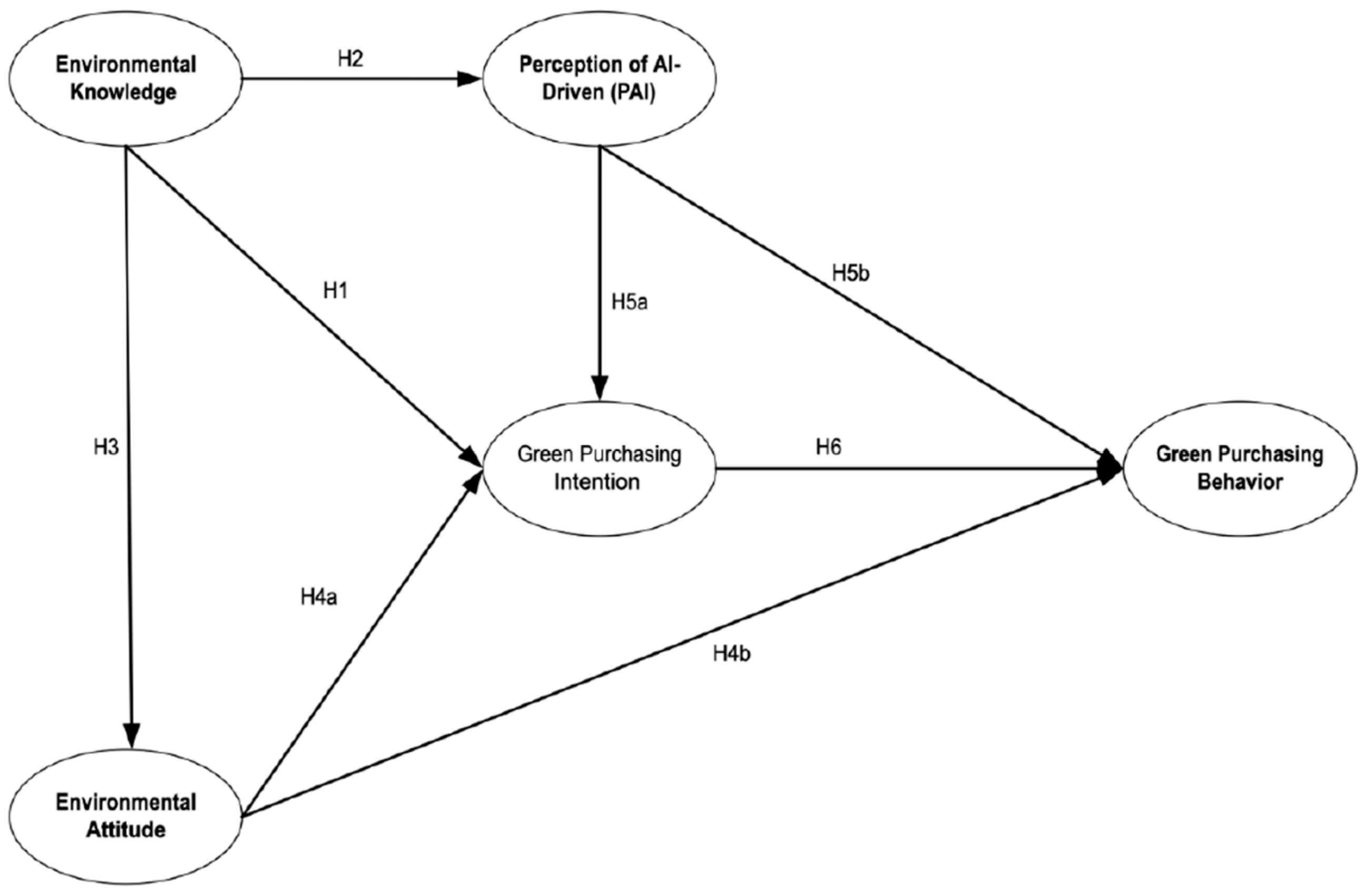
Based on the above discussion, this study proposes a hypothesized structural model that integrates environmental knowledge, environmental attitude, and perception of AI-driven personalization as predictors of green purchasing intention and behavior. The model highlights the mediating role of intention and represents an extended Theory of Planned Behavior (TPB) framework adapted to AI-enabled sustainable consumption. The hypothesized SEM framework is presented in Figure 1.

3. Methods

3.1. Research Design

This study adopted a quantitative research design with a cross-sectional survey approach to examine the relationships among environmental knowledge (EK), environmental attitude (EAT), perception of AI-driven personalization (PAI), green purchasing intention (GPI), and green purchasing behavior (GPB). The conceptual framework integrates the Theory of Planned Behavior (TPB) with an AI-driven personalization variable as an additional predictor, thereby extending the traditional model to incorporate technological engagement in sustainable consumption contexts.

3.2. Population and Sampling

The target population comprised youth in Java, Indonesia, aged 17–25 years, specifically undergraduate students. A non-probability purposive sampling method was employed to select respondents from universities affiliated with Catholic Higher Education Association and reputable private and public universities, ensuring geographic coverage across Jakarta, Bandung, Semarang, Yogyakarta, Malang and Surabaya.
According to data from the Ministry of Education, Culture, Research, and Technology (2024) [25], the total number of active undergraduate students in these regions is approximately 690,000. Based on this population size, Yamane’s formula [26] was applied with a precision level of 5%, yielding a minimum sample size of 267 participants. To enhance statistical power and ensure adequate subgroup representation, data were collected from 517 respondents, exceeding the required minimum threshold.

3.3. Data Collection

Data were gathered using a structured online questionnaire, distributed through institutional networks and student organizations. The instrument employed a five-point Likert scale (1 = strongly disagree; 5 = strongly agree) for all construct items. Measurement items for EK, EAT, PAI, GPI, and GPB were adapted from validated scales in prior studies [1,5,6,8,27].
To ensure the validity and cultural suitability of the measurement scales, a rigorous multi-step adaptation process was conducted. First, all items were translated from English to Bahasa Indonesia by two bilingual researchers with expertise in sustainability and behavioral sciences. The translated version was then back-translated into English by an independent translator unfamiliar with the original items to verify semantic and conceptual equivalence. Discrepancies were discussed and resolved collaboratively among the research team to maintain both linguistic accuracy and theoretical consistency.
Second, the items underwent cultural adaptation to reflect the Indonesian socio-environmental context. For example, terms such as “eco-friendly products” were contextualized as produk ramah lingkungan and examples of sustainable actions (e.g., recycling, minimizing single-use plastics) were tailored to align with local consumption habits. Minor modifications were made to ensure readability and cultural resonance without altering the underlying construct meanings.
Third, a pilot test involving 30 university students from Jakarta was conducted to examine clarity, comprehension, and response variability. Participants were asked to provide feedback on item wording and relevance. Reliability coefficients from the pilot data showed acceptable internal consistency (Cronbach’s α > 0.75 for all constructs). Based on feedback, minor linguistic adjustments were applied to improve item clarity.
Finally, content validity was confirmed through an expert panel review consisting of three academics specializing in consumer behavior, environmental psychology, and AI applications. The experts assessed the representativeness and appropriateness of each item for the Indonesian youth context. Their feedback ensured that the adapted instrument captured both psychological and technological aspects of sustainable consumption in a culturally valid manner.

3.4. Variables and Measurement

The questionnaire consisted of two main sections. The first section gathered demographic information, including gender, age, study major, level of education, and university name. The second section contained the measurement items for the five latent variables: environmental knowledge (EK), environmental attitude (EAT), perception of AI-driven personalization (PAI), green purchasing intention (GPI), and green purchasing behavior (GPB). All items were measured using a five-point Likert scale, ranging from 1 (“strongly disagree”) to 5 (“strongly agree”).
The measurement items were adapted from previously validated scales to ensure content validity and comparability with prior research. Environmental Knowledge (EK) was assessed using five indicators reflecting awareness of environmental protection, resource efficiency, and problem-solving capability [5]. Environmental Attitude (EAT) was measured with six items capturing personal responsibility, commitment, and support for environmentally responsible enterprises [28]. Perception of AI-driven Personalization (PAI) included six indicators assessing perceived usefulness, ease of use, trust, and acceptance of AI-based product recommendations [8]. Green Purchasing Intention (GPI) was measured through four items evaluating willingness and readiness to buy green products [1]. Finally, Green Purchasing Behavior (GPB) was assessed using five indicators that reflected the frequency of purchasing eco-friendly products and willingness to pay a price premium for them [27].
All questionnaire items were translated and reviewed to ensure conceptual clarity and linguistic accuracy in the Indonesian context. A pilot test with 30 respondents was conducted prior to data collection to confirm that the items were clear and comprehensible. The results of the pilot test confirmed adequate face validity and internal consistency. For transparency and replicability, the detailed measurement instrument is provided in Appendix A. The appendix presents each latent variable, its corresponding indicators, and the statement items used in the questionnaire. This allows readers to understand how each construct was operationalized and measured in the study.

3.5. Data Analysis

Partial Least Squares Structural Equation Modeling (PLS-SEM) was employed to test the hypothesized relationships among environmental knowledge (EK), environmental attitude (EAT), perception of AI-driven personalization (PAI), green purchasing intention (GPI), and green purchasing behavior (GPB) using SmartPLS 4.0 software. PLS-SEM was selected instead of covariance-based SEM (CB-SEM) because it is more suitable for models with multiple mediating variables, complex causal paths, and non-normally distributed data [29,30]. Moreover, it emphasizes prediction-oriented analysis, which aligns with the exploratory nature of this research that seeks to identify the psychological and technological factors driving sustainable purchasing behavior.
The evaluation process followed the two-step analytical approach recommended by Hair et al. [29], encompassing measurement model assessment and structural model assessment. The measurement model was first evaluated to ensure the reliability and validity of the latent constructs. Indicator reliability was examined through outer loadings, ensuring that all indicators adequately represented their underlying constructs. Internal consistency reliability was verified using Cronbach’s Alpha and Composite Reliability (CR), both of which exceeded the recommended threshold of 0.70. Convergent validity was established through the Average Variance Extracted (AVE) values above 0.50, while discriminant validity was confirmed using the Heterotrait–Monotrait (HTMT) ratio below 0.90, confirming that each construct measured a distinct concept.
Following this, the structural model was assessed to examine the hypothesized relationships among constructs. Collinearity diagnostics using the Variance Inflation Factor (VIF) confirmed the absence of multicollinearity, with all values below 5. The significance of the structural paths was evaluated using a bootstrapping procedure with 5000 resamples to obtain the path coefficients (β), t-values, and p-values. The explanatory power of the model was assessed through the coefficient of determination (R2), while the effect size (f2) was used to evaluate the relative importance of each predictor variable. In addition, the predictive relevance of endogenous constructs was verified using the Stone–Geisser Q2 value obtained via the blindfolding procedure, where Q2 values greater than zero indicate satisfactory predictive capability.
Finally, model fit and predictive performance were examined to ensure the overall robustness of the model. The Standardized Root Mean Square Residual (SRMR) and the Normed Fit Index (NFI) were used to assess model fit, with SRMR values below 0.08 indicating good model adequacy. To evaluate out-of-sample predictive performance, the PLSpredict procedure was conducted to compare the PLS-SEM model against a linear regression benchmark. The results demonstrated that the PLS-SEM model achieved superior predictive accuracy across most indicators, providing evidence of its practical utility in explaining and predicting green purchasing behavior among youth in Java.
This comprehensive evaluation ensured that both the measurement and structural components of the model satisfied the recommended quality standards for reliability, validity, and predictive power, thereby providing confidence in the robustness and generalizability of the empirical findings.

3.6. Ethical Considerations

Ethical approval for the study was obtained from the appropriate institutional review board prior to data collection. All participants provided informed consent, and responses were anonymized to protect confidentiality.

4. Results

4.1. Measurement Model Evaluation

The measurement model was assessed to ensure reliability and validity of the constructs. The values of convergent validity and reliability for the measurement model can be seen in Table 1. Indicator reliability was confirmed as all standardized factor loadings exceeded the recommended threshold of 0.50 [31]. Internal consistency reliability was supported, with Composite Reliability (CR) values ranging from 0.843 to 0.895 and exceeding the minimum criterion of 0.70. Convergent validity was confirmed, with Average Variance Extracted (AVE) values between 0.520 and 0.631, surpassing the 0.50 threshold [31]. Furthermore, Cronbach’s Alpha (CA) values for all constructs ranged from 0.766 to 0.854, which also demonstrate satisfactory reliability. Similarly, the Rho A values, which provide a more accurate estimation of construct reliability, were consistently above 0.76, further supporting the robustness of the measurement model. The loading factors for individual items varied between 0.567 and 0.846, indicating that each item contributes adequately to its respective construct. Among the constructs, GPB demonstrated the highest reliability, with a CR of 0.895 and an AVE of 0.631, while PAI, although slightly lower, still met the acceptable thresholds (CR = 0.843, AVE = 0.520). These results collectively confirm that the constructs employed in this study are both reliable and valid, thereby ensuring that subsequent structural model analysis can be performed on a solid measurement foundation.
Discriminant validity was established through the Heterotrait–Monotrait (HTMT) ratio, with all values below the threshold of 0.90 [31]. The results of the HTMT analysis are presented in Table 2. As shown in the table, all construct pairs exhibit HTMT values ranging from 0.360 to 0.814, which indicates adequate discriminant validity. Specifically, the highest HTMT value (0.814) was observed between EAT and EK, while the lowest value (0.360) was found between EA and PAI. Since all the values fall below the recommended cut-off point, the constructs in this study are empirically distinct from each other. This confirms that each construct measures a unique concept, thereby strengthening the validity of the measurement model. Consequently, these results provide a solid basis for proceeding with the evaluation of the structural model.
After testing the validity of the measurement model, the fitness of the measurement model was then examined based on the following indices: Chi-squared (χ2); standardized root mean square (SRMR); A value of SRMR less than 0.08 is considered a good fit [32]. The results of the measurement model fitness are presented in Table 3. The SRMR value obtained was 0.074, which falls below the recommended threshold, indicating that the model demonstrates an acceptable fit. Although the Chi-squared statistic (χ2 = 1108) is significant, this is common in large sample sizes and therefore not considered a sole indicator of poor model fit. The Normed Fit Index (NFI) value was 0.799, which is slightly below the ideal threshold of 0.90 but still indicates a reasonable level of model fit. Meanwhile, the RMS Theta value was 0.128, which is within the acceptable range suggested for measurement models, reflecting that the model specification errors are minimal. Taken together, these results suggest that the measurement model demonstrates adequate overall fitness, providing confidence in the structural relationships to be tested in the subsequent analysis.

4.2. Structural Model Evaluation

Collinearity diagnostics showed that all inner Variance Inflation Factor (VIF) values were below the threshold of 5, indicating no multicollinearity issues [29]. As presented in Table 4, the VIF values ranged between 1.000 and 1.841, suggesting that each predictor variable contributes uniquely to the model without inflating the variance of the regression estimates. This ensures that the relationships between constructs are not biased by redundancy among predictors, thereby strengthening the robustness of the model.
The coefficient of determination (R2) values, shown in Table 5, provide insight into the explanatory power of the model. The model explained 43.6% of the variance in EAT (R2 = 0.436), 55.3% of the variance in GPB (R2 = 0.553), 37.3% of the variance in GPI (R2 = 0.373), and 7.7% of the variance in PAI (R2 = 0.077). According to the guidelines suggested by Hair et al. [29], these results indicate that the explanatory power of the model is moderate for GPB, moderate-to-low for EAT and GPI, and weak for PAI. Nevertheless, the relatively higher R2 value for GPB shows that the constructs included in the model account for more than half of the variance in green purchasing behavior, highlighting the strong predictive ability of the model in this domain.
The path analysis revealed significant relationships between EK, EAT, and PAI on GPI and GPB, providing support for most of the proposed hypotheses. As presented in Table 6, the path from EK to EAT (H3) showed the strongest effect (β = 0.661, t = 22.423, p < 0.001), confirming that environmental knowledge plays a crucial role in shaping environmental attitude. Likewise, EAT was found to be a powerful predictor of both green purchasing intention (H4a: β = 0.445, t = 7.545, p < 0.001) and green purchasing behavior (H4b: β = 0.366, t = 9.151, p < 0.001). These findings highlight the central role of environmental attitude in translating knowledge into pro-environmental behavioral outcomes.
The influence of PAI was also noteworthy. While PAI significantly influenced GPI (H5a: β = 0.136, t = 3.259, p = 0.001), its effect on GPB was not significant (H5b: β = 0.056, t = 1.574, p = 0.116), suggesting that personal AI interaction may enhance intention but does not directly translate into actual purchasing behavior. Meanwhile, the path from GPI to GPB (H6: β = 0.444, t = 11.494, p < 0.001) was both strong and highly significant, reinforcing the Theory of Planned Behavior that intention is the most immediate antecedent of actual behavior.
Table 6 illustrates the structural model with the significance of the path coefficients. Bold black arrows represent paths significant at p < 0.01, thin black arrows indicate significance at p < 0.05, and red arrows mark unsupported hypotheses. Out of the eight tested hypotheses, seven were supported, indicating a well-fitting structural model. Overall, these results demonstrate that environmental knowledge and environmental attitude are the key drivers of green purchasing, while intention remains the strongest mediator between predictors and behavior. These findings provide theoretical support for the TPB framework and practical implications for businesses and policymakers seeking to design strategies that strengthen environmental attitudes and intentions, ultimately driving sustainable consumption behavior.

4.3. Validated Structural Equation Model

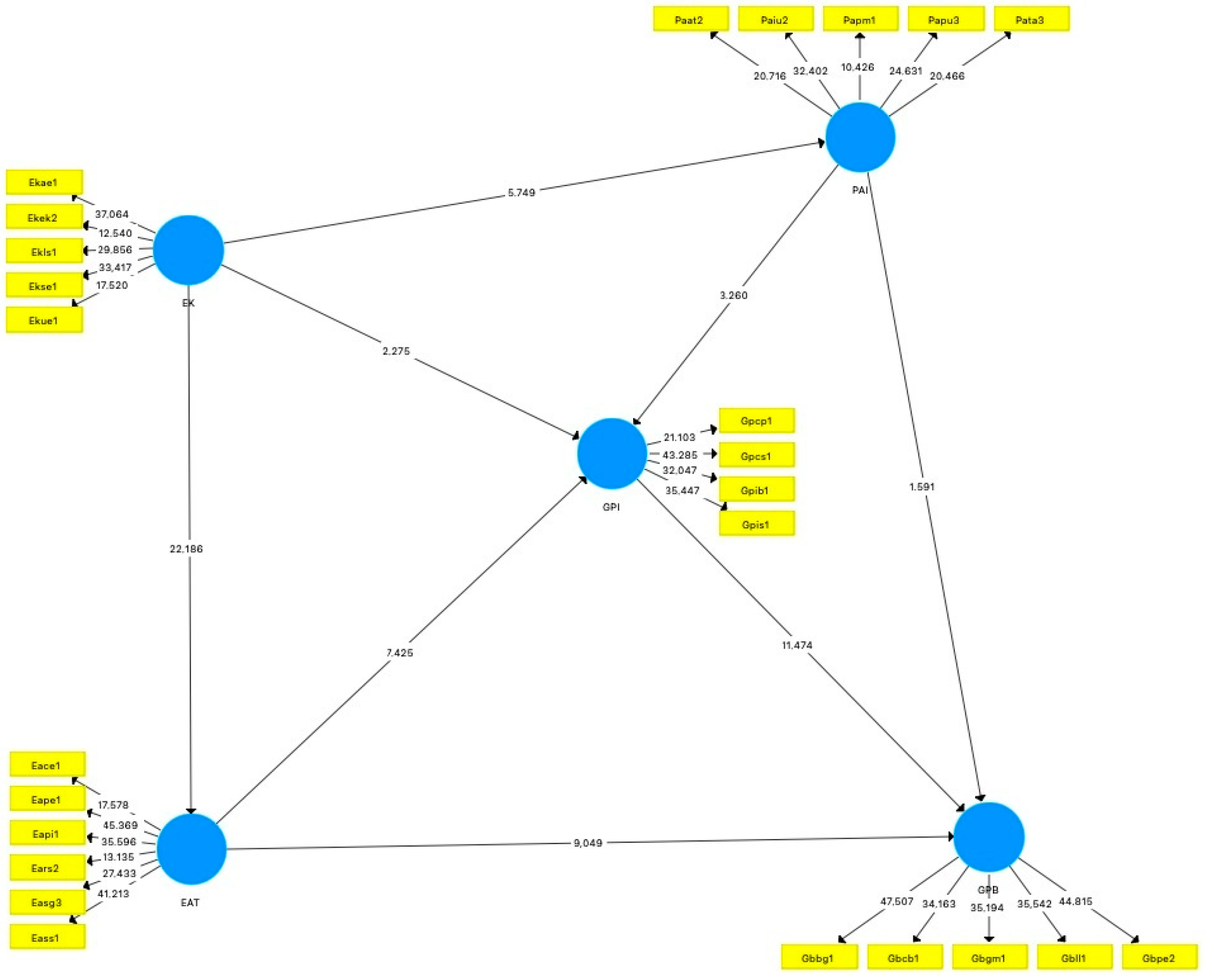
After confirming that the measurement and structural models met the required validity and reliability criteria, the final structural equation model was validated to visualize the significant relationships among the constructs. Figure 2 presents the validated SEM, which integrates both psychological and technological determinants of green purchasing behavior within the extended Theory of Planned Behavior (TPB) framework. The validated SEM illustrates the significant relationships among Environmental Knowledge (EK), Environmental Attitude (EAT), Perception of AI-Driven Personalization (PAI), Green Purchasing Intention (GPI), and Green Purchasing Behavior (GPB). Arrows represent standardized path coefficients, while R2 values indicate the explained variance for endogenous constructs. The model confirms that GPI mediates the effects of EK, EAT, and PAI on GPB within the extended TPB framework.
The results reveal that Environmental Knowledge (EK) exerts a strong positive influence on Environmental Attitude (EAT), which subsequently affects both Green Purchasing Intention (GPI) and Green Purchasing Behavior (GPB). Perception of AI-Driven Personalization (PAI) significantly influences GPI, indicating that AI-enabled personalization enhances consumers’ willingness to purchase eco-friendly products, although its direct effect on GPB is weaker. The mediating role of GPI underscores that behavioral intention serves as the key psychological bridge through which knowledge, attitude, and technological perceptions are converted into sustainable behavior. The R2 values of GPI (0.373) and GPB (0.553) indicate satisfactory explanatory power, confirming that the model accounts for a substantial proportion of the variance in both constructs.
Overall, the validated SEM supports the extended TPB, demonstrating that both psychological readiness and technological engagement jointly shape sustainable consumption among youth in Java Island. These findings provide a visual summary of the empirical relationships, reinforcing the theoretical integration between behavioral and technological perspectives.

4.4. Mediation Analysis

The mediating effects of GPI and PAI were tested using a bootstrapping procedure with 5000 resamples, which is widely recommended in PLS-SEM studies to ensure robust estimation of indirect effects. As presented in Table 7, several mediation paths were found to be statistically significant. Specifically, the path EK → EAT → GPB (β = 0.242, t = 8.424, p < 0.001) demonstrated a strong indirect effect, highlighting the crucial role of environmental attitude in linking knowledge with behavior. Similarly, the mediation path EAT → GPI → GPB (β = 0.198, t = 6.011, p < 0.001) confirmed that green purchasing intention transmits the effect of environmental attitude to actual purchasing behavior. The sequential mediation path EK → EAT → GPI → GPB (β = 0.131, t = 5.870, p < 0.001) further illustrates how environmental knowledge indirectly drives behavior through a combination of attitude and intention.
Additional significant mediation was observed in the paths EK → GPI → GPB (β = 0.064, t = 2.282, p = 0.023) and PAI → GPI → GPB (β = 0.060, t = 3.101, p = 0.002), suggesting that intention serves as a key conduit for both environmental knowledge and personal AI interaction to influence behavior. Moreover, the path EK → PAI → GPI → GPB (β = 0.017, t = 2.542, p = 0.011) was also significant, although the effect size was smaller, showing a more nuanced role of PAI in shaping behavior indirectly. In contrast, the direct mediation path EK → PAI → GPB (β = 0.016, t = 1.525, p = 0.127) was not significant, indicating that PAI alone does not translate knowledge into behavior without the involvement of intention.
Table 7 presents the mediation results with the significance of the path coefficients. Bold black arrows represent indirect effects significant at p < 0.01, thin black arrows indicate effects significant at p < 0.05, and red arrows represent non-significant mediation paths. Out of the nine tested mediation paths, eight were supported, providing strong evidence for the mediating role of both environmental attitude and green purchasing intention. Overall, these findings highlight that intention plays a central mediating role, while environmental attitude strengthens the pathway from knowledge to behavior.
These mediation findings provide deeper insight into the mechanisms through which knowledge, attitude, and AI interaction shape pro-environmental purchasing. The results not only reinforce the theoretical assumptions of the TPB framework but also offer practical guidance for strategies aimed at promoting sustainable consumer behavior. The following Section 5 elaborates on these theoretical and managerial implications in greater detail.

4.5. Model Predictive Performance

Predictive relevance was assessed using Stone–Geisser’s Q2 obtained via the blindfolding procedure (Q2 = 1 − SSE/SSO). As reported in Table 8, the model exhibits meaningful predictive relevance for all endogenous constructs. Specifically, EAT shows Q2 = 0.228 and GPI shows Q2 = 0.220, both indicating medium predictive relevance, while GPB attains Q2 = 0.337, approaching the large threshold. By contrast, EK is an exogenous construct; therefore Q2 is not computed (shown as “–“). These results imply that the measurement–structural specification can reproduce observed data with acceptable accuracy, especially for predicting green purchasing behavior.
For interpretive clarity, note that SSO denotes the sum of squares of observations and SSE the sum of squared prediction errors; larger gaps between SSO and SSE yield higher Q2, signaling better predictive capability. In line with common benchmarks, Q2 values greater than zero indicate predictive relevance, with ≈0.02, ≈0.15, and ≈0.35 often interpreted as small, medium, and large, respectively. Hence, the current model provides medium predictive relevance for EAT and GPI and medium-to-high predictive relevance for GPB.
To complement construct-level Q2, we also inspected out-of-sample predictive performance using PLSpredict at the indicator level. The results show that for most indicators (13 out of 20), the PLS model outperforms the linear benchmark (LM), yielding higher Q2_predict (or equivalently, lower prediction errors), which corroborates the model’s practical predictive utility. Collectively, these findings confirm that the proposed model is not only explanatory (via R2) but also predictively relevant, especially for GPB—supporting the robustness of subsequent substantive interpretations and managerial implications.
Out-of-sample predictive performance was evaluated using PLSpredict by comparing the PLS-SEM model against a linear benchmark (LM) on three metrics: item-level Q2_predict, RMSE, and MAE. MAE captures the average absolute prediction error, while RMSE penalizes larger errors more heavily; thus, consistent reductions in both signal stronger predictive ability [19]. As shown in Table 9, all indicators report positive Q2_predict values, confirming predictive relevance at the item level. Moreover, the PLS-SEM model achieves lower errors for the majority of indicators: 13 of 20 items show lower RMSE than LM and 13 of 20 show lower MAE, yielding 26 of 40 metric-item comparisons that favor PLS-SEM.
Improvements are broadly distributed across constructs. For example, several GPB and GPI indicators (e.g., Gbpe2, Gbbg1, Gpcp1, Gpib1, Gpcs1) exhibit lower RMSE and/or MAE under PLS-SEM, indicating better practical prediction of green purchasing behavior and intention. Some indicators (e.g., Eass1, Easg3, Eape1) show slightly lower errors under the LM benchmark, suggesting pockets where variance remains relatively harder to capture; however, these differences are modest and do not offset the overall advantage of PLS-SEM.
Taken together with the construct-level Q2 results (Table 8), these findings demonstrate that the proposed model is not only explanatory (via R2) but also predictively useful out-of-sample, especially on behavior-related indicators, thereby reinforcing the robustness of the model for subsequent theoretical interpretation and managerial application.

4.6. Summary of Findings

The results collectively support the extended TPB framework that integrates technological engagement (PAI) with psychological antecedents (EK, EAT). The measurement model was sound: all standardized loadings exceeded 0.50, CR ranged from 0.843 to 0.895, and AVE from 0.520 to 0.631; HTMT values were <0.90, establishing discriminant validity. Model fit indices further indicated adequacy (SRMR = 0.074; NFI = 0.799; RMS Theta = 0.128). Collinearity was not a concern (inner VIFs = 1.000–1.841). On explanatory power, the structural model accounted for 43.6% of EAT, 37.3% of GPI, 55.3% of GPB, and 7.7% of PAI.
At the path level, EK strongly predicted EAT (β = 0.661, p < 0.001), and EAT predicted both GPI (β = 0.445, p < 0.001) and GPB (β = 0.366, p < 0.001). GPI also had a sizable effect on GPB (β = 0.444, p < 0.001), reaffirming intention as the most proximal driver of behavior. EK directly influenced GPI (β = 0.145, p = 0.022) and PAI (β = 0.278, p < 0.001), while PAI enhanced GPI (β = 0.136, p = 0.001) but did not directly affect GPB (β = 0.056, p = 0.116). Mediation tests (5000 bootstraps) showed robust indirect effects via EAT and GPI—most notably EK → EAT → GPB (β = 0.242, p < 0.001), EAT → GPI → GPB (β = 0.198, p < 0.001), and the sequential EK → EAT → GPI → GPB (β = 0.131, p < 0.001)—underscoring the centrality of attitude and intention as mechanisms.
Predictively, construct-level Q2 values were positive (EAT = 0.228; GPI = 0.220; GPB = 0.337), with GPB approaching a “large” benchmark. PLSpredict showed that, at the indicator level, 26 of 40 RMSE/MAE comparisons favored the PLS-SEM model over a linear benchmark, evidencing out-of-sample utility. Overall, environmental knowledge and attitudes remain foundational, PAI primarily elevates intention (rather than behavior directly), and intention is the key gateway from cognitions to action among youth in Java.

5. Discussion

5.1. Interpretation of Key Relationships

The results reinforce the Theory of Planned Behavior (TPB): environmental knowledge (EK) shapes environmental attitudes (EAT), which in turn elevate green purchasing intention (GPI) and ultimately green purchasing behavior (GPB) [14]. The strong EK → EAT link suggests that concrete, actionable knowledge—about labels, lifecycle impacts, and product attributes, helps youth form favorable evaluations of green options that translate into intentions and behavior. The sizable GPI → GPB coefficient accords with evidence that intentions are the most proximal antecedent of action, even while an intention–behavior gap may persist when situational frictions remain (e.g., price premiums, availability, checkout friction) [24].
Technology-related engagement (PAI) functions primarily as an upstream catalyst of intention rather than a direct driver of behavior. Personalization likely raises perceived relevance and reduces search costs, lifting intention, but translation to behavior still hinges on attitudinal alignment and context. This is consistent with work on the personalization–privacy paradox: overt, transparent data practices tend to improve responses to personalized content, whereas covert collection can trigger vulnerability and dampen effectiveness [18,33]. The significant sequential mediations (EK → EAT → GPI → GPB; PAI → GPI → GPB) in our model therefore indicate that personalization adds value when it complements knowledge-based attitude formation and clear intentions.
Predictive assessments are aligned with these explanatory results. Construct-level Q2 values (especially for GPB) and PLSpredict comparisons against a linear benchmark indicate meaningful out-of-sample utility, consistent with current guidance to report both explanatory and predictive performance in PLS-SEM [34].
The present findings align with recent sustainability research emphasizing the central role of environmental knowledge and attitude in predicting pro-environmental behavior. For instance, Liu et al. [28] similarly found that environmental knowledge indirectly affects behavior through environmental attitude and intention, reinforcing the sequential mediation pattern observed in this study. The strong EK → EAT → GPI → GPB pathway observed among Indonesian youth mirrors patterns identified in Chinese and Turkish contexts, suggesting cross-cultural consistency in the psychological mechanisms underlying sustainable consumption [3,12].
However, our results extend prior findings by integrating perception of AI-driven personalization (PAI) into this behavioral framework. While prior studies (e.g., Sohaib et al. [20]) identified AI-based marketing as an enabler of consumer engagement, this study reveals that such personalization primarily strengthens intention rather than directly changing behavior. This nuance contributes to understanding the “intention–behavior gap” in green consumption, suggesting that personalization enhances motivational readiness but requires supporting contextual factors (e.g., affordability, trust, or data transparency) to convert into consistent behavioral outcomes.
Furthermore, the observed mediation through green purchasing intention aligns with meta-analytic evidence from Sheeran [24] and recent sustainability research [4], confirming that behavioral intention remains the most robust predictor of actual behavior. Yet, the relatively weak direct link between PAI and GPB underscores the importance of human agency and ethical AI design in sustainability contexts, echoing findings by Aguirre et al. [18] on the personalization–privacy paradox. Thus, this study strengthens prior evidence while situating it within the emerging intersection of environmental psychology and AI-driven consumer analytics.

5.2. Theoretical Contributions

This study makes three main theoretical contributions to the sustainability and consumer behavior literature. First, it introduces a distinct theoretical integration between behavioral and technological perspectives by embedding perception of AI-driven personalization (PAI) into the Theory of Planned Behavior (TPB). While TPB has long been used to explain green purchasing through cognitive (knowledge), affective (attitude), and conative (intention) pathways, it rarely accounts for the influence of digital technologies that now mediate consumer decision-making. By treating PAI as a technological enabler of intention formation, this study extends the boundary conditions of TPB from a purely psychological model toward a techno-behavioral framework that better reflects consumer behavior in AI-mediated markets. This conceptual extension responds to recent calls to modernize behavioral theories in the age of digital personalization [20].
Second, the study clarifies the mechanism by which environmental knowledge and AI perceptions jointly shape sustainable consumption, demonstrating a sequential process: knowledge enhances environmental attitude, which amplifies the effect of AI-driven personalization on green purchasing intention. This layered mechanism refines the “knowledge–attitude–intention” pipeline in sustainability theory by identifying technology perception as a contextual amplifier of intention formation. Such a perspective deepens the understanding of how informational and emotional antecedents interact with technological trust to drive sustainable behavior, a dynamic underexplored in prior TPB-based models.
Third, the study contributes methodologically to sustainability research by applying a predictive, theory-extension approach using PLS-SEM. Instead of solely confirming existing theoretical paths, the model emphasizes both explanatory power (R2) and predictive relevance (Q2, PLSpredict), aligning with recent methodological shifts toward predictive validity as evidence of theoretical robustness [34]. This approach underscores that behavioral models should not only fit existing theory but also demonstrate their ability to predict emerging phenomena, such as AI-enabled sustainable consumption, thereby strengthening the cumulative rigor of TPB research.
Taken together, these contributions offer a coherent theoretical increment: the Extended TPB for AI-Enabled Sustainable Consumption (ETPB-AI). This integrated model provides a more contemporary understanding of how psychological readiness (knowledge and attitude) and technological engagement (AI personalization) co-evolve to influence sustainable consumer behavior, particularly among digitally active youth in developing economies.

5.3. Practical and Policy Implications

For platforms and retailers, personalization should be attitude-compatible. Present tailored green recommendations with brief, credible micro-explanations (why a product is greener, expected impact, verified labels) so that personalization reinforces EAT while nudging GPI. Ensure data-use transparency and provide visible privacy controls; experiments show that overt (vs. covert) data practices improve responses to personalized messages [18]. To bridge the intention–behavior gap, reduce last-mile frictions by surfacing price-efficiency information (e.g., total cost of ownership, durability), highlighting availability, and minimizing checkout steps—moves consistent with intention-to-behavior evidence [24].
For public policy and institutional ecosystem partners such as universities, environmental NGOs, and industry associations, two levers stand out. First, scale environmental literacy initiatives that convert knowledge into favorable attitudes—curricula, campus/community campaigns, and credible ecolabel standards—given the dominant EK → EAT pathway. Second, deploy choice-architecture tools that make green options easy: defaults (with simple opt-outs), salience cues, and standardized labels. Meta-analytic evidence indicates that defaults and broader nudges yield small-to-moderate average effects that can cumulate at population scale [35,36]. Programs should be paired with transparency and autonomy safeguards to avoid undermining trust, especially in data-driven personalization contexts [33].

5.4. Boundary Conditions and Future Research

The non-significant PAI → GPB path suggests that technology’s direct behavioral impact may depend on moderators (e.g., price sensitivity, perceived green value, data-handling transparency). Future work should test these moderators explicitly and compare alternative personalization designs (overt vs. covert data sourcing; high vs. low explanation). To bolster causal claims and track dynamic conversion from intention to behavior, combine field experiments/A–B tests with longitudinal observation, and fuse self-reports with behavioral traces (clickstream, receipts). Extending the sample beyond students to diverse youth segments—and to different provinces or income tiers—would enhance external validity and reveal context-specific elasticities in the knowledge → attitude → intention pipeline.

6. Conclusions

This study investigated the influence of environmental knowledge (EK), environmental attitude (EAT), and perception of AI-driven personalization (PAI) on green purchasing behavior (GPB) among youth in Java, Indonesia, with green purchasing intention (GPI) as a mediating variable. By extending the Theory of Planned Behavior (TPB) to include technological engagement, the findings highlight that both psychological readiness and favorable perceptions of AI personalization significantly enhance green purchasing intention and behavior.
The findings confirm that EK has a strong positive effect on EAT, which subsequently enhances both GPI and GPB. GPI emerges as the most immediate antecedent of actual behavior, consistent with prior TPB-based evidence. Although PAI significantly influences intention, its direct effect on behavior remains limited, implying that AI-based personalization can motivate but not guarantee sustainable action. This highlights the persistent intention–behavior gap and the need for contextual supports, such as affordability, trust, and transparency, to convert pro-environmental intention into consistent action.
This study offers a theoretically and empirically grounded understanding of how EK, EAT, and PAI jointly influence GPI and GPB among youth in Indonesia. By integrating PAI into TPB, this study develops what can be termed the Extended TPB for AI-Enabled Sustainable Consumption (ETPB-AI), a novel framework that captures how psychological readiness and technological engagement co-determine sustainable consumption in the digital age.
This research makes a distinct theoretical contribution by being among the first to embed perceptions of AI-driven personalization into a TPB-based model of sustainable behavior. Prior TPB studies have focused primarily on psychological determinants such as knowledge, attitude, and norms, with limited consideration of how technological environments shape behavioral intention. The present study addresses this gap by positioning PAI as a contextual amplifier that strengthens the knowledge–attitude–intention sequence, thereby connecting cognitive and affective precursors with technology-enabled decision-making. This conceptual expansion advances TPB from a static behavioral model into a dynamic techno-behavioral framework applicable to AI-mediated markets.
Furthermore, the study refines sustainability theory by explaining why and how environmental knowledge fosters favorable perceptions of AI technology: informed consumers are more capable of interpreting personalized green messages and discerning their environmental relevance. This integration bridges two theoretical streams, environmental psychology and AI acceptance research, creating a unified understanding of responsible consumption in data-driven societies.
Practically, the study provides actionable guidance for businesses to design AI-enabled marketing strategies that align with environmental values, and for policymakers to develop youth-focused sustainability programs that leverage digital tools to promote eco-friendly consumption. Furthermore, the findings suggest that marketers and digital platforms should design transparent, value-based personalization systems that reinforce environmental values and trust. For instance, AI recommendation tools should clearly explain the sustainability attributes of products, provide verifiable ecolabels, and highlight long-term value rather than short-term convenience.
In addition, for policymakers and educators, initiatives that enhance environmental literacy and digital ethics awareness among youth can strengthen the foundational EK → EAT pathway and build a generation of informed, responsible consumers. Integrating AI-driven tools into sustainability education programs can also foster technology-enabled environmental awareness.
Despite these contributions, this study is limited by its cross-sectional design and student-based sample, which may not capture behavioral changes over time or reflect the diversity of Indonesia’s population. Future research should employ longitudinal or experimental designs to examine causality and incorporate behavioral data (e.g., purchase records, digital footprints) to validate self-reported measures. Comparative studies across regions or cultures could also test whether the AI-driven personalization mechanism varies with digital literacy, cultural norms, or regulatory environments. Moreover, exploring ethical dimensions of AI personalization, such as fairness, privacy, and autonomy, represents an emerging research frontier for sustainable consumer behavior.
In conclusion, advancing sustainable consumption among youth requires a dual strategy: strengthening environmental knowledge and attitudes while deploying AI-driven personalization ethically and transparently to translate intention into consistent green behavior. The integration of behavioral and technological insights presented in this study provides both a theoretical bridge and a practical roadmap for promoting sustainability in the age of digital personalization.

Author Contributions

Conceptualization, F.P.S.S., H.A.H. and M.M.W.I.; Data curation, H.A.H., J.M.M. and L.E.S.; Formal analysis, F.P.S.S., M.M.W.I. and H.A.H.; Investigation, F.P.S.S., M.M.W.I. and H.A.H.; Methodology, F.P.S.S., M.M.W.I. and H.A.H.; Resources, F.P.S.S., M.M.W.I. and H.A.H.; Supervision, M.M.W.I. and Y.-M.Y.; Validation, F.P.S.S., M.M.W.I., H.A.H. and Y.-M.Y.; Visualization, J.M.M. and L.E.S.; Writing—original draft, F.P.S.S.; Writing—review and editing, F.P.S.S., M.M.W.I., H.A.H., J.M.M. and L.E.S. All authors have read and agreed to the published version of the manuscript.

Funding

This research was funded by the Ministry of Education, Culture, Research, and Technology of the Republic of Indonesia, grant number 0982/LL3/AL.04/2025 and The APC was funded by the Ministry of Education, Culture, Research, and Technology of the Republic of Indonesia.

Institutional Review Board Statement

The study was conducted in accordance with the Declaration of Helsinki, and approved by the Institutional Ethics Committee of Atma Jaya Catholic University of Indonesia (protocol code: KE250618, date of approval: 7 July 2025).

Informed Consent Statement

Informed consent was obtained from all subjects involved in the study.

Data Availability Statement

The original data will be made available on request to Feliks Prasepta Sejahtera Surbakti.

Conflicts of Interest

The authors declare no conflicts of interest.

Abbreviations

The following abbreviations are used in this manuscript:
AIArtificial Intelligence
PAIPerception of AI-Driven Personalization
EKEnvironmental Knowledge
EATEnvironmental Attitude
GPIGreen Purchasing Intention
GPBGreen Purchasing Behavior
TPBTheory of Planned Behavior
PLS-SEMPartial Least Squares Structural Equation Modeling
HTMTHeterotrait–Monotrait Ratio
CRComposite Reliability
AVEAverage Variance Extracted
CACronbach’s Alpha
VIFVariance Inflation Factor
SRMRStandardized Root Mean Square Residual
NFINormed Fit Index
RMS ThetaRoot Mean Square Theta
PLSpredictPLS out-of-sample prediction procedure
LMLiniar Model
SSOSum of Squares of Observations
SSESum of Squared Errors
SDGsSustainable Development Goals

Appendix A

Table A1. Variables, Indicators, Definitions, and Statement Items.
Latent VariableIndicatorsStatement Items
Environmental Knowledge.Environmental knowledge for environmental protectionI have knowledge about how to effectively protect the environment.
I understand the importance of conserving natural resources in daily life.
I can explain simple ways to reduce environmental pollution.
Use environmental knowledge to improve efficiency and responsible consumptionI use environmental knowledge to improve efficiency and responsible consumption.
I practice energy efficiency based on my environmental knowledge.
I reduce the use of single-use plastics based on environmental information I have learned.
Link sources of environmental knowledge to solving problemsI connect sources of environmental knowledge with efforts to solve environmental problems.
I use environmental news to understand current ecological issues.
I use environmental articles or literature to find solutions to environmental problems.
Applying environmental knowledge for environmental issuesI apply environmental knowledge to address environmental issues.
I apply environmental science in daily activities such as recycling.
I participate in social activities aimed at solving environmental problems.
Share environmental knowledge with the surrounding environment to foster sustainable consumption behaviorI share environmental knowledge with people around me to encourage sustainable consumption behavior.
I invite others to care about the environment through social media.
I discuss with friends or family the importance of green consumption.
Environmental AttitudeCommitment for environmental safeguardI am committed to preserving the environment.
I make environmental preservation a part of my life principles.
I consistently support environmental conservation activities in my community.
Responsible for sustainable environmentI am responsible for creating a sustainable environment.
I feel a moral obligation to care for my surroundings.
I act with consideration for long-term environmental impact.
Provide environmental issues and problem solvingI care about environmental issues and strive to provide solutions.
I follow the development of environmental issues and their solutions through various media.
I give advice to others on how to solve environmental problems.
Protect and Improve for the environmentI actively protect and improve environmental quality.
I regularly take practical actions such as planting trees or cleaning up waste.
I support environmental restoration programs organized by the government or NGOs.
Share solution and problem solving for the damageI share solutions to environmental damage with others.
I disseminate information on how to repair environmental damage.
I share my personal experiences in dealing with environmental problems.
Support goods and services from environmentally responsible enterprisesI support products and services from companies that care about environmental issues in their business operations.
I choose products from companies that apply sustainable business principles.
I read a company’s environmental policy before deciding to buy its product.
Perception of AI- Driven Tools. (PAI)Personalized marketing messages and offersPersonalized marketing messages and offers attract my attention more than general ones.
I am more interested in product recommendations that match my needs.
I pay more attention to ads customized based on my preferences.
Trust in AII trust tools powered by artificial intelligence (AI).
I believe AI provides objective and neutral recommendations.
I feel safe using services operated by AI-based systems.
Ease of useI find AI-based tools easy to use.
I have no difficulty understanding features in AI-based tools.
I can use AI-based applications without much help.
Perceived usefulnessI find AI-based tools useful.
I feel the use of AI improves my efficiency.
I think AI helps me make more accurate decisions.
Attitude toward AII have a positive attitude toward the use of AI.
I support the application of AI in various aspects of modern life.
I believe AI can bring positive impacts if used ethically.
Intention to useI intend to use AI-powered tools in my activities.
I plan to continue using AI-based tools in my daily life.
I am willing to try new AI technologies to make my tasks easier.
Green Purchasing IntentionConsider purchasing organic productsI consider buying organic products.
I often look for information about available organic products.
I believe that buying organic products is a form of environmental responsibility.
Consider switching to another brandI consider switching to brands that are more environmentally friendly.
I am open to trying new eco-friendly products.
I don’t mind changing brands for sustainability reasons.
Intend to buy organic productsI intend to buy organic products.
I plan to buy organic products regularly.
I will choose organic products more often if the price is affordable.
Intend to switch to an organic version of a productI intend to replace products I usually use with more eco-friendly versions.
I am ready to stop using old products if an eco-friendly version is available.
I plan to gradually replace daily needs with organic products.
Green Purchasing BehaviorChoose to buy environmentally friendly productsI choose to buy environmentally friendly products.
I consciously avoid products that are not eco-friendly.
I always consider environmental impact before purchasing products.
Prefer environmentally friendly products when qualities are similarI prefer eco-friendly products over regular ones if the quality is similar.
I will choose eco-friendly products even if they are slightly more expensive.
I feel satisfied buying products that do not harm the environment.
Look at the label to check environmental impactI check ingredient labels to ensure products do not contain harmful materials.
I read packaging labels to find out if products contain hazardous substances.
I look for environmental certification logos before buying products.
Buy green products despite higher pricesI still buy eco-friendly products even if they cost more.
I am willing to pay more for products with lower environmental impact.
I believe higher prices are worth the environmental benefits.
Green marketing influenceI buy products because of green marketing strategies, not just regular advertisements.
I trust products promoted with sustainability approaches more.
I choose products based on the environmental values they represent.

References

  1. Margariti, K.; Hatzithomas, L.; Boutsouki, C. Elucidating the gap between green attitudes, intentions, and behavior through the prism of greenwashing concerns. Sustainability 2024, 16, 5108. [Google Scholar] [CrossRef]
  2. Pratiwi, F.S. BPS: Penduduk Indonesia Diproyeksi Capai 328,93 Juta Pada 2050. Available online: https://dataindonesia.id/varia/detail/bps-penduduk-indonesia-diproyeksi-capai-32893-juta-pada-2050 (accessed on 15 February 2025).
  3. Ullah, A.; Tekbaş, M.; Doğan, M. The impact of economic growth, natural resources, urbanization and biocapacity on the ecological footprint: The case of Turkey. Sustainability 2023, 15, 12855. [Google Scholar] [CrossRef]
  4. Shang, W.; Zhu, R.; Liu, W.; Liu, Q. Understanding the influences on green purchase intention with moderation by sustainability awareness. Sustainability 2024, 16, 4688. [Google Scholar] [CrossRef]
  5. Zhang, W.; Xu, R.; Jiang, Y.; Zhang, W. How environmental knowledge management promotes employee green behavior: An empirical study. Int. J. Environ. Res. Public Health 2021, 18, 4738. [Google Scholar] [CrossRef]
  6. Shrirame, V.; Sabade, J.; Soneta, H.; Vijayalakshmi, M. Consumer behavior analytics using machine learning algorithms. In Proceedings of the 2020 IEEE International Conference on Electronics, Computing and Communication Technologies (CONECCT), Bangalore, India, 2–4 July 2020; pp. 1–6. [Google Scholar]
  7. Surbakti, F.P.S.; Wang, W.; Indulska, M.; Sadiq, S. Factors influencing effective use of big data: A research framework. Inf. Manag. 2020, 57, 103146. [Google Scholar] [CrossRef]
  8. Raji, M.A.; Olodo, H.B.; Oke, T.T.; Addy, W.A.; Ofodile, O.C.; Oyewole, A.T. E-commerce and consumer behavior: A review of AI-powered personalization and market trends. GSC Adv. Res. Rev. 2024, 18, 066–077. [Google Scholar] [CrossRef]
  9. Surbakti, F.P.S.; Perdana, A.; Indulska, M.; Liono, J.; Arief, I.B. From data to decisions: Leveraging AI to enhance online travel agency operations. J. Inf. Technol. Teach. Cases 2024, 20438869241279130. [Google Scholar] [CrossRef]
  10. Yin, J.; Qiu, X.; Wang, Y. The Impact of AI-Personalized Recommendations on Clicking Intentions: Evidence from Chinese E-Commerce. J. Theor. Appl. Electron. Commer. Res. 2025, 20, 21. [Google Scholar] [CrossRef]
  11. Qiu, X.; Wang, Y.; Zeng, Y.; Cong, R. Artificial Intelligence Disclosure in Cause-Related Marketing: A Persuasion Knowledge Perspective. J. Theor. Appl. Electron. Commer. Res. 2025, 20, 193. [Google Scholar] [CrossRef]
  12. Cao, P.; Liu, S. The impact of artificial intelligence technology stimuli on sustainable consumption behavior: Evidence from ant forest users in China. Behav. Sci. 2023, 13, 604. [Google Scholar] [CrossRef]
  13. Ofori, D.; Nsiah-Sarfo, D.J.; Frimpong, S.E.; Buer, S.B. Determinants of green purchase and conservation behaviour among young consumers: Emerging economy perspective. Clean. Logist. Supply Chain 2025, 16, 100234. [Google Scholar] [CrossRef]
  14. Ajzen, I. The theory of planned behavior. Organ. Behav. Hum. Decis. Process. 1991, 50, 179–211. [Google Scholar] [CrossRef]
  15. Moon, S.-J. Investigating beliefs, attitudes, and intentions regarding green restaurant patronage: An application of the extended theory of planned behavior with moderating effects of gender and age. Int. J. Hosp. Manag. 2021, 92, 102727. [Google Scholar] [CrossRef]
  16. Sharma, K.; Aswal, C.; Paul, J. Factors affecting green purchase behavior: A systematic literature review. Bus. Strategy Environ. 2023, 32, 2078–2092. [Google Scholar] [CrossRef]
  17. Zheng, M.; Li, T.; Ye, J. The confluence of AI and big data analytics in Industry 4.0: Fostering sustainable strategic development. J. Knowl. Econ. 2025, 16, 5479–5515. [Google Scholar] [CrossRef]
  18. Aguirre, E.; Mahr, D.; Grewal, D.; De Ruyter, K.; Wetzels, M. Unraveling the personalization paradox: The effect of information collection and trust-building strategies on online advertisement effectiveness. J. Retail. 2015, 91, 34–49. [Google Scholar] [CrossRef]
  19. Rahnama, H.; Rajabpour, S. Identifying effective factors on consumers’ choice behavior toward green products: The case of Tehran, the capital of Iran. Environ. Sci. Pollut. Res. 2017, 24, 911–925. [Google Scholar] [CrossRef]
  20. Sohaib, O.; Alshemeili, A.; Bhatti, T. Exploring AI-enabled green marketing and green intention: An integrated PLS-SEM and NCA approach. Clean. Responsible Consum. 2025, 17, 100269. [Google Scholar] [CrossRef]
  21. Mekheimer, M. Technological self-efficacy, motivation, and contextual factors in advanced EFL e-learning: A mixed-methods study of strategy use and satisfaction. Humanit. Soc. Sci. Commun. 2025, 12, 677. [Google Scholar] [CrossRef]
  22. Davis, F.D. Perceived usefulness, perceived ease of use, and user acceptance of information technology. MIS Q. 1989, 13, 319–340. [Google Scholar]
  23. Kim, N.; Lee, K. Environmental consciousness, purchase intention, and actual purchase behavior of eco-friendly products: The moderating impact of situational context. Int. J. Environ. Res. Public Health 2023, 20, 5312. [Google Scholar] [CrossRef]
  24. Sheeran, P. Intention—Behavior relations: A conceptual and empirical review. Eur. Rev. Soc. Psychol. 2002, 12, 1–36. [Google Scholar] [CrossRef]
  25. Ministry of Education, Culture, Research, and Technology of the Republic of Indonesia. Higher Education Statistics Report 2024: Number of Active Undergraduate Students by Region and Province. Available online: https://www.bps.go.id/en/publication/2024/11/22/c20eb87371b77ee79ea1fa86/statistics-of-education-2024.html (accessed on 9 October 2025).
  26. Anderson, T.W.; Finn, J.D. The New Statistical Analysis of Data; Springer Science & Business Media: New York, NY, USA, 2012. [Google Scholar]
  27. Taufique, K.M.R.; Vaithianathan, S. A fresh look at understanding Green consumer behavior among young urban Indian consumers through the lens of Theory of Planned Behavior. J. Clean. Prod. 2018, 183, 46–55. [Google Scholar] [CrossRef]
  28. Liu, P.; Teng, M.; Han, C. How does environmental knowledge translate into pro-environmental behaviors?: The mediating role of environmental attitudes and behavioral intentions. Sci. Total Environ. 2020, 728, 138126. [Google Scholar] [CrossRef]
  29. Hair, J.F.; Risher, J.J.; Sarstedt, M.; Ringle, C.M. When to use and how to report the results of PLS-SEM. Eur. Bus. Rev. 2019, 31, 2–24. [Google Scholar] [CrossRef]
  30. Chin, W.W. The partial least squares approach to structural equation modeling. In Modern Methods for Business Research; Psychology Press: Abingdon, UK, 1998; pp. 295–336. [Google Scholar]
  31. Cheung, G.W.; Cooper-Thomas, H.D.; Lau, R.S.; Wang, L.C. Reporting reliability, convergent and discriminant validity with structural equation modeling: A review and best-practice recommendations. Asia Pac. J. Manag. 2024, 41, 745–783. [Google Scholar] [CrossRef]
  32. Kline, R.B. Principles and Practice of Structural Equation Modeling; Guilford Publications: New York, NY, USA, 2023. [Google Scholar]
  33. Chellappa, R.K.; Sin, R.G. Personalization versus privacy: An empirical examination of the online consumer’s dilemma. Inf. Technol. Manag. 2005, 6, 181–202. [Google Scholar] [CrossRef]
  34. Shmueli, G.; Sarstedt, M.; Hair, J.F.; Cheah, J.-H.; Ting, H.; Vaithilingam, S.; Ringle, C.M. Predictive model assessment in PLS-SEM: Guidelines for using PLSpredict. Eur. J. Mark. 2019, 53, 2322–2347. [Google Scholar] [CrossRef]
  35. Jachimowicz, J.M.; Duncan, S.; Weber, E.U.; Johnson, E.J. When and why defaults influence decisions: A meta-analysis of default effects. Behav. Public Policy 2019, 3, 159–186. [Google Scholar] [CrossRef]
  36. Mertens, S.; Herberz, M.; Hahnel, U.J.; Brosch, T. The effectiveness of nudging: A meta-analysis of choice architecture interventions across behavioral domains. Proc. Natl. Acad. Sci. USA 2022, 119, e2107346118. [Google Scholar] [CrossRef]
Figure 1. The Hypothesized Model.
Sustainability 17 09600 g001
Figure 2. Validated Model.
Sustainability 17 09600 g002
Table 1. Convergent validity and reliability for the measurement model.
ConstructItemsLoading FactorCARho ACRAVE
EATEace10.6520.8180.8330.8690.528
Eape10.802
Eapi10.797
Ears20.567
Easg30.721
Eass10.789
EKEkae10.7880.7690.7850.8440.521
Ekek20.583
Ekls10.766
Ekse10.752
Ekue10.704
GPBGbbg10.8460.8540.8550.8950.631
Gbcb10.742
Gbgm10.775
Gbll10.788
Gbpe20.818
GPIGpcp10.7320.7850.7920.8610.607
Gpcs10.804
Gpib10.797
Gpis10.783
PAIPaat20.7340.7660.7610.8430.520
Paiu20.805
Papm10.568
Papu30.756
Pata30.721
Table 2. Results of heterotrait monotrait ratio (HTMT).
ConstructEATEAGPBGPIPAI
EAT
EK0.814
GPB0.7490.566
GPI0.7210.6000.808
PAI0.3960.3600.3760.398
Table 3. Measurement Model Fitness.
Fit IndicesValues
Chi-squared (χ2)1108
SRMR0.074
NFI0.799
RMS Theta0.128
Table 4. Results of Inner Variance Inflation Factor (VIF).
ItemsEATEKGPBGPIPAI
EAT 1.5661.841
EK1.000 1.7901.000
GPB
GPI 1.565
PAI 1.1481.124
Table 5. Results of R square.
ConstructR SquareR Square Adjusted
EAT0.4360.435
GPB0.5530.550
GPI0.3730.369
PAI0.0770.075
Table 6. Structural model results.
HypothesisPathβT-Statisticsp-ValueSupported
H1EK → GPI0.1452.2970.022*
H2EK → PAI0.2785.6080.000***
H3EK → EAT0.66122.4230.000***
H4aEAT → GPI0.4457.5450.000***
H4bEAT → GPB0.3669.1510.000***
H5aPAI → GPI0.1363.2590.001***
H5bPAI GPB0.0561.5740.116
H6GPI → GPB0.44411.4940.000***
Note: * p < 0.05; *** p < 0.001. Paths marked with “–” indicate non-significant relationships (p ≥ 0.05).
Table 7. Mediation analysis results.
PathβT-Statisticsp-ValueSupported
EK → EAT → GPB0.2428.4240.000***
EAT → GPI → GPB0.1986.0110.000***
EK → EAT → GPI → GPB0.1315.8700.000***
EK → GPI → GPB0.0642.2820.023*
PAI → GPI → GPB0.0603.1010.002***
EK → PAI → GPI → GPB0.0172.5420.011*
EK PAI GPB0.0161.5250.127
EK → EAT → GPI0.2947.2830.000***
EK → PAI → GPI0.0382.6560.008***
Note: * p < 0.05; *** p < 0.001. Paths marked with “–” indicate non-significant relationships (p ≥ 0.05).
Table 8. Predictive relevance values results.
ConstructSSOSSEQ2 (=1 − SSE/SSO)
EAT3072.0002371.1180.228
EK2560.0002560.000
GPB2560.0001697.3540.337
GPI2048.0001597.1900.220
Table 9. RMSE and MAE Comparison (PLS-SEM vs. LM) for Predictive Performance.
Items IndicatorPLS SEMLM
Q2_PredictRMSEMAEQ2_PredictRMSEMAE
Ears20.1450.6140.5160.1290.6190.519
Eape10.3190.6980.5300.3230.6960.528
Easg30.1690.9380.7340.1860.9290.728
Eass10.2850.7930.6310.3030.7830.618
Eapi10.2660.7670.5960.2770.7610.600
Eace10.1730.6380.5170.1600.6440.523
Gbgm10.1280.8560.6670.1240.8580.663
Gbcb10.1830.7010.5490.1830.7010.552
Gbll10.1281.0030.7920.1380.9970.787
Gbbg10.1100.9640.7560.1030.9670.764
Gbpe20.1270.8920.7160.1160.8970.726
Gpis10.1680.7240.5670.1710.7230.571
Gpcs10.1550.7910.6100.1510.7920.612
Gpcp10.0700.8330.6220.0650.8360.624
Gpib10.1320.7520.5720.1210.7570.573
Pata30.0360.9620.7930.0360.9620.783
Papu30.0140.9140.7280.0050.9190.732
Paat20.0240.8410.6470.0340.8370.646
Paiu20.0320.9590.7760.0250.9630.777
Papm10.0500.8520.6580.0420.8560.669
Disclaimer/Publisher’s Note: The statements, opinions and data contained in all publications are solely those of the individual author(s) and contributor(s) and not of MDPI and/or the editor(s). MDPI and/or the editor(s) disclaim responsibility for any injury to people or property resulting from any ideas, methods, instructions or products referred to in the content.