


Optimization of China’s Child-Friendly City Construction Policy from the Perspective of Policy Tools


Abstract
1. Introduction
2. Materials and Methods
2.1. Source of Materials
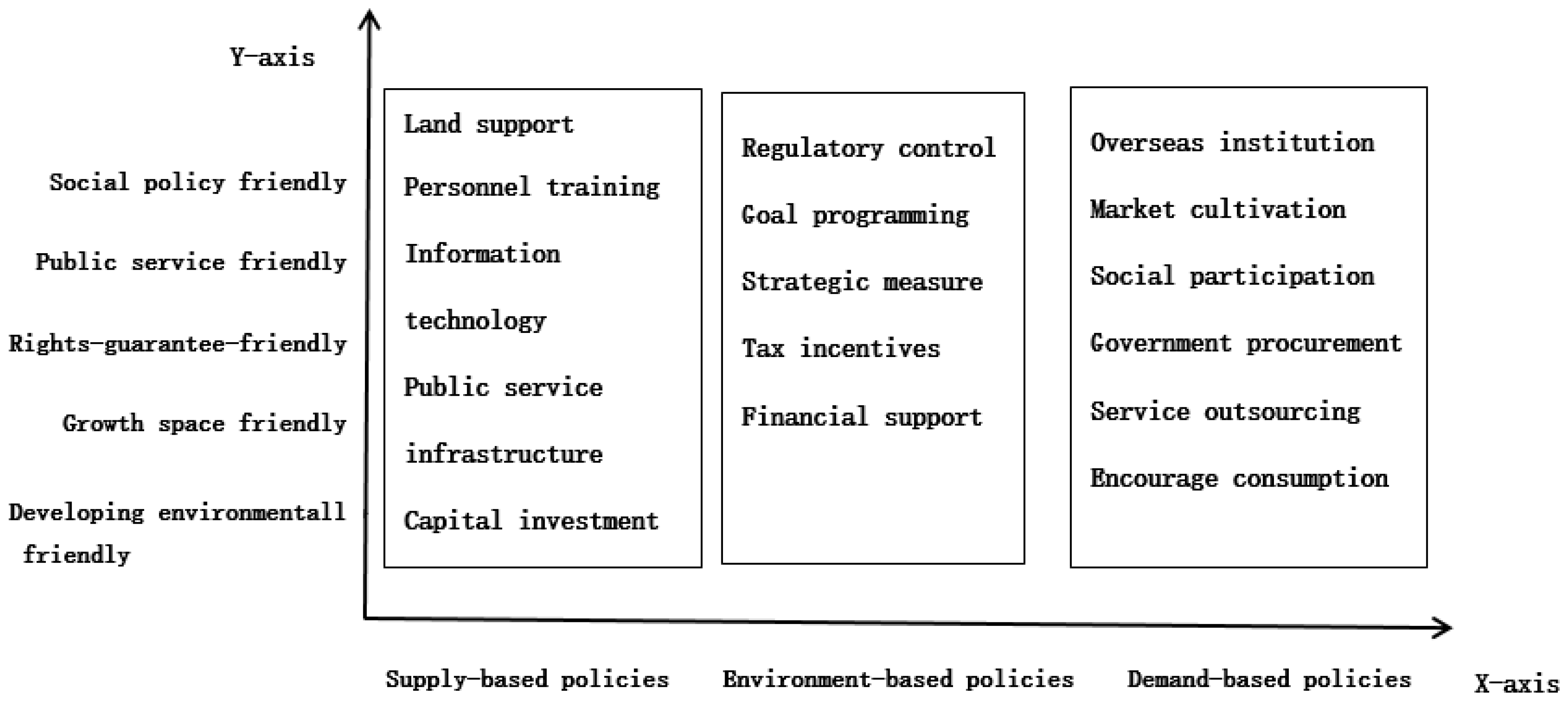
2.2. Analytical Framework
2.2.1. Dimension X-Policy Instruments
2.2.2. Y-Dimensional Policy Element
2.3. Encoding Policy Texts
3. Results
3.1. Bibliometric Analysis of Policy Documents on the Construction of Child-Friendly Cities in China
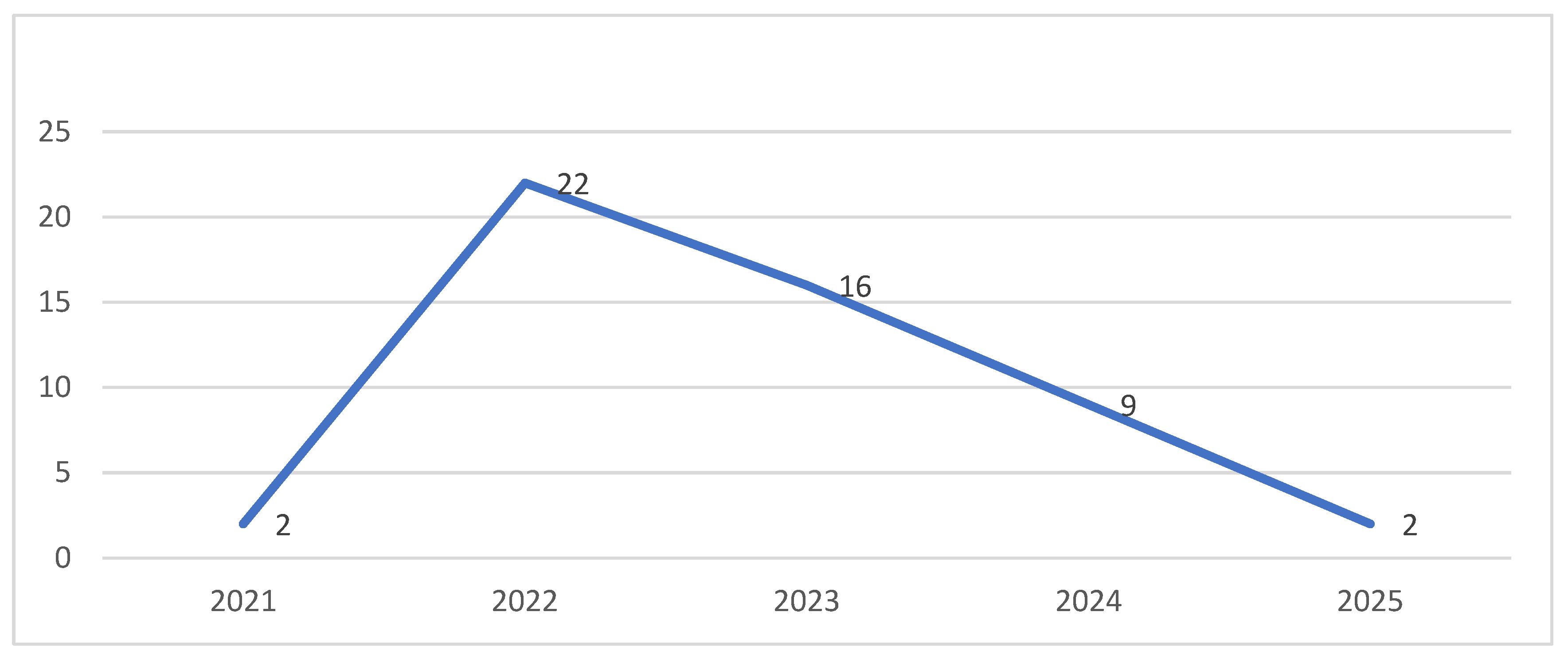
3.1.1. Analysis of Publication Dates
3.1.2. Frequency Analysis of Policy Documents
3.1.3. Frequency Analysis of Issuing Agencies
3.2. Results of the X-Dimension Analysis of the Policy Instrument Dimension
3.3. Y-Dimensional Analysis of the Dimension of the Policy Element
3.4. XY Dimensional Analysis Results of Policy Tools and Elements
4. Discussion
4.1. The Selection of Policy Instruments Is Often Unbalanced
4.2. The Setting of Policy Content and Agendas Is Not Scientific
5. Conclusions and Recommendations
Author Contributions
Funding
Institutional Review Board Statement
Informed Consent Statement
Data Availability Statement
Conflicts of Interest
References
- Simon-i-Mas, G.; Honey-Roses, J. A global overview of Bike Bus: A journey toward a child-friendly city. Int. J. Sustain. Transp. 2024, 18, 1012–1025. [Google Scholar] [CrossRef] [Scilit]
- Rut, M.; Davies, A.R. Transitioning without confrontation? Shared food growing niches and sustainable food transitions in Singapore. Geoforum 2018, 96, 278–288. [Google Scholar] [CrossRef] [Scilit]
- Schirmer, T.; Bailey, A.; Kerr, N.; Walton, A.; Ferrington, L.; Cecilio, M.E. Start small and let it build; a mixed-method evaluation of a school-based physical activity program, Kilometre Club. BMC Public Health 2023, 23, 137. [Google Scholar] [CrossRef] [Scilit] [PubMed]
- Chan, P. Child-Friendly Urban Development: Smile Village Community Development Initiative in Phnom Penh. World 2021, 2, 505–520. [Google Scholar] [CrossRef] [Scilit]
- Fang, K.; Azizan, S.A.; Huang, H. GIS-based intelligent planning approach of child-friendly pedestrian pathway to promote a child-friendly city. Sci. Rep. 2024, 14, 8139. [Google Scholar] [CrossRef] [Scilit]
- Oberg, C. The Child-Friendly Cities Initiative-Minneapolis Model. Matern. Child Health J. 2024, 28, 990–997. [Google Scholar] [CrossRef] [Scilit]
- Di, G.; Shi, Y.; Chen, R. Environmental affordances and children’s needs: Insights from child-friendly community streets in China. Front. Arch. Res. 2023, 12, 411–422. [Google Scholar]
- Kamelnia, H. A Paradigm Shift to CA in Spatial Indicators of Children’s Environment: An Investigation of Children’s Participation in Design and Relation to SCI: Case of CFC of BAM, 2005–2020. Child Indic. Res. 2025, 18, 93–114. [Google Scholar] [CrossRef] [Scilit]
- Akhbari, P.; Mohammadi, N.K.; Zayeri, F.; Ramezankhani, A.; Hakimian, P.; Sahamkhadam, N. Design and validation of Iranian Child Health-Friendly Neighbourhood checklist: A mixed-methods study. BMJ Paediatr. Open 2024, 8, e002918. [Google Scholar] [CrossRef] [Scilit]
- Akhbari, P.; Keshavarz-Mohammadi, N.; Ramezankhani, A. Child health-friendly neighbourhood: A qualitative study to explore the perspectives and experiences of experts and mothers of children under 6 years of age in Tehran, Iran. BMJ Open 2024, 14, e077167. [Google Scholar] [CrossRef] [Scilit]
- Perez-del-Pulgar, C.; Anguelovski, I.; Connolly, J.J.T. Child-friendly urban practices as emergent place-based neoliberal subjectivation? Urban Stud. 2024, 61, 2349–2369. [Google Scholar] [CrossRef] [Scilit]
- Katsavounidou, G.; Sousa, S. Reimagining Urban Spaces for Children: Insights and Future Directions. Urban Plan. 2024, 9. [Google Scholar] [CrossRef] [Scilit]
- Khanian, M.; Laszkiewicz, E.; Kronenberg, J. Exposure to greenery during children’s home-school walks: Socio-economic inequalities in alternative routes. Transp. Res. Part D Transp. Environ. 2024, 130, 104162. [Google Scholar] [CrossRef] [Scilit]
- Million, A.; Schamun, K.; Fegter, S. Understanding Well-Being Through Children’s Eyes: Lessons for Shaping the Built Environment. Urban Plan. 2024, 9, 8618. [Google Scholar] [CrossRef] [Scilit]
- Torun, A.O.; Akin, I.Z.; Bingol, H.; Defeyter, M.A.; Severcan, Y.C. Children’s Perspectives of Neighbourhood Spaces: Gender-Based Insights From Participatory Mapping and GIS Analysis. Urban Plan. 2024, 9, 8499. [Google Scholar] [CrossRef] [Scilit]
- Kaplan, D. Challenging Child-Friendly Urban Design: Towards Inclusive Multigenerational Spaces. Urban Plan. 2024, 9, 8495. [Google Scholar] [CrossRef] [Scilit]
- Patel, S.; Jabbour, N.; John, D.; Ahmad, A.M.; Furlan, R.; Al-Matwi, R.; Isaifan, R.J. The impact of urban design on mental well-being by integrating green spaces in Doha City, Qatar. J. Infrastruct. Policy Dev. 2024, 8, 3147. [Google Scholar] [CrossRef] [Scilit]
- D’Amico, A. Examples of good experiences for child-friendly cities. Comparison of sustainable practices in Italy and around the world. TeMA-J. Land Use Mobil. Environ. 2024, 2, 143–155. [Google Scholar]
- Larsson, K.; Anund, A.; Pettigrew, S. Autonomous shuttles contribution to independent mobility for children—A qualitative pilot study. J. Urban Mobil. 2023, 4, 10058. [Google Scholar] [CrossRef] [Scilit]
- Young, S.; Church, A.; Maskiell, A.; Raisbeck, P.; Eadie, T. Design considerations in the activation of a temporary playspace for children and families: Perspectives of council, architects and designers. Aust. Plan. 2023, 59, 143–153. [Google Scholar] [CrossRef] [Scilit]
- Ahmed, H.; Parker, D.C.; Drescher, M. Adoption determinants and policy tools for residential green stormwater infrastructure: A review synthesizing differences and commonalities among lot-level practices. J. Environ. Manag. 2025, 373, 123279. [Google Scholar] [CrossRef] [Scilit] [PubMed]
- Abbasnezhad, B.; Abrams, J.B. Are prevailing policy tools effective in conserving ecosystem services under individual private tenure? Challenges and policy gaps in a rapidly urbanizing region. Trees For. People 2025, 19, 100730. [Google Scholar] [CrossRef] [Scilit]
- Zegveld, W. Technology policy under changing socioeconomic conditions. Environ. Plan. C-Gov. Policy 1988, 6, 375–381. [Google Scholar] [CrossRef] [Scilit]
- Capano, G. Policy implementation and policy instruments: The underdeveloped dimensions of the four “political” American policy process theories. A Western European perspective. Eur. Policy Anal. 2025, 11, 230–253. [Google Scholar] [CrossRef] [Scilit]
- Yang, Y.; Wang, Q.; Wu, D.; Hang, T.; Ding, H.; Wu, Y.; Liu, Q. Constructing child-friendly cities: Comprehensive evaluation of street-level child-friendliness using the method of empathy-based stories, street view images, and deep learning. Cities 2024, 154, 105385. [Google Scholar] [CrossRef] [Scilit]
- Liao, Y.; Furuya, K. A Bibliometric Analysis of Child-Friendly Cities: A Cross-Database Analysis from 2000 to 2022. Land 2023, 12, 1919. [Google Scholar] [CrossRef] [Scilit]
- Pagoto, S.; Cordaway, C.; Napolitano, A.; Foy, J.; Pan, C.; Bellizzi, K. A Content Analysis of #Childhoodcancer Chatter on X. J. Adolesc. Young Adult Oncol. 2024. ahead of print. [Google Scholar] [CrossRef] [Scilit]
- Wang, X.; Elkhouly, A.A.N.; Shukla, P.; Jiang, W.; Zhang, X.; Zhang, Q.; Wu, S.; Ni, M.; Fan, S.; Gunay, Z.; et al. The child-friendly cities concept in China: A prototype case study of a migrant workers’ community. Int. Soc. Work 2024, 67, 119–135. [Google Scholar] [CrossRef] [Scilit]
- Cordero-Vinueza, V.A.; Niekerk, F.F.; van Dijk, T.T. Making child-friendly cities: A socio-spatial literature review. Cities 2023, 137, 104248. [Google Scholar] [CrossRef] [Scilit]
- Adams, S.; Savahl, S.; Florence, M.; Jackson, K. Considering the Natural Environment in the Creation of Child-Friendly Cities: Implications for Children’s Subjective Well-Being. Child Indic. Res. 2019, 12, 545–567. [Google Scholar] [CrossRef] [Scilit]
- Nisa, N.J.; Sundari, L. A new platform taps the ban through child-friendly cities. Tob. Induc. Dis. 2021, 19, 57. [Google Scholar] [CrossRef] [Scilit]
- Nan, F. Policy innovation on building child-friendly cities in China: Evidence from four Chinese cities. Child. Youth Serv. Rev. 2020, 118, 105491. [Google Scholar] [CrossRef] [Scilit]
- Chu, M.; Fang, Z.; Lee, C.; Shang-Kuan, C.; Mao, L.; Chiang, Y. Building a child-friendly social environment from the perspective of children in China based on focus group interviews. Curr. Psychol. 2025, 44, 2001–2017. [Google Scholar] [CrossRef] [Scilit]
- Fan, J.; Zheng, B.; Liu, J.; Tian, F.; Sun, Z. Research on Child-Friendly Evaluation and Optimization Strategies for Rural Public Spaces. Buildings 2024, 14, 2948. [Google Scholar] [CrossRef] [Scilit]
- Zhao, M.; Yang, L.; Qian, B.; Yang, Y.; Wei, G.; Li, C. Physical-medical integration policies and health equity promotion in China: A text analysis based on policy instruments. Int. J. Equity Health 2024, 23, 266. [Google Scholar] [CrossRef] [Scilit]
- Tian, X.; Liu, J.; Mai, Q. Exploring the impact mechanisms of the green innovation policy instruments system: A system dynamics approach. Int. J. Environ. Sci. Technol. 2024, 22, 9949–9970. [Google Scholar] [CrossRef] [Scilit]
- Chen, C.; Gao, J.; Yuan, J. Issue uncertainty and selections of policy instruments in policy pilots: Evidence from China’s long-term care insurance. J. Asian Public Policy 2024, 1–26. [Google Scholar] [CrossRef] [Scilit]
- Jung, B.; Kim, D. Children as Key Actors in Participatory Planning: Co-Working Experience of Community Planning for Walking Safety Around Bongrae Elementary School in South Korea. Plan. Theory Pract. 2024, 25, 321–351. [Google Scholar] [CrossRef] [Scilit]
- Chu, M.; Fang, Z.; Mao, L.; Ma, H.; Lee, C.; Chiang, Y. Creating A child-friendly social environment for fewer conduct problems and more prosocial behaviors among children: A LASSO regression approach. Acta Psychol. 2024, 244, 104200. [Google Scholar] [CrossRef] [Scilit]
- Han, H.; Huang, J.; Jia, X.; Zhang, J.; Guo, J. Evaluation of route choice for walking commutes to school and street space optimization in old urban areas of China based on a child-friendly orientation: The case of the Wuyi Park area in Zhengzhou. Child. Soc. 2024, 38, 1527–1556. [Google Scholar]
- Lu, C.; Yu, C.; Liu, X. Evaluating the Quality of Children’s Active School Travel Spaces and the Mechanisms of School District Friendliness Impact Based on Multi-Source Big Data. Land 2024, 13, 1319. [Google Scholar] [CrossRef] [Scilit]

| Time | Name of Initiative or Action Plan | Main Significance |
|---|---|---|
| 1996 | Child-Friendly Cities Initiative (CFCI) | There are 54 agreements in the full text, the most well-known of which is that children have four basic rights: to establish an urban governance system that is committed to achieving children’s rights, to hear children’s voices, and to prioritize children’s development. |
| 1996 | International Child-Friendly Cities Program | The contents of the Convention on the Rights of the Child will be fully integrated into urban shaping, actively responding to the needs of children in the living environment, and fundamentally promoting the construction of child-friendly cities. |
| 2004 | Building Child-Friendly Cities: A Framework for Action | Establish 12 rights that children should have, define 9 sections to realize child-friendly cities, and provide a framework for action for the definition and development of child-friendly cities. |
| 2017 | Child-Friendly Community Self-Test Kit Assessment Tool for Children | Provide child-friendly community assessment tools to compensate for the lack of participatory assessment tools in the Child-Friendly Cities Initiative. |
| 2018 | UNICEF’s Child-Friendly Cities and Communities Handbook | Guide implementation, monitoring, and evaluation, as well as a broad set of global basic standards and operational frameworks, streamline the Child-Friendly Cities Initiative globally to improve efficiency and provide a basis and foundation for UNICEF child-friendly city certification. |
| 2018 | Child-Friendly City Planning Manual: Building a Better City for Children (Shaping Urbanization for Children: A Handbook on Child-Responsive Urban Planning) | Guide the central role that urban planning should play in achieving sustainable development goals, with a focus on children, and clarify the building of healthy, safe, inclusive, green, and prosperous communities. |
| No | Name of the Policy Text | Developing Body | Date of Implementation |
|---|---|---|---|
| 1 | Guidance Opinions on Promoting the Construction of Child-Friendly Cities | The National Development and Reform Commission, the All-China Women’s Federation, and 13 other departments | 30 September 2021 |
| 2 | Regulations of Changzhou Municipality on the Construction of a Child-Friendly City | Standing Committee of the Changzhou Municipal People’s Congress | 1 September 2024 |
| 3 | Administrative Measures of Dongguan Municipality on the Construction of a Child-Friendly City | Dongguan Municipal People’s Government | 1 February 2025 |
| 4 | Regulations of Heze Municipality on Promoting the Construction of a Child-Friendly City | Standing Committee of the Heze Municipal People’s Congress | 1 March 2023 |
| 5 | Implementation Plan for the Construction of a Child-Friendly City in Hefei, China | Hefei Municipal People’s Government Office, located in Beijing, China. | 8 January 2024 |
| 6 | Implementation Plan for the Construction of Child-Friendly Cities in Guangdong Province | Development and Reform Commission of Guangdong Province and 23 other departments | 1 March 2023 |
| 7 | Resolution on Promoting the Construction of Child-Friendly Cities | Standing Committee of the Jinan Municipal People’s Congress | 25 August 2022 |
| 8 | Implementation Plan for Promoting the Construction of Child-Friendly Cities in Qinghai Province | Qinghai Development and Reform Commission and 23 other departments | 11 March 2022 |
| 9 | Notice on Submitting Relevant Policies, Measures, and Transformation Suggestions for the Construction of Child-Friendly Cities | Shanxi Development and Reform Commission and Women and Children Working Committee, Shanxi Provincial People’s Government | 21 November 2024 |
| 10 | Three-Year Action Plan for Promoting the Construction of Child-Friendly Cities in Shanghai (2023–2025) | Shanghai Municipal Leading Group Office on Promoting the Construction of Child-Friendly Cities | 14 September 2023 |
| 11 | Implementation Plan for the Construction of a Child-Friendly City in Shijiazhuang | Shijiazhuang Development and Reform Commission and 22 other departments | 2 February 2023 |
| 12 | Implementation Plan for the Construction of Child-Friendly Cities in Sichuan Province | Sichuan Development and Reform Commission and 23 other departments | 22 August 2022 |
| 13 | Resolution on Accelerating the Construction of Child-Friendly Cities | Standing Committee of the Zhengzhou Municipal People’s Congress | 2 November 2024 |
| 14 | Implementation Plan for the Construction of a Child-Friendly City in Chongqing | Chongqing Development and Reform Commission and 23 other departments | 25 April 2022 |
| 15 | Implementation Plan for the Construction of a Child-Friendly City in Chengdu | The General Office of the Chengdu Municipal People’s Government and 23 other departments | 5 March 2022 |
| 16 | Implementation Plan for Promoting the Construction of Child-Friendly Cities in Debao County | Debao County People’s Government Office, | 4 January 2023 |
| 17 | Work Plan for Building a Child-Friendly City in Gaoming District of Foshan City | People’s Government Office, Gaoming District, Foshan City | 12 September 2024 |
| 18 | Implementation Plan for Promoting the Construction of Child-Friendly Cities in Fujian Province | Fujian Provincial Development and Reform Commission and 3 other departments | 13 May 2022 |
| 19 | Implementation Plan for the Construction of Child-Friendly Cities in Guangxi, China | Development and Reform Commission of Guangxi Zhuang Autonomous Region and 24 other departments | 7 February 2022 |
| 20 | Construction Plan of Harbin Child-Friendly City | General Office of the Harbin Municipal People’s Government | 31 December 2023 |
| 21 | Construction Plan of Haidong Child-Friendly City | Haidong Municipal People’s Government Office, Haidong, China | 25 March 2022 |
| 22 | Implementation Plan for the Construction of a Child-Friendly City in Haikou | Haikou Development and Reform Commission | 23 October 2023 |
| 23 | Implementation Plan for Promoting the Construction of Child-Friendly Cities in Hainan Province | Hainan Provincial Development and Reform Commission and 22 other departments | 8 August 2022 |
| 24 | Decision on Strengthening the Construction of Child-Friendly Cities | Standing Committee of the Hangzhou Municipal People’s Congress | 20 December 2022 |
| 25 | Implementation Plan for the Construction of a Hebi National Child-Friendly City | Hebi Municipal People’s Government | 11 November 2023 |
| 26 | Implementation Plan for the Construction of Child-Friendly Cities in Heilongjiang Province | Heilongjiang Development and Reform Commission and 23 other departments | 25 February 2022 |
| 27 | Construction plan for Huzhou’s Child-Friendly City (2023–2025) | Huzhou Municipal People’s Government | 28 November 2023 |
| 28 | Implementation Plan for the Construction of a Child-Friendly City in Jinchang | Office of the Jinchang Municipal People’s Government | 4 December 2023 |
| 29 | Implementation Plan for the Construction of a Child-Friendly City in Kunming | Office of the Kunming Municipal People’s Government | 7 November 2023 |
| 30 | Implementation Plan for Promoting the Construction of Child-Friendly Cities in the Ningxia–Hui Autonomous Region | Ningxia Hui Autonomous Region Development and Reform Commission and 22 other departments | 21 February 2022 |
| 31 | Implementation Plan for Building Qingdao into a Child-Friendly City | General Office of Qingdao Municipal People’s Government | 8 November 2023 |
| 32 | Notice on Promoting the Construction of Taiyuan into a National Child-Friendly City | Taiyuan Development and Reform Commission and 3 other departments | 14 March 2024 |
| 33 | Implementation Plan for Promoting the Construction of Child-Friendly Cities in Shanxi Province | Shanxi Development and Reform Commission and 23 other departments | 22 June 2022 |
| 34 | Implementation Plan for the Construction of a Child-Friendly City in Shanghai | General Office of the Shanghai Municipal People’s Government | 2 September 2022 |
| 35 | Notice on Further Promoting the Construction of Child-Friendly Spaces in Shanghai City | Shanghai Municipal Leading Group Office on Promoting the Construction of Child-Friendly Cities | 17 December 2022 |
| 36 | Work plan for the construction of a Shiyan Child-Friendly City | Office of the Shiyan Municipal People’s Government | 30 December 2022 |
| 37 | Implementation Plan for the Construction of a Child-Friendly City in Shizuishan City | Office of the Shizuishan Municipal People’s Government | 6 February 2023 |
| 38 | Strategic Plan for Building a Child-Friendly City in Suzhou (2021~2035) | Office of the Suzhou Municipal People’s Government | 29 December 2021 |
| 39 | Implementation Plan for Promoting the Construction of Child-Friendly Cities in Tian’e County | Tian’e County People’s Government Office, | 28 April 2022 |
| 40 | Implementation Plan for Promoting the Construction of Child-Friendly Cities in Tianjin | Tianjin Development and Reform Commission and 22 other departments | 21 June 2022 |
| 41 | Implementation Plan for the Development of a Child-Friendly City in Xishan District | Government Office of Xishan District, Wuxi City, China | 17 January 2024 |
| 42 | Construction Plan for a Child-Friendly City in Zhengzhou | The People’s Government of Zhengzhou | 12 April 2022 |
| 43 | Zibo’s Action Plan for Accelerating the Construction of Child-Friendly Cities during the 14th Five-Year Plan Period | Office of Zibo Municipal People’s Government | 27 May 2022 |
| 44 | Regulations of Yangzhou Municipality on Promoting the Construction of Child-Friendly Cities | Standing Committee of the Yangzhou Municipal People’s Congress | 28 January 2025 |
| 45 | Regulations of Heze Municipality on Promoting the Construction of a Child-Friendly City | Standing Committee of the Heze Municipal People’s Congress | 1 March 2023 |
| 46 | Resolution on Accelerating the Construction of Child-Friendly Cities | Standing Committee of the Zhengzhou Municipal People’s Congress | 2 November 2024 |
| 47 | Construction of a child-friendly city in Hefei, China | Hefei Municipal People’s Government Office, located in Beijing, China. | 8 January 2024 |
| 48 | Three-Year Action Plan for Building a Child-Friendly City in Nanning (2023–2025) | Office of the Nanning Municipal People’s Government | 19 September 2023 |
| 49 | Implementation Plan for the Construction of a Child-Friendly City in Jiuquan | Jiuquan Municipal People’s Government | 3 August 2022 |
| 50 | Implementation Plan for Promoting the Construction of Child-Friendly Cities in Lingyun County | Lingyun County People’s Government | 28 January 2023 |
| 51 | Action Plan for Building a Child-Friendly City in Wujiang District | People’s Government of Wujiang District, Suzhou | 24 June 2022 |
| Tool Type | Tool Name | Description of the Tool’s Meaning |
|---|---|---|
| Supply-oriented policy | Personnel training | Provide talent support for the construction of child-friendly cities, such as talent training and introduction. |
| Information Technology | Build an intelligent information platform for the construction of child-friendly cities, strengthen data collection and integration, and promote information interconnection and sharing; promote child-friendly city communication activities; and open up new media channels for the construction of child-friendly cities. | |
| Public service | Various public service facilities and related platforms are needed to build child-friendly cities, such as child rights protection centers and child public facility inquiry services. | |
| Infrastructure | It includes infrastructure construction such as roads, sanitation, electricity, communication, and fire protection. Such facilities include urban sewage and garbage treatment facilities and harmless public toilets. | |
| Land use support | Provide land use indicators, encourage the revitalization of land resources, optimize land use approval procedures, and other ways to build a good city for children. | |
| Capital input | The government ensures the smooth construction progress of child-friendly cities using financial input and subsidies. | |
| Environmental type Policy | Regulation | Through the implementation of various laws and regulations, we should improve the system of supervision of child food and drug safety, strengthen food and drug supervision, and prevent and regulate the occurrence of food and drug safety incidents. |
| Goal planning | Through an analysis of the main factors that affect the construction of child-friendly cities, the government has developed a development plan for the construction of such cities based on actual research. | |
| Tax incentives | Provide preferential treatment for constructing child-friendly cities through tax reduction and fee reduction. | |
| Strategic measures | By carrying out various environmental renovation activities, improving the ecological protection system, and improving the health management system and mechanisms, it provides an operable way to achieve the policy objectives. | |
| Financial support | Providing credit and guarantees for the construction of various facilities and relaxing financial restrictions on the healthcare industry. | |
| Demand-type Policy | Market cultivation | Strengthen publicity and promotion, encourage and support the development of child-related industries, and promote the formation of a multilevel and all-around children’s service industry market. |
| Government procurement | Government departments directly or indirectly purchase new children’s health industry products to promote the development of the children’s health industry. | |
| Service outsourcing | Outsource development and infrastructure construction, personnel training, and other projects needed for constructing child-friendly cities to third parties. | |
| Overseas institutions | Explore overseas markets of emerging child-related industries and promote multidirectional development of such industries. | |
| Social participation | Promote social forces to actively participate in and support the construction of child-friendly cities, integrate the resources of various social organizations, and form a working situation in which the whole population is mobilized and everyone participates. | |
| Encourage consumption | By cultivating and publicizing new health industries, we can stimulate consumption and promote the construction of the children’s health industry. |
| No | Name of the Policy Text | Content Analysis Module for Policy Texts | Coding |
|---|---|---|---|
| 1 | Guiding Opinions on Promoting the Construction of Child-Friendly Cities | 3. Promoting the friendliness of public service to fully meet the needs of children’s growth and development | |
| (1) Support the development of inclusive nursery services. Encourage and support enterprises, institutions, social organizations, and communities to provide inclusive nursery and infant care services. Explore the implementation of the parental leave system and strengthen family scientific child-rearing guidance services. | 1-3-1 | ||
| (2) Promoting balanced development of basic education. We will improve the guarantee mechanism for inclusive preschool education, further improve the level of universal coverage, strictly implement the policy of supporting kindergartens in urban communities, compensate for the shortcomings in resources, and improve the quality of education. | 1-3-2 | ||
| (3) Strengthen children’s health protection. Pay attention to health protection for 1000 days in early life, and strengthen premarital, pre-pregnancy, and maternal health care and early childhood development services. We will promote the implementation of comprehensive prevention and control of birth defects and the promotion of breastfeeding, improve the level of eugenic and eugenic services, and build mother–child-friendly hospitals. We will build a network of children’s health care services, do a good job in children’s health management, standardize vaccination and prevention of dental caries, and reduce the incidence of myopia and obesity. Pay attention to children’s mental health, conduct children’s life and sex education, cultivate the consciousness of cherishing life, and enhance the ability of self-emotional adjustment. | 1-3-3 | ||
| (4) Providing medical treatment and security for children. Focusing on children’s hospitals, maternal and child health care institutions, pediatrics of general hospitals, township hospitals, and community health service centers, and supported by pediatrics and child health care departments, we should strengthen the construction of a children’s medical service network and provide high-quality diagnosis and treatment services. We should strengthen the training of pediatricians, such as in neonatology, and improve the incentive mechanism for the development of relevant talents. We will strengthen the comprehensive security functions of the triple system of basic medical insurance, major illness insurance, and medical assistance, and do a good job in children’s basic medical security. Develop the construction of child-friendly hospitals. | 1-3-4 | ||
| 51 | Notice of the Government Office of the Wujiang District of the Suzhou Government to issue an Action Plan to Build a Child-Friendly City in Wujiang District | II. Objectives and Tasks | |
| (1) Social policy friendliness: Building a systematic and complete policy system | |||
| 1. Child-friendly policy design initiatives | 51-2-1-1 | ||
| Preparation of the Child Development Plan (2021–2025). Promote the construction of child-friendly cities in the three-year plan of action of the national civilized model city. To develop and promulgate policies to promote the high-quality development of nursery services and the welfare of disabled children and to improve the protection system of children’s rights in Wujiang. | |||
| …… | …… | ||
| III. Implementation Guarantee | |||
| 1. Strengthen organizational leadership and clarify work responsibilities. Establish a leading group for the construction of child-friendly cities in Wujiang District, with the main leaders of the district government as the leader of the leading group and the heads of relevant departments as members of the leading group, to coordinate the construction work as a whole. The lead group office is in the District Women’s Federation and is responsible for daily work. Depending on the responsibilities of the department, each unit of members refines the specific implementation plan to ensure that all work is carried out on time, in order, and of high quality. | 51-3-1 | ||
| 2. Included in the budget to ensure the input of funds. The budget for developing children’s enterprises and increased investment in such undertakings. Encourage and guide social capital and forces to participate in the construction of child-friendly cities to ensure priority development for children. | 51-3-2 | ||
| 3. Strengthen monitoring and evaluation to ensure effective results. A monitoring and evaluation team composed of experts in relevant fields, citizens, and children will be established to regularly monitor and evaluate the implementation of the action plan and ensure its implementation. | 51-3-3 | ||
| 4. Widespread publicity and mobilization to form a social consensus. We should further innovate the publicity mode, publicize the experience and effectiveness of the construction of child-friendly cities in an all-around, multiform, and three-dimensional way; improve awareness, participation, and perception of the construction of child-friendly cities; and make child-friendly cities the consensus and action of the whole society. | 51-3-4 |
| The Types of Policy Instruments | Tool Name | Counting | Percentage |
|---|---|---|---|
| Supply-oriented policy | Personnel training | 20 | 58.4% |
| Information Technology | 35 | ||
| Public service | 550 | ||
| Infrastructure | 135 | ||
| Land use support | 42 | ||
| Capital input | 45 | ||
| Environmentally oriented policy | Regulation | 65 | 27.8% |
| Goal planning | 90 | ||
| Tax incentives | 36 | ||
| Strategic measures | 170 | ||
| Financial support | 32 | ||
| Demand-oriented policy | Market cultivation | 40 | 13.8% |
| Government procurement | 24 | ||
| Service outsourcing | 16 | ||
| Overseas institutions | 14 | ||
| Social participation | 90 | ||
| Encourage consumption | 12 |
| Policy Tools Type | Specific Tools Name | Social Policy-Friendly | Public Service-Friendly | Rights Protection-Friendly | Space for Growth-Friendly | Development Environment-Friendly |
|---|---|---|---|---|---|---|
| Supply-oriented policy | Personnel training | 6 | 0 | 8 | 6 | 0 |
| Information Technology | 5 | 15 | 5 | 10 | 0 | |
| Public service | 38 | 56 | 110 | 182 | 164 | |
| Infrastructure | 21 | 47 | 5 | 27 | 35 | |
| Land use support | 15 | 21 | 0 | 0 | 6 | |
| Capital input | 10 | 21 | 4 | 6 | 4 | |
| Environmentally oriented policy | Regulation | 7 | 3 | 33 | 11 | 11 |
| Goal planning | 36 | 24 | 7 | 15 | 8 | |
| Tax incentives | 0 | 19 | 0 | 9 | 8 | |
| Strategic measures | 10 | 28 | 32 | 62 | 38 | |
| Financial support | 12 | 30 | 0 | 0 | 0 | |
| Demand-oriented policy | Market cultivation | 4 | 22 | 0 | 8 | 6 |
| Government procurement | 11 | 13 | 0 | 0 | 0 | |
| Service outsourcing | 0 | 0 | 0 | 0 | 0 | |
| Overseas institutions | 9 | 5 | 0 | 0 | 0 | |
| Social participation | 33 | 12 | 4 | 21 | 20 | |
| Encourage consumption | 0 | 4 | 0 | 7 | 1 |
Disclaimer/Publisher’s Note: The statements, opinions and data contained in all publications are solely those of the individual author(s) and contributor(s) and not of MDPI and/or the editor(s). MDPI and/or the editor(s) disclaim responsibility for any injury to people or property resulting from any ideas, methods, instructions or products referred to in the content. |
© 2025 by the authors. Licensee MDPI, Basel, Switzerland. This article is an open access article distributed under the terms and conditions of the Creative Commons Attribution (CC BY) license (https://creativecommons.org/licenses/by/4.0/).
Share and Cite
Cao, H.; Wang, Q.; Zhang, Q. Optimization of China’s Child-Friendly City Construction Policy from the Perspective of Policy Tools. Sustainability 2025, 17, 6220. https://doi.org/10.3390/su17136220
Cao H, Wang Q, Zhang Q. Optimization of China’s Child-Friendly City Construction Policy from the Perspective of Policy Tools. Sustainability. 2025; 17(13):6220. https://doi.org/10.3390/su17136220
Chicago/Turabian StyleCao, Hanyu, Quansheng Wang, and Qi Zhang. 2025. "Optimization of China’s Child-Friendly City Construction Policy from the Perspective of Policy Tools" Sustainability 17, no. 13: 6220. https://doi.org/10.3390/su17136220
APA StyleCao, H., Wang, Q., & Zhang, Q. (2025). Optimization of China’s Child-Friendly City Construction Policy from the Perspective of Policy Tools. Sustainability, 17(13), 6220. https://doi.org/10.3390/su17136220

