Abstract
Smart product service ecosystem (SPSE) has multi-level complexity. It is necessary to find a method to describe the hierarchical nested relationship and topological relationship of the structure of SPSE, so as to provide a systematic reference for the construction of industrial SPSE such as smart home and smart Internet-connected vehicle. Moreover, the explanatory ability of ecological service organization is insufficient, and there is a lack of accurate quantitative analysis and modeling tools. Therefore, this paper studies a survival system model and structural modeling for SPSE on sustainability using EVSM (eco-viable system model). In terms of case analysis, this paper applies the proposed methods and technologies to the structural modeling of smart home service ecosystem. The results show that EVSM model can intuitively analyze the nested hierarchical relationship of smart home service ecosystem through graphical method. This set of systematic methods has important application value for guiding the construction of system structure model of similar smart product service ecosystem and analyzing key growth and stability indicators.
1. Introduction
The transformation to service economy and rapid development of smart technologies have greatly changed traditional commodity trading-based business models [1]. As a new organization form of collaborative symbiosis, smart product service ecosystem (SPSE) needs to analyze its internal structural relationship, stability, value creation, and other core mechanisms [2]. First, smart product service ecosystem has multi-level complexity. It is necessary to find a method to describe the hierarchical nested relationship and topological relationship of smart product service ecosystem structure [3]. Second, the smart product service ecosystem has a stable ecological structure [4]. It is necessary to study its stability mechanism, development and evolution process, system node relationship, and other related mechanisms, and seek reasonable ways to enhance the stability of the system [5]. In addition, the subsystems, various participants, and external environment of the smart product service ecosystem realize the recombination and emergence of functions and values through complex interaction processes [6].
Because the smart product service ecosystem integrates diverse elements, in order to ensure the stable and sustainable operation of the system [7], it is necessary to study its internal universal operation mechanism, including general system structure, system stability, and sustainable value creation, so as to provide a systematic reference for the construction of industrial smart product service ecosystems such as smart home and smart Internet connected vehicle. This paper summarizes this research process as the “analysis” process of smart product service ecosystem.
Aiming at the basic problem characteristics of smart product service ecosystem in terms of structural relationship, stability, and value creation, the following three core problems need to be solved:
(1) SPSE has multi-level and complex internal correlation. It is necessary to build a general theoretical model to describe the hierarchical nesting relationship and topological relationship of smart product service ecosystem;
(2) SPSE has a relatively stable ecological structure, so it is necessary to analyze its internal stability mechanism and study the evolution and development process of the system. At the same time, the constituent nodes (including products and relevant stakeholders) in the system need to be reasonably positioned to reduce conflicts, so as to promote the diversified development of the role of service ecology;
(3) The subsystems of SPSE and relevant stakeholders will produce the combination and emergence of functions or values due to environmental effects, structural effects, component effects and scale effects through the process of quasi ecological interaction, and the total value will increase continuously through value interaction.
In order to solve the three main problems of SPSE analysis, the following three aspects of research work need to be constructed: hierarchical topology analysis and modeling of smart product service ecosystem, system robustness research and ecological value-added. At the same time, due to the uniqueness of the three characteristics of “intelligence, ecology, and service” of the smart product service ecosystem [8], the research contents of the three aspects are further compared with the three main characteristics, and the problems to be studied and solved are mapped to the three feature levels respectively, as shown in Table 1. Among them, the research focus of this paper is the first stage, that is, the hierarchical topology analysis and modeling of smart product service ecosystem.
Table 1.
Key problem characteristics decomposition for SPSE discovery.
The organizational structure of this paper is as follows: (1) introduction, (2) related works, (3) hierarchical analysis for SPSE, (4) survival system model (EVSM) for SPSE, (5) structural modeling for SPSE based on EVSM, (6) the value emerges of SPSE, (7) case study for SPSE, and (8) conclusions.
2. Related Works
System theory is the knowledge of studying the general model, structure, and law of the system [9]. It studies the common characteristics of various systems, quantitatively describes their functions with mathematical methods, and seeks and establishes the principles and mathematical models applicable to all systems. It is a new science with logical and mathematical properties. From the development process of system theory, it can be divided into three stages: general system theory stage, open system theory stage, and survivable system theory stage [10].
2.1. Related Theory
- (1).
- General System Theory (GST)
Bertalanffy’s monograph “general system theory—foundation, development, and application” summarized the concept, method, and application of general system theory [11]. It is inappropriate to limit general system theory to technology as a mathematical theory, because many system problems cannot be expressed by modern mathematical concepts. The term general system theory has a broader content, including a very wide range of research fields, including three main aspects. (1) Science of system: also known as mathematical system theory. This is to use precise mathematical language to describe the system and study the fundamental theory applicable to all systems [12]. (2) System technology, also known as system engineering [13]: this is to study complex systems such as engineering system, life system, economic system, and social system with system thought and system method. (3) System philosophy: it studies the nature of scientific methodology of general system theory and raises it to the status of philosophical methodology [14]. Bertalanffy tried to extend the general system theory to the category of system science, including almost all three levels of system science. However, the main research contents of modern general system theory are still limited to system thought, system isomorphism, and system philosophy. System engineering, which specializes in the technology of organization and management of complex systems, has become an independent discipline and is not included in the research scope of general system theory.
- (2).
- Open System Theory (OST)
Open system refers to the system considering input, output state, and open system theory explains the increase of steady state and order of the system [15]. The basic assumption of open system theory is that organizations have the same “open” characteristics as all life systems [16], that is, they are relatively independent of the external environment and constantly interact with the external environment.
Katz et al., applied the open system theory to the research of organization management. In the theory of open system organization, people’s attention has shifted from the inside of the organization to the organizational environment. The organization is studied as an open and dynamic system. It is a theory formed on the basis of the method of system theory. The main representative is Miller and Parsons. Miller’s theory focuses on the theoretical framework of various decision-making through the process of “input”, “transformation”, and “output”. Parsons’ theory puts forward that any organization is a subsystem of the social system, and there are many different systems within the organization. Bronfenbrenner put forward the dynamic system theory [17]. He explained some typical properties of the system through special ordinary differential equations, including integrity, weighting, competitiveness, mechanization, centralization.
- (3).
- Viable System Approach (VSA)
Survival system model is an organization design model proposed by British scholar Stafford beer when studying the traditional organization structure [18]. The model takes the organization as a system with independent survivability for organization design and diagnosis. The fundamental starting point of survival system model is the idea of diversity balance and recursive decomposition. Beer believes that each survivable system contains some smaller survivable systems, which can be analyzed with the same analysis framework as its upper control system.
From the perspective of system, the survival system model establishes the organization as a system with self-organization ability [19]. It not only emphasizes the connection between various operation units, but also pays attention to the coordination with the external environment. Through the formulation of rules and order, it realizes organizational control by means of supervision and assessment. Its basic idea perfectly meets the requirements of service and ecology for the organizational structure, and has reference significance for the design of the organizational structure of service-oriented and ecological enterprises. It can not only improve the innovation ability of the innovation business department, but also strengthen the connection within the innovation business department and between the innovation business department and the existing business department and the external environment, so as to stimulate more enthusiasm for innovation, and maintain its continuous innovation ability. Other scholars have popularized and applied the survival system model in many fields such as organization management and knowledge management [20,21,22,23,24].
2.2. Literature Review
A conceptual framework of SPSE is proposed by [1], covering the study on its definition, characters, components, mutual interactions, and development roadmap. A novel business paradigm of smart product-service ecosystem (SPSE) is proposed by [25], integrating value co-creation network, service ecological thinking and Information &Communication Technologies (ICT), trying to offer possible guidelines and roadmaps for those transforming and emerging industries. An IoT open innovation ecosystem for smart cities is built by [26]. [27] proposed an interoperated, intelligent, and integrated platform for smart city ecosystem. [28] proposed strategies for extended product business models in manufacturing service ecosystems. Smart, [29] applied the ecosystem service concept to air quality management. [30] deal with the problem of allocating the revenues generated by subscription fees, advertising in a Smart TV (STV) ecosystem. [31] aims to identify fire-smart management strategies that promote wildfire hazard reduction, climate regulation ecosystem service, and biodiversity conservation. [32] presented a smart wheelchair ecosystem for autonomous navigation in urban environments. [33] examined the relationship between consumers’ value perception and the platform ecosystem theory and how this relationship contributes to their perception of smart home products’ value. Roumboutsos, [34] proposed an EcoSystem Innovation Framework (ESIF) applied to a flagship innovation: Mobility as a Service (MaaS). [35] proposed a data-driven reversible framework for achieving sustainable smart product-service systems. [36] conducted a integrative research on SSP innovation ecosystem (SSPIE) for understanding innovation ecosystem-based SSP innovation that lead to better innovation performance and sustainability. [37] proposed a innovative ecosystem for informing visual impaired person in smart shopping environment. In the field of smart home, a method of dynamic QoS aware scheduling for concurrent traffic in smart home is proposed [38]. In the field of energy systems, a method of event-triggered distributed hybrid control scheme for the integrated energy system is proposed [39].
To sum up, the research on smart product service ecosystem modeling mainly focuses on general system theory (GST), open system theory (OST), and survival system theory (VSA). However, the explanatory ability of ecological service organization is insufficient, and there is a lack of accurate quantitative analysis and modeling tools. Moreover, these methods are not combined with the main characteristics of SPSE’s intelligence, ecology, and service presented in Table 1. Therefore, this paper studies the hierarchical topology analysis and modeling of smart product service ecosystem. It mainly includes: hierarchical analysis of smart product service ecosystem, survival system model (EVSM) of smart product service ecosystem, and structural modeling of smart product service ecosystem based on EVSM. Finally, in the field of smart home, the theory and method of topology analytic hierarchy process of smart home service ecosystem are verified by examples.
The purpose of this paper is as follows:
(1) Hierarchical topology analysis and modeling of smart product service ecosystem: through case analysis, this paper combs the main system hierarchy and nesting relationship of SPSE, and based on this, develops the smart product service ecosystem survivable system model (EVSM), and uses this tool to build the overall and four level topology model of SPSE.
(2) Research on value emergence of smart product service ecosystem: by analyzing the intrinsic value emergence mechanism of smart product service ecosystem, a description model of its value space expansion is constructed, and on this basis, the basic algorithm of value emergence of smart product service ecosystem is defined to conduct quantitative evaluation of value space.
3. Hierarchical Analysis for SPSE
According to the analysis of the transformation path from product to smart product service ecosystem, it is concluded that the smart product service ecosystem has four basic levels, namely smart product (L1 level), smart product function system (L2 level), smart product service system (L3 level), and smart service ecosystem (L4 level). The four levels are superimposed from bottom to top, and the system composition, function and function of each level, and application examples are shown in Table 2.
Table 2.
Four basic layers of smart product service ecosystems.
Among them, the minimum granularity of the smart product service ecosystem studied in this paper is decomposed to L1 level, that is, the smart product level that can realize independent functions, which does not involve the internal function realization principle and technology development of smart products. L2 level of smart product system is composed of several L1 level of products or software systems. Through the interconnection and integration of diversified software and hardware, it realizes relatively complex functions and has certain adaptive ability. L3 level of smart product service system integrates the service process and support system on the basis of L2 level of smart software and hardware function system. Through the functional combination of software and hardware system, it can meet the personalized needs of customers and realize value-added. L4 level of smart product service ecosystem integrates diversified service providers and external service resources. Through the cooperation and resource sharing of service providers, the operation efficiency optimization of smart product service ecosystem and the emergence of functions and values are realized.
4. Survival System Model (EVSM) for SPSE
In order to accurately describe the four-level nested structure of smart product service ecosystem summarized in Section 3, based on the survivable system model (viable system model, VSM) [40], this paper develops the survivable system model (eco-viable system model, EVSM) for smart product service ecosystem, which is used for hierarchical topology analysis and modeling of SPSE. Through the summary of the research status, it can be seen that the foundation of the survivable system model is based on the idea of diversity balance and recursive decomposition, which has a good explanation and matching degree for the complex multi-level characteristics of the smart product service ecosystem.
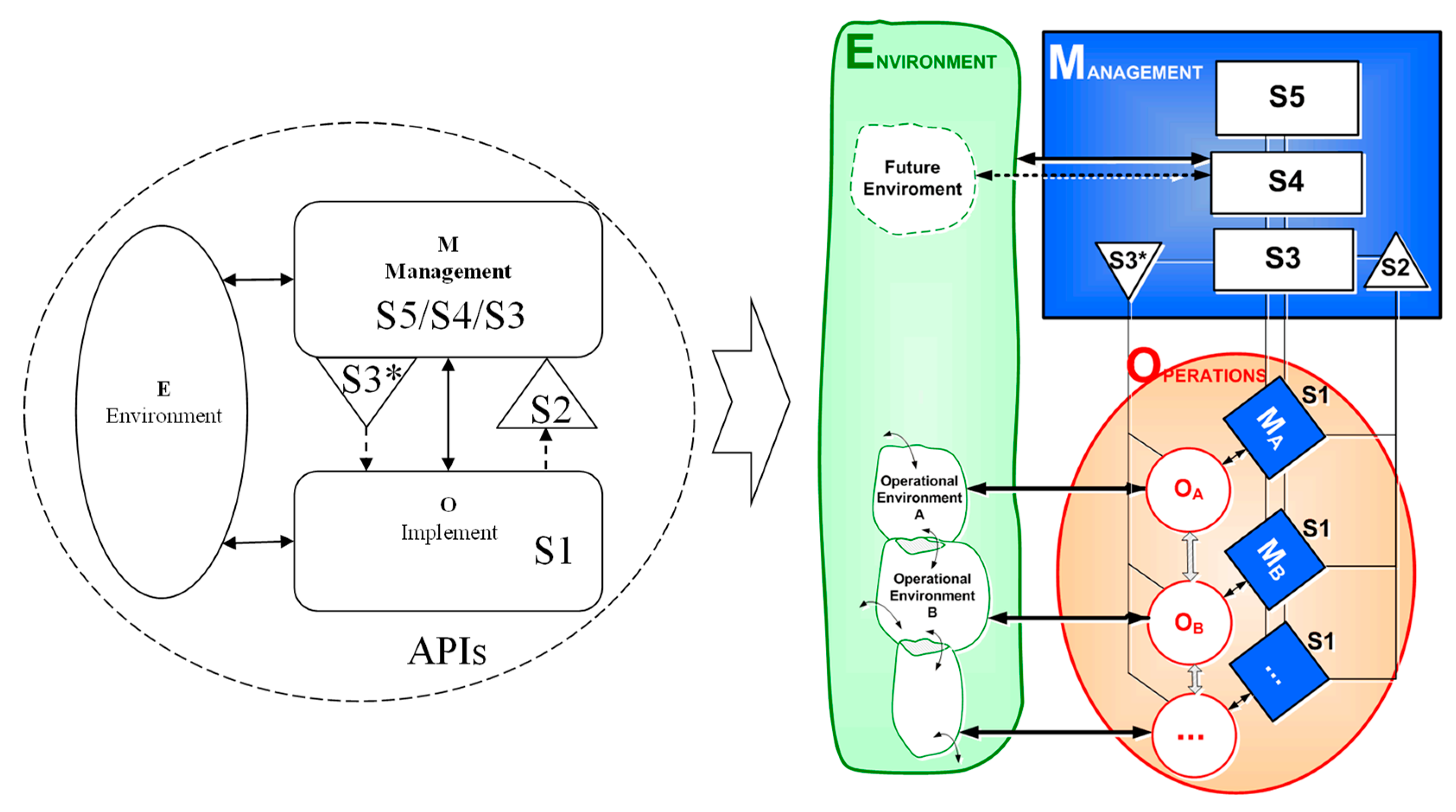
As shown in the left of Figure 1, EVSM divides the basic composition module of smart product service ecosystem into three parts, including operation module (O), management module (M), and external environment (E). As shown in the right of Figure 1, EVSM is further divided into sub modules, in which the execution module is composed of multiple execution processes (S1), the management module is composed of five sub-system modules such as coordination system (S2), control system (S3), supervision system (S3*), planning system (S4), and target decision system (S5), while the external environment (E) will present different scenes and states, affecting the operation mode of the system. The detailed functional description of the constituent elements of each EVSM system sub module is shown in Table 3.
Figure 1.
Fundamental components of eco-viable system model (EVSM) for SPSE.
Table 3.
Illustration of EVSM components.
This is similar to the human body, which has the functional structure of nervous system, motor system, immune system, and circulatory system [41]. The natural ecosystem has the ecological structure of abiotic material and energy, producers, consumers, and decomposers. The human society has the organizational structure of production, consumption, entertainment, politics and education. The different subsystem modules of the smart product service ecosystem perform their respective functions and cooperate with each other, so as to realize the organic and stable operation of the system.
5. Structural Modeling for SPSE Based on EVSM
5.1. The Framework of Structural Modeling for SPSE Based on EVSM
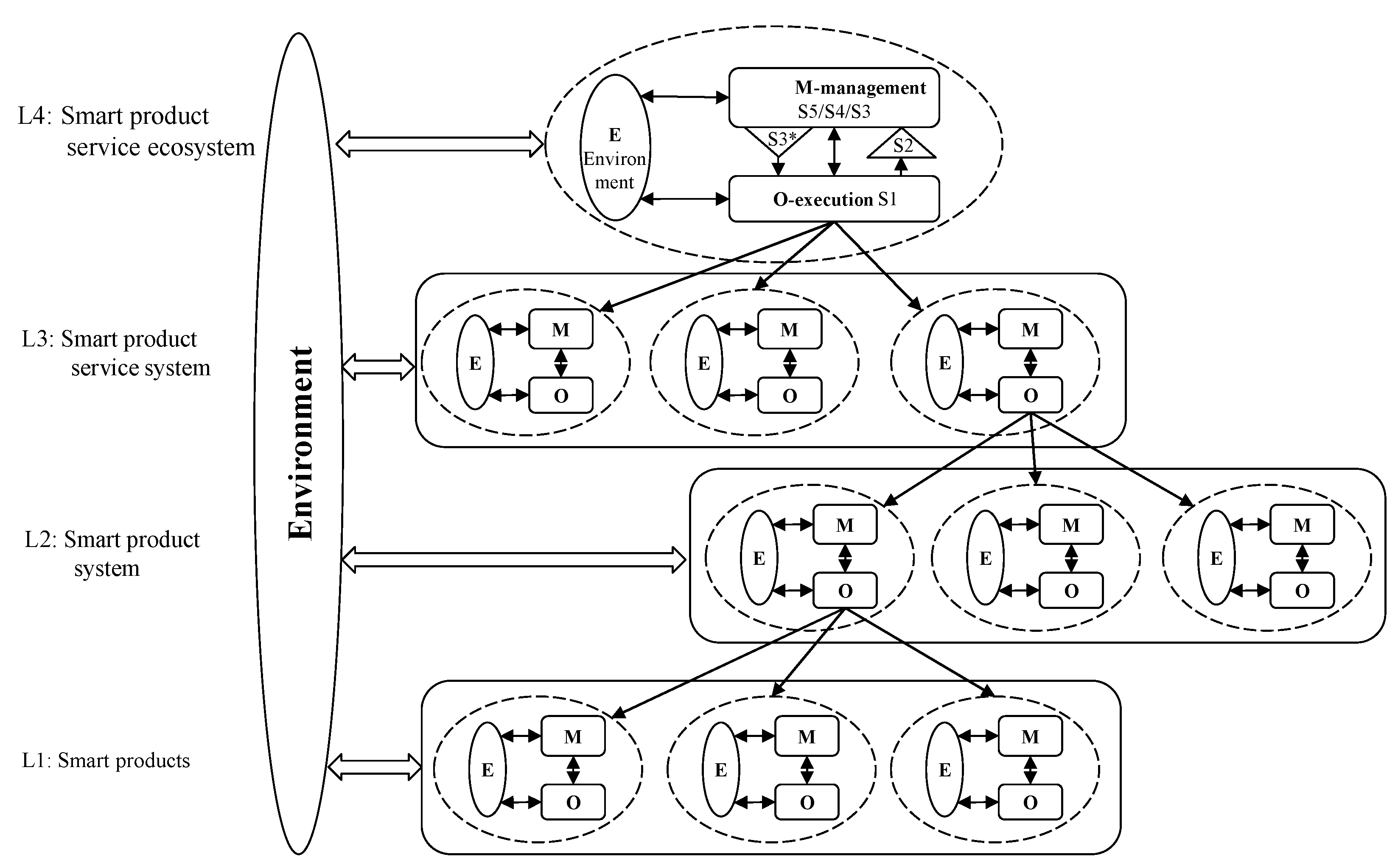
The EVSM model shown in Figure 1 mainly explains the structure of SPSE single-layer system, while the four system levels of smart product service ecosystem are nested layer by layer. Each level has complete system components and composition of EVSM model. Therefore, the EVSM model is used to decompose the four structural levels of SPSE layer by layer for global description. Then it can get the SPSE hierarchical nested tree structure conceptual model as shown in Figure 2.
Figure 2.
The framework of structural modeling for SPSE based on EVSM.
Among them, the lower level of each system level is called subsystem, and the upper level is called super system. The subsystem of each level system exists as several execution systems (O). The environment (E) of each level also differs from the large environment and small environment due to the different scope of problems considered, while the management system (M) module runs through from top to bottom to coordinate the task organization interaction and resource allocation optimization between different levels and different systems.
5.2. Components of Smart Products (L1)
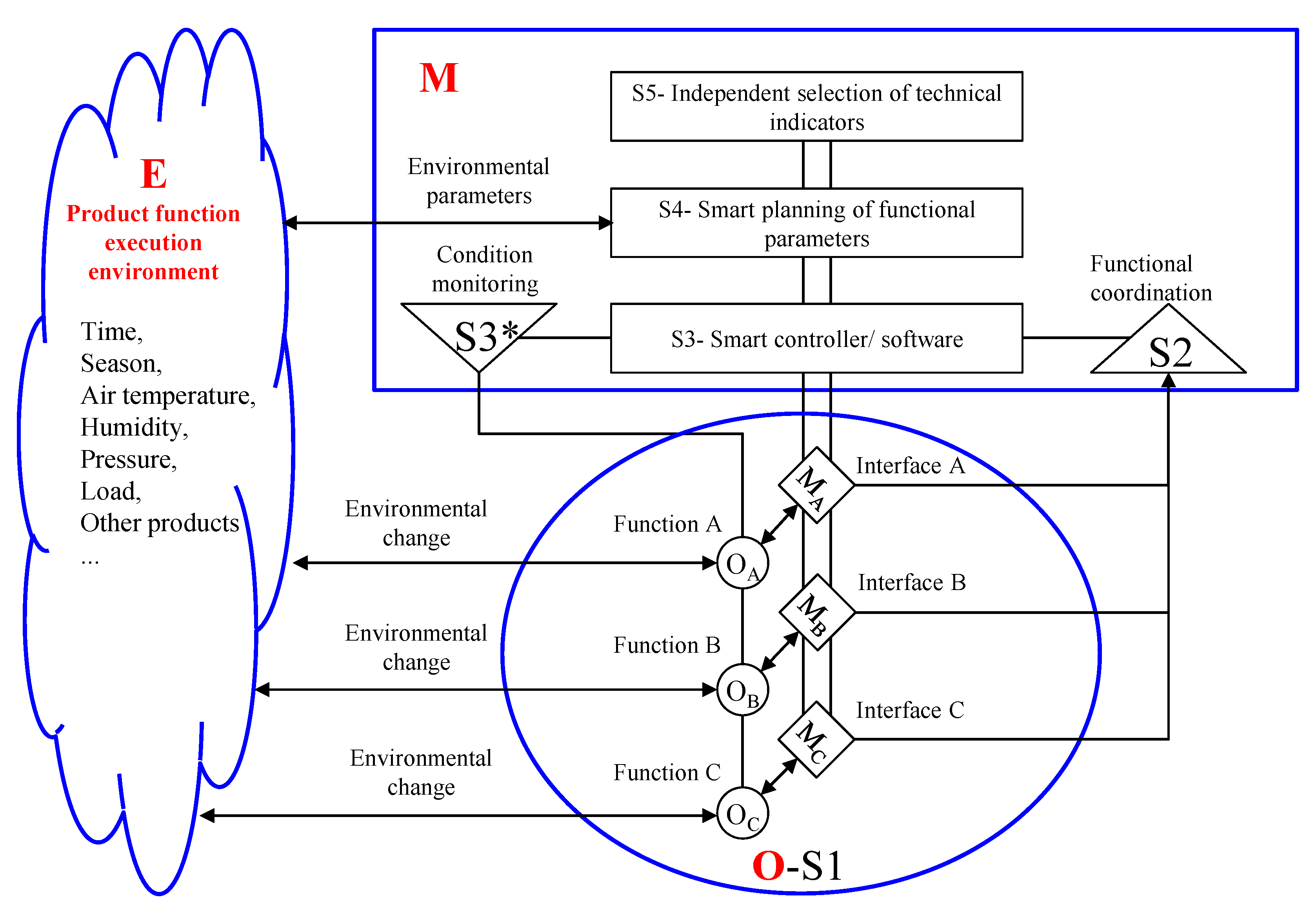
First, decompose the conceptual model in Figure 2 layer by layer, and build EVSM models for smart products, smart product systems, smart product service systems, and smart product service ecosystems respectively. Among them, the EVSM model of L1-smart product is shown in Figure 3, and its execution subsystem (O) is composed of several product functional components (S1); the management subsystem module (M) includes S2—function coordination, S3—smart controller/ software, S3*—status monitoring, S4—function parameter smart planning, S5—technical index independent selection, and other decision-making and control links; environment subsystem module (E) mainly refers to the execution environment of product functions, including external conditions such as space, time, season, temperature, etc.
Figure 3.
Components of smart products (L1).
5.3. Components of Smart Product Systems (L2)
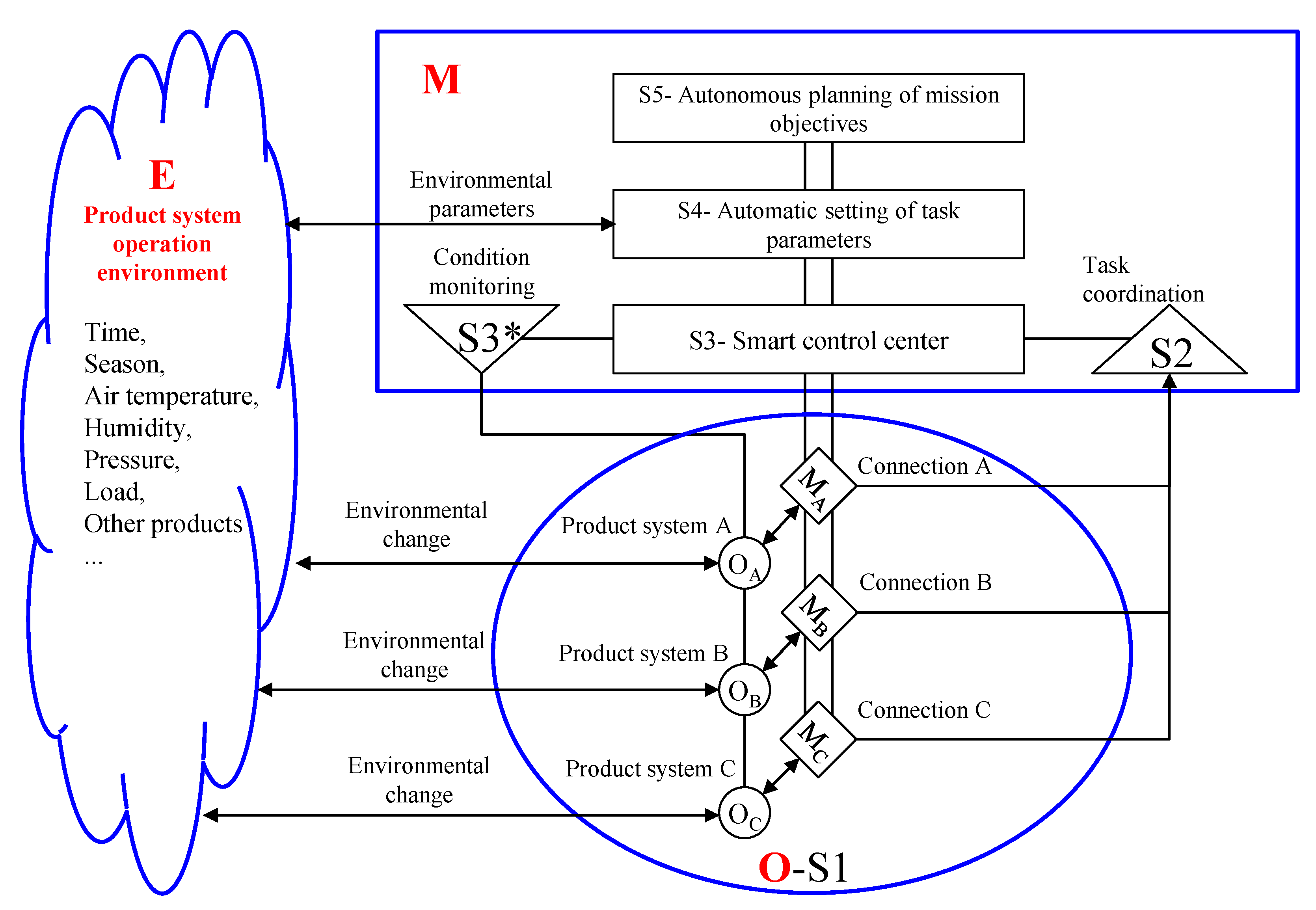
The EVSM model of L2 level of smart product system is shown in Figure 4. Its execution subsystem (O) is composed of several smart products (S1). Different S1 can complete independently or cooperate with each other to realize specific system functions; the management subsystem (M) is composed of S2—task coordination, S3—smart control center, S3*—status monitoring, S4—task parameter automatic setting, S5—task goal autonomous planning, and other cross system task planning and coordination; the environmental subsystem (E) is similar to the L1 level of product system, except that its spatial scope and time span increase, and the number and complexity of other environmental parameter options will respond to superposition.
Figure 4.
Components of smart product systems (L2).
5.4. Components of Smart Product Service Systems (L3)
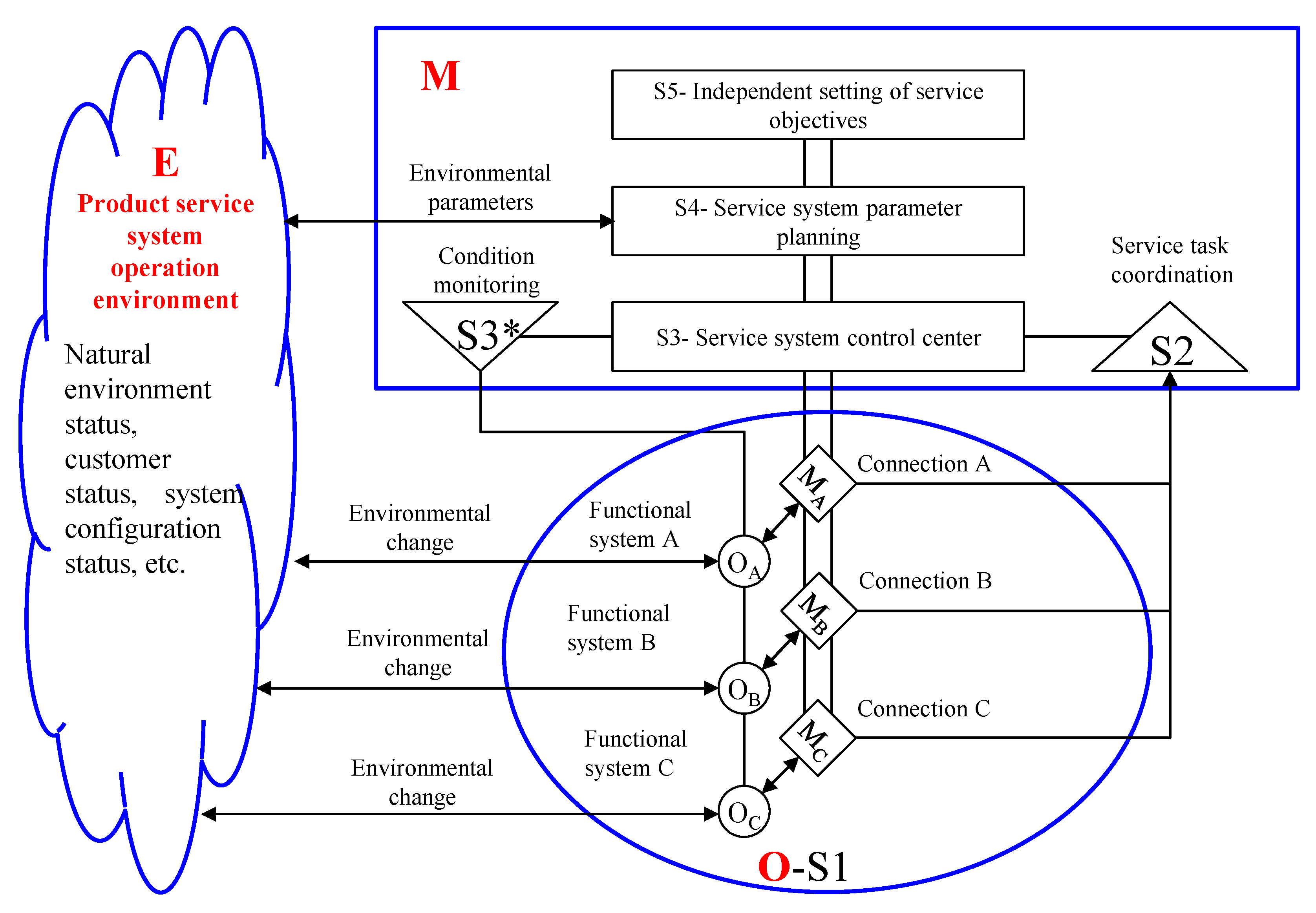
Starting from the L3 level of smart product service system, the participation of “people” is added in the system, and its EVSM model is shown in Figure 5. Among them, the execution subsystem module is composed of several product systems (S1), which is different from the L2 level subsystem, and the S1 system in L3 level takes the realization of the service process as the main task; the corresponding management subsystem module (M) is service-oriented, and is configured with service business organization and coordination across product systems, such as S2—service task coordination, S3—service system control center, S3*—service status monitoring, S4—service system parameter planning, S5—service target independent setting, etc. The operation environment (E) of smart product service system includes external parameters such as natural environment, customer status, system configuration status, and so on.
Figure 5.
Components of smart product service systems (L3).
5.5. Components of Smart Product Service Ecosystems (L4)
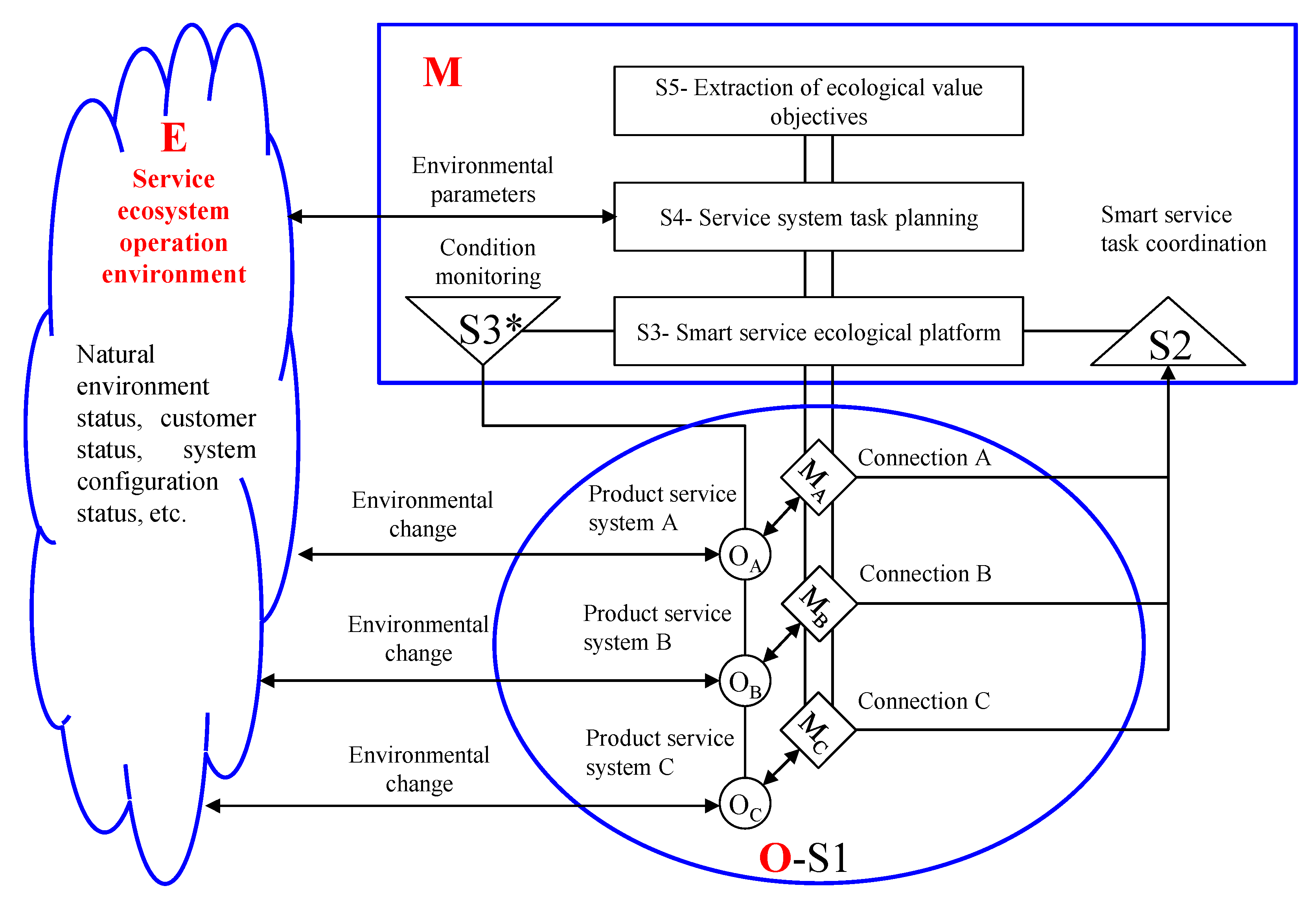
The EVSM model of L4 level of smart product service ecosystem is shown in Figure 6. Its execution system (O) is composed of several product service systems (S1), and each S1 subsystem can provide customers with corresponding service items independently or in cooperation with each other; the management subsystem (M) of smart product service ecosystem includes ecological service process organization and value coordination, such as S2—smart service task coordination, S3—smart service ecological platform, S3*—status monitoring, S4—service system task planning, S5—ecological value target extraction, etc.; the operation environment (E) of the smart product service ecosystem is similar to the composition of L3 lever of smart product service system. The scope of its natural environment and related stakeholders are superimposed and amplified accordingly.
Figure 6.
Components of smart product service ecosystems (L4).
6. The Value Emerges of SPSE
6.1. The Value Emergence Mechanism of SPSE
During the evolution of the dissipative structure of the SPSE, continuous value creation is one of the most important sources and inputs of the “negative entropy flow”. Unlike the general dissipative structure system, the value creation of the SPSE is endogenous, that is, due to the ecological interaction among the elements and nodes within the system, new ecological values are generated based on the existing system values, which is called “Value Emergence”.
According to the system engineering viewpoint, the functional emergence of a system comes from the diverse combinations, configurations, and relationships between the different elements in the system. Similarly, the value emergence of SPSE can also be attributed to several basic effects. Based on the isomorphism between SPSE and general system, four basic effects can be summarized, namely component effect, scale effect, structure effect, and environment effect. Examples of specific descriptions and applications of the four effects are shown in Table 4, different value emergence effects are triggered between the nodes of the SPSE through different role relationships, thus generating an endogenous value generation phenomenon, i.e., 1 + 1 > 2 value increment.
Table 4.
Four effectives for value emergence of SPSE.
6.2. Expansion of the Value Space of the Ecosystem of Smart Product Services
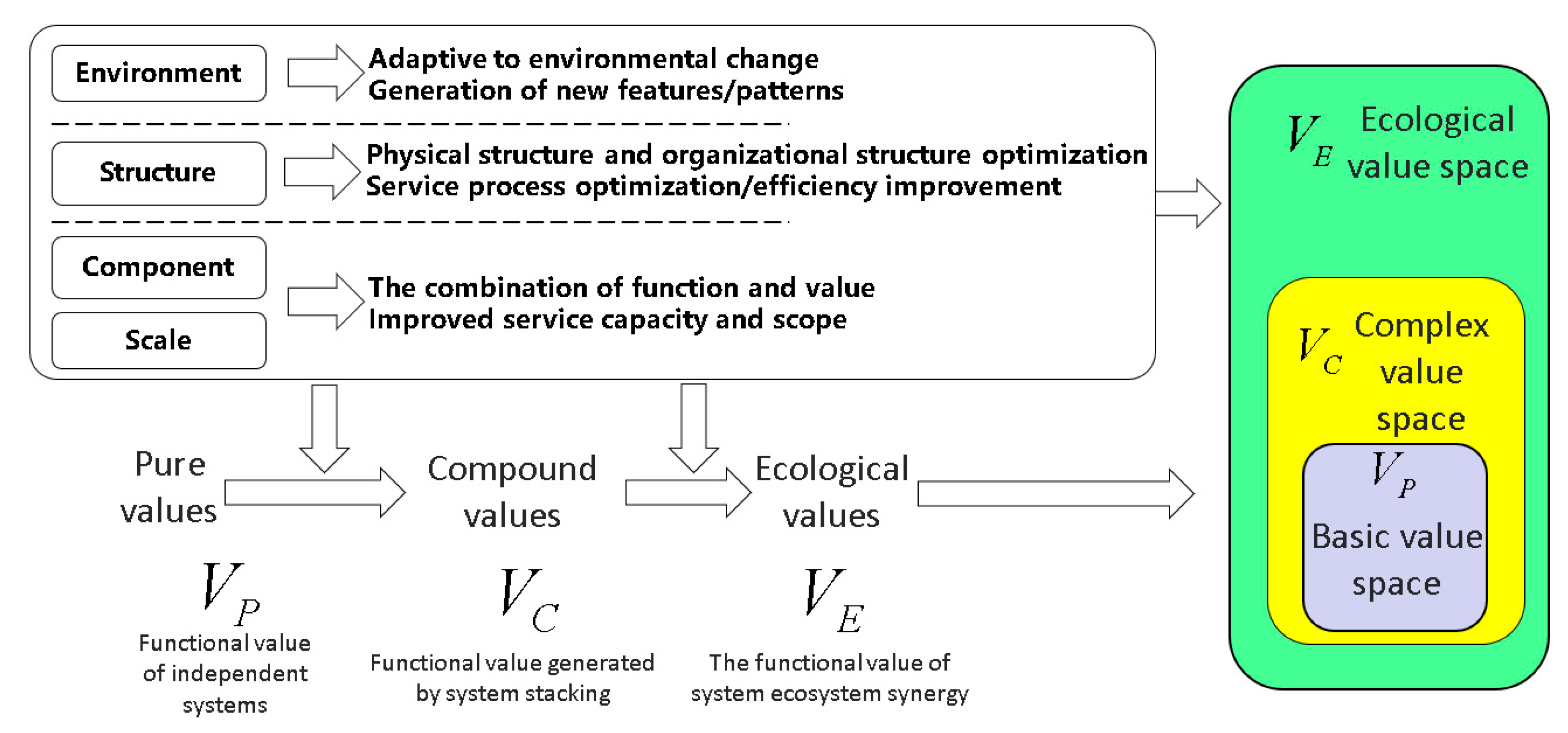
The existence of the value emergence mechanism makes the total value of the SPSE increase, and the concept of “value space” is given here to describe this change. The “value space” is the set of values of each node and the set of expanded values contained in the system in a certain state.
In the loose equilibrium state, there is almost no interaction and association between the nodes in the system, and the value space of the system is a simple linear superposition of the values of the nodes in the system, so the values of the nodes are called simple values . Therefore, the value space of each node is called simple value, and the value space obtained by simple current superposition is called basic value space .The value space obtained by simple current superposition is called the base value space.
In the near-equilibrium state, the nodes in the system are loosely connected and coupled with each other, so new values are generated due to the emergence of values . The value space in the near-equilibrium state is called the composite value space . The value space in the near-equilibrium state is called the composite value space.
When the system reaches the dissipative equilibrium state, the system nodes will further generate new values due to more complex ecological interactions of composite values . The value space at this point is called the ecological value space . The value space is called ecological value space.
As Figure 7 shows, the value space of three different stages forms a hierarchical nested relationship, and due to the existence of the value emergence phenomenon, the value space of the SPSE will gradually expand from the basic value space to the composite value space, and then further expand to the ecological value space, a phenomenon defined as the expansion of the value space in this paper. Similar to the increase of social wealth prompted by labor, the value space expansion model can provide the basic theoretical support for the measurement of the total value of SPSE.
Figure 7.
Value space expanding of smart product service ecosystem.
6.3. Evaluation of the Value Space of SPSE
In order to be able to further evaluate the total value of the value space of the SPSE based on qualitative analysis, the four symbolic algorithms of value emergence are defined.
(1) Component effects:
(2) Scale effect:
(3) Structural effects:
(4) Environmental effects:
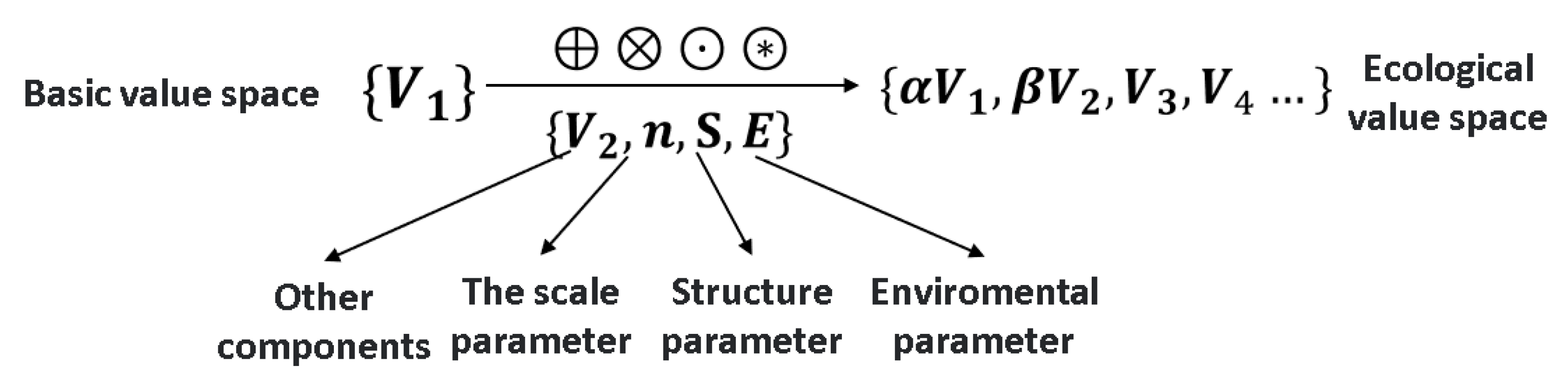
represents the existing value space, represents the newly added value set of other system components, n represents the number of nodes, S represents the different structural parameters, E represents the different environment types, and represent the operator symbols of the four value emergence algorithms, respectively, and are the multiplication coefficients of the underlying value space, and the V values with the operator symbols in the lower right corner are the new values emerging from the corresponding effects. Since the four effects are prevalent in the general SPSE, the conceptualized formula for the generation and evaluation of the ecological value space of the SPSE can be obtained by mixing the four operations, as shown in Figure 8.
Figure 8.
Generation and assessment of ecological value space.
In the specific evaluation operation of the ecological value space of smart product services, there are two main steps.
Step 1: Expand the generation of value space. Analyze the basic value space based on the algorithm of the four effects of the ecological value emergence of smart products and services, respectively 𝑉1 in the introduction of 𝑉2, and 𝑛, and S, and 𝐸. The value increment process of the four base parameters, and get the expanded value space after the four effects respectively, including ;
Step 2: Generation of ecological value space. The expanded value space generated by the four effects in the first step is subjected to the merging operation, and the ecological value space is generated after merging the value terms into similar terms . This result can be used to evaluate the capacity of the ecological value space of smart product services.
7. Case Study for SPSE
7.1. Hierarchical Analysis for SPSE in Smart Home Industry
Taking the smart home industry as an example, this paper verifies the theory and method of topology analytic hierarchy process of smart home service ecosystem structure. First, the four level analysis model from L1 to L4 is applied to analyze the element composition and system nesting relationship of the solution of smart home service provider H, as shown in Table 5.
Table 5.
Hierarchy analysis for smart home service ecosystem.
7.2. Survival System Model and Structural Modeling for SPSE Based on EVSM in Smart Home Industry
- (1)
- The framework of structural modeling for SPSE based on EVSM in smart home industry
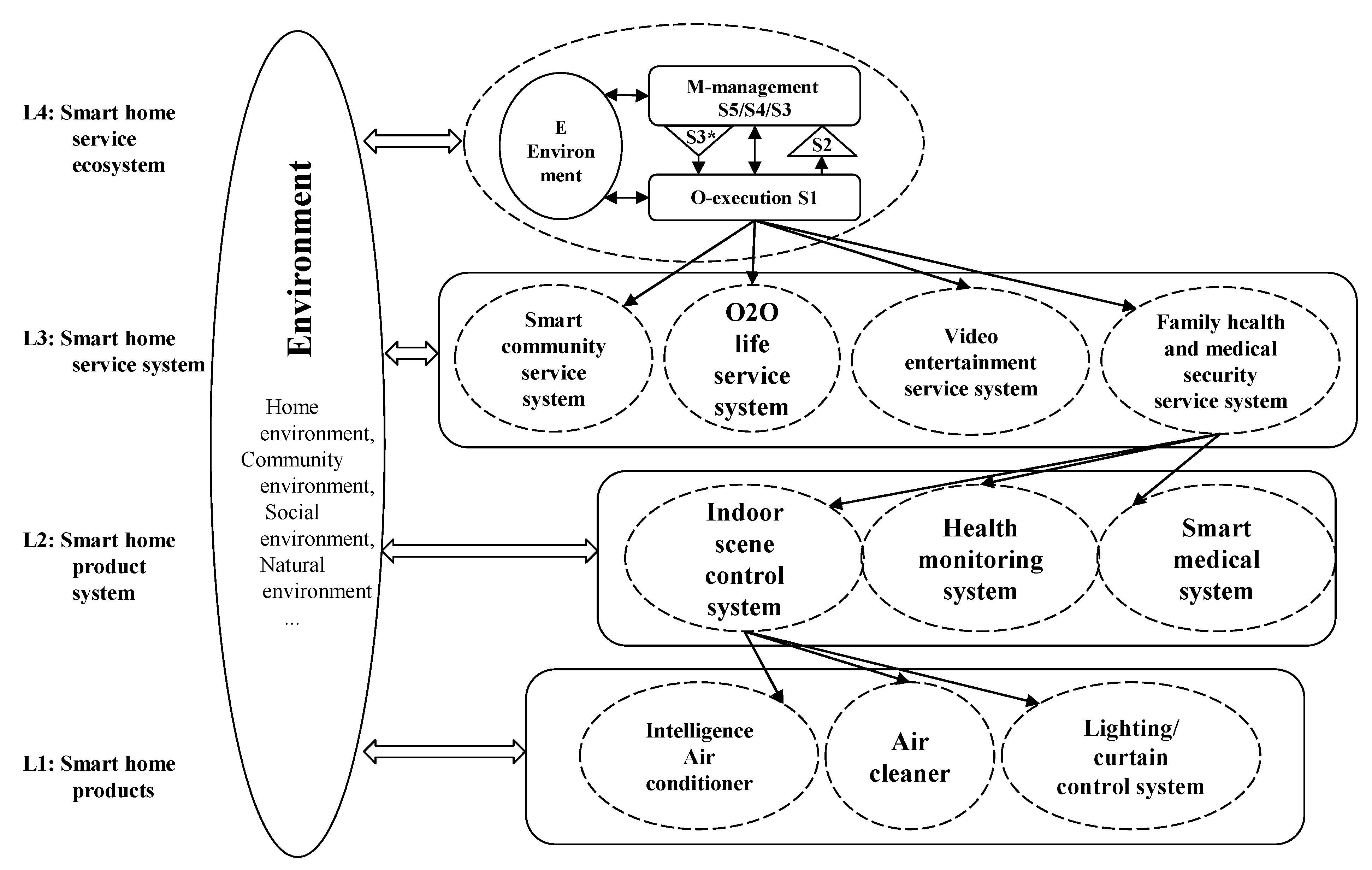
At the same time, the main line of “smart home products → indoor scenario control system → health care service system → smart home service ecosystem” is selected, modeled, and analyzed by EVSM method. The nested relationship model from L1 to L4 is shown in Figure 9. Its common external environment includes family environment, community environment, social environment, natural environment, and so on. Subsystems contain different contents due to their different levels and supersystems.
Figure 9.
Hierarchy modeling for typical smart home service ecosystem based on EVSM.
- (2)
- Components of SPSE from L1 to L4 in smart home industry
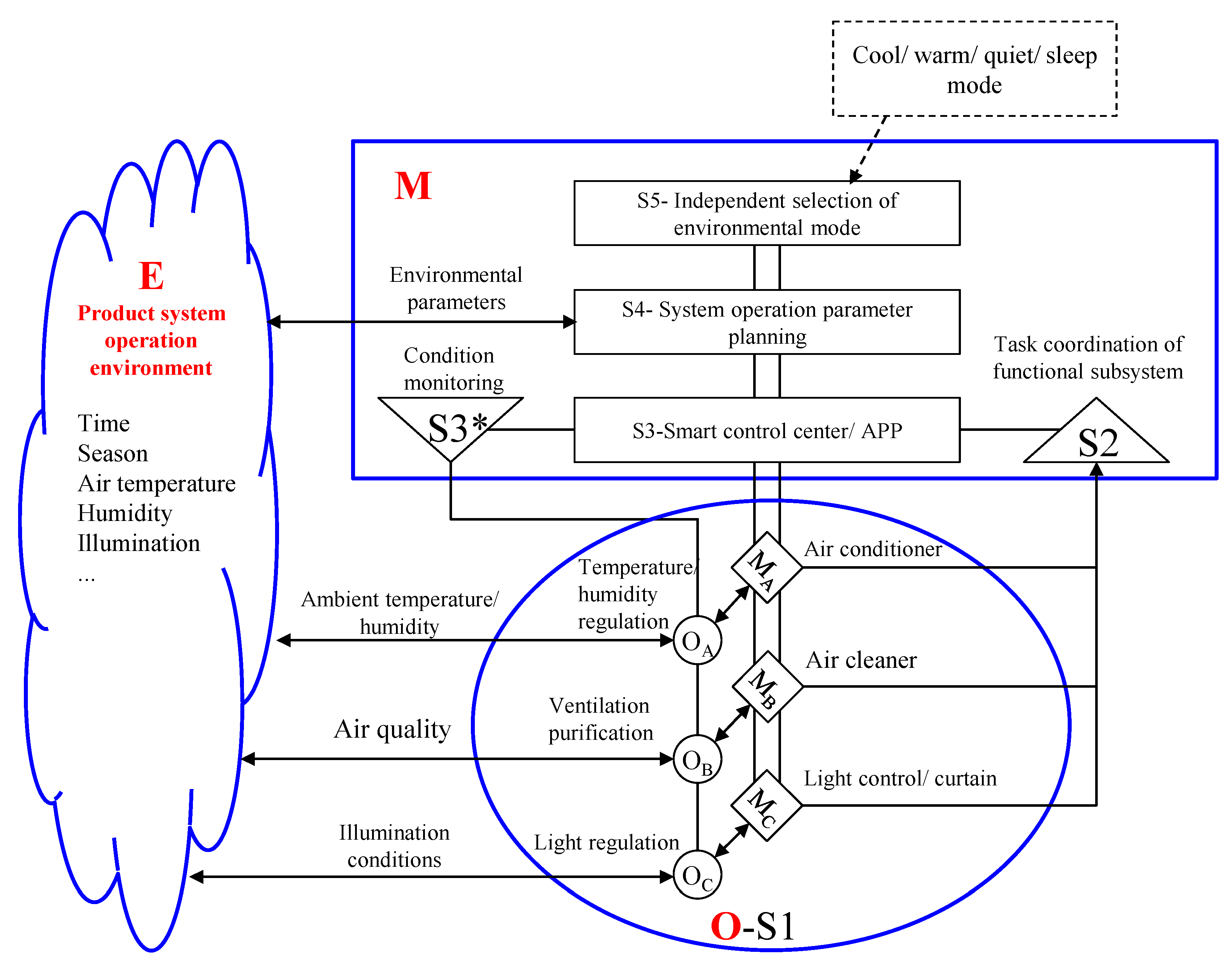
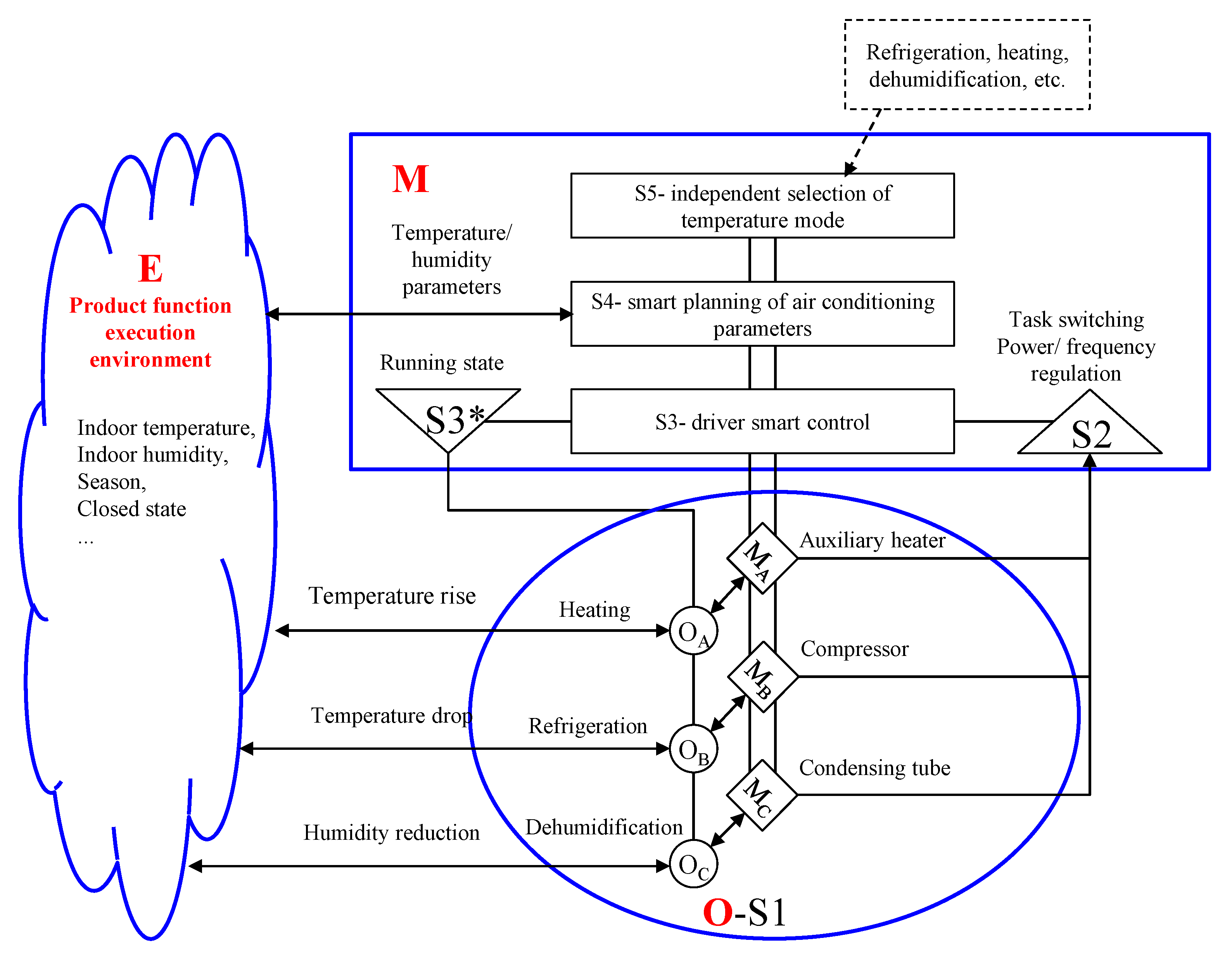
Further, for the overall EVSM model of smart home service ecosystem constructed in Figure 9, a typical smart home product service ecosystem subsystem is selected for structural topology analysis in a bottom-up stacking manner. Among them, for L1 subsystem, household smart air conditioner is selected for EVSM modeling. The composition of each module of the system is shown in Figure 10. The external environment of air conditioner operation includes indoor temperature, indoor humidity, season, room closed state, and other elements. Each executive system (O) includes heating, refrigeration, dehumidification, and other functions; S2 specifically controls the switching of air conditioning tasks, including the adjustment of power and frequency; S3 is the software and hardware of smart controller of smart air conditioner; S3* is a real-time monitoring module for the operation status of smart air conditioner; S4 is the smart planning and optimization module of air conditioning operation parameters; S5 integrates the functions of smart scene judgment and independent selection of operation mode to make global smart judgment and decision on the operation of smart air conditioning.
Figure 10.
Smart air conditioner product system.
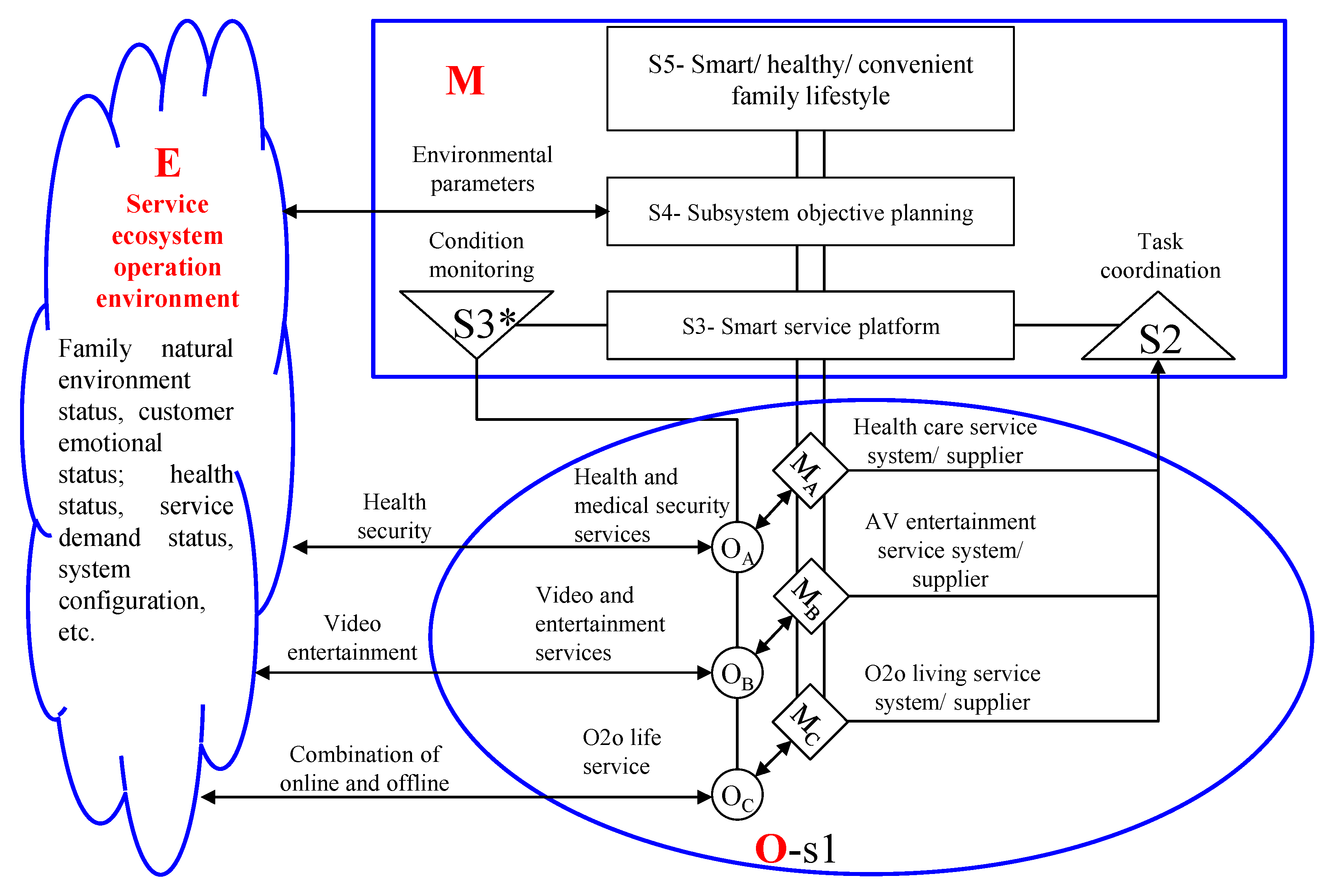
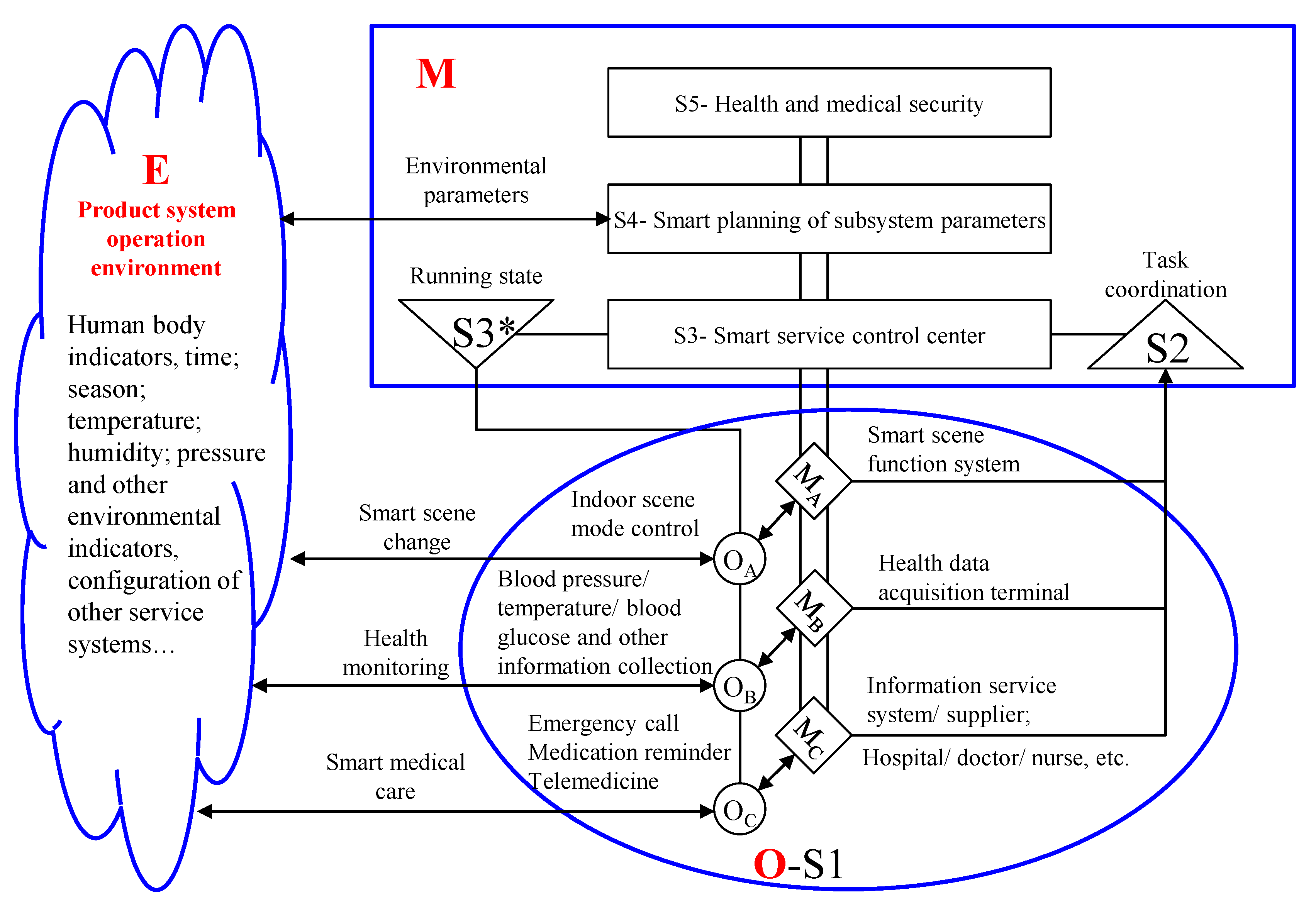
Similarly, using EVSM model, L2 level of home smart scene control system (Figure 11), L3 level of home smart health and medical service system (Figure 12) and L4 level of smart home product service ecosystem (Figure 13) are constructed. Using EVSM model, it can intuitively sort out the nested structure level of smart home service ecosystem and the relationship between different levels and different subsystems.
Figure 11.
Smart home scene control system.
Figure 12.
Smart home healthcare service system.
Figure 13.
Smart home service ecosystem.
7.3. The Emerge of Smart Home Service Ecosystem Value
Smart home service ecosystem has typical “value emergence” four effects, including component effect, scale effect, structural effect and environmental effect, selected some typical cases for application examples, as shown in Table 6.
Table 6.
Value emergence of smart home service ecosystem.
Among them, in terms of component effect, based on smart connection to achieve a systematic combination of smart home products, typical smart home products (such as air conditioners, refrigerators, washing machines, etc.,) can be connected to the Internet through routers, smart gateways, etc., and integrated interconnection with cell phone APPs, which can achieve its basic functions, in addition to remote monitoring, data collection, and other ways to home appliances energy consumption analysis, energy-saving control, and fault warning, as well as the customer experience of smart recommendation, and one-click purchase of consumables such as detergent and food to replenish the letter. In terms of scale effect, as air conditioners, refrigerators, washing machines, and other products reach high retention and remote access in the client, sufficient sample data accumulation and real-time data flow can be generated, which can then be used for failure mode analysis of product commonality, preventive/predictive maintenance, and operation parameter optimization for the same type of products, and also for user group behavior habit analysis and prediction. In terms of structural effects, in the case of audio and lighting, for example, a scientific and reasonable layout of the location and space of indoor audio equipment can significantly improve the effect of audio and enhance the customer’s experience of music and film; similarly, a reasonable layout of the location and height of indoor lighting can make indoor lighting more uniform and more comfortable for the user’s senses. In terms of environmental effects, as new smart household electrical such as light control, curtains and air conditioners have environmental perception and customer perception capabilities, they can be adaptively adjusted according to the environment and user habits, thus reducing human intervention and achieving synergy of human, machine, and environment to realize a comfortable and mind-saving user experience.
According to the Table 6, the value emergence effect of the smart home service ecosystem shown, apply the SPSE value space expansion model, further analyze the process of smart home service ecosystem value space expansion, specifically taking the value space expansion of three products and their services of smart air conditioner, smart washing machine, and smart refrigerator as an example, as Table 7 shown.
Table 7.
Value space expansion of smart air conditioner, smart washing machine and smart refrigerator.
By Table 7, the simple value of three typical smart home products in , composite value , ecological value , the evolution analysis, the following conclusions can be drawn as follows.
The original intention of designing home appliance products for customer needs contains a number of the most primitive simple values, such as air conditioners to provide cooling and heating functions, replacing traditional furnaces or heaters, making life more comfortable; refrigerators to provide food refrigeration and freezing functions, extending the preservation time and freshness of food; and washing machines to provide clothes washing and tumble drying functions, freeing human labor.
With the mutual integration of smart sensing and other technologies and home appliances and various effects (component effect , scale effect , structural effect , environmental effects ), superposition, new expanded functional values (composite value) emerge, such as smart air conditioning sleep mode, temperature memory, automatic wind adjustment, human body perception and light perception, etc., smart washing machine detergent automatically put, sterilization, automatic laundry mode, fault information tips and inverter energy saving, etc., smart refrigerator bacteria deodorization, digital temperature control, time-of-day power saving, etc.
Furthermore, owing to the support of networked technologies and the multidimensional participation of product service providers, component effect , scale effect , structural effect , environmental effects . The effects such as energy consumption analysis and failure mode analysis of smart air conditioners, detergent recommendation and water/power consumption analysis of smart washing machines, food/recipe recommendation, food shelf life, Table 7, also show that the non-linear process of value emergence of smart air conditioners, smart washing machines, and smart refrigerators has greatly enriched the connotation of their value space, providing customers with more comfortable, more convenient, and more worry-free smart family life experience and value.
Therefore, by applying the theoretical approach in this section to the practical analysis of the smart home service ecosystem case, the validity and wide applicability of the value emergence theory and value space expansion evaluation model of the SPSE are verified in a more comprehensive manner.
8. Conclusions
8.1. Conclusions and Main Contributions
First, from the method and key techniques constructed in this paper, the EVSM model is applied to graphically model and analyze the four-level nested relationship of the SPSE, and common structural elements such as execution module (O), management module (M), and external environment (E) of each level subsystem are extracted, which effectively explains the typical multi-level nested ecological characteristics of SPSE. The study of SPSE value emergence mechanism and value space expansion mode provides a qualitative analysis method for the generation of additional value, value-added value, and ecological value of SPSE system from the theoretical level, and the four operations of value emergence further provide a method for quantitative description of value emergence and value space.
Second, from the demonstration case itself, a main line of “smart home products → indoor scenario mode control system → health care service system → smart home service ecosystem” is selected, and EVSM method is applied for hierarchical topology modeling and analysis, which shows that the single or multiple coupling between different product systems and service systems can generate higher-order system forms, rather than just simple superposition between systems. Based on the analysis of the value emergence effect of typical smart home products and services such as smart air conditioners, smart washing machines and smart refrigerators, the evolutionary process of value space expansion of the three product service systems is summarized, and it can be seen from the analysis that the non-linear process of value emergence greatly enriches the connotation of value space and provides customers with more comfortable, more convenient, and more worry-free smart home life experience and value.
Finally, in terms of potential industrial application benefits, the SPSE modeling method (EVSM) based on survivable system model proposed in this paper, as a general method, can be widely applied to graphical structural topology analysis modeling of smart product service ecosystems in different industries such as smart home, engineering machinery, smart agriculture, smart networked vehicles, etc. This model can also be applied as part of complex autonomous robotic systems to perform various technological operations in agriculture. The SPSE value emergence and value space expansion models provide important guidance for measuring and assessing the value growth space of SPSEs.
8.2. Discussion and Future Studies
In order to further establish the theory and method system required for the analysis of smart product service ecosystem, the existing and required theories and methods of product system analysis, service system analysis, and smart product service ecosystem analysis are compared from the three levels of system modeling, robustness analysis, and value analysis, as shown in Table 8.
Table 8.
The research content of this paper and future work.
Among them, in terms of system modeling, different from the application of CAD drawings, electrical schematic diagrams, flow charts, sequence diagrams and other product system and service system modeling, smart product service ecosystem needs new theoretical methods to build its ecological, multi-dimensional, and nested structure description model.
In terms of system robustness analysis, it is different from using system structural strength, stiffness, and response curve to describe product robustness, and using queuing theory and Markov chain to analyze service system robustness. It is necessary to introduce methods including dissipative structure theory and niche theory to explain the robustness mechanism of smart product service ecosystem.
In terms of value analysis, product value is reflected in its reliability, functional diversity, and performance indicators, service value is reflected in its availability, efficiency, and customer satisfaction, while smart product service ecosystem needs to introduce new theoretical methods to explain the emergence of ecological value and the expansion of value space.
The research content of this paper is the hierarchical topology analysis and modeling of smart product service ecosystem, which belongs to the system modeling stage of smart product service ecosystem analysis. In order to ensure the integrity of the analysis and research of smart product service ecosystem, the robustness of SPSE is a future work, including: evolution of the dissipative structure of SPSE, separation of ecological niches of SPSE, valuation of the robustness of SPSE, and redundancy mechanism of SPSE.
As this paper mainly studies an innovative model, it mainly studies smart product service ecosystem from the perspective of hierarchy, survival system model, and value emergencies. Therefore, the mathematical methods used include: eco-viable system model and value emergency algorithms. For the robustness analysis of SPSE in the future work, we will adopt a quantitative method for research and use relevant computing programming languages.
Author Contributions
Conceptualization, Q.T., M.Z. and X.M.; methodology, Q.T., M.Z. and X.Z.; software, Q.T. and M.Z.; validation, Q.T.; formal analysis, Q.T., X.Z. and Z.W.; investigation, Q.T., M.Z. and X.Z.; resources, M.Z. and X.M.; data curation, M.Z. and X.M.; writing—original draft preparation, Q.T. and M.Z.; writing—review and editing, Q.T. and Z.W. All authors have read and agreed to the published version of the manuscript.
Funding
This work was supported by the National Natural Science Foundation of China [grant number 71632008, grant number 71971139]; National Key Research and Development Program of China [grant number 2018YFF0213701]; and National Major Science and Technology Project of China [grant number 2017-I-0007-0008, grant number 2017-I-0011-0012].
Institutional Review Board Statement
Not applicable.
Informed Consent Statement
Not applicable.
Data Availability Statement
The data presented in this study are available within the article. It was compiled from notes that the authors took during the interviews carried out and are compiled in the article itself.
Acknowledgments
The authors would like to thank Producer Service Development Innovation Center of Shanghai Jiao Tong University, Shanghai Research Center for industrial Informatics, and Shanghai Key Lab of Advanced manufacturing Environment.
Conflicts of Interest
The authors declare no conflict of interest.
References
- Ahmadi, M.; Baei, F.; Hosseini-Amiri, S.M.; Moarefi, A.; Suifan, T.S.; Sweis, R. Proposing a model of manager’s strategic intelligence, organization development, and entrepreneurial behavior in organizations. J. Manag. Dev. 2020, 39. ahead-of-print. [Google Scholar] [CrossRef]
- Al-Mahbashi, A.M.; Dafalla, M.; Shaker, A.; Al-Shamrani, M.A. Sustainable and Stable Clay Sand Liners over Time. Sustainability 2021, 13, 7840. [Google Scholar] [CrossRef]
- Atif, S.; Ahmed, S.; Wasim, M.; Zeb, B.; Pervez, Z.; Quinn, L. Towards a Conceptual Development of Industry 4.0, Servitisation, and Circular Economy: A Systematic Literature Review. Sustainability 2021, 13, 6501. [Google Scholar] [CrossRef]
- Attia, M.B.; Nguyen, K.K.; Cheriet, M. Dynamic QoS-Aware Scheduling for Concurrent Traffic in Smart Home. IEEE Internet Things J. 2020, 7, 5412–5425. [Google Scholar] [CrossRef]
- Barile, S.; Polese, F. Smart Service Systems and Viable Service Systems: Applying Systems Theory to Service Science. Serv. Sci. 2010, 2, 21–40. [Google Scholar] [CrossRef]
- Cao, Y.; You, J.; Wang, R. Research on funding mechanism of social organization based on system dynamics model. J. Ind. Eng. Manag. 2018, 32, 195–205. [Google Scholar]
- Chen, C.; Chen, C.; Wang, Y.; Zhao, J.; Li, Y. I 3 City: An Interoperated, Intelligent, and Integrated Platform for Smart City Ecosystem. IT Prof. 2021, 23, 88–94. [Google Scholar] [CrossRef]
- Chen, J.; Micheas, A.C.; Holan, S.H. Hierarchical Bayesian modeling of spatio-temporal area-interaction processes. Comput. Stat. Data Anal. 2021, 167, 107349. [Google Scholar] [CrossRef]
- Chiu, M.-C.; Huang, J.-H.; Gupta, S.; Akman, G. Developing a personalized recommendation system in a smart product service system based on unsupervised learning model. Comput. Ind. 2021, 128, 103421. [Google Scholar] [CrossRef]
- Córdova, F.M.; Gutiérrez, F.A. Knowledge Management System in Service Companies. Procedia Comput. Sci. 2018, 139, 392–400. [Google Scholar] [CrossRef]
- Fu, X.; Sun, H.; Guo, Q.; Pan, Z.; Xiong, W.; Wang, L. Uncertainty analysis of an integrated energy system based on information theory. Energy 2017, 122, 649–662. [Google Scholar] [CrossRef]
- Golinelli, G.M.; Barile, S.; Spohrer, J.; Bassano, C. The evolving dynamics of service co-creation in a viable systems perspective. In Proceedings of the 13th Toulon-Verona Conference on Excellence in Services, Coimbra, Portugal, 2–4 September 2015; pp. 1–13. [Google Scholar]
- Hallstedt, S.I.; Isaksson, O.; Ronnback, A.O. The Need for New Product Development Capabilities from Digitalization, Sustainability, and Servitization Trends. Sustainability 2020, 12, 10222. [Google Scholar] [CrossRef]
- Inoue, Y. Services on Platform Ecosystems in the Smart Home 2.0 Era: Elements Influencing Consumers’ Value Perception for Smart Home Products. Sensors 2021, 21, 7391. [Google Scholar]
- Javed, A.; Kubler, S.; Malhi, A.; Nurminen, A.; Robert, J.; Framling, K. bIoTope: Building an IoT Open Innovation Ecosystem for Smart Cities. IEEE Access 2020, 8, 224318–224342. [Google Scholar] [CrossRef]
- Jin, T.; Xia, H.; Gao, S. Reliability analysis of the uncertain fractional-order dynamic system with state constraint. Math. Methods Appl. Sci. 2021, 45, 2615–2637. [Google Scholar] [CrossRef]
- Li, P.; Jiang, P. Enhanced agents in shared factory: Enabling high-efficiency self-organization and sustainability of the shared manufacturing resources. J. Clean. Prod. 2021, 292, 126020. [Google Scholar] [CrossRef]
- Li, X.; Wang, Z.; Chen, C.-H.; Zheng, P. A data-driven reversible framework for achieving Sustainable Smart product-service systems. J. Clean. Prod. 2020, 279, 123618. [Google Scholar] [CrossRef]
- Liang, W.; Ma, S.; Lin, C. Marginal false discovery rate for a penalized transformation survival model. Comput. Stat. Data Anal. 2021, 160, 107232. [Google Scholar] [CrossRef]
- Liao, M.; Lan, K.; Yao, Y. Sustainability implications of artificial intelligence in the chemical industry: A conceptual framework. J. Ind. Ecol. 2021, 26, 164–182. [Google Scholar] [CrossRef]
- Lopez-Navarrete, F.; Sanchez-Soriano, J.; Bonastre, O.M. Allocating revenues in a Smart TV ecosystem. Int. Trans. Oper. Res. 2019, 26, 1611–1632. [Google Scholar] [CrossRef]
- Ludmila, P.; Zloshchastiev, K.G. Phase space formulation of density operator for non-Hermitian Hamiltonians and its application in quantum theory of decay. Int. J. Mod. Phys. B 2018, 32, 1850276. [Google Scholar]
- Malekshah, S.; Ansari, J. A novel decentralized method based on the system engineering concept for reliability-security constraint unit commitment in restructured power environment. Int. J. Energy Res. 2020, 45, 703–726. [Google Scholar] [CrossRef]
- Minguzzi, A.; Modina, M.; Gallucci, C. Foundations of Banking Origin and Social Rating Philosophy—A New Proposal for an Evaluation System. Sustainability 2019, 11, 3518. [Google Scholar] [CrossRef]
- Mo, L.; Chen, J.; Xie, Y. Ecological Approach for the Evaluation of Structure and Sustainability in the Tourism Industry. Sustainability 2021, 13, 13294. [Google Scholar] [CrossRef]
- Pais, S.; Aquilué, N.; Campos, J.; Sil, A.; Marcos, B.; Martínez-Freiría, F.; Domínguez, J.; Brotons, L.; Honrado, J.P.; Regos, A. Mountain farmland protection and fire-smart management jointly reduce fire hazard and enhance biodiversity and carbon sequestration. Ecosyst. Serv. 2020, 44, 101143. [Google Scholar] [CrossRef]
- Peria, M.; Perakovi, D.; Cviti, I.; Krsti, M. Innovative ecosystem for informing visual impaired person in smart shopping environment: InnIoTShop. Wirel. Netw. 2021, 28, 469–479. [Google Scholar] [CrossRef]
- Roumboutsos, A.; Pagoni, I.; Tsirimpa, A.; Polydoropoulou, A. An Ecosystem Innovation Framework: Assessing Mobility as a Service in Budapest. Sustainability 2021, 13, 3753. [Google Scholar] [CrossRef]
- Schwesinger, D.; Shariati, A.; Montella, C.; Spletzer, J. A smart wheelchair ecosystem for autonomous navigation in urban environments. Auton. Robot. 2016, 41, 519–538. [Google Scholar] [CrossRef]
- Sharma, V. Modeling the interactions among critical criteria of a cellular manufacturing system. IEEE Eng. Manag. Rev. 2020, 49, 148–164. [Google Scholar] [CrossRef]
- Singh, N. A Conceptual Framework for Flexible Marketing System. Glob. J. Flex. Syst. Manag. 2010, 11, 11–16. [Google Scholar] [CrossRef]
- Smart, J.C.R.; Hicks, K.; Morrissey, T.; Heinemeyer, A.; Sutton, M.A.; Ashmore, M. Applying the ecosystem service concept to air quality management in the UK: A case study for ammonia. Environmetrics 2011, 22, 649–661. [Google Scholar] [CrossRef]
- Subramoniam, R.; Sundin, E.; Subramoniam, S.; Huisingh, D. Riding the Digital Product Life Cycle Waves towards a Circular Economy. Sustainability 2021, 13, 8960. [Google Scholar] [CrossRef]
- Wang, J.; Zhao, X.; Guo, X.; Li, B. Analyzing the research subjects and hot topics of power system reliability through the Web of Science from 1991 to 2015. Renew. Sustain. Energy Rev. 2018, 82, 700–713. [Google Scholar] [CrossRef]
- Wiesner, S.; Winkler, M.; Eschenbcher, J.; Thoben, K.D. Strategies for Extended Product Business Models in Manufacturing Service Ecosystems. In Product-Service Integration for Sustainable Solutions—Proceedings of the 5th CIRP International Conference on Industrial Product-Service Systems; Springer: Berlin/Heidelberg, Germany, 2013. [Google Scholar]
- Yang, X.; Zheng, X. Swing-Up and Stabilization Control Design for an Underactuated Rotary Inverted Pendulum System: Theory and Experiments. IEEE Trans. Ind. Electron. 2018, 65, 7229–7238. [Google Scholar] [CrossRef]
- Yin, D.; Ming, X.; Zhang, X. Sustainable and smart product innovation ecosystem: An integrative status review and future perspectives. J. Clean. Prod. 2020, 274, 123005. [Google Scholar] [CrossRef]
- Zhang, N.; Sun, Q.; Yang, L.; Li, Y. Event-Triggered Distributed Hybrid Control Scheme for the Integrated Energy System. IEEE Trans. Ind. Inform. 2021, 18, 835–846. [Google Scholar] [CrossRef]
- Zheng, M.; Ming, X.; Li, G.; Shi, Y. The framework of business model innovation for Smart Product-Service Ecosystem. In Proceedings of the Norddesign, Trondheim, Norway, 10–12 August 2016. [Google Scholar]
- Zheng, M.; Ming, X.; Wang, L.; Yin, D.; Zhang, X. Status Review and Future Perspectives on the Framework of Smart Product Service Ecosystem. Procedia CIRP 2017, 64, 181–186. [Google Scholar] [CrossRef]
- Zl, A.; Xm, A.; Wsb, C.; Sq, A.; Yq, A. A perspective on value co-creation-oriented framework for smart product-service system—ScienceDirect. Procedia CIRP 2018, 73, 155–160. [Google Scholar]
Publisher’s Note: MDPI stays neutral with regard to jurisdictional claims in published maps and institutional affiliations. |
© 2022 by the authors. Licensee MDPI, Basel, Switzerland. This article is an open access article distributed under the terms and conditions of the Creative Commons Attribution (CC BY) license (https://creativecommons.org/licenses/by/4.0/).