


Investigating Accessibility of Social Security System (SSS) Mobile Application: A Structural Equation Modeling Approach

 ,
,  , and
, and
Abstract
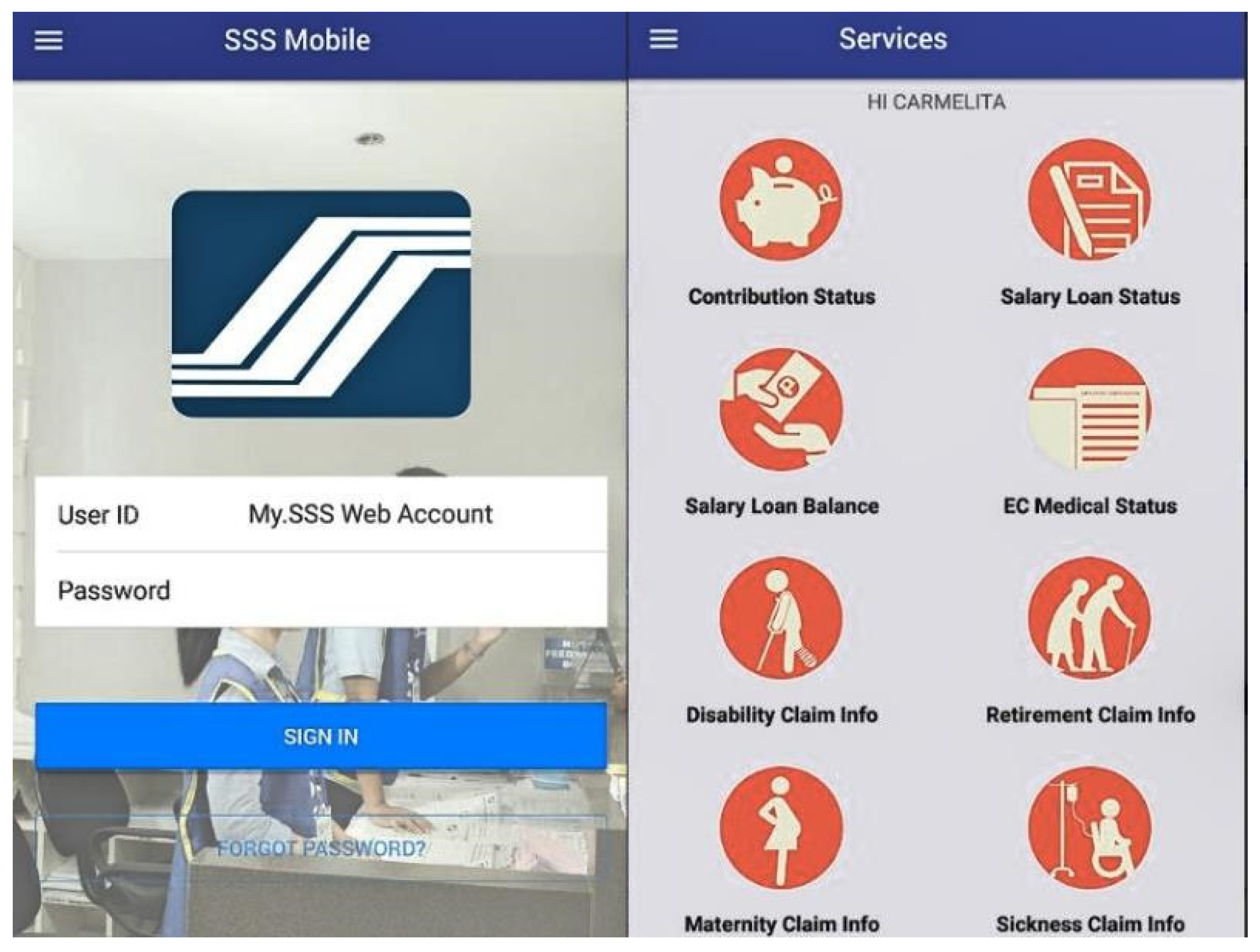
:1. Introduction
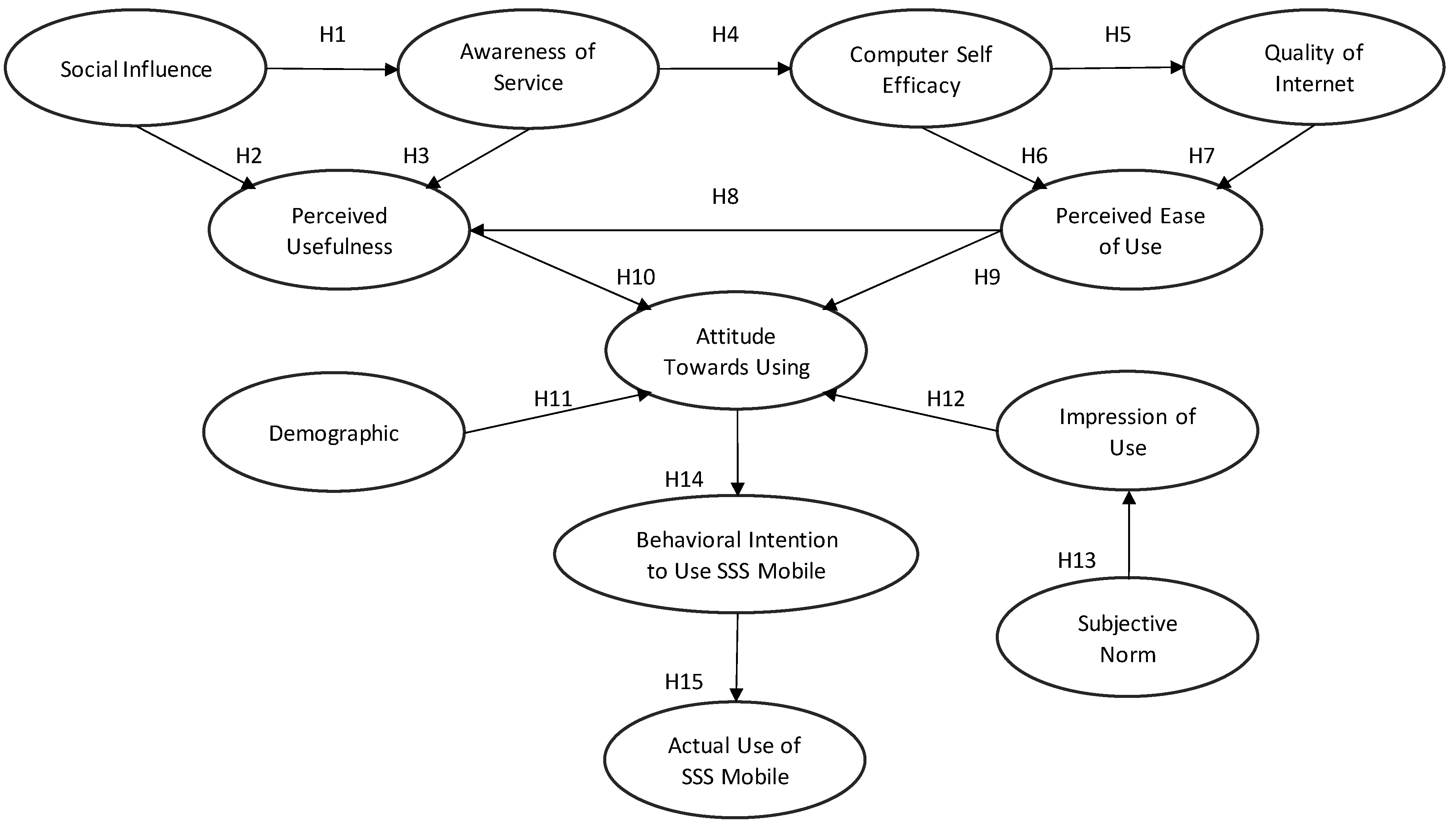
Theoretical Research Framework
2. Methodology
2.1. Participants
2.2. Questionnaire
2.3. Structural Equation Modeling (SEM)
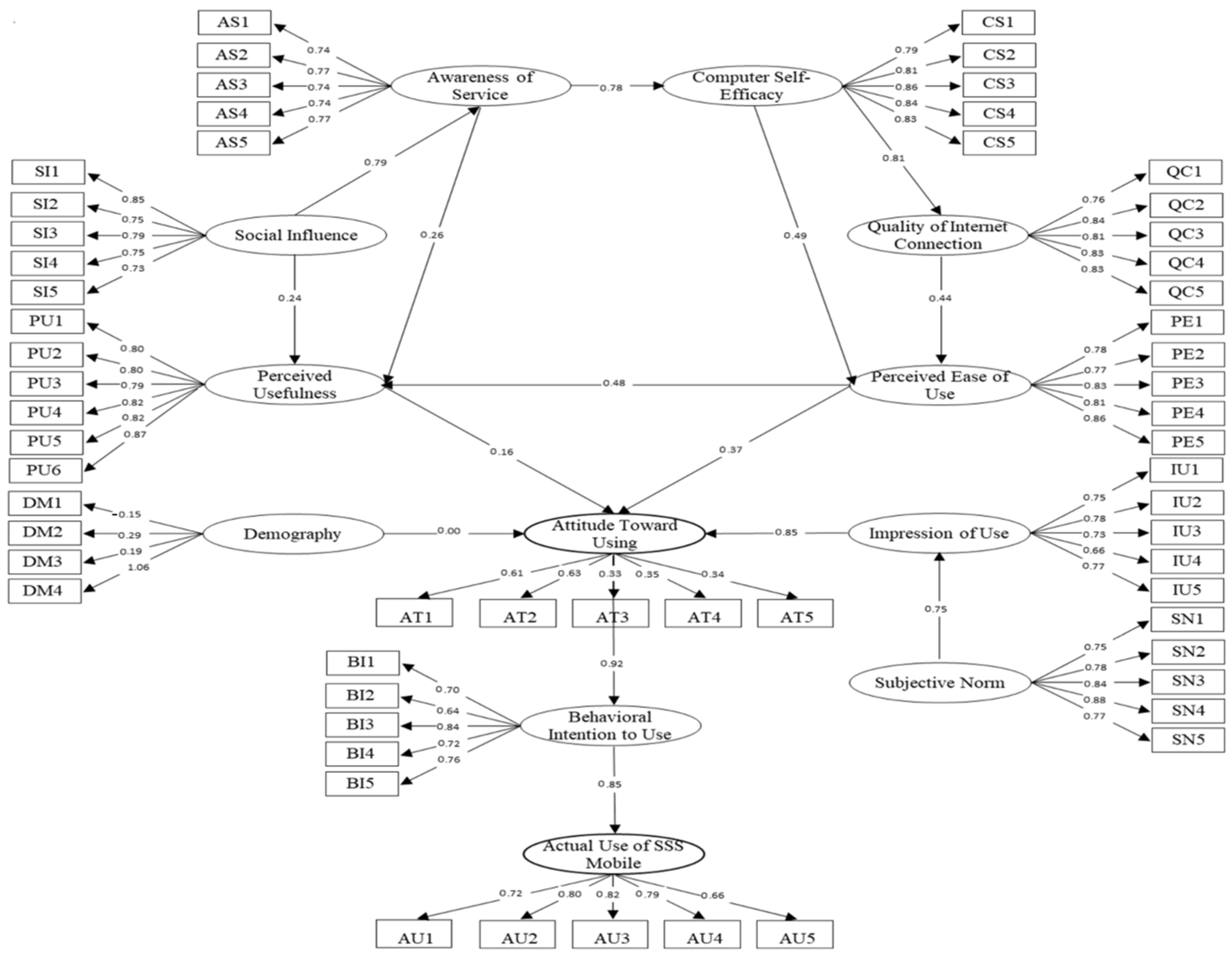
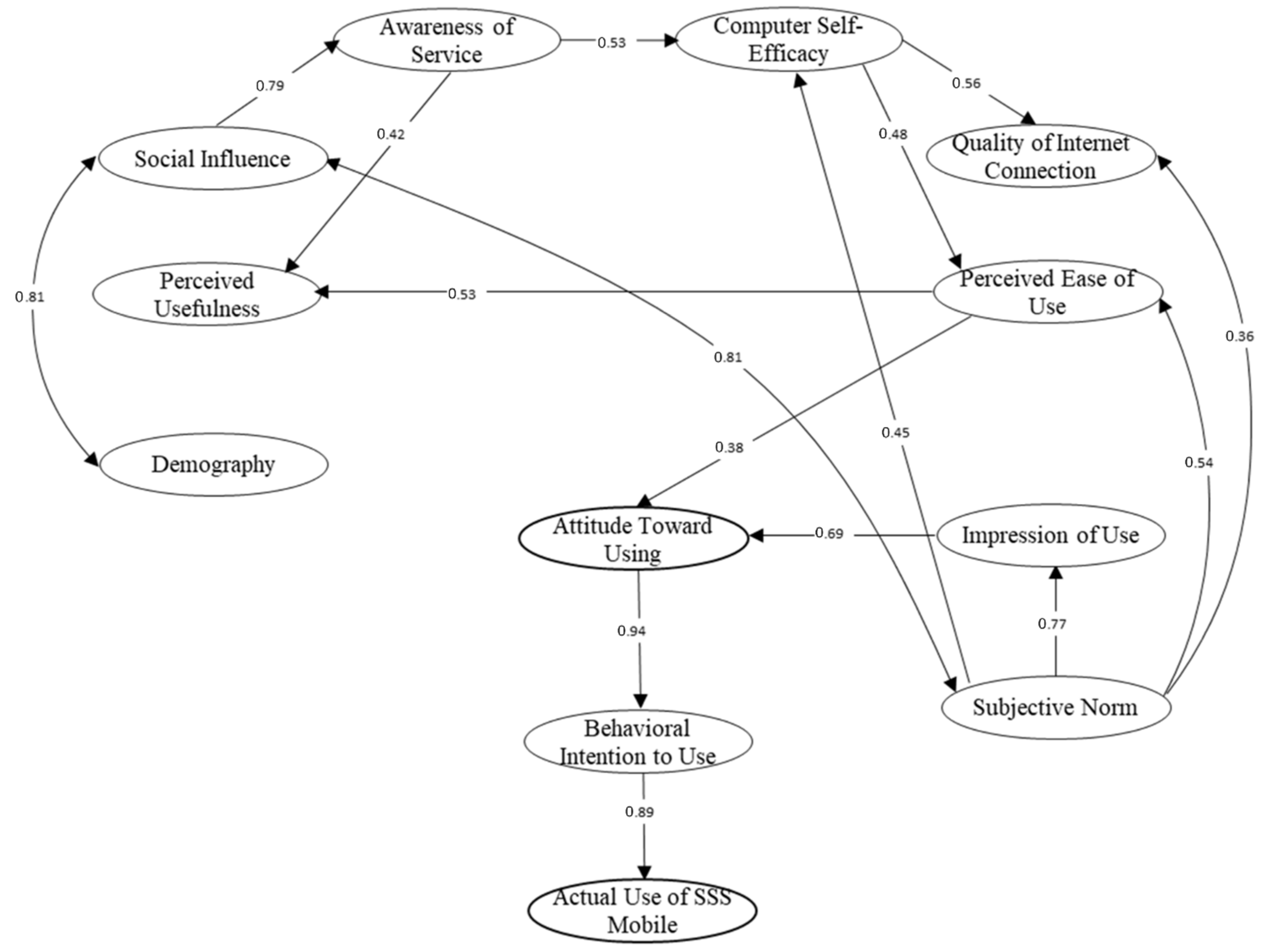
3. Results
4. Conclusions
Theoretical Contribution
5. Limitations and Future Research
Author Contributions
Funding
Institutional Review Board Statement
Informed Consent Statement
Data Availability Statement
Conflicts of Interest
References
- Social Security Act of 1997 (R.A. 8282), Republic of the Philippines. 1997. Available online: Chrome-extension://efaidnbmnnnibpcajpcglclefindmkaj/https://www.sss.gov.ph/sss/DownloadContent?fileName=RA8282.pdf (accessed on 20 May 2022).
- Social Security System Philippines—The SSS Mandate. Republic of the Philippines Social Security System. Available online: https://www.sss.gov.ph/sss/appmanager/pages.jsp?page=sssmandate (accessed on 20 May 2022).
- Djimesah, I.E.; Zhao, H.; Okine, A.N.; Li, Y.; Duah, E.; Kissi Mireku, K. Analyzing the technology of acceptance model of Ghanaian crowdfunding stakeholders. Technol. Forecast. Soc. Chang. 2022, 175, 121323. [Google Scholar] [CrossRef]
- Palanissamy, A.; Kesavamoorthy, R. Automated dispute resolution system (ADRS)—A proposed initial framework for digital justice in online consumer transactions in India. Procedia Comput. Sci. 2019, 165, 224–231. [Google Scholar] [CrossRef]
- Hoffman, D.L.; Novak, T.P.; Peralta, M. Building consumer trust online. Commun. ACM 1999, 42, 80–85. [Google Scholar] [CrossRef]
- Ha, N.T.; Nguyen, T.L.H.; Nguyen, T.P.L.; Nguyen, T.D. The effect of trust on consumers’ online purchase intention: An integration of TAM and TPB. Manag. Sci. Lett. 2019, 9, 1451–1460. [Google Scholar] [CrossRef]
- Lai, P.C. Security as an extension to TAM model: Consumers’ intention to use a single platform e-payment. Asia-Pac. J. Manag. Res. Innov. 2017, 13, 110–119. [Google Scholar] [CrossRef]
- Al-Gahtani, S.S. Modeling the electronic transactions acceptance using an extended technology acceptance model. Appl. Comput. Inform. 2011, 9, 47–77. [Google Scholar] [CrossRef] [Green Version]
- Davis, F.D. Perceived usefulness, perceived ease of use, and user acceptance of Information Technology. MIS Q. 1989, 13, 319. [Google Scholar] [CrossRef] [Green Version]
- Oliver, T.A.; Shapiro, F. Self-efficacy and Computers. J. Comput.-Based Instr. 1993, 20, 81–85. [Google Scholar]
- Bandura, A. Self-efficacy mechanism in human agency. Am. Psychol. 1982, 37, 122–147. [Google Scholar] [CrossRef]
- Rojas-Méndez, J.I.; Parasuraman, A.; Papadopoulos, N. Demographics, attitudes, and technology readiness. Mark. Intell. Plan. 2017, 35, 18–39. [Google Scholar] [CrossRef]
- Lam, S.Y.; Chiang, J.; Parasuraman, A. The effects of the dimensions of technology readiness on technology acceptance: An empirical analysis. J. Interact. Mark. 2008, 22, 19–39. [Google Scholar] [CrossRef]
- Cruz-Cárdenas, J.; Zabelina, E.; Deyneka, O.; Guadalupe-Lanas, J.; Velín-Fárez, M. Role of demographic factors, attitudes toward technology, and cultural values in the prediction of technology-based Consumer Behaviors: A study in developing and emerging countries. Technol. Forecast. Soc. Chang. 2019, 149, 119768. [Google Scholar] [CrossRef]
- Venkatesh, V.; Davis, F.D. A theoretical extension of the technology acceptance model: Four longitudinal field studies. Manag. Sci. 2000, 46, 186–204. [Google Scholar] [CrossRef] [Green Version]
- Shiferaw, K.B.; Mehari, E.A. Modeling predictors of acceptance and use of electronic medical record system in a resource limited setting: Using modified utaut model. Inform. Med. Unlocked 2019, 17, 100182. [Google Scholar] [CrossRef]
- Šumak, B.; Šorgo, A. The acceptance and use of interactive whiteboards among teachers: Differences in Utaut determinants between pre- and post-adopters. Comput. Hum. Behav. 2016, 64, 602–620. [Google Scholar] [CrossRef]
- Munabi, I.G.; Buwembo, W. Partial least squares structural equation path modelling determined predictors of students reported human cadaver dissection activity. Forensic Med. Anat. Res. 2020, 08, 18–37. [Google Scholar] [CrossRef]
- Siddiqui, K. Heuristics for Sample Size Determination in Multivariate Statistical Techniques. 6 December 2013. Available online: https://papers.ssrn.com/sol3/papers.cfm?abstract_id=2447286 (accessed on 15 May 2022).
- Kineber, A.F.; Othman, I.; Oke, A.E.; Chileshe, N.; Zayed, T. Exploring the value management critical success factors for Sustainable Residential Building—A structural equation modelling approach. J. Clean. Prod. 2021, 293, 126115. [Google Scholar] [CrossRef]
- Grilli, G.; Curtis, J.; Hynes, S.; O’Reilly, P. Sea bass angling in Ireland: A structural equation model of catch and effort. Ecol. Econ. 2018, 149, 285–293. [Google Scholar] [CrossRef] [Green Version]
- Wu, M.-J.; Zhao, K.; Fils-Aime, F. Response rates of online surveys in published research: A Meta-analysis. Comput. Hum. Behav. Rep. 2022, 7, 100206. [Google Scholar] [CrossRef]
- Ismaeel, W.S.E.; Mohamed, A.G. Indoor air quality for sustainable building renovation: A decision-support assessment system using structural equation modelling. Build. Environ. 2022, 214, 108933. [Google Scholar] [CrossRef]
- Osswald, S.; Wurhofer, D.; Trösterer, S.; Beck, E.; Tscheligi, M. Predicting information technology usage in the car. In Proceedings of the 4th International Conference on Automotive User Interfaces and Interactive Vehicular Applications—AutomotiveUI ’12, Portsmouth, NH, USA, 17–19 October 2012. [Google Scholar] [CrossRef]
- Madigan, R.; Louw, T.; Wilbrink, M.; Schieben, A.; Merat, N. What influences the decision to use automated public transport? Using UTAUT to understand public acceptance of automated road transport systems. Transp. Res. Part F Traffic Psychol. Behav. 2017, 50, 55–60. [Google Scholar] [CrossRef]
- Asio, J.M.R.; Gadia, E.; Abarintos, E.; Paguio, D.; Balce, M. Internet Connection and Learning Device Availability of College Students: Basis for Institutionalizing Flexible Learning in the New Normal. Stud. Humanit. Educ. 2021, 2, 56–69. [Google Scholar] [CrossRef]
- Gaol, F.L.; Mars, W.; Saragih, H. Management and Technology in Knowledge, Service, Tourism & Hospitality. In Google Books; CRC Press: Boca Raton, FL, USA, 2014; Available online: https://books.google.com.ph/books?id=FjjMBQAAQBAJ& (accessed on 2 June 2022).
- Mensah, I.K.; Mwakapesa, D.S. The impact of context awareness and ubiquity on Mobile Government Service adoption. Mob. Inf. Syst. 2022, 2022, 5918826. [Google Scholar] [CrossRef]
- Mtebe, J. Examining eLearning system self-efficacy amongst instructors at the University of Dodoma, Tanzania. Open Prax. 2020, 12, 343. [Google Scholar] [CrossRef]
- Malhotra, Y.; Galletta, D. Extending the technology acceptance model to account for social influence: Theoretical bases and empirical validation. In Proceedings of the 32nd Annual Hawaii International Conference on Systems Sciences, Maui, HI, USA, 5–8 January 1999. [Google Scholar]
- Cheng, T.C.E.; Lam, D.Y.C.; Yeung, A.C.L. Adoption of internet banking: An empirical study in Hong Kong. Decis. Support Syst. 2006, 42, 1558–1572. [Google Scholar] [CrossRef] [Green Version]
- Al-Sharafi, M.A.; Al-Qaysi, N.; Iahad, N.A.; Al-Emran, M. Evaluating the sustainable use of mobile payment contactless technologies within and beyond the COVID-19 pandemic using a hybrid Sem-Ann Approach. Int. J. Bank Mark. 2022, 40, 1071–1095. [Google Scholar] [CrossRef]
- Muñoz-Leiva, F.; Climent-Climent, S.; Liébana-Cabanillas, F. Determinants of intention to use the Mobile Banking Apps: An extension of the classic Tam model. Span. J. Mark.-ESIC 2017, 21, 25–38. [Google Scholar] [CrossRef]
- Thatcher, J.B.; Perrewe, P.L. An Empirical Examination of Individual Traits as Antecedents to Computer Anxiety and Computer Self-Efficacy. MIS Q. 2002, 26, 381. [Google Scholar] [CrossRef] [Green Version]
- Lee, H.; Choi, S.Y.; Kang, Y.S. Formation of E-Satisfaction and Repurchase Intention: Moderating Roles of Computer Self-Efficacy and Computer Anxiety. Expert Syst. Appl. 2009, 36, 7848–7859. Available online: https://www.researchgate.net/publication/220219081_Formation_of_e-satisfaction_and_repurchase_intention_Moderating_roles_of_computer_self-efficacy_and_computer_anxiety (accessed on 10 May 2022). [CrossRef]
- Abdullah, Z.D.; Mustafa, K.I. The underlying factors of computer self-efficacy and the relationship with students’ academic achievement. Int. J. Res. Educ. Sci. 2019, 5, 346–354. [Google Scholar]
- Parker, A.; Santos, J.; Dancy, K. Student Polling on Access to Internet and Devices Online Isn’t Optional. 2021. Available online: https://files.eric.ed.gov/fulltext/ED612947.pdf (accessed on 30 May 2022).
- Kukulska-Hulme, A. Will mobile learning change language learning? ReCALL 2009, 21, 157–165. Available online: http://oro.open.ac.uk/16987/ (accessed on 10 May 2022). [CrossRef] [Green Version]
- Park, S.Y.; Nam, M.-W.; Cha, S.-B. University students’ behavioral intention to use mobile learning: Evaluating the technology acceptance model. Br. J. Educ. Technol. 2011, 43, 592–605. [Google Scholar] [CrossRef]
- Venkatesh, V.; Thong, J.; Xu, X. Consumer acceptance and use of information technology: Extending the unified theory of acceptance and use of Technology. MIS Q. 2012, 36, 157. [Google Scholar] [CrossRef] [Green Version]
- Gefen, D.; Karahanna, E.; Straub, D.W. Trust and TAM in Online Shopping: An Integrated Model. MIS Q. 2003, 27, 51. [Google Scholar] [CrossRef]
- Diaz, A.C.; Sasaki, N.; Tsusaka, T.W.; Szabo, S. Factors affecting farmers’ willingness to adopt a mobile app in the marketing of Bamboo Products. Resour. Conserv. Recycl. Adv. 2021, 11, 200056. [Google Scholar] [CrossRef]
- Xu, Y.; Jin, L.; Deifell, E.; Angus, K. Chinese character instruction online: A technology acceptance perspective in emergency remote teaching. System 2021, 100, 102542. [Google Scholar] [CrossRef]
- Conner, K. Mandatory Face Masks in Stores, Cars, Outside: Where You’re Expected to Wear a Covering. CNET. Available online: https://www.cnet.com/health/mandatory-face-masks-in-stores-cars-outside-where-youre-expected-to-wear-a-covering/ (accessed on 22 May 2022).
- Rubio-Romero, J.C.; Pardo-Ferreira, M.; Torrecilla-García, J.A.; Calero-Castro, S. Disposable masks: Disinfection and sterilization for reuse, and non-certified manufacturing, in the face of shortages during the COVID-19 pandemic. Saf. Sci. 2020, 129, 104830. [Google Scholar] [CrossRef]
- Yancey-Bragg, N.; Bravo, V. Can I Still Go for a Walk, Run under Stay at Home Orders? Should I Wear a Mask? USA Today News, 15 April 2020. Available online: https://www.usatoday.com/in-depth/news/health/2020/04/15/coronavirus-masks-how-safely-go-outside-during-stay-home-order/2970072001/ (accessed on 17 September 2020).
- Ocampo, L.; Yamagishi, K. Modeling the lockdown relaxation protocols of the Philippine government in response to the COVID-19 pandemic: An intuitionistic fuzzy DEMATEL analysis. Socio-Econ. Plan. Sci. 2020, 72, 100911. [Google Scholar] [CrossRef]
- Prasetyo, Y.T.; Castillo, A.M.; Salonga, L.J.; Sia, J.A.; Seneta, J.A. Factors affecting perceived effectiveness of COVID-19 prevention measures among Filipinos during enhanced community quarantine in Luzon, Philippines: Integrating Protection Motivation Theory and extended theory of planned behavior. Int. J. Infect. Dis. 2020, 99, 312–323. [Google Scholar] [CrossRef]
- Boateng, H.; Adam, D.R.; Okoe, A.F.; Anning-Dorson, T. Assessing the determinants of internet banking adoption intentions: A social cognitive theory perspective. Comput. Hum. Behav. 2016, 65, 468–478. [Google Scholar] [CrossRef]
- Park, C.; Kim, D.; Cho, S.; Han, H.-J. Adoption of multimedia technology for learning and gender difference. Comput. Hum. Behav. 2019, 92, 288–296. [Google Scholar] [CrossRef]
- San-Martin, S.; López-Catalán, B. How can a mobile vendor get satisfied customers? Ind. Manag. Data Syst. 2013, 113, 156–170. [Google Scholar] [CrossRef]
- Choi, K.-S.; Cho, W.-H.; Lee, S.; Lee, H.; Kim, C. The relationships among quality, value, satisfaction and behavioral intention in Health Care Provider Choice. J. Bus. Res. 2004, 57, 913–921. [Google Scholar] [CrossRef]
- Natasia, S.R.; Wiranti, Y.T.; Parastika, A. Acceptance analysis of NUADU as e-learning platform using the Technology Acceptance Model (TAM) approach. Procedia Comput. Sci. 2022, 197, 512–520. [Google Scholar] [CrossRef]
- Binyamin, S.S.; Zafar, B.A. Proposing a mobile apps acceptance model for users in the health area: A systematic literature review and meta-analysis. Health Inform. J. 2021, 27, 146045822097673. [Google Scholar] [CrossRef]
- Raykov, T.; Marcoulides, G.A. A First Course in Structural Equation Modeling; Lawrence Erlbaum Associates Publishers: Mahwah, NJ, USA, 2000. [Google Scholar]
- Hoyle, R.H. The structural equation modeling approach: Basic concepts and fundamental issues. In Structural Equation Modeling: Concepts, Issues, and Applications; Hoyle, R.H., Ed.; SAGE Publications, Inc.: Thousand Oaks, CA, USA, 1995; pp. 1–15. [Google Scholar]
- Ampofo, R.T.; Aidoo, E.N. Structural equation modelling of COVID-19 knowledge and attitude as determinants of preventive practices among university students in Ghana. Sci. Afr. 2022, 16, e01182. [Google Scholar] [CrossRef]
- Islam, A.K.M.N.; Azad, N. Satisfaction and continuance with a learning management system. Int. J. Inf. Learn. Technol. 2015, 32, 109–123. [Google Scholar] [CrossRef]
- Kamal, S.A.; Shafiq, M.; Kakria, P. Investigating acceptance of telemedicine services through an extended technology acceptance model (TAM). Technol. Soc. 2020, 60, 101212. [Google Scholar] [CrossRef]
- Elkaseh, A.M.; Wong, K.W.; Fung, C.C. Perceived ease of use and perceived usefulness of social media for e-learning in libyan higher education: A structural equation modeling analysis. Int. J. Inf. Educ. Technol. 2016, 6, 192–199. [Google Scholar] [CrossRef] [Green Version]
- Kusyanti, A.; Santoso, N.; Ayu Catherina, H.P.; Oktavia, E. Investigating mobile users’ intention: Technology acceptance and privacy perspectives. Procedia Comput. Sci. 2022, 197, 576–582. [Google Scholar] [CrossRef]
- Praveena, K.; Thomas, S. Continuance intention to use Facebook: A study of perceived enjoyment and Tam. Bonfring Int. J. Ind. Eng. Manag. Sci. 2014, 4, 24–29. [Google Scholar] [CrossRef] [Green Version]
- Becker, D. Acceptance of Mobile Mental Health Treatment Applications. Procedia Comput. Sci. 2016, 98, 220–227. [Google Scholar] [CrossRef] [Green Version]
- Ming, J.; Chen, R.; Tu, R. Factors influencing user behavior intention to use mobile library application: A theoretical and empirical research based on grounded theory. Data Inf. Manag. 2021, 5, 131–146. [Google Scholar] [CrossRef]
- Hair, J.F. Multivariate Data Analysis: A Global Perspective; Pearson Prentice Hall: London, UK, 2010. [Google Scholar]
- Hu, L.; Bentler, P.M. Cutoff criteria for fit indexes in covariance structure analysis: Conventional criteria versus new alternatives. Struct. Equ. Model. Multidiscip. J. 1999, 6, 1–55. [Google Scholar] [CrossRef]
- Steiger, J.H. Understanding the limitations of global fit assessment in structural equation modeling. Pers. Individ. Differ. 2007, 42, 893–898. [Google Scholar] [CrossRef]
- Shahzad, F.; Xiu, G.; Shafique Khan, M.A.; Shahbaz, M. Predicting the adoption of a mobile government security response system from the user’s perspective: An application of the artificial neural network approach. Technol. Soc. 2020, 62, 101278. [Google Scholar] [CrossRef]

| Characteristics | Category | N | % |
|---|---|---|---|
| Gender | Male | 96 | 48.0 |
| Female | 102 | 51.0 | |
| Prefer not to say | 2 | 1.0 | |
| Age | Less than 20 years old | 5 | 2.5 |
| 20–30 years old | 155 | 77.5 | |
| 31–40 years old | 21 | 10.5 | |
| 41–50 years old | 12 | 6.0 | |
| 51–60 years old | 7 | 3.5 | |
| Educational Background | Less than high school | 3 | 1.5 |
| High school | 51 | 25.5 | |
| College | 140 | 70.0 | |
| Master’s degree | 6 | 3.0 | |
| Monthly Income | <15,000 PHP | 149 | 74.5 |
| 15,000–30,000 PHP | 39 | 19.5 | |
| 30,000–45,000 PHP | 5 | 2.5 | |
| 45,000–60,000 PHP | 1 | 0.5 | |
| 60,000–75,000 PHP | 4 | 2.0 | |
| >75,000 PHP | 2 | 1.0 |
| Latent Variables | Acronym | Questions | Reference |
|---|---|---|---|
| Social Influence | SI1 | Overall, people who I like would encourage me to use the SSS mobile application. | Osswald et al. (2012) [24] |
| SI2 | People whose opinions are important to me would like the autonomous vehicles too. | Madigan et al. (2017) [25] | |
| SI3 | My friends who are important to me think that I should use SSS mobile application. | Asio et al. (2021) [26] | |
| SI4 | I think I am more likely to use the SSS mobile application if my friends or family used it. | Osswald et al. (2012) [24] | |
| SI5 | I use the SSS mobile app because of the proportion of colleagues who use the system. | Asio et al. (2021) [26] | |
| Awareness of Service | AS1 | I understand the meaning of SSS mobile application. | Gaol et al. (2014) [27] |
| AS2 | I understand the purpose of using SSS mobile application. | Gaol et al. (2014) [27] | |
| AS3 | The SSS mobile government application provides service based on my location. | Mensah and Mwakapesa (2022) [28] | |
| AS4 | The SSS mobile government application provides service based on my status/needs. | Mensah and Mwakapesa (2022) [28] | |
| AS5 | I am aware of SSS mobile application’s use for SSS transaction. | Mtebe (2020) [29] | |
| Perceived Usefulness | PU1 | Using SSS mobile app would enable me to accomplish transactions more quickly. | Malhotra and Galleta (1999) [30] |
| PU2 | I think the SSS mobile app is useful. | Cheng et al. (2006) [31] | |
| PU3 | The SSS mobile app meet my needs, so I find it useful for me. | Al-Sharafi et al. (2021) [32] | |
| PU4 | Using the SSS mobile application increased my effectiveness in consulting and/or conducting my online transactions. | Muñoz-Leiva et al. (2017) [33] | |
| PU5 | I believe that the SSS mobile app is valuable to me. | Al-Gahtani (2011) [8] | |
| PU6 | In general, the SSS mobile app can be useful when consulting and/or conducting my online transactions | Muñoz-Leiva et al. (2017) [33] | |
| Computer Self Efficacy | CS1 | I can use the SSS mobile app even when there is no one around to tell me what to do. | Thatcher and Perrewe (2002) [34], Lee et al. (2009) [35] |
| CS2 | I feel it is easy to learn to use SSS mobile app. | Abdullah and Mustafa (2019) [36] | |
| CS3 | I feel capable of understanding words related to the SSS mobile app. | Abdullah and Mustafa (2019) [36] | |
| CS4 | I am confident about my ability to use the system to complete my work. | Mtebe (2020) [29] | |
| CS5 | I believe in my ability to use the system to complete my work. | Mtebe (2020) [29] | |
| Quality of Internet Connection | QC1 | SSS mobile can access fast and reliable Internet connections. | Parker et al. (2021) [37] |
| QC2 | The SSS mobile application service is accessible at any time and place | Asio et al. (2021) [26] | |
| QC3 | The SSS mobile application service provides real-time and updated information about SSS updates. | Kukulska-Hulme (2009) [38] | |
| QC4 | I can easily get information or contents for the SSS mobile application. | Park et al. (2011) [39] | |
| QC5 | It is easy to access the Internet and search for SSS information. | Park et al. (2011) [39] | |
| Perceived Ease of Use | PE1 | Learning to operate the SSS mobile app is easy for me. | Venkatesh et al. (2012) [40] |
| PE2 | I think that interaction with SSS mobile app does not require a lot of mental effort. | Cheng et al. (2006) [31] | |
| PE3 | It is easy to interact with the SSS mobile app. | Gefen et al. (2003) [41] | |
| PE4 | The SSS mobile app is easy to use in general. | Muñoz-Leiva et al. (2017) [33] | |
| PE5 | I find it easy to locate the information that I need in SSS mobile app. | Al-Gahtani (2011) [8] | |
| Subjective Norm | SN1 | I find the SSS mobile app easy to use. | Diaz et al. (2021) [42] |
| SN2 | Most people I know with a SSS account are following instructions during the COVID-19 pandemic. | Xu et al. (2021) [43] | |
| SN3 | Most people I know are using the SSS mobile application. | Conner (2020) [44]; Rubio-Romero et al. (2020) [45] | |
| SN4 | Most people I know are staying at home and using the SSS mobile application | Yancey-Bragg and Bravo (2020) [46] | |
| SN5 | Most people I know are following the preventive protocols given by the government to use SSS mobile application. | Ocampo and Yamagishi (2020) [47] | |
| Attitude towards Using SSS mobile app | AT1 | During a pandemic, the SSS mobile app is a good idea to use. | Asio et al. (2021) [26] |
| AT2 | I think the use of the SSS mobile app is mandatory for any SSS transactions. | Asio et al. (2021) [26] | |
| AT3 | Most people I know are using the SSS mobile app. | Asio et al. (2021) [26] | |
| AT4 | I feel anxious while using the SSS mobile application. | Prasetyo et al. (2020) [48] | |
| AT5 | I feel insecure if someone is using the SSS mobile application. | Prasetyo et al. (2020) [48] | |
| Impression of Use | IU1 | The information published and provided by the SSS mobile app is credible. | Al-Gahtani (2011) [8] |
| IU2 | I find using the SSS mobile app to be secure in conducting transactions. | Boateng et al. (2016) [49] | |
| IU3 | Distance transactions via the SSS mobile app are trustworthy. | Al-Gahtani (2011) [8] | |
| IU4 | I believe that the SSS mobile app is appropriate technology for online government transaction. | Park et al. (2019) [50] | |
| IU5 | Transacting on my mobile phone is very satisfactory. | San-Martín & López-Catalán (2013) [51] | |
| Demography | DM1 | Age: <20 years, 41−50 years, 20−30 years, 51−60 years, 31−40 years, >60 years | |
| DM2 | Gender: Male Female | Al-Gahtani (2011) [8] | |
| DM3 | Education: Less than HS raduate High School Higher Studies Diploma | Al-Gahtani (2011) [8] | |
| DM4 | Income: <15,000 PHP 265, 15,000–30,000 PHP 202, 30,000–45,000 PHP, 45,000–60,000 PHP, 60,000–75,000 PHP, >75,000 PHP | Prasetyo et al. (2020) [48] | |
| Behavioral Intention to Use SSS mobile app | BI1 | In the future, I will use the SSS mobile app during a pandemic. | Asio et al. (2021) [26] |
| BI2 | I recommend the SSS mobile app for use in SSS transactions in the future. | Asio et al. (2021) [26] | |
| BI3 | I will recommend this SSS mobile application to others. | Choi et al. (2004) [52] | |
| BI4 | I will tell others good things about this SSS mobile application. | Naik Jandavath and Byram (2016) [47] | |
| BI5 | I would consider SSS mobile application as my first choice. | Naik Jandavath and Byram (2016) [47] | |
| Actual Use of SSS mobile application | AU1 | I will often use the SSS mobile app during distance transactions. | Natasia et al. (2021) [53] |
| AU2 | I use the SSS mobile app for distance transactions. | Park et al. (2019) [50] | |
| AU3 | I intend to use SSS mobile app as long as I need it. | Binyamin and Zafar (2021) [54] | |
| AU4 | Using the SSS mobile app is very relevant during distance transactions. | Natasia et al. (2021) [53] | |
| AU5 | I already use the SSS mobile app regularly. | Binyamin and Zafar (2021) [54] |
| Factor | Item | Mean | StDev | Factor Loading | |
|---|---|---|---|---|---|
| Initial Model | Final Model | ||||
| Social Influence | SI1 | 4.14 | 0.93 | 0.85 | 0.83 |
| SI2 | 4.08 | 0.90 | 0.75 | 0.75 | |
| SI3 | 4.09 | 0.91 | 0.79 | 0.79 | |
| SI4 | 4.22 | 0.83 | 0.75 | 0.73 | |
| SI5 | 4.11 | 0.96 | 0.73 | 0.73 | |
| Awareness of Service | AS1 | 4.47 | 0.76 | 0.74 | 0.75 |
| AS2 | 4.48 | 0.79 | 0.77 | 0.77 | |
| AS3 | 4.32 | 0.84 | 0.74 | 0.73 | |
| AS4 | 4.31 | 0.82 | 0.74 | 0.72 | |
| AS5 | 4.39 | 0.81 | 0.77 | 0.77 | |
| Perceived Usefulness | PU1 | 4.38 | 0.87 | 0.80 | 0.79 |
| PU2 | 4.44 | 0.77 | 0.80 | 0.8 | |
| PU3 | 4.33 | 0.80 | 0.79 | 0.79 | |
| PU4 | 4.29 | 0.89 | 0.82 | 0.82 | |
| PU5 | 4.33 | 0.85 | 0.82 | 0.81 | |
| PU6 | 4.35 | 0.83 | 0.87 | 0.87 | |
| Computer Self Efficacy | CS1 | 4.24 | 0.89 | 0.79 | 0.78 |
| CS2 | 4.30 | 0.86 | 0.81 | 0.81 | |
| CS3 | 4.26 | 0.86 | 0.86 | 0.86 | |
| CS4 | 4.27 | 0.86 | 0.84 | 0.83 | |
| CS5 | 4.31 | 0.83 | 0.83 | 0.83 | |
| Quality of Internet Connection | QC1 | 4.26 | 0.91 | 0.76 | 0.76 |
| QC2 | 4.12 | 0.98 | 0.84 | 0.84 | |
| QC3 | 4.31 | 0.80 | 0.81 | 0.8 | |
| QC4 | 4.31 | 0.83 | 0.83 | 0.83 | |
| QC5 | 4.31 | 0.88 | 0.83 | 0.83 | |
| Perceived Ease of Use | PE1 | 4.28 | 0.80 | 0.78 | 0.78 |
| PE2 | 4.23 | 0.93 | 0.77 | 0.78 | |
| PE3 | 4.29 | 0.84 | 0.83 | 0.82 | |
| PE4 | 4.32 | 0.81 | 0.81 | 0.81 | |
| PE5 | 4.27 | 0.84 | 0.86 | 0.85 | |
| Subjective Norm | SN1 | 4.32 | 0.78 | 0.75 | 0.79 |
| SN2 | 4.31 | 0.84 | 0.78 | 0.79 | |
| SN3 | 3.97 | 0.99 | 0.84 | 0.81 | |
| SN4 | 4.04 | 1.04 | 0.88 | 0.85 | |
| SN5 | 4.21 | 0.82 | 0.77 | 0.76 | |
| Attitude towards Using SSS mobile app | AT1 | 4.34 | 0.83 | 0.61 | 0.68 |
| AT2 | 4.18 | 0.95 | 0.63 | 0.71 | |
| AT3 | 3.74 | 1.25 | 0.33 | 0.41 | |
| AT4 | 3.66 | 1.31 | 0.35 | 0.43 | |
| AT5 | 3.56 | 1.37 | 0.34 | 0.41 | |
| Impression of Use | IU1 | 4.31 | 0.73 | 0.75 | 0.76 |
| IU2 | 4.29 | 0.83 | 0.78 | 0.78 | |
| IU3 | 4.31 | 0.74 | 0.73 | 0.73 | |
| IU4 | 4.32 | 0.76 | 0.66 | 0.66 | |
| IU5 | 4.27 | 0.79 | 0.77 | 0.77 | |
| Demography | DM1 | 1.54 | 0.52 | −0.15 | −0.14 |
| DM2 | 2.31 | 0.77 | 0.29 | 0.28 | |
| DM3 | 2.75 | 0.53 | 0.19 | 0.18 | |
| DM4 | 1.37 | 0.79 | 1.06 | 1.11 | |
| Behavioral Intention to Use SSS mobile app | BI1 | 4.41 | 0.78 | 0.70 | 0.76 |
| BI2 | 4.37 | 0.78 | 0.64 | 0.7 | |
| BI3 | 4.32 | 0.81 | 0.80 | 0.85 | |
| BI4 | 4.39 | 0.71 | 0.72 | 0.78 | |
| BI5 | 4.22 | 0.85 | 0.76 | 0.82 | |
| Actual Use of SSS mobile application | AU1 | 4.29 | 0.90 | 0.72 | 0.78 |
| AU2 | 4.36 | 0.79 | 0.80 | 0.85 | |
| AU3 | 4.42 | 0.77 | 0.82 | 0.86 | |
| AU4 | 4.38 | 0.77 | 0.79 | 0.83 | |
| AU5 | 4.13 | 1.04 | 0.66 | 0.72 | |
| Constructs | Reliability Statistic | |
|---|---|---|
| Cronbach’s Alpha | No. of Items | |
| AS | 0.850 | 5 |
| AT | 0.812 | 5 |
| AU | 0.878 | 5 |
| BI | 0.883 | 5 |
| CS | 0.889 | 5 |
| IU | 0.869 | 5 |
| PE | 0.904 | 5 |
| PU | 0.879 | 6 |
| QC | 0.893 | 5 |
| SI | 0.871 | 5 |
| SN | 0.896 | 5 |
| Goodness of Fit Measures of the SEM | Parameter Estimates | Minimum Cut-Off | Suggested by |
|---|---|---|---|
| Incremental Fit Index (IFI) | 0.952 | >0.90 | Hair (2010) [65] |
| Tucker Lewis Index (TLI) | 0.932 | >0.90 | Hu and Bentler (1999) [66] |
| Comparative Fit Index (CFI) | 0.952 | >0.90 | Hair (2010) [65] |
| Goodness of Fit Index (GFI) | 0.901 | >0.80 | Gefen et al. (2003) [41] |
| Adjusted Goodness of Fit Index (AGFI) | 0.836 | >0.80 | Gefen et al. (200) [41] |
| Root Mean Square Error of Approximation (RMSEA) | 0.097 | <0.07 | Steiger (2007) [67] |
| No | Variables | Direct Effect | p-Value | Indirect Effect | p-Value | Total Effect | p-Value | ||
|---|---|---|---|---|---|---|---|---|---|
| 1 | SI | → | AS | 0.791 | 0.002 | - | - | 0.791 | 0.002 |
| 2 | SN | → | CS | 0.477 | 0.046 | - | - | 0.447 | 0.046 |
| 3 | SI | → | CS | - | - | 0.417 | 0.001 | 0.417 | 0.001 |
| 4 | AS | → | CS | 0.527 | 0.002 | - | - | 0.527 | 0.002 |
| 5 | SN | → | IU | 0.768 | 0.023 | - | - | 0.768 | 0.023 |
| 6 | SN | → | PE | 0.538 | 0.012 | 0.214 | 0.012 | 0.753 | 0.056 |
| 7 | SI | → | PE | - | - | 0.2 | 0.000 | 0.200 | 0.000 |
| 8 | AS | → | PE | - | - | 0.252 | 0.001 | 0.252 | 0.001 |
| 9 | CS | → | PE | 0.479 | 0.01 | - | - | 0.479 | 0.010 |
| 10 | SN | → | AT | - | - | 0.821 | 0.036 | 0.821 | 0.036 |
| 11 | SI | → | AT | - | - | 0.076 | 0.000 | 0.076 | 0.000 |
| 12 | AS | → | AT | - | - | 0.097 | 0.000 | 0.097 | 0.000 |
| 13 | CS | → | AT | - | - | 0.183 | 0.004 | 0.183 | 0.004 |
| 14 | IU | → | AT | 0.695 | 0.008 | - | - | 0.659 | 0.008 |
| 15 | PE | → | AT | 0.382 | 0.013 | - | - | 0.382 | 0.013 |
| 16 | SN | → | QC | 0.361 | 0.032 | 0.252 | 0.012 | 0.613 | 0.041 |
| 17 | SI | → | QC | - | - | 0.253 | 0.001 | 0.235 | 0.001 |
| 18 | AS | → | QC | - | - | 0.296 | 0.002 | 0.296 | 0.002 |
| 19 | CS | → | QC | 0.563 | 0.007 | - | - | 0.563 | 0.007 |
| 20 | SN | → | AU | - | - | 0.731 | 0.034 | 0.731 | 0.034 |
| 21 | SI | → | AU | - | - | 0.068 | 0.000 | 0.068 | 0.000 |
| 22 | AS | → | AU | - | - | 0.086 | 0.000 | 0.086 | 0.000 |
| 23 | CS | → | AU | - | - | 0.163 | 0.004 | 0.163 | 0.004 |
| 24 | IU | → | AU | - | - | 0.619 | 0.007 | 0.619 | 0.007 |
| 25 | PE | → | AU | - | - | 0.341 | 0.012 | 0.341 | 0.012 |
| 26 | AT | → | AU | 0.891 | 0.012 | - | - | 0.891 | 0.012 |
| 27 | SN | → | BI | - | - | 0.773 | 0.039 | 0.773 | 0.039 |
| 28 | SI | → | BI | - | - | 0.072 | 0.000 | 0.072 | 0.000 |
| 29 | AS | → | BI | - | - | 0.091 | 0.000 | 0.091 | 0.000 |
| 30 | CS | → | BI | - | - | 0.172 | 0.004 | 0.172 | 0.004 |
| 31 | IU | → | BI | - | - | 0.654 | 0.006 | 0.654 | 0.006 |
| 32 | PE | → | BI | - | - | 0.36 | 0.009 | 0.360 | 0.009 |
| 33 | AT | → | BI | 0.941 | 0.009 | - | - | 0.941 | 0.009 |
| 34 | SN | → | PU | - | - | 0.401 | 0.049 | 0.401 | 0.049 |
| 35 | SI | → | PU | - | - | 0.44 | 0.002 | 0.440 | 0.002 |
| 36 | AS | → | PU | 0.422 | 0.003 | 0.135 | 0.001 | 0.557 | 0.002 |
| 37 | CS | → | PU | - | - | 0.255 | 0.011 | 0.255 | 0.011 |
| 38 | IU | → | PU | - | - | - | - | - | - |
| 39 | PE | → | PU | 0.533 | 0.041 | - | - | 0.533 | 0.041 |
Publisher’s Note: MDPI stays neutral with regard to jurisdictional claims in published maps and institutional affiliations. |
© 2022 by the authors. Licensee MDPI, Basel, Switzerland. This article is an open access article distributed under the terms and conditions of the Creative Commons Attribution (CC BY) license (https://creativecommons.org/licenses/by/4.0/).
Share and Cite
Jou, Y.-T.; Mariñas, K.A.; Saflor, C.S.; Young, M.N. Investigating Accessibility of Social Security System (SSS) Mobile Application: A Structural Equation Modeling Approach. Sustainability 2022, 14, 7939. https://doi.org/10.3390/su14137939
Jou Y-T, Mariñas KA, Saflor CS, Young MN. Investigating Accessibility of Social Security System (SSS) Mobile Application: A Structural Equation Modeling Approach. Sustainability. 2022; 14(13):7939. https://doi.org/10.3390/su14137939
Chicago/Turabian StyleJou, Yung-Tsan, Klint Allen Mariñas, Charmine Sheena Saflor, and Michael Nayat Young. 2022. "Investigating Accessibility of Social Security System (SSS) Mobile Application: A Structural Equation Modeling Approach" Sustainability 14, no. 13: 7939. https://doi.org/10.3390/su14137939
APA StyleJou, Y.-T., Mariñas, K. A., Saflor, C. S., & Young, M. N. (2022). Investigating Accessibility of Social Security System (SSS) Mobile Application: A Structural Equation Modeling Approach. Sustainability, 14(13), 7939. https://doi.org/10.3390/su14137939

