Abstract
In this work we analyzed the mapping of Sustainable Development Goals in the curricular units of the undergraduate courses of the School of Social Sciences at the University of Évora. Of a total of 449 curricular units, only 374 had students enrolled in 2020/2021. The data presented refer to the 187 course units that had Sustainable Development Goals in addition to SDG4 (Quality Education) assigned to all the course units. Considering the set of curricular units, the results showed that the most mentioned objectives were those related to Gender Equality (SDG 5), Reduced Inequalities (SDG 10), Decent Work and Economic Growth (SDG 8) and Peace, Justice and Strong Institutions (SDG 16). Regarding the differences between the departments, which are also distinct scientific areas, we have observed that the Departments of Economics and Management had more objectives related to labor and economic growth, while the other departments mentioned more objectives related to inequalities, gender or other.
1. Introduction
In view of the social and environmental threats facing the world, the term sustainable development, widely used since the 1980s, is particularly relevant [1]. The term “sustainable development” was formalized in 1987 in the Brundtland report “Our common future” by the World Commission on Environment and Development [2]. In this report, the definition of sustainable development gained greater visibility since it highlighted a form of development that considers the needs of the present generation without compromising the ability of future generations to meet their own needs and that enables people to achieve a satisfactory level of social and economic development and of human and cultural fulfilment while making reasonable use of the earth’s resources and preserving species and natural habitats. Since then, a considerable volume of environmental legislation and a set of international agreements, in addition to the mapping of environmental changes, has strongly driven global policy change in this context [3].
Subsequently, in 1990, an international conference was held in Taillores, France, with 22 university representatives presenting ten action measures for higher education institutions to contribute to a more sustainable future. In the Taillores Declaration [4] (p. 1) we read: “Universities educate most of the people who develop and manage society’s institutions. For this reason, universities bear profound responsibilities to increase the awareness, knowledge, technologies, and tools to create an environmentally sustainable future”. This declaration was thus the first official document signed by Universities reflecting the commitment to teach and research in the framework of sustainable development [5].
Higher education, considering specifically SDG 4, is seen as an essential component given its role in education policy and practice at all levels through teaching and research [6]. Universities should try to make the most of the many opportunities that the SDGs offer, not only in the field of teaching and research, but also in their university extension activities [7]. According to Bautista-Cerro Ruiz and González [8], this commitment in universities is advancing with the help of academics (professors and managers) who individually include it in their disciplines and course design but consider that there is still a long way to go.
Although widely used in the scientific literature, the term sustainable development is subject to different conceptualizations [9], its meaning varying according to contexts and areas of application [10,11]. Despite the absence of consensus on the concept, there is general acceptance that sustainable development is about striking a balance between human needs and the environment and understanding the complex dynamics of interaction between the two [12]. There is also agreement that sustainable development is advantageous and promotes human well-being in the long term by optimizing the management of the environmental system [13].
At the 2015 United Nations Summit on Sustainable Development in New York, the resolution “Transforming our world: Agenda 2030 for Sustainable Development” [14] was adopted and entered into force on 1 January 2016 [15]. Agenda 2030 is the new global sustainable development strategy and includes 17 Sustainable Development Goals (SDG) that we will present later. This Agenda is an action plan focused on people, the planet, prosperity, peace and partnerships, with the main objective of achieving sustainable development by 2030 around the world [16]. The SDGs replaced the Millennium Development Goals (MDGs), adopted in 2000 and which were the guide for action for development until 2015. Unlike the MDGs, the SDGs set a wide range of economic, social and environmental goals to be implemented by all countries, including developed countries and not just developing countries [14], postulating that they should help each other and share responsibility [16], thus becoming a universal, broad and ambitious agenda [15].
Although the SDGs are not binding, it is proposed that governments take responsibility for their implementation and establish national actions for their implementation and monitoring [14].
The most urgent problems facing the world have been identified and they cover aspects ranging from eradication of poverty and hunger to strategies that foster economic growth and address social needs, including education, health, social protection and employment opportunities, to climate change and environmental protection. This plan is the 2030 Agenda for Sustainable Development, encompassing 17 Goals “to Transform Our World, that are a call for action by all countries” [17] (p. 18) as can be seen in Table 1.
Table 1.
Sustainable Development Goals (SDGs).
Regarding Portugal’s identified strategic priority SDGs, considering the country’s strategic development vision, they are SDG 4, 5,9, 10, 13 and 14, i.e., Quality Education; Gender Equality; Industry, Innovation and Infrastructure; Reducing Inequalities; Climate Action; and Protecting Marine Life, respectively [18].
It is in this context that universities are challenged to include the 17 Sustainable Development Goals (SDG) in the wide range of their training offers and that higher education is expected to contribute knowledge and innovation to meet societal, economic and environmental challenges through the training of both academic staff and students.
Goal 4 (Quality Education) recognizes, in particular, the importance of education for sustainable development and some goals of this Goal explicitly require the action of higher education institutions, given their direct relevance in teaching and learning activities, in the production of knowledge and in the development of skills to meet the challenges of today’s and the future world [19]. Target 4.7 of this SDG in particular aims to ensure that all students acquire the knowledge and skills necessary to promote sustainable development and highlights the contribution that higher education institutions can make to the achievement of SDGs in general [20]. It should be noted that universities occupy a privileged place within society and assume an unquestionable role in the creation and dissemination of knowledge. Over time they have proved to be powerful drivers of local, national and global innovation, economic development and human welfare [21]. Thus, the contribution of universities at the level of SDGs can be very broad as they embrace several fields such as: (i) learning and teaching where they can provide students with the knowledge, skills and motivation needed to understand and approach SDG and generally education for sustainable development; (ii) research, through scientific production, technological solutions and innovation resulting from new national and international interdisciplinary or transdisciplinary approaches; (iii) governance through university management and extension policies; and (iv) social leadership through strengthening the public commitment of the university to the implementation of SDG [22].
According to Annan-Diab and Molinari [23], professionals from different departments should take every opportunity to provide sustainable development by considering social, environmental and economic aspects, as well as issues relating to decent working conditions and climate change. In their case study of an MBA, they mention the importance of incorporating sustainable development into the whole curriculum from an integrated and interdisciplinary approach, recognising the added value of different perspectives on sustainability. Interdisciplinarity is seen as fundamental in promoting the capacity to understand and act on complex problems, and it is essential to align the expected outcomes of sustainable development education with SDGs.
Despite progress, there is still a lack of integrative approaches to truly implementing the Sustainable Development Goals in higher education. It is on this basis that Sáez de Cámara, Fernández and Castillo-Eguskitza [24] carried out a case study at the University of the Basque Country (UPV/EHU) proposing a holistic approach involving the whole institution. After defining the path of analysis (mapping, mainstreaming, diagnosis and definition to estimate the situation taking into account the SDGs) they concluded that it is crucial that the university defines and endorses indicators and values them in order to bring about a change of culture in the organisation as a whole, something traditionally difficult in this type of organisation. They conclude that if the indicators are not endorsed and valued by the university, they can be perceived as an additional administrative burden with the opposite effect. Thus, the training of university faculty for sustainability development through the SDGs is critical for them to adapt their programmes and methodologies [25]. It is desirable to achieve sustainable development and “in order to do so, organizational boundaries need to be bridged, perspectives aligned, overarching coordination ensured, and so on” [26], (p. 17).
With this commitment, the University of Évora started in April 2020 the mapping of SDGs in its training offer and was one of the Portuguese higher education institutions to strengthen the alignment with the guidelines outlined in the 2030 Agenda for Sustainable Development. Teachers were challenged to identify the SDGs (out of 17 available) that could be developed from their courses. This process consisted of marking the SDGs (symbols) on the university platform (SIIUE) where all the information about the courses is displayed.
This study is based on the 17 SDGs. The SDGs have not been subject to any broader categorization (e.g., social, economic and environmental) because: (i) we share the view that visibility given to certain issues such as gender equality, peace and others is important [27]; and (ii) such a categorization poses, in our view, problems of classification criteria. An example is the SDG concerning poverty which involves a social issue (situation), an economic issue (cause) and an environmental issue (consequence). In addition to leading to a more reductive interpretation it would be difficult to adopt the same criteria for all SDGs.
In the first instance, the SDGs were identified by the teachers of the School of Social Sciences (SSS) of the University of Évora in the courses for which they are responsible. The SDGs indicated may give us a first reading regarding the aspects that each department (scientific area) considers possible to develop/integrate in the curricular structure of the 1st cycle courses. In a second step, we considered it relevant to investigate if there were differences in the SDGs reported by teachers in the different departments, although all are included in the social sciences area. We raised this possibility considering studies carried out with students [28] that indicated differences between students in the area of education and in the area of health sciences. The results obtained in the research with students may be relevant because of the close relationship established between students and teachers in the teaching and learning process [29].
The School of Social Sciences includes eight departments (Economics, Philosophy, Management, History, Languages and Literature, Pedagogy and Education, Psychology and Sociology) which together offer 12 1st cycle courses. In the current academic year, the Department of Philosophy does not offer any courses so we only consider 7 departments which ensure 11 undergraduate courses that have students enrolled in 374 curricular units/courses. In this context the objectives of the study are (i) to identify the SDG marked in all the course units of all the SSS courses, (ii) to identify the presence of the SDG in the course units considering each department and (iii) to identify possible differences in the mapping of SDG at department level.
2. Methods
This study aims to map the SDGs in the curricular units of 7 of the SSS departments that have students enrolled in this school year (2020/2021).
2.1. Analysis Phases of the SDG in the Various Course Units
The selection of course units has been carried out in three phases as shown in Figure 1.
Figure 1.
SDG analysis phases in the course units of the School of Social Sciences.
- Phase 1.
- Initially, the course units were identified from their code, which at the beginning contains the initial of the Department (e.g., ECN) and at the end the letter corresponding to the academic degree (e.g., L—Degree/First Cycle). A total of 449 course units were counted in the seven departments under analysis.
- Phase 2.
- Curricular units with students enrolled in the year 2020/2021 were selected as the SDGs were only mapped in April 2020. There were 374 course units with students enrolled.
- Phase 3.
- Curriculum units with more than one SDG were identified as the SDG4 (Quality Education) and were automatically marked by the university. We found that 187 courses (50%) had other SDGs than SDG4 marked.
2.2. Quantitative Data Analysis
For quantitative data analysis, descriptive analysis and analysis of variance (ANOVA) we used IBM SPSS Statistics 24.
For the hypothesis test we used analysis of variance (one-way ANOVA) because it allows us to compare the distribution of three or more groups in independent samples. We have proposed the following defined assumptions for the test:
Hypothesis 0.
There are no differences between the SDGs marked by teachers in each department.
Hypothesis 1.
There is at least one department where the marked SDGs are different.
3. Results
In the SDG mapping process at the University of Évora, Goal 4 (Quality Education) is present in all curriculum units (automatically marked by the institution).
3.1. Sustainable Development Goals in the Courses by Department
The analysis of the data considering the course units by department (Table 2) shows us, as previously mentioned, that SDG 4 was present in all the course units and that the SDG 6 was not marked in any of them.
Table 2.
Sustainable Development Goals in the courses by department.
We find that in the Department of Economics and in the Department of Management SDG 8 (Decent Work and Economic Growth) appears more prominent. In the Departments of History, Languages and Literature and Psychology, SDG 5 (Gender Equality) is more frequently marked. The Department of History also marks SDG 16 (Peace, Justice, and Strong Institutions) with significance. In the Department of Languages and Literature many course units were marked SDG 10 (Reducing Inequality). The Department of Pedagogy and Education also marks SDG 5 (Gender Equality) and SDG 10 (Reducing Inequality). In the Department of Sociology, SDG 10 (Reducing Inequality) and SDG 8 (Decent Work and Economic Growth) are most frequently marked.
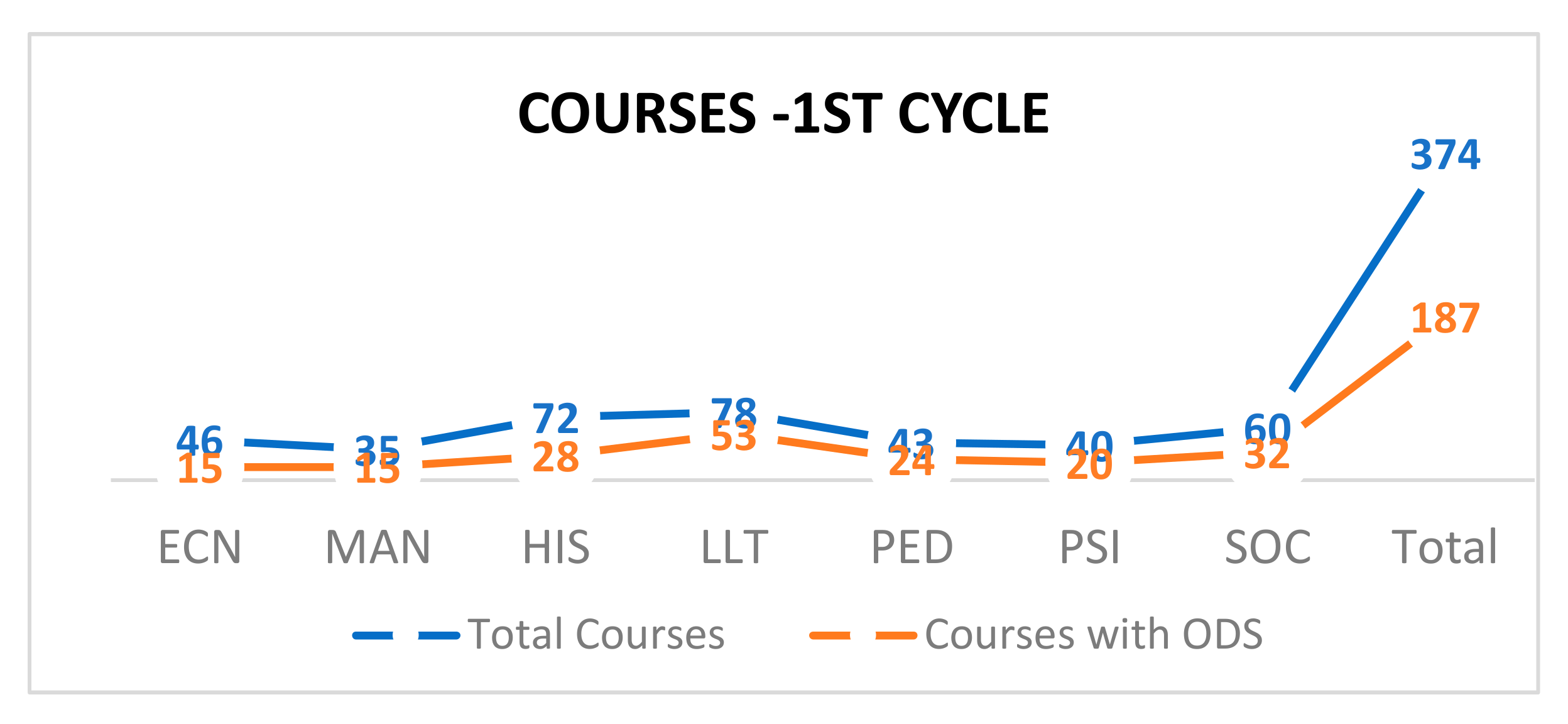
We can see in Figure 2 that for the overall curriculum units (374) only half (187) have a SDG marked in addition to SDG4.
Figure 2.
Curricular units with enrolled students and SDGs marked by department.
The analysis by department indicates that in the Department of Economics (ECN), SDGs were pointed out in 32.6% of the curricular units, in the Department of Management (MAN) 42.9%, in the Department of History (HIS) 38.9%, in the Department of Languages and Literatures (LLT) 67.9%, in the Department of Pedagogy and Education (PED) 55.8%, in the Department of Psychology (PSI) 50% and in the Department of Sociology (SOC) 53.3%.
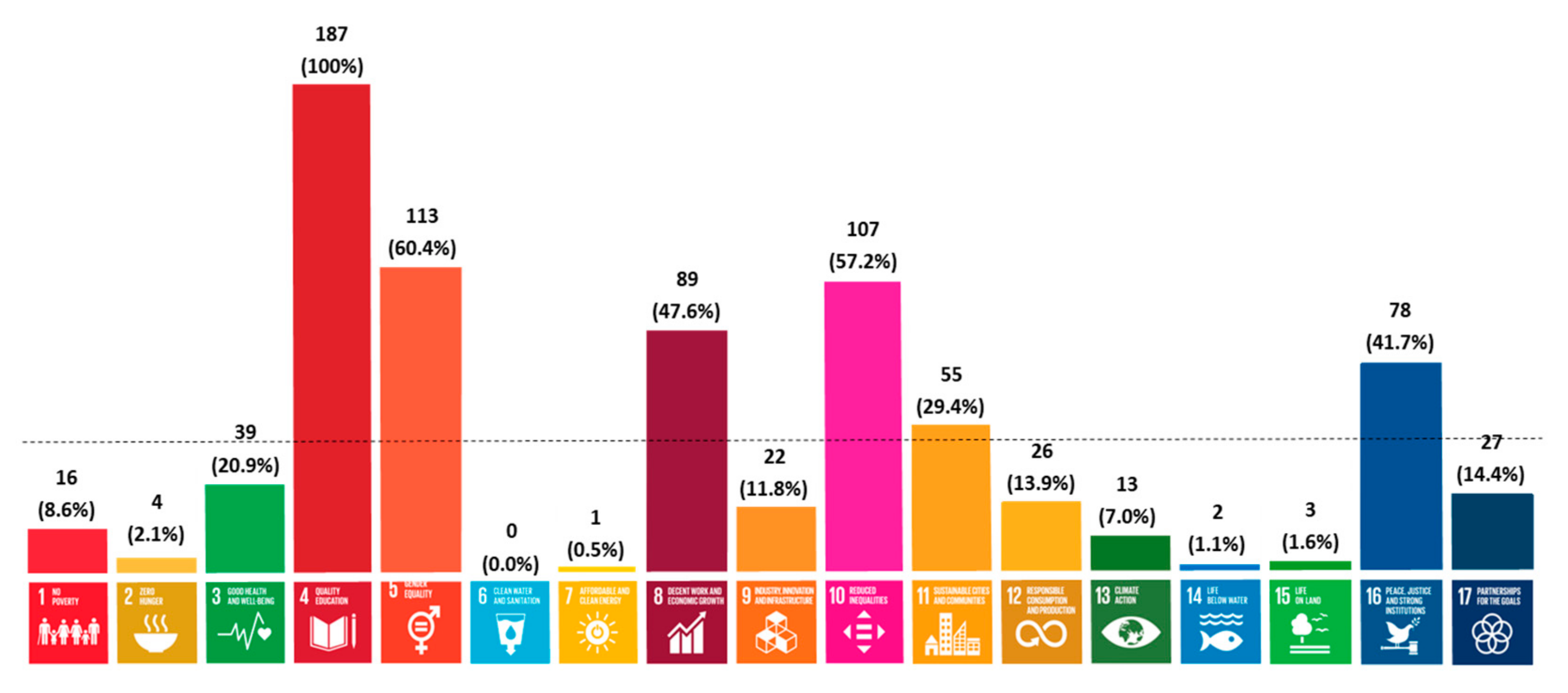
In the 187 curricular units, as we can see in Figure 3, beyond Goal 4, Goal 5—Gender Equality (64%) and Goal 10—Reduced Inequalities (57.2%) were the most identified. This was followed by Goal 8—Decent Work and Economic Growth (47.6%), Goal 16—Peace, Justice and Strong Institutions (41.7%), Goal 11—Sustainable Cities and Communities (29.4%) and Goal 3—Good Health and Well-Being (20.9%). All other SDGs were less identified (percentages below 15%), except for Goal 6—Clean Water and Sanitation, which was not identified in any courses.
Figure 3.
Sustainable Development Goals in the School of Social Sciences.
3.2. Differences between the SDGs Marked in the Different Departments
Considering the hypotheses H0, “there are no differences between the SDGs marked by teachers in each Department” the results point to its rejection.
The analysis of variance performed (one-way ANOVA) showed the existence of significant differences between the departments in SDG 1, 2, 3, 5, 8, 9, 10, 11, 12, 16 and 17 as we can see in Table 3.
Table 3.
Analysis of differences in SDG between departments (ANOVA).
We found statistically significant differences when considering the departments in SDG 1 (F = 3.73; p < 0.05) most marked in the Departments of Economics, Psychology and Sociology. In relation to SDG 2 (F = 4.73; p = 0.000) the differences indicate a greater presence in the Departments of Economics and Languages and Literature. SDG 3 (F = 9.95; p = 0.000) is more present in the curriculum units of the Departments of Pedagogy and Education, Psychology and Sociology. In the case of SDG 5 (F = 12.0; p = 0.000) it is more present in the curriculum units of the Departments of Languages and Literatures, Psychology and Sociology. SDG 8 (F = 3.52; p < 0.05), SDG 10 (F = 2.67; p < 0.05), SDG 11 (F = 4.98; p = 0.001) and SDG 16 (F = 6.46; p = 0.000) are more marked in the Departments of History, Languages and Literature and Sociology. SDG 9 (F = 3.12; p < 0.05) and SDG 12 (F = 4.21; p = 0.001) are more present in the curriculum units of the Departments of Economics and Management. Finally, SDG 17 (F = 2.53; p < 0.05) is more present in the Management, History and Languages and Literature course units.
Therefore, it can be seen that these results are in line with Portugal’s strategic priorities, given that most of the SDGs identified correspond to the country’s strategic development vision, as mentioned in [18]. This shows the fact that a significant number of teachers of the Social Science School of the University of Évora recognise the importance of mapping the SDGs in their subjects, ensuring that all students can acquire the knowledge and skills necessary to respond and promote sustainable development, as mentioned in [18,19,20,21].
4. Final Considerations
The overall conclusion of this work is that, despite the appeal of the University leaders, only half of the curriculum units have been marked with a SDG. This does not mean, of course, that the professors of the various departments are not interested in achieving the objectives of sustainable development. The confinement that teachers and students were forced into in mid-March 2020 due to the pandemic meant that teachers had to change quickly from face-to-face to online teaching. It is possible that this adaptation became central to their concerns, relegating other tasks to second place, one of them being the signposting of the most relevant SDG in the course units under their responsibility. Although research in the field of technology has already produced tools aimed at new ways of learning and teaching [30], the training of university teachers in this field has remained incipient. In any case, this transition from face-to-face classes to online teaching was not the execution of a well-laid plan, but an inevitability, implemented effortfully by everyone involved. The fact that this year is totally atypical may explain the lower uptake of the task even in a context where the need for global cooperation has become so evident. Against this background, the institution could create a new opportunity for reflection on the importance of sustainable development and the need for each member of the academy to become more involved in achieving the goals of the 2030 Agenda for Sustainable Development.
The results showed that the most notable objectives in the curriculum units as a whole were SDG 5—Gender Equality, and Goal 10—Reduced Inequalities, aspects that teachers in the School of Social Sciences consider to be able to work from the curricular units for which they are scientifically responsible. Also highlighted were Goal 8—Decent Work and Economic Growth and Goal 16—Peace, Justice and Strong Institutions. Less mentioned were Goal 11—Sustainable Cities and Communities and Goal 3—Good Health and Well-Being. All other SGDs were less represented and Goal 6—Clean Water and Sanitation was not identified in any courses.
These results can be explained by the nature of the curriculum units, but also by the greater attention of teachers to the accentuation of inequalities, the rise in unemployment, and the possibility of another economic crisis when they are still aware of the impact of the latter, aspects which have been aggravated by the pandemic. Furthermore, the heightened global conflict may have influenced teachers’ selection of SGD.
With regard to differences between departments, they reveal that different areas focus on different aspects of sustainable development. While the Departments of Economics and Management report more on Decent Work and Economic Growth, the other departments highlight the objectives related to gender and other inequalities.
In short, it is safe to guarantee that practically all SDGs are present in the mapping under analysis in the disciplines of the seven departments of the School of Social Sciences of the University of Évora, despite the fact that in some cases there is a limited presence. It is also clear that the shortage of SDGs recorded is probably not related to the fact that teachers neglect SDGs, but due to the lack of time, given the volume of work they have been involved in in recent months due to the pandemic crisis.
It should be noted that the present work is an indicative contribution, and not an exhaustive analysis, seeking to reflect specifically on the mapping of the SDGs in one of the four schools of the University of Évora. However, the analysis we are developing is the beginning of a long journey towards raising awareness of the challenges of promoting sustainable development now and in the future.
One of the greatest limits of the present work is that it only portrays the reality of an institution. Nevertheless, it shows that there is much to be done at university level to promote the SDGs and that it will be necessary to involve the various sectors of the institution in addition to the teachers for more coordinated and interdisciplinary work. In this way it will be possible to expect some impact on the level of student learning so that it can effectively move towards sustainability.
Author Contributions
Conceptualization, E.C. and M.S.; methodology, E.C. and F.L.; software, E.C.; validation, E.C., I.F. and A.B.; formal analysis, E.C.; investigation, E.C. and F.L.; resources, E.C.; data curation, E.C.; writing—original draft preparation, E.C. and M.S.; writing—review and editing, E.C. and M.S.; visualization, I.F., F.L. and A.B.; supervision, E.C.; project administration, E.C.; funding acquisition, E.C. All authors have read and agreed to the published version of the manuscript.
Funding
This research was funded by Fundação para a Ciência e a Tecnologia, grant number PTDC/CED-EDG/29252/2017.
Institutional Review Board Statement
Not applicable.
Informed Consent Statement
Not applicable.
Data Availability Statement
The data presented in this study are available on request from the corresponding author. The data are not available to the public due they are on the University’s intranet platform with limited access to members of the institution.
Conflicts of Interest
The authors declare no conflict of interest.
References
- Pisani, J.A. Sustainable development–historical roots of the concept. Environ. Sci. 2006, 3, 83–96. [Google Scholar] [CrossRef]
- WCED. Our Common Future; WCER Report; WCED: New York, NY, USA, 1987; Available online: https://sustainabledevelopment.un.org/content/documents/5987our-common-future.pdf (accessed on 22 December 2020).
- Adams, W. The Future of Sustainability: Re-Thinking Environment and Development in the Twenty-First Century; World Conservation Union: Gland, Switzerland, 2006. [Google Scholar]
- Talloires Declaration. Talloires Declaration of University Leaders for a Sustainable Future; 1990; Available online: http://ulsf.org/wp-content/uploads/2015/06/TD.pdf (accessed on 15 December 2020).
- Figueiró, P. Raufflet, Emmanuel, Sustainability in Higher Education: A systematic review with focus on management education. J. Clean. Prod. 2015, 106, 22–33. [Google Scholar] [CrossRef]
- Association of Commonwealth Universities; Agence Universitaire de la Francophonie; International Association of Universities. Higher Education’s Essential Contribution to the SDGs. Available online: https://www.iau-hesd.net/sites/default/files/iauacuauf_statementhigher-education_s-essential-contribution-to-the-sdgs.pdf (accessed on 7 February 2021).
- Leal Filho, W.; Shiel, C.; Paço, A.; Mifsud, M.; Ávila, L.V.; Brandli, L.L.; Molthan-Hill, P.; Pace, P.; Azeiteiro, U.M.; Vargas, V.R.; et al. Sustainable Development Goals and sustainability teaching at universities: Falling behind or getting ahead of the pack? J. Clean. Prod. 2019, 232, 285–294. [Google Scholar] [CrossRef]
- Bautista-Cerro Ruiz, M.J.; Díaz González, M.J. La sostenibilidad en los grados universitarios: Presencia y coherencia. Teoría Educ. Rev. Interuniv. 2017, 29. [Google Scholar] [CrossRef]
- Lindsey, T.C. Sustainable principles: Common values for achieving sustainability. J. Clean. Prod. 2011, 19, 561–565. [Google Scholar] [CrossRef]
- Stepanyan, K.; Littlejohn, A.; Margaryan, A. Sustainable e-Learning: Toward a Coherent Body of Knowledge. Educ. Technol. Soc. 2013, 16, 91–102. [Google Scholar]
- Yolles, M.; Fink, G. The Sustainability of Sustainability. Bus. Syst. Rev. 2014, 3, 1–32. [Google Scholar] [CrossRef]
- Barbosa, G.; Drach, P.; Corbella, O. A Conceptual Review of the Terms Sustainable Development and Sustainability. Int. J. Soc. Sci. 2014, III, 1–15. [Google Scholar]
- Seager, T. The Sustainability Spectrum and the Sciences of Sustainability. Bus. Strategy Environ. 2008, 17, 444–453. [Google Scholar] [CrossRef]
- Eurostat. Sustainable Development in the European Union—Monitoring Report on Progress towards the SDGs in an EU Context; Publications Office of the European Union: Luxembourg, 2017; Available online: https://ec.europa.eu/eurostat/web/products-statistical-books/-/KS-02-20-202 (accessed on 26 January 2021).
- UNRIC. Guia Sobre Desenvolvimento Sustentável: 17 Objetivos Para Transformar o Nosso Mundo; Centro de Informação Regional das Nações Unidas para a Europa Ocidental: Lisboa, Portugal, 2016; Available online: https://www.cidadaniaemportugal.pt/wp-content/uploads/recursos/Guia_sobre_Desenvolvimento_Sustentavel.pdf (accessed on 26 January 2021).
- European Commission. Next Steps for a Sustainable European Future; European Commission: Strasbourg, France, 2016. [Google Scholar]
- United Nations. Transforming Our World: The 2030 Agenda for Sustainable Development; United Nations: New York, NY, USA, 2016; Available online: https://sdgs.un.org/2030agenda (accessed on 27 December 2020).
- MNE. Relatório Nacional Sobre a Implementação da Agenda 2030 para o Desenvolvimento Sustentável, por Ocasião da Apresentação Nacional Voluntária no Fórum Político de Alto Nível das Nações Unidas; Ministério dos Negócios Estrangeiros: Lisboa, Portugal, 2017. Available online: https://www.cig.gov.pt/wp-content/uploads/2017/07/Portugal2017.pdf (accessed on 26 January 2021).
- Leicht, A.; Heiss, J.; Byun, J. Issues and Trends in Education for Sustainable Development; Education on the Move; UNESCO: Paris, France, 2018. [Google Scholar]
- UNESCO. Education for Sustainable Development Goals-Learning Objectives; UNESCO: Paris, France, 2017; Available online: https://unesdoc.unesco.org/ark:/48223/pf0000247444 (accessed on 26 January 2021).
- SDSN General Assembly. The Role of Higher Education to Foster Sustainable Development: Practices, Tools and Solutions; Position Paper; SDSN General Assembly: New York, NY, USA, 2017; Available online: https://www.sdsn-mediterranean.unisi.it/wp-content/uploads/sites/30/2017/08/Testo-positional-CON-FIG-1.pdf (accessed on 7 February 2021).
- SDSN Australia/Pacific. Getting Started with the SDGs in Universities: A Guide for Universities, Higher Education Institutions, and the Academic Sector; Australia, New Zealand and Pacific Edition; Sustainable Development Solutions Network–Australia/Pacific: Melbourne, Australia, 2017. [Google Scholar]
- Annan-Diab, F.; Molinari, C. Interdisciplinarity: Practical approach to advancing education for sustainability and for the Sustainable Development Goals. Int. J. Manag. Educ. 2017, 15, 73–83. Available online: https://doi.org/10.1016/j.ijme.2017.03.006 (accessed on 26 January 2021). [CrossRef]
- Sáez de Cámara, E.; Fernández, I.; Castillo-Eguskitza, N. A Holistic Approach to Integrate and Evaluate Sustainable Development in Higher Education. The Case Study of the University of the Basque Country. Sustainability 2021, 13, 392. [Google Scholar] [CrossRef]
- Saitua-Iribar, A.; Corral-Lage, J.; Peña-Miguel, N. Improving Knowledge about the Sustainable Development Goals through a Collaborative Learning Methodology and Serious Game. Sustainability 2020, 12, 6169. [Google Scholar] [CrossRef]
- Niedlich, S.; Bauer, M.; Doneliene, M.; Jaeger, L.; Rieckmann, M.; Bormann, I. Assessment of sustainability governance in higher education institutions—A systemic tool using a governance equalizer. Sustainability 2020, 12, 1816. [Google Scholar] [CrossRef]
- Leal Filho, W.; Wu, Y.C.J.; Brandli, L.L.; Avila, L.V.; Azeiteiro, U.M.; Caeiro, S.; Madruga, L.R.D.R.G. Identifying and overcoming obstacles to the implementation of sustainable development at universities. J. Integr. Environ. Sci. 2017, 14, 93–108. [Google Scholar] [CrossRef]
- Zamora-Polo, F.; Sánchez-Martín, J.; Corrales-Serrano, M.; Espejo-Antúnez, L. What do university students know about sustainable development goals? A realistic approach to the reception of this UN program amongst the youth population. Sustainability 2019, 11, 3533. [Google Scholar] [CrossRef]
- Zamora-Polo, F.; Sánchez-Martín, J. Teaching for a better world. Sustainability and sustainable development goals in the construction of a change-maker university. Sustainability 2019, 11, 4224. [Google Scholar] [CrossRef]
- Rapanta, C.; Botturi, L.; Goodyear, P.; Guàrdia, L.; Koole, M. Online university teaching during and after the Covid-19 crisis: Refocusing teacher presence and learning activity. Postdigital Sci. Educ. 2020, 2, 923–945. [Google Scholar] [CrossRef]
Publisher’s Note: MDPI stays neutral with regard to jurisdictional claims in published maps and institutional affiliations. |
© 2021 by the authors. Licensee MDPI, Basel, Switzerland. This article is an open access article distributed under the terms and conditions of the Creative Commons Attribution (CC BY) license (http://creativecommons.org/licenses/by/4.0/).