Delineating an Integrated Ecological and Cultural Corridor Network: A Case Study in Beijing, China



Abstract
1. Introduction
2. Materials and Methods
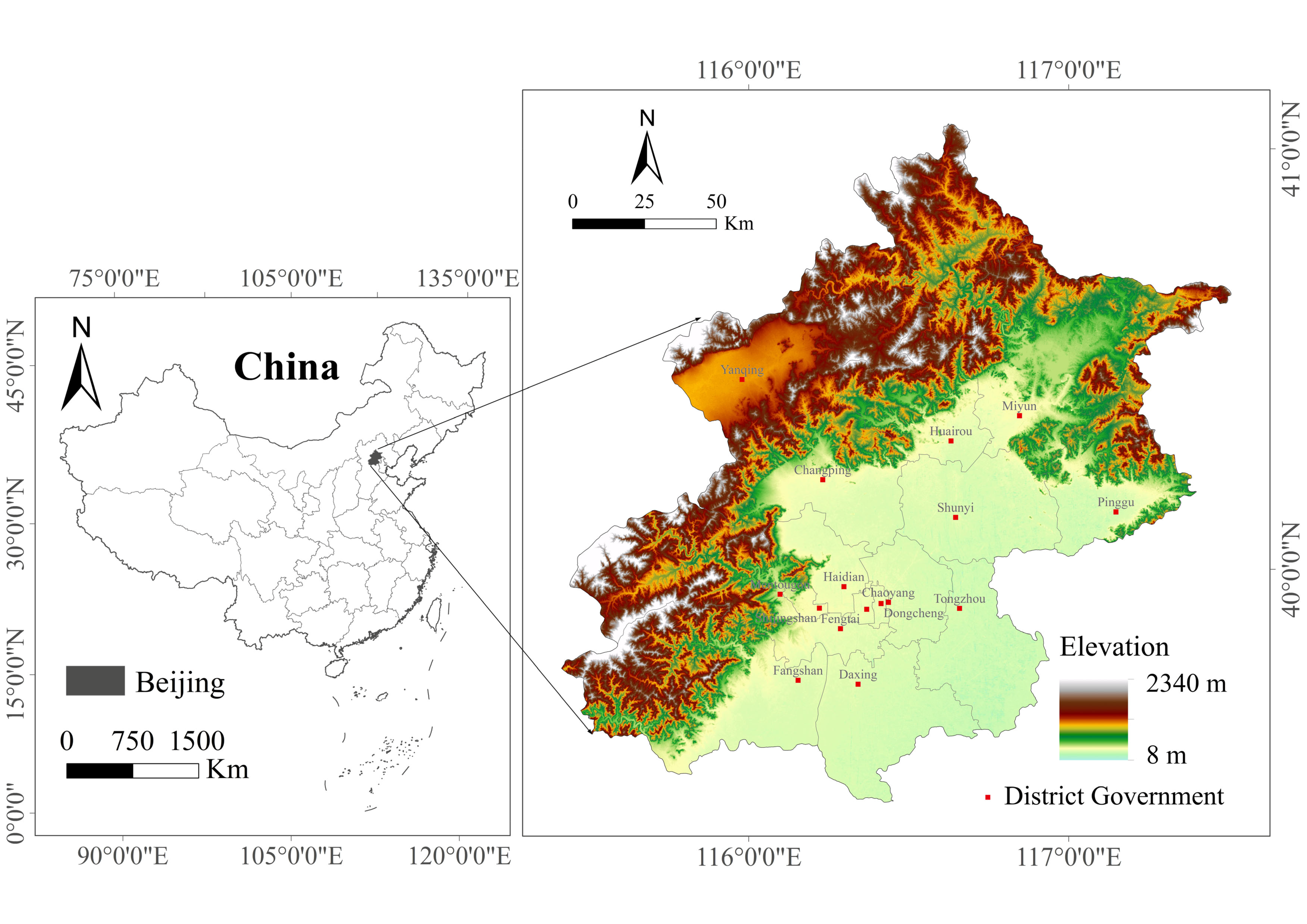
2.1. Study Area
2.2. Data and Data Sources
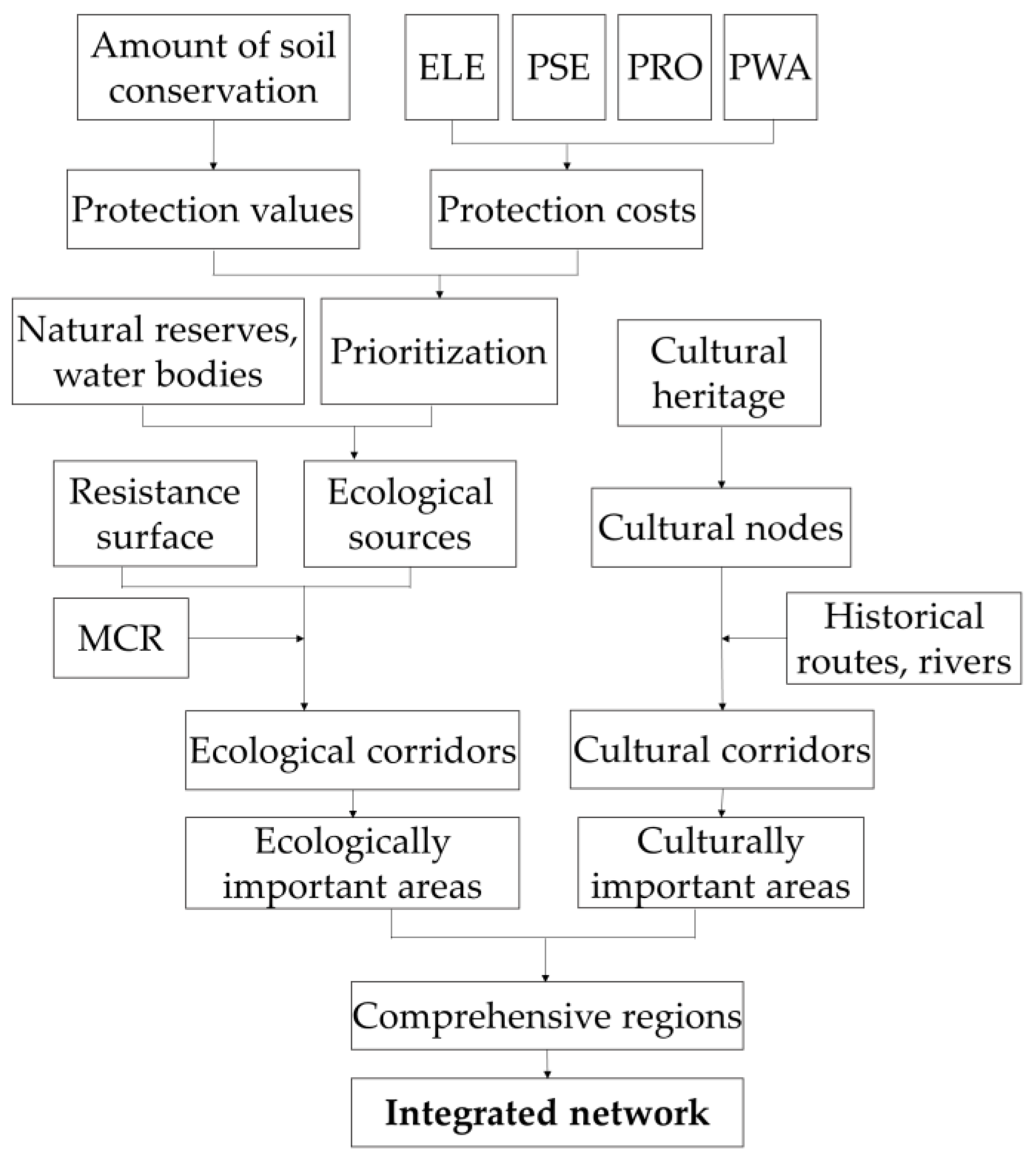
2.3. Methodological Framework
2.4. Delineation of Ecological Corridors
2.4.1. Identification of Ecological Sources
- (1)
- R represents the erosivity factor (MJ∙mm∙ha−1∙h−1∙year−1), which is calculated by monthly precipitation and annual precipitation.where Pi (mm) is the average precipitation of month i and P (mm) represents the multi-year average precipitation. We converted punctuated weather station data into raster data using the inverse distance weighted (IDW) tool in ArcGIS 10.5.
- (2)
- K represents the soil erodibility factor calculated from the soil content (t∙h∙MJ−1∙mm−1).where SAN, SIL, CLA, and orgC represent the proportion of sand, silt, clay, and organic carbon in the soil respectively, SN1 = 1 − SAN/100.
- (3)
- L represents the slope length factor.where λ is slope length, m is slope length index, and θ is slope measured in percentage.
- (4)
- S represents the slope steepness factor.
- (5)
- C is the vegetation cover management factor.where c is vegetation coverage, and NDVIsoil and NDVIveg are the values of NDVI when the confidence level is 5% and 95%, respectively.
- (6)
- P is the support practices factor, which is a ratio of the soil loss with a conservation practice to soil loss from straight-row farming up and down the slope [39]. We used a P factor value of 1 in the study.
2.4.2. Delineation of Ecological Corridors
2.5. Delineation of Cultural Corridors
2.5.1. Identification of Cultural Nodes
2.5.2. Delineation of Cultural Corridors
2.6. Delineation of the Integrated Network
3. Results
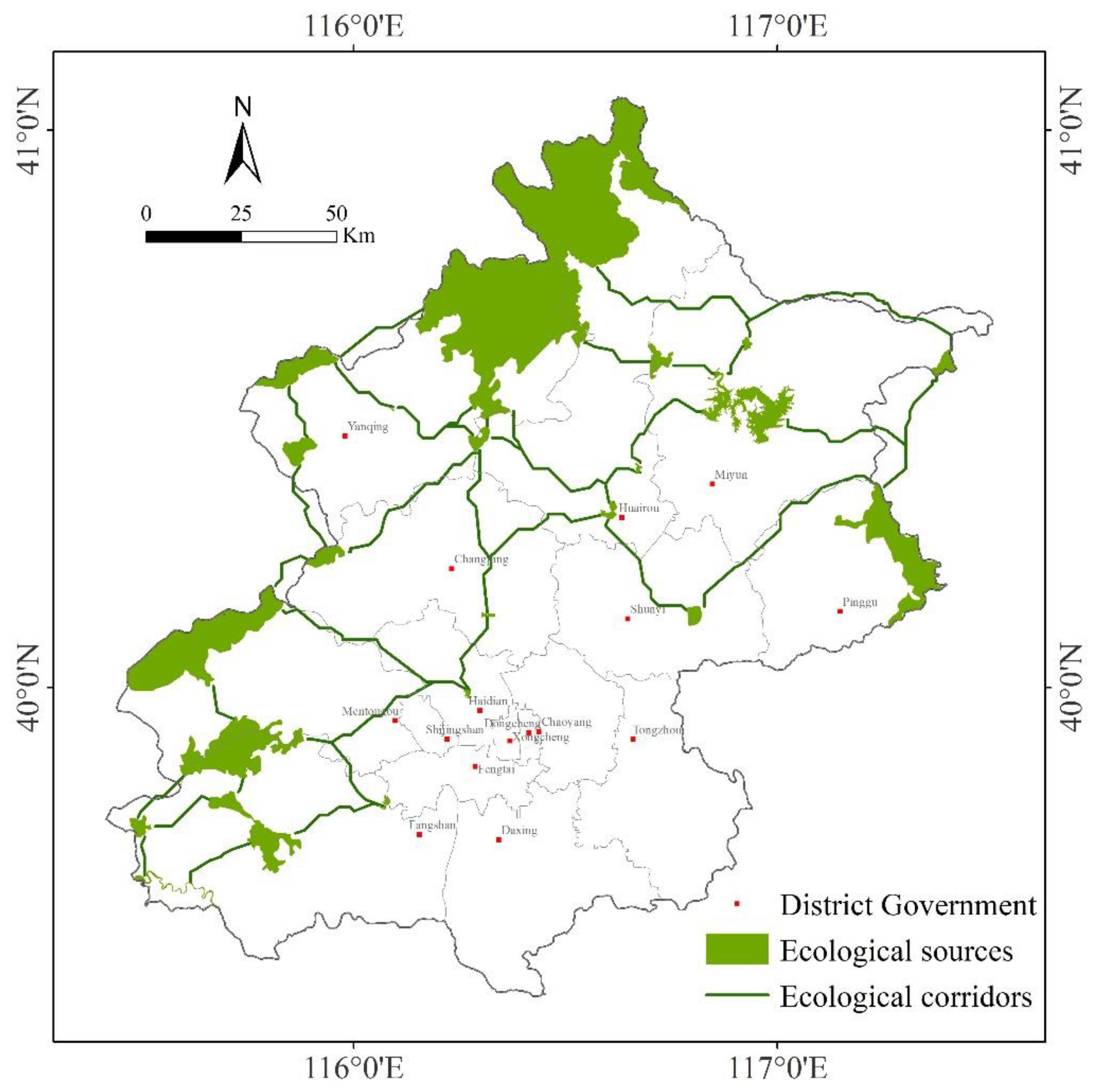
3.1. Ecological Sources and Ecological Corridors
3.1.1. Ecological Sources
3.1.2. Ecological Corridors
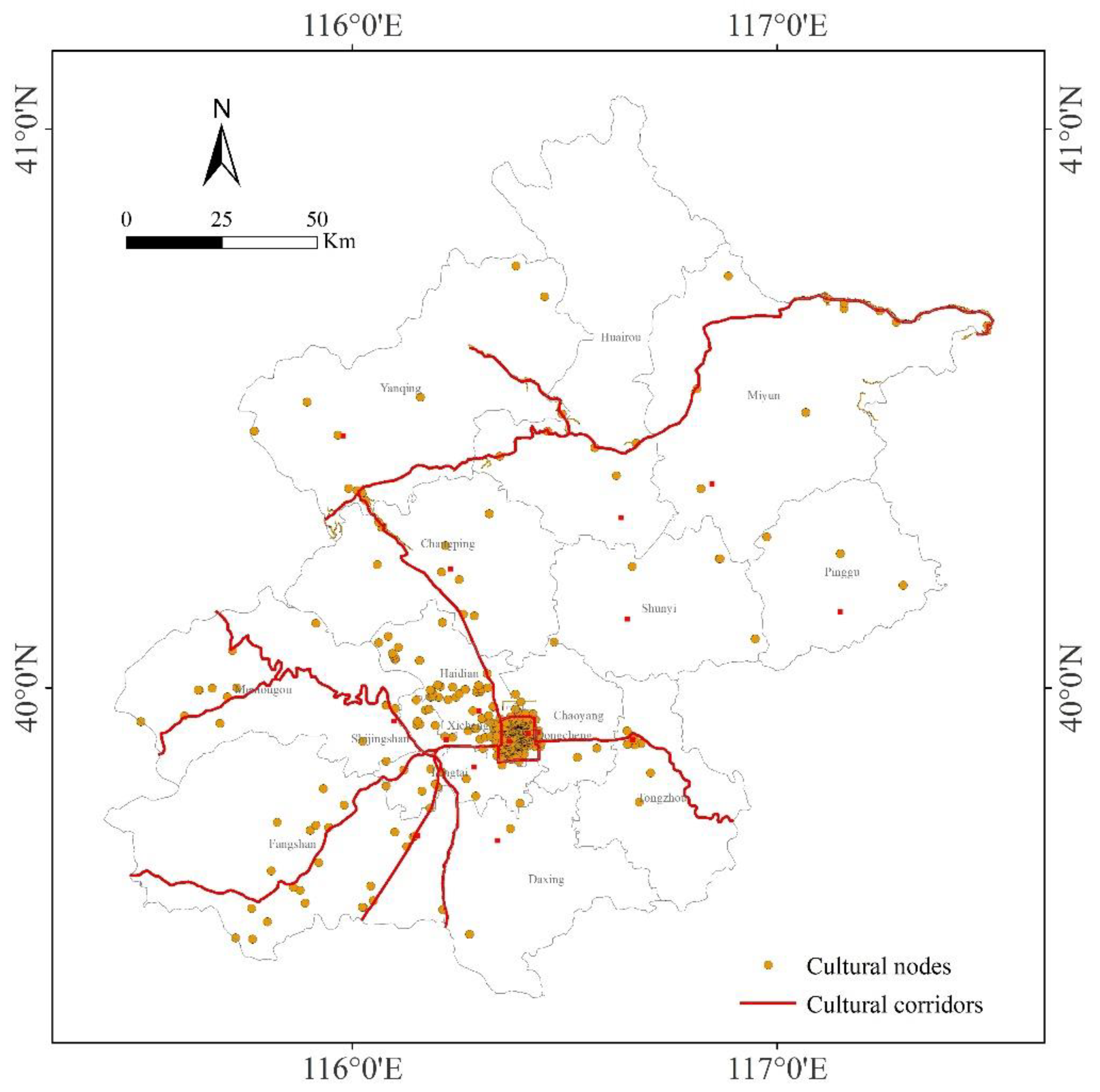
3.2. Cultural Nodes and Cultural Corridors
3.2.1. Cultural Nodes
3.2.2. Cultural Corridors
- (1)
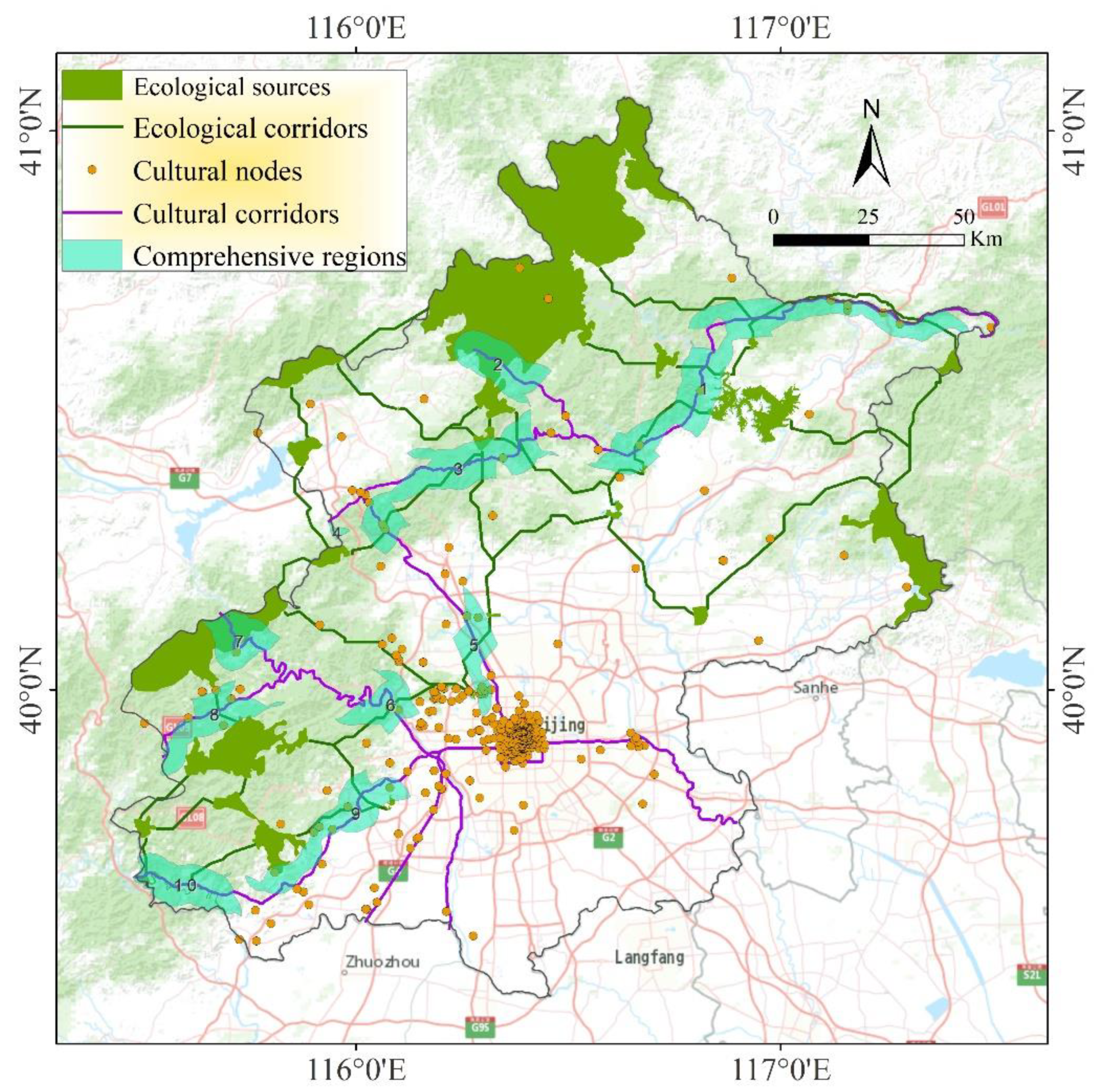
- The central district cultural corridor is bounded by the second ring road, which encloses 32.93% of Beijing’s cultural heritage. There are many cultural nodes in the area along the corridor, which has a large population. Visits to the heritage sites are more frequent than in other cultural corridor areas. At the same time, the impact from outside is greater and protection is more difficult.
- (2)
- The Great Wall cultural corridor extends along the ridgeline of the northern exurbs from west to northeast and covers famous heritage sites such as Badaling, Juyong Pass, Mutianyu, and Simatai. The development of the related cultural industry has promoted economic development and environmental protection in the area.
- (3)
- The Yongding-Qingshui River cultural corridor is mainly in the Mentougou District, extending from the south to the source of the Yongding River and its tributary, Qingshui River. The rich history in this corridor has led to numerous ancient villages and buildings being located there. The cultural corridor plays an important role in promoting the ancient capital, improving the ecological environment, and providing recreational space.
- (4)
- The Grand Canal cultural corridor extends from the city center to Hebei province, along which there are Huitong River, Tonghui River, Wanning bridge, and Dongbuya bridge. As the longest canal in the world, the Grand Canal has played an important role in the cultural and economic development and exchange between the north and the south of China. It was granted World Heritage site status in 2014.
- (5)
- The Beijing–Guangzhou line cultural corridor along the Beijing–Guangzhou railroad to Hebei province begins in the city center. It is an ancient recreational route. There are numerous cultural nodes in the vicinity of the corridor, such as Lugou bridge, Liangxiang tower, and Liuli River bridge.
- (6)
- The Beijing–Taiyuan line cultural corridor along the Beijing–Taiyuan railroad to Hebei province also originates in the city center. It is an ancient recreational route. Famous heritage sites along the cultural corridor include the Peking Man Site at Zhoukoudian, Tantuo temple, and Yao Guangxiao grave.
- (7)
- The Beijing–Baotou line cultural corridor is one of the imperial roads from the Ming Dynasty and Qing Dynasty. It starts from the city center and extends along the Beijing–Baotou railroad to the Badaling Great Wall and Ming Tombs. Famous heritage sites along the cultural corridor include the Beijing–Zhangjiakou Railway and Juyong Pass.
3.3. The Integrated Network
4. Discussion
5. Conclusions
Author Contributions
Funding
Institutional Review Board Statement
Informed Consent Statement
Data Availability Statement
Acknowledgments
Conflicts of Interest
Appendix A

| Data Name | Data Source |
|---|---|
| Digital Elevation Model (DEM) | Geospatial Data Cloud site, Computer Network Information Center, Chinese Academy of Sciences. (http://www.gscloud.cn) |
| Land cover data (2018) Roads (2018) Water bodies (2018) NDVI (2018) | International Scientific & Technical Data Mirror Site, Computer Network Information Center, Chinese Academy of Sciences. (http://www.resdc.cn) |
| Monthly average meteorological data (1980–2017) | China Meteorological Administration (http://cdc.nmic.cn/home.do) |
| Soil data | Cold and Arid Regions Sciences Data Center at Lanzhou (http://westdc.westgis.ac.cn) |
| Nature reserves (to 2017) | Beijing Municipal Environmental Protection Bureau (http://www.bjepb.gov.cn/bjhrb/index/index.html) |
| Cultural heritages (to 2019) | State Administration of Cultural Heritage (http://www.sach.gov.cn/) |
| Name | Main Protection Objects | Type |
|---|---|---|
| Song mountain | Wild animals, such as golden eagle, natural oil pine forest | Forest ecosystem |
| Baihua Mountain | Temperate secondary forest, such as brown eared pheasant, arethusa and Dahurian larch | Forest ecosystem |
| Labagoumen | Natural secondary forest | Forest ecosystem |
| Wild duck lake | Wetland and migratory bird | Wetland |
| Yunmeng Mountain | Secondary forest | Forest ecosystem |
| Yunfeng Mountain | Secondary Pinus Tabulaeformis | Forest ecosystem |
| Wuling mountain | Valuable and rare animals and plants, natural secondary forests and typical forest ecosystems. | Forest ecosystem |
| Sizuolou | Natural secondary forest and national protected plants (wild soybean, Amur corktree, tilia amurensis and Acanthopanax) | Forest ecosystem |
| Yudu mountain | Forest and wild animals and plants | Forest ecosystem |
| Lianhua mountain | Wild animals and plants | Forest ecosystem |
| Datan | Natural secondary forest and wild animals and plants | Forest ecosystem |
| Jinniu lake | Wetland | Wetland |
| Baihebao | Water conservation forest | Forest ecosystem |
| Taian mountain | Forest and wild animals and plants | Forest ecosystem |
| Shuitou | Forest and wild animals and plants | Forest ecosystem |
| Puwa | Forest ecosystem | Forest ecosystem |
| Hanshiqiao | Wetland and migratory bird | Wetland |
| Juma river | Aquatic wildlife, such as Giant salamander | Wetland |
| Huaisha and Huaijiu river | Aquatic wildlife, such as Giant salamander, needle-mackerel and mandarin duck | Wetland |
| Shihuadong | Karst caverns | Geological heritage |
| Chaoyang temple | Fossil wood | Geological heritage |
| Number | Name | Level |
|---|---|---|
| 1 | Ancient Cliff Dwelling Site | Beijing Municipal |
| 2 | Anti-Japanese War Sites of Yuzi Mountain | Beijing Municipal |
| 3 | Architectural Heritage of Beijing Normal University | Beijing Municipal |
| 4 | Architectural Heritage of Leshan Park | Beijing Municipal |
| 5 | Architecture Remains of Daci Yanfu Palace | Beijing Municipal |
| 6 | Architecture Remains of Nations’ Affairs Office | Beijing Municipal |
| 7 | Back Hall of Capital City Temple | Beijing Municipal |
| 8 | Bai Yihua Martyr Cemetery | Beijing Municipal |
| 9 | Baipu Temple | Beijing Municipal |
| 10 | Baoguo Temple and Gu Tinglin Temple | Beijing Municipal |
| 11 | Beiguan Dragon Temple | Beijing Municipal |
| 12 | Beihai, Tuancheng | Beijing Municipal |
| 13 | Beijia Park | Beijing Municipal |
| 14 | Beijing Babaoshan Revolutionary Cemetery | Beijing Municipal |
| 15 | Beijng Newspaper Museum | Beijing Municipal |
| 16 | Bi Xia Yuanjun Temple Site of Yahuan Mountain | Beijing Municipal |
| 17 | Cai Yuanpei’s Former Residence | Beijing Municipal |
| 18 | Changxindian “Twenty-seven” Revolutionary Sites | Beijing Municipal |
| 19 | Chaozhong Bridge | Beijing Municipal |
| 20 | Charity Temple | Beijing Municipal |
| 21 | Chen Duxiu’s Former Residence | Beijing Municipal |
| 22 | Cheng Yanqiu’s Former Residence | Beijing Municipal |
| 23 | Chengze Park | Beijing Municipal |
| 24 | Chinese Episcopal Church | Beijing Municipal |
| 25 | Church of St. Michael | Beijing Municipal |
| 26 | Clay City Site at Caizhuang | Beijing Municipal |
| 27 | Coloured Glaze Factory of the Ministry of Works of Qing Dynasty | Beijing Municipal |
| 28 | Confucius Temple | Beijing Municipal |
| 29 | Congress of the Republic of China | Beijing Municipal |
| 30 | Cross-Street Building of Sanguan Pavilion | Beijing Municipal |
| 31 | Cuandixia Ancient Residential village | Beijing Municipal |
| 32 | Da Park | Beijing Municipal |
| 33 | De Shoutang Pharmacy | Beijing Municipal |
| 34 | Diaoyutai and Yangyuan Temple | Beijing Municipal |
| 35 | Dinghui Temple | Beijing Municipal |
| 36 | Dongsi Mosque | Beijing Municipal |
| 37 | DongYue Temple | Beijing Municipal |
| 38 | Dongyue Temple, Shangzhuang | Beijing Municipal |
| 39 | Doudian Clay City | Beijing Municipal |
| 40 | Drama Stage of Anhui Guide Hall | Beijing Municipal |
| 41 | Drama Stage of Yangping Guide Hall | Beijing Municipal |
| 42 | Early Buildings of Beijing Hotel | Beijing Municipal |
| 43 | Eight Sites of Xishan Mountain | Beijing Municipal |
| 44 | Fanzi Stone Inscription | Beijing Municipal |
| 45 | Female Normal College of Former National Beiping University | Beijing Municipal |
| 46 | Fire God Temple of Huashi | Beijing Municipal |
| 47 | Fomer Site of Continential Bank (Beijing) | Beijing Municipal |
| 48 | Forked Road City | Beijing Municipal |
| 49 | Former Furen Univeisity | Beijing Municipal |
| 50 | Former Peking Union Medical College | Beijing Municipal |
| 51 | Former Sino-France University | Beijing Municipal |
| 52 | Former Site of American Embassy | Beijing Municipal |
| 53 | Former Site of Austrian Embassy | Beijing Municipal |
| 54 | Former Site of Bank of Communications | Beijing Municipal |
| 55 | Former Site of Bank of Gold | Beijing Municipal |
| 56 | Former Site of Banque Indosuez (Beijing) | Beijing Municipal |
| 57 | Former Site of Baoshang Bank | Beijing Municipal |
| 58 | Former Site of Bazaar | Beijing Municipal |
| 59 | Former Site of Beijing Origin | Beijing Municipal |
| 60 | Former Site of Belgian Embassy | Beijing Municipal |
| 61 | Former Site of Branch College of Beijing Normal University | Beijing Municipal |
| 62 | Former Site of British Embassy | Beijing Municipal |
| 63 | Former Site of Central Bank | Beijing Municipal |
| 64 | Former site of China Geology Investigation Institute | Beijing Municipal |
| 65 | Former Site of Chinese Bible Society | Beijing Municipal |
| 66 | Former Site of Citibank | Beijing Municipal |
| 67 | Former Site of Duan Qirui Government | Beijing Municipal |
| 68 | Former Site of Dutch Embassy | Beijing Municipal |
| 69 | Former Site of Exhibition Hall of Geology, Beijing University | Beijing Municipal |
| 70 | Former Site of French Embassy | Beijing Municipal |
| 71 | Former Site of French Post Office | Beijing Municipal |
| 72 | Former Site of General Post Office of the Qing Dynasty | Beijing Municipal |
| 73 | Former Site of Japanese Embassy | Beijing Municipal |
| 74 | Former Site of Jiaoshi Building and Baiyou Building of Fuyu Female School | Beijing Municipal |
| 75 | Former Site of Nanyuan Army Headquarters | Beijing Municipal |
| 76 | Former Site of North Telephone Subexchang of Beiping | Beijing Municipal |
| 77 | Former Site of Notre Dame French School | Beijing Municipal |
| 78 | Former Site of Salt Industry Bank | Beijing Municipal |
| 79 | Former Site of Tongzhou Army | Beijing Municipal |
| 80 | Former site of work study program in France in Chang Xindian | Beijing Municipal |
| 81 | Former Site of Zhengyangmen East Station of Beijing Fengtian Railway | Beijing Municipal |
| 82 | Former Teaching Building of Luhe Middle School | Beijing Municipal |
| 83 | Fuguo Street Quadrangle, Xicheng District | Beijing Municipal |
| 84 | Fusheng Temple | Beijing Municipal |
| 85 | Fuyou Temple | Beijing Municipal |
| 86 | Girderless Pavilion | Beijing Municipal |
| 87 | Glacial Striae | Beijing Municipal |
| 88 | Gold Hall of Huguo Temple | Beijing Municipal |
| 89 | Gonghua City | Beijing Municipal |
| 90 | Gonghua Palace | Beijing Municipal |
| 91 | Gongjian Ice Cellar | Beijing Municipal |
| 92 | Great Hall of Lingyan Temple | Beijing Municipal |
| 93 | Guangfu Temple | Beijing Municipal |
| 94 | Guanghua Temple | Beijing Municipal |
| 95 | Guangji Bridge | Beijing Municipal |
| 96 | Heilong Pool and Longwang Temple | Beijing Municipal |
| 97 | Heping Temple | Beijing Municipal |
| 98 | Hongluo Temple | Beijing Municipal |
| 99 | House at East Imperial Root South Street, Dongcheng District | Beijing Municipal |
| 100 | House at North Buzong Hutong, Dongcheng District | Beijing Municipal |
| 101 | House at Weijia Hutong, Dongcheng District | Beijing Municipal |
| 102 | Huguang Guide Hall | Beijing Municipal |
| 103 | Huixian Hall | Beijing Municipal |
| 104 | Hunan Guide Hall | Beijing Municipal |
| 105 | Huoshen Temple | Beijing Municipal |
| 106 | Imperial Ancestral Temple | Beijing Municipal |
| 107 | Imperial City Wall Site | Beijing Municipal |
| 108 | Imperial College Street | Beijing Municipal |
| 109 | Jade Emperor Tower | Beijing Municipal |
| 110 | Ji Xiaolan’s Former Residence | Beijing Municipal |
| 111 | Jiaolao Tai | Beijing Municipal |
| 112 | Jiemin Hall | Beijing Municipal |
| 113 | Jinghua Publishing House | Beijing Municipal |
| 114 | Jingming Park | Beijing Municipal |
| 115 | Jingyi Park (Xiangshan Moutain) | Beijing Municipal |
| 116 | Jintai Academy | Beijing Municipal |
| 117 | Jiufeng Seismic Station | Beijing Municipal |
| 118 | Juesheng Temple | Beijing Municipal |
| 119 | Kang Youwei’s Former Residence | Beijing Municipal |
| 120 | Lao She’s Former Residence | Beijing Municipal |
| 121 | Lejia Garden | Beijing Municipal |
| 122 | Li Dazhao’s Former Residence | Beijing Municipal |
| 123 | Liangxiang Tower | Beijing Municipal |
| 124 | Lingzhao Temple | Beijing Municipal |
| 125 | Liuyang Guide Hall | Beijing Municipal |
| 126 | Long’an Temple | Beijing Municipal |
| 127 | Longquan Temple of Bailong Pool | Beijing Municipal |
| 128 | Lotus Pool | Beijing Municipal |
| 129 | Lu Xun’s Former Residence | Beijing Municipal |
| 130 | Lumi Warehouse | Beijing Municipal |
| 131 | Lvzu Pavilion | Beijing Municipal |
| 132 | Main Building of Beijng Library | Beijing Municipal |
| 133 | Main Building of Italian Embassy Site | Beijing Municipal |
| 134 | Mansion of Beile Tao | Beijing Municipal |
| 135 | Mansion of Crown Prince of Ning County | Beijing Municipal |
| 136 | Mansion of Crown Prince of Shuncheng County | Beijing Municipal |
| 137 | Mansion of King Chun | Beijing Municipal |
| 138 | Mansion of King Fu | Beijing Municipal |
| 139 | Mansion of King Heng | Beijing Municipal |
| 140 | Mansion of King Li | Beijing Municipal |
| 141 | Mansion of King Qing | Beijing Municipal |
| 142 | Mansion of King Seng | Beijing Municipal |
| 143 | Mansion of King Zheng | Beijing Municipal |
| 144 | Mansion of Princess Hejing | Beijing Municipal |
| 145 | Mao Dun’s Former Residence | Beijing Municipal |
| 146 | Martyr Li Dazhao cemetery | Beijing Municipal |
| 147 | Mei Lanfang’s Former Residence | Beijing Municipal |
| 148 | Memorial of Sun Yat Sen’s Death | Beijing Municipal |
| 149 | Monument to the Luanzhou Uprising | Beijing Municipal |
| 150 | Monument to the Martyrs who Died in the Anti-Japanese War in Wanping County | Beijing Municipal |
| 151 | Nangangwa Bridge | Beijing Municipal |
| 152 | Niangniang Temple of North Peak | Beijing Municipal |
| 153 | Nianhua Temple | Beijing Municipal |
| 154 | Ninghe Temple | Beijing Municipal |
| 155 | Niujie Street Mosque | Beijing Municipal |
| 156 | No.36 Fuxue Hutong, Dongcheng District | Beijing Municipal |
| 157 | No.63–65 Quadrangle, Dongsiliutiao, Dongcheng District | Beijing Municipal |
| 158 | North Guide Hall of Tingzhou, Fujian | Beijing Municipal |
| 159 | North New Warehouse | Beijing Municipal |
| 160 | Old Messuage | Beijing Municipal |
| 161 | Old Style Shops | Beijing Municipal |
| 162 | Public Elder Longevity Tower | Beijing Municipal |
| 163 | Publishing Factory Site of Ministry of Finance of the Republic of China | Beijing Municipal |
| 164 | Puzhao Temple | Beijing Municipal |
| 165 | Qi Baishi’s Former Residence | Beijing Municipal |
| 166 | Qinghe Hancheng Site | Beijing Municipal |
| 167 | Qingyin Pavilion of Yunhui Building | Beijing Municipal |
| 168 | Randeng Tower | Beijing Municipal |
| 169 | Remains of Mansion of Zhaohui | Beijing Municipal |
| 170 | Remains of the School Department in Qing Dynasty | Beijing Municipal |
| 171 | Residence Group of Union Hospital | Beijing Municipal |
| 172 | Riverside City and Enemy Platform | Beijing Municipal |
| 173 | Rong Tomb Site at Yuhuangmiao Mountain | Beijing Municipal |
| 174 | Ruins of Shang, Zhou Dynasty at Liu Lihe | Beijing Municipal |
| 175 | Sansheng Temple | Beijing Municipal |
| 176 | Shangzhai Cultural Site | Beijing Municipal |
| 177 | Shaoxing Guide Hall | Beijing Municipal |
| 178 | Sheng Pingshu Drama Stage | Beijing Municipal |
| 179 | Shifang Buddists Tower | Beijing Municipal |
| 180 | Shijia Hutong, Dongcheng District | Beijing Municipal |
| 181 | Shuanglin Temple | Beijing Municipal |
| 182 | Shuiguan Great Wall | Beijing Municipal |
| 183 | Shuntian State-run School | Beijing Municipal |
| 184 | Shuqu Square Stele of Zhengyang Bridge | Beijing Municipal |
| 185 | Sibei Temple, Tao ranting | Beijing Municipal |
| 186 | No.11 Quadrangle, Neiwubu Street, Dongcheng District | Beijing Municipal |
| 187 | No.11 Quadrangle, Xisibei 3, Xicheng District | Beijing Municipal |
| 188 | No.129 Quadrangle, Lishi Hutong, Dongcheng District | Beijing Municipal |
| 189 | No.13,15 Quadrangle, Fangjia Hutong, Dongcheng District | Beijing Municipal |
| 190 | No.15 Quadrangle, Qian Gongyong Hutong, Xicheng District | Beijing Municipal |
| 191 | No.19 Quadrangle, Xisibei 3, Xicheng District | Beijing Municipal |
| 192 | No.2 Quadrangle, Guoxiang Hutong, Dongcheng District | Beijing Municipal |
| 193 | No.20 Quadrangle, Xinkai Road, Chongwen District | Beijing Municipal |
| 194 | No.23 Quadrangle, Xisibei Avenue 6, Xicheng District | Beijing Municipal |
| 195 | No.7,9 Quadrangle, Back Yuan’en Temple Street, Dongcheng District | Beijing Municipal |
| 196 | No.15 Quadrangle and its Tile Carving, Dongmianhua Hutong, Dongcheng District | Beijing Municipal |
| 197 | No.25 Quadrangle, Art Museum East Street, Dongcheng District | Beijing Municipal |
| 198 | No.153 Quadrangle, Di’anmenxi Avenue, Xicheng District | Beijing Municipal |
| 199 | No.93 Quadrangle, Fuchengmennei Street, Xicheng District | Beijing Municipal |
| 200 | No.255 Quadrangle, Gulou East Avenue, Dongcheng District | Beijing Municipal |
| 201 | No.13 Quadrangle, Heizhima Hutong, Dongcheng District | Beijing Municipal |
| 202 | No.5 Quadrangle, Maoer Hutong, Dongcheng District | Beijing Municipal |
| 203 | No.7,9 Quadrangle, Qiangulouyuan Hutong, Dongcheng District | Beijing Municipal |
| 204 | No.7,9 Quadrangle, Qianyongkang Hutong, Dongcheng District | Beijing Municipal |
| 205 | No.15 Quadrangle, Shajing Hutong, Dongcheng District | Beijing Municipal |
| 206 | Quadrangle, Xijiaominxiang Street 87, Beixinhua Street 112, Xicheng District | Beijing Municipal |
| 207 | No.25–37 Quadrangle, Xitangzi Hutong, Dongcheng District | Beijing Municipal |
| 208 | Site of Chinese Communist Delegation of the Ministry of Military Transfer in 1946 | Beijing Municipal |
| 209 | Site of European and American students’ Association | Beijing Municipal |
| 210 | Site of Hebei-Rehe-Chahaer Advance Army Commander’s Headquarter of Eight Route Army | Beijing Municipal |
| 211 | Site of Taiye Pool at the Mid-capital of the Kin Dynasty | Beijing Municipal |
| 212 | Site of the Farmer and Worker Bank of China | Beijing Municipal |
| 213 | Site of Tuanhe Palace | Beijing Municipal |
| 214 | Site of Xizhi Men Station of Pingsui | Beijing Municipal |
| 215 | Sites of Bai Fuquan | Beijing Municipal |
| 216 | Sites of Da Baotai Tombs of Western Han Dynasty | Beijing Municipal |
| 217 | Songzhu Temple and Zhizhu Temple | Beijing Municipal |
| 218 | South Mansion of King Chun | Beijing Municipal |
| 219 | South New Warehouse | Beijing Municipal |
| 220 | Southeastern Corner Tower of the City | Beijing Municipal |
| 221 | Stage and Guandi Temple at Huapen Village | Beijing Municipal |
| 222 | Stone Buddha in Baishui Temple | Beijing Municipal |
| 223 | Stone Sculptures of Yi Sanga | Beijing Municipal |
| 224 | Temple of Empress of Fengtai | Beijing Municipal |
| 225 | Temples and Yunshui Cave at Shangfang Moutain | Beijing Municipal |
| 226 | The Bell Tower | Beijing Municipal |
| 227 | The Chairman Mao Memorial Hall | Beijing Municipal |
| 228 | The Drum Tower | Beijing Municipal |
| 229 | The Former Chartered Bank | Beijing Municipal |
| 230 | The Front of Former Site of Qian Xiangyi | Beijing Municipal |
| 231 | The Front of Former Site of Rui Fuxiang | Beijing Municipal |
| 232 | The Front of Quanjude Roast Duck | Beijing Municipal |
| 233 | The Great Hall of Pudu Temple | Beijing Municipal |
| 234 | The Great Hall of Shuntian Mansion | Beijing Municipal |
| 235 | The Interior Office of Inspecting the Imperial Government in Qing Dynasty | Beijing Municipal |
| 236 | The Land Altar (Zhongshan Park) | Beijing Municipal |
| 237 | The Remains of Beijing City Wall in Ming Dynasty | Beijing Municipal |
| 238 | The statue of Wei Taihe | Beijing Municipal |
| 239 | The Tenth Hotel at Grain Shop Street | Beijing Municipal |
| 240 | Three Eighteen Martyr Monument | Beijing Municipal |
| 241 | Tianli Coal Factory Site | Beijing Municipal |
| 242 | Tiewa Temple | Beijing Municipal |
| 243 | Tomb of Crown Prince of Fu County | Beijing Municipal |
| 244 | Tomb of Laoshan of Han Dynasty | Beijing Municipal |
| 245 | Tomb of Li Zhuowu | Beijing Municipal |
| 246 | Tomb of Liang Qichao | Beijing Municipal |
| 247 | Tomb of Sunyue | Beijing Municipal |
| 248 | Tomb of Tianyi | Beijing Municipal |
| 249 | Tomb, Stele and Status of Zhan Tianyou | Beijing Municipal |
| 250 | Tombs of Lu Huixiang’s Family | Beijing Municipal |
| 251 | Tombs of Soldiers and Men Killed in the Battle of Gubeikou | Beijing Municipal |
| 252 | Tongyun Bridge and Remains of Zhang Jiawan City Wall | Beijing Municipal |
| 253 | Tongzhou Mosque | Beijing Municipal |
| 254 | Tower of Zen Master Wuai | Beijing Municipal |
| 255 | Tuancheng Fortress | Beijing Municipal |
| 256 | Tucheng | Beijing Municipal |
| 257 | Wanning Bridge | Beijing Municipal |
| 258 | Waterworks of Qing Dynasty | Beijing Municipal |
| 259 | Weiming Lake District, Former Yanjing University | Beijing Municipal |
| 260 | Wofo Temple | Beijing Municipal |
| 261 | Wuta Tower | Beijing Municipal |
| 262 | Xianliang Temple | Beijing Municipal |
| 263 | Xianying Temple | Beijing Municipal |
| 264 | Xihuang Temple | Beijing Municipal |
| 265 | Xishiku Church | Beijing Municipal |
| 266 | Xiuyun Temple | Beijing Municipal |
| 267 | Xuanren Temple | Beijing Municipal |
| 268 | Xuechi Ice Cellar | Beijing Municipal |
| 269 | Xuhua Pavilion and Song Hall | Beijing Municipal |
| 270 | Yandun | Beijing Municipal |
| 271 | Yang Jiaoshan Temple | Beijing Municipal |
| 272 | Yaowang Temple of Fengtai | Beijing Municipal |
| 273 | Yinshan Tower | Beijing Municipal |
| 274 | Yiyuan Park | Beijing Municipal |
| 275 | Yongning Catholic Church | Beijing Municipal |
| 276 | Yuansheng Palace | Beijing Municipal |
| 277 | Yun Tai | Beijing Municipal |
| 278 | Yuqian Temple | Beijing Municipal |
| 279 | Zhao Tower | Beijing Municipal |
| 280 | Zhaoxian Temple | Beijing Municipal |
| 281 | Zhengyang Gate and Arrow tower | Beijing Municipal |
| 282 | Zhengyi Temple | Beijing Municipal |
| 283 | Zhongshan Guide Hall | Beijing Municipal |
| 284 | Zhou Jixiang Tower | Beijing Municipal |
| 285 | Zhu Yizhun’s Former Residence | Beijing Municipal |
| 286 | Cuandixia Village, Zhaitang Town | National |
| 287 | Gubeikou Town | National |
| 288 | Jiaozhuanghu Village, Longwantun Town | National |
| 289 | Lingshui Village, Zhaitang Town | National |
| 290 | Liuliqu Village, Longquan Town | National |
| 291 | Shuiyu Village, Nanjiao Town | National |
| 292 | Ancient Building Group in Cuandixia Village | National |
| 293 | Ancient Cliff Dwelling in Yanqing | National |
| 294 | Ancient Weather Station | National |
| 295 | Anhui Guide Hall | National |
| 296 | Badaling Great Wall | National |
| 297 | Baiyun Temple | National |
| 298 | Baoguo Temple | National |
| 299 | Beihai and Tuancheng | National |
| 300 | Beijing Bell Tower, Drum Tower | National |
| 301 | Beijing City Walls of the Ming Dynasty | National |
| 302 | Beijing Huguang Guide Hall | National |
| 303 | Biyun Temple | National |
| 304 | Bolin Temple | National |
| 305 | Bridge of Liuli River | National |
| 306 | Buddists Hall, Stone Inscription and Tower of Kongshui Cave | National |
| 307 | Changchun Temple | National |
| 308 | Cheng’en Temple | National |
| 309 | Chinese Episcopal Church | National |
| 310 | Chongli Residence | National |
| 311 | Church of Xi Shiku | National |
| 312 | Cishou Temple Tower | National |
| 313 | Commerce Building in Dashila Area | National |
| 314 | Confucius Temple | National |
| 315 | Da Gaoxuan Hall | National |
| 316 | Dahui Temple | National |
| 317 | Dajue Temple | National |
| 318 | Desheng Gate Archery Tower | National |
| 319 | Dongyue Temple, Beijing | National |
| 320 | Duobao Buddist Tower of Liangxiang | National |
| 321 | Early Architectures inTshinghua Univeisity | National |
| 322 | East Hall | National |
| 323 | Embassy Architecture Group of Dongjiaominxiang | National |
| 324 | Fahai Temple | National |
| 325 | Fayuan Temple | National |
| 326 | Former Site of Agricultural Experimental Farm of Qing Dynasty | National |
| 327 | Former Site of Beijing Branch of China Bible Church | National |
| 328 | Former Site of Beijing Female Normal College | National |
| 329 | Former Site of Beijing Parliament | National |
| 330 | Former Site of Beiping Library | National |
| 331 | Former Site of Branch College of Beijing Normal University | National |
| 332 | Former Site of Exhibition Hall of Geology, Beijing University | National |
| 333 | Former Site of Main Campus of Furen University | National |
| 334 | Former Site of National Mongolian Tibetan School | National |
| 335 | Former Site of Peking Union Medical College | National |
| 336 | Former Site of Radio 491 | National |
| 337 | Former Sites of Shengxin Middle School and Youzhen Female Middle School | National |
| 338 | Former Sites of the Army and Navy Departments of the Qing Dynasty | National |
| 339 | Gate of Heavenly Peace | National |
| 340 | Guangji Temple | National |
| 341 | Guanyue Temple | National |
| 342 | Guide Hall of Sun Yat-sen | National |
| 343 | Guo Moruo’s Former Residence | National |
| 344 | Imperial Ancestral Temple | National |
| 345 | Imperial Archives | National |
| 346 | Imperial College | National |
| 347 | Jianruiying Martial Arts Hall | National |
| 348 | Jiaozhuanghu Tunnel Battle Site | National |
| 349 | Jietai Temple | National |
| 350 | Jingming Park | National |
| 351 | Juesheng Temple | National |
| 352 | Ke Park | National |
| 353 | Li Dazhao’s Former Residence | National |
| 354 | Lingyue Temple | National |
| 355 | Lu Xun’s Former Residence in Beijing | National |
| 356 | Lugou Bridge | National |
| 357 | Mansion of Crown Prince of Keqin County | National |
| 358 | Mansion of King Chun | National |
| 359 | Mansion of King Fu | National |
| 360 | Mei Lanfang’s Former Residence | National |
| 361 | Memorial Park of Luanzhou Uprising of Xinhai Year | National |
| 362 | Modern Bank Building Group in Xijiaominxiang | National |
| 363 | Modern School Buildings Group in Tongzhou | National |
| 364 | Moke Temple | National |
| 365 | Mout Jing | National |
| 366 | Nankou-Badaling Section of Jing-Zhang Raiway | National |
| 367 | Niujie Street Mosque | National |
| 368 | Peking Man Site at Zhoukoudian | National |
| 369 | Prince Gong’s Mansion and Park | National |
| 370 | Publishing House Site of Ministry of Finance of the Republic of China | National |
| 371 | Pudu Temple | National |
| 372 | Qingjinghuacheng Tower | National |
| 373 | Red Building in Peking University | National |
| 374 | Remains of Great-Capital City Wall of Yuan Dynasty | National |
| 375 | Shangzhai Site | National |
| 376 | Shifang Pujue Temple | National |
| 377 | Shuangqing Villa | National |
| 378 | Shuiguan Site of the Mid-Capital of the Kin Dynasty | National |
| 379 | Simatai Section of Great Wall | National |
| 380 | Site of Jinling | National |
| 381 | Site of Liuli River | National |
| 382 | Site of Old Summer Palace | National |
| 383 | Site of Shizi Temple | National |
| 384 | Song Qingling Children’s Science and Technology Museum | National |
| 385 | Song Qingling’s Former Residence in Beijing | National |
| 386 | South Hall | National |
| 387 | Southeastern Corner Tower of the Beijing City | National |
| 388 | Staiton Building of Beijng Railway Station | National |
| 389 | Summer Palace | National |
| 390 | Tantuo Temple | National |
| 391 | Temple of Heaven | National |
| 392 | Temple of the Moon | National |
| 393 | Temple of the Past-Ages Emperors | National |
| 394 | Temple of Wen Tianxiang | National |
| 395 | The Altar to the Sun | National |
| 396 | The Forbidden City | National |
| 397 | The Lama Temple | National |
| 398 | The Land Altar | National |
| 399 | The Ming Tombs | National |
| 400 | The Site of Atomic Energy | National |
| 401 | The Site of the Two-Seven Strike in Changxindian | National |
| 402 | The Monument to the People’s Heroes | National |
| 403 | Tianning Temple Tower | National |
| 404 | Tomb and Temple of Yuan Chonghuan | National |
| 405 | Tomb of Jingtai | National |
| 406 | Tomb of King Chun | National |
| 407 | Tombs of Matteo Ricci and Foreign Missionaries of Ming, Qing Dynasties | National |
| 408 | Wanshou Temple | National |
| 409 | Wansong Elder Tower | National |
| 410 | White Tower of Miaoying Temple | National |
| 411 | Wuta Temple Tower | National |
| 412 | Xiannong Altar | National |
| 413 | Yanyuan Buildings of Weiming Lake | National |
| 414 | Yao Guangxiao Tomb Tower | National |
| 415 | Yasili Hall | National |
| 416 | Yinshan Forest of Pagodas | National |
| 417 | Yun Terrace in Juyong Pass | National |
| 418 | Yunju Temple Tower and Stone Scripture of Fangshan | National |
| 419 | Zhengang Tower | National |
| 420 | Zhengyang Gate | National |
| 421 | Zhihua Temple | National |
| 422 | Zhizhu Temple | National |
| 423 | Zhong Nan Hai | National |
References
- Fang, C.; Yu, D. Urban agglomeration: An evolving concept of an emerging phenomenon. Landsc. Urban Plan. 2017, 162, 126–136. [Google Scholar] [CrossRef] [Scilit]
- Nations, U. Growing at a Slower Pace, World Population is Expected to Reach 9.7 Billion in 2050 and Could Peak at Nearly 11 Billion around 2100. Available online: https://www.un.org/development/desa/en/news/population/world-population-prospects-2019.html (accessed on 23 March 2020).
- Li, Y.; Li, Y.; Zhou, Y.; Shi, Y.; Zhu, X. Investigation of a coupling model of coordination between urbanization and the environment. J. Environ. Manag. 2012, 98, 127–133. [Google Scholar] [CrossRef] [Scilit] [PubMed]
- Gunawardhana, L.N.; Kazama, S.; Kawagoe, S. Impact of Urbanization and Climate Change on Aquifer Thermal Regimes. Water Resour. Manag. 2011, 25, 3247–3276. [Google Scholar] [CrossRef] [Scilit]
- Breuste, J.; Qureshi, S.; Li, J. Applied urban ecology for sustainable urban environment. Urban Ecosyst. 2013, 16, 675–680. [Google Scholar] [CrossRef] [Scilit]
- Taylor, L.; Hochuli, D.F. Creating better cities: How biodiversity and ecosystem functioning enhance urban residents’ wellbeing. Urban Ecosyst. 2015, 18, 747–762. [Google Scholar] [CrossRef] [Scilit]
- Breuste, J.; Qureshi, S. Urban sustainability, urban ecology and the Society for Urban Ecology (SURE). Urban Ecosyst. 2011, 14, 313–317. [Google Scholar] [CrossRef] [Scilit]
- Wu, J. Urban sustainability: An inevitable goal of landscape research. Landsc. Ecol. 2010, 25, 1–4. [Google Scholar] [CrossRef] [Scilit]
- Wu, J. Landscape sustainability science: Ecosystem services and human well-being in changing landscapes. Landsc. Ecol. 2013, 28, 999–1023. [Google Scholar] [CrossRef] [Scilit]
- Assessment, M.E. Ecosystems and Human Well-Being: A Framework for Assessment; Island Press: Washington, DC, USA, 2003. [Google Scholar]
- Daily, G.C. Nature’s Services: Societal Dependence on Natural Ecosystems; Island Press: Washington, DC, USA, 1997. [Google Scholar]
- Costanza, R.; d’Arge, R.; de Groot, R.; Farber, S.; Grasso, M.; Hannon, B.; Limburg, K.; Naeem, S.; O’Neill, R.V.; Paruelo, J.; et al. The value of the world’s ecosystem services and natural capital. Nature 1997, 387, 253–260. [Google Scholar] [CrossRef] [Scilit]
- Nahlik, A.M.; Kentula, M.E.; Fennessy, M.S.; Landers, D.H. Where is the consensus? A proposed foundation for moving ecosystem service concepts into practice. Ecol. Econ. 2012, 77, 27–35. [Google Scholar] [CrossRef] [Scilit]
- Kubiszewski, I.; Costanza, R.; Anderson, S.; Sutton, P. The future value of ecosystem services: Global scenarios and national implications. Ecosyst. Serv. 2017, 26, 289–301. [Google Scholar] [CrossRef] [Scilit]
- Braat, L.C.; de Groot, R. The ecosystem services agenda:bridging the worlds of natural science and economics, conservation and development, and public and private policy. Ecosyst. Serv. 2012, 1, 4–15. [Google Scholar] [CrossRef] [Scilit]
- Costanza, R.; de Groot, R.; Sutton, P.; van der Ploeg, S.; Anderson, S.J.; Kubiszewski, I.; Farber, S.; Turner, R.K. Changes in the global value of ecosystem services. Glob. Environ. Chang. Part A Hum. Policy Dimens. 2014, 26, 152–158. [Google Scholar] [CrossRef] [Scilit]
- Wolff, S.; Schulp, C.J.E.; Verburg, P.H. Mapping ecosystem services demand: A review of current research and future perspectives. Ecol. Indic. 2015, 55, 159–171. [Google Scholar] [CrossRef] [Scilit]
- Zhang, L.; Peng, J.; Liu, Y.; Wu, J. Coupling ecosystem services supply and human ecological demand to identify landscape ecological security pattern: A case study in Beijing–Tianjin–Hebei region, China. Urban Ecosyst. 2017, 20, 701–714. [Google Scholar] [CrossRef] [Scilit]
- Xie, H.; Yao, G.; Liu, G. Spatial evaluation of the ecological importance based on GIS for environmental management: A case study in Xingguo county of China. Ecol. Indic. 2015, 51, 3–12. [Google Scholar] [CrossRef] [Scilit]
- Campolo, D.; Bombino, G.; Meduri, T. Cultural Landscape and Cultural Routes: Infrastructure Role and Indigenous Knowledge for a Sustainable Development of Inland Areas. Procedia-Soc. Behav. Sci. 2016, 223, 576–582. [Google Scholar] [CrossRef] [Scilit]
- Liang, J.; He, X.; Zeng, G.; Zhong, M.; Gao, X.; Li, X.; Li, X.; Wu, H.; Feng, C.; Xing, W.; et al. Integrating priority areas and ecological corridors into national network for conservation planning in China. Sci. Total Environ. 2018, 626, 22–29. [Google Scholar] [CrossRef] [Scilit]
- Hoppert, M.; Bahn, B.; Bergmeier, E.; Deutsch, M.; Epperlein, K.; Hallmann, C.; Mller, A.; Platz, T.V.; Reeh, T.; Stck, H.; et al. The Saale-Unstrut cultural landscape corridor. Environ. Earth Sci. 2018, 77, 58. [Google Scholar] [CrossRef] [Scilit]
- Oikonomopoulou, E.a.; Delegou, E.T.A.; Sayas, J.B.; Moropoulou, A.A. An innovative approach to the protection of cultural heritage: The case of cultural routes in Chios Island, Greece. J. Archaeol. Sci. Rep. 2017, 14, 742–757. [Google Scholar] [CrossRef] [Scilit]
- Pierik, M.; Dell’Acqua, M.; Confalonieri, R.; Bocchi, S.; Gomarasca, S. Designing ecological corridors in a fragmented landscape: A fuzzy approach to circuit connectivity analysis. Ecol. Indic. 2016, 67, 807–820. [Google Scholar] [CrossRef] [Scilit]
- Ye, H.; Yang, Z.; Xu, X. Ecological Corridors Analysis Based on MSPA and MCR Model—A Case Study of the Tomur World Natural Heritage Region. Sustainability 2020, 12, 959. [Google Scholar] [CrossRef] [Scilit]
- Lewis, P.H. Landscape Resources. In The Wisconsin Blue Book; Rupert, T.H., Ed.; Wisconsin Legislative Reference Bureau: Madison, WI, USA, 1964; pp. 130–142. [Google Scholar]
- Lee, J.A.; Chon, J.; Ahn, C. Planning Landscape Corridors in Ecological Infrastructure Using Least-Cost Path Methods Based on the Value of Ecosystem Services. Sustainability 2014, 6, 7564–7585. [Google Scholar] [CrossRef] [Scilit]
- Mossman, H.L.; Panter, C.J.; Dolman, P.M. Modelling biodiversity distribution in agricultural landscapes to support ecological network planning. Landsc. Urban Plan. 2015, 141, 59–67. [Google Scholar] [CrossRef] [Scilit]
- Shishmanova, M.V. Cultural Tourism in Cultural Corridors, Itineraries, Areas and Cores Networked. Procedia-Soc. Behav. Sci. 2015, 188, 246–254. [Google Scholar] [CrossRef] [Scilit]
- Xu, H.; Plieninger, T.; Primdahl, J. A Systematic Comparison of Cultural and Ecological Landscape Corridors in Europe. Land 2019, 8, 41. [Google Scholar] [CrossRef] [Scilit]
- Eiter, S.; Vik, M.L. Public participation in landscape planning: Effective methods for implementing the European Landscape Convention in Norway. Land Use Policy 2015, 44, 44–53. [Google Scholar] [CrossRef] [Scilit]
- Ahn, S.; Kim, S. Assessment of watershed health, vulnerability and resilience for determining protection and restoration Priorities. Environ. Model. Softw. 2019, 122, 103926. [Google Scholar] [CrossRef] [Scilit]
- Opdam, P.; Steingröver, E.; Rooij, S.V. Ecological networks: A spatial concept for multi-actor planning of sustainable landscapes. Landsc. Urban Plan. 2006, 75, 322–332. [Google Scholar] [CrossRef] [Scilit]
- Naidoo, R.; Balmford, A.; Ferraro, P.J.; Polasky, S.; Ricketts, T.H.; Rouget, M. Integrating economic costs into conservation planning. Trends Ecol. Evol. 2006, 21, 681–687. [Google Scholar] [CrossRef] [Scilit]
- Prahl, B.F.; Boettle, M.; Costa, L.; Kropp, J.P.; Rybski, D. Damage and protection cost curves for coastal floods within the 600 largest European cities. Sci. Data 2018, 5, 1–18. [Google Scholar] [CrossRef] [Scilit] [PubMed]
- Zhu, M.; Xi, X.; Hoctor, T.S.; Volk, M. Integrating conservation costs into sea level rise adaptive conservation prioritization. Glob. Ecol. Conserv. 2015, 4, 48–62. [Google Scholar] [CrossRef] [Scilit]
- Manhães, A.P.; Loyola, R.; Mazzochini, G.G.; Ganade, G.; Oliveira-Filho, A.T.; Carvalho, A.R. Low-cost strategies for protecting ecosystem services and biodiversity. Biol. Conserv. 2018, 217, 187–194. [Google Scholar] [CrossRef] [Scilit]
- Alexakis, D.D.; Hadjimitsis, D.G.; Agapiou, A. Integrated use of remote sensing, GIS and precipitation data for the assessment of soil erosion rate in the catchment area of “Yialias” in Cyprus. Atmos. Res. 2013, 131, 108–124. [Google Scholar] [CrossRef] [Scilit]
- Renard, K.G.; Foster, F.G.; Weesies, G.A.; McCool, K.K.; Yoder, D.C. Predicting Soil Loss Erosion by Water: A Guide to Conservation Planning with the Revised Universal Soil Loss Equation (RUSLE); US Government Printing Office: Washington, DC, USA, 1997.
- Yang, Z.; Wu, J. Conservation cost of China’s nature reserves and its regional distribution. J. Nat. Resour. 2019, 34, 839–852. [Google Scholar]
- Armsworth, P.R.; Cantú-Salazar, L.; Parnell, M.; Davies, Z.G.; Stoneman, R. Management costs for small protected areas and economies of scale in habitat conservation. Biol. Conserv. 2011, 144, 423–429. [Google Scholar] [CrossRef] [Scilit]
- Tao, G.; Ou, X.; Guo, Y.; Xu, Q.; Yu, Q.; Zhang, Z.; Wang, C. Priority area identification for vegetation in northwest Yunnan, based on protection value and protection cost. Acta Ecol. Sin. 2016, 36, 5777–5789. [Google Scholar]
- Huck, M.; Jędrzejewski, W.; Borowik, T.; Jędrzejewska, B.; Nowak, S.; Mysłajek, R.W. Analyses of least cost paths for determining effects of habitat types on landscape permeability: Wolves in Poland. Acta Theriol. 2011, 56, 91–101. [Google Scholar] [CrossRef] [Scilit]
- Knaapen, J.P.; Scheffer, M.; Harms, B. Estimating habitat isolation in landscape planning. Landsc. Urban Plan. 1992, 23, 1–16. [Google Scholar] [CrossRef] [Scilit]
- Gurrutxaga, M.; Rubio, L.; Saura, S. Key connectors in protected forest area networks and the impact of highways: A transnational case study from the Cantabrian Range to the Western Alps (SW Europe). Landsc. Urban Plan. 2011, 101, 310–320. [Google Scholar] [CrossRef] [Scilit]
- Hepcan, C.C.; Ozkan, M.B. Establishing ecological networks for habitat conservation in the case of Çeşme-Urla Peninsula, Turkey. Environ. Monit. Assess. 2011, 174, 157–170. [Google Scholar] [CrossRef] [Scilit] [PubMed]
- Yu, K.; Wang, S.; Li, D. Regional Ecological Security Patterns: The Beijing Case. Beijing: China; Architecture & Building Press: Beijing, China, 2012. [Google Scholar]
- UNESCO. What is Intangible Cultural Heritage? Available online: https://ich.unesco.org/en/what-is-intangible-heritage-00003/ (accessed on 15 November 2020).
- Bozic, S.; Tomic, N. Developing the Cultural Route Evaluation Model (CREM) and its application on the Trail of Roman Emperors. Tour. Manag. Perspect. 2016, 17, 26–35. [Google Scholar] [CrossRef] [Scilit]
- Xu, H.; Zhao, G.; Fagerholm, N.; Primdahl, J.; Plieninger, T. Participatory mapping of cultural ecosystem services for landscape corridor planning: A case study of the Silk Roads corridor in Zhangye, China. J. Environ. Manag. 2020, 264, 110458. [Google Scholar] [CrossRef] [Scilit] [PubMed]
- Zhu, Q.; Yu, K.; Li, D. The width of ecological corridor in landscape planning. Acta Ecol. Sin. 2005, 25, 2406–2412. [Google Scholar]
- Wu, J.; Li, X.; Long, N.; Xiao, J. Ecological Corridor Network Planning for Dense City Areas: A Case Study of Guangzhou Metropolitan Area. Mod. Urban Res. 2017, 2017, 61–67. [Google Scholar] [CrossRef]
- Fabos, J.G. Introduction and overview: The greenway movement, uses and potentials of greenways. Landsc. Urban Plan. 1995, 33, 1–13. [Google Scholar] [CrossRef] [Scilit]
- Li, L.; Shao, M.; Wang, S.; Li, Z. Preservation of earthen heritage sites on the Silk Road, northwest China from the impact of the environment. Environ. Earth Sci. 2011, 64, 1625–1639. [Google Scholar] [CrossRef] [Scilit]
- Peng, J.; Zhao, H.; Liu, Y. Urban ecological corridors construction: A review. Acta Ecol. Sin. 2017, 37, 23–30. [Google Scholar] [CrossRef] [Scilit]
- Smith, L. Uses of Heritage; Routeledge: London, UK; New York, NY, USA, 2006. [Google Scholar]
- Von Haaren, C.; Reich, M. The German way to greenways and habitat networks. Landsc. Urban Plan. 2006, 76, 7–22. [Google Scholar] [CrossRef] [Scilit]
- Manton, R.; Clifford, E. Identification and classification of factors affecting route selection of cycling routes in Ireland. Cycl. Res. Int. 2012, 3, 136–153. [Google Scholar]
- Ottomano Palmisano, G.; Loisi, R.V.; Ruggiero, G.; Rocchi, L.; Boggia, A.; Roma, R.; Dal Sasso, P. Using Analytic Network Process and Dominance-based Rough Set Approach for sustainable requalification of traditional farm buildings in Southern Italy. Land Use Policy 2016, 59, 95–110. [Google Scholar] [CrossRef] [Scilit]


| Land-Use Type | Resistance Coefficient (Rl) |
|---|---|
| Forest land | 1 |
| Grassland | 10 |
| Rivers and wetland | 20 |
| Reservoir | 30 |
| Farmland | 50 |
| Other land types | 80 |
| Developed land | 100 |
| Distance From Developed Land (m) | Resistance Coefficient (Rd) |
|---|---|
| 0~100 | 100 |
| 100~200 | 70 |
| 200~300 | 60 |
| 300~500 | 40 |
| 500~1000 | 30 |
| 1000~3000 | 10 |
| 3000~5000 | 5 |
| >5000 | 1 |
Publisher’s Note: MDPI stays neutral with regard to jurisdictional claims in published maps and institutional affiliations. |
© 2021 by the authors. Licensee MDPI, Basel, Switzerland. This article is an open access article distributed under the terms and conditions of the Creative Commons Attribution (CC BY) license (http://creativecommons.org/licenses/by/4.0/).
Share and Cite
Li, Y.; Wang, X.; Dong, X. Delineating an Integrated Ecological and Cultural Corridor Network: A Case Study in Beijing, China. Sustainability 2021, 13, 412. https://doi.org/10.3390/su13010412
Li Y, Wang X, Dong X. Delineating an Integrated Ecological and Cultural Corridor Network: A Case Study in Beijing, China. Sustainability. 2021; 13(1):412. https://doi.org/10.3390/su13010412
Chicago/Turabian StyleLi, Yanyan, Xinhao Wang, and Xiaofeng Dong. 2021. "Delineating an Integrated Ecological and Cultural Corridor Network: A Case Study in Beijing, China" Sustainability 13, no. 1: 412. https://doi.org/10.3390/su13010412
APA StyleLi, Y., Wang, X., & Dong, X. (2021). Delineating an Integrated Ecological and Cultural Corridor Network: A Case Study in Beijing, China. Sustainability, 13(1), 412. https://doi.org/10.3390/su13010412