

You are currently viewing a new version of our website. To view the old version click .
Sustainability
  • Article
  • Open Access

27 February 2020

Factors Affecting the Popularity of Video Content on Live-Streaming Services: Focusing on V Live, the South Korean Live-Streaming Service

and
Graduate School of Information, Yonsei University, Seoul 03772, Korea
*
Author to whom correspondence should be addressed.
This article belongs to the Special Issue Social Media Influence on Consumer Behaviour

Abstract

Naver V Live, a South Korean live-streaming service, showcases video contents specific to the entertainment industry, such as K-pop and music. On V Live, K-pop stars and their fans can interact directly in a natural way, and V Live provides high-quality video content with novel topics. This study has identified key characteristics of video content that affect its popularity. A total of 620 video contents of five leading Star channels were classified on the basis of production company, type of video content, and whether it was live-streamed or not. The popularity of video content was measured by the number of comments, hearts, and views. To control potential bias, additional variables were set as control variables—such as the number of channel subscribers, mini-album sales, if the video content was previewed, and cumulative number of days since the video content was uploaded. For analysis, a hierarchical linear regression was conducted. The findings suggest future directions in video content planning.

1. Introduction

With the diffusion of wireless networks and mobile devices, anyone can provide recorded video and live-streaming video content. In the past, substantial manpower and funds were required to produce video content, whereas in recent years, video content has been produced using minimum capital and mobile devices. There are various live-streaming services such as Periscope on Twitter, YouTube Live, Facebook Live, Instagram Live, Twitch, Mixer, AfreecaTV, and V Live. Periscope, YouTube Live, Facebook Live, and Instagram Live provide video content on social network services, and any user can live-stream his or her own daily life or produce entertainment content. Twitch, acquired by Amazon in 2014, is specific to game content, even though various types of content related to food, cooking, and outdoor activities were provided [1]. Microsoft’s Mixer, launched in 2017, also focuses on game-related content, including E-sports, animation, and branded content [1]. AfreecaTV, the leading live-streaming service in South Korea, provides various types of video content, including “Sports,” “Food Shows,” “Games,” and “Music.” V Live, another live-streaming service in South Korea, focuses on content related to music and K-pop stars. While V Live’s content is largely related to K-pop, it recently started to cover beauty and classical music content.
The distinctive feature of live-streaming is “real-time,” wherein streamers and viewers can communicate directly in real-time. For example, V Live users can communicate with their favorite K-pop stars in real-time.
The demand for live-streaming services has increased due to global social network service providers like Facebook, Instagram, and YouTube actively launching live-streaming services. Numerous studies have investigated users’ motives, perceived value, and attitudes for watching live-streaming content and users’ intention to watch live-streaming content. However, no study has examined V Live services, which is the South Korean live-streaming service. V Live was launched by Naver, which is one of IT companies in South Korea and offers its own search engine. V Live focuses on entertainment content such as music and K-pop stars, whereas other live-streaming services mainly provide sports, games, and user-generated content. V Live is the only service that enables K-pop stars to live-stream in a natural manner and it provides original live-streaming content and recorded video content produced by entertainment agencies (outsourced production).
V Live is positively evaluated as an effective medium to advertise K-pop stars’ upcoming albums, dramas, or movies [2]. When an upcoming album, drama, or movie is promoted on V Live’s live-streaming services, keywords related to these upcoming works are usually ranked high in Naver’s real-time search rankings, which is one of Korea’s most popular search engines. As keywords rank highly in Naver’s search rankings—which are extensively followed in Korea—many K-pop stars try to upload their content on V Live. However, it is not easy for any V Live content to gain popularity as several factors affect users’ attention to V Live content.
This study aims to determine the kinds of V Live video content that gained popularity among viewers, especially focusing on characteristics of V Live video content. This study identifies characteristics of V Live’s free video content and aspects of the content that attract maximum interest from V Live viewers. In addition, based on this study’s results, we propose a direction for producing video content and budget allocation for video content production on V Live.
The rest of the paper is organized as follows. We briefly introduce practical articles and academic papers related to live-streaming services and the popularity of video content. We then describe the study’s methodology, and finally, we discuss results, implications, and directions for future studies.

2. V Live, Naver’s Live-Streaming Service

V Live was launched by Naver in August 2015; while most of its content is free, paid content has been provided since 2017. V Live started its service specifically for content related to K-pop stars and allows K-pop stars and fans to communicate directly. In addition, content planned by outsourced companies such as entertainment management agencies are also distributed on V Live, making it the only online video service to focus on K-pop stars.
In addition to live-streaming content and recorded content (not live) and collaborations with professional producers and broadcasters, V Live has developed original, competitive, and exclusive content. For example, using “Happy Train,” K-pop stars and fans can share experiences and excitement while on a trip, and using “Lie-V,” K-pop stars live-stream in their pajamas; the filming set is decorated with the star’s own cherished possessions, creating a cozy atmosphere [3]. With “VS Live!”, a K-pop star plays a virtual reality (VR) game wearing a VR device in a chroma key background [3], and with “Run BTS!”, previously recorded, edited, and serial content relating to the South Korean hip-hop group BTS (Bangtan Boys) and original V Live content, fans can watch their favorite idols camping and gaming.
Currently, V Live’s content covers beauty, classical music, and overall entertainment services. In particular, V Live’s live-streaming service enables not only interaction between K-pop stars and fans, but also an elimination of the limit on offline space. For example, pianist Seong-Jin Cho held a recital in a small venue with 200 seats, but when it was broadcast live on V Live, approximately 100,000 cumulative viewers could appreciate his performance [4]. Moreover, the BTS concert held in London’s Wembley Stadium was live-streamed on V Live, and more than 140,000 viewers watched it around the globe [5].
The demand for V Live has been increasing. According to Naver’s reports, in the fourth quarter of 2017, the number of cumulative downloads surpassed 42 million. Among those viewers, overseas viewers (except South Korean viewers) accounted for 80% of total viewers, and younger viewers in the age group between 15 and 24 accounted for 79% of the total views [6,7]. In addition, according to a report by the international application analysis company App Annie, V Live sales ranked second-highest in South Korea and Thailand and fourth-highest in Singapore [8]. Thus, almost four years after V Live’s launch, its performance is gradually emerging, suggesting that it is securing a position as a global entertainment platform. So far, V Live has been developing video content related to the entertainment services, and we focus on V Live’s “Star channels” which are owned and run by K-pop stars.

4. Research Methodology

4.1. Selection of the Top Five V Live Channels

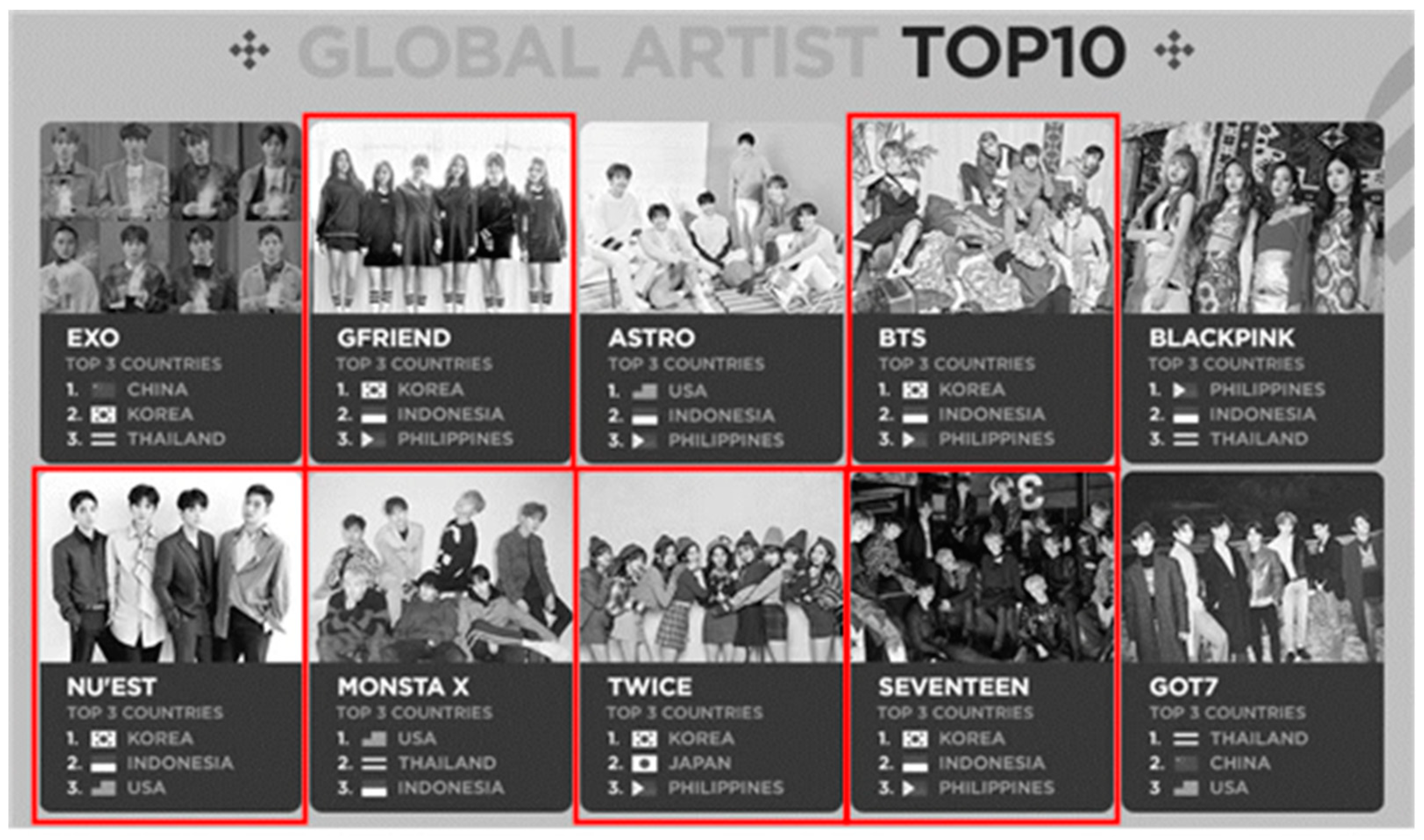
In 2018, the top-ten K-pop stars (or groups) were honorably selected as the “Global Artist Top 10,” based on total scores of views, hearts, and comments on the video content, and fan attendance rate on each Star channel between January 1 and December 25, 2017. Fan attendance rate is a measure of how often fans visit their favorite K-pop star’s channel. However, details of the proportions of each score were not disclosed. In addition, V Live measures the popularity of each Star channel in the top three countries (See Figure 1). This study focused on the five most popular Star channels in South Korea. Other countries (China, the U.S., the Philippines, and Thailand) were excluded as cultural differences and market conditions could not be controlled for. Thus, the following top five K-pop groups were selected for this study: BTS, Nu’est, SEVENTEEN, GFRIEND, and TWICE.
Figure 1. Global Artist Top 10 in 2018.

4.2. Data Coding

We coded only for video content that met the criteria for this study. The criteria were as follows: (1) paid video content was excluded; (2) video clips edited from full versions of live-streamed content with the “V Pick” logo were excluded, because they were not newly uploaded; and (3) re-uploaded video clips from the past, edited, and trending in live-streaming were excluded because they were not newly uploaded (e.g., BTS from two years ago, Nu’est from two years ago). In 2017, the total video content on the top five Star channels was 1224; of these, 620 videos were selected for coding in accordance with the criteria. The following data were coded for each video. There were three independent variables for content factors: 1) production company, 2) type of video content, and 3) whether the video content was live-streamed. The three dependent variables indicating the popularity of video content were: 1) number of comments, 2) hearts, 3) views. For each video content, the following factors were coded:
  • Characteristics of video content (IV)
    -
    Video content production company: 3 categories
    -
    Type of video content: 8 categories
    -
    Video content live-streamed or not: 2 categories
  • Popularity of video content (DV)
    -
    Number of comments
    -
    Number of hearts
    -
    Number of views
The first independent variable, production company, identified whether a production company produced the video content and the type of company. There were three options. Some video content was produced without a production company, as in the case of free-style live-streaming. Video content was also produced by V Live itself and by outsourced companies such as entertainment management agencies (See Table 2).
The second independent variable, type of video content, was categorized into a total of eight types based on previous studies [16,17,23,24,25]. All 620 videos were classified into mutually exclusive sub-categories (See Table 2).
The eight types of video content were as follows: (1) Free-style live-streaming, (2) Music/Choreography, (3) Offline event-related live-streaming, (4) Series-edited video content, (5) Non-series-edited video content, (6) Series live-streaming, (7) Non-series live-streaming, and (8) Others.
(1) Free-style live-streaming focuses on a K-pop star at home or in a car in a casual manner, without a purpose or script. In such a case, the K-pop star suddenly starts live-streaming without any notice and without the participation of a production company. (2) Music/Choreography is pre-edited video content with no subtitles such as dance performances, music videos, and voices of K-pop stars. (3) Offline event-related live-streaming is live broadcasting of events held offline, such as concerts and press conferences. (4) Series-edited video content is an edited series of broadcasts for which the content, script, and subtitles are clearly planned; these are produced by outsourced companies such as entertainment management agencies. (5) Non-series-edited video content consists of edited one-off broadcasts with planned content, scripts, and subtitles produced by outsourced companies such as entertainment management agencies. (6) Series live-streaming is a series of live broadcasts for which the content and script are planned, unlike free-style live-streaming. This video content is produced not only by V Live, but also by outsourced companies such as entertainment management agencies. (7) Non-series live-streaming is a category of one-off live broadcasts for which the content and script are clearly planned. Such video content is produced by outsourced companies (such as entertainment management agencies) and by V Live. (8) The “Others” category includes short video content that K-pop stars provide to fans such as holiday greetings and encouragement for college entrance exams.
The third independent variable, “whether a video content is live-streamed or not,” indicates whether a video content is not a recording but a live broadcast. Compared to other services, V Live provides both K-pop-specific video content that enables viewers to communicate directly with stars, and that V Live or outsourced companies have previously filmed, edited, and subtitled. As one characteristic of video content, we examined whether live-streaming content gains more popularity than recorded video content, or vice versa. Among eight types of video content, free-style live-streaming, offline event-related live-streaming, series live-streaming, and non-series live-streaming are all live (Dummy variable = 0). Four additional content types, music/choreography, series-edited video content, non-series-edited video content, and “others” are previously recorded (Dummy variable = 1).
We controlled several factors affecting the dependent variable. Judging from the new fandom trend, “Heart Labor [7],” the video content of K-pop stars with large fandoms is preferred and viewed more than that of K-pop stars with small fandoms. “Heart Labor” describes the act of quickly pressing the heart button on V Live to increase the number of hearts. During live-streaming on V Live, fans cannot send cyber money (as with AfreecaTV’s “Star Balloons” or Twitch’s “Donations”) to K-pop stars; instead, V Live viewers press the “hearts,” which indicates the popularity of video content and that of their favorite K-pop stars. To investigate the effect of V Live content on dependent variables, it is necessary to control for the popularity of K-pop stars themselves. Specifically, as the selected top-five channels were all vocal groups, the number of V Live channel subscribers and mini-album sales for each group were used to measure the popularity of the K-pop groups.
The number of V Live channel subscribers indicates how many V Live viewers subscribe to each channel; this variable can be used to measure the popularity of each K-pop group. Since the number of channel subscribers varies from hour to hour each day, we used the value on June 1, 2018 when the data were collected. At that time, there were 11,034,567 BTS channel subscribers; 3,386,062 SEVENTEEN channel subscribers; 2,487,123 TWICE channel subscribers; 739,048 GFRIEND channel subscribers; and 702,408 Nu’est channel subscribers.
The album-sales variable indicates the number of albums sold by each K-pop group in 2017. In this study, album sales were based on Gaon Music Chart. Gaon Music Chart is a South Korean official music chart published by Korea Music Content Association (KMCA), which is affiliated to the Ministry of Culture, Sports, and Tourism; they consider it necessary to have an official domestic music chart, like the U.S. Billboard chart and Japan’s Oricon music chart. The Gaon Chart monitors album sales by counting the number of released records minus the number of returned records. The number and type of albums released by K-pop groups in 2017 were different. TWICE released two repackaged albums, one mini-album, and one regular album; total album sales were 1,048,746, and mini-album sales were 285,294. Nu’est released only one mini-album; thus, total album sales and mini-album sales were 308,108. Regular albums, repackaged albums, and mini-albums are different in character and not comparable. Total album sales and mini-album sales showed a high correlation; the correlation coefficient was 0.910 (p < 0.000). The presence of highly correlated independent variables in a regression equation can lead to multicollinearity problems. To compare album sales of the five K-pop groups, mini-album sales were set as an album-sales variable, based on Nu’est, which released only one mini-album.
Variables such as “previewed or not” and “cumulative number of days since video content was uploaded” were also controlled for in this study. “Previewed or not” indicates whether the video content was uploaded after a preview. On previewed live-streaming, viewers can press “hearts” before the live-streaming begins. In either case, the heart button can be pressed after live-streaming ends [7]. For previewed video content, data include the number of hearts and comments accumulated before live-streaming begins; for non-previewed video content, data include only those hearts and comments that accumulate after live-streaming begins.
The “cumulative number of days since video content was uploaded” indicates the period from when the video content was uploaded to when the study data were collected. Data used in this study were collected in June 2018, not when the video content was uploaded. In other words, depending on when the video content was uploaded, viewers may have had more or less time to repeat the video content, comment on it, or press the heart button. For example, it is assumed that video content A was uploaded in January 2017, and video content B was uploaded in December 2017. As this study’s data were collected in June 2018, video content A had been online for 18 months, while video content B had been online for only six months. There was thus a gap of 12 months (one year) between uploads of video contents A and B. As a result, the popularity of video content A reflected the number of comments, views, and hearts accumulated over an 18-month period since upload, while the popularity of video content B reflected the same data gathered over a six-month period. To address these time gaps, the variable “cumulative number of days since video content was uploaded” was used to control the number of comments, views, and hearts indicating the popularity of video content.

4.3. Data Analysis

To find the answer for the research question, we conducted a hierarchical linear regression. The adoption of a hierarchical model allowed us to examine if each variable explains a statistically significant amount of variance in each dependent variable after considering for all other variables. Formally, we specify our hierarchical linear regression model as follows:
  • (Model 1) ln(Yi) = α*ln(Xcv) + e,
  • (Model 2) ln(Yi) = α*ln(Xcv) + βXpc + e,
  • (Model 3) ln(Yi) = α*ln(Xcv) + βXpc + τXct + e,
  • (Model 4) ln(Yi) = α*ln(Xcv) + βXpc + τXct + γXst + e,
where i is the individual video content, Y is the popularity of video content (i.e., number of comments, hearts, and views), Xcv is variables denoting control variables (i.e., number of channel subscribers, mini-album sales, previewed or not, and cumulative number of days after video content uploaded), Xpc is a dummy variable denoting three production companies, Xct is a dummy variable denoting eight types of video content, and Xst is a dummy variable denoting video content live-streamed or not. Due to the skewedness of dependent variables, most variables except for dummy variables were log-transformed.

5. Empirical Results

By analyzing 620 free video contents of the top five Star channels in 2017, this study aimed to examine which factors affect the popularity of video content. A hierarchical regression analysis was conducted with three independent variables indicating the characteristics of video content (i.e., production company, types of video content, and live-streamed or not). There were three dependent variables indicating the popularity of video content (i.e., number of comments, hearts, and views), and four control variables (i.e., number of channel subscribers, mini-album sales, whether the video content was previewed, and cumulative number of days after the video content was uploaded).
Before the regression analysis, we conducted a frequency analysis, a descriptive analysis, and a correlation analysis to understand the composition of the data. As Table 2 indicates, of a total of 620 videos posted on the top five Star V Live channels, 212 were free-style broadcasting (34.2%), 133 were music/choreography (21.5%), and 112 were series-edited video content (18.1%). In addition, as Table 3 indicates, the average number of comments was 149,949.98 (S.D.= 327,847.36), the average number of hearts was 13,146,072.98 (S.D.35,194,871.76), and the average number of views was 541,766.79 (S.D.1,017,211.20).
Table 3. Descriptive statistics for dependent variables.
Concerning the skewedness of dependent variables (i.e., number of comments, hearts, and views), we transformed dependent variables into logarithms, and conducted a Pearson correlation analysis to examine the relationships between variables (See Table 4). The correlation coefficients between dependent and independent variables were generally significant. In other words, a significant effect was discovered between the characteristics and the popularity of V Live’s video content.
Table 4. Pearson correlation matrix.
When the dependent variable was the number of comments, Model 1 of Table 5 presents that “mini-album sales (β = 1.046; p < 0.000)” and “cumulative number of days after video content uploaded (β = 0.239; p < 0.01)”, control variables, had a positive effect on the popularity of video content; however, “previewed or not,” which was also a control variable, had a negative effect (β = −0.653; p < 0.01). Model 2 shows that video content without a production company had a greater positive impact on its popularity than video content produced by V Live (β = −0.139; p < 0.000) and by outsourced companies (β = −0.474; p < 0.000). It can be inferred that video contents made without any production plans are generally broadcasts that a streamer starts live-streaming to communicate with viewers without any preview; the way viewers can communicate with a streamer is by commenting, and this type of video content can drive more comments from viewers. Model 3 presents that free-style live-streaming had a greater positive impact on video content popularity than Music/Choreography (β = −1.432; p < 0.000), Series-edited video content (β = −1.221; p < 0.000), Non-series edited video content (β = −1.495; p < 0.000), or “Others” (β = −1.932; p < 0.000). Conversely, non-series live-streaming won more popularity than free-style live-streaming (β = 0.974; p < 0.000). Model 4 shows that whether a video is live-streamed had no significant impact on its popularity.
Table 5. Hierarchical regression (DV = log (number of comments)).
When the dependent variable was the number of hearts, Model 1 of Table 6 reports that “previewed or not” (β = −0.856; p < 0.000), and “cumulative number of days after the video content was uploaded” (β = −0.847; p < 0.000), which were all control variables, had a negative impact on the popularity of video content. Otherwise, mini-album sales positively affected the popularity of video content (β = 1.655; p < 0.000), and indicates that the video content of the K-pop star, whose album has sold more, has gained more popularity. Model 2 shows that video content without a production company won more popularity from viewers than the original content of V Live (β = −0.728; p < 0.01). On video content that did not use a production company, viewers can communicate with their favorite streamers in a natural way. Without any script or topic, the spontaneous interaction induced viewers to press the heart button even more actively, and such video content became popular. Model 3 shows that non-series live-streaming had a greater positive impact on the popularity of video content compared to free-style live-streaming (β = 1.144; p < 0.000). However, music/choreography had a negative impact on the popularity of video content compared to free-style live-streaming (β = −1.299; p < 0.000). Free-style live-streaming with K-pop stars is only available on V Live; however, music/choreography video content is provided on YouTube and V Live. Exclusive video content won more popularity among viewers. As per Model 4, whether a video is live-streamed had no effect on its popularity.
Table 6. Hierarchical regression (DV = number of hearts).
When the dependent variable was the number of views, Model 1 of Table 7 reflects that the number of channel subscribers (β = 1.041; p < 0.000), mini-album sales (β = 0.341; p < 0.05), which were the control variables, positively affected the popularity of video content. Model 2 reflects that video content without a production company became more popular than video content produced by V Live (β = −0.878; p < 0.01), whereas that produced by outsourced companies such as an entertainment management agency was viewed more than video content without any production companies (β = 0.241; p < 0.05). Model 3 shows that non-series live-streaming (β = 0.488; p < 0.01) was played more than free-style live-streaming. Otherwise, music/choreography (β = −0.460; p < 0.05) and series live-streaming (β = −0.878; p < 0.01) were viewed less than free-style live-streaming. At the same time, Model 4 indicates that the live-streaming video content was played less than the recorded video content (β = −2.574; p < 0.000).
Table 7. Hierarchical regression (DV = number of views).

6. Conclusions

In this section, we summarize the main findings and interpret these findings. Then, we discuss the implications and limitations of this study. Finally, we propose future research.

6.1. Main Findings

We determined the factors of V Live’s contents that affected the popularity of video content. The characteristics of V Live video content were divided into production company, type of video content, and whether the video content was live-streamed. The popularity of video content was measured by number of comments, hearts, and views. To control the potential bias of dependent variables, additional variables were set as control variables, such as number of channel subscribers, mini-album sales, whether video content was previewed, and cumulative number of days since the video content was uploaded.
The summary of results are as follows. First, mini-album sales, a control variable indicating the popularity of K-pop groups, had a positive effect on the number of comments, hearts, and views. The greater the popularity of the K-pop group, the more video content V Live viewers played and the more they commented and clicked on hearts. This study has therefore confirmed that V Live viewers prefer video content of popular K-pop groups. In other words, it represents the rich-get-richer effect wherein the more popular the group grows, the more popular its video content becomes.
The second finding involves previewed versus non-previewed video content. This control variable had a negative impact on the number of comments and hearts, but a positive impact on the number of views. That is, non-previewed video content received more comments and hearts from V Live viewers but was less frequently viewed. Of the 620 videos analyzed in this study, 93.4% were not previewed (n = 579), or there was almost 14 times more non-previewed than previewed video content. Moreover, 35.2% of the non-previewed video contents were free-style live-streaming (n = 204), 22.3% were Music/Choreography (in which fans watch K-pop stars sing or dance) (n = 129), and 18.1% were series-edited video content (n = 105). When V Live live-streaming is previewed, viewers can comment and press the heart button before live-streaming begins. For this reason, comments and hearts begin to accumulate before live-streaming starts; for non-previewed video content, comments and hearts begin to accumulate immediately after live-streaming begins. Despite this time gap, non-previewed video content ultimately received more comments and hearts from viewers than previewed video content. The non-previewed video content gives viewers unexpected interest, which makes them feel more satisfied [26]. When positive emotions such as higher satisfaction are triggered, viewers become more reactive and involved, resulting in actual engagement behavior such as commenting or pressing the heart [27].
Third, video content without a production company gained more popularity than original content produced by V Live (βcomments = −1.680, βhearts = −0.726, βviews = −0.878), and also received more comments from viewers than video content produced by outsourced companies such as entertainment management agencies (βcomments = −0.474). In all, 87.6% (n = 191) of video contents planned without a production company are free-style live-streaming, on which streamers spontaneously live-stream to chat with viewers, or show their ordinary lives to viewers. This free-style live-streaming video content presents a slice of everyday life of the K-pop star, known as “Meforming [18]”. With Meforming content, K-pop stars exhibit how they cope with unpredictable situations as well as life values and feelings. V Live viewers reacted more actively to the type of video content that allows them to peek into K-pop star’s “Meforming” video contents, and this kind of video content won popularity with viewers.
Fourth, non-series live-streaming had a greater positive impact on the number of comments, hearts, and views (βcomments = 0.974, βhearts = 1.144, βviews = 0.488). Non-series live-streaming includes original V Live content such as “Lie-V,” “Eat Together,” and “Orgel Live,” and video content produced by outsourced companies such as “Cooking Star (i.e., video content that a K-pop star cooks).” Video content produced by V Live and outsourced companies requires more effort in production than that made without a production company. According to [17], video content that required more effort in production attracted more viewers than the kind made without a production company. The non-series live-streaming produced by V Live and outsourced companies covers various topics and is produced using a range of broadcasting techniques. In other words, V Live viewers favored either a type of video content that allowed them to interact with K-pop stars or a type of live-streaming that was different from existing broadcasting, consistent with the results of [28].
Fifth, 49.7% of the 620 video contents were live-streamed content (n = 308), and 50.3% were edited content (n = 312), and the difference had a significant impact on all three dependent variables (pcomments<.000, phearts<.10, pviews<0.01). For comments and hearts, the number was higher when it was live-streaming content, while for views, the number was higher when it was recorded video content. Our evidence supports that commenting and pressing “hearts“ are ways to express viewers’ intentions and emotions [29]. For example, if a streamer asks viewers how they spent a day, what they ate for dinner, how good the newly released album is and so on, viewers can answer through comments and express positive emotions through hearts in real time. That is, video content that enables two-way interaction between a streamer and viewers more effectively drives comments and hearts. On the other hand, it can be inferred that the length of video content causes a higher number of views. The recorded video content (not live-streamed) is at least 15 seconds to less than an hour long, but the live-streaming content is about an hour long on an average. That is, the recorded video content is even shorter than live-streaming, and this indicates that there is less pressure to repeat recorded video content than live-streaming content.

6.2. Limitations and Implications

This study has its limitations. First, because it focuses on the top five Star channels, the research findings do not account for factors of video content of other Star channels, beauty channels, classical music channels, or channels in other genres. A “long-tail” phenomenon through which niche content becomes more popular has recently been identified in the new media environment [30,31]. In future research, it will be necessary to understand the characteristics of video contents on low-ranking channels that provide incredible content. In other words, by analyzing how low-ranking channels produce and provide video content on trending topics, it will be possible to separate their identities from those of high-ranking channels to discover the characteristics of video content provided only on low-ranking channels.
Second, in this study, due to data being directly obtained from V Live, results could not be interpreted form the perspective of V Live viewers. Based on this study’s findings, future studies will need to collect data directly from V Live viewers.
Third, data for dependent variables (number of comments, hearts, and views) are cumulative totals calculated from the date of video content uploaded. In other words, the number of comments, hearts, and views collected before, during, and after live-streaming cannot be distinguished for each point in time. In future research, it will be necessary to use a new technique to collect data in real time. If data are collected before, during, and after live-streaming, the relationship between content factor and popularity of video content can be explained more concretely.
Despite these limitations, our results offer key implications for academics and managers.
This study adds to our theoretical understanding in new media services and video contents. Although past studies have focused on user-generated, game-oriented, and SNS-based live-streaming services, this study investigated V Live, the only live-streaming service that is specific to the entertainment industry. Moreover, we diversified characteristics of video content based on three categories: production company, type of video content, and if it was live-streamed, and obtained a total of 13 sub-items. Compared to past studies that focused only on types of video content, the categories of video content of this study are more detailed. At a time when a lot of video content is simultaneously available through a variety of online video platforms, our study will serve an opportunity to classify video content from varied perspectives.
This study furthers our understanding of the popularity of video content, and we believe that it can serve as a foundation to understand how to produce popular video content for content providers. We estimated the “pure effect” of video content that leads in popularity of video content, controlling for additional factors such as the popularity of K-pop star. As per the results, not-previewed video content, interactive video content, and novel video content with high-filming quality gains popularity from viewers. Recently, V Live is generating revenue by providing exclusive video content through paid channels, and the revenue has been increasing. In other words, content providers who are concerned about profitability of video content can distribute higher budgets to produce this video content and plan countermeasures.

Author Contributions

Conceptualization, methodology, writing-review & editing: S.W.L., Data collection, data analysis, writing-original draft: M.H. All authors have read and agreed to the published version of the manuscript.

Funding

This research received no external funding.

Conflicts of Interest

The authors declare no conflict of interest.

References

  1. Kim, S.C.; Lee, S.E.; Choi, M.; Kim, S.W.; Koo, H.M. Snack Media Industry Trend Report. Volume 1. Available online: http://www.rapa.or.kr/modules/board/bd_download.asp?idx=4774 (accessed on 6 June 2018).
  2. Hong, S.W.; Hae, M.Y.; Cho, S.H. 2017 Report on Trends in Performance and Art. Available online: https://www.gokams.or.kr:442/05_know/data_view.aspx?Idx=927&txtSearchStr=&ddlSearchSel= (accessed on 6 May 2018).
  3. Jin, H.J. Evolution of V Live Content: Virtual Reality Content. Available online: http://www.dt.co.kr/contents.html?article_no=2017102502101031043002 (accessed on 7 December 2018).
  4. Kim, D.W. More than 80,000 People Have Watched Seong-Jin Cho’s Showcase Via Live-Streaming. Available online: http://www.donga.com/news/article/all/20161220/81941744/1 (accessed on 6 June 2018).
  5. Ahn, S. BTS Performs at Historic Sold-Out Wembley Concert. Available online: http://www.koreaherald.com/view.php?ud=20190602000198 (accessed on 7 December 2018).
  6. Naver. Quarterly and Annual Report 2017. Available online: https://www.navercorp.com/investment/earningsRelease (accessed on 14 April 2019).
  7. Lee, M.J. “Heart Work” for My Entertainer, V Live for 10s and Fandom. Available online: http://magazine.hankyung.com/business/apps/news?popup=0&nid=01&c1=1013&nkey=2018082001186000111&mode=sub_view (accessed on 7 December 2018).
  8. Kim, T.G. The Two Biggest Sales of Domestic Video Apps, Pooq and V Live. Available online: http://www.yonhapnews.co.kr/bulletin/2017/09/13/0200000000AKR20170913079700033.HTML (accessed on 6 June 2018).
  9. Lee, G.T. K-Pop and the Global Active Audience: The Transnationality of the Naver Webcast Service “V-Live”. Korean Assoc. Arts Manag. 2016, 39, 33–65. [Google Scholar]
  10. Scheibe, K.; Fietkiewicz, K.J.; Stock, W.G. Information behavior on social live-streaming services. J. Inf. Sci. Theory. Pract. 2016, 4, 6–20. [Google Scholar] [CrossRef]
  11. Oh, J.; Youn, H.; Yoon, H. A Study on practical use of internet broadcast content. In Proceedings of the Korea Content Society, Chungbuk, Korea, 21–22 November 2003; pp. 468–473. [Google Scholar]
  12. Hilvert-Bruce, Z.; Neill, J.T.; Sjoeblom, M.; Hamari, J. Social Motivations of Live-streaming viewer engagement. Comput. Human Behav. 2018, 84, 58–67. [Google Scholar] [CrossRef]
  13. Yu, E.; Jung, C.; Kim, H.; Jung, J. Impact of viewer engagement on gift-giving in live-video streaming. Telematic. Inform. 2018, 35, 1450–1460. [Google Scholar] [CrossRef]
  14. Chen, C.; Lin, Y. What drives live-stream usage intention? The perspectives of flow, entertainment, social interaction, and endorsement. Telemat. Informat. 2018, 35, 293–303. [Google Scholar] [CrossRef]
  15. Hu, M.; Zhang, M.; Wang, Y. Why do audiences choose to keep watching on live video streaming platforms? An explanation of dual identification framework. Comput. Human Behav. 2017, 75, 594–606. [Google Scholar] [CrossRef]
  16. Welbourne, D.J.; Grant, W.J. Science communication on YouTube: Factors that affect channel and video popularity. Public Underst. Sci. 2016, 25, 706–718. [Google Scholar] [CrossRef] [PubMed]
  17. Friedlaender, M.B. Streamer motives and user-generated content on social live-streaming services. J. Inf. Sci. Theory Pract. 2017, 5, 65–84. [Google Scholar]
  18. Tang, J.C.; Venolia, G.; Inkpen, K.M. Meerkat and periscope: I stream, you stream, apps stream for live streams. In Proceedings of the 2016 CHI Conference on Human Factors in Computing Systems, San Jose, CA, USA, 7–12 May 2016; pp. 4770–4780. [Google Scholar]
  19. Figueiredo, F.; Almeida, J.M.; Benevenuto, F.; Gummadi, K.P. Does content determine information popularity in social media? A case study of YouTube videos’ content and their popularity. In Proceedings of the 32th Annual ACM Conference, Toronto, ON, Canada, 26 April–1 May 2014. [Google Scholar]
  20. Burgess, J.E.; Green, J.B. YouTue: Online Video and Participatory Culture; Press: Cambridge, UK, 2009; ISBN 978-0-7456-4478-3. [Google Scholar]
  21. Lee, J.J. The Dark Shadows of the YouTube Creators’ World. Available online: http://www.mediatoday.co.kr/?mod=news&act=articleView&idxno=146327 (accessed on 3 March 2019).
  22. Hong, S.Y. Why Making Money on YouTube is Tough? Available online: http://www.econovill.com/news/articleView.html?idxno=334418 (accessed on 17 August 2018).
  23. Hollenbaugh, E.E.; Ferris, A.L. Facebook self-disclosure: Examining the role of traits, social cohesion, and motives. Comput. Human Behav. 2014, 30, 50–58. [Google Scholar] [CrossRef]
  24. Cheung, C.M.; Chiu, P.; Lee, M. Online social networks: Why do students use Facebook? Comput. Hum. Behav. 2011, 27, 1337–1343. [Google Scholar] [CrossRef]
  25. Kim, Y.; Sohn, D.; Choi, S.M. Cultural differences in motivations for using social networking sites: A comparative study of American and Korean college students. Comput. Hum. Behav. 2010, 22, 365–372. [Google Scholar]
  26. Chatterjee, P. Advertised versus unexpected next purchase coupons: Consumer satisfaction, perceptions of value, and fairness. J. Prod. Brand Manag. 2007, 16, 59–69. [Google Scholar] [CrossRef]
  27. Chen, Y. The sustainable development of social media contents: An analysis of concrete and abstract information on cultural and creative institutions with “artist” and “ordinary people” positioning. Sustainability 2019, 11, 4131. [Google Scholar] [CrossRef]
  28. Lee, J.H.; Lee, C.F. Extension of TAM by perceived interactivity to understand usage behaviors on ACG social media sites. Sustainability 2019, 11, 5723. [Google Scholar] [CrossRef]
  29. Marwick, A.E.; Boyd, D. I tweet honestly, I tweet passionately: Tweeter users, context collapse, and the imagined audience. New Media Soc. 2010, 13, 114–133. [Google Scholar] [CrossRef]
  30. Yoon, Y. A Study on increased user autonomy and new content paradigm according to media fragmentation. J. Korea Entertain. Ind. Assoc. 2015, 9, 43–56. [Google Scholar] [CrossRef]
  31. Napoli, P.M. Audience Evolution: New Technologies and the Transformation of Media Audiences; Columbia University Press: New York, NY, USA, 2011; ISBN 978-023-115-034-7. [Google Scholar]

Article Metrics

Citations

Article Access Statistics

Multiple requests from the same IP address are counted as one view.
