

Identifying Promising Research Frontiers of Pattern Recognition through Bibliometric Analysis



Abstract
1. Introduction
2. Literature Review
2.1. Concept of Promising Technology
2.2. Detecting Promising Technology Using Bibliometrics
3. Methodology
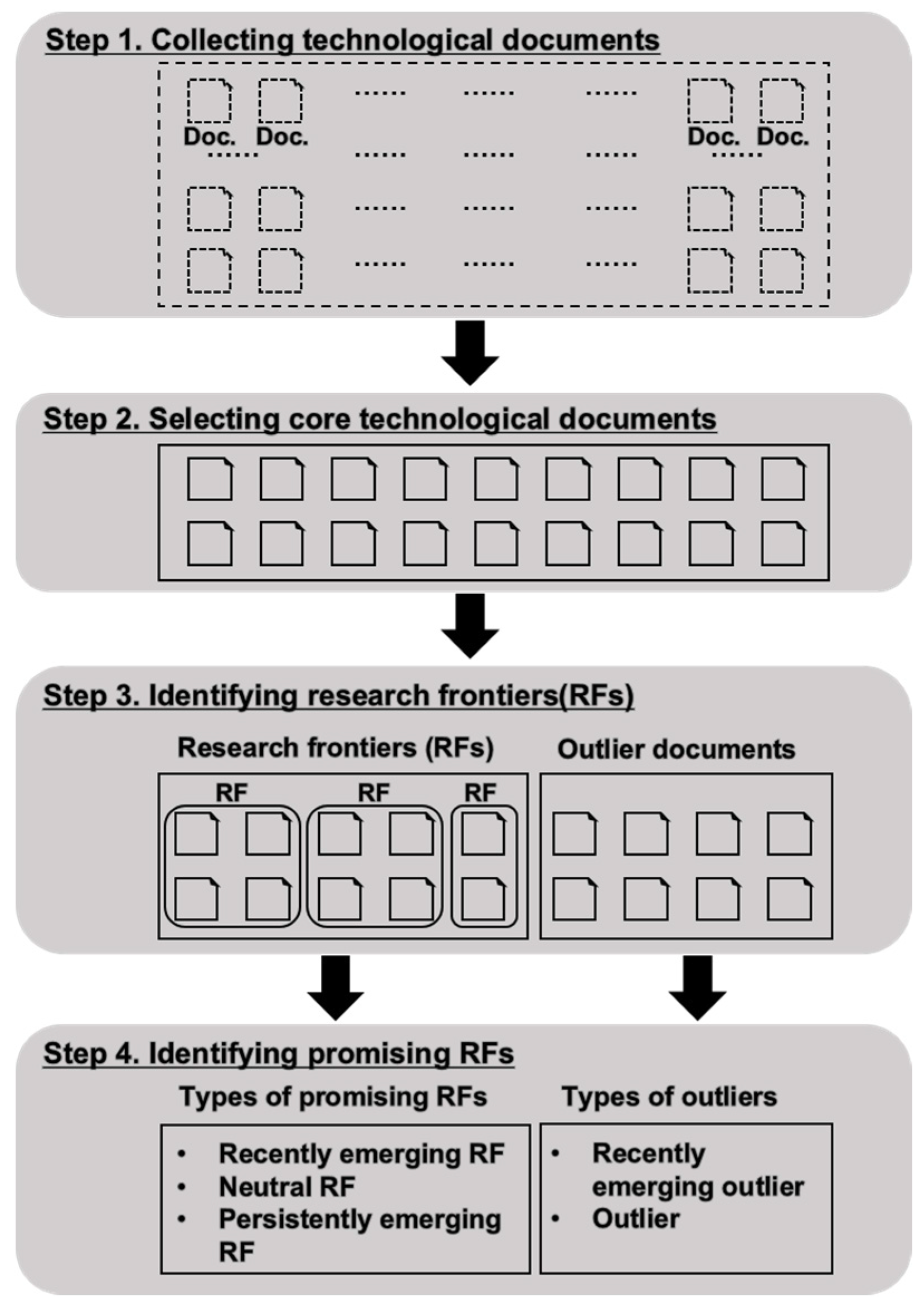
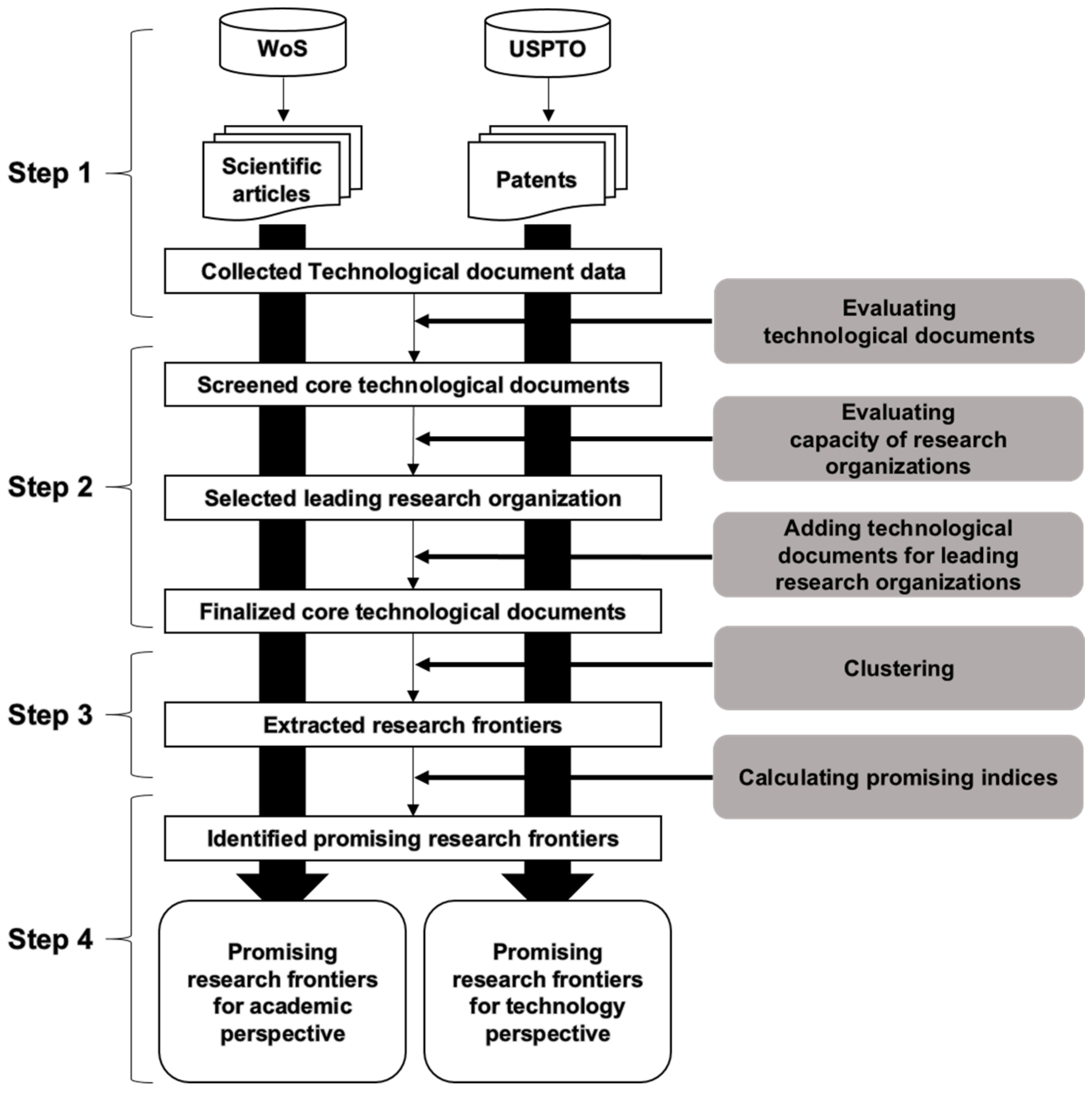
3.1. Research Concept and Overall Process
3.2. Database, Data Collection, and Quantitative Methodology
3.2.1. Technological Documents Collection
3.2.2. Core Technological Documents Selection by Evaluating Technological Documents
3.2.3. Core Technological Documents Selection by Evaluating Research Organization
3.2.4. Research Frontiers Extraction by Clustering
3.2.5. Promising Research Frontiers Identification by Calculating Promising Indices
4. Results
4.1. Results of the Analysis Using Scientific Papers
4.2. Results of the Analysis Using Patents
4.3. Comparisons Results of the Analysis Using between Scientific Papers and Patents
5. Discussion
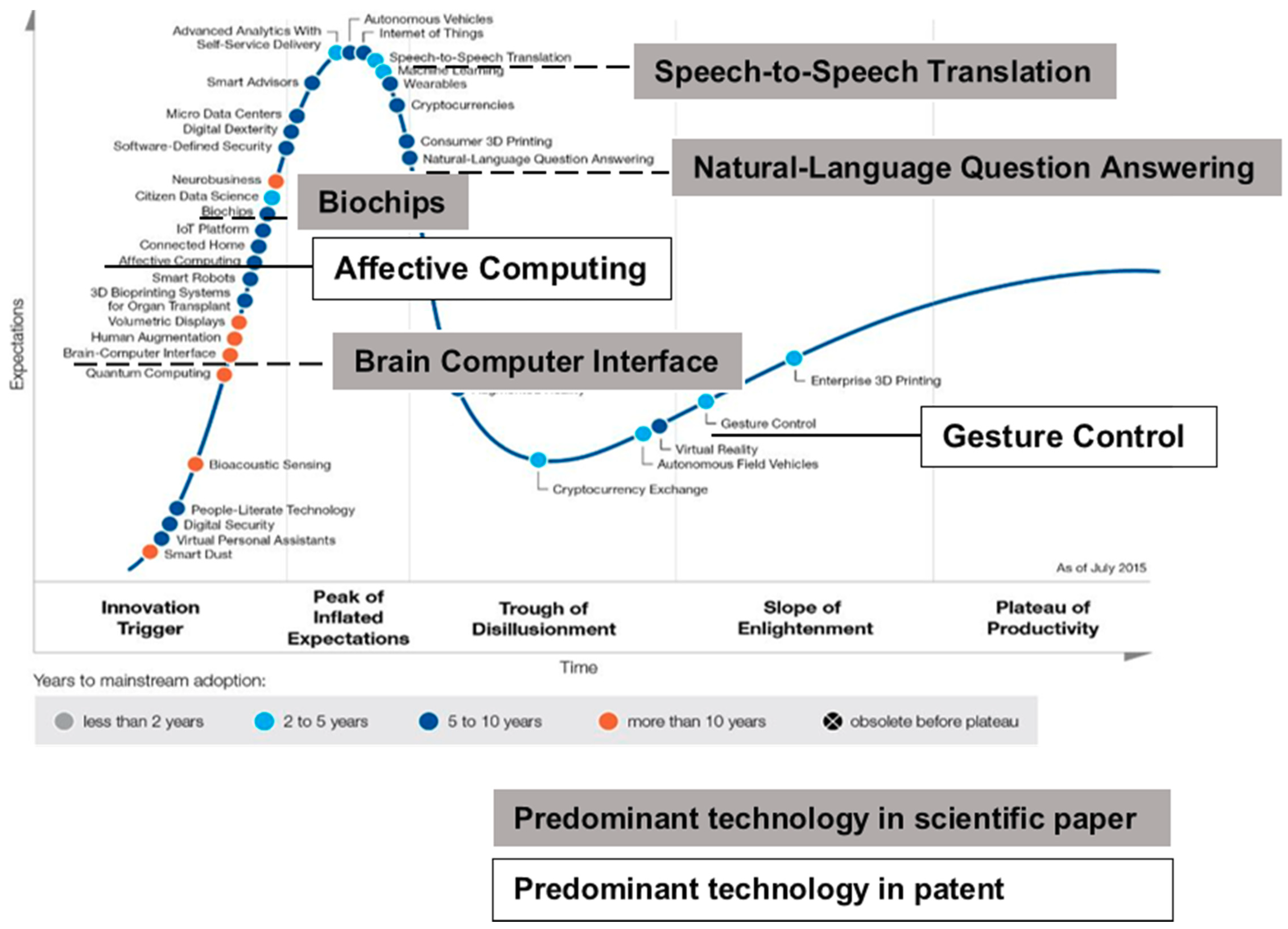
5.1. Promising Research Frontiers with the Proposed Model and the Gartner’s Hype Cycle
5.2. Comparison of the Promising Research Frontiers from Scientific Papers and Patents
6. Conclusions
Author Contributions
Funding
Conflicts of Interest
Appendix A

| Upper Classification | Middle Classification | Lower Classification | Patent Searching Query | Scientific Paper Searching Query |
|---|---|---|---|---|
| Biometric recognition | Biometric recognition | DNA recognition | TI = (Recogni* or Cogni* or Realiz* or Perce* or Sens* or detect*) and (DNA* or RNA*)) and AB = ((Recogni* or Cogni* or Realiz* or Perce* or Sens* or detect*) and (DNA* or RNA*)) and (RD >= 20050101 and RD <= 20141231) | ((Recogni* or Cogni* or Realiz* or Perce* or Sens* or detect*) and (DNA* or RNA*)) and pattern* |
| Vein recognition | TI = ((Recogni* or Cogni* or Realiz* or Perce* or Sens* or detect*) and vein) or AB = ((Recogni* or Cogni* or Realiz* or Perce* or Sens* or detect*) and vein) and (RD >= 20050101 and RD <= 20141231) | (((Recogni* or Cogni* or Realiz* or Perce* or Sens* or detect*) and vein)) | ||
| Fingerprint recognition | TI = ((Recogni* or Cogni* or Realiz* or Perce* or Sens* or detect*) and (fingerprint* or thumb*)) and (RD >= 20050101 and RD <= 20141231) | (((Recogni* or Cogni* or Realiz* or Perce* or Sens* or detect*) and (fingerprint* or thumb*))) | ||
| Iris recognition | TI = ((Recogni* or Cogni* or Realiz* or Perce* or Sens* or detect*) and Iris) or AB = ((Recogni* or Cogni* or Realiz* or Perce* or Sens* or detect*) and Iris) and (RD >= 20050101 and RD <= 20141231) | (((Recogni* or Cogni* or Realiz* or Perce* or Sens* or detect*) and Iris)) | ||
| Image recognition | Object recognition | Object recognition | TI = ((“feature vector”) or “SITF” or (“robust feature”)) or AB = ((“feature vector”) or “SITF” or (“robust feature”)) and (RD >= 20050101 and RD <= 20141231) | - |
| Human recognition | Human detection and trace | TI = (((“Motion detection”) or (“Multiple Threshold”)) and (Recogni* or Cogni* or detect*)) or AB = (((“Motion detection”) or (“Multiple Threshold”)) near/2 (Recogni* or Cogni* or detect*)) and (RD >= 20050101 and RD <= 20141231) | ((((“Motion detection”) or (“Multiple Threshold”)) and (Recogni* or Cogni* or detect*))) | |
| Face recognition | TI = (“HAAR” or ((Recogni* or detect*) near/2 (face*))) or AB = (“HAAR” or ((Recogni* or detect*) near/2 (face*))) and (RD >= 20050101 and RD <= 20141231) | ((“HAAR” or ((Recogni* or detect*) near/2 (face*)))) and pattern* | ||
| Action and gesture recognition | TI = (((Recogni* or Cogni* or detect*) near/2 (gesture* or action* or “Active Marker”or “Passive Marker”))) or AB = (((Recogni* or Cogni* or detect*) near/2 (gesture* or action* or “Active Marker” or “Passive Marker”))) and (RD >= 20050101 and RD <= 20141231) | ((((Recogni* or Cogni* or detect*) near/2 (gesture* or action* or “Active Marker” or “Passive Marker”)))) | ||
| Voice recognition | Utterance recognition | Isolated language recognition | TI = (isolat* or fix*) and (word* or voca* or speech* or language*) and ((VQ) or (Recogni* or Cogni* or Realiz* or Perce* or Sens*)) or AB = (isolat* or fix*) and (word* or voca* or speech* or language*) and ((VQ or LPC OR mfcc or vq or dtw) or (Recogni* or Cogni* or Realiz* or Perce* or Sens*)) and (RD >= 20050101 and RD <= 20141231) | (“voice recognition” or “speech recognition” or “language recognition”) and (“voice recognition” or “speech recognition” or “language recognition”) |
| Continuous speech recognition | TI = (connect* or continu* or flexi*) and (word* or voca* or speech*) and ((LPC or MFCC or VQ or DTW) or (Recogni* or Cogni* or Realiz* or Perce* or Sens*)) and (RD >= 20050101 and RD <= 20141231) | |||
| Speaker recognition | Speaker recognition | TI = ((((((voice or speach or sentence or pronounc*) and (Recogni* or Cogni* or Realiz* or Perce* or Sens* or detect*)) or “AVR” or “VAD” or “Automatic voice recognition”))) and identi*) or AB = ((((((voice or speach or sentence or pronounc*) and (Recogni* or Cogni* or Realiz* or Perce* or Sens* or detect*)) or “AVR” or “VAD” or “Automatic voice recognition”))) and identi*) and (RD >= 20050101 and RD <= 20141231) |
| Indices | Source | Perspective | Bibliographic Information | Equations |
|---|---|---|---|---|
| Evaluation for technological documents | Scientific paper | Paper impact | Forward citation | Equation (1) |
| Research impact | Journal impact factor (JIF), Forward citation | Equation (2) Equation (3) | ||
| Patent | Patent novelty | Backward citation | Equation (4) | |
| Patent impact | Forward citation | Equation (1) | ||
| Patent marketability | Patent family | Equation (5) | ||
| Patent right range | Claim | Equation (6) | ||
| Evaluation for research organizations | Scientific paper | RO’s activity for publication | Frequency | Equation (7) Equation (8) |
| RO’s productivity for core publication | Frequency, Journal impact factor | Equation (9) Equation (10) | ||
| Impact of RO’s publication | Frequency, Forward citation | Equation (11) Equation (12) | ||
| Patent | RO’s activity for patent application | Frequency | Equation (7) Equation (8) | |
| Market competitiveness of RO’s patents | Patent family | Equation (13) | ||
| Effect of RO’s patents | Forward citation | Equation (11) Equation (12) | ||
| Promising indices for promising research frontiers | Scientific paper | Growth | Frequency | Equation (17) |
| Impact | Forward citation | Equation (18) | ||
| Science-based effect | Journal impact factor | Equation (19) | ||
| Patent | Growth | Frequency | Equation (17) | |
| Marketability | Patent family | Equation (20) | ||
| Impact | Forward citation | Equation (18) |
References
- Park, I.; Park, G.; Yoon, B.; Koh, S. Exploring Promising Technology in ICT Sector Using Patent Network and Promising Index Based on Patent Information. ETRI J. 2016, 38, 405–415. [Google Scholar] [CrossRef]
- Shibata, N.; Kajikawa, Y.; Takeda, Y.; Sakata, I.; Matsushima, K. Detecting emerging research fronts in regenerative medicine by the citation network analysis of scientific publications. Technol. Forecast. Soc. Chang. 2011, 78, 274–282. [Google Scholar] [CrossRef]
- Ciarli, T.; Coad, A.; Rafols, I. Quantitative analysis of technology futures: A review of techniques, uses and characteristics. Sci. Public Policy 2016, 43, 630–645. [Google Scholar] [CrossRef]
- Soranzo, B.; Nosella, A.; Filippini, R. Managing firm patents: A bibliometric investigation into the state of the art. J. Eng. Technol. Manag. 2016, 42, 15–30. [Google Scholar] [CrossRef]
- Chen, N.; Liu, Y.; Cheng, Y.; Liu, L.; Yan, Z.; Tao, L.; Guo, X.; Luo, Y.; Yan, A. Technology resource, distribution, and development characteristics of global influenza virus vaccine: A patent bibliometric analysis. PLoS ONE 2015, 10, e0136953. [Google Scholar] [CrossRef] [PubMed]
- Park, H.; Magee, C.L. Tracing technological development trajectories: A genetic knowledge persistence-based main path approach. PLoS ONE 2017, 12, e0170895. [Google Scholar] [CrossRef] [PubMed]
- Youtie, J.; Porter, A.L.; Huang, Y. Early social science research about Big Data. Sci. Public Policy 2016, 44, 65–74. [Google Scholar] [CrossRef][Green Version]
- Zhou, Y.; Li, X.; Lema, R.; Urban, F. Comparing the knowledge bases of wind turbine firms in Asia and Europe: Patent trajectories, networks, and globalisation. Sci. Public Policy 2015, 43, 476–491. [Google Scholar] [CrossRef]
- Roepke, S.; Moehrle, M.G. Sequencing the evolution of technologies in a system-oriented way: The concept of technology-DNA. J. Eng. Technol. Manag. 2014, 32, 110–128. [Google Scholar] [CrossRef]
- Cho, Y.; Kim, M. Entropy and gravity concepts as new methodological indexes to investigate technological convergence: Patent network-based approach. PLoS ONE 2014, 9, e98009. [Google Scholar] [CrossRef] [PubMed]
- Lee, W.J.; Lee, W.K.; Sohn, S.Y. Patent network analysis and quadratic assignment procedures to identify the convergence of robot technologies. PLoS ONE 2016, 11, e0165091. [Google Scholar] [CrossRef] [PubMed]
- Van Reenen, J.; Bloom, N.; Draca, M.; Kretschmer, T.; Sadun, R.; Overman, H.; Schankerman, M. The Economic Impact of ICT; Final report; John Van Reenen London School of Economics: London, UK, 2010. [Google Scholar]
- Burton, B.; Walker, M. Hype Cycle for Emerging Technologies, 2015; Gartner’s Hype Cycle Special Report; Gartner: Stamford, CT, USA, 2015. [Google Scholar]
- Niosi, J. Fourth-generation R&D: From linear models to flexible innovation. J. Bus. Res. 1999, 45, 111–117. [Google Scholar]
- Noh, H.; Song, Y.-K.; Lee, S. Identifying emerging core technologies for the future: Case study of patents published by leading telecommunication organizations. Telecommun. Policy 2016, 40, 956–970. [Google Scholar] [CrossRef]
- Lee, W.H. How to identify emerging research fields using scientometrics: An example in the field of Information Security. Scientometrics 2008, 76, 503–525. [Google Scholar] [CrossRef]
- Iwami, S.; Mori, J.; Sakata, I.; Kajikawa, Y. Detection method of emerging leading papers using time transition. Scientometrics 2014, 101, 1515–1533. [Google Scholar] [CrossRef]
- Corrocher, N.; Malerba, F.; Montobbio, F. The Emergence of New Technologies in the ICT Field: Main Actors, Geographical Distribution and Knowledge Sources; Department of Economics, University of Insubria: Varese, Italy, 2003. [Google Scholar]
- Day, G.S.; Schoemaker, P.J. A different game. In Wharton on Managing Emerging Technologies; John Wiley & Sons Inc.: New York, NY, USA, 2000. [Google Scholar]
- Hung, S.-C.; Chu, Y.-Y. Stimulating new industries from emerging technologies: Challenges for the public sector. Technovation 2006, 26, 104–110. [Google Scholar] [CrossRef]
- Porter, A.L.; Roessner, J.D.; Jin, X.-Y.; Newman, N.C. Measuring national ‘emerging technology’ capabilities. Sci. Public Policy 2002, 29, 189–200. [Google Scholar] [CrossRef]
- Visessonchok, T.; Sasaki, H.; Sakata, I. Detection and introduction of emerging technologies for green buildings in Thailand. In Proceedings of the 2014 Portland International Conference on Management of Engineering & Technology (PICMET), Kanazawa, Japan, 27–31 July 2014; pp. 620–631. [Google Scholar]
- Breitzman, A.; Thomas, P. The Emerging Clusters Model: A tool for identifying emerging technologies across multiple patent systems. Res. Policy 2015, 44, 195–205. [Google Scholar] [CrossRef]
- Érdi, P.; Makovi, K.; Somogyvári, Z.; Strandburg, K.; Tobochnik, J.; Volf, P.; Zalányi, L. Prediction of emerging technologies based on analysis of the US patent citation network. Scientometrics 2013, 95, 225–242. [Google Scholar] [CrossRef]
- Lucio-Arias, D.; Leydesdorff, L. An indicator of research front activity: Measuring intellectual organization as uncertainty reduction in document sets. J. Am. Soc. Inf. Sci. Technol. 2009, 60, 2488–2498. [Google Scholar] [CrossRef]
- Jarneving, B. Bibliographic coupling and its application to research-front and other core documents. J. Inform. 2007, 1, 287–307. [Google Scholar] [CrossRef]
- Jarneving, B. A comparison of two bibliometric methods for mapping of the research front. Scientometrics 2005, 65, 245–263. [Google Scholar] [CrossRef]
- Boyack, K.W.; Klavans, R. Co-citation analysis, bibliographic coupling, and direct citation: Which citation approach represents the research front most accurately? J. Am. Soc. Inf. Sci. Technol. 2010, 61, 2389–2404. [Google Scholar] [CrossRef]
- Toivanen, H. The shift from theory to innovation: The evolution of Brazilian research frontiers 2005–2011. Technol. Anal. Strateg. Manag. 2014, 26, 105–119. [Google Scholar] [CrossRef]
- Park, I.; Lee, K.; Yoon, B. Exploring Promising Research Frontiers Based on Knowledge Maps in the Solar Cell Technology Field. Sustainability 2015, 7, 13660–13689. [Google Scholar] [CrossRef]
- Cozzens, S.; Gatchair, S.; Kang, J.; Kim, K.-S.; Lee, H.J.; Ordóñez, G.; Porter, A. Emerging technologies: Quantitative identification and measurement. Technol. Anal. Strateg. Manag. 2010, 22, 361–376. [Google Scholar] [CrossRef]
- Rotolo, D.; Hicks, D.; Martin, B.R. What is an emerging technology? Res. Policy 2015, 44, 1827–1843. [Google Scholar] [CrossRef]
- Small, H.; Boyack, K.W.; Klavans, R. Identifying emerging topics in science and technology. Res. Policy 2014, 43, 1450–1467. [Google Scholar] [CrossRef]
- Srinivasan, R. Sources, characteristics and effects of emerging technologies: Research opportunities in innovation. Ind. Mark. Manag. 2008, 37, 633–640. [Google Scholar] [CrossRef]
- Stahl, B.C. What does the future hold? A critical view of emerging information and communication technologies and their social consequences. In Researching the Future in Information Systems; Springer: Berlin, Germany, 2011; pp. 59–76. [Google Scholar]
- Alexander, J.; Chase, J.; Newman, N.; Porter, A.; Roessner, J.D. Emergence as a conceptual framework for understanding scientific and technological progress. In Proceedings of the PICMET’12—Technology Management for Emerging Technologies (PICMET), Vancouver, BC, Canada, 29 July–2 August 2012; pp. 1286–1292. [Google Scholar]
- Martin, B.R. Foresight in science and technology. Technol. Anal. Strateg. Manag. 1995, 7, 139–168. [Google Scholar] [CrossRef]
- Boon, W.; Moors, E. Exploring emerging technologies using metaphors—A study of orphan drugs and pharmacogenomics. Soc. Sci. Med. 2008, 66, 1915–1927. [Google Scholar] [CrossRef] [PubMed]
- Halaweh, M. Emerging technology: What is it. J. Technol. Manag. Innov. 2013, 8, 108–115. [Google Scholar] [CrossRef]
- Setti, G. Bibliometric indicators: Why do we need more than one? IEEE Access 2013, 1, 232–246. [Google Scholar] [CrossRef]
- Polanco, X. Infométrie et Ingénierie de la Connaissance; INIST: Vandœuvre-lès-Nancy, France, 1994. [Google Scholar]
- Morris, S.; DeYong, C.; Wu, Z.; Salman, S.; Yemenu, D. DIVA: A visualization system for exploring document databases for technology forecasting. Comput. Ind. Eng. 2002, 43, 841–862. [Google Scholar] [CrossRef]
- Daim, T.U.; Rueda, G.; Martin, H.; Gerdsri, P. Forecasting emerging technologies: Use of bibliometrics and patent analysis. Technol. Forecast. Soc. Chang. 2006, 73, 981–1012. [Google Scholar] [CrossRef]
- Ki, W.; Kim, K. Generating Information Relation Matrix Using Semantic Patent Mining for Technology Planning: A Case of Nano-Sensor. IEEE Access 2017, 5, 26783–26797. [Google Scholar] [CrossRef]
- Saka, A.; Igami, M.; Kuwahara, T. Science Map 2008-Study on Hot Research Areas (2003–2008) by Bibliometric Method; Institute of Science and Technology Policy Science and Technology Foundation Research laboratory: Washington, DC, USA, 2010. [Google Scholar]
- GEUM, Y.; Jeon, J.; Seol, H. Identifying technological opportunities using the novelty detection technique: A case of laser technology in semiconductor manufacturing. Technol. Anal. Strateg. Manag. 2013, 25, 1–22. [Google Scholar] [CrossRef]
- Lee, C.; Kang, B.; Shin, J. Novelty-focused patent mapping for technology opportunity analysis. Technol. Forecast. Soc. Chang. 2015, 90, 355–365. [Google Scholar] [CrossRef]
- Kim, J.; Lee, C. Novelty-focused weak signal detection in futuristic data: Assessing the rarity and paradigm unrelatedness of signals. Technol. Forecast. Soc. Chang. 2017, 120, 59–76. [Google Scholar] [CrossRef]
- Dahlin, K.B.; Behrens, D.M. When is an invention really radical?: Defining and measuring technological radicalness. Res. Policy 2005, 34, 717–737. [Google Scholar] [CrossRef]
- Newman, M.E.; Girvan, M. Finding and evaluating community structure in networks. Phys. Rev. E 2004, 69, 026113. [Google Scholar] [CrossRef] [PubMed]
- Glänzel, W.; Czerwon, H.-J. A new methodological approach to bibliographic coupling and its application to research-front and other core documents. In Proceedings of the International Society for Scientometrics and Informetrics, River Forest, IL, USA, 7–10 June 1995; pp. 167–176. [Google Scholar]
- Freeman, L.C. A set of measures of centrality based on betweenness. Sociometry 1977, 40, 35–41. [Google Scholar] [CrossRef]
- Girvan, M.; Newman, M.E. Community structure in social and biological networks. Proc. Natl. Acad. Sci. USA 2002, 99, 7821–7826. [Google Scholar] [CrossRef] [PubMed]
- Shibata, N.; Kajikawa, Y.; Sakata, I. Extracting the commercialization gap between science and technology—Case study of a solar cell. Technol. Forecast. Soc. Chang. 2010, 77, 1147–1155. [Google Scholar] [CrossRef]
| Concept of Emerging Technology | Literature | Terminology | Data | Method | |
|---|---|---|---|---|---|
| from Rotolo et al. (2015) [32] | from Cozzens et al. (2010) [31] | ||||
| Relatively fast growth | Fast recent growth | Lee (2008) [16] | Promising/emerging research field | Publications | Co-word analysis |
| Shibata et al. (2011) [2] | Emerging research front | Publications | Citation network; Clustering | ||
| Iwami et al. (2014) [17] | Promising field | Publications | Citation network; Time transition analysis | ||
| Toivanen (2014) [29] | Research frontier | Publications | Bibliometrics | ||
| Corrocher et al. (2003) [18] | Emerging technology | Patents | Co-word analysis | ||
| Breitzman and Thomas (2015) [23] | Emerging technology | Patents | Co-citation analysis; Clustering; Scoring | ||
| Noh et al. (2016) [15] | Emerging technology | Patents | Network analysis; Textmining | ||
| Park et al. (2016) [1] | Promising research frontier | Patents | Network analysis; Clustering; Index | ||
| Park et al. (2015) [30] | Promising research frontier | Patents and publications | Network analysis; Clustering | ||
| Visessonchok et al. (2014) [22] | Emerging technology | Patents and publications | Citation network; Clustering | ||
| Radical novelty | Transition/change to something new | Érdi et al. (2013) [24] | Emerging technology | Patents | Citation network; Clustering |
| Prominent impact | Market/economic potential | Park et al. (2016) [1] | Promising research frontier | Patents | Network analysis; Clustering; Index |
| Science-based innovation | - | - | - | - | |
| Coherence | - | - | - | - | - |
| Uncertainty and ambiguity | - | - | - | - | - |
| Upper Classification | Middle Classification | Lower Classification | Collected Scientific Papers | Core Scientific Papers |
|---|---|---|---|---|
| Biometric recognition | Biometric recognition | DNA recognition | 172 | 95 |
| Vein recognition | 92 | 26 | ||
| Fingerprint recognition | 233 | 81 | ||
| Iris recognition | 189 | 47 | ||
| Image recognition | Human recognition | Face recognition | 361 | 120 |
| Action and gesture recognition | 459 | 170 | ||
| Voice recognition | Voice recognition | Voice recognition | 915 | 206 |
| Total | 2421 | 745 | ||
| Upper Classification | Middle Classification | Lower Classification | Collected Patents | Core Patents |
|---|---|---|---|---|
| Biometric recognition | Biometric recognition | DNA recognition | 141 | 20 |
| Vein recognition | 141 | 19 | ||
| Fingerprint recognition | 298 | 65 | ||
| Iris recognition | 172 | 14 | ||
| Image recognition | Object recognition | Object recognition | 414 | 87 |
| Human recognition | Human detection and trace | 561 | 93 | |
| Face recognition | 1390 | 334 | ||
| Action and gesture recognition | 1203 | 237 | ||
| Voice recognition | Utterance recognition | Isolated language recognition | 416 | 76 |
| Continuous speech recognition | 44 | 6 | ||
| Speaker recognition | Speaker recognition | 264 | 42 | |
| Total | 5144 | 993 | ||
| Source | Perspective | Bibliographic Information | Operational Definition |
|---|---|---|---|
| Scientific paper | Paper impact | Forward citation | The normalized number of forward citations for scientific papers |
| Research impact | Journal impact factor (JIF), Forward citation | The normalized value that multiplies journal impact factor for the scientific paper by the number of forward citations for scientific papers | |
| Patent | Patent novelty | Backward citation | The normalized number of backward citations for the patent that is subtracted from one |
| Patent impact | Forward citation | The normalized number of forward citations for patents | |
| Patent marketability | Patent family | The normalized patent family size | |
| Patent right range | Claim | The normalized number of independent claims |
| Source | Perspective | Bibliographic Information | Operational Definition |
|---|---|---|---|
| Scientific paper | * RO’s activity for publication | Frequency | The normalized value of the number of RO’s papers divided by the total number of papers |
| RO’s productivity for core publication | Frequency, Journal impact factor | The normalized value of the percentage of the number of RO’s papers published in the core journal among the number of RO’s papers | |
| Impact of RO’s publication | Frequency, Forward citation | The normalized value of the percentage of the number of forward citations for RO’s papers among the number of forward citations for total papers divided by the percentage of the number of RO’s papers among the number of total papers | |
| Patent | RO’s activity for patent application | Frequency | The normalized value of the number of RO’s patents divided by the total number of patents |
| Market competitiveness of RO’s patents | Patent family | The normalized value of RO’s patent family size divided by the average patent family size | |
| Effect of RO’s patents | Forward citation | The normalized value of the number of forward citations for RO’s patents divided by the number of forward citations for total patents |
| Source | Perspective | Bibliographic Information | Operational Definition |
|---|---|---|---|
| Scientific paper | Growth | Frequency | ● Growing potential of research frontier (RF) ● The value that multiplies the percentage of the papers in the RF among the total papers by the growth rate of papers in the RF |
| Impact | Forward citation | ● Applicability to other technologies ● The sum of forward citations of papers in the RF divided by the number of papers in the RF | |
| Science-based effect | Journal impact factor | ● Effect of knowledge on science and technology ● The sum of JIFs of papers in the RF divided by the number of papers in the RF | |
| Patent | Growth | Frequency | ● Growing potential of the research frontier ● The value that multiplies the percentage of the papers in the RF among the total patents by growth rate of patents in the RF |
| Marketability | Patent family | ● Potential for utilization as product and service ● The family size of patents in the RF divided by the number of patents in the RF | |
| Impact | Forward citation | ● Applicability to other technologies ● The sum of forward citation of patents in the RF divided by the number of patents in the RF |
| Type | Title | No. of Scientific Papers (%) | No. of Clusters (%) |
|---|---|---|---|
| Cluster | Recently emerging RF | 4 (1.11%) | 2 (5.71%) |
| Neutral RF | 86 (23.82%) | 22 (62.86%) | |
| Persistently emerging RF | 271 (75.07%) | 11 (31.43%) | |
| Outlier | Recently emerging outlier | 157 (40.89%) | - |
| outlier | 227 (59.11%) | - |
| Type of Cluster | RF No. | Title of Promising RF | GI | II | SEI | Mean | Keywords |
|---|---|---|---|---|---|---|---|
| Recently emerging RF | RF 33 | Sclera vein recognition | 0.056 | 0 | 0.143 | 0.066 | Iris, recognition, sclera, vein |
| RF 35 | Optimal extraction and fingerprint analysis | 0 | 0.015 | 0.068 | 0.027 | Extraction, spectrometry, determination | |
| Neutral RF | RF 30 | DNA Sequencing, and cancerous DNA recognition | 0.011 | 1 | 1 | 0.670 | DNA, mixture, synthetic, nanotube, recognition |
| RF 16 | The pattern of distribution of amino groups for RNA recognition | 0.029 | 0.283 | 0.527 | 0.280 | DNA, antibiotics, RNA, cleavage, molecular, genome | |
| RF 20 | DNA microarray-based detection | 0.010 | 0.336 | 0.429 | 0.258 | DNA, detection, cell, microarray | |
| RF 410 | Detection of actionable genomic alterations | 0.028 | 0.357 | 0.328 | 0.238 | Clinic, tumor, cancer, target, detection | |
| RF 10 | RNA sequencing | 0.215 | 0.089 | 0.247 | 0.184 | RNA, gene, RNA-seq, cell, DNA, identify | |
| RF 272 | Study on voice recognition | 0.040 | 0.145 | 0.230 | 0.138 | Voice, recognition, face, individual, speech | |
| RF 416 | Face recognition method under lighting or color condition | 0.065 | 0.242 | 0.044 | 0.117 | Recognition, face, pattern, represent | |
| RF 13 | Nanoscale DNA-polymer micelles | 0.042 | 0.026 | 0.280 | 0.116 | DNA, surfaces, micelles, individual, pattern, recognition | |
| RF 31 | RNA recognition motif protein | 0 | 0.066 | 0.260 | 0.108 | RBM, RBP, MMA, transcription, pattern | |
| RF 29 | HPV DNA detection | 0.009 | 0.168 | 0.112 | 0.096 | HPV, carcinoma, cervical, detect, DNA | |
| Persistently emerging RF | RF 92 | Human action and gesture recognition | 1 | 0.236 | 0.071 | 0.436 | Action, recognition, motion, gesture, human, feature |
| RF 1 | RNA pattern recognition | 0.339 | 0.335 | 0.601 | 0.425 | RNA, immune, response, dsRNA, DNA, recognition, protein | |
| RF 2 | Fingerprint recognition using model-based density map | 0.970 | 0.118 | 0.055 | 0.381 | Iris, recognition, detect, extract | |
| RF 415 | Analytic techniques for face recognition | 0.283 | 0.336 | 0.094 | 0.238 | Face, recognition, discriminative, detect | |
| RF 93 | Cognition, action, and object manipulation | 0.101 | 0.308 | 0.206 | 0.205 | Action, activation, cognitive, recognition, inferior, demonstrate | |
| RF 254 | Robust speech recognition algorithm | 0.409 | 0.110 | 0.049 | 0.189 | Speech, recognition, recognition, feature, signal, vector | |
| RF 257 | Speech recognition by bilateral cochlear implant users | 0.339 | 0.126 | 0.030 | 0.165 | Speech, recognition, cochlear, hear, listen | |
| RF 417 | Patterns of feature space, correlation, classification for face recognition | 0.152 | 0.220 | 0.0821 | 0.151 | Face, recognition, match, extract | |
| RF 17 | DNA methylation patterns | 0.057 | 0.099 | 0.258 | 0.138 | Methylation, DNA, detect, cancer, hypermethylation | |
| RF 6 | Detection of latent fingerprints | 0.179 | 0.088 | 0.107 | 0.124 | Fingerprint, detect, latent, contaminate, fluorescence, surfaces |
| Title of Recently Emerging Outlier (Paper) | II | SEI | Mean | Keywords |
|---|---|---|---|---|
| In-Situ Generation of Differential Sensors that Fingerprint Kinases and the Cellular Response to Their Expression | 0.044 | 0.359 | 0.202 | Kinases, protein, vitro |
| Fully Printed Flexible Fingerprint-like Three-Axis Tactile and Slip Force and Temperature Sensors for Artificial Skin | 0.013 | 0.378 | 0.195 | Tactile, skin, temperature, detect |
| Direct recognition of homology between double helices of DNA in Neurospora crassa | 0.013 | 0.337 | 0.175 | DNA, homology, identical, recognition |
| Fooling the Kickers but not the Goalkeepers: Behavioral and Neurophysiological Correlates of Fake Action Detection in Soccer | 0.053 | 0.259 | 0.156 | Action, predict, observe |
| The Negative Association of Childhood Obesity to Cognitive Control of Action Monitoring | 0.049 | 0.259 | 0.154 | Children, condition, amplitude, action |
| Human Parietofrontal Networks Related to Action Observation Detected at Rest | 0.008 | 0.259 | 0.134 | Observation, action, identified, correspondence |
| Detecting bacterial lung infections: in vivo evaluation of in vitro volatile fingerprints | 0.129 | 0.108 | 0.119 | Vitro, vivo, fingerprint, aeruginosa |
| Detection of a transient mitochondrial DNA heteroplasmy in the progeny of crossed genetically divergent isolates of arbuscular mycorrhizal fungi | 0.031 | 0.197 | 0.114 | Isolates, progeny, heteroplasmy, divergent |
| In Vivo Magnetization Transfer and Diffusion-Weighted Magnetic Resonance Imaging Detects Thrombus Composition in a Mouse Model of Deep Vein Thrombosis | 0.017 | 0.209 | 0.113 | Thrombus, histological, vein, detect |
| Interactions Between Visual and Motor Areas During the Recognition of Plausible Actions as Revealed by Magnetoencephalography | 0 | 0.215 | 0.107 | Action, activity, interact, recognition |
| Type | Title | No. of Patents (%) | No. of Clusters (%) |
|---|---|---|---|
| Cluster | Recently emerging RF | 51 (14.91%) | 20 (31.25%) |
| Neutral RF | 257 (72.15%) | 43 (67.19%) | |
| Persistently emerging RF | 34 (9.94%) | 1 (1.56%) | |
| Outlier | Recently emerging outlier | 317 (48.69%) | - |
| outlier | 334 (51.30%) | - |
| Type of Cluster | RF No. | Title of Promising RF | GI | II | MI | Mean | Keywords |
|---|---|---|---|---|---|---|---|
| Recently emerging RF | RF 45 | Automatic face detection | 0.148 | 0.724 | 0.375 | 0.415 | Face, detect, measure, confidence, person, gesture |
| RF 63 | Displaying view for recognition | 0.021 | 0.004 | 0.541 | 0.189 | Recognition, detect, feature, synchronization | |
| RF 90 | Facial decoding method | 0.021 | 0.057 | 0.416 | 0.165 | Motion, movement, contact, decoding, face, generate | |
| RF 237 | Recursive motion recognition | 0 | 0.139 | 0.333 | 0.157 | Motion, region, detector, hand, gesture | |
| RF 8 | Vein pattern detection | 0 | 0 | 0.291 | 0.097 | Determine, Vein Fistula, vessel, identified, atrium | |
| RF 12 | Biometric sensor device for fingerprint | 0.028 | 0 | 0.25 | 0.092 | Sensor, encapsulation, biometric, fingerprint | |
| RF 154 | Image discriminating method | 0 | 0.059 | 0.208 | 0.089 | Image, determine, voice, predetermine, recognition | |
| RF 175 | Multi angle face recognition | 0.084 | 0.013 | 0.166 | 0.088 | face, detect, track, determine, facial, head | |
| RF 699 | Voice control method | 0.084 | 0 | 0.166 | 0.083 | Voice, recognition, receive, language, speech | |
| RF 20 | Blood vessel recognition for treat | 0.080 | 0 | 0.166 | 0.082 | Pressure, peripheral, hemodynamic, venous, vessel, configure | |
| Neutral RF | RF 99 | Human image recognition | 1 | 0.075 | 0.791 | 0.622 | Detect, face, image, gesture, eye, section, recognition |
| RF 49 | Image acquisition devices using face detection | 0.009 | 1 | 0.708 | 0.572 | Detect, magnification, gesture, face | |
| RF 52 | Gesture image processing | 0.309 | 0.149 | 0.708 | 0.389 | Image, detection, face, motion, gesture, capturing, feature | |
| RF 51 | Facial image processing | 0.222 | 0.112 | 0.75 | 0.361 | Image, detection, face, determine, gesture, feature | |
| RF 1 | Detecting DNA | 0.034 | 0.006 | 1 | 0.346 | DNA, detecting, different, determine, molecule | |
| RF 74 | Biometric authentication method | 0.393 | 0.048 | 0.541 | 0.327 | Image, detecting, face, feature, configure, apparatus, vector, signal | |
| RF 48 | Image acquisition devices using face detection | 0.014 | 0.238 | 0.708 | 0.320 | Detecting, finger, gesture, determine, display | |
| RF 2 | Fingerprint recognition using sensors | 0.007 | 0.357 | 0.416 | 0.260 | Fingerprint, sensor, finger, configure, capture | |
| RF 56 | Automatic recognition by tracking method | 0 | 0.304 | 0.416 | 0.240 | Hand, focus, determine, face, track, human, autofocus | |
| RF 87 | Facial feature selection | 0.066 | 0 | 0.541 | 0.202 | Search, face, detection, determine, configure, recognition | |
| Persistently emerging RF | RF 7 | Hand characteristic information | 0.251 | 0.013 | 0.5 | 0.255 | Fingerprint, sensor, substrate, detect, determine, finger |
| Title of Recently Emerging Outlier (Patent) | II | MI | Mean | Keywords |
|---|---|---|---|---|
| Deletion gestures on a portable multifunction device | 0.007 | 1 | 0.503 | Deletable, gesture, detection, touch sensitive, multifunction |
| Architecture for controlling a computer using hand gestures | 1 | 0 | 0.5 | Gesture, image, control, recognition, hand |
| Illumination detection using classifier chains | 0.363 | 0.529 | 0.446 | Face, illumination, condition, correct |
| Image processing method using sensed eye position | 0.003 | 0.823 | 0.413 | Capture, detection, eye, face, graphic, capture |
| Fixed codebook searching apparatus and fixed codebook searching method | 0 | 0.823 | 0.411 | Impulse, codebook, processor, apparatus |
| Event recognition | 0.146 | 0.588 | 0.367 | Recognizes, gesture, determination |
| Real-time face tracking with reference images | 0.169 | 0.529 | 0.349 | Face, determination, relative, movement |
| Synchronization system and method for audiovisual programmes associated devices and methods | 0.007 | 0.588 | 0.298 | Recognition, synchronization, audiovisual, detection |
| Multi-dimensional disambiguation of voice commands | 0.272 | 0.294 | 0.283 | Action, audio, select, identifying |
| Systems and methods for interactively accessing hosted services using voice communications | 0.003 | 0.529 | 0.266 | Voice, convert, identified, recognition |
| 5 Phases in Gartner’s Hype Cycle | Matched Technologies | Years to Mainstream Adoption | RF No. | RF Title | Type of RF | Rank |
|---|---|---|---|---|---|---|
| Innovation trigger | Affective computing | 5 to 10 years | RF 415 | Analytic techniques for face recognition | Persistently emerging RF | 7 |
| RF 417 | Patterns of feature space, correlation, classification for face recognition | Persistently emerging RF | 13 | |||
| RF 416 | Face recognition method under lighting or color condition | Neutral RF | 17 | |||
| Brain computer interface/Biochips | More than 10 years/5 to 10 years | RF 30 | DNA Sequencing, and cancerous DNA Recognition | Neutral RF | 1 | |
| RF 1 | RNA pattern recognition | Persistently emerging RF | 3 | |||
| RF 16 | The pattern of distribution of amino groups for RNA recognition | Neutral RF | 5 | |||
| RF 20 | DNA microarray-based detection | Neutral RF | 6 | |||
| RF 410 | Detection of actionable genomic alterations | Neutral RF | 8 | |||
| RF 93 | Cognition, action, and object manipulation | Persistently emerging RF | 9 | |||
| RF 10 | RNA sequencing | Neutral RF | 11 | |||
| RF 17 | DNA methylation patterns | Persistently emerging RF | 15 | |||
| RF 13 | Nanoscale DNA-polymer micelles | Neutral RF | 18 | |||
| RF 31 | RNA recognition motif protein | Neutral RF | 19 | |||
| RF 29 | HPV DNA detection | Neutral RF | 20 | |||
| Peak of inflated expectation/Trough of disillusionment | Speech-to-speech translation/Natural-language question answering | 2 to 5 years/5 to 10 years | RF 254 | Robust speech recognition algorithm | Persistently emerging RF | 10 |
| RF 257 | Speech recognition by bilateral cochlear implant users | Persistently emerging RF | 12 | |||
| RF 272 | Study on voice recognition | Neutral RF | 14 | |||
| Slope of enlightenment | Gesture control | 2 to 5 years | RF 92 | Human action and gesture recognition | Persistently emerging RF | 2 |
| - | - | - | RF 2 | Fingerprint recognition using model-based density map | Persistently emerging RF | 4 |
| - | - | - | RF 6 | Detection of latent fingerprints | Persistently emerging RF | 16 |
| - | - | - | RF 33 | Sclera Vein Recognition | Recently emerging RF | 27 |
| - | - | - | RF 35 | Optimal extraction and fingerprint analysis | Recently emerging RF | 34 |
| 5 Phases in Gartner’s Hype Cycle | Matched Technologies | Years to Mainstream Adoption | RF No. | RF title | Type of RF | Rank |
|---|---|---|---|---|---|---|
| Innovation trigger | Affective computing | 5 to 10 years | RF 49 | Image acquisition devices using face detection | Neutral RF | 2 |
| RF 45 | Automatic face detection | Recently emerging RF | 3 | |||
| RF 51 | Facial image processing | Neutral RF | 5 | |||
| RF 48 | Image acquisition devices using face detection | Neutral RF | 8 | |||
| RF 87 | Facial feature selection | Neutral RF | 12 | |||
| RF 90 | Facial decoding method | Recently emerging RF | 18 | |||
| RF 175 | Multi angle face recognition | Recently emerging RF | 39 | |||
| Brain computer interface/Biochips | More than 10 years/5 to 10 years | RF 1 | Detecting DNA | Neutral RF | 6 | |
| RF 74 | Biometric authentication method | Neutral RF | 7 | |||
| Peak of inflated expectation/Trough of disillusionment | Speech-to-speech translation/Natural-language question answering | 2 to 5 years/5 to 10 years | RF 699 | Voice control method | Recently emerging RF | 42 |
| Slope of enlightenment | Gesture control | 2 to 5 years | RF 52 | Gesture image processing | Neutral RF | 4 |
| RF 56 | Automatic recognition by tracking method | Neutral RF | 11 | |||
| RF 237 | Recursive motion recognition | Recently emerging RF | 19 | |||
| - | - | - | RF 99 | Human image recognition | Neutral RF | 1 |
| - | - | - | RF 2 | Fingerprint recognition using sensors | Neutral RF | 9 |
| - | - | - | RF 7 | Hand characteristic information | Persistently emerging RF | 10 |
| - | - | - | RF 63 | Displaying view for recognition | Recently emerging RF | 14 |
| - | - | - | RF 8 | Vein pattern detection | Recently emerging RF | 33 |
| - | - | - | RF 12 | Biometric sensor device for fingerprint | Recently emerging RF | 36 |
| - | - | - | RF 154 | Image discriminating method | Recently emerging RF | 37 |
| - | - | - | RF 20 | Blood vessel recognition for treat | Recently emerging RF | 43 |
© 2018 by the authors. Licensee MDPI, Basel, Switzerland. This article is an open access article distributed under the terms and conditions of the Creative Commons Attribution (CC BY) license (http://creativecommons.org/licenses/by/4.0/).
Share and Cite
Park, I.; Yoon, B. Identifying Promising Research Frontiers of Pattern Recognition through Bibliometric Analysis. Sustainability 2018, 10, 4055. https://doi.org/10.3390/su10114055
Park I, Yoon B. Identifying Promising Research Frontiers of Pattern Recognition through Bibliometric Analysis. Sustainability. 2018; 10(11):4055. https://doi.org/10.3390/su10114055
Chicago/Turabian StylePark, Inchae, and Byungun Yoon. 2018. "Identifying Promising Research Frontiers of Pattern Recognition through Bibliometric Analysis" Sustainability 10, no. 11: 4055. https://doi.org/10.3390/su10114055
APA StylePark, I., & Yoon, B. (2018). Identifying Promising Research Frontiers of Pattern Recognition through Bibliometric Analysis. Sustainability, 10(11), 4055. https://doi.org/10.3390/su10114055

