

Sexual Violence Against Mental Health Nurses in Inpatient Psychiatric Settings: A Systematic Review of Prevalence, Outcomes, and Risk Factors

 ,
,  , , ,
, , ,  ,
,  ,
,  and
and 
Abstract
1. Introduction
2. Materials and Methods
2.1. Study Design
2.2. Eligibility Criteria
2.3. Information Sources
2.4. Search Strategy
2.5. Selection Process
2.6. Data Collection Process
2.7. Data Items
2.8. Study Risk-of-Bias Assessment
2.9. Effect Measures
2.10. Synthesis Methods
3. Results
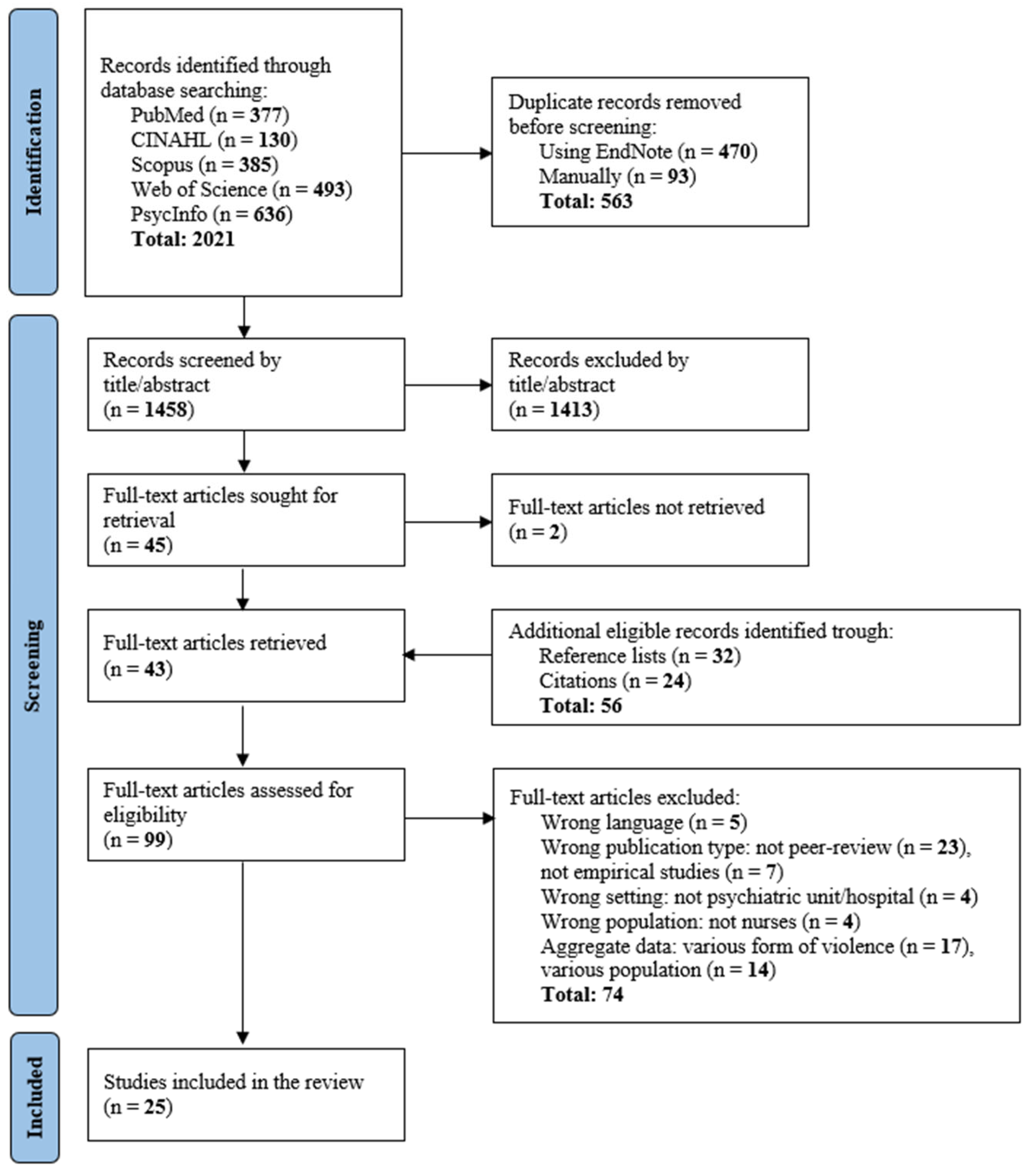
3.1. Study Selection
3.2. Study Characteristics
3.3. Synthesis of Findings
3.3.1. Prevalence and Characteristics of Sexual Violence Against MHNs
3.3.2. Consequences of Sexual Violence Against MHNs
3.3.3. Risk Factors of Sexual Violence Against MHNs
3.4. Risk of Bias
3.5. Quality of Evidence
4. Discussion
4.1. Implications for Practice and Policy
4.2. Strengths, Limitations, and Future Research
5. Conclusions
Author Contributions
Funding
Institutional Review Board Statement
Informed Consent Statement
Data Availability Statement
Public Involvement Statement
Guidelines and Standards Statement
Use of Artificial Intelligence
Conflicts of Interest
Abbreviations
| MHNs | Mental Health Nurses |
| HCWs | Healthcare Workers |
| MHSs | Mental Health Settings |
| SV | Sexual Violence |
| QoL | Quality of Life |
| PTSD | Post-Traumatic Stress Disorder |
| PRISMA | Preferred Reporting Items for Systematic Reviews and Meta-Analyses |
| PROSPERO | International Prospective Register of Systematic Reviews |
Appendix A

| Section and Topic | Item # | Checklist Item | Location Where the Item is Reported |
|---|---|---|---|
| TITLE | |||
| Title | 1 | Identify the report as a systematic review. | Pag. 1 |
| ABSTRACT | |||
| Abstract | 2 | See the PRISMA 2020 for Abstracts checklist. | Pag. 1 |
| INTRODUCTION | |||
| Rationale | 3 | Describe the rationale for the review in the context of existing knowledge. | Pag. 2–3 |
| Objectives | 4 | Provide an explicit statement of the objective(s) or question(s) the review addresses. | Pag. 3 |
| METHODS | |||
| Eligibility criteria | 5 | Specify the inclusion and exclusion criteria for the review and how studies were grouped for the syntheses. | Pag. 3 |
| Information sources | 6 | Specify all databases, registers, websites, organizations, reference lists, and other sources searched or consulted to identify studies. Specify the date when each source was last searched or consulted. | Pag. 3 |
| Search strategy | 7 | Present the full search strategies for all databases, registers, and websites, including any filters and limits used. | Pag. 4 |
| Selection process | 8 | Specify the methods used to decide whether a study met the inclusion criteria of the review, including how many reviewers screened each record and each report retrieved, whether they worked independently, and, if applicable, details of automation tools used in the process. | Pag. 4 |
| Data collection process | 9 | Specify the methods used to collect data from reports, including how many reviewers collected data from each report, whether they worked independently, any processes for obtaining or confirming data from study investigators, and, if applicable, details of automation tools used in the process. | Pag. 4 |
| Data items | 10a | List and define all outcomes for which data were sought. Specify whether all results that were compatible with each outcome domain in each study were sought (e.g., for all measures, time points, analyses), and if not, the methods used to decide which results to collect. | Pag. 4 |
| 10b | List and define all other variables for which data were sought (e.g., participant and intervention characteristics, funding sources). Describe any assumptions made about any missing or unclear information. | Pag. 4 | |
| Study risk of bias assessment | 11 | Specify the methods used to assess risk of bias in the included studies, including details of the tool(s) used, how many reviewers assessed each study, and whether they worked independently, and if applicable, details of automation tools used in the process. | Pag. 4–5 |
| Effect measures | 12 | Specify for each outcome the effect measure(s) (e.g., risk ratio, mean difference) used in the synthesis or presentation of results. | Pag. 5 |
| Synthesis methods | 13a | Describe the processes used to decide which studies were eligible for each synthesis (e.g., tabulating the study intervention characteristics and comparing against the planned groups for each synthesis (item #5)). | Pag. 5 |
| 13b | Describe any methods required to prepare the data for presentation or synthesis, such as handling of missing summary statistics or data conversions. | Pag. 5 | |
| 13c | Describe any methods used to tabulate or visually display the results of individual studies and syntheses. | Pag. 5 | |
| 13d | Describe any methods used to synthesize results and provide a rationale for the choice(s). If meta-analysis was performed, describe the model(s), method(s) to identify the presence and extent of statistical heterogeneity, and software package(s) used. | Pag. 5 | |
| 13e | Describe any methods used to explore possible causes of heterogeneity among study results (e.g., subgroup analysis, meta-regression). | - | |
| 13f | Describe any sensitivity analyses conducted to assess the robustness of the synthesized results. | - | |
| Reporting bias assessment | 14 | Describe any methods used to assess the risk of bias due to missing results in a synthesis (arising from reporting biases). | Pag. 4 |
| Certainty assessment | 15 | Describe any methods used to assess certainty (or confidence) in the body of evidence for an outcome. | Pag. 5 |
| RESULTS | |||
| Study selection | 16a | Describe the results of the search and selection process, from the number of records identified in the search to the number of studies included in the review, ideally using a flow diagram. | Pag. 5–6 Figure 1 |
| 16b | Cite studies that might appear to meet the inclusion criteria, but which were excluded, and explain why they were excluded. | Pag. 5–6 Figure 1 | |
| Study characteristics | 17 | Cite each included study and present its characteristics. | Pag. 6–11 Table 1 |
| Risk of bias in studies | 18 | Present assessments of risk of bias for each included study. | Pag. 15–16 Table 4 |
| Results of individual studies | 19 | For all outcomes, present, for each study: (a) summary statistics for each group (where appropriate) and (b) an effect estimate and its precision (e.g., confidence/credible interval), ideally using structured tables or plots. | Pag. 11–15 Table 2 and Table 3 |
| Results of syntheses | 20a | For each synthesis, briefly summarize the characteristics and risk of bias among contributing studies. | Pag. 11–15 Table 2 and Table 3 |
| 20b | Present the results of all statistical syntheses conducted. If meta-analysis was done, present for each the summary estimate and its precision (e.g., confidence/credible interval) and measures of statistical heterogeneity. If comparing groups, describe the direction of the effect. | Pag. 11–15 Table 2 and Table 3 | |
| 20c | Present the results of all investigations of possible causes of heterogeneity among study results. | Pag. 11–15 Table 2 and Table 3 | |
| 20d | Present the results of all sensitivity analyses conducted to assess the robustness of the synthesized results. | - | |
| Reporting biases | 21 | Present assessments of risk of bias due to missing results (arising from reporting biases) for each synthesis assessed. | Pag. 11–15 Table 2 and Table 3 |
| Certainty of evidence | 22 | Present assessments of certainty (or confidence) in the body of evidence for each outcome assessed. | Pag. 16–17 Table 5 |
| DISCUSSION | |||
| Discussion | 23a | Provide a general interpretation of the results in the context of other evidence. | Pag. 17–18 |
| 23b | Discuss any limitations of the evidence included in the review. | Pag. 19–20 | |
| 23c | Discuss any limitations of the review processes used. | Pag. 19–20 | |
| 23d | Discuss implications of the results for practice, policy, and future research. | Pag. 19 | |
| OTHER INFORMATION | |||
| Registration and protocol | 24a | Provide registration information for the review, including the register name and registration number, or state that the review was not registered. | Pag. 3 |
| 24b | Indicate where the review protocol can be accessed, or state that a protocol was not prepared. | Pag. 3 | |
| 24c | Describe and explain any amendments to information provided at registration or in the protocol. | - | |
| Support | 25 | Describe sources of financial or non-financial support for the review, and the role of the funders or sponsors in the review. | Pag. 20 |
| Competing interests | 26 | Declare any competing interests of review authors. | Pag. 21 |
| Availability of data, code, and other materials | 27 | Report which of the following are publicly available and where they can be found: template data collection forms; data extracted from included studies; data used for all analyses; analytic code; any other materials used in the review. | Pag. 21 |
| ID | Final Search Strategy for PubMed/Medline (Search Conducted on 19 July 2025) | Results |
|---|---|---|
| 1 | ((“Nurses” [Mesh]) OR (“nurses”) OR (“nurse”) OR (“Licensed Practical Nurses” [Mesh]) OR (“Nursing Assistants ”[Mesh])) OR (((“nursing”) OR (“nurse”) OR (“nurses”)) AND ((“staff”) OR (“team”) OR (“worker”) OR (“workers”) OR (“personnel”) OR (“professional”) OR (“professionals”) OR (“workforce”) OR (“assistant”) OR (“assistants”) OR (“auxiliary”) OR (“aid”) OR (“aides”) OR (“employee”) OR (“employees”) OR (“practitioner”) OR (“practitioners”))) | 653,602 |
| 2 | ((“Psychiatric Department, Hospital” [Mesh]) OR (“Hospitals, Psychiatric” [Mesh]) OR (“acute psychiatric unit”) OR (“acute inpatient psychiatric unit”) OR (“acute mental health unit”) OR (“acute inpatient mental health unit”)) OR (((“psychiatric”) OR (“mental health”)) AND ((“department”) OR (“hospital”) OR (“unit”) OR (“ward”))) | 528,993 |
| 3 | (((“Nurses” [Mesh]) OR (“nurses”) OR (“nurse”) OR (“Licensed Practical Nurses” [Mesh]) OR (“Nursing Assistants” [Mesh])) OR (((“nursing”) OR (“nurse”) OR (“nurses”)) AND ((“staff”) OR (“team”) OR (“worker”) OR (“workers”) OR (“personnel”) OR (“professional”) OR (“professionals”) OR (“workforce”) OR (“assistant”) OR (“assistants”) OR (“auxiliary”) OR (“aid”) OR (“aides”) OR (“employee”) OR (“employees”) OR (“practitioner”) OR (“practitioners”)))) AND (((“Psychiatric Department, Hospital” [Mesh]) OR (“Hospitals, Psychiatric” [Mesh]) OR (“acute psychiatric unit”) OR (“acute inpatient psychiatric unit”) OR (“acute mental health unit”) OR (“acute inpatient mental health unit”)) OR (((“psychiatric”) OR (“mental health”)) AND ((“department”) OR (“hospital”) OR (“unit”) OR (“ward”)))) | 28,426 |
| 4 | ((“Sex Offenses” [Mesh]) OR (“Sexual Harassment” [Mesh]) OR (“rape”)) OR ((“sexual”) AND ((“Aggression” [Mesh]) OR (“aggression”) OR (“Violence” [Mesh]) OR (“violence”) OR (“workplace violence”) OR (“offense”) OR (“offence”) OR (“harassment”) OR (“assault”) OR (“abuse”))) | 73,518 |
| 5 | ((((“Nurses” [Mesh]) OR (“nurses”) OR (“nurse”) OR (“Licensed Practical Nurses” [Mesh]) OR (“Nursing Assistants” [Mesh])) OR (((“nursing”) OR (“nurse”) OR (“nurses”)) AND ((“staff”) OR (“team”) OR (“worker”) OR (“workers”) OR (“personnel”) OR (“professional”) OR (“professionals”) OR (“workforce”) OR (“assistant”) OR (“assistants”) OR (“auxiliary”) OR (“aid”) OR (“aides”) OR (“employee”) OR (“employees”) OR (“practitioner”) OR (“practitioners”)))) AND (((“Psychiatric Department, Hospital” [Mesh]) OR (“Hospitals, Psychiatric” [Mesh]) OR (“acute psychiatric unit”) OR (“acute inpatient psychiatric unit”) OR (“acute mental health unit”) OR (“acute inpatient mental health unit”)) OR (((“psychiatric”) OR (“mental health”)) AND ((“department”) OR (“hospital”) OR (“unit”) OR (“ward”))))) AND (((“Sex Offenses” [Mesh]) OR (“Sexual Harassment” [Mesh]) OR (“rape”)) OR ((“sexual”) AND ((“Aggression” [Mesh]) OR (“aggression”) OR (“Violence” [Mesh]) OR (“violence”) OR (“workplace violence”) OR (“offense”) OR (“offence”) OR (“harassment”) OR (“assault”) OR (“abuse”)))) | 377 |
| ID | Final search strategy for CINAHL (search conducted on 19 July 2025) | Results |
| 1 | ((MH “Nurses+”) OR (MH “Correctional Nurses”) OR (MH “Addictions Nurses”) OR (MH “Psychiatric Nurses”) OR (MH “Community Mental Health Nurses”) OR (MH “Psychiatric Mental Health Clinical Nurse Specialists”) OR (MH “Psychiatric Mental Health Nurse Practitioners”) OR (MH “Community Mental Health Nursing”) OR (MH “Nurse Practitioners”) OR (MH “Registered Nurses”) OR (MH “Staff Nurses”) OR (MH “Nursing Staff, Hospital”) OR (MH “Medical Staff”) OR (MH “Medical Staff, Hospital”) OR (MH “Practical Nurses”) OR (MH “Certified Nursing Assistants”) OR (MH “First Assistants”) OR (MH “Medical Assistants”) OR (MH “Paramedics”) OR (MH “Physician Assistants”) OR (MH “Psychiatric Technicians”) OR (“MH “Health Personnel”) OR (MH “Health Personnel, Unlicensed”)) | 551,333 |
| 2 | (((“nursing”) OR (“nurse”) OR (“nurses”)) AND ((“staff”) OR (“team”) OR (“worker”) OR (“workers”) OR (“personnel”) OR (“professional”) OR (“professionals”) OR (“workforce”) OR (“assistant”) OR (“assistants”) OR (“auxiliary”) OR (“aid”) OR (“aides”) OR (“employee”) OR (“employees”) OR (“practitioner”) OR (“practitioners”))) | 733,755 |
| 3 | S1 OR S2 | 977,164 |
| 4 | ((MH “Hospitals, Psychiatric”) OR (MH “Psychiatric Units”) OR (MH “Psychiatric Service”) OR (“acute psychiatric unit”) OR (“acute inpatient psychiatric unit”) OR (“acute mental health unit”) OR (“acute inpatient mental health unit”)) | 24,556 |
| 5 | (((“psychiatric”) OR (“mental health”)) AND ((“department”) OR (“hospital”) OR (“unit”) OR (“ward”) OR (“service”))) | 116,643 |
| 6 | S4 OR S5 | 127,183 |
| 7 | ((MH “Sexual Harassment”) OR (MH “Sexual Abuse”) OR (MH “Rape”) OR (“rape”)) | 36,617 |
| 8 | ((“sexual”) AND ((“aggression”) OR (“violence”) OR (“offense”) OR (“offence”) OR (“harassment”) OR (“assault”) OR (“abuse”))) | 77,543 |
| 9 | S7 OR S8 | 81,929 |
| 10 | S3 AND S6 AND S9 | 130 |
| ID | Final search strategy for SCOPUS (search conducted on 19 July 2025) | Results |
| 1 | TITLE-ABS-KEY (((“nurses”) OR (“nurse”) OR (“paramedics”))) | 542,470 |
| 2 | TITLE-ABS-KEY ((((“nursing”) OR (“nurse”) OR (“nurses”)) AND ((“staff”) OR (“team”) OR (“worker”) OR (“workers”) OR (“personnel”) OR (“professional”) OR (“professionals”) OR (“workforce”) OR (“assistant”) OR (“assistants”) OR (“auxiliary”) OR (“aid”) OR (“aides”) OR (“employee”) OR (“employees”) OR (“practitioner”) OR (“practitioners”)))) | 442,194 |
| 3 | (TITLE-ABS-KEY (((“nurses”) OR (“nurse”) OR (“paramedics”)))) OR (TITLE-ABS-KEY ((((“nursing”) OR (“nurse”) OR (“nurses”)) AND ((“staff”) OR (“team”) OR (“worker”) OR (“workers”) OR (“personnel”) OR (“professional”) OR (“professionals”) OR (“workforce”) OR (“assistant”) OR (“assistants”) OR (“auxiliary”) OR (“aid”) OR (“aides”) OR (“employee”) OR (“employees”) OR (“practitioner”) OR (“practitioners”))))) | 691,345 |
| 4 | TITLE-ABS-KEY (((“acute psychiatric unit”) OR (“acute inpatient psychiatric unit”) OR (“acute mental health unit”) OR (“acute inpatient mental health unit”))) | 473 |
| 5 | TITLE-ABS-KEY ((((“psychiatric”) OR (“mental health”)) AND ((“department”) OR (“hospital”) OR (“unit”) OR (“ward”) OR (“service”)))) | 322,367 |
| 6 | (TITLE-ABS-KEY (((“acute psychiatric unit”) OR (“acute inpatient psychiatric unit”) OR (“acute mental health unit”) OR (“acute inpatient mental health unit”))))) OR (TITLE-ABS-KEY ((((“psychiatric”) OR (“mental health”)) AND ((“department”) OR (“hospital”) OR (“unit”) OR (“ward”) OR (“service”))))) | 322,367 |
| 7 | TITLE-ABS-KEY (((“sex offenses”) OR (“rape”))) | 49,874 |
| 8 | TITLE-ABS-KEY (((“sexual”) AND ((“aggression”) OR (“violence”) OR (“offense”) OR (“offence”) OR (“harassment”) OR (“assault”) OR (“abuse”)))) | 131,273 |
| 9 | (TITLE-ABS-KEY (((“sex offenses”) OR (“rape”)))) OR (TITLE-ABS-KEY (((“sexual”) AND ((“aggression”) OR (“violence”) OR (“offense”) OR (“offence”) OR (“harassment”) OR (“assault”) OR (“abuse”)))) | 158,704 |
| 10 | ((TITLE-ABS-KEY (((“nurses”) OR (“nurse”) OR (“paramedics”)))) OR (TITLE-ABS-KEY ((((“nursing”) OR (“nurse”) OR (“nurses”)) AND ((“staff”) OR (“team”) OR (“worker”) OR (“workers”) OR (“personnel”) OR (“professional”) OR (“professionals”) OR (“workforce”) OR (“assistant”) OR (“assistants”) OR (“auxiliary”) OR (“aid”) OR (“aides”) OR (“employee”) OR (“employees”) OR (“practitioner”) OR (“practitioners”)))))) AND ((TITLE-ABS-KEY (((“acute psychiatric unit”) OR (“acute inpatient psychiatric unit”) OR (“acute mental health unit”) OR (“acute inpatient mental health unit”)))) OR (TITLE-ABS-KEY ((((“psychiatric”) OR (“mental health”)) AND ((“department”) OR (“hospital”) OR (“unit”) OR (“ward”) OR (“service”)))))) AND ((TITLE-ABS-KEY (((“sex offenses”) OR (“rape”)))) OR (TITLE-ABS-KEY (((“sexual”) AND ((“aggression”) OR (“violence”) OR (“offense”) OR (“offence”) OR (“harassment”) OR (“assault”) OR (“abuse”)))))) | 385 |
| ID | Final search strategy for Web of Science (search conducted on 19 July 2025) | Results |
| 1 | ALL = (((“nurses”) OR (“nurse”) OR (“paramedics”))) | 334,067 |
| 2 | ALL = ((((“nursing”) OR (“nurse”) OR (“nurses”)) AND ((“staff”) OR (“team”) OR (“worker”) OR (“workers”) OR (“personnel”) OR (“professional”) OR (“professionals”) OR (“workforce”) OR (“assistant”) OR (“assistants”) OR (“auxiliary”) OR (“aid”) OR (“aides”) OR (“employee”) OR (“employees”) OR (“practitioner”) OR (“practitioners”)))) | 288,812 |
| 3 | #1 OR #2 | 461,983 |
| 4 | ALL = (((“acute psychiatric unit”) OR (“acute inpatient psychiatric unit”) OR (“acute mental health unit”) OR (“acute inpatient mental health unit”))) | 258 |
| 5 | ALL = ((((“psychiatric”) OR (“mental health”)) AND ((“department”) OR (“hospital”) OR (“unit”) OR (“ward”) OR (“service”)))) | 361,107 |
| 6 | #4 OR #5 | 361,107 |
| 7 | ALL = (((“sex offenses”) OR (“rape”))) | 33,392 |
| 8 | ALL = (((“sexual”) AND ((“aggression”) OR (“violence”) OR (“offense”) OR (“offence”) OR (“harassment”) OR (“assault”) OR (“abuse”)))) | 95,970 |
| 9 | #7 OR #8 | 118,843 |
| 10 | #3 AND #6 AND #9 | 493 |
| ID | Final search strategy for PsycInfo (search conducted on 19 July 2025) | Results |
| 1 | ((DE “Nurses”) OR (DE “Nurse Practitioners”) OR (DE “Psychiatric Nurses”) OR (DE “Psychiatric Hospital Staff”) OR (DE “Mental Health Personnel”) OR (DE “Allied Health Personnel”) OR (DE “Health Personnel”) OR (DE “Medical Personnel”) OR (DE “Physician Assistants”) OR (DE “Direct Care Workers”) OR (DE “Paramedics”)) | 94,696 |
| 2 | (((“nursing”) OR (“nurse”) OR (“nurses”)) AND ((“staff”) OR (“team”) OR (“worker”) OR (“workers”) OR (“personnel”) OR (“professional”) OR (“professionals”) OR (“workforce”) OR (“assistant”) OR (“assistants”) OR (“auxiliary”) OR (“aid”) OR (“aides”) OR (“employee”) OR (“employees”) OR (“practitioner”) OR (“practitioners”))) | 108,788 |
| 3 | S1 OR S2 | 156,643 |
| 4 | ((DE “Psychiatric Hospitals”) OR (DE “Psychiatric Units”) OR (DE “Psychiatric Hospitalization”) OR (DE “Psychiatric Clinics”) OR (DE “Sanatoriums”) OR (DE “Mental Health Services”) OR (“acute psychiatric unit”) OR (“acute inpatient psychiatric unit”) OR (“acute mental health unit”) OR (“acute inpatient mental health unit”)) | 71,302 |
| 5 | (((“psychiatric”) OR (“mental health”)) AND ((“department”) OR (“hospital”) OR (“unit”) OR (“ward”) OR (“service”))) | 512,368 |
| 6 | S4 OR S5 | 533,023 |
| 7 | ((DE “Sexual Violence”) OR (DE “Sex Offenses”) OR (DE “Sexual Harassment”) OR (DE “Sexual Abuse”) OR (DE “Sexual Coercion”) OR (DE “Rape”) OR (“rape”)) | 50,728 |
| 8 | ((“sexual”) AND ((“aggression”) OR (“violence”) OR (“offense”) OR (“offence”) OR (“harassment”) OR (“assault”) OR (“abuse”))) | 80,726 |
| 9 | S7 OR S8 | 89,747 |
| 10 | S3 AND S6 AND S9 | 636 |
References
- Rossi, M.F.; Beccia, F.; Cittadini, F.; Amantea, C.; Aulino, G.; Santoro, P.E.; Borrelli, I.; Oliva, A.; Ricciardi, W.; Moscato, U.; et al. Workplace violence against healthcare workers: An umbrella review of systematic reviews and meta-analyses. Public Health 2023, 221, 50–59. [Google Scholar] [CrossRef]
- O’Brien, C.J.; van Zundert, A.A.J.; Barach, P.R. The growing burden of workplace violence against healthcare workers: Trends in prevalence, risk factors, consequences, and prevention—A narrative review. eClinicalMedicine 2024, 72, 102641. [Google Scholar] [CrossRef] [PubMed]
- de Oliveira, A.C.; de Souza, A.S.; Marcheti, P.M.; Sperotto, M.M.; Sarti, E.; de Andrade Porto, J.V. Occupational violence in health care: A systematic review. Acta Psychol. 2025, 260, 105611. [Google Scholar] [CrossRef] [PubMed]
- Mento, C.; Silvestri, M.C.; Bruno, A.; Muscatello, M.R.A.; Cedro, C.; Pandolfo, G.; Zoccali, R.A. Workplace violence against healthcare professionals: A systematic review. Aggress. Violent Behav. 2020, 51, 101381. [Google Scholar] [CrossRef]
- Lanctôt, N.; Guay, S. The aftermath of workplace violence among healthcare workers: A systematic literature review of the consequences. Aggress. Violent Behav. 2014, 19, 492–501. [Google Scholar] [CrossRef]
- Zhang, S.; Zhao, Z.; Zhang, H.; Zhu, Y.; Xi, Z.; Xiang, K. Workplace violence against healthcare workers during the COVID-19 pandemic: A systematic review and meta-analysis. Environ. Sci. Pollut. Res. 2023, 30, 74838–74852. [Google Scholar] [CrossRef]
- Liu, J.; Gan, Y.; Jiang, H.; Li, L.; Dwyer, R.; Lu, K.; Yan, S.; Sampson, O.; Xu, H.; Wang, C.; et al. Prevalence of workplace violence against healthcare workers: A systematic review and meta-analysis. Occup. Environ. Med. 2019, 76, 927–937. [Google Scholar] [CrossRef]
- Sahebi, A.; Golitaleb, M.; Moayedi, S.; Torres, M.; Sheikhbardsiri, H. Prevalence of workplace violence against health care workers in hospital and pre-hospital settings: An umbrella review of meta-analyses. Front. Public Health 2022, 10, 895818. [Google Scholar] [CrossRef]
- d’Ettorre, G.; Pellicani, V. Workplace Violence Toward Mental Healthcare Workers Employed in Psychiatric Wards. Saf. Health Work 2017, 8, 337–342. [Google Scholar] [CrossRef]
- Weltens, I.; Bak, M.; Verhagen, S.; Vandenberk, E.; Domen, P.; van Amelsvoort, T.; Drukker, M. Aggression on the psychiatric ward: Prevalence and risk factors. A systematic review of the literature. PLoS ONE 2021, 16, e0258346. [Google Scholar] [CrossRef]
- Odes, R.; Chapman, S.; Harrison, R.; Ackerman, S.; Hong, O. Frequency of violence towards healthcare workers in the United States’ inpatient psychiatric hospitals: A systematic review of literature. Int. J. Ment. Health Nurs. 2021, 30, 27–46. [Google Scholar] [CrossRef] [PubMed]
- Iozzino, L.; Ferrari, C.; Large, M.; Nielssen, O.; de Girolamo, G. Prevalence and Risk Factors of Violence by Psychiatric Acute Inpatients: A Systematic Review and Meta-Analysis. PLoS ONE 2015, 10, e0128536. [Google Scholar] [CrossRef] [PubMed]
- Bowers, L.; Banda, T.; Nijman, H. Suicide Inside: A Systematic Review of Inpatient Suicides. J. Nerv. Ment. Dis. 2010, 198, 315–328. [Google Scholar] [CrossRef] [PubMed]
- Slemon, A.; Jenkins, E.; Bungay, V. Safety in psychiatric inpatient care: The impact of risk management culture on mental health nursing practice. Nurs. Inq. 2017, 24, e12199. [Google Scholar] [CrossRef]
- Vogt, K.S.; Baker, J.; Morys-Edge, M.; Kendal, S.; Mizen, E.; Johnson, J. ‘I Think the First Priority is Physically Safe First, Before You Can Actually Get Psychologically Safe’: Staff Perspectives on Psychological Safety in Inpatient Mental Health Settings. J. Psychiatr. Ment. Health Nurs. 2025, 32, 276–287. [Google Scholar] [CrossRef]
- Caruso, R.; Antenora, F.; Riba, M.; Belvederi Murri, M.; Biancosino, B.; Zerbinati, L.; Grassi, L. Aggressive Behavior and Psychiatric Inpatients: A Narrative Review of the Literature with a Focus on the European Experience. Curr. Psychiatry Rep. 2021, 23, 29. [Google Scholar] [CrossRef]
- Cornaggia, C.M.; Beghi, M.; Pavone, F.; Barale, F. Aggression in psychiatry wards: A systematic review. Psychiatry Res. 2011, 189, 10–20. [Google Scholar] [CrossRef]
- Renwick, L.; Lavelle, M.; James, K.; Stewart, D.; Richardson, M.; Bowers, L. The physical and mental health of acute psychiatric ward staff, and its relationship to experience of physical violence. Int. J. Ment. Health Nurs. 2019, 28, 268–277. [Google Scholar] [CrossRef]
- Xie, X.M.; Zhao, Y.J.; An, F.R.; Zhang, Q.E.; Yu, H.Y.; Yuan, Z.; Cheung, T.; Ng, C.H.; Xiang, Y.T. Workplace violence and its association with quality of life among mental health professionals in China during the COVID-19 pandemic. J. Psychiatr. Res. 2021, 135, 289–293. [Google Scholar] [CrossRef]
- Jang, S.J.; Son, Y.J.; Lee, H. Prevalence, associated factors and adverse outcomes of workplace violence towards nurses in psychiatric settings: A systematic review. Int. J. Ment. Health Nurs. 2022, 31, 450–468. [Google Scholar] [CrossRef]
- Tonso, M.A.; Prematunga, R.K.; Norris, S.J.; Williams, L.; Sands, N.; Elsom, S.J. Workplace Violence in Mental Health: A Victorian Mental Health Workforce Survey. Int. J. Ment. Health Nurs. 2016, 25, 444–451. [Google Scholar] [CrossRef] [PubMed]
- Aguglia, A.; Belvederi Murri, M.; Conigliaro, C.; Cipriani, N.; Vaggi, M.; Di Salvo, G.; Maina, G.; Cavone, V.; Aguglia, E.; Serafini, G.; et al. Workplace Violence and Burnout Among Mental Health Workers. Psychiatr. Serv. 2020, 71, 284–288. [Google Scholar] [CrossRef] [PubMed]
- Merritt, C.; Agyapong, V.I.O.; Nkire, N. Post-traumatic stress disorder in inpatient psychiatry staff: A narrative review. Front. Psychiatry 2025, 16, 1680477. [Google Scholar] [CrossRef] [PubMed]
- Barnett, B. Addressing Sexual Violence in Psychiatric Facilities. Psychiatr. Serv. 2020, 71, 959–961. [Google Scholar] [CrossRef]
- World Health Organization. Violence Against Women: Intimate Partner and Sexual Violence Against Women: Intimate Partner and Sexual Violence Have Serious Short- and Long-Term Physical, Mental and Sexual and Reproductive Health Problems for Survivors: Fact Sheet; World Health Organization: Geneva, Switzerland, 2014. [Google Scholar]
- World Health Organization; Pan American Health Organization. Understanding and Addressing Violence Against Women: Intimate Partner Violence; World Health Organization: Geneva, Switzerland; Pan American Health Organization: Washington, DC, USA, 2012. [Google Scholar]
- Dartnall, E.; Jewkes, R. Sexual violence against women: The scope of the problem. Best Pract. Res. Clin. Obstet. Gynaecol. 2013, 27, 3–13. [Google Scholar] [CrossRef]
- Demirci, Ş.; Uğurluoğlu, Ö. An Evaluation of Verbal, Physical, and Sexual Violence Against Healthcare Workers in Ankara, Turkey. J. Forensic Nurs. 2020, 16, E33–E41. [Google Scholar] [CrossRef]
- Chakraborty, S.; Mashreky, S.R.; Dalal, K. Violence against physicians and nurses: A systematic literature review. J. Public Health 2022, 30, 1837–1855. [Google Scholar] [CrossRef]
- Kahsay, W.G.; Negarandeh, R.; Dehghan Nayeri, N.; Hasanpour, M. Sexual harassment against female nurses: A systematic review. BMC Nurs. 2020, 19, 58. [Google Scholar] [CrossRef]
- Mushtaq, M.; Sultana, S.; Imtiaz, I. The Trauma of Sexual Harassment and its Mental Health Consequences Among Nurses. J. Coll. Physicians Surg. Pak. 2015, 25, 675–679. [Google Scholar]
- Kırlıoğlu, M.; Toygar, Ş.A. The effects of sexual harassment on quality of nurses’ work life and turnover intentions: A sample of Ankara Province. OPUS Int. J. Soc. Res. 2020, 16, 1613–1627. [Google Scholar]
- Williams, M.F. Violence and Sexual Harassment:Impact on Registered Nurses in the Workplace. AAOHN J. 1996, 44, 73–77. [Google Scholar] [CrossRef] [PubMed]
- Ibrahim, R.H.; Ahmed, A.J.; Zeighami, M.; Behzadi Fard, S.; Dehghan, M. Workplace sexual harassment and post-traumatic stress disorder symptoms in nurses: A cross-sectional study in southeast Iran. BMJ Open 2025, 15, e101722. [Google Scholar] [CrossRef] [PubMed]
- Tsukamoto, S.A.S.; Galdino, M.J.Q.; Barreto, M.F.C.; Martins, J.T. Burnout syndrome and workplace violence among nursing staff: A cross-sectional study. Sao Paulo Med. J. 2022, 140, 101–107. [Google Scholar] [CrossRef] [PubMed]
- Nielsen, M.B.D.; Kjær, S.; Aldrich, P.T.; Madsen, I.E.H.; Friborg, M.K.; Rugulies, R.; Folker, A.P. Sexual harassment in care work—Dilemmas and consequences: A qualitative investigation. Int. J. Nurs. Stud. 2017, 70, 122–130. [Google Scholar] [CrossRef]
- Adams, E.A.; Darj, E.; Wijewardene, K.; Infanti, J.J. Perceptions on the sexual harassment of female nurses in a state hospital in Sri Lanka: A qualitative study. Glob. Health Action 2019, 12, 1560587. [Google Scholar] [CrossRef]
- Zeighami, M.; Zakeri, M.A.; Mangolian Shahrbabaki, P.; Dehghan, M. Strategies to prevent workplace sexual harassment among Iranian nurses: A qualitative study. Front. Psychol. 2022, 13, 912225. [Google Scholar] [CrossRef]
- Hilton, N.Z.; Addison, S.; Ham, E.; Rodrigues, N.C.; Seto, M.C. Workplace violence and risk factors for PTSD among psychiatric nurses: Systematic review and directions for future research and practice. J. Psychiatr. Ment. Health Nurs. 2022, 29, 186–203. [Google Scholar] [CrossRef]
- Li, L.; Zhang, Q.; Yang, H.; Undergraduate, S.L. Incidence and related influencing factors of workplace violence among psychiatric nurses in China: A systematic review and Meta-analysis. Arch. Psychiatr. Nurs. 2022, 40, 68–76. [Google Scholar] [CrossRef]
- Varghese, A.; Joseph, J.; Vijay, V.R.; Khakha, D.C.; Dhandapani, M.; Gigini, G.; Kaimal, R. Prevalence and determinants of workplace violence among nurses in the South-East Asian and Western Pacific Regions: A systematic review and meta-analysis. J. Clin. Nurs. 2022, 31, 798–819. [Google Scholar] [CrossRef]
- Clari, M.; Conti, A.; Scacchi, A.; Scattaglia, M.; Dimonte, V.; Gianino, M.M. Prevalence of Workplace Sexual Violence against Healthcare Workers Providing Home Care: A Systematic Review and Meta-Analysis. Int. J. Environ. Res. Public Health 2020, 17, 8807. [Google Scholar] [CrossRef]
- Lu, L.; Dong, M.; Lok, G.K.I.; Feng, Y.; Wang, G.; Ng, C.H.; Ungvari, G.S.; Xiang, Y.-T. Worldwide prevalence of sexual harassment towards nurses: A comprehensive meta-analysis of observational studies. J. Adv. Nurs. 2020, 76, 980–990. [Google Scholar] [CrossRef] [PubMed]
- Page, M.J.; Moher, D.; Bossuyt, P.M.; Boutron, I.; Hoffmann, T.C.; Mulrow, C.D.; Shamseer, L.; Tetzlaff, J.M.; Akl, E.A.; Brennan, S.E.; et al. PRISMA 2020 explanation and elaboration: Updated guidance and exemplars for reporting systematic reviews. BMJ 2021, 372, n160. [Google Scholar] [CrossRef] [PubMed]
- Page, M.J.; McKenzie, J.E.; Bossuyt, P.M.; Boutron, I.; Hoffmann, T.C.; Mulrow, C.D.; Shamseer, L.; Tetzlaff, J.M.; Akl, E.A.; Brennan, S.E.; et al. The PRISMA 2020 statement: An updated guideline for reporting systematic reviews. BMJ 2021, 372, n71. [Google Scholar] [CrossRef] [PubMed]
- Richardson, W.S.; Wilson, M.C.; Nishikawa, J.; Hayward, R.S. The well-built clinical question: A key to evidence-based decisions. ACP J. Club 1995, 123, A12–A13. [Google Scholar] [CrossRef]
- Ouzzani, M.; Hammady, H.; Fedorowicz, Z.; Elmagarmid, A. Rayyan-a web and mobile app for systematic reviews. Syst. Rev. 2016, 5, 210. [Google Scholar] [CrossRef]
- Higgins, J.; Chandler, J.; Cumpston, M.; Li, T.; Page, M.; Welch, V. Cochrane Handbook for Systematic Reviews of Interventions, Version 6.4; Cochrane: London, UK, 2023. [Google Scholar]
- Munn, Z.; Barker, T.H.; Moola, S.; Tufanaru, C.; Stern, C.; McArthur, A.; Stephenson, M.; Aromataris, E. Methodological quality of case series studies: An introduction to the JBI critical appraisal tool. JBI Evid. Synth. 2020, 18, 2127–2133. [Google Scholar] [CrossRef]
- Hong, Q.N.; Fàbregues, S.; Bartlett, G.; Boardman, F.; Cargo, M.; Dagenais, P.; Gagnon, M.-P.; Griffiths, F.; Nicolau, B.; O’Cathain, A.; et al. The Mixed Methods Appraisal Tool (MMAT) version 2018 for information professionals and researchers. Educ. Inf. 2018, 34, 285–291. [Google Scholar] [CrossRef]
- Campbell, M.; McKenzie, J.E.; Sowden, A.; Katikireddi, S.V.; Brennan, S.E.; Ellis, S.; Hartmann-Boyce, J.; Ryan, R.; Shepperd, S.; Thomas, J.; et al. Synthesis without meta-analysis (SWiM) in systematic reviews: Reporting guideline. BMJ 2020, 368, l6890. [Google Scholar] [CrossRef]
- Schünemann, H.J.; Oxman, A.D.; Brozek, J.; Glasziou, P.; Jaeschke, R.; Vist, G.E.; Williams, J.W., Jr.; Kunz, R.; Craig, J.; Montori, V.M.; et al. Grading quality of evidence and strength of recommendations for diagnostic tests and strategies. BMJ 2008, 336, 1106–1110. [Google Scholar] [CrossRef]
- Abu El-Kass, S.M.; Ellayan, O.M.; Turkman, A.M.; Al Mansour, H.M.; Alrowily, M.A.; Alsobhan, K.A.; Alruwaili, B.A.; Alqahtani, N.S.; Alruwaili, H.A.; El Bilbeisi, A.H. The prevalence of workplace violence toward psychiatric nurses in Saudi Arabia and its effect on their quality of life. Front. Psychiatry 2025, 16, 1524845. [Google Scholar] [CrossRef]
- Abu Khait, A.; Hamaideh, S.H.; Aldalaykeh, M.; ALhamdan, A.; Lazenby, M. Psychiatric nurses’ experiences and the emotional and psychological sequelae after being psychologically or physically assaulted in psychiatric units: A phenomenological study. Arch. Psychiatr. Nurs. 2022, 40, 115–123. [Google Scholar] [CrossRef] [PubMed]
- Alenezi, A. The Impact of Resilience on Workplace Violence Experienced by Mental Health Nurses: A Cross-Sectional Survey. J. Nurs. Manag. 2024, 2024, 4449445. [Google Scholar] [CrossRef] [PubMed]
- Alyousef, S.M.; Alhamidi, S.A. Exploring Experiences of Workplace Violence and Attempts to Address Violence Among Mental Health Nurses in the Kingdom of Saudi Arabia. SAGE Open Nurs. 2022, 8, 23779608221142716. [Google Scholar] [CrossRef] [PubMed]
- Chen, W.C.; Huang, C.J.; Chen, C.C.; Wang, J.D. The Incidence and Risk Factors of Workplace Violence towards Female Nurses Reported via Internet in an Acute Psychiatric Hospital. Arch. Environ. Occup. Health 2011, 66, 100–106. [Google Scholar] [CrossRef]
- Chen, W.C.; Hwu, H.G.; Kung, S.M.; Chiu, H.J.; Wang, J.D. Prevalence and determinants of workplace violence of health care workers in a psychiatric hospital in Taiwan. J. Occup. Health 2008, 50, 288–293. [Google Scholar] [CrossRef]
- Chen, W.C.; Hwu, H.G.; Wang, J.D. Hospital staff responses to workplace violence in a psychiatric hospital in Taiwan. Int. J. Occup. Environ. Health 2009, 15, 173–179. [Google Scholar] [CrossRef]
- Chen, W.C.; Sun, Y.H.; Lan, T.H.; Chiu, H.J. Incidence and risk factors of workplace violence on nursing staffs caring for chronic psychiatric patients in taiwan. Int. J. Environ. Res. Public Health 2009, 6, 2812–2821. [Google Scholar] [CrossRef]
- Hesketh, K.L.; Duncan, S.M.; Estabrooks, C.A.; Reimer, M.A.; Giovannetti, P.; Hyndman, K.; Acorn, S. Workplace violence in Alberta and British Columbia hospitals. Health Policy 2003, 63, 311–321. [Google Scholar] [CrossRef]
- James, B.O.; Isa, E.W.; Oud, N. Patient aggression in psychiatric services: The experience of a sample of nurses at two psychiatric facilities in Nigeria. Afr. J. Psychiatry 2011, 14, 130–133. [Google Scholar] [CrossRef][Green Version]
- Jonker, E.J.; Goossens, P.J.; Steenhuis, I.H.; Oud, N.E. Patient aggression in clinical psychiatry: Perceptions of mental health nurses. J. Psychiatr. Ment. Health Nurs. 2008, 15, 492–499. [Google Scholar] [CrossRef]
- Khoshknab, M.F.; Tamizi, Z.; Ghazanfari, N.; Mehrabani, G. Prevalence of workplace violence in psychiatric wards, Tehran, Iran. Pak. J. Biol. Sci. 2012, 15, 680–684. [Google Scholar] [CrossRef]
- Kobayashi, Y.; Oe, M.; Ishida, T.; Matsuoka, M.; Chiba, H.; Uchimura, N. Workplace Violence and Its Effects on Burnout and Secondary Traumatic Stress among Mental Healthcare Nurses in Japan. Int. J. Environ. Res. Public Health 2020, 17, 2747. [Google Scholar] [CrossRef] [PubMed]
- Maguire, J.; Ryan, D. Aggression and violence in mental health services: Categorizing the experiences of Irish nurses. J. Psychiatr. Ment. Health Nurs. 2007, 14, 120–127. [Google Scholar] [CrossRef] [PubMed]
- McKenna, B.G.; Poole, S.J.; Smith, N.A.; Coverdale, J.H.; Gale, C.K. A survey of threats and violent behaviour by patients against registered nurses in their first year of practice. Int. J. Ment. Health Nurs. 2003, 12, 56–63. [Google Scholar] [CrossRef] [PubMed]
- Moylan, L.B.; Cullinan, M. Frequency of assault and severity of injury of psychiatric nurses in relation to the nurses’ decision to restrain. J. Psychiatr. Ment. Health Nurs. 2011, 18, 526–534. [Google Scholar] [CrossRef]
- Nijman, H.; Bowers, L.; Oud, N.; Jansen, G. Psychiatric nurses’ experiences with inpatient aggression. Aggress. Behav. 2005, 31, 217–227. [Google Scholar] [CrossRef]
- Niu, S.F.; Kuo, S.F.; Tsai, H.T.; Kao, C.C.; Traynor, V.; Chou, K.R. Prevalence of workplace violent episodes experienced by nurses in acute psychiatric settings. PLoS ONE 2019, 14, e0211183. [Google Scholar] [CrossRef]
- Schlup, N.; Gehri, B.; Simon, M. Prevalence and severity of verbal, physical, and sexual inpatient violence against nurses in Swiss psychiatric hospitals and associated nurse-related characteristics: Cross-sectional multicentre study. Int. J. Ment. Health Nurs. 2021, 30, 1550–1563. [Google Scholar] [CrossRef]
- Shiao, J.S.; Tseng, Y.; Hsieh, Y.T.; Hou, J.Y.; Cheng, Y.; Guo, Y.L. Assaults against nurses of general and psychiatric hospitals in Taiwan. Int. Arch. Occup. Environ. Health 2010, 83, 823–832. [Google Scholar] [CrossRef]
- Yang, B.X.; Stone, T.E.; Petrini, M.A.; Morris, D.L. Incidence, Type, Related Factors, and Effect of Workplace Violence on Mental Health Nurses: A Cross-sectional Survey. Arch. Psychiatr. Nurs. 2018, 32, 31–38. [Google Scholar] [CrossRef]
- Yosep, I.; Hikmat, R.; Suryani, S.; Mardhiyah, A. Experiences of Sexual Harassment by Patients among Nurses at the Mental Hospital of West Java Province: A Qualitative Study. Int. J. Environ. Res. Public Health 2023, 20, 5525. [Google Scholar] [CrossRef]
- Zeng, J.Y.; An, F.R.; Xiang, Y.T.; Qi, Y.K.; Ungvari, G.S.; Newhouse, R.; Yu, D.S.; Lai, K.Y.; Yu, L.Y.; Ding, Y.M.; et al. Frequency and risk factors of workplace violence on psychiatric nurses and its impact on their quality of life in China. Psychiatry Res. 2013, 210, 510–514. [Google Scholar] [CrossRef] [PubMed]
- Zeng, L.N.; Lok, K.I.; An, F.R.; Zhang, L.; Wang, D.; Ungvari, G.S.; Bressington, D.T.; Cheung, T.; Chen, L.; Xiang, Y.T. Prevalence of sexual harassment toward psychiatric nurses and its association with quality of life in China. Arch. Psychiatr. Nurs. 2020, 34, 394–397. [Google Scholar] [CrossRef] [PubMed]
- Zwane, P.G.; Shongwe, M.C.; Shabalala, F.S. Challenges faced by mental health nurses working with people living with mental illness in Eswatini: A qualitative study. Int. J. Afr. Nurs. Sci. 2022, 17, 100475. [Google Scholar] [CrossRef]
- Bagwell-Gray, M.E.; Messing, J.T.; Baldwin-White, A. Intimate Partner Sexual Violence:A Review of Terms, Definitions, and Prevalence. Trauma Violence Abus. 2015, 16, 316–335. [Google Scholar] [CrossRef]
- Bruschini, M.M.; Hediger, H.; Busch, A.-K. Patients’ sexual harassment of nurses and nursing students: A cross-sectional study. Int. J. Nurs. Stud. Adv. 2023, 5, 100121. [Google Scholar] [CrossRef]
- Ekpor, E.; Kobiah, E.; Akyirem, S. Prevalence and predictors of workplace violence against nurses in Africa: A systematic review and meta-analysis. Health Sci. Rep. 2024, 7, e2068. [Google Scholar] [CrossRef]
- Abdelmalik, M.; Alenezi, A.; Abdallah, M.; Ibrahim, I.; Ahmed, M.; Mohammead, M.O.; Mohammed, A.M.; Saeed, A.; Alhowaymel, F.M.; Abaoud, A.F.; et al. Prevalence of workplace violence against nurses in Saudi Arabia: A systematic review and meta-analysis. Int. J. Nurs. Sci. 2025, 12, 438–444. [Google Scholar] [CrossRef]
- Spector, P.E.; Zhou, Z.E.; Che, X.X. Nurse exposure to physical and nonphysical violence, bullying, and sexual harassment: A quantitative review. Int. J. Nurs. Stud. 2014, 51, 72–84. [Google Scholar] [CrossRef]
- Ramzi, Z.S.; Fatah, P.W.; Dalvandi, A. Prevalence of Workplace Violence Against Healthcare Workers During the COVID-19 Pandemic: A Systematic Review and Meta-Analysis. Front. Psychol. 2022, 13, 896156. [Google Scholar] [CrossRef]
- Weldehawaryat, H.N.; Weldehawariat, F.G.; Negash, F.G. Prevalence of Workplace Violence and Associated Factors Against Nurses Working in Public Health Facilities in Southern Ethiopia. Risk Manag. Healthc. Policy 2020, 13, 1869–1877. [Google Scholar] [CrossRef] [PubMed]
- Stevenson, K.N.; Jack, S.M.; O’Mara, L.; LeGris, J. Registered nurses’ experiences of patient violence on acute care psychiatric inpatient units: An interpretive descriptive study. BMC Nurs. 2015, 14, 35. [Google Scholar] [CrossRef] [PubMed]
- Lim, Z.Y.; Idris, D.R.; Abdullah, H.M.A.L.; Omar, H.R. Violence toward staff in the inpatient psychiatric setting: Nurses’ perspectives: A qualitative study. Arch. Psychiatr. Nurs. 2023, 46, 83–90. [Google Scholar] [CrossRef] [PubMed]
- Choiniere, J.A.; MacDonnell, J.A.; Campbell, A.L.; Smele, S. Conceptualizing structural violence in the context of mental health nursing. Nurs. Inq. 2014, 21, 39–50. [Google Scholar] [CrossRef]
- Havaei, F. Does the Type of Exposure to Workplace Violence Matter to Nurses’ Mental Health? Healthcare 2021, 9, 41. [Google Scholar] [CrossRef]
- Valente, S.M.; Bullough, V. Sexual Harassment of Nurses in the Workplace. J. Nurs. Care Qual. 2004, 19, 234–241. [Google Scholar] [CrossRef]
- Schnittker, J. What makes sexual violence different? Comparing the effects of sexual and non-sexual violence on psychological distress. SSM—Ment. Health 2022, 2, 100115. [Google Scholar] [CrossRef]
- Duan, X.; Ni, X.; Shi, L.; Zhang, L.; Ye, Y.; Mu, H.; Li, Z.; Liu, X.; Fan, L.; Wang, Y. The impact of workplace violence on job satisfaction, job burnout, and turnover intention: The mediating role of social support. Health Qual. Life Outcomes 2019, 17, 93. [Google Scholar] [CrossRef]
- Luo, Y.; Zhang, M.; Yu, S.; Guan, X.; Zhong, T.; Wu, Q.; Li, Y. The impact of psychological violence in the workplace on turnover intention of clinical nurses: The mediating role of job satisfaction. BMC Nurs. 2024, 23, 844. [Google Scholar] [CrossRef]
- Frawley, T.; Culhane, A. Solving the shortage of psychiatric—Mental health nurses in acute inpatient care settings. J. Psychiatr. Ment. Health Nurs. 2024, 31, 119–124. [Google Scholar] [CrossRef]
- Wang, X.-X.; Wang, L.-P.; Wang, Q.-Q.; Fang, Y.-Y.; Lv, W.-J.; Huang, H.-L.; Yang, T.-T.; Qian, R.-L.; Zhang, Y.-H. Related factors influencing Chinese psychiatric nurses’ turnover: A cross-sectional study. J. Psychiatr. Ment. Health Nurs. 2022, 29, 698–708. [Google Scholar] [CrossRef]
- Hibino, Y.; Hitomi, Y.; Kambayashi, Y.; Nakamura, H. Exploring factors associated with the incidence of sexual harassment of hospital nurses by patients. J. Nurs. Sch. 2009, 41, 124–131. [Google Scholar] [CrossRef]
- Weldesenbet, H.; Yibeltie, J.; Hagos, T. Sexual Harassment and Associated Factors Among Female Nurses: The Case of Addis Ababa Public Hospitals. Psychol. Res. Behav. Manag. 2022, 15, 3053–3068. [Google Scholar] [CrossRef]
- Chan, K.L. Gender differences in self-reports of intimate partner violence: A review. Aggress. Violent Behav. 2011, 16, 167–175. [Google Scholar] [CrossRef]
- Hietamäki, J.; Husso, M.; Arponen, T.; Lahtinen, H.-M. Differences Between Girls and Boys in the Disclosure of Sexual Violence. J. Interpers. Violence 2024, 39, 2629–2654. [Google Scholar] [CrossRef]
- Chang, H.E.; Jeong, S. Male Nurses’ Experiences of Workplace Gender Discrimination and Sexual Harassment in South Korea: A Qualitative Study. Asian Nurs. Res. (Korean Soc. Nurs. Sci.) 2021, 15, 303–309. [Google Scholar] [CrossRef]
- Papantoniou, P. Are male nurses sexually harassed? A cross-sectional study in the Greek Health System. BMC Nurs. 2021, 20, 137. [Google Scholar] [CrossRef]
- Torkelson, D.J.; Seed, M.S. Gender differences in the roles and functions of inpatient psychiatric nurses. J. Psychosoc. Nurs. Ment. Health Serv. 2011, 49, 34–41. [Google Scholar] [CrossRef]
- Brown, S.; Bass, N. The psychiatric intensive care unit (PICU): Patient characteristics, treatment and outcome. J. Ment. Health 2004, 13, 601–609. [Google Scholar] [CrossRef]
- Petrucci, C.; Marcucci, G.; Carpico, A.; Lancia, L. Nursing care complexity in a psychiatric setting: Results of an observational study. J. Psychiatr. Ment. Health Nurs. 2014, 21, 79–86. [Google Scholar] [CrossRef]
- Anderson, C. Workplace violence: Are some nurses more vulnerable? Issues Ment. Health Nurs. 2002, 23, 351–366. [Google Scholar] [CrossRef]
- Anastasi, G.; Bambi, S. Utilization and effects of security technologies in mental health: A scoping review. Int. J. Ment. Health Nurs. 2023, 32, 1561–1582. [Google Scholar] [CrossRef]
- Hamby, S. On defining violence, and why it matters. Psychol. Violence 2017, 7, 167–180. [Google Scholar] [CrossRef]
| Reference | Design | Country | Sample | Form of Sexual Violence | Main Findings |
|---|---|---|---|---|---|
| Abu El-Kass et al., 2025 [53] | Cross-sectional | Saudi Arabia | 171 MHNs | SA (attempted) or SH | Prevalence: SA (attempted) or SH = 0.6% Consequences: associations between SA (attempted) or SH and poor QoL (p < 0.05). |
| Abu Khait et al., 2022 [54] | Qualitative descriptive | Jordan | 27 MHNs | SV | Prevalence: SV = 3.7%. |
| Alenezi, 2024 [55] | Cross-sectional | Saudi Arabia | 361 MHNs | SV | Prevalence: SV = 9.1%. |
| Alyousef & Alhamidi, 2022 [56] | Qualitative explorative | Saudi Arabia | 16 MNHs (female) | SH | Characteristics: SH was perpetrated by both genders, in forms such as the inducement of sexual intercourse, being accused of prostitution, nudity, being forced to hug, being forced to kiss, touching of private body parts, choking, and forced sexual intercourse. |
| Chen et al., 2011 [57] | Cohort study | Taiwan | 74 MNHs (female) | SH | Prevalence: SH = 1%. Characteristics: perpetrators were patients (100%). |
| Chen et al., 2008 [58] | Cross-sectional | Taiwan | 69 MHNs, 131 NAs, 22 clerks | SH | Prevalence: SH = 9.5%. Characteristics: perpetrators were patients (76.2%) and staff (9.5%). In 38.1% cases, incidents were investigated. Exposed staff (71.4%) considered SH preventable. Consequences: 14.3% of exposed staff reported PTSD symptoms. |
| Chen et al., 2009 [59] | Cross-sectional | Taiwan | 69 MHNs, 131 NAs, 22 clerks | SH | Prevalence: SH = 9.5%. Characteristics: staff exposed to SH reported the incident to senior staff more (p < 0.01) than staff exposed to other forms of violence. Exposed staff did not report the SH due to shame, guilt, and the consideration that reporting was useless. |
| Chen et al., 2009 [60] | Cohort study | Taiwan | 167 (MHNs and NAs) | SH | Prevalence: SH = 4.4%. Risk factors: female gender (CRR 24.78), college education (CRR 24.78), shorter work experience (< 4 years, CRR 1.37), acute ward (CRR 52.98), and being moderately worried about violence (CRR 9.68). |
| Hesketh et al., 2003 [61] | Cross-sectional | Canada | 276 MHNs | SH (verbal) SA | Prevalence: SH (verbal) = 19.5%; SA = 0.8%. Characteristics: perpetrators were patients (92.3%), visitors, and staff (1.9% each), with a higher percentage compared to other nursing specialties. Risk factors: MHNs were more likely to report incidents of verbal SH (42.9%) and SA (50%) compared to nurses working in other settings. |
| James et al., 2011 [62] | Cross-sectional | Nigeria | 73 MHNs | SH | Prevalence: SH = 32.9%. Risk factors: MHNs with <10 years of work experience were more likely to report fewer incidents of SH (t = −2.40, df = 71, p < 0.02). |
| Jonker et al., 2008 [63] | Cross-sectional | The Netherlands | 85 MHNs | SH | Prevalence: SH = 20%. |
| Khoshknab et al., 2012 [64] | Cross-sectional | Iran | 183 MHNs | SV | Prevalence: SV = 5.5%. Characteristics: perpetrators were patients (100%). |
| Kobayashi et al., 2020 [65] | Cross-sectional | Japan | 599 (398 MHNs, 195 NAs, 6 missing) | SV | Prevalence: SV = 2.6%. Risk factors: SV prevalence did not differ by occupation (MHNs vs. NAs) or ward (acute vs. other). |
| Maguire & Ryan, 2007 [66] | Cross-sectional | Ireland | 87 MHNs | SH SA | Prevalence: SH = 18%; SA = 0%. Characteristics: perpetrators were patients (100%). Risk factors: MHNs of middle age (40–44 years) were more likely to report SH compared to older and younger colleagues (p = 0.04). |
| McKenna et al., 2003 [67] | Cross-sectional | New Zealand | 68 MHNs | SH (verbal) SH (physical) | Prevalence: SH (verbal) = 51%; SH (physical) = 21%. Risk factors: MHNs were more likely to report verbal SH (p < 0.001) and physical SH (p = 0.08) compared to nurses working in other settings. |
| Moylan and Cullian, 2011 [68] | Mixed method | United States of America | 110 MHNs | SA | Prevalence: SA = 2.7%. Characteristics: exposed MHNs were female (100%). Consequences: one exposed MHN reported that after examination in the emergency room, she was sent back to work on the same unit, and if she refused to return, she would be disciplined. |
| Nijman et al., 2005 [69] | Cross-sectional | The United Kingdom | 154 MHNs | SH SA | Prevalence: SH = 68%, SA = 3%. Consequences: associations between SH and days lost from work (r = 0.38; p < 0.001); SA and days lost from work (r = 0.20; p = 0.014). Risk factors: female (p < 0.05) and young (<40 years, p < 0.05) MHNs were more likely to report SH. |
| Niu et al., 2019 [70] | Cross-sectional | Taiwan | 429 MHNs | SH | Prevalence: SH = 32.4%. Characteristics: perpetrators were patients (97.1%), visitors (11.5%), and staff (1.4%). Perpetrators were verbally warned (62.6%) or had no consequences (12.2%). Exposed MHNs did not report SH because they considered reporting useless (46.8%) or not important (28.8%) or were afraid of consequences (14.4%). |
| Schlup et al., 2021 [71] | Cross-sectional | Switzerland | 1128 MHNs | SV (verbal) SV (physical) SA | Prevalence: SV (verbal) = 39%; SV (physical) = 14%; SA = 5%. Consequences: exposed MHNs reported serious injuries requiring medical treatment. Risk factors: male MHNs had a lower risk of exposure to verbal SV (OR 0.49; p ≤ 0.001) and physical SV (OR 0.66; p = 0.08) compared to female MHNs. MHNs with less work experience (≤ 3 years) had a higher risk of exposure to verbal SV (OR 3.60; p ≤ 0.001) compared to more experienced (> 20 years) MHNs. No differences were found between different levels of experience and physical SV. MHNs working part-time had a lower risk of exposure to physical SV (OR 0.53; p = 0.05) compared to MHNs working full-time. No differences were found between employment time and verbal SV. A history of SA was associated with a higher risk of verbal (OR 4.04; p ≤ 0.001) and physical SV (OR 4.53; p ≤ 0.001). A history of physical violence was associated with a higher risk of verbal SV (OR 1.72; p < 0.01), but not physical SV. MHNs perceiving that violence is part of the job reported a higher risk of exposure to verbal SV (OR 1.12; p ≤ 0.001), but not physical SV. |
| Shiao et al., 2010 [72] | Cross-sectional | Taiwan | 467 MHNs (female) | SH (verbal) SH (physical) SA | Prevalence: SH (verbal) = 47.5%; SH (physical) = 17.6%; SA = 3.9%. Risk factors: MHNs had a higher annual incidence of verbal SH (p = 0.005) and physical SH (p = 0.005), but not SA (p = 0.50), compared to nurses working in other settings. |
| Yang et al., 2018 [73] | Cross-sectional | China | 245 MHNs | SH (verbal) SH (physical) | Prevalence: SH (verbal) = 53.4%; SH (physical) = 42.9%; SH (verbal and physical) = 63.4%. Characteristics: SH was correlated with physical attack (r = 0.549; p ≤ 0.001). Consequences: the annual frequency of SH significantly correlated with burnout dimensions: emotional exhaustion (r = 0.253; p ≤ 0.001) and depersonalization (r = 0.179; p ≤ 0.001). MHNs reporting at least one SH incident had a higher mean emotional exhaustion compared to those who did not report SH incidents (2.18 ± 1.26 vs. 1.65 ± 1.22; p = 0.003). Risk factors: male MHNs reported a higher mean incidence of SH compared to females (1.61 ± 1.34 vs. 0.93 ± 1.24; p ≤ 0.001). MHNs working in psychiatric intensive care units for adult males reported a higher mean incidence of SH compared to MHNs working in other settings (2.26 ± 1.44; p ≤ 0.001). MHNs working on night shifts reported a higher mean incidence of SH compared to MHNs working on day shifts (1.46 ± 1.38 vs. 1.01 ± 1.24; p = 0.013). MHNs reported a higher mean incidence of SH when providing routine treatment (e.g., administering medications) compared to when performing other activities (1.70 ± 1.54; p = 0.016). MHNs reported a higher mean incidence of SH perpetrated by male patients compared to SH perpetrated by females (1.60 ± 1.34; p ≤ 0.001). No differences were found between MHNs’ marital status, education, professional title, employment type, perceptions of preventability, locations of events, perpetrator’s age, perpetrator’s residence, and SH. |
| Yosep et al., 2023 [74] | Qualitative descriptive | Indonesia | 40 MHNs | SH | Characteristics: SH mostly involved male patients and female MHNs, in forms such as asking for sexual intercourse, accusing of being a whore, compelling to get married, touching, grabbing the face, hugging from behind, forcibly embracing, being naked, forcibly kissing, and touching breasts and buttocks. Responses to SH included leaving the location of incidents and slapping/hitting the patients. Strategies to avoid SH were being careful, keeping distance from the patient, ensuring to have an exit, and maintaining a dominant position. SH was described as unexpected and unpredictable. Consequences: avoidance behavior (e.g., avoiding the patient and avoiding wearing makeup), discomfort, shock, fear, anxiety, and intention to leave the job. |
| Zeng et al., 2013 [75] | Cross-sectional | China | 387 MHNs | SH (verbal) SH (physical) SA | Prevalence: SH (verbal) = 24.8%; SH (physical) = 16.0%; SA = 18.6%. Risk factors: male MHNs were more likely to experience SA (28.9% vs. 15.5%; p = 0.004) compared to female MHNs. No differences were found between genders and verbal or physical SH. |
| Zeng et al., 2020 [76] | Cross-sectional | China | 1449 MHNs | SH | Prevalence: SH = 21.5% (exposure to incident: once = 8.4%; twice = 7.1%; three or more = 6.0%). Consequences: MHNs exposed to SH reported lower QoL scores for each domain (physical, p < 0.001; psychological, p < 0.001; social, p = 0.003; environmental, p = 0.001), compared to MHNs not exposed. Risk factors: MHNs with shorter work experience were more likely to experience SH (p = 0.02). |
| Zwane et al., 2022 [77] | Qualitative descriptive | Eswatini | 9 MHNs | SH | Characteristics: female MHNs reported that caring for male patients exposes them to SH, especially on night shifts when only one MHN (themselves) is present. SH was perpetrated by both genders, in forms such as calling them wives, asking for sexual intercourse, being naked in front of them, touching buttocks, and attempting to rape. Consequences: embarrassment, feeling unsafe, and fear. |
| Reference | Form of Sexual Violence | Outcome Group | Outcome (Variable) | Direction of Effect | Risk of Bias | Statistical Testing |
|---|---|---|---|---|---|---|
| Abu El-Kass et al., 2025 [53] | SA (attempted) or SH | Psychological | QoL | Negative | Low | Yes |
| Chen et al., 2008 [58] | SH | Psychological | PTSD (emotional exhaustion) | Negative | Low | No |
| Moylan and Cullian, 2011 [68] | SA | Physical | Need for medical treatment | Negative | Moderate | No |
| Nijman et al., 2005 [69] | SH SA | Occupational | Day lost from work | Negative | Moderate | Yes |
| Schlup et al., 2021 [71] | SV (verbal) SV (physical) SA | Physical | Need for medical treatment | Negative | Low | No |
| Yang et al. 2018 [73] | SH (verbal) SH (physical) | Psychological | Burnout | Negative | Low | Yes |
| Yosep et al., 2023 [74] | SH | Psychological | Adverse emotional responses | Negative | Low | No |
| Occupational | Avoidance behaviors Intention to leave the job | Negative | ||||
| Zeng et al., 2020 [76] | SH | Psychological | QoL | Negative | Low | Yes |
| Zwane et al., 2022 [77] | SH | Psychological | Adverse emotional responses | Negative | Low | No |
| Reference | Form of Sexual Violence | Risk Factor Group | Risk Factor (Variable) | Direction of Effect | Risk of Bias | Statistical Testing |
|---|---|---|---|---|---|---|
| Chen et al., 2009 [60] | SH | Sociodemographic | Gender (female) Education (college) | Positive | Moderate | Yes |
| Professional | Ward type (acute) Work experience (<4 years) | Positive | ||||
| Experiential | Being worried about violence | Positive | ||||
| Hesketh et al., 2003 [61] | SH (verbal) SA | Professional | Work settings (psychiatry) | Positive | Moderate | No |
| James et al., 2011 [62] | SH | Professional | Work experience (<10 years) | Negative | Moderate | Yes |
| Kobayashi et al., 2020 [65] | SV | Professional | Ward type Professional title | Unclear | Low | Yes |
| Maguire & Ryan, 2007 [66] | SH | Sociodemographic | Age (40–44 years) | Positive | Moderate | Yes |
| McKenna et al., 2003 [67] | SH (verbal) SH (physical) | Professional | Work settings (psychiatry) | Positive | Moderate | Yes |
| Nijman et al., 2005 [69] | SH | Sociodemographic | Gender (female) Age (<40 years) | Positive | Moderate | Yes |
| Schlup et al., 2021 [71] | SV (verbal) SV (physical) | Sociodemographic | Gender (male) | Negative | Low | Yes |
| SV (verbal) | Professional | Work experience (<4 years) | Positive | |||
| Work schedule | Unclear | |||||
| SV (physical) | Work experience | Unclear | ||||
| Work schedule (part-time) | Negative | |||||
| SV (verbal) SV (physical) | Experiential | History of violence (sexual) | Positive | |||
| SV (verbal) | History of violence (physical) Normalization of violence | Positive | ||||
| SV (physical) | History of violence (physical) Normalization of violence | Unclear | ||||
| Shiao et al., 2010 [72] | SH (verbal) SH (physical) | Professional | Work settings (psychiatry) | Positive | Low | Yes |
| SA | Unclear | |||||
| Yang et al. 2018 [73] | SH (verbal) SH (physical) | Sociodemographic | Gender (male) | Positive | Low | Yes |
| Marital status Education | Unclear | |||||
| Professional | Ward type (acute) Work shift (night shift) Work activities (routine activities) Patient gender (male) | Positive | ||||
| Professional title Employment type Location of events Patient age Patient residence | Unclear | |||||
| Experiential | Perception of preventability | Unclear | ||||
| Zeng et al., 2013 [75] | SA | Sociodemographic | Gender (male) | Positive | Low | Yes |
| SH (verbal) SH (physical) | Sociodemographic | Gender | Unclear | |||
| Zeng et al., 2020 [76] | SH | Professional | Work experience (shorter) | Positive | Low | Yes |
| Cohort studies (assessed using the JBI checklist for cohort study, 11 items) | ||||||||||||||
| Reference | Q1 | Q2 | Q3 | Q4 | Q5 | Q6 | Q7 | Q8 | Q9 | Q10 | Q11 | Total | % | Risk |
| Chen et al., 2011 [57] | Y | Y | Y | U | U | U | Y | Y | Y | U | Y | 7/11 | 63.63 | Moderate |
| Chen et al., 2009 [60] | Y | Y | Y | U | U | U | U | Y | Y | U | Y | 6/11 | 54.54 | Moderate |
| Qualitative studies (assessed using the JBI checklist for qualitative research, 10 items) | ||||||||||||||
| Reference | Q1 | Q2 | Q3 | Q4 | Q5 | Q6 | Q7 | Q8 | Q9 | Q10 | - | Total | % | Risk |
| Abu Khait et al., 2022 [54] | U | Y | Y | Y | Y | U | Y | Y | Y | Y | - | 8/10 | 80.00 | Low |
| Alyousef & Alhamidi, 2022 [56] | Y | Y | Y | Y | Y | U | Y | Y | Y | Y | - | 9/10 | 90.00 | Low |
| Yosep et al., 2023 [74] | U | Y | Y | Y | Y | U | U | Y | Y | Y | - | 8/10 | 80.00 | Low |
| Zwane et al., 2022 [77] | U | Y | Y | Y | Y | U | Y | Y | Y | Y | - | 8/10 | 80.00 | Low |
| Cross-sectional studies (assessed using the JBI checklist for analytical cross-sectional study, 8 items) | ||||||||||||||
| Reference | Q1 | Q2 | Q3 | Q4 | Q5 | Q6 | Q7 | Q8 | - | - | - | Total | % | Risk |
| Abu El-Kass et al., 2025 [53] | Y | Y | Y | Y | U | N | Y | Y | - | - | - | 6/8 | 75.00 | Low |
| Alenezi, 2024 [55] | Y | Y | Y | Y | Y | Y | U | Y | - | - | - | 7/8 | 87.50 | Low |
| Chen et al., 2008 [58] | U | Y | Y | Y | Y | Y | U | Y | - | - | - | 6/8 | 75.00 | Low |
| Chen et al., 2009 [59] | Y | Y | Y | Y | U | U | U | Y | - | - | - | 5/8 | 62.50 | Moderate |
| Hesketh et al., 2003 [61] | Y | Y | U | Y | U | N | Y | Y | - | - | - | 5/8 | 62.50 | Moderate |
| James et al., 2011 [62] | Y | Y | Y | Y | U | N | U | Y | - | - | - | 5/8 | 62.50 | Moderate |
| Jonker et al., 2008 [63] | Y | Y | Y | Y | U | Y | Y | Y | - | - | - | 7/8 | 87.50 | Low |
| Khoshknab et al., 2012 [64] | Y | Y | Y | Y | U | N | U | Y | - | - | - | 5/8 | 62.50 | Moderate |
| Kobayashi et al., 2020 [65] | Y | Y | Y | Y | U | Y | Y | Y | - | - | - | 7/8 | 87.50 | Low |
| Maguire & Ryan, 2007 [66] | Y | Y | Y | Y | U | N | U | Y | - | - | - | 5/8 | 62.50 | Moderate |
| McKenna et al., 2003 [67] | U | Y | Y | Y | U | U | Y | Y | - | - | - | 5/8 | 62.50 | Moderate |
| Nijman et al., 2005 [69] | Y | Y | Y | Y | U | U | U | Y | - | - | - | 5/8 | 62.50 | Moderate |
| Niu et al., 2019 [70] | Y | Y | Y | Y | U | Y | U | Y | - | - | - | 6/8 | 75.00 | Low |
| Schlup et al., 2021 [71] | Y | Y | Y | Y | U | Y | U | Y | - | - | - | 6/8 | 75.00 | Low |
| Shiao et al., 2010 [72] | Y | Y | Y | Y | U | Y | Y | Y | - | - | - | 7/8 | 87.50 | Low |
| Yang et al. 2018 [73] | Y | Y | Y | Y | U | U | Y | Y | - | - | - | 6/8 | 75.00 | Low |
| Zeng et al., 2013 [75] | Y | Y | Y | Y | U | Y | Y | Y | - | - | - | 7/8 | 87.50 | Low |
| Zeng et al., 2020 [76] | Y | Y | Y | Y | U | Y | Y | Y | - | - | - | 7/8 | 87.50 | Low |
| Mixed-method studies (assessed using the MMAT checklist for mixed-method studies, 7 items) | ||||||||||||||
| Reference | Q1 | Q2 | Q3 | Q4 | Q5 | Q6 | Q7 | - | - | - | - | Total | % | Risk |
| Moylan and Cullian, 2011 [68] | Y | Y | U | Y | Y | Y | U | 4/7 | 57.14 | Moderate | ||||
| Outcome | Scale | Mean Score (±SD) | Reference | Sample | Form of Sexual Violence | Association | Quality of Evidence (GRADE) | Explanation |
|---|---|---|---|---|---|---|---|---|
| QoL | SF-36 | QoL overall: 93.1 (±11.5) | [53,76] | 1620 MHNs | SH | Negative | ⊕⊕◯◯ Low | Significant negative associations (p < 0.05) were found for overall QoL and its four dimensions (social, physical, psychological, and environmental) in two cross-sectional studies. No criteria emerged to justify an increase or decrease in the quality of the evidence. Caution is advised in interpretation. |
| WHOQOL-BREF | QoL social: 13.1 (±3.1) QoL physical: 13.4 (±2.3) QoL psychological: 12.9 (±2.6) QoL environmental: 11.5 (±2.6) | |||||||
| Burnout | MBI-GS | EE: 1.99 (±1.25) DP: 1.24 (±1.24) RPA: 2.18 (±1.21) | [73] | 245 MHNs | SH | Positive | ⊕⊕◯◯ Low | Significant positive associations (p < 0.05) were found for EE in one cross-sectional study. No criteria emerged to justify an increase or decrease in the quality of the evidence. Caution is advised in interpretation. |
| Day lost from work | - | 1.2 days | [69] | 154 MHNS | SH SA | Positive | ⊕◯◯◯ Very low | Significant positive association (p < 0.05) was found for days lost from work in one cross-sectional study. A reduction in evidence quality is necessary due to the utilization of unstructured tools (additional items), the limited sample size, and the result of the risk of bias assessment. Interpretation should proceed with great caution. |
Disclaimer/Publisher’s Note: The statements, opinions and data contained in all publications are solely those of the individual author(s) and contributor(s) and not of MDPI and/or the editor(s). MDPI and/or the editor(s) disclaim responsibility for any injury to people or property resulting from any ideas, methods, instructions or products referred to in the content. |
© 2026 by the authors. Licensee MDPI, Basel, Switzerland. This article is an open access article distributed under the terms and conditions of the Creative Commons Attribution (CC BY) license.
Share and Cite
Anastasi, G.; Lo Monaco, M.; Figura, M.; D’Amico, D.; Amodio, E.; Stievano, A.; Notarnicola, I.; Latina, R. Sexual Violence Against Mental Health Nurses in Inpatient Psychiatric Settings: A Systematic Review of Prevalence, Outcomes, and Risk Factors. Nurs. Rep. 2026, 16, 59. https://doi.org/10.3390/nursrep16020059
Anastasi G, Lo Monaco M, Figura M, D’Amico D, Amodio E, Stievano A, Notarnicola I, Latina R. Sexual Violence Against Mental Health Nurses in Inpatient Psychiatric Settings: A Systematic Review of Prevalence, Outcomes, and Risk Factors. Nursing Reports. 2026; 16(2):59. https://doi.org/10.3390/nursrep16020059
Chicago/Turabian StyleAnastasi, Giuliano, Marika Lo Monaco, Mariachiara Figura, Daniela D’Amico, Emanuele Amodio, Alessandro Stievano, Ippolito Notarnicola, and Roberto Latina. 2026. "Sexual Violence Against Mental Health Nurses in Inpatient Psychiatric Settings: A Systematic Review of Prevalence, Outcomes, and Risk Factors" Nursing Reports 16, no. 2: 59. https://doi.org/10.3390/nursrep16020059
APA StyleAnastasi, G., Lo Monaco, M., Figura, M., D’Amico, D., Amodio, E., Stievano, A., Notarnicola, I., & Latina, R. (2026). Sexual Violence Against Mental Health Nurses in Inpatient Psychiatric Settings: A Systematic Review of Prevalence, Outcomes, and Risk Factors. Nursing Reports, 16(2), 59. https://doi.org/10.3390/nursrep16020059

