


Abstract
Primary Brain Calcification (PBC) is a neurodegenerative disorder of unknown etiology that results in bilateral calcifications within the brain. PBC symptoms vary, including Parkinsonian symptoms and psychiatric symptoms. Abnormalities in phosphate metabolism within the brain are hypothesized to be a mechanism underlying the onset of PBC, but the precise pathophysiological mechanism remains unclear. Furthermore, no fundamental treatment or therapeutic agent for PBC has been established. Previous studies have reported SLC20A2, PDGFB, PDGFRB, XPR1, MYORG, JAM2, CMPK2, and NAA60 as causative genes for familial PBC. Elucidating the pathophysiological mechanisms of PBC and developing treatments and therapeutic agents requires appropriate experimental disease models. Knockout mice and mutant mice targeting familial causative genes have been reported to be useful as in vivo models of PBC. Furthermore, several disease-specific iPS cells for PBC have been reported, suggesting their potential utility as PBC models. This paper reviews each familial causative gene and current PBC models, including genetically modified animals and disease-specific iPS cells, and examines their usefulness for understanding disease mechanisms and advancing therapeutic research.
1. Introduction
Primary Brain Calcification (PBC) is an idiopathic neurodegenerative disorder causing bilateral calcifications within the brain. The symptoms of PBC vary widely and include Parkinsonian symptoms, psychiatric symptoms, and others. Abnormalities in phosphate metabolism within the brain are thought to be a mechanism underlying the onset of PBC, but the precise pathophysiological mechanism remains unclear. Therefore, no established treatments or medications exist for PBC. Previous studies have reported SLC20A2, PDGFB, PDGFRB, XPR1, MYORG, JAM2, CMPK2, and NAA60 as causative genes for familial PBC. SLC20A2 is a phosphate transporter that facilitates the uptake of inorganic phosphate (Pi) into cells [1]. PDGFB is a growth factor involved in angiogenesis and cell proliferation [2]. PDGFRB is the receptor tyrosine kinase for PDGFB and is involved in cell proliferation [3]. XPR1 is a phosphate transporter that transports Pi out of cells [4]. MYORG could possess α-galactosidase activity [5,6]. JAM2 has been reported as a protein involved in tight junctions [7]. CMPK2 has been reported to be involved in nucleotide phosphorylation [8]. NAA60 has been reported to possess N-terminal acetyltransferase activity [9]. Although various causative genes for PBC have been reported, elucidating the pathophysiological mechanisms of PBC and developing treatments and therapeutic drugs requires appropriate experimental disease models based on these causative genes. Knockout mice and mutant mice targeting familial causative genes have been reported to be useful as in vivo models of PBC. Furthermore, several reports have described disease-specific iPS cells (iPSC) for PBC, which could also prove useful as PBC models. This paper reviews each familial causative gene and current PBC models, including genetically modified animals and disease-specific iPS cells, examining their pathophysiological mechanisms and utility for therapeutic research.
2. Genes Causing Familial PBC
Several familial causative genes for PBC have been identified (Table 1) [10,11]. Analysis of these familial causative genes is crucial for developing disease models of PBC. Below is an overview of these familial causative genes.
Table 1.
Summary of PBC familial causative gene.
2.1. SLC20A2
SLC20A2 is the first identified causative gene for PBC and encodes the Pit2 protein, one of the sodium-dependent type III phosphate transporters that transport Pi into cells [1]. SLC20A2 is expressed in a wide range of organs, but it has been reported to be particularly highly expressed in the globus pallidus, thalamus, and cerebellum of the brain [12,13]. The SLC20A2 mutation follows an autosomal dominant inheritance pattern [1]. The SLC20A2 gene is the most common causative gene for PBC, with SLC20A2 mutations identified in approximately 58% of genetic-confirmed PBC patients [10]. In Slc20a2 homozygous knockout (KO) mice and autopsies of SLC20A2 mutant PBC patients, calcification has been reported to be observed both outside the cerebral blood vessels and within the vascular walls [14,15,16,17]. In Slc20a2 homozygous KO mice, calcification was particularly observed within the pericyte and astrocyte cells [15]. It has been suggested that functional abnormalities caused by calcification of these pericytes and astrocytes could lead to permeability issues in the blood–brain barrier (BBB) [18]. A recent study using cell-specific Slc20a2 KO mice suggested that astrocytic Slc20a2 could play a crucial role in pathological conditions associated with PBC, such as brain calcification [19]. Furthermore, Pit2 is known to be expressed on the apical membrane of rat choroid plexus epithelial cells, suggesting that Pit2 plays a crucial role in the active transport of Pi from cerebrospinal fluid (CSF) to blood to maintain Pi homeostasis in CSF [20]. Pi concentrations in the CSF of PBC patients carrying the SLC20A2 mutation and in Slc20a2 homozygous KO mice were elevated [15,21,22]. In PBC patients with the SLC20A2 mutation, a localized hyperphosphatemic environment in the CSF is considered one cause of calcification.
2.2. PDGFB
PDGFB was reported as a familial causative gene for PBC in 2013 [23]. PDGFB is a growth factor associated with angiogenesis and cell proliferation [2]. PDGFB is expressed in nerve cells and brain vascular endothelium [23]. PDGFB forms homodimers or heterodimers with PDGFA and acts as a ligand for PDGFRA or PDGFRB [24]. PDGFB gene mutations follow an autosomal dominant inheritance pattern, and heterozygous mutations account for approximately 13% of genetic-confirmed PBC patients [10]. Pdgfb-deficient mice and vascular endothelial cell-specific Pdgfb knockout mice exhibit cerebral calcification and BBB disruption [23,25]. Therefore, PDGFB dysfunction-induced breakdown of the BBB is thought to trigger intracerebral calcification.
2.3. PDGFRB
PDGFRB was reported as a familial causative gene for PBC in 2013 [3]. PDGFRB gene mutations are autosomal dominant, and heterozygous mutations account for approximately 4% of genetic-confirmed PBC patients [10]. PDGFRB is one of the receptor tyrosine kinases, and its ligands are PDGFB, PDGFC, and PDGFD [24]. PDGFRB is expressed in vascular smooth muscle cells (SCMs) and pericytes [26,27]. PDGFRB signaling is crucial for the proliferation and migration of vascular smooth muscle cells and pericytes, and is deeply involved in the formation of the blood–brain barrier [3,28]. Similarly to PDGFB mentioned above, dysfunction of PDGFRB is thought to cause breakdown of the BBB and is considered one factor contributing to intracerebral calcification.
2.4. XPR1
XPR1 was reported as a familial causative gene for PBC in 2015 [4]. The XPR1 gene mutation is autosomal dominant, and heterozygous mutations account for approximately 6% of genetic-confirmed PBC patients [10]. XPR1 is a phosphate transporter that transports Pi from the intracellular to the extracellular [4]. XPR1 dysfunction is thought to increase intracellular Pi accumulation and cause calcification [4]. Interestingly, it has been reported that intracellular Pi uptake mediated by Pit2 increases PP-IP via IP6K, and that the SPX domain of XPR1 senses this PP-IP to promote phosphorus efflux [29]. Based on the above, XPR1 maintains intracellular Pi homeostasis in coordination with Pit2, and disruption of this process is thought to be involved in the pathogenesis of PBC.
2.5. MYORG
MYORG was reported as a familial causative gene for PBC in 2018 [5]. The MYORG gene mutation is an autosomal recessive inheritance, and the homozygous mutation accounts for approximately 14% of genetic-confirmed PBC patients [10]. Based on its amino acid sequence, MYORG could possess α-galactosidase activity [5,6]. MYORG has been reported to be highly expressed in the cerebellum, particularly in the endoplasmic reticulum and astrocytes [5]. MYORG dysfunction could likely suppress protein glycosylation and contribute to the pathogenesis of PBC. Interestingly, it has been reported that MYORG is involved in the distribution of Pit2 to the cell membrane in astrocytes [19]. The molecular mechanisms underlying the pathophysiology of MYORG-related PBC remain unclear, and further research should be required, including the identification of MYORG-interacting proteins.
2.6. JAM2
JAM2 was reported as a familial causative gene for PBC in 2020 [7]. The JAM2 gene mutations follow an autosomal recessive inheritance pattern, and homozygous mutations account for approximately 3% of genetic-confirmed PBC patients [10]. JAM2 is a protein involved in tight junctions and is thought to play a crucial role in cell polarity, endothelial permeability, and the function of the BBB [7,30]. JAM2 is highly expressed in the caudate nucleus of the brain. Furthermore, JAM2 is highly expressed in endothelial cells and astrocytes [30]. Dysfunction of JAM2 leads to loss of intercellular adhesion, causing impaired solute permeability and potentially contributing to cerebral calcification.
2.7. CMPK2
CMPK2 was reported in 2022 as an autosomal recessive familial causative gene for PBC [31]. CMPK2 belongs to the nucleoside monophosphate kinase family and is involved in the salvage pathway for the phosphorylation of dCMP, dUMP, CMP, and UMP in mitochondria [32]. CMPK2 is highly expressed in the hippocampus and cerebellum of the brain. It is also expressed in neurons and vascular endothelial cells [31]. Dysfunction of CMPK2 could also affect mitochondrial function and could be associated with brain calcification.
2.8. NAA60
NAA60 was reported in 2024 as an autosomal recessive PBC familial causative gene [33], and homozygous mutants account for approximately 2% of genetic-confirmed PBC patients [10]. NAA60 acetylates the N-terminus of various membrane proteins and localizes to the Golgi apparatus [34]. Interestingly, it has been reported that the N-terminus of Pit2 protein could be acetylated, and loss of NAA60 reduces Pit2 expression levels on the cell membrane [33]. Further research is needed to clarify the role of NAA60 in the molecular mechanisms underlying PBC pathology.
3. PBC Models
Disease models of PBC are crucial for developing treatments and therapies for PBC. Generally, KO mice with mutations in familial causative genes or loss-of-function mutations, as well as disease-specific iPSC, are considered useful models. The following provides an overview of the current situation of PBC models.
3.1. In Vivo Models
Several genetically modified mice targeting the familial causative genes of PBC have been reported (Table 2). Among these, Slc20a2 KO mice are well studied. Of these, many reports are based on studies involving C57BL/6NTac-Slc20a2tm1a-(EUCOMM)Wtsi/Ieg mice (EM: 05549) [14,15,18,21,35,36,37,38]. Multiple reports have established that in this mouse model, significant intracerebral calcification is observed primarily in the midbrain and thalamus by approximately one year of age at the latest in homozygous KO mice [35,37,38]. Additionally, elevated Pi levels in cerebrospinal fluid have been reported in these homozygous KO mice [21,36]. Similarly, elevated Pi levels in cerebrospinal fluid have been reported in PBC patients harboring the SLC20A2 mutation [22]. Furthermore, a characteristic phenotype is that homozygous mice are born with smaller body weight and skeletal structure, and tend to have lower survival rates [15,36]. This growth inhibition and reduced survival rate phenotype may also be associated with placental calcification in homozygous KO mice [35]. Furthermore, BBB disruption [18] and spatial learning memory impairments and sensorimotor gating deficits were also confirmed in homozygous KO mice [38]. We also generated Slc20a2 KO mice similar to the previously reported C57BL/6NTac-Slc20a2tm1a-(EUCOMM)Wtsi/Ieg mice and similarly observed brain calcification in 11-month-old homozygous mice. Furthermore, weight loss and reduced survival rates were also confirmed [17]. In recent years, astrocyte-specific Slc20a2 KO mice and genetically modified mice expressing human SLC20A2 mutations have been generated. Phenotypes in these models also show cerebral calcification and elevated Pi levels in CSF [19,39].
There are few reports using genetically modified animals based on other PBC causative genes. In Pdgfb gene-deficient mice, including Pdgfbret/ret exhibiting functional deficiency and Pdgfb−/−; R26P+/0 mice with Pdgfb expression restricted to vascular endothelium, cerebral calcification and BBB disruption are observed [23,25]. Knockout mice for Xpr1 also exist, but homozygous KO mice are lethal due to severe growth retardation caused by placental and embryonic calcification [40]. Therefore, Xpr1 heterozygous KO mice were used for analysis. While cerebral calcification was observed, unlike Slc20a2 KO mice, the Pi concentration in CSF decreased [41]. Homozygous KO mice for the Myorg gene exhibit brain calcification [5] and elevated Pi levels in CSF [19], similar to Slc20a2 KO mice. The Cmpk2 homozygous KO mice or knock-in mice showed calcification of thalamus, and disruption of mitochondrial function [31]. On the other hand, Jam2 KO mice show no brain calcification, but histological vacuoles in the brain and gait abnormalities are observed [7]. Based on the above, Slc20a2 KO mice appear to be a suitable PBC model at this time, as they exhibit brain calcification, elevated CSF Pi levels, and abnormalities in higher brain functions. Regarding genetically modified mice targeting other PBC causative genes, further phenotypic analysis should be necessary to utilize them as PBC models. A knock-in model using the CRISPR/Cas9 system in a PBC model mouse targeting SLC20A2 has been reported [39]. We believe it is important to expand the development of CRISPR knock-in model PBC models for other causative genes as well. Since organ-specific calcification is observed in PBC, in vivo PBC models are considered essential for studying disease mechanisms and therapeutic drug research.
Table 2.
Summary of In Vivo/in vitro PBC models.
3.2. In Vitro Models
Several PBC disease-specific iPSC have also been established (Table 2). Among these, there are numerous reports of iPSC established from SLC20A2 mutant PBC patients [42,43,44,45,46]. Vascular endothelial cells differentiated from iPSC derived from these SLC20A2 mutant PBC patients have been reported to exhibit reduced Pi uptake capacity [42] and Golgi apparatus dysfunction [44]. Additionally, it has been reported that PDGFB levels are low in the culture medium of vascular endothelial cells differentiated from iPSC established from PDGFB-mutated PBC patients [47]. Another iPSC line was also established from the sporadic PBC patient [48]. Thus, the number of disease-specific iPSC lines for PBC is limited, consisting almost exclusively of those established from patients with SLC20A2-mutant PBC and PDGFB-mutant PBC. Furthermore, phenotypic analysis remains underdeveloped. iPSC are important as human in vitro models. We believe that establishing iPSC with other PBC familial causative gene mutations and conducting detailed phenotypic analyses of their differentiation into nervous system cells (neurons, astrocytes, microglia, vascular cells, pericytes, vascular smooth muscle cells, and vascular endothelial cells) would be essential for studying the disease mechanism and developing therapeutic drugs.
4. Discussion
The frequency of PBC in the population is estimated about 2.1–6.6 per 1000 people [49,50]. PBC had been considered a rare disease for a long time [51]. Therefore, there is difficulty for PBC in funding the research and developing new therapeutic options due to socio-economical aspects. Although the pathogenesis and treatment of PBC remain unclear, analysis of several familial causative genes and genetically modified mice targeting these genes has gradually elucidated its underlying mechanisms. Dysfunction of the PBC causative genes SLC20A2 and XPR1 is thought to be a cause of abnormal Pi metabolism in cells. SLC20A2 and XPR1 interact with each other, and PP-IP derived from IP6K taken up by SLC20A2 is required for Pi excretion by XPR1 [29]. Pi levels are elevated in the CSF of Slc20a2 homozygous KO mice and SLC20A2 mutant PBC patients [21,22], whereas Pi levels are low in the CSF of Xpr1 heterozygous KO mice [41]. Therefore, it is considered that intracellular and extracellular Pi homeostasis cannot be maintained unless both SLC20A2 and XPR1 function properly. Furthermore, analysis of other familial PBC causative genes—PDGFB, PDGFRB, and JAM2—along with studies using astrocyte-specific Slc20a2 KO mice, suggests that disruption of the neurovascular unit (NVU), such as increased BBB permeability, may also contribute to intracerebral calcification [3,19,23,30]. On the other hand, MYORG, CMPK2, and NAA60 are thought to be involved in PBC pathogenesis through some form of target protein modification or nucleic acid metabolism mechanisms. Some reports indicate that MYORG is involved in the distribution of Pit2 to the cell membrane in astrocytes [19], and that NAA60 could acetylate the N-terminus of the Pit2 protein to regulate its expression at the cell membrane [33]. Detailed molecular mechanism analyses using genetically modified mice targeting these PBC causative genes are expected to lead to the discovery of therapeutic targets for PBC.
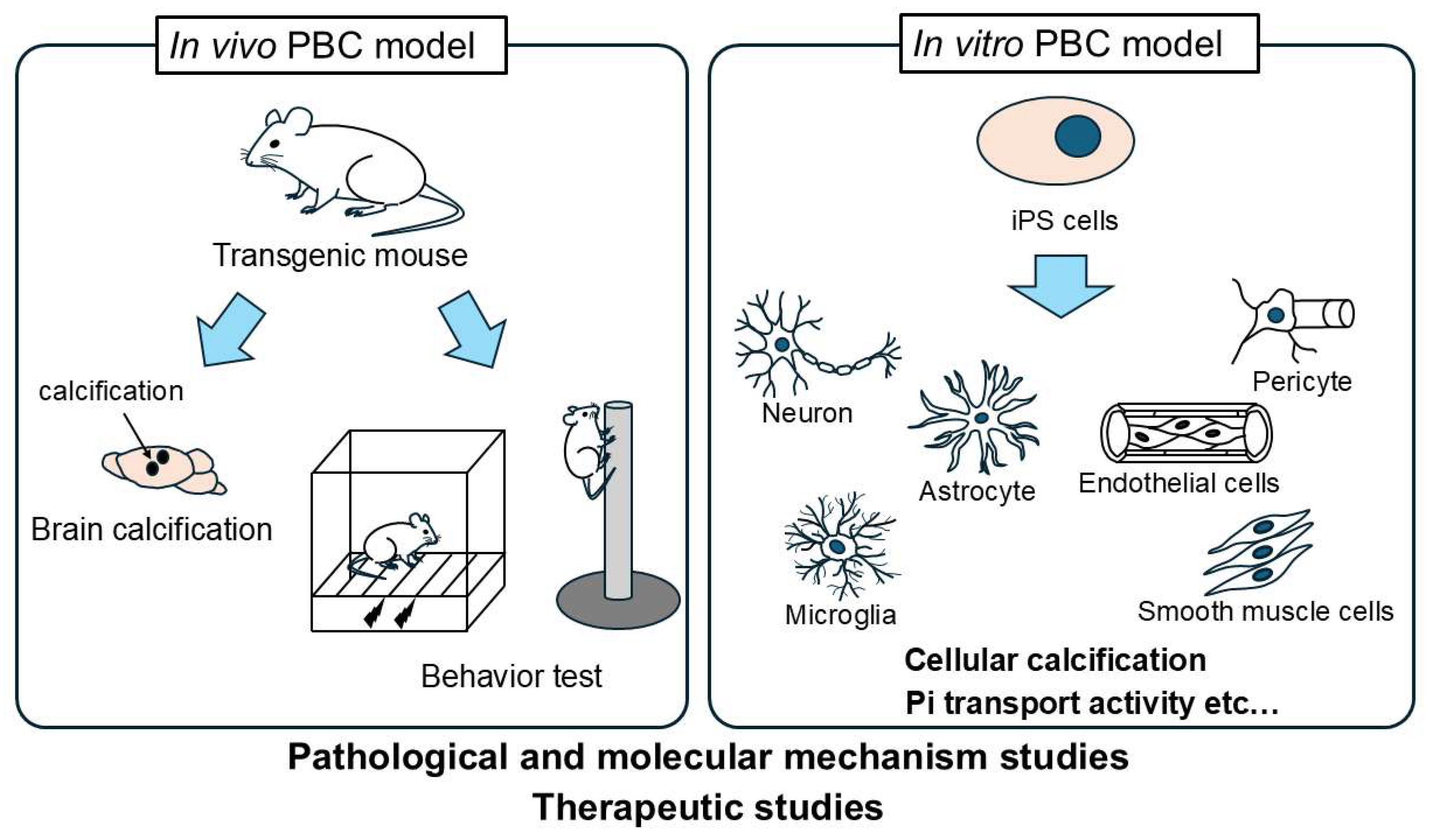
On the other hand, PBC models are crucial for evaluating candidate therapeutics in PBC drug discovery research. When comparing in vivo and in vitro PBC models, the advantage of the in vivo PBC mouse model is its ability to reproduce phenotypes observed in PBC patients, such as intracerebral calcification and higher brain functions. The disadvantage of in vivo PBC models is that they are costly and time-consuming for drug evaluation. The advantages of using an in vitro iPSC PBC model include the ability to utilize human cells, allowing consideration of species differences, and its suitability for drug screening compared to in vivo approaches. The disadvantages of in vitro PBC models include the limited types of iPS cells that can be used, and the difficulty in reproducing calcification. Therefore, a combination of in vivo and in vitro evaluation systems is required (Figure 1). In vivo PBC models should be able to reproduce neurobehavioral phenotypes such as intracerebral calcification, abnormalities in Pi metabolism, and higher brain functions. From that perspective, while the Slc20a2 KO mouse currently meets these criteria, considering the diverse pathologies of PBC, evaluation using a single PBC model is insufficient. Therefore, it is ideal to establish and utilize other types of KO mice for familial PBC causative genes and knock-in mice for human PBC mutations as PBC models for evaluation. It is considered necessary to establish in vivo PBC models targeting other PBC familial genes besides SLC20A2. We consider experimental systems using iPSC to be useful for in vitro drug evaluation systems; however, for PBC, the number of cell types is limited, and phenotypic information is also scarce. iPSC is important as an appropriate human experimental evaluation system, and it is considered that they should be used to complement in vivo models. There have been no reports of reproducing calcification using PBC-derived iPSC or cells differentiated from iPSC. It is considered necessary to develop in vitro drug evaluation systems using various cells constituting the NVU differentiated from iPSC, establish 3D cultures, co-cultures, and organoids using these cells, and evaluate Pi uptake capacity and cellular calcification in these models.
Figure 1.
Importance of in vitro and in vivo PBC models. PBC models are crucial for evaluating candidate therapeutics in PBC drug discovery research. Generally, a combination of in vivo and in vitro evaluation systems is required. In vivo PBC models should be able to reproduce neurobehavioral phenotypes such as intracerebral calcification, abnormalities in Pi metabolism, and higher brain functions. We consider experimental systems using iPSC to be useful for in vitro drug evaluation systems. iPSC is important as an appropriate human experimental evaluation system, and it is considered that they should be used to complement in vivo models. It is considered necessary to develop in vitro drug evaluation systems using various cells constituting the NVU differentiated from iPSC, such as those that evaluate phosphate uptake capacity and cellular calcification.
Therefore, while it is important to utilize both in vitro and in vivo PBC model systems in drug discovery research and studies of the disease mechanism, this approach is still considered to be in its developmental stage. Furthermore, while no PBC models have been reported to date, utilizing models based on nematodes, Drosophila, or AI tools for anticipating therapeutic molecular targets and iPSC-derived organoids could also prove useful. We anticipate that further functional analysis of genes responsible for familial cases of the disease will clarify their involvement in its pathogenesis, leading to the development of improved models of PBC.
Author Contributions
H.K. and J.M., writing—original draft.; K.O., Y.H. and M.I., review and editing. All authors have read and agreed to the published version of the manuscript.
Funding
This work received no external funding.
Institutional Review Board Statement
Not applicable.
Informed Consent Statement
Not applicable.
Data Availability Statement
No new data were created or analyzed in this study.
Conflicts of Interest
The authors declare no conflicts of interest.
References
- Wang, C.; Li, Y.; Shi, L.; Ren, J.; Patti, M.; Wang, T.; de Oliveira, J.R.; Sobrido, M.J.; Quintans, B.; Baquero, M.; et al. Mutations in SLC20A2 link familial idiopathic basal ganglia calcification with phosphate homeostasis. Nat. Genet. 2012, 44, 254–256. [Google Scholar] [CrossRef] [Scilit] [PubMed]
- Andrae, J.; Gallini, R.; Betsholtz, C. Role of platelet-derived growth factors in physiology and medicine. Genes Dev. 2008, 22, 1276–1312. [Google Scholar] [CrossRef] [Scilit] [PubMed]
- Nicolas, G.; Pottier, C.; Maltete, D.; Coutant, S.; Rovelet-Lecrux, A.; Legallic, S.; Rousseau, S.; Vaschalde, Y.; Guyant-Marechal, L.; Augustin, J.; et al. Mutation of the PDGFRB gene as a cause of idiopathic basal ganglia calcification. Neurology 2013, 80, 181–187. [Google Scholar] [CrossRef] [Scilit] [PubMed]
- Legati, A.; Giovannini, D.; Nicolas, G.; Lopez-Sanchez, U.; Quintans, B.; Oliveira, J.R.; Sears, R.L.; Ramos, E.M.; Spiteri, E.; Sobrido, M.J.; et al. Mutations in XPR1 cause primary familial brain calcification associated with altered phosphate export. Nat. Genet. 2015, 47, 579–581. [Google Scholar] [CrossRef] [Scilit]
- Yao, X.P.; Cheng, X.; Wang, C.; Zhao, M.; Guo, X.X.; Su, H.Z.; Lai, L.L.; Zou, X.H.; Chen, X.J.; Zhao, Y.; et al. Biallelic Mutations in MYORG Cause Autosomal Recessive Primary Familial Brain Calcification. Neuron 2018, 98, 1116–1123.e5. [Google Scholar] [CrossRef] [Scilit]
- Meek, R.W.; Brockerman, J.; Fordwour, O.B.; Zandberg, W.F.; Davies, G.J.; Vocadlo, D.J. The primary familial brain calcification-associated protein MYORG is an alpha-galactosidase with restricted substrate specificity. PLoS Biol. 2022, 20, e3001764. [Google Scholar] [CrossRef] [Scilit]
- Schottlaender, L.V.; Abeti, R.; Jaunmuktane, Z.; Macmillan, C.; Chelban, V.; O’Callaghan, B.; McKinley, J.; Maroofian, R.; Efthymiou, S.; Athanasiou-Fragkouli, A.; et al. Bi-allelic JAM2 Variants Lead to Early-Onset Recessive Primary Familial Brain Calcification. Am. J. Hum. Genet. 2020, 106, 412–421. [Google Scholar] [CrossRef] [Scilit]
- Li, J.; Liu, Q.; Yang, J.; Yang, Z.; Zhang, M.; Zhang, J.; Sun, C. Biological functions and clinical implications of the CMPK2 across multisystemic diseases. Cell Biosci. 2025, 15, 122. [Google Scholar] [CrossRef] [Scilit]
- Siggervag, A.; Bekkelund, A.K.; Saraste, J.; Aksnes, H. Understanding brain calcification via N-terminal acetylation at the Golgi apparatus. Brain 2025, 148, 3085–3094. [Google Scholar] [CrossRef] [Scilit]
- Black, A.; Klein, C.; Westenberger, A. Primary Familial Brain Calcification. In GeneReviews; Updated 2025; University of Washington: Seattle, WA, USA, 2004. [Google Scholar]
- Chen, S.Y.; Ho, C.J.; Lu, Y.T.; Lin, C.H.; Lan, M.Y.; Tsai, M.H. The Genetics of Primary Familial Brain Calcification: A Literature Review. Int. J. Mol. Sci. 2023, 24, 10886. [Google Scholar] [CrossRef] [Scilit]
- Da Silva, R.J.; Pereira, I.C.; Oliveira, J.R. Analysis of gene expression pattern and neuroanatomical correlates for SLC20A2 (PiT-2) shows a molecular network with potential impact in idiopathic basal ganglia calcification (“Fahr’s disease”). J. Mol. Neurosci. 2013, 50, 280–283. [Google Scholar] [CrossRef] [Scilit] [PubMed]
- Inden, M.; Iriyama, M.; Zennami, M.; Sekine, S.I.; Hara, A.; Yamada, M.; Hozumi, I. The type III transporters (PiT-1 and PiT-2) are the major sodium-dependent phosphate transporters in the mice and human brains. Brain Res. 2016, 1637, 128–136. [Google Scholar] [CrossRef] [Scilit]
- Jensen, N.; Schroder, H.D.; Hejbol, E.K.; Fuchtbauer, E.M.; de Oliveira, J.R.; Pedersen, L. Loss of function of Slc20a2 associated with familial idiopathic Basal Ganglia calcification in humans causes brain calcifications in mice. J. Mol. Neurosci. 2013, 51, 994–999. [Google Scholar] [CrossRef] [Scilit] [PubMed]
- Jensen, N.; Schroder, H.D.; Hejbol, E.K.; Thomsen, J.S.; Bruel, A.; Larsen, F.T.; Vinding, M.C.; Orlowski, D.; Fuchtbauer, E.M.; Oliveira, J.R.M.; et al. Mice Knocked Out for the Primary Brain Calcification-Associated Gene Slc20a2 Show Unimpaired Prenatal Survival but Retarded Growth and Nodules in the Brain that Grow and Calcify over Time. Am. J. Pathol. 2018, 188, 1865–1881. [Google Scholar] [CrossRef] [Scilit] [PubMed]
- Kimura, T.; Miura, T.; Aoki, K.; Saito, S.; Hondo, H.; Konno, T.; Uchiyama, A.; Ikeuchi, T.; Takahashi, H.; Kakita, A. Familial idiopathic basal ganglia calcification: Histopathologic features of an autopsied patient with an SLC20A2 mutation. Neuropathology 2016, 36, 365–371. [Google Scholar] [CrossRef] [Scilit]
- Kurita, H.; Kitaura, H.; Nishii, K.; Masaka, T.; Ohuchi, K.; Inden, M.; Kakita, A.; Osawa, M.; Hozumi, I. Generation of a new Slc20a2 knockout mouse line as in vivo model for primary brain calcification. Mol. Brain 2025, 18, 70. [Google Scholar] [CrossRef] [Scilit]
- Zhang, Y.; Ren, Y.; Zhang, Y.; Li, Y.; Xu, C.; Peng, Z.; Jia, Y.; Qiao, S.; Zhang, Z.; Shi, L. T-cell infiltration in the central nervous system and their association with brain calcification in Slc20a2-deficient mice. Front. Mol. Neurosci. 2023, 16, 1073723. [Google Scholar] [CrossRef] [Scilit]
- Cheng, X.; Zhao, M.; Chen, L.; Huang, C.; Xu, Q.; Shao, J.; Wang, H.T.; Zhang, Y.; Li, X.; Xu, X.; et al. Astrocytes modulate brain phosphate homeostasis via polarized distribution of phosphate uptake transporter PiT2 and exporter XPR1. Neuron 2024, 112, 3126–3142.e8. [Google Scholar] [CrossRef] [Scilit]
- Guerreiro, P.M.; Bataille, A.M.; Parker, S.L.; Renfro, J.L. Active removal of inorganic phosphate from cerebrospinal fluid by the choroid plexus. Am. J. Physiol. Renal Physiol. 2014, 306, F1275–F1284. [Google Scholar] [CrossRef] [Scilit]
- Jensen, N.; Autzen, J.K.; Pedersen, L. Slc20a2 is critical for maintaining a physiologic inorganic phosphate level in cerebrospinal fluid. Neurogenetics 2016, 17, 125–130. [Google Scholar] [CrossRef] [Scilit]
- Hozumi, I.; Kurita, H.; Ozawa, K.; Furuta, N.; Inden, M.; Sekine, S.I.; Yamada, M.; Hayashi, Y.; Kimura, A.; Inuzuka, T.; et al. Inorganic phosphorus (Pi) in CSF is a biomarker for SLC20A2-associated idiopathic basal ganglia calcification (IBGC1). J. Neurol. Sci. 2018, 388, 150–154. [Google Scholar] [CrossRef] [Scilit]
- Keller, A.; Westenberger, A.; Sobrido, M.J.; Garcia-Murias, M.; Domingo, A.; Sears, R.L.; Lemos, R.R.; Ordonez-Ugalde, A.; Nicolas, G.; da Cunha, J.E.; et al. Mutations in the gene encoding PDGF-B cause brain calcifications in humans and mice. Nat. Genet. 2013, 45, 1077–1082. [Google Scholar] [CrossRef] [Scilit] [PubMed]
- Irma, J.; Kartasasmita, A.S.; Kartiwa, A.; Irfani, I.; Rizki, S.A.; Onasis, S. From Growth Factors to Structure: PDGF and TGF-beta in Granulation Tissue Formation. A Literature Review. J. Cell Mol. Med. 2025, 29, e70374. [Google Scholar] [CrossRef] [Scilit] [PubMed]
- Armulik, A.; Genove, G.; Mae, M.; Nisancioglu, M.H.; Wallgard, E.; Niaudet, C.; He, L.; Norlin, J.; Lindblom, P.; Strittmatter, K.; et al. Pericytes regulate the blood-brain barrier. Nature 2010, 468, 557–561. [Google Scholar] [CrossRef] [Scilit] [PubMed]
- Kempuraj, D.; Dourvetakis, K.D.; Cohen, J.; Valladares, D.S.; Joshi, R.S.; Kothuru, S.P.; Anderson, T.; Chinnappan, B.; Cheema, A.K.; Klimas, N.G.; et al. Neurovascular unit, neuroinflammation and neurodegeneration markers in brain disorders. Front. Cell Neurosci. 2024, 18, 1491952. [Google Scholar] [CrossRef] [Scilit]
- Betsholtz, C.; Raines, E.W. Platelet-derived growth factor: A key regulator of connective tissue cells in embryogenesis and pathogenesis. Kidney Int. 1997, 51, 1361–1369. [Google Scholar] [CrossRef] [Scilit]
- Quintans, B.; Oliveira, J.; Sobrido, M.J. Primary familial brain calcifications. Handb. Clin. Neurol. 2018, 147, 307–317. [Google Scholar]
- Lopez-Sanchez, U.; Tury, S.; Nicolas, G.; Wilson, M.S.; Jurici, S.; Ayrignac, X.; Courgnaud, V.; Saiardi, A.; Sitbon, M.; Battini, J.L. Interplay between primary familial brain calcification-associated SLC20A2 and XPR1 phosphate transporters requires inositol polyphosphates for control of cellular phosphate homeostasis. J. Biol. Chem. 2020, 295, 9366–9378. [Google Scholar] [CrossRef] [Scilit]
- Cen, Z.; Chen, Y.; Chen, S.; Wang, H.; Yang, D.; Zhang, H.; Wu, H.; Wang, L.; Tang, S.; Ye, J.; et al. Biallelic loss-of-function mutations in JAM2 cause primary familial brain calcification. Brain 2020, 143, 491–502. [Google Scholar] [CrossRef] [Scilit]
- Zhao, M.; Su, H.Z.; Zeng, Y.H.; Sun, Y.; Guo, X.X.; Li, Y.L.; Wang, C.; Zhao, Z.Y.; Huang, X.J.; Lin, K.J.; et al. Loss of function of CMPK2 causes mitochondria deficiency and brain calcification. Cell Discov. 2022, 8, 128. [Google Scholar] [CrossRef] [Scilit]
- Xu, Y.; Johansson, M.; Karlsson, A. Human UMP-CMP kinase 2, a novel nucleoside monophosphate kinase localized in mitochondria. J. Biol. Chem. 2008, 283, 1563–1571. [Google Scholar] [CrossRef] [Scilit] [PubMed]
- Chelban, V.; Aksnes, H.; Maroofian, R.; LaMonica, L.C.; Seabra, L.; Siggervag, A.; Devic, P.; Shamseldin, H.E.; Vandrovcova, J.; Murphy, D.; et al. Biallelic NAA60 variants with impaired n-terminal acetylation capacity cause autosomal recessive primary familial brain calcifications. Nat. Commun. 2024, 15, 2269. [Google Scholar] [CrossRef] [Scilit]
- Aksnes, H.; Ree, R.; Arnesen, T. Co-translational, Post-translational, and Non-catalytic Roles of N-Terminal Acetyltransferases. Mol. Cell 2019, 73, 1097–1114. [Google Scholar] [CrossRef] [Scilit] [PubMed]
- Wallingford, M.C.; Gammill, H.S.; Giachelli, C.M. Slc20a2 deficiency results in fetal growth restriction and placental calcification associated with thickened basement membranes and novel CD13 and lamininalpha1 expressing cells. Reprod. Biol. 2016, 16, 13–26. [Google Scholar] [CrossRef] [Scilit] [PubMed]
- Wallingford, M.C.; Chia, J.J.; Leaf, E.M.; Borgeia, S.; Chavkin, N.W.; Sawangmake, C.; Marro, K.; Cox, T.C.; Speer, M.Y.; Giachelli, C.M. SLC20A2 Deficiency in Mice Leads to Elevated Phosphate Levels in Cerbrospinal Fluid and Glymphatic Pathway-Associated Arteriolar Calcification, and Recapitulates Human Idiopathic Basal Ganglia Calcification. Brain Pathol. 2017, 27, 64–76. [Google Scholar] [CrossRef] [Scilit]
- Nahar, K.; Lebouvier, T.; Andaloussi Mae, M.; Konzer, A.; Bergquist, J.; Zarb, Y.; Johansson, B.; Betsholtz, C.; Vanlandewijck, M. Astrocyte-microglial association and matrix composition are common events in the natural history of primary familial brain calcification. Brain Pathol. 2020, 30, 446–464. [Google Scholar] [CrossRef] [Scilit]
- Ren, Y.; Shen, Y.; Si, N.; Fan, S.; Zhang, Y.; Xu, W.; Shi, L.; Zhang, X. Slc20a2-Deficient Mice Exhibit Multisystem Abnormalities and Impaired Spatial Learning Memory and Sensorimotor Gating but Normal Motor Coordination Abilities. Front. Genet. 2021, 12, 639935. [Google Scholar] [CrossRef] [Scilit]
- Zhao, M.; Cheng, X.; Chen, L.; Zeng, Y.H.; Lin, K.J.; Li, Y.L.; Zheng, Z.H.; Huang, X.J.; Zuo, D.D.; Guo, X.X.; et al. Antisense oligonucleotides enhance SLC20A2 expression and suppress brain calcification in a humanized mouse model. Neuron 2024, 112, 3278–3294.e7. [Google Scholar] [CrossRef] [Scilit]
- Xu, X.; Li, X.; Sun, H.; Cao, Z.; Gao, R.; Niu, T.; Wang, Y.; Ma, T.; Chen, R.; Wang, C.; et al. Murine Placental-Fetal Phosphate Dyshomeostasis Caused by an Xpr1 Deficiency Accelerates Placental Calcification and Restricts Fetal Growth in Late Gestation. J. Bone Miner. Res. 2020, 35, 116–129. [Google Scholar] [CrossRef] [Scilit]
- Maheshwari, U.; Mateos, J.M.; Weber-Stadlbauer, U.; Ni, R.; Tamatey, V.; Sridhar, S.; Restrepo, A.; de Jong, P.A.; Huang, S.F.; Schaffenrath, J.; et al. Inorganic phosphate exporter heterozygosity in mice leads to brain vascular calcification, microangiopathy, and microgliosis. Brain Pathol. 2023, 33, e13189. [Google Scholar] [CrossRef] [Scilit]
- Sekine, S.I.; Nishii, K.; Masaka, T.; Kurita, H.; Inden, M.; Hozumi, I. SLC20A2 variants cause dysfunctional phosphate transport activity in endothelial cells induced from Idiopathic Basal Ganglia Calcification patients-derived iPSCs. Biochem. Biophys. Res. Commun. 2019, 510, 303–308. [Google Scholar] [CrossRef] [Scilit] [PubMed]
- Sekine, S.I.; Kondo, T.; Murakami, N.; Imamura, K.; Enami, T.; Shibukawa, R.; Tsukita, K.; Funayama, M.; Inden, M.; Kurita, H.; et al. Induced pluripotent stem cells derived from a patient with familial idiopathic basal ganglia calcification (IBGC) caused by a mutation in SLC20A2 gene. Stem Cell Res. 2017, 24, 40–43. [Google Scholar] [CrossRef] [Scilit] [PubMed]
- Sun, H.; Wang, Z.; Zhang, Q.; Chen, N.; Tang, M.; Yang, Z.; Xu, Y.; Kang, J.; Wang, Y. Golgi damage caused by dysfunction of PiT-2 in primary familial brain calcification. Biochem. Biophys. Res. Commun. 2023, 642, 167–174. [Google Scholar] [CrossRef] [Scilit]
- Zhang, Q.; Li, Z.; Sun, H.; Zhang, S.; Zhang, J.; Wang, Y.; Fang, H.; Xu, Y. Generation of induced pluripotent stem cell line (ZZUi0012-A) from a patient with Fahr’s disease caused by a novel mutation in SLC20A2 gene. Stem Cell Res. 2019, 35, 101395. [Google Scholar] [CrossRef] [Scilit] [PubMed]
- Begentas, O.C.; Koc, D.; Sendur, N.K.; Besarat, P.; Ezgin, S.; Temel, M.; Bora, H.A.T.; Kiris, E. Generation and characterization of human induced pluripotent stem cell line METUi002-A from a patient with primary familial brain calcification (PFBC) carrying a heterozygous mutation (c.687dupT (p.Val230CysfsTer28)) in the SLC20A2 gene. Stem Cell Res. 2023, 72, 103226. [Google Scholar] [CrossRef] [Scilit]
- Sekine, S.I.; Kaneko, M.; Tanaka, M.; Ninomiya, Y.; Kurita, H.; Inden, M.; Yamada, M.; Hayashi, Y.; Inuzuka, T.; Mitsui, J.; et al. Functional evaluation of PDGFB-variants in idiopathic basal ganglia calcification, using patient-derived iPS cells. Sci. Rep. 2019, 9, 5698. [Google Scholar] [CrossRef] [Scilit]
- Yada, Y.; Kondo, T.; Suga, M.; Tsukita, K.; Enami, T.; Shibukawa, R.; Sagara, Y.; Okanishi, Y.; Imamura, K.; Kihara, T.; et al. Human induced pluripotent stem cells generated from a patient with idiopathic basal ganglia calcification. Stem Cell Res. 2021, 53, 102274. [Google Scholar] [CrossRef] [Scilit]
- Nicolas, G.; Charbonnier, C.; Campion, D.; Veltman, J.A. Estimation of minimal disease prevalence from population genomic data: Application to primary familial brain calcification. Am. J. Med. Genet. B Neuropsychiatr. Genet. 2018, 177, 68–74. [Google Scholar] [CrossRef] [Scilit]
- Chen, S.; Cen, Z.; Fu, F.; Chen, Y.; Chen, X.; Yang, D.; Wang, H.; Wu, H.; Zheng, X.; Xie, F.; et al. Underestimated disease prevalence and severe phenotypes in patients with biallelic variants: A cohort study of primary familial brain calcification from China. Parkinsonism Relat. Disord. 2019, 64, 211–219. [Google Scholar] [CrossRef] [Scilit]
- Luo, W.; Cen, Z.; Koek, H.; Carecchio, M.; Hozumi, I.; Chen, W.J.; Batla, A.; Balck, A.; Magrinelli, F.; Yang, D.; et al. Primary Brain Calcification: An International Consensus on Nomenclature, Diagnosis, Evaluation, and Management. Mov. Disord. 2025. online ahead of print. [Google Scholar] [CrossRef] [Scilit]


Disclaimer/Publisher’s Note: The statements, opinions and data contained in all publications are solely those of the individual author(s) and contributor(s) and not of MDPI and/or the editor(s). MDPI and/or the editor(s) disclaim responsibility for any injury to people or property resulting from any ideas, methods, instructions or products referred to in the content. |
© 2025 by the authors. Licensee MDPI, Basel, Switzerland. This article is an open access article distributed under the terms and conditions of the Creative Commons Attribution (CC BY) license.