


Abstract
With the increasing adoption of regenerative braking technology in electric vehicles (EVs), one-pedal driving (OPD) mode has become a prevalent feature. While OPD offers technical advantages in energy efficiency, its implications for driver behavior and traffic safety remain unclear. To address the lack of human factors research in this domain, this study utilized a driving simulator to systematically compare driving performance between OPD and two-pedal driving (TPD) modes. Twenty-six participants engaged in car-following tasks under varying traffic densities (uncongested vs. congested) and cognitive load levels (normal vs. 1-back). Driving performance and safety were quantified using the absolute speed difference, distance headway, braking frequency, and Time-to-Collision at brake onset (TTCbrake). The results revealed a significant trade-off: while OPD simplified operation, it led to compromised driving performance compared to TPD in specific contexts. Specifically, OPD resulted in larger speed variations and reduced safety margins during the approach stage. Conversely, under high cognitive load, OPD demonstrated a protective effect by mitigating performance degradation. These findings suggest that while OPD can benefit drivers under mental pressure, its deployment requires adaptive safety strategies, such as the integration of Headway Monitoring Warning (HMW) and Forward Collision Warning (FCW), to compensate for performance deficits in complex traffic environments.
1. Introduction
According to Global EV Outlook 2025 released by the International Energy Agency (IEA) [1], global electric vehicle (EV) sales exceeded 17 million units in 2024, accounting for more than 20% of total vehicle sales. To address range anxiety and optimize energy efficiency, current efforts largely focus on advancing battery technologies [2] and expanding accessible charging infrastructure [3], while vehicle-side energy-saving control strategies are increasingly adopted in parallel. Prior research suggests that, particularly in urban driving where frequent acceleration and braking account for nearly 50% of energy consumption [4]; accordingly, manufacturers have widely adopted the one-pedal driving (OPD) system based on regenerative braking technology. By allowing drivers to decelerate solely by releasing the accelerator, OPD transforms kinetic energy into electrical storage while simplifying vehicle control [5].
Currently, the automotive braking system is undergoing a technological transition from the traditional two-pedal driving (TPD) mode to OPD. As OPD becomes increasingly widespread, drivers must adapt to two distinct control paradigms. As an emerging form of human–machine interaction (HMI), OPD departs from the TPD paradigm that separates acceleration and braking actions, potentially inducing operational habit transfer risks. Recognizing these concerns, China, the world’s largest EV market, has pioneered regulatory intervention. The Ministry of Industry and Information Technology (MIIT) recently updated the mandatory national standard GB 21670-2025 [6], stipulating that from 1 January 2026, the “full-stop” functionality of OPD must be disabled by default, requiring manual activation by users [7,8]. This legislative move underscores a critical consensus: while OPD offers undeniable energy benefits, its safety implications in complex real-world scenarios remain controversial and require rigorous human factors scrutiny.
Existing human factors research on OPD presents a divided landscape. Proponents highlight its operational advantages, such as faster deceleration response times [9], rapid user adaptation [10], and improved control ability. However, other studies have highlighted potential safety concerns associated with OPD under specific driving conditions, such as ambiguous foot movements [11] and insufficient braking intensity during emergency events [12]. Ma et al. [12] primarily investigated safety-critical rear-end events by parametrically manipulating situational urgency (via lead vehicle braking profiles and initial headway) and quantifying drivers’ pre-crash reaction sequence (e.g., throttle release and foot-transition timing) together with collision/TTC outcomes in a distraction-free environment. Overall, OPD’s applicability appears scenario-dependent: while it simplifies conventional braking operations, it may simultaneously compromise safety under high-demand driving conditions.
Despite the growing interest in OPD, most studies have focused on basic driving scenarios, whereas research in high-frequency congested traffic environments remains limited [13]. Research on OPD in congested traffic, where stop-and-go behaviors are frequent and collision risks are elevated [14], has primarily examined drivers’ strategies and habits. For instance, Schmitz et al. compared OPD behavior in urban and rural environments and found that drivers in denser traffic conditions engaged regenerative braking more frequently [13]. Cocron et al. further observed, through on-road field studies, that drivers often perceived OPD deceleration as “too abrupt” during stop-and-go traffic [15]. Overall, the current literature on OPD under congested conditions remains limited. Few studies have quantitatively assessed driver behavior and safety in such scenarios.
Furthermore, due to the high frequency and severity of collisions during car-following, car-following behavior has become one of the key topics in studies of driving safety under congested traffic conditions. From the perspective of driving task, car-following behavior essentially reflects the dynamics of the self vehicle (SV) and the lead vehicle (LV) movements in the traffic flow, which can be decomposed into an alternating following stage and approach stage [16]. The following stage represents a relatively stable maintenance period, during which the driver maintains a dynamic equilibrium distance headway from the LV through subtle acceleration and deceleration adjustments [17]. The approach stage requires the driver to make more proactive responses based on situational anticipation. Its core characteristic lies in the driver’s transition from a relatively free driving state to a constrained state in which close monitoring and reaction to the LV’s movements become essential [18]. Although previous studies have extensively examined driver behaviors across these two stages, they exhibit two major limitations. First, most existing work has focused on the traditional TPD model [19,20]. Second, even the limited studies on OPD have primarily concentrated on the approach stage, highlighting OPD’s braking advantages while neglecting behavioral characteristics in the following stage [21].
Within the human–vehicle–road closed-loop system, the driver is regarded as the most vulnerable component. Among the numerous factors influencing driver behavior, cognitive workload and driving performance are two fundamental factors. Clarifying the relationship between the two factors is essential for improving driving safety [22]. Research has shown that excessive workload can impair drivers’ cognitive functioning, reduce safety awareness [23], and consequently deteriorate driving performance [24]. Conversely, when cognitive workload is excessively low, driving performance may also deteriorate, as drivers are prone to distraction and may overlook critical environmental information [25]. While the relationship between cognitive workload and driving performance is well-established in TPD [23], it remains underexplored in OPD. Whether the “reduced workload” claimed by some OPD proponents leads to better control or, conversely, to complacency and delayed reaction is yet to be determined. Moreover, existing studies have mainly concentrated on basic operational performance, without fully addressing cognitive and behavioral responses in safety-critical driving scenarios. Therefore, further research is needed to explore the integrated effects of OPD across diverse driving scenarios, with particular attention to human–machine interaction mechanisms and safety-related performance.
To address these gaps, this study utilizes a driving simulator to systematically evaluate the safety and driving performance of OPD compared to TPD. Specifically, this study addresses the following research questions (RQs):
RQ1.
How does OPD influence driving performance during the following stage?
RQ2.
How does OPD influence driving performance during the approach stage?
RQ3.
How do varying traffic densities and cognitive load modulate the safety performance of OPD?
2. Methods
2.1. Participants
A total of 26 participants (13 males and 13 females) were recruited for this study, ranging in age from 25 to 33 years (Mean = 28.0, Standard Deviation = 2.1). All participants were in good physical health with normal or corrected-to-normal vision. The specific age range was considered representative of the majority of drivers with substantial experience in operating both electric vehicles (EVs) and internal combustion engine vehicles (ICEVs). In addition, all participants reported prior skilled driving experience with both OPD and TPD. All participants possessed a valid driver’s license and reported driving at least 500 km per year. The study was conducted in accordance with the principles of the Declaration of Helsinki and was approved by the Science and Technology Ethics Committee of Tongji University (tjdxsr012). Furthermore, informed consent was obtained from all participants prior to their participation in the experiment. In addition, separate written informed consent to publish anonymized individual details (e.g., age range, sex, driving experience) was obtained from all participants.
2.2. Apparatus
The driving simulation system consisted of an open cab and computer-generated scenarios. The open cab consisted of a Fanatec® simulated cockpit (Fanatec, Landshut, Germany) and three 45-inch screens with a 150° field of view (Figure 1). The simulated driving scenarios and driving modes were built via SCANeR Studio® (2022) software (AVSimulation, Boulogne-Billancourt, France). Signals from the steering wheel, brake pedal, and accelerator pedal were collected through the ACQUISITION module of the software at a sampling frequency of 50 Hz.

Figure 1.
Experimental apparatus.
To simulate the cognitive demand of complex in-vehicle interactions, participants were required to perform a 1-back task concurrently with the driving task. The n-back task is a widely adopted paradigm in HF/E research [26]. To occupy the driver’s cognitive resources without interfering with the primary driving task, the auditory 1-back task was adopted as the high-cognitive-load condition [27]. A randomized sequence of single digits (0–9), generated via MATLAB (R2024b), was presented auditorily at a rate of one digit every 2.25 s. Participants were instructed to verbally repeat the digit presented one trial earlier while simultaneously listening to the current number in the sequence.
2.3. Experiment Design
Within the SCANeR studio® simulation platform, this study implemented two vehicular control paradigms: the OPD mode and the TPD mode. The OPD mode was implemented by mapping accelerator-pedal release to a prescribed deceleration profile. Previous research indicated that EVs with stronger regenerative deceleration (0.15–0.2 g) tend to offer more direct controllability, and that the differences between the two modes become more pronounced [9]. In production EVs, regenerative braking intensity is typically configurable, and the resulting coasting deceleration can vary across vehicle models and settings. To ground the simulator parameterization in real-world evidence, we referenced an on-road measurement study that quantified regenerative deceleration for several mainstream EVs [28]. Under high-intensity settings, the reported steady-state deceleration is commonly close to 0.2 g. Accordingly, the regenerative braking intensity in the OPD mode was set to approximately 0.2 g to represent a high-intensity one-pedal configuration, allowing the mode-dependent behavioral differences to be more discernible. This choice is also consistent with prior simulator-based OPD research adopting a comparable setting (steady-state deceleration ≈ 0.2 g) [12]. For the TPD mode, the default ICEV model provided by SCANeR studio® was used.
The simulated environment consisted of a 15.8 km bidirectional urban roadway with three lanes in each direction. The car-following scenarios included both uncongested and congested urban traffic conditions. To enhance realism, the swarm and trailer module in SCANeR was used to generate slight opposing traffic flow. In the uncongested scenario, traffic density on the same-direction road ranged between 200 and 300 vehicles per hour [14]. Considering that different levels of lane occupancy influence roadway capacity [29], the congested scenario was designed to fully occupy all lanes in one direction, such that the SV was constrained to follow the LV. To mitigate learning effects, ten trigger points were randomly distributed along the route. When the LV reached a trigger point, it decelerated at a preset rate. In the uncongested scenario, the LV’s maximum speed was approximately 50 km/h with a preset deceleration of 0.85 g, whereas in the congested scenario, the maximum speed was about 6 km/h with a preset deceleration of 0.15 g. Upon completion of ten LV deceleration events, participants were notified that the trial had ended.
Furthermore, simulated chassis pitch dynamics were rendered during acceleration and braking to provide realistic visual feedback of vehicle load transfer. Participants were instructed to drive naturally, avoiding unrealistic behaviors such as extreme tailgating or unnecessary emergency braking.
2.4. Procedure
Before the test runs, participants were required to read an information statement outlining the general information of the study. They were then asked to review and sign an informed consent form. Afterward, participants completed a questionnaire that collected information on demographics, driving experience, and simulator sickness. The experimental procedure is illustrated in Figure 2. Prior to the formal experiment, participants were given sufficient time (approximately 5 min) to familiarize themselves with the driving simulator, including the simulator controls (accelerator pedal, brake pedal and steering wheel) and the surrounding virtual environment. If any participant reported discomfort or showed signs of simulator sickness, the trial was immediately terminated for health and safety reasons.

Figure 2.
Experimental Procedure.
Subsequently, participants completed a 10 min practice, which consisted of a car-following exercise and a secondary task training. During the car-following exercise, the LV traveled at a constant speed of 50 km/h, and participants were instructed to maintain a stable distance headway according to their natural driving habits. The SV speed was displayed in real time on the simulator screen. These same requirements applied in the formal experiments. The next stage was the secondary task training. The experimenter instructed participants on how to perform the 1-back tasks and guided them through several practice trials. In the formal experiment, participants’ primary task was to drive the simulated vehicle, the secondary task was to perform the 1-back task.
The experiment adopted a within-subject design, consisting of eight combinations of experimental conditions: Two pedal modes (OPD vs. TPD) × Two traffic scenarios (Uncongested vs. Congested) × Two cognitive loads (Normal vs. 1-back). Each participant completed eight experimental conditions in total. The experiment was divided into two main sessions (one for each driving mode), separated by a 10 min rest period to minimize fatigue. In the uncongested scenario, the LV was positioned 20 m ahead of the SV in the same lane, with both vehicles initially stationary. Once the participant pressed the accelerator pedal, the LV automatically accelerated to approximately 50 km/h and maintained that constant speed. Each time the LV reached a trigger point, it decelerated unpredictably at a preset deceleration rate until coming to a complete stop, remained stationary for 5 s, and then accelerated back to its maximum speed with the preset acceleration. Participants were instructed to maintain a stable distance headway based on their natural driving habits. The SV’s real-time speed was continuously displayed on the simulator screen. In the congested scenario, the procedure was similar, except that (1) the LV was initially positioned 5 m ahead of the SV; (2) the LV’s maximum speed was approximately 6 km/h. To mitigate learning effects, the four types of scenarios were presented in a randomized order during the experiment. Each scenario lasted approximately 10 min, and the entire experiment took about 120 min per participant to complete.
2.5. Dependent Measures and Analysis
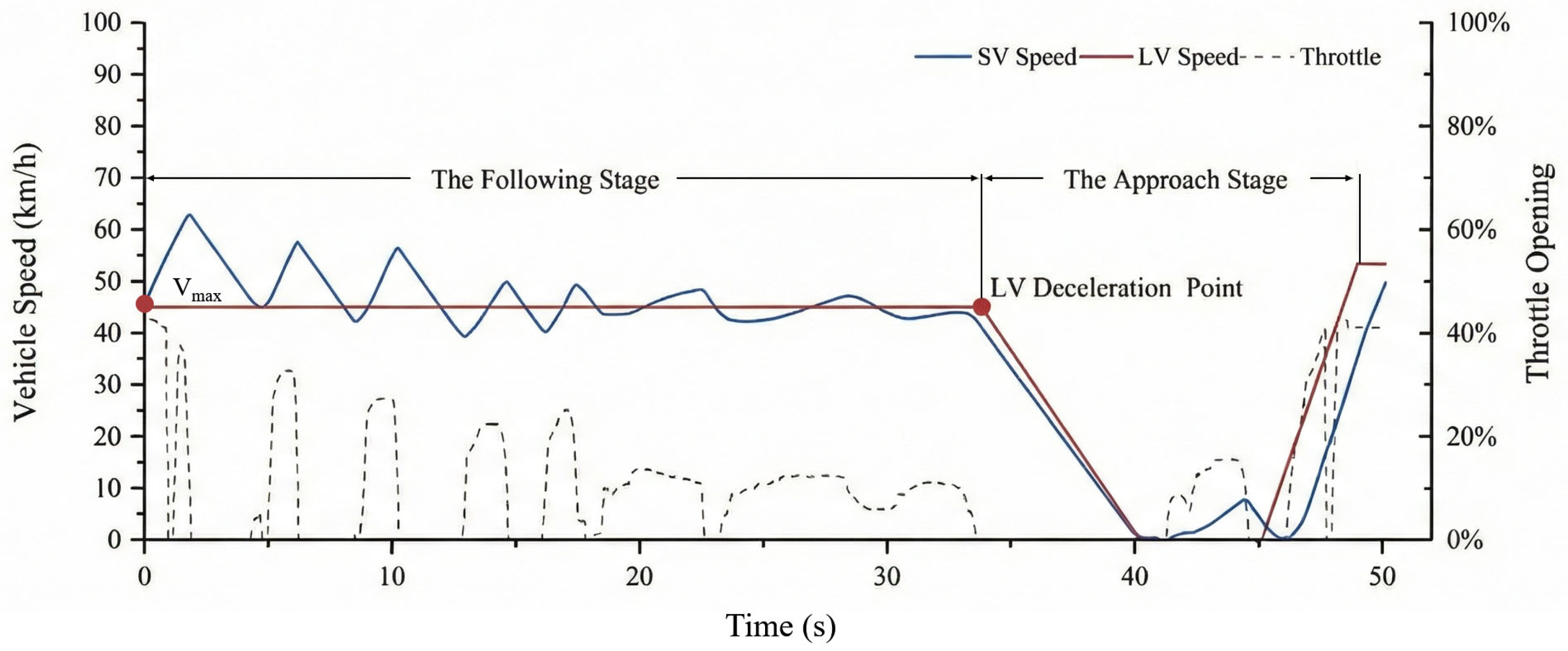
In this study, to more accurately evaluate drivers’ car-following behavior, each car-following cycle was segmented into two stages based on the LV speed profile: the following stage and the approach stage (Figure 3). The following stage was defined as the stable car-following interval from the onset of LV cruising (i.e., when the LV speed first reached Vmax) until the onset of LV deceleration. The approach stage was defined as the interval from LV deceleration onset to the recovery of LV cruising.

Figure 3.
The two stages of car-following behavior.
During the following stage, three key indicators were extracted from the driving simulator: (1) the instantaneous absolute value of the speed difference between the LV and the SV; (2) the Fourier transform of the speed difference computed over the following-stage segment; (3) the instantaneous distance headway between the two vehicles [30]. The Fourier transform of the speed difference was employed to quantify the fluctuation characteristics of the SV’s speed during steady car-following. During the approach stage, three indicators were examined: braking frequency, maximum braking force, and TTCbrake [12,31]. Braking frequency refers to the average number of braking actions within each approach segment, while maximum braking force refers to the maximum brake pedal force used by the participant in each segment. Time to collision (TTC) is one of the most widely recognized time-based safety indicators, defined as the time remaining before a rear-end collision would occur if the course and speed of vehicles are maintained [32]. In this study, TTCbrake was measured at the instant when the SV began to brake during the approach stage, reflecting the driver’s decision-making and safety margin in response to the imminent hazard [12].
All dependent variables collected in this experiment were within-subject measures. To address the research questions, all dependent variables were analyzed across the different driving conditions. For variables that met the assumption of normality, paired-samples t-tests were conducted. When the assumption of normality was violated, the Wilcoxon signed-rank test was used as a non-parametric alternative. The statistical significance level was set at α = 0.05.
3. Results
All twenty-six participants successfully completed the experiment, and none reported discomfort or post-simulation sickness. To evaluate longitudinal control stability, we analyzed the absolute speed difference relative to the LV and the spectral characteristics (Fourier transform) of speed fluctuations.
3.1. The Following Stage
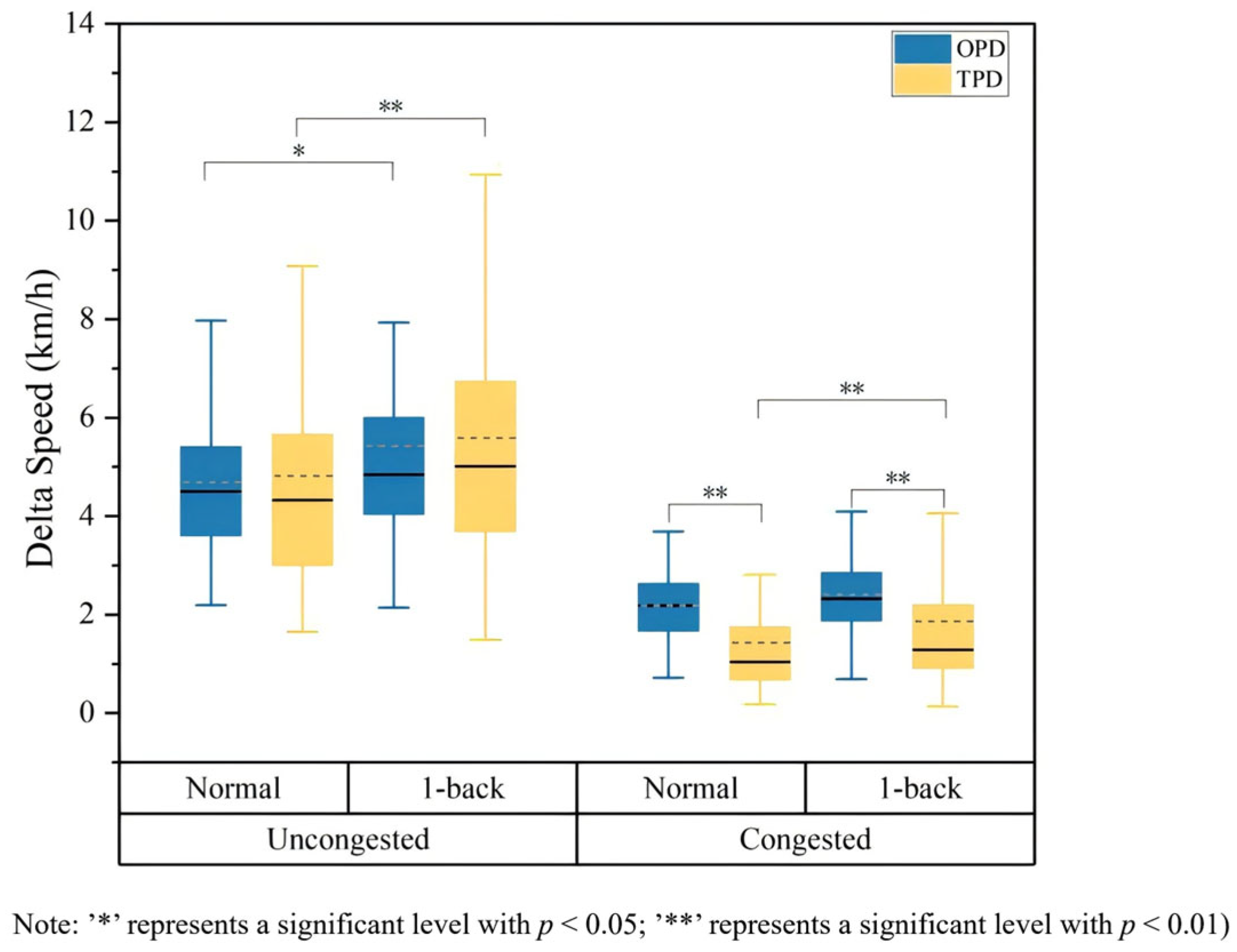
Stable car-following segments were extracted from each scenario, and detailed analyses were conducted for the following stage data. Figure 4 illustrates the absolute value of the speed difference between the SV and the LV during the following stage. As the data did not meet the assumption of normality, the Wilcoxon signed-rank test was employed for statistical analysis. Figure 5 presents the results of the Fourier transform performed on the speed difference to examine fluctuations in the following behavior.

Figure 4.
The absolute value of the delta speed between SV and LV during the following stage.


Figure 5.
The result of applying Fourier transform to delta speed during the following stage.
In the uncongested scenario, regardless of the presence of the 1-back task, no significant differences (all p > 0.05) were observed between OPD and TPD in either the absolute value of the speed difference or the fluctuation characteristics of the following speed. Conversely, in the congested scenario, both the absolute speed difference (all p < 0.01) and the frequency of its fluctuation were significantly higher under OPD compared with TPD, regardless of the presence of the 1-back task. It is noteworthy that in the congested scenario, the introduction of the 1-back task had a greater effect on the absolute speed difference and fluctuation frequency in the TPD mode than in the OPD mode. However, both the absolute speed difference and fluctuation magnitude remained consistently larger in the OPD mode, indicating that the overall car-following control precision was lower in OPD compared to TPD.
Figure 6 presents the mean distance headway of the SV during the stable following stage. As shown in Figure 6a, in the uncongested–normal (hereafter U–N) condition, participants maintained a slightly larger headway distance under OPD compared to TPD; however, the difference was not statistically significant (p = 0.055 > 0.05). In the uncongested–1-back (hereafter U–1) condition, the distance headway in the OPD mode decreased significantly (p = < 0.01), whereas no significant change was observed for TPD (p = 0.779 > 0.05). Consequently, although the mean distance headway in the OPD mode was slightly smaller than that in the TPD mode in the U–1 condition, the difference between the two modes remained non-significant (p = 0.346 > 0.05).

Figure 6.
Distance headway between SV and LV during the following stage. (a) In the uncongested scenario; (b) In the congested scenario.
Similarly, as shown in Figure 6b, in the congested–normal (hereafter C–N) condition, the distance headway in the OPD mode was slightly shorter than in the TPD, but this difference was not significant (p = 0.497 > 0.05). However, in the congested–1-back (hereafter C–1) condition, the distance headway for OPD further decreased, while that for TPD increased, resulting in a significant difference between the two driving modes (p = 0.009 < 0.01).
The findings suggest that while TPD drivers actively compensate for cognitive demand by expanding safety margins, OPD drivers may fail to adapt or even adopt riskier following behaviors when cognitively burdened in dense traffic.
3.2. The Approach Stage
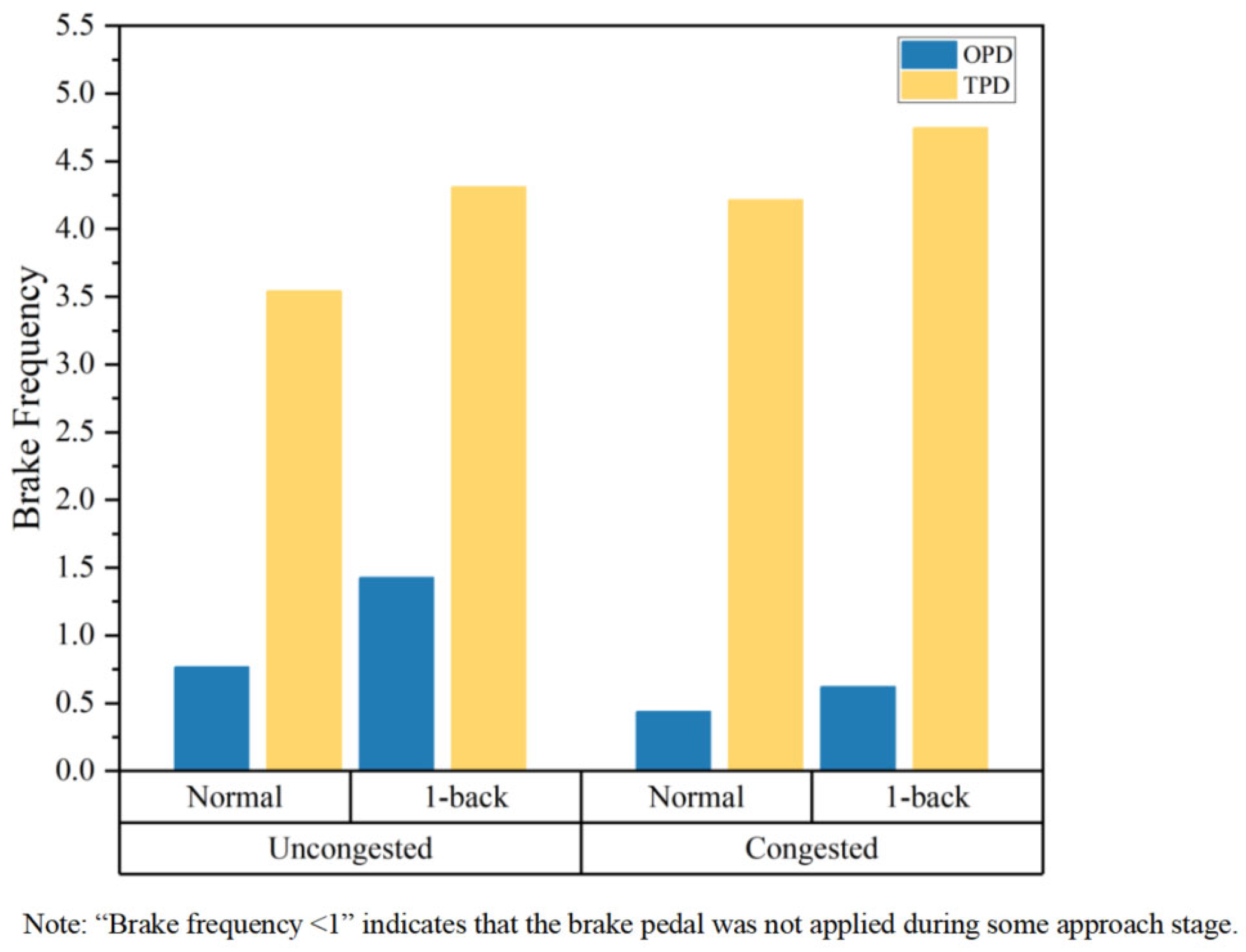
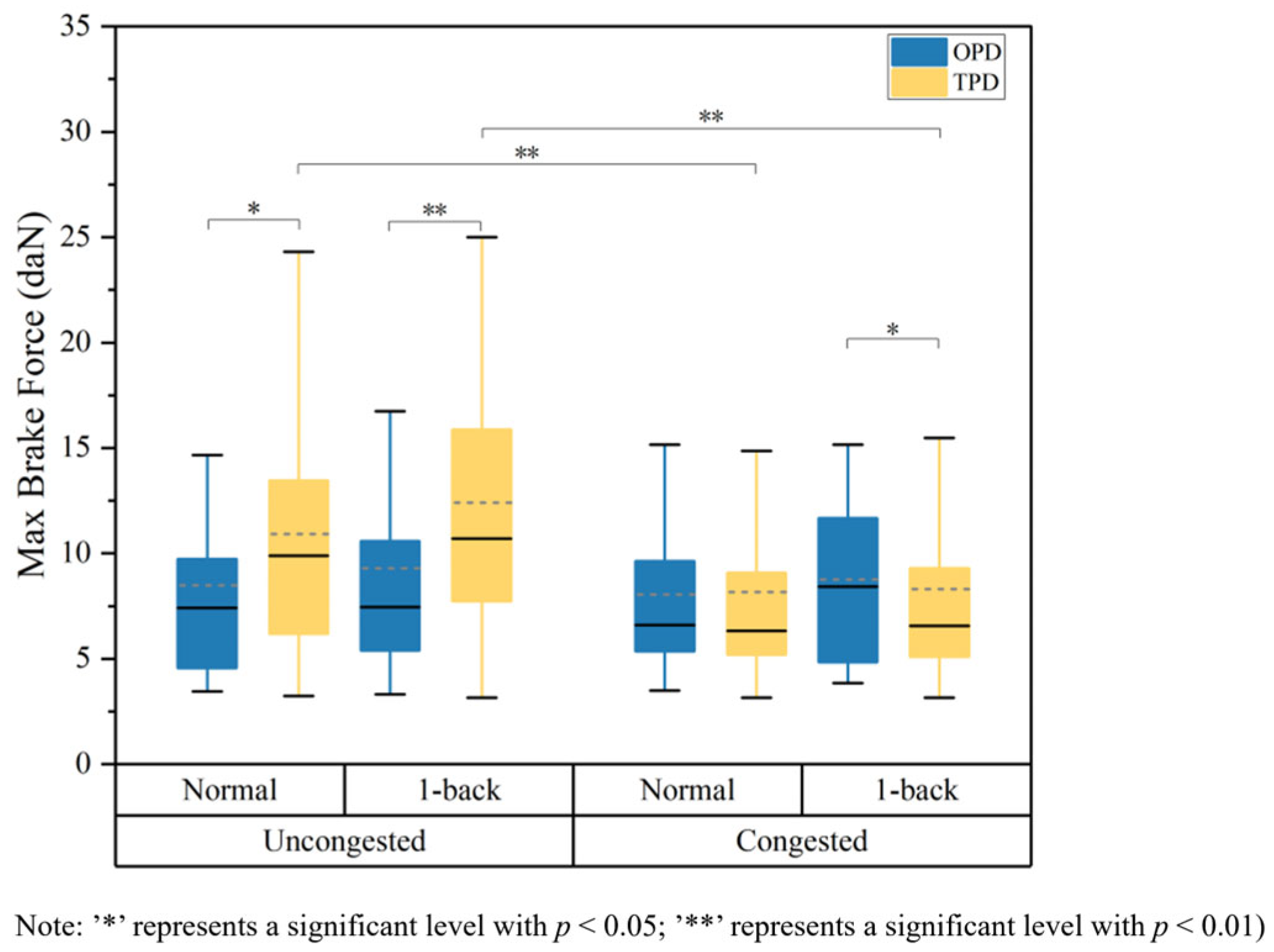
To evaluate the drivers’ active risk avoidance strategies, we analyzed the Braking Frequency (number of physical brake pedal activations) and Maximum Braking Force during the approach stage, as shown in Figure 7 and Figure 8.

Figure 7.
Frequency of brake pedal usage during the approach stage.

Figure 8.
Maximal brake force during the approach.
As the data did not meet the assumption of normality, the Wilcoxon signed-rank test was used for statistical analysis. The results showed that, for both driving modes, participants’ braking frequency increased with the occupation of cognitive resources. However, the maximum braking force, with the maximum pedal force set to 25 daN in this experiment, did not differ significantly between OPD and TPD (all p > 0.05). Compared with the uncongested scenario, participants in the congested scenario exhibited a significant increase in braking frequency and a significant decrease in maximum braking force in the TPD mode (all p < 0.01). However, in the OPD mode, participants showed a significant reduction in braking frequency, while the maximum braking force remained statistically unchanged (all p > 0.05).
Figure 9 shows that, across all experimental conditions, the TTCbrake values in the OPD mode were significantly smaller than those in the TPD mode (all p < 0.01). In the uncongested scenario, cognitive load did not significantly affect TTCbrake in either driving mode (all p > 0.05). However, in the congested scenario, the effect of cognitive load on TTCbrake became significant for both driving modes, with a stronger reduction observed in the OPD mode. Specifically, TTCbrake decreased significantly under OPD (p < 0.01) and showed a smaller yet significant decrease under TPD (p = 0.046 < 0.05).

Figure 9.
TTC of SV brake onset.
4. Discussion
This study conducted a comparative analysis of drivers’ driving performance under different traffic scenarios and levels of cognitive load across two driving modes, thereby revealed their implications for driving safety.
As illustrated in Figure 4 and Figure 5, during the stable car-following stage, no significant differences were observed between OPD and TPD in either the absolute value of speed difference or the fluctuation frequency under the uncongested scenario. A plausible explanation is that the uncongested condition imposed relatively low task demand, allowing drivers to maintain adequate control in both modes such that operational differences were not manifested. In contrast, under congested scenario with the same load levels, both the absolute speed difference and the fluctuation frequency were significantly higher in OPD compared to TPD. This suggests that relative to TPD, drivers using OPD needed to make more frequent speed adjustments while still demonstrating lower following stability. Moreover, the introduction of the 1-back task under congested scenario had a stronger impact on TPD drivers’ absolute speed difference and fluctuation frequency than on those using OPD. Nevertheless, OPD consistently showed higher values across all congested conditions. These findings indicate that TPD performance is more sensitive to additional cognitive demand, whereas OPD showed reduced control precision even under lower workload and exhibits comparatively limited responsiveness to workload variation. This pattern suggests that OPD drivers may have reduced risk awareness and lower risk sensitivity, particularly under low-load conditions, leading to coarser and less stable longitudinal control.
As shown in Figure 6a, in the U–1 condition, the distance headway under OPD decreased significantly, while that remained stable in the TPD mode. Similarly, in the C–1 condition in Figure 6b, OPD drivers exhibited a further reduction in distance headway, whereas TPD drivers increased their distance headway. Under high cognitive load, the simpler and smoother control offered by OPD may lead drivers to over-rely on regenerative braking and underestimate the need for active distance regulation. This underestimation of risk could result in misjudgment of safety distances and more aggressive driving strategies. In contrast, TPD requires explicit pedal coordination, which may promote more cautious behavior and active headway maintenance [33,34]. Therefore, additional safety interventions or driver-assistance features may be necessary for OPD-equipped vehicles to mitigate the risk of insufficient distance headway under cognitively demanding conditions.
Taken together, these three indicators provide complementary insights into longitudinal control strategies during car-following. The absolute speed difference and the fluctuation frequency characterize the magnitude and variability of relative-speed corrections, reflecting the precision and intensity with which drivers regulate speed to match the LV. By contrast, the distance headway primarily reflects the driver’s spacing policy, i.e., the preferred following distance. Importantly, these dimensions are not necessarily coupled: tighter spacing may co-occur with larger and more frequent corrections, depending on how drivers trade off comfort, effort, and perceived risk. In this sense, the combined pattern across, fluctuation frequency, and helps reveal that drivers adopt a more conservative, margin-preserving strategy in the TPD mode (e.g., smoother speed matching with larger headway). While in the OPD mode, they adopt a more aggressive driving strategy (e.g., coarser, more oscillatory speed regulation with smaller headway). This clarifies the behavioral mechanism behind the differences between OPD and TPD.
During the approach stage, that is, after the LV began to decelerate, the results based on braking frequency and maximum braking force (Figure 7 and Figure 8) revealed that cognitive load significantly increased braking frequency in both driving modes, while it had no significant effect on maximum braking force. This pattern is consistent with the findings of Dang and Tapus [35], who reported that when drivers are required to process a greater number of events or secondary tasks, their cognitive workload increases, leading to more frequent braking behavior. The underlying mechanisms may include the following: (1) Under higher cognitive load, drivers tend to adopt a more conservative longitudinal control strategy [36,37], characterized by frequent light braking to maintain safety margins; (2) Elevated cognitive load may also reduce drivers’ predictive capability for the LV’s motion dynamics [31], necessitating more frequent micro-adjustments maintain acceptable following performance. This “compensatory micro-adjustments” strategy results in an increase in braking frequency without inducing higher peak braking demands.
Traffic congestion further revealed a mode-specific modulation. In the TPD mode, braking frequency increased significantly while maximum braking force decreased. This pattern aligns with the characteristic strategy commonly observed in congested traffic, where drivers apply small, short-duration braking actions to maintain safe distance headway [38,39]. Moreover, under low average speeds, the demand for peak braking force naturally declines. However, congestion led to a significant reduction in braking frequency in the OPD mode, whereas the maximum braking force remained relatively constant at a higher level. This can be explained by the strong regenerative deceleration inherent in OPD, which already covers most of the necessary speed reductions in low-speed traffic. As a result, drivers use the brake pedal less often, consistent with the observations made by [15]. When drivers perceived that additional deceleration was necessary, they tended to apply the brake pedal only at that point, resulting in larger instantaneous braking forces once mechanical braking was initiated. This phenomenon is in line with the findings of Cocron et al. [40], who, based on a one-year field study in the Berlin metropolitan area, reported that participants frequently noted the impression that the EV ahead seemed to brake sharply in traffic queues. Mitropoulos-Rundus et al. further suggested that OPD drivers perceive braking to occur automatically when the accelerator is released, and consequently delay pressing on the brake until it feels necessary [9]. Taken together, these results imply that even in low-speed congested scenarios, drivers operating in the OPD mode still exhibit relatively strong braking forces.
Figure 9 shows that drivers’ TTCbrake values were significantly smaller in the OPD mode compared with the TPD mode. Similar observations were reported by Mitropoulos-Rundus et al. [9] and Saito et al. [21]. As discussed previously, our results showed that the maximum brake-pedal force in OPD varies relatively little across experimental conditions, suggesting that drivers postpone brake-pedal braking until a higher perceived need for deceleration emerges. The deceleration characteristics of OPD encourage drivers to rely more heavily on the regenerative braking system and reduce the driver’s demand for active braking control. Therefore, the driver’s risk perception was delayed in the OPD mode. The value of TTCbrake decreased accordingly.
This delay in braking indicates reduced safety margins and may introduce potential safety risks. Under extreme conditions, such as sudden deceleration of the LV, the reduced TTCbrake could increase the likelihood of rear-end collisions. Ma et al. further demonstrated that the OPD mode is safer when the LV’s deceleration is equal to or lower than the SV’s preset deceleration; conversely, when the LV’s deceleration exceeds that preset threshold, the OPD mode becomes comparatively less safe [12]. It is also noteworthy that the effect of cognitive load on TTCbrake was significant only under congested scenario, with a greater impact observed for OPD than for TPD. This may be because, in the uncongested scenario, the task environment was relatively simple, and the imposed cognitive demand did not substantially impair drivers’ risk situational awareness. In contrast, the congested scenario presented more complex situational cues and required greater attentional resources, making drivers more susceptible to cognitive overload. Under these conditions, OPD drivers who engage in fewer active control operations may experience reduced situational awareness, leading to slower braking responses. In comparison, TPD drivers, who must actively determine braking timing, may rely on habitual braking behaviors, maintaining relatively stable responses even under cognitive constraints. Such preventive braking habits may explain the smaller reduction in TTCbrake observed for TPD [41].
Finally, it is important to emphasize that, compared with the following stage, the approach stage revealed a more pronounced degradation in driving performance under OPD relative to TPD. Numerous studies and accident data have identified the approach stage as a critical moment for rear-end collision occurrence [42,43]. Therefore, the deterioration of performance observed in this stage represents a substantial safety concern, underscoring the need for further investigation and potential mitigation strategies.
5. Limitation and Future Work
A potential limitation of the present study is that it only considered two levels of scenario complexity and cognitive load. To more comprehensively explore the behavioral differences between OPD and TPD, future research should incorporate a broader range of experimental variables and more fine-grained conditions. Another limitation is that the OPD regenerative deceleration was modeled as a single high-intensity setting (~0.2 g). Because production vehicles differ in regeneration calibration and drivers may select low/standard/high levels, the magnitude of OPD–TPD differences observed here may not generalize to all vehicles or settings. Future studies should incorporate multiple regeneration intensity levels and calibrate parameters against specific vehicle models, ideally complemented by longer-term naturalistic or field experiments to strengthen external validity.
Another limitation concerns the age range of participants (25–33 years). Although this age group reflects the majority of drivers who currently have experience with both EVs and ICEVs, the extent of drivers adapting or compensating for vehicle control differences is difficult to capture in short-term exploratory experiments such as this one. Therefore, long-term investigations with larger and more diverse samples are recommended to validate and extend these findings. In particular, future work should recruit a broader participant population with an increased sample size, and explicitly account for prior OPD familiarity or habitual use. In addition, longer-term naturalistic or on-road vehicle studies are needed to characterize the learning and adaptation trajectories associated with OPD over weeks or months, and to determine whether the observed OPD–TPD differences persist, attenuate, or reverse with prolonged exposure. With larger and more diverse samples and a broader set of experimental factors, future work could also employ factorial repeated-measures analyses or linear mixed-effects models to more systematically quantify main and interaction effects among driving mode, traffic density, cognitive load, and additional variables.
Finally, for ethical and safety reasons, this study was conducted using a driving simulator. It should be noted that there were no real hazards for participants during the simulated driving tasks. Consequently, their behavior might differ when driving in real traffic, particularly in complex or automated driving situations. Despite the inherent differences between simulated and real environments, previous literature on simulator validity suggests that behavioral effects observed in simulation studies are generally consistent with those found in comparable real-world traffic situations. Nevertheless, future studies should examine driver-initiated behaviors in field studies to further enhance ecological validity.
6. Conclusions
This study conducted a comparative analysis of the effects of OPD and TPD on drivers’ driving performance under varying traffic scenarios and levels of cognitive load, and further evaluated the safety implications of these two driving modes. Regarding driving performance, significant differences were observed between OPD and TPD during both following and approach stages. During the following stage, drivers made more frequent speed adjustments and maintain shorter distance headway in the OPD mode, resulting in lower control precision and reduced sensitivity to changes in cognitive load. Safety distances were ignored and drivers became less aware of risks. During the approach stage, drivers’ reliance on the OPD led to a delayed braking response, resulting in a significant reduction in TTCbrake. This aggressive braking pattern increases the likelihood of collisions, and the tendency becomes more pronounced under the congested scenario.
This suggests that while OPD is beneficial for reducing physical workload, its simplicity does not inherently guarantee safety. Therefore, when promoting or implementing OPD technology, it is essential to carefully consider its adaptability across driving scenarios. The present findings also have direct implications for driver assistance design in OPD vehicles. Compared with TPD, OPD was associated with a tighter spacing policy (smaller headway) and a reduced safety margin at brake onset (smaller TTCbrake). These patterns suggest that conventional Headway Monitoring Warning (HMW) and Forward Collision Warning (FCW) functions may benefit from OPD-aware tuning. Accordingly, OPD vehicles could adopt (i) earlier or more conservative trigger thresholds in contexts where reduced safety margins are more likely (e.g., approach stage and congested/high-load conditions), and (ii) state-aware triggering that incorporates accelerator-release status and regenerative deceleration level to infer whether the current lift-off deceleration is sufficient to restore a safe margin. Future work should validate these OPD warning strategies and thresholds using multi-level regeneration settings and more ecologically valid driving conditions. By implementing these measures, we aim to guide the behavior of drivers and reduce the potential safety risks that may arise from excessive reliance on regenerative braking.
Author Contributions
Conceptualization, J.M., Y.F. and Z.G.; methodology, Y.F., Z.G. and W.X.; software, Y.F.; validation, Y.F.; formal analysis, Y.F.; investigation, Y.F. and J.L.; resources, J.M. and Z.G.; data curation, Y.F.; writing—original draft preparation, Y.F. and S.W.; writing—review and editing, Y.F., S.W. and J.L.; visualization, Y.F. and S.W.; supervision, J.M., Z.G. and W.X.; project administration, J.M. and Y.F. All authors have read and agreed to the published version of the manuscript.
Funding
This research received no external funding.
Institutional Review Board Statement
The study was conducted in accordance with the Declaration of Helsinki, and approved by Science and Technology Ethics Committee of Tongji University Approval No.: tjdxsr012 (22 July 2024).
Informed Consent Statement
Informed consent was obtained from all subjects involved in the study.
Data Availability Statement
The raw data supporting the conclusions of this article will be made available by the authors on request.
Conflicts of Interest
The authors declare no conflicts of interest.
References
- Global EV Outlook 2025—Analysis. Available online: https://www.iea.org/reports/global-ev-outlook-2025 (accessed on 10 January 2026).
- Liu, H.; Zhu, J.; Shen, B.; Weng, W.; Xu, W.; Wang, Y.; Lu, H.; He, W.; Wang, X.; Wei, X.; et al. Investigation of Lithium Plating Mechanism Based on N/P Ratio Controlled Lithium-Ion Batteries. Appl. Energy 2026, 408, 127427. [Google Scholar] [CrossRef]
- Pan, Y.A.; Song, Y.; Yang, T.; Ding, Y.; Hu, X. Equitable Urban Electric Vehicle Charging: Feasibility and Benefits of Streetlight Charging in Kansas City Right-of-Way. J. Urban Plann. Dev. 2025, 151, 04025066. [Google Scholar] [CrossRef]
- Nakamura, E.; Soga, M.; Sakai, A.; Otomo, A.; Kobayashi, T. Development of Electronically Controlled Brake System for Hybrid Vehicle. In 2002 World Congress & Exhibition, Detroit, MI, USA, 4–7 March 2002; SAE: Warrendale, PA, USA, 2002; SAE Technical Paper 2002-01-0300. [Google Scholar] [CrossRef]
- Faghihian, H.; Sargolzaei, A. A Novel Energy-Efficient Automated Regenerative Braking System. Appl. Energy 2024, 390, 125746. [Google Scholar] [CrossRef]
- GB 21670-2025; Technical Requirements and Testing Methods for Passenger Car Braking Systems. Standardization Administration of China: Beijing, China, 2025.
- Technical Requirements and Test Methods for Passenger Vehicle Braking Systems—Draft for Public Comments. Available online: https://www.miit.gov.cn/jgsj/zbys/qcgy/art/2024/art_d5eac3a13ece412697c8cc085252bba0.html (accessed on 10 January 2026).
- Technical Requirements and Test Methods for Passenger Vehicle Braking Systems—Second Draft for Public Comments. Available online: https://www.miit.gov.cn/jgsj/zbys/gzdt/art/2024/art_4b1e6ffeab1343f8aabef7af44304483.html (accessed on 10 January 2026).
- Mitropoulos-Rundus, C.; Schwarz, C.; McGehee, D. Benefits Estimation of Regenerative Braking versus Service Braking. Ergonomics 2021, 64, 1217–1227. [Google Scholar] [CrossRef]
- Everett, A.; Walsh, C.; Carroll, S.; Burgess, M.; Harris, M. Ultra Low Carbon Vehicle Demonstrator Programme—Post-Experience Usage Patterns, Driver Attitudes and Behavioural Change. World Electr. Veh. J. 2012, 5, 839–849. [Google Scholar] [CrossRef]
- Rundus, C.; McGehee, D.; Schwarz, C. Driver Foot Behavior with Regenerative Braking. In Proceedings of the 8th Road Safety & Simulation International Conference, Athens, Greece, 8–10 June 2022. [Google Scholar]
- Ma, J.; Zhang, X.; Xu, W.; Li, J.; Gong, Z.; Zhao, J. One-Pedal or Two-Pedal: Does the Regenerative Braking System Improve Driving Safety? Accid. Anal. Prev. 2025, 210, 107832. [Google Scholar] [CrossRef] [PubMed]
- Schmitz, M.; Maag, C.; Jagiellowicz, M.; Hanig, M. Impact of a Combined Accelerator–Brake Pedal Solution on Efficient Driving. IET Intell. Transp. Syst. 2013, 7, 203–209. [Google Scholar] [CrossRef]
- Li, G.; Lai, W.; Sui, X.; Li, X.; Qu, X.; Zhang, T.; Li, Y. Influence of Traffic Congestion on Driver Behavior in Post-Congestion Driving. Accid. Anal. Prev. 2020, 141, 105508. [Google Scholar] [CrossRef] [PubMed]
- Cocron, P.; Bühler, F.; Franke, T.; Neumann, I.; Dielmann, B.; Krems, J.F. Energy Recapture through Deceleration—Regenerative Braking in Electric Vehicles from a User Perspective. Ergonomics 2013, 56, 1203–1215. [Google Scholar] [CrossRef]
- Zhu, M.; Wang, X.; Wang, Y. Human-like Autonomous Car-Following Model with Deep Reinforcement Learning. Transp. Res. Part C Emerg. Technol. 2018, 97, 348–368. [Google Scholar] [CrossRef]
- Chen, X.; Zhu, M.; Chen, K.; Wang, P.; Lu, H.; Zhong, H.; Han, X.; Wang, X.; Wang, Y. FollowNet: A Comprehensive Benchmark for Car-Following Behavior Modeling. Sci. Data 2023, 10, 828. [Google Scholar] [CrossRef] [PubMed]
- Zhang, T.T.; Jin, P.J.; McQuade, S.T.; Bayen, A.; Piccoli, B. Car-Following Models: A Multidisciplinary Review. IEEE Trans. Intell. Veh. 2025, 10, 92–116. [Google Scholar] [CrossRef]
- Schoenmakers, M.; Yang, D.; Farah, H. Car-Following Behavioural Adaptation When Driving next to Automated Vehicles on a Dedicated Lane on Motorways: A Driving Simulator Study in the Netherlands. Transp. Res. Part F Traffic Psychol. Behav. 2021, 78, 119–129. [Google Scholar] [CrossRef]
- Adavikottu, A.; Velaga, N.R.; Mishra, S. Modelling the Effect of Aggressive Driver Behavior on Longitudinal Performance Measures during Car-Following. Transp. Res. Part F Traffic Psychol. Behav. 2023, 92, 176–200. [Google Scholar] [CrossRef]
- Saito, Y.; Raksincharoensak, P. Effect of Risk-Predictive Haptic Guidance in One-Pedal Driving Mode. Cogn. Technol. Work 2019, 21, 671–684. [Google Scholar] [CrossRef]
- Entezarizarch, E.; Zakerian, S.A.; Madreseh, E.; Abbasinia, M.; Abdi, H. Comparative Analysis of Mental Workload and Performance between Young and Elderly Drivers: Implications for Road Safety and Age-Related Driving Challenges. WORK J. Prev. Assess. Rehabil. 2025, 81, 3088–3098. [Google Scholar] [CrossRef]
- Melnicuk, V.; Thompson, S.; Jennings, P.; Birrell, S. Effect of Cognitive Load on Drivers’ State and Task Performance during Automated Driving: Introducing a Novel Method for Determining Stabilisation Time Following Take-over of Control. Accid. Anal. Prev. 2021, 151, 105967. [Google Scholar] [CrossRef] [PubMed]
- Li, P.; Markkula, G.; Li, Y.; Merat, N. Is Improved Lane Keeping during Cognitive Load Caused by Increased Physical Arousal or Gaze Concentration toward the Road Center? Accid. Anal. Prev. 2018, 117, 65–74. [Google Scholar] [CrossRef]
- Ma, J.; Li, J.; Wang, W.; Huang, H.; Zhang, X.; Zhao, J. Exploring the Impact of the Passenger’s Display on Driver Workload and Driving Performance. Appl. Ergon. 2024, 114, 104138. [Google Scholar] [CrossRef]
- Mehler, B.; Reimer, B.; Coughlin, J.F. Sensitivity of Physiological Measures for Detecting Systematic Variations in Cognitive Demand from a Working Memory Task: An On-Road Study Across Three Age Groups. Hum. Factors J. Hum. Factors Ergon. Soc. 2012, 54, 396–412. [Google Scholar] [CrossRef]
- Mamo, W.G.; Alhajyaseen, W.K.M.; Brijs, K.; Dirix, H.; Vanroelen, G.; Hussain, Q.; Brijs, T.; Ross, V. The Impact of Cognitive Load on a Lane Change Task (LCT) among Male Autistic Individuals: A Driving Simulator Study. Transp. Res. Part F Traffic Psychol. Behav. 2024, 106, 27–43. [Google Scholar] [CrossRef]
- Vigil, C.M.; Kaayal, O.; Szepelak, A. Quantifying the Deceleration of Various Electric Vehicles Utilizing Regenerative Braking. In WCX SAE World Congress Experience, Detroit, MI, USA, 11 April 2023; SAE: Warrendale, PA, USA, 2023; SAE Technical Paper 2023-01-0623. [Google Scholar] [CrossRef]
- New TRB Publication: Highway Capacity Manual 2010. Available online: https://www.researchgate.net/publication/284612392_New_TRB_Publication_Highway_Capacity_Manual_2010 (accessed on 11 January 2026).
- Tawfeek, M.H. Inter- and Intra-Driver Reaction Time Heterogeneity in Car-Following Situations. Sustainability 2024, 16, 6182. [Google Scholar] [CrossRef]
- Li, X.; Yan, X.; Wu, J.; Radwan, E.; Zhang, Y. A Rear-End Collision Risk Assessment Model Based on Drivers’ Collision Avoidance Process under Influences of Cell Phone Use and Gender—A Driving Simulator Based Study. Accid. Anal. Prev. 2016, 97, 1–18. [Google Scholar] [CrossRef] [PubMed]
- Saffarzadeh, M.; Nadimi, N.; Naseralavi, S.; Mamdoohi, A.R. A General Formulation for Time-to-Collision Safety Indicator. Proc. Inst. Civ. Eng. Transp. 2013, 166, 294–304. [Google Scholar] [CrossRef]
- Kerwin, T.; McManus, B.; Wrabel, C.; Kalra, V.; Stavrinos, D.; Yang, J. Driving Performance Acutely after mTBI among Young Drivers. Accid. Anal. Prev. 2023, 193, 107299. [Google Scholar] [CrossRef] [PubMed]
- Cuenen, A.; Jongen, E.M.M.; Brijs, T.; Brijs, K.; Lutin, M.; Van Vlierden, K.; Wets, G. Does Attention Capacity Moderate the Effect of Driver Distraction in Older Drivers? Accid. Anal. Prev. 2015, 77, 12–20. [Google Scholar] [CrossRef]
- Dang, T.-H.-H.; Tapus, A. Physiological Signals in Driving Scenario: How Heart Rate and Skin Conductance Reveal Different Aspects of Driver’s Cognitive Load. In Proceedings of the OASIS Special Session at International Conference on Physiological Computing Systems; SCITEPRESS—Science and and Technology Publications: Lisbon, Portugal, 2014; pp. 378–384. [Google Scholar]
- Oh, H.; Yun, Y.; Myung, R. Driver Behavior and Mental Workload for Takeover Safety in Automated Driving: ACT-R Prediction Modeling Approach. Traffic Inj. Prev. 2024, 25, 381–389. [Google Scholar] [CrossRef]
- O’Hern, S.; Stephan, K.; Qiu, J.; Oxley, J. A Simulator Study of Driving Behavior and Mental Workload in Mixed-Use Arterial Road Environments. Traffic Inj. Prev. 2019, 20, 648–654. [Google Scholar] [CrossRef]
- Berthaume, A.L.; James, R.M.; Hammit, B.E.; Foreman, C.; Melson, C.L. Variations in Driver Behavior: An Analysis of Car-Following Behavior Heterogeneity as a Function of Road Type and Traffic Condition. Transp. Res. Rec. J. Transp. Res. Board 2018, 2672, 31–44. [Google Scholar] [CrossRef]
- Wang, J.; Yang, J.; Fu, Q.; Zhang, J.; Zhang, J. A New Dynamic Spatial Information Design Framework for AR-HUD to Evoke Drivers’ Instinctive Responses and Improve Accident Prevention. Int. J. Hum. Comput. Stud. 2024, 183, 103194. [Google Scholar] [CrossRef]
- Cocron, P.; Bühler, F.; Neumann, I.; Franke, T.; Krems, J.F.; Schwalm, M.; Keinath, A. Methods of Evaluating Electric Vehicles from a User’s Perspective—The MINI E Field Trial in Berlin. IET Intell. Transp. Syst. 2011, 5, 127–133. [Google Scholar] [CrossRef]
- Markkula, G.; Engström, J.; Lodin, J.; Bärgman, J.; Victor, T. A Farewell to Brake Reaction Times? Kinematics-Dependent Brake Response in Naturalistic Rear-End Emergencies. Accid. Anal. Prev. 2016, 95, 209–226. [Google Scholar] [CrossRef]
- Muhrer, E.; Vollrath, M. Expectations While Car Following—The Consequences for Driving Behaviour in a Simulated Driving Task. Accid. Anal. Prev. 2010, 42, 2158–2164. [Google Scholar] [CrossRef] [PubMed]
- Xue, Q.; Lu, L.; Chen, A.; Xiang, W.; Li, Y. Structural Equation Modelling of Driver Behaviour and Eye-Movement Pattern: A Comprehensive Analysis of Rear-End Collision Avoidance. J. Transp. Saf. Secur. 2025, 17, 1557–1579. [Google Scholar] [CrossRef]





Disclaimer/Publisher’s Note: The statements, opinions and data contained in all publications are solely those of the individual author(s) and contributor(s) and not of MDPI and/or the editor(s). MDPI and/or the editor(s) disclaim responsibility for any injury to people or property resulting from any ideas, methods, instructions or products referred to in the content. |
© 2026 by the authors. Published by MDPI on behalf of the World Electric Vehicle Association. Licensee MDPI, Basel, Switzerland. This article is an open access article distributed under the terms and conditions of the Creative Commons Attribution (CC BY) license.