3.1. Establishment of Simulation Parameters
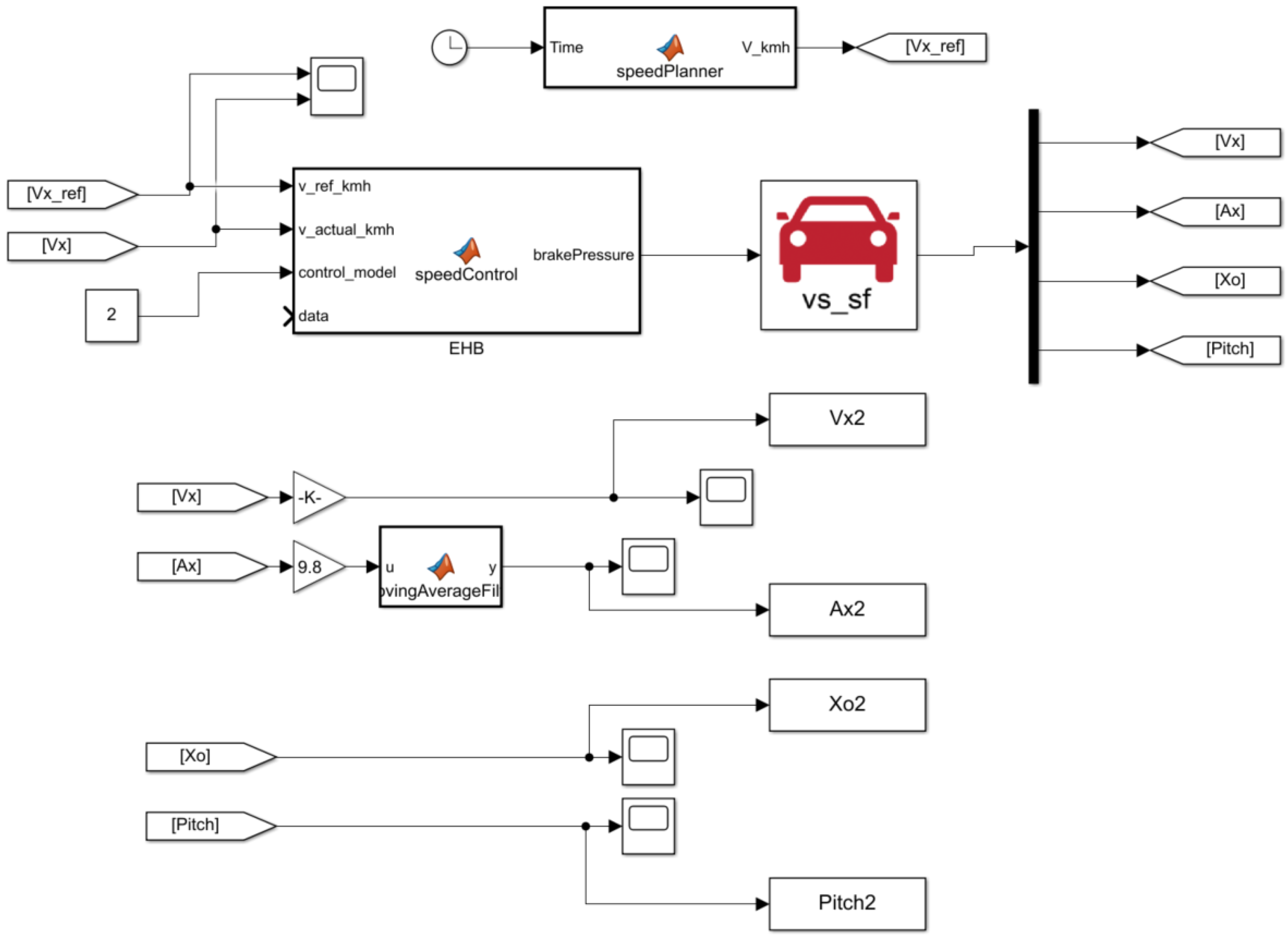
The EHB model described in this study refers to a physical model of the electro-hydraulic braking system, which is used to characterize the mapping relationship between braking control commands and brake fluid pressure, and to represent the dynamic response characteristics of the EHB actuation layer. Based on this model, a control framework for deceleration target planning was constructed. As illustrated in
Figure 1, the geometric structure of the model used in this study strictly adheres to the physical causal relationships inherent in the actual braking process. Taking velocity trajectory planning as the control starting point, the EHB pressure adjustments are applied to the longitudinal and pitch dynamics model of the vehicle, forming a closed-loop feedback structure. Unlike traditional control architectures that directly operate based on deceleration or braking force, this approach achieves decoupling between the controller and vehicle dynamics at the structural level, while explicitly retaining key state variables such as the pitch attitude. This study constructs an integrated hierarchical closed-loop braking control and vehicle dynamics model, which consists of a deceleration planning layer, an electronic braking control layer, and a vehicle longitudinal-pitch coupled dynamics layer. The deceleration planning layer generates a reference velocity based on a predefined deceleration target to shape the desired deceleration trajectory, with a particular focus on optimizing ride comfort during the final stage of braking. The electronic braking control layer takes the error between the reference velocity and the actual velocity as input and outputs the braking pressure command, thereby achieving closed-loop regulation of the braking actuator. The vehicle dynamics layer uses braking pressure as input to establish a longitudinal-pitch coupled dynamics model and outputs key response parameters such as vehicle velocity, longitudinal acceleration, displacement, and pitch angle. In contrast to traditional single-loop control models that focus solely on braking distance or deceleration, this model explicitly accounts for the coupling relationship between longitudinal load transfer and vehicle attitude changes during braking. At the system structure level, it realizes a causal chain of “deceleration trajectory shaping—pressure adjustment—attitude response.” By embedding deceleration planning into the closed-loop control architecture, the model smooths the deceleration recovery process during the final braking phase without compromising overall braking performance, thereby effectively suppressing longitudinal jerks and pitch oscillations, and enhancing braking comfort and system stability.
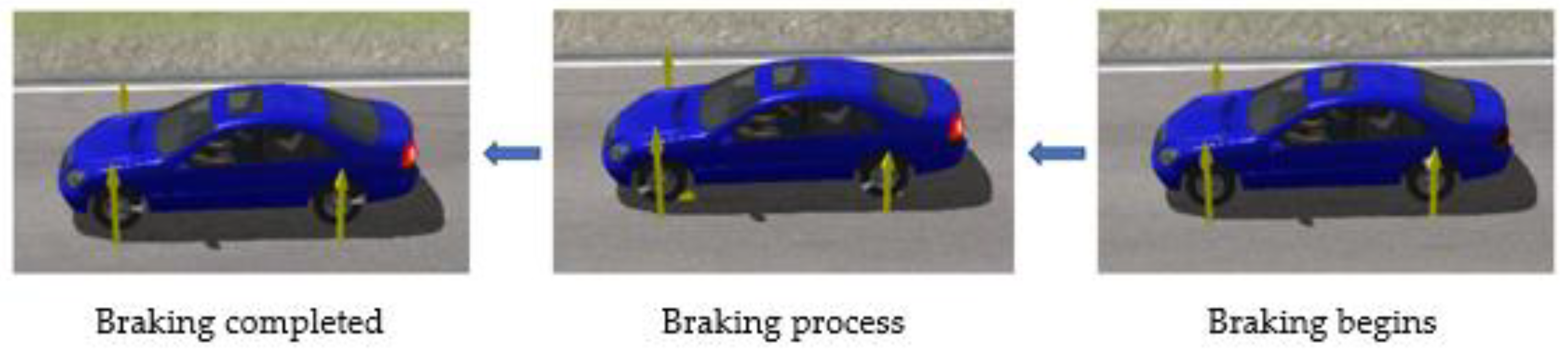
Table 2 lists the vehicle parameters of the research object, and the simulation parameters are consistent with the actual vehicle test parameters. Based on the previously established simulation model, a straight-line braking simulation was conducted using CarSim (Vehicle dynamics simulations were conducted using CarSim 2022.1 (Mechanical Simulation Corporation, Ann Arbor, MI, USA).) software. In this scenario, the initial vehicle speed was set to 36 km/h, followed by deceleration. The braking process is shown in
Figure 2.
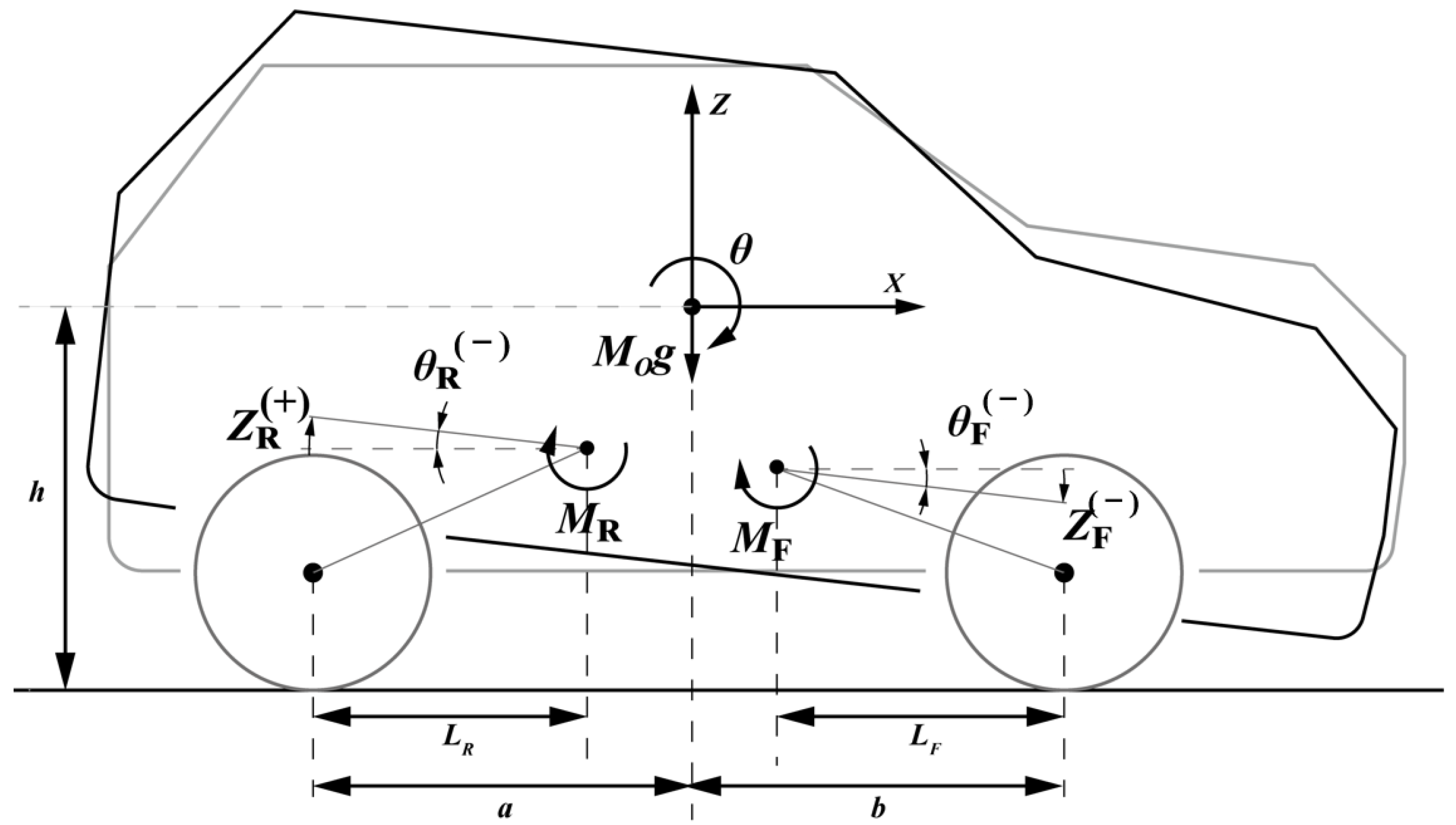
During the initial phase of braking, the change in the pitch angle is relatively small; during the middle phase, the forward shift in the center of gravity leads to compression of the front suspension and extension of the rear suspension, thereby increasing the pitch angle. The pitch motion of the vehicle can be described by the following equation:
In the formula, and represent the spring forces of the front and rear axle suspensions, respectively.
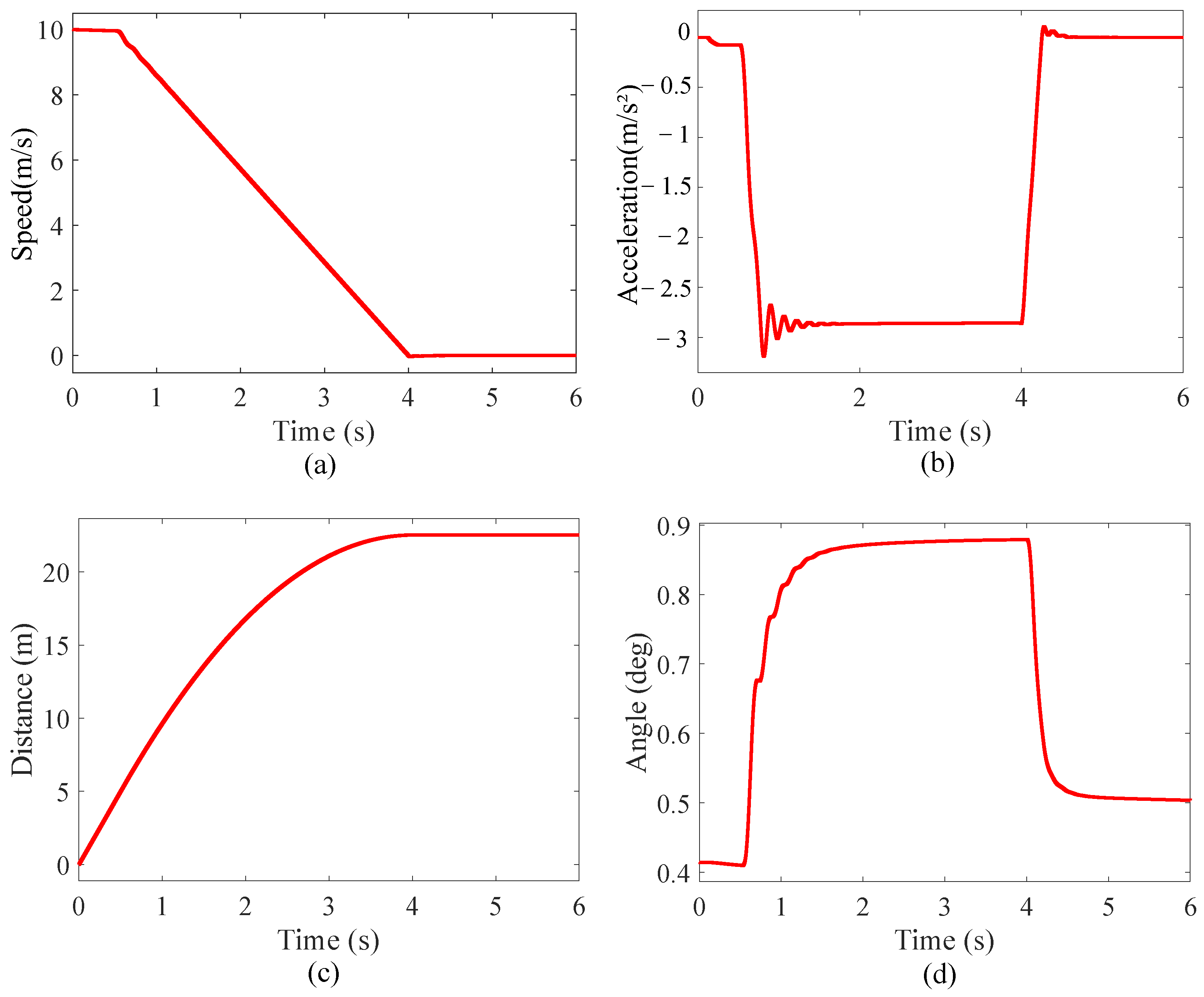
As shown in
Figure 3a, during the initial braking phase (0–0.8 s), the vehicle deceleration is relatively small, and the pitch angle remains relatively stable at 0.4–0.5°. In the mid-braking phase (0.8–3.9 s), as the deceleration increases, the center of gravity shifts forward, causing the pitch angle to increase rapidly and stabilize at approximately 0.85–0.9°. During this period, the front suspension compresses while the rear suspension extends, resulting in axle load transfer. In the later braking phase (after 3.9 s), the braking force diminishes, and the pitch angle decreases rapidly, eventually stabilizing at around 0.5°.
Figure 3b,c illustrate the variations in velocity and deceleration, respectively: the initial vehicle speed is 10 m/s, and after approximately 0.5 s, it enters a constant deceleration phase of −3 m/s
2, coming to a complete stop at 4 s. At the moment the vehicle halts, the deceleration changes abruptly and returns to 0 m/s
2.
Figure 3d presents the variation in braking distance as the vehicle decelerates from 36 km/h to a complete stop. The total braking distance does not exceed 23 m, meeting the safety requirements for daily driving.
3.2. The Incorporation of Speed Planning
When the control mode is set to Control Model = 1, the system operates in the normal braking mode, employing standard PI control parameters to regulate the braking deceleration. In this mode, the controller prioritizes fundamental braking performance and safety, focusing on the rapid response and steady-state accuracy of the deceleration target, thereby ensuring braking effectiveness and system stability under most normal operating conditions. Conversely, when Control Model = 2, the system switches to the comfort braking mode. To reduce the rate of change in deceleration and the vehicle pitch jerk during braking, the PI parameter gains are appropriately reduced in this mode. This results in a smoother controller output, avoiding abrupt deceleration changes caused by excessive control actions, and thus achieves a smoother and more continuous braking regulation process.
In both modes, the controller uses the deviation between the target deceleration and the actual deceleration as its input. Based on the PI control law, the controller calculates the braking pressure adjustment, where the proportional component is used for rapid response to instantaneous errors, and the integral component is used to compensate for steady-state errors, ensuring deceleration tracking accuracy. Through mode switching and differentiated parameter design, this system can not only meet the dynamic performance requirements of conventional braking but also effectively mitigate deceleration fluctuations and improve ride comfort under conditions with high comfort demands, such as in traffic congestion or when approaching a stop.
where
represents the control output at the
sampling time;
is the speed error; and
is the error integral term.
To prevent abrupt changes in the target parameter values inferred by fuzzy logic from directly impacting the control system, a smooth, gradual adjustment mechanism is introduced as a transitional step in this design. This mechanism transforms instantaneous target values into a gradual adjustment process by limiting the maximum rate of change in the parameter per unit time. For the proportional gain and integral gain, symmetric rate limiters are employed, allowing for smooth, bidirectional adjustment of the parameters. In contrast, an asymmetric ratchet mechanism is adopted for the coordination coefficient, permitting upward adjustment only while prohibiting downward adjustment. This design stems from the monotonicity requirement of weight coefficients in multi-objective optimization, ensuring the convergence of the optimization process and the cumulative improvement characteristic of system performance. The final outputs of all parameters are subjected to saturation limits, strictly constraining them within preset boundaries, thereby fundamentally guaranteeing the stability and safety of the control system.
Table 3 defines the membership functions for velocity fuzzification. The low-speed fuzzy set employs a left-shoulder trapezoidal function, with full membership below 5 km/h, linearly decreasing membership between 5 km/h and 30 km/h, and zero membership above 30 km/h. The high-speed fuzzy set employs a right-shoulder trapezoidal function, complementary to the low-speed fuzzy set. The sum of the two membership functions is always equal to 1, satisfying the completeness requirement.
Table 4 presents the rule base structure of the fuzzy control. Rule 1 corresponds to low-speed operating conditions and outputs the minimum parameter value; Rule 2 corresponds to high-speed operating conditions and outputs the maximum parameter value. The comprehensive output is obtained using the weighted average method, where the output values are weighted and summed according to the membership degrees of the two rules, thereby achieving continuous and smooth adjustment of the parameters. All three control parameters adopt the same inference structure, ensuring the consistency of the control strategy.
This study designs a rule-based fuzzy adaptive PI controller for the online tuning of vehicle longitudinal dynamics parameters. This method utilizes fuzzy logic to adaptively adjust conventional PI gains, enhancing the system’s adaptability to nonlinear, time-varying characteristics and uncertainties. The controller comprises four stages: fuzzification, fuzzy inference, defuzzification, and output adjustment. The input variable is the real-time velocity of the vehicle, which is fuzzified using trapezoidal membership functions. These functions employ a left-shoulder type for the low-speed range and a right-shoulder type for the high-speed range, with a smooth overlap in the medium-speed region to achieve a continuous transition of control parameters. The rule base contains two fundamental rules: using smaller proportional and integral gains under low-speed conditions to suppress overshoot, and employing larger gains under high-speed conditions to enhance response performance. This paper adopts the Mamdani inference mechanism and utilizes the membership degree weighted average method to calculate the PI parameters, enabling continuous gain adjustment and boundary constraints. To prevent system instability caused by abrupt parameter changes, rate limiters and saturation mechanisms are implemented at the output stage, ensuring smooth parameter variations and confining them within safe ranges, thereby improving system stability and robustness.
The mode switching logic serves as the core decision-making mechanism of the adaptive control system, continuously adjusting between different control modes based on the vehicle’s real-time velocity. According to vehicle longitudinal dynamics, the velocity range is partitioned into a low-speed zone (0–5 km/h), a transition zone (5–30 km/h), and a high-speed zone (≥30 km/h). The low-speed zone emphasizes smoothness and oscillation suppression, employing smaller proportional gain, integral gain, and coordination coefficient. The high-speed zone prioritizes rapid response and disturbance rejection, correspondingly increasing the control parameters. Within the transition zone, complementary fuzzy sets are constructed using trapezoidal membership functions, and a weighted average method is employed to achieve continuous and monotonic variation in the parameters, thereby avoiding the jerks and instability caused by hard switching. The mode switching is entirely driven by the vehicle velocity. In each control cycle, the membership degrees are calculated in real-time to generate target parameters, while rate limiters and boundary constraints are introduced to suppress abrupt parameter changes. The coordination coefficient adopts a unidirectional incremental ratchet mechanism to ensure the monotonic optimization of multi-objective performance and prevent performance degradation caused by mode regression.
The variation in longitudinal acceleration reflects the build-up process of braking force and the dynamic response characteristics of the vehicle mass; the pitch angle response reflects the dynamic load transfer between the front and rear axles during deceleration, which directly affects the vehicle’s ride comfort and braking stability; the suspension deflection reveals the vertical dynamic interaction between the vehicle body and the wheel assemblies under the load redistribution induced by braking; the change in braking pressure corresponds to the control input and regulation characteristics of the electro-hydraulic braking (EHB) system.
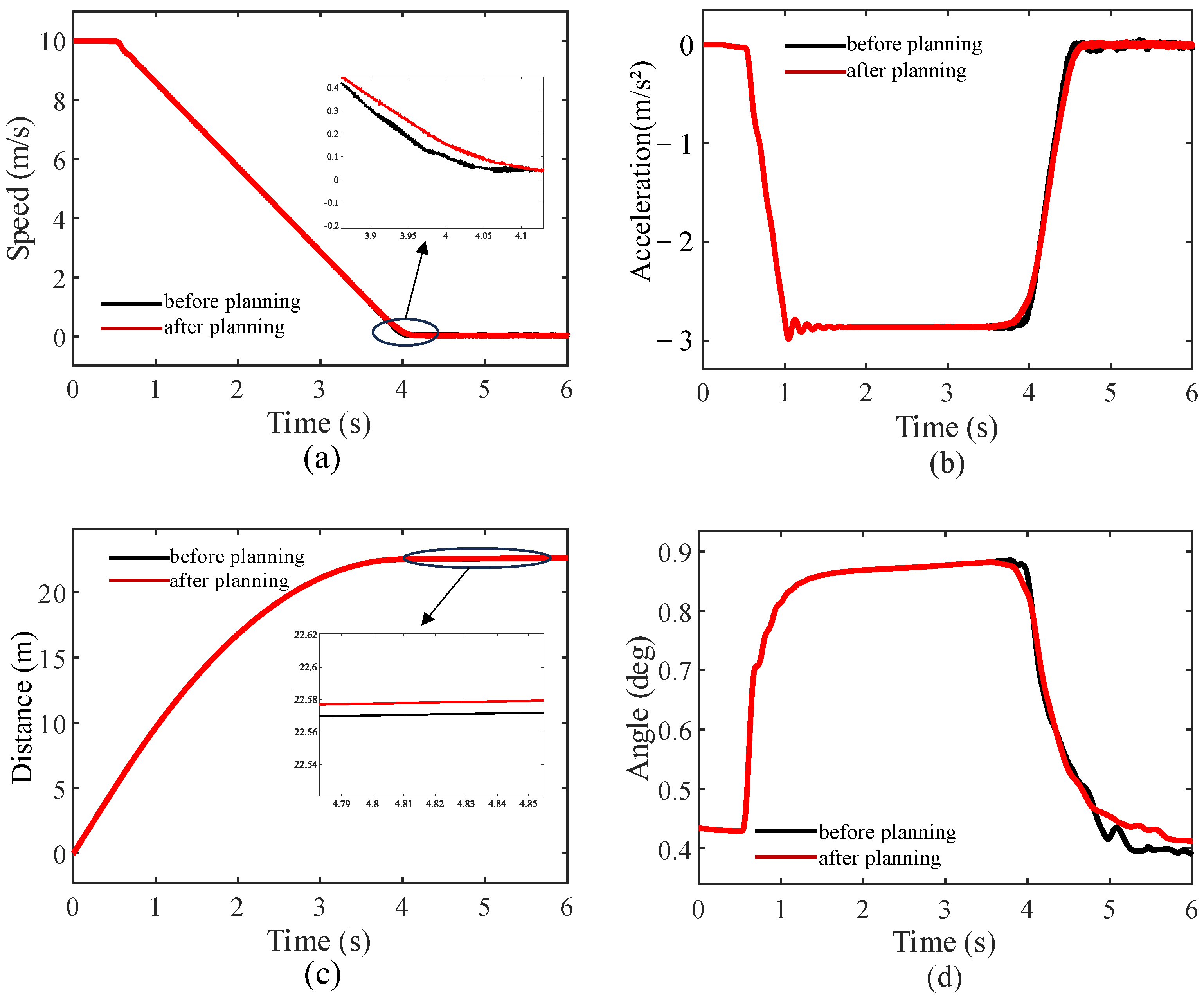
Figure 4 compares the vehicle velocity, acceleration, longitudinal displacement, and pitch angle responses during braking, both with and without deceleration planning.
Figure 4a shows that, under both strategies, the vehicle velocity exhibits an approximately linear decrease during the main braking phase. However, during the final stage of braking, the deceleration planning strategy allows the vehicle velocity to converge to zero more smoothly, indicating that it effectively suppresses longitudinal jerk at the end of the braking event.
Figure 4b demonstrates that, due to the rapid build-up of braking pressure, the deceleration increases quickly during the initial phase and remains approximately constant during the steady braking phase. In contrast, the deceleration planning strategy enables the deceleration to return to zero more smoothly, demonstrating its effectiveness in mitigating jerk during the braking release phase.
Figure 4c indicates that the longitudinal displacement of the vehicle is nearly identical under both strategies, validating that the proposed method optimizes comfort without compromising braking performance or braking distance.
Figure 4d shows that, with the transfer of longitudinal load, the pitch angle gradually increases during braking and subsequently decreases after the braking release. With the adoption of the planning strategy, the pitch angle recovery process becomes smoother, indicating that abrupt load transfer is effectively suppressed, thereby enhancing ride comfort.
In summary, the proposed deceleration planning strategy optimizes and reshapes the braking process as the vehicle approaches a stop without altering the overall braking effect. By achieving a smoother deceleration recovery and braking pressure release process, it effectively suppresses longitudinal jerk and pitch oscillations, significantly enhancing comfort at the end of the braking event while ensuring braking safety.
3.3. Comfort Braking Control Effect at Different Initial Velocities
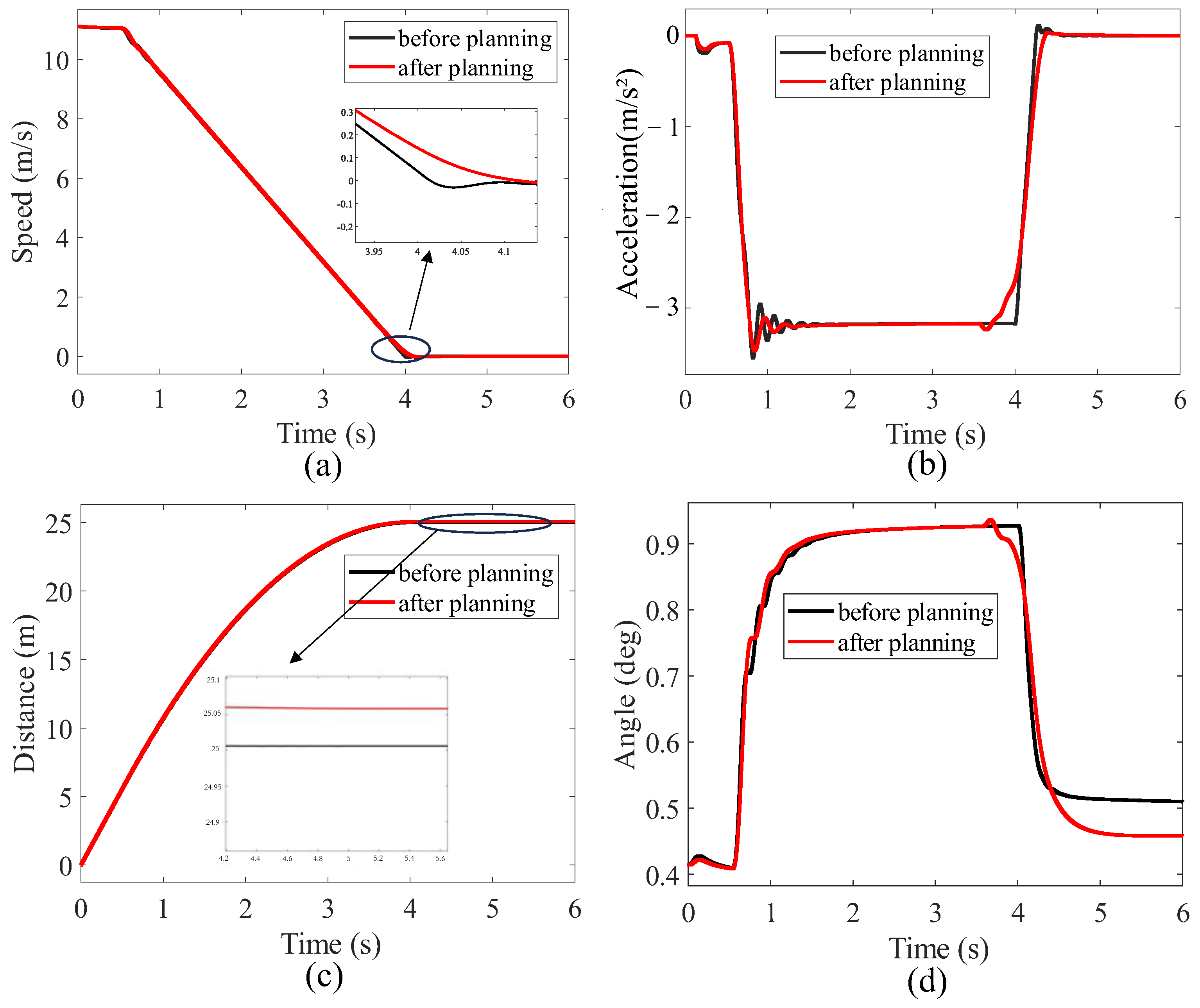
The foregoing analysis indicates that, compared to braking without deceleration planning control, the introduction of the deceleration planning control algorithm can significantly enhance driving comfort during the braking process. However, due to the inherent hysteresis in deceleration control, validation under a single operating condition cannot fully reflect the stability of the control algorithm. To reduce random interference and more comprehensively evaluate the effectiveness of the proposed comfort braking control algorithm, this paper further validates the algorithm by varying the initial vehicle speed and selecting different initial speed conditions. Specifically, the initial vehicle speed is set to 40 km/h and 44 km/h, respectively, and deceleration simulations are conducted for each case.
Figure 5 shows that, compared with the 36 km/h condition, the 40 km/h condition results in a significantly longer braking duration and greater braking distance due to its higher initial energy. However, after implementing deceleration planning, stable braking is achieved in both operating conditions. Specifically, without deceleration planning, the 40 km/h condition exhibits more pronounced velocity fluctuations towards the end of the braking process, dropping abruptly to 0 m/s around the fourth second and showing a tendency to rebound. After deceleration planning is applied, the velocity profile displays a continuous and smooth decline when approaching a stop, significantly improving the end-of-braking jerk and residual motion. Regarding the deceleration response, although both conditions maintain a braking level of approximately −3 m/s
2, the magnitude of deceleration oscillations is greater for the 40 km/h condition in the absence of deceleration planning. This indicates that a higher initial speed makes the system more sensitive to actuator nonlinearities and hydraulic dynamics. The introduction of the planning strategy effectively suppresses these oscillations, advancing the deceleration recovery time by approximately 0.4 s, thereby achieving a smoother deceleration variation. This demonstrates that the proposed planning method maintains good robustness and smooth control capability even at higher speeds. The distance curve results show that the final stopping position at 40 km/h is significantly farther than at 36 km/h, but the final position error is small in both cases after planning. The improvement in distance tracking accuracy is more pronounced at the higher speed, further validating the applicability and consistency of the method under different initial speed conditions. Furthermore, concerning the vehicle attitude response, the peak pitch angle at 40 km/h is slightly higher than that at 36 km/h, indicating that a higher initial speed induces a stronger braking pitch effect. However, after planning, the variation in the pitch angle becomes more continuous and smoother, and the pitch angle near the standstill is approximately 0.25° smaller than that without planning.
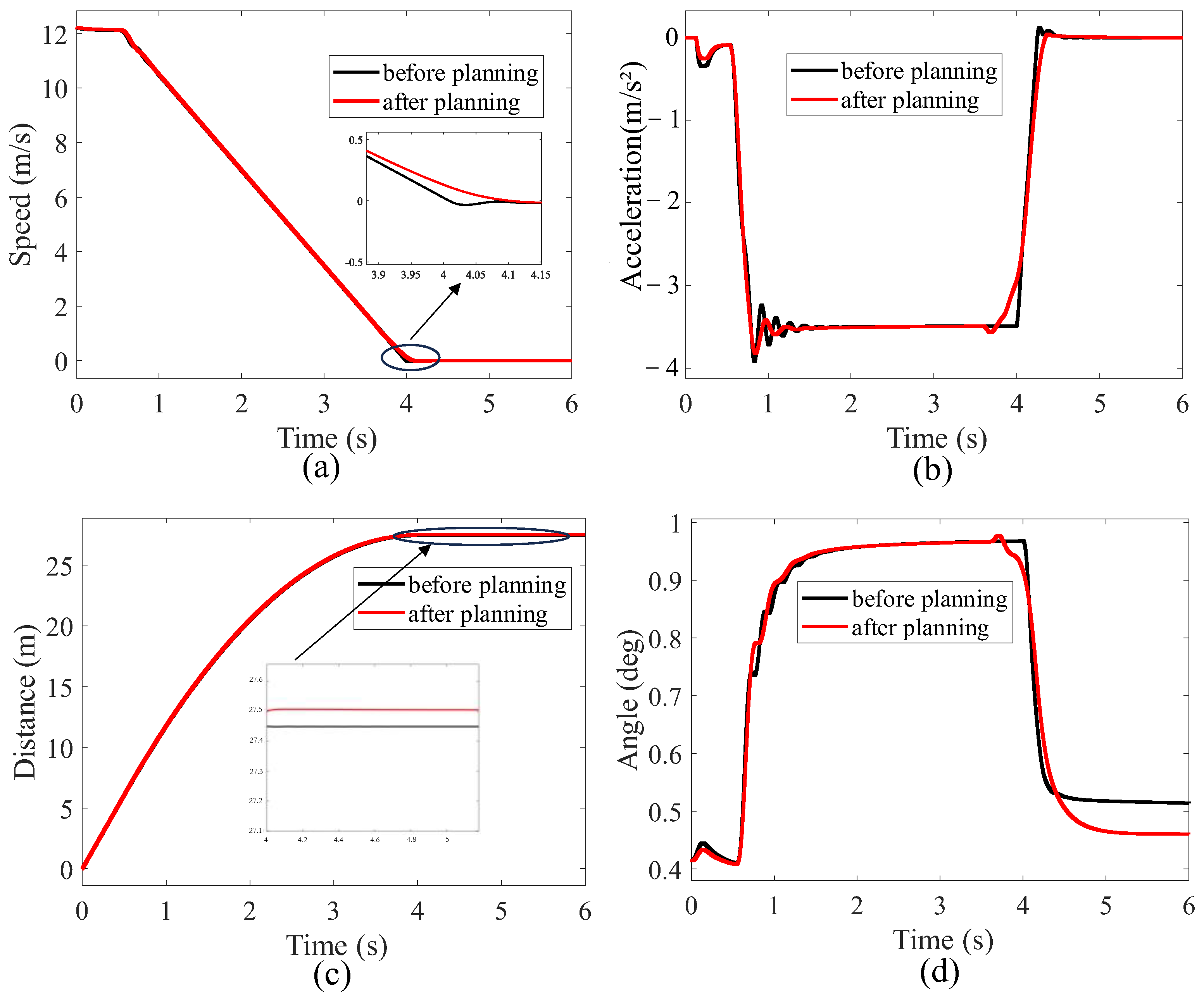
Figure 6 shows that, at an initial speed of 44 km/h, the overall braking trend of the vehicle remains consistent with that under lower speed conditions. However, due to the further increase in initial kinetic energy, both the braking duration and braking distance increase. The velocity profile indicates that, without braking planning, the vehicle still exhibits some velocity rebound and residual fluctuations when approaching zero speed. After implementing braking planning, the final velocity decay process becomes smoother. The deceleration profile shows that, under this operating condition, the overall vehicle deceleration stabilizes at approximately −3 m/s
2. Nevertheless, in the absence of braking planning, significant oscillations and jitters are observed during the initial pressure build-up and steady-state phases, suggesting that the nonlinear effects of the braking system and hydraulic dynamic fluctuations become more pronounced at higher initial speeds. With the implementation of the planning strategy, the amplitude of deceleration fluctuations is significantly reduced, and the deceleration variation becomes smoother. Following two acceleration phases, the constant deceleration duration is shortened (by approximately 0.3 s), implying that by sacrificing a portion of the constant deceleration time, the deceleration recovery time is extended, thereby achieving a smoother deceleration process. From the perspective of distance response, the stopping distance at 44 km/h further increases, but the final position error of the planned distance curve is significantly reduced. This indicates that the method not only meets braking distance requirements but also maintains excellent distance tracking capability and consistency even under high initial speed conditions. The pitch angle results demonstrate that the peak pitch angle increases slightly with the initial speed; high-speed braking leads to a more pronounced tendency for pitch forward, yet this does not compromise the control effectiveness. Under the planning strategy, the pitch angle during deceleration recovery is smoother and more continuous, without abrupt changes. The pitch angle at vehicle standstill is approximately 0.2° smaller than that in the uncontrolled case.
Velocity, as the most intuitive motion state variable, reflects the smoothness and convergence of the braking trajectory through its time-domain variation. By statistically analyzing the average velocity, maximum velocity, and instantaneous velocity at critical moments, the optimization effect of trajectory planning on the velocity profile can be quantitatively evaluated. Acceleration is a crucial indicator for assessing braking dynamic performance; its average value characterizes the overall braking intensity, while its extreme values reflect the degree of dynamic fluctuation. Excessive deceleration peaks or abrupt changes can potentially lead to wheel lock-up, a sensation of jerk, and reduced comfort, thus making their quantitative analysis significant. Braking distance directly reflects vehicle safety performance; by comparing the braking distance before and after planning, the optimization effect of the algorithm can be verified without compromising the ability to stop safely. The pitch angle reflects the load transfer and vehicle attitude changes during braking; excessive pitch response can adversely affect comfort and suspension performance. Therefore, by analyzing its average value, peak value, and response at critical moments, the degree of improvement in attitude control can be assessed. Linear interpolation was employed in data processing to obtain precise parameter values at the 4 s mark, a time point situated in the mid-to-late braking phase, which aids in reflecting the system’s dynamic response characteristics. The selected statistical indicators consider both the overall trend and extreme value suppression, while the three vehicle speed conditions cover a typical urban operating range, rendering the evaluation results valuable for engineering representation and generalizability. Specific values are shown in
Table 5,
Table 6,
Table 7 and
Table 8.
3.4. This Method Is Compared with Similar Methods
To avoid the potential limitations of drawing conclusions based solely on self-comparison, this paper selects representative relevant studies from recent years as reference objects and conducts a comparative analysis from the perspective of braking smoothness indicators. This horizontal comparison not only more clearly demonstrates the advantages of the proposed strategy over fixed-parameter or piecewise control methods but also helps to clarify the technical positioning and innovative contributions of this paper.
Table 9 compares the differences in key braking performance indicators between the method proposed in this paper and the reference [
20]. In terms of maximum deceleration, the peak deceleration in reference [
20] is slightly higher (−9.2 m/s
2), whereas that of the proposed method is −8.9 m/s
2. This result indicates that while ensuring sufficient braking capability, the strategy proposed in this paper appropriately reduces the peak instantaneous deceleration, thereby helping to mitigate longitudinal jerk during the braking process. Regarding braking distance, the proposed method achieves 26.83 m, which is superior to the 27.4 m reported in reference [
20]. This suggests that a slight reduction in peak deceleration does not compromise braking safety but rather enables better control over the braking distance. In terms of braking time, the difference between the two methods is minimal (4 s vs. 3.84 s), and the overall braking efficiency is similar, indicating that the proposed method maintains good braking response performance while ensuring safety. Furthermore, concerning the pressure build-up feedback characteristics, the proposed method exhibits a smaller pressure overshoot, signifying a smoother accumulation process of braking pressure. This contributes to suppressing longitudinal jerk and pitch oscillations, thereby enhancing ride comfort at the end of braking and improving system stability.
Overall, compared with reference [
20], the method in this paper achieves smoother pressure regulation characteristics and better comfort performance while maintaining the basic consistency of braking safety performance, demonstrating certain comprehensive performance advantages. Considering that the initial working conditions and simulation parameter settings in different references may differ, in order to ensure the fairness of the comparison, this paper re-performed the simulation verification under the same working conditions as reference [
20], and gave the corresponding performance indicators to ensure the objectivity and comparability of the comparison results.