
A Novel Reduced-Ripple Average Torque Control Technique for Light Electric Vehicle Switched Reluctance Motors




Abstract
1. Introduction
- (1)
- It provides a novel ATC technique that has the ability to further reduce the torque ripples by an additional current profiling scheme to meet the requirements of an EV.
- (2)
- It introduces a novel current compensation mechanism (CCM) that has the ability to profile the phase current and, hence, reduce the torque ripple.
- (3)
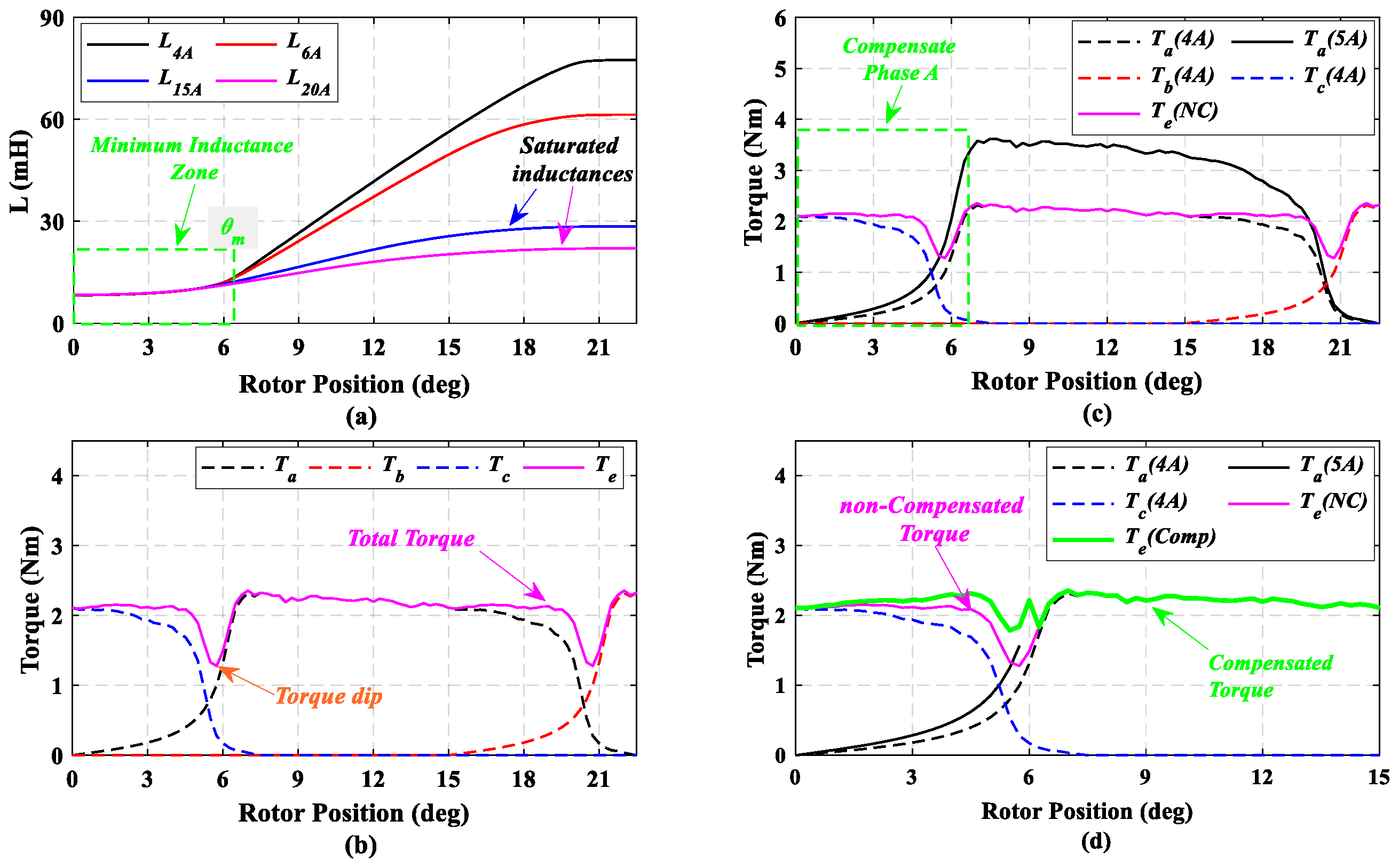
- The simplicity of the control algorithm is considered, and the proposed CCM is meant only over the MIZ, hence, providing a simple mathematical formulation and fast control algorithm.
2. Machine Modeling
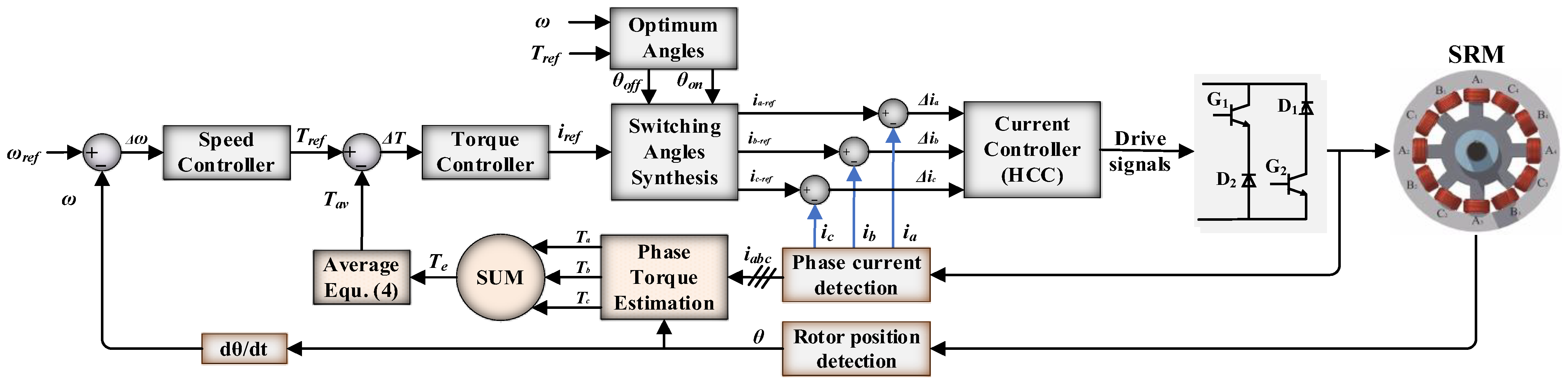
3. The Conventional Average Torque Control Technique for SRMs
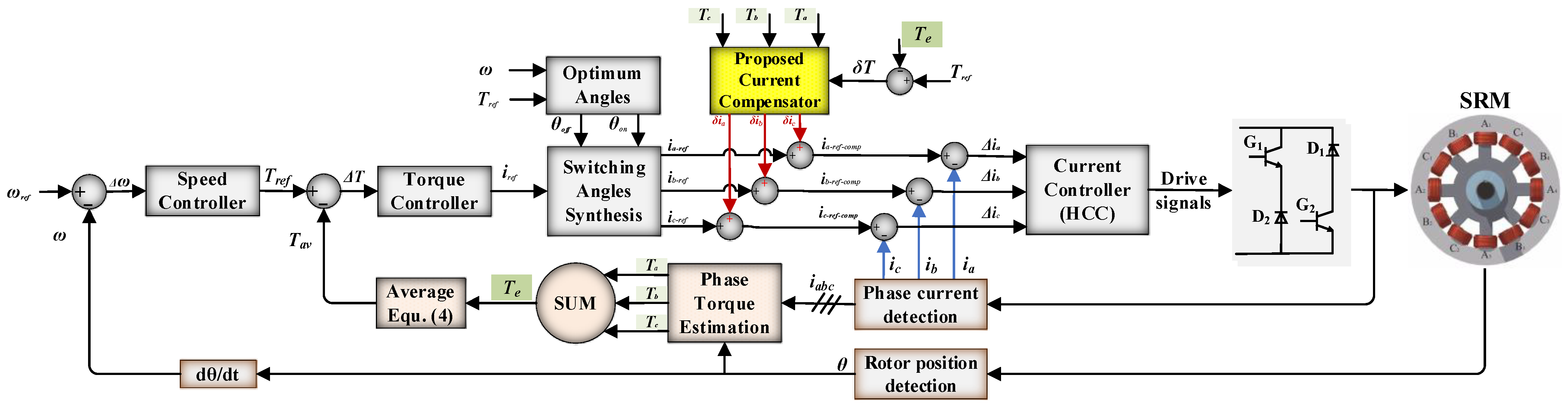
4. The Proposed Average Torque Control Technique for SRMs
4.1. Description of Proposed ATC Technique
- (1)
- The proposed current compensator allows us to profile the phase current and, hence, provide a better torque ripple reduction capability.
- (2)
- The compensation mechanism is simple and does not complicate the overall control algorithm.
- (3)
- The compensation mechanism is very flexible; it can be activated or deactivated any time while maintaining the conventional ATC scheme.
- (4)
- No additional hardware is required.
- (5)
- The proposed method is totally compatible with any SRM even with different configurations or a different structure, as the proposed control method is applied for each phase due to the independent phase control of SRMs.
- (6)
- The proposed method has no limitations in terms of control accuracy. The only limitation is the speed range, especially the high speeds. As the proposed method profiles the phase current, it will show superior performance for low- and medium-speed operations while the phase current control is still effective. However, under high-speed operation, the current control becomes difficult, limiting the functionality of the proposed control method for effective current profiling.
4.2. The Main Idea for Proposed Current Compensation Mechanism
4.3. Real-Time Implementation of Proposed Control for SRMs
- (1)
- Measure the phases’ currents (ia, ib, ic) and the rotor position ().
- (2)
- Estimate the torque component for each phase (Ta, Tb, Tc).
- (3)
- Calculate the total instantaneous motor torque (Te) using Equation (2).
- (4)
- Calculate the torque error (T) using Equation (9).
- (5)
- Calculate the required current compensation () using Equation (10).
- (6)
- Update the final compensated reference current for each phase (ia-ref-comp, ib-ref-comp, ic-ref-comp).
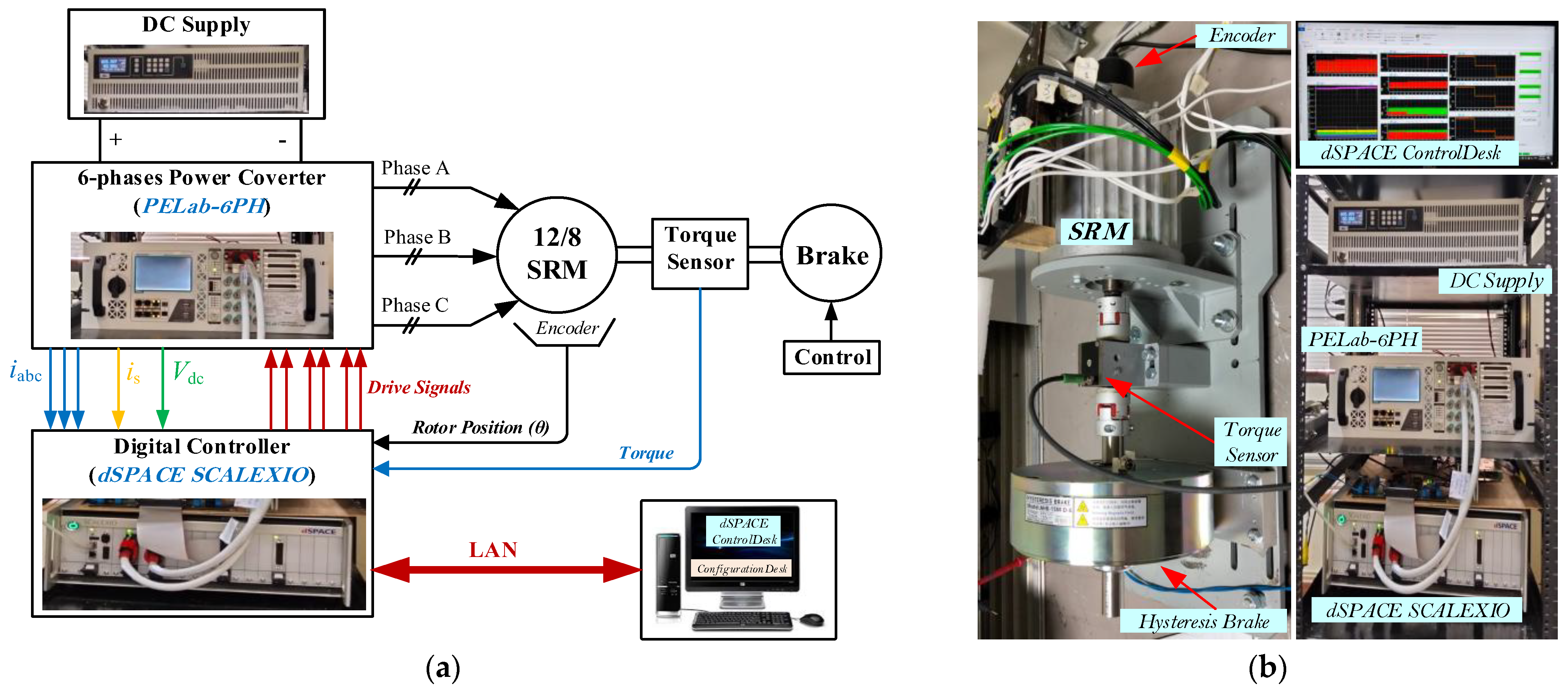
5. Experimental Validations
- (1)
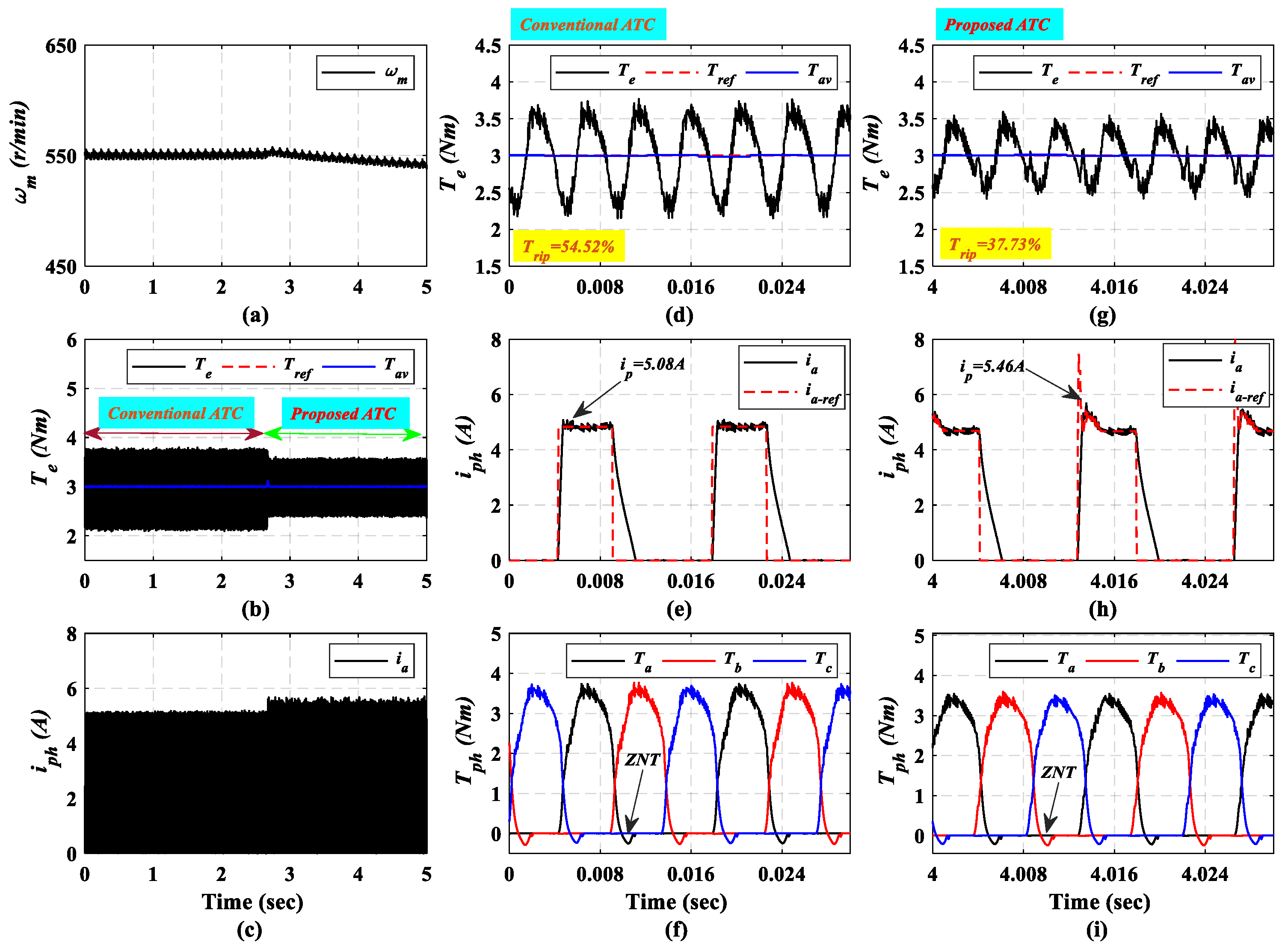
- Case 1: Detailed performance analysis for proposed ATC technique.
- (2)
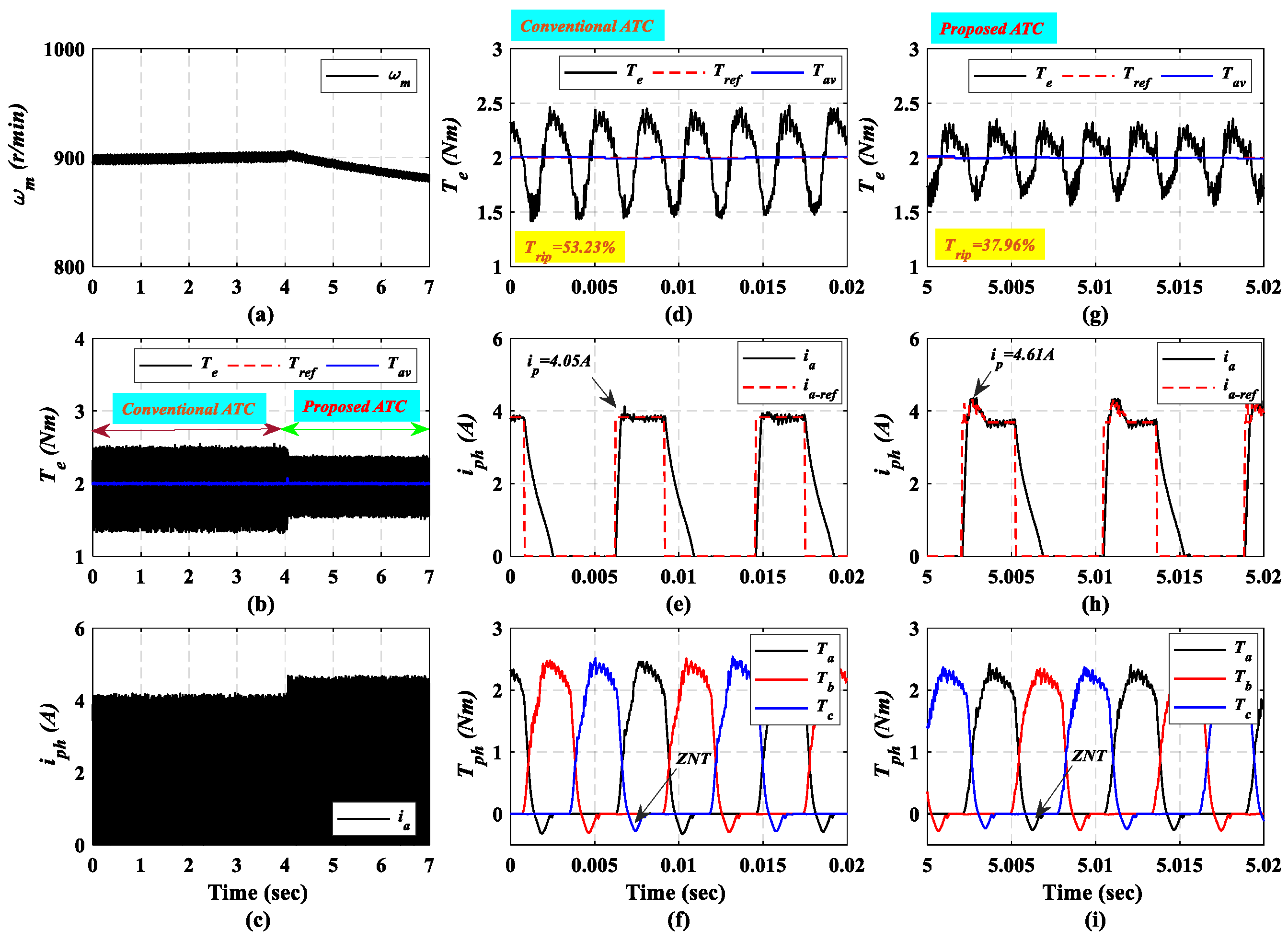
- Cases 2: Comparison between the proposed and conventional ATC techniques, considering open loop torque control.
- (3)
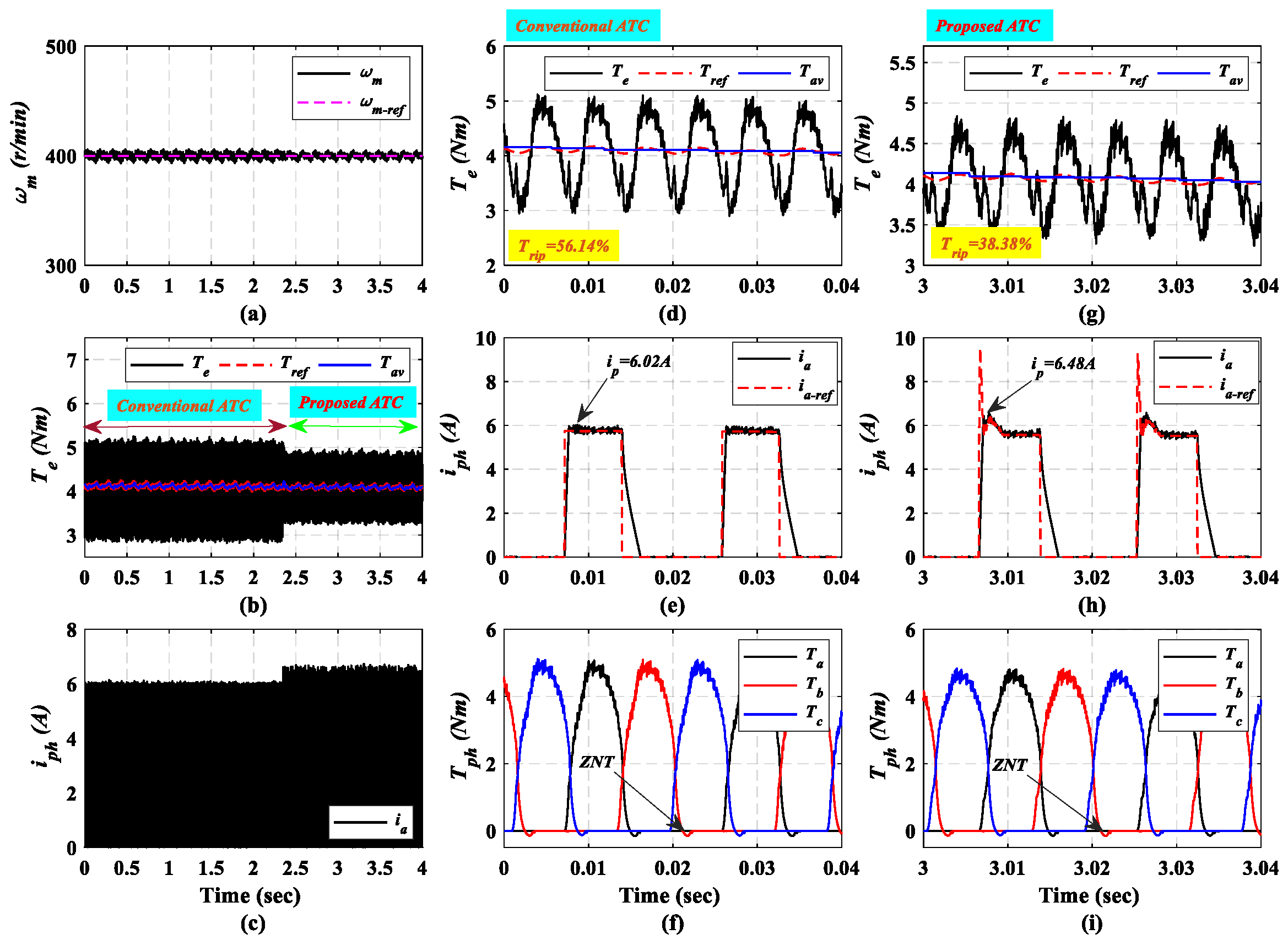
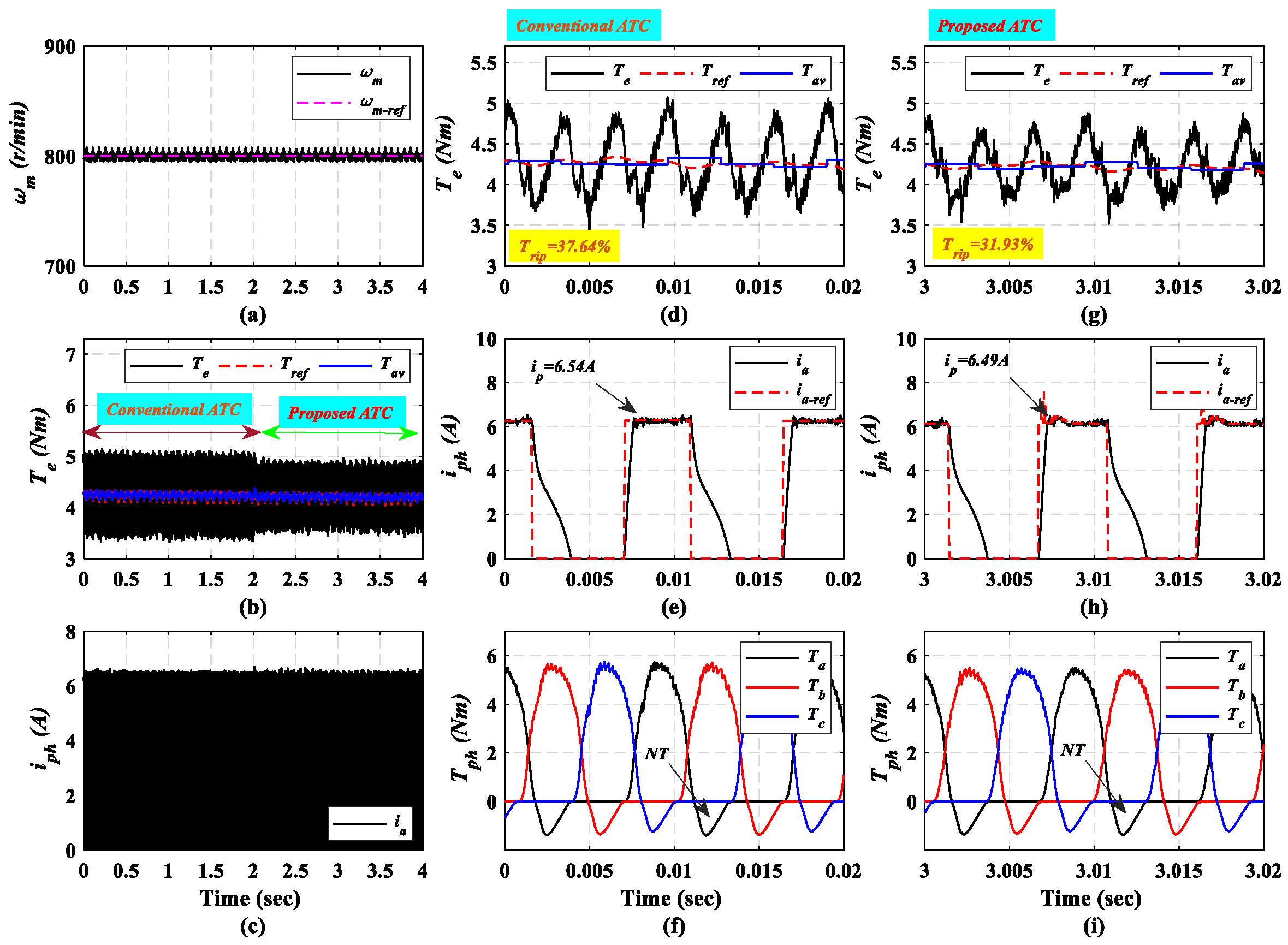
- Cases 3: Comparison between the proposed and conventional ATC techniques, considering closed loop control.
- (4)
- Cases 4: Comparison between the proposed and conventional ATC techniques under speed change
- (5)
- Cases 5: Comparison between the proposed and conventional ATC techniques under sudden change in loading torque.
5.1. Case 1: Detailed Performance Analysis for Proposed ATC Technique
5.2. Case 2: Open Loop Torque Control
5.3. Case 3: Closed Loop Control
5.4. Case 4: Closed Loop Control with Speed Change
5.5. Case 5: Closed Loop Control with Sudden Change in Loading Torque
6. Comparative Summary
7. Conclusions
Author Contributions
Funding
Data Availability Statement
Acknowledgments
Conflicts of Interest
Abbreviations
| ATC | Average torque control |
| CCC | Current chopping control |
| CCM | Current compensation mechanism |
| DC | Direct current |
| EVs | Electric vehicles |
| HEVs | Hybrid electric vehicles |
| ITC | Instantaneous torque control |
| MIZ | Minimum inductance zone |
| MPC | Model predictive control |
| PPR | Pulse per revolution |
| SRMs | Switched reluctance motors |
| TSF | Torque sharing function |
Nomenclature
| Symbol | Definition | Unit |
| B | The combined rotor and load viscous friction coefficient | Kg·m2 |
| Iav | The average supply current | A |
| ia-ref, ib-ref, ic-ref | The reference current of phases A, B, and C | A |
| ia-ref-comp, ib-ref-comp, ic-ref-comp | The final compensated reference current signals for phases A, B, and C | A |
| ik | The phase current of kth phase | A |
| iref | The reference current | A |
| is | The instantaneous supply current | A |
| ip | The peak phase current | A |
| J | The combined rotor and load inertia coefficient | Kg·m2·S |
| Lk | The inductance of kth phase | H |
| q | The number of motor phases | |
| R | The phase resistance | Ω |
| Tav | The average torque | N·m |
| Te | The total electromagnetic torque | N·m |
| Tk | The torque of kth phase | N·m |
| TL | The load torque | N·m |
| Tmax | The maximum value of instantaneous motor torque | N·m |
| Tmin | The minimum value of instantaneous motor torque | N·m |
| Trip | The torque ripple | N·m |
| Tref | The reference torque | N·m |
| Vdc | The DC supply voltage | V |
| vk | The phase voltage of kth phase | V |
| θ | The rotor position | Deg. |
| θm | The angle where rotor and stator poles start to overlap | Deg. |
| θon | The turn-on angle | Deg. |
| θoff | The turn-off angle | Deg. |
| η | The drive efficiency | |
| ωm | The actual motor speed | Rad/min |
| ωref | The reference commanded speed | Rad/min |
| δT, ∆T | The torque errors | N·m |
| δia, δib, δic | The compensated current signals for phases A, B, C | A |
| τ | The time of one electric cycle | s |
References
- El Hadraoui, H.; Zegrari, M.; Chebak, A.; Laayati, O.; Guennouni, N. A Multi-Criteria Analysis and Trends of Electric Motors for Electric Vehicles. World Electr. Veh. J. 2022, 13, 65. [Google Scholar] [CrossRef]
- Vosswinkel, M.; Lohner, A.; Platte, V.; Hirche, T. Design, production, and verification of a switched-reluctance wheel hub drive train for battery electric vehicles. World Electr. Veh. J. 2019, 10, 82. [Google Scholar] [CrossRef]
- Gan, C.; Wu, J.; Sun, Q.; Kong, W.; Li, H.; Hu, Y. A Review on Machine Topologies and Control Techniques for Low-Noise Switched Reluctance Motors in Electric Vehicle Applications. IEEE Access 2018, 6, 31430–31443. [Google Scholar] [CrossRef]
- Lan, Y.; Benomar, Y.; Deepak, K.; Aksoz, A.; El Baghdadi, M.; Bostanci, E.; Hegazy, O. Switched reluctance motors and drive systems for electric vehicle powertrains: State of the art analysis and future trends. Energies 2021, 14, 2079. [Google Scholar] [CrossRef]
- Feng, L.; Sun, X.; Bramerdorfer, G.; Zhu, Z.; Cai, Y.; Diao, K.; Chen, L. A review on control techniques of switched reluctance motors for performance improvement. Renew. Sustain. Energy Rev. 2024, 199, 114454. [Google Scholar] [CrossRef]
- Saleh, A.L.; Al-Amyal, F.; Számel, L. Control techniques of switched reluctance motors in electric vehicle applications: A review on torque ripple reduction strategies. AIMS Electron. Electr. Eng. 2024, 8, 104–145. [Google Scholar] [CrossRef]
- Diao, K.; Sun, X.; Bramerdorfer, G.; Cai, Y.; Lei, G.; Chen, L. Design optimization of switched reluctance machines for performance and reliability enhancements: A review. Renew. Sustain. Energy Rev. 2022, 168, 112785. [Google Scholar] [CrossRef]
- Ma, Q.; Qiao, L.; Wang, Z.; Hu, Y. Direct Torque Control of Switched Reluctance Motor Based on Improved Sliding Mode Reaching Law Strategy. World Electr. Veh. J. 2025, 16, 548. [Google Scholar] [CrossRef]
- Wang, H.; Wu, J.; Xie, C.; Guo, Z. Vehicle-Mounted SRM DITC Strategy Based on Optimal Switching Angle TSF. World Electr. Veh. J. 2025, 16, 26. [Google Scholar] [CrossRef]
- Omar, M.; Bakr, M.H.; Emadi, A. Advanced Design Optimization of Switched Reluctance Motors for Torque Improvement Using Supervised Learning Algorithm. IEEE Access 2023, 11, 122057–122068. [Google Scholar] [CrossRef]
- Saleh, A.L.; Al-Amyal, F.; Számel, L. An enhanced current chopping control strategy for SRM drives using Harris Hawks optimization algorithm. ISA Trans. 2024, 150, 338–358. [Google Scholar] [CrossRef]
- Hamouda, M.; Menaem, A.A.; Rezk, H.; Ibrahim, M.N.; Számel, L. Comparative evaluation for an improved direct instantaneous torque control strategy of switched reluctance motor drives for electric vehicles. Mathematics 2021, 9, 302. [Google Scholar] [CrossRef]
- Cai, Y.; Dong, Z.; Liu, H.; Liu, Y.; Wu, Y. Direct Instantaneous Torque Control of SRM Based on a Novel Multilevel Converter for Low Torque Ripple. World Electr. Veh. J. 2023, 14, 140. [Google Scholar] [CrossRef]
- Zhu, Y.; Yao, M.; Sun, X. A Review on Predictive Control Technology for Switched Reluctance Motor System. World Electr. Veh. J. 2023, 14, 221. [Google Scholar] [CrossRef]
- Hamouda, M.; Al-Amyal, F.; Odinaev, I.; Ibrahim, M.N.; Számel, L. A Novel Universal Torque Control of Switched Reluctance Motors for Electric Vehicles. Mathematics 2022, 10, 3833. [Google Scholar] [CrossRef]
- Al Quraan, L.; Saleh, A.L.; Szamel, L. Indirect Instantaneous Torque Control for Switched Reluctance Motor Based on Improved Torque Sharing Function. IEEE Access 2024, 12, 11810–11821. [Google Scholar] [CrossRef]
- Hamouda, M.; Szamel, L.; Alquraan, L. Maximum Torque per Ampere based Indirect Instantaneous Torque Control for Switched Reluctance Motor. In Proceedings of the 2019 International IEEE Conference and Workshop in Óbuda on Electrical and Power Engineering (CANDO-EPE), Budapest, Hungary, 20–21 November 2019; pp. 47–54. [Google Scholar] [CrossRef]
- Yao, X.; He, H.; Wang, J.; Guan, Q.; Gao, R. An Online Torque Sharing Function Method Based on Region Division for Reducing Torque Ripple and Copper Losses of Switched Reluctance Motors. IEEE J. Emerg. Sel. Top. Power Electron. 2024, 12, 4825–4837. [Google Scholar] [CrossRef]
- Yang, Y.; Sun, X.; Dianov, A.; Demidova, G.; Prakht, V.; Wang, Y.; Han, S. Model Predictive Torque Control of Six-Phase Switched Reluctance Motors Based on Improved Voltage Vector Strategy. IEEE Trans. Transp. Electrif. 2025, 11, 7650–7661. [Google Scholar] [CrossRef]
- Xu, S.; Chen, H.; Wang, P.; Nie, R.; Si, J. An Improved Model Predictive Torque Control for Switched Reluctance Motors Based on Variable Hyperbolic Tangent Function Modeling. IEEE Trans. Transp. Electrif. 2025, 11, 5029–5041. [Google Scholar] [CrossRef]
- Lv, D.; Ding, W.; Wang, Y.; Wang, K.; Chen, S.; Cai, J. Finite Control Set Model Predictive Torque Control of Switched Reluctance Motor Based on Three-Phase Four-Leg Inverter. IEEE Trans. Ind. Electron. 2025, 72, 9931–9941. [Google Scholar] [CrossRef]
- Cai, J.; Dou, X.; Song, S.; Cheok, A.D.; Yan, Y.; Zhang, X. Flux-Linkage Loop-Based Model Predictive Torque Control for Switched Reluctance Motor. IEEE Trans. Ind. Electron. 2025, 72, 2435–2443. [Google Scholar] [CrossRef]
- Hamouda, M.; Szamel, L. Reduced Torque Ripple based on a Simplified Structure Average Torque Control of Switched Reluctance Motor for Electric Vehicles. In Proceedings of the 2018 International IEEE Conference and Workshop in Óbuda on Electrical and Power Engineering (CANDO-EPE), Budapest, Hungary, 20–21 November 2018; pp. 109–114. [Google Scholar] [CrossRef]
- Cheng, H.; Chen, H.; Yang, Z. Average torque control of switched reluctance machine drives for electric vehicles. IET Electr. Power Appl. 2015, 9, 459–468. [Google Scholar] [CrossRef]
- Wang, X.; Yang, Z.; Wang, T.; He, D.; Huo, Y.; Cheng, H.; Yu, G. Design of a wide speed range control strategy of switched reluctance motor for electric vehicles. In Proceedings of the 2015 IEEE International Conference on Information and Automation, Harbin, China, 8–10 August 2015; pp. 294–299. [Google Scholar] [CrossRef]
- Jamil, M.U.; Kongprawechnon, W.; Chayopitak, N. Average Torque Control of a Switched Reluctance Motor Drive for Light Electric Vehicle Applications. IFAC-PapersOnLine 2017, 50, 11535–11540. [Google Scholar] [CrossRef]
- Inderka, R.; De Doncker, R. High-Dynamic Direct Average Torque Control for Switched Reluctance Drives. IEEE Trans. Ind. Appl. 2003, 39, 1040–1045. [Google Scholar] [CrossRef]
- Ferkova, Z.; Bober, P. Switched reluctance motor efficiency increasing by firing angle adjustment for average torque control. In Proceedings of the 13th International Conference ELEKTRO 2020, ELEKTRO 2020—Proceedings, Žilina, Slovakia, 25–26 May 2020; Institute of Electrical and Electronics Engineers Inc.: Piscataway, NJ, USA, 2020. [Google Scholar] [CrossRef]
- Fernando, N.; Barnes, M. Average torque control with current-peak regulation in switched reluctance motors. In Proceedings of the International Conference on Power Electronics and Drive Systems, Sydney, Australia, 9–12 June 2015; Institute of Electrical and Electronics Engineers Inc.: Piscataway, NJ, USA, 2015; pp. 762–766. [Google Scholar] [CrossRef]
- Hannoun, H.; Hilairet, M.; Marchand, C. Design of an SRM speed control strategy for a wide range of operating speeds. IEEE Trans. Ind. Electron. 2010, 57, 2911–2921. [Google Scholar] [CrossRef]
- Pillai, A.; Anuradha, S.; Gangadharan, K.V.; Umesht, P.; Bhaktha, S. Modeling and Analysis of Average Torque Control Strategy on Switched Reluctance Motor for E-mobility. In Proceedings of the CONECCT 2021: 7th IEEE International Conference on Electronics, Computing and Communication Technologies, online, 9–11 July 2021; Institute of Electrical and Electronics Engineers Inc.: Piscataway, NJ, USA, 2021. [Google Scholar] [CrossRef]
- Hamouda, M.; Menaem, A.A.; Rezk, H.; Ibrahim, M.N.; Számel, L. Numerical estimation of switched reluctance motor excitation parameters based on a simplified structure average torque control strategy for electric vehicles. Mathematics 2020, 8, 1213. [Google Scholar] [CrossRef]
- Fan, J.; Lee, Y. A Novel Average Torque Control of Switched Reluctance Motor Based on Flux-Current Locus Control. Can. J. Electr. Comput. Eng. 2020, 43, 273–281. [Google Scholar] [CrossRef]






| Criterion | PMSMs | IMs | SRMs |
|---|---|---|---|
| Stator structure (windings) | Distributed | Distributed | Concentrated |
| Rare-earth materials | Required | None | None |
| Efficiency | Very High | High | High |
| Thermal robustness | Limited (magnets) | Good | Excellent |
| Demagnetization risk | High (magnets) | None | None |
| Fault tolerance | Low | Medium | Very high |
| Operation under phase loss | Usually not | Limited | Possible |
| Torque ripple | Low | Low | High |
| High-speed capability | Limited | Good | Excellent |
| Field-weakening range | Limited | Wide | Very wide |
| Over-speed capability | Limited | High | Very high |
| Starting torque | High | Moderate | High |
| Motor manufacturing cost | High (magnets) | Moderate | Low |
| Supply chain risk | High (rare earths) | Low | Very low |
| Sustainability | Poor | Good | Excellent |
| Cooling requirement | High | Moderate | Moderate |
| Maintenance | Low | Low | Very low |
| Reliability in harsh environments | Moderate | Good | Excellent |
| Cost stability (long term) | Volatile | Stable | High |
| Parameter | SRM | Parameter | SRM |
|---|---|---|---|
| Stator/Rotor poles | 12/8 | Stator outer diameter | 141 mm |
| Rated speed | 800 rpm | Rotor outer diameter | 82 mm |
| Rated torque | 4 Nm | Stator pole width | 10 mm |
| Max phase current | 9 A | Rotor pole width | 12 mm |
| Phase resistance | 1.73 Ω | Stack length | 71 mm |
| 550 r/min and 3 Nm | 900 r/min and 2 Nm | |||
|---|---|---|---|---|
| Conv-ATC | Prop-ATC | Conv-ATC | Prop-ATC | |
| Trip (%) | 54.52% | 37.73% | 53.23% | 37.96% |
| Reduction ratio of Trip (%) | - - - - - | 30.79% ↓ | - - - - - | 28.71% ↓ |
| Peak current ip (A) | 5.08 | 5.46 | 4.05 | 4.61 |
| RMS current IRMS (A) | 2.9305 | 2.9841 | 2.3492 | 2.4309 |
| Efficiency η (%) | 69.693 | 68.930 | 80.397 | 79.874 |
| Trip (%) | RR Trip (%) | ip (A) | IRMS (A) | η (%) | ||
|---|---|---|---|---|---|---|
| 400 r/min and 4 Nm | Conv-ATC | 56.14% | - - - - - | 6.02 | 3.5164 | 63.080 |
| Prop-ATC | 38.38% | 31.63% ↓ | 6.48 | 3.6186 | 62.112 | |
| 800 r/min and 4 Nm | Conv-ATC | 37.64% | - - - - - | 6.54 | 4.1447 | 73.441 |
| Prop-ATC | 31.93% | 15.17% ↓ | 6.49 | 4.1765 | 72.837 | |
| 1200 r/min and 4 Nm | Conv-ATC | 45.23% | - - - - - | 7.28 | 4.1229 | 80.030 |
| Prop-ATC | 40.36% | 10.76% ↓ | 7.65 | 4.2773 | 79.684 | |
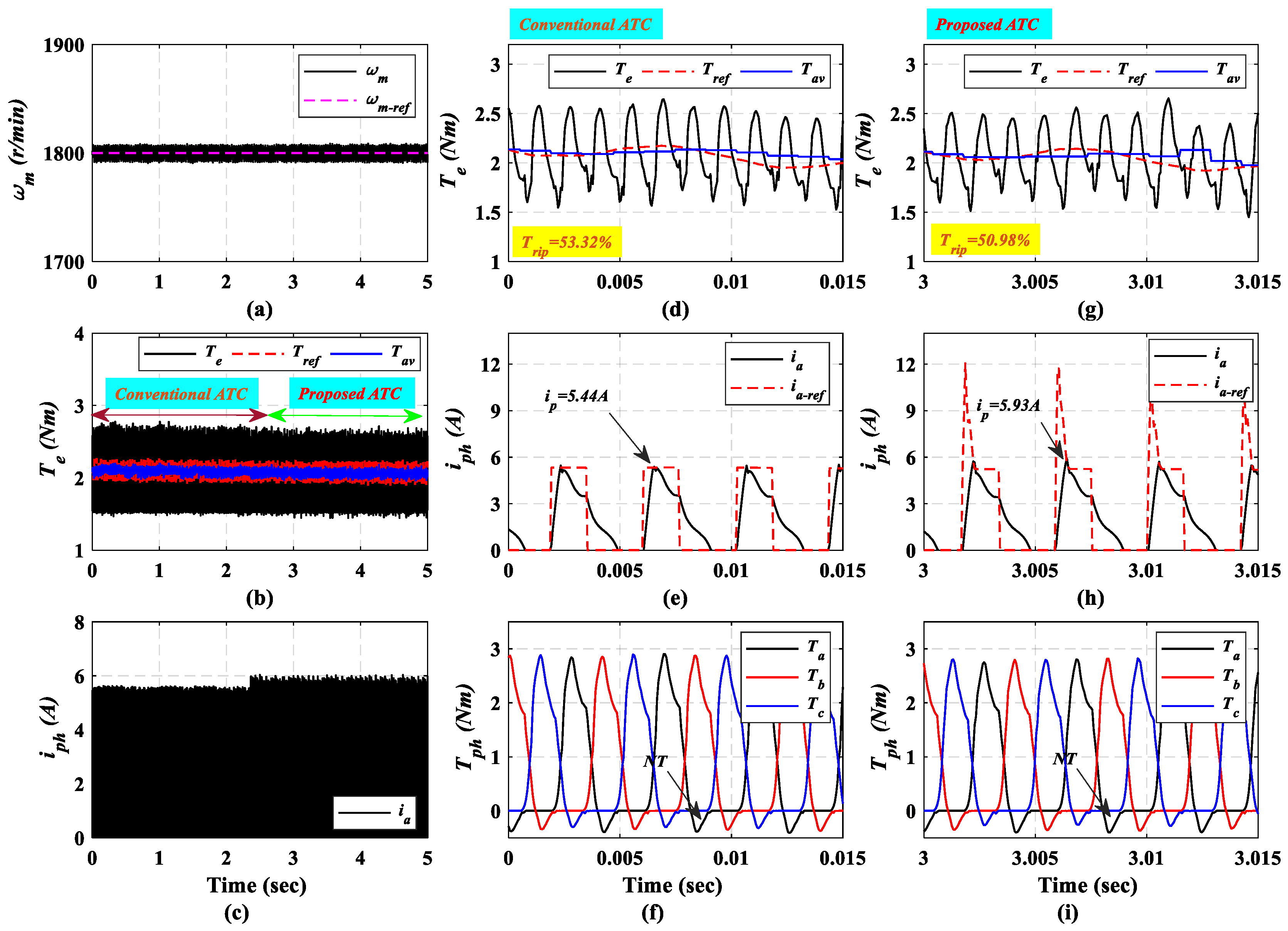
| 1800 r/min and 2 Nm | Conv-ATC | 53.32% | - - - - - | 5.44 | 2.7141 | 89.833 |
| Prop-ATC | 50.91% | 4.38% ↓ | 5.93 | 2.7138 | 89.863 |
| Criterion | IITC | DITC | MPC | Prop-ATC |
|---|---|---|---|---|
| Model dependency | Moderate | Low | Very high | Very low |
| Computational burden | Low | Moderate | Very high | Minimal |
| Implementation complexity | Low | Medium | Highest | Lowest |
| Fault tolerance compatibility | Good | Very good | Moderate | Excellent |
| Operation under phase failure | Limited | Possible | Complex | Highly possible |
| Scalability to multi-phase SRMs | Excellent | Moderate | Limited | Excellent |
| Development cost | Moderate | High | Very high | Low |
| Real-time feasibility | Excellent | Good | Challenging | Excellent |
| Reliability under harsh conditions | Good | Good | Questionable | Excellent |
| Sensitivity to parameter mismatch | Moderate | Low | High | Very low |
| Ease of calibration and tuning | Moderate | Difficult | Very difficult | Very easy |
| Robustness to noise and disturbances | Moderate | High | Moderate | Excellent |
| Torque ripple (system-level) | Lower | Lower | Lowest | Acceptable |
| Overall EV system efficiency | Similar | Similar | Marginal gain | Competitive |
Disclaimer/Publisher’s Note: The statements, opinions and data contained in all publications are solely those of the individual author(s) and contributor(s) and not of MDPI and/or the editor(s). MDPI and/or the editor(s) disclaim responsibility for any injury to people or property resulting from any ideas, methods, instructions or products referred to in the content. |
© 2025 by the authors. Published by MDPI on behalf of the World Electric Vehicle Association. Licensee MDPI, Basel, Switzerland. This article is an open access article distributed under the terms and conditions of the Creative Commons Attribution (CC BY) license.
Share and Cite
Hamouda, M.; Saleh, A.L.; Elsanabary, A.; Abido, M.A. A Novel Reduced-Ripple Average Torque Control Technique for Light Electric Vehicle Switched Reluctance Motors. World Electr. Veh. J. 2026, 17, 9. https://doi.org/10.3390/wevj17010009
Hamouda M, Saleh AL, Elsanabary A, Abido MA. A Novel Reduced-Ripple Average Torque Control Technique for Light Electric Vehicle Switched Reluctance Motors. World Electric Vehicle Journal. 2026; 17(1):9. https://doi.org/10.3390/wevj17010009
Chicago/Turabian StyleHamouda, Mahmoud, Ameer L. Saleh, Ahmed Elsanabary, and Mohammad A. Abido. 2026. "A Novel Reduced-Ripple Average Torque Control Technique for Light Electric Vehicle Switched Reluctance Motors" World Electric Vehicle Journal 17, no. 1: 9. https://doi.org/10.3390/wevj17010009
APA StyleHamouda, M., Saleh, A. L., Elsanabary, A., & Abido, M. A. (2026). A Novel Reduced-Ripple Average Torque Control Technique for Light Electric Vehicle Switched Reluctance Motors. World Electric Vehicle Journal, 17(1), 9. https://doi.org/10.3390/wevj17010009