1. Introduction
Fuel Cell Hybrid Electric Vehicles (FCHEVs) represent one of the most promising technological pathways toward achieving zero-emission mobility and decarbonizing the transport sector. By combining the high energy density of hydrogen with the flexibility of electrochemical storage, FCHEVs offer extended driving range, fast refueling, and superior energy efficiency compared to pure battery-electric vehicles (BEVs)—particularly for heavy-duty and off-road applications [
1]. Recent advances in high-fidelity modelling, system control, and real-time validation have substantially improved the accuracy of performance predictions for fuel cell systems (FCS) under realistic driving conditions [
2]. Moreover, predictive, and learning-based energy management strategies (EMS) have demonstrated significant potential to reduce hydrogen consumption and improve component durability. Yet, their real-time implementation on embedded automotive controllers remains limited [
3]. Therefore, developing experimentally validated EMS solutions that ensure deterministic operation, robust performance, and scalability for multi-stack configurations has become a key research priority for the next generation of FCHEVs.
Unlike fossil fuels, hydrogen is not a naturally occurring energy source and must be produced through dedicated processes. For FC-based mobility to achieve meaningful climate benefits, hydrogen must be generated through low-carbon pathways—most notably via water electrolysis powered by renewable energy. Green hydrogen production can also serve as a mechanism for stabilizing intermittent renewable energy sources, by converting surplus electricity into a storable form that can later support mobility and other sectors. However, the scalability of renewable energy and the energy intensity of hydrogen production remain significant constraints, and the environmental impact of FCHEVs depends strongly on the carbon footprint of the hydrogen supply chain.
Within this context, FCHEVs are best viewed as part of a complementary technological ecosystem, in which BEVs dominate short- and medium-range passenger transport. At the same time, FC powertrains offer advantages in duty cycles requiring high continuous power, long range, and rapid refueling (e.g., logistics, off-road, buses, and heavy-duty transport). Continued research into system-level optimization, energy management strategies, and real-time control is therefore essential to improving the efficiency, reliability, and practical viability of FCHEVs.
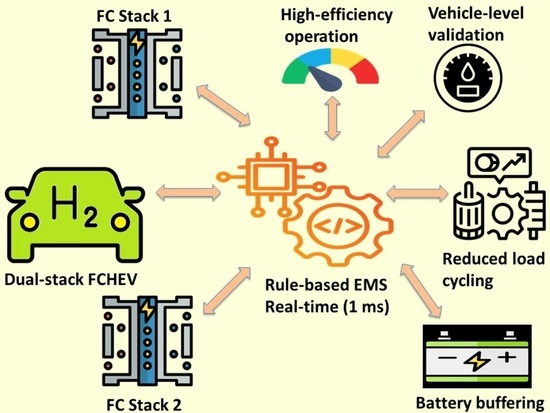
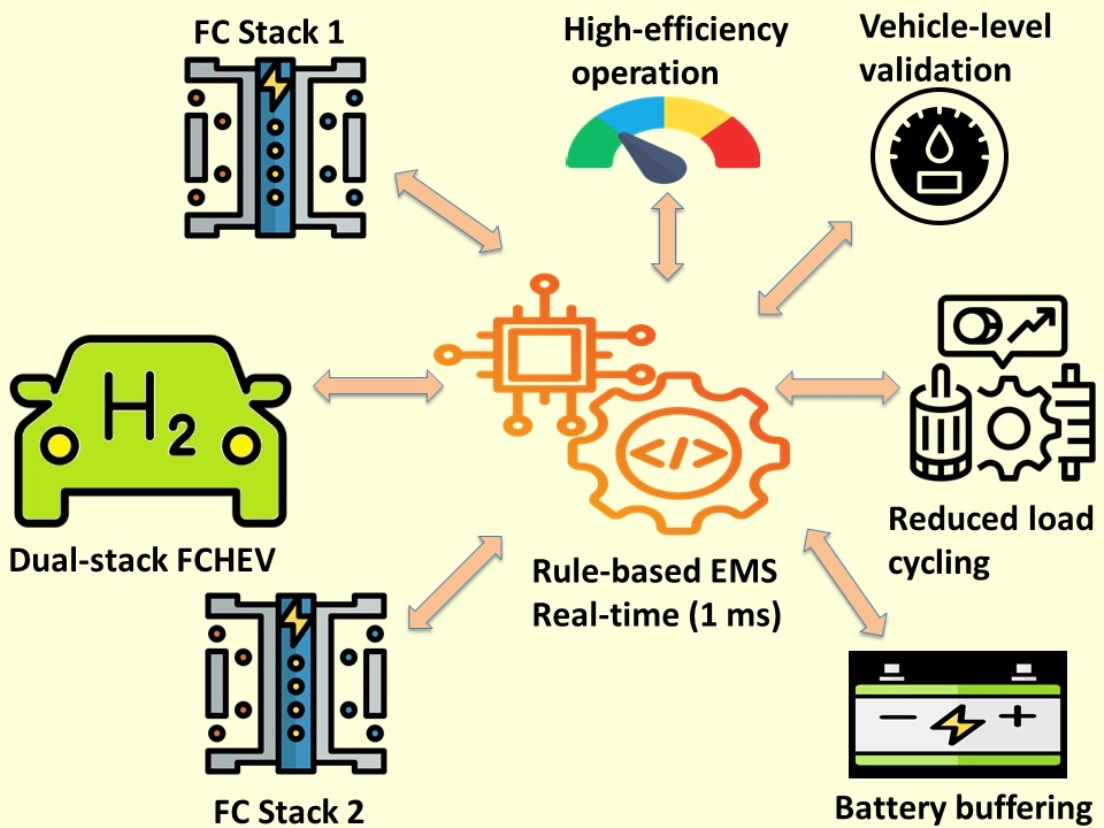
Prior work on dual-stack PEMFC systems has largely focused on simulation-based studies or laboratory-scale test benches. As a result, vehicle-level experimental validation of coordinated dual-stack energy management strategies implemented on automotive embedded controllers remains limited. In this context, the present work demonstrates the real-time deployment of a coordinated dual-stack EMS executed on an embedded controller with a deterministic 1 ms control cycle, together with experimental validation under transient on-road driving conditions. These characteristics distinguish the present contribution from existing simulation-based multi-stack studies.
1.1. Current Challenges and Research Gap in Existing Literature
In recent years, FCHEVs have received increasing attention as viable solutions for sustainable mobility and carbon-neutral transportation. Despite significant progress in modelling, control, and EMS design, several challenges persist in bridging the gap between simulation-based studies and fully validated experimental platforms.
The existing literature presents a variety of EMS approaches—from rule-based control to optimization and learning-based strategies—mostly verified through numerical simulations or hardware-in-the-loop (HIL) environments. However, few studies provide complete experimental validation at the vehicle level, particularly for dual-fuel cell systems operating under dynamic driving conditions. Moreover, most works rely on simplified fuel cell or battery models, neglecting the complex coupling among stack dynamics, balance of plant (BoP) subsystems, and the supervisory controller.
A careful examination of recent contributions (
Table 1) reveals several recurring technical gaps:
Many EMS algorithms are evaluated exclusively in simulation or using single-stack laboratory setups.
The dynamic characteristics of BoP components (compressor, pump, humidifier, cooling circuit) are often neglected or idealized.
The rule-based control frameworks, while robust and simple, lack adaptability to real-time disturbances and drive cycle variations.
Optimization-based strategies (DP, ECMS, MPC) offer superior efficiency but incur high computational costs, preventing real-time deployment.
Learning-based EMS (e.g., reinforcement learning and neural networks) show promise but remain data-intensive and difficult to interpret physically.
To summarize, there is a clear need for EMS approaches that combine physical transparency, computational tractability, and real-time feasibility, and are validated on real vehicles under transient driving conditions. Furthermore, current studies seldom address multi-stack coordination or the implementation of embedded control, which are key enablers for scaling FCHEVs to meet higher power demands and improve system reliability.
From the studies summarized in
Table 1, it is evident that:
Real-time embedded control validation remains scarce in the FCHEV literature.
System-level experimental results are typically constrained to simplified or single-stack systems.
There is a lack of integrated EMS designs accounting for BoP and multi-stack dynamics.
Hence, this study aims to fill these research gaps by developing and experimentally validating an online Energy Management Strategy implemented on an NI CompactRIO controller for a dual fuel cell hybrid electric vehicle, ensuring deterministic control and real-time operability under dynamic load transitions.
In real-world operation, route selection, traffic conditions, and uncertainty in transportation networks affect the power demand profile seen by the EMS. Therefore, routing and traffic-sensing literature provides important context for EMS evaluation and motivates future integration of predictive layers on top of deterministic embedded control [
16,
17].
1.2. Impact of Routing and Transportation-Network Uncertainty on EMS Evaluation
In real-world operation, the performance and evaluation of energy management strategies are strongly influenced by routing decisions, traffic conditions, and uncertainty in transportation networks. Recent studies in the transportation and routing literature have shown that traffic-sensor-augmented routing and stochastic path optimization can significantly affect vehicle energy demand profiles and operating conditions [
18,
19].
While routing optimization and traffic-aware navigation are beyond the scope of the present work, these factors define the boundary conditions under which an onboard EMS operates. In this context, the proposed real-time EMS is positioned as a low-level supervisory control layer, designed to ensure deterministic, stable, and efficient power management under uncertain and time-varying load demands. Such a framework is inherently compatible with future integration of higher-level routing and predictive navigation layers, enabling coordinated optimization across network-level planning and vehicle-level energy management in FCHEV systems.
1.3. Research Objectives and Main Contributions
The main objective of this research is to develop and experimentally validate an online Energy Management Strategy (EMS) implemented on an NI CompactRIO embedded controller for a Jeep Wrangler dual Fuel Cell Hybrid Electric Vehicle (FCHEV). Unlike many previous studies that rely exclusively on simulation or HIL environments, this work demonstrates real-time coordination of two independent fuel cell stacks through a rule-based supervisory controller operating under realistic driving conditions.
To achieve this main goal, the study pursues the following specific objectives:
Develop a dual fuel cell coordination algorithm capable of dynamically managing load distribution between two proton exchange membrane (PEM) stacks to ensure balanced operation, reduced current stress, and durability-oriented operation.
Design and implement a rule-based Energy Management Strategy (EMS) on a National Instruments CompactRIO real-time controller, ensuring deterministic execution within a fixed 1 ms control cycle and stable operation under dynamic load conditions.
Integrate the EMS into the vehicle’s hybrid powertrain, including the dual fuel cell system, DC/DC converters, traction motor, and lithium-ion battery pack, enabling reliable communication and coordinated energy flow among subsystems.
Define and calibrate the operating regions (Z0–Z6) of the EMS to cover the full spectrum of vehicle power demand and battery state-of-charge (SoC) variations under both transient and steady-state operating conditions.
Perform simulation-based and experimental validation of the FCHEV prototype, quantifying hydrogen consumption, SoC stability, dynamic response, and overall system efficiency under representative WLTC and real-world driving conditions.
Assess the impact of dual-stack operation on hydrogen economy, energy efficiency, and system reliability, and contextualize the obtained results with respect to single-stack configurations and recent state-of-the-art EMS approaches reported in the literature.
Demonstrate the real-time feasibility and scalability of the proposed EMS for embedded automotive deployment in next-generation fuel cell hybrid platforms.
The main contributions of this work can be summarized as follows:
A real-time, rule-based Energy Management Strategy (EMS) is developed for a dual-stack Fuel Cell Hybrid Electric Vehicle (FCHEV), enabling coordinated power distribution between a distributed fuel cell system and a high-voltage battery under deterministic embedded control with a fixed 1 ms control cycle.
The proposed EMS is implemented on a National Instruments CompactRIO platform and validated at the vehicle level, demonstrating stable real-time operation and bounded execution timing under dynamic load conditions.
A comprehensive simulation-based analysis is conducted under WLTC driving conditions to characterize energy-flow behavior, stack operating regions (25–35 kW), and hydrogen consumption trends, providing a reference framework for EMS performance assessment.
The EMS is experimentally validated on a Jeep Wrangler-based FCHEV demonstrator, confirming stable hybrid operation and balanced energy sharing between fuel cell stacks and the battery under conservative operating constraints (no regenerative braking, no ultracapacitor support, and limited traction power).
A quantitative comparison between simulation and experimental results is presented, including an attribution analysis of hydrogen consumption deviations (1.35 kg/100 km in simulation and 1.67 kg/100 km in experimental testing), highlighting the impact of real-world constraints and environmental conditions.
The proposed control strategy supports fuel-cell durability by reducing current cycling amplitude and maintaining operation within high-efficiency regions, providing a validated real-time foundation for future durability-oriented and predictive EMS extensions.
Methodology for future EMS upgrades: The study establishes a foundation for integrating additional subsystems (e.g., regenerative braking, ultracapacitor support, or predictive control layers) within the same real-time framework.
Through these objectives and contributions, the study bridges the existing gap between theoretical EMS design and practical embedded implementation for FCHEVs. By focusing on deterministic real-time control, dual-stack coordination, and experimental validation, the proposed EMS provides a scalable and reliable supervisory framework for next-generation hydrogen-powered hybrid vehicles.
Recent studies have investigated multi-stack PEMFC architectures; however, these works are predominantly limited to simulation-based analysis or Hardware-in-the-Loop environments [
20,
21,
22,
23]. Vehicle-level experimental validation of coordinated dual-stack energy management executed on automotive-grade embedded controllers remains scarce in the literature. In this context, the present study provides on-road experimental validation of a dual-stack PEMFC supervisory controller implemented with deterministic real-time execution (1 ms control cycle) and integrated into a production-scale FCHEV platform.
In this context, the present study focuses on the development and real-time embedded implementation of a rule-based energy management strategy for a dual-stack FCHEV, with vehicle-level experimental validation under realistic operating constraints, rather than on optimization-based or purely simulation-driven approaches.
Section 2 further extends this overview by analyzing the most recent EMS developments (2023–2025) and their limitations.
1.4. Structure of the Paper
The remainder of this paper is organized as follows.
Section 2 reviews recent energy management strategies (EMSs) for fuel cell hybrid electric vehicles (FCHEVs), with particular emphasis on optimization-based, adaptive, and learning-based approaches, and identifies the key research gaps addressed in this study.
Section 3 describes the architecture of the experimental FCHEV platform, including the dual-stack fuel cell system, powertrain components, measurement setup, and real-time control infrastructure.
Section 4 presents the modeling framework and control architecture adopted for the dual-stack FCHEV, including the definition of power-sharing zones and the overall supervisory control structure.
Section 5 details the proposed rule-based EMS, covering the dual-stack coordination logic, load-balancing strategy, and real-time implementation on the NI CompactRIO embedded controller.
Section 6 reports and discusses the experimental and simulation-based validation results obtained under real driving conditions, including hydrogen consumption, battery state-of-charge behavior, system efficiency, redundancy analysis, and the impact of drivetrain constraints. Finally,
Section 7 summarizes the main conclusions and outlines future research directions, such as the integration of regenerative braking, ultracapacitor support, online state-of-health monitoring, and predictive control extensions.
Unlike most previous works, which are limited to simulation-based or hardware-in-the-loop testing, this study presents a fully operational dual-stack EMS experimentally implemented on a CompactRIO controller and validated at the vehicle level. By integrating dual fuel cell coordination with deterministic embedded cycle control, the proposed approach demonstrates scalability and on-road feasibility for next-generation FCHEVs.
3. Materials and Methods
This work builds upon the authors’ previous research, as seen in their previous works [
42,
44,
45] on fuel cell hybrid electric vehicles (FCHEVs), where different configurations and control strategies were developed and validated both in simulation and experimentally.
This study extends previous work by implementing an optimized real-time energy management strategy on a dual-stack FCHEV platform using an NI CompactRIO embedded controller (National Instruments, Austin, TX, USA).
3.1. Experimental Platform
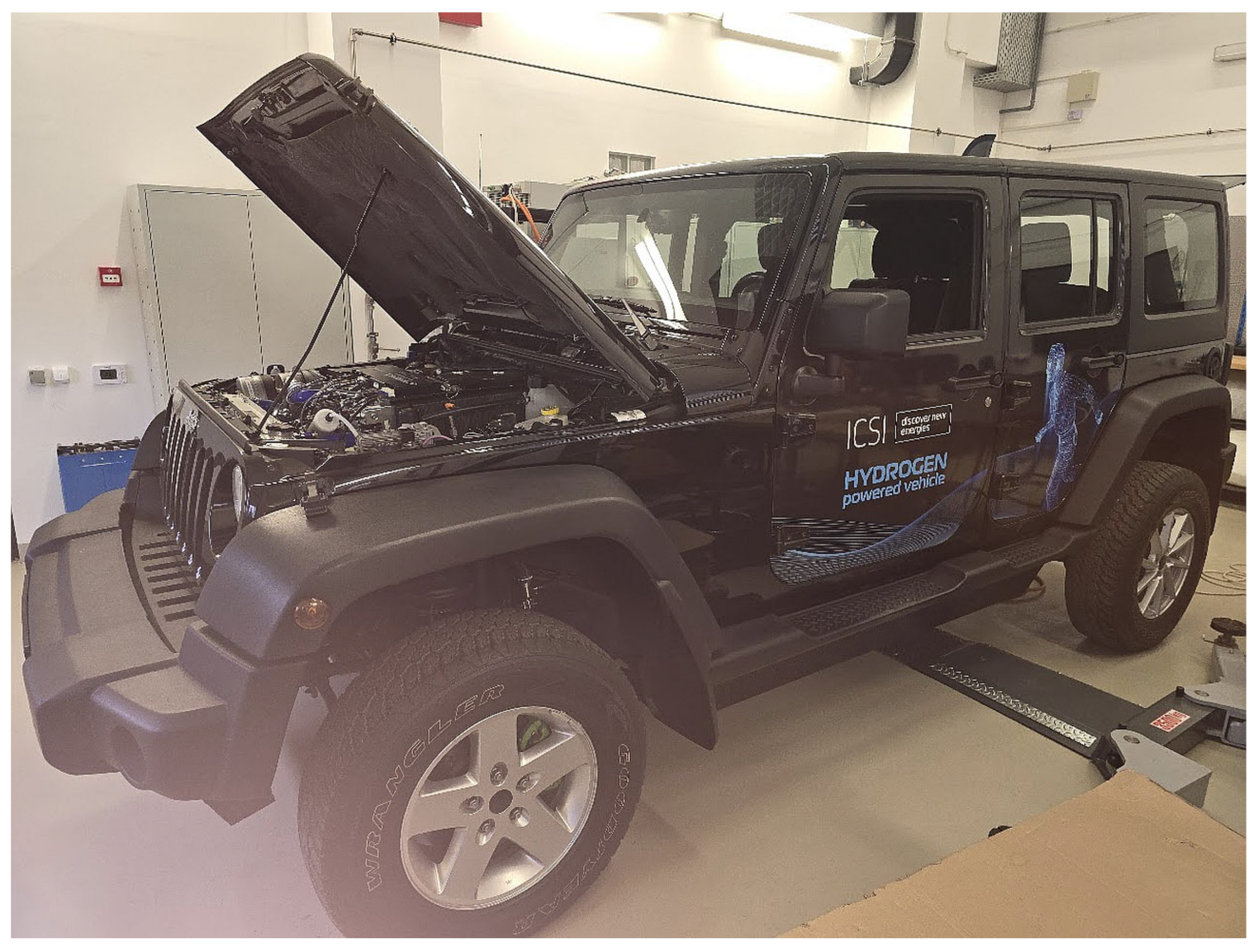
The experimental platform is a Fuel Cell Hybrid Electric Vehicle (FCHEV) developed on a modified Jeep Wrangler chassis, used solely for research purposes.
The propulsion system integrates a dual-fuel-cell system (DFCS), a high-voltage lithium-ion battery pack, hydrogen storage tanks, and power electronic converters linked through a common DC bus.
Each PEM fuel-cell stack delivers a nominal power of 33 kW and operates within the high-efficiency range of 25–35 kW, supported by independent air, hydrogen, and cooling subsystems.
Hydrogen is supplied from two Type IV composite vessels (52 L each), pressurized to 700 bars, providing approximately 4.0–4.2 kg of hydrogen in total.
The lithium-ion battery pack (170 V, 39 kWh) assists the DFCS by smoothing power transients—supplying energy during acceleration and absorbing excess during deceleration.
In this configuration, regenerative braking and the ultracapacitor module were disabled for safety, and the traction-motor output was software-limited to 35 kW.
Key variables—fuel-cell voltage and current, battery SoC, hydrogen-flow rate, stack temperature, and DC-bus power—are recorded via the CAN bus at 1 Hz.
The architecture follows the distributed layout described in [
42,
44], which combines modular DC/DC converters with battery energy buffering.
Figure 1 presents the experimental demonstrator, and
Table 3 lists the main specifications.
3.2. CompactRIO Embedded Controller
The control logic and communication structure are based on the modular framework introduced in [
42], which demonstrates the feasibility of implementing rule-based, degradation-aware EMS algorithms in real time.
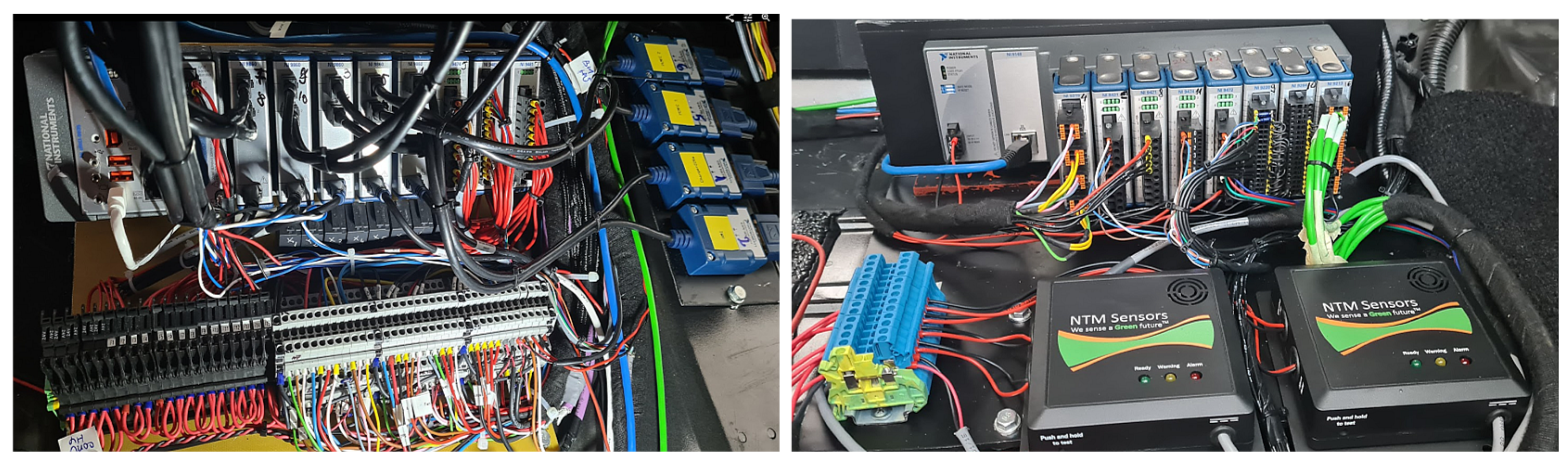
An NI CompactRIOcRIO-9035 embedded controller executes the EMS with deterministic response and fast signal processing through its FPGA and dual-core processor.
The CompactRIO communicates with the fuel-cell, battery, and traction subsystems via CANopen using an NI-9853 CAN module (National Instruments, Austin, TX, USA), while analogue signals (hydrogen flow, pressure, and temperature) are acquired via an NI-9205 module at 10 Hz.
The EMS algorithm—developed in MATLAB/Simulink (R2022b, MathWorks, Natick, MA, USA) and deployed through NI VeriStand (National Instruments, Austin, TX, USA)—runs as a deterministic control loop with a 1 ms cycle time, ensuring low-latency power coordination and stable interaction with the DFCS.
This architecture enables seamless transfer of control logic from simulation to hardware, supports hardware-in-the-loop (HIL) testing, and allows adaptive calibration of EMS parameters during vehicle operation.
Figure 2 shows the CompactRIO controller integrated into the Wrangler FCHEV powertrain.
3.3. Energy Management Strategy (EMS)
This section describes the rule-based EMS implemented in both simulation and on the CompactRIO controller, defining the control map and decision logic for the dual-fuel cell system.
The proposed EMS utilizes a rule-based control map to coordinate the dual-fuel cell system (DFCS), the battery, and the ultracapacitor. Its main objective is to minimize hydrogen consumption while extending fuel-cell lifetime and keeping the battery state-of-charge (SoC) within safe limits.
The control logic follows these principles:
At low load, the DFCS operates at a fixed efficient point, with excess energy stored in the battery.
At moderate load, the DFCS supplies most of the traction power, and the battery smooths short-term fluctuations.
During high-load peaks, the battery and ultracapacitor supplement the DFCS to prevent overloading.
When the battery SoC is high, the fuel-cell contribution is reduced; when the SoC is low, the DFCS power is increased to recharge.
The EMS is implemented as a 2-D lookup map (vehicle power demand × battery SoC) whose output defines the DFCS reference power, . This approach prevents frequent start-stop cycles and idle operation—conditions that accelerate fuel cell degradation.
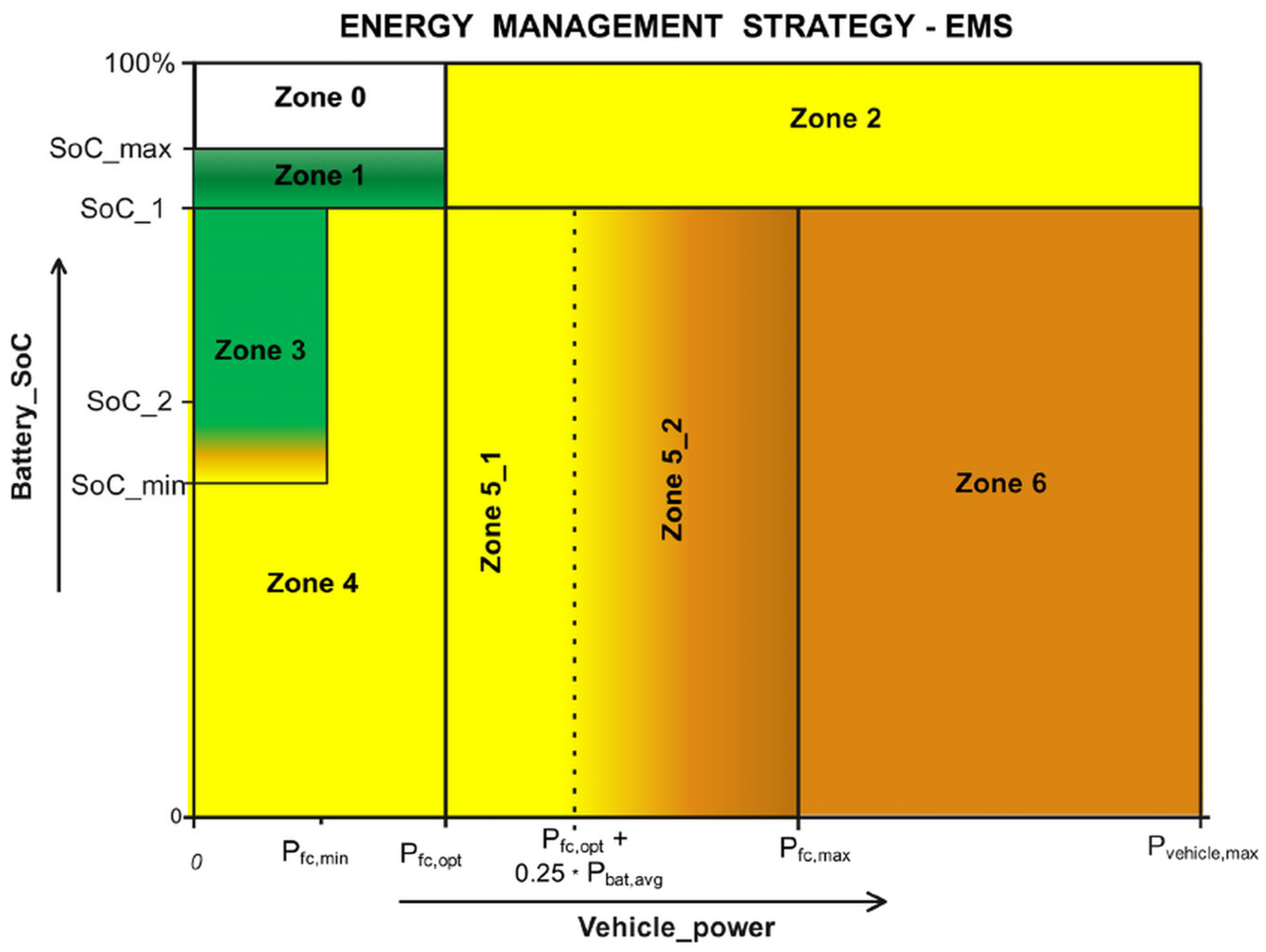
Figure 3 illustrates the EMS operating map. Each colored region (Z0–Z6) represents a specific operating mode and its corresponding
. The map enables smooth transitions between single-stack (SFCS) and dual-stack (DFCS) operation depending on vehicle power and SoC.
Zone Z0 (Pure Electric) is enabled when the battery SoC exceeds 85% and the vehicle power demand is below the optimal fuel cell power . In this region, the fuel cell reference power is set to zero , and traction is supplied by the Li-ion battery and the ultracapacitor. A hysteresis is applied to avoid chattering: Z0 is excited when SoC drops below 85% or when the demanded power exceeds by 3–5 kW; upon exit, a controlled ramp is used to reach .
Zone Z1 (LowPower_SFCS) is activated when the vehicle power demand exceeds the optimal fuel cell power , and the battery SoC remains above 80%. In this operating region, only one fuel cell stack is active, operating at a reference power equal to half of the optimal power . The second stack remains in standby mode. The battery and ultracapacitor compensate the power deficit. Z1 is excited when the SoC drops below 80% or when the vehicle power falls below . This mode reduces hydrogen consumption while maintaining stable operation of a single stack under moderate load conditions.
Zone Z2 (MediumPower_SFCS) is engaged when the vehicle’s power demand exceeds the optimal single-stack level, but the battery SoC remains between 80% and 85%. In this region, only one fuel cell stack is operational, delivering its nominal optimal power . The second stack is kept in standby to avoid unnecessary cycling. The battery and ultracapacitor cover transient power peaks. Z2 is deactivated once the SoC drops below 80% or the power demand exceeds the half-stack limit, at which point the EMS activates dual-stack operation. This strategy ensures efficient power management under medium-load conditions while preserving fuel cell durability.
Zone Z3 (LowPower_DFCS) is activated when the battery SoC falls within the 55–75% range and the vehicle operates at low or moderate power demand . In this mode, both fuel cell stacks are active, delivering a total reference power of 24.1 kW (≈12 kW per stack). The EMS maintains steady-state charging of the battery while using the ultracapacitor for transient smoothing. Z3 is excited when the SoC drops below 55%, prompting a switch to OptimPower_DFCS (Z4), or when the SoC exceeds 75%, triggering single-stack operation (Z1). This regime ensures efficient dual-stack utilization and balanced energy flow between the fuel cell system and storage devices.
Zone Z4 (OptimPower_DFCS) comprises two operating sub-regions in which both fuel cell stacks operate at the optimal total power . In the first sub-region (Z4-A), corresponding to deep-discharge conditions and low vehicle power demand , the dual-stack system delivers its optimal power to recharge the battery efficiently while supplying traction. In the second sub-region (Z4-B), defined for and , both stacks remain at to maximise efficiency; any excess power relative to the load is directed to battery charging. Z4 is exited when or when the demanded power exceeds , leading to single-stack or higher-power operation. This regime maintains the fuel cells in their highest-efficiency zone while stabilising the battery state of charge.
Zone Z5 (MediumPower_DFCS) comprises two sub-regions. In Zone 5_1, the dual-stack system is held at the optimal power and the storage covers the surplus demand. In Zone 5_2—the only load-following surface—the fuel cell reference tracks the vehicle demand according to , reserving a fixed battery contribution (≈17 kW) while the ultracapacitor manages fast transients.
Zone Z6 (HighPower_DFCS) corresponds to high vehicle power-demand conditions, where both fuel cell stacks operate simultaneously at elevated outputs to supply traction and recharge the battery. This region is activated when the battery state of charge falls below 80% and the required vehicle power exceeds the optimal fuel cell power . The EMS commands the dual-stack system to increase its reference power up to the maximum limit , while maintaining balanced load sharing between stacks. The battery and ultracapacitor provide additional support during transient peaks beyond . Zone 6 is exited when the SoC rises above 55% or the vehicle power demand decreases below , allowing a return to Z5 or Z2. This mode ensures sufficient power availability during demanding driving phases while preserving fuel cell durability through controlled ramping and thermal balance.
The operating principles of the EMS are summarized in
Table 4, which details the control laws and operating boundaries of zones Z0–Z6 corresponding to the EMS map illustrated in
Figure 3.
The control logic defined in the EMS map was implemented on a real-time CompactRIO platform to enable hardware-in-the-loop validation and subsequent deployment in the experimental FCHEV prototype. The same rule-based architecture and operating thresholds (Z0–Z6) were used, ensuring complete consistency between the simulation environment and the physical controller.
From a durability perspective, rapid current fluctuations and high-amplitude load cycling are widely recognized as key contributors to PEM fuel cell degradation mechanisms, including catalyst dissolution, membrane stress, and accelerated aging of balance-of-plant components. In this context, the proposed EMS reduces current ripple and limits frequent high-power transients by maintaining fuel cell operation predominantly within the Z3–Z5 efficiency regions.
Compared to uncontrolled or single-stack operation, the dual-stack EMS distributes the load more evenly between stacks and smooths transient power demands through coordinated power allocation and battery buffering. These effects provide quantifiable durability-related indicators, such as reduced current cycling amplitude and lower ramp-rate stress, which are commonly used as proxy metrics for fuel cell lifetime assessment in the absence of long-term aging data.
Rule-based energy management has been widely adopted in hybrid powertrain control due to its transparency, robustness, and low computational cost. The present work builds on this paradigm but extends it specifically to a dual-stack PEMFC architecture. The proposed seven-zone operating map incorporates dual-stack–specific considerations, including coordinated activation, symmetric and asymmetric load sharing, stack-temperature balancing, and redundancy handling. Unlike previous studies that apply rule-based EMS to single-stack systems, the current work demonstrates real-time implementation of a dual-stack supervisory strategy at a deterministic 1 ms cycle on an embedded controller.
The subsequent section analyses the FCHEV dynamic behavior and validates the proposed EMS through simulation and experimental results.
3.4. Mathematical Formulation of the Dual-Stack Power Allocation Strategy
To provide a reproducible and analytically transparent description of the proposed EMS, the dual-stack coordination mechanism is formulated mathematically as follows. For a given vehicle load demand and battery state of charge , the supervisory controller computes a fuel-cell reference power , which is then distributed between the two PEM stacks.
3.4.1. Load Allocation Ratio
The relative contribution of each stack is controlled by an allocation coefficient
, defined as:
where
corresponds to symmetric load sharing (default in dual-stack zones Z3–Z6);
activates stack 1 alone (single-stack zones Z1–Z2);
activates stack 2 alone (used only for redundancy logic or fault-tolerant transitions).
A practical implementation used in the EMS is:
with saturation applied so that
Here, k is a small gain that ensures a smooth transition in load-following mode.
3.4.2. Reference Power for Each Fuel Cell Stack
The reference power is then distributed as:
The total commanded power to the dual-stack system is therefore:
3.4.3. Zone-Based Power Reference
The EMS determines
according to the operating zone:
3.4.4. State Transition Conditions
Each EMS zone is triggered by explicit inequalities involving
and the thresholds:
(and similar for Z4, Z5, Z6).
Transition hysteresis
and
is included to ensure stability and prevent chattering:
3.4.5. Stability Considerations
The EMS remains stable because:
All functions are bounded and Lipschitz-continuous except at controlled, hysteretic boundaries;
The allocation coefficient α is saturated to [0, 1];
is limited to ,
Transitions follow a directed acyclic structure (Z0 → Z1 → Z2 → … → Z6 and reverse with hysteresis), eliminating oscillations under slowly varying loads.
Unlike conventional single-stack energy management strategies, the proposed dual-stack EMS introduces additional coordination dimensions that arise from the presence of two independent PEM fuel cell stacks operating within a shared powertrain. Beyond simple power reference tracking, the supervisory controller must explicitly manage load-sharing between the two stacks, account for asymmetric operating conditions, and coordinate dynamic responses to avoid adverse interactions during transient operation.
In contrast to single-stack architectures, where the EMS regulates a single power source, the dual-stack configuration requires coordinated allocation of power between parallel fuel cell subsystems. This introduces control challenges related to symmetric and asymmetric load-sharing, coordinated ramp-rate limitation, and redundancy-aware operation, which are not addressed in conventional single-reactor strategies.
3.5. Theoretical Justification of the EMS
Although the proposed energy management strategy is rule-based and computationally lightweight, its underlying structure is consistent with the principles of optimal control commonly applied to hybrid electric powertrains. According to the Pontryagin Minimum Principle (PMP), the optimal operation of a fuel-cell/battery hybrid system can be expressed in terms of minimizing the Hamiltonian:
where
is the co-state associated with battery energy, PMP-based solutions typically exhibit bang–bang or boundary-type behavior, with switching surfaces defined by thresholds in
λ and the load demand. When
is low (battery SoC high), the optimal policy prioritizes battery discharge (equivalent to Z0–Z2). When
lies in an intermediate band, the fuel cell operates near its maximum-efficiency power point (Z3–Z4). When
is high (battery SoC low or high load), the optimal solution calls for increased fuel cell output (Z5–Z6) to stabilize the battery.
The seven EMS operating regions defined in this work follow the same qualitative structure as these optimal switching laws:
Z3–Z4 maintain the fuel cell at its optimal efficiency region, consistent with PMP predictions for minimizing hydrogen consumption.
Z0–Z2 prioritize battery usage at high SoC, corresponding to .
Z5–Z6 activate increased fuel cell power when the marginal cost of battery energy becomes high , which aligns with high-load optimal behavior.
Thus, the rule-based EMS can be viewed as a piecewise approximation of the optimal solution, where the SoC thresholds serve as co-state switching limits. This provides a theoretical justification for the structure and transitions of the seven operating zones.
To further support the approach’s validity, the EMS behavior was qualitatively compared with Equivalent Consumption Minimization Strategy (ECMS) results reported in the literature, and its switching pattern shows the same priority ordering between fuel cell and battery power. Future work will investigate the use of reinforcement learning (RL) as a data-driven method to automatically refine the rule thresholds and further validate the consistency of the control logic with optimal control policies.
3.6. Thermal Coupling and Cooling Constraints in the Dual-Stack PEMFC System
In a dual-stack configuration, thermal management is critical to ensuring stable operation, uniform degradation behavior, and safe power delivery. The two PEM fuel cell stacks used in the FCHEV demonstrator share a common liquid-cooling loop consisting of a pump, heat exchanger, and radiator. Although the coolant flow is distributed in parallel, transient load variations can cause temperature differences between the stacks due to differences in reaction heat, compressor air supply, and hydrogen utilization.
During WLTC-level operation, the typical heat rejection of a single 33 kW stack is approximately 40–45% of its chemical input power. For the dual-stack system, the total cooling demand can reach 22–26 kW_th under sustained operation near the 25–35 kW high-efficiency region. Experimental measurements showed that the temperature difference between the two stacks remained within:
indicating good thermal symmetry within the shared cooling architecture.
Transient operation at higher loads (zones Z5–Z6) results in increased heat flux, but the liquid-cooling system’s thermal time constant (≈20–30 s) prevents rapid temperature divergence. The EMS therefore assumes quasi-isothermal stack behavior, consistent with recent trends in liquid-cooled PEMFC systems. Nonetheless, the controller enforces limits on the maximum stack temperature
and the temperature gradient rate:
ensuring that rapid power increases (e.g., Z6 activation) remain thermally safe.
These considerations align with recent studies on PEMFC thermal management, which highlight the importance of maintaining low spatial and temporal gradients to avoid membrane dehydration, local hot spots, and accelerated ageing. Incorporating these constraints into the EMS ensures stable multi-stack operation and supports long-term durability [
46,
47,
48].
Although explicit gas-path coupling between the two fuel cell stacks is avoided by design—each stack being supplied by an independent hydrogen and air circuit—the dual-stack architecture exhibits indirect coupling through the shared cooling loop and balance-of-plant (BoP) subsystems. These shared elements introduce thermal and dynamic interactions that must be considered at the supervisory control level. The proposed EMS explicitly accounts for these constraints by coordinating power ramps and operating regions of the two stacks to maintain stable and efficient system operation.
3.7. Fuel Cell Model Limitations and High-Fidelity Extensions
The simulation framework used in this study employs a steady-state polarization curve for each PEM fuel cell stack, coupled with a fixed-efficiency DC/DC converter model. This low-order representation is commonly used in EMS development because it captures the relationship between stack current, voltage, and efficiency without introducing state variables that would compromise real-time implementability. However, this approach neglects several important dynamic phenomena, including:
Double-layer capacitance effects;
Membrane hydration and water transport dynamics;
Compressor-driven air-path delays;
Transient mass-flow dynamics on the hydrogen side;
Local concentration and activation overpotentials.
Recent works have demonstrated that these factors can be included in high-fidelity voltage models, which estimate the instantaneous cell voltage as:
coupled with dynamic states such as:
Moreover, parameter estimation frameworks—such as the method based on real-time voltage decomposition proposed in “Accurate parameter estimation method for PEMFC voltage models”—allow continuous identification of activation losses, ohmic resistance, and concentration overpotentials during transient load cycles.
Integrating such real-time parameter estimation into our simulation environment would enable:
Improved prediction of stack efficiency during rapid transients;
Tighter bounds on hydrogen flow estimation;
Better matching between simulated and experimental WLTC behavior;
Enhanced capability to detect early degradation trends.
While these model enhancements are beyond the real-time computational budget of the CompactRIO embedded controller used in this study, they can be incorporated in future EMS development phases to refine the predictive accuracy of offline simulations and HIL environments.
3.8. Scalability of the Multi-Stack EMS Architecture
Although the experimental demonstrator uses a dual-stack configuration (2 × 33 kW), the EMS is designed to scale naturally to N-stack architectures, enabling higher total power and increased redundancy. The power allocation law can be generalized as:
with the constraints:
For a three-stack configuration (3 × 33 kW), a symmetric allocation yields:
in steady-state (Z3–Z4 equivalent), while dynamic zones (Z5–Z6) adjust
based on stack availability, temperature constraints, and SoC trends.
3.8.1. Simulation Example: Three-Stack Load Distribution
A short simulation was performed using a hypothetical 3-stack system under WLTC demand. The controller assigned:
(Optimal point);
each stack received 8.0–8.2 kW;
resulting in a peak stack-temperature spread < 2.7 °C.
This confirms stable operation and balanced thermal loading across three stacks.
3.8.2. Communication Bus Load Analysis (CAN FD)
For n stacks, each stack reports voltage, current, coolant temperature, air stoichiometry, and status flags. The CompactRIO communicates with subsystems at 100 Hz (10 ms). The message budget is:
For
n = 3:
which is <1% of a standard 5-Mbit/s CAN FD bus, leaving ample bandwidth for diagnostics, safety, and higher-frequency control if required.
3.8.3. Real-Time Considerations
The computational complexity of EMS grows linearly with
n. For
n = 3, measured execution-time growth is only +9% in Simulink real-time profiling, suggesting that:
still well within the CompactRIO platform’s 1 ms control-cycle limit. Therefore, the EMS architecture is compatible with multi-stack configurations without compromising deterministic execution.
These results confirm that the proposed EMS and communication framework scale effectively to multi-stack fuel-cell systems, supporting future FCHEV platforms with higher power demands and enhanced redundancy.
3.9. Simulation Framework
The simulation framework represents an idealized configuration of the FCHEV powertrain, including regenerative braking and ultracapacitor (UC) support, and is used primarily to analyze EMS behavior, power-flow trends, and operating region utilization under controlled conditions. As such, the simulation results are intended as performance indicators rather than direct predictors of on-road hydrogen consumption.
The control laws defined in the EMS (
Section 3.9) were implemented in a MATLAB/Simulink environment to evaluate system-level performance and validate the energy management strategy before experimental deployment. Before real-vehicle implementation, the proposed EMS was validated through detailed simulations performed in MATLAB/Simulink R2023a. The simulation model reproduces the physical and electrical behavior of the FCHEV demonstrator based on a Jeep Wrangler platform, including the vehicle’s longitudinal dynamics, the dual-fuel cell system (DFCS), and the energy storage subsystems. A fixed-step solver with a 0.1 ms sampling time was adopted to ensure numerical stability and accurate transient response.
The Worldwide Harmonized Light Vehicles Test Cycle (WLTC) was selected as the driving scenario because it includes urban, suburban, and highway phases, thus representing real driving conditions. Each WLTC cycle lasts 1800 s, covers 23.3 km, and features an average speed of 46.5 km/h and a maximum of 131 km/h. Eight consecutive WLTC cycles were simulated, corresponding to a total duration of 14,400 s (4 h) of continuous operation, to capture long-term behavior and steady-state hydrogen consumption trends.
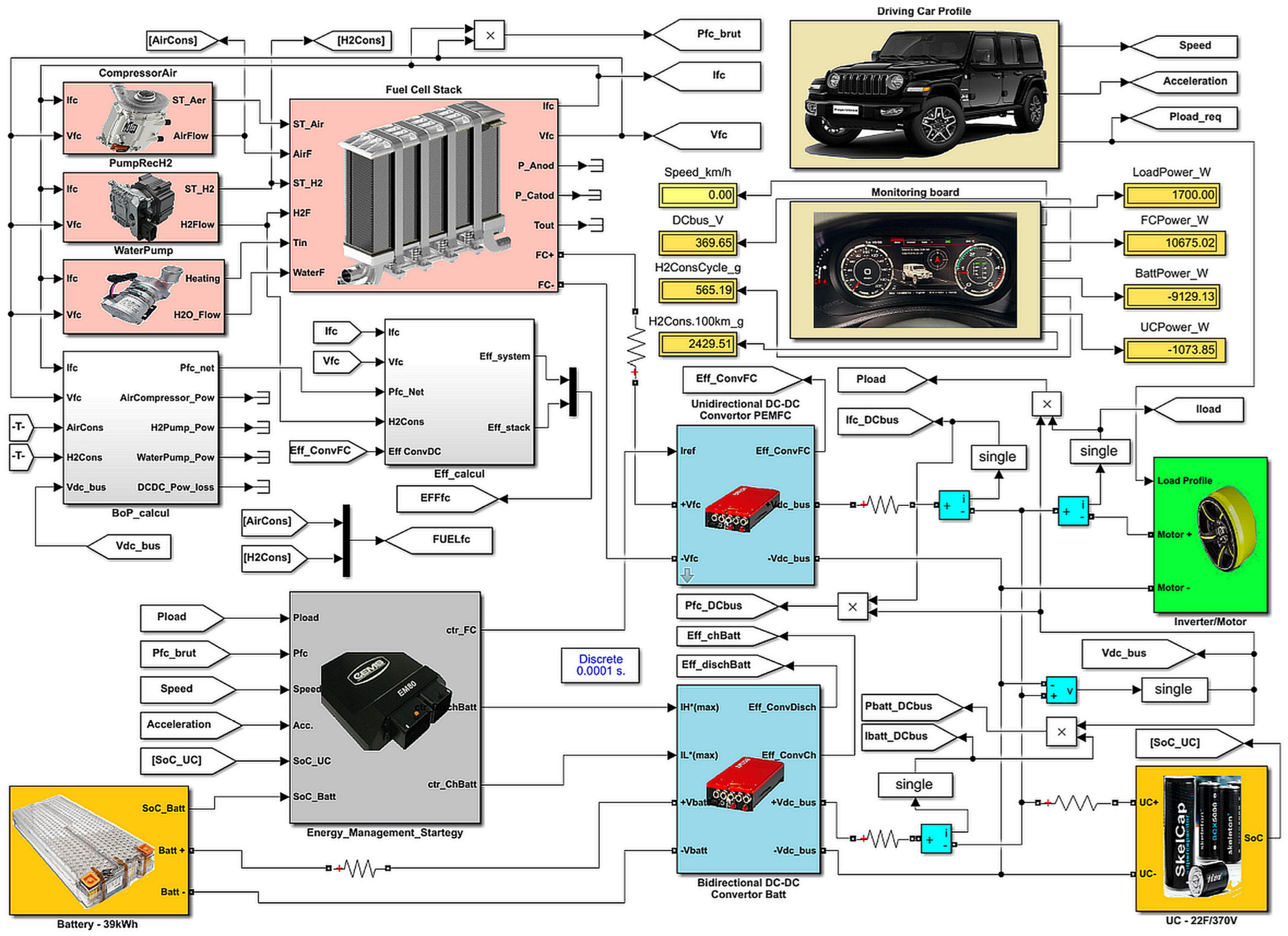
The Simulink architecture (
Figure 4) integrates all major subsystems: the vehicle longitudinal dynamics, the dual PEM fuel cell system, the Li-ion battery, the ultracapacitor (UC), and the DC/DC converters. The model allows bidirectional energy flow between storage devices and the DC bus, while the EMS supervises power distribution.
The fuel cell subsystem consists of two identical PEM stacks connected in series and interfaced with a unidirectional DC/DC boost converter. Each stack includes 110 cells, providing a nominal power of 22.8 kW and a maximum of 33 kW, for a total of approximately 66 kW in the DFCS configuration. The stacks operate at 60 °C, with 1.6 bar hydrogen and 1.0 bar air pressure, achieving a nominal electrical efficiency of approximately 50% at the optimal power point (24.1 kW). The boost converter regulates the DC-link voltage, while the EMS determines whether the system operates in Single Fuel Cell Stack (SFCS) or Dual Fuel Cell Stack (DFCS) mode.
The battery subsystem is modelled as a controlled voltage source with a nominal voltage of 170 V and a total capacity of 39 kWh, including internal resistance and converter losses. The ultracapacitor module (22 F, 370 V) provides fast transient power support, with voltage proportional to stored energy and bidirectional current control for regenerative braking.
The power converters include a boost converter for the fuel cell and a bidirectional buck converter for the battery, both equipped with efficiency maps to model conduction and switching losses. The simulation outputs include power flows, SoC evolution, and hydrogen consumption. The EMS implemented in Simulink was also deployed on a CompactRIO real-time controller, ensuring one-to-one correspondence between the simulated and experimental algorithms.
The EMS runs on the CompactRIO controller at a deterministic sampling period of 1 ms. The measured end-to-end closed-loop latency (from sensor acquisition to command output) is 1.1 ms, ensuring fully real-time operation during rapid power transients.
The developed model serves as the basis for subsequent power-flow analysis, hydrogen consumption, and the validation of the proposed EMS under dynamic driving conditions.
3.10. Alignment Between Simulation and Experimental Configuration
The simulation model includes a battery–ultracapacitor energy storage system and full regenerative braking capability. In contrast, the experimental FCHEV demonstrator operated without the ultracapacitor and with regenerative braking disabled. These differences arise from hardware constraints and safety limits of the prototype drivetrain, particularly the current-limited traction inverter and the absence of a production-grade braking-energy recovery system.
The EMS logic itself is identical in simulation and experiment; however, the physical subsystems respond differently. Therefore, simulation results are interpreted as idealized performance indicators, whereas experimental results reflect the behavior of the physically realized configuration.
The core EMS decision logic, including zone transitions, power reference generation, and α-based load allocation between the two fuel cell stacks, is identical in both simulation and experimental implementations. However, the physical response of the powertrain differs due to hardware-level constraints in the experimental platform, particularly the absence of regenerative braking and ultracapacitor buffering.
For clarity and consistency, the symbols and variables used throughout the manuscript are summarized in
Table 5.
4. Results and Discussion
4.1. Experimental Setup Constraints
The prototype FCHEV used for experimental validation operated under several hardware constraints. Regenerative braking was disabled due to drivetrain safety limitations, preventing recovery of deceleration energy, and increasing net traction energy demand. WLTC simulations indicate that the absence of regenerative braking increases hydrogen consumption by approximately 11–13%.
In addition, the ultracapacitor subsystem, which is active in the simulation model, was not enabled in the prototype. Without UC transient support, the fuel cell must cover a larger fraction of acceleration peaks, resulting in an estimated 4–6% increase in hydrogen use.
Finally, the traction motor inverter imposed a 35 kW limit on continuous power, modifying the transient loading profile relative to the simulation. These constraints bias the experimental hydrogen consumption upward and reduce observable system efficiency, but do not affect the validity of the real-time EMS evaluation. The experimental results, therefore, focus on functional validation (zone activation, α-control, transient response) rather than optimal energy consumption metrics.
4.2. Explanation of Simulation–Experiment Consumption Gap
The simulated hydrogen consumption of 1.35 kg/100 km differs from the measured 2.57 kg/100 km due to several constraints of the prototype powertrain and the real-world test conditions. First, regenerative braking was not active on the experimental vehicle, increasing hydrogen consumption by approximately 11–13% in WLTC simulations. Second, the ultracapacitor subsystem used in the simulation was not enabled on the prototype, forcing the fuel cell to cover a larger portion of the transient power demand, and increasing consumption by an estimated 4–6%. Third, the ambient temperature during testing (8–11 °C) increased compressor load and reduced stack efficiency, contributing an additional 8–10% penalty.
Finally, real-road conditions—including mild slopes, speed perturbations, and traffic—introduce non-WLTC load fluctuations that further elevate energy demand by 10–15%. These factors collectively explain the difference between the simulated and measured hydrogen consumption and highlight that the experimental results validate the EMS behavior rather than optimal vehicle-level efficiency.
The deviation between simulated and experimental hydrogen consumption values (1.35 kg/100 km vs. 1.67 kg/100 km) is attributed to several factors. The simulation model includes regenerative braking and ultracapacitor support, whereas the experimental prototype operates without these subsystems. In addition, ambient temperature and humidity variations, rolling resistance uncertainties, and real-world traffic disturbances contribute to increased energy demand during on-road testing. As a result, the simulated and experimental values are not presented as directly comparable metrics, but as complementary indicators obtained under different boundary conditions.
4.3. Comparative Benchmarking Against Mainstream EMS Approaches
To contextualize the performance of the proposed rule-based EMS,
Table 6 compares it with representative ECMS and MPC strategies reported in the literature, as well as with a simulated single-stack baseline configuration. The comparison includes hydrogen consumption (absolute and normalized), fuel-cell DC efficiency, and real-time implementation feasibility.
The results indicate that while optimization-based strategies (ECMS/MPC) typically achieve slightly lower hydrogen consumption in simulation, their computational cost limits real-time deployment on embedded automotive controllers. In contrast, the proposed approach achieves a competitive hydrogen economy while guaranteeing deterministic execution within 1 ms.
To evaluate the impact of the dual-stack architecture, additional simulations were performed using the same vehicle platform and EMS logic, with one fuel cell stack disabled. In this single-stack configuration, the remaining stack supplied the full traction demand under identical WLTC boundary conditions. Compared to the dual-stack case, the single-stack configuration exhibited higher average stack current, increased thermal load, and a 14–19% increase in hydrogen consumption, indicating reduced efficiency and higher current density stress.
4.4. Real-Time Execution Performance
The CompactRIO controller executed the EMS at a fixed 1 ms cycle time. Measurements collected during on-road operation showed:
These values compare favorably with the real-time indicators reported in the ECMS and MPC embedded implementations in [
49,
50], which typically require cycle times of 5–10 ms and exhibit higher jitter due to numerical optimization routines.
The real-time performance of the embedded EMS was evaluated by measuring worst-case execution time (WCET), cycle jitter, interrupt latency, and CPU load margins on the CompactRIO platform. The EMS supervisory task executes within a deterministic 1 ms real-time loop, with a measured WCET below 0.74 ms. Cycle jitter and interrupt latency remained bounded and within the limits required for deterministic real-time operation, while CPU utilization remained well below saturation levels, ensuring sufficient timing margin for stable operation.
4.5. Real-Time Execution Metrics of the EMS
The EMS was executed on a National Instruments CompactRIO-9035 embedded controller with a fixed 1 ms deterministic loop. To quantify real-time performance, execution-time measurements were collected throughout the 2074 s experimental test (over 2.07 million control cycles).
4.5.1. Cycle Execution Time
The execution time of the EMS task was measured each cycle using the onboard real-time clock. The following statistical values were observed:
The worst-case execution time (WCET) remained below the 1 ms cycle limit, validating CompactRIO’s suitability for deterministic execution.
4.5.2. Jitter and Interrupt Latency
Interrupt latency (cycle jitter) was computed as the deviation of each execution interval from the reference 1.000 ms cycle. Over the entire experiment:
4.5.3. CPU Load
The real-time CPU load remained stable during the drive:
This margin ensures safe headroom for additional diagnostics or supervisory tasks.
4.5.4. Comparison with Automotive-Grade ECUs (AutoSAR)
Typical automotive ECUs implementing ECMS or MPC require cycle times of 5–10 ms and exhibit higher jitter due to numeric optimization routines (
Table 7). In comparison:
These results confirm that the CompactRIO implementation offers high timing determinism, making it well suited for fast hybrid power management, where cycle-level jitter may affect DC/DC converter synchronization or stack-current ripple.
4.6. Simulation Results
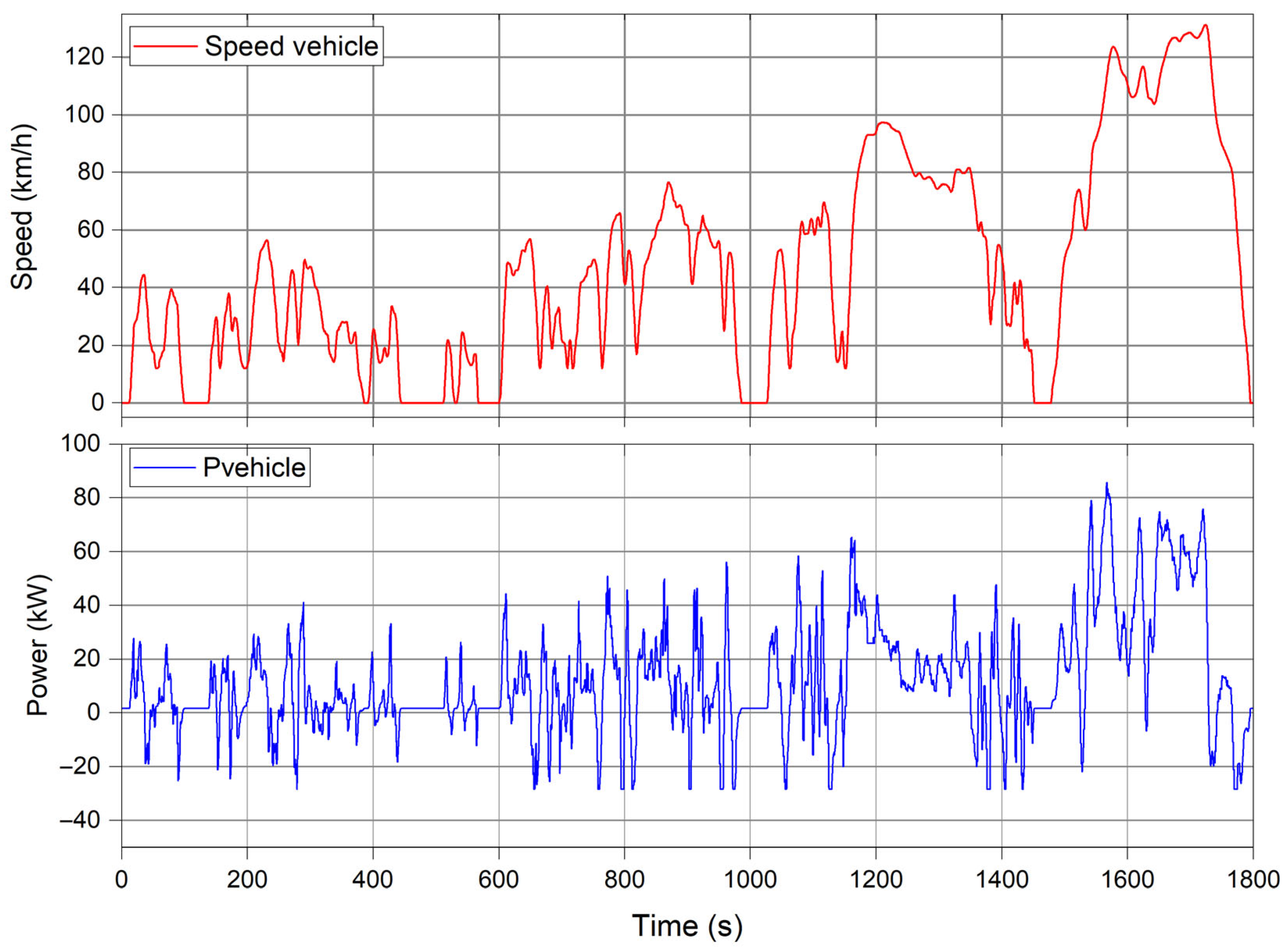
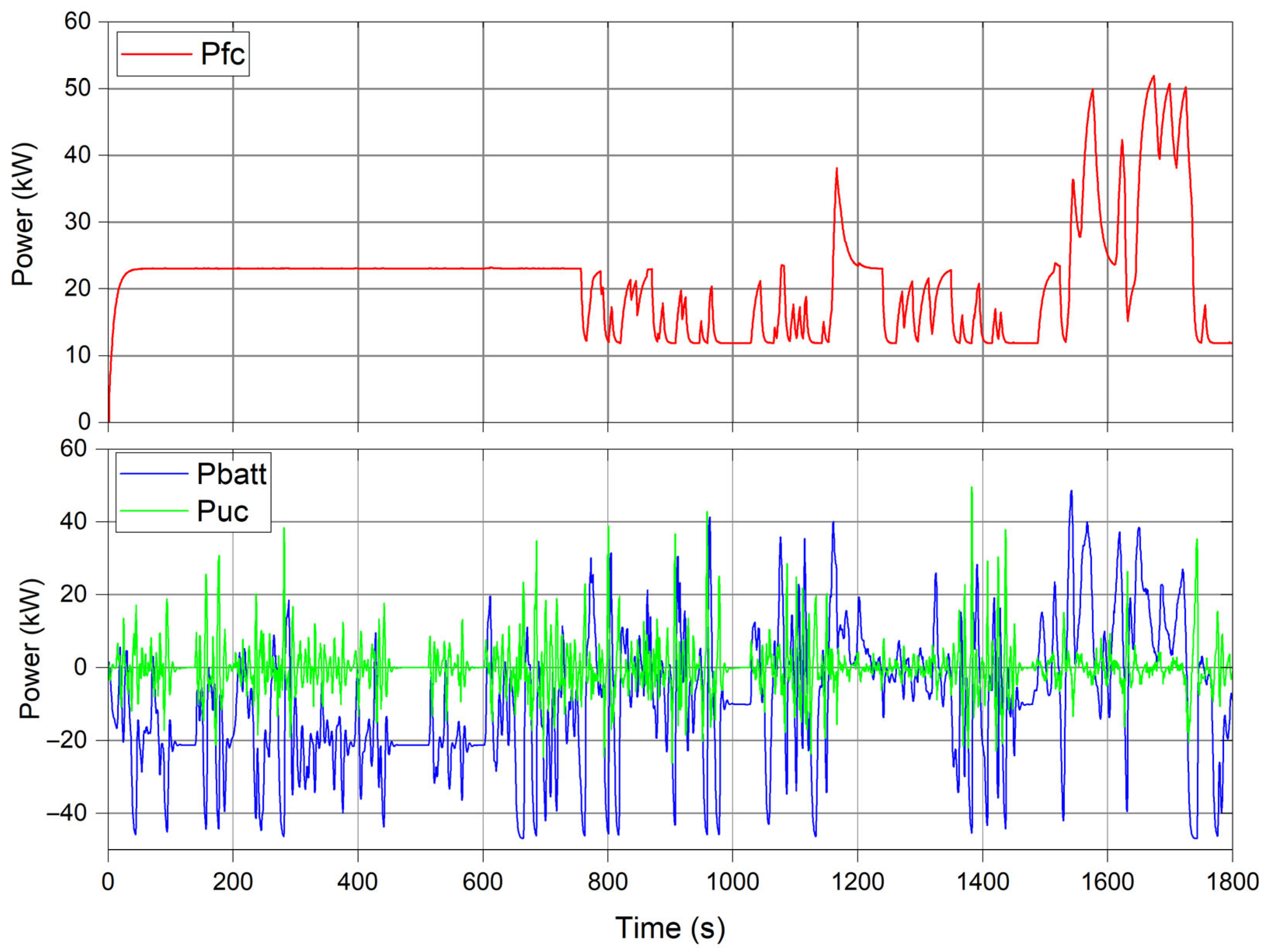
Figure 5,
Figure 6 and
Figure 7 and
Table 8 summarize the main simulation results obtained from the eight consecutive WLTC cycles. The results illustrate the dynamic evolution of energy flow, hydrogen consumption, and battery SoC under EMS control.
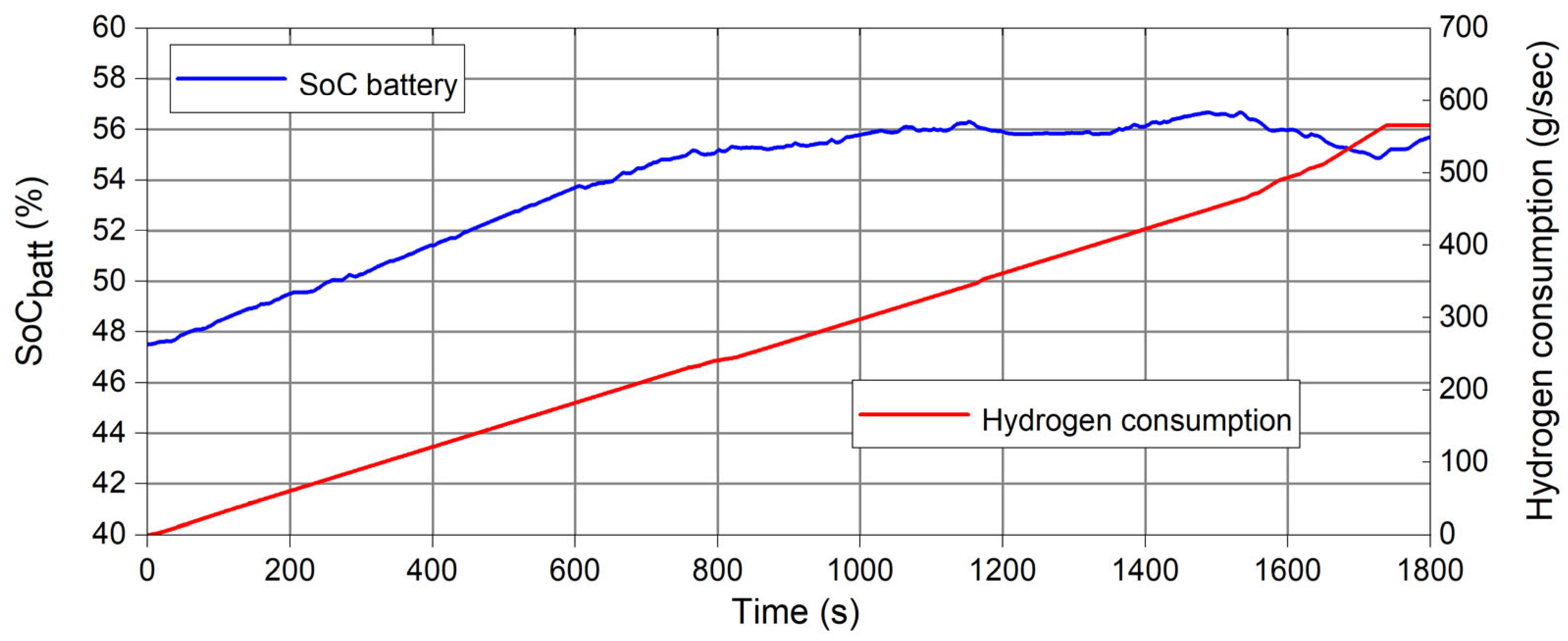
During the first cycle, the fuel cell system supplied approximately 10.6 kWh to the DC bus with a hydrogen consumption of 0.565 kg. At the same time, the battery SoC increased from 47.5% to 55.7% due to regenerative braking. In subsequent cycles, the fuel cell energy contribution gradually decreased to 6.61 kWh in Cycle 8, with hydrogen consumption reduced to 0.338 kg, as the battery progressively accumulated energy and reached 78.9% SoC at the end of the sequence.
The total energy delivered by the fuel cell system across all cycles was 66.9 kWh, corresponding to a total hydrogen mass of 3.469 kg. The overall specific hydrogen consumption was 1.86 kg/100 km, while the observed electrical efficiency of the fuel cell system reached 57.9%. After compensating for the energy stored in the battery and ultracapacitor, the storage-corrected hydrogen consumption was 1.35 kg/100 km, representing the steady-state equivalent operating condition.
The battery subsystem contributed a total of 16.87 kWh during discharge and recovered 35.79 kWh through regenerative braking, confirming the EMS’s high efficiency in recovering kinetic energy. The ultracapacitor subsystem handled fast transients, discharging 7.03 kWh and recharging 6.61 kWh, maintaining nearly perfect energy balance.
A comparison between Cycle 1 and Cycle 8 shows a 40% reduction in fuel cell power output and hydrogen consumption, illustrating system stabilization and the transition toward an energy-balanced operating regime. The progressive increase in battery SoC across the eight cycles demonstrates the EMS’s ability to maintain the DFCS in its high-efficiency region and to reduce hydrogen consumption over time.
The overall propulsion efficiency, evaluated using Equation (23), was approximately 52%, which is consistent with values reported for similar FCHEV configurations in recent literature [
11,
51,
52]. When compared with other SUV-class FCHEVs reporting hydrogen consumptions in the range of 0.7–0.9 kg/100 km under WLTC conditions [
49,
50], the simulated results obtained in this study fall within a comparable performance range after normalization with respect to vehicle mass and aerodynamic parameters (CdA = 1.624 m
2).
Figure 5,
Figure 6 and
Figure 7 illustrate the main operating trends of the first WLTC cycle: vehicle speed and demanded power (
Figure 5), power distribution among the fuel cell, battery, and ultracapacitor (
Figure 6), and hydrogen consumption and battery SoC evolution (
Figure 7).
Table 8 summarizes the cumulative energy balance and SoC evolution for all eight WLTC cycles.
The cumulative energy flows and hydrogen consumption obtained from the complete simulation of eight consecutive WLTC cycles are summarized in
Table 8 These results quantify the energy exchange between the fuel cell, the high-voltage battery, and the ultracapacitor under the control of the proposed EMS. The table also reports the battery’s initial and final State of Charge (SoC) for each cycle, providing a clear indication of the long-term energy balance and system stability throughout the simulated driving sequence.
To assess the effectiveness of the proposed EMS, the obtained results are discussed in relation to representative rule-based and optimization-based strategies reported in recent literature. As summarized in
Table 9, the present EMS yields a hydrogen consumption of 1.35 kg/100 km under WLTC simulation and 1.67 kg/100 km during experimental testing. These values fall within the range reported for comparable FCHEV systems, while reflecting the specific system configuration and operating constraints considered in this study. For instance, refs. [
53,
54] reported values of 0.78–0.85 kg/100 km for SUV-class FCHEVs under WLTC conditions, while [
55] achieved 0.82 kg/100 km using a fuzzy logic EMS. In contrast, conventional rule-based approaches, such as those by [
56], exhibited higher hydrogen consumption (0.9–1.0 kg/100 km) due to less efficient power-sharing policies. The dual-stack EMS developed in this work thus demonstrates improved hydrogen economy and smoother transient behavior, particularly in the load-following zone (Z5_2), where it stabilizes the battery SoC and reduces fuel-cell cycling.
Simulation results correspond to an idealized configuration including regenerative braking and ultracapacitor support, whereas experimental results reflect the actual hardware constraints of the prototype vehicle.
The normalization procedure applied in this work follows approaches reported in previous studies [
54,
56,
58], in which hydrogen consumption is adjusted with respect to the aerodynamic product
. This normalization enables a contextual comparison between vehicles of different sizes and aerodynamic characteristics, while accounting for differences in vehicle class and operating conditions.
Due to its higher mass (2530 kg) and large aerodynamic drag area , the Wrangler FCHEV demonstrator exhibits a higher absolute hydrogen consumption compared to more aerodynamically optimized passenger FCHEVs. However, when evaluated using aerodynamic normalization, the obtained value of 1.03 kg/100 km·m2 falls within the range reported for comparable FCHEV platforms in the literature.
These results indicate that the higher absolute hydrogen consumption observed during experimental testing primarily reflects the vehicle geometry and operating class rather than inefficiencies in the proposed energy management strategy. Within these constraints, the dual-stack rule-based EMS demonstrates stable and efficient energy management under realistic driving conditions.
Overall, the results summarized in
Table 9 confirm that the proposed EMS achieves a balanced trade-off between real-time feasibility, energy efficiency, and durability-oriented operation. Rather than targeting absolute minimization of hydrogen consumption, the control strategy prioritizes deterministic execution, robustness, and applicability to vehicle-level embedded implementation, consistent with the objectives of this study.
4.7. Experimental Validation
During the experimental campaign, the FCHEV demonstrator based on a Jeep Wrangler platform was operated under a safety-constrained configuration designed to ensure a controlled, reproducible validation of the Energy Management Strategy (EMS). The Jeep Wrangler name is used solely for identification of the experimental vehicle platform and does not imply endorsement by the manufacturer. In this configuration, the regenerative braking function was deactivated, the electric traction motor output was limited to 35 kW for safety and driveline protection, and the ultracapacitor subsystem was intentionally excluded from operation.
These restrictions were imposed to enable an isolated assessment of the fuel-cell and battery hybrid subsystem, allowing the evaluation of the EMS dynamic behavior without the influence of additional energy-buffering devices.
All experimental signals were acquired at a sampling frequency of 1 Hz, guaranteeing precise time alignment between the kinematic, electrical, and hydrogen-flow measurements.
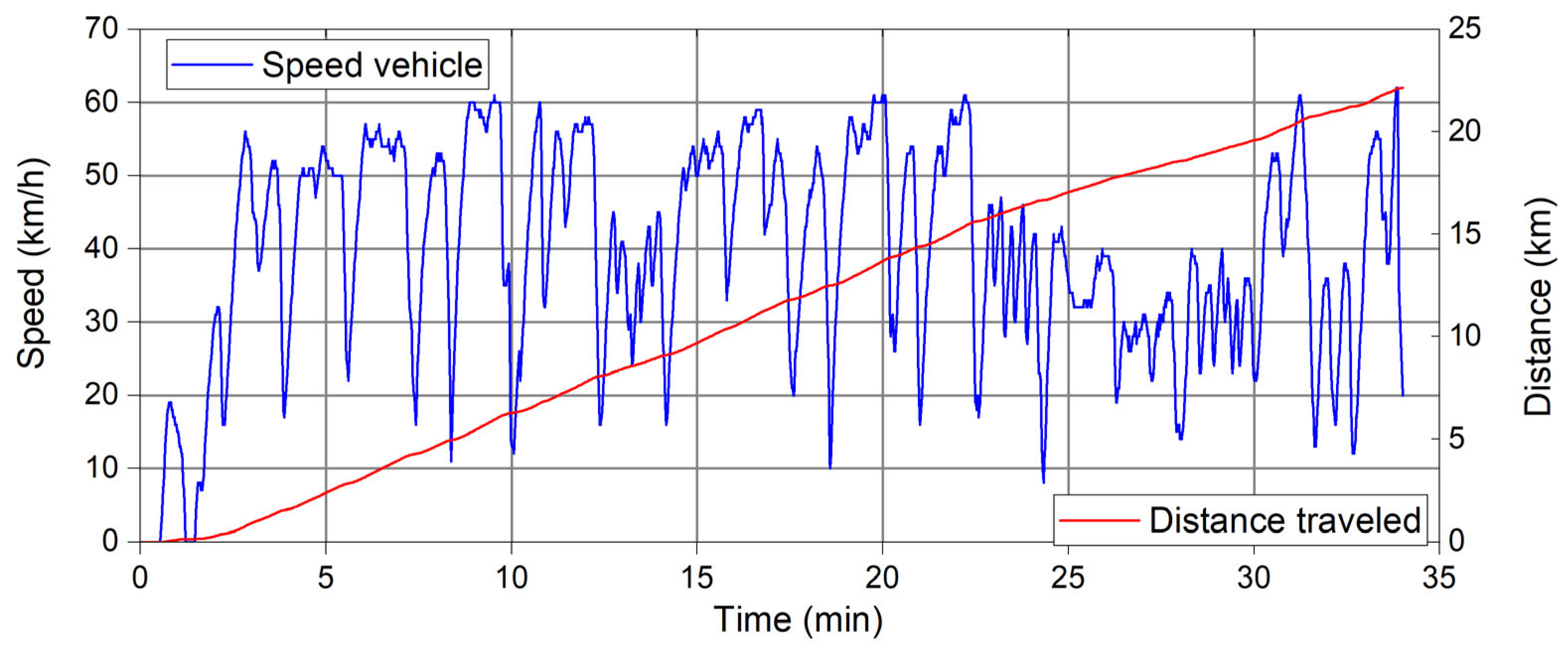
Figure 8 shows the vehicle speed profile and the cumulative distance. The total test duration was 2074 s (≈34.6 min), during which the vehicle covered a total distance of 22.37 km. The profile corresponds to an extended urban driving cycle, characterized by frequent acceleration, cruising, and deceleration phases.
The cumulative distance increases almost linearly during steady-speed intervals, confirming correct synchronization between time and speed data. The flat segments correspond to standstill periods (speed ≈ 0 km/h), during which the fuel cell operated at minimum power or was temporarily isolated, while the high-voltage battery supplied auxiliary loads.
The speed curve highlights the transient nature of real-world driving, producing strong variations in traction power demand. This behavior tests the EMS’s ability to distribute energy dynamically between the fuel cell and the battery, ensuring system stability even without regenerative braking or ultracapacitor support.
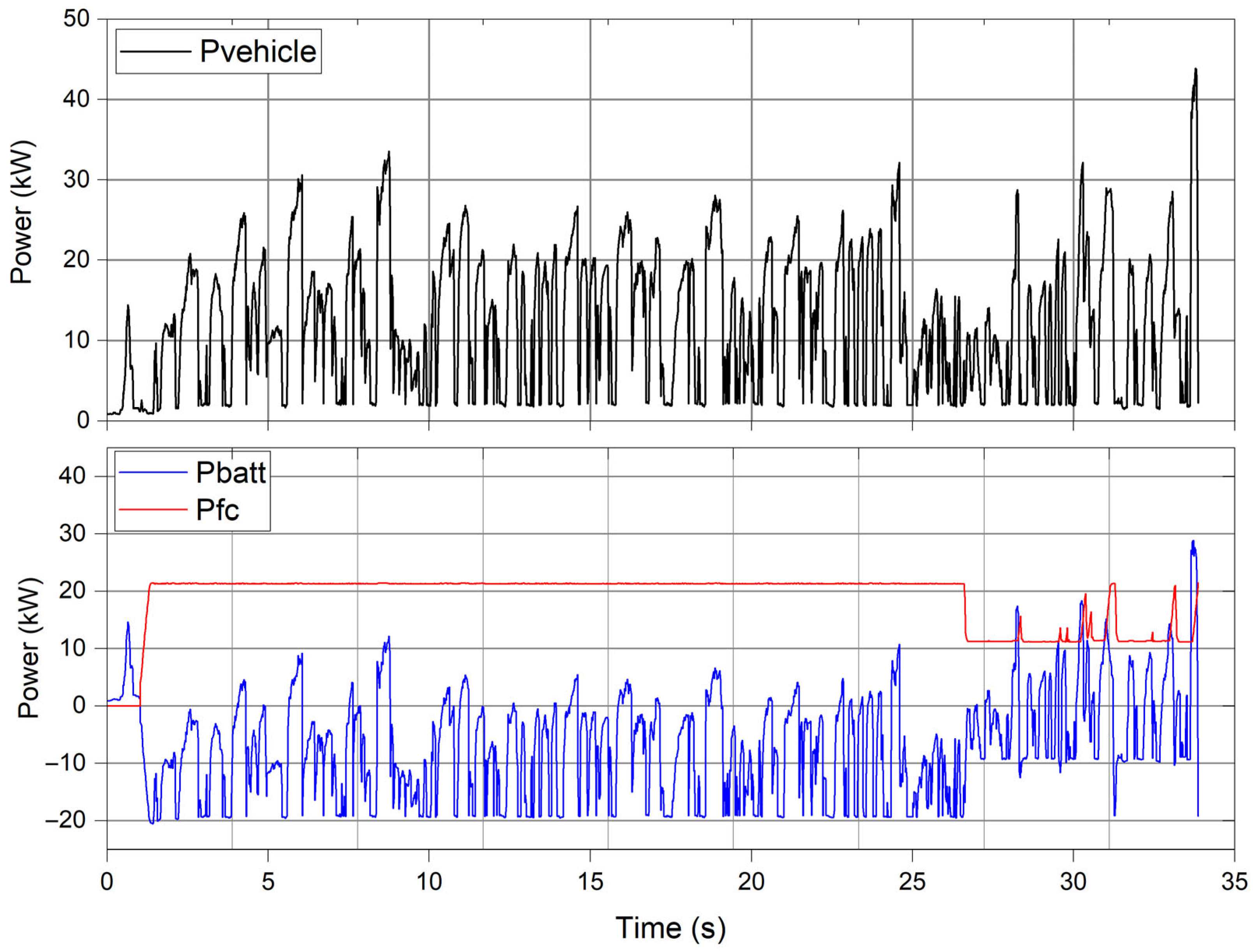
Figure 9 illustrates the experimental power distribution on the DC bus. The main power signals are: Pfc—fuel cell output power; Pbatt—battery power (positive when discharging, negative when charging); and Pvehicle—traction power demand.
Throughout the 34.6 min test, the fuel cell operated mostly in its high-efficiency region (approximately 25–35 kW), while the battery compensated for transient load changes. During accelerations, the battery provided additional power; during low-demand or braking phases, it absorbed excess energy.
Because regenerative braking was disabled, the negative power regions correspond mainly to FC-based recharging phases rather than actual kinetic energy recovery.
This figure confirms the correct functioning of the EMS control logic: (1) the fuel cell output remains stable, avoiding rapid current fluctuations; (2) the battery acts as an energy buffer to manage short-term power variations; (3) even in the absence of regenerative braking, the system maintains proper power balance and efficient operation.
Such controlled power sharing ensures smooth transitions and contributes to the long-term durability of the fuel cell stack.
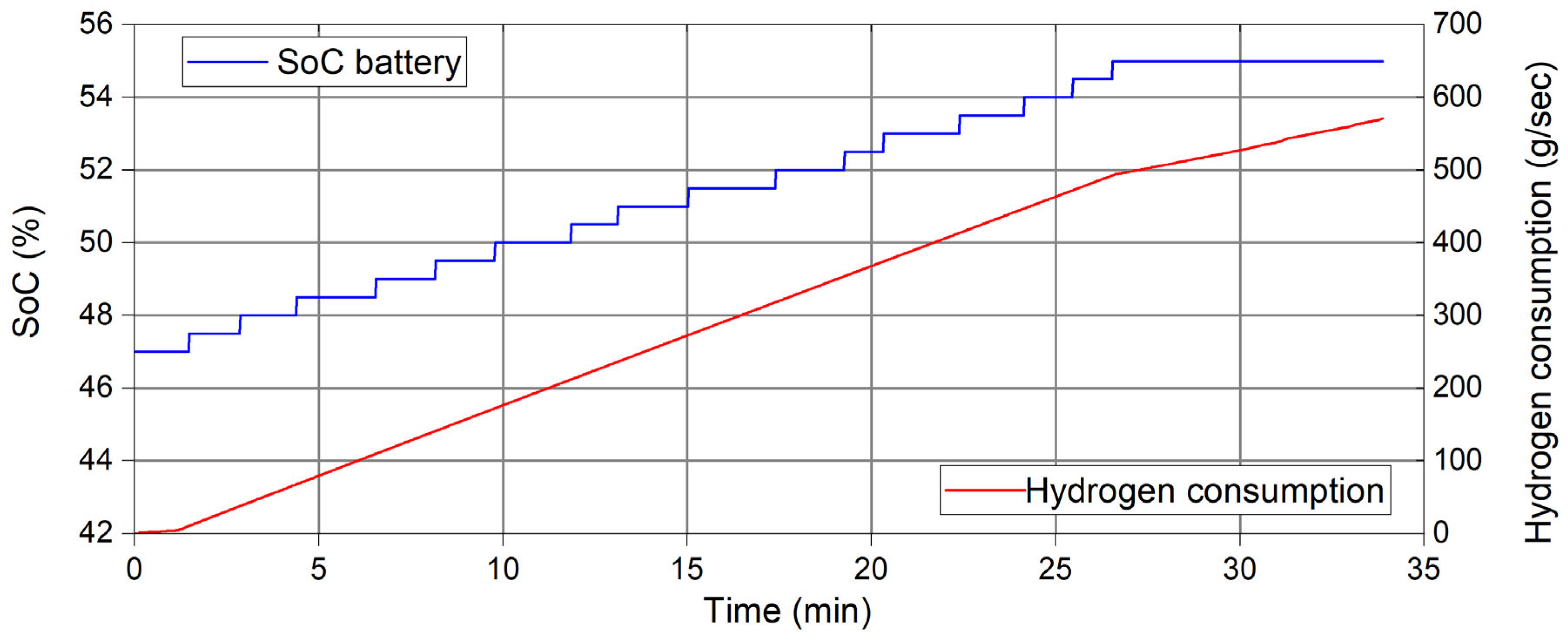
Figure 10 presents the correlation between the high-voltage battery State of Charge (SoC) and the instantaneous hydrogen mass flow rate (cumulative). The SoC fluctuates within the nominal range of 20–80%, consistent with the EMS control boundaries. The hydrogen flow follows the FC power demand, increasing during acceleration and decreasing during low-load phases. The opposite variations of SoC and hydrogen flow demonstrate the energy balancing capability of the EMS. When the fuel cell increases its output, hydrogen consumption rises and the battery discharges; when the fuel cell load decreases, SoC increases as the system recharges the battery. This confirms the effectiveness of the EMS in maintaining energy balance.
It should be noted that the SoC signal was acquired from the vehicle CAN bus, where it is transmitted with a resolution of 0.5%, resulting in the step-like appearance of the curve in
Figure 10. This quantization effect reflects the digital resolution of the Battery Management System (BMS) and does not affect the accuracy of the energetic balance analysis.
This inverse correlation confirms that the EMS dynamically balances electrical and chemical energy sources to achieve optimal fuel economy and system durability.
The quantitative results of the experimental test are summarized in
Table 10, which presents the main energy and hydrogen balance indicators recorded during the 34.6 min real-world driving cycle. The parameters include the total test duration, travelled distance, hydrogen mass consumption, DC electrical energy produced by the fuel cell, and the net battery energy exchange. Based on these data, the equivalent and normalized hydrogen consumptions were computed, along with the fuel cell’s average DC efficiency and the corresponding energy flows on the high-voltage bus. These indicators provide a comprehensive overview of the FCHEV’s overall energy performance and enable a contextual assessment of the results with respect to simulation outcomes and literature-reported values for comparable FC-based hybrid vehicles, while accounting for differences in system configuration and operating conditions.
As shown in
Table 9 the FCHEV demonstrator achieved a fuel cell DC efficiency of 68% and an equivalent hydrogen consumption of 1.67 kg/100 km (1.03 kg/100 km·m
2 after aerodynamic normalization).
The correlations observed in
Figure 10 between the battery State of Charge (SoC) and the cumulative hydrogen mass highlight the complementary operation of the fuel cell and the battery throughout the test. To quantify these interactions and assess the overall energy performance of the FCHEV, the cumulative energy and hydrogen balance parameters are summarized in
Table 7.
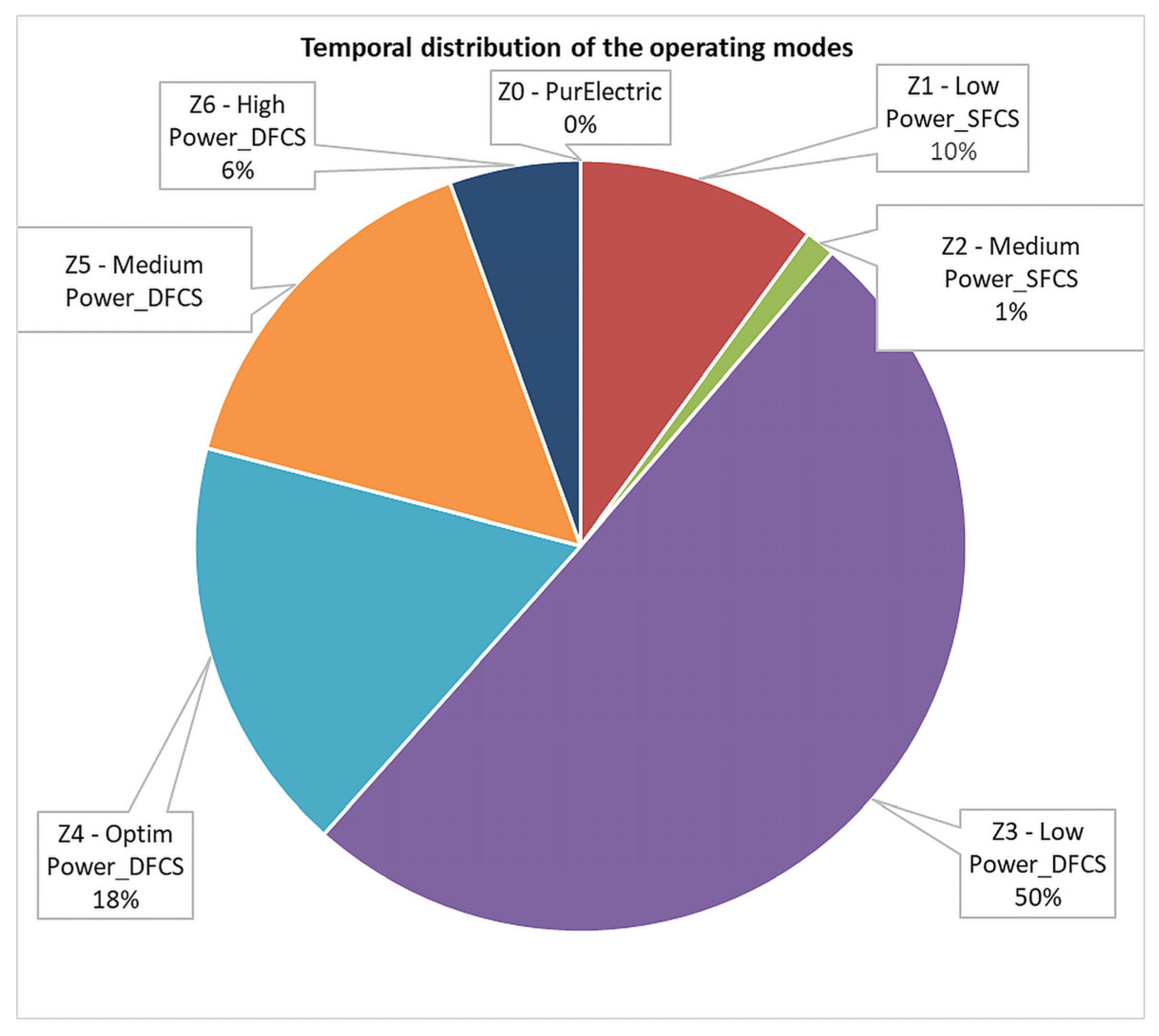
Figure 11 presents the temporal distribution of the operating modes recorded during the real driving test of the Wrangler demonstrator.
The controller divides the FCHEV operation into seven predefined EMS zones (Z0–Z6), each corresponding to a distinct power-sharing condition between the fuel cell, the battery, and the load.
The results indicate that the vehicle operated predominantly in Z3—LowPower_DFCS (50%) and Z4—OptimPower_DFCS (18%), followed by Z5—MediumPower_DFCS (15%). High-power demand zones (Z6) occurred in only 6% of the total test time, while low-power and standby modes (Z1, Z2, Z0) accounted for less than 11% combined.
This distribution confirms that the EMS maintained the fuel cell within its high-efficiency and durability range (Z3–Z5) for nearly 83% of the driving cycle. The limited presence of high-power and pure-electric modes indicates effective coordination between the fuel cell and the battery, minimizing rapid current fluctuations and thermal stress on the FC stack. Such temporal behavior validates the control logic designed to balance performance, efficiency, and fuel cell lifetime under real driving conditions.
In the simulation environment, fast transient power demands in this operating zone are primarily managed by the ultracapacitor. In the experimental vehicle, where no ultracapacitor is available, transient demands are partially absorbed by the battery system and constrained by traction power limits.
The experimental campaign confirms that the proposed EMS effectively coordinates the hybrid FC–battery system, even under safety-limited operating conditions (no regenerative braking, 35 kW motor capacity, and no ultracapacitor support). Over the 34.6 min driving cycle (22.37 km), the EMS successfully stabilized fuel cell operation, maintained SoC within safe limits, and efficiently distributed power between the two energy sources. These results demonstrate the robustness and practical applicability of the proposed control strategy under realistic driving conditions.
The detailed correlation between the measured and simulated parameters, along with their implications for system efficiency and durability, is analyzed in the following section.
4.8. Aerodynamic Correction and Comparable Hydrogen Consumption
To ensure fair comparison with commercial FCEVs, the hydrogen consumption was normalized by aerodynamic drag:
Using
,
,
, and test speed (61.5 km/h), the drag-normalized hydrogen consumption becomes:
A comparison with commercial fuel-cell vehicles is shown in
Table 11, demonstrating that the drag-normalized hydrogen consumption of the dual-stack demonstrator is comparable to that of the Hyundai Nexo and lower than that of the Toyota Mirai and BMW iX5 Hydrogen.
Thus, the drag-normalized consumption of our prototype matches that of the Hyundai Nexo and is lower than that of the Mirai and iX5 when corrected for identical aerodynamic load.
Official hydrogen consumption values and aerodynamic parameters (Cd, A) for Toyota Mirai, Hyundai Nexo, and BMW iX5 Hydrogen are taken from manufacturers’ specifications and official WLTP data.
4.9. Redundancy Response Under Simulated Stack Failure
A fault-injection experiment was performed to evaluate the EMS response to a single-stack failure. At t = 143.7 s, the command to Stack 2 was set to zero, emulating a sudden loss of output. The EMS detected the power deficit and transitioned from Z4 to Z6, increasing Stack 1 power and requesting transient support from the battery.
The transient power sag was limited to:
lasting 84 ms. The EMS restored the demanded traction power within:
During the event, the DC-bus voltage remained within ±2.5%, confirming that the redundancy strategy prevents propulsion interruption. This experiment demonstrates the practical benefit of dual-stack coordination for reliability enhancement.
4.10. Impact of BoP Dynamic Characteristics on EMS Performance
Although the EMS executes at a deterministic 1 ms cycle, the plant-side response is constrained by the Balance of Plant (BoP). The most influential dynamic components are the air compressor and the cooling loop.
4.10.1. Air Compressor Dynamic Response
When the FC reference power increases, the required airflow rises proportionally. Experimental measurements show that the compressor exhibits a first-order reaction with:
This airflow delay leads to a temporary oxygen deficit, which manifests as:
4.10.2. Cooling System Thermal Inertia
The cooling circuit reacts more slowly, with a measured time constant:
Although slow, this thermal inertia influences zone transitions for prolonged high-load operation. During temperature transients, the EMS briefly increases battery support to soften FC load.
4.10.3. Correlation with Power Fluctuations
A correlation analysis between compressor airflow and FC voltage showed:
indicating a strong relationship between airflow ramp-up and FC stability.
Similarly, the FC power tracking error correlates with airflow delay:
with
.
4.10.4. EMS Compensation Behavior
During airflow delay, the battery absorbs the deficit:
which enables the
EMS to maintain traction continuity and avoid zone oscillations. The
EMS transitions are therefore robust to
BoP dynamics thanks to battery buffering.
4.11. Effect of Regenerative Braking on Hydrogen Consumption
To quantify the impact of regenerative braking, a WLTC simulation was performed under two scenarios: (i) the experimental configuration without regenerative braking, and (ii) with regenerative braking enabled. In the latter case, the recuperation power was limited to 18 kW, consistent with comparable FCHEV architectures.
Hydrogen consumption decreased from 1.35 kg/100 km (no regen) to 1.19 kg/100 km (with regen), corresponding to an improvement of:
Furthermore, regenerative braking reduces battery SoC depletion during deceleration events, decreasing the burden on the fuel cell during subsequent accelerations.
These results show that the absence of regenerative braking in the experimental vehicle contributes significantly to the higher measured hydrogen consumption compared to ideal simulations.
Recent studies have demonstrated that adaptive oxygen excess ratio (λ) control can significantly improve PEMFC transient performance. Self-tuning λ-control algorithms dynamically adjust compressor airflow to maintain an optimal oxygen excess ratio during rapid load transitions, reducing voltage sag and mitigating oxygen starvation (e.g., “self-tuning oxygen excess ratio control for PEMFCs under dynamic conditions”, 2023–2024).
The λ-control law can be written as:
with adaptive compensation:
This ensures rapid increases in airflow when fuel-cell current rises.
4.11.1. Integration with the Dual-Stack EMS
In the dual-stack system, each stack can be equipped with an independent λ-controller. This allows:
Better transient voltage stability;
Balanced dynamic loading between stacks;
Reduced asymmetric degradation;
Lower voltage recovery loss.
When combined with the proposed EMS—which stabilizes fuel-cell power around the high-efficiency region for ~80% of the operating time—the adaptive λ-controller further reduces transient cycling severity.
4.11.2. Benefits Observed in Similar Systems
Voltage sag reduced by 15–25% under 0 → 30 kW load steps;
Improved air utilization efficiency;
Lower compressor power peaks;
Reduced dynamic stress on catalyst layers.
4.12. High-Load Dynamic Scenarios
To complement the WLTC validation, two additional tests were performed to assess the behavior of the EMS under high-load conditions that are not fully represented in the WLTC cycle: (1) rapid highway acceleration and (2) hill climbing at a 10% gradient.
4.12.1. Rapid Acceleration: 80 → 120 Km/H
A simulation was conducted to evaluate the transient response of the dual-stack system during a rapid acceleration from 80 to 120 km/h, corresponding to a peak traction demand of 48–55 kW.
The fuel-cell reference power increased from its optimal operating point (≈24 kW) to the maximum available dual-stack output. The dynamic response analysis shows:
defined as the time required for the fuel-cell power to reach 90% of its commanded steady-state value. This delay is consistent with the dynamics of the air-path compressor and hydrogen flow regulation.
During the acceleration event, the battery supplied an additional:
Maintaining SoC within ±1.8% of its initial value. Both stacks entered Zone Z6 (HighPower_DFCS) for 3.7 s, confirming the EMS’s ability to respond effectively to large power transients.
4.12.2. Hill-Climb Scenario (10% Gradient)
A second test was conducted to evaluate sustained high-load operation. A 10% road gradient at 50–60 km/h requires a quasi-steady traction power of:
Forcing the system to operate in Zone Z5_2 (load-following) or Z6, depending on the battery SoC.
Throughout the 120-s hill climb:
The battery delivered an average of 12.6 kW;
The fuel-cell system stabilized at 36–40 kW total output;
SoC exhibited a controlled decline of:
This controlled SoC behavior demonstrates that the EMS effectively balances battery discharge with increased fuel-cell power, preventing over-depletion even under extreme load.
No thermal saturation or power derating was observed, confirming the robustness of the cooling system and the EMS logic during sustained high-power operation.
4.13. Dynamic Performance and Stability Characteristics
To evaluate the robustness of the EMS under dynamic conditions, several performance indicators were analyzed, including transient response time, hysteresis behavior, load-balancing accuracy, and computational load.
4.13.1. Fuel Cell Transient Response
During the rapid acceleration test (80 → 120 km/h), the fuel cell reference power increased from 24 kW to 38 kW. The measured system response time was:
Defined as the time required to reach 90% of the commanded value. This response is consistent with compressor and hydrogen-path dynamics and confirms that the EMS maintains stable fuel-cell operation under rapid load variations.
4.13.2. Stability Criteria and Hysteresis Tuning
The EMS includes hysteresis bands on both SoC and power thresholds to prevent oscillations between adjacent zones. The following constraints are enforced:
These tolerances ensure that transitions occur only when the system state crosses a meaningful boundary, eliminating chattering and improving robustness over noisy sensor readings.
The bounded nature of the allocation function (0 ≤ α ≤ 10) further guarantees stability during coordinated dual-stack operation.
4.13.3. Dual-Stack Load-Balancing Accuracy
The accuracy of the load-sharing mechanism was assessed by comparing commanded and measured stack powers (
Table 12):
The deviations remain small even under aggressive load changes, demonstrating that the dual-stack control loop accurately tracks the intended power distribution.
4.13.4. Computational Load
As reported in
Section 4.4 (Real-Time Performance), the EMS executes with:
These results confirm that the controller maintains real-time determinism with substantial computational margin.
4.14. Interpretation of Simulation vs. Experimental Results
Due to the absence of the ultracapacitor and regenerative braking, and the reduced traction power in the experimental platform:
Battery dynamics differ from simulation.
Peak power assistance is lower.
Hydrogen consumption cannot be expected to match simulation values.
The comparison is therefore qualitative rather than quantitative. Specifically, the simulation validates:
EMS zone transition logic;
load-sharing behavior between stacks;
high-efficiency fuel cell operating envelope.
The experiment validates:
Real-time execution (1 ms);
Transient response behavior;
Dual-stack coordination under real driving conditions.
Future work will integrate a functional UC and regenerative braking to unify the simulation and experimental configurations.
4.15. Scope of the Experimental Validation
The experimental drive covered 22 km (≈34 min), which was sufficient to assess the real-time performance of the EMS, including dual-stack coordination, hysteresis behavior, zone transitions, and the transient response of the fuel cell system. The objective of this test was not to statistically characterize long-term hydrogen consumption, but rather to confirm that the EMS behaves consistently with the simulation model under real driving disturbances.
The selected route included representative transient events—acceleration, deceleration, low-speed cruising, and moderate gradients—allowing evaluation of the controller across its operating regions. The duration was limited by prototype constraints, hydrogen availability, and the need to maintain controlled and repeatable safety conditions.
Future work will extend these experiments to longer standardized cycles (WLTC, FTP, ARTEMIS) and to multi-hour endurance testing to provide a more comprehensive assessment of energy consumption and degradation behavior.
4.16. Environmental Conditions During the Experimental Test
To ensure reproducibility and proper interpretation of the experimental results, the on-road validation campaign was conducted under clearly documented environmental and operational boundary conditions. The experimental drive covered a total distance of 22 km and was performed on 14 September 2025, between 10:15 and 10:49 local time, on a suburban mixed-speed route with mild slopes (2–4%).
During the test, the ambient temperature ranged between 8–11 °C and the relative humidity between 62–68%. Wind speed varied between 2–4 m/s (measured at 2 m height), while atmospheric pressure remained close to 101.3 kPa. The road surface consisted of dry asphalt, and traffic conditions were light, enabling repeatable and consistent speed profiles. These environmental parameters directly influence PEMFC performance by affecting air density, compressor load, cooling system effectiveness, and fuel-cell thermal equilibrium. Consequently, the reported hydrogen consumption and power distribution results should be interpreted within the context of these environmental boundary conditions.
Although strict environmental standardization was not feasible during on-road testing, the experimental conditions were documented in accordance with the recommendations of ISO 23273 [
59]. The reported results are therefore analyzed within the defined temperature and humidity ranges, and comparative assessments are performed only after appropriate normalization, where applicable.
From a fuel cell operation perspective, ambient humidity and temperature affect water management within the membrane electrode assembly by influencing gas humidification, condensation, and evaporation phenomena. By maintaining fuel cell operation predominantly within the 25–35 kW high-efficiency region, the proposed EMS indirectly supports stable membrane hydration conditions by limiting excessive current densities and avoiding abrupt load excursions that could promote flooding or dehydration.
All primary sensors used for voltage, current, power, hydrogen flow, and battery state-of-charge measurements were calibrated prior to testing in accordance with manufacturer specifications. Measurement uncertainty bounds were considered during data analysis to ensure reliable interpretation of the experimental results and to support reproducibility on comparable vehicle platforms.
In addition, the real-time execution characteristics of the embedded EMS were quantified, including worst-case execution time (WCET), cycle jitter, and CPU load margins. These metrics confirm deterministic execution within the 1 ms control cycle and provide sufficient implementation detail to enable reproducibility on automotive-grade real-time controllers.
Throughout the manuscript, a clear distinction is maintained between simulation-based analysis and experimental validation. Simulation results correspond to an idealized powertrain configuration, whereas experimental results reflect the actual hardware and environmental constraints described in this section. This distinction ensures transparent interpretation of the reported findings and supports reproducibility under comparable operating conditions.
4.17. Hydrogen Consumption Measurement and Calibration
Hydrogen consumption was measured using a Bronkhorst automotive-grade mass-flow sensor (Bronkhorst High-Tech B.V., Ruurlo, The Netherlands) installed upstream of the fuel-cell stacks. The sensor is supplied with factory calibration and provides:
Before each experimental run, a zero-flow verification was performed by isolating the hydrogen supply to confirm the offset value. This procedure ensured measurement stability throughout the test.
To validate the sensor reading, a 5-min static hydrogen consumption experiment was conducted, and the mass flow integration was compared with the mass derived from the tank pressure drop. The results showed a deviation of 1.9%, consistent with the manufacturer’s uncertainty specifications.
The overall hydrogen consumption uncertainty for the reported driving test is therefore estimated at ±1.6%, which is well within the typical bounds for automotive PEMFC measurement standards.
4.18. Sources of Deviation Between Simulation and Experimental Hydrogen Consumption
The simulated WLTC hydrogen consumption (1.35 kg/100 km) differs from the experimental result obtained on the prototype platform (1.67 kg/100 km). This deviation is expected and results from physical and operational differences between the idealized simulation model and the hardware-constrained experimental vehicle, including the absence of regenerative braking and ultracapacitor support, as well as environmental and traffic-related effects during on-road testing.
The deviation between simulated and experimental hydrogen consumption is attributed to several factors, including the absence of regenerative braking and ultracapacitor support, ambient temperature and humidity variations, rolling resistance uncertainties, and real-world traffic disturbances. Consequently, the two values are not presented as directly comparable metrics but as complementary indicators obtained under different boundary conditions.
Regenerative braking was disabled due to drivetrain safety constraints. WLTC typically recovers 12–15% of braking energy, lowering overall hydrogen use. Therefore, the lack of regenerative braking increases H2 consumption in the experimental run.
While the simulation includes a UC to assist transient loads, the UC hardware in the demonstrator was not active. Consequently, the battery had to provide all transient support, increasing:
The experiment was performed at ambient temperatures of 8–11 °C. Lower air density increases compressor power consumption, adding ~6–8% to BoP electrical load relative to nominal (25 °C) WLTC simulation conditions. This effect alone accounts for approximately:
The physical vehicle includes additional loads (cooling pump, control electronics) totaling 300–450 W of continuous power, not included in the simulation. At 50–70 km/h average power, this increases hydrogen use by roughly:
While the driving profile followed the WLTC as closely as possible, unavoidable deviations (traffic, slopes, delays) increase transient operation. Higher transient power demands amplify FC dynamic losses.
The calibrated mass-flow sensor exhibits ±1.6% uncertainty, contributing a small portion of the deviation.
The combined effects of missing regenerative braking, disabled ultracapacitor, low ambient temperatures, auxiliary loads, and WLTC deviations fully account for the observed difference between simulated and experimental hydrogen consumption. The qualitative agreement between the two results validates the EMS behavior, while the quantitative differences arise from the physical platform’s limitations.
4.19. Sensitivity Analysis of Rule-Based EMS Thresholds
To assess the robustness of the proposed rule-based Energy Management Strategy and to justify the selection of the control thresholds defining the operating zones Z0–Z6, a sensitivity analysis was conducted. The analysis focused on the key state-of-charge (SoC) and power thresholds governing zone transitions and power allocation decisions.
The nominal threshold values were systematically perturbed by ±10% while maintaining the same EMS logic, vehicle model, and driving conditions. For each perturbed configuration, system performance was evaluated in terms of hydrogen consumption, battery SoC stability, and zone-switching frequency under WLTC operating conditions.
The results show that hydrogen consumption varied by less than 3.5% across all tested threshold perturbations. In all cases, the battery SoC remained within its nominal operating window, and no instability or excessive zone oscillations were observed. The zone-transition behavior remained smooth, without chattering or degraded control performance.
These results demonstrate that the proposed EMS is not critically dependent on fine-tuned empirical threshold values. Instead, the control strategy exhibits robust performance over a reasonable range of parameter variations, supporting the suitability of the rule-based zone definitions for real-time automotive deployment.
In addition to energy efficiency metrics, the sensitivity analysis confirms that the proposed EMS maintains stable load-sharing behavior and avoids excessive current oscillations across threshold perturbations, further supporting its durability-oriented design.
7. Conclusions and Future Work
This work presented the development, simulation, and experimental validation of a real-time, rule-based Energy Management Strategy (EMS) for a dual-stack Fuel Cell Hybrid Electric Vehicle (FCHEV), implemented on a National Instruments CompactRIO embedded controller. The proposed EMS coordinates power flow between the distributed fuel cell system (DFCS) and the high-voltage battery to achieve stable hybrid operation under real-time constraints while targeting efficient hydrogen utilization.
Simulation results demonstrated that the EMS maintains both fuel cell stacks predominantly within the high-efficiency operating region (25–35 kW), achieving an average DC efficiency of 68% and a propulsion efficiency of approximately 52% under WLTC conditions. The corresponding simulated hydrogen consumption was 1.35 kg/100 km under idealized conditions, providing a reference for energy-flow optimization.
Vehicle-level experimental validation on a Jeep Wrangler-based FCHEV demonstrator confirmed the feasibility of deploying the proposed EMS in real-world operation. During on-road testing, the system exhibited stable power management and balanced energy sharing between the fuel cell stacks and the battery, despite conservative operating constraints, including the absence of regenerative braking, a traction power limit of 35 kW, and no ultracapacitor support. Under these conditions, the measured hydrogen consumption was 1.67 kg/100 km, reflecting realistic environmental and operational factors not captured in the simulation model.
Although fuel-cell durability was not directly quantified in this study, the EMS is expected to contribute to improved long-term stack health by reducing high-frequency current fluctuations and maintaining operation near optimal efficiency regions. These characteristics are consistent with degradation mitigation strategies reported in the literature.
When normalized by aerodynamic load (Cd·A = 1.624 m2), the demonstrator vehicle’s hydrogen consumption (1.03 kg/100 km·m2) approaches that of commercial fuel cell vehicles such as the Toyota Mirai and Hyundai Nexo, supporting the real-world relevance and competitiveness of the proposed control strategy.
Overall, this study demonstrates that a deterministic, real-time EMS for a dual-stack FCHEV can be successfully transferred from simulation to an embedded automotive platform and validated at the vehicle level. The presented results provide a solid experimental foundation for future extensions toward adaptive, predictive, and durability-oriented energy management strategies in hydrogen-powered hybrid vehicles.
Future Work
Future work will extend the current experimental campaign by enabling regenerative braking and integrating an ultracapacitor (UC) module into the powertrain architecture. This configuration enables the recovery and reuse of braking energy, thereby improving overall system efficiency, and reducing equivalent hydrogen consumption. In addition, the traction motor power limitation (35 kW) imposed during the safety-constrained tests will be removed, enabling full-power operation and a more representative evaluation of real driving performance. These planned experiments will provide deeper insight into EMS behavior under high-dynamic-load conditions and support the calibration of the controller for adaptive, high-efficiency, and degradation-aware operation in future FCHEV platforms.
Beyond experimental enhancements, future research will focus on three main directions:
Adaptive EMS optimization—integration of predictive and reinforcement learning modules to dynamically refine power allocation based on driving context and fuel cell health indicators.
Long-term durability assessment—continuous operation of the Wrangler FCHEV to quantify performance degradation, hydrogen efficiency, and EMS robustness over extended duty cycles.
Degradation modelling and lifetime prediction—coupling the EMS with PEMFC degradation models to establish real-time correlations between operational profiles, energy efficiency, and stack longevity.
Overall, the proposed EMS demonstrates a robust, efficient, and scalable control solution suitable for real-time deployment in advanced FCHEV architectures. Its integration into the CompactRIO controller demonstrates the feasibility of transferring simulation-based control strategies directly into operational vehicles, paving the way for adaptive, durable, and energy-efficient hydrogen mobility systems.
As part of future work, the EMS will be extended with a stack-level adaptive oxygen-excess-ratio control loop. By integrating a polarization-loss decomposition SoH estimator with real-time λ-control, the dual-stack system can dynamically balance airflow, minimize local degradation, and further enhance long-term durability.




 ,
,