
Article

Trajectory Tracking and Stability Control of Distributed-Drive Heavy Trucks on High-Speed Curves with Large Curvature

Hubei Key Laboratory of Power System Design and Test for Electrical Vehicle, Hubei University of Arts and Science, Xiangyang 441053, China
*
Author to whom correspondence should be addressed.
World Electr. Veh. J. 2026, 17(1), 10; https://doi.org/10.3390/wevj17010010
Submission received: 10 November 2025 / Revised: 18 December 2025 / Accepted: 20 December 2025 / Published: 23 December 2025
(This article belongs to the Section Propulsion Systems and Components)

Abstract

To address the difficulty of balancing trajectory-tracking accuracy and yaw stability for distributed-drive four-axle heavy trucks under high-speed and large-curvature cornering conditions, this paper proposes a hierarchical cooperative control strategy. The upper layer employs Sliding Mode Control (SMC) to achieve precise trajectory tracking, while the lower layer integrates a sliding-mode-based Direct Yaw Moment Control (DYC) and a differential braking allocation strategy to enhance vehicle stability. TruckSim–Simulink co-simulation results demonstrate that, under large-curvature scenarios such as S-shaped paths, sharp lane changes, and single-lane transitions, the proposed strategy outperforms the conventional SMC method. Specifically, the maximum lateral deviation is reduced by 19.23–23.02%, the peak heading angle error decreases from 5.3° to 3.5°, the maximum yaw rate drops from 12.6°/s to 4.6°/s (a 63.49% reduction), and the peak sideslip angle at the vehicle’s center of mass converges from 4.6° to 3.8° (a 17.39% decrease). The results indicate that the proposed strategy achieves coordinated optimization of trajectory tracking and yaw stability under high-speed, large-curvature cornering conditions, providing both theoretical support and engineering value for high-dynamic control of distributed-drive heavy trucks.

1. Introduction

With the rapid advancement of intelligence and electrification technologies in commercial vehicles, distributed-drive four-axle heavy-duty trucks have become an important research focus in vehicle engineering and control. Their independently actuated wheels and flexible torque distribution capabilities offer significant potential for improving handling and stability. However, when operating under extreme conditions such as high-speed travel on large-curvature bends, these vehicles exhibit highly nonlinear and strongly coupled dynamic behaviors. Conventional trajectory-tracking control methods often fail to guarantee both path-tracking accuracy and yaw stability in such scenarios, leading to issues including lateral deviation, excessive sideslip, and even loss of control. Consequently, developing a control strategy that can achieve high-precision trajectory tracking while maintaining robust yaw stability under extreme high-speed, large-curvature conditions has become a key challenge in the control of distributed-drive heavy-duty trucks. From the perspective of heavy-duty truck electrification, the distributed-drive configuration is typically achieved through a multi-motor electric powertrain, which enables rapid and precise control of torque across multiple wheels. This facilitates yaw control based on torque vectoring, allowing for the generation of corrective yaw moments not only through frictional braking but also by utilizing regenerative braking torque. Therefore, the issues of trajectory tracking and yaw stability discussed in this paper constitute the core components of the motion control layer for the chassis of electric heavy-duty trucks, enhancing driving stability on high-speed, large-curvature roads and directly influencing the safety and energy efficiency of electrified heavy commercial vehicles.
In the field of vehicle trajectory tracking control, extensive research has been conducted by scholars worldwide on control strategies based on vehicle dynamics models. The mainstream approaches include Proportional–Integral–Derivative (PID) control, Linear Quadratic Regulator (LQR) control, SMC, and Model Predictive Control (MPC). As one of the simplest feedback control techniques, the PID controller has been widely adopted in industrial applications due to its simplicity and strong applicability [1]. However, it is difficult for PID control to cope with the inherent nonlinearities of vehicle dynamics and variations in operating conditions. Moreover, its inability to explicitly handle system constraints and predict future behaviors limits its effectiveness in achieving stable and high-precision tracking performance under complex or high-speed driving scenarios. The LQR method computes a linear optimal feedback gain by solving the Riccati differential equation and thereby constructs a closed-loop system with global asymptotic stability [2,3]. Nevertheless, it relies on linearized vehicle models and therefore struggles to accommodate strong nonlinearities and time-varying characteristics in real vehicle dynamics. Furthermore, LQR cannot explicitly address input or state constraints, nor can it directly handle nonlinear and complex road geometries such as sharp curves, which restricts its applicability in highly dynamic driving environments. SMC, essentially a class of nonlinear control techniques, is known for its strong robustness [4,5]. However, its intrinsic switching control law leads to chattering, which may adversely affect actuator performance and ride comfort. In addition, SMC requires accurate system modeling and precise estimation of uncertainty bounds. Given the nonlinear, time-varying, and noise-prone nature of vehicle systems, these requirements significantly increase the design and implementation complexity. MPC is capable of predicting future trajectories and explicitly handling multiple constraints, thus enabling high-precision and optimal trajectory tracking performance [6,7]. Nevertheless, its practical application is challenged by high computational demand, strong dependence on model accuracy, and considerable parameter tuning effort. These factors may lead to real-time difficulties or even optimization failure under extreme driving conditions. Zhang et al. [8] employed a hierarchical control method based on four-wheel steering, significantly enhancing vehicle stability and path tracking performance during high-speed driving through the coordinated feedback of additional yaw moment calculation and drive moment distribution. Liu et al. [9] proposed a dual-layer MPC architecture, where the outer layer generates reference vehicle speed by integrating road curvature, and the inner layer, based on dynamic MPC, adaptively adjusts parameters through fuzzy logic. This approach balances robustness, computational efficiency, and tracking stability under high-speed and large-curvature conditions. Zhu et al. [10] adopted an integrated longitudinal and lateral control method combining LQR and SMC. By incorporating feedforward acceleration input and yaw moment compensation, they achieved higher path tracking accuracy and yaw stability for distributed-drive vehicles under high-speed and large-curvature conditions. Lee et al. [11] utilized tubular robust MPC, unifying steering and braking into a single model and addressing uncertainties through prediction intervals and constraint tightening. This approach enabled robust path tracking and stable control while ensuring real-time performance under high-speed and large-curvature conditions. Li et al. [12] proposed an adaptive MPC method that introduces stability boundary constraints into a three-degree-of-freedom model. By optimizing the prediction and control horizons through a genetic algorithm and incorporating vehicle speed and curvature feedback for real-time adjustments, they overcame the limitations of traditional MPC under large-curvature conditions. Nan et al. [13] applied the pure pursuit algorithm for feedforward generation of ideal steering inputs and combined it with MPC feedback prediction and optimization. By adaptively adjusting the constraint range, they improved path tracking accuracy and robustness under high-speed and large-curvature conditions. Yu et al. [14] modeled lateral dynamics and tire nonlinear constraints based on MPC, optimizing front wheel steering and yaw moment within the prediction horizon. Through independent drive torque distribution and lateral force constraint adjustments, they achieved high-precision path tracking and yaw stability under high-speed, large-curvature, and low-adhesion conditions. Meng et al. [15] proposed the Fixed-Instant Model Predictive Control (FI-MPC) method, balancing the accuracy and real-time performance of nonlinear MPC through rule convergence criteria and iterative optimization, enabling trajectory tracking under high-speed and large-curvature conditions. However, this method is highly dependent on model parameters and constraints, exhibiting insufficient robustness under low-adhesion and extreme conditions. Lee et al. [16] employed a Nonlinear Model Predictive Control (NMPC) method that incorporates tire nonlinearity and friction constraints. By jointly optimizing steering and braking, they significantly improved path tracking stability and accuracy during high-speed cornering. Teng et al. [17] proposed a cooperative control strategy based on MPC and improved sliding mode control, combining active front steering and direct yaw moment control to enhance tracking accuracy and stability for distributed-drive vehicles under extreme conditions. However, this method relies on a linearized model and exhibits limited performance under strong nonlinearity and large lateral acceleration conditions. Zhang et al. [18] adopted an Active Front Steering–Direct Yaw Moment Control (AFS–DYC) coordinated control strategy that integrates adaptive MPC, fuzzy control, and sliding mode control. This approach achieved a balance between path tracking and stability under extreme conditions and was validated through hardware-in-the-loop testing. However, its weight adjustment relies on empirical rules, and the applicability of the stability criteria is limited, necessitating further improvement in robustness. Guan et al. [19] employed a speed-adaptive MPC method that dynamically adjusts the prediction horizon and weights based on vehicle speed to enhance tracking accuracy and stability in lanes with curvature changes. However, this method is highly dependent on vehicle speed estimation and parameter tuning.
Despite the substantial progress achieved in MPC, LQR, and hybrid control frameworks, several critical challenges remain unresolved under extreme operating conditions such as high-speed driving on large-curvature roads. MPC-related methods fundamentally rely on linearized prediction models and accurate tire-force characterization, which makes them highly sensitive to parameter uncertainties, rapid variations in road adhesion, and nonlinear tire behaviors. Under conditions involving large lateral acceleration or reduced friction, prediction-model mismatch and tightened constraints may lead to degraded robustness or even infeasible optimization. Likewise, LQR-based coordinated control approaches depend on linear time-invariant vehicle dynamics and therefore struggle to deliver satisfactory performance when subjected to pronounced nonlinear coupling among steering inputs, tire–road forces, and yaw dynamics. Existing MPC–SMC hybrid schemes mitigate some of these shortcomings, but they still require substantial empirical tuning of weighting factors and stability boundaries, and their ability to withstand rapid transient disturbances remains limited. In view of these unresolved issues, this paper adopts SMC as the upper-layer controller owing to its inherent robustness against modeling uncertainties, parameter variations, and external disturbances, as well as its capacity to guarantee finite-time convergence of trajectory-tracking and yaw-rate errors. Moreover, unlike robust MPC or adaptive nonlinear control, SMC avoids computationally intensive online optimization and complex real-time parameter adaptation, making it particularly suited for the rapidly varying, strongly nonlinear, and high-dynamic scenarios encountered by distributed-drive heavy trucks negotiating large-curvature roads at high speeds.
The primary contribution of this paper is the proposal of a hierarchical cooperative control strategy to address the challenges of trajectory tracking and yaw stability control for distributed-drive four-axle heavy trucks under high-speed, large-curvature operating conditions. Simulation results demonstrate that the strategy reduces the maximum lateral deviation by 19.23–23.02%, decreases the peak yaw rate by 63.49%, and converges the sideslip angle at the vehicle’s center of mass by 17.39%. It effectively resolves the stability-precision imbalance issues encountered by conventional SMC methods under strongly nonlinear and coupled operating conditions, providing theoretical support and engineering references for high-dynamic control of distributed-drive heavy trucks.
The structure of this paper unfolds as follows: Initially, a 12-degree-of-freedom dynamic model for a heavy-duty truck is constructed, encompassing the vehicle body’s longitudinal, lateral, and yaw motions, along with the rotational characteristics of its eight wheels. The model’s accuracy is verified through co-simulation using TruckSim and Simulink. Subsequently, a hierarchical control framework is devised: the upper layer employs SMC to generate the desired yaw rate and longitudinal force, while the lower layer calculates additional yaw moment via DYC and optimizes moment distribution through differential braking allocation. An optimization problem is solved to balance tire load utilization, and the lower-layer control design is simplified based on a linear two-degree-of-freedom model. Finally, simulation validation is performed under three extreme scenarios: S-shaped continuous steering, large-curvature lane changing, and single-lane changing. Compared with traditional SMC methods, the proposed strategy exhibits enhanced trajectory tracking accuracy.

2. Distributed Drive Heavy Truck Dynamics Model

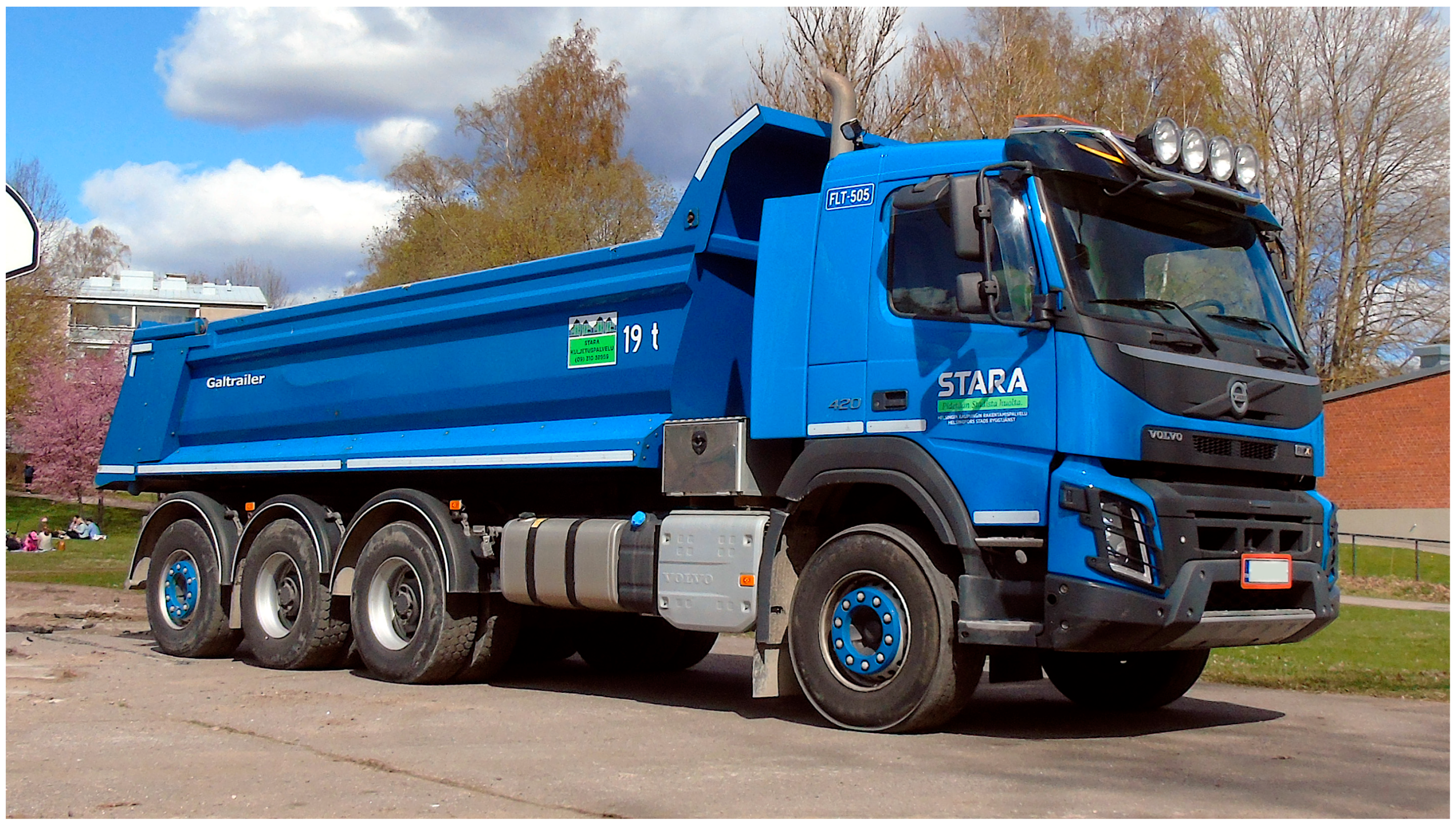
As shown in Figure 1, this is a physical image of a distributed-drive four-axle heavy-duty truck. Due to the high complexity of the distributed-drive four-axle heavy-duty truck, there exist intricate interactions and coordination relationships among its various subsystems, such as the body, suspension, and steering systems. To thoroughly analyze and optimize the vehicle’s overall dynamic performance, employing mathematical models for simulation is regarded as an effective approach. This method enables the simulation of the behaviors of each subsystem, reveals their interrelationships, and provides data support and optimization solutions, thereby enhancing the vehicle’s performance in terms of handling, stability, and ride comfort.

2.1. Simplification of the Heavy-Duty Truck Dynamics Model

Given the inherent complexity of the mathematical model for distributed-drive four-axle heavy trucks, and in order to ensure accurate trajectory-tracking control, the modeling framework primarily concentrates on the vehicle’s planar motion characteristics and yaw stability. During the modeling process, dynamic effects that exert relatively minor influence on yaw stability—such as pitch motion, roll dynamics, and vertical tire oscillations are neglected. The resulting model accounts for the three principal degrees of freedom associated with the vehicle body and incorporates the rotational degrees of freedom of the eight driven wheels, in addition to one steering degree of freedom, yielding a total of twelve degrees of freedom. With these assumptions, the model is able to capture the dynamic responses of distributed-drive heavy trucks with high fidelity while maintaining computational tractability.

2.2. Heavy-Duty Truck Chassis Dynamics Model

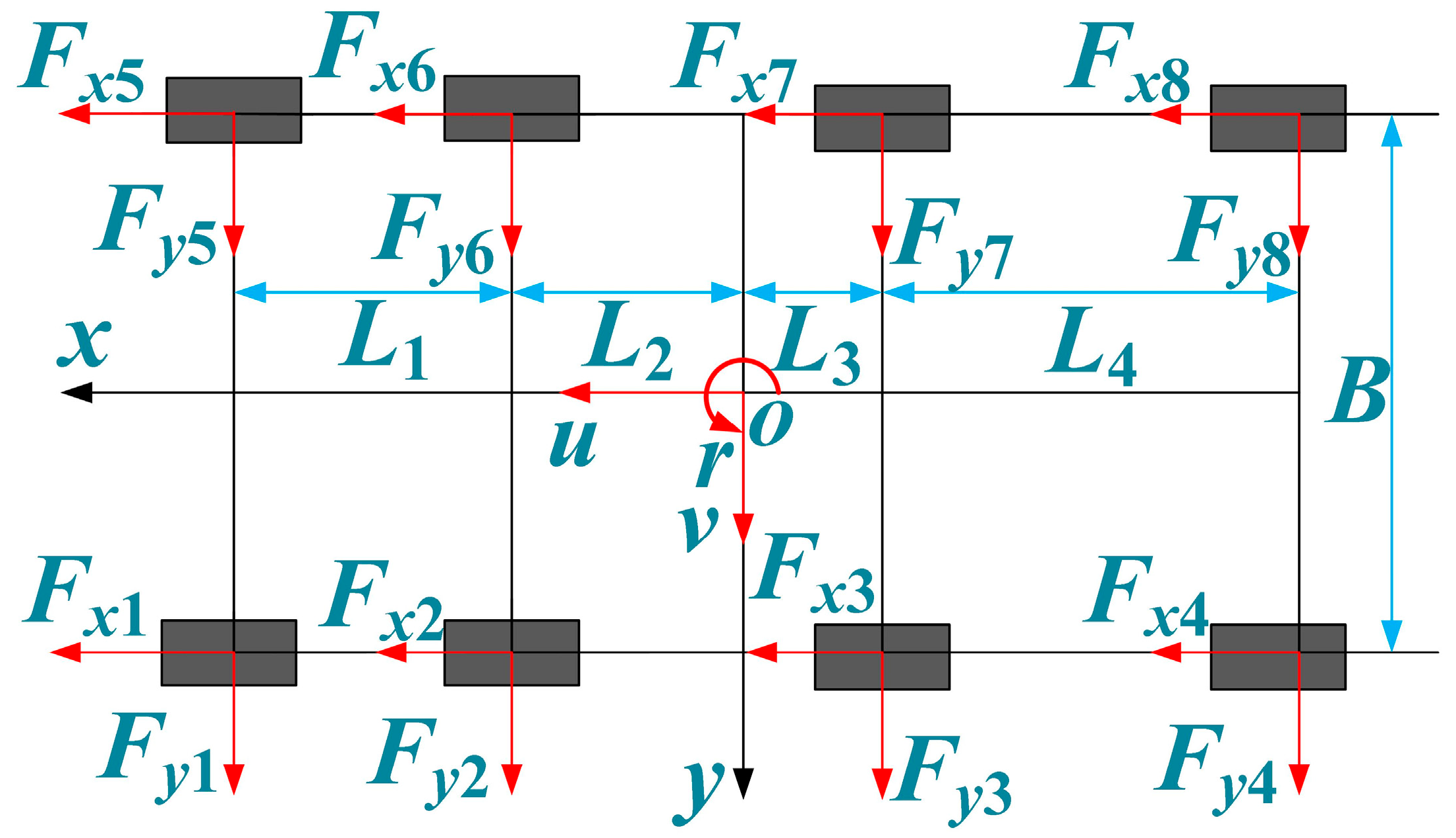
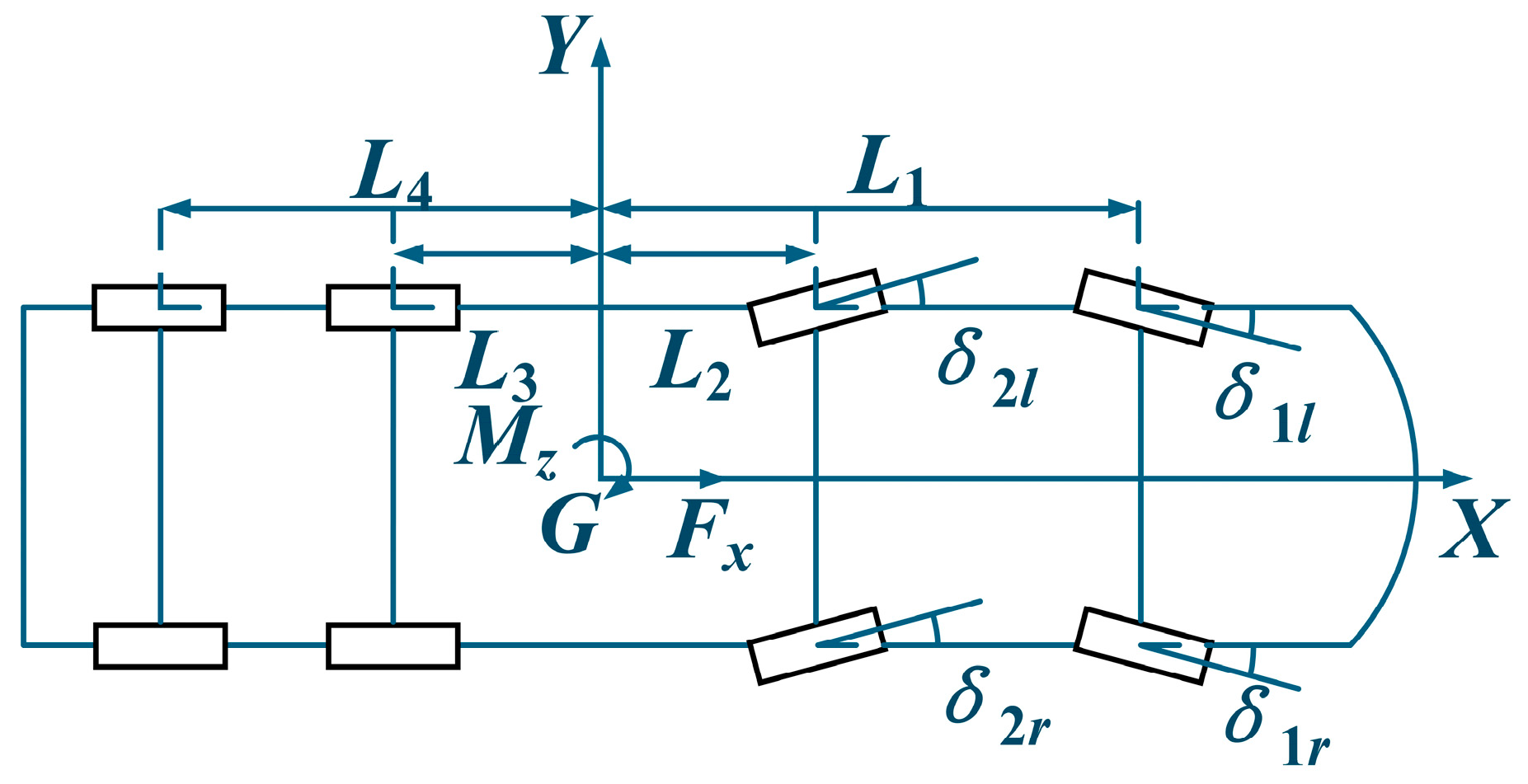
As can be observed from the mechanical model of the distributed-drive heavy truck in Figure 2, the vehicle coordinate system is represented by 0-xyz. Here, vx is defined as the velocity of the center of mass along the x-axis, vy is defined as the velocity of the center of mass along the y-axis, and r is defined as the rotational velocity of the heavy truck about the z-axis.
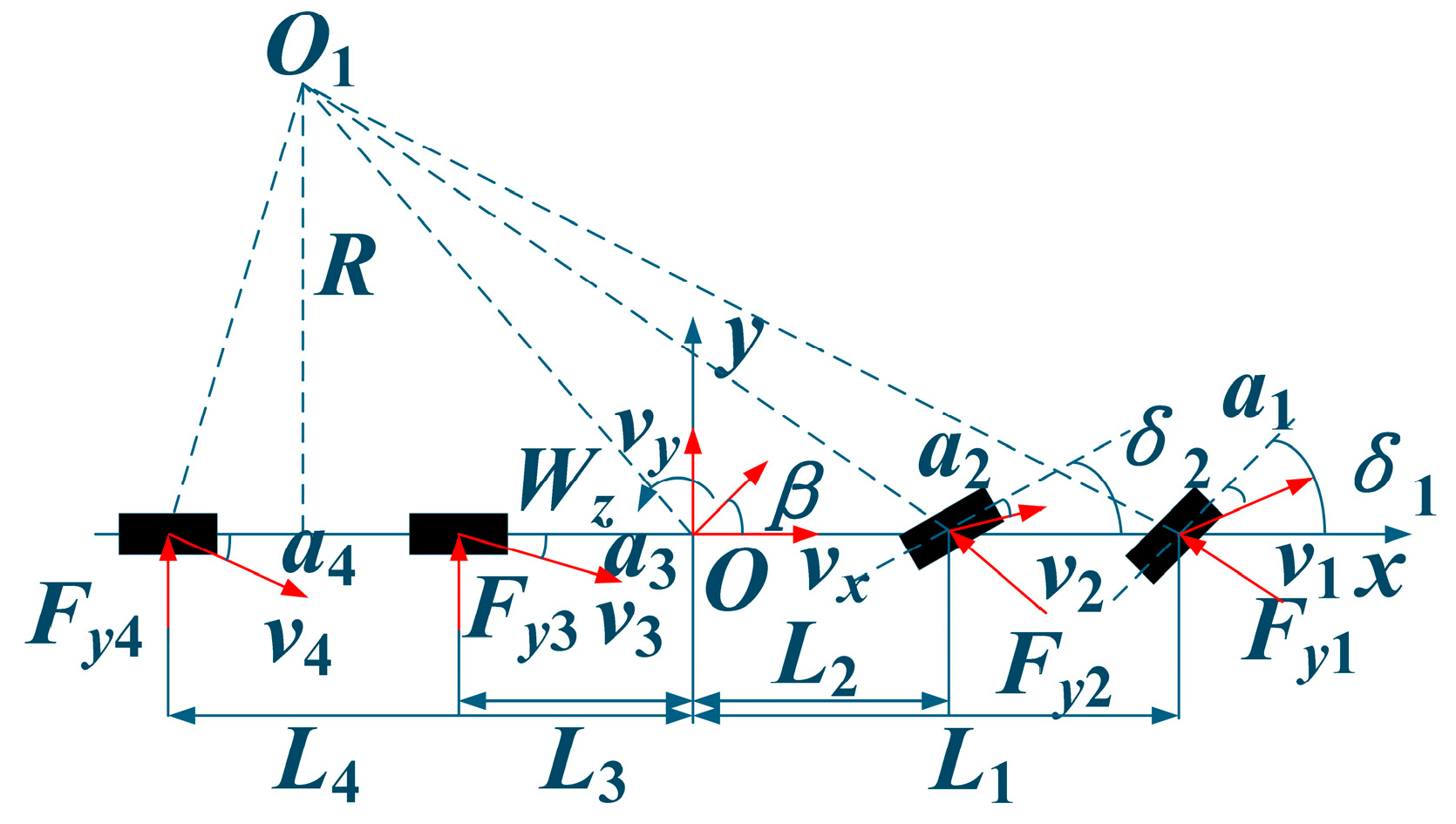
The wheel track of the heavy truck is denoted by B. Although the distributed-drive heavy truck lacks a traditional axle structure, for the convenience of analysis, the concept of a virtual axle is introduced. The distance between the first and second axles is defined as L1, which is established based on the spatial arrangement of the virtual axles. The distance from the vehicle body’s center of mass to the second axle is defined as L2, and this definition is made with reference to the position of the center of mass relative to the virtual second axle. Likewise, the distance from the center of mass to the third axle is defined as L3, and the distance from the third axle to the fourth axle is defined as L4, both of which are set according to the virtual-axle setup. In addition, the figure contains some unlabeled parameters. The sideslip angle of the center of mass is recorded as β, which is calculated based on the vehicle’s velocity components. The vertical height of the center of mass is denoted as h, and it is measured from a reference ground surface to the center of mass. The distance from the center of mass to the roll axis is denoted as h’, and this distance is specified according to the vehicle’s structural design. The distance from the center of mass to the pitch axis is denoted as hq, which is also defined based on the vehicle’s geometric characteristics.
Considering factors like the longitudinal velocity, lateral velocity, and sideslip angle of the heavy truck, the kinematic equilibrium equations for the distributed-drive four-axle heavy truck during longitudinal, lateral, and yaw motions have been formulated.
m ( v ˙ y + r v x ) = F y 1 + F y 2 + F y 3 + F y 4 + F y 5 + F y 6 + F y 7 + F y 8
m ( v ˙ x r v y ) = ( F x 1 + F x 2 + F x 3 + F x 4 + F x 5 + F x 6 + F x 7 + F x 8 ) m g f c o s 1 2 C d ρ A v x 2
I z r ˙ = L 1 + L 2 F y 1 + F y 5 + L 2 F y 2 + F y 6 L 3 F y 3 + F y 7 L 3 + L 4 F y 4 + F y 8           + B 2 F x 5 + F x 6 + F x 7 + F x 8 B 2 F x 1 + F x 2 + F x 3 + F x 4
In the ground coordinate system, the longitudinal and lateral ground forces of the i-th wheel are denoted as Fxi and Fyi, respectively. The variable r represents the yaw angular velocity of the vehicle about the z-axis, with units in degrees per second (°/s). represents the road slope, the mass of the heavy truck is recorded as m, the variable f represents the rolling resistance coefficient, the air-resistance coefficient is indicated as Cd, the frontal area is specified as A, and the moment of inertia about the z-axis is given as Iz. vx and vy are used to represent the longitudinal and lateral velocities, respectively. In the tire coordinate system, the longitudinal and lateral forces acting on the i-th wheel are defined as Fxwi and Fywi. The steering angles of each wheel are set as δi. Therefore, based on the force-decomposition relationship, the relationships between the ground force components in the vehicle coordinate system and the tire forces borne by each tire in the tire coordinate system are derived as follows:
F x i = F x w i cos δ i F y w i sin δ i F y i = F x w i sin δ i + F y w i cos δ i

2.3. Heavy-Duty Truck Wheel Motion Model

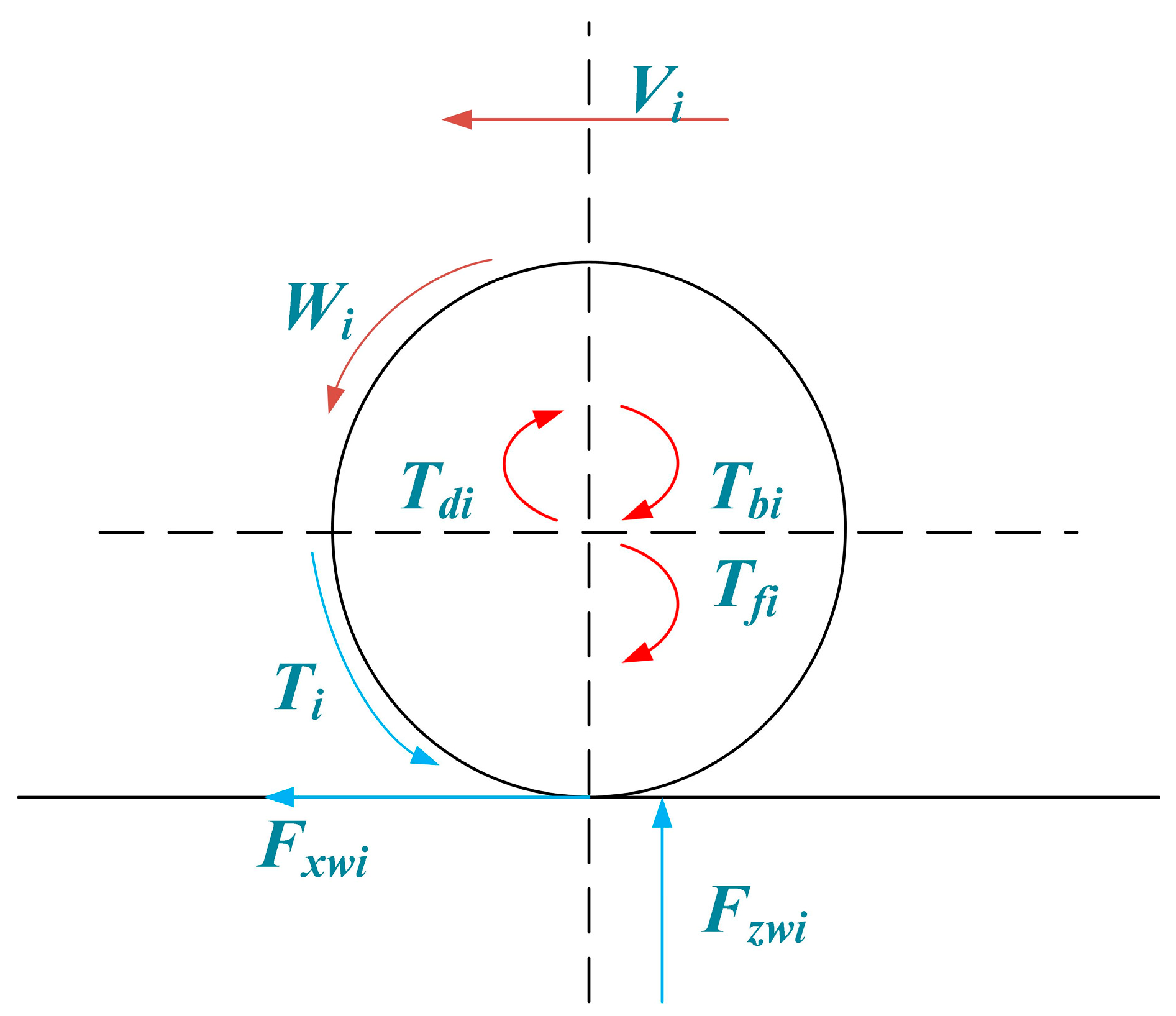
According to Figure 3, in the context of the wheel’s rotational motion direction for the heavy truck, the driving torque is represented by Ti, the braking torque by Tbi, and the reaction torque by Tdi, while the rolling resistance torque is denoted as Tfi. The transmission ratio is specified as ig, the moment of inertia of the wheel is given as Iw, and the angular velocity of the wheel is indicated as wi. A dynamic equilibrium relationship is established among them as follows:
I w d w i d t = T i · i g T b i T f i T d i

2.4. Heavy-Duty Truck Suspension Dynamics Model

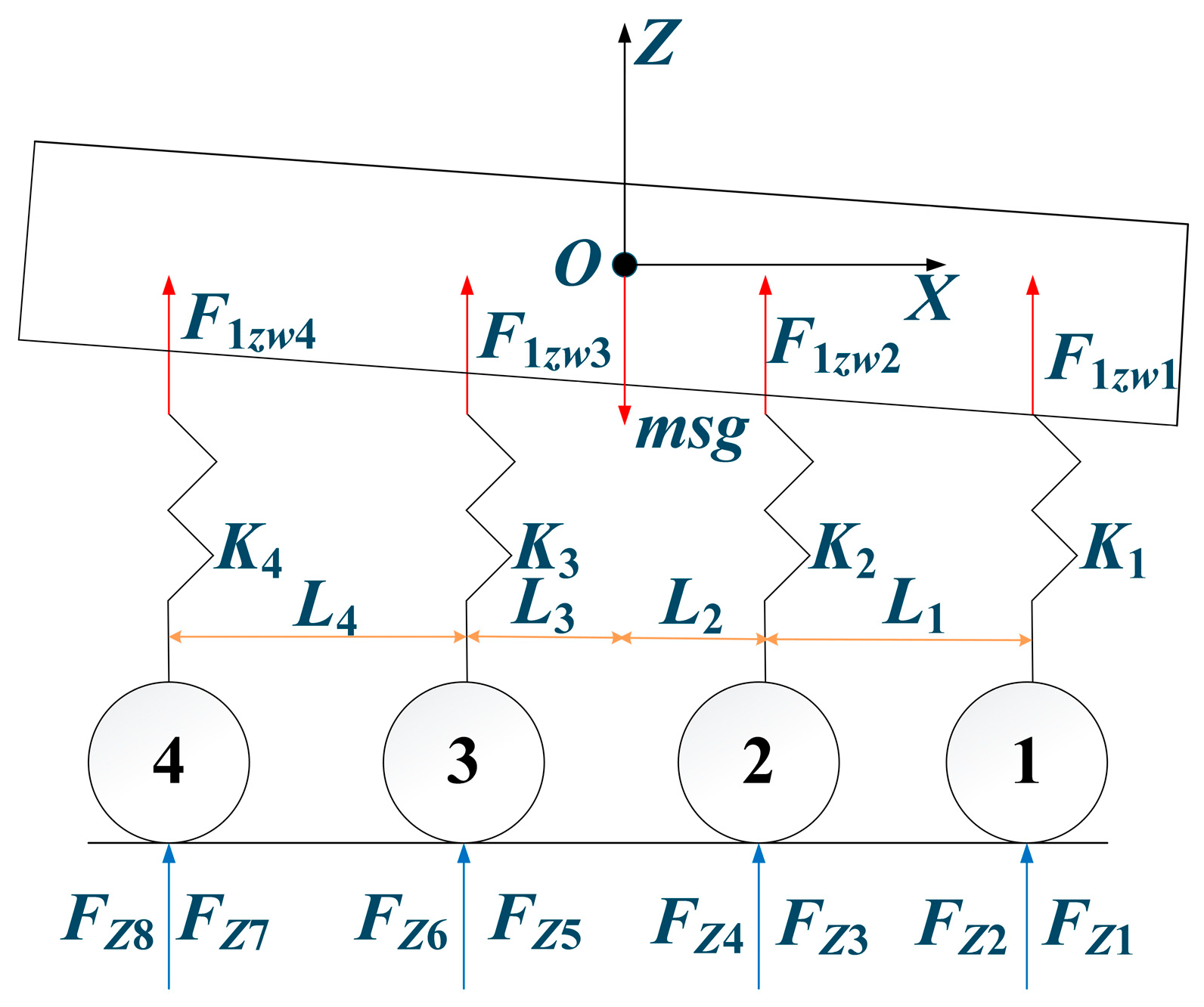
In the heavy truck suspension dynamics model, the pitch and roll motions of the vehicle are neglected. When analyzing vertical load transfer, only the effects of the inertial forces induced by longitudinal and lateral accelerations on the load distribution are considered. Under this assumption, the dynamic vertical load on each tire is determined by the combined effect of the static vertical load and the inertial forces generated during vehicle acceleration or cornering. The specific force conditions are illustrated in Figure 4, which depicts the dynamic variation characteristics of the vertical loads under different acceleration conditions.
Based on the force analysis of the distributed-drive heavy truck body, the corresponding force and moment equilibrium equations of the vehicle are derived accordingly.
F 1 z w 1 + F 1 z w 2 + F 1 z w 3 + F 1 z w 4 = m s g F 1 z w 1 L 1 + L 2 + F 1 z w 2 L 2 = F 1 z w 3 L 3 + F 1 z w 4 L 3 + L 4
Here, F1zwi(i = 1,2,3,4) is defined as the static suspension force acting on each axle of the heavy truck, while ms is specified as the sprung mass of the vehicle. Ki(i = 1,2,3,4) represents the suspension stiffness of each axle. Based on geometric characteristics, it is required that the static deformation qi = F1zwi/Ki(i = 1,2,3,4) for each axle of the heavy truck should conform to the following condition:
q 1 q 2 q 1 q 3 = L 1 L 1 + L 2 L 3 q 1 q 2 q 1 q 4 = L 1 L 1 + L 2 + L 3 + L 4
Accordingly, the static suspension forces of each axle can be calculated to satisfy the following relationship:
F 1 z w 1 = L b L a L 1 + L 2 L a 4 L 1 + L 2 l 1 4 L b L a 2 m s g F 1 z w 2 = L b L a L 1 + L 2 L a 4 L 1 + L 2 l 2 4 L b L a 2 m s g F 1 z w 3 = L b L a L 1 + L 2 L a 4 L 1 + L 2 l 3 4 L b L a 2 m s g F 1 z w 4 = L b L a L 1 + L 2 L a 4 L 1 + L 2 l 4 4 L b L a 2 m s g
l 1 = 0 , l 2 = L 1 , l 3 = L 1 + L 2 + L 3 , l 4 = L 1 + L 2 + L 3 + L 4 L a = L 1 + L 1 + L 2 + L 3 + L 1 + L 2 + L 3 + L 4 L b = L 1 2 + L 1 + L 2 + L 3 2 + L 1 + L 2 + L 3 + L 4 2 K 1 = K 2 = K 3 = K 4
The static vertical load Fzvi on each wheel (left and right) is given by:
F z v i = 1 2 F z w i + 1 8 ( m m s ) · g
The longitudinal and lateral accelerations of the heavy truck can be derived from the dynamic equilibrium equations.
a x = i = 1 4 F x i + j = 5 8 F x j m g f cos 1 2 C d ρ A v x 2 m a y = i = 1 4 F y i + j = 5 8 F y j m
For a distributed-drive heavy truck, the dynamic vertical load on each tire is calculated by vectorially superimposing the static vertical load and the inertial forces generated by the longitudinal and lateral accelerations.
F z 1 = F 1 z v 1 C 1 m s a y h B D 1 m s a x h 2 F z 2 = F 1 z v 2 + C 1 m s a y h B D 1 m s a x h 2 F z 3 = F 1 z v 3 C 2 m s a y h B D 2 m s a x h 2 F z 4 = F 1 z v 4 + C 2 m s a y h B D 2 m s a x h 2 F z 5 = F 1 z v 5 C 3 m s a y h B D 3 m s a x h 2 F z 6 = F 1 z v 6 + C 3 m s a y h B D 3 m s a x h 2 F z 7 = F 1 z v 7 C 4 m s a y h B D 4 m s a x h 2 F z 8 = F 1 z v 8 + C 4 m s a y h B D 4 m s a x h 2
Among them, the coefficients Ci and Di are, respectively, derived through the application of force equilibrium and moment equilibrium equations.
C 1 = L b L a ( L 1 + L 2 ) 4 L b L a 2 C 2 = L b L a ( L 1 + L 2 ) L 1 ( L a 4 ( L 1 + L 2 ) ) 4 L b L a 2 C 3 = L b L a ( L 1 + L 2 ) 4 L b L a 2 ( L 1 + L 2 + L 3 ) ( L a 4 ( L 1 + L 2 ) ) 4 L b L a 2 C 4 = L b L a ( L 1 + L 2 ) 4 L b L a 2 ( L 1 + L 2 + L 3 + L 4 ) L a 4 ( L 1 + L 2 ) 4 L b L a 2 D 1 = L a 4 L b L a 2 D 2 = L a 4 L 1 4 L b L a 2 D 3 = L a 4 ( L 1 + L 2 + L 3 ) 4 L b L a 2 D 4 = L a 4 ( L 1 + L 2 + L 3 + L 4 ) 4 L b L a 2

2.5. Model of Tire Sideslip Angle and Slip Ratio for Heavy Trucks

In the vehicle coordinate system, the longitudinal and lateral velocities of a heavy-duty truck’s wheels are as follows:
V x i = v x ± B 2 · r V y i = v y ± l s i · r
Among which, ls1 = L1 + L2, ls2 = L2, ls3 = L3, ls4 = L3 + L4.
In the analysis of the heavy truck’s dynamics, the roll and pitch motions are neglected, and the focus is placed on the yaw motion. By decomposing the longitudinal and lateral velocities at the wheel centers, the longitudinal velocity of each wheel center of the heavy truck along the horizontal plane in the tire coordinate system can be expressed as:
V i = V x i · cos δ i + V y i · sin δ i = v x ± B 2 · r · cos δ i + ( v y ± l s i · r ) · sin δ i
For each tire of a heavy-duty truck, the sideslip angle ai and slip ratio Si can be calculated as follows:
α i = δ i arctan V yi V xi i = 1 , 2 , , 8 S i = w i · r w V i max ( w i · r w , V i )
In the above equation, δi denotes the steering angle of each tire of the heavy truck, wi represents the rotational speed of each wheel, and rw is the tire radius. The value of Si ranges from –1 to 1. When Si 0, the wheel is in a slipping (driving or braking) condition; conversely, when Si < 0, the wheel experiences lateral skidding.

2.6. Steering Model of Heavy Truck

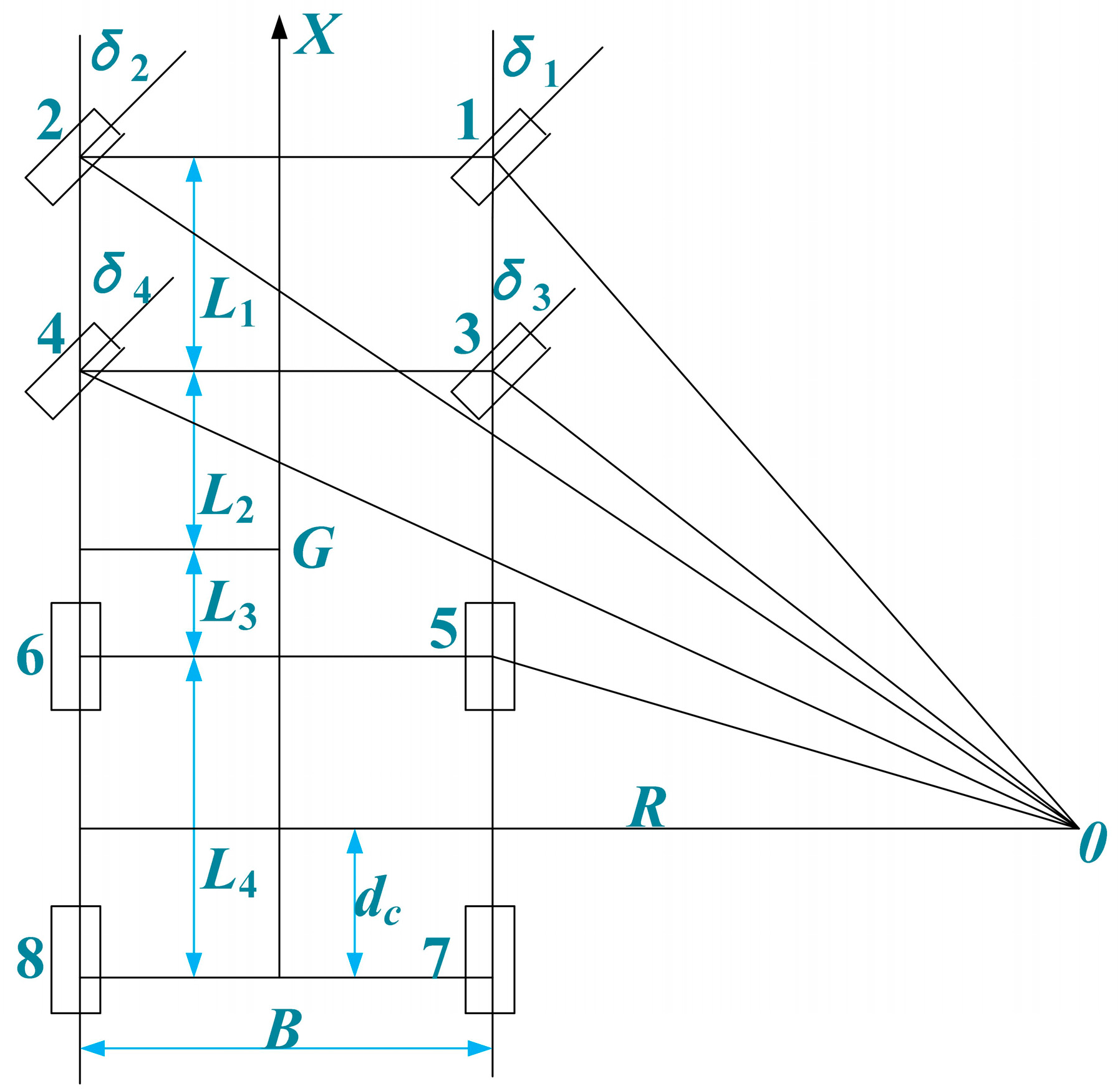
To facilitate the analysis, it is assumed that during the steering maneuver of the distributed-drive heavy truck, the instantaneous center of rotation lies on the exten-sion of the longitudinal axis between the third and fourth axles when the front two ax-les are steered. Under this assumption, the vehicle is subject to the following specific geometric relationship:
d c = 1 2 L 4
Based on the Ackermann steering principle and the geometric configuration illustrated in Figure 5, the steering angle relationship of the wheels on the same side of the heavy truck can be derived as follows:
t a n δ 1 tan δ 3 = t a n δ 2 tan δ 4 = L 1 + L 2 + L 3 + L 4 d c L 2 + L 3 + L 4 d c
Similarly, the steering angle relationship between the inner and outer wheels on the same axle of the front two axles of the heavy truck can be determined as follows:
cot δ 2 cot δ 1 = B L 1 + L 2 + L 3 + L 4 d c cot δ 4 cot δ 3 = B L 2 + L 3 + L 4 d c
To simplify the modeling of the heavy truck steering system, it is assumed that the steering transmission ratio of the multi-axle vehicle remains constant. Under this as-sumption, the steering angle of the left wheel on the first axle is defined to be linearly proportional to the steering wheel angle, such that:
δ 1 = δ w i w
By simultaneously solving the above equations, the angular relationships of the remaining steering wheels of the heavy truck can be determined as follows:
δ 2 = arccot B L 1 + L 2 + L 3 + L 4 d c + cot δ 1 δ 3 = arccot L 2 + L 3 + L 4 d c L 1 + L 2 + L 3 + L 4 d c · tan δ 1 δ 4 = arccot B L 2 + L 3 + L 4 d c + cot δ 1 · L 1 + L 2 + L 3 + L 4 d c L 2 + L 3 + L 4 d c

2.7. In-Wheel Motor Model

Based on the vehicle’s fundamental parameters and dynamic performance requirements, this paper selects an outer-rotor permanent magnet synchronous motor as the in-wheel motor for the electric wheels of the four-axle distributed electric drive heavy-duty truck in this research project. Since the in-wheel motor is not the focal point of this study, to simplify calculations, the aforementioned motor model is approximated as a second-order system and represented using a transfer function for the experimental model.
G s = 1 1 + 2 ξ s + 2 ξ 2 s 2
In the equation, ξ represents the motor characteristic parameter.

2.8. Model Validation

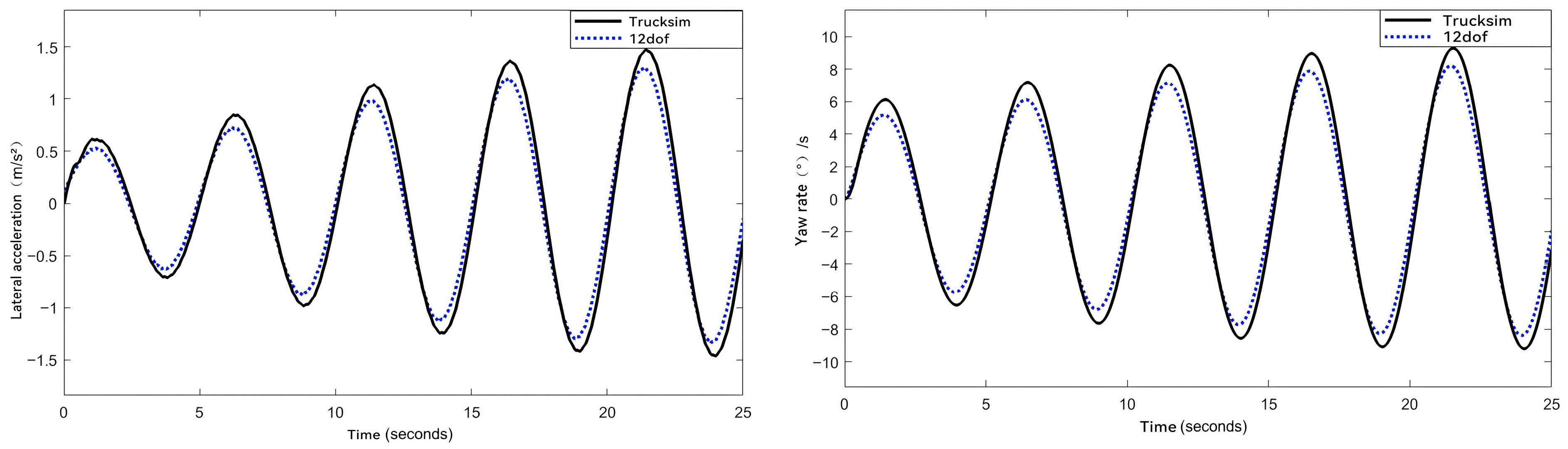
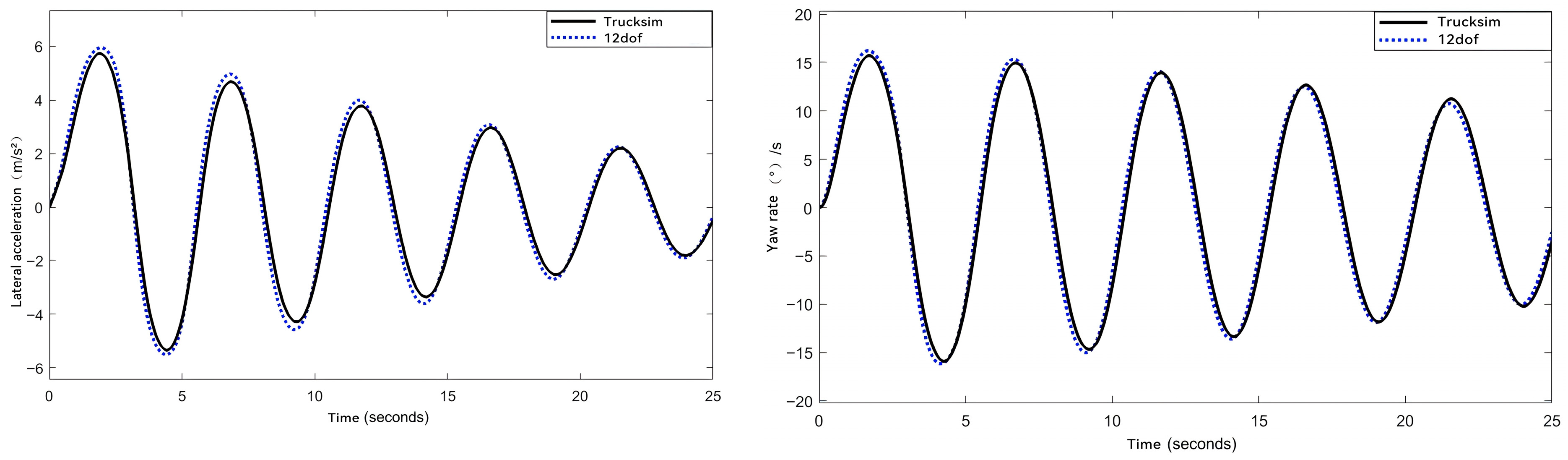
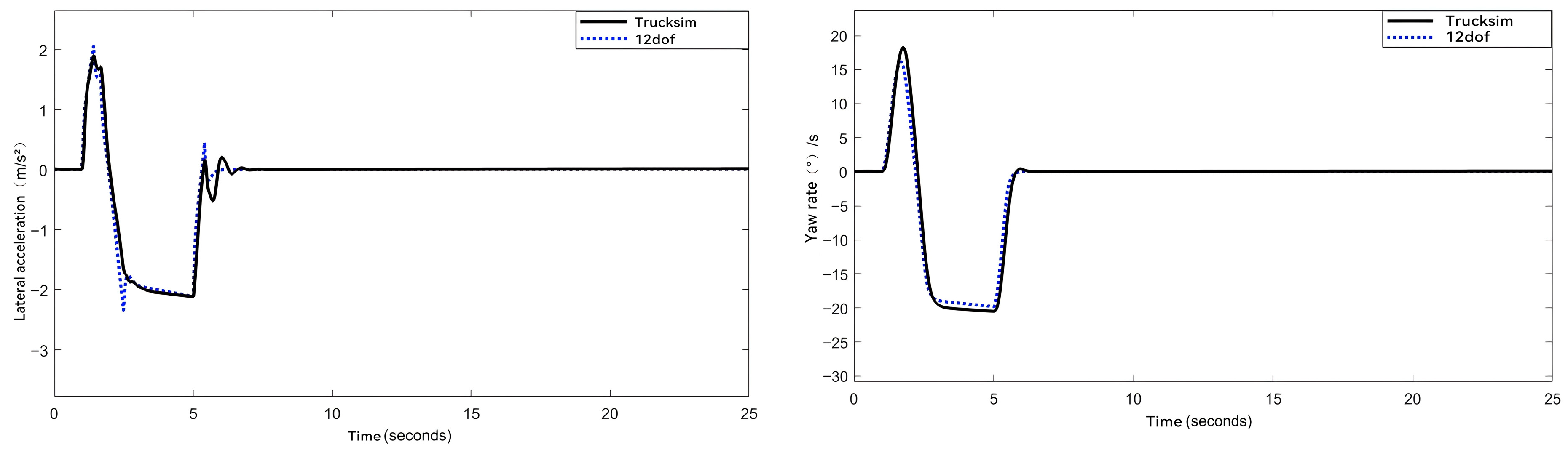
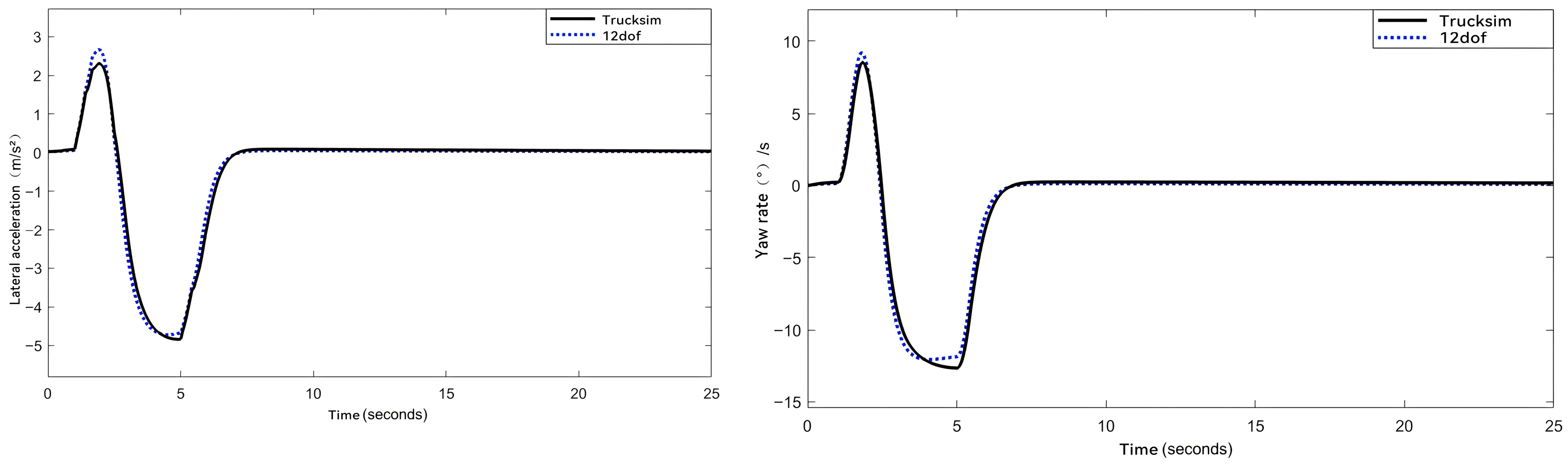
To validate the accuracy of the established 12-degree-of-freedom (12-dof) vehicle model of the distributed-drive four-axle heavy truck, simulation results under sine steering and J-turn conditions were compared with those obtained from the TruckSim vehicle model. The comparison results are shown in Figure 6, Figure 7, Figure 8 and Figure 9.
In Figure 6, Figure 7, Figure 8 and Figure 9, the variable μ represents the road surface adhesion coefficient, and the variable v denotes the vehicle speed. From the simulation results, it can be concluded that the proposed vehicle dynamics model accurately captures the vehicle’s motion characteristics, demonstrating good rationality and high modeling accuracy. Therefore, the model satisfies the precision requirements for subsequent studies on vehicle trajectory tracking and stability control strategies.

3. Design of the Controller

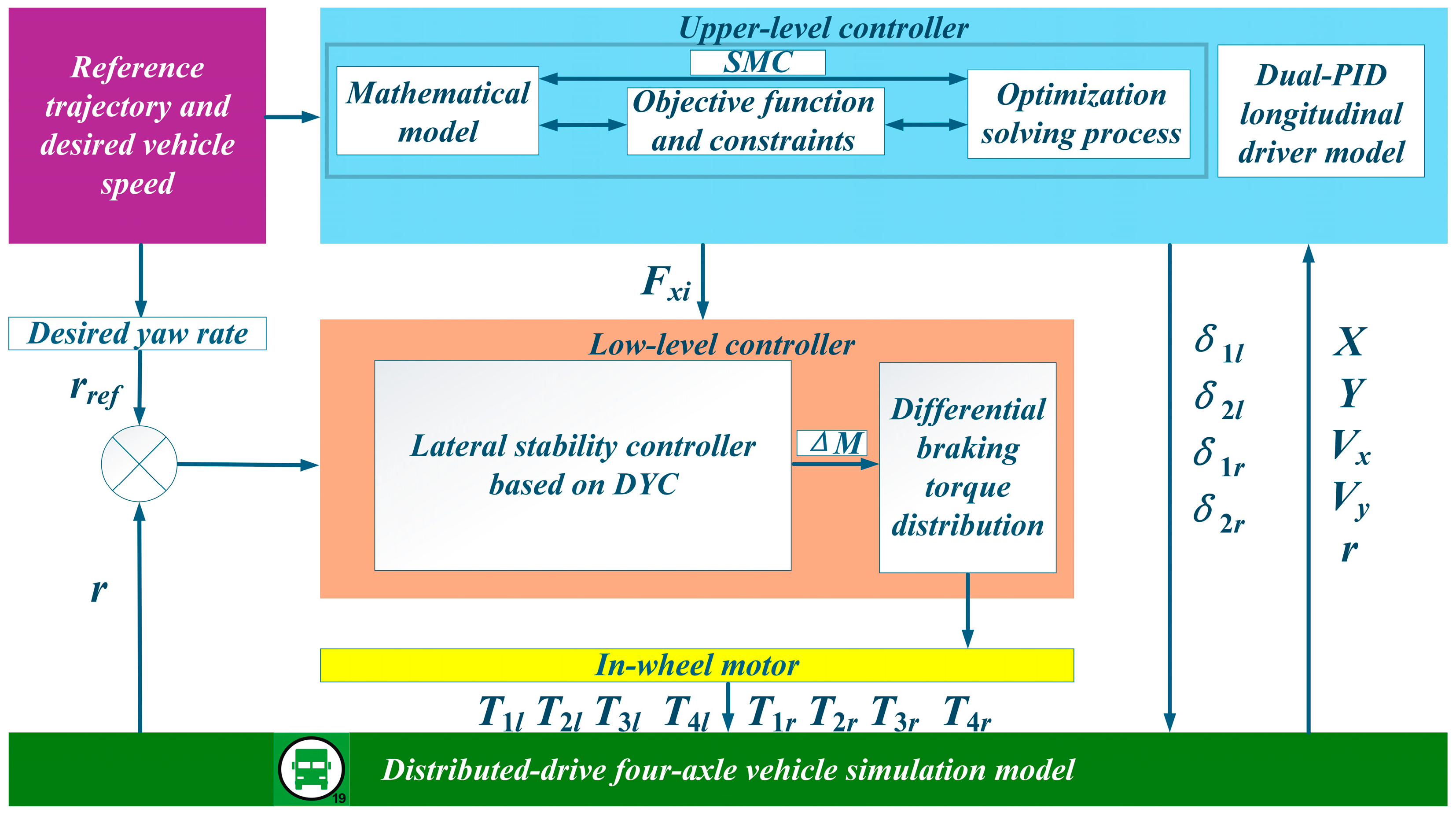
This section presents the control block diagram shown in Figure 10, which employs a hierarchical architecture to achieve trajectory tracking control of the distributed-drive four-axle heavy truck. In the proposed hierarchical cooperative control framework, the division of responsibilities and interaction mechanisms between the two control layers are clearly defined. The upper-layer controller, designed using SMC, determines the desired longitudinal force, lateral force, and reference yaw moment by regulating vehicle trajectory-tracking errors under highly nonlinear and rapidly varying operating conditions. These generalized force commands reflect the motion requirements necessary for tracking the reference trajectory. The lower-layer controller employs a sliding-mode-based DYC strategy to enhance vehicle stability by generating an additional corrective yaw moment based on the deviation between the actual and desired yaw motion states. This corrective yaw moment is subsequently distributed to individual in-wheel motors through a differential braking torque allocation mechanism. Coordination between the two layers is achieved through a structured information flow: the upper layer provides the desired force and yaw moment commands, while the lower layer refines and allocates these commands to ensure stable and coordinated vehicle behavior. Through this interaction, the upper layer focuses on trajectory-tracking performance, while the lower layer concentrates on yaw stability, enabling the entire control system to achieve collaborative optimization under extreme operating conditions.

3.1. Upper-Layer Controller

In this section, the motion controller for the autonomous vehicle is derived based on the desired longitudinal velocity and desired yaw rate. As shown in Figure 11, the nonlinear 12-degree-of-freedom vehicle dynamics model is appropriately simplified by retaining only the three primary motion degrees of freedom of the vehicle body. The simplified planar vehicle dynamics equations are then incorporated into the model as follows:
m v ˙ x v y γ = F x C a v x 2 m v ˙ y + v x γ = F y r ˙ = M z I z
In Formula (23), C a signifies the aerodynamic coefficient, M z denotes the yaw moment, I z is the moment of inertia about the z-axis, and r stands for the yaw rate.
The upper-layer controller determines the forces and moments required to achieve accurate trajectory tracking. In particular, the desired longitudinal and lateral forces are computed to ensure that the vehicle follows the intended motion. The longi-tudinal force is responsible for regulating the vehicle’s speed, either maintaining the target velocity or providing appropriate deceleration based on the corrected reference speed. To realize this objective, a dual-PID control strategy [20] is employed to calculate the required longitudinal force as follows:
F x = k P ( v x d v x ) + k I ( v x d v x ) + k D ( v ˙ x d v ˙ x )
where kp, kI, and kD are the parameters of the PID controller, and vxd denotes the desired longitudinal velocity.
Since vy is regarded as a disturbance in this study, the lateral disturbance is assumed to be negligible in the calculation of the lateral force. Accordingly, the lateral force can be defined as follows:
F y   = m v x r d + k y e y
where ky denotes the feedback parameter. It should be noted that the total tire force must not exceed the maximum available road adhesion. Compared with lateral and yaw control, the longitudinal controller is generally less accurate in tracking the corrected desired speed under real driving conditions. This is because, in most cases, the longitudinal force exhibits a transient characteristic, serving primarily to provide the necessary deceleration capability under extreme conditions. Consequently, the total longitudinal force is constrained by both the maximum tire–road adhesion and the total lateral force.
| F x | ( μ m g ) 2 F y 2
The target yaw moment is designed using the SMC approach to ensure that the actual yaw rate closely follows the reference value. The sliding surface for the yaw motion is defined as follows:
S r = r r d
Here, r represents the actual yaw rate, and rd denotes the desired yaw rate. To ensure that the error between the actual and desired yaw rates reaches the sliding surface within a finite time while mitigating chattering, an exponential reaching law is adopted in the controller.
S ˙ r = ε 1 sign ( S r ) k 1 S r
Here, ε 1 and k 1 are controller parameters, both of which are positive constants. To improve the convergence rate and reduce chattering, a relatively larger k1 and a smaller ε1 are selected. The equation can then be transformed as follows:
r ˙ = ε 1 sign ( S r ) k 1 S r + r ˙ d
To further mitigate the chattering effect, a thin boundary layer is introduced in the vicinity of the switching surface, and the discontinuous term sign(S) is replaced by a continuous approximation function sat(S/Δ) [21].
sat ( S / Δ ) = S / Δ | S / Δ | 1 sgn ( S / Δ ) | S / Δ | > 1
Here, Δ represents the thickness of the boundary layer, which can be adjusted to reduce chattering.
By combining the above equations, the desired yaw moment can be calculated using the following expression:
M d = I z ( ε 1 sat ( S / Δ ) k 1 S + r ˙ d )

3.2. Optimization Problem Solving

In this study, a four-axle heavy truck is employed to achieve path-tracking control. It is known that such a vehicle configuration possesses redundant degrees of freedom, which can be exploited through control allocation to enhance overall control performance. Therefore, an optimization-based method is adopted to distribute the generalized forces acting on the tires. Here, the performance index is defined as the variance of the squared sum of the eight tire loads, with the objective of minimizing this value to ensure efficient utilization of each tire. The generalized forces are formulated as equality constraints based on the vehicle’s dynamic relationships. Moreover, the tire forces are constrained by the tire friction circle and actuator limitations, which are imposed as inequality constraints during the optimization process. To simplify the optimization procedure, the vertical loads and adhesion coefficients of the tires are treated as constants in the cost function, with their values measured at each control step. The cost function for this allocation problem is expressed as follows.
J m i n , F lax , F lai = i = 1 8 ( F x i 2 + F y i 2 ) μ 2 F z i 2 + W 1 8 Σ i = 1 8 ( F x i 2 + F y i 2 ) μ 2 F z i 2 1 8 Σ i = 1 8 ( F x i 2 + F y i 2 ) μ 2 F z i 2 2
Here, W represents the weighting factor of the variance term. The design of this cost function is justified from both theoretical and practical perspectives. The first term minimizes the total tire force utilization to maintain adequate stability margins, while the second term with weighting factor W ensures balanced load distribution among all tires. To realize the generalized forces, the equality constraints applied in the optimization process are expressed as follows:
F y total = F y 1 i = 1 8 F x i l sin ( δ i ) F x i r sin ( δ i )
M z total = M z 1 i = 1 8 F x i l L 1 + L 2 sin ( δ i ) 0.5 B cos ( δ i ) F x i r ( L 1 + L 2 ) sin ( δ i ) + 0.5 B c o s ( δ i )   i = 1 8 F x i l L 2 s i n ( δ i ) 0.5 B c o s ( δ i ) F x i r L 2 s i n ( δ i ) + 0.5 B c o s ( δ i ) i = 1 8 F x i l ( L 3 ) s i n ( δ i )   0.5 B cos ( δ i ) F x i r ( L 3 ) sin ( δ i ) + 0.5 B c o s ( δ i ) i = 1 8 F x i l ( ( L 3 + L 4 ) ) sin ( δ i )   0.5 B c o s ( δ i ) F x i r ( ( L 3 + L 4 ) ) sin ( δ i ) + 0.5 B c o s ( δ i )
b eq = F y total M z total
The inequality constraints are given as follows:
F x i 2 + F y i 2 μ F z i 2 T b max R F x i T d max R F y i m a x F y i F y i m a x
Here, Tdmax denotes the maximum driving torque of the motor, Tbmax represents the maximum braking torque of each wheel, and Fymax is the maximum lateral force of each tire, which varies with the vertical load and the road adhesion coefficient.
Since the equality constraints are defined as hard constraints, infeasibility may occur during the optimization process. To prevent control failure caused by infeasibility, when Equation (32) has no feasible solution, the left-hand side of Equation (33) is replaced with FydKySat(FydFytotal), which limits the deviation between the desired and actual total lateral forces. If Equation (32) remains infeasible, the left-hand side of Equation (34) is modified in the same manner and can be reformulated as MdKMSat(MdMtotal). Here, Fytotal and Mtotal represent the actual total lateral force and yaw moment generated by the four tires, respectively.
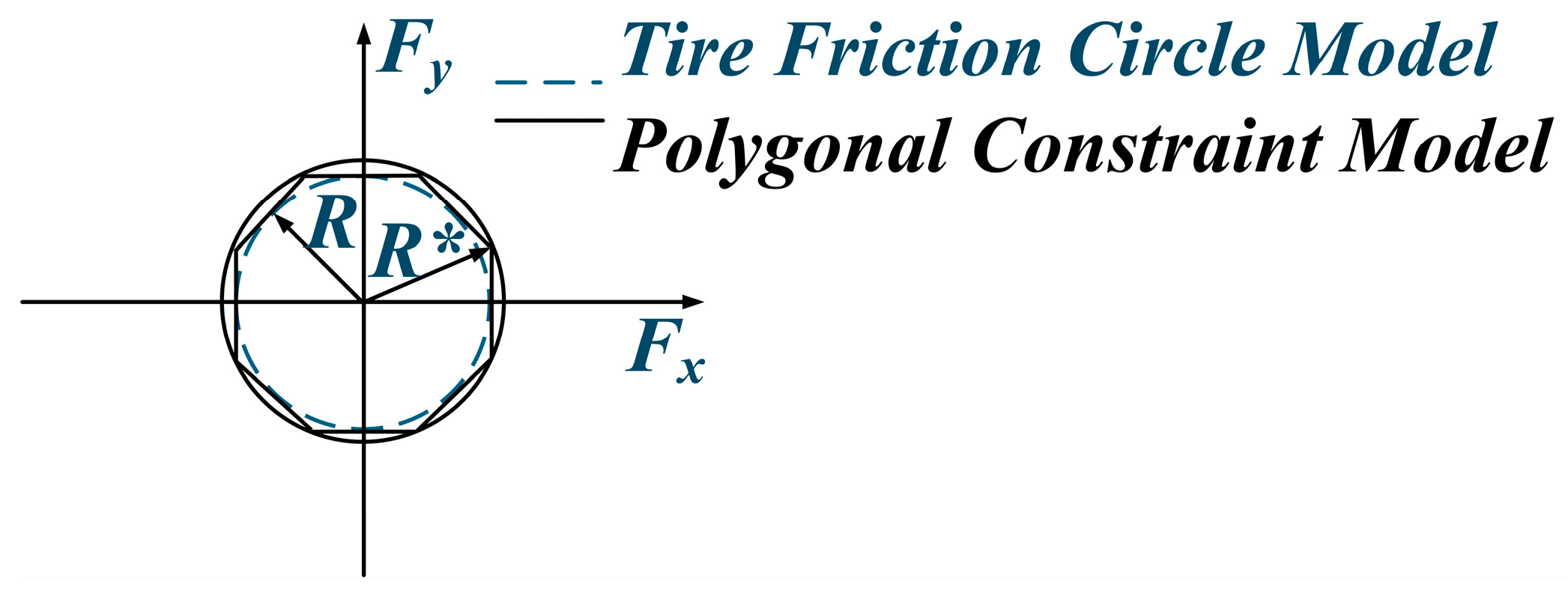
However, because the friction circle constraint is inherently nonlinear, directly solving this optimization problem becomes both challenging and computationally intensive. To alleviate this issue, the adhesion limit of each tire is approximated by a regular octagon, which is inscribed within the tire’s friction circle, as illustrated in Figure 12.
According to Figure 12, the nonlinear constraint of the friction limit is transformed into a set of linear constraints, as expressed below:
R = μ F z i j R * 1.08 R μ F z i j < F x i j < μ F z i j μ F z i j < F y i j < μ F z i j 2 μ F z i j < F x i j + F y i j < 2 μ F z i j 2 μ F z i j < F x i j + F y i j < 2 μ F z i j
After the forces for each tire are allocated according to the governing equations, the longitudinal forces are subsequently transformed into the corresponding driving or braking torques, while the lateral forces are translated into the required steering angles, as expressed below:
δ 1 l = arctan v y + L 1 + L 2 r v x 0.5 · B · r F y 1 C a 1 l δ 1 r = arctan v y + L 1 + L 2 r v x + 0.5 · B · r F y 2 C a 1 r δ 2 l = arctan v y + L 2 r v x 0.5 · B · r F y 3 C a 2 l δ 2 r = arctan v y + L 2 r v x + 0.5 · B · r F y 4 C a 2 r
Similarly to parameter Fymax, parameter Caij varies with the vertical load and road adhesion conditions. Therefore, its value can be updated at each time step using a lookup table. However, since tire cornering stiffness exhibits strong nonlinear relationships with various factors, the lookup table provides only a coarse approximation. In future work, nonlinear tire models will be investigated to more accurately describe the relationship between lateral tire force and slip angle. Moreover, as the dynamic response of the actuator motors is much faster than that of the vehicle, their dynamic characteristics are neglected in this study.

3.3. Lower-Level Controller

Based on the longitudinal target velocity generated by the upper-level controller, the lower-level controller is responsible for efficiently distributing the desired yaw moment command among the in-wheel motors to achieve yaw stability control of the four-axle heavy truck. To meet the handling and stability requirements under high-speed cornering and limit conditions, a DYC module based on SMC is designed. This module computes the required additional yaw moment command according to the vehicle’s real-time state and desired yaw rate, and then converts this command into adjustments of the driving torques for each in-wheel motor through a torque distribution mechanism.
In the proposed control strategy, vehicle dynamics modeling is based on a linear two-degree-of-freedom model. By constructing the deviation between the desired and actual yaw motion states, feedback regulation of the control command is achieved. The allocation of driving torque follows optimization objectives such as minimizing energy consumption or maximizing response performance, while dynamically adjusting according to the instantaneous capability of each drive motor and the vehicle’s real-time operating state. This enhances the system’s ability to maintain yaw stability under extreme driving conditions and improves the overall handling stability and active safety performance of the vehicle. The lower-level control strategy thus provides a feasible and efficient yaw stability solution for multi-wheel independently driven heavy trucks within a distributed drive architecture.
To establish the linear two-degree-of-freedom (2-dof) model, it is assumed that the vehicle maintains a constant longitudinal velocity, the tire cornering characteristics remain within the linear region, and only the lateral and yaw motions are considered. Under these assumptions, the linear 2-dof dynamic model of the 8×4 distributed-drive heavy truck can be derived, as illustrated in Figure 13.
The vehicle investigated in this study adopts a mechanically linked dual-front-axle steering configuration, with the steering system designed based on the Ackermann steering geometry principle. On this basis, the vehicle’s state dynamic equations can be expressed as follows:
m ( v ˙ y + v x ψ ˙ ) = F y 1 cos δ 1 + F y 2 cos δ 2 + F y 3 + F y 4 I z ω ˙ z = L 1 F y 1 cos δ 1 + L 2 F y 2 cos δ 2 L 3 F y 3 L 4 F y 4
In the equation, Iz denotes the yaw moment of inertia of the vehicle, ψ represents the yaw angle. Considering that the angles δ1 and δ2 are small, it can be assumed that cosδ1 ≈ 1 and cosδ2 ≈ 1. Thus, the equation can be simplified as follows:
m ( v ˙ y + v x ω z ) = k 1 α 1 + k 2 α 2 + k 3 α 3 + k 4 α 4 I z ω ˙ z = L 1 k 1 α 1 + L 2 k 2 α 2 L 3 k 3 α 3 L 4 k 4 α 4
In the equation, the cornering stiffness of each axle is represented by ki(i = 1,2,3,4), which is treated as the combined effect of the cornering stiffness of the left and right tires, The cornering stiffness of each tire within the linear region kl,r is primarily determined by the vertical load acting on the wheel and is obtained from TruckSim through a lookup table.
For the vehicle sideslip angle at the center of mass β = vy/vx, the following relationship holds, and the sideslip angle of each wheel ai(i = 1,2,3,4) can be expressed as:
α 1 = δ 1 v + L 1 ω z v x = β + L 1 ω z v x δ 1 α 2 = δ 2 v + L 2 ω z v x = β + L 2 ω z v x δ 2 α 3 = v L 3 ω z v x = β L 3 ω z v x α 4 = v L 4 ω z v x = β L 4 ω z v x
From the above equations, the differential equations governing the two-degree-of-freedom vehicle motion can be derived as follows:
m v ˙ y + v x ω z = ( k 1 + k 2 + k 3 + k 4 ) β + 1 v x ( L 1 k 1 + L 2 k 2 L 3 k 3 L 4 k 4 ) ω z k 1 δ 1 k 2 δ 2 I z ω ˙ z = ( L 1 k 1 + L 2 k 2 L 3 k 3 L 4 k 4 ) β + 1 v x ( L 1 2 k 1 + L 2 2 k 2 + L 3 2 k 3 + L 4 2 k 4 ) ω z L 1 k 1 δ 1 L 2 k 2 δ 2
When the vehicle operates under steady-state conditions, both the lateral velocity and the yaw rate are assumed to remain constant, that is, v ˙ y = 0 and w ˙ z = 0 . Then Formula (42) can be transformed as:
m v x ω z = ( k 1 + k 2 + k 3 + k 4 ) β + 1 v x ( L 1 k 1 + L 2 k 2 L 3 k 3 L 4 k 4 ) ω z k 1 δ 1 k 2 δ 2 0 = ( L 1 k 1 + L 2 k 2 L 3 k 3 L 4 k 4 ) β + 1 v x ( L 1 2 k 1 + L 2 2 k 2 + L 3 2 k 3 + L 4 2 k 4 ) ω z L 1 k 1 δ 1 L 2 k 2 δ 2
Based on the Ackermann steering geometry model, the following geometric relationship can be derived:
tan δ 1 = L 1 + L 3 + L 4 L 3 2 / R tan δ 2 = L 2 + L 3 + L 4 L 3 2 / R
Considering that the angles δ1 and δ2 are relatively small, it follows that tanδ1 ≈ δ1 and tanδ2 ≈ δ2. By combining these approximations with Formula (44), we can derive the following equation:
δ 2 = a s δ 1
In the formula, a s = 2 L 2 + L 3 + L 4 2 L 1 + L 3 + L 4 represents the angular ratio coefficient between the second axle and the first axle.
By combining Formulas (43) and (45), the ideal yaw rate and sideslip angle at the center of mass can be obtained as follows:
ω z 1 = G ω z δ 1 β = G β δ 1
Among them, the expressions for Gwz and Gβ in Formula (46) are as follows:
G ω z = ( k 1 + k 2 + k 3 + k 4 ) ( L 1 k 1 + L 2 k 2 α s ) v x ( L 1 k 1 + L 2 k 2 L 3 k 3 L 4 k 4 ) ( k 1 + k 2 α s ) v x ( k 1 + k 2 + k 3 + k 4 ) ( L 1 2 k 1 + L 2 2 k 2 + L 3 2 k 3 + L 4 2 k 4 ) + ( L 1 k 1 + L 2 k 2 L 3 k 3 L 4 k 4 ) m v x 2 ( L 1 k 1 + L 2 k 2 L 3 k 3 L 4 k 4 ) 2 G β = ( m v x 2 L 1 k 1 L 2 k 2 + L 3 k 3 + L 4 k 4 ) ( L 1 k 1 + L 2 k 2 α s ) + ( L 1 2 k 1 + L 2 2 k 2 + L 3 2 k 3 + L 4 2 k 4 ) ( k 1 + k 2 + k 3 + k 4 ) ( m v x 2 L 1 k 1 L 2 k 2 + L 3 k 3 + L 4 k 4 ) ( L 1 2 k 1 + L 2 2 k 2 + L 3 2 k 3 + L 4 2 k 4 ) + ( L 1 k 1 + L 2 k 2 L 3 k 3 L 4 k 4 ) 2
Here, Gwz and Gβ represent the steady-state gain of yaw rate and the steady-state gain of sideslip angle at the center of mass, respectively.
To balance the control performance of the yaw rate and the sideslip angle at the center of gravity, a combined deviation of the two quantities is defined as follows:
e = ( 1 λ ) ( w r w r d e s ) + λ ( β β d e s )
where λ serves as the weighting coefficient for the coordinated control.
To mitigate the influence of steady-state errors, an integral term of the tracking error is incorporated into the sliding mode switching function. The corresponding expression is given as follows:
s = e + k 0 t e d t
where k denotes the integral gain. An increase in k is generally associated with a faster convergence of the system toward its steady state; however, if an excessively large value is adopted, intensified chattering within the system may be induced.
Based on the above equations, the following expression can be derived:
s = ( 1 λ ) ( w r w r d e s ) + λ ( β β d e s ) + k 0 t ( 1 λ ) ( w r w r d e s ) + λ ( β β d e s ) d t
By performing differentiation on the integral sliding mode switching function, the following expression is obtained:
s ˙ = ( 1 λ ) ( w ˙ r w ˙ r d e s ) + λ ( β ˙ β ˙ d e s ) + k [ ( 1 λ ) ( w r w r d e s ) + λ ( β β d e s ) ]
where s denotes the integral sliding mode switching function, s ˙ represents the time derivative of the sliding surface s, used for designing the sliding mode control law and conducting stability analysis. w r represents the actual vehicle yaw rate, w r d e s denotes the desired yaw rate, w ˙ r represents the actual yaw angular acceleration, w ˙ r d e s denotes the desired yaw angular acceleration, β represents the actual vehicle center of mass lateral deviation angle, β d e s denotes the desired lateral deviation angle, β ˙ stands for the actual sideslip angle rate, and β ˙ d e s indicates the desired sideslip angle rate.
By jointly considering the aforementioned equations, the following relationship is obtained.
Δ M = I z ( 1 λ ) ( 1 λ ) ( L 1 k 1 + L 2 k 2 L 3 k 3 L 4 k 4 ) I z β + ( L 1 2 k 1 + L 2 2 k 2 + L 3 2 k 3 + L 4 2 k 4 ) I z V w r k 1 L 1 l z δ 1 k 2 L 2 l z δ 2 w ˙ r d e s   + λ ( β ˙ β ˙ d e s ) + k [ ( 1 λ ) ( w r w r d e s ) + λ ( β β d e s ) ] ε 1 sat S Δ k 1 S
The additional yaw moment obtained from the DYC is implemented through a differential braking allocation strategy. When the heavy truck is observed to exhibit understeer during left turns or oversteer during right turns, braking forces are applied to the wheels on the left side of the vehicle. In this manner, a counterclockwise corrective yaw moment about the vehicle’s center of mass is generated, which effectively compensates for the understeering or oversteering tendency. Consequently, the distribution of braking forces between the left and right wheels of the four-axle heavy truck is determined as follows [22]:
F 1 l = F 2 l = F 3 l = F 4 l = Δ M 0.5 · B F 1 r = F 2 r = F 3 r = F 4 r = 0 T 1 l = T 2 l = T 3 l = T 4 l = Δ M · R w · 0.25 0.5 · B T 1 r = T 2 r = T 3 r = T 4 r = 0
where F1l, F2l, F3l, and F4l are defined as the braking force applied to the left-side wheels of the heavy truck, while T1l, T2l, T3l, and T4l denote the braking moment generated by these wheels. Similarly, F1r, F2r, F3r, and F4r represent the braking force applied to the right-side wheels, and T1r, T2r, T3r, and T4r correspond to the braking moment produced by them. The desired additional yaw moment is denoted by ΔM, whereas B and Rw represent the wheel track width and the wheel radius, respectively.
In a similar manner, when the heavy-duty truck is subjected to excessive left turning or insufficient right turning, braking control is applied to all right-side wheels. In this case, a clockwise additional yaw moment is generated about the vehicle’s center of gravity, by which the excessive or insufficient steering behavior is effectively corrected. Accordingly, the distribution of braking forces between the left and right wheels of the four-axle heavy-duty truck can be expressed as follows:
F 1 r = F 2 r = F 3 r = F 4 r = Δ M 0.5 · B F 1 l = F 2 l = F 3 l = F 4 l = 0 T 1 r = T 2 r = T 3 r = T 4 r = Δ M · R w · 0.25 0.5 · B T 1 l = T 2 l = T 3 l = T 4 l = 0
where F1l, F2l, F3l, are F4l are defined as the braking force applied to the left-side wheels of the heavy truck, while T1l, T2l, T3l, and T4l denote the braking moment generated by these wheels. Similarly, F1r, F2r, F3r, and F4r represent the braking force applied to the right-side wheels, and T1r, T2r, T3r, and T4r correspond to the braking moment produced by them. The desired additional yaw moment is denoted by ΔM, whereas B and Rw represent the wheel track width and the wheel radius, respectively.

4. Simulation Analysis

To validate the effectiveness of the proposed trajectory tracking control system for the distributed-drive four-axle heavy truck, a co-simulation platform was established based on MATLAB R2024b/Simulink and TruckSim 2022. The trajectory tracking performance, attitude response stability, and torque distribution efficiency under high-speed and large-curvature conditions were evaluated through a comparative analysis between the SMC + DYC controller and the SMC controller. The vehicle parameters employed in the simulation are presented in Table 1.

4.1. S-Shaped Continuous Steering Maneuver

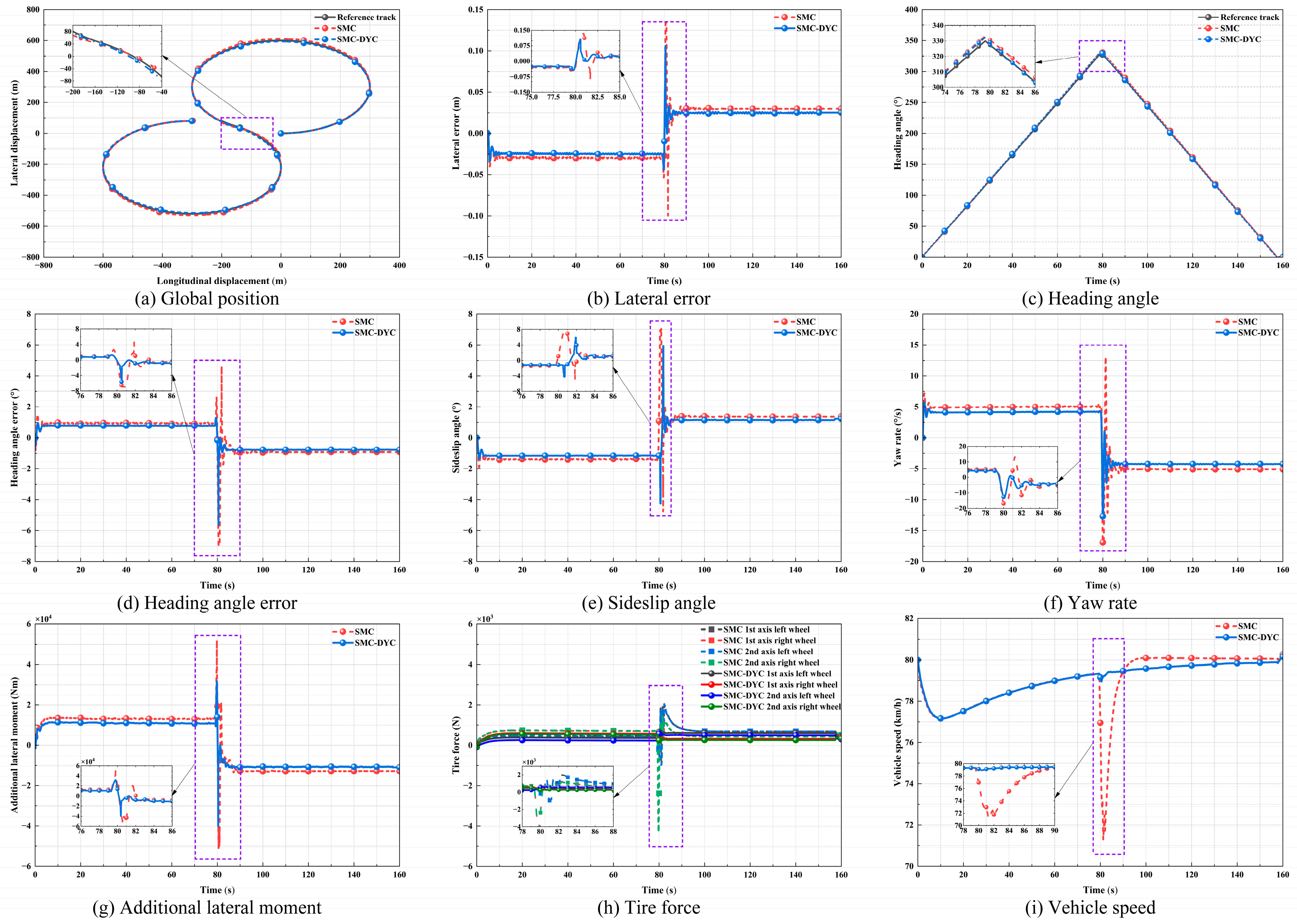
A complex “S”-shaped path (double-circle open-loop trajectory) has been designed for test condition 1, which corresponds to the scenario of complex continuous turning on actual roads. The simulation results are presented in Figure 14.
As shown in Figure 14a, both SMC and SMC+ DYC yield tracking trajectories that are almost indistinguishable from the reference over the entire global maneuvering range, thereby achieving stable tracking of the S-shaped path. Notably, SMC+ DYC exhibits a tighter adherence to the reference, indicating a stronger capability to suppress lateral deviations under rapid curvature variations. Figure 14b,d depict the time histories of the lateral position error and heading-angle error, respectively; SMC + DYC eliminates the lateral error within a shorter transient, with the peak lateral error occurring at t = 80 s and limited to 0.105 m, which is markedly lower than that of SMC, while the steady-state error approaches zero. In terms of heading regulation, SMC+ DYC also demonstrates improved steady-state retention and faster convergence, with a maximum heading-angle error of 5.8° at t = 80 s and a reduced oscillation amplitude compared with SMC, implying smoother and more accurate control during steering-angle changes; these benefits are primarily attributed to the sliding-surface design and the exponential reaching law, which jointly enhance transient responsiveness and robustness against model uncertainties and disturbances. The heading-angle tracking result in Figure 14c further confirms that both methods remain globally consistent with the reference profile; however, SMC exhibits noticeable lag and overshoot, whereas the SMC + DYC response is nearly coincident with the reference throughout the dynamic phase, evidencing a clear improvement in tracking accuracy and dynamic robustness. The centroid sideslip response in Figure 14e shows that SMC leads to larger sideslip fluctuations with a tendency toward reduced stability, while SMC + DYC effectively attenuates the sideslip variation by 14.29% and confines it within a smaller band, thereby providing superior handling stability. Figure 14f illustrates the tracking error of the yaw rate. The results indicate that SMC + DYC can achieve a faster response and smaller overshoot when the target angular velocity changes, with the amplitude reduced by 63.49%, effectively maintaining vehicle attitude stability. As indicated by Figure 14g, the additional yaw-moment response under SMC varies within a limited range and is insufficient for dynamic state compensation; in contrast, SMC + DYC regulates the yaw moment online through differential braking torque between wheels, enabling effective correction of vehicle motion during steering and maintaining close agreement with the reference path, which substantiates the pivotal role of DYC in improving yaw stability and tracking precision. The tire force distribution in Figure 14h shows that the force curves for each wheel under SMC + DYC are smoother, with smaller fluctuations and more frequent and precise adjustments. This reflects a higher control resolution and faster response in compensating for real-time dynamic imbalances. In contrast, the forces on each wheel under SMC exhibit noticeable jumps and delays in certain intervals, which may induce driveline shocks and degrade ride comfort and stability. Finally, the vehicle-speed response in Figure 14i indicates that SMC maintains a lower speed level, whereas SMC + DYC shows a mild speed drop to 77 km/h during steering followed by a smoother recovery to near the reference of 80 km/h in the steady phase, demonstrating that SMC + DYC achieves improved overall performance by jointly satisfying tracking accuracy, vehicle stability, and dynamic constraints.

4.2. High-Curvature Lane-Change Condition

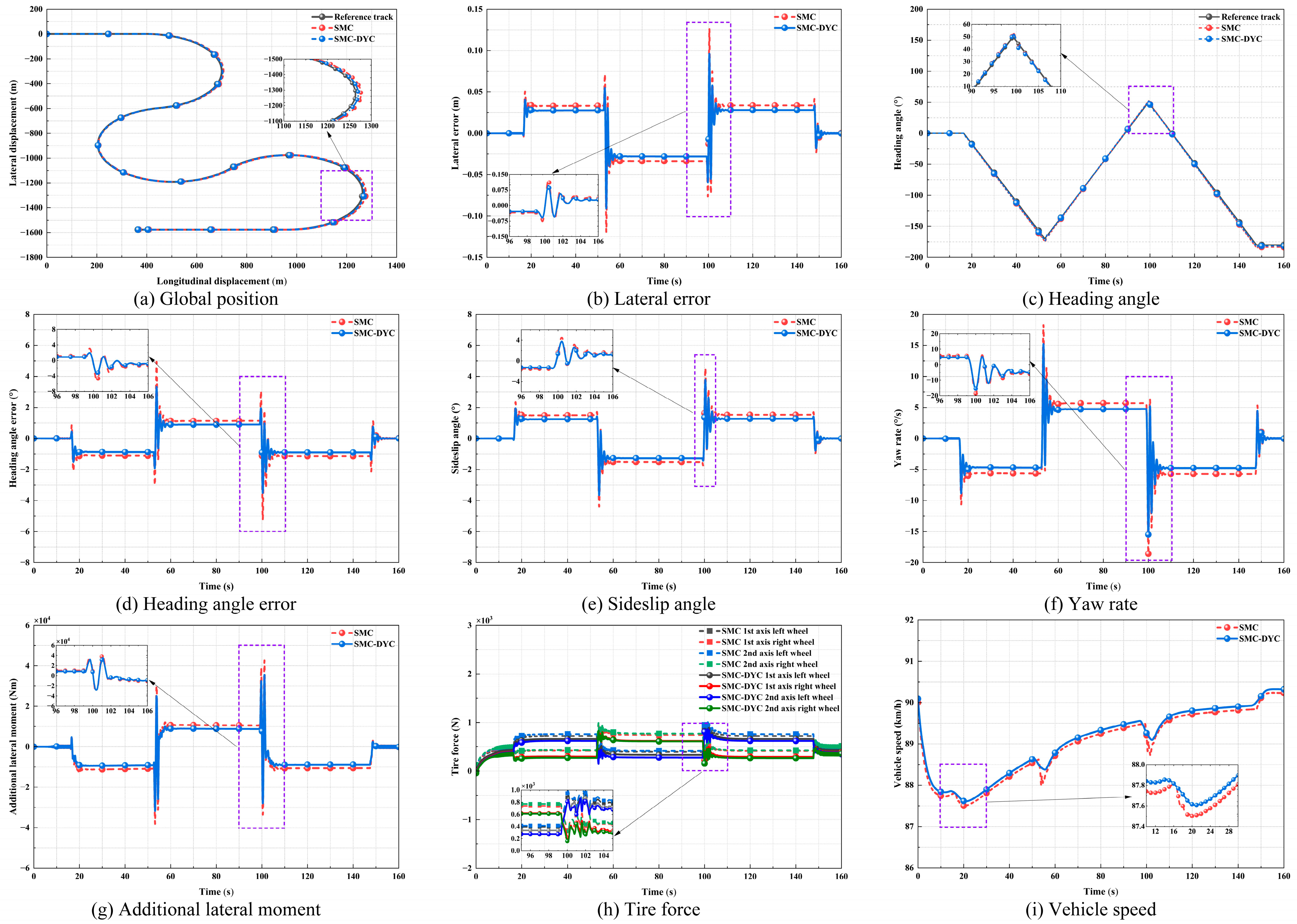
To evaluate the improvement in vehicle handling performance achieved by the DYC compensation strategy under extreme dynamic conditions, a second simulation scenario was established. In this scenario, a reference path consisting of multiple consecutive curves was designed, and complex variations in the desired yaw angle were introduced to construct a high-dynamic trajectory-tracking test condition. The corresponding simulation results are illustrated in Figure 15.
Figure 15a compares the global position trajectories of the vehicle under a large-curvature lane-change maneuver. It can be observed that, with or without the DYC compensation module, the vehicle is able to accomplish the path-tracking task; however, the SMC + DYC strategy achieves noticeably tighter trajectory conformity, where the DYC compensation substantially reduces lateral deviation at curvature-discontinuity points, enabling more accurate path following. Figure 15b illustrates the time evolution of the lateral tracking error: across all steering phases, SMC + DYC exhibits smaller error fluctuations and faster convergence, with the maximum deviation reduced by 23.02% relative to the baseline SMC controller, thereby confirming the effectiveness of the DYC module in compensating yaw-stabilization demands under highly dynamic cornering conditions. Figure 15c–e present the responses of the yaw angle, yaw-angle error, and centroid sideslip angle, respectively. The reference yaw profile in Figure 15c involves pronounced variations, posing a stringent challenge to the control system; nevertheless, SMC + DYC maintains higher tracking accuracy and smaller yaw overshoot during large-angle yaw transitions. As shown in Figure 15d, the SMC + DYC scheme confines the yaw-angle error within 3.5°and accelerates error decay, avoiding the error accumulation that can arise in uncompensated SMC under nonlinear disturbances. The centroid sideslip response in Figure 15e further indicates that, during the two steering events, the peak sideslip angle decreases from 4.6° (SMC) to 3.8° (SMC + DYC); by initiating compensation at the early stage of lateral slip development, SMC + DYC effectively suppresses sideslip growth and keeps the vehicle within a more stable and controllable regime. Figure 15f reports the yaw-rate responses under the two strategies, showing that SMC + DYC yields smaller oscillations and a faster settling process. The additional yaw moment applied by SMC + DYC in Figure 15g reacts promptly during yaw transients and exhibits an evident symmetric regulation pattern, reflecting active real-time stabilization and markedly improved adaptability to complex maneuvers. Figure 15h depicts the force curves of the four tires. During rapid state changes, SMC + DYC can more promptly coordinate the forces acting on the left and right wheels, generating more targeted and directional driving adjustments. It works in synergy with the additional yaw moment to correct the overall vehicle motion. The force conditions of each tire exhibit clear coordination and stronger dynamic consistency. Finally, Figure 15i shows that the SMC + DYC strategy induces a slight speed reduction at the beginning of the maneuver, followed by a gradual recovery to a steady level.

4.3. Single-Lane-Change Condition

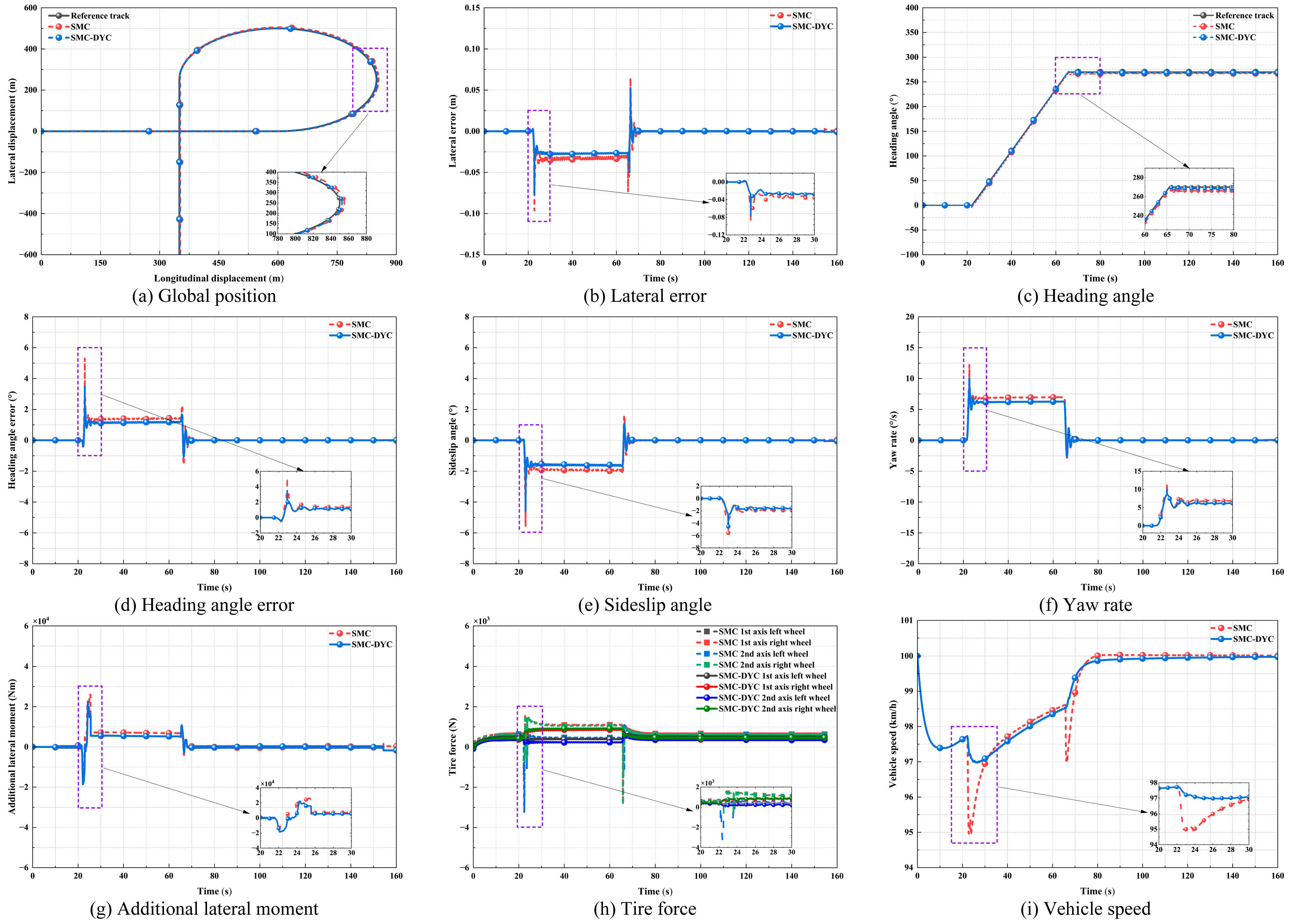
To further evaluate the control effectiveness of the DYC yaw moment compensation strategy under typical urban lane-change and steering scenarios, Scenario 3 was designed to include a representative single-sided, large-curvature lane-change path. This scenario is intended to simulate emergency lane-change maneuvers such as highway exits or obstacle avoidance, where the vehicle must accomplish a significant heading transition within a short time. Such conditions impose stringent requirements on both path-tracking accuracy and vehicle stability control. The simulation results are presented in Figure 16.
Figure 16a displays the tracking trajectory of the vehicle in the global position coordinate system. It can be seen that the SMC + DYC demonstrates stronger tracking capability and higher path-fitting accuracy in the large-curvature arc section, almost perfectly overlapping with the reference path. In contrast, the traditional SMC scheme shows noticeable deviations when entering the section with rapidly changing curvature, particularly experiencing a certain degree of yaw drift at the end of the path. Figure 16b further quantifies the lateral error, showing that the SMC + DYC strategy consistently keeps the lateral error within 0.076 m throughout the entire simulation period, with fast error convergence and more stable response. From the comparative analysis in Figure 16c–e, it is evident that the SMC + DYC hierarchical control strategy significantly outperforms the standalone SMC in terms of heading angle tracking accuracy, heading angle error control, and vehicle lateral stability. The SMC control exhibits lag during the heading angle tracking process, resulting in larger heading angle errors and poor convergence. After introducing DYC, the heading angle can rapidly follow changes in the reference value, with the error quickly decreasing and remaining within a small range. Meanwhile, the fluctuation of the centroid sideslip angle is significantly reduced, effectively enhancing the vehicle’s lateral stability. This indicates that DYC control plays a crucial role in improving trajectory tracking accuracy and vehicle stability. The reference heading angle design in Figure 16c features substantial variations, posing a high challenge to the control system. During the controller response process, the SMC + DYC scheme maintains higher tracking accuracy and smaller heading overshoot when dealing with large-angle heading switches. In Figure 16d, the SMC controller exhibits significant heading angle tracking deviations, particularly overshooting in the initial steering phase, with a maximum heading angle error of 5.3°. In contrast, the SMC + DYC scheme maintains a small error within 3.5° throughout the entire phase, effectively tracking the reference heading. Figure 16e shows the centroid sideslip angle response curve. The SMC + DYC controller, with a maximum peak of 4.8°, significantly suppresses the vehicle’s sideslip tendency. Due to the addition of the yaw moment control compensation mechanism, it intervenes in advance during the initial increase in the centroid sideslip angle, effectively delaying or even reversing the upward trend of the sideslip angle, ensuring stable vehicle driving conditions. In contrast, the SMC scheme responds relatively sluggishly to abrupt yaw changes, with a maximum peak close to 5.8°, resulting in large fluctuations in the centroid sideslip angle. Figure 16f shows the yaw rate response, indicating that the SMC + DYC strategy achieves smoother and more target-oriented yaw rate control, with a 20% reduction in the maximum amplitude, avoiding high-frequency oscillations caused by inertia or control lag. Especially during path steering angle changes, its control behavior is more “predictive,” contributing to improved vehicle steering sensitivity and trajectory stability. Figure 16g illustrates the response characteristics of the additional yaw moment generated by the DYC control module. The moment response precisely corresponds to the steering moment, swiftly applying additional moment when the vehicle enters large-steering conditions and actively unloading the compensation once the vehicle state stabilizes, effectively avoiding issues of over-control or moment residue, demonstrating the compensation strategy’s precision and adaptive capability. Figure 16h shows the force conditions of the four independently driven wheels. Under large-steering conditions, the SMC + DYC strategy enables more coordinated left-right wheel drive force regulation, thereby achieving overall vehicle lateral stability control. Figure 16i presents the vehicle speed variation curve over time. Under standalone SMC control, the vehicle speed generally remains at a relatively high level, ranging from 95 km/h to 100 km/h, but experiences certain fluctuations during steering and trajectory changes, indicating insufficient longitudinal dynamic adjustment capability. In contrast, under the SMC + DYC hierarchical control, although the vehicle speed slightly decreases initially, the overall speed remains within the range of 97 km/h to 100 km/h and gradually converges to a stable interval, enabling the vehicle to better maintain the target driving speed.

5. Discussion

Across the three high-speed large-curvature operating scenarios, as shown in Table 2, Table 3 and Table 4, the SMC + DYC method employed systematically reduces key trajectory tracking error parameters and stability parameters: the maximum lateral deviation is reduced by 19.23–23.02%, the maximum heading-angle error by 17.14–33.96%, the peak sideslip angle by 14.29–17.39%, and the peak yaw rate by 13.89–63.49%.Compared with PID control, which has poor adaptability under strong nonlinear vehicle operating conditions and finds it difficult to explicitly incorporate constraints and predict future behavior, as well as the LQR method, whose applicability is limited in scenarios with strong nonlinearity and complex curved paths due to its reliance on linearized models, the hierarchical control framework adopted in this paper introduces stronger robustness and faster error convergence characteristics through the upper-layer SMC, making it more suitable for large-curvature transient operating conditions. Although MPC methods (including robust tube-MPC, adaptive MPC, NMPC, FI-MPC, and speed-adaptive MPC) can explicitly handle multiple constraints and pursue optimality in a certain sense, their performance is often highly sensitive to model accuracy, tire force representation, and parameter tuning, and they involve a large amount of computation. When approaching limit handling operating conditions, issues such as reduced feasibility or weakened robustness may also arise. It should be noted that the method adopted in this paper also has certain limitations: On the one hand, SMC itself introduces chattering and relies on the setting or estimation of the uncertainty bound. On the other hand, when DYC generates yaw moments, it brings additional energy losses in engineering implementation and is limited by the capabilities and constraints of the braking actuators.

6. Conclusions

The present study has been devoted to addressing the problem of path tracking and yaw stability control for a distributed-drive four-axle heavy truck operating under high-speed and large-curvature cornering conditions. A hierarchical cooperative control strategy, integrating SMC with DYC, has been proposed. An accurate full-vehicle dynamic model and a corresponding drive constraint model were established, and a series of simulations were conducted on a co-simulation platform developed in TruckSim and Simulink. Through these simulations, the effectiveness and superiority of the proposed control strategy were systematically verified. The principal conclusions can be summarized as follows:
(1)
In terms of vehicle modeling, a comprehensive 12-degree-of-freedom full-vehicle dynamic model was developed in this study to describe the coupled longitudinal, lateral, yaw, and wheel rotational dynamics of the heavy truck. The model explicitly incorporates the effects of tire sideslip angles, slip ratios, and load transfer to more accurately capture real-world vehicle behavior. In addition, a multi-axle steering model based on Ackermann steering geometry, together with a tire force model considering load distribution, was established. These formulations provide a rigorous theoretical foundation for the precise design of the proposed control system.
(2)
With respect to the control strategy design, a hierarchical control architecture was established, in which the path-tracking and stability-control tasks were decoupled. In the upper control layer, the desired longitudinal velocity and yaw rate were generated in a closed-loop manner by means of an SMC approach integrated with a dual-PID mechanism. In the lower control layer, a DYC scheme was introduced, through which differential braking torques were distributed among the independently driven wheels to actively regulate the vehicle’s yaw response. By adopting this coordinated control structure, the robustness and coherence of the overall system were effectively enhanced under varying dynamic conditions.
(3)
In the aspect of simulation validation, three highly dynamic scenarios, namely S-shaped continuous steering, large-curvature lane changing, and single-lane-change maneuvers, were designed to comparatively evaluate the SMC and SMC + DYC strategies. It was observed that, under all tested conditions, the SMC + DYC scheme yielded superior trajectory-tracking performance, with the maximum lateral deviation being reduced by no less than 19.23%. Moreover, fluctuations in yaw rate and the peak values of the sideslip angle were effectively attenuated, indicating a marked improvement in the overall yaw stability of the vehicle. At the actuator level, a more coordinated distribution of driving and braking torques between the left and right wheels was achieved through the integration of DYC, which helped to alleviate sudden variations in tire load and driveline impact. As a result, energy consumption and speed-holding capability were improved without causing a noticeable reduction in vehicle velocity. In terms of robustness, the SMC controller was characterized by its inherent capability to accommodate modeling uncertainties and external disturbances. Meanwhile, the DYC mechanism, functioning as an auxiliary yaw-moment compensation layer, was found to enhance the system’s robustness when subjected to nonlinear trajectories, lateral slip, and high-dynamic cornering conditions, without introducing additional sensor requirements.
In summary, the SMC + DYC hierarchical control strategy proposed in this paper not only demonstrates excellent performance in trajectory tracking and attitude regulation but is also more suitable for meeting the autonomous driving requirements of distributed-drive electric heavy trucks in future complex traffic environments. Subsequent research can further integrate real-vehicle experimental platforms to conduct in-depth evaluations of the stability and real-time performance of the controller under the influences of factors such as sensor delays, motor dynamic responses, and variations in low-adhesion coefficients. Additionally, it can explore learning-based optimization methods for online tuning and adaptive adjustment of control parameters, aiming to achieve a higher level of intelligent decision-making and coordinated control.

Author Contributions

Conceptualization, Z.L. (Zhi Li); Data curation, Z.L. (Zhi Li); Funding acquisition, Z.L. (Zhi Li) and H.W.; Investigation, Z.L. (Zhouquan Li); Methodology, Z.L. (Zhouquan Li) and H.W.; Software, Z.L. (Zhouquan Li); Supervision, Z.L. (Zhen Liu) and H.W.; Visualization, Z.L. (Zhouquan Li); Writing—original draft, Z.L. (Zhouquan Li); Writing—review and editing, H.W., Z.L. (Zhen Liu), and Z.L. (Zhouquan Li). All authors have read and agreed to the published version of the manuscript.

Funding

This work Supported by the National Natural Science Foundation of China (Grant Nos. 52472405), Hubei Province Central Guiding Local Science and Technology Development Special Project (2024CSA081), Natural Science Foundation of Hubei Province (Grant Nos,2024AFB219, 2024AFD042, 2024AFD045), the Open Fund of Hubei Longzhong Laboratory (2024KF-22), and the Special Fund of Hubei Longzhong Laboratory of Xiangyang Science and Technology Plan.

Data Availability Statement

The original contributions presented in this study are included in the article. Further inquiries can be directed to the corresponding author.

Conflicts of Interest

The authors declare no conflict of interest.

Abbreviations

To facilitate readers’ better understanding of the meanings represented by the abbreviations and variables used in this paper, Abbreviations section below will provide detailed introductions to the abbreviations and variables appearing throughout the full text.
AbbreviationsFull form
SMCSliding Mode Control
DYCDirect Yaw Moment Control
PIDProportional–Integral–Derivative
LQRLinear Quadratic Regulator
MPCModel Predictive Control
FI-MPCFixed-Instant Model Predictive Control
NMPCNonlinear Model Predictive Control
AFS–DYCActive Front Steering–Direct Yaw Moment Control
12-dof12-degree-of-freedom
2-doftwo-degree-of-freedom
VariablesMeaningsUnits
0-xyzThe vehicle coordinate system
vxVelocity of mass center on x-axiskm/h
vyVelocity of mass center on y-axiskm/h
rSpin velocity of heavy truck around z-axis°/s
FxiLongitudinal ground force on i-th wheelN
FyiThe lateral ground force of the i-th wheelN
BThe wheel track of the heavy truckm
L1Distance between first and second axlesm
L2Distance from mass center to second axlesm
L3Distance from mass center to third axlesm
L4Distance between third and fourth axlesm
βThe sideslip angle of the center of mass°
hThe vertical height of the center of massm
The road slope°
mThe mass of the heavy truckkg
fThe rolling resistance coefficient
CdThe air-resistance coefficient
AThe frontal aream2
IzThe moment of inertia about the z-axiskg·m2
δiThe steering angles of each wheel°
FxwiLongitudinal forces on i-th wheelN
FywiThe lateral forces acting on the i-th wheelN
TiThe driving torqueN·m
TbiThe braking torqueN·m
TdiThe reaction torqueN·m
TfiThe rolling resistance torqueN·m
igThe transmission ratio
IwThe moment of inertia of the wheelkg·m2
wiThe angular velocity of the wheelrad/s
F1zwiStatic suspension force on each axleN
msThe sprung mass of the vehiclekg
KiThe suspension stiffness of each axleN/m
qiStatic deformation of every axlem
FzviThe static vertical load on each wheelN
aiThe sideslip angle°
SiThe slip ratio
rwThe tire radiusm
μThe road surface adhesion coefficient
vThe vehicle speedkm/h
C a The aerodynamic coefficient
M z The yaw momentN·m
kp, kI, kDThe parameters of the PID controller
vxdThe desired longitudinal velocitykm/h
rdThe desired yaw ratekm/h
ψ The yaw angle°
GwzThe steady-state gain of yaw rate
GβSteady-state gain of mass-center sideslip
F1l, F2l, F3l, F4lThe braking force on the left-side wheelsN
T1l, T2l, T3l, T4lBraking moment of left wheelsN·m
F1r, F2r, F3r, F4rThe braking force on the right-side wheelsN
T1r, T2r, T3r, T4rBraking moment of right wheelsN·m

References

  1. Artuñedo, A.; Moreno-Gonzalez, M.; Villagra, J. Lateral control for autonomous vehicles: A comparative evaluation. Annu. Rev. Control 2024, 57, 100910. [Google Scholar] [CrossRef]
  2. Xu, S.; Peng, H.; Tang, Y. Preview path tracking control with delay compensation for autonomous vehicles. IEEE Trans. Intell. Transp. Syst. 2020, 22, 2979–2989. [Google Scholar] [CrossRef]
  3. Zhang, X.; Zhu, X. Autonomous path tracking control of intelligent electric vehicles based on lane detection and optimal preview method. Expert Syst. Appl. 2019, 121, 38–48. [Google Scholar] [CrossRef]
  4. Wu, Y.; Wang, L.; Zhang, J.; Li, F. Path following control of autonomous ground vehicle based on nonsingular terminal sliding mode and active disturbance rejection control. IEEE Trans. Veh. Technol. 2019, 68, 6379–6390. [Google Scholar] [CrossRef]
  5. Chen, Z.; Pan, S.; Yu, K.; Tang, X.; Gao, W.; Zhou, Z. Dynamic Event-Triggered and Fast Natural Logarithmic Sliding Mode Path Tracking Control for Autonomous Ground Vehicles with the Experiment Validation. IEEE Trans. Veh. Technol. 2025, 74, 362–377. [Google Scholar] [CrossRef]
  6. Li, W.; Yu, S.; Lin, B.; Chen, H. Nonlinear model predictive control of trajectory tracking for autonomous trucks with terminal ingredients. Nonlinear Dyn. 2025, 113, 21383–21402. [Google Scholar] [CrossRef]
  7. Chu, D.; Li, H.; Zhao, C.; Zhou, T. Trajectory tracking of autonomous vehicle based on model predictive control with PID feedback. IEEE Trans. Intell. Transp. Syst. 2022, 24, 2239–2250. [Google Scholar] [CrossRef]
  8. Zhang, J.; Liu, C.; Zhao, J.; Liu, H. Research on Stability Control of Distributed Drive Vehicle with Four-Wheel Steering. World Electr. Veh. J. 2024, 15, 228. [Google Scholar] [CrossRef]
  9. Liu, H.; Sun, J.; Cheng, K.W.E. A two-layer model predictive path-tracking control with curvature adaptive method for high-speed autonomous driving. IEEE Access 2023, 11, 89228–89239. [Google Scholar] [CrossRef]
  10. Zhu, S.; Lu, J.; Zhu, L.; Chen, H.; Gao, J.; Xie, W. Coordinated Control of Differential Drive-Assist Steering and Direct Yaw Moment Control for Distributed-Drive Electric Vehicles. Electronics 2024, 13, 3711. [Google Scholar] [CrossRef]
  11. Lee, J.; Hwang, Y.; Choi, S.B. Robust tube-MPC based steering and braking control for path tracking at high-speed driving. IEEE Trans. Veh. Technol. 2023, 72, 15301–15316. [Google Scholar] [CrossRef]
  12. Li, C.; Jiang, H.; Yang, X.; Wei, Q. Path Tracking Control Strategy Based on Adaptive MPC for Intelligent Vehicles. Appl. Sci. 2025, 15, 5464. [Google Scholar] [CrossRef]
  13. Nan, J.; Shang, B.; Deng, W.; Ren, B.; Liu, Y. MPC-based path tracking control with forward compensation for autonomous driving. IFAC-PapersOnLine 2021, 54, 443–448. [Google Scholar] [CrossRef]
  14. Yu, Z.; Zhao, R.; Yuan, T. Lateral-Stability-Oriented Path-Tracking Control Design for Four-Wheel Independent Drive Autonomous Vehicles with Tire Dynamic Characteristics under Extreme Conditions. World Electr. Veh. J. 2024, 15, 465. [Google Scholar] [CrossRef]
  15. Meng, D.; Chu, H.; Tian, M.; Gao, B.; Chen, H. Real-time high-precision nonlinear tracking control of autonomous vehicles using fast iterative model predictive control. IEEE Trans. Intell. Veh. 2024, 9, 3644–3657. [Google Scholar] [CrossRef]
  16. Lee, J.; Choi, S. Nonlinear model predictive control for path tracking in high-speed corner entry situations. Int. J. Automot. Technol. 2022, 23, 1373–1381. [Google Scholar] [CrossRef]
  17. Teng, F.; Wang, J.; Jin, L.; Wang, Z.; Zhou, Z.; Liu, Z. Cooperative control strategy of trajectory tracking and driving stability for distributed-drive vehicle-s under extreme conditions. Control Eng. Pract. 2024, 147, 105905. [Google Scholar] [CrossRef]
  18. Zhang, L.; Zhang, Y.; Qi, B.; Zhang, X.; Zhao, M. Lateral stability control for distributed drive autonomous vehicle with extreme path tracking. Proc. Inst. Mech. Eng. Part D J. Automob. Eng. 2024, 239, 6288–6301. [Google Scholar] [CrossRef]
  19. Guan, L.; Liao, P.; Wang, A.; Shi, L.; Zhang, C.; Wu, X. Path tracking control of intelligent vehicles via a speed-adaptive MPC for a curved lane with varying curvature. Proc. Inst. Mech. Eng. Part D J. Automob. Eng. 2024, 238, 802–824. [Google Scholar] [CrossRef]
  20. Chen, S.-P.; Xiong, G.-M.; Chen, H.-Y.; Negrut, D. MPC-based path tracking with PID speed control for high-speed autonomous vehicles considering time-optimal travel. J. Cent. South Univ. 2020, 27, 3702–3720. [Google Scholar] [CrossRef]
  21. Liang, Y.; Li, Y.; Zheng, L.; Yu, Y.; Ren, Y. Yaw rate tracking-based path-following control for four-wheel independent driving and four-wheel independent steering autonomous vehicles considering the coordination with dynamics stability. Proc. Inst. Mech. Eng. Part D J. Automob. Eng. 2021, 235, 260–272. [Google Scholar] [CrossRef]
  22. Zhao, Y.; Chen, S.; Shim, T. Investigation of trailer yaw motion control using active front steer and differential brake. SAE Int. J. Mater. Manuf. 2011, 4, 1057–1067. [Google Scholar] [CrossRef]
Figure 1. Physical image of a distributed-drive four-axle heavy-duty truck.
Wevj 17 00010 g001
Figure 2. Distributed drive heavy-duty truck mechanical model.
Wevj 17 00010 g002
Figure 3. Distributed drive heavy-duty truck wheel force diagram.
Wevj 17 00010 g003
Figure 4. Static force diagram of distributed drive heavy-duty truck suspension.
Wevj 17 00010 g004
Figure 5. Ackermann steering model of distributed-drive heavy truck.
Wevj 17 00010 g005
Figure 6. μ = 0.5 v = 20 km/h.
Wevj 17 00010 g006
Figure 7. μ = 0.9 v = 90 km/h.
Wevj 17 00010 g007
Figure 8. μ = 0.5 v = 20 km/h.
Wevj 17 00010 g008
Figure 9. μ = 0.9 v = 90 km/h.
Wevj 17 00010 g009
Figure 10. Control block diagram.
Wevj 17 00010 g010
Figure 11. Schematic diagram of the vehicle planar dynamics model.
Wevj 17 00010 g011
Figure 12. Schematic diagram of the tire friction circle and its polygonal constraint approximation.
Wevj 17 00010 g012
Figure 13. Linear two-degree-of-freedom model.
Wevj 17 00010 g013
Figure 14. μ = 0.4 v = 80 km/h.
Wevj 17 00010 g014
Figure 15. μ = 0.5 v = 90 km/h.
Wevj 17 00010 g015
Figure 16. μ = 0.6 v = 100 km/h.
Wevj 17 00010 g016
Table 1. Vehicle Parameters.
ParametersValues
Total vehicle mass (m)12,200 (kg)
Sprung mass (ms)10,000 (kg)
Yaw moment of inertia around the z-axis (Iz)60,000 (kg·m2)
Track width (B)1.863 (m)
Distance from the centroid to the first axle (L1)1.3 (m)
Distance from the centroid to the second axle (L2)0.5 (m)
Distance from the centroid to the third axle (L3)0.85(m)
Distance from the centroid to the fourth axle (L4)1.35 (m)
Tire radius (Rw)0.51 (m)
The height of the vehicle’s centroid (h)1.2 (m)
Table 2. Performance indicators for trajectory tracking of “S”-shaped path.
Maximum Lateral DeviationMaximum Heading Angle
Error
Maximum Sideslip Angle at the Center of MassMaximum Yaw Rate
SMC0.13 m12.6°/s
SMC + DYC0.105 m5.8°4.6°/s
Decline Rate19.23%17.14%14.29%63.49%
Table 3. Trajectory tracking performance metrics under high-curvature lane-change conditions.
Maximum Lateral DeviationMaximum Heading Angle ErrorMaximum Sideslip Angle at the Center of MassMaximum Yaw Rate
SMC0.126 m5.2°4.6°18°/s
SMC + DYC0.097 m3.5°3.8°15.5°/s
Decline Rate23.02%32.69%17.39%13.89%
Table 4. Trajectory tracking performance metrics under the single lane-change scenario.
Maximum Lateral DeviationMaximum Heading Angle ErrorMaximum Sideslip Angle at the Center of MassMaximum Yaw Rate
SMC0.097 m5.3°5.8°12.5°/s
SMC + DYC0.076 m3.5°4.8°10°/s
Decline Rate21.65%33.96%17.24%20%
Disclaimer/Publisher’s Note: The statements, opinions and data contained in all publications are solely those of the individual author(s) and contributor(s) and not of MDPI and/or the editor(s). MDPI and/or the editor(s) disclaim responsibility for any injury to people or property resulting from any ideas, methods, instructions or products referred to in the content.