1. Introduction
Faced with the midst of the Artificial Intelligence (AI) and digitalization revolution, the construction industry is one of the key areas for industrial digitalization. Among these, autonomous vehicles can replace workers in performing repetitive, high-load, and high-risk mobile tasks, such as transporting construction materials, laying materials, and cleaning, thereby effectively shortening the construction lifecycle and driving the digitalization and intelligent upgrading of the construction industry [
1]. Reliable localization in large-scale outdoor environments is the foundation for the stable operation of autonomous or semi-autonomous mobile unmanned vehicles. However, a single sensor typically cannot meet the on-site localization accuracy requirements of unmanned vehicles. If reliance is solely on measurement feedback from odometry, mobile unmanned vehicles will experience cumulative errors, leading to increasing movement deviations over time, and the limited environmental data obtained is insufficient for mobile operations. If only LiDAR is used to obtain pose information, sudden changes in environmental noise, LiDAR noise, and algorithm matching errors can lead to significant localization errors in the vehicle. Therefore, designing a multi-sensor fusion localization system to achieve on-site localization for unmanned vehicles is a comprehensive solution to explore.
The current mainstream localization technologies for autonomous vehicles primarily include: Simultaneous Localization and Mapping (SLAM) technology [
2]; multi-sensor fusion localization technology [
3]; GPS localization technology [
4]; ultrasonic navigation localization technology [
5], among others. Among these, feature-based matching methods in SLAM can accurately determine the spatial relationships between autonomous vehicles, such as the ICP algorithm and its variants. However, these methods must address issues such as noise interference in point cloud data, incomplete information, and uneven sampling density [
6]. Filter-based techniques can rapidly and effectively estimate the state of unmanned vehicles, just as the Finite Impulse Response (FIR) structure state estimator and Generalized Minimum Variance FIR (GMVF) filter are developed [
7,
8]. Additionally, the Kalman filter is commonly applied in target tracking and localization, and it is regarded as the optimal linear state estimator. The nonlinearity of the system model limits the effective application of the Kalman filter, leading to the development of EKF and unscented Kalman filter (UKF) for nonlinear models [
9,
10,
11]. The EKF introduces the concept of linearization based on the classical Kalman filter, making it more suitable for solving nonlinear models. The UKF provides accurate estimates for nonlinear systems under ideal conditions, but modeling errors may accumulate, which typically leads to filter divergence. State estimation methods based on Gaussian approximation have gained increasing attention due to their advantages of good estimation accuracy, moderate computational complexity, and ease of implementation [
12]. Pak designed an extended MVF filter and combined it with Horizon Group Shift (HGS) to form the HGS-FIR filter [
13]. Compared to the UKF, the HGS-FIR filter takes 60 times longer to compute the estimated values and has weaker resistance to external noise interference. To overcome the design flaws of the HGS-FIR filter, the TLNF filter and the fused TLNF/UK filter are further designed [
14]. To enhance the real-time positioning performance of unmanned vehicles, the integrated Global Positioning System (GPS) and Inertial Measurement Unit (IMU) navigation scheme serves as the fundamental positioning solution. However, in GPS-denied environments such as urban canyons, this method suffers from significant cumulative errors. Meanwhile, LiDAR-based SLAM can achieve positioning and mapping without GPS, yet it involves high costs and demands substantial computational resources for processing feature-rich point clouds. Although visual SLAM offers a low-cost alternative for positioning, it is prone to failure in outdoor settings with poor lighting or insufficient texture details. Therefore, adopting a multi-sensor fusion positioning approach can improve rapid localization and robustness for unmanned vehicles in outdoor environments.
The localization performance of outdoor autonomous vehicles is closely related to the measurement values of sensors, which are susceptible to various external interferences, faults, and attacks, such as false measurements, missing measurements, delayed measurements, and non-Gaussian measurement noise. Developed for autonomous vehicle steering systems, a fault-tolerant path-tracking controller utilizing static output-feedback and linear parameter varying techniques is presented [
15]. Its operational framework employs dual-mode coordination between steering and torque-vectoring control to preserve vehicle stability in the presence of steering actuator gain faults. Among them, Intentional Electromagnetic Interference (IEMI) comprises the conducted interference and radiated interference [
16]. Conducted interference infiltrates vehicular electronic systems through physical conductors such as power lines and communication cables, while radiated interference involves attackers projecting high-frequency electromagnetic waves toward vehicles from a distance via directional antennas or high-power electromagnetic pulse devices. These emissions can couple into critical sensor systems and Controller Area Network (CAN) bus lines of unmanned vehicles. The specific impacts manifest as follows: IEMI can induce sensor failure across multiple modalities. In LiDAR systems, strong electromagnetic noise generates substantial artifacts in point cloud data, potentially causing complete distortion; for imaging sensors, electromagnetic saturation may produce entirely white or streaked output frames; regarding high-precision GPS/IMU integrated navigation systems, electromagnetic interference directly disrupts high-frequency circuitry and signal reception, leading to significant positioning deviations or complete navigation failure. Concurrently, IEMI induces communication interruptions and protocol violations in CAN. Furthermore, when IEMI power exceeds electronic components’ tolerance thresholds, it can cause thermal breakdown or electrical overstress damage to sensor chips, main processors, and power components. The Minimum Mean Square Error (MMSE) criterion is employed in state estimation using nonlinear Kalman filters, and a Huber–Kalman filter (HKF) that suppresses outliers in both the system and observation data is proposed [
17]. The robust Student’s t-based Kalman filter (RSTKF) utilizes the Student’s t-distribution to model heavy-tailed non-Gaussian noise, thereby generating robust posterior estimates [
18]. Additionally, Information Theory Language (ITL) [
19] has been applied to counteract non-Gaussian noise, incorporating metrics such as the Maximum Correntropy Criterion (MCC) from ITL into adaptive filtering theory to capture higher error statistics. Replacing the MMSE criterion in the Kalman filter with the MCC, the maximum correntropy Kalman filter (MCKF) [
20] and the maximum correlation entropy unscented Kalman filter (MCUKF) [
21,
22,
23] are also developed for combating non-Gaussian noise.
For the uncertainty noise data generated by multiple sensors of autonomous vehicles, a line feature SLAM algorithm is combined with EKF, and the EKF is used to estimate the robot’s position state [
24]. The UKF is combined with Pedestrian Dead Reckoning (PDR) to fuse the results of Wi-Fi localization, which achieved localization results superior to those obtained by the single sensor of Wi-Fi or PDR [
25]. A Kalman filter algorithm based on the maximum entropy correlation criterion is proposed and applied to address the issue of non-Gaussian distribution data in UWB indoor localization under complex environmental conditions [
26]. The BIM-based indoor navigation using end-to-end visual localization and ARCore is proposed, which enhances robot localization through BIM’s map [
27].
Based on the above, although existing research has made progress in improving the accuracy and robustness of outdoor positioning for unmanned vehicles, further exploration is still required to achieve a balance between high performance and low cost while maintaining reliable positioning performance in construction scenarios characterized by GPS signal obstruction and lack of natural features. In addition, the large-scale outdoor environments typically feature uneven terrain, which can cause autonomous vehicles to slip, resulting in significant discrepancies between the odometry-measured speed and the actual speed. Therefore, it is essential to realize the fusion estimation by LiDAR and odometry. In our paper, the term “large-scale” primarily refers to the fact that the working area for outdoor material handling tasks is substantially larger than the structural dimensions of the unmanned vehicle itself, and the vehicle must move to complete the transportation tasks. The term “large-scale” herein does not carry a strict quantitative value. Additionally, the Kalman filter, as a mature probabilistic localization technique, significantly reduces the interference of various uncertainty errors while ensuring computational efficiency and minimal memory usage, thereby enhancing localization accuracy and real-time performance. Therefore, in conjunction with outdoor material handling tasks, this paper proposes LiDAR sensors and odometry to design a localization optimization system for an unmanned vehicle based on an extended Kalman filter in an outdoor construction environment.
The main innovations of this paper are as follows:
- (1)
Due to the mixed features of the large-scale construction environment that are difficult to identify and extract effectively, this paper proposes an artificial landmark to build the construction map, which realizes on-site localization of the unmanned vehicle based on the landmark map.
- (2)
Considering the rapid and robust localization performance of on-site, the paper provides an extended Kalman filter framework to combine the current pose of the unmanned vehicle by odometry information, and the ICP algorithm is adopted to match the current landmark feature with that scanned at the previous moment.
- (3)
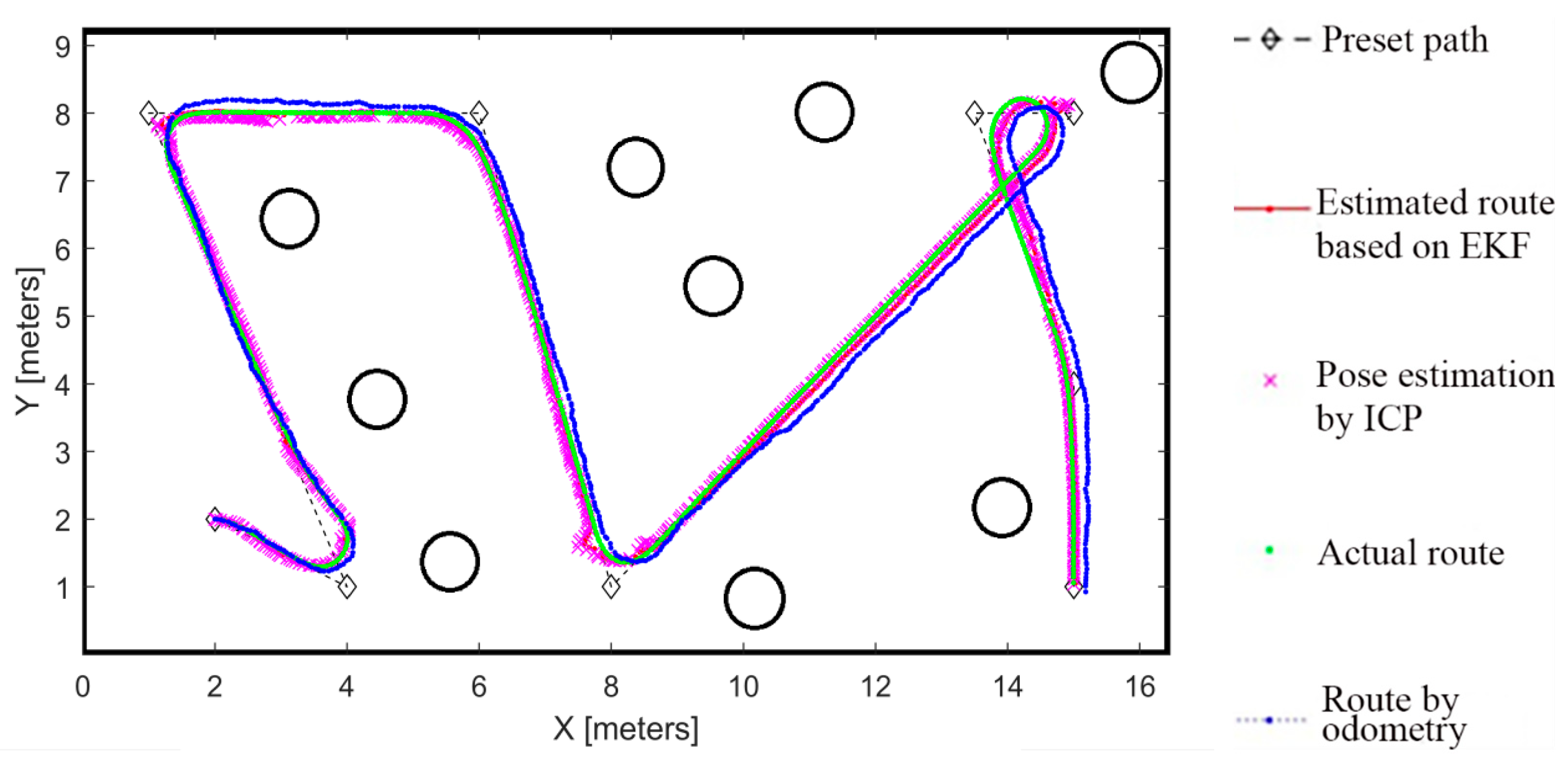
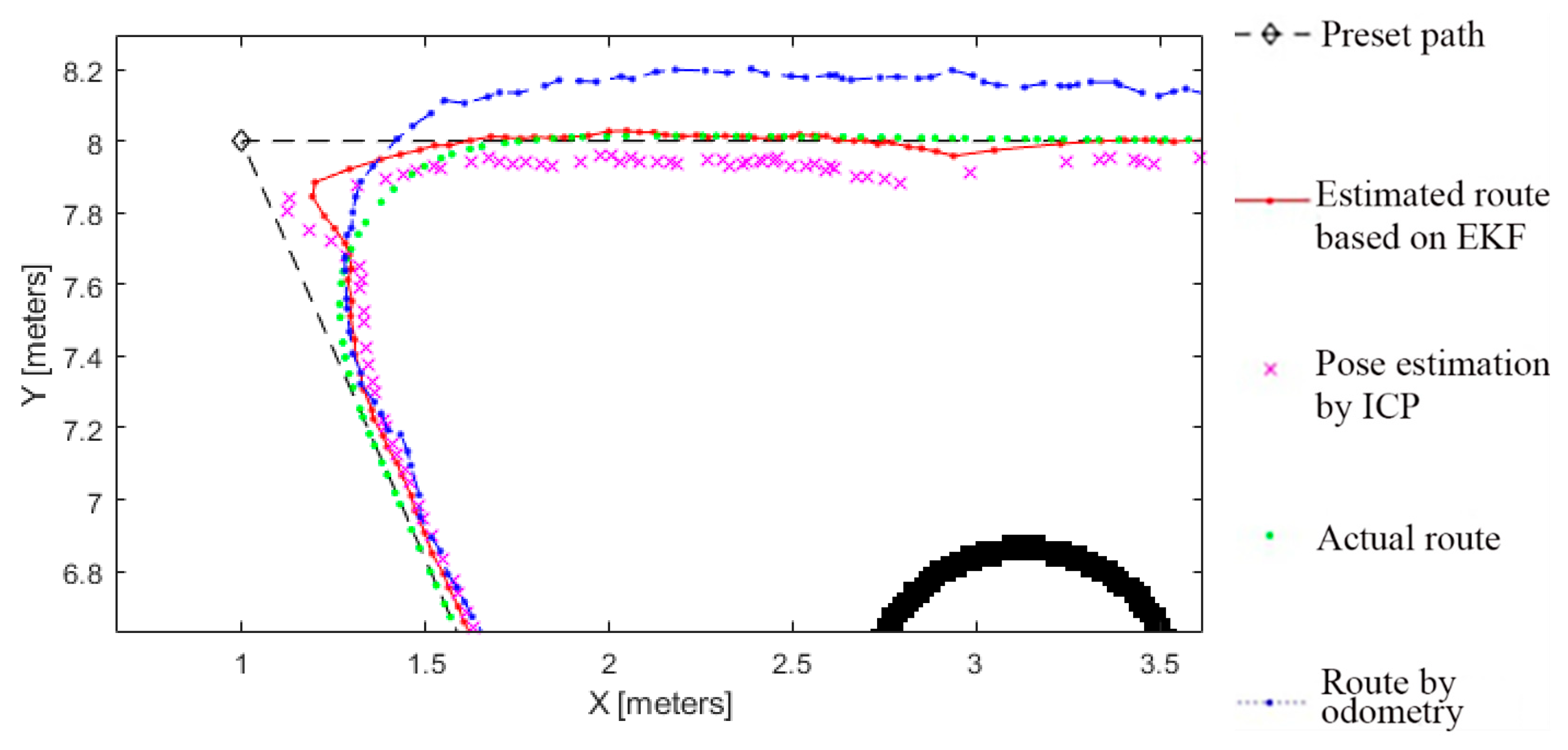
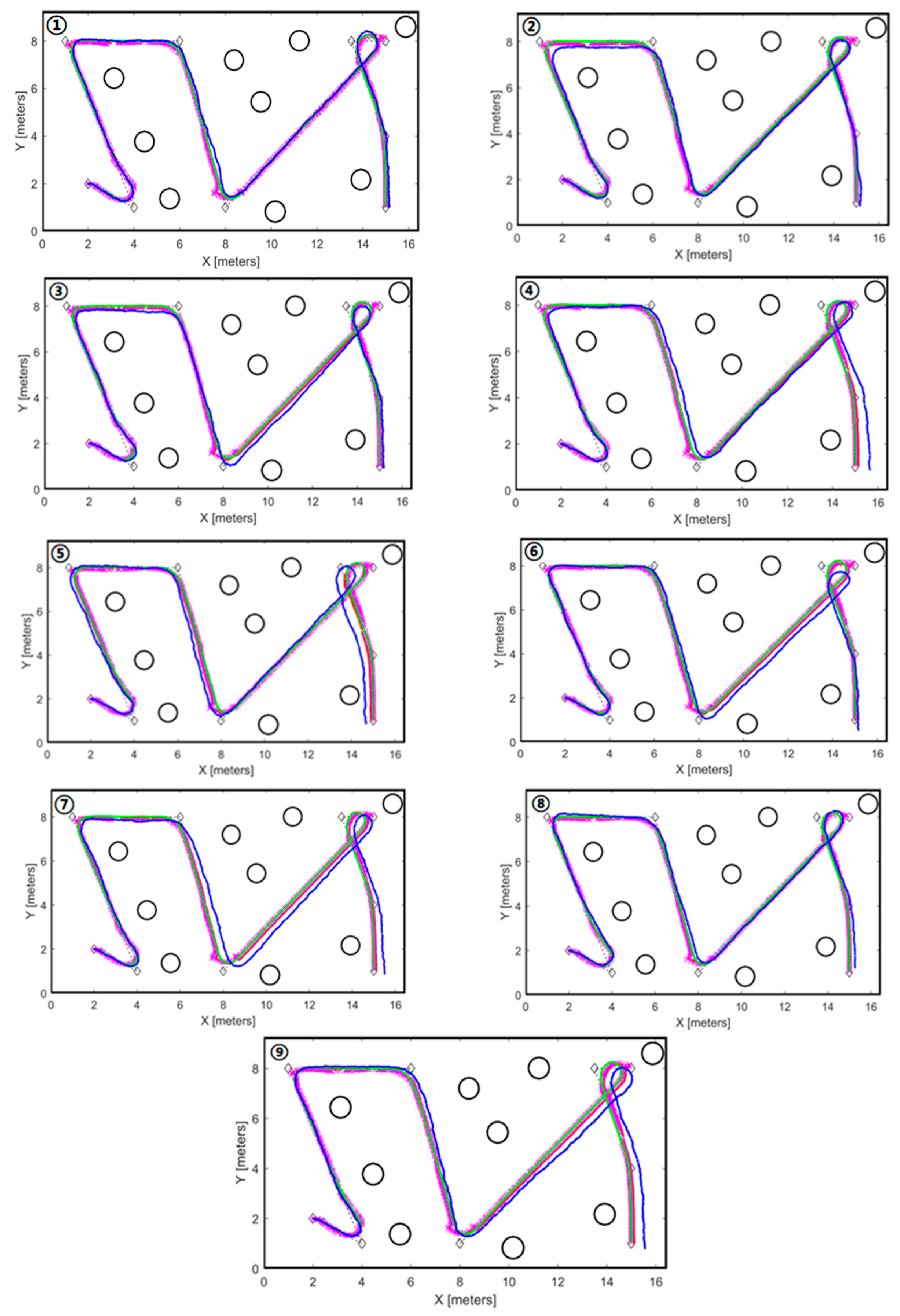
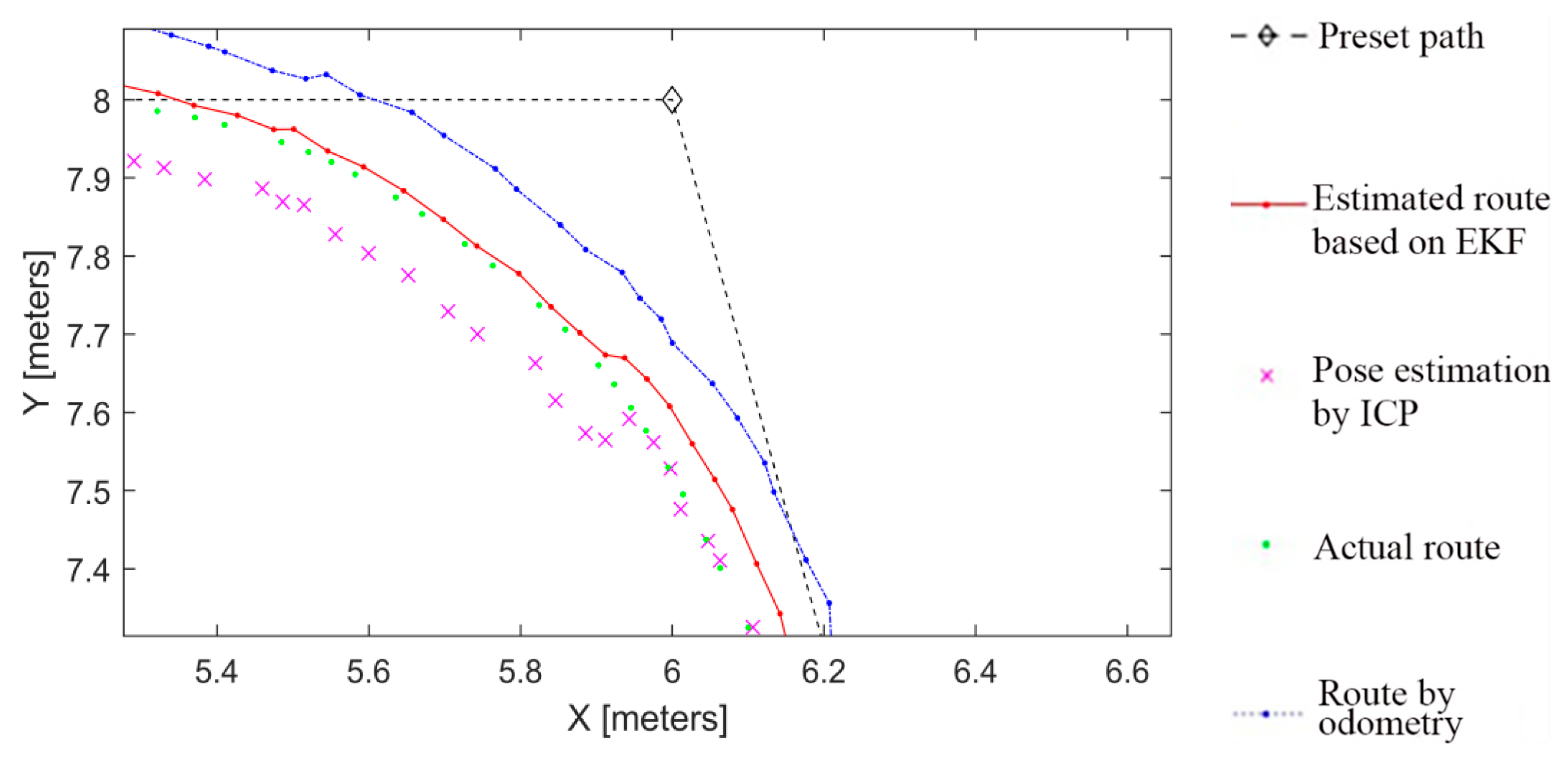
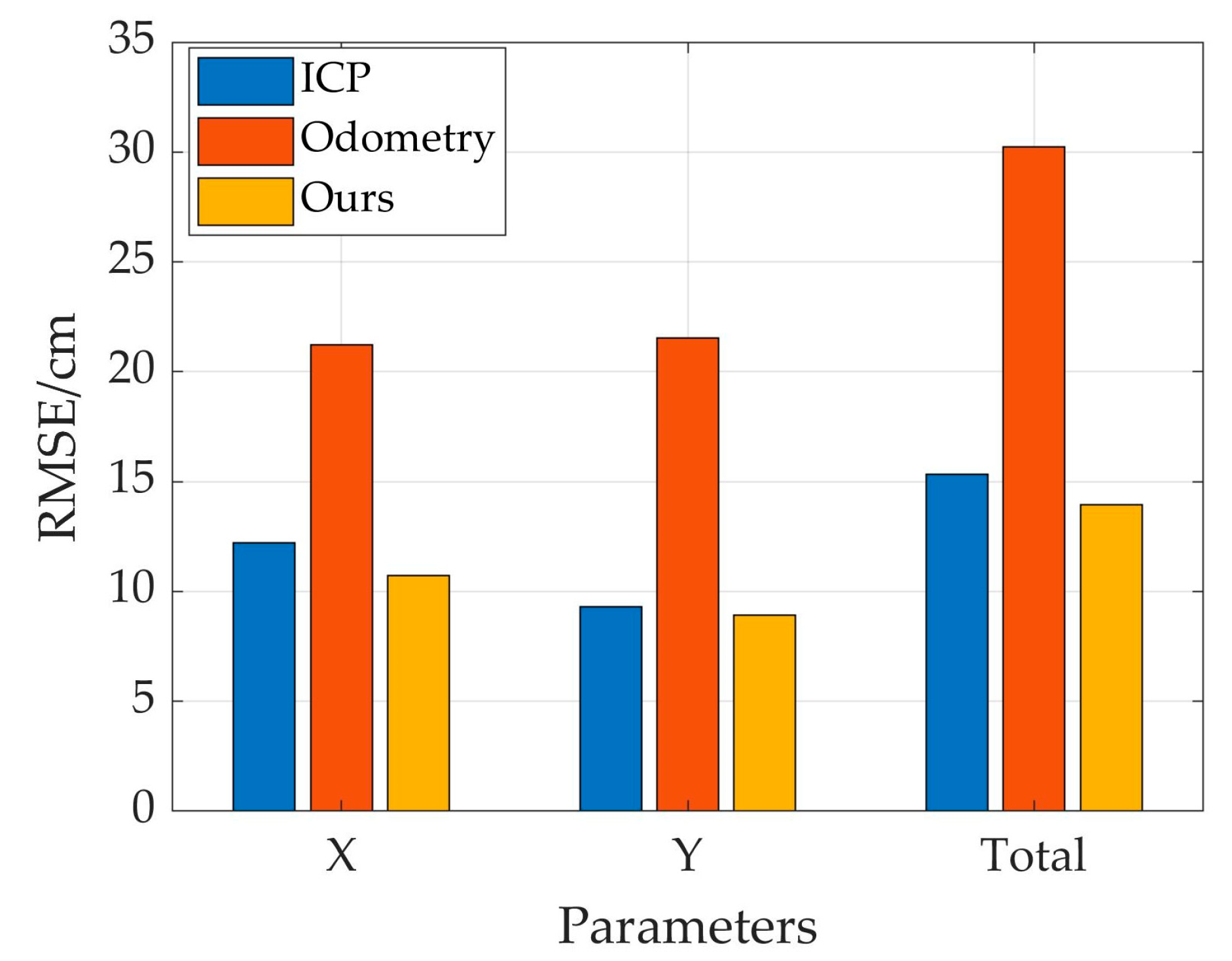
Simulation experiments were conducted to validate the fused localization solution of an unmanned vehicle based on the operational path that considers the flatness of the on-site environment, and the results from odometry, ICP matching, and EKF-fused methods are obtained and compared.
The remainder of this paper is organized as follows:
Section 2 provides model descriptions of the environment map and the unmanned vehicle.
Section 3 describes the on-site localization methods of unmanned vehicles based on an improved framework of the EKF algorithm.
Section 4 presents the simulation experiments and discusses the results. Finally, the conclusion and future work are presented in
Section 5.
2. Model Descriptions
For the outdoor handling tasks, unlike indoor service robots, unmanned vehicles rely heavily on good localization performance, which is crucial for them to perform tasks efficiently and accurately in outdoor environments. Considering that the operating areas in outdoor scenarios have obvious undulations and complex time-varying characteristics, it is difficult for unmanned vehicles to extract effective environmental features for localization.
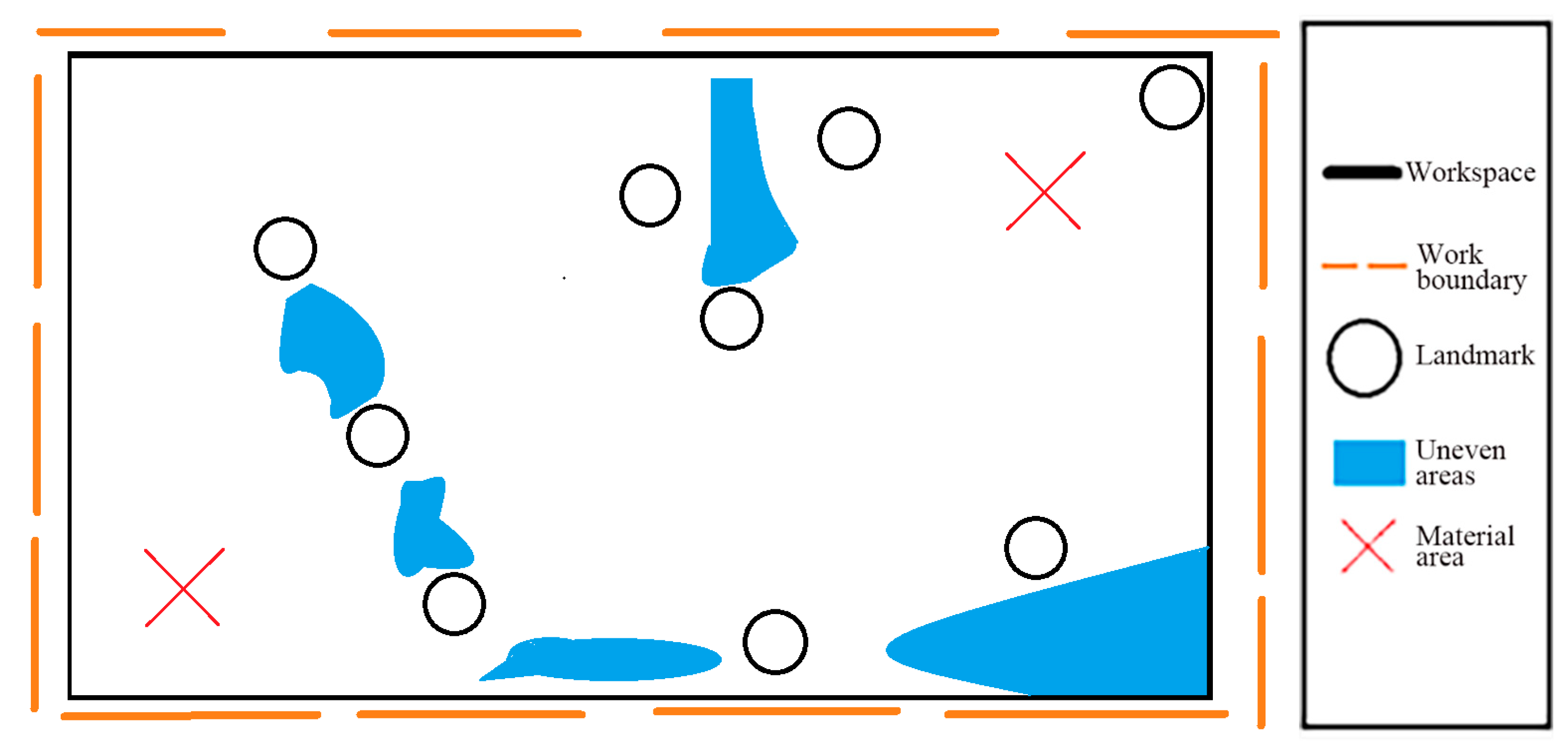
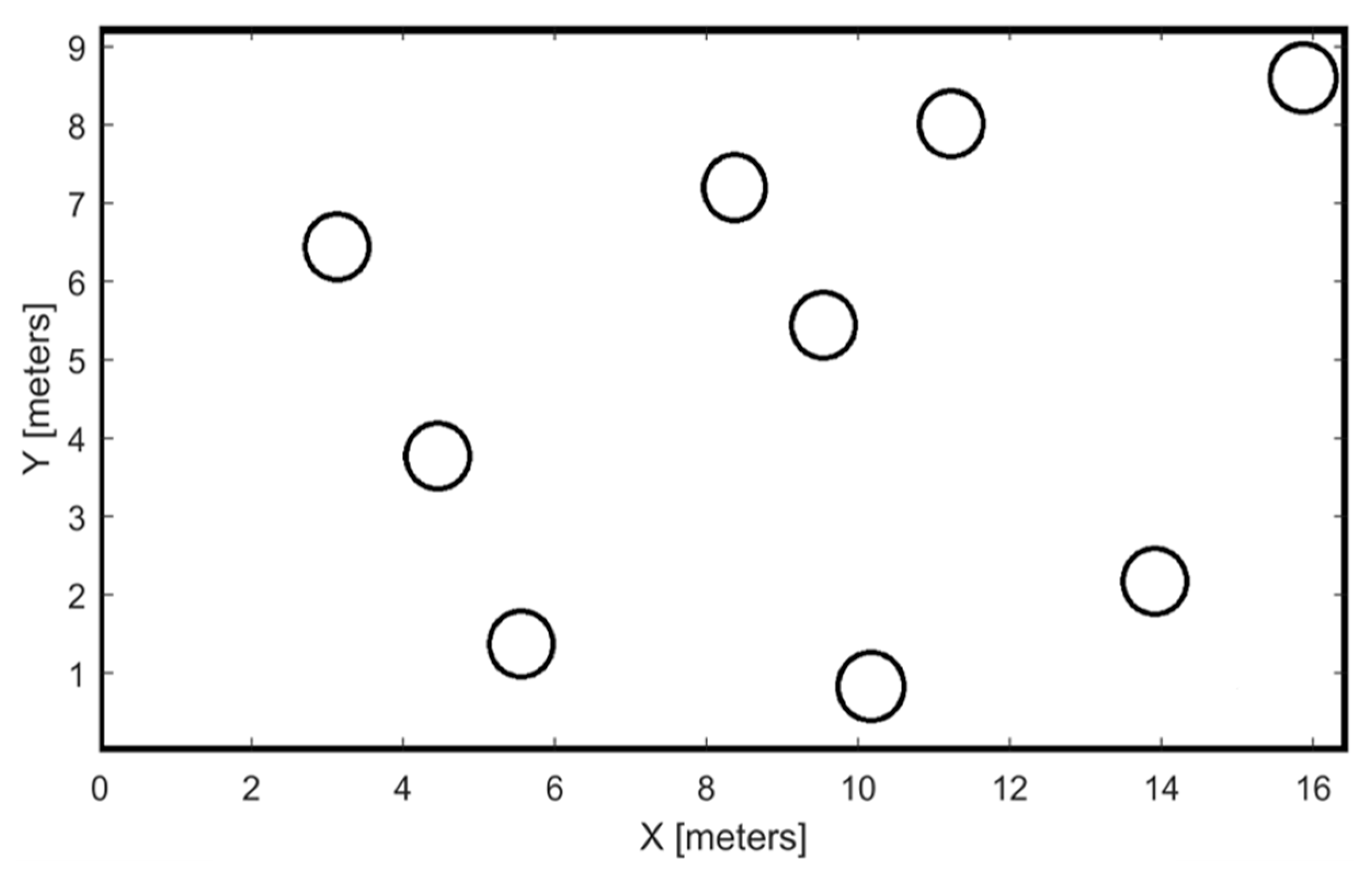
This makes the method based on landmark arrangement a simple and reliable solution. Specifically, on-site localization of the unmanned vehicle is achieved by arranging artificial landmarks on-site and extracting data through LiDAR scanning, and the specific operating environment is shown in
Figure 1.
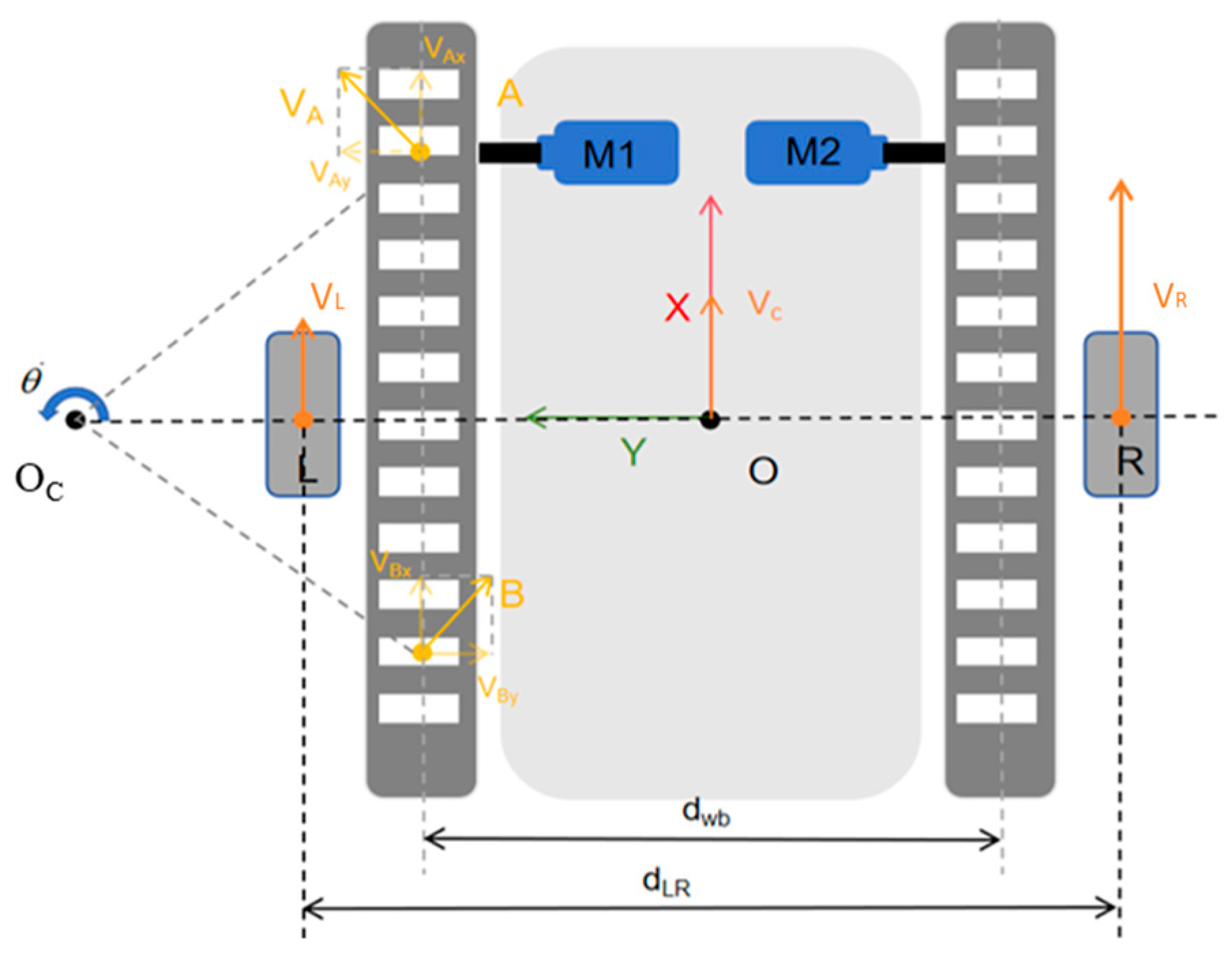
In this paper, the tracked unmanned vehicle is simplified into the motion model of a two-wheeled differential drive robot, where
and
represent the linear velocities of the left and right wheels, respectively;
dLR denotes the wheel spacing, and
rC and
VC represent the rotation radius of point O and total velocity of vehicle, which are shown in
Figure 2.
Taking O-O
L as the horizontal axis and the
X-axis as the vertical axis, the positions of the equivalent virtual left and right wheels are at points L and R, respectively. By calculating the velocity of center O through the velocities of the left and right driving wheels, the forward kinematics model of the unmanned vehicle can be obtained as follows:
By decomposing the velocity of the centroid O, the velocities of the left and right driving wheels are derived, and the inverse kinematics model is simplified as follows:
Since the distance between the equivalent left and right wheels (denoted as
) of the unmanned vehicle is not necessarily equal to the actual distance between the two tracks, and
is dynamically variable, a dimensionless parameter
is introduced. Through derivation, the virtual wheel spacing
can be expressed as:
where
represents the wheel spacing of the unmanned vehicle;
is the coefficient of the wheel spacing, which is related to the relative friction coefficient between the unmanned vehicle’s tracks and the ground, total load, turning radius, and centroid position.
Thus, the forward kinematics model of the unmanned vehicle can be obtained as:
The inverse kinematics model is as follows:
Finally, the system state equation of the unmanned vehicle can be derived from the linear velocity and angular velocity as follows:
where parameter
is a state vector containing the displacement in the
x-axis direction, the displacement in the
y-axis direction, the angle
r, and the linear velocity
v; the parameter
dt is the time interval for sensor data acquisition, and the parameter
represents the process noise vector of the system.
3. Localization Framework of Unmanned Vehicle in Large-Scale Outdoor Environment
The research object is an unmanned vehicle equipped with a 2D LiDAR and odometry, and the global landmark map and initial pose information of the unmanned vehicle are also known. Based on the global point cloud map, the unmanned vehicle can scan the current local map in real time and match it with the global map to obtain the current pose of the robot. It is assumed that the initial pose of the unmanned vehicle satisfies the rough matching condition of the ICP algorithm, which avoids the matching from falling into a local optimal solution, and the transformation matrix for each subsequent frame of ICP is derived from the previous frame.
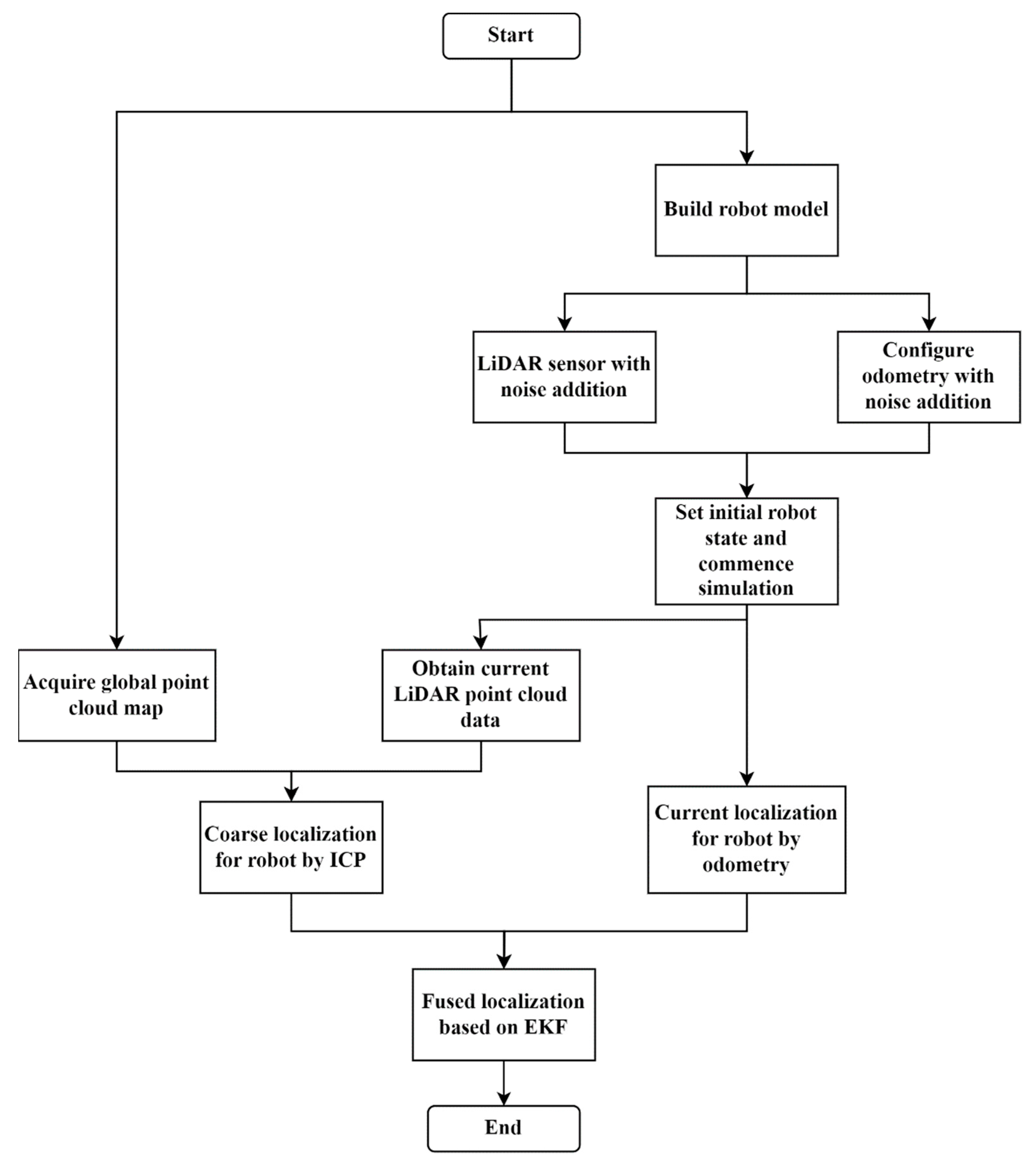
Therefore, this paper proposes an improved Kalman localization optimization scheme based on the fusion of LiDAR and odometry. The specific global localization optimization framework flow of the unmanned vehicle is shown in
Figure 3. First, the current XOY coordinate position and angle
r of the robot are calculated based on the odometry. Considering the existence of cumulative errors in long-term odometry measurements, the reliability of the pose information fed back by the odometry will decrease, which is corrected and compensated for by the LiDAR measurement results. Meanwhile, with time frames as the unit, each time frame is designed to have an interval of 0.1 s, and each frame includes odometry information collection, point cloud information from LiDAR, point cloud matching based on ICP, and localization results from the improved Kalman filter, to obtain the optimized pose of the robot in each time frame in real time. In the improved Kalman filter framework, a prediction model is established to enable the prediction and estimation of the pose from the previous frame to the current frame. Then, the pose information (X, Y) from odometry and the fused pose results of the x and y axes matched by the ICP algorithm are used as the optimized estimation results of the current frame, which are applied to the prediction and estimation of the next frame.
3.1. Localization of Unmanned Vehicle Based on Feature Matching of Artificial Landmarks
The rough localization of the unmanned vehicle is realized based on the ICP matching algorithm, that is, to solve the transformation matrix T that minimizes the distance between the target point cloud and the source point cloud . The source point cloud is the local point cloud information acquired by the laser radar, and the target point cloud is the global point cloud map, so , and the relationship between target point cloud Q and source point cloud P before matching is , thus obtaining . Then, the corresponding homogeneous transformation matrix T (Rotation matrix R, Translation matrix t) can be solved based on the parameters and .
Also, the objective function of the point cloud matching error can be obtained as:
where the parameter
n represents the number of point clouds acquired by the laser radar, and it belongs to [1, N
p].
The basic matching steps of the specific ICP algorithm are as follows:
- (1)
Take the source point cloud P, denote its point cloud set as , and detect potential landmark arc feature points;
- (2)
Generate a descriptor for each feature point, and obtain the subset in the target point cloud Q that satisfies ;
- (3)
Take and as input quantities, and obtain the rotation matrix R and translation matrix t that minimize E(R,t) through the similarity of feature vector matching;
- (4)
Obtain a new point cloud set
based on the rotation and translation matrices
R and
t;
- (5)
Calculate the average distance from to again;
- (6)
When the average distance is less than the set threshold or the number of iterations exceeds the maximum set number of iterations, stop the iteration, jump out of the loop, and output the current transformation matrix;
- (7)
When the condition in step 6 is not met, return to step 2 and continue the iteration.
3.2. Optimization of Localization for Unmanned Vehicle by an Improved Kalman Filter
The extended Kalman filter algorithm, as an improved filtering method for nonlinear systems, has state-space equations that can be expressed as:
where
and
are the nonlinear function equations, respectively;
and
represent normal distributions with an expected value of 0;
Qc and
Rc are the a priori process noise and a priori measurement noise of the covariance matrix, respectively;
represents the measurement of point cloud features of artificial landmarks acquired by LiDAR; and the nonlinear function
computes the theoretical coordinates of the landmarks observed from the vehicle’s pose
and
which represent the additive measurement noise of the LiDAR system.
However, the calculation of the nonlinear model is complex and time-consuming. To improve the on-site performance of the unmanned vehicle, this paper solves the nonlinear model through a linearization method. It is assumed that when linearizing at
, the higher-order terms in the series expansion are ignored, and the error
near the point
is set to 0. Thus, at time k, the nonlinear functions
f() and
h() are expanded in a first-order Taylor series, and the posterior state estimate
after ignoring the higher-order terms is used to obtain an approximate linearized model as follows:
where
and
are the Jacobian matrices obtained by differentiating the function f with respect to the parameters x and w at time k + 1, respectively.
Finally, the nonlinear EKF algorithm is transformed into the classic Kalman filtering algorithm for calculation, and the state estimation value X[k+1] at the next moment k + 1 is predicted through the prediction and update steps. The specific implementation process is as follows:
Initialize the initial values of parameters, mainly including the initial state estimation value and the covariance matrix of the initial state estimation error.
Calculate the a priori state estimation:
Then, calculate the corresponding Jacobian matrices
and
, and the specific equations are:
Based on the covariance matrix
of the previous state estimation error and the Jacobian matrix calculated from the process noise matrix
, the covariance matrix
of the a priori state estimation error can be obtained:
At the same time, its Jacobian matrix is calculated as:
The calculation of the Kalman gain can be obtained as:
The calculation of its posterior state estimation is:
Update the covariance of the state estimation error, and the specific equation is depicted as: