


You are currently viewing a new version of our website. To view the old version click .

Pharmaceutics, Volume 14, Issue 11

November 2022 - 291 articles

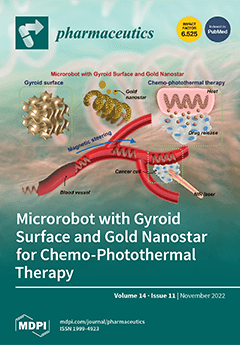
Cover Story: Microrobots for precise synergistic drug delivery and controlled release have attracted attention over the past decade. A high surface area of the microrobot is desired to achieve greater therapeutic effect by increasing the drug load. Therefore, various nano or microporous microrobot structures have been developed to load more drugs. However, as most porous structures are not interconnected deep inside, the drug-loading efficiency may be reduced. Here, we propose a magnetically guided helical microrobot with a gyroid surface for high drug-loading efficiency and precise delivery. All spaces inside the proposed microrobot are interconnected, thereby enabling drug loading deep inside the structure. Moreover, we introduced gold nanostars on the microrobot structure for near-infrared-induced photothermal therapy and triggering drug release. View this paper
  • Issues are regarded as officially published after their release is announced to the table of contents alert mailing list .
  • You may sign up for email alerts to receive table of contents of newly released issues.
  • PDF is the official format for papers published in both, html and pdf forms. To view the papers in pdf format, click on the "PDF Full-text" link, and use the free Adobe Reader to open them.

Articles (291)

  • Article
  • Open Access
21 Citations
4,587 Views
14 Pages

ZIF-8 and Its Magnetic Functionalization as Vehicle for the Transport and Release of Ciprofloxacin

  • Ventura Castillo Ramos,
  • Cinthia Berenice García Reyes,
  • Guillermo Mangas García,
  • María Inmaculada Sampedro Quesada,
  • Fernando José Martínez-Checa Barrero,
  • Jacob Josafat Salazar Rábago and
  • Manuel Sánchez Polo

The use of nanomaterials for the controlled release of drugs aims to enhance their effectiveness, especially when poorly soluble in water, and achieve their rapid, localized, and effective administration. The present study focuses on the use of a Zeo...

  • Review
  • Open Access
22 Citations
5,510 Views
35 Pages

Translocator protein 18 kDa (TSPO) is a transmembrane protein in the mitochondrial membrane, which has been identified as a peripheral benzodiazepine receptor. TSPO is generally present at high concentrations in steroid-producing cells and plays an i...

  • Article
  • Open Access
2,199 Views
11 Pages

Leveraging Dissolution by Autoinjector Designs

  • Christoph Spangardt,
  • Christoph Keßler,
  • Ramona Dobrzewski,
  • Antonia Tepler,
  • Simon Hanio,
  • Bernd Klaubert and
  • Lorenz Meinel

Chemical warfare or terrorism attacks with organophosphates may place intoxicated subjects under immediate life-threatening and psychologically demanding conditions. Antidotes, such as the oxime HI-6, which must be formulated as a powder for reconsti...

  • Review
  • Open Access
18 Citations
5,099 Views
26 Pages

Gut Dysbiosis and Diabetic Foot Ulcer: Role of Probiotics

  • Ankit Awasthi,
  • Leander Corrie,
  • Sukriti Vishwas,
  • Monica Gulati,
  • Bimlesh Kumar,
  • Dinesh Kumar Chellappan,
  • Gaurav Gupta,
  • Rajaraman D. Eri,
  • Kamal Dua and
  • Sachin Kumar Singh

Diabetic foot ulcer (DFU) is a multifactorial disease and one of the complications of diabetes. The global burden of DFU in the health sector is increasing at a tremendous rate due to its cost management related to hospitalization, medical costs and...

  • Article
  • Open Access
2 Citations
2,606 Views
27 Pages

Dendritic Cell-Derived Artificial Microvesicles Inhibit RLS40 Lymphosarcoma Growth in Mice via Stimulation of Th1/Th17 Immune Response

  • Oleg V. Markov,
  • Aleksandra V. Sen’kova,
  • Islam S. Mohamed,
  • Elena V. Shmendel,
  • Mikhail A. Maslov,
  • Anastasiya L. Oshchepkova,
  • Evgeniy V. Brenner,
  • Nadezhda L. Mironova and
  • Marina A. Zenkova

Cell-free antitumor vaccines represent a promising approach to immunotherapy of cancer. Here, we compare the antitumor potential of cell-free vaccines based on microvesicles derived from dendritic cells (DCs) with DC- and cationic-liposome-based vacc...

  • Article
  • Open Access
11 Citations
3,029 Views
14 Pages

Antibacterial Potential Analysis of Novel α-Helix Peptides in the Chinese Wolf Spider Lycosa sinensis

  • Huaxin Tan,
  • Junyao Wang,
  • Yuxin Song,
  • Sisi Liu,
  • Ziyan Lu,
  • Haodang Luo and
  • Xing Tang

The spider Lycosa sinensis represents a burrowing wolf spider (family Lycosidae) widely distributed in the cotton region of northern China, whose venom is rich in various bioactive peptides. In previous study, we used a combination strategy of peptid...

  • Article
  • Open Access
13 Citations
2,648 Views
19 Pages

(1) Background: The increasing use of silver and platinum bimetallic nanoparticles in the diagnosis and treatment of cancer presents significant advances in biomedical applications due to their extraordinary physicochemical properties. This study inv...

  • Article
  • Open Access
4 Citations
3,250 Views
12 Pages

Formulation of SARS-CoV-2 Spike Protein with CpG Oligodeoxynucleotides and Squalene Nanoparticles Modulates Immunological Aspects Following Intranasal Delivery

  • Hui-Min Ho,
  • Chiung-Yi Huang,
  • Chung-Hsiang Yang,
  • Shih-Jen Liu,
  • Hsin-Wei Chen,
  • Guann-Yi Yu,
  • Jen-Kun Chen,
  • Tsung-Hsien Chuang and
  • Ming-Hsi Huang

Nasal spray vaccination is viewed as a promising strategy for inducing both mucosal and systemic protection against respiratory SARS-CoV-2 coronavirus. Toward this goal, a safe and efficacious mucosal adjuvant is necessary for the transportation of t...

  • Article
  • Open Access
16 Citations
3,623 Views
16 Pages

Combination of Nanovectorized siRNA Directed against Survivin with Doxorubicin for Efficient Anti-Cancer Activity in HER2+ Breast Cancer Cells

  • Sahar Eljack,
  • Emilie Allard-Vannier,
  • Yoann Misericordia,
  • Katel Hervé-Aubert,
  • Nicolas Aubrey,
  • Igor Chourpa,
  • Areeg Faggad and
  • Stephanie David

According to Globocan 2020, breast cancer is considered one of the most common cancers affecting women and is one of the leading causes of death in over 100 countries. The available classical treatment options do not always give satisfactory outcomes...

  • Review
  • Open Access
53 Citations
26,252 Views
19 Pages

FDA-Approved Small Molecules in 2022: Clinical Uses and Their Synthesis

  • Davide Benedetto Tiz,
  • Luana Bagnoli,
  • Ornelio Rosati,
  • Francesca Marini,
  • Claudio Santi and
  • Luca Sancineto

This review describes the recently FDA-approved drugs (in the year 2022). Many of these products contain active moieties that FDA had not previously approved, either as a single ingredient or as part of a combination. These products frequently provid...

of 30

Get Alerted

Add your email address to receive forthcoming issues of this journal.

XFacebookLinkedIn
Pharmaceutics - ISSN 1999-4923