


Abstract
Palm trees are very fast-growing species. Their management produces annually a large amount of biomass that traditionally has been either disposed of at dumping sites or has been burnt onsite. This paper presents an experimental study to obtain particleboard using this biomass in a low energy process (short pressing time and low pressing temperature), using particles of different sizes from the rachis (midrib) of the three palm species most representative of urban gardening in Spain: canary palm (Phoenix canariensis hort. ex Chabaud), date palm (Phoenix dactylifera L.) and washingtonia palm (Washingtonia robusta H. Wendl). Their physical and mechanical properties were tested, and the feasibility of their use as a construction material was evaluated. The results showed that the manufactured particleboard had similar performance to conventional wood particleboard and good thermal insulation properties. Boards made with the canary species showed better mechanical performance. The properties of the particleboard depended on the particle size and species. The use of the pruning waste of palm trees to produce durable materials such as particleboard could be beneficial to the environment since it is a method of carbon fixation, helping to decrease atmospheric pollution and reducing the amount of waste that ends in dumping sites.
1. Introduction
Climate change is a real long-term problem that requires a multidisciplinary global approach. One of the proposed strategies for responding to this issue is mitigation, understood as actions to limit the emission of greenhouse gases by capturing and storing atmospheric carbon dioxide (CO2) in sinks such as forests [1]. The appropriate management of carbon sinks is needed in order to conserve and expand their size in a socio-economically sustainable manner. One manner of storing carbon is by transforming the biomass produced within forests into wood-based products. A few studies have been performed to assess the carbon flux through the life cycle of wood panels: Wang et al. [2] conducted a study to assess the contribution of the wood-based panels to CO2 emissions and removal in different panels in China. They estimated the CO2 emissions through panel production and the CO2 stored during their useful lives, concluding that the wood-based industry can potentially contribute to climate change mitigation. Rivela et al. [3] studied the life cycle of particleboard and created a database to identify and characterize the manufacture of particleboard. They reported that environmental, economic and social considerations strengthened the hypothesis that the use of forest residues in particleboard manufacture is more sustainable than their use as fuel.
In the south-east of Spain, palm trees are extensively used in urban landscaping, as in most of the countries surrounding the Mediterranean Sea. Among the different species, the most abundant are: Phoenix dactylifera L. (hereafter called date palm), Phoenix canariensis hort. ex Chabaud (canary palm), and Washingtonia robusta H. Wendl (washingtonia palm). Apart from their ornamental use, the date palm can also be found in groves in the Alicante province, in two cities (Elche and Orihuela) forming a unique forest ecosystem.
Some palm species can live from 150 to 300 hundred years. As part of their management, they are pruned to remove old leaves (fronds) and inflorescences at least once a year, producing a large amount of biomass that has traditionally been disposed of either at dumping sites or has been burnt onsite.
Palm trees are a very fast-growing species. Their management produces an annual average dry mass of 49.34 kg/tree from Phoenix canariensis [4], 72.26 kg/tree from Phoenix dactylifera [4], and 35.70 kg/tree from Washingtonia robusta [5]. This biomass is classified as urban waste according to the European list of waste [6]. Several studies have been conducted focusing on the manufacturing of building materials using different palm residues. Particleboard with synthetic adhesives and different manufacturing procedures have been studied using fibers or chips of date palm [7,8,9,10,11,12,13,14,15], washingtonia palm [5,16,17,18], and canary palm [19,20,21]. Other studies have been performed using date palm pruning waste as a reinforcement in concrete [22,23,24], in gypsum [25], and in the manufacturing of different composites [25,26,27]. Most of these works were aimed at the use of palm pruning waste to produce thermal insulating materials [18,21,22,25,28,29,30]. These investigations showed different results depending on the palm species and the part of the plant used (generally the leaves or trunk). The particle size and production parameters can also affect the physical and mechanical properties of the resulting materials.
Particleboard is made by applying pressure and heat to particles of wood or other lignocellulosic biomass with the addition of an adhesive. The temperature in the hot press varies with the type of adhesive employed. For urea–formaldehyde (UF) the hardening occurs at 90 °C, but to shorten this process, temperatures over 200 °C are employed. Times of 3 to 4 min for a 20 mm thick particleboard are required when using UF at 180 °C. The majority of the world’s production of particleboard is made of wood with densities ranging from 0.60 to 0.80 g/cm3. Most of these are three-layered, with outer layers made of finer particles and a central section composed of coarser and cheaper chips, which improves the strength, stiffness, and appearance. In general, 9% and 12% of UF is needed to bond the particles of the core and the particles of the outer layers, respectively [31]. Although it is possible to manufacture particleboard from almost all types of wood, those with a specific weight smaller than 0.60 g/cm3 are more suitable, since denser woods present difficulties when cutting [31]. The utilization of hard wood causes wear to chippers and other tools and requires higher pressures at the hot press [32]. However, the use of soft woods results in lower strength [33].
Several authors have studied the influence of different manufacturing parameters for particleboard. Of these parameters, Nemli et al. [34] studied the humidity of the mat, the amount of resin, the addition of wood powder, and the pressing time. Boonstra et al. [35] studied steam pretreatments at 200 °C and 210 °C. Han et al. [36] studied the press speed and the humidity of the raw material. Abdalla et al. [37] studied the density of the boards. Blanchet et al. [38] studied the amount of wood particles and UF (12%, 14% and 16%) in the outer layers (12%, 14% and 16%) and in the core (8%). Ashori et al. [9] studied the amount of UF (9%, 10% and 16%) in single-layer particleboards with 4, 5 and 6 min in the hot press, respectively. Wang et al. [39] studied the different adhesives in the board industry and their optimization. Current investigations are aimed at obtaining a new generation of biocomposites with a wide range of materials, such as plastics, plaster, cement, metal, glass and lignocellulosic residues.
The aim of this study was to obtain particleboard using a low energy process (short pressing time and low pressing temperature), using particles of different sizes from the rachis (midrib) (Figure 1) of the three most representative palm species in urban gardening in Spain. Their physical and mechanical properties were tested, and the feasibility of their use as a construction material was evaluated.
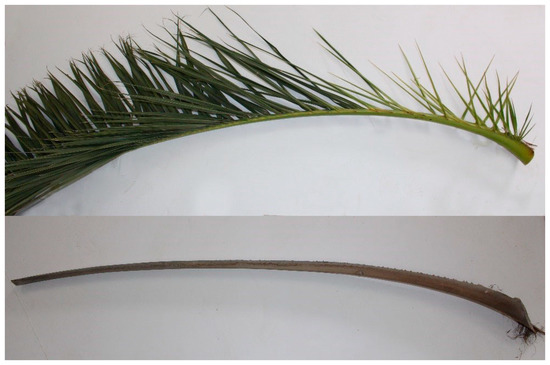
Figure 1.
Frond and rachis of a palm tree.
2. Materials and Methods
The raw material used was the rachis of the fronds of three different palm species—date, canary, and washingtonia palm—that were kindly supplied by the municipality of the San Anton palm grove in Orihuela, Alicante (Spain). These rachises were obtained by trimming the leaflets from the fronds. They had an initial moisture content of 73% and were air dried for 8 months to an approximate moisture content of 8%. Particles were obtained using a laboratory-scale ring-knife chipper, after which they were sieved using a horizontal screen shaker with sieves of 8, 4, 2, 1 and 0.25 mm to remove oversize and undersize (dust) particles. A combination of the fractions retained on each sieve was used for the panel manufacture: 0.25 to 1 mm, 1 to 2 mm and 2 to 4 mm.
The particleboard manufacturing method applied was the conventional dry process used in the industry. Particles were mixed by injection with 8% UF with a 65% solid content in a resin blender for 5 min. The mixture was placed into iron molds measuring 600 × 400 mm to form the mat. The amount of material used was variable since the thickness of the panels was fixed to 10 mm. Mats were then pressed in a hot plate press under 2.6 MPa of pressure for 5 min at 130 °C. A total of 9 types of particleboard (Figure 2) were made using three different particle sizes from the 3 different palm species studied. Five replicate panels were made for each type; therefore, a total of 45 particleboards were produced.
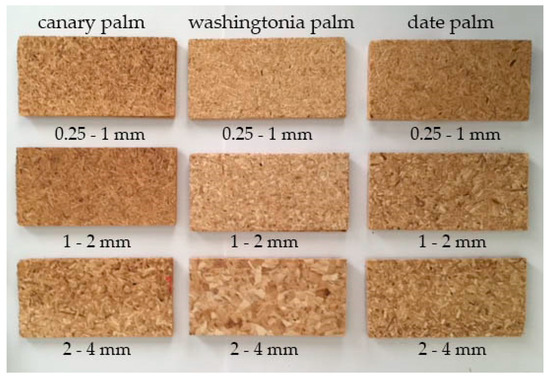
Figure 2.
Particleboards made with rachises of different palm species.
After pressing, the particleboards were conditioned at 20 °C and 65% relative humidity for one week in a vertical position. The finished particleboards were trimmed to avoid edge effects to a final size of 600 mm × 400 mm × 10 mm, and then cut into various sizes for property evaluation according to EN 326-1:1994 [40] (Figure 3).
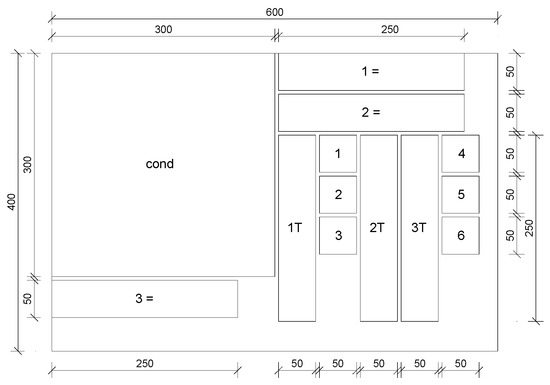
Figure 3.
Cutting scheme of particleboards.
Some physical properties were determined in accordance with appropriate EN standards for wood products: density [41], water absorption (WA), thickness swelling (TS) after 2 and 24 h of water immersion [42] and the thermal conductivity was measured following the heat flow meter method [43]. The mechanical properties determined were the modulus of rupture (MOR) and modulus of elasticity (MOE) [44], and internal bond strength (IB) [45]. Each panel was cut to obtain six density samples (50 mm × 50 mm), three WA/TS samples (50 mm × 50 mm), six MOR/MOE samples (different lengths, depending on the thickness, ×50 mm width), and three IB samples (50 mm × 50 mm). Table 1 shows the relation between the samples and the properties tested. The tests for the mechanical properties, WA, TS, and density were conducted on an Imal universal testing machine (Model IB600, Modena, Italy). Samples of 300 × 300 mm were used to test the thermal conductivity using a heat flow meter (Model HFM 436/3/0, NETZSCH Gerätebau GmbH, Selb, Germany).

Table 1.
Name of the samples and tests conducted.
Particleboards were classified in accordance with the European standard [46] considering the requirements for wood particleboard with a thickness range of 6–13 mm.
The results were analyzed using the IBM SPSS v.24.0 software (Amonk, NY, USA). Average values and the standard deviation of the properties of the panels were obtained to determine the variability. One-way analysis of variance was conducted to identify the influence between the manufactured process (material and particle size) and the properties of the particleboard.
3. Results
3.1. Physical Properties
The experimental particleboard can be considered to be of medium density (Table 2). The average values obtained were 841.55 kg/m3 with canary, 813.20 kg/m3 with washingtonia and 797.38 kg/m3 with date palm rachis. The boards with the highest density were achieved with the smallest particle size (0.25–1 mm) for the three species. There was no significant deviation in the thickness of the panels since this was a fixed variable of the manufacturing process.
Table 2.
Average values of the physical properties of the palm rachis particleboard.
The TS average values after 2 h of water immersion ranged from 19.99 to 37.83%; after 24 h they ranged from 31.96 to 49.74% (Figure 4). The date palm particleboard showed the lowest TS results, while the canary palm particleboards showed the highest TS results. As can be observed in Figure 4a, the TS value did not depend on the particle size.
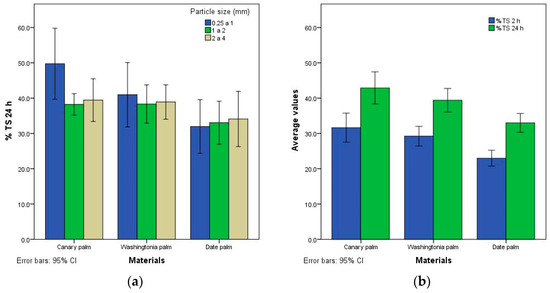
Figure 4.
(a) Average TS values after 24 h of water immersion according to the palm species and particle size (b) Average TS values after 2 and 24 h according to palm species.
The average WA results after 2 h of water immersion ranged from 47.48 to 72.14%, and after 24 h from 61.26 to 85.91% (Figure 5). Particleboards manufactured with smaller particles (0.25 to 1 mm) absorbed a larger amount of water and had greater TS values.
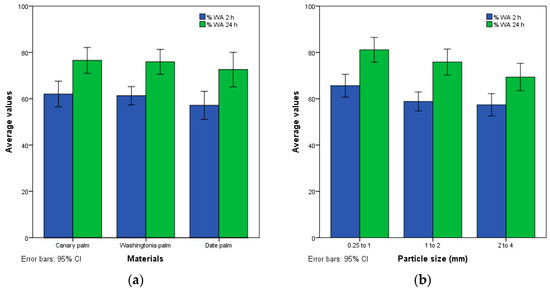
Figure 5.
(a) Average WA values after 2 and 24 h of water immersion according to palm species. (b) Average WA values after 2 and 24 h of water immersion according to particle size.
3.2. Mechanical Properties
Canary palm particleboards had an average MOR performance of 13.97, 19.85, and 12.68 N/mm2 from the smaller to bigger particle size respectively The MOR achieved by the washingtonia palm particleboards was 16.95, 12.40, and 7.38 N/mm2. The date palm boards had the lowest MOR values with 13.51, 10.76, and 7.85 N/mm2 (Table 3). The highest MOR value was obtained with canary palm, with 1–2 mm of particle size. The MOE showed the same tendency as the MOR, and was higher for the canary palm boards and lower for the date palm panels. The IB values ranged from 0.72 to 0.99 N/mm2, with the canary palm boards having the lowest values.
Table 3.
Average mechanical properties of particleboards from different palm rachis species.
European standards classify wood particleboard according to its physical and mechanical properties [46], starting with the P1 grade for general indoor uses, to the P7 grade for structural uses.
All three types of particleboard made of canary palm particles exceeded the requirements for grade P1 or higher (Figure 6). Panels made with washingtonia and date palm with particle sizes of 0.25–1 and 1–2 mm could be classified as grade P1. Boards made with canary palm with a particle size of 1–2 mm reached the grade P2. Washingtonia and date palm boards made with a particle size of 0.25–1 mm met the minimum values of MOR and IB of P2 but not the required MOE value. None of the particleboards achieved the grade P3, which requires a minimum MOE value of 2050 N/mm2.
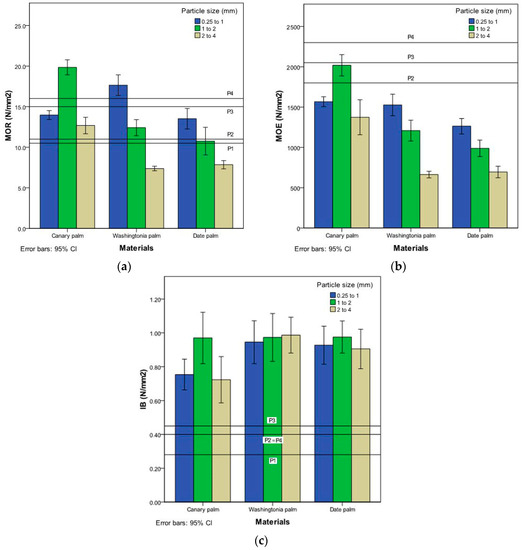
Figure 6.
(a) MOR. (b) MOE (c) IB according to palm species and particle size and compared to the European standards (black horizontal lines) [46].
3.3. Thermal Conductivity
The average values of thermal conductivity ranged from 0.053 to 0.061 W/mK (Figure 7). No significant dependence was observed between the particle sizes or palm species with thermal conductivity (Figure 8).
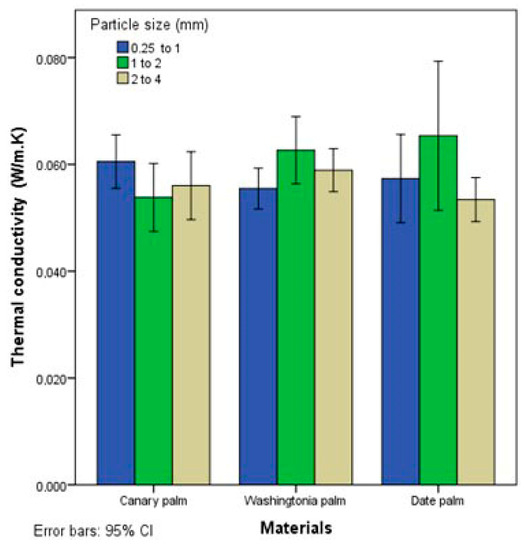
Figure 7.
Average thermal conductivity results according to the palm species and particle size.
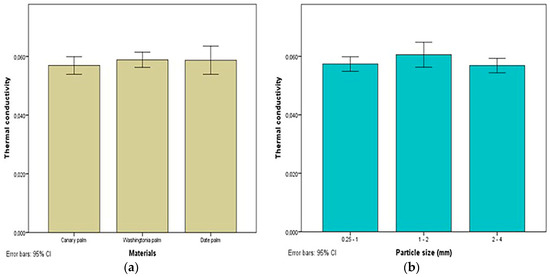
Figure 8.
(a) Average thermal conductivity results according to the palm species. (b) Average thermal conductivity results according to the particle size.
4. Discussion
Several authors have obtained particleboards made of palm rachis with an adhesive following a similar manufacturing process (Table 4). Nemli et al. [8] manufactured boards from date palm using 33% of UF and applying 150 °C for 5 min in a hot press. They obtained boards with a density of 650 kg/m3, a good MOR, and a low TS due to the high amount of adhesive used. The boards obtained by Ashori and Nourbakhsh [9] achieved a lower MOR and a higher density than the latter when using 9% of UF at 160 °C, but they accomplished better mechanical properties by increasing the amount of UF to 11%. Amirou et al. [13] studied the mechanical properties of boards from date palm manufactured at a higher temperature and pressing time (195 °C and 7.5 min), and 10% of PF. Their results showed a large increase in MOE, satisfactory values of MOR and IB, and a low TS value, probably due to the nature of the curing resin. Hegazy and Ahmed and Hegazi et al. [14,15] studied the influence of density on the strength of panels produced with date palm fibers at 140 °C for 10 min and 160 °C for 8 min with the same resin dose. Better strength (MOR, MOE and IB) was achieved in both cases with higher densities. In addition, the mechanical properties achieved were greater with the increase in the pressing temperature. In general, the results of the present study, which used a lower pressing temperature, pressing time, and amount of resin were in accordance with those described above.
Table 4.
Average properties of palm rachis particleboards by different authors.
Regarding the palm species, several studies have been made with canary palm. Ferrandez-Garcia et al. [22] obtained binderless boards with poor mechanical properties and a high TS value. Garcia-Ortuño et al. [19] substituted the UF with 10% of starch and longer pressing times. They obtained panels with a high density and with a good MOR and IB. These results are similar to the values obtained in the present work.
Ferrandez-Garcia et al. [18] made boards from the rachis of washingtonia palm using a pressing temperature of 120 °C for 6 min. They obtained better values of MOR and MOE, and similar but lower values of IB and TS than the present study just by lowering the temperature by 10 °C and increasing the pressing time by 1 min.
In general, using a higher processing temperature and a higher density resulted in the improved mechanical behavior of the particleboard, nevertheless, the best performance was obtained with pressing times between 5 and 7.5 min. The addition of higher amounts of UF was found to improve the mechanical properties and to reduce the TS, however, regulation limits must be taken into account due to the harmful effects of UF on human health. Particleboards with good mechanical properties were produced using pressing temperatures between 120 and 140 °C.
Industrial companies in Spain traditionally employ pine wood particles (Pinus radiata D. Dom) and other sawmill leftovers in the manufacturing of commercial particleboard. The standard process uses a higher pressing temperature and amount of UF [47,48], resulting in single-layer panels that have a similar MOR but higher MOE than those obtained in this study (Table 5). A different study [49] that used a hard wood such as eucalyptus (Eucalyptus urophylla S.T. Blake), manufactured particleboards that achieved a greater MOR but had a thickness of 17 mm.
Table 5.
Average properties of commercial particleboards tested by different authors.
Wood has always been considered a building material with good insulation properties. For comparison purposes, the thermal conductivity of some woods with a similar density to that of the particleboard in the present study is shown in Table 6. The experimental particleboard has lower thermal conductivity values than those made from wood.
Table 6.
Average thermal conductivity values of wood with similar densities as rachis particleboards.
In terms of thermal conductivity, the results suggested the possibility of using these particleboards as thermal insulation materials, since they had better thermal properties than commonly-used woods with similar densities.
In the literature, some authors have investigated the thermal conductivity of particleboards using fibers from the rachis of palm species. The results of such tests are in accordance with the values achieved in this study (Table 7). The board density and palm species did not have a relevant effect on their thermal insulating capacity. The composites shown in the table had the least insulation capacity, as cement and gypsum are not good insulators.
Table 7.
Average thermal conductivity values of palm particleboards studied by different authors.
The results showed that the physical and mechanical properties of particleboard in general were influenced by the palm species in addition to other parameters, such as the particle size, pressing temperature, pressure, pressing time, raw material, amount and type of adhesive used, particle moisture, and particleboard density. In the present study, the manufacturing variables were the palm species and the particle size. A statistical analysis was conducted in order to determine the dependence of the mechanical and physical properties of the experimental particleboards with respect to the variables of the study (Table 8).
Table 8.
ANOVA of the results of the tests.
With a significance of <0.05, the density, MOR, MOE, and WA depended on the particle size of the particleboard, whereas the MOR, MOE, IB, and TS depended on the palm species.
5. Conclusions
This study was focused on testing the mechanical, physical and thermal behavior of particleboard made of particles from the rachis of canary palm (Phoenix canariensis hort. ex Chabaud), date palm (Phoenix dactylifera L.) and washingtonia palm (Washingtonia robusta H. Wendl). Moreover, the influence of the particle size and the raw material (palm species) of the particleboard was also investigated.
It can be concluded that it is feasible to manufacture particleboard using palm rachis that will have similar properties to conventional wood particleboard using a low energy manufacturing process (short pressing time and low pressing temperature). This particleboard could replace the traditional raw materials used in construction, contributing to a reduction of the pressure on forest wood resources.
The particleboard made with canary palm rachis had better properties than the washingtonia and date palm rachis boards; therefore, it could be considered that it was the best raw material for the production of particleboard under the conditions tested in this study.
In terms of the particle size, the results showed that it affected some of the properties of the particleboard, namely the density, WA, MOR, and MOE. A particle size of 1 to 2 mm of canary palm and 0.25 to 1 mm of washingtonia and date palm achieved the best results. In general, smaller particles had better properties.
The TS, MOR, MOE and IB were found to be influenced by the palm species. Canary palm rachis particleboard of any particle size, and boards made of washingtonia and date palm with particle sizes of 0.25 to 1 mm, could be classified as P1 “General purpose boards for use in dry conditions”. Canary palm rachis with particle sizes from 1 to 2 mm could be classified as type P2 “Boards for interior fitments (including furniture) for use in dry conditions”.
The particleboard manufactured can be considered a good insulating material. The thermal conductivity did not depend on the particle size or the palm species.
The use of the pruning waste of palm trees to produce durable materials such as particleboard could be beneficial to the environment since it is a method of carbon fixation, helping to decrease atmospheric pollution and reducing the amount of waste that ends in dumping sites.
Author Contributions
M.-T.F.-G. and T.G.-O. conceived and designed the experiments; C.-E.F.-G., T.G.-O. and A.F.-G. performed the experiments; M.F.-V. and M.-T.F.-G. analyzed the data; M.F.-V. obtained and selected the raw materials; C.-E.F.G., A.F.-G., and J.F.H.-C. wrote the paper.
Funding
This research was funded by the Ministerio de Economía y Competitividad, grant number AGL2013-41612-R. And the APC was funded by the Department of Engineering at the Miguel Hernandez University.
Acknowledgments
The authors wish to acknowledge the support of the Ministerio de Economía y Competitividad of Spain through the program “Retos”.
Conflicts of Interest
The authors declare no conflict of interest. The founding sponsors had no role in the design of the study; in the collection, analyses, or interpretation of data; in the writing of the manuscript, and in the decision to publish the results.
References
- IPPC. Climate Change 2001: Mitigation. Intergovernmental Panel on Climate Changes. Available online: www.ipcc.ch/docs/UN_products/ipcc_wg3_booklet_TAR.pdf (accessed on 5 July 2018).
- Wang, S.; Zhang, H.; Nie, Y.; Yang, H. Contributions of China’s Wood-Based Panels to CO2 Emission and Removal Implied by the Energy Consumption Standards. Forests 2017, 8, 273. [Google Scholar] [CrossRef]
- Rivela, B.; Hospido, A.; Moreira, M.; Feijoo, G. Life Cycle Inventory of Particleboard: A Case Study in the Wood Sector (8 pp). Int. J. Life Cycle Assess. 2006, 11, 106–113. [Google Scholar] [CrossRef]
- Sajdak, M.; Velázquez-Martí, B.; López-Cortés, I. Quantitative and qualitative characteristics of biomass derived from pruning Phoenix canariensis hort. ex Chabaud and Phoenix dactilifera L. Renew. Energy 2014, 71, 545–552. [Google Scholar] [CrossRef]
- García-Ortuño, T.; Ferrández García, M.T.; Andréu Rodríguez, J.; Ferrández García, C.E.; Ferrández-Villena, M. Evaluating the properties of palm particle boards (Washingtonia robusta H. Wendl). In Proceedings of the 6th Iberian Congress of Agroengineering, September 2011; Sociedad Española de Agroingeniería: Evora, Portugal; pp. 126–130. ISBN 978-972-778-113-3.
- Lista Europea de Residuos [Decisión 2014/955/UE] con código LER 20 02 01. Diario Oficial de la Unión Europea L 370/46. (30 December 2014). Available online: https://eur-lex.europa.eu/legal-content/ES/TXT/?uri=celex%3A32014D0955 (accessed on 4 December 2018).
- El-Morsy, M.M.S. Studies on the rachises of the Egyptian date palm leaves for hardboard production. Fibre Sci. Technol. 1980, 13, 317–321. [Google Scholar] [CrossRef]
- Nemli, G.; Kalaycıoğlu, H.; Alp, T. Suitability of date (Phoenix dactyiferis) branches for particleboard production. Holz. Als. Roh. Werkst. 2001, 59, 411–412. [Google Scholar] [CrossRef]
- Ashori, A.; Nourbakhsh, A. Effect of press cycle time and resin content on physical and mechanical properties of particleboard panels made from the underutilized low-quality raw materials. Ind. Crop. Prod. 2008, 28, 225–230. [Google Scholar] [CrossRef]
- Iskanderani, F.I. Physical properties of particleboard panels manufactured from Phoenix dactylifera-L (date palm) mid-rib chips using urea formaldehyde binder. Int. J. Polym. Mat. 2008, 57, 979–995. [Google Scholar] [CrossRef]
- Hegazy, S.; Aref, I. Suitability of some fast growing trees and date palm fronds for particleboard production. For. Prod. J. 2010, 60, 599–604. [Google Scholar] [CrossRef]
- Agoudjil, B.; Benchabane, A.; Boudenne, A.; Ibos, L.; Fois, M. Renewable materials to reduce building heat loss: Characterization of date palm wood. Energy Build 2011, 43, 491–497. [Google Scholar] [CrossRef]
- Amirou, S.; Zerizer, A.; Pizzi, A.; Haddadou, I.; Zhou, X. Particleboards production from date palm biomass. Eur. J. Wood Wood Prod. 2013, 71, 717–723. [Google Scholar] [CrossRef]
- Hegazy, S.; Ahmed, K.; Hiziroglu, S. Oriented strand board production from water-treated date palm fronds. BioResources 2015, 10, 448–456. [Google Scholar] [CrossRef]
- Hegazy, S.; Ahmed, K. Effect of date palm cultivar, particle size, panel density and hot water extraction on particleboards manufactured from date palm fronds. Agriculture 2015, 5, 267–285. [Google Scholar] [CrossRef]
- García-Ortuño, T.; Andreu-Rodríguez, J.; Ferrández-García, M.T.; Ferrández-García, C.E.; Medina, E.; Paredes, C.; Perez-Murcia, M.D.; Moreno-Caselles, J. Evaluation of the Different Uses of Washingtonia robusta Pruning Waste. Commun. Soil Sci. Plan. 2013, 44, 623–631. [Google Scholar] [CrossRef]
- Ferrandez-Villena, M.; Ferrandez-Garcia, C.E.; Andreu-Rodriguez, J.; Garcia-Ortuno, T.; Ferrandez-Garcia, M.T. Analysis of the properties of particleboard palm (Washingtonia robusta) and Giant Reed (Arundo donax L.). In Proceedings of the 8th Iberian Congress of Agroengineering, Libro de Actas: Retos de la Nueva Agricultura Mediterránea, 1–3 June 2015; Universidad Miguel Hernández de Elche: Alicante, Spain, 2015; pp. 461–467. ISBN 978-84-16024-30-8. [Google Scholar]
- Ferrández-García, C.C.; Ferrández-García, C.E.; Ferrández-Villena, M.; Ferrandez-García, M.T.; García-Ortuño, T. Acoustic and Thermal Evaluation of Palm Panels as Building Material. BioResources 2017, 12, 8047–8057. [Google Scholar] [CrossRef]
- García-Ortuño, T.; Ferrández-García, M.T.; Andreu-Rodríguez, J.; Ferrández-Garcia, C.E.; Ferrández-Villena, M. Valorization of pruning residues: The use of Phoenix canariensis to elaborate eco-friendly particleboards. In Structures and Environmental Technologies. International Conference of Agricultural Engineering-CIGR-AgEng 2012, Valencia, Spain, 8–12 July 2012; Federación de Gremios de Editores de España: Madrid, Spain, 2012; ISBN 978-84-615-9928-8. [Google Scholar]
- Moral, R.; Bustamante, M.; Ferrández-García, C.E.; Andreu-Rodríguez, J.; Ferrández-García, M.T.; Garcia-Ortuño, T. New Biomass Sources to Reduce Peat Dependence in Mediterranean Substrates: Validation of Morus alba L., Sorghum vulgare L., and Phoenix canariensis Pruning Wastes. Commun. Soil Sci. Plan 2015, 46 (Suppl. 1), 10–19. [Google Scholar] [CrossRef]
- Ferrandez-Garcia, C.E.; Ferrandez-Garcia, M.T.; Moral, R.; Ferrandez-Villena, M.; Andreu-Rodriguez, J.; Garcia-Ortuño, T. Development of bioproducts from Palm trees (Phoenix canariensis, Washingtonia robusta) oriented to carbon sequestration. In Proceedings of the 8th Iberian Congress of Agroengineering, Libro de Actas: Retos de la Nueva Agricultura Mediterránea, Orihuela, Spain, 1–3 June 2015; Universidad Miguel Hernández de Elche: Alicante, Spain, 2015; ISBN 978-84-16024-30-8. [Google Scholar]
- Ferrández-García, A.; Ferrández-Villena, M.; Ferrández-García, C.E.; García-Ortuño, T.; Ferrández-García, M.T. Potential Use of Phoenix canariensis Biomass in Binderless Particleboards at Low Temperature and Pressure. BioResources 2017, 12, 6698–6712. [Google Scholar] [CrossRef]
- Braiek, A.; Karkri, M.; Adili, A.; Ibos, L.; Nasrallah, S.B. Estimation of the thermophysical properties of date palm fibers/gypsum composite for use as insulating materials in building. Energy Build 2017, 140, 268–279. [Google Scholar] [CrossRef]
- Nasser, R.A.; Al-Mefarrej, H.A. Midribs of date palm as a raw material for wood-cement composite industry in Saudi Arabia. World Appl. Sci. J. 2011, 15, 1651–1658. [Google Scholar]
- Kriker, A.; Bali, B.; Debicki, G.; Bouziane, M.; Chabannet, M. Durability of date palm fibers and their use as reinforcement in hot dry climates. Cem. Concr. Compos. 2008, 30, 639–648. [Google Scholar] [CrossRef]
- Boumhaout, M.; Boukhattem, L.; Hamdi, H.; Benhamou, B.; Nouh, F.A. Thermomechanical characterization of a bio-composite building material: Mortar reinforced with date palm fibers mesh. Constr. Build Mater. 2017, 135, 241–250. [Google Scholar] [CrossRef]
- Al-Juruf, R.S.; Ahmed, F.A.; Alam, I.A. Development of heat insulating materials using date palm leaves. Therm. Insul. 1988, 11, 158–164. [Google Scholar] [CrossRef]
- Al-Sulaiman, F.A. Date palm fiber reinforced composite as a new insulating material. Int. J. Energy Res. 2003, 27, 1293–1297. [Google Scholar] [CrossRef]
- Al-Khanbashi, A.; Al-Kaabi, K.; Hammami, A. Date palm fibers as polymeric matrix reinforcement: Fiber characterization. Polym. Compos. 2005, 26, 486–497. [Google Scholar] [CrossRef]
- Bourmaud, A.; Dhakal, H.; Habrant, A.; Padovani, J.; Siniscalco, D.; Ramage, M.H.; Shah, D.U. Exploring the potential of waste leaf sheath date palm fibres for composite reinforcement through a structural and mechanical analysis. Compos. Part A Appl. 2017, 103, 292–303. [Google Scholar] [CrossRef]
- García Esteban, L.; Guindeo Casasús, A.; Peraza Oramas, C.; de Palacios de Palacios, P. La Madera y su Tecnología; Coedición FUCOVASA, Mundiprensa y AITIM: Madrid, España, 2002; p. 336. ISBN 84-86793-84-X. [Google Scholar]
- Boucher, J.; Méausoone, P.J.; Martin, P.; Auchet, S.; Perrin, L. Influence of helix angle and density variation on the cutting force in wood-based products machining. J. Mater. Process. Technol. 2007, 189, 211–218. [Google Scholar] [CrossRef]
- Pan, Z.; Zheng, Y.; Zhang, R.; Jenkins, B.M. Physical properties of thin particleboard made from saline eucalyptus. Ind. Crop. Prod. 2007, 26, 185–194. [Google Scholar] [CrossRef]
- Nemli, G.; Aydin, I.; Zekovic, E. Evaluation of some of the properties of particleboard as function of manufacturing parameters. Mater. Des. 2007, 28, 1169–1176. [Google Scholar] [CrossRef]
- Boonstra, M.J.; Pizzi, A.; Ohlmeyer, M.; Paul, W. The effects of a two stage heat treatment process on the properties of particleboard. Holz. Als. Roh. Werkst. 2006, 64, 157–164. [Google Scholar] [CrossRef]
- Han, G.; Wu, Q.; Wang, X. Stress-wave velocity of wood-based panels: Effect of moisture, product type, and material direction. For. Prod. J. 2006, 56, 28–33. [Google Scholar]
- Abdalla, A.M.; Sekino, N. Veneer strand flanged I-beam with MDF or particleboard as web material III: Effect of strand density and preparation method on the basic properties. J. Wood Sci. 2005, 51, 492–497. [Google Scholar] [CrossRef]
- Blanchet, P.; Cloutier, A.; Riedl, B. Particleboard made from hammer milled black spruce bark residues. Wood Sci. Technol. 2000, 34, 11–19. [Google Scholar] [CrossRef]
- Wang, W.; Zhang, X.; Lu, R. Adhesive application method in MDI-UF particleboard manufacture. Front. For. China 2006, 1, 225–229. [Google Scholar] [CrossRef]
- EN 326. Wood-based panels. In Sampling, Cutting and Inspection. Part 1: Sampling and Cutting of Test Pieces and Expression of Test; European Committee for Standardization: Brussels, Belgium, 1994. [Google Scholar]
- EN 323. Wood-based panels. In Determination of Density; European Committee for Standardization: Brussels, Belgium, 1993. [Google Scholar]
- EN 317. Particleboards and fiberboards. In Determination of Swelling in Thickness after Immersion in Water; European Committee for Standardization: Brussels, Belgium, 1993. [Google Scholar]
- EN 12667. Thermal performance of building materials and products. In Determination of Thermal Resistance by Means of Guarded Hot Plate and Heat Flow Meter Methods. Products of High and Medium Thermal Resistance; European Committee for Standardization: Brussels, Belgium, 2001. [Google Scholar]
- EN 310. Wood-based panels. In Determination of Modulus of Elasticity in Bending and of Bending Strength; European Committee for Standardization: Brussels, Belgium, 1993. [Google Scholar]
- EN 319. Particleboards and fiberboards. In Determination of Tensile Strength Perpendicular to the Plane of de Board; European Committee for Standardization: Brussels, Belgium, 1993. [Google Scholar]
- EN 312. Particleboards—Specifications; European Committee for Standardization: Brussels, Belgium, 2010. [Google Scholar]
- Berterreche, A.; Poblete, H.; Niemz, P. Propiedades de tableros de partículas de Pinus Radiata D. Don. con aserrín de la misma especie. Cienc. E Investig. For. 1995, 9, 73–90. [Google Scholar]
- Pérez-García, A. Estimación de Parámetros de Calidad Sobre Tableros Derivados de la Madera a Partir de Ensayos no Destructivos. Proyecto Fin de Carrera; E.U.I.T. Forestal. Universidad Politécnica de Madrid: Madrid, Spain, 2012. [Google Scholar]
- Rangel, L.; Moreno, P.; Trejo, S.; Valero, S. Propiedades de tableros aglomerados de partículas fabricados con madera de Eucalyptus urophylla. Maderas Cienc. Tecnol. 2017, 9. [Google Scholar] [CrossRef]
- Miliarium, Ingeniería Civil y Medioambiente. Propiedades Térmicas de Materiales. Available online: https://es.scribd.com/document/211788851/propiedades-termicas-de-los-materiales (accessed on 17 January 2018).
- Ali, M.E.; Alabdulkarem, A. On thermal characteristics and microstructure of a new insulation material extracted from date palm trees surface fibers. Constr. Build Mater. 2017, 138, 276–284. [Google Scholar] [CrossRef]
© 2018 by the authors. Licensee MDPI, Basel, Switzerland. This article is an open access article distributed under the terms and conditions of the Creative Commons Attribution (CC BY) license (http://creativecommons.org/licenses/by/4.0/).