Abstract
Under the dual pressures of climate change and intensive urban expansion, which jointly exacerbate urban heat risks, optimizing the urban thermal environment through vegetation has become a core pathway for climate adaptation. However, accurately quantifying the nonlinear cooling responses of vegetation under complex urban morphologies and diverse geomorphic conditions remains a major scientific challenge in achieving efficient heat-resilient urban planning. This study takes three representative megacities in China—Beijing, Shanghai, and Shenzhen—as case studies. By integrating multi-source datasets, an urban spatial morphology indicator system was constructed that encompasses key dimensions of the natural environment, urban morphology, and socioeconomic factors. Eleven machine learning models were applied to model and compare urban land surface temperature (LST). The results demonstrate that the CatBoost model exhibited superior performance in simulating complex urban thermal environments (R2 = 0.683–0.873), effectively capturing the interactive effects among multidimensional factors. The findings reveal a dual differentiation pattern of “topographic constraint–morphological dominance” in urban thermal environments: in mountainous cities, elevation and mountain forests act as rigid cooling barriers that restrict the spread of heat islands; whereas in plain cities, thermal conditions are primarily governed by the synergistic warming effects of impervious surface expansion and intensive human–economic activities. More importantly, the study identifies a significant nonlinear threshold effect of vegetation cover (NDVI) on LST reduction—only when vegetation coverage exceeds a critical threshold can large-scale cooling benefits be activated to effectively offset the thermal accumulation associated with high GDP intensity. Based on these insights, the study proposes differentiated climate-adaptive spatial planning strategies: mountainous cities should strictly maintain ecological redlines at mountain fronts to safeguard macro-scale cooling sources, while high-density plain cities should focus on integrating green space patches to surpass the “cooling threshold” and enhance vertical greening systems. These findings provide a quantitative scientific basis for improving urban thermal resilience.
1. Introduction
Rapid urbanization worldwide has become one of the most prominent features of human activity in the 21st century [1,2]. However, this process has replaced natural land cover with impervious surfaces, significantly altering surface energy balance and thermal properties, thereby intensifying the Urban Heat Island (UHI) effect [3,4]. As a key indicator of urban thermal environments, elevated Land Surface Temperature (LST) not only threatens urban ecosystem stability and increases building energy consumption but also poses serious risks to public health [5,6,7]. Under the compounded impacts of climate change and urban expansion, elucidating the driving mechanisms of urban thermal environments and developing evidence-based mitigation strategies have become urgent tasks in urban planning and sustainable development research [8,9].
In recent years, research on the relationship between urban spatial morphology and LST has deepened, showing that morphological characteristics play a critical role in regulating urban heat environments [10,11]. Early studies mainly relied on remote sensing and geostatistical methods, focusing on two-dimensional surface features such as land cover types, vegetation indices, and impervious surface ratios [12]. For instance, Guo et al. (2020) [13] employed a Geographically Weighted Regression (GWR) model to systematically analyze the spatiotemporal heterogeneity of LST in Ganjingzi District, Dalian, finding that the Normalized Difference Built-up Index (NDBI) was highly correlated with LST, and that urban expansion significantly intensified the UHI effect—highlighting the importance of optimizing urban land-use structures for mitigating surface warming. Meanwhile, the three-dimensional characteristics of urban morphology (e.g., building height, floor area ratio, and sky view factor) have also been shown to exert significant influences on surface heat regulation. Guo et al. (2016) [14], using a regularized regression model, analyzed the relationship between building morphology and LST in Guangzhou, revealing that medium-height, low-density building areas exhibited the greatest thermal fluctuations, while high-rise, high-density clusters showed relatively lower LST variability—indicating that building density exerts a stronger driving influence on LST than height.
With advances in spatial data acquisition and computational capacity, research has shifted from analyzing average morphological characteristics to depicting spatial heterogeneity [15,16]. Liao and Heo (2021) introduced spatial standard deviations of morphological variables to represent the heterogeneity of London and Seoul’s urban forms, finding that the spatial dispersion of green space ratios, building coverage, and street canyon height–width ratios significantly affected LST distribution—suggesting that intra-city morphological variation better explains thermal patterns than average morphology [15]. Similarly, Liu et al. (2024) [17] applied a Random Forest model to analyze the seasonal impacts of urban morphology on LST across different Urban Functional Zones (UFZs) in Guangzhou. The results showed that building morphology had a pronounced cooling effect in spring, autumn, and winter, while vegetation coverage and biophysical attributes dominated thermal regulation in summer, underscoring the seasonal and functional heterogeneity of urban morphological effects [17].
In recent years, machine learning (ML) techniques—owing to their capacity for nonlinear fitting and high-dimensional data processing—have been widely adopted in quantitative analyses of urban thermal environments [18,19,20]. Researchers have used models such as Random Forest (RF), Support Vector Regression (SVR), Gradient Boosted Decision Trees (GBDT), XGBoost, and LightGBM to predict LST or UHI intensity, generally achieving higher predictive accuracy than traditional linear models [21,22,23]. Among these, ensemble learning models such as CatBoost and XGBoost have demonstrated superior stability and generalization ability in urban climate studies, thanks to their ability to handle categorical features and complex variable interactions [24,25]. However, model accuracy alone is insufficient to inform planning and climate adaptation decisions, making model interpretability a growing focus of recent research. Explainable machine learning approaches based on SHapley Additive exPlanations (SHAP) allow researchers to quantify the marginal contributions of different urban morphological factors to LST, thereby elucidating the driving mechanisms underlying urban thermal environments [26,27]. Despite rapid progress in this area, cross-city comparative studies that integrate diverse morphological indicators with explainable ML frameworks remain limited. A unified analytical framework is urgently needed to reveal the fundamental mechanisms underlying inter-city differences in thermal responses.
To address these gaps, this study takes Beijing, Shanghai, and Shenzhen as representative cases and integrates multi-source high-resolution data to construct a comprehensive urban spatial morphology indicator system encompassing natural, built, and socioeconomic dimensions. Eleven machine learning models were applied to model and compare LST. By systematically evaluating model performance, the CatBoost model was identified as optimal. Subsequently, SHAP-based explainability analyses were employed to dissect the contribution mechanisms and regional variations of different spatial morphological factors affecting LST. The study aims to: (1) Quantify the influence strength of multi-source spatial factors on urban LST; (2) Elucidate the mechanisms of thermal environment formation under different urban morphologies; (3) Provide scientific evidence and decision support for urban planning and ecological regulation.
The innovations of this study are threefold: (1) A systematic multi-model comparison to assess the applicability and stability of machine learning approaches in urban thermal environment modeling; (2) The introduction of a CatBoost-based explainable framework enabling quantitative decomposition of complex spatial influences; (3) A comparative analysis of Beijing, Shanghai, and Shenzhen revealing the heterogeneity of urban thermal environments under diverse morphological and socioeconomic contexts, offering a transferable scientific pathway toward climate-adaptive urban planning.
2. Materials and Methods
2.1. Study Areas
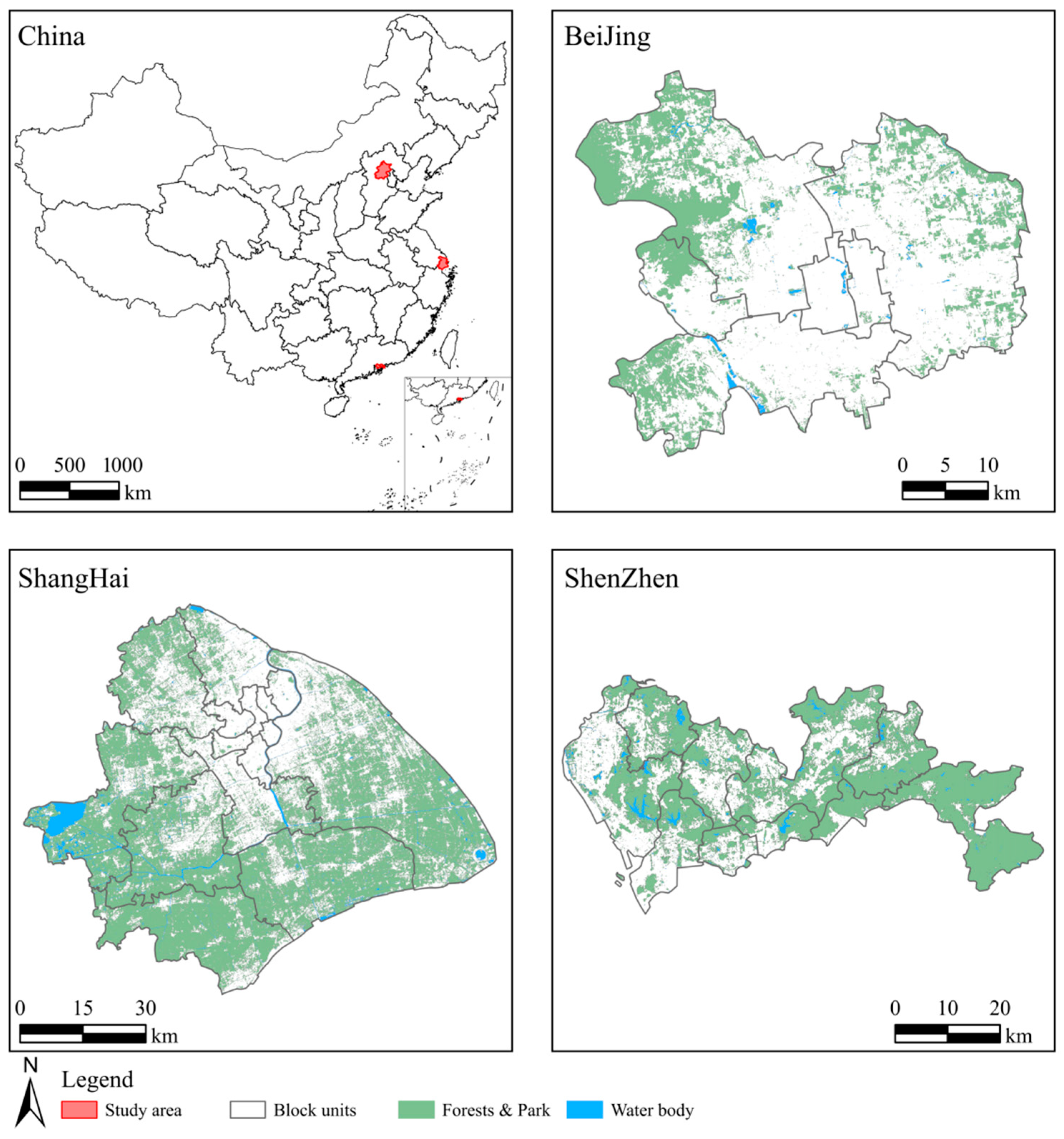
This study selects Beijing, Shanghai, and Shenzhen—three representative megacities in China—as comparative case studies (Figure 1). These cities not only serve as the core engines of the Beijing–Tianjin–Hebei, Yangtze River Delta, and Pearl River Delta urban agglomerations, respectively, but also span distinct climatic zones from the temperate to the subtropical regions, exhibiting markedly different geomorphological characteristics. Beijing is located at the transitional zone between plains and mountains, characterized by substantial elevation differences and a typical “monocentric, concentric expansion” spatial pattern. Shanghai, situated at the estuary of the Yangtze River, features a flat terrain interlaced with dense waterways, demonstrating intensive population concentration and contiguous high-density built-up areas. In contrast, Shenzhen represents a typical coastal hilly city with a “polycentric, clustered” spatial structure, where built-up land is intricately interwoven with complex vegetation cover and diverse topographic forms.
Figure 1.
Study area.
In summary, these three cities differ significantly and representatively in terms of their climatic background (from temperate to subtropical), geomorphological settings (plains, water networks, and hills), and urban spatial morphology (concentric, sprawling, and clustered forms). A comparative study of these cities thus provides a multidimensional perspective for uncovering the mechanisms by which various spatial morphological elements influence land surface temperature, offering a robust scientific basis for formulating differentiated strategies to optimize urban thermal environments.
2.2. Data Sources
We selected the daytime-mean LST for the boreal summer of 2022 (June–August) as the dependent variable. The original imagery was sourced from the USGS Landsat 8/9 OLI/TIRS Collection 2 Level-1 products, and scenes with cloud cover below 10% were retained to ensure data quality. To account for the heterogeneity of urban surfaces, LST was retrieved using the radiative transfer equation (RTE) method. This approach removes atmospheric effects from the total radiance received by the satellite sensor by incorporating atmospheric transmittance (), upwelling radiance (), and downwelling radiance () obtained from NASA’s Atmospheric Correction Parameter Calculator (ATM), thereby isolating the top-of-atmosphere spectral radiance () [28]. The retrieval equations are as follows:
Here, denotes the top-of-atmosphere spectral radiance; is the quantized calibrated pixel value (digital number, DN); and are the multiplicative and additive radiance rescaling factors, respectively. Surface emissivity () was estimated using the NDVI threshold method. and are the sensor-specific thermal conversion constants. The final results were converted to degrees Celsius (°C), cloud-masked, temporally averaged through multi-date compositing, and resampled to a uniform 500 m × 500 m grid to match the model inputs.
Based on a natural–morphological–social multidimensional framework, this study selected nine key indicators as independent variables (Table 1). Among them, natural environmental factors include elevation (DEM), Normalized Difference Vegetation Index (NDVI), Normalized Difference Water Index (NDWI), and Vegetation Ratio (VR). Urban morphological factors consist of average building height (BH), building density (BD), and road density (RD). Socioeconomic factors encompass population density (PD) and Gross Domestic Product (GDP).
Table 1.
Summary of Independent Variables.
All independent variable datasets underwent projection transformation, clipping, and resampling to ensure spatial consistency with the LST data. Each dataset was unified to a 500 m × 500 m grid resolution, matching the spatial extent of the three study areas for precise variable alignment and analysis. Detailed descriptions and data sources of all variables are summarized in Table 1.
2.3. Model Construction
2.3.1. Multiple Linear Regression (MLR) Model
The Multiple Linear Regression (MLR) model, as a classical parametric statistical approach, is employed to describe the linear additive relationships between explanatory variables and the response variable [29]. In this study, MLR serves as the baseline model to evaluate the linear structural influence of urban spatial morphological characteristics on the target variable (LST) and to provide a reference framework for assessing the performance improvements achieved by subsequent nonlinear machine learning models. The general form of the MLR model is expressed as [30]:
where represents the explanatory variables, denotes the corresponding regression coefficients, and and εis the random error term. The model parameters are estimated by minimizing the sum of squared residuals.
MLR offers advantages such as structural transparency and strong interpretability, enabling clear identification of both the direction and approximate magnitude of each variable’s effect [31]. Although it has inherent limitations in capturing nonlinear relationships and complex interaction effects, its theoretical maturity and interpretive clarity make it an ideal benchmark model for comparing predictive accuracy and explanatory power with more advanced nonlinear approaches.
2.3.2. Machine Learning Models
To comprehensively capture the potentially strong nonlinear relationships and complex interaction effects between urban spatial morphological characteristics and the target variable, this study employed multiple mainstream machine learning regression models to construct a multi-model framework. This approach enables a thorough evaluation of the applicability and performance differences among various algorithms when dealing with complex urban environmental data. Compared with linear models, machine learning models do not require predefined functional relationships between variables. Instead, they can automatically learn high-order feature interactions and nonlinear structures in a data-driven manner [32]. Consequently, they have been widely applied in urban thermal environment analysis, remote sensing, and spatial modeling research.
In total, ten representative machine learning models were included in this study, encompassing kernel-based methods, nonparametric neighborhood-based models, shallow neural networks, and several types of ensemble learning algorithms based on decision trees. The main characteristics and functions of each model are summarized in Table 2.
Table 2.
Overview of Machine Learning Regression Models.
To ensure optimal performance of each machine learning model under comparable conditions, a systematic and reproducible parameter optimization procedure was implemented. First, the complete dataset was randomly divided into a training set (70%) and an independent test set (30%), with the random seed fixed to ensure experimental reproducibility [33]. Within the training set, an initial candidate parameter space was established for each algorithm. The parameter ranges were determined based on a combination of existing literature and preliminary experimental results to cover potential optimal regions. Subsequently, five-fold cross-validation was employed to comprehensively evaluate all candidate parameter combinations, balancing computational efficiency and the stability of validation metrics.
For each model, the parameter combination achieving the highest average predictive performance (with the coefficient of determination, R2, as the primary metric) during cross-validation was used to construct a more refined secondary parameter grid. This process further narrowed the search range and improved optimization precision. When no significant performance improvement was observed in the higher-resolution parameter space, the final optimal hyperparameter configuration was determined. All unspecified parameters were retained as the default values in each algorithm’s library to maintain consistency across models.
The final model performance was evaluated using the independent test set, and three commonly used metrics were employed for comprehensive quantitative assessment: the coefficient of determination (R2), mean absolute error (MAE), and root mean square error (RMSE) [34].
2.3.3. SHAP Interpretation Method
To systematically reveal the contribution of urban spatial morphological characteristics to the model’s predictive outcomes, this study employed the SHAP (SHapley Additive exPlanations) method, which is grounded in cooperative game theory, to interpret the machine learning models. SHAP decomposes the model’s prediction into additive contributions of individual features. Its theoretical foundation originates from the Shapley Value, which quantifies the marginal contribution of each feature under all possible feature combinations [35]. SHAP is recognized as one of the most theoretically consistent methods for interpreting tree-based and other complex nonlinear models [36].
The mathematical definition of the Shapley value is as follows:
where N denotes the full set of features, S represents a subset of features excluding feature iii, and f(S) denotes the model’s expected output based solely on the feature subset S. The formula averages the marginal contribution of feature i across all possible feature orderings, ensuring that the explanation satisfies a series of theoretical axioms—efficiency, symmetry, and additivity. These properties endow SHAP with transparency and consistency in explaining complex models.
3. Results
3.1. Spatial Autocorrelation Analysis and Model Performance Evaluation
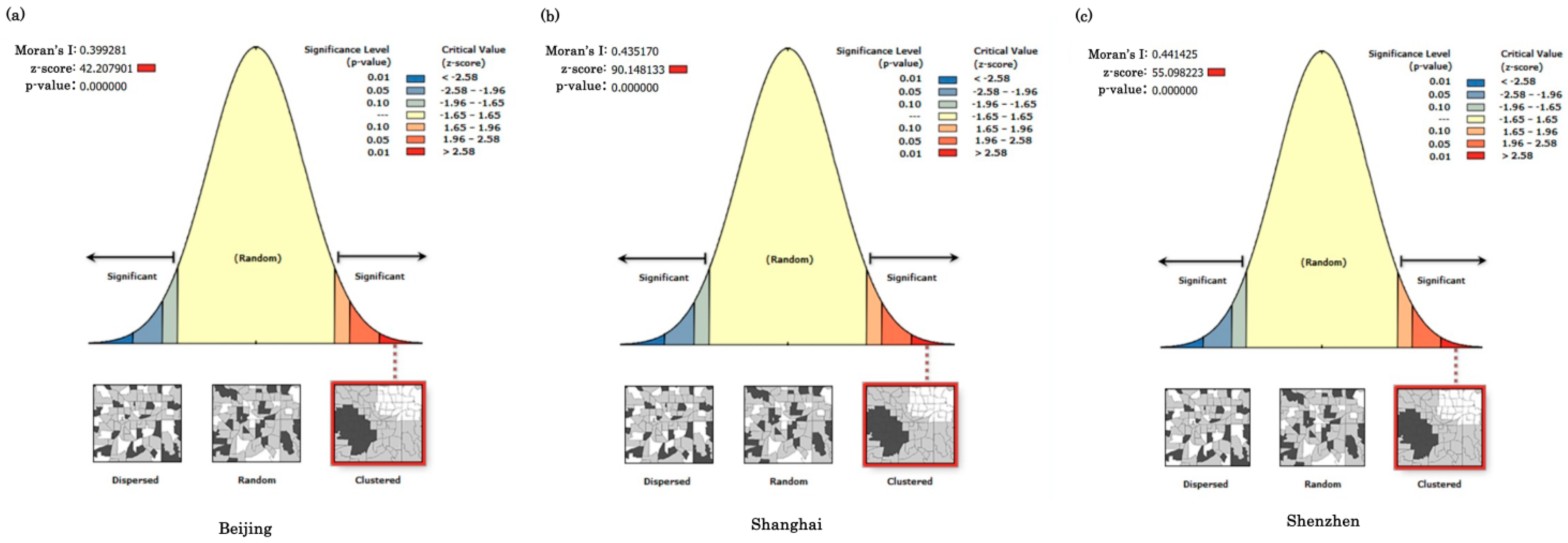
Before constructing the machine-learning models, we applied the Global Moran’s I statistic to test the spatial autocorrelation of LST for the three cities, thereby verifying spatial dependence in the thermal environment. The results (Figure 2) indicate that the LST distributions in Beijing, Shanghai, and Shenzhen exhibit significant clustering (p-value < 0.01), rejecting the null hypothesis of spatial randomness. Specifically, Shenzhen shows pronounced spatial clustering (Moran’s I = 0.441, Z-score = 55.10); Shanghai, characterized by extensive, contiguous high-density built-up areas, demonstrates the strongest clustering significance, with the highest Z-score (Moran’s I = 0.435, Z-score = 90.15); and Beijing’s Moran’s I is 0.399 (Z-score = 42.21). The substantial positive autocorrelation and Z-scores collectively show that LST in these three megacities exhibits strong spatial heterogeneity and aggregation, confirming the necessity of introducing spatial morphological indicators and employing nonlinear models to elucidate the driving mechanisms.
Figure 2.
Global Moran’s I results for land surface temperature in the study areas (a) Beijing, (b) Shanghai, and (c) Shenzhen.
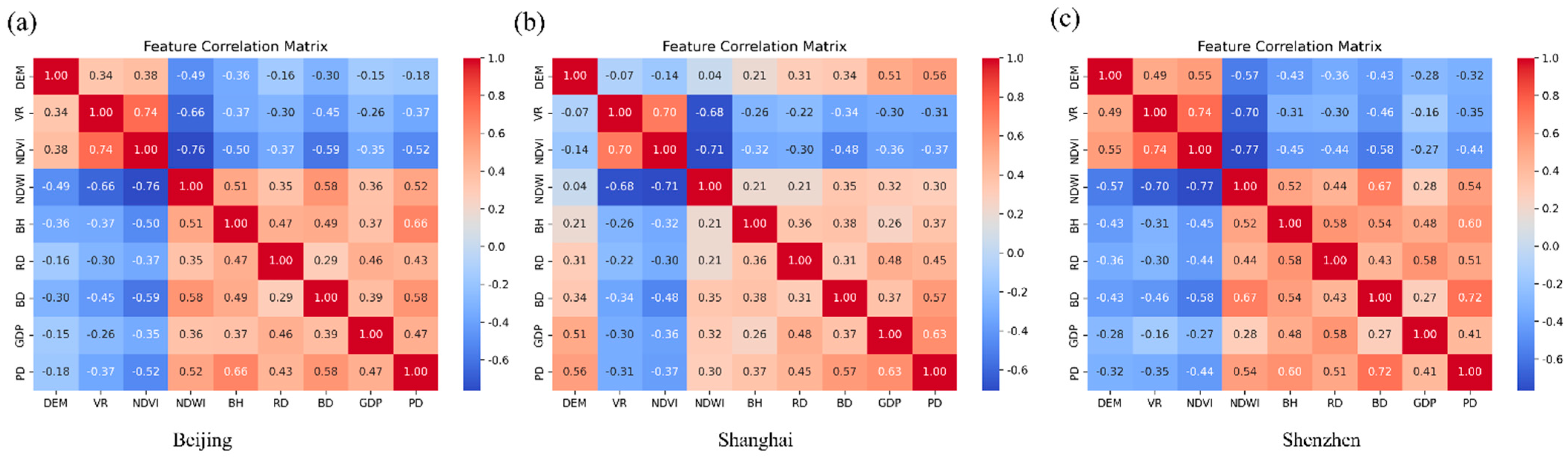
On this basis, analyzing the internal correlations among explanatory variables is essential [37]. This not only facilitates understanding of the synergies and trade-offs between urban spatial morphology and socioeconomic drivers, but also serves as a necessary step to assess multicollinearity and its potential impact on model interpretability [38]. We computed pairwise Pearson correlation coefficients for the candidate features in Beijing, Shanghai, and Shenzhen; the results are shown in Figure 3.
Figure 3.
Distribution of Pearson correlation coefficients among variables (a) Beijing, (b) Shanghai, and (c) Shenzhen.
An absolute correlation coefficient threshold of |r| = 0.7 was established to identify strong collinearity. Variables exceeding this threshold were considered redundant and excluded from the feature set [39]. As shown in Figure 3, NDWI and NDVI exhibited a strong negative correlation exceeding the threshold in all three cities, with correlation coefficients of −0.76 for Beijing, −0.71 for Shanghai, and −0.77 for Shenzhen. Accordingly, following the 0.7 collinearity criterion, NDWI was excluded from the feature set to eliminate redundancy. The final modeling, therefore, uses eight predictors: NDVI, VR, BH, BD, RD, DEM, GDP, and PD.
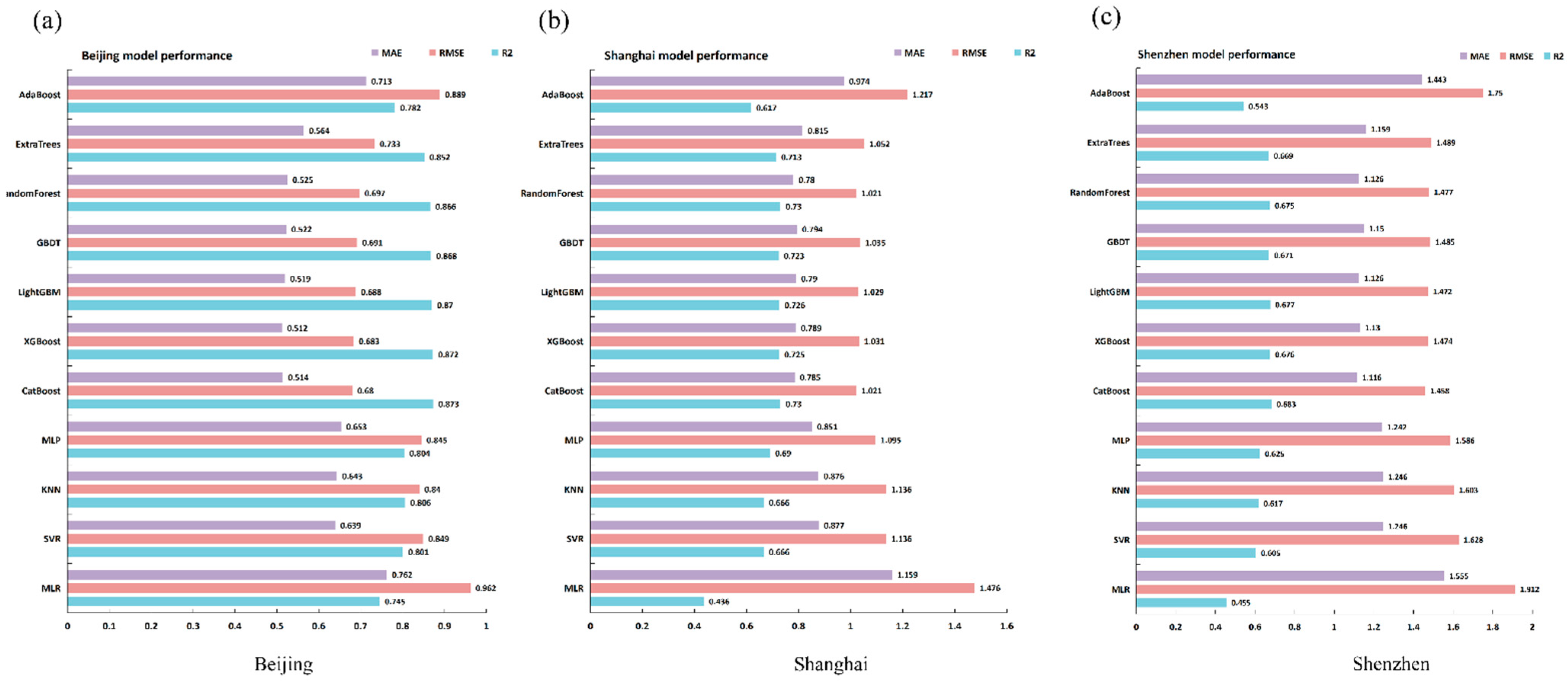
Subsequently, to investigate the mechanisms by which urban spatial morphology influences LST, we constructed 11 predictive models to evaluate their performance (Figure 4). These models included Multiple Linear Regression (MLR), K-Nearest Neighbors (KNN), Support Vector Regression (SVR), Multilayer Perceptron (MLP), and several tree-based ensemble learning algorithms (Random Forest, AdaBoost, Gradient Boosted Decision Trees (GBDT), ExtraTrees, XGBoost, LightGBM, and CatBoost).
Figure 4.
Comparative analysis of model performance (a) Beijing, (b) Shanghai, and (c) Shenzhen.
The results demonstrate that tree-based ensemble models significantly outperformed traditional linear and standalone nonlinear models in overall predictive performance. Among them, the CatBoost model consistently exhibited the best generalization ability and predictive accuracy across all three cities. Specifically, it achieved the highest goodness of fit and lowest root mean square error (RMSE) values: Beijing (R2 = 0.872, MAE = 0.51, RMSE = 0.68), Shanghai (R2 = 0.73, MAE = 0.0.78, RMSE = 1.021), and Shenzhen (R2 = 0.683, MAE = 1.13, RMSE = 1.458). Therefore, CatBoost was selected as the benchmark model for subsequent SHAP-based explainability analysis.
3.2. SHAP Model Interpretation and Feature Importance Analysis
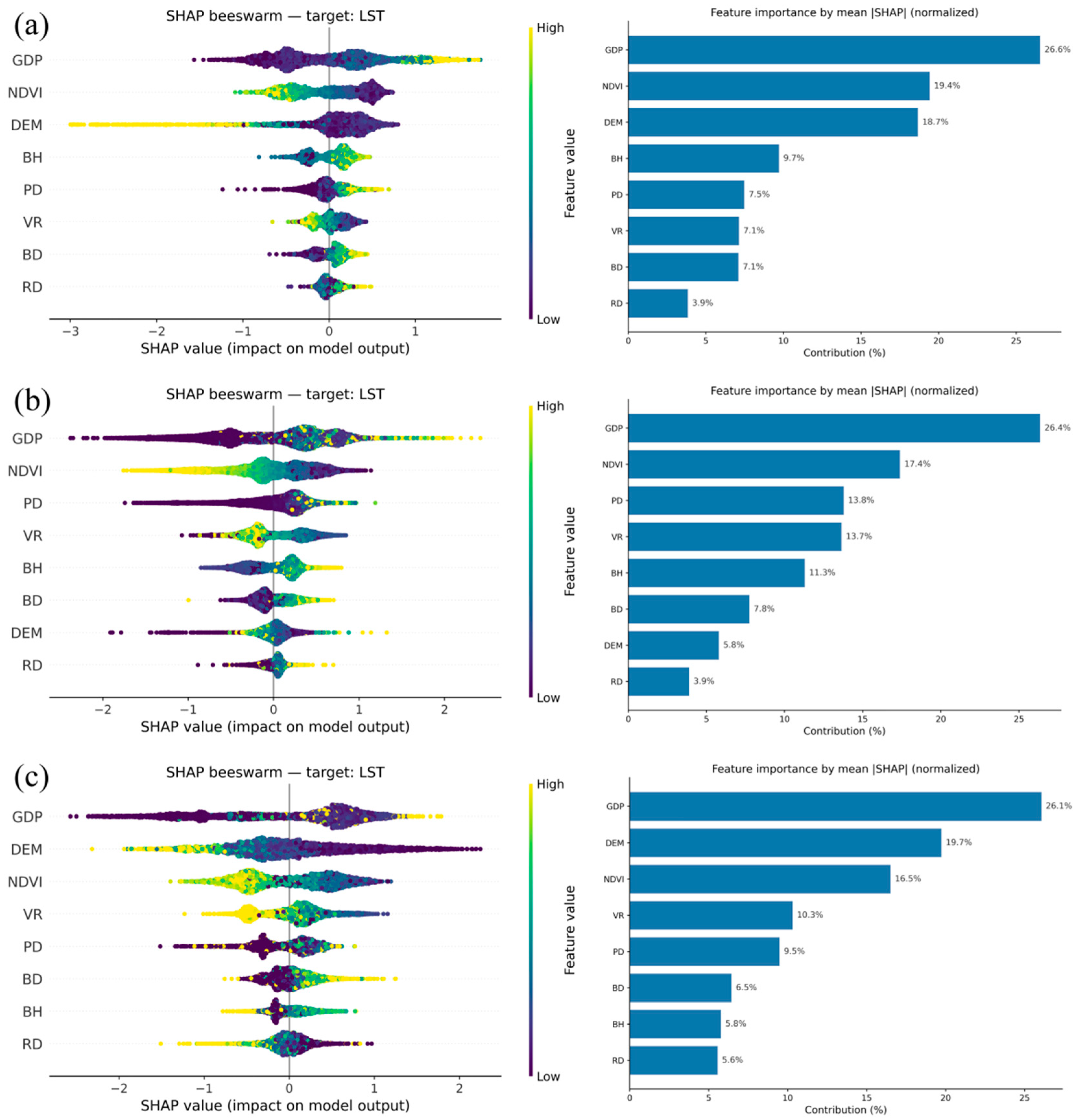
To quantitatively assess the contribution magnitude and directional effects of various driving factors on LST, this study employed the SHAP (SHapley Additive exPlanations) algorithm to interpret the CatBoost model. Figure 5 presents the global feature importance rankings (bar charts on the right) and SHAP summary plots (beeswarm plots on the left) for Beijing, Shanghai, and Shenzhen. The horizontal axis represents SHAP values, indicating both the direction and magnitude of each feature’s influence on model output: positive SHAP values signify that the feature contributes to an increase in LST, whereas negative values indicate a cooling effect. The color gradient from purple to yellow represents increasing feature values. Meanwhile, the bar charts derived from normalized mean absolute SHAP values depict the global contribution structure of all features.
Figure 5.
SHAP-based global interpretation of land surface temperature (LST) driving factors in (a) Beijing, (b) Shanghai, and (c) Shenzhen.
For Beijing (Figure 5a), the global importance results reveal a distinct “economic–ecological–topographic” triadic driving mechanism. GDP dominates the thermal environment pattern, contributing 26.6% to the model’s explanatory power. The SHAP beeswarm plot shows that high GDP values correspond to strong positive SHAP values, indicating that intensive urban development in central districts significantly elevates surface temperatures. NDVI (19.4%) and DEM (18.7%) follow as the second and third most influential factors, together accounting for nearly 40% of total importance. The high importance of DEM reflects Beijing’s pronounced topographical duality between the mountainous northwest and the low-lying southeast plains. In the SHAP distribution, higher DEM values are clustered in the negative SHAP range, signifying that mountainous regions in northwestern Beijing serve as natural cooling barriers that effectively constrain the outward expansion of urban heat islands. This underscores the pronounced negative regulatory role of terrain in shaping Beijing’s thermal environment.
In contrast, Shanghai exhibits a characteristic metropolitan plain-type driving mechanism (Figure 5b), where topographic constraints are virtually absent, and the thermal environment is shaped predominantly by dense population and urban morphological factors. Owing to its flat alluvial terrain at the Yangtze River Delta estuary, DEM contributes only 5.8%—ranking second to last among the main variables. In the absence of terrain moderation, the influence of internal urban morphological parameters on LST becomes substantially more pronounced. Beyond GDP (26.4%) and NDVI (17.4%), population density (PD) emerges as the third most influential factor, contributing 13.8%, a value notably higher than in Beijing and Shenzhen. Additionally, volumetric ratio (VR) and building height (BH) also show considerable importance. These findings suggest that in flat, high-density megacities, anthropogenic heat emissions from population aggregation and the thermal effects of complex built forms jointly shape the spatial heterogeneity of LST. Consequently, mitigating urban heat in such contexts depends more on optimizing artificial green space configurations rather than relying on natural topography.
Shenzhen, meanwhile, combines both intensive urban development and complex terrain characteristics (Figure 5c), displaying a driving pattern more similar to Beijing’s but with a stronger topographic influence. GDP remains the primary thermal driver (26.1%), yet DEM surpasses NDVI to become the second most critical variable, contributing 19.7%. This ranking highlights the fundamental role of Shenzhen’s hilly and mountainous landscape in regulating its urban microclimate. The SHAP beeswarm plot clearly illustrates a nonlinear threshold effect for DEM, with high-elevation areas exerting pronounced cooling effects. Although Shenzhen is an extremely high-density megacity, its rugged topography substantially mitigates the intensifying impact of population concentration—reflected in PD’s relatively modest contribution (9.5%), ranking fifth. This indicates that in Shenzhen, the undulating terrain not only directly influences the vertical temperature gradient but also spatially fragments urban heat island continuity at a macro scale. Consequently, topographic conservation emerges as a central factor in sustaining the city’s thermal resilience [40].
3.3. PDP Nonlinear Response and Threshold Effect Analysis
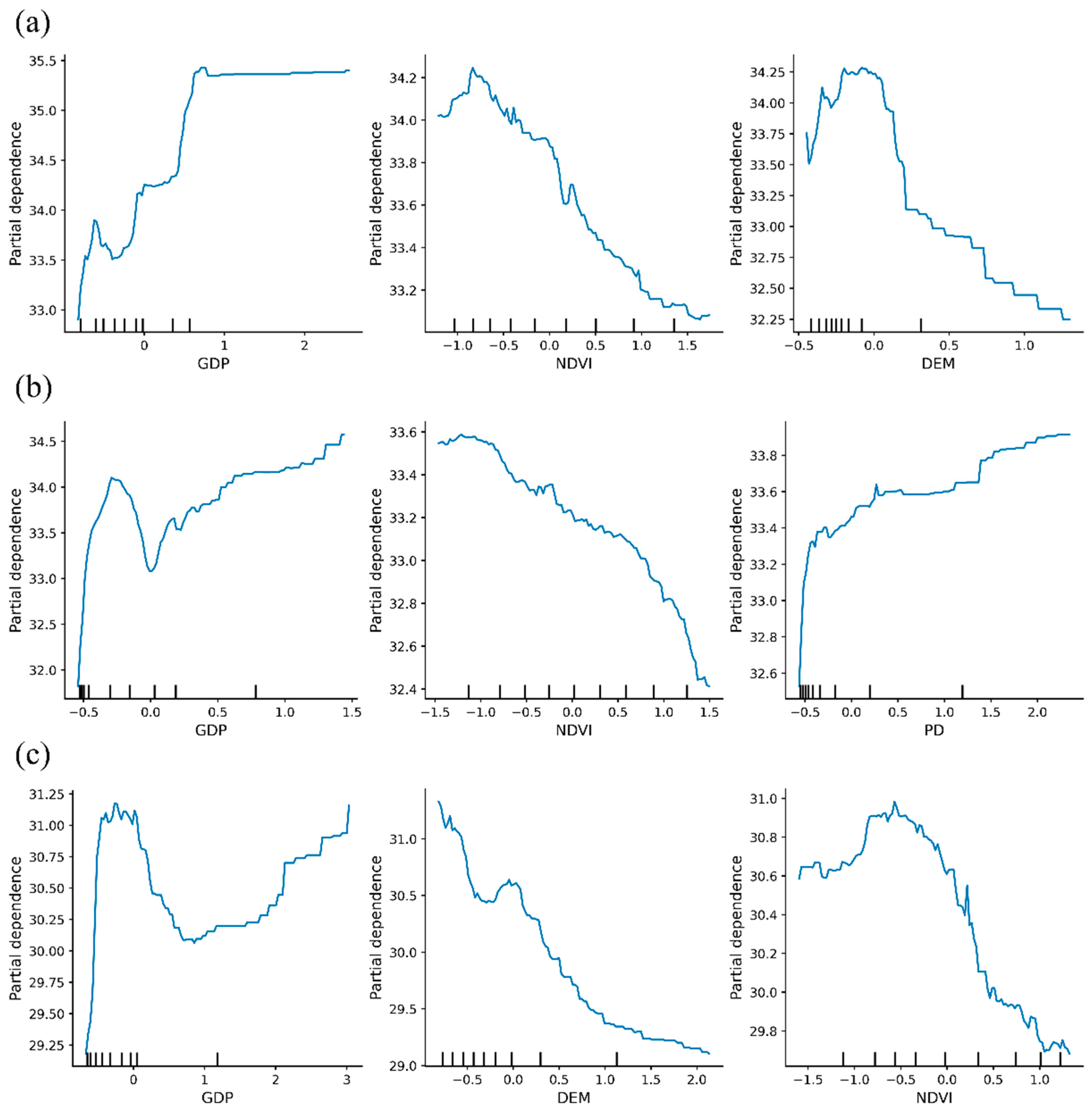
To further elucidate the complex nonlinear mechanisms through which driving factors influence LST and to identify critical control thresholds, this study employed Partial Dependence Plots (PDP) to visualize the marginal effects of the three most dominant variables (Figure 6). The results demonstrate that the relationships between the driving factors and LST are far from linear; instead, they exhibit pronounced stage-dependent patterns and saturation effects, with distinct spatial heterogeneity across different cities.
Figure 6.
Partial dependence plots (PDP) of key driving factors affecting LST: (a) Beijing, (b) Shanghai, and (c) Shenzhen.
As shown in Figure 6, the warming effect of socioeconomic activity (GDP) on LST generally displays a nonlinear pattern that transitions from steep to gradual, indicating an evident threshold saturation phenomenon. In Beijing (Figure 6a) and Shanghai (Figure 6b), GDP is positively correlated with LST, but the rate of temperature increase is significantly higher in the lower-value range. Taking Beijing as an example, when the normalized GDP value is below 0.5, LST rises sharply with economic intensity; however, once GDP exceeds the threshold of approximately 0.8, the curve flattens, suggesting that beyond a certain level of urban development intensity, the marginal warming effect of economic activity diminishes, and the thermal environment enters a stabilized high-temperature state. Notably, Shenzhen (Figure 6c) exhibits a more complex “N-shaped” GDP–LST response curve, which may be attributed to its polycentric, cluster-based urban structure and the frequent coexistence of high GDP zones (e.g., high-tech parks) with well-planned green spaces. This pattern implies a potential decoupling between economic growth and thermal degradation under high-quality, sustainability-oriented urban development.
The cooling effect of NDVI displays a distinct threshold-trigger mechanism, wherein high vegetation coverage yields disproportionately greater cooling efficiency than sparse greening. Across all three cities, the PDP curves show a general negative correlation between NDVI and LST; however, the rate of decline varies markedly across NDVI intervals. In Shanghai (Figure 6b) and Shenzhen (Figure 6c), when NDVI is low, the curve remains relatively flat, suggesting that scattered greenery contributes minimally to mitigating the urban heat island effect. Once NDVI surpasses a critical threshold (approximately 0.5 in Shanghai and 0.45 in Shenzhen), the curve’s slope steepens sharply, and the cooling effect intensifies. This finding confirms the existence of a scale effect in urban greening: only when vegetation coverage exceeds a certain proportion to form large, contiguous “cool island” patches can it achieve optimal ecological regulation and thermal mitigation [41].
The DEM and PD variables, representing physical constraints in the vertical and horizontal dimensions, respectively, define the limits of thermal environment variation. In the mountainous cities of Beijing and Shenzhen, DEM exhibits a strong and monotonic negative effect on LST. The DEM curve for Shenzhen (Figure 6c) follows an approximately exponential decay pattern, indicating that even small increases in elevation yield substantial cooling benefits in the initial stages. Terrain thus functions as the most powerful natural barrier preventing heat island propagation. In contrast, in the flat city of Shanghai, the PDP curve of PD (Figure 6b) follows a logarithmic growth pattern similar to GDP: LST rises rapidly with increasing population density, but the trend levels off once PD surpasses the high-density threshold (≈0.5). This implies that in ultra-dense built-up areas, merely dispersing population offers limited marginal cooling benefits; instead, structural interventions—such as altering urban morphology or expanding blue–green infrastructure—are required to achieve effective thermal regulation [42].
In summary, the PDP analysis not only validates the directionality of each factor’s influence but also quantifies the critical management intervals for urban thermal regulation. The results indicate that maintaining urban development intensity (GDP and PD) below saturation thresholds while ensuring that vegetation coverage (NDVI) exceeds its cooling acceleration threshold constitutes the core strategy for achieving thermally adaptive urban spatial optimization. This identification of nonlinear thresholds provides direct, quantitative evidence to guide precision-oriented, climate-adaptive urban planning.
4. Discussion
4.1. Interaction Mechanisms Among Variables
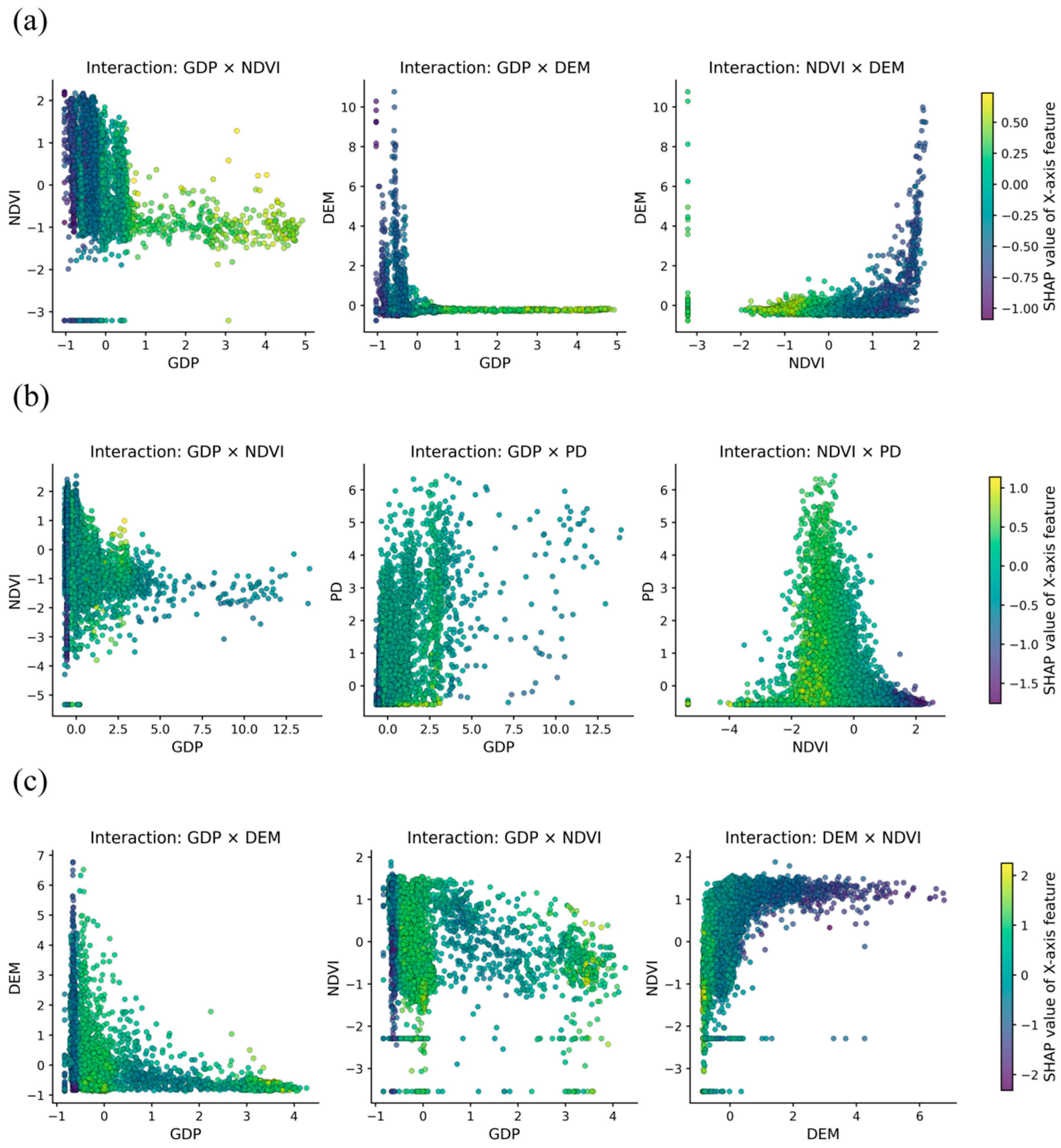
The spatial heterogeneity of urban surface thermal environments is fundamentally the result of nonlinear couplings among multiple driving factors [43]. The marginal effects of individual variables alone are insufficient to fully reveal the intricate mechanisms underlying their formation. To overcome the limitations of traditional linear regression models in addressing inter-variable dependencies, this study introduces SHAP interaction values to quantitatively decompose the synergistic enhancement (synergy) and antagonistic regulation (trade-off/antagonism) among key factors. The visualization results (Figure 7) indicate pronounced bivariate coupling effects between socioeconomic factors (GDP, PD) and natural environmental factors (NDVI, DEM).
Figure 7.
SHAP interaction analysis: (a) Beijing, (b) Shanghai, and (c) Shenzhen.
In Beijing (Figure 7a) and Shanghai (Figure 7b), the GDP–NDVI interaction plots show that high GDP regions (right side of the x-axis) are generally associated with higher SHAP values (warm colors), confirming that economic activity is indeed a major thermal driver of urban heat islands. However, the vertical color gradients reveal that even at equivalent high GDP levels, SHAP values shift markedly from warm (yellow) to cool (blue) as NDVI increases along the y-axis. This finding not only corroborates the cooling effect of urban greening, but—more importantly—identifies a critical threshold marking a transition from incremental to transformative impact [44,45]. In densely built, high-GDP zones, economic growth typically elevates ambient temperatures directly [20]. Our analysis shows that this association can be disrupted: sporadic greening yields negligible effects, whereas only when green coverage attains sufficient scale and surpasses the threshold can it effectively offset the heat generated by intensive economic activity [46,47].
The GDP–DEM interaction plots for Shenzhen (Figure 7a) and Beijing (Figure 7b) display a distinctive “L-shaped” pattern. High-intensity economic activities (high GDP) are strictly confined to low-elevation zones (low DEM), where the combined SHAP interaction values reach their peak (dense yellow regions). This indicates that topography influences thermal conditions not only through adiabatic cooling but also indirectly by spatially constraining human activities—forcing thermal sources to concentrate in low-lying plains. Consequently, natural geography imposes a rigid morphological constraint that leads to vertically differentiated heat accumulation patterns: lowlands experience dual warming effects from anthropogenic heat emissions and topographic enclosure, whereas uplands benefit from synergistic cooling through ecological vegetation and enhanced ventilation [48].
In contrast, Shanghai (Figure 7b), unconstrained by topography, exhibits a different pattern in the GDP–PD interaction plot. Within the high-density urban core (GDP values between 0 and 3), SHAP interaction values shift significantly from blue to yellow with increasing PD, indicating a strong positive synergistic warming effect between population concentration and economic activity. Their spatial overlap amplifies the intensity of urban heat islands. However, at the extreme high-value end of the plot (GDP > 7.5), the interaction effect no longer strengthens but instead trends toward neutrality (cyan-green zone). This reflects a saturation threshold in the urban thermal environment: at extreme levels of development intensity, the heating contribution of individual factors approaches physical limits, and the marginal gains from synergistic effects begin to decline [49].
These findings carry important implications for urban climate adaptation and spatial planning. Planners should not only manage the overlapping risks of high-density population and land use in typical dense urban zones but also recognize that in ultra-developed areas, further heat mitigation cannot rely solely on spatial redistribution. Instead, source-level emission reduction—through strategies such as energy efficiency improvements, cooling-oriented building design, and green infrastructure integration—should become the primary focus to prevent the escalation of thermal saturation effects [50].
4.2. Influence of Urban Spatial Morphology on LST
The explainable machine learning results in this study confirm that in rapidly urbanizing high-density areas, the intensity of socioeconomic activity has surpassed traditional physical morphological parameters in determining the urban surface thermal environment. As the top-ranking feature (importance > 26%), GDP effectively serves as a comprehensive proxy for Anthropogenic Heat Flux (AHF), encompassing spatial accumulations of industrial energy consumption, transportation heat emissions, and building cooling loads. This finding challenges conventional research paradigms that focus primarily on structural indicators such as building density or impervious surface ratio, revealing that functional heat emissions have become a more critical driver of the urban heat island effect than structural heat storage [10].
More importantly, the comparative analysis highlights the rigid constraints and modal differentiation of natural environmental elements in shaping urban thermal mechanisms. Two distinct driving modes were identified. In Beijing and Shenzhen, where DEM plays a dominant role (18.7%–19.7%), its strong “L-shaped” spatially exclusive relationship with GDP indicates that mountainous terrain not only provides direct cooling through lapse-rate effects but, more critically, delineates the physical boundaries of urban expansion. This constraint forces high-intensity development to concentrate in low-lying plains, thereby reinforcing a macro-scale “lowland heat island–highland cool island” dichotomy. In contrast, in Shanghai, a flat plain city with minimal topographic barriers (DEM importance only 5.8%), spatial heterogeneity in the thermal environment is entirely governed by the horizontal spread of impervious surfaces and population concentration. The strong synergistic warming effects revealed in the GDP–PD interaction analysis confirm that, in plain megacities lacking natural topographic moderation, functional agglomeration and population clustering produce a “1 + 1 > 2” cumulative heating feedback loop.
4.3. Urban Planning and Policy Implications
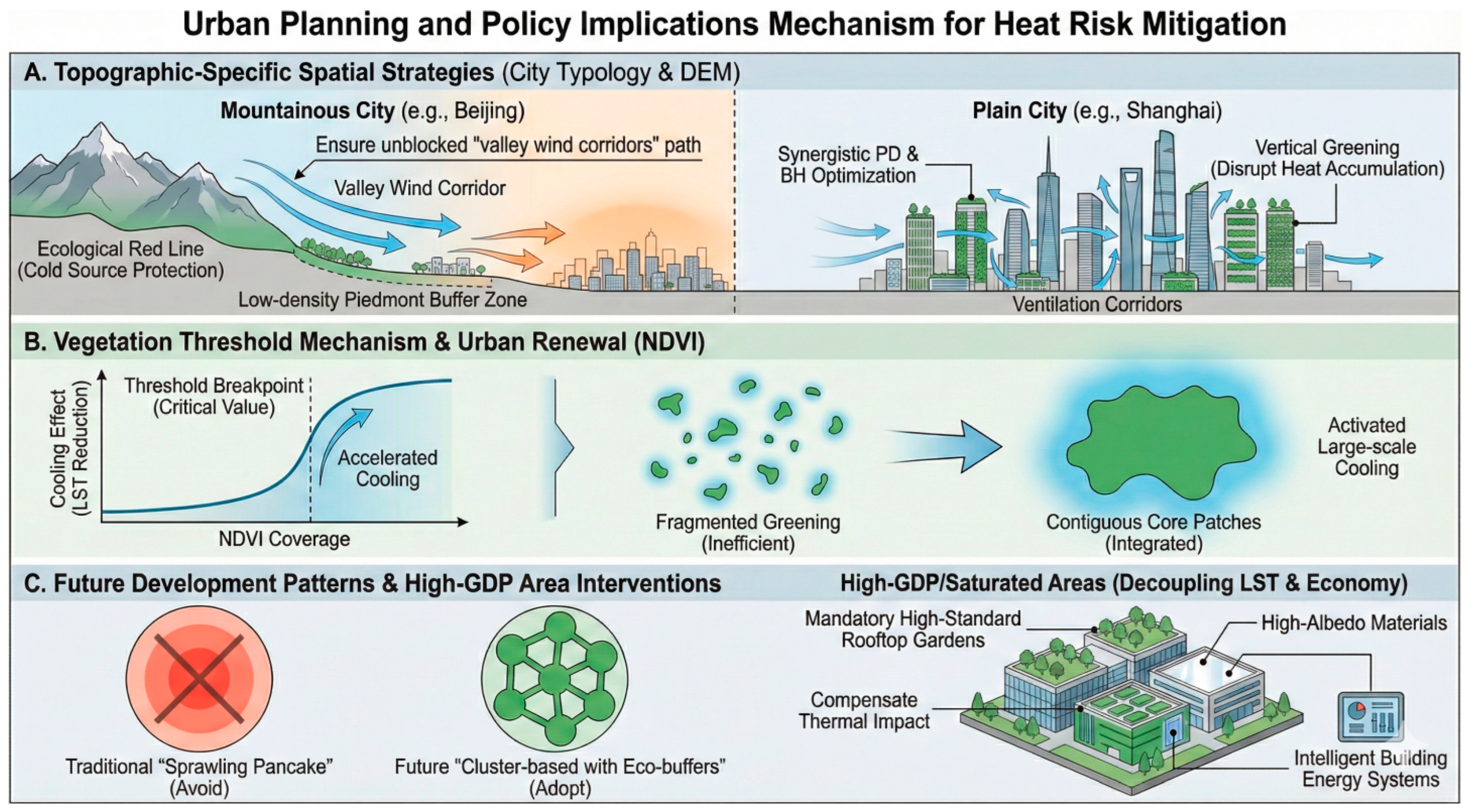
Building upon the empirical findings and mechanism analyses above, this study proposes targeted planning and policy recommendations for thermal risk management in high-density cities under a warming climate (Figure 8).
Figure 8.
Mechanisms of heat-risk mitigation under urban planning and policy interventions.
For mountainous cities such as Beijing and Shenzhen, it is crucial to strictly preserve ecological redlines and protect mountainous cooling sources along the urban periphery. Planning efforts should capitalize on the cooling threshold effect of elevation (DEM) by establishing low-density buffer zones at mountain fronts to prevent urban expansion from blocking valley wind corridors that provide natural ventilation to the urban core [51,52].
For plain, high-density cities such as Shanghai, where natural topographic regulation is absent, heat mitigation must rely on internal morphological optimization within built-up areas [53]. Particular attention should be paid to the co-optimization of population density (PD) and building height (BH). In high-density zones where PD has reached its saturation threshold, the marginal cooling benefits of population decentralization are limited. Instead, vertical greening and the construction of urban ventilation corridors should be prioritized to disrupt heat accumulation and improve microclimatic airflow [54,55].
Traditional “fragmentary greening” approaches are inefficient in addressing extreme heat. The PDP analysis identifies specific NDVI breakpoints—thresholds beyond which vegetation induces accelerated cooling effects. Urban renewal projects should target these thresholds by integrating fragmented green patches into large, contiguous core green spaces, ensuring that local vegetation coverage surpasses critical levels to activate large-scale cooling benefits [56]. Furthermore, in areas with extremely high GDP, the antagonistic GDP–NDVI relationship underscores the necessity of mandatory high-standard vertical greening, such as rooftop gardens and green façades, to compensate for the heat emissions associated with intensive development [57].
Notably, in some high-GDP zones (e.g., high-tech industrial parks), a local decoupling between economic growth and LST rise has already been achieved through high greening ratios and climate-conscious spatial planning. Future urban district planning should thus avoid conventional “sprawling” development and instead adopt clustered layouts with ecological interspaces (“group-based + ecological buffer” model) [58]. For mature urban cores that have already reached GDP-induced thermal saturation, planning priorities should shift from merely restricting development intensity to enhancing the ecological quality per development unit. Advanced technologies—such as high-albedo materials, intelligent building energy management systems, and cool roof technologies—should be employed to maintain economic vitality while reducing anthropogenic heat emissions, achieving a synergistic balance between urban growth and thermal resilience [59,60].
5. Conclusions
This study investigated three representative megacities in China—Beijing, Shanghai, and Shenzhen—integrating multi-source indicators encompassing natural environment, urban morphology, and socioeconomic dimensions. By systematically comparing eleven regression models and applying a CatBoost–SHAP interpretability framework, the study not only quantified the contribution strength of multidimensional driving factors but also unveiled the nonlinear response mechanisms and interactive effects underpinning complex urban thermal environments. The main conclusions are as follows:
- Ensemble learning models demonstrate significant performance advantages in urban thermal environment simulation. Comparative analyses show that tree-based ensemble models consistently outperform both linear and single nonlinear models. Among them, the CatBoost model, owing to its superior ability to handle high-dimensional features and complex nonlinear relationships, achieved the best generalization performance across all study areas (R2 = 0.683–0.873). This confirms its robustness and applicability as a fine-scale urban climate modeling tool.
- The driving mechanisms of urban LST exhibit a distinct “topographic constraint–morphological dominance” dual differentiation pattern. While socioeconomic activity (GDP) was identified as the primary thermal driver (contribution > 26%) in all cities—confirming the dominant influence of anthropogenic heat emissions on the thermal environments of modern megacities—the underlying natural geographic context fundamentally shapes the spatial configuration of urban heat islands. In mountainous cities such as Beijing and Shenzhen, elevation (DEM) serves as a rigid physical barrier limiting the spread of heat islands, forming a vertical gradient of “lowland heat accumulation–highland cooling.” In contrast, in the flat city of Shanghai, thermal heterogeneity is governed entirely by the horizontal expansion of impervious surfaces and population clustering, producing a pronounced population–economy synergistic warming effect.
- Key driving factors exert strong nonlinear threshold and saturation effects, as revealed by the PDP analysis, which identified “critical intervention intervals” for urban heat management. The warming effect of socioeconomic intensity exhibits a saturation threshold, suggesting that in highly developed built-up zones, economic growth and thermal deterioration may become partially decoupled. More importantly, vegetation cover (NDVI) demonstrates a distinct break-point phenomenon—only when greening coverage exceeds a critical threshold can large-scale cooling effects be activated. This finding quantitatively differentiates the ecological regulation efficiency of fragmented greening versus contiguous green patches.
- Differentiated climate-adaptive planning strategies are essential for cities with varying geomorphological characteristics. For cities constrained by topography (e.g., Beijing and Shenzhen), planning should focus on maintaining ecological redlines along mountain fronts and leveraging topographic cooling effects to interrupt the spatial continuity of heat islands. For plain, high-density cities (e.g., Shanghai), attention should be directed toward morphological optimization in densely populated zones—implementing vertical greening systems and ventilation corridors to disrupt the cumulative heating feedback between population and economy. Future urban renewal efforts should move beyond merely increasing total greening area and instead emphasize surpassing the “cooling threshold” through ecological patch integration and targeted thermal compensation strategies in high-GDP regions.
Despite the effectiveness of the CatBoost–SHAP framework in elucidating the nonlinear drivers of the urban thermal environment across multiple cities, several limitations warrant further investigation. First, the analysis is based on data from the summer of 2024; consequently, the findings pertain specifically to heat-mitigation strategies during the hot season and do not capture thermal characteristics in other seasons. Second, in representing socioeconomic drivers, we employed gridded GDP as a key indicator of socioeconomic activity intensity and anthropogenic heat flux (AHF). Although areas with high GDP typically spatially coincide with energy-intensive industrial enterprises or commercial agglomerations—thereby serving as an effective proxy for heat effects induced by industrialization—the present study does not explicitly incorporate the spatial distribution of industrial point sources or greenhouse gas emission inventories. Differences in industrial structure across cities (e.g., the relative shares of heavy industry versus services) may lead to divergent heat-emission intensities at comparable GDP levels. The absence of pollutant emission data limits, to some extent, the model’s ability to resolve industrial heat sources at a fine scale.
Moreover, this study uses land surface temperature (LST) rather than near-surface air temperature (SAT). While LST is a key driver of urban climate, it does not fully represent human thermal comfort, which is also modulated by wind speed, shading, and mean radiant temperature, among other factors. Finally, the current model emphasizes static spatial-morphology indicators and does not incorporate dynamic meteorological parameters (e.g., relative humidity, wind fields) or surface physical properties such as albedo. Future research should integrate multi-temporal thermal infrared observations, microclimate simulations, and high-resolution carbon-emission or enterprise energy-census datasets to address these gaps, enabling validation of day–night differences in urban heat island drivers and a more granular attribution of the independent contribution of industrial activities to the urban thermal environment.
In summary, this study not only provides new empirical evidence for understanding the formation mechanisms of urban thermal environments in China’s megacities but also establishes a transferable, explainable analytical framework that offers a quantitative and scientifically grounded pathway for climate-adaptive urban planning and sustainable thermal resilience design.
Author Contributions
Conceptualization, T.L. and Y.Y.; methodology, T.L.; software, T.L.; validation, T.L., Z.L. and Y.Y.; formal analysis, T.L.; investigation, T.L.; resources, T.L.; data curation, T.L. and Z.L.; writing—original draft preparation, T.L.; writing—review and editing, Z.L. and Y.Y.; visualization, T.L.; supervision, Y.Y.; project administration, Y.Y.; funding acquisition, Y.Y. All authors have read and agreed to the published version of the manuscript.
Funding
This research received no external funding.
Data Availability Statement
The data presented in this study are available on request from the corresponding author.
Conflicts of Interest
The authors declare no conflicts of interest.
References
- Wu, S.; Chen, B.; Webster, C.; Xu, B.; Gong, P. Improved human greenspace exposure equality during 21st century urbanization. Nat. Commun. 2023, 14, 6460. [Google Scholar] [CrossRef]
- Kabir, M.; Habiba, U.E.; Khan, W.; Shah, A.; Rahim, S.; De los Rios-Escalante, P.R.; Farooqi, Z.-U.-R.; Ali, L.; Shafiq, M. Climate change due to increasing concentration of carbon dioxide and its impacts on environment in 21st century; a mini review. J. King Saud Univ.-Sci. 2023, 35, 102693. [Google Scholar] [CrossRef]
- Shen, P.; Zhao, S.; Ma, Y. Perturbation of urbanization to Earth’s surface energy balance. J. Geophys. Res. Atmos. 2021, 126, e2020JD033521. [Google Scholar] [CrossRef]
- Halefom, A.; He, Y.; Nemoto, T.; Feng, L.; Li, R.; Raghavan, V.; Jing, G.; Song, X.; Duan, Z. The Impact of Urbanization-Induced Land Use Change on Land Surface Temperature. Remote Sens. 2024, 16, 4502. [Google Scholar] [CrossRef]
- Zhang, C.; Yang, Y.; Yu, L. Assessing urban surface thermal environment and heat health risk in Chinese cities: A twenty-year study. Urban Clim. 2025, 59, 102304. [Google Scholar] [CrossRef]
- Zhang, Y.; Xia, X.; Zhang, Y.; Jian, L. Mobilities in the heat: Identifying travel-related urban heat exposure and its built environment drivers using remote sensing and mobility data in Chengdu, China. ISPRS Int. J. Geo-Inf. 2025, 14, 372. [Google Scholar] [CrossRef]
- Xia, J.; Li, T.; Zhang, Y.; Sun, Y. Heterogeneous Impacts of Urban Built Environment on Land Surface Temperature: A Comparative Study of Seoul, Busan, and Gwangju, South Korea. Sustain. Cities Soc. 2025, 135, 107015. [Google Scholar] [CrossRef]
- Almashhour, R.; Kolo, J.; Beheiry, S. Critical reflections on strategies for mitigating and adapting to urban heat islands. Int. J. Urban Sustain. Dev. 2024, 16, 144–162. [Google Scholar] [CrossRef]
- Li, F.; Yigitcanlar, T.; Nepal, M.; Thanh, K.N.; Dur, F. A novel urban heat vulnerability analysis: Integrating machine learning and remote sensing for enhanced insights. Remote Sens. 2024, 16, 3032. [Google Scholar] [CrossRef]
- Huang, C.; Liu, K.; Ma, T.; Xue, H.; Wang, P.; Li, L. Analysis of the impact mechanisms and driving factors of urban spatial morphology on urban heat islands. Sci. Rep. 2025, 15, 18589. [Google Scholar] [CrossRef]
- Yao, X.; Zhu, Z.; Zhou, X.; Shen, Y.; Shen, X.; Xu, Z. Investigating the effects of urban morphological factors on seasonal land surface temperature in a “Furnace city” from a block perspective. Sustain. Cities Soc. 2022, 86, 104165. [Google Scholar] [CrossRef]
- Zhao, L.; Fan, X.; Hong, T. Urban Heat Island Effect: Remote Sensing Monitoring and Assessment—Methods, Applications, and Future Directions. Atmosphere 2025, 16, 791. [Google Scholar] [CrossRef]
- Guo, A.; Yang, J.; Sun, W.; Xiao, X.; Cecilia, J.X.; Jin, C.; Li, X. Impact of urban morphology and landscape characteristics on spatiotemporal heterogeneity of land surface temperature. Sustain. Cities Soc. 2020, 63, 102443. [Google Scholar] [CrossRef]
- Guo, G.; Zhou, X.; Wu, Z.; Xiao, R.; Chen, Y. Characterizing the impact of urban morphology heterogeneity on land surface temperature in Guangzhou, China. Environ. Model. Softw. 2016, 84, 427–439. [Google Scholar] [CrossRef]
- Liao, W.; Hong, T.; Heo, Y. The effect of spatial heterogeneity in urban morphology on surface urban heat islands. Energy Build. 2021, 244, 111027. [Google Scholar] [CrossRef]
- Wang, Y.; He, Z.; Zhai, W.; Wang, S.; Zhao, C. How do the 3D urban morphological characteristics spatiotemporally affect the urban thermal environment? A case study of San Antonio. Build. Environ. 2024, 261, 111738. [Google Scholar] [CrossRef]
- Liu, Y.; Zhang, W.; Liu, W.; Tan, Z.; Hu, S.; Ao, Z.; Li, J.; Xing, H. Exploring the seasonal effects of urban morphology on land surface temperature in urban functional zones. Sustain. Cities Soc. 2024, 103, 105268. [Google Scholar] [CrossRef]
- Petrou, I.; Kassomenos, P. Estimating the importance of environmental factors influencing the urban heat island for urban areas in Greece. A machine learning approach. J. Environ. Manag. 2024, 368, 122255. [Google Scholar] [CrossRef]
- Malekloo, A.; Ozer, E.; AlHamaydeh, M.; Girolami, M. Machine learning and structural health monitoring overview with emerging technology and high-dimensional data source highlights. Struct. Health Monit. 2022, 21, 1906–1955. [Google Scholar] [CrossRef]
- Xia, J.; Yan, Y.; Dou, Z.; Han, D.; Zhang, Y. Exploring the Role of Urban Green Spaces in Regulating Thermal Environments: Comparative Insights from Seoul and Busan, South Korea. Forests 2025, 16, 1515. [Google Scholar] [CrossRef]
- Hoang, N.-D.; Nguyen, Q.-L. Geospatial Analysis and Machine Learning Framework for Urban Heat Island Intensity Prediction: Natural Gradient Boosting and Deep Neural Network Regressors with Multisource Remote Sensing Data. Sustainability 2025, 17, 4287. [Google Scholar] [CrossRef]
- Mallick, J.; Alqadhi, S. Explainable artificial intelligence models for proposing mitigation strategies to combat urbanization impact on land surface temperature dynamics in Saudi Arabia. Urban Clim. 2025, 59, 102259. [Google Scholar] [CrossRef]
- Lin, J.; Gan, W.; Li, X.; Xu, X. Exploring the nonlinear and spatial effects of urban activity heterogeneity on the nighttime thermal environment using machine learning and GWR. Build. Environ. 2025, 288, 113928. [Google Scholar] [CrossRef]
- Qin, Y.; Yu, Y.; Liu, J.; Liu, R. Machine learning-based identification of key factors and spatial heterogeneity analysis of urban flooding: A case study of the central urban area of Ordos. Sci. Rep. 2025, 15, 24749. [Google Scholar] [CrossRef]
- Yuan, H.; Wang, M.; Zhang, D.; Ikram, R.M.A.; Su, J.; Zhou, S.; Wang, Y.; Li, J.; Zhang, Q. Data-driven urban configuration optimization: An XGBoost-based approach for mitigating flood susceptibility and enhancing economic contribution. Ecol. Indic. 2024, 166, 112247. [Google Scholar] [CrossRef]
- Cheng, J.; Yang, D.; Qie, K.; Wang, J. Analysis of land surface temperature drivers in Beijing’s central urban area across multiple spatial scales: An explainable ensemble learning approach. Energy Build. 2025, 338, 115704. [Google Scholar] [CrossRef]
- Han, T.; Du, C.; Xie, Y.; Xian, X.; Zhang, X.; Yang, B.; Chen, Y. A 3D perspective for understanding the mechanisms of urban heat island and urban morphology using multi-modal geospatial data and interpretable machine learning. Build. Environ. 2025, 282, 113184. [Google Scholar] [CrossRef]
- Nazeer, M.; Ilori, C.O.; Bilal, M.; Nichol, J.E.; Wu, W.; Qiu, Z.; Gayene, B.K. Evaluation of atmospheric correction methods for low to high resolutions satellite remote sensing data. Atmos. Res. 2021, 249, 105308. [Google Scholar] [CrossRef]
- Zheng, Y.; Zhao, X.; Li, X.; Chen, H.; Li, C.; Zhang, C. Mapping soil organic carbon density via geographically weighted regression with smooth terms: A case study in Shanxi Province. Ecol. Indic. 2024, 166, 112588. [Google Scholar] [CrossRef]
- Cheshmehzangi, A.; Li, Y.; Li, H.; Zhang, S.; Huang, X.; Chen, X.; Su, Z.; Sedrez, M.; Dawodu, A. A hierarchical study for urban statistical indicators on the prevalence of COVID-19 in Chinese city clusters based on multiple linear regression (MLR) and polynomial best subset regression (PBSR) analysis. Sci. Rep. 2022, 12, 1964. [Google Scholar] [CrossRef]
- Yue, Z.; Wang, N.; Xu, B.; Huang, X.; Yang, D.; Xiao, H.; Shi, Z. Toward trustworthy machine learning for daily sediment modeling in the riverine systems: An integrated framework with enhanced uncertainty quantification and interpretability. Water Resour. Res. 2025, 61, e2024WR038650. [Google Scholar] [CrossRef]
- Liu, H.; Li, S.; Zhu, S.; Hu, Y.; Han, X.; Shi, C.; He, F.; He, C.; Chen, B.; Zhao, N. How machine learning has driven the development of rechargeable ion batteries. Adv. Energy Mater. 2025, 15, e04095. [Google Scholar] [CrossRef]
- Zhu, J.-J.; Yang, M.; Ren, Z.J. Machine learning in environmental research: Common pitfalls and best practices. Environ. Sci. Technol. 2023, 57, 17671–17689. [Google Scholar] [CrossRef]
- Liu, X.; Liu, Z.; Zhu, Z.; Qiao, R. Decoupling the multi-drivers of urban extreme heat environment in urban agglomerations using ensemble learning. Build. Environ. 2024, 258, 111618. [Google Scholar] [CrossRef]
- Chen, Z.; Gong, F.; Song, J.; Zhang, K. Interpretable prediction of biomass-derived biochar characteristics: Combining machine learning with shapley additive explanation. Energy 2025, 335, 137877. [Google Scholar] [CrossRef]
- Song, Z.; Cao, S.; Yang, H. An interpretable framework for modeling global solar radiation using tree-based ensemble machine learning and Shapley additive explanations methods. Appl. Energy 2024, 364, 123238. [Google Scholar] [CrossRef]
- Kapp, S.; Choi, J.-K.; Hong, T. Predicting industrial building energy consumption with statistical and machine-learning models informed by physical system parameters. Renew. Sustain. Energy Rev. 2023, 172, 113045. [Google Scholar] [CrossRef]
- Wu, Q.; Yu, C.; Su, D.; Cao, Y. A multi-scale framework for understanding spatial scale effects on ecosystem service heterogeneity, interactions, drivers and their socio-ecological impact pathways for adaptive management. J. Clean. Prod. 2025, 516, 145757. [Google Scholar] [CrossRef]
- Wang, Z.; Zhou, R.; Rui, J.; Yu, Y. Revealing the impact of urban spatial morphology on land surface temperature in plain and plateau cities using explainable machine learning. Sustain. Cities Soc. 2025, 118, 106046. [Google Scholar] [CrossRef]
- Lin, X.; Wang, Z.; Bao, Y.; Chen, X. Enhancing urban thermal resilience in multi-mountainous cities through optimized 3D block morphology: A machine learning framework. Energy Build. 2025, 349, 116562. [Google Scholar] [CrossRef]
- Rakoto, P.Y.; Deilami, K.; Hurley, J.; Amati, M.; Sun, Q.C. Revisiting the cooling effects of urban greening: Planning implications of vegetation types and spatial configuration. Urban For. Urban Green. 2021, 64, 127266. [Google Scholar] [CrossRef]
- Kumar, P.; Debele, S.E.; Khalili, S.; Halios, C.H.; Sahani, J.; Aghamohammadi, N.; de Fatima Andrade, M.; Athanassiadou, M.; Bhui, K.; Calvillo, N.; et al. Urban heat mitigation by green and blue infrastructure: Drivers, effectiveness, and future needs. Innovation 2024, 5, 100588. [Google Scholar] [CrossRef]
- Si, M.; Li, Z.-L.; Tang, B.-H.; Liu, X.; Nerry, F. Spatial heterogeneity of driving factors-induced impacts for global long-term surface urban heat island. Int. J. Remote Sens. 2024, 45, 7139–7159. [Google Scholar] [CrossRef]
- Bobo Merga, B.; Tabor, K.W.; Melka, G.A. Analysis of the cooling effects of urban green spaces in mitigating micro-climate change using geospatial techniques in Adama City, Ethiopia. Sustain. Environ. 2024, 10, 2350806. [Google Scholar] [CrossRef]
- Erell, E.; Zhou, B. The effect of increasing surface cover vegetation on urban microclimate and energy demand for building heating and cooling. Build. Environ. 2022, 213, 108867. [Google Scholar] [CrossRef]
- Gago, E.J.; Roldan, J.; Pacheco-Torres, R.; Ordóñez, J. The city and urban heat islands: A review of strategies to mitigate adverse effects. Renew. Sustain. Energy Rev. 2013, 25, 749–758. [Google Scholar] [CrossRef]
- Wang, C.; Ren, Z.; Dong, Y.; Zhang, P.; Guo, Y.; Wang, W.; Bao, G. Efficient cooling of cities at global scale using urban green space to mitigate urban heat island effects in different climatic regions. Urban For. Urban Green. 2022, 74, 127635. [Google Scholar] [CrossRef]
- Ma, W.; Yu, Z.; Yang, W.; Zhang, Y.; Hu, Y.; Hu, J.; Zhang, H.; Yang, G. Optimizing Vegetation and Building Configurations for Streetscape Heat Mitigation: A Multi-Scale Analysis under Extreme Heat. Build. Environ. 2025, 283, 113331. [Google Scholar] [CrossRef]
- Lin, L.; Zhao, Y. Optimizing Local Climate Zones to Mitigate Urban Heat Risk: A Multi-Models Coupled Approach in the Context of Urban Renewal. Build. Environ. 2025, 282, 113282. [Google Scholar] [CrossRef]
- El Samanoudy, G.; Mahmoud, N.S.A.; Jung, C. Analyzing the effectiveness of building integrated Photovoltaics (BIPV) to reduce the energy consumption in Dubai. Ain Shams Eng. J. 2024, 15, 102682. [Google Scholar] [CrossRef]
- Gong, D.; Dai, X.; Zhou, L. Satellite-Based optimization and planning of urban ventilation corridors for a healthy microclimate environment. Sustainability 2023, 15, 15653. [Google Scholar] [CrossRef]
- Xiong, P.; Guan, D.; Su, Y.; Zeng, S. Summer Cooling Effect of Rivers in the Yangtze Basin, China: Magnitude, Threshold and Mechanisms. Land 2025, 14, 1511. [Google Scholar] [CrossRef]
- Zeng, P.; Zong, C.; Wei, X. Quantitative analysis and spatial pattern research of built-up environments and surface urban heat island effect in beijing’s main urban area. J. Urban Plan. Dev. 2024, 150, 04024006. [Google Scholar] [CrossRef]
- Guo, A.; Yue, W.; Yang, J.; Li, M.; Xie, P.; He, T.; Zhang, M.; Yu, H. Quantifying the impact of urban ventilation corridors on thermal environment in Chinese megacities. Ecol. Indic. 2023, 156, 111072. [Google Scholar] [CrossRef]
- Lin, H.; Li, X. The Role of Urban Green Spaces in Mitigating the Urban Heat Island Effect: A Systematic Review from the Perspective of Types and Mechanisms. Sustainability 2025, 17, 6132. [Google Scholar] [CrossRef]
- Lin, L.; Zhao, Y.; Zhao, J. Optimizing urban green space spatial patterns for thermal environment improvement: A multi-objective approach in the context of urban renewal. Comput. Environ. Urban Syst. 2025, 121, 102320. [Google Scholar] [CrossRef]
- Zhao, X.; Li, J.; Ruan, F.; Zou, Z.; He, X.; Zhou, C. Spatiotemporal Dynamics and Multi-Scenario Projections of the Land Use and Habitat Quality in the Yellow River Basin: A GeoDetector-PLUS-InVEST Integrated Framework for a Coupled Human–Natural System Analysis. Remote Sens. 2025, 17, 2181. [Google Scholar] [CrossRef]
- Chen, H.; Zhao, D.; Zhang, L.; Zhang, S.; You, R.; Zhang, W.; Yang, Y. Research on Urban Design Control Methods for Intermontane Basin “Bazi” City in Southwest China During Territorial Space Planning: A Case Study of Mile City, Yunnan Province. Buildings 2025, 15, 2389. [Google Scholar] [CrossRef]
- Anser, M.K.; Nassani, A.A.; Al-Aiban, K.M.; Zaman, K.; Haffar, M. Sustainable Urbanization Strategies: Mitigating Urban Heat Islands through Synergy between Economic Choices, Renewable Energy Consumption, and Environmental Interventions. Probl. Ekorozwoju/Probl. Sustain. Dev. 2025, 20, 86–100. [Google Scholar] [CrossRef]
- Wang, H.; Yang, Y.; Liu, S.; Xue, H.; Xu, T.; He, W.; Gao, X.; Jiang, R. Unveiling the coupling coordination and interaction mechanism between the local heat island effect and urban resilience in China. Sustainability 2024, 16, 2306. [Google Scholar] [CrossRef]
Disclaimer/Publisher’s Note: The statements, opinions and data contained in all publications are solely those of the individual author(s) and contributor(s) and not of MDPI and/or the editor(s). MDPI and/or the editor(s) disclaim responsibility for any injury to people or property resulting from any ideas, methods, instructions or products referred to in the content. |
© 2026 by the authors. Licensee MDPI, Basel, Switzerland. This article is an open access article distributed under the terms and conditions of the Creative Commons Attribution (CC BY) license.