Article

Do Riparian Plant Hybrids Mimic Leaf Mixtures in Terms of In-Stream Litter Dynamics?

by
Walton M. Andrews
1,2,
Carri J. LeRoy
2,* and
Dylan G. Fischer
3
1
San Juan Islands Conservation District, Friday Harbor, WA 98250, USA
2
Freshwater Ecology Laboratory, The Evergreen State College, Olympia, WA 98505, USA
3
Ecosystem Ecology Laboratory, The Evergreen State College, Olympia, WA 98505, USA
*
Author to whom correspondence should be addressed.
Forests 2026, 17(3), 295; https://doi.org/10.3390/f17030295
Submission received: 30 January 2026 / Revised: 17 February 2026 / Accepted: 24 February 2026 / Published: 26 February 2026
(This article belongs to the Section Forest Ecology and Management)

Abstract

Both riparian tree species diversity and genetic diversity can influence streams through leaf litter decomposition; however, these two sources of variation have not been compared directly. Here, we compare leaf litter decomposition for a physical mixture of two Populus species to the litter from an F1 hybrid (a genetic mixture) of the same two species. Leaf litter was collected from a common garden for an F1 hybrid between Japanese poplar (Populus maximowiczii A. Henry) and black cottonwood (Populus trichocarpa Torr. & A. Gray ex Hook.), as well as both parent species. Four litterbag treatments consisted of litter from the F1 hybrid, an equal-part mixture treatment of litters from both parents, and litter from each parent in isolation. The hybrid litter had higher C:N content and lower % condensed tannins than either parent species, or the average of the two parents that represented the mixture. While the hybrid and mixture treatments both lost more mass than expected by day 42, the mixture lost relatively more mass than the hybrid and roughly as much as the faster-decomposing P. trichocarpa parent. The hybrid mimicked the mixture, and both supported higher aquatic macroinvertebrate richness and less litter mass remaining than expected based on parent species values, despite differences between the hybrid and mixture in initial phytochemistry.

Graphical Abstract

1. Introduction

Riparian forest and stream ecosystems are linked through the contribution of leaf litter inputs to streams [1,2]. Leaf litter inputs have been shown to influence the structure and function of stream ecosystems through the decomposition of diverse species [3], leaf litter mixtures [4], within-species variation [5], and riparian plant hybridization [6,7], but rarely have these sources of variation been compared directly. Foundation tree species, such as Populus spp., play an important role in the organization of biodiversity in riparian ecosystems [8,9] and can modulate ecosystem processes [10,11,12]. Diversity (at both species and within species levels) has also been shown to influence decomposition and the assemblage of detritivores colonizing and breaking down leaf litter in streams [13,14,15]. Two distinct bodies of research have investigated the separate influences of hybridization and physical mixing of leaf litter on in-stream leaf litter decomposition.
In one body of research, a variety of hybrid leaf litters have been shown to differ from their parent species in terms of in-stream litter breakdown [5,6,7,16,17]. Hybridization is an important eco-evolutionary process that widely affects the origin, maintenance, and loss of biodiversity [18]. Hybrids can exhibit additive traits—properties intermediate to parent species or non-additive traits—more extreme traits than either parent, or similarities to one parent or the other [19]. Hybridization can provide genetic diversity, which can influence leaf litter quality, the rate of leaf litter decomposition in streams, and associated detritivore communities [5,6]. Leaf litter quality is characterized by concentrations of both labile (nitrogen [N], phosphorus [P]) and recalcitrant (cellulose, lignin, condensed tannin [CT] and other phenolic) compounds in leaves [3,20,21]. Hybridization has led to both elevated initial % nitrogen (N) compared to parent species for Populus [7], and elevated CTs in Populus hybrids [5]. This variation in CTs can explain over 98% of the variation in aquatic decomposition of litter in a Populus hybridizing system [7], and the tannin to nitrogen ratio can explain over 80% of the variation in terrestrial decomposition in the same system [10]. Genetic variation in CT in Populus can also explain over 55% of the variation in the aquatic macroinvertebrate community colonizing leaf litter in a hybridizing Populus complex [14]. However, hybrid cross-type has not always been shown to affect associated macroinvertebrate diversity [7]. Evidence suggests that macroinvertebrates can track nutrient release from faster-decomposing, labile hybrid litters compared to slower, more recalcitrant cross-types over the course of litter decomposition [22]. However, fewer studies have focused on detritivores, so the relationship between hybrid litter decomposition and macroinvertebrate community dynamics is still unresolved [23]. In addition, no studies have compared the effect of hybridization to the physical effect of mixing two species of leaf litter together.
A separate and larger body of research shows that species-level litter mixtures can decompose in streams at rates that are not expected based on constituent litter species in isolation [4,22,24,25,26,27,28], with similar types of additive or non-additive responses for mixtures compared to parent species. The influence of leaf litter diversity on stream function varies due to differences in the compositional mixture effects of different combinations of species of leaf litter [29]. Some freshwater studies have shown additive responses similar to the expected average response value for litters in isolation [4,30,31,32], while other studies have shown non-additive litter chemistry and decomposition rates that depart from expected values. Some non-additive responses exhibit antagonistic responses to litter mixing [4,22,29], resulting in slower or lower values than expected. However, more often, litter mixtures show synergistic effects in aquatic environments, results that are higher or faster than the expected value of the average for each species in isolation [22,24,29,30,32,33,34,35,36].
The non-additive responses of decomposing mixtures may be influenced by both microbial and invertebrate consumers. For example, mixtures of both low and high quality litter have been shown to vary in terms of microbial community structure according to litter species combinations [30]. Higher microbial diversity can depend on litter mixing and the presence of certain species in litter mixtures compared to single-species litters, which can exhibit lower microbial diversity [30]. Microbial community response can depend on the litter traits of individual species in mixtures, with fungi playing more of an early role in aquatic litter decomposition and bacterial communities influencing subsequent litter breakdown [37,38]. Increasing litter mixture nutrient concentrations tends to increase microbial activity and litter decomposition [22]. However, there is evidence that diversity response and decomposition may be decoupled. Kominoski et al. [30] and Pascoal et al. [37] report microbial community responses to litter mixture treatments despite additive or only weak responses in terms of litter decomposition. Siders et al. [39] suggest that faster decomposing litter supports higher microbial biomass compared to slower decomposing litter, which is consumed at relatively higher rates by shredders.
Many studies have examined leaf litter mixtures, and several previous studies have examined hybrid leaf litter decay, but this study uniquely joins these two bodies of literature for a direct comparison between these two sources of variation in streams. In mixed litterbags, there is high inter-leaf variability and concentrations of different phytochemicals in different leaves. In litter mixtures, consumers are faced with choices between two leaf types, so complementarity effects can affect consumption and indirectly, mass loss. In contrast, genetic mixtures like those found in hybrid plant litters have low inter-leaf variability and allow for more complex genetic interactions between the two parent species, and hybrids may express heterosis or trait dominance. Since maintaining both species diversity and genetic diversity on the landscape are important goals of both conservation and restoration, this approach allows us to understand whether community and ecosystem responses can be attributed to genetic combinations of litter traits or the physical mixing of litter traits. In this study, we ask: Does the effect of a hybrid between two parent species mimic the effect of a physical mixture of leaves from the same two parent species? We hypothesized that: (1) hybrid leaf litter would exhibit additive concentrations of CT, C, N, and C:N intermediate to the two Populus parents Populus trichocarpa Torr. & A. Gray ex Hook. and Populus maximowiczii A. Henry, mimicking the mixture of the two species; (2) hybrid and mixed litter treatments would exhibit rates of decomposition (k) intermediate to the two parents in isolation, and not different from each other—showing additive diversity effects; (3) macroinvertebrate communities associated with hybrid and mixed leaf litters would exhibit similar macroinvertebrate community characteristics (species richness, evenness, and diversity expressed with common indices that mimic each other), and these community patterns would be intermediate to the two parent litters in isolation, again showing additive ecological effects; and (4) both litter decomposition and aquatic macroinvertebrate community assemblages would be influenced by the initial chemistry of the leaf litter treatments.

2. Materials and Methods

2.1. Site Description

Our study site was located in a headwater reach of Snyder Cove Creek (47.08270° N, 122.97417° W), a second-order stream encompassed by The Evergreen State College Forest Reserve. Snyder Cove Creek is approximately 1.3 km in length and flows directly into Puget Sound, WA, USA. Dominant overstory species of riparian vegetation along Snyder Cove Creek include black cottonwood (Populus trichocarpa), bigleaf maple (Acer macrophyllum Pursh), and red alder (Alnus rubra Bong). Understory species are mostly represented by common sword fern (Polystichum munitum Kaulf) and salmonberry (Rubus spectabilis Pursh). The study reach (10 m) was a riffle along the upper 0.5 km length of the stream between two slower water reaches where our experiment was not likely to be disturbed. The study was in place for 42 days, during which time there were rainfall events but no major floods. The stream was flowing at baseflow conditions, and we were unable to measure environmental conditions in the stream due to a lack of equipment and funds.

2.2. Leaf Litter Collection

We collected Populus leaf litter from a 38-year-old common garden at the Puyallup Research and Extension Center of Washington State University’s R.L. Goss Research Farm in Puyallup (WA, USA) on five dates during the fall of 2008 (14 October, 21 October, 31 October, 7 November, and 14 November). We collected leaf litter from several branches on each of several individual clones for one genotype of black cottonwood, P. trichocarpa; one genotype of Japanese poplar, P. maximowiczii; and one F1 hybrid between P. trichocarpa and P. maximowiczii. To maintain the genetic identity of all leaf litter collected, we wrapped individual branches in mesh enclosures and collected litter immediately following natural abscission and prior to rainfall events. This litter collection method limited the overall quantity of leaf material that could be collected and subsequently limited the scope and number of replicates in this study. Because litter from only one genotype of each parental species and their hybrid was collected, it should be noted that these trees cannot represent all genotypes of parents and hybrids for these two species. Nevertheless, litter collected from common garden genotypes in this study minimizes variation in phenotype due to environment and allows us to test for differences between mixing the genetic material of two parents in a hybrid form compared to the physical combination of the same two parent litters in a mixture. Leaves were air-dried in paper sacks and stored for several weeks prior to chemical analysis and leaf litterbag preparation.

2.3. Leaf Litter Chemistry

Air-dried leaf litter was ground using a Wiley Mill (Thomas Co., Philadelphia, PA, USA) to pass a 0.42 mm mesh screen to create leaf powder for all chemical analyses. Condensed tannins (CT) were extracted from initial litter samples using a modified butanol-HCl method [40]. For CT analysis, litter powder was weighed into 0.050 g ± 0.005 g quantities and placed in 2 mL centrifuge tubes. Cold 70% acetone + 10 mM ascorbic acid (AA; 0.50 mL) was added, and samples were sonicated at 4 °C for 30 min, then centrifuged for 15 min (3000–3500× g). The supernatant was decanted, and the extraction process was repeated three more times. For the assay, extracted samples (25–50 µL) were combined with 475–450 µL of 70% acetone + 10 mM AA, 3.0 mL acid butanol, and 100 µL of iron reagent. Each test tube was vortexed for 3 s, heated in a water bath (~97 °C) for exactly 50 min, cooled in a tub of ice water, and then analyzed for absorbance on a diode-array spectrometer (Hewlett-Packard 8453, Germany) at 550 nm. Samples were compared to standards prepared from each species using the methods in Hagerman and Butler [41].
Initial C and N were determined using an Elemental Analyzer-Isotopic Ratio Mass Spectrometer (EA-IRMS, Delta-V, Thermo Fisher Scientific, Waltham, MA, USA) at the Colorado Plateau Stable Isotope Laboratory in Flagstaff, AZ, USA. Samples were prepared by taking dried ground litter and placing 5 mg of leaf powder into 4 × 6 mm tin capsules. Precise weights were recorded on a microbalance, and these values were used to calculate % C, % N and C:N for all analyzed samples.

2.4. Leaf Litter Decomposition

Leaf litter was enclosed in mesh litterbags to determine the influence of Populus hybridization and leaf litter mixing on leaf decomposition, mass loss, and aquatic macroinvertebrate communities. The experimental unit was leaf litter from specific genotypes of Populus and hybrids, so replication (n = 5) at this level was used. Leaf litter was air-dried and weighed into 2.00 g ± 0.05 g samples of four treatments: (1) P. maximowiczii parent; (2) P. trichocarpa parent; (3) the P. maximowiczii × P. trichocarpa F1 hybrid; and (4) an equal weight mixture of both parent species (1.00 g ± 0.05 g each of P. trichocarpa and P. maximowiczii). Sixty samples in total (4 treatments × 3 harvest dates × 5 replicates; n = 5) were packed into 15 cm × 15 cm litterbags stitched with monofilament line, with 8.0 mm mesh openings to allow for access of large-bodied macroinvertebrates to the litter [42]. Populus leaves are quite large, tough, and are not prone to fragmentation, so litter mass was not lost through the large-sized mesh; instead, the Populus decomposition pattern is one of skeletonization (see photo in [7]). Each sample was randomly assigned a location along four different segments of rebar to ensure random placement in the stream. Rebar lengths were placed in similar microhabitats along the reach at an average depth of 25 cm. Samples were fastened to the rebar roughly 10–15 cm apart using color-coded cable ties for each harvest date to facilitate removal and minimize the disturbance of adjacent litterbags on each collection date.
Litterbags were placed into Snyder Cove Creek on 25 November 2008. Twenty leaf litterbags (4 treatments × 5 replicates each) were removed from the stream on each of three dates: 5 December 2008 (11 d), 19 December 2008 (25 d), and 5 January 2009 (42 d) for a total of N = 60 litterbags. Study length was determined by mass loss, and we ended the study once several of the litterbags retained less than 20% mass loss. Once removed from Snyder Cove Creek, the bags were each placed in polyethylene zipper bags to retain macroinvertebrates and leaf litter fragments during transit. Samples were stored in a refrigerator and processed within 24–36 h of removal from Snyder Cove Creek to avoid further microbial decay in the lab. Sediment, detritus, and macroinvertebrates were separated from the leaf litter by gently rinsing the leaves with tap water. Remaining leaf material was dried at 70 °C for 72 h in a drying oven (Blue Line Electric Ovens, Blue Island, IL, USA). Leaves were then ground (as above), and 0.25 g subsamples were combusted at 550 °C for 3 h in a muffle furnace (Box Furnace, Lindberg/Blue M, Asheville, NC, USA) to determine the ash-free dry mass (AFDM) remaining fraction. Decomposition rates (k day−1) were determined by regressing the natural log of the percent AFDM remaining through time (days), with the slope of the line equal to the exponential decay rate constant (k).

2.5. Macroinvertebrates

Macroinvertebrates were sieved through a mesh net (105 µm) and preserved in 70% ethanol. Macroinvertebrates were sorted and identified to the lowest taxonomic level possible (using [43,44]). Reference specimens were stored in 70% ethanol with glycerol in the Freshwater Ecology Lab (Lab 1 3057, The Evergreen State College, 2700 Evergreen Parkway NW, Olympia, WA 98505, USA).

2.6. Statistical Analysis

All statistical analyses were performed using R (version 4.4.2 2024-10-31, [45]). To avoid the need for testing assumptions, we used permutative statistical tests throughout. We used permutative one-way analyses of variance (ANOVA) to compare litter chemical concentrations, mass loss and simple macroinvertebrate metrics across litter treatments with Tukey’s Honestly Significant Difference (HSD) post hoc tests. We used permutative one-way ANOVAs to compare percent litter mass remaining (AFDM, g) at each harvest date across litter treatments. We used permutative analysis of co-variance (ANCOVA) to compare decomposition rates among treatments (days in stream as co-variate). Macroinvertebrate communities were analyzed by comparing total taxa abundance (number of individuals per litterbag), taxa richness (number of taxa per litterbag), Pielou’s evenness (J’), Shannon’s diversity index (H’) and Simpson’s diversity index (D) for each leaf litterbag (n = 5) on harvest date 3 (H’ and D were calculated using the vegan package in R (version 2.5-6, [46]).
To determine whether the hybrid and mixture were exhibiting non-additive (synergistic or antagonistic) effects on any of the variables mentioned above, Chi-square tests were used to compare observed values of phytochemistry, litter mass loss, and macroinvertebrate metrics to those expected based on the average values for the two parent species in isolation. Significant deviations from expected (p < 0.05) were considered emergent (non-additive) effects.
Macroinvertebrate data were further analyzed using a variety of community analysis techniques in the vegan package. Community similarity was determined using a Bray-Curtis distance measure, and species abundances were relativized to species maximum to minimize the influence of hyper-abundant species. To compare community-wide differences among litter treatments, we used non-metric multidimensional scaling (NMDS) ordination techniques with a multi-response permutation procedure (MRPP) to test for differences among treatments. Additionally, Indicator Species Analysis was completed using the labdsv package (version 2.0-1, [47]) following Dufrêne & Legendre [48] to determine whether any taxa were significantly associated with particular litter treatments.

3. Results

3.1. Leaf Litter Chemistry

Initial leaf litter % C, % N, C:N, and % CT varied significantly among litter treatments (Figure 1; ANOVAs: % C: F(2,3) = 26.52, p = 0.0124; %N: F(2,3) = 35.88, p = 0.008; C:N: F(2,3) = 35.95, p = 0.008; % CT: F(2,10) = 64.66, p < 0.0001). Contrary to the additive hypothesis, hybrid leaf litter showed non-additive litter chemistry when compared to the mean of parent litters in terms of C:N and % CT. One litter trait showed a synergistic effect where the hybrid litter exhibited significantly higher initial C:N than expected, higher than either parent (Figure 1C; χ2(1) = 12.36685, p = 0.0004). A second litter trait showed an antagonistic effect, where initial % CT was significantly lower for the hybrid than expected and lower than either parent (Figure 1D; χ2(3) = 8.615705, p = 0.0349). Although not significantly different from expected (Figure 1A; χ2(3) = 0.554, p = 0.457), there was a strong trend of higher % C in the hybrid litter than in either parent and of lower % N in the hybrid litter than in the P. trichocarpa parent (Figure 1B; χ2(3) = 0.058, p = 0.81).

3.2. Leaf Litter Decomposition

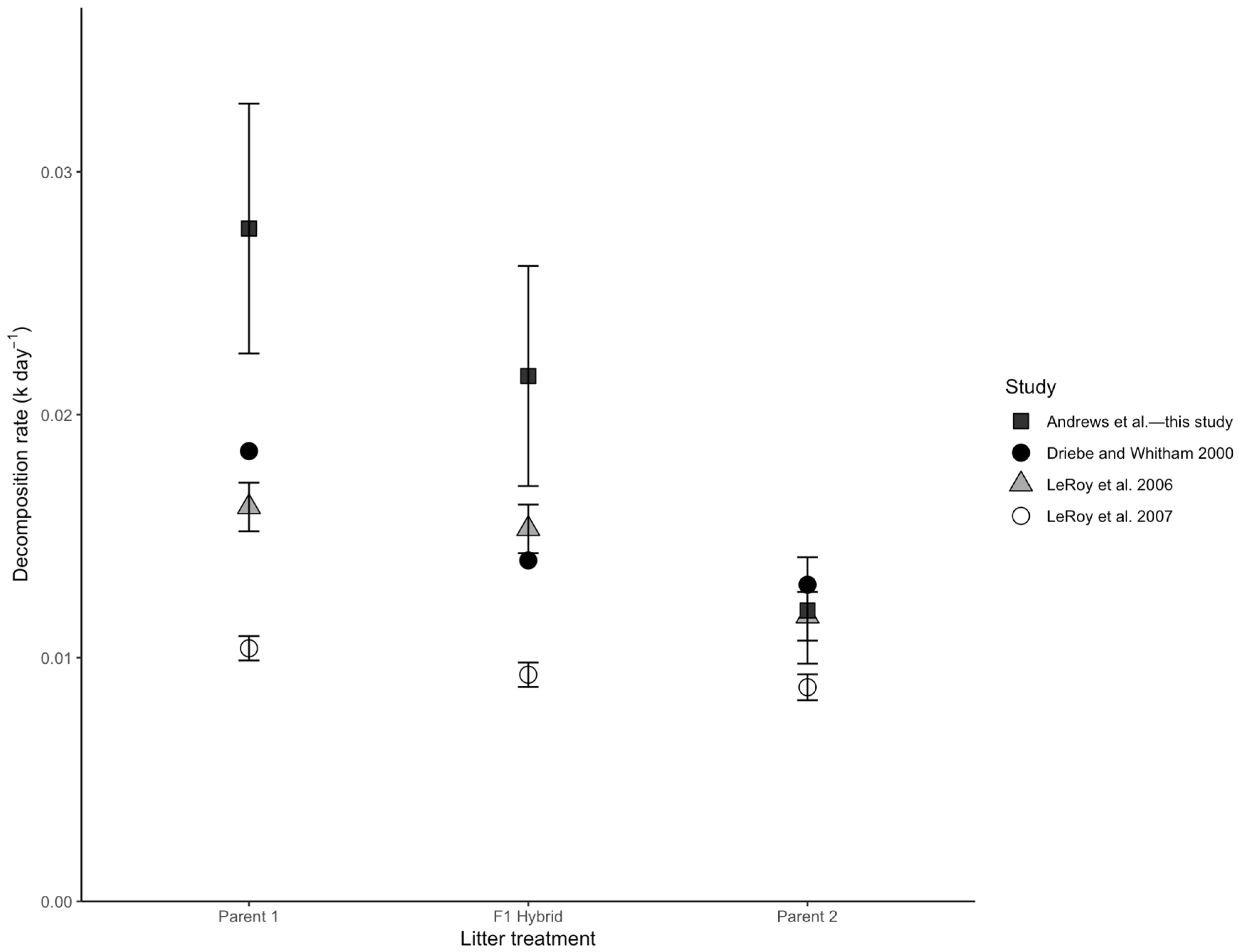
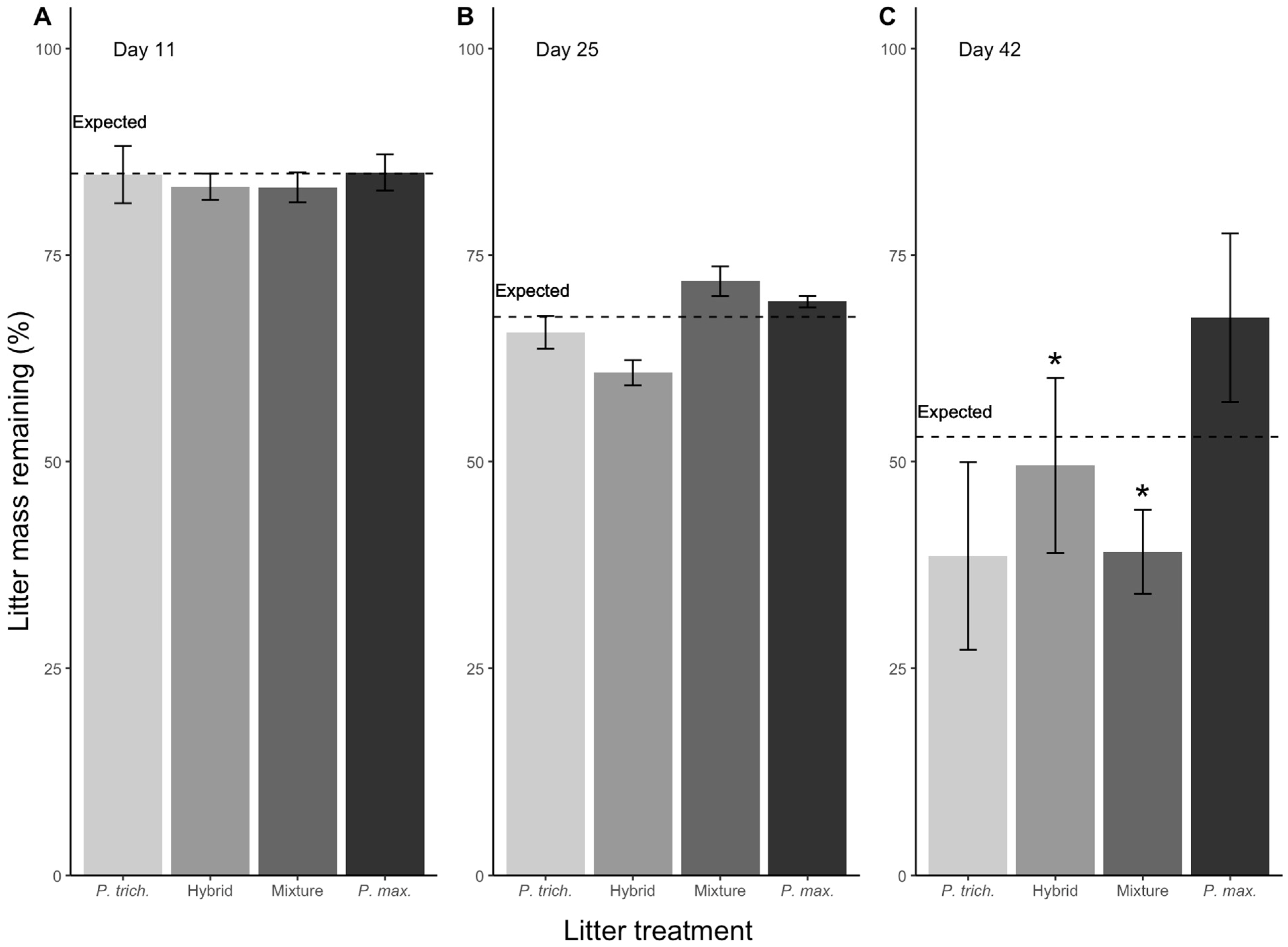
Patterns in decomposition were different when examining holistic decomposition rates versus mass loss at individual time steps. We found no significant differences in overall leaf litter decomposition rates (k day−1) among litter treatments (Litter treatment*day interaction from permutative ANCOVA: p = 0.1422), despite a greater than two-fold difference in average decay rates between treatments. Decomposition rates ranged from 0.0119 for the P. maximowiczii parent to 0.0276 for the P. trichocarpa parent. Both hybrid and mixture decomposition rates were intermediate to the two parents (Table 1), consistent with additive responses to both hybridization and mixing. Nevertheless, on examining patterns of mass loss at each time step, we saw non-additive responses for hybrid and mixture litter mass remaining after 42 days of decomposition (Figure 2C; Hybrid: χ2(4) = 35.32058, p < 0.0001; Mixture: χ2(4) = 20.66261, p = 0.0004). The hybrid had some litterbags that decomposed especially fast and some that decomposed especially slowly, resulting in a large Chi-squared value, even though the mean mass loss for this treatment was relatively intermediate to the two parents (Figure 2C). The mixture showed synergistic mass loss (faster than expected, less mass remaining) at day 42, with mass loss values more similar to the P. trichocarpa parent.
Decomposition rates in this study generally support the findings of similar studies of hybrid leaf litter decomposition in aquatic environments [5,6,7], with k rates of litter in this study with values that are intermediate to the parents. In this case, the k rates for P. trichocarpa (plotted as parent 2 in Figure 3) are intermediate to rates shown for other species of Populus. However, k rates for P. maximowiczii (plotted as Parent 1 in Figure 3) and the hybrid litter are greater than k rates found in other studies for other Populus species and hybrids (Figure 3; [5,6,7]).

3.3. Macroinvertebrates

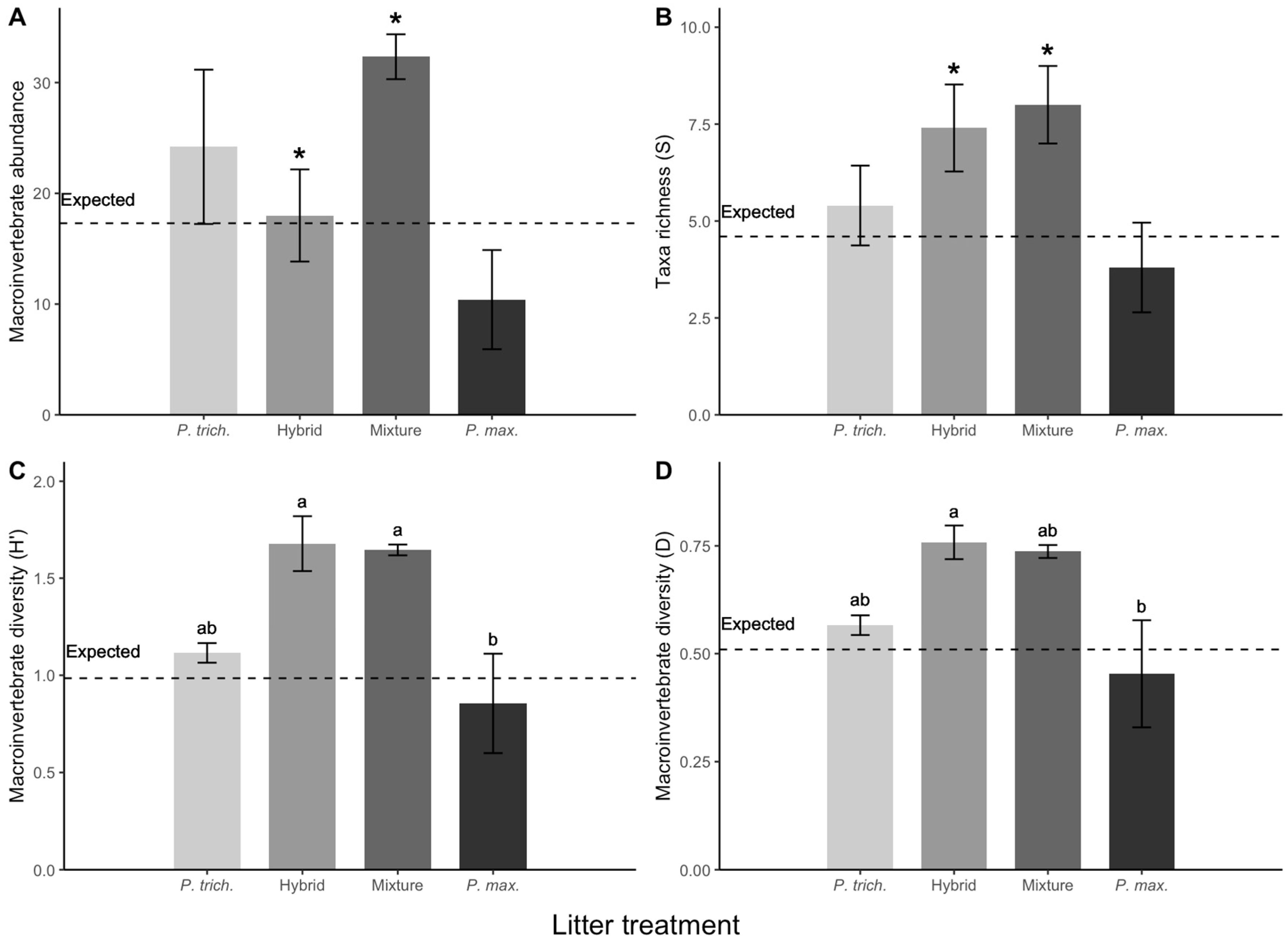
Macroinvertebrate diversity metrics in this study generally varied more than in similar studies [5,7,49], with higher diversity index values for both the hybrid and the mixture compared to parent litters in isolation. Macroinvertebrate diversity indices varied significantly among treatments after 42 days in terms of Shannon–Wiener Diversity Index (H’) and Simpson’s Diversity Index (D) values (Figure 4; Table 2; H’: F(3,17) = 5.90, p = 0.008, and D: F(3,17) = 3.868, p = 0.0331). Macroinvertebrate abundance, richness (S), and evenness (Pielou’s evenness or J’) did not vary significantly among litter treatments (abundance: F(3,17) = 2.75, p = 0.0823; S: F(3,17) = 2.81, p = 0.777 and J’: F(3,17) = 1.39, p = 0.29). However, macroinvertebrate abundance did vary in terms of expected versus observed values for the hybrid after 42 days (Hybrid: χ2(4) = 18.427, p = 0.001). Hybrid S showed a similar pattern (Hybrid: χ2(4) = 10.8, p = 0.0289). For mixture abundance, expected versus observed values differed significantly (Hybrid: χ2(4) = 28.735, p = 0.0001), and mixture S varied significantly between expected and observed values (Hybrid: χ2(4) = 6.6, p = 0.0369.) Other diversity metrics, J’, H’, and D, did not differ for either the hybrid or mixture in terms of expected versus observed values (hybrid J’: χ2(4) = 0.127, p = 0.9981; mixture J’: χ2(2) = 0.026, p = 0.9871; hybrid H’: χ2(4) = 1.923, p = 0.7499; mixture H’: χ2(2) = 0.837, p = 0.658; hybrid D: χ2(4) = 0.379, p = 0.9841, and mixture D: χ2(2) = 0.157, p = 0.9246).
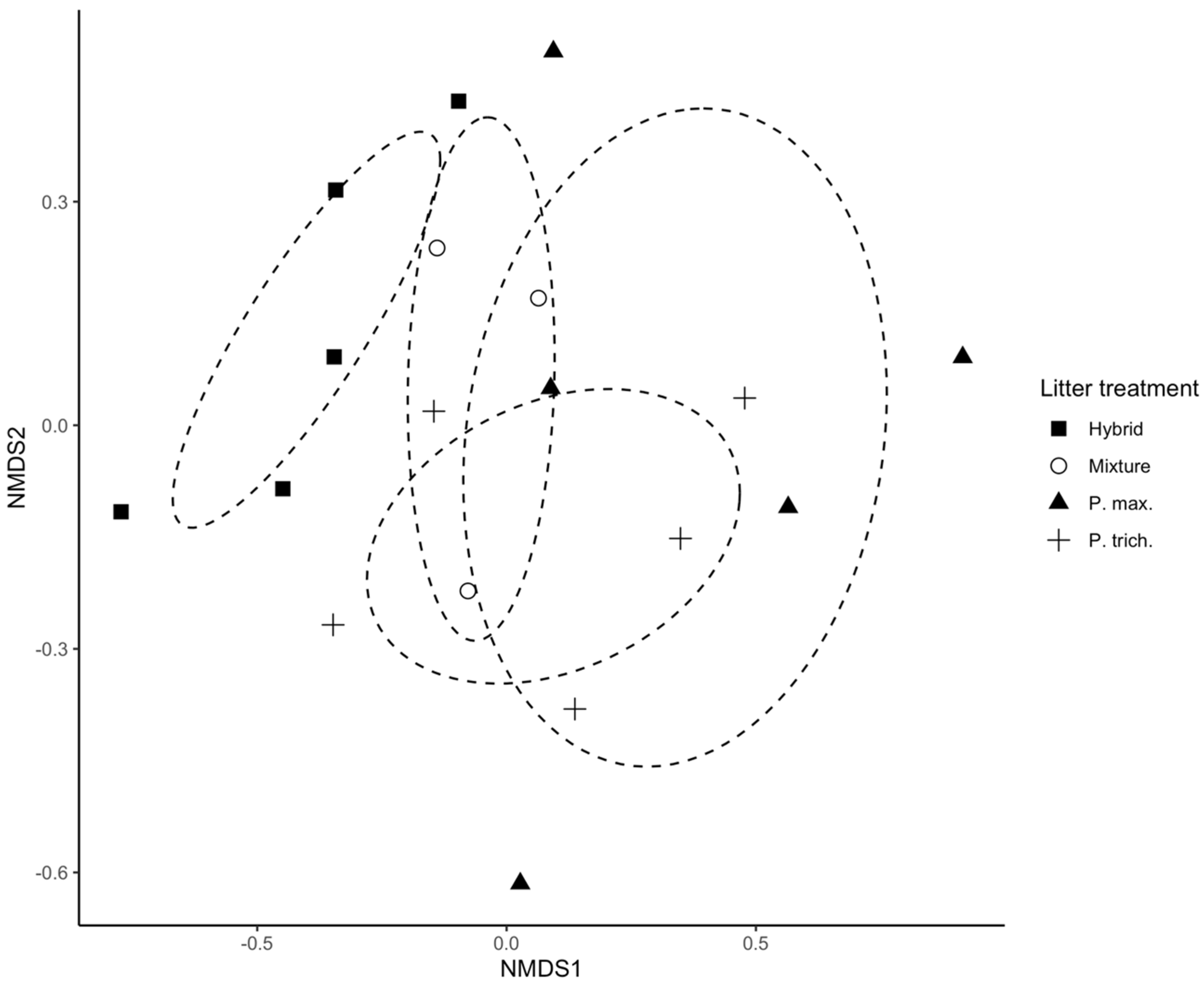
Multiple response permutation procedures (MRPPs) did not demonstrate significant differences in macroinvertebrate community structure across treatments (after 42 days, A = 0.0159, p = 0.525), despite some separation among litter types (Figure 5). Percent shredders did not vary by treatment (% Shredders: F(3,14) = 1.19, p = 0.351), but there was a significantly higher percent of predators in the hybrid and mixture treatments compared to parent litters (% Predators: F(3,14) = 4.61, p = 0.0192). Percent Ephemeroptera, Plecoptera, and Trichoptera taxa (% EPT) were compared at day 42 using ANOVAs, but no significant differences were found among treatments (F(3,14) = 2.55, p = 0.0975). Indicator Species Analysis showed that members of the family Tipulidae were significantly associated with hybrid leaf litter (Indicator value: 0.5676, p = 0.025) at 42 days.

4. Discussion

Since hybrid plants represent genetic mixtures of parent species, it might be assumed that hybrids will be intermediate to parents in both chemical composition and ecological function. Our questions were: (1) Are hybrids intermediate to parents? (2) Do chemical differences result in altered decomposition processes and associated communities? and (3) Do hybrids mimic leaf mixtures? We found significant differences among hybrid and parent species in terms of all initial litter chemistry traits measured, and significant non-additivity for two traits (C:N and %CT). These results were in contrast with our predictions of additivity for all hybrid litter chemical traits. Some of the initial litter chemistry values measured for the hybrid showed intermediate (additive) values as predicted, but two traits showed non-additive levels, more similar to one parent species or the other (P. trichocarpa or P. maximowiczii). These patterns also demonstrate, due to the synergism showed for C:N and the antagonism shown for CT, that while there is the potential for emergent litter chemistry effects of hybridization, the combination of a suite of both synergistic and antagonistic effects may result in minimal net differences in decomposition rates among hybrids and parent species.
Does hybrid leaf litter mimic a leaf litter mixture in terms of the dynamics of in-stream litter breakdown? Hybrid and leaf litter mixture decomposition studies have formed separate bodies of work. To our knowledge, this is the first study to directly compare hybrid and mixed leaf litter decomposition from the same litter parents. Our study suggests that the hybrid generally tended to mimic the mixture in terms of leaf litter breakdown. We expected that differences in N, C:N, and CT between the hybrid and mixture would contribute to differences in decomposition rates, but we did not find significant differences in decomposition rates among litter treatments [7,22,50]. Litter decomposition was decoupled from initial litter chemistry, possibly due to contrasting effects of a combination of both lower- and higher-quality litter traits in hybrids. Litter decomposition rates are influenced by chemical traits [51], but differences in initial litter chemistry could have canceled each other out. For example, Frainer et al. [52] found that despite differences in litter chemistry among species, no significant difference in decomposition of litter mixtures was found. However, both hybrid and litter mixture treatments in this study lost mass differently than expected by the end of the study, with the mixture losing more mass than expected and more mass than the hybrid.
Our results are similar to other studies that have investigated in-stream hybrid litter breakdown, showing intermediate decomposition rates for F1 hybrids in other Populus systems in the intermountain West [5,6,7,53]. Similarly, the F1 hybrid in this study tends to more closely resemble the parent litter with lower CT in these studies. In at least one case, Compson et al. [54] showed that F1 hybrid litter can decompose slightly faster than either parent due to lower CT compared to parent litters. However, the use of only two species in this study may make this pattern difficult to detect.
Results from this study are also consistent with those found in other litter mixture studies that show synergistic responses for mixtures [55]. We show synergistic litter mass loss for the mixture at day 42, with a significant difference between the average of parent litter mass loss and the mixture. The hybrid in this study showed similar mass loss to the mixture loss by the end of the experiment; however, the mixture lost more mass than the hybrid. The mixture and P. trichocarpa parent equally lost the most mass. It should be recognized that additive mass loss for mixtures has also been found [32]. Yajun et al. [56] suggest that the direction of the non-additive effect may be determined by litter quality. In this study, parental litter quality appears to influence the direction of the mass loss effect. Synergistic litter decomposition can be accentuated in some cases by the presence of macroinvertebrates [22], and the presence of macroinvertebrates in this study could play a similar role.
The hybrid and mixture in this study exhibited non-additive deviations from the expected values for macroinvertebrate abundance and richness (S) compared to expected values (although neither abundance nor S varied significantly among treatments using ANOVA methods). However, hybrid litter showed significantly higher values for Shannon’s diversity index (H’) and Simpson’s index (D) compared to P. maximowiczii litter, even though neither H’ nor D showed significant synergistic effects. These differences are interesting and demonstrate some nuanced effects of litter trait mixtures on macroinvertebrate metrics. Deviations from expected values in a Chi-square framework can result from either large directional differences compared to average values or high levels of variation among individual experimental units within a treatment. Potentially, for richness and abundance, individual litterbags with extreme values could have resulted in significant non-additive effects. In contrast, significant differences using ANOVA models rely on variation within treatments being minimized in relation to variation among groups. For diversity metrics, we see significantly higher values for mixture and hybrid litter types, and smaller errors around the means. Kominoski and Pringle [49] found elevated S during litter breakdown for some mixtures and similarly found higher numbers of predators in mixed litter treatments at the end of their study. The significant differences shown in this study between each of the hybrid and mixed litters and the P. maximowiczii litter could be attributed to higher quantities of defensive compounds (CTs). Lower % CT for the hybrid may help account for elevated diversity effects of the hybrid compared to the P. maximowiczii parent after 42 days. In the P. maximowiczii single-litter treatment, colonizing macroinvertebrates were presented with a less palatable litter choice, in which case, the hybrid and P. trichocarpa litter would present more palatable choices. Relatively labile litter chemistry that was more similar to the P. trichocarpa parent and higher macroinvertebrate diversity (H’ and D) associated with the hybrid and mixture could have contributed to synergistic mass loss for the hybrid and mixture after 42 days. This is consistent with many other studies showing that species with labile litter chemistry contribute to synergistic mass loss of litter mixtures [31]. Macroinvertebrates can also drive litter decomposition rates depending on the species composition of the detritivore community, particularly when shredders are present [57].
While whole-community macroinvertebrate structure did not show significant variation among litter treatments, qualitatively, the hybrid showed the least overlap in community structure with other litters in this study, and both hybrid and mixture communities tended to cluster on one side of the ordination. A larger sample size could have revealed a significant difference in community structure among litter treatments. Lack of preference for litters with contrasting litter quality by shredders may suggest that shredders exhibited a plastic response to available litter resources in this study, as has been shown in other studies [58]. Finally, this study could have been improved by increasing the numbers of clones and parents included to provide better replication at the leaf origin level and increase our ability to generalize across a larger number of genotypes and hybrid types in this system. In addition, this study could have been improved by more thoroughly describing the influences of environmental and microbial influences on litter decay. The results of this study should be considered preliminary and based on a limited scale of inference.

5. Conclusions

In conclusion, differences in initial phytochemistry did not strongly influence litter decomposition. However, non-additive effects were observed at the end of the breakdown process and for aspects of the detritivore community. Negative complementarity has been shown in a similar study [59], and in this case, litter with higher tannin content may have acted as a feeding deterrent limiting consumption of higher-quality litter. In addition, leaching of recalcitrant compounds from some litters may have inhibited microbial colonization, but we were unable to address microbial community structure in this study due to lack of funding. The hybrid in this regard tended to mimic the mixture by showing similar mass loss and macroinvertebrate diversity effects, but this was context-dependent mimicry, not perfect similarity. Neither the hybrid nor the mixture could be characterized as the average of their constituent litters in isolation. Non-additive effects were identified in this study for hybrid litter chemistry, late-stage hybrid and mixture litter mass loss, and both hybrid and mixture macroinvertebrate abundance and richness. However, it is important to note that the direction of these non-additive effects was not consistent and may reflect that characteristics like C:N can have variable effects on the colonization of leaf litter by invertebrates [60].
This study provides a unique direct comparison of hybrid and mixture leaf litters from the same two parents. Our findings support compositional effects on litter mass loss and associated macroinvertebrate abundance and richness that are based on litter identity and traits. The nature of the litter combination itself, i.e., genetic hybridization effects versus physical mixtures of parent litters, did not significantly influence decomposition in this study. This is important because compositional effects can influence ecosystem function by leaf type and local riparian zone [61], and the loss of litter species can significantly alter ecosystem processes [62]. These results suggest that in the presence of contrasting initial litter chemistry, mass loss and diversity effects can be modulated similarly through both non-additive genetic and physical mechanisms based on the trait identities of parent litters decomposing in a stream. This has implications for riparian restoration projects, whereby the planting of diverse species mixtures may have similar effects on ecosystem processes and associated communities as hybrid zones. The planting of diverse species mixtures also allows for the eventual development of hybridization as a mechanism of evolution to confront impending climate changes.

Author Contributions

Conceptualization, W.M.A., C.J.L. and D.G.F.; methodology, W.M.A. and C.J.L.; software, W.M.A.; validation, W.M.A. and C.J.L.; formal analysis, W.M.A. and C.J.L.; investigation, W.M.A. and C.J.L.; resources, C.J.L. and D.G.F.; data curation, W.M.A. and C.J.L.; writing—original draft preparation, W.M.A.; writing—review and editing, W.M.A., C.J.L. and D.G.F.; visualization, W.M.A. and C.J.L.; supervision, C.J.L.; project administration, C.J.L.; funding acquisition, C.J.L. All authors have read and agreed to the published version of the manuscript.

Funding

This research received no external funding.

Data Availability Statement

All data and R code are available at: https://github.com/carrileroy/Hybrid-Mixture.

Acknowledgments

We would like to thank the program “Environmental Analysis” at The Evergreen State College (2008–2009) and The Evergreen State College Science Support Center for their assistance with lab work and the tannin assay. The Evergreen State College EEON Laboratory provided comments and suggestions on early drafts of the manuscript. Shannon Claeson of the United States Forest Service research station in Olympia, WA, assisted with macroinvertebrate identification, and Jeff Kallestad of Washington State University provided access to the WSU common garden facility in Puyallup, WA. Graphical Abstract created in BioRender; Andrews, W. (2025) https://BioRender.com/pnicusi (accessed on 4 December 2025).

Conflicts of Interest

The authors declare no conflicts of interest.

References

  1. Peterson, R.C.; Cummins, K.W. Leaf Processing in a Woodland Stream. Freshw. Biol. 1974, 4, 343–368. [Google Scholar] [CrossRef] [Scilit]
  2. Wallace, J.B.; Eggert, S.L.; Meyer, J.L.; Webster, J.R. Multiple Trophic Levels of a Forest Stream Linked to Terrestrial Litter Inputs. Science 1997, 277, 102–104. [Google Scholar] [CrossRef] [Scilit]
  3. Webster, J.R.; Benfield, E.F. Vascular Plant Breakdown in Freshwater Ecosystems. Annu. Rev. Ecol. Evol. Syst. 1986, 17, 567–594. [Google Scholar] [CrossRef]
  4. Swan, C.M.; Palmer, M.A. Leaf Diversity Alters Litter Breakdown in a Piedmont Stream. J. North Am. Benthol. Soc. 2004, 23, 15–28. [Google Scholar] [CrossRef] [Scilit]
  5. LeRoy, C.J.; Whitham, T.G.; Wooley, S.C.; Marks, J.C. Within-Species Variation in Foliar Chemistry Influences Leaf-Litter Decomposition in a Utah River. J. N. Am. Benthol. Soc. 2007, 26, 426–438. [Google Scholar] [CrossRef] [Scilit]
  6. Driebe, E.M.; Whitham, T.G. Cottonwood Hybridization Affects Tannin and Nitrogen Content of Leaf Litter and Alters Decomposition. Oecologia 2000, 123, 99–107. [Google Scholar] [CrossRef] [Scilit]
  7. LeRoy, C.J.; Whitham, T.G.; Keim, P.; Marks, J.C. Plant Genes Link Forests and Streams. Ecology 2006, 87, 255–261. [Google Scholar] [CrossRef] [Scilit]
  8. Dayton, P.K. Toward an Understanding of Community Resilience and the Potential Effects of Enrichments to the Benthos at McMurdo Sound, Antarctica. In Proceedings of the Colloquium on Conservation Problems in Antarctica, Blacksburg, VA, USA, 10–12 September 1971; Parker, B.C., Ed.; Allen Press: Lawrence, KS, USA, 1972; pp. 81–96. [Google Scholar]
  9. Ellison, A.M.; Bank, M.S.; Clinton, B.D.; Colburn, E.A.; Elliott, K.; Ford, C.R.; Foster, D.R.; Kloeppel, B.D.; Knoepp, J.D.; Lovett, G.M.; et al. Loss of Foundation Species: Consequences for the Structure and Dynamics of Forested Ecosystems. Front. Ecol. Environ. 2005, 3, 479–486. [Google Scholar] [CrossRef]
  10. Schweitzer, J.A.; Bailey, J.K.; Rehill, B.J.; Martinsen, G.D.; Hart, S.C.; Lindroth, R.L.; Keim, P.; Whitham, T.G. Genetically Based Trait in a Dominant Tree Affects Ecosystem Processes. Ecol. Lett. 2004, 7, 127–134. [Google Scholar] [CrossRef] [Scilit]
  11. Schweitzer, J.A.; Madritch, M.D.; Bailey, J.K.; LeRoy, C.J.; Fischer, D.G.; Rehill, B.J.; Lindroth, R.L.; Hagerman, A.E.; Wooley, S.C.; Hart, S.C.; et al. From Genes to Ecosystems: The Genetic Basis of Condensed Tannins and Their Role in Nutrient Regulation in a Populus Model System. Ecosystems 2008, 11, 1005–1020. [Google Scholar] [CrossRef] [Scilit]
  12. Ellison, A.M. Foundation Species, Non-Trophic Interactions, and the Value of Being Common. iScience 2019, 13, 254–268. [Google Scholar] [CrossRef] [Scilit] [PubMed]
  13. Wallace, J.B.; Webster, J.R.; Cuffney, T.F. Stream Detritus Dynamics: Regulation by Invertebrate Consumers. Oecologia 1982, 53, 197–200. [Google Scholar] [CrossRef] [Scilit] [PubMed]
  14. Whitham, T.G.; Bailey, J.K.; Schweitzer, J.A.; Shuster, S.M.; Bangert, R.K.; LeRoy, C.J.; Lonsdorf, E.V.; Allan, G.J.; DiFazio, S.P.; Potts, B.M.; et al. A Framework for Community and Ecosystem Genetics: From Genes to Ecosystems. Nat. Rev. Genet. 2006, 7, 510–523. [Google Scholar] [CrossRef] [Scilit]
  15. Jackrel, S.L.; Broe, T.Y. Intraspecific Variation in Leaf Litter Alters Fitness Metrics and the Gut Microbiome of Consumers. Oecologia 2023, 202, 769–782. [Google Scholar] [CrossRef] [Scilit]
  16. Marks, J.C.; Haden, G.A.; Harrop, B.L.; Reese, E.G.; Keams, J.K.; Watwood, M.E.; Whitham, T.G. Genetic and Environmental Controls of Microbial Communities on Leaf Litter in Streams. Freshw. Biol. 2009, 54, 2616–2627. [Google Scholar] [CrossRef] [Scilit]
  17. Jackrel, S.L.; Morton, T.C.; Wootton, J.T. Intraspecific Leaf Chemistry Drives Locally Accelerated Ecosystem Function in Aquatic and Terrestrial Communities. Ecology 2016, 97, 2125–2135. [Google Scholar] [CrossRef] [Scilit]
  18. Gompert, Z.; Buerkle, A.C. What, If Anything, Are Hybrids: Enduring Truths and Challenges Associated with Population Structure and Gene Flow. Evol. Appl. 2016, 9, 909–923. [Google Scholar] [CrossRef] [Scilit]
  19. Birchler, J.A.; Yao, H.; Chudalayandi, S.; Vaiman, D.; Veitia, R.A. Heterosis. Plant Cell 2010, 22, 2105–2112. [Google Scholar] [CrossRef] [Scilit]
  20. Findlay, S.; Carreiro, M.; Krischik, V.; Jones, C. Effects of Damage on Leaf Litter Quality. Ecol. Appl. 1996, 6, 269–275. [Google Scholar] [CrossRef] [Scilit]
  21. Yang, K.; Zhu, J.; Zhang, Q.; Lu, D.; Zhang, Y.; Zheng, X.; Shuang, X.; Wang, G. Litter Decomposition and Nutrient Release from Monospecific and Mixed Litters: Comparisons of Litter Quality, Fauna and Decomposition. J. Ecol. 2022, 110, 1673–1686. [Google Scholar] [CrossRef] [Scilit]
  22. Santonja, M.; Rodríguez-Pérez, H.; Le Bris, N.; Piscart, C. Leaf Nutrients and Macroinvertebrates Control Litter Mixing Effects on Decomposition in Temperate Streams. Ecosystems 2020, 23, 400–416. [Google Scholar] [CrossRef] [Scilit]
  23. Compson, Z.; Hungate, B.; Whitham, T.; Koch, G.; Dijkstra, P.; Siders, A.; Wojtowicz, T.; Jacobs, R.; Rakestraw, D.; Allred, K.; et al. Linking Tree Genetics and Stream Consumers: Isotopic Tracers Elucidate Controls on Carbon and Nitrogen Assimilation. Ecology 2018, 99, 1759–1770. [Google Scholar] [CrossRef] [Scilit] [PubMed]
  24. Blair, J.M.; Parmelee, R.W.; Beare, M.H. Decay Rates, Nitrogen Fluxes, and Decomposer Communities of Single- and Mixed-Species Foliar Litter. Ecology 1990, 71, 1976–1985. [Google Scholar] [CrossRef] [Scilit]
  25. Lecerf, A.; Risnoveanu, G.; Popescu, C.; Gessner, M.O.; Chauvet, E. Decomposition of Diverse Litter Mixtures in Streams. Ecology 2007, 88, 219–227. [Google Scholar] [CrossRef] [Scilit] [PubMed]
  26. Kominoski, J.S.; Pringle, C.M.; Ball, B.A.; Bradford, M.A.; Coleman, D.C.; Hall, D.B.; Hunter, M.D. Nonadditive Effects of Litter Species Diversity on Breakdown Dynamics in a Detritus-Based Stream. Ecology 2007, 88, 1167–1176. [Google Scholar] [CrossRef] [Scilit]
  27. Lecerf, A.; Kominoski, J. Functional Leaf Traits and Biodiversity Effects on Litter Decomposition in a Stream: Comment. Ecology 2010, 91, 1867–1869. [Google Scholar] [CrossRef]
  28. Gessner, M.O. Functional Leaf Traits and Biodiversity Effects on Litter Decomposition in a Stream: Reply. Ecology 2010, 91, 1869–1871. [Google Scholar] [CrossRef] [Scilit]
  29. Lecerf, A.; Marie, G.; Kominoski, J.S.; LeRoy, C.J.; Bernadet, C.; Swan, C.M. Incubation Time, Functional Litter Diversity, and Habitat Characteristics Predict Litter-Mixing Effects on Decomposition. Ecology 2011, 92, 160–169. [Google Scholar] [CrossRef] [Scilit]
  30. Kominoski, J.S.; Hoellein, T.J.; Kelly, J.J.; Pringle, C.M. Does Mixing Litter of Different Qualities Alter Stream Microbial Diversity and Functioning on Individual Litter Species? Oikos 2009, 118, 457–463. [Google Scholar] [CrossRef] [Scilit]
  31. Schindler, M.H.; Gessner, M.O. Functional Leaf Traits and Biodiversity Effects on Litter Decomposition in a Stream. Ecology 2009, 90, 1641–1649. [Google Scholar] [CrossRef] [Scilit]
  32. Santschi, F.; Gounand, I.; Harvey, E.; Altermatt, F. Leaf Litter Diversity and Structure of Microbial Decomposer Communities Modulate Litter Decomposition in Aquatic Systems. Funct. Ecol. 2018, 32, 522–532. [Google Scholar] [CrossRef] [Scilit]
  33. Alonso, A.; Pérez, J.; Monroy, S.; López-Rojo, N.; Basaguren, A.; Bosch, J.; Boyero, L. Loss of Key Riparian Plant Species Impacts Stream Ecosystem Functioning. Ecosystems 2021, 24, 1436–1449. [Google Scholar] [CrossRef] [Scilit]
  34. Jabiol, J.; Chauvet, E. Biodiversity and Litter Decomposition: A Case Study in a Mediterranean Stream. Freshw. Sci. 2015, 34, 423–430. [Google Scholar] [CrossRef] [Scilit]
  35. Liu, J.; Liu, X.; Song, Q.; Compson, Z.G.; LeRoy, C.J.; Luan, F.; Wang, H.; Hu, Y.; Yang, Q. Synergistic Effects: A Common Theme in Mixed-Species Litter Decomposition. New Phytol. 2020, 227, 757–765. [Google Scholar] [CrossRef] [Scilit]
  36. Swan, C.M.; Sparkman, A. The Role of Functional and Phylogenetic Diversity in Riparian Tree Vegetation on Leaf Litter Breakdown in Rivers. Oikos 2023, 2023, e09361. [Google Scholar] [CrossRef] [Scilit]
  37. Pascoal, C.; Fernandes, I.; Seena, S.; Danger, M.; Ferreira, V.; Cássio, F. Linking Microbial Decomposer Diversity to Plant Litter Decomposition and Associated Processes in Streams. In The Ecology of Plant Litter Decomposition in Stream Ecosystems; Swan, C.M., Boyero, L., Canhoto, C., Eds.; Springer Nature: Cham, Switzerland, 2021; pp. 163–192. [Google Scholar]
  38. Abril, M.; Menéndez, M.; Ferreira, V. Decomposition of Leaf Litter Mixtures in Streams: Effects of Component Litter Species and Current Velocity. Aquat. Sci. 2021, 83, 54. [Google Scholar] [CrossRef] [Scilit]
  39. Siders, A.C.; Compson, Z.G.; Hungate, B.A.; Dijkstra, P.; Koch, G.W.; Wymore, A.S.; Grandy, A.S.; Marks, J.C. Litter Identity Affects Assimilation of Carbon and Nitrogen by a Shredding Caddisfly. Ecosphere 2018, 9, e02340. [Google Scholar] [CrossRef] [Scilit]
  40. Porter, L.J.; Hrstich, L.N.; Chan, B.G. The Conversion of Procyanidins and Prodelphinidins to Cyanidin and Delphinidin. Phytochemistry 1985, 25, 223–230. [Google Scholar] [CrossRef] [Scilit]
  41. Hagerman, A.E.; Butler, L.G. Choosing Appropriate Methods and Standards for Assaying Tannin. J. Chem. Ecol. 1989, 15, 1795–1810. [Google Scholar] [CrossRef] [Scilit]
  42. Benfield, E.F. Leaf Breakdown in Stream Ecosystems. In Methods in Stream Ecology, 1st ed.; Hauer, F.R., Lamberti, G.A., Eds.; Academic Press: San Diego, CA, USA, 1996; pp. 579–589. [Google Scholar]
  43. Merritt, R.W.; Cummins, K.W.; Berg, M.B. An Introduction to the Aquatic Insects of North America, 4th ed.; Kendall-Hunt Publishing: Dubuque, IA, USA, 2008. [Google Scholar]
  44. Thorp, J.H.; Covich, A.P. Ecology and Classification of North American Freshwater Invertebrates, 2nd ed.; Academic Press: San Diego, CA, USA, 2001. [Google Scholar]
  45. R Core Team. R: A Language and Environment for Statistical Computing; R Foundation for Statistical Computing: Vienna, Austria, 2024; Available online: https://www.R-project.org/ (accessed on 1 December 2024).
  46. Oksanen, J.; Simpson, G.; Blanchet, F.; Kindt, R.; Legendre, P.; Minchin, P.; O’Hara, R.; Solymos, P.; Stevens, M.; Szoecs, E.; et al. vegan: Community Ecology Package. R Package Version 2.6-6.1. 2024. Available online: https://CRAN.R-project.org/package=vegan (accessed on 1 December 2024).
  47. Roberts, D.W. labdsv: Ordination and Multivariate Analysis for Ecology. R Package Version 2.1-0. 2023. Available online: https://CRAN.R-project.org/package=labdsv (accessed on 1 December 2024).
  48. Dufrêne, M.; Legendre, P. Species Assemblages and Indicator Species: The Need for a Flexible Asymmetrical Approach. Ecol. Monogr. 1997, 67, 345–366. [Google Scholar] [CrossRef] [Scilit]
  49. Kominoski, J.S.; Pringle, C.M. Resource–Consumer Diversity: Testing the Effects of Leaf Litter Species Diversity on Stream Macroinvertebrate Communities. Freshw. Biol. 2009, 54, 1461–1473. [Google Scholar] [CrossRef] [Scilit]
  50. Yue, K.; De Frenne, P.; Van Meerbeek, K.; Ferreira, V.; Fornara, D.A.; Wu, Q.; Ni, X.; Wang, D.; Heděnec, P.; Yang, Y.; et al. Litter Quality and Stream Physicochemical Properties Drive Global Invertebrate Effects on Instream Litter Decomposition. Biol. Rev. 2022, 97, 2023–2038. [Google Scholar] [CrossRef] [Scilit] [PubMed]
  51. Zhang, M.; Cheng, X.; Geng, Q.; Shi, Z.; Luo, Y.; Xu, X. Leaf Litter Traits Predominantly Control Litter Decomposition in Streams Worldwide. Glob. Ecol. Biogeogr. 2019, 28, 1469–1486. [Google Scholar] [CrossRef] [Scilit]
  52. Frainer, A.; Moretti, M.S.; Xu, W.; Gessner, M.O. No Evidence for Leaf-Trait Dissimilarity Effects on Litter Decomposition, Fungal Decomposers, and Nutrient Dynamics. Ecology 2015, 96, 550–561. [Google Scholar] [CrossRef] [Scilit]
  53. Wymore, A.S.; Compson, Z.G.; McDowell, W.H.; Potter, J.D.; Hungate, B.A.; Whitham, T.G.; Marks, J.C. Leaf-Litter Leachate Is Distinct in Optical Properties and Bioavailability to Stream Heterotrophs. Freshw. Sci. 2015, 34, 857–866. [Google Scholar] [CrossRef] [Scilit]
  54. Compson, Z.G.; Hungate, B.A.; Whitham, T.G.; Meneses, N.; Busby, P.E.; Wojtowicz, T.; Ford, A.C.; Adams, K.J.; Marks, J.C. Plant Genotype Influences Aquatic-Terrestrial Ecosystem Linkages through Timing and Composition of Insect Emergence. Ecosphere 2016, 7, e01331. [Google Scholar] [CrossRef] [Scilit]
  55. López-Rojo, N.; Martínez, A.; Pérez, J.; Basaguren, A.; Pozo, J.; Boyero, L. Leaf Traits Drive Plant Diversity Effects on Litter Decomposition and FPOM Production in Streams. PLoS ONE 2018, 13, e0198243. [Google Scholar] [CrossRef] [Scilit]
  56. Xie, Y.; Xie, Y.; Chen, X.; Li, F.; Hou, Z.; Li, X. Non-Additive Effects of Water Availability and Litter Quality on Decomposition of Litter Mixtures. J. Freshw. Ecol. 2016, 31, 153–168. [Google Scholar] [CrossRef] [Scilit]
  57. Jonsson, M.; Sponseller, R.A. The Role of Macroinvertebrates on Plant Litter Decomposition in Streams. In The Ecology of Plant Litter Decomposition in Stream Ecosystems; Swan, C.M., Boyero, L., Canhoto, C., Eds.; Springer Nature: Cham, Switzerland, 2021; pp. 193–216. [Google Scholar]
  58. Casas, J.J.; Larrañaga, A.; Menéndez, M.; Pozo, J.; Basaguren, A.; Martínez, A.; Pérez, J.; González, J.M.; Mollá, S.; Casado, C.; et al. Leaf Litter Decomposition of Native and Introduced Tree Species of Contrasting Quality in Headwater Streams: How Does the Regional Setting Matter? Sci. Total Environ. 2013, 458–460, 197–208. [Google Scholar] [CrossRef] [Scilit]
  59. López-Rojo, N.; Pérez, J.; Pozo, J.; Basaguren, A.; Apodaka-Etxebarria, U.; Correa-Araneda, F.; Boyero, L. Shifts in Key Leaf Litter Traits Can Predict Effects of Plant Diversity Loss on Decomposition in Streams. Ecosystems 2020, 24, 185–196. [Google Scholar] [CrossRef] [Scilit]
  60. Marks, J.C. Revisiting the Fates of Dead Leaves That Fall into Streams. Annu. Rev. Ecol. Evol. Syst. 2019, 50, 547–568. [Google Scholar] [CrossRef] [Scilit]
  61. Oester, R.; dos Reis Oliveira, P.C.; Moretti, M.S.; Altermatt, F.; Bruder, A. Leaf-Associated Macroinvertebrate Assemblage and Leaf Litter Breakdown in Headwater Streams Depend on Local Riparian Vegetation. Hydrobiologia 2023, 850, 3359–3374. [Google Scholar] [CrossRef] [Scilit]
  62. Alonso, A.; López-Rojo, N.; Pérez, J.; Boyero, L. Functional Consequences of Alder and Oak Loss in a Stream. Freshw. Biol. 2022, 67, 1618–1630. [Google Scholar] [CrossRef] [Scilit]
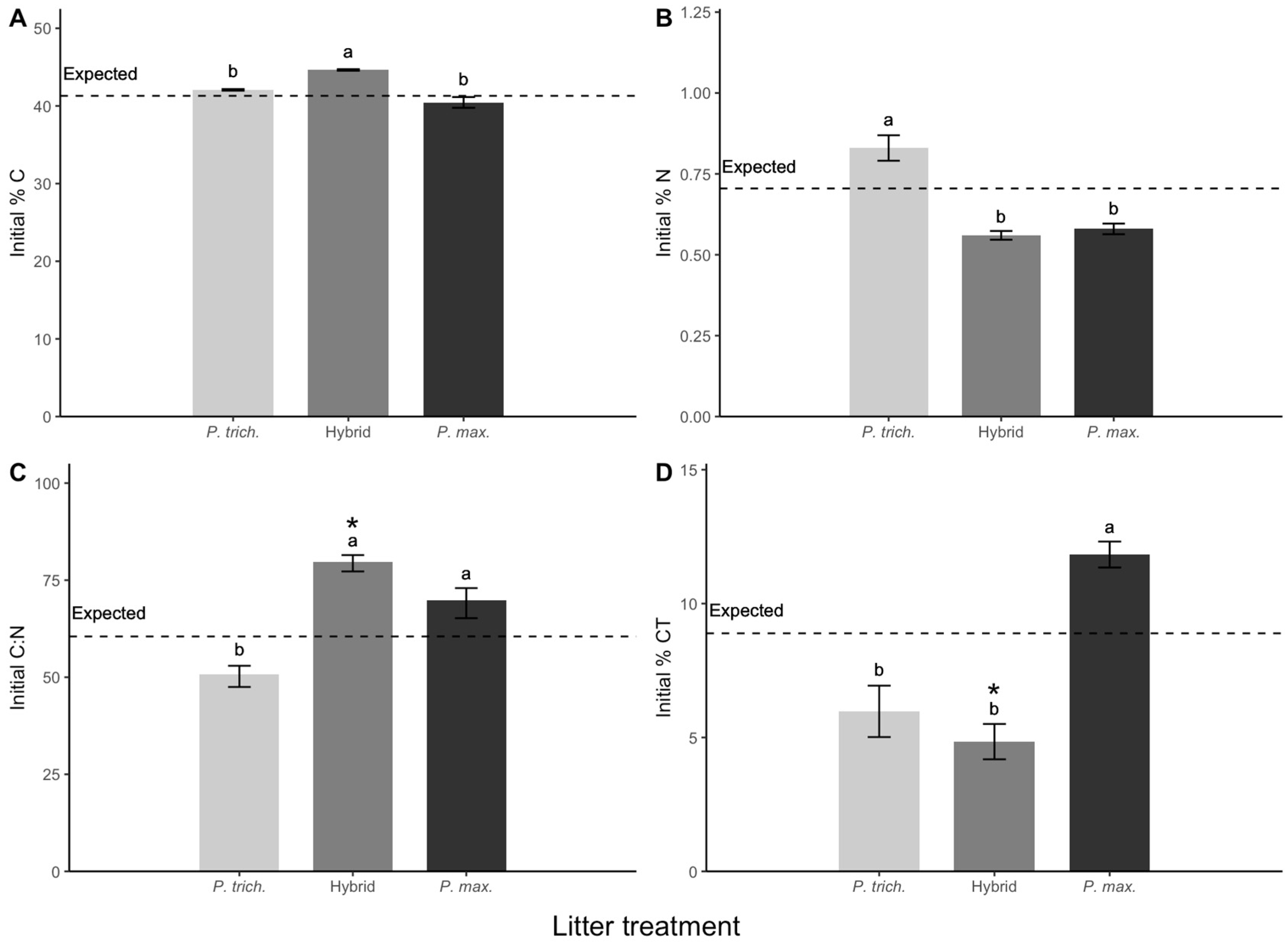
Figure 1. Mean initial leaf litter chemical concentrations for Populus trichocarpa, Populus maximowiczii, and their F1 hybrid in terms of: (A) % C, (B) % N, (C) C:N, and (D) % CT (condensed tannins). Lower-case letters represent differences among treatments in terms of initial litter chemistry. Dashed lines show average values of P. trichocarpa and P. maximowiczii foliar chemistry, which represent mixture values and the expected values of litter chemistry for the F1 hybrid (assuming additivity). Asterisks denote significant differences between expected values (the average of the parent litters) and observed litters (Chi-square, χ2 results). Error bars represent standard error of the mean (SE) for all treatments.
Forests 17 00295 g001
Figure 2. Mean percent litter mass remaining (AFDM) for four leaf litter treatments: the P. trichocarpa parent, the P. trichocarpa × P. maximowiczii F1 hybrid, a mixture of the two parents, and the P. maximowiczii parent at each harvest date: (A) 11 days of incubation, (B) 25 days of incubation, and (C) 42 days of incubation in Snyder Cove Creek. Dashed lines show average values of P. trichocarpa and P. maximowiczii percent mass remaining, which represent the expected values for the F1 hybrid and mixture treatments (assuming additivity). Asterisks above bars show significant differences between expected values and observed values (Chi-squared, χ2 results). Error bars represent standard error of the mean (SE) for all treatments.
Forests 17 00295 g002
Figure 3. In-stream decomposition rates (k day−1) for several Populus hybridization studies. In all cases, two Populus parents are compared to their F1 hybrid. The studies include: Driebe & Whitham [6], LeRoy et al. [5], LeRoy et al. [7], and this study. Symbols represent mean k ± 1 SE (standard error of the mean).
Forests 17 00295 g003
Figure 4. Mean macroinvertebrate abundance, richness, and diversity at 42 days: (A) total invertebrate abundance, (B) taxa richness, (C) Shannon’s Diversity Index (H’), and (D) Simpson’s Diversity Index (D). Hybrid and mixture leaf litters are compared to parent litter types. Dashed lines show average values of P. trichocarpa and P. maximowiczii community metrics, which represent the expected values for the F1 hybrid and mixture treatments (assuming additivity). Asterisks show significant differences between expected values and observed values (Chi-squared, χ2 results). Lower-case letters indicate significant differences among litter treatments, reported as Tukey’s HSD.
Forests 17 00295 g004
Figure 5. NMDS ordination showing benthic macroinvertebrate communities from leaf litterbags made from two Populus parent species (P. trichocarpa, cross; P. maximowiczii, black triangle), compared to their F1 hybrid (black square), and a mixture of leaf litter from both parents (open circle).
Forests 17 00295 g005
Table 1. Decomposition rate (k day−1) and standard error (SE) for leaf litter from Populus trichocarpa, Populus maximowiczii, their F1 hybrid, and a mixture of the two parent species. Decomposition rates (k) were determined by linear regression of ln-transformed % ash-free dry mass (AFDM) remaining as a function of days in the stream.
Leaf Litter Typek day−1SE
P. trichocarpa parent0.027660.00514
P. maximowiczii parent0.011940.00219
F1 hybrid0.021600.00453
Mixture0.024950.00345
Table 2. ANOVA results for macroinvertebrate community metrics (abundance, richness, evenness, and two diversity indices) at day 42. Treatments included 4 leaf litter treatments: Populus trichocarpa, Populus maximowiczii, F1 hybrid, and a mixture of the two species.
Community MetricSSAmongR2F(3,17)p-Value 1
Total abundance1025.30.37042.74570.0823
Taxa richness (S)47.7440.37612.81320.0777
Taxa evenness (J’)0.05320.2431.39090.2900
Shannon’s index (H’)2.23150.55855.90440.0080 *
Simpson’s index (D)0.33980.60443.86800.0331 *
1 Statistically significant results denoted in bold and with an asterisk.
Disclaimer/Publisher’s Note: The statements, opinions and data contained in all publications are solely those of the individual author(s) and contributor(s) and not of MDPI and/or the editor(s). MDPI and/or the editor(s) disclaim responsibility for any injury to people or property resulting from any ideas, methods, instructions or products referred to in the content.