Skip to Content
ForestsForests
  • Article
  • Open Access

12 February 2026

Improving SAR-Based Burn Severity Assessment with Consideration of Non-Uniform Scattering Medium in Fire-Affected Areas

,
and
1
State Key Laboratory of Complex Electromagnetic Environment Effects on Electronics and Information System, College of Electronic Science, National University of Defense Technology, Changsha 410073, China
2
College of Resources and Environment, Chengdu University of Information Technology, Chengdu 610225, China
*
Author to whom correspondence should be addressed.

Abstract

Traditional burn severity assessment methods have predominantly leveraged optical remote sensing data, yet such methods often overlook critical vegetation structural information inherent to post-fire ecosystems. Synthetic Aperture Radar (SAR) data offer structural information but are hindered by non-uniform scattering in fire-affected areas, limiting the utility of conventional decomposition techniques. Here, we introduced a metric that quantifies scattering non-uniformity by jointly considering canopy burn and ground condition non-uniformity. From this metric, we derived quantitative polarimetric features that enhance SAR-based severity estimation and demonstrated the potential to assess burn severity, with an R of 0.77 and a RMSE of 0.58. Initially, six decomposition features were extracted with the covariance matrix and then 14 feature groups were formed through metric and combination. Subsequently, sensitivity analyses were conducted for the first nine feature groups with the Composite Burn Index (CBI) values. Following this, the 14 feature groups were employed as inputs and the CBI values as outputs for random forest learning at a 7:3 training ratio to assess burn severity and generate burn severity maps. This study used the Jinyun Mountain fire in Chongqing as the primary case and eight fires in the United States as supplemental data to discuss the general applicability of the quantitative polarimetric features in assessing burn severity. Notably, the developed methodology showcased superior results within all wildfires, offering a new outlook for future burn severity assessments utilizing vegetation structure information.

1. Introduction

As a significant disturbance agent in the forest ecosystems, wildfires destroy large areas of vegetation and alter species composition [1,2,3]. They are widely acknowledged as a major driver of biodiversity loss, soil degradation, gaseous pollutant releases, and various environmental repercussions [4,5,6]. Burn severity refers to the degree of impact or destruction of fires on forest ecosystems [7,8,9,10]. The quantitative assessment of burn severity could be helpful for understanding the development of diverse ecological processes within forest ecosystems and the formation of forest landscape patterns [11,12,13]. This assessment is also helpful for human estimation of biodiversity change and could provide insights for research on vegetation recovery and the global carbon balance [10,12].
To develop a set of criteria for assessing burn severity, Key and Benson proposed the Composite Burn Index (CBI) which was based on ground surveys [14]. Generally, the ground surveys were constrained by substantial resource demands and limited spatial–temporal coverage, hindering their applicability in large-scale monitoring efforts [15,16,17]. The development of spectral indices addressed the critical need for large-scale burn severity assessment. Researchers leveraged distinct spectral indices in visible, near-infrared (NIR), and short-wave infrared (SWIR) to monitor vegetation changes caused by fires [18,19,20,21]. These indices effectively correlated with ground measurements, revolutionizing burn severity monitoring by capturing spectral alterations. However, optical remote sensing images might be hindered by weather conditions such as rainfall, cloud cover, and haze [22,23,24,25].
Synthetic Aperture Radar (SAR), as an active microwave sensor, could offer all-weather, day and night, high-resolution imaging capabilities [26,27,28]. SAR could characterize a wide range of surface properties, such as vegetation structure, soil dielectric properties, moisture levels, and surface roughness [29,30,31,32]. In the context of wildfire, the consumption of foliage and branches, alongside increased soil exposure, could significantly alter SAR backscatter characters [33]. Therefore, backscatter coefficients of SAR imagery have potential in the development of burn severity assessment models.
Early foundational work focused on establishing empirical relationships between single- or dual-polarization backscatter coefficients and burn severity. To be specific, Tanase et al. (2013) conducted a study examining the impact of burn severity on C-band and L-band SAR backscatter, with consideration given to the local incidence angle [34]. Kurum (2015) further assessed C-band backscatter coefficients in Mediterranean forests to determine their relationship with burn severity [35]. Tariq et al. (2021) then identified burned areas by analyzing the VV backscatter coefficient under wet conditions [36]. Furthermore, De Petris et al. (2022) employed a multi-temporal method based on the Sentinel-1 data to estimate burn severity and track post-fire changes in the Piemonte area of northwestern Italy [37].
To better disentangle scattering mechanisms, subsequent studies explored polarimetric decomposition techniques. Engelbrecht et al. (2017) investigated a Normalized Difference α-Angle (NDαl) approach to burn mapping using C-band data [38]. Due to the potential correlation between the vegetation structure information contained in SAR data and field variables of CBI [38,39,40], Zheng et al. (2024) recently extracted three polarimetric decomposition features and used them for the first time to assess burn severity of wildfires [41]. The introduction of polarimetric decomposition features marked a step forward by incorporating vegetation structure information; yet their method, like most traditional decomposition approaches, assumed a uniform scattering condition [39,42,43]. However, this uniformity assumption may not be applicable in fire-affected areas because the area in which wildfires occur is not always uniform, both in terms of the burned and ground condition. This would largely discourage studies that use SAR data to assess the burn severity of wildfires [38].
Therefore, it is crucial to consider the non-uniform scattering medium in fire-affected areas to improve SAR-based burn severity assessment. Through the investigation of polarimetric decomposition features in fire-affected areas, quantitative polarimetric features were constructed from the metric that describes both the canopy burn non-uniformity and ground condition non-uniformity in this study. Building upon these quantitative polarimetric features, an improved SAR-based burn severity assessment model was presented that explicitly accounts for structural non-uniformity in fire-affected areas. We hypothesized that the proposed model could reduce the effect of non-uniform scattering medium in burned areas and enhance the accuracy of SAR-based burn severity assessments. The specific objectives of this study could be outlined as follows:
1.
We introduced the new quantitative polarimetric features with consideration of non-uniform scattering medium in fire-affected areas.
2.
We intended to perform a sensitivity analysis on different polarimetric features to assess burn severity.
3.
We aimed to propose a SAR-based model for burn severity assessment and expected this model to be generally applicable to multiple study areas.

2. Methodology

2.1. PolSAR Observables

2.1.1. C2 Matrices

Target decomposition techniques were designed for quadrature polarimetric SAR to distinguish surface scattering, volume scattering, and dihedral scattering [44]. However, the Sentinel-1 data was dual-polarization, meaning it lacks co-polarization modes S h h [45]. To match the conventional complex scattering matrix of dual-polarization SAR, some studies modified S h h = 0 [46,47]. For a monostatic radar system, it generally assumed the reciprocity principle is satisfied, Shv = Svh, making Sdual a complex matrix.
S d u a l = 0 S h v S v h S v v
where h represents the horizontal polarimetric and v represents the vertical polarimetric.
The covariance matrix was derived by the complex matrix.
C 2 = S v v S v v S v v S h v S h v S v v S h v S h v = c 11 c 12 c 21 c 22
where * represents the covariance operation and ⟨·⟩ represents multilook processing.
The quantized power was determined through the utilization of Equation (2), employing the parameters c 11 and c 22 to represent the dominant scattering and secondary scattering features.

2.1.2. Model-Based Decomposition

Mascolo et al. proposed a model-based decomposition method [48]. This was performed using the dual-polarization SAR data to obtain the covariance matrix C2, which was then converted to a Stokes vector:
S = S 1 S 2 S 3 S 4 = c 11 + c 22 c 11 c 22 2 R e ( c 12 ) 2 I m ( c 12 )
where 2Re(c12) and 2Im(c12) represent the real and imaginary features of c12, respectively.
The Stokes vector S could be represented using a model-based decomposition.
S = m v s v + m s s p = m v 1 ± 0.5 0 0 = m s 1 cos 2 α sin 2 α cos δ sin 2 α sin δ
On the left, s v and s p represent the partially polarized and fully polarized features, respectively, with their corresponding powers being m v and m s . On the right, the volume term was modeled using the random cloud model for dipoles. Here, mv represents the power of the partially polarized volume feature (known as volume scattering), while ms represents the power of the polarized term (known as surface scattering and dihedral scattering). The angle α measures the divergence between the transmitted and received waves, and δ is the cross-polarized phase, which carries no information in vegetated and river areas.
The quantized power was determined through the utilization of Equation (4), employing the parameters m v and m s to represent the volume scattering and polarized term features.

2.1.3. Feature Value Extraction

The dual-polarization SAR had two polarized channels [49] and its covariance matrix was a non-negative definite matrix [50], allowing us to extract two non-negative feature values by diagonalizing the matrix C 2 .
C 2 = U 2 λ 1 0 0 λ 2 U 2 1
where λ 1 and λ 2 are the feature values representing secondary scattering and dominant scattering, and U 2 is the unitary matrix corresponding to these feature values.
The quantized power was determined through the utilization of Equation (5), employing the parameters λ 1 and λ 2 to represent the dominant scattering and secondary scattering features.

2.2. The New PolSAR Features

2.2.1. Polarimetric Characters for Non-Uniform Scattering Conditions

Conventional model-based polarimetric decomposition techniques, when applied to assess burn severity, fundamentally rely on the assumption of a uniform scattering medium. This assumption implies that the pre-fire vegetation structure and ground conditions are spatially homogeneous, allowing changes in scattering components (e.g., volume scattering from the canopy and surface scattering from the ground) to be directly and linearly related to burn severity.
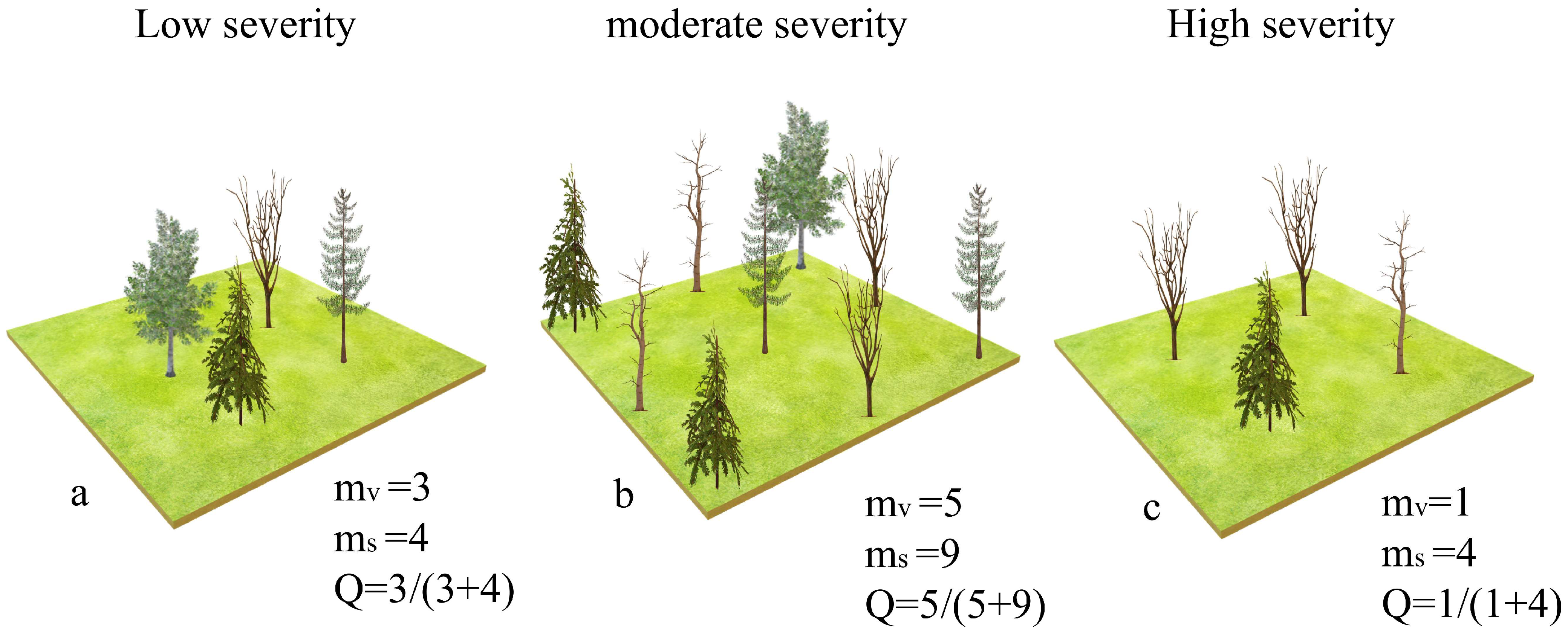
However, this assumption is frequently invalid in natural forest ecosystems affected by wildfire. As illustrated in Figure 1, fire-affected areas exhibit inherent non-uniformity in both the pre-fire vegetation density and the post-fire burn severity. Figure 1a,c show uniform pre-fire scattering conditions (four trees), and their post-fire volume scattering m v is inversely related to the burn severity. In contrast, Figure 1a (four trees) and Figure 1b (nine trees) have non-uniform pre-fire scattering conditions.
Figure 1. Three non-uniform scattering conditions surrounding fire-affected zones, where (a) represents the low burn severity of four trees, (b) represents the moderate burn severity of nine trees, and (c) represents the high burn severity of four trees.
Notably, when using the CBI for fire damage assessment, Figure 1a–c represent low, moderate, and high severity. However, due to the higher volume scattering values of Figure 1b m v = 5 compared to Figure 1a m v = 3 , we mistakenly believed that Figure 1b had a lower severity level than Figure 1a. This discrepancy revealed potential misclassification risks when employing absolute power alone to distinguish the severity levels of the non-uniform scattering conditions.

2.2.2. The Development of the New Polarimetric Characters

The traditional model-based decomposition method proved inadequate for burn severity quantification in forest fire-affected areas, primarily due to the non-uniform scattering medium. To address this limitation, a novel metric that can represent the non-uniformity of the fire-affected areas was introduced. Based on this metric, a novel polarization feature was constructed. The feature design is grounded in the following assumptions:
1.
The volume scattering m v is able to estimate the biomass information and thus express the non-uniform scattering conditions.
2.
The post-fire polarimetric term p o s t m s correlates with pre-fire non-uniform scattering conditions, barring exceptional events like landslides and downed wood.
3.
The ratio of the partial scattered power normalized to the total scattered power can mitigate the impact of the non-uniform condition.
Based on the above assumptions, we derived the polarization feature post m v / post m v + post m s , which is the relative contribution within the total backscattering. The core rationale is that while the absolute power of a component depends on both the pre-fire structure and the fire impact, its proportion relative to the total scattering may be more stable. For instance, a severe fire that consumes most of the canopy should significantly reduce the proportion of volume scattering while increasing the relative contribution of ground-dominated scattering, regardless of the initial tree density. By integrating an absolute–relative scattering dynamic relationship, the method enabled precise ecosystem damage assessment in non-uniform fire zones. These results underscore the imperative to incorporate burn severity dynamics into polarimetric model architectures for improved ecological impact monitoring. We outline the inference process for this metric in the Supplementary Materials.

2.2.3. Generalization to Other Decomposition Feature

The extension to covariance matrices and eigenvalues matrices yielded three polarimetric parameters for severity quantification. The strategic omission of molecular variation analysis in two parameters stemmed from the observation that the sum of λ 1 / λ 1 + λ 2 and λ 2 / λ 1 + λ 2 is equal to unity and has a negligible impact on machine learning outcomes. In general, to address non-uniform scattering power distribution, the total scattering power values were employed to characterize non-uniform ground conditions, formalized in Equation (6). The subsequent derivation of three quantitative polarimetric SAR features (Equation (7)) quantified the partial scattering contributions within composite scattering regimes and amplified synergistic effects in the non-uniform medium.
m e t r i c c = c 11 + c 22 m e t r i c λ =   λ 1 + λ 2   m e t r i c m = m v + m s  
Q c = c 11 / m e t r i c c = c 11 / c 11 + c 22 Q λ = λ 1 / m e t r i c λ = λ 1 /   λ 1 + λ 2   Q m = m v / m e t r i c m = m v / m v + m s  
While all three features are designed for non-uniform scattering conditions, they may emphasize different aspects of the scattering mixture. Q m has the most direct physical link to canopy vs. ground scattering. Q c and Q λ offer analogous normalized measures derived from more general matrix representations, providing robustness against the specific assumptions of any single decomposition model. Their combination in a machine learning framework allows the model to synergistically exploit these related but non-identical indicators of structural change.

2.3. Random Forest Algorithm

Based on the updated feature space, a random forest algorithm was employed to train a model to assess burn severity. This non-parametric approach served to mitigate the likelihood of overfitting. The random forest algorithm was constituted by numerous regression trees, with each being trained through bootstrap resampling of the dataset. During this procedure, the out-of-bag (OOB) samples, which were not part of the bootstrap resampling, were utilized to assess the efficacy of individual tree models. Consequently, the ultimate predictions generated by the random forest algorithm were a culmination of the predictions derived from each tree model. The investigation involved employing groups (1–14) as inputs and CBI values as outputs, resulting in 14 random forest models. A training set comprising 70% of the data selected at random was utilized, while the remaining 30% was subjected to validation through the assessment of the Correlation coefficient (R) and Root Mean Square Error (RMSE). Moreover, default hyperparameters were employed throughout the experimental procedure (random seed = 42, n_estimators = 100, and max_depth = none).

2.4. Experimental Design

The benefits of utilizing this technique to assess burn severity were investigated through a series of analytical steps. To begin with, features were categorized into 14 distinct groups, as displayed in Table 1. Then, scatter plots were generated for among feature groups (1–9), and correlation plots were constructed to analyze the relationships between these feature groups. Subsequently, the random forest accuracy was calculated for all 14 feature groups, with a training-to-testing ratio of 7:3. A comparative analysis with the correlation coefficient (R) and Root Mean Square Error (RMSE) was conducted to assess the alterations in accuracy of the traditional versus proposed method application. Finally, we applied the trained random forest model to every pixel across the Jinyun Mountain, generating visual representations of burn severity.
Table 1. The list of 14 PolSAR groups used in this study.
Moreover, in order to test that the proposed model was more universally applicable, we also used the ALOS data to extend the application to other study areas in the US. However, the number of data points in the US fires was relatively small. So, we selected eight fires, all of which have 20 or more data points, as the expansion areas.

3. Study Area and Data

3.1. Study Area

The Jinyun fire, which occurred in the Beibei District of Chongqing municipality in China, was selected as the study area (29°44′–29°48′ N; 106°18′–106°23′ E). This area had a subtropical monsoon climate with hot and dry summers, and milder winters. The average annual temperature is about 15 °C, and the annual precipitation is about 1000–1300 mm, mainly concentrated in summer and autumn [51]. The vegetation gradually transitions from subtropical evergreen broad-leaved forests at low altitudes upwards to coniferous forests, bamboo forests, and scrubs [52].
We selected Jinyun Mountain as the study area based on the abundance of sample points and the availability of remote sensing data. Furthermore, eight fires were selected from a total of 37 fires in the FIRESEV (FIRE SEVerity mapping system project) database for comparative analysis [53,54]. FFIRESEV is a project under the Joint Fire Science Program, aimed at providing critical information to fire managers in the western United States in order to provide, create, and assess burn severity maps throughout fire management phases [55,56]. The case study of the eight fires in the western United States helped us to show the ability of the proposed method when applied in different fire environments. The fire names are listed in Table 2.
Table 2. Summary of remotely sensed data used in this study.

3.2. Field Data

Field data were collected through the application of the Composite Burn Index (CBI) method, as recommended by Key and Benson (2006), to assess burn severity [14]. Specifically, within a 30 m × 30 m sample plot, five strata were identified based on vertical height: the initial strata comprised surface combustibles, soil, and downed wood. The second strata encompassed herbaceous plants, low shrubs, and small trees (<1 m). The third strata included tall shrubs and trees (1–5 m). The fourth strata represented the secondary canopy (5–20 m). Additionally, the final strata indicated the primary forest canopy (>20 m). Each stratum entailed the visual estimation of 4–5 variables (ranging from zero to three, with zero signifying no burn and three representing an extremely severe burn). The aggregated estimates for each stratum were then combined to derive the CBI value for the entire sample plot. The recovery and delayed mortality of burned vegetation was taken into account in the assessment process.
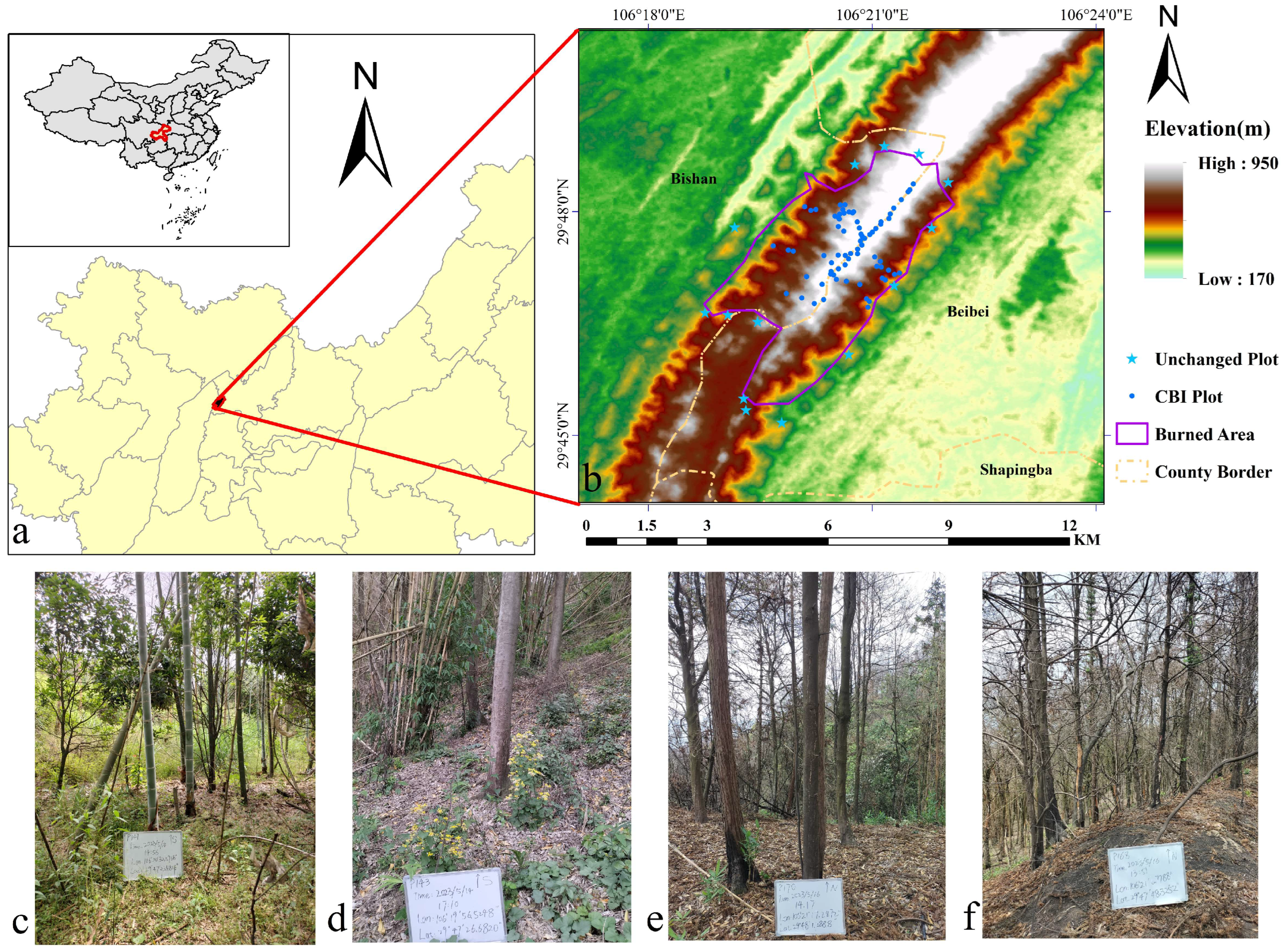
Before commencing the field survey, one hundred random sample plots were designated across the Jinyun study area, evenly distributed within the burned area. However, certain fire plots posed accessibility challenges during the survey, and some fire plots were undergoing manual restoration efforts. As a result, some fire plots were excluded or substituted with nearby locations as alternatives. Ultimately, from 11 May to 17 May, a total of 72 samples were collected from the burnt area at Jinyun Mountain to assess the burn severity in the first growing season post fire. We tested the spatial autocorrelation between the CBI areas, where the Moran’s I = 0.166 and p = 0.020. Additionally, 14 unburned samples were selected from the unburnt area to maintain a proportional representation of different burn severity levels, with these unburned samples assigned a CBI value of zero. Figure 2 shows the location of the study area in the Chongqing municipality of China, and the burn conditions.
Figure 2. The study area, (a) location of the study area in the Chongqing municipality of China. (b) burned area and CBI plot, where blue points represent CBI field survey plots in burned area and cyan pentagrams represent plots with CBI = 0 collected in unchanged areas. Field photographs depict varying levels of severity, including unchanged (c), low (d), moderate (e) and high severity (f), which were captured at the Jinyun fire site.
Data on the burn severity of the eight fires in the United States were sourced from FIRESEV. However, these fires were not documented by the same investigator and may have employed distinct assessment criteria, precluding their inclusion in the unified dataset. In addition, the number of fire plots in these areas was less than 32. To ensure the robustness of the random forest algorithm, eight fires with more than 20 fire plots were selected as supplementary data.

3.3. SAR Data

SAR data from Sentinel-1, a C-band dual-polarization satellite launched by the European Space Agency (ESA, https://www.esa.int/) in 2014, and ALOS, a mission by the Japan Aerospace Exploration Agency (JAXA, https://www.jaxa.jp/), which was operational from 2006 to 2011, were used. Sentinel-1 provides free global SAR imagery with a spatial resolution of 10 m and a revisit time of 12 days, covering the study area in Chongqing. ALOS offers L-band SAR imagery with a spatial resolution of 20 m and a revisit time of 46 days, covering the study area in the United States. The Sentinel Application Platform (SNAP), accessible for free from the ESA website (https://step.esa.int/main/download/snap-download/, accessed on 15 April 2023), was utilized for efficient processing of Sentinel-1 and ALOS data. The Sentinel-1 and ALOS data were downloaded from the Alaska Satellite Facility (ASF, https://search.asf.alaska.edu/#/, accessed on 19 May 2024).
In this research endeavor, the intention was to acquire SAR data in proximity to the field survey data to avoid potential changes in vegetation status. Regrettably, owing to the extensive interval between revisits in the ALOS dataset, the requisite data could not be obtained. As such, remote sensing data dating back to within a month of the field survey was utilized in the Chongqing region. Consequently, the U.S. study region served merely as ancillary information, whereas the Chongqing study area emerged as the more compelling focal point.

3.4. Data Processing

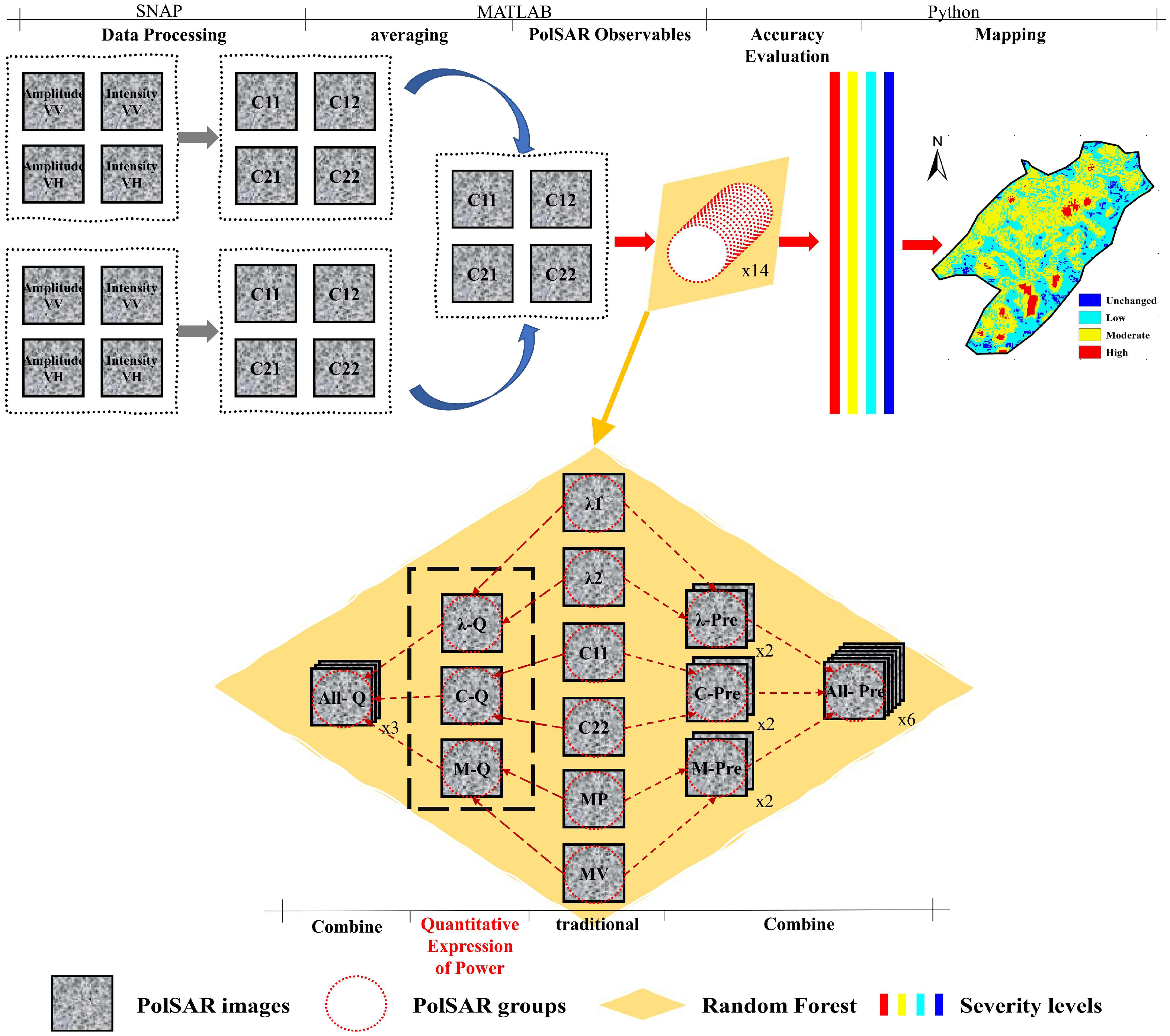
Data processing involved preprocessing Sentinel-1 and ALOS data using SNAP(V11). For Sentinel-1, the preprocessing steps included orbit file correction, radiometric calibration, debursting, polarimetric matrix computation, multilooking, terrain correcting, and cropping to generate a C2 matrix with a spatial resolution of 30 m matching the CBI requirements. Two remote sensing images from different time points for the Jinyun fire were downloaded, and averaging the C2 matrices for these time points helped to mitigate noise. In contrast, ALOS data preprocessing excluded orbit file correction, debursting, and averaging. The 14 groups of feature images were generated using the MATLAB 2022b. The feature groups were then extracted in ArcGIS 10.8 using the Extract Multi Value to Points of the Analysis tool which followed the spatial coordinates of the field survey data. Finally, the random forest algorithm was performed using Python 3.9 and mapped the burn severity. Figure 3 showed the flowchart of proposed model for the Jinyun Mountain fire.
Figure 3. The flowchart of proposed model for the Jinyun Mountain fire.

4. Results

4.1. The Sensitivity Analysis of PolSAR Features

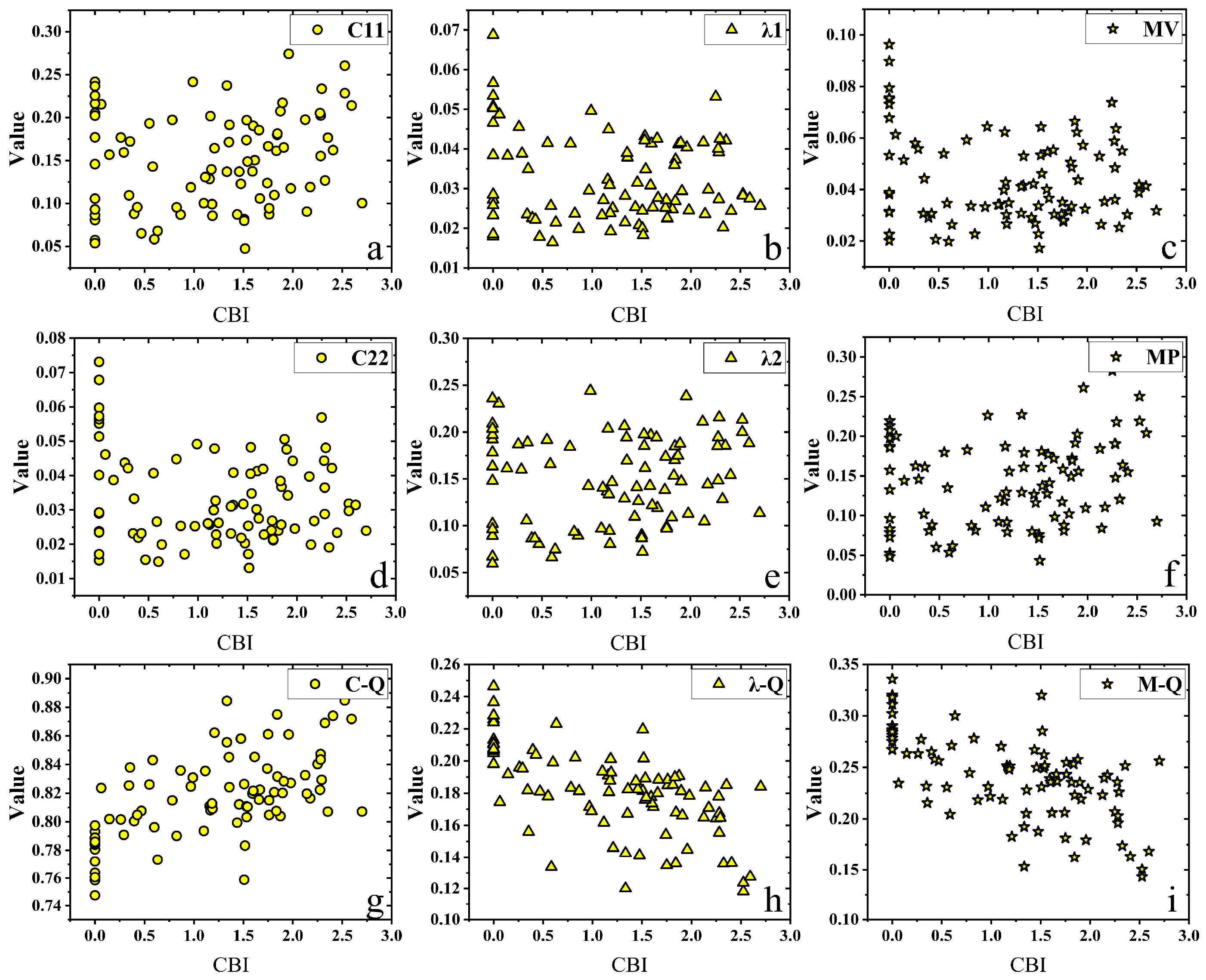
As shown in Figure 4, this study revealed the correlation between different scattering feature groups (1–9), outlined in Table 1, and CBI values through scatter plots. The initial observations revealed a lack of significant correlation between the features in Figure 4a–f and CBI in the conventional feature space. In contrast, the correlation between scattering features and CBI was significantly enhanced with the quantitative polarimetric features. Figure 4g,h show that the M-Q and C-Q feature indices are directly correlated with the field survey features, while the λ-Q index shows the opposite relationship with the field survey features. This was enough to prove that the method we provided has a stronger correlation with forest burn severity compared to the traditional method. In addition, the specific enhancement value of the correlation between the quantitative polarimetric feature and forest burn severity has become our next research objective.
Figure 4. The scatter plot of PolSAR groups 1–9 with CBI, where the horizontal axis represents the CBI values and the vertical axis represents the PolSAR observations. Where (a) represents the scatter plot of C11, (b) λ1, (c) MV, (d) C22, (e) λ2, (f) MP, (g) C-Q, (h) λ-Q, (i) M-Q.
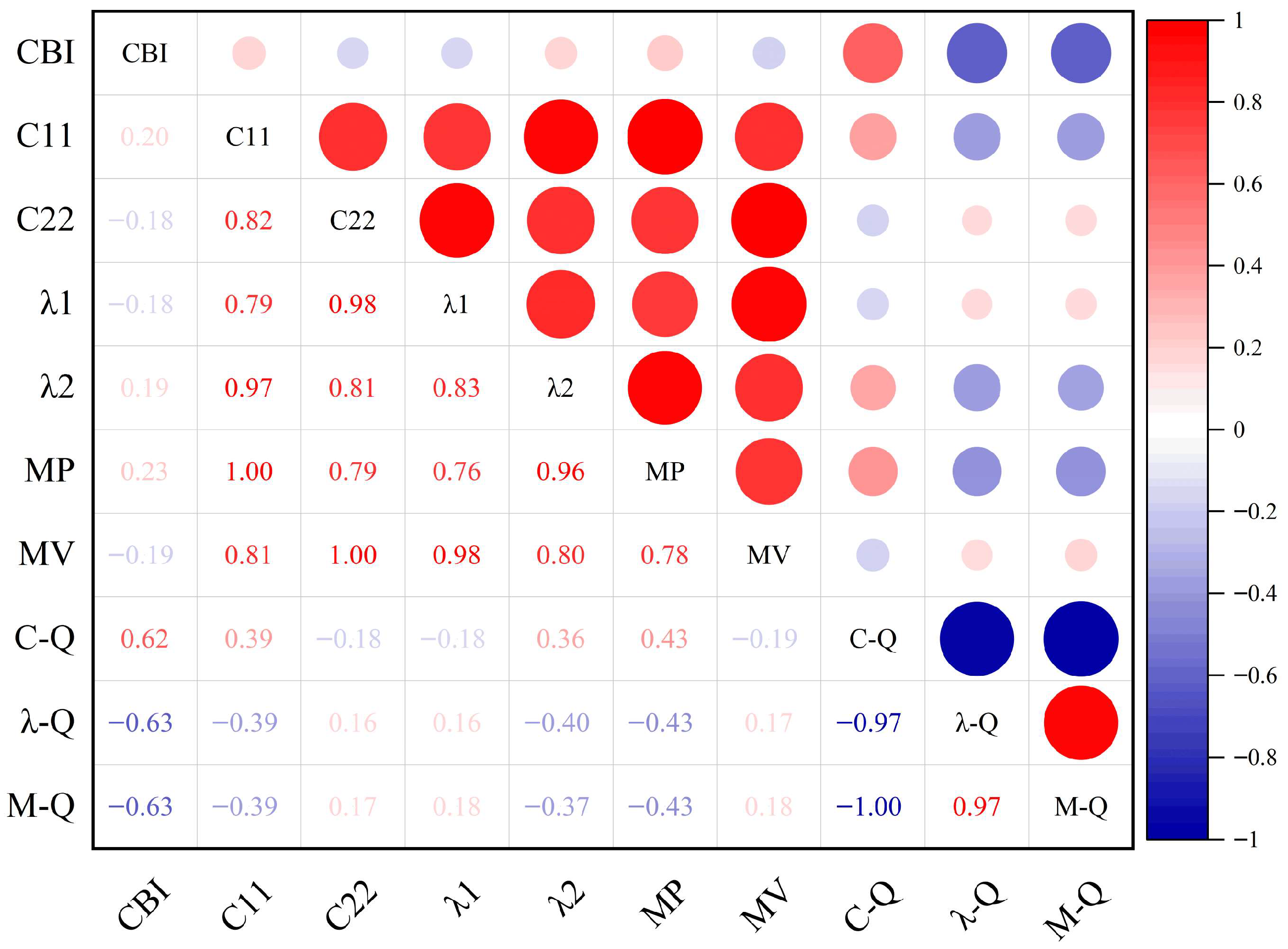
Figure 5 illustrates the Pearson correlation coefficients between the feature groups (1–9) and the CBI values. The strength and direction of the correlation coefficients are visually expressed in the figure in terms of the color and shade, where red indicates a positive correlation and blue indicates a negative correlation, and the darker the color, the stronger the correlation. Notably, the quantitative polarimetric feature improved the average correlation coefficient between the features and CBI, from 0.18 in the traditional method to 0.62 (ΔR = 0.44) compared to the traditional feature.
Figure 5. The correlation coefficients between the PolSAR groups (1–9) coupled with the CBI, where red means positive correlation, blue means negative correlation, and the depth of the color means the correlation strength.

4.2. The Performance of Proposed Method in Burn Severity Assessment

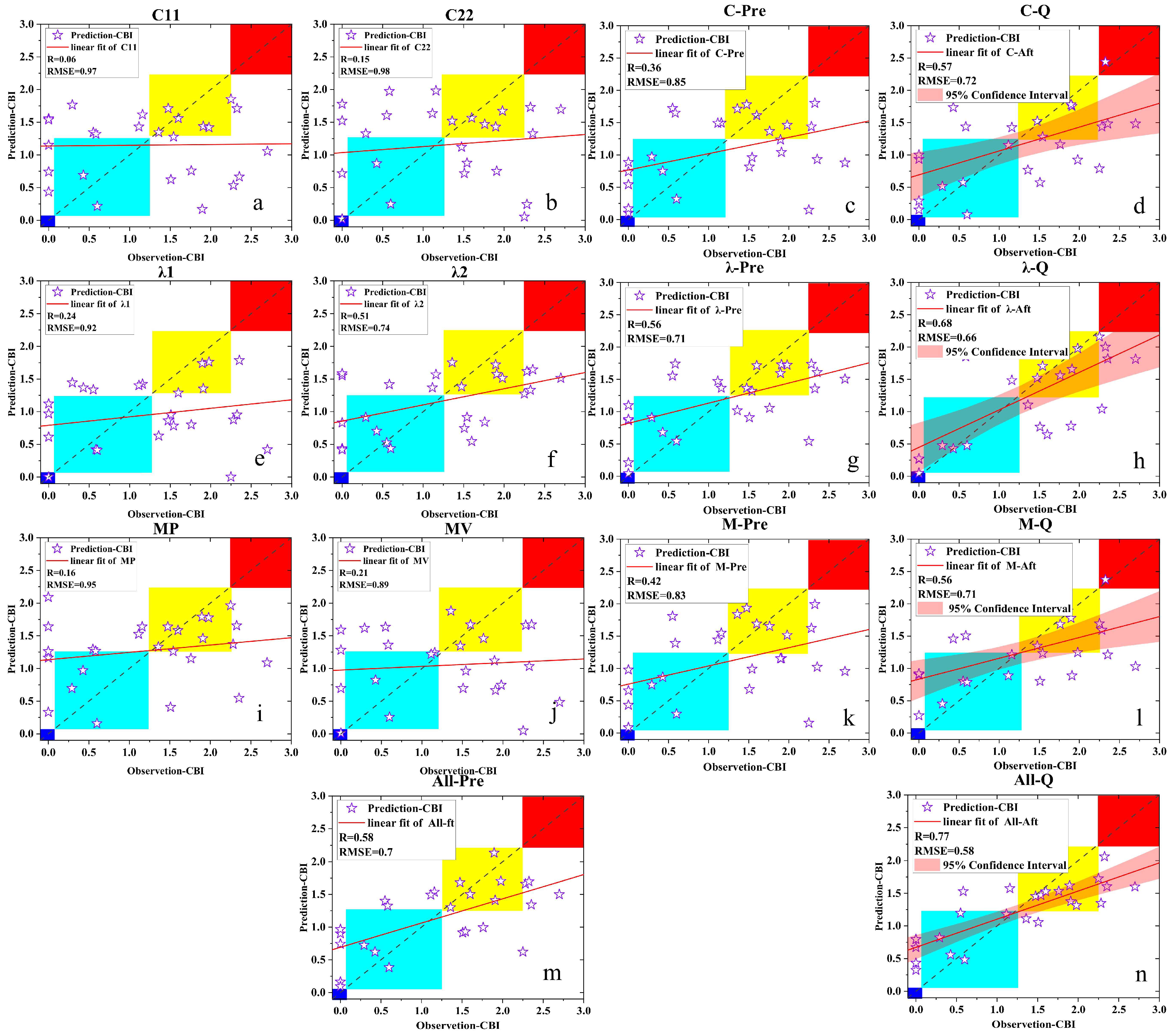
To investigate the contribution of the quantitative polarimetric features to the assessment of burn severity, Table 3 and Table 4 depict the precision results (R and RMSE) of our random forest model with 30% test data. In Table 3, the results for individual indices exhibit a correlation coefficient (R) of less than 0.51. This indicates the inefficiency of relying on any individual indices to accurately assess burn severity. In Table 4, the combination of the indices improves the correlation coefficient (R) compared to the individual indices. However, the effect of this improvement will not be significant, with a maximum value of only 0.58 (All-pre). On the contrary, after using the quantitative method, the correlation coefficient (R) stayed at a minimum of 0.56 (M-Aft) and improved by at least 0.12 (λ-Aft). After applying the quantitative polarimetric features proposed in this paper, the evaluation accuracy of all feature sets was consistently improved. Among them, All-Q achieved the best performance, with R = 0.77 and RMSE = 0.58. The quantitative polarimetric feature brought a significant improvement in burn severity assessment.
Table 3. The accuracy of evaluation of groups (1–6) under the random forest model.
Table 4. The accuracy of evaluation of groups (7–14) under the random forest model, where the ‘λ’ row and ‘Pre-treatment’ column represent the abbreviation ‘λ-Pre’ and the ‘Different’ column represent the value of the quantified treatment upgrade from pre-treatment.
Based on the findings from Table 3 and Table 4, the accuracy assessment of the 14 feature groups is graphically represented in Figure 6. Groups (1–9) exhibit varying degrees of misses between prediction CBI values and observation CBI values, with none closer to the 1:1 line. Despite the λ-Q performing better in predicting unchanged severity levels, only C-Q and M-Q accurately predict high severity levels. Taken together, All-Q demonstrated reliable prediction results at low and moderate severity, but there was still room for improvement in predicting unchanged and high severity.
Figure 6. Accuracy evaluation results for PolSAR groups (1–14), where blue rectangles represent unchanged scales with CBI = 0–0.1, cyan rectangles represent low severity scales with CBI = 0.1–1.24, yellow rectangles represent moderate severity scales with CBI = 1.25–2.24, and red rectangles represent high severity scales with CBI = 2.25–3. And the dotted line represents the 1:1 scale line. (a) represents the accuracy evaluation results of C11, (b) C22, (c) C-Pre, (d) C-Q, (e) λ1, (f) λ2, (g) λ-Pre, (h) λ-Q, (i) MP, (j) MQ, (k) M-Pre, (l) M-Q, (m) All-Pre, (n) All-Q.
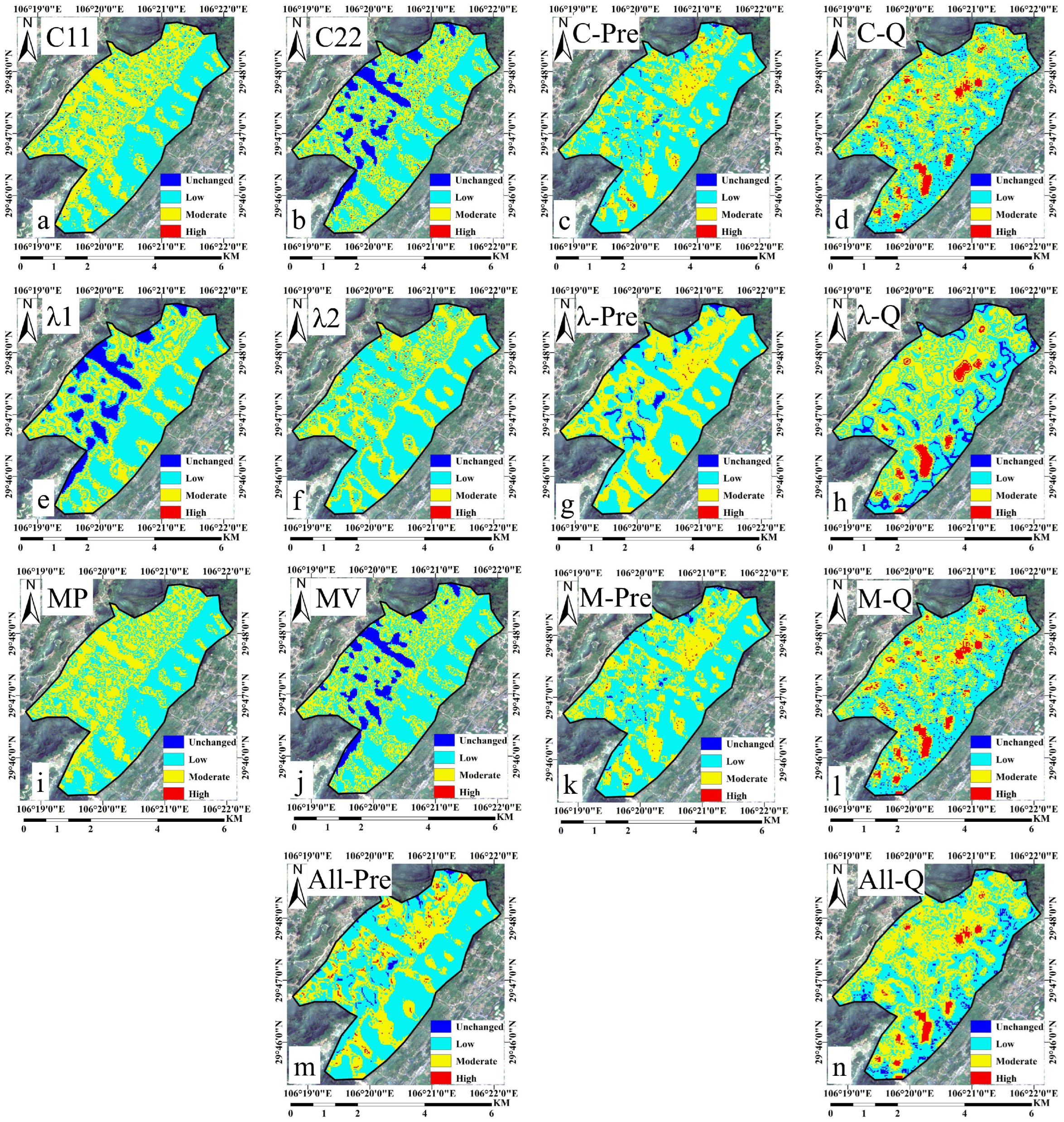
Figure 7 presented the burn severity map based on the analysis of 14 different feature groups. In terms of overall trends, the different feature groups showed some differences in severity predictions. Traditional decomposition features were severely limited by slope, resulting in the uneven distribution of burn severity. Its ability to predict the severity categories still needs to be further evaluated. The quantitative decomposition features provided a relatively balanced description of burn severity, as shown in Figure 7n, which was further improved in terms of overall predictive effectiveness, as it demonstrated the best performance across all severity levels. This feature group may contain more comprehensive information and be able to more accurately predict fire impacts at different levels of severity.
Figure 7. Burn severity maps for PolSAR groups (1–14). Where (a) represents the burn severity maps of C11, (b) C22, (c) C-Pre, (d) C-Q, (e) λ1, (f) λ2, (g) λ-Pre, (h) λ-Q, (i) MP, (j) MQ, (k) M-Pre, (l) M-Q, (m) All-Pre, (n) All-Q.

4.3. The Performance of the Flow Used in the Expanded Study Area

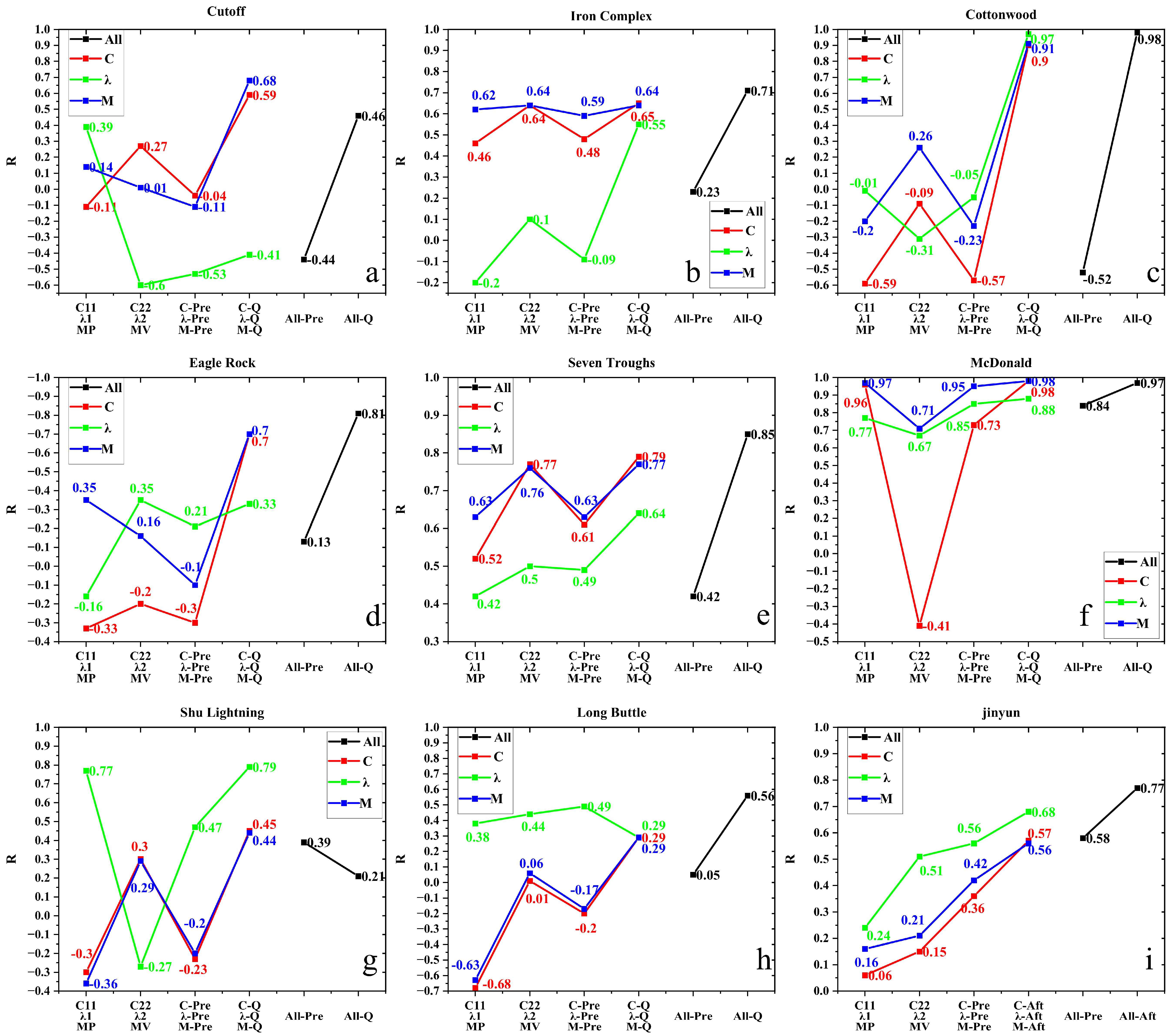
The eight fires across the United States served as supplementary study areas that effectively showcased the capability of the quantitative method in assessing burn severity in diverse geographical settings. This showcased the adaptability and robustness of the quantitative polarimetric features across different study areas, indicating its potential for wider application in wildfire research. Figure 8 delineates the assessment accuracy (R) within the study area when the random forest model was employed to assess burn severity across the nine fires. It is easy to notice that the assessment accuracy of quantitative method surpasses that of traditional method across all instances, with the exceptions noted in Figure 8g,h.
Figure 8. Accuracy evaluation of nine fires, where the black line represents Group-All, the red line represents Group-C, the green line represents group λ, and the blue line represents Group M. where (a) represents the accuracy evaluation of Cutoff, (b) Iron Complex, (c) Cottonwood, (d) Eagle Rock, (e) Seven Troughs, (f) McDonald, (g) Shu lightning, (h) Long Buttle, And the accuracy evaluation of Jinyun Mountain is in the lower right corner (i).

5. Discussion

5.1. Results Discussion

The target decomposition techniques could convert the SAR signal into powers such as surface scattering and volume scattering [44,57]. The surface scattering was derived mainly from ground surface scattering, while volume scattering was derived mainly from canopy branching [58]. We derived the unique metric based on traditional target decomposition techniques that describe both the canopy burn non-uniformity and ground condition non-uniformity. We then utilized the metric to modify the scattered power, ultimately generating the quantitative polarimetric features in this paper. This study was prompted by the non-uniform scattering medium, caused by the spatial heterogeneity of forests, which is not conducive burn severity assessment.
Based on traditional decomposition techniques [48,59,60,61], the quantitative method regarded partial power as a fraction of total non-uniform power, weakening the effect of non-uniform scattering medium in forest areas. The quantitative polarimetric features are very sensitive to the vegetation’s structural characteristics in the post-fire forest environment. This may be a promising direction for burn severity assessment using target decomposition techniques.
A series of experimental studies were conducted to demonstrate the effectiveness of the quantitative method. The scatter plots in Figure 4 indicated that using the indices in the traditional decomposition method alone was inadequate for burn severity studies [34]. On the contrary, the percentage of dominant scattering (surface scattering), after applying the quantitative method, was related to the burn severity. Moreover, in the dual-polarization SAR of C-band, surface scattering prevailed over volume scattering in burnt forest regions [42]. The predominance of surface scattering increased as canopy burning and the proportion of volume scattering diminished.
Figure 4e,f indicate a weak tendency for both surface scattering and volume scattering to rise with increasing burn severity when CBI > 0, albeit this trend lacks robustness. The elevation in surface scattering that was postulated was likely due to canopy burning exposing the ground surface [62]. Moreover, when CBI = 0, Figure 4a–f exhibit a wide range of values across the vertical axis, possibly attributed to variations in scattering powers originating from vegetation density or type. The scattering powers in forested areas are complex and influenced by a combination of factors [63,64,65]. Therefore, we cannot assume a linear relationship between scattering powers and burn severity [15]. Conversely, after the application of the proposed method (Figure 4g–i), the feature values consistently clustered in the upper or lower half-axis of the vertical coordinate when CBI = 0. The quantitative polarimetric feature from our method was able to overcome the effects of vegetation spatial heterogeneity, which could contribute to the assessment of burn severity with vegetation structure.
In Figure 5, the correlation coefficient between the traditional feature and the quantitative polarimetric feature is lower than 0.43, indicating that the data calculated by the quantitative method are relatively independent and can be considered as a new data source. The correlation coefficients between some of the features calculated by the quantitative method are higher than 0.97, indicating that the method enhances the connection between the features and reduces the differences between different algorithms. λ-Q shows a very strong negative correlation with the C-Q and M-Q indices, which, combined with the formulae of the three feature indices, suggests that the λ-Q, and the C-Q and M-Q indices may contain completely opposite physical information, consistent with the physical interpretation of decomposition features we actually defined.
In Table 3, the predictions for all features maintain a low correlation due to the non-uniform scattering medium. Although a simple feature combination was performed in Table 4, the accuracy of assessment was still low. This underscores that a combination of features does not improve the assessment of burn severity performance. However, the results indicate that the quantitative method improves the assessment of burn severity performance (R = 0.77; RMSE = 0.58), highlighting its effectiveness. Compared to the study by Zheng et al., which reported R = 0.60, this method achieved an improvement of 0.17 [41]. This is due to the fact that we considered the non-uniform scattering medium in the forest region to deeply explore the relationship between decomposition parameters and burn severity. On the other hand, under ideal conditions (clear skies; no smoke), the correlation coefficient (R) between the optical index (dNBR) and CBI typically ranges from 0.64 to 0.92 [41,66,67]. While the quantitative method proposed in this study does not surpass optical precision, it plays an irreplaceable role under conditions of cloud or fog obstruction. Therefore, future research should prioritize the effect of non-uniform scattering medium by calculating the scattering power under a certain metric. The metric proposed in this study is one such aspect, and not the only one. The construction of quantitative models to enhance the accuracy of burn severity assessments via this method may become one of the future directions.
It is worth noting that in Figure 7, in groups 1 to 6, on the sunny slopes of Jinyun Mountain, the forecasts remained relatively consistent across the feature groups. However, the predicted results on the shady slopes have significant differences. Such disparities could be attributed to the satellite incidence angle and terrain relief [68]. Tanase et al. explored the possibility of assessing burn severity separately for sunny and shady slopes [34]. However, this approach diminished the number of available sample plots. Consequently, it was challenging to use SAR data to assess burn severity in areas with significant terrain relief.
Despite this, the feature groups 10 to 12 (Figure 7c,g,k) were able to reduce the unchanged severity resulting from satellite incidence angle and terrain relief, and to increase the high severity. However, the challenge of the non-uniform scattering medium persists remained, which affected the accuracy of the burn severity assessment. Conversely, feature groups 7 to 9 (Figure 7d,h,l), leveraging our proposed methodology, encompassed all severity levels and yielded reliable outcomes. Notably, the λ-Q group, influenced by coherence filtering, displayed certain morphological regularities while lacking high severity instances. Furthermore, the All-Q feature group covered the entire spectrum of severity levels, offering more precise burn severity predictions without significant morphological biases.
Through a case study on the Jinyun fire in the Chongqing municipality of China, we aimed to show that the quantitative method can improve the accuracy of burn severity assessment with scattering power employing Sentinel-1 data. Moreover, with a case study of eight fires in the United States employing ALOS data, we aimed to demonstrate the applicability of the quantitative method to other study areas and other dual-polarization SAR. The findings presented in Figure 8 highlight a significant enhancement in the precision of burn severity assessment across various fire incidents through the utilization of the proposed methodology. This suggests that the methodology was not exclusive to the Chongqing study region but exhibited a broad utility in diverse geographical settings.

5.2. Limitations and Future Work

Nevertheless, it is imperative to acknowledge certain constraints associated with the United States fire data, namely: (1) the limited number of data points, (2) disparities in severity level distribution, (3) ambiguous fire boundaries, and (4) the inconsistency of remote sensing data availability during the growing season. These limitations might contribute to fluctuations in the accuracy of the assessment, as evidenced in Figure 8g,h. The Chongqing study area overcame these limitations and was more representative of the validity of the experiment.
The quantitative method effectively addressed challenges related to the non-uniform scattering medium, caused by spatial heterogeneity, as well as the satellite incidence angle and terrain relief. The quantitative method was specifically designed for burn severity assessment in wildfires areas, cautioning against its generalizability to other research objectives (e.g., urban environments and floods). When this method is applied to objectives other than forest burn severity, the reduced amount of data might compromise accuracy. In addition, the experiment focused on dual-polarization data, with future plans to expand research to full-polarization data.
This study employed a random forest model to enhance the accuracy of assessing burn severity through SAR data. Although the results demonstrated robust performance, we did not adjust the model’s hyperparameters or test different splitting ratios, which limited its precision. Future research may explore parameter tuning and comparisons of different machine learning models.
Although this study considered multiple burned areas, it did not examine specific vegetation types within these regions. Differences in structure, density, and moisture conditions across vegetation types may influence scattering mechanisms, necessitating future validation across broader ecoregions.
The current method relied on single temporal SAR data post fire. A key future direction is exploring the potential for multi-source data fusion, including optical and lidar data. Simultaneously, multi-temporal SAR data could be utilized to track the dynamic recovery process of post-fire vegetation structure.

6. Conclusions

This research paid attention to the non-uniform scattering medium in fire-affected forested areas, which has hindered the effective use of traditional target decomposition techniques in burn severity assessment. To tackle this challenge, this study proposed a metric that can represent non-uniform scattering conditions based on the traditional target decomposition techniques. The quantitative polarimetric features were constructed from the metric, which effectively utilized vegetation structure information to assess burn severity. The correlation results showed that the quantitative polarimetric features had a lower correlation with the traditional features, and could be used as new data to assess burn severity. Comparative analysis between the quantitative and traditional method revealed the stronger correlation of the quantitative method with the CBI value. Furthermore, the analogy was made between the accuracy of burn severity in the Jinyun study area and eight wildfires in the United States. The results indicated that the quantitative methods were generally applicable to burn severity assessment and provided a new perspective for future burn severity assessment based on the target decomposition technique.

Supplementary Materials

The following supporting information can be downloaded at: https://www.mdpi.com/article/10.3390/f17020243/s1.

Author Contributions

Y.Z. (Yaoqiang Zeng) analyzed the data and wrote original draft preparation; Z.Z. designed the experimental scheme and wrote review and editing. Y.Z. (Yaoqiang Zeng) performed the experiment with Y.Z. (Yangyang Zhang). All authors have read and agreed to the published version of the manuscript.

Funding

This research received no external funding.

Data Availability Statement

The original contributions exhibited in the study are included in the article. For further inquiries, please contact the corresponding author directly.

Acknowledgments

The authors thank those students who assisted with fieldwork and data collection, and instructors for their constructive comments on the improvement of this study.

Conflicts of Interest

The authors declare that the research was conducted in the absence of any commercial or financial relationships that could have appeared to influence the work reported in this paper.

References

  1. Eidenshink, J.; Schwind, B.; Brewer, K.; Zhu, Z.-L.; Quayle, B.; Howard, S. A project for monitoring trends in burn severity. Fire Ecol. 2007, 3, 3–21. [Google Scholar] [CrossRef]
  2. Zheng, Z.; Gao, Y.; Zhang, J.; Chen, Z. Modeling the susceptibility of forest fires using a genetic algorithm: A case study in mountain areas of southwestern China. Sci. Program. 2022, 2022, 5502209. [Google Scholar] [CrossRef]
  3. Chen, M.; Wang, Y.; Zheng, Z.; You, X.; Zeng, Y. Modeling the forest fire risk by incorporating a new human activity factor from nighttime light data. Geocarto Int. 2023, 38, 2289454. [Google Scholar] [CrossRef]
  4. de Vasconcelos, S.S.; Fearnside, P.M.; de Alencastro Graça, P.M.L.; Dias, D.V.; Correia, F.W.S. Variability of vegetation fires with rain and deforestation in Brazil's state of Amazonas. Remote Sens. Environ. 2013, 136, 199–209. [Google Scholar] [CrossRef]
  5. You, X.; Zheng, Z.; Yang, K.; Yu, L.; Liu, J.; Chen, J.; Lu, X.; Guo, S. A PSO-CNN-Based Deep Learning Model for Predicting Forest Fire Risk on a National Scale. Forests 2023, 15, 86. [Google Scholar] [CrossRef]
  6. Zheng, Z.; Jinfei, W.; Bin, Z.; Yanghua, G.; Shiqi, Y.; Yongqian, W. Initial assessment of burn severity using the transfer learning model. Natl. Remote Sens. Bull. 2022, 26, 2001–2013. [Google Scholar] [CrossRef]
  7. Lentile, L.B.; Holden, Z.A.; Smith, A.M.; Falkowski, M.J.; Hudak, A.T.; Morgan, P.; Lewis, S.A.; Gessler, P.E.; Benson, N.C. Remote sensing techniques to assess active fire characteristics and post-fire effects. Int. J. Wildland Fire 2006, 15, 319–345. [Google Scholar] [CrossRef]
  8. Key, C.H.; Benson, N.C. Measuring and remote sensing of burn severity. In Proceedings of the Proceedings Joint Fire Science Conference and Workshop; ResearchGate GmbH: Berlin, Germany, 1999; p. 284. [Google Scholar]
  9. Quintano, C.; Fernández-Manso, A.; Calvo, L.; Marcos, E.; Valbuena, L. Land surface temperature as potential indicator of burn severity in forest Mediterranean ecosystems. Int. J. Appl. Earth Obs. Geoinf. 2015, 36, 1–12. [Google Scholar] [CrossRef]
  10. Cocke, A.E.; Fulé, P.Z.; Crouse, J.E. Comparison of burn severity assessments using Differenced Normalized Burn Ratio and ground data. Int. J. Wildland Fire 2005, 14, 189–198. [Google Scholar] [CrossRef]
  11. Van Wagtendonk, J.W.; Root, R.R.; Key, C.H. Comparison of AVIRIS and Landsat ETM+ detection capabilities for burn severity. Remote Sens. Environ. 2004, 92, 397–408. [Google Scholar] [CrossRef]
  12. Zheng, Z.; Zeng, Y.; Li, S.; Huang, W. A new burn severity index based on land surface temperature and enhanced vegetation index. Int. J. Appl. Earth Obs. Geoinf. 2016, 45, 84–94. [Google Scholar] [CrossRef]
  13. Picotte, J.J.; Robertson, K.M. Validation of remote sensing of burn severity in south-eastern US ecosystems. Int. J. Wildland Fire 2011, 20, 453–464. [Google Scholar] [CrossRef]
  14. Key, C.H.; Benson, N.C. Landscape assessment (LA). In FIREMON: Fire Effects Monitoring and Inventory System; USDA: Fort Collins, CO, USA, 2006; Volume 164, p. LA-1-55. [Google Scholar]
  15. Kane, V.R.; North, M.P.; Lutz, J.A.; Churchill, D.J.; Roberts, S.L.; Smith, D.F.; McGaughey, R.J.; Kane, J.T.; Brooks, M.L. Assessing fire effects on forest spatial structure using a fusion of Landsat and airborne LiDAR data in Yosemite National Park. Remote Sens. Environ. 2014, 151, 89–101. [Google Scholar] [CrossRef]
  16. Fernandez-Carrillo, A.; McCaw, L.; Tanase, M.A. Estimating prescribed fire impacts and post-fire tree survival in eucalyptus forests of Western Australia with L-band SAR data. Remote Sens. Environ. 2019, 224, 133–144. [Google Scholar] [CrossRef]
  17. Loboda, T.V.; French, N.H.; Hight-Harf, C.; Jenkins, L.; Miller, M.E. Mapping fire extent and burn severity in Alaskan tussock tundra: An analysis of the spectral response of tundra vegetation to wildland fire. Remote Sens. Environ. 2013, 134, 194–209. [Google Scholar] [CrossRef]
  18. Miller, J.D.; Thode, A.E. Quantifying burn severity in a heterogeneous landscape with a relative version of the delta Normalized Burn Ratio (dNBR). Remote Sens. Environ. 2007, 109, 66–80. [Google Scholar] [CrossRef]
  19. Boucher, J.; Beaudoin, A.; Hébert, C.; Guindon, L.; Bauce, É. Assessing the potential of the differenced Normalized Burn Ratio (dNBR) for estimating burn severity in eastern Canadian boreal forests. Int. J. Wildland Fire 2016, 26, 32–45. [Google Scholar] [CrossRef]
  20. Zheng, Z.; Zeng, Y.; Li, S.; Huang, W. Mapping burn severity of forest fires in small sample size scenarios. Forests 2018, 9, 608. [Google Scholar] [CrossRef]
  21. Parks, S.A.; Dillon, G.K.; Miller, C. A new metric for quantifying burn severity: The relativized burn ratio. Remote Sens. 2014, 6, 1827–1844. [Google Scholar] [CrossRef]
  22. Schaepman-Strub, G.; Schaepman, M.E.; Painter, T.H.; Dangel, S.; Martonchik, J.V. Reflectance quantities in optical remote sensing—Definitions and case studies. Remote Sens. Environ. 2006, 103, 27–42. [Google Scholar] [CrossRef]
  23. Tsai, Y.-L.S.; Dietz, A.; Oppelt, N.; Kuenzer, C. Remote sensing of snow cover using spaceborne SAR: A review. Remote Sens. 2019, 11, 1456. [Google Scholar] [CrossRef]
  24. Li, X.; Xu, J.; Jia, Y.; Liu, S.; Jiang, Y.; Yuan, Z.; Du, H.; Han, R.; Ye, Y. Spatio-temporal dynamics of vegetation over cloudy areas in Southwest China retrieved from four NDVI products. Ecol. Inform. 2024, 81, 102630. [Google Scholar] [CrossRef]
  25. Alarcon-Aguirre, G.; Miranda Fidhel, R.F.; Ramos Enciso, D.; Canahuire-Robles, R.; Rodriguez-Achata, L.; Garate-Quispe, J. Burn severity assessment using sentinel-1 SAR in the southeast Peruvian Amazon, a case study of Madre de Dios. Fire 2022, 5, 94. [Google Scholar] [CrossRef]
  26. Moreira, A.; Prats-Iraola, P.; Younis, M.; Krieger, G.; Hajnsek, I.; Papathanassiou, K.P. A tutorial on synthetic aperture radar. IEEE Geosci. Remote Sens. Mag. 2013, 1, 6–43. [Google Scholar] [CrossRef]
  27. Dasgupta, A.; Grimaldi, S.; Ramsankaran, R.; Pauwels, V.R.; Walker, J.P.; Chini, M.; Hostache, R.; Matgen, P. Flood mapping using synthetic aperture radar sensors from local to global scales. In Global Flood Hazard: Applications in Modeling, Mapping, and Forecasting; American Geophysical Union: Washington, DC, USA, 2018; pp. 55–77. [Google Scholar] [CrossRef]
  28. Sreedhar, R.; Varshney, A.; Dhanya, M. Sugarcane crop classification using time series analysis of optical and SAR sentinel images: A deep learning approach. Remote Sens. Lett. 2022, 13, 812–821. [Google Scholar] [CrossRef]
  29. El-Darymli, K.; Gill, E.W.; Mcguire, P.; Power, D.; Moloney, C. Automatic target recognition in synthetic aperture radar imagery: A state-of-the-art review. IEEE Access 2016, 4, 6014–6058. [Google Scholar] [CrossRef]
  30. Chiang, C.-Y.; Chen, K.-S.; Yang, Y.; Wang, S. Computation of backscattered fields in polarimetric SAR imaging simulation of complex targets. IEEE Trans. Geosci. Remote Sens. 2021, 60, 2004113. [Google Scholar] [CrossRef]
  31. Imperatore, P.; Azar, R.; Calo, F.; Stroppiana, D.; Brivio, P.A.; Lanari, R.; Pepe, A. Effect of the vegetation fire on backscattering: An investigation based on Sentinel-1 observations. IEEE J. Sel. Top. Appl. Earth Obs. Remote Sens. 2017, 10, 4478–4492. [Google Scholar] [CrossRef]
  32. Aziz, I.; Soltanaghai, E.; Watts, A.; Alipour, M. Bayesian inversion of GPR waveforms for sub-surface material characterization: An uncertainty-aware retrieval of soil moisture and overlaying biomass properties. Remote Sens. Environ. 2024, 313, 114351. [Google Scholar] [CrossRef]
  33. Belenguer-Plomer, M.A.; Chuvieco, E.; Tanase, M.A. Temporal decorrelation of c-band backscatter coefficient in mediterranean burned areas. Remote Sens. 2019, 11, 2661. [Google Scholar] [CrossRef]
  34. Tanase, M.A.; Santoro, M.; Aponte, C.; de la Riva, J. Polarimetric properties of burned forest areas at C-and L-band. IEEE J. Sel. Top. Appl. Earth Obs. Remote Sens. 2013, 7, 267–276. [Google Scholar] [CrossRef]
  35. Kurum, M. C-band SAR backscatter evaluation of 2008 Gallipoli forest fire. IEEE Geosci. Remote Sens. Lett. 2015, 12, 1091–1095. [Google Scholar] [CrossRef]
  36. Tariq, A.; Shu, H.; Li, Q.; Altan, O.; Khan, M.R.; Baqa, M.F.; Lu, L. Quantitative analysis of forest fires in southeastern Australia using SAR data. Remote Sens. 2021, 13, 2386. [Google Scholar] [CrossRef]
  37. De Petris, S.; Momo, E.J.; Sarvia, F.; Borgogno-Mondino, E. Multitemporal dual-pol Sentinel-1 data to support monitoring of forest post-fire dynamics. Geocarto Int. 2022, 37, 15463–15484. [Google Scholar] [CrossRef]
  38. Engelbrecht, J.; Theron, A.; Vhengani, L.; Kemp, J. A simple normalized difference approach to burnt area mapping using multi-polarisation C-Band SAR. Remote Sens. 2017, 9, 764. [Google Scholar] [CrossRef]
  39. Varghese, A.O.; Suryavanshi, A.; Joshi, A.K. Analysis of different polarimetric target decomposition methods in forest density classification using C band SAR data. Int. J. Remote Sens. 2016, 37, 694–709. [Google Scholar] [CrossRef]
  40. Tariq, A.; Jiango, Y.; Lu, L.; Jamil, A.; Al-ashkar, I.; Kamran, M.; Sabagh, A.E. Integrated use of Sentinel-1 and Sentinel-2 data and open-source machine learning algorithms for burnt and unburnt scars. Geomat. Nat. Hazards Risk 2023, 14, 2190856. [Google Scholar] [CrossRef]
  41. Zheng, Z.; Zeng, Y.; Zou, B.; Xie, Q.; Xian, W.; Xu, W.; Liu, Y.; Liu, Z. Assessing the burn severity of wildfires by incorporating vegetation structure information. Geomat. Nat. Hazards Risk 2024, 15, 2401042. [Google Scholar] [CrossRef]
  42. Minchella, A.; Del Frate, F.; Capogna, F.; Anselmi, S.; Manes, F. Use of multitemporal SAR data for monitoring vegetation recovery of Mediterranean burned areas. Remote Sens. Environ. 2009, 113, 588–597. [Google Scholar] [CrossRef]
  43. Kobayashi, S.; Omura, Y.; Sanga-Ngoie, K.; Widyorini, R.; Kawai, S.; Supriadi, B.; Yamaguchi, Y. Characteristics of decomposition powers of L-band multi-polarimetric SAR in assessing tree growth of industrial plantation forests in the tropics. Remote Sens. 2012, 4, 3058–3077. [Google Scholar] [CrossRef]
  44. Voormansik, K.; Jagdhuber, T.; Zalite, K.; Noorma, M.; Hajnsek, I. Observations of cutting practices in agricultural grasslands using polarimetric SAR. IEEE J. Sel. Top. Appl. Earth Obs. Remote Sens. 2015, 9, 1382–1396. [Google Scholar] [CrossRef]
  45. Sugimoto, R.; Nakamura, R.; Tsutsumi, C.; Yamaguchi, Y. Extension of scattering power decomposition to dual-polarization data for tropical forest monitoring. Remote Sens. 2023, 15, 839. [Google Scholar] [CrossRef]
  46. Ji, K.; Wu, Y. Scattering mechanism extraction by a modified cloude-pottier decomposition for dual polarization SAR. Remote Sens. 2015, 7, 7447–7470. [Google Scholar] [CrossRef]
  47. Zhou, Z.-S.; Caccetta, P.; Lehmann, E.; Held, A.; McNeill, S.; Mitchell, A.; Milne, A.; Tapley, I.; Lowell, K. Dual polarised Entropy/alpha decomposition and coherence optimisation for improved forest height mapping. In Proceedings of the 2011 IEEE International Geoscience and Remote Sensing Symposium; IEEE: Piscataway, NJ, USA, 2011; pp. 3951–3954. [Google Scholar]
  48. Mascolo, L.; Cloude, S.R.; Lopez-Sanchez, J.M. Model-based decomposition of dual-pol SAR data: Application to Sentinel-1. IEEE Trans. Geosci. Remote Sens. 2021, 60, 5220119. [Google Scholar] [CrossRef]
  49. Xie, L.; Zhang, H.; Li, H.; Wang, C. A unified framework for crop classification in southern China using fully polarimetric, dual polarimetric, and compact polarimetric SAR data. Int. J. Remote Sens. 2015, 36, 3798–3818. [Google Scholar] [CrossRef]
  50. Van Zyl, J.J.; Arii, M.; Kim, Y. Model-based decomposition of polarimetric SAR covariance matrices constrained for nonnegative eigenvalues. IEEE Trans. Geosci. Remote Sens. 2011, 49, 3452–3459. [Google Scholar] [CrossRef]
  51. Shao, J.; Wei, C.; Xie, D. Mountain land use planning of metropolitan suburbs: The case of the Jinyun mountain and its surrounding area, Chongqing, China. J. Mt. Sci. 2005, 2, 116–128. [Google Scholar] [CrossRef]
  52. Li, F.; Zhou, W.; Shao, Z.; Zhou, X. Effects of ecological projects on vegetation in the Three Gorges Area of Chongqing, China. J. Mt. Sci. 2022, 19, 121–135. [Google Scholar] [CrossRef]
  53. Dillon, G.K.; Morgan, P.; Holden, Z.A. Mapping the potential for severe fire in the Western United States. Fire Manag. Today 2011, 71, 1–28. [Google Scholar]
  54. Sikkink, P.G.; Dillon, G.K.; Keane, R.E.; Morgan, P.; Karau, E.C.; Holden, Z.A.; Silverstein, R.P. Composite Burn Index (CBI) Data and Field Photos Collected for the FIRESEV Project, Western United States; USDA: Washington, DC, USA, 2013. [Google Scholar]
  55. Addison, P.; Oommen, T. Utilizing satellite radar remote sensing for burn severity estimation. Int. J. Appl. Earth Obs. Geoinf. 2018, 73, 292–299. [Google Scholar] [CrossRef]
  56. Keane, R.E.; Morgan, P.M.; Dillon, G.K.; Sikkink, P.G.; Karau, E.C.; Holden, Z.A.; Drury, S.A. A fire severity mapping system for real-time fire management applications and long-term planning: The FIRESEV project. In Final Report January 2013; United States Joint Fire Science Program: Boise, ID, USA, 2013. [Google Scholar]
  57. Touzi, R. Target scattering decomposition in terms of roll-invariant target parameters. IEEE Trans. Geosci. Remote Sens. 2006, 45, 73–84. [Google Scholar] [CrossRef]
  58. Le Toan, T.; Beaudoin, A.; Riom, J.; Guyon, D. Relating forest biomass to SAR data. IEEE Trans. Geosci. Remote Sens. 1992, 30, 403–411. [Google Scholar] [CrossRef]
  59. Arii, M.; Van Zyl, J.J.; Kim, Y. Adaptive model-based decomposition of polarimetric SAR covariance matrices. IEEE Trans. Geosci. Remote Sens. 2010, 49, 1104–1113. [Google Scholar] [CrossRef]
  60. Ballester-Berman, J.D.; Lopez-Sanchez, J.M. Applying the Freeman–Durden decomposition concept to polarimetric SAR interferometry. IEEE Trans. Geosci. Remote Sens. 2009, 48, 466–479. [Google Scholar] [CrossRef]
  61. Cloude, S.R.; Pottier, E. An entropy based classification scheme for land applications of polarimetric SAR. IEEE Trans. Geosci. Remote Sens. 1997, 35, 68–78. [Google Scholar] [CrossRef]
  62. Kozoderov, V.V.; Dmitriev, E. Remote sensing of soils and vegetation: Quantitative parameters retrieval using pattern-recognition techniques and forest stand structure assessment. Int. J. Remote Sens. 2011, 32, 5699–5717. [Google Scholar] [CrossRef]
  63. Pirotti, F.; Adedipe, O.; Leblon, B. Sentinel-1 Response to Canopy Moisture in Mediterranean Forests before and after Fire Events. Remote Sens. 2023, 15, 823. [Google Scholar] [CrossRef]
  64. Tsang, L.; Kong, J.A.; Shin, R.T. Theory of Microwave Remote Sensing; NASA: Washington, DC, USA, 1985. [Google Scholar]
  65. Moran, M.S.; Hymer, D.C.; Qi, J.; Sano, E.E. Soil moisture evaluation using multi-temporal synthetic aperture radar (SAR) in semiarid rangeland. Agric. For. Meteorol. 2000, 105, 69–80. [Google Scholar] [CrossRef]
  66. Cai, L.; Wang, M. Is the RdNBR a better estimator of wildfire burn severity than the dNBR? A discussion and case study in southeast China. Geocarto Int. 2022, 37, 758–772. [Google Scholar] [CrossRef]
  67. Vanderhoof, M.K.; Menick, C.E.; Picotte, J.J.; Robertson, K.M.; Nowell, H.K.; Matechik, C.; Hawbaker, T.J. Modelling and mapping burn severity of prescribed and wildfires across the southeastern United States (2000–2022). Int. J. Wildland Fire 2025, 34, WF24137. [Google Scholar] [CrossRef]
  68. Tanase, M.; Santoro, M.; de la Riva, J.; Kasischke, E.; Korets, M.A. L-band SAR backscatter prospects for burn severity estimation in boreal forests. In Proceedings of the ESA Living Planet Symposium, Bergen, Norway, 28 June–2 July 2010. [Google Scholar]
Disclaimer/Publisher’s Note: The statements, opinions and data contained in all publications are solely those of the individual author(s) and contributor(s) and not of MDPI and/or the editor(s). MDPI and/or the editor(s) disclaim responsibility for any injury to people or property resulting from any ideas, methods, instructions or products referred to in the content.

Article Metrics

Citations

Article Access Statistics

Multiple requests from the same IP address are counted as one view.