


Abstract
Cracks and holes are commonly found in wooden components, and ancient Chinese wooden buildings, represented by the Yingxian Wooden Pagoda, demonstrate the ability to work with defects. This study systematically investigated the effects of longitudinal cracks and circular holes on the load-bearing capacity of wooden beams through four-point bending experiments on 1580 specimens. The study focuses on load-bearing capacity as the core indicator and provides calculation formulas for the section weakening coefficient and damage tolerance coefficient to quantitatively evaluate the impact of defects. Research has found that the harmfulness of a defect strongly depends on its position within the wooden beam. In the horizontal direction, when the longitudinal crack is located in the pure bending section of the wooden beam, it has little effect on the load-bearing capacity of the wooden beam. Once it deviates to the transverse bending section, the load-bearing capacity of the wooden beam significantly decreases. The hole is most dangerous when it is located in the horizontal center of the wooden beam, and it is also dangerous when it is near the loading point. In the vertical direction, the crack has the greatest impact on the load-bearing capacity of the wooden beam when it is located in the middle-height layer or its vicinity, while its impact decreases when it is close to the top and bottom surfaces of the wooden beam. Holes have the least impact when approaching the middle-height layer, which is different from the impact pattern of cracks. In addition, the hazard increases when the hole is located in the tension zone of the wooden beam, and decreases when it is located in the compression zone. The anisotropy and fiber structure of wood are the microscopic basis for the damage-tolerance mechanical behavior of timber beams.
1. Introduction
Wood, as a natural biomaterial with a long history of application, plays an indispensable role in load-bearing structures such as buildings, bridges, and small boats due to its excellent specific strength, ease of processing, and unique ecological environment properties [1]. However, unlike homogeneous and isotropic engineering materials, wood, as a bio-composite material, inevitably has inherent characteristics such as knots [2], insect holes, and uneven texture inside. More commonly and noteworthy is that during their service, wooden components are prone to cracks [3] due to the release of drying shrinkage stress [4,5] and growth stress [6] caused by changes in environmental humidity, or factors such as human processing and accidental damage. The simple understanding of ancient Chinese craftsmen that “wood invariably cracks” not only includes an understanding of the mechanical characteristics of wood anisotropy [7], but also profoundly reveals the universality and inevitability of cracks, especially longitudinal cracks along the direction of wood fibers, in wooden components. In addition to cracks, wooden components frequently contain holes. These may be natural defects such as wormholes and scars, or intentional openings required for structural connections, pipeline installation, or maintenance reinforcement. The existence of such defects, particularly in critical load-bearing elements like beams, threatens the safety and service life of wooden structures.
From the perspective of classical continuum mechanics and fracture mechanics, cracks and holes in components are considered as potential causes of structural failure. There is a singular stress field at the crack tip, which may lead to unstable crack propagation under external loads [8]. Holes can significantly alter the stress field around them and lead to stress concentration, thereby weakening the effective load-bearing area of the component [9]. Within this theoretical framework, traditional engineering evaluations generally regard these defects with a highly conservative attitude, considering them to substantially erode structural safety margins and often interpreting their presence as a potential sign of failure. However, a large number of engineering practices, especially the millennium-long existence of ancient Chinese wooden architecture represented by the Yingxian Wooden Pagoda, provide vivid examples that contradict this “zero tolerance for defects” viewpoint. The wooden beams in these ancient buildings generally have historical cracks and holes, but they can still effectively bear loads. This contradictory phenomenon suggests that wood and its wooden components may possess a unique “damage tolerance” ability that goes beyond conventional engineering material cognition.
The concept of “damage tolerance” originated in the aviation industry in the mid-20th century and was a revolutionary change in engineering design philosophy after experiencing a series of catastrophic accidents caused by fatigue cracks. The core idea is to acknowledge that there must be initial defects or damage in the structure during manufacturing and use, but through reasonable material selection, detailed design, and the establishment of scientific inspection and maintenance cycles, this damage can be detected in a timely manner before expanding to critical dimensions, thereby ensuring the safety of the structure in a “damaged working” state. Damage tolerance design has been successfully applied in fields such as aerospace, nuclear power, and major equipment, becoming an important pillar of modern structural safety assessment. It is interesting that the wisdom embodied in ancient Chinese wooden architecture, such as “cracking is not a disease” and “walls collapse but houses do not collapse”, is highly consistent with modern damage tolerance theory both in concept and practical effect. This resonance across time and space prompts us to ponder: what are the micro mechanisms and macro laws behind the natural damage tolerance characteristics of wood and wood structures?
To reveal this scientific issue, scholars have conducted beneficial explorations from different perspectives. In the field of crack research, previous studies have explored the weakening law of prefabricated crack depth on the bending strength of wooden beams [10], revealed the propagation mechanism and damage evolution process of shrinkage cracks using digital image correlation technology [11], provided the location and distribution pattern of cracks [12], analyzed the toughening mechanisms such as microcracks and fiber bridging in wood crack propagation through double cantilever beam experiments [13], and analyzed the propagation mechanisms of cracks in wooden beams through the extended finite element method (XFEM) [14]. In terms of hole research, scholars have analyzed the influence of hole position on the bending strain distribution and neutral axis offset of wooden beams [15], evaluated the influence of different sizes of holes on the load-bearing capacity of glued laminated timber beams through experiments and numerical simulations [16], studied the residual strength of pine load-bearing components with small wormholes [17], and attempted to use probabilistic fracture mechanics methods to analyze the strength of wooden beams with holes [18]. These studies provide valuable experimental data and local insights for us to understand the impact of single-type defects.
However, there are still some areas that urgently need to be further explored and integrated in current research: firstly, most studies focus on a single type of crack or hole, lacking systematic comparative analysis and mechanistic correlation between the two under a unified theoretical framework, and failing to answer the core engineering concern of which is more dangerous under the same degree of weakening: a crack or hole. Secondly, there is no unified evaluation index for the impact of defects. Existing research either uses absolute load-bearing capacity loss, stress concentration factor, or fracture toughness parameters, making it difficult to conduct lateral comparisons and universal evaluations. A unified quantitative indicator that can intuitively reflect the safety status of components and is convenient for engineering applications urgently needs to be proposed. Finally, for anisotropic and multi-scale composite materials such as wood, the explanation of the mechanism of defect influence still needs to be deepened. It is necessary to more closely combine macroscopic mechanical properties with microscopic fiber structure, fracture morphology, and microscopic stress field distribution.
In view of this, this study proposes a systematic and comparative study on the damage tolerance characteristics of wooden beams with longitudinal cracks and circular holes, using load-bearing capacity as the core criterion. The load-bearing capacity directly reflects the safety reserve of the component after damage and is the most direct and critical parameter in engineering safety assessment. This paper aims to establish a damage tolerance evaluation framework based on load-bearing capacity analysis, in order to quantitatively study the influence of cracks (considering length and position) and holes (considering position) on the ultimate breaking force (i.e., the direct manifestation of load-bearing capacity) of wooden beams through systematic four-point bending experiments, and draw their relationship curves. In addition, a unified evaluation coefficient is proposed to assess the impact of crack and hole damage on the bearing capacity of wooden beams, achieving comparison and grading of the harmfulness of defects of different types and positions. It is best to combine fracture morphology analysis and finite element (FE) simulation to explain the micro-mechanical mechanisms of wood’s different tolerance capabilities for cracks and holes from the perspectives of stress redistribution, crack propagation paths, fiber failure modes, etc.
This research combines experimental data with theoretical analysis to provide a scientific basis and practical method based on the concept of damage tolerance for the safety diagnosis and maintenance decision-making of in-service wooden components. This study not only helps deepen the scientific understanding of the mechanical behavior of wood, a complex biomaterial, and promotes the cross integration of fracture mechanics and wood science, but also provides new theoretical assistance and practical guidance for the scientific protection of ancient wooden buildings and the reliable design of modern wooden structures.
2. Materials and Methods
2.1. Material Selection
Pinus sylvestris var. mongolica was obtained from the Krasnoyarsk Krai region in Russia and used as the experimental material in this study. The material was characterized by a standard air-dry density of 477 kg/m3 [19]. This type of wood has the advantages of wide application, moderate strength, moderate durability, easy processing, and low cost, and is often used as a material for wooden beams in timber structures [20,21]. To reduce the uncertainty of experimental results caused by individual differences in specimens, large sample sizes were used in the experiments for each defect parameter, with a total sample size of 1580. The specimens comprised two fundamental types: those with holes and those with cracks. Corresponding to the specimens with cracks, the influence of 7 different vertical positions and 5 different horizontal positions of cracks on the bearing capacity of the specimens was investigated in the experiment. For specimens with holes, the influence of 9 different vertical positions and 5 different horizontal positions on the bearing capacity of the specimens was investigated. The specific sample size for each test condition is provided in the table corresponding to the case later. As a sufficiently large number of defect locations were investigated experimentally, the overall validity of the data could be assessed by evaluating the physical plausibility of the fitted curve shape, even when individual defect locations exhibited abnormally high data scatter. In order to avoid excessive consumption of wood and reduce the difficulty of specimen processing and energy consumption, small-sized specimens were used for testing in this study. In addition, by continuously purchasing wood from the same origin and selecting specimens with the same ring width and direction as far as possible, the material variation error of the specimens can be reduced.
2.2. Experimental Testing Methods and Methods for Correcting Experimental Results
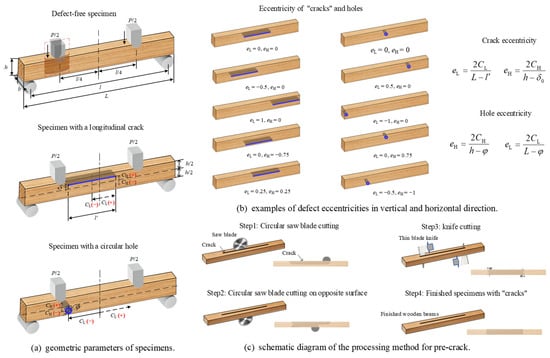
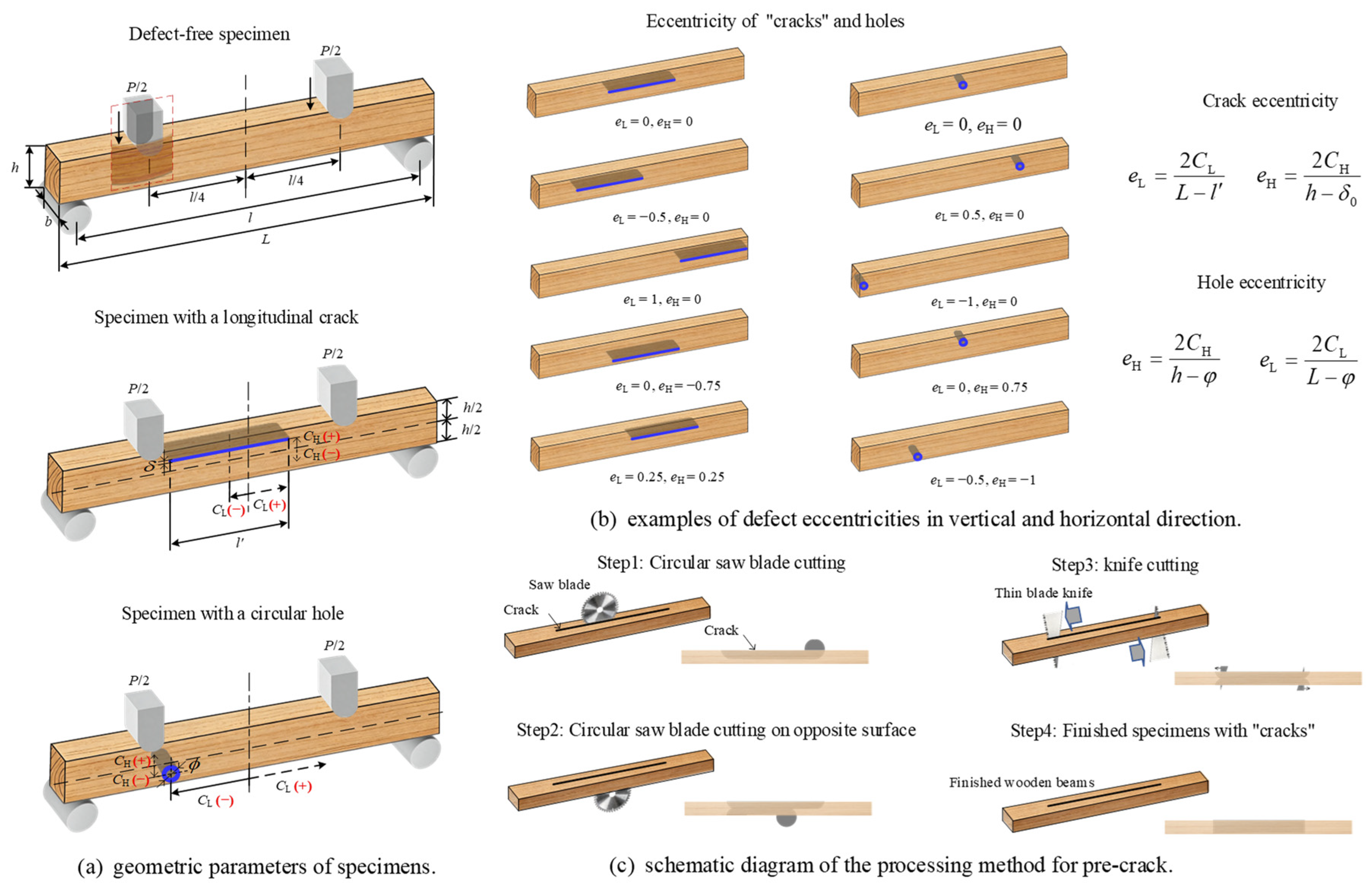
Figure 1 presents the key parameters of the experimental specimens, with Figure 1a showing the loading method, dimensions, and defect sizes of the specimens; Figure 1b visually illustrates the relationship between the eccentricity values (eL,eH) and defect locations; Figure 1c illustrates the prefabrication method for “cracks” in specimens.
Figure 1.
Dimensions of the specimens and loading method used in the experiment, parameters of “cracks” and holes, and processing method for prefabricated “cracks”.
Existing research has indicated that when cracks appear at the middle-height layer of a wooden beam (which is likely to be the neutral layer of the beam or in its vicinity), their impact on the load-bearing capacity of the beam is significant [22]. In addition, the maximum shear stress generated by the transverse bending section of the wooden beam occurs at the neutral layer, indicating that when the damage is located at the neutral layer, it is easy to induce shear crack propagation. Therefore, it is necessary to analyze the influence of longitudinal cracks and circular holes at the middle-height layer on the load-bearing capacity of wooden beams. The fiber structure of wood causes its tensile elastic modulus to be slightly higher than its compressive elastic modulus, resulting in the neutral layer of the wooden beam being slightly higher than its middle-height layer [23]. However, the offset problem of the neutral layer can make the processing and theoretical analysis of the specimen too complex. Therefore, this study considers that the actual offset of the neutral layer is very small, and still assumes that the position of the neutral layer in the wooden beam coincides with the middle-height layer of the wooden beam. This makes both theoretical analysis and experimental specimen processing more convenient.
Considering that the study should select specimens with span-to-height ratios close to those of actual timber structural members, and from the perspective of mechanics of materials, the specimen’s span–height ratio should be suitable for applying existing mechanical formulas to calculate its stress and deformation. In addition, the size parameters of the specimens should also facilitate the preparation, testing, and data analysis of the experimental specimens. After considering the above factors comprehensively, this study limits the relationship between the span–height ratio of specimens to l/h = 10, and uses specimens with uniform dimensions and spans (l0 = 150 mm, h0 = 15 mm, b0 = 10 mm, L0 = 160 mm). Regarding the selection of the experimental loading configuration, consideration was given to the fact that many traditional Chinese timber structures employ an auxiliary beam system—a structural form that maximizes the load-bearing capacity of wooden beams. In such structural systems, the distance between the two loading points on top of the main beam is precisely half of the beam’s span. Therefore, in the experiments of this study, a four-point bending loading method with a loading point distance of half the span of the specimens was used, and the maximum load value before fracture of each specimen was measured.
It should be noted that the experimental conditions differ from naturally formed defects caused by shrinkage or the release of growth stress. Naturally formed defects typically exhibit more irregular morphologies; therefore, it is impossible to produce a large number of specimens with identical defect sizes and positions by prefabricating defects through natural forming methods, which makes the reproducibility of the experiment very poor. Defects prefabricated by manual sawing or drilling processes can maintain a high degree of consistency in their shape, which is conducive to conducting parametric experimental research on a large sample size.
In addition, specimens with cracks that run through the entire width of the beam were used in this study. However, in real wooden beams, this situation is almost non-existent. The reason for adopting this experimental setup is to predict the impact of defects on wooden beams from the worst possible perspective. In the worst-case scenario, it can be predicted how much the load-bearing capacity of wooden beams will decrease, so in actual use, the safety of wooden beams must be more optimistic.
In the preparation stage of the test piece, 60 specimens without macroscopic defects, as well as 700 specimens with different longitudinal-crack parameters and 820 specimens with different circular-hole parameters, were processed. Specimens with longitudinal cracks were prepared using a special method: an ultra-thin, small-diameter saw blade with a thickness of only 0.5 mm was used to fabricate the “cracks”, and the shape of the “cracks” was subsequently trimmed using a thin cutting blade. The specific processing method is shown in Figure 1c. The processed specimens were stored in a dedicated drying oven with a moisture content controlled at 12.0% ± 1.5%.
Before starting the experiment, a KT50 upgraded inductive wood moisture meter (Jingtai Instrument Co., Ltd., Xinghua, China) was used to retest the moisture content of the specimens (4 × 5 specimens were bundled and stacked for measurement to make the measurement results of moisture content more accurate) and ensure that the moisture content of the specimens met the requirements. Then, the cross-sectional width (b), cross-sectional height (h), and total length (L) of specimens were measured using a vernier caliper, and the static mass (m) of specimens was measured using an electronic balance with a resolution of 0.01 g.
During the experimental operation, specimens were placed on a dedicated metal hinge support with a span of l = 150 mm, and subjected to fracture and failure loading using a universal mechanical testing machine, PUYAN980 (Yaofeng Electronic Equipment Co., Ltd., Dongguan, China), with a maximum load of 20 kN (load measurement resolution 0.01 N) and in conjunction with a four-point bending loading head. Firstly, the specimens without macroscopic defects were tested. Subsequently, the specimens with cracks and holes were tested, and the maximum loading force (P) of each specimen during the fracture process was recorded. To reduce the uncertainty of experimental results caused by differences in the size and density of specimens, it is necessary to adjust the tested loading force P to an equivalent value Pe:
where Cρ is the density influence coefficient used to adjust the impact of density differences on experimental results, and CW is the coefficient of influence on cross-sectional dimensions, used to adjust the impact of machining deviations on experimental results. The physical meaning of the equivalent fracture load value is the fracture load value of a specimen with standard density and identical cross-sectional dimensions, which is calculated based on the assumption that the load-bearing capacities of wooden beamsare proportional to their density. There is a complex functional relationship between the density and bearing capacity of wooden beams, which is related to the type of wood and the microstructure of the beams. Although the assumption of this proportional relationship ignores the actual functional relationship mentioned above, the accuracy of the experimental results can still be significantly improved compared to not making any modifications.
Pe = P·Cρ·CW
The calculation formula for the density influence coefficient Cρ is
where ρ is the standard air-dry density of Pinus sylvestris var. mongolica wood (taken as 477 kg/m3) and ρm is the measured density of the specimen before experiment. For defect-free wooden beams, those with cracks, and those with holes, the specific calculation formula for ρm can be calculated separately through Formulas (3)–(5).
where b, h, L, and m are the width, height, length, and static mass of the wooden beam, respectively; l′ is the length of the crack, δ is the width of the longitudinal crack; and φ is the diameter of the circular hole. It can be seen that the calculation formulas take into account the volume of wood removed due to processing cracks or holes, making the calculated density more accurate. In addition, when measuring the static mass of wooden beams, based on the condition of a moisture content of 12%, it is ensured that the calculated ρm is the actual air-dry density of the wooden beam.
Cρ=ρ/ρm
ρm(defect-free-beam) = m/bhL ρ(defect-free-beam)= m/bhL
ρm(cracked-beam) = m/(bhL − bδl′) ρ(cracked-beam) = m/(bhL − bδl′)
ρm(circular-hole-beam) = m/(bhL − 0.25πbφ2) ρ(circular-hole-beam) = m/(bhL − 0.25πbφ2)
The calculation method for the influence coefficient CW of cross-sectional dimensions is shown in Formula (6):
where b0 and h0 are the standard width and height of the specimen (b0 = 10.0 mm, h0 = 15.0 mm), respectively; b and h are the actual cross-sectional width and height of the wooden beam measured by a vernier caliper (accuracy 0.1 mm).
CW = b0h02/(bh2)
By introducing the density influence coefficient and the cross-sectional influence coefficient to adjust the experimental results, the influence of density differences between specimens and processing errors in specimen size on the experimental results can be significantly reduced. Examples of the fracture load adjustment in this study are shown in Table 1.
Table 1.
Examples of the fracture load adjustment under three cases.
From the process of adjusting the fracture load in Table 1, it can be seen that if the cross-sectional size and density of the specimen are below the standard value, the adjusted fracture load value will increase compared to the actual measured value; if the cross-sectional size and density of the wooden beam are exceeding the standard value, the adjusted fracture load value will decrease compared to the actual measured value. By using this method for adjustments, the influence of size and density differences between specimens on experimental results can be reduced, making the experimental results more credible.
Despite the use of adjustment methods, individual differences in the mechanical properties of specimens still induce uncertainty in experimental results. This study aims to reduce the influence of random factors through a large sample size.
Based on prior research and the empirical evidence from this study, four characteristic conditions of data dispersion are identified. As shown in Table 2, for each condition, the coefficient of variation (CV) is provided, along with the necessary sample size to estimate the mean with a confidence interval width of either ±5% or ±10% of the experimental value at the 95% confidence level.
Table 2.
Typical data dispersion levels in the research, corresponding CVs, and sample sizes required in experiments.
In this study, the target width of the confidence interval was defined relative to the experimental value. When experimental results showed a significant difference from control group values, a target width of ±10% of the measured value was adopted. In cases where experimental values closely approximated control group levels, a more stringent target width of ±5% was applied. Considering that at all levels of data dispersion, a sample size of 40 can bring the experimental values into a ±10% confidence interval width, a sample size of 40 was selected for most conditions. For certain groups requiring a ±5% confidence interval width under conditions of high data dispersion, larger sample sizes of 60 or 80 were assigned as appropriate.
Given that the sample size of 80 is already quite large, even in some cases where the actual confidence interval width slightly exceeds the target of ±5%, this sample size will be used in relevant tests without further increase. This approach ensures that sample size determination aligns with statistical principles while facilitating consistent data recording and systematic analysis across the study.
Considering the large amount of data in this study, the research team used a self-developed script combined with Excel 2019 to input, organize, calculate, and analyze key experimental data, such as specimen size (b, h, L), mass(m), density(ρ), density influence coefficient (Cρ), cross-sectional size influence coefficient (CW), fracture load (P), and its equivalent value (Pe) (including maximum, minimum, average values, and coefficient of variation), in order to improve the automation level of data analysis, accelerate data analysis speed, and reduce the workload of manual data analysis.
2.3. Quantitative Description Method for the Load-Bearing Capacity of Defective Wooden Beams
In order to facilitate the measurement of the impact of cracks and holes on the load-bearing capacity of wooden beams, three coefficients were defined in this study, namely the “load-bearing capacity coefficient (R)”, “section weakening coefficient (λ)”, and “damage tolerance coefficient (ζ)”.
The physical meaning of the load-bearing capacity coefficient is the ratio of the equivalent fracture load value of defective wooden beams to the fracture load value of defect-free wooden beams under the same conditions. Its calculation formula is
where Ped is the equivalent fracture load value of a defective wooden beam, and Pe is the equivalent fracture load value of a defect-free wooden beam. Due to the fact that the fracture load value of defective wooden beams is usually smaller than that of defect-free wooden beams, R is usually less than 1.0.
R = Ped/Pe
The section weakening coefficient is the ratio of the bending section coefficient of the defective wooden beam to that of a defect-free wooden beam.
The calculation formula for the section weakening coefficient of wooden beams with longitudinal cracks is
where δ is the width of the crack, cH is the distance from the centerline of the crack to the centerline of the wooden beam in the vertical direction, and h is the height of the wooden beam.
λ = 1 − (δ3 + 12δcH2)/h3
The calculation formula for the section weakening coefficient of wooden beams with a circular hole is
where φ is the diameter of the circular hole, and cH is the distance between the center of the hole and the centerline of the wooden beam in the vertical direction.
λ = 1 − (φ3 + 12φcH2)/h3
This study defines the damage tolerance coefficient as the ratio of the load-bearing capacity coefficient to the section weakening coefficient, that is:
ϛ = R/λ
After introducing the section weakening coefficient and damage tolerance coefficient, there is a relationship between the fracture load of defective and defect-free wooden beams as follows:
Ped = Peλϛ
3. Results
3.1. Fracture Load of Defect-Free Specimens
The test result of the average equivalent fracture load of 60 defect-free specimens was 1367 N, with a maximum value of 2672 N and a minimum value of 801 N. The coefficient of variation (CV) of the experimental measurement values was 21.0%. However, this is completely normal for small, defect-free solid wood specimens, as it falls within the intraspecific variability of the material. Pinus sylvestris var. mongolica wood is mainly composed of tubular cells at the microscopic level, and there are natural differences in cell wall thickness, arrangement direction (fiber angle), and chemical composition (such as cellulose and lignin) among samples. The random distribution of microstructures and defects directly leads to a significant dispersion of fracture loads, which is the fundamental reason for the CV reaching 21.0%. Due to the use of a large sample size for averaging, the average fracture load obtained from the experiment can be credible. In the subsequent analysis, the fracture loads of all longitudinal-crack and circular-hole specimens will be compared with the defect-free specimens, and the related phenomena and mechanisms of defects affecting the bearing capacity of wooden beams will also be analyzed and discussed.
3.2. The Relationship Between the Fracture Load and the Vertical Position of Defects
Table 3 shows the comparison of fracture loads of specimens with longitudinal cracks centered horizontally (eL =0) but located at different vertical positions. Due to the fact that longitudinal cracks centered horizontally require a significant length to have a noticeable impact on the load-bearing capacity of wooden beams, this study used specimens with larger crack lengths (l′ = 4L/5) to investigate the effect of longitudinal cracks at different vertical positions (eH = 0, ±0.25, ±0.50, ±0.75) on the load-bearing capacity of wooden beams.
Table 3.
Comparison of experimental data of Pinus sylvestris var. mongolica specimens with a horizontally centered longitudinal crack located at different vertical positions.
Table 4 compares the fracture loads of specimens with circular holes located at different heights. Since large holes are uncommon in wooden beams and small holes minimally affect load-bearing capacity, a standardized hole diameter of φ = h/5 was selected for this experimental study. Circular holes were placed at multiple vertical positions (eH = 0, ±0.25, ±0.50, ±0.75, ±1).
Table 4.
Comparison of experimental data of Pinus sylvestris var. mongolica specimens with a horizontally centered circular hole located at different vertical positions.
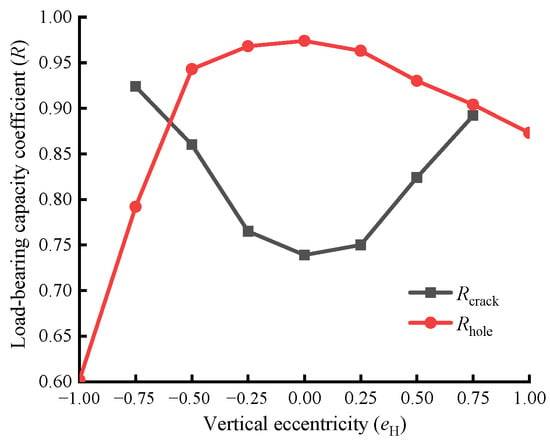
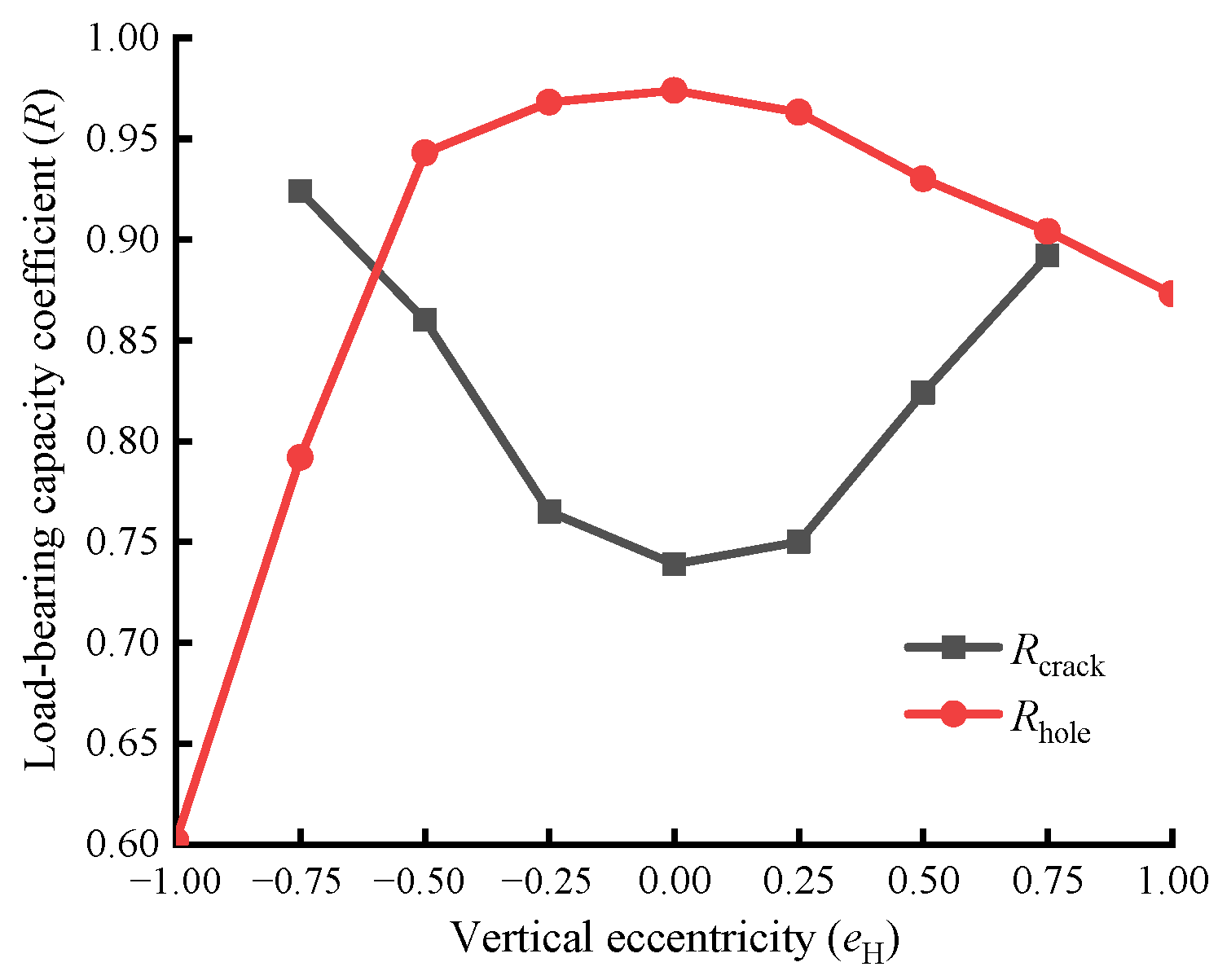
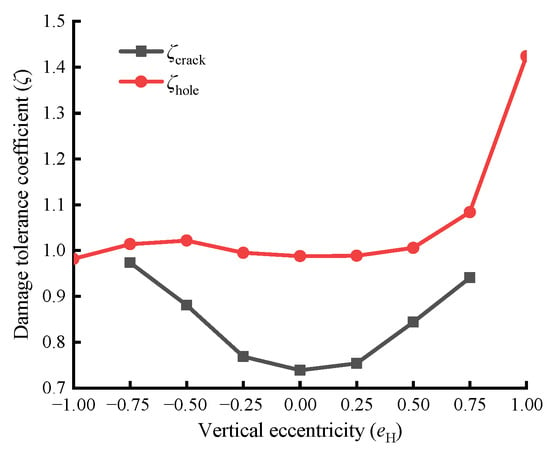
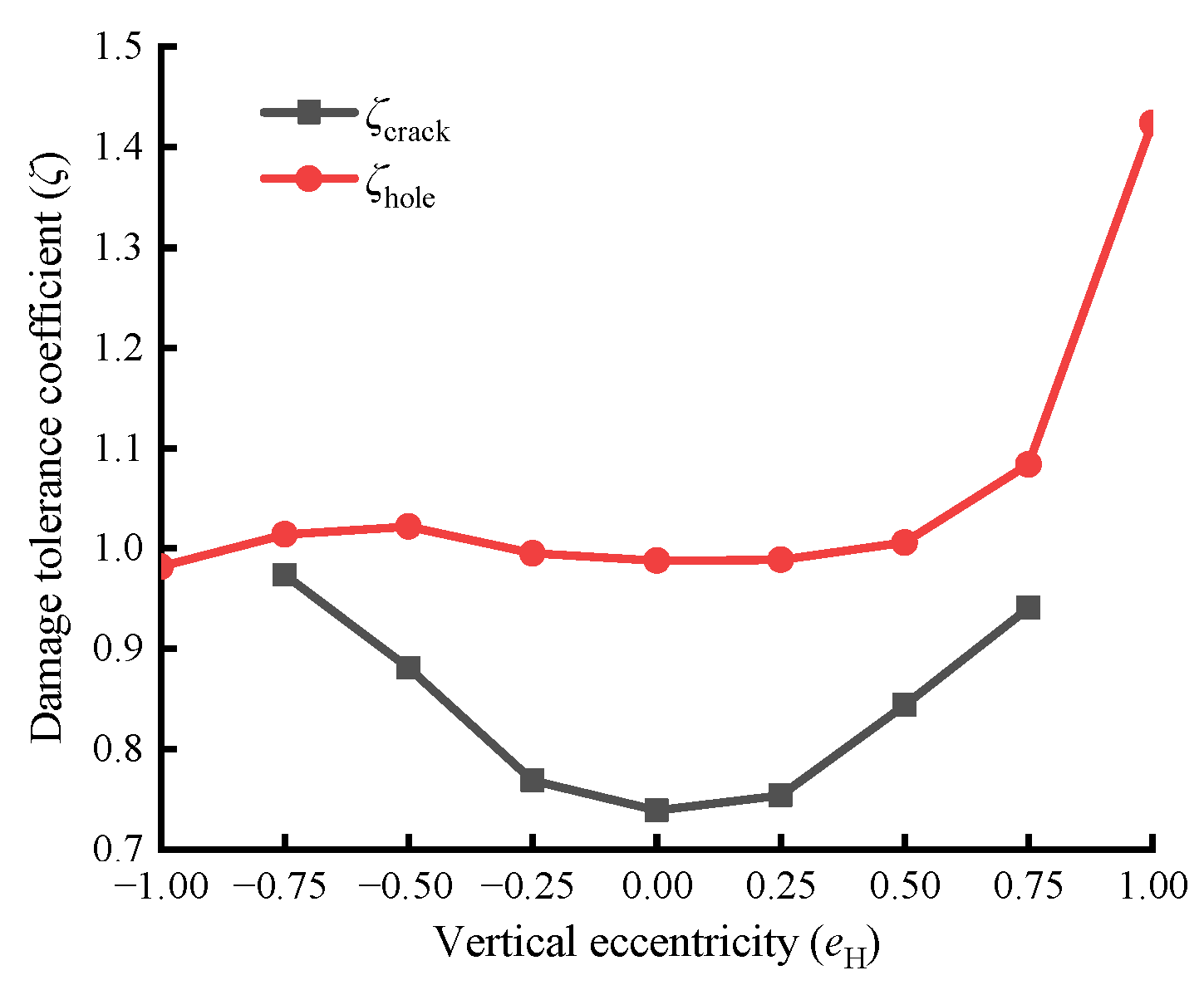
In order to visually compare and demonstrate the variation in the load-bearing capacity of longitudinal-crack specimens and circular-hole specimens with the vertical position of damage, the key coefficients were plotted as curves, with the load-bearing capacity coefficient curve shown in Figure 2 and the damage tolerance coefficient curve shown in Figure 3.
Figure 2.
Comparison of load-bearing capacity coefficient curves of longitudinal crack and circular hole specimens (related to vertical position).
Figure 3.
Comparison of damage tolerance capacity coefficient curves of longitudinal crack and circular hole specimens (related to vertical position).
Figure 2 shows that the load-bearing capacity coefficient of the wooden beam is lowest when the hole is at the bottom (eH = −1). As the hole rises from eH = −1 to −0.5, the coefficient increases almost linearly. Beyond eH = −0.5, the increase becomes more gradual until the peak is reached at the middle-height layer (eH = 0). Above the middle-height layer, the coefficient gradually declines as the hole moves upward. Notably, the coefficient at the top position (eH = 1) remains significantly higher than that at the bottom (eH = −1). This behavior can be explained by stress distribution. The bottom hole lies in the maximum tensile stress zone, where it severs tension-bearing wood fibers. In contrast, the top hole is located in the maximum compressive stress zone; although local crushing may occur, the material around the hole can still sustain compressive stress.
The trend for cracked beams is opposite to that observed for beams with circular holes: as the eH approaches ±1, the bearing capacity coefficient of the wooden beam increases, and as the eH approaches 0, the bearing capacity coefficient of the wooden beam decreases. This reversal can be explained by the crack’s effect on structural continuity: A crack bisects the beam into two separate regions (it practically transforms a beam with a section height h into two superimposed beams with a section height of h1 and h2, respectively, resulting in a decrease in the total section flexural modulus Wz). As the eH approaches ±1, the relationship between cross-sectional height of the two superimposed beams is lim(h1/h2) = ∞ or lim(h2/h1) = ∞, and in this case, the geometric characteristics of the wooden beam are very close to those of a crack-free wooden beam. On the other hand, a crack at the middle-height layer (eH = 0) transforms a beam with a section height h into two superimposed beams, each with a section height of h/2, resulting in a fourfold decrease in the section flexural modulus Wz, critically weakening its integrity and resulting in the lowest load-bearing capacity.
A crack located near the lower surface (eH = −0.75) yielded a load-bearing capacity coefficient about 3.6% higher than one near the upper surface (eH = 0.75). This is because the mechanical properties of wood are asymmetric in tension and compression, and the tensile strength of wood is much higher than its compressive strength. In addition, the wood layer immediately above a crack (when positioned near the upper face) experienced buckling, which caused it to lose its compressive capacity. Consequently, the beam’s overall strength was more significantly compromised. Conversely, for a crack near the lower surface, the corresponding wood layer below it did not buckle when subjected to tensile stress, which wood fibers are better at withstanding. The above material factors and geometric factors work together, leading to a comparatively smaller reduction in load-bearing capacity.
From the damage tolerance coefficient curve in Figure 3, it can be seen that the wooden beam has the lowest damage tolerance coefficient for longitudinal cracks at the middle-height layer (eH = 0), and the farther the crack is from the middle-height layer of the wooden beam, the higher the damage tolerance coefficient of the wooden beam to the crack. The damage tolerance coefficient of wooden beams to circular holes is relatively close in most vertical positions, and only when the hole is close to the top surface of the wooden beam, the damage tolerance coefficient of the wooden beam to the hole will significantly increase. It should be noted that the damage tolerance coefficient curve is a curve drawn after considering the weakening effect of defects on wooden beams. A higher damage tolerance coefficient demonstrates that “the defect is not as dangerous as people intuitively feel”.
3.3. The Relationship Between the Fracture Load and the Horizontal Position of Defects
Table 5 compares the fracture loads of specimens with a longitudinal crack located at different horizontal positions.
Table 5.
Comparison of experimental data of Pinus sylvestris var. mongolica specimens with a vertically centered longitudinal crack located at different horizontal positions.
To ensure comparability across different horizontal eccentricities and a measurable impact on load-bearing capacity, a crack with a length of l′ = L/3 located at the middle-height layer (eH = 0) of wooden beams was examined, and the effects of cracks at different horizontal positions (eL = 0, ±0.25, ±0.50, ±0.75, ±1) on the load-bearing capacity of wooden beams were investigated.
Table 6 shows the experimental data of specimens with a circular hole located at different horizontal positions. Holes with eH = −1 (highest tensile stress) and eH = 0 (highest shear stress) were selected for investigation, and the hole diameter was still adopted as φ = h/5. The influence of circular holes at different horizontal positions (eL = 0, ±0.25, ±0.50, ±0.75, ±1) on the bearing capacity of wooden beams was investigated.
Table 6.
Comparison of experimental data of Pinus sylvestris var. mongolica specimens with a circular hole located at different horizontal positions.
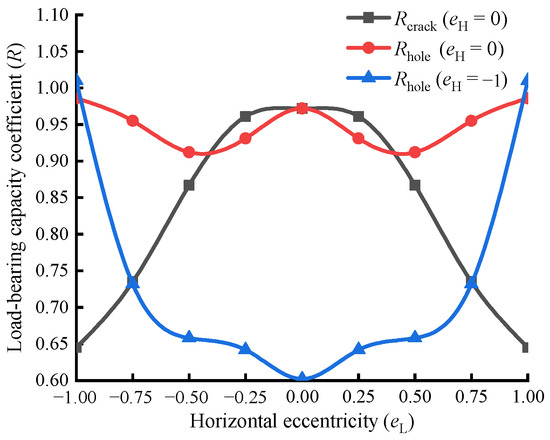
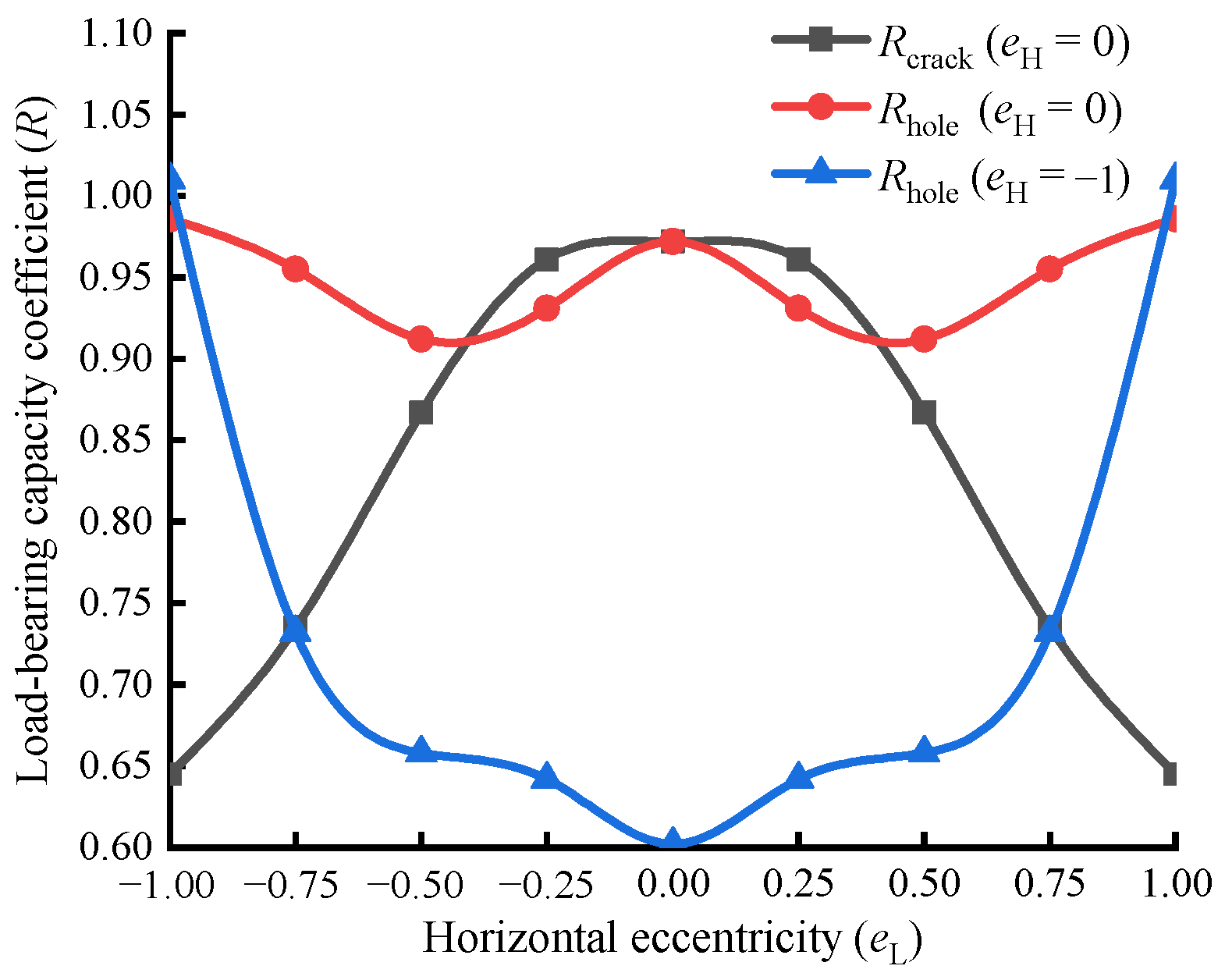
In order to visually compare and illustrate how the load-bearing capacity of defective specimens varies with the horizontal position of defects, key coefficients were plotted as curves. Figure 4 shows the load-bearing capacity coefficient curve, and it can be observed that when a longitudinal crack is located at the middle-height layer (eH = 0) of the beam, its load-bearing capacity coefficient decreases as the crack moves closer to either the left or right edge. This occurs because when the crack is near the horizontal center of the beam, it lies entirely within the pure bending region where shear stress is negligible. Additionally, since normal stress at the neutral layer is zero, there is no driving force for crack propagation, resulting in a relatively high load-bearing capacity coefficient. Conversely, when the crack approaches the left or right sides of the beam (e.g., eL < −0.5 or eL > 0.5), it enters the transverse bending region where shear stress is present. Under shear stress, the crack tends to propagate, thereby reducing the load-bearing capacity of the beam and leading to a decline in the load-bearing capacity coefficient.
Figure 4.
Comparison of load-bearing capacity coefficient curves of longitudinal crack and circular hole specimens (related to horizontal position).
The influence of circular holes located at the middle-height layer (eH = 0) of wooden beams on their load-bearing capacity is closely related to the position of the loading head: the closer the hole is to the loading head, the lower the load-bearing capacity coefficient of the wooden beam. When eL = ±0.5, the hole is located directly below the loading head, and the complex stress state caused by the loading head can easily induce the occurrence and propagation of cracks in the hole. The load-bearing capacity coefficient of the wooden beam is the lowest. In the center and left–right side positions of the wooden beam, the load-bearing capacity coefficient is relatively high. Especially on the left and right sides of the wooden beam (eL = ±1), the holes have completely entered the low stress zone, so it almost does not affect the load-bearing capacity of the wooden beam; The hole with eL = ±0.75 is located in the maximum shear stress range of the wooden beam, which may also lead to crack formation. Therefore, the hole here still has a weakening effect on the load-bearing capacity of the wooden beam.
The circular hole located on the bottom surface of wooden beams (eH = −1) shows a more severe decrease in the load-bearing capacity as it approaches the middle span position (eL = 0) of the beam. The closer it is to the left or right side of the wooden beam, the smaller the impact on its load-bearing capacity. However, when the hole reaches the left or right side of the wood beam (eL = ±1), it completely enters the low-stress region and has almost no effect on load-bearing capacity.
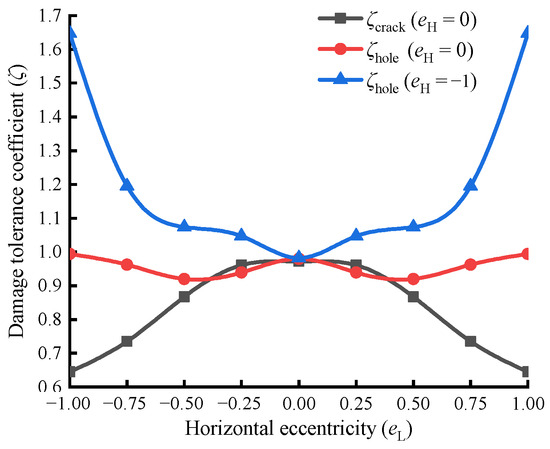
Figure 5 shows the relationship between the horizontal position of defects and the damage tolerance coefficient of the specimens. It can be seen that the more severe the horizontal deviation of the crack at the middle-height layer, the poorer the tolerance of the wooden beam to crack damage. The damage tolerance of wooden beams to holes in the middle-height layer also fluctuates with the position of the holes, but the overall change does not exceed 10%. The damage tolerance coefficient of the hole tangent to the lower surface (eH = −1) of wood beams changes more dramatically: the closer the hole is to the left and right sides of the wooden beam, the stronger the wooden beam’s ability to withstand damage. The damage tolerance coefficient of the holes on the left and right sides (eL = ±1) of the wooden beam can reach 1.7 times that of the holes in the middle (eL = 0). Furthermore, the center position of the wooden beam (eH = eL = 0) is a special location, and any defect located here has a damage tolerance coefficient of approximately 1.0 for the wooden beam.
Figure 5.
Comparison of damage tolerance capacity coefficient curves of longitudinal crack and circular hole specimens (related to horizontal position).
4. Discussion
4.1. The Influence Mechanism of Longitudinal Cracks and Circular Holes on the Bearing Capacity of Wooden Beams
By analyzing the morphology photos of the wooden beam fracture, it is possible to visually display the characteristics of the damage that causes the wooden beam fracture under different conditions. By further combining the simulation results of finite element analysis (FEA), the mechanism of related damage and failure phenomena can be elucidated. This study established FE models of Pinus sylvestris var. mongolica wooden beams under various damage and failure conditions and set the wood constitutive parameters with anisotropic material properties based on the elastic constant measurement data of Pinus sylvestris var. mongolica in the existing literature [24], as shown in Table 7. It can be seen that the mechanical properties of Pinus sylvestris var. mongolica along the fiber direction (L) are much higher than those in the radial direction (R) and tangential direction (T). This extremely strong anisotropy is an important reason for the special fracture mechanical properties of damaged wooden beams.
Table 7.
Elastic constant data of Pinus sylvestris var. mongolica used in the FE model.
When a crack with l′ = L/3 is located in the center position of the wooden beam (eH = eL = 0), the resulting decrease in the load-bearing capacity of the wooden beam is only 2.8%. In this case, the failure mode of the wooden beam is that the fibers under the crack experience tensile fracture. Once the crack deviates to a position where eL < −0.25 or eL > 0.25, the load-bearing capacity of the wooden beam significantly decreases. The failure mode is that the crack propagates and layers in the wooden beam, and then the phenomenon of wood fiber tensile fracture under the cracks occurs. This paper identifies this threshold phenomenon of horizontal crack position as the “critical eccentricity effect”.
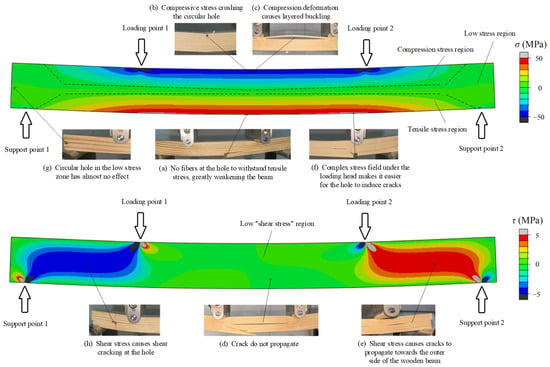
Through FE simulation, the stress field in wooden beams can be visualized. The normal stress distribution in the wooden beam is shown in the cloud map in the upper part of Figure 6, and the shear stress distribution is shown in the cloud map in the lower part of Figure 6. Comparing the maximum stress values of the two stress contour plots, it can be seen that the maximum normal stress in the wooden beam is about 10 times its maximum shear stress. However, due to the anisotropic nature of wood, normal stress causes the wood fibers to stretch or compress, while shear stress can easily lead to shear cracking between the wood fibers. Although shear stress is much smaller than normal stress, its danger is no less than that of normal stress.
Figure 6.
Normal and shear stress distribution on a wooden beam and the resulting forms of failure.
The crack with a length of L/3 and located in the horizontal center of the wooden beam (eL = 0) corresponds exactly to the green area (low stress zone) in the FE contour plot; if the crack is located at the horizontal deviation position (eL < −0.25 or eL > 0.25), its tip will enter the blue or red area (shear stress zone) in the FE contour plot.
The above analysis indicates that in order to evaluate the impact of defects in wooden beams on their load-bearing capacity, as well as the potential hazards they may bring, it is not only necessary to look at the size of the defect, but also to examine its location and conduct a comprehensive evaluation based on existing experimental results and FEA.
In Figure 6, each subfigure corresponding to (a)–(h) is a photograph of a representative specimen failure morphology selected during the experimental process. Each photo points to the corresponding area in the FE stress counter plot of the wooden beam through a black line with a small arrow, indicating that the stress in that area caused the structural failure, or that the structure would not fail in areas with very low stress.
4.2. The Effectiveness and Limitations of Experimental Methods
This study employed a strategy of using small-scale specimens with a large sample size (n = 1580). While this approach reduced experimental costs and operational complexity to some extent, it also introduced issues such as size effects and material inhomogeneity. As a natural anisotropic material, the mechanical properties of wood are significantly influenced by its microstructure (e.g., fiber orientation, distribution of earlywood and latewood), leading to a relatively high coefficient of variation in the bearing capacity of the test specimens (average CV around 15%). Although the experimental data were standardized by introducing correction factors for density and cross-sectional dimensions, the inherent randomness of the microstructure may still affect the generalizability of the results. Additionally, the study applied an assumption that the load-bearing capacity of wooden beams is proportional to their density to correct the experimental outcomes. While this represents a substantial improvement over applying no correction, it may not be the optimal approach. In the future, the authors will work to accumulate more experimental data and seek a deeper understanding of the relationship between wood density and strength, aiming to develop a more effective correction formula and achieve more precise experimental measurements. To mitigate interference from size effects, the research team will consider gradually reducing the sample size while increasing specimen dimensions, seeking an optimal specimen size that balances size effects and experimental costs. Although full-scale timber beam tests most closely replicate the working conditions of real engineering structures, conducting hundreds or thousands of such tests is impractical. From this perspective, experiments on small-scale specimens remain essential. Refining experimental methods and improving fracture theory may hold greater significance than simply increasing specimen size.
Another limitation of this study is that it did not directly interface with engineering standards, nor did it directly analyze cases from ancient wooden architecture. The contribution of this study is to offer a unified approach to analyzing crack- and hole-related issues, conduct experiments based on a large sample size, and provide references for engineers in designing large-scale specimen tests—thereby helping to avoid unnecessary material waste caused by ineffective defect parameters in such experiments. Furthermore, it is hoped that this research will offer conceptual insights for practitioners engaged in the restoration of historical buildings.
5. Conclusions
This study focuses on the load-bearing capacity as the core indicator, and through systematic experiments and theoretical analysis, reveals the damage tolerance characteristics and microscopic mechanism of Pinus sylvestris var. mongolica wooden beams with longitudinal cracks and circular holes. Through this study, it was found that wooden beams exhibit strong damage tolerance towards holes and cracks. In the absence of issues such as decay or design flaws, even the most severe crack or hole damage scenarios considered in this study are insufficient to directly jeopardize the safety of timber structures when such beams are used in construction.
The influence mechanism of holes and cracks on the load-bearing capacity of wooden beams is different. The impact of hole damage on the load-bearing capacity of wooden beams primarily depends on the stress state at its location, posing the greatest hazard when in the tension zone, as it directly severs the fibers. In contrast, the hazard of crack damage is mainly determined by whether it induces delamination propagation—when a crack near the neutral layer enters a high shear stress zone, the load-bearing capacity drops sharply. Below are some key influencing mechanisms of circular holes and longitudinal cracks.
In the vertical direction, the harm of longitudinal cracks reaches its maximum in the neutral layer (eH = 0), seriously weakening the integrity of the wooden beam; the closer the longitudinal crack is to the top and bottom surfaces of the wooden beam, the smaller its impact. On the contrary, circular holes cause the most severe loss of load-bearing capacity in the tensile zone at the bottom surface position of the beam (eH = −1), as they directly cut off the tensile fibers; when the hole moves to the top compression zone (eH = 1), the damage tolerance coefficient can reach 1.424 due to the ability of wood fibers to collapse and continue to bear, exhibiting strong damage tolerance characteristics.
In the horizontal direction, the influence of longitudinal cracks and circular holes on the load-bearing capacity of wooden beams has a common pattern, that is, they are both dominated by whether they are located in high stress zones. If the crack is located in the mid-span (pure bending and low-shear-stress section) of the wooden beam, its impact is weak. Once the crack enters the transverse bending (high-shear-stress) section of the wooden beam, it triggers a “critical eccentricity effect”, and the load-bearing capacity of the wooden beam sharply decreases. Similarly, the hole is most dangerous when it is located at the mid-span of the wooden beam and in the vicinity of the bottom surface (high tensile stress region) of the beam, and it is also dangerous near the loading point (complex stress region). In the low-stress region near the end of the wooden beam, the influence of the holes is significantly reduced. In summary, the harm of cracks mainly depends on whether they induce delamination propagation (controlled by shear stress), while the harm of holes is related to the tensile/compressive state of local fibers. However, the ultimate impact of both on load-bearing capacity fundamentally depends on their precise position in the stress field under specific loads.
The strong anisotropy and fiber structure of wood are the microscopic basis of its damage tolerance ability: defects in the tensile zone are significantly damaged by direct cutting of fibers; defects in the compression zone or low-stress region can obtain tolerance characteristics through stress redistribution and hole collapse. The FE contour plot further verified that the coupling mechanism between defect location and stress field is the key driving force for damage propagation and ultimate failure.
This paper represents an initial attempt to discuss the influence of cracks and holes on the load-bearing capacity of wooden beams within a unified framework. It is hoped that the findings of this study will serve as a practical reference for engineers involved in the design and maintenance of timber structures. By offering insights into effective defect parameter selection, this work aims to minimize unnecessary trial-and-error in full-scale specimen testing and thereby reduce material waste. Furthermore, it is intended to provide conceptual inspiration for all researchers investigating fracture behavior in wooden structural components.
Patents
The Chinese utility model patent “A Prefabricated Wooden Beam Crack Device” (patent number ZL202322195580.1) is closely related to the research work in this article.
Author Contributions
Conceptualization, X.H.; methodology, X.H. and L.Z.; software, D.L.; validation, X.H. and D.L.; formal analysis, X.H. and L.Z.; investigation, X.H. and Y.N.; resources, X.H. and Y.N.; data curation, X.H. and L.L.; writing—original draft preparation, X.H.; writing—review and editing, X.H. and D.L.; visualization, X.H.; supervision, X.H.; project administration, X.H.; funding acquisition, X.H., D.L. and Y.N. All authors have read and agreed to the published version of the manuscript.
Funding
This research was funded by the National Natural Science Foundation of China, grant number 32171700.
Data Availability Statement
The original contributions presented in this study are included in the article. Further inquiries can be directed to the corresponding author.
Acknowledgments
The authors gratefully acknowledge the support from the National Natural Science Foundation of China, Grant No. 32171700.The corresponding author would like to express special thanks to his wife for her support in the work of the paper.
Conflicts of Interest
The funders had no role in the design of the study; in the collection, analyses, or interpretation of data; in the writing of the manuscript; or in the decision to publish the results.
Abbreviations
The following abbreviations are used in this manuscript:
| CV | Coefficient of variation |
| FE | Finite element |
| FEA | Finite element analysis |
| XFEM | Extended finite element method |
References
- Zhou, J.; Tian, Q.; Nie, J.L.; Cao, P.; Tan, Z.F. Mechanical properties and damage mechanisms of woods under extreme environmental conditions. Case Stud. Constr. Mater. 2024, 20, e03146. [Google Scholar] [CrossRef] [Scilit]
- Hu, X.Y.; Liu, Z.L.; Zhuang, Z. XFEM study of crack propagation in logs after growth stress relaxation and drying stress accumulation. Wood Sci. Technol. 2017, 51, 1447–1468. [Google Scholar] [CrossRef] [Scilit]
- Xu, N.; Li, M.; Fang, S.Y.; Huang, C.L.; Chen, C.; Zhao, Y.; Mao, F.L.; Deng, T.T.; Wang, Y. Research on the detection of the hole in wood based on acoustic emission frequency sweeping. Constr. Build. Mater. 2023, 400, 132761. [Google Scholar] [CrossRef] [Scilit]
- Chi, X.; Tang, S.; Song, X.; Ren, Z.C.; Han, G.P.; Cheng, W.L.; Avramidis, S. Visible dynamic changes in the mechanism of water evaporation surface formation during wood drying. Wood Sci. Technol. 2023, 57, 1061–1076. [Google Scholar] [CrossRef] [Scilit]
- Majka, J.; Sydor, M. Analysis of stress development during kiln drying of beech timber. Eur. J. Wood Wood Prod. 2023, 81, 1189–1200. [Google Scholar] [CrossRef] [Scilit]
- Jospeh, G.; Delphine, J.; Sandrine, B.; Hiroyuki, Y. Tree growth stress and related problems. J. Wood Sci. 2017, 63, 411–432. [Google Scholar] [CrossRef] [Scilit]
- Karkoodi, S.; Karampour, H.; Gilbert, B.P.; Gunalan, S. A study on enhanced mechanical properties of wood in the parallel-to-grain direction in timber-filled-steel tubular columns. Eng. Struct. 2025, 331, 119973. [Google Scholar] [CrossRef] [Scilit]
- Liu, Y.; Moran, B. Tearing a neo-Hookean sheet. Part II: Asymptotic analysis for crack tip fields. Int. J. Fract. 2023, 240, 93–117. [Google Scholar] [CrossRef] [Scilit]
- Goyat, V.; Verma, S.; Garg, R.K. Reduction in stress concentration around a pair of circularholes with functionally graded material layer. Acta Mech. Sin. 2018, 129, 1045–1060. [Google Scholar] [CrossRef] [Scilit]
- Bai, X.C.; Yang, X.J.; Tan, Y.J.; Liu, J.M.; Wang, C.J. Flexural bearing capacity of crack damaged solid wood beams. Chin. J. For. Eng. 2023, 8, 46–51. [Google Scholar] [CrossRef]
- Zhang, B.Z.; Xie, Q.F.; Xue, J.Y. Study on the flexural behavior evolution of timber beams with natural shrinkage cracks in historic timber structure. Structures 2025, 73, 108429. [Google Scholar] [CrossRef] [Scilit]
- Halicka, A.; Ślósarz, S. Analysis of behavior and failure modes of timber beams prestressed with CFRP strips. Comp. Struct. 2022, 301, 116171. [Google Scholar] [CrossRef] [Scilit]
- Romanowicz, M.; Grygorczuk, M. The effect of crack orientation on the mode I fracture resistance of pinewood. Int. J. Fract. 2024, 248, 27–48. [Google Scholar] [CrossRef] [Scilit]
- Qiu, L.P.; Zhu, E.C.; Kuilen, J.W.G. Modeling crack propagation in wood by extended finite element method. Eur. J. Wood Prod. 2014, 72, 273–283. [Google Scholar] [CrossRef] [Scilit]
- Wen, Y.X.; Yang, Y.; Zhao, J.; Zhao, D. Theoretical and experimental considerations on the neutral axis of wood beams with a hole in different locations. Holzforschung 2018, 72, 769–777. [Google Scholar] [CrossRef] [Scilit]
- Okamoto, S.; Akiyama, N.; Araki, Y.; Aoki, K.; Inayama, M. Study on the strength of glued laminated timber beams with circular holes: Difference in structural performance between homogeneous-grade and heterogeneous-grade timber. J. Wood Sci. 2021, 67, 8. [Google Scholar] [CrossRef] [Scilit]
- Parracha, J.L.; Pereira, M.F.C.; Mauricío, A.; Machado, J.S.; Faria, P.; Nunes, L. A semi-destructive assessment method to estimate the residual strength of maritime pine structural elements degraded by anobiids. Mater. Struct. 2019, 52, 54. [Google Scholar] [CrossRef] [Scilit]
- Danielsson, H.; Gustafsson, P.J. A probabilistic fracture mechanics method and strength analysis of glulam beams with holes. Eur. J. Wood Wood Prod. 2011, 69, 407–419. [Google Scholar] [CrossRef] [Scilit]
- Cheng, J.Q.; Yang, J.J.; Liu, P. Characteristics and Utilization of Wood. In Chronicle of Chinese Timber, 1st ed.; China Forestry Publishing House: Beijing, China, 1992; pp. 67–694. [Google Scholar]
- Li, Z.; Tao, X.; Zhao, Z.C.; Sun, H.Y.; Lei, Z. Mechanical properties and crack propagation for camphor pine during compression process. Forg. Stamp. Technol. 2024, 49, 87–93. [Google Scholar] [CrossRef]
- Xiong, L.M.; Xing, X.F.; Lin, L.Y.; Zhou, Y.D.; Fu, F. Effects of high-field-intensity microwave treatment on macroscopic cracks in mongolian scotch pine. China Wood Ind. 2020, 34, 1–4. [Google Scholar] [CrossRef]
- Toivanen, M.; Pajunen, S.; Ilgın, H.E. Effect of cracks on the load-carrying capacity of glulam. Wood Mater. Sci. Eng. 2025, 20, 1–8. [Google Scholar] [CrossRef] [Scilit]
- Davis, P.M.; Gupta, R.; Sinha, A. Revisiting the neutral axis in wood beams. Holzforschung 2012, 66, 497–503. [Google Scholar] [CrossRef] [Scilit]
- He, S. Study of Finite Element Modeling Analysis for Pinus Sylvestris L. var. mongolicaLitv. Finger-Jointed Lumber. Master’s Thesis, Nanjing Forestry University, Nanjing, China, 2011. [Google Scholar]

Disclaimer/Publisher’s Note: The statements, opinions and data contained in all publications are solely those of the individual author(s) and contributor(s) and not of MDPI and/or the editor(s). MDPI and/or the editor(s) disclaim responsibility for any injury to people or property resulting from any ideas, methods, instructions or products referred to in the content. |
© 2026 by the authors. Licensee MDPI, Basel, Switzerland. This article is an open access article distributed under the terms and conditions of the Creative Commons Attribution (CC BY) license.