Development and Comparison of Allometric Equations for Estimating Carbon Storage of Two Hibiscus syriacus Cultivars with Different Growth Forms in Urban Areas of Republic of Korea
 , , , , , , , , , , and
Abstract
1. Introduction
2. Materials and Methods
2.1. Study Site and Materials
2.2. Biomass and Carbon Content Analysis
2.3. Statistical Analysis
3. Results
3.1. Biomass Allocation and Carbon Content
3.2. Variable Selection and Allometric Equation Development
3.3. Comparison of Root-Shoot Ratio Between Cultivars by Growth Environment
4. Discussion
5. Conclusions
6. Recommendations
Author Contributions
Funding
Data Availability Statement
Conflicts of Interest
Abbreviations
| AIC | Akaike information criterion |
| BIC | Bayesian information criterion |
| CF | Carbon fraction |
| CS | Carbon storage |
| CW | Crown Width |
| H | Height |
| R | Root-shoot ratio |
| LAR | Least Absolute Residuals |
| RCD | Root collar diameter |
| RMSE | Root Mean Square Error |
| RR | Robust Regression |
Appendix A


| Cultivar | Classification | Breeding Method | Organization | Release |
|---|---|---|---|---|
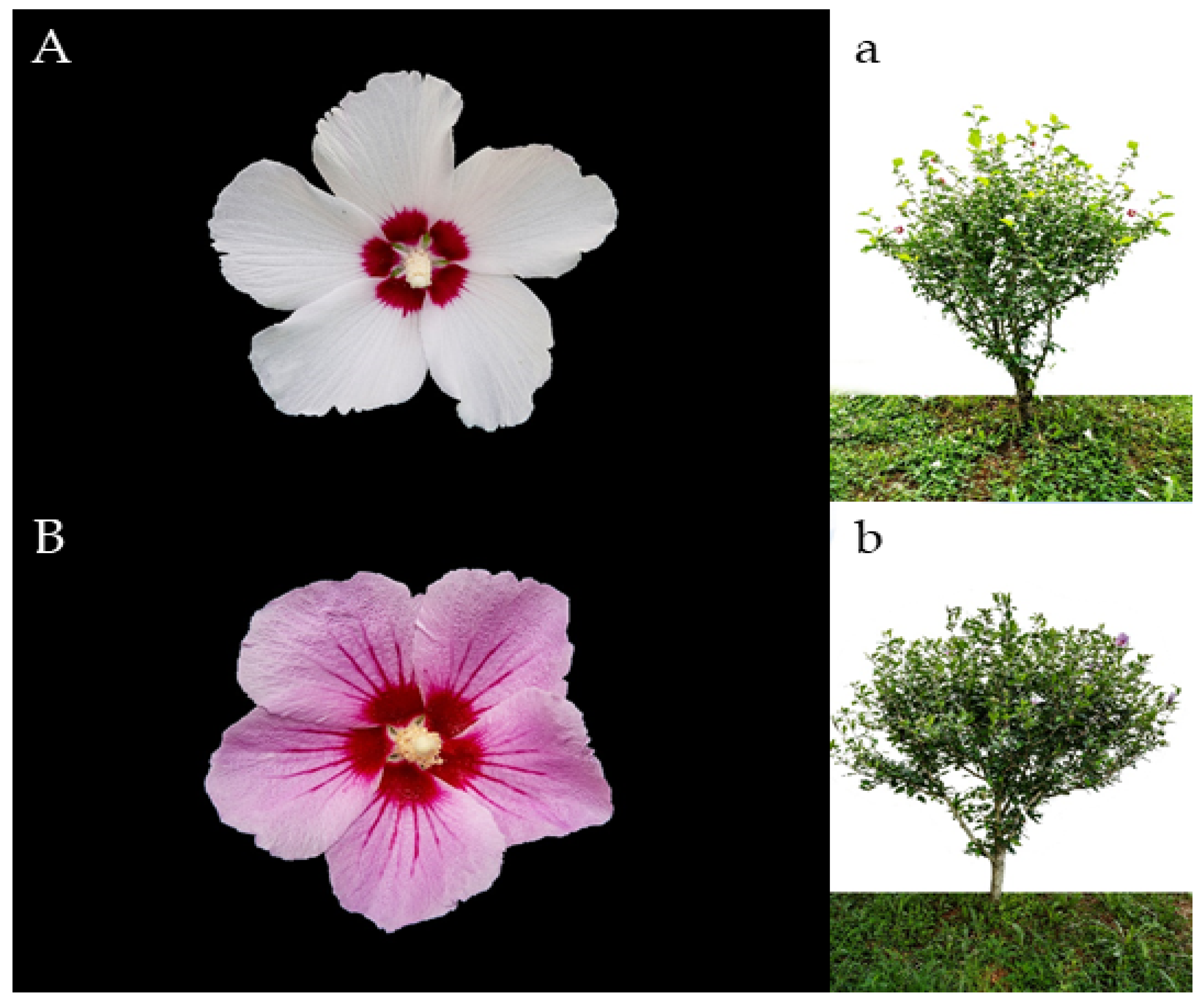
| ‘Wonhwa’ | White with red-eye zone | Artificial selection | National Institute of Forest Science (Republic of Korea) | 1990. |
| ‘Chilbo’ | Pink with red-eye zone | Artificial selection | National Institute of Forest Science (Republic of Korea) | 1990. |
| Cultivar | Shape | Shape Index | Annual Shoot Growth (cm) | Leaf Shape | Number of Leaves per Branch | Leaf Blade | |
|---|---|---|---|---|---|---|---|
| Length (cm) | Width (cm) | ||||||
| ‘Wonhwa’ | Semi-erect | 60~63 | 58.9 | Broadly ovate | 14.7 | 5.3~6.8 | 3.8~5.0 |
| ‘Chilbo’ | Spreading | 65~66 | 42.1 | Lanceolate | 7.7 | 5.9~6.5 | 2.6~4.1 |
| Cultivar | Flower Type | Flower Diamter (cm) | Flowering Period | Duration of Flowering (Day) | Number of Flowers per Node (Inflorescence) |
|---|---|---|---|---|---|
| ‘Wonhwa’ | Single flower | 8–12 | Late June–Early October | 89–103 | 2.6–3.8 |
| ‘Chilbo’ | Single flower | 8–9 | Early July–Mid-September | 79–108 | 1.4–3.8 |
References
- Nowak, D.J.; Crane, D.E. Carbon Storage and Sequestration by Urban Trees in the USA. Environ. Pollut. 2002, 116, 381–389. [Google Scholar] [CrossRef] [PubMed]
- Jo, H.-K.; Ahn, T.-W. Carbon Storage and Uptake by Deciduous Tree Species for Urban Landscape. J. Korean Inst. Landsc. Archit. 2012, 40, 160–168. [Google Scholar] [CrossRef]
- IPCC. 2019 Refinement to the 2006 IPCC Guidelines for National Greenhouse Gas Inventories; Calvo Buendia, E., Tanabe, K., Kranjc, A., Baasansuren, J., Fukuda, M., Ngarize, S., Osako, A., Pyrozhenko, Y., Shermanau, P., Federici, S., Eds.; IPCC: Geneva, Switzerland, 2019. [Google Scholar]
- Liu, C.; Li, X. Carbon Storage and Sequestration by Urban Forests in Shenyang, China. Urban For. Urban Green. 2012, 11, 121–128. [Google Scholar] [CrossRef]
- Choi, J.; Kim, G. History of Seoul’s Parks and Green Space Policies: Focusing on Policy Changes in Urban Development. Land 2022, 11, 474. [Google Scholar] [CrossRef]
- Timilsina, N.; Escobedo, F.J.; Staudhammer, C.L.; Brandeis, T. Analyzing the Causal Factors of Carbon Stores in a Subtropical Urban Forest. Ecol. Complex. 2014, 20, 23–32. [Google Scholar] [CrossRef]
- Kim, H.; Baek, G.; Choi, B.; Lee, J.; Lee, J.; Son, Y.; Kim, C. Allometric Equations for Estimating the Carbon Storage of Maple Trees in an Urban Settlement Area. J. Korean Soc. For. Sci. 2023, 112, 32–39. [Google Scholar] [CrossRef]
- Parhizgar, L.; Pattnaik, N.; Yazdi, H.; Qiguan, S.; Pauleit, S.; Rahman, M.A.; Ludwig, F.; Pretzsch, H.; Rötzer, T. Branch Biomass Allometries for Urban Tree Species Based on Terrestrial Laser Scanning (TLS) Data. Trees 2025, 39, 57. [Google Scholar] [CrossRef]
- Ha, J.; Baek, G.; Choi, B.; Lee, J.; Son, Y.; Kim, C. Development of Allometric Equations for Carbon Storage of Ginkgo Biloba Linn., Zelkova Serrata (Thunb.) Makino. and Prunus × Yedoense Matsum. Planted in Jinju-City. J. Clim. Chang. Res. 2022, 13, 135–145. [Google Scholar] [CrossRef]
- Yoon, T.K.; Park, C.-W.; Lee, S.J.; Ko, S.; Kim, K.N.; Son, Y.; Lee, K.H.; Oh, S.; Lee, W.-K.; Son, Y. Allometric Equations for Estimating the Aboveground Volume of Five Common Urban Street Tree Species in Daegu, Korea. Urban For. Urban Green. 2013, 12, 344–349. [Google Scholar] [CrossRef]
- McPherson, E.G.; Van Doorn, N.; De Goede, J. Structure, Function and Value of Street Trees in California, USA. Urban For. Urban Green. 2016, 17, 104–115. [Google Scholar] [CrossRef]
- Song, X.P.; Lai, H.R.; Wijedasa, L.S.; Tan, P.Y.; Edwards, P.J.; Richards, D.R. Height–Diameter Allometry for the Management of City Trees in the Tropics. Environ. Res. Lett. 2020, 15, 114017. [Google Scholar] [CrossRef]
- Hitchcock, H.C.; McDonnell, J.P. Biomass Measurement: A Synthesis of the Literature. In Tennessee Valley Authority, Proceedings of the IUFRO Workshop on Forest Resource Inventories, Vernon, BC, Canada, 22–27 July 1979; Tennessee Valley Authority: Norris, TN, USA, 1979; pp. 544–595. [Google Scholar]
- Peper, P.; McPherson, E.G.; Mori, S. Equations for Predicting Diameter, Height, Crown Width, and Leaf Area of San Joaquin Valley Street Trees. Arboric. Urban For. 2001, 27, 306–317. [Google Scholar] [CrossRef]
- Lee, J.-M.; Kim, H.-S.; Choi, B.; Jung, J.-Y.; Lee, S.; Jo, H.; Kim, G.; Kwon, S.; Lee, S.-J.; Yoon, T.K.; et al. Enhanced Accuracy in Urban Tree Biomass Estimation: Developing Allometric Equations with Land Use Classifications. Forests 2025, 16, 841. [Google Scholar] [CrossRef]
- Dobbs, C.; Escobedo, F.J.; Zipperer, W.C. A Framework for Developing Urban Forest Ecosystem Services and Goods Indicators. Landsc. Urban Plan. 2011, 99, 196–206. [Google Scholar] [CrossRef]
- Ngo, K.M.; Lum, S. Aboveground Biomass Estimation of Tropical Street Trees. J. Urban Ecol. 2018, 4, jux020. [Google Scholar] [CrossRef]
- McHale, M.R.; Burke, I.C.; Lefsky, M.A.; Peper, P.J.; McPherson, E.G. Urban Forest Biomass Estimates: Is It Important to Use Allometric Relationships Developed Specifically for Urban Trees? Urban Ecosyst. 2009, 12, 95–113. [Google Scholar] [CrossRef]
- Ampoorter, E.; De Frenne, P.; Hermy, M.; Verheyen, K. Effects of Soil Compaction on Growth and Survival of Tree Saplings: A Meta-Analysis. Basic Appl. Ecol. 2011, 12, 394–402. [Google Scholar] [CrossRef]
- Speak, A.F.; Salbitano, F. The Impact of Pruning and Mortality on Urban Tree Canopy Volume. Urban For. Urban Green. 2023, 79, 127810. [Google Scholar] [CrossRef]
- Comin, S.; Fini, A.; Napoli, M.; Frangi, P.; Vigevani, I.; Corsini, D.; Ferrini, F. Effects of Severe Pruning on the Microclimate Amelioration Capacity and on the Physiology of Two Urban Tree Species. Urban For. Urban Green. 2025, 103, 128583. [Google Scholar] [CrossRef]
- Pretzsch, H.; Biber, P.; Uhl, E.; Dahlhausen, J.; Rötzer, T.; Caldentey, J.; Koike, T.; Van Con, T.; Chavanne, A.; Seifert, T.; et al. Crown Size and Growing Space Requirement of Common Tree Species in Urban Centres, Parks, and Forests. Urban For. Urban Green. 2015, 14, 466–479. [Google Scholar] [CrossRef]
- Poorter, H.; Niklas, K.J.; Reich, P.B.; Oleksyn, J.; Poot, P.; Mommer, L. Biomass Allocation to Leaves, Stems and Roots: Meta-analyses of Interspecific Variation and Environmental Control. New Phytol. 2012, 193, 30–50. [Google Scholar] [CrossRef] [PubMed]
- Ali, J.; Haoran, W.; Mehmood, K.; Muhammad, B.; Hussain, W.; Hussain, K.; Shahzad, F.; Qun, Y.; Zhongkui, J. Evaluating Biomass and Carbon Stock Responses to Thinning and Pruning in Mature Larix Principis-Rupprechtii Mayr Stands: A Case Study from Northern China. Front. For. Glob. Chang. 2025, 8, 1592009. [Google Scholar] [CrossRef]
- McPherson, E.G.; Van Doorn, N.S.; Peper, P.J. Urban Tree Database and Allometric Equations; General Technical Report PSW-GTR-253; U.S. Department of Agriculture, Forest Service, Pacific Southwest Research Station: Albany, CA, USA, 2016. [Google Scholar]
- Moser, A.; Rötzer, T.; Pauleit, S.; Pretzsch, H. Structure and Ecosystem Services of Small-Leaved Lime (Tilia Cordata Mill.) and Black Locust (Robinia Pseudoacacia L.) in Urban Environments. Urban For. Urban Green. 2015, 14, 1110–1121. [Google Scholar] [CrossRef]
- Reich, P.B. The World-wide ‘Fast–Slow’ Plant Economics Spectrum: A Traits Manifesto. J. Ecol. 2014, 102, 275–301. [Google Scholar] [CrossRef]
- Yang, J.; Ma, C.; Zhou, L.; Gui, Q.; Gong, M.; Yang, H.; Liu, J.; Chai, Y.; Sun, Y.; Wu, X. Intraspecific Variation and Environmental Determinants of Leaf Functional Traits in Polyspora Chrysandra Across Yunnan, China. Plants 2025, 14, 2953. [Google Scholar] [CrossRef] [PubMed]
- Sjöman, H.; Watkins, H.; Kelly, L.J.; Hirons, A.; Kainulainen, K.; Martin, K.W.E.; Antonelli, A. Resilient Trees for Urban Environments: The Importance of Intraspecific Variation. Plants People Planet 2024, 6, 1180–1189. [Google Scholar] [CrossRef]
- Westerband, A.C.; Funk, J.L.; Barton, K.E. Intraspecific Trait Variation in Plants: A Renewed Focus on Its Role in Ecological Processes. Ann. Bot. 2021, 127, 397–410. [Google Scholar] [CrossRef]
- Laureysens, I.; Bogaert, J.; Blust, R.; Ceulemans, R. Biomass Production of 17 Poplar Clones in a Short-Rotation Coppice Culture on a Waste Disposal Site and Its Relation to Soil Characteristics. For. Ecol. Manag. 2004, 187, 295–309. [Google Scholar] [CrossRef]
- Horváthová, E.; Badura, T.; Duchková, H. The Value of the Shading Function of Urban Trees: A Replacement Cost Approach. Urban For. Urban Green. 2021, 62, 127166. [Google Scholar] [CrossRef]
- Shin, H.; Kwon, S.-H.; Park, Y.; Choi, Y.-I.; Kwon, H.-Y. ‘Huiwon’: A Cultivar of Rose of Sharon (Hibiscus syriacus L.) with Plate-Shaped Flowers for Pot Cultivation. Korean J. Breed. Sci. 2024, 56, 73–77. [Google Scholar] [CrossRef]
- Moon, Y.; Shin, H. ‘Laon’: A Rose of Sharon (Hibiscus syriacus L.) Cultivar with a Large and Distinct Eye Zone Developed for Pot Cultivation. Flower Res. J. 2025, 33, 53–58. [Google Scholar] [CrossRef]
- Korea Forest Research Institute (KFRI). Characteristics of Hibiscus Syriacus Cultivars; KFRI: Seoul, Republic of Korea, 2014. [Google Scholar]
- Sharafatmandrad, M.; Khosravi Mashizi, A. Plant Species Selection for Urban Green Spaces in Arid Lands: A New Approach Using Ecosystem Services and Disservices. Landsc. Ecol. Eng. 2025, 21, 47–64. [Google Scholar] [CrossRef]
- Priya, U.K.; Senthil, R. Framework for Enhancing Urban Living Through Sustainable Plant Selection in Residential Green Spaces. Urban Sci. 2024, 8, 235. [Google Scholar] [CrossRef]
- Chen, W.Y.; Jim, C.Y. Assessment and Valuation of the Ecosystem Services Provided by Urban Forests. In Ecology, Planning, and Management of Urban Forests; Carreiro, M.M., Song, Y.-C., Wu, J., Eds.; Springer: New York, NY, USA, 2008; pp. 53–83. ISBN 978-0-387-71424-0. [Google Scholar]
- Chen, J.; Fang, X.; Wu, A.; Xiang, W.; Lei, P.; Ouyang, S. Allometric Equations for Estimating Biomass of Natural Shrubs and Young Trees of Subtropical Forests. New For. 2024, 55, 15–46. [Google Scholar] [CrossRef]
- Jucker, T.; Bouriaud, O.; Coomes, D.A. Crown Plasticity Enables Trees to Optimize Canopy Packing in Mixed-species Forests. Funct. Ecol. 2015, 29, 1078–1086. [Google Scholar] [CrossRef]
- Conti, G.; Enrico, L.; Casanoves, F.; Díaz, S. Shrub Biomass Estimation in the Semiarid Chaco Forest: A Contribution to the Quantification of an Underrated Carbon Stock. Ann. For. Sci. 2013, 70, 515–524. [Google Scholar] [CrossRef]
- Picard, N.; Saint-André, L.; Henry, M. Manual for Building Tree Volume and Biomass Allometric Equations: From Field Measurement to Prediction; Food and Agriculture Organization of the United Nations (FAO): Rome, Italy, 2012. [Google Scholar]
- Thomas, S.C.; Martin, A.R. Carbon Content of Tree Tissues: A Synthesis. Forests 2012, 3, 332–352. [Google Scholar] [CrossRef]
- Jo, I.; Lee, S.; Oh, S. Improved Measures of Redundancy and Relevance for mRMR Feature Selection. Computers 2019, 8, 42. [Google Scholar] [CrossRef]
- Nguyen, N.A.; Trong, N.L.; Cong, D.B.; Nguyen, P.N. MRMR Feature Selection Algorithm for Microgrid Frequency Stability Classification. Eng. Technol. Appl. Sci. Res. 2025, 15, 23422–23429. [Google Scholar] [CrossRef]
- Peng, H.; Long, F.; Ding, C. Feature Selection Based on Mutual Information Criteria of Max-Dependency, Max-Relevance, and Min-Redundancy. IEEE Trans. Pattern Anal. Mach. Intell. 2005, 27, 1226–1238. [Google Scholar] [CrossRef]
- Burnham, K.P.; Anderson, D.R. Model Selection and Multimodel Inference: A Practical Information-Theoretic Approach; Springer Science & Business Media: New York, NY, USA, 2003; ISBN 978-0-387-95364-9. [Google Scholar]
- Wang, F.; Yang, Y.; Wang, J.; Liu, Y.; Wang, H.; Song, Y.; Lu, Z.; Yang, Y. Biomass Allocation and Allometry in Juglans Mandshurica Seedlings from Different Geographical Provenances in China. Forests 2024, 15, 1434. [Google Scholar] [CrossRef]
- Kim, H.-K. Estimation of Carbon Storage Through the Development of Carbon Emission Factorsfor Major Shrubs in Neighborhood Green Space. Ph.D. Thesis, Chungbuk National University, Cheongju, Republic of Korea, 2025. [Google Scholar]
- Annighöfer, P.; Ameztegui, A.; Ammer, C.; Balandier, P.; Bartsch, N.; Bolte, A.; Coll, L.; Collet, C.; Ewald, J.; Frischbier, N.; et al. Species-Specific and Generic Biomass Equations for Seedlings and Saplings of European Tree Species. Eur. J. For. Res. 2016, 135, 313–329. [Google Scholar] [CrossRef]
- Hintural, W.P.; Jeon, H.J.; Kim, S.Y.; Go, S.; Park, B.B. Quantifying Regulating Ecosystem Services of Urban Trees: A Case Study of a Green Space at Chungnam National University Using i-Tree Eco. Forests 2024, 15, 1446. [Google Scholar] [CrossRef]
- Weiner, J. Allocation, Plasticity and Allometry in Plants. Perspect. Plant Ecol. Evol. Syst. 2004, 6, 207–215. [Google Scholar] [CrossRef]
- Huang, R.; Zhu, W.; Du, A.; Xu, Y.; Wang, Z. Stand Age Affects Biomass Allocation and Allometric Models for Biomass Estimation: A Case Study of Two Eucalypts Hybrids. Forests 2025, 16, 193. [Google Scholar] [CrossRef]
- Day, S.; Wiseman, P.E.; Dickinson, S.; Harris, J.R. Contemporary Concepts of Root System Architecture of Urban Trees. Arboric. Urban For. 2010, 36, 149–159. [Google Scholar] [CrossRef]


| Cultivar | Age of the Plant | Planting Site | Planting Area | Planting Material | Planting Date | Cultivation System | Pruning |
|---|---|---|---|---|---|---|---|
| ‘Wonhwa’ | 3–9 | Sejong | Pot-grown | Rooted cutting | 2017–2023 | Container a (Potting mix) | No |
| 10–13 | Suwon | 0.3 ha | Rooted cutting | 2015 | Open field (Sandy loam) | No | |
| ‘Chilbo’ | 3–9 | Sejong | Pot-grown | Rooted cutting | 2017–2023 | Container (Potting mix) | No |
| 10–13 | Suwon | 0.3 ha | Rooted cutting | 2015 | Open field (Sandy loam) | No |
| Cultivar (y) | R a (cm) | H b (cm) | CW c (cm) | RL d (cm) | RW e (cm) | LA f (cm2) |
|---|---|---|---|---|---|---|
| ‘Wonhwa’ (3–13) | 3.1 ± 2.3 g | 155.5 ± 69.0 | 59.0 ± 48.6 | 16.9 ± 7.0 | 27.3 ± 19.6 | 9.5 ± 2.4 |
| 0.6–7.5 | 49.5–338.2 | 6.2–182.0 | 8.8–37.7 | 6.6–97.5 | 4.0–15.1 | |
| ‘Chilbo’ (3–13) | 3.9 ± 2.5 | 166.1 ± 46.6 | 73.2 ± 47.8 | 22.3 ± 7.2 | 35.4 ± 19.4 | 7.8 ± 1.9 |
| 0.6–9.0 | 62.5–238.7 | 8.5–170.5 | 6.8–40.0 | 3.5–97.0 | 2.3–13.6 | |
| Total (3–13) | 3.5 ± 2.4 | 161.0 ± 58.7 | 66.4 ± 48.7 | 19.7 ± 7.6 | 31.5 ± 19.9 | 8.6 ± 2.3 |
| 0.6–9.0 | 49.5–338.2 | 6.2–182.0 | 6.8–40.0 | 3.5–97.5 | 2.3–15.1 |
| Species (y) | Biomass Allocation Ratio | Reference | ||||
|---|---|---|---|---|---|---|
| Leaf & Twig | Branch | Stem | Root | |||
| Acer palmatum, Zelkova serrata, Prunus yedoensis (8–23) | 4–7% | 21–26% | 41–44% | 26–30% | Jo and Ahn (2012) [2] | |
| Ginkgo biloba (11–27) | 8% | 16% | 36% | 40% | ||
| A. palmatum (13–26) | 4% | 17% | 38% | 41% | Kim et al. (2023) [7] | |
| G.biloba (11–45) | 4% | 21% | 47% | 28% | Ha et al. (2022) [9] | |
| Z. serrata (12–27) | 4% | 32% | 35% | 29% | ||
| Prunus × yedoense (6–26) | 6% | 30% | 37% | 27% | ||
| Shrub a (3–11) | 16% | 26% | 31% | 26% | Kim (2025) [49] | |
| ‘Wonhwa’ (3–13) | Younger pot-grown (3–9) | 13% | 39% | 20% | 28% | - |
| Older field-grown (10–13) | 6% | 54% | 25% | 15% | ||
| Overall | 8% | 51% | 25% | 16% | ||
| ‘Chilbo’ (3–13) | Younger pot-grown (3–9) | 12% | 35% | 22% | 31% | |
| Older field-grown (10–13) | 6% | 52% | 24% | 18% | ||
| Overall | 5% | 50% | 26% | 19% | ||
| Total (3–13) | Younger pot-grown (3–9) | 12% | 37% | 21% | 30% | |
| Older field-grown (10–13) | 6% | 53% | 25% | 16% | ||
| Overall | 6% | 50% | 26% | 18% | ||
| Cultivar (n) | Leaf and Twig (%) | Branch (%) | Stem (%) | Root (%) | Total Carbon per Plant (kgC) |
|---|---|---|---|---|---|
| ‘Wonhwa’ (51) | 40.56 ± 1.36 | 45.20 ± 0.95 | 45.13 ± 0.84 | 45.77 ± 1.14 | 0.49 |
| ‘Chilbo’ (55) | 40.11 ± 1.29 | 44.29 ± 1.03 | 44.34 ± 1.33 | 44.68 ± 1.31 | 0.63 |
| Total (106) | 40.39 ± 1.38 | 44.79 ± 1.11 | 44.77 ± 1.19 | 45.25 ± 1.35 | 0.56 |
| Cultivar | Type | Variable | ||||||
|---|---|---|---|---|---|---|---|---|
| R a | H b | CW c | RL d | RW e | LA f | |||
| ‘Wonhwa’ | Factor analysis | Commonality | 0.94 | 0.68 | 0.90 | - | 0.75 | - |
| Component | 0.97 | 0.83 | 0.95 | - | 0.87 | - | ||
| KMO: 0.77 | Bartlett | x2: 338.08, df: 21, p < 0.001 | No. of Factors: 1 | |||||
| Importance scores | MRMR | 0.52 | 0.28 | 0.79 | 0.50 | 0.56 | - | |
| F-Test | 38.19 | 9.61 | 36.13 | 3.30 | 23.04 | 3.21 | ||
| RReliefF | 0.09 | 0.03 | 0.12 | 0.10 | 0.10 | - | ||
| ‘Chilbo’ | Factor analysis | Commonality | 0.95 | 0.80 | 0.94 | - | 0.61 | 0.78 |
| Component1 | 0.97 | 0.89 | 0.94 | - | 0.78 | - | ||
| Component2 | - | - | - | - | - | 0.88 | ||
| KMO: 0.77 | Bartlett | x2: 342.84, df: 21, p < 0.001 | No. of Factors: 2 | |||||
| Importance scores | MRMR | 1.02 | 0.60 | 0.62 | - | 0.57 | - | |
| F-Test | 53.75 | 32.11 | 43.48 | 0.58 | 11.82 | 1.72 | ||
| RReliefF | 0.08 | 0.004 | 0.03 | - | 0.01 | - | ||
| Models | a | b | c | d | n | R2 | RMSE | AIC | BIC | p |
|---|---|---|---|---|---|---|---|---|---|---|
| a · RCD + b | 0.60 | −0.78 | - | - | 51 | 0.77 | 0.73 | −27.47 | −23.61 | <0.001 |
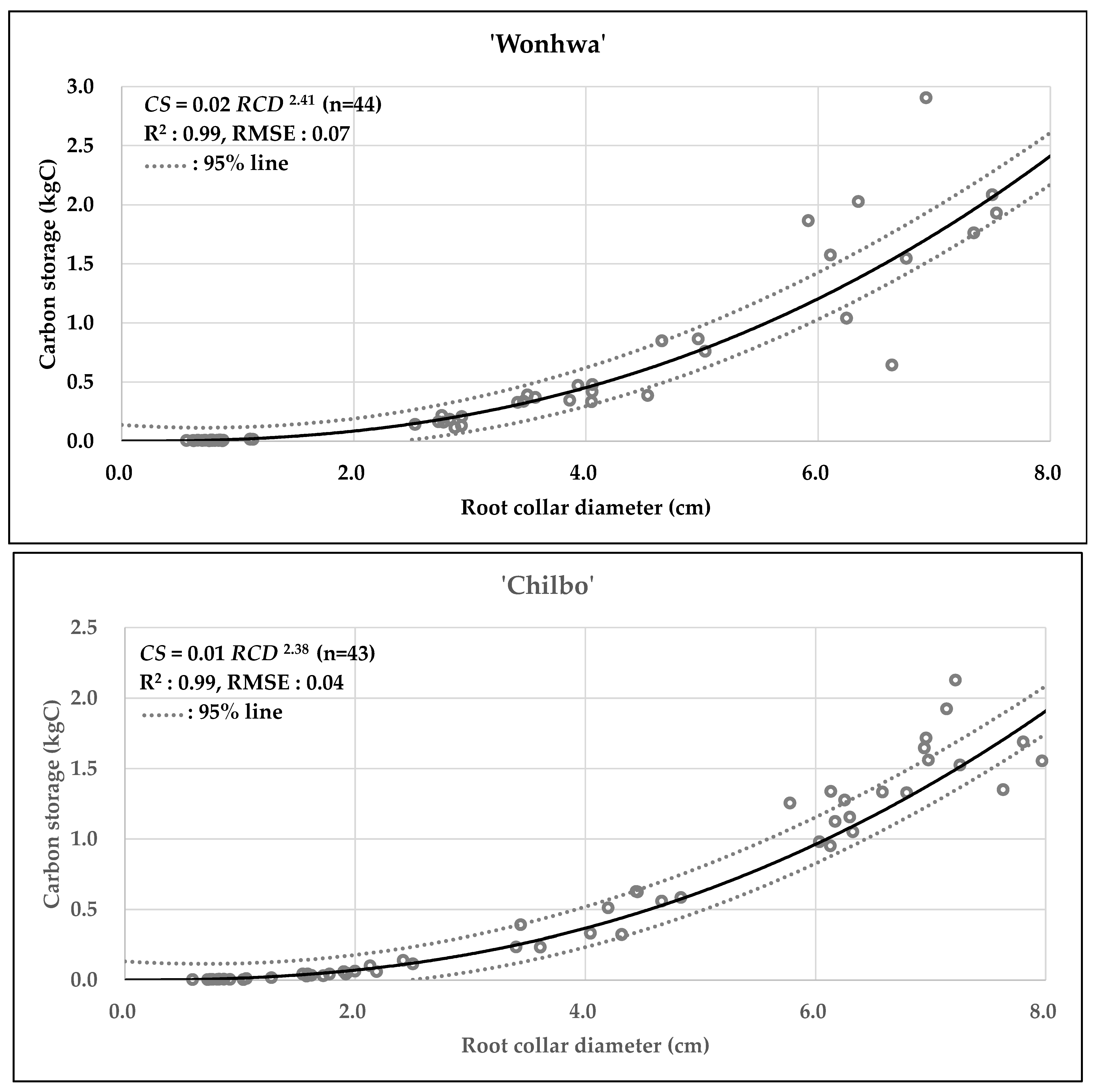
| a · RCD b (LAR) | 0.02 | 2.41 | 44 | 0.99 | 0.07 | −53.12 | −49.26 | <0.001 | ||
| a · RCD b | 0.03 | 2.57 | - | - | 51 | 0.86 | 0.57 | −52.64 | −48.78 | <0.001 |
| a · exp (b · RCD) | 1.31 | 0.05 | - | - | 51 | 0.56 | 1.02 | 5.63 | 9.49 | <0.001 |
| a · H + b | 0.01 | −1.04 | - | - | 51 | 0.38 | 1.22 | 24.00 | 27.86 | <0.001 |
| a · ln(H) + b | 1.74 | −7.48 | - | - | 51 | 0.35 | 1.24 | 26.15 | 30.01 | <0.001 |
| a · CW + b | 0.03 | −0.64 | - | - | 51 | 0.85 | 0.59 | −49.90 | −46.04 | <0.001 |
| a · CW b | 2.55 × 10⁻⁵ | 2.42 | - | - | 51 | 0.78 | 0.72 | −29.82 | −25.96 | <0.001 |
| a · ln(CW) + b | 1.38 | −4.02 | - | - | 51 | 0.63 | 0.94 | −2.63 | 1.24 | <0.001 |
| a · RCD b · H c | 1.97 × 10⁻³ | 2.26 | 0.58 | - | 51 | 0.87 | 0.56 | −52.74 | −46.95 | <0.001 |
| a · RCD b · CW c | 0.01 | 2.27 | 0.32 | - | 51 | 0.89 | 0.50 | −64.67 | −58.87 | <0.001 |
| a · CW b · H c | 2.80 × 10⁻⁸ | 1.36 | 2.18 | - | 51 | 0.88 | 0.53 | −58.99 | −53.20 | <0.001 |
| a · RCD b · H c · CW d | 4.39 × 10⁻⁴ | 1.86 | 0.66 | 0.38 | 51 | 0.92 | 0.45 | −74.58 | −66.85 | <0.001 |
| Models | a | b | c | d | n | R2 | RMSE | AIC | BIC | p |
|---|---|---|---|---|---|---|---|---|---|---|
| a · RCD + b | 0.57 | −0.84 | - | - | 55 | 0.91 | 0.44 | −85.66 | −81.64 | <0.001 |
| a · RCD b (LAR) | 0.01 | 2.38 | - | - | 43 | 0.99 | 0.04 | −89.34 | −85.32 | <0.001 |
| a · RCD b | 0.02 | 2.59 | - | - | 55 | 0.91 | 0.44 | −86.25 | −82.23 | <0.001 |
| a · ln(RCD) + b | 1.60 | −0.35 | - | - | 55 | 0.74 | 0.76 | −25.71 | −21.70 | <0.001 |
| a · H + b | 0.02 | −2.68 | - | - | 55 | 0.58 | 0.98 | 1.84 | 5.86 | <0.001 |
| a · H b | 2.16 × 10⁻¹³ | 5.57 | - | - | 55 | 0.56 | 1.00 | 3.71 | 7.72 | <0.001 |
| a · exp(b · H) | 3.65 × 10⁻⁴ | 0.04 | - | - | 55 | 0.46 | 1.10 | 14.88 | 18.89 | <0.001 |
| a · ln(H) + b | 3.02 | −13.87 | - | - | 55 | 0.47 | 1.10 | 14.22 | 18.23 | <0.001 |
| a · CW + b | 0.03 | −0.71 | - | - | 55 | 0.83 | 0.61 | −49.86 | −45.85 | <0.001 |
| a · CW b | 3.81 × 10⁻⁵ | 2.31 | - | - | 55 | 0.85 | 0.58 | −56.46 | −52.44 | <0.001 |
| a · ln(CW) + b | 1.39 | −4.13 | - | - | 55 | 0.66 | 0.88 | −10.20 | −6.19 | <0.001 |
| a · RCD b · H c | 2.22 × 10⁻³ | 2.40 | 0.50 | - | 55 | 0.93 | 0.41 | −91.55 | −85.52 | <0.001 |
| a · RCD b · CW c | 5.85 × 10⁻³ | 2.10 | 0.47 | - | 55 | 0.96 | 0.31 | −121.65 | −115.63 | <0.001 |
| a · CW b · H c | 2.96 × 10⁻⁸ | 1.69 | 1.90 | - | 55 | 0.90 | 0.49 | −73.28 | −67.25 | <0.001 |
| a · RCD b · H c · CW d | 4.75 × 10⁻⁴ | 1.89 | 0.53 | 0.48 | 55 | 0.96 | 0.29 | −128.81 | −120.78 | <0.001 |
| Cultivar | Models | a | b | n | R2 | RMSE | p | Algorithm |
|---|---|---|---|---|---|---|---|---|
| ‘Wonhwa’ | a · RCD b | 0.02 | 2.41 | 44 | 0.99 | 0.07 | <0.001 | LAR |
| ‘Chilbo’ | a · RCD b | 0.01 | 2.38 | 43 | 0.99 | 0.04 | <0.001 | Bisquare |
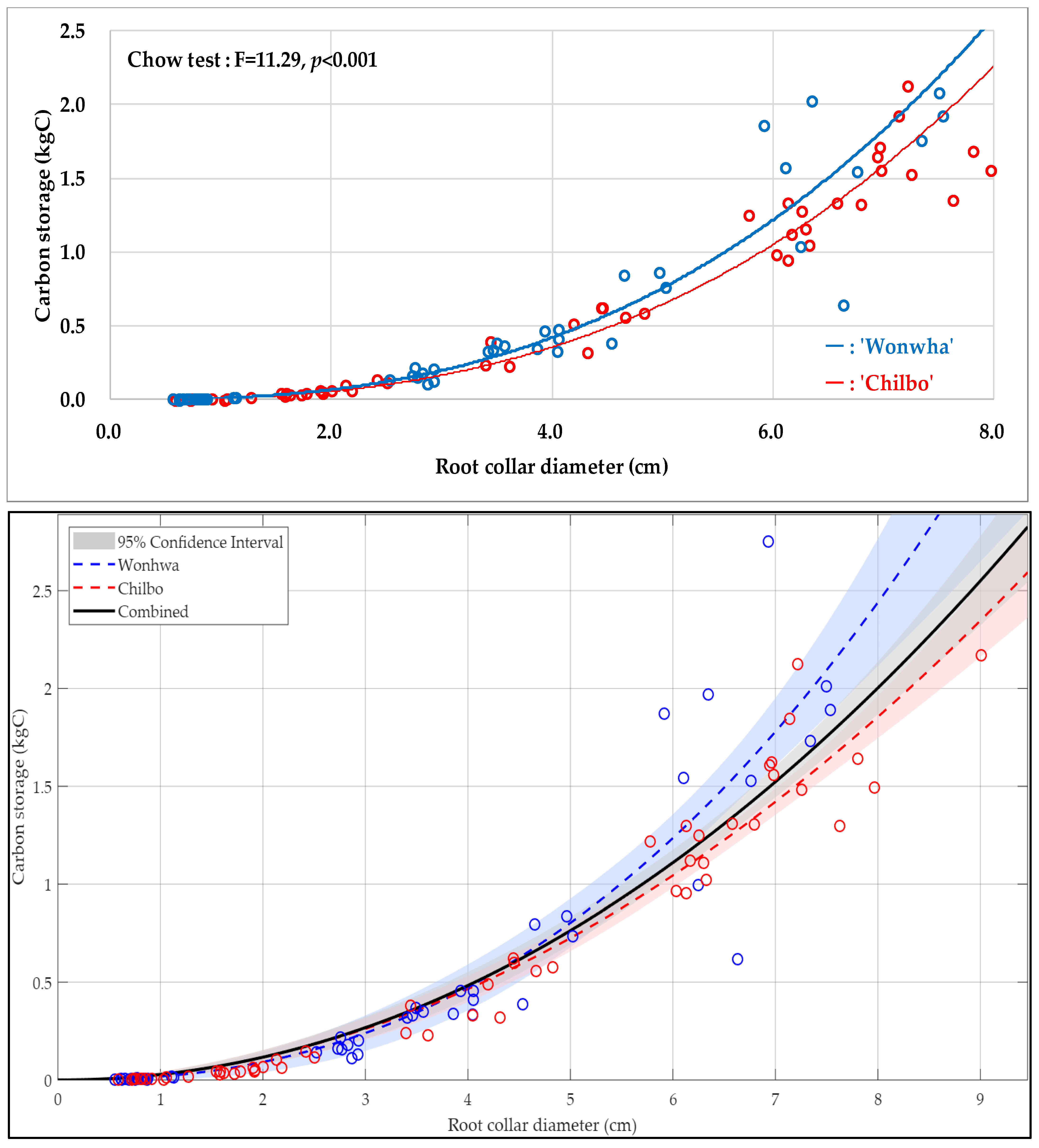
| Statistical parameter | Residual sum of square (Full) | Residual sum of square (Reduced) | F-statistic | p | ||||
| Value | 4.73 | 5.78 | 11.29 | <0.001 | ||||
| Comparison Group | Sub-Group | F | p |
|---|---|---|---|
| ‘Wonhwa’ | Younger pot-grown (3 to 9 yrs) | 0.46 | >0.05 |
| Older field-grown (10 to 13 yrs) | |||
| ‘Chilbo’ | Younger pot-grown (3 to 9 yrs) | 11.23 | <0.001 |
| Older field-grown (10 to 13 yrs) | |||
| Total | Younger pot-grown (3 to 9 yrs) | 5.78 | <0.05 |
| Older field-grown (10 to 13 yrs) |
| Comparison Group | Sub-Group | n | Mean ± SD | F | p |
|---|---|---|---|---|---|
| Younger pot-grown (3 to 9 years) | ‘Wonhwa’ | 32 | 0.43 ± 0.15 | 61.45 | <0.001 |
| ‘Chilbo’ | 28 | 0.68 ± 0.09 | |||
| Older field-grown (10 to 13 years) | ‘Wonhwa’ | 19 | 0.25 ± 0.10 | 501.83 | <0.001 |
| ‘Chilbo’ | 27 | 0.79 ± 0.05 |
Disclaimer/Publisher’s Note: The statements, opinions and data contained in all publications are solely those of the individual author(s) and contributor(s) and not of MDPI and/or the editor(s). MDPI and/or the editor(s) disclaim responsibility for any injury to people or property resulting from any ideas, methods, instructions or products referred to in the content. |
© 2025 by the authors. Licensee MDPI, Basel, Switzerland. This article is an open access article distributed under the terms and conditions of the Creative Commons Attribution (CC BY) license (https://creativecommons.org/licenses/by/4.0/).
Share and Cite
Kim, H.-K.; Shin, H.; Lee, J.-M.; Joo, S.-H.; Bang, G.-E.; Kim, H.-A.; Lee, J.-S.; Lee, S.; Lim, Y.-K.; Kim, H.-C.; et al. Development and Comparison of Allometric Equations for Estimating Carbon Storage of Two Hibiscus syriacus Cultivars with Different Growth Forms in Urban Areas of Republic of Korea. Forests 2025, 16, 1845. https://doi.org/10.3390/f16121845
Kim H-K, Shin H, Lee J-M, Joo S-H, Bang G-E, Kim H-A, Lee J-S, Lee S, Lim Y-K, Kim H-C, et al. Development and Comparison of Allometric Equations for Estimating Carbon Storage of Two Hibiscus syriacus Cultivars with Different Growth Forms in Urban Areas of Republic of Korea. Forests. 2025; 16(12):1845. https://doi.org/10.3390/f16121845
Chicago/Turabian StyleKim, Hak-Koo, Hanna Shin, Jeong-Min Lee, Seo-Hyeon Joo, Go-Eun Bang, Hyun-A Kim, Jun-Seop Lee, Seonghun Lee, Yun-Kyung Lim, Hyun-Chul Kim, and et al. 2025. "Development and Comparison of Allometric Equations for Estimating Carbon Storage of Two Hibiscus syriacus Cultivars with Different Growth Forms in Urban Areas of Republic of Korea" Forests 16, no. 12: 1845. https://doi.org/10.3390/f16121845
APA StyleKim, H.-K., Shin, H., Lee, J.-M., Joo, S.-H., Bang, G.-E., Kim, H.-A., Lee, J.-S., Lee, S., Lim, Y.-K., Kim, H.-C., Kwon, Y.-J., & Kim, C.-B. (2025). Development and Comparison of Allometric Equations for Estimating Carbon Storage of Two Hibiscus syriacus Cultivars with Different Growth Forms in Urban Areas of Republic of Korea. Forests, 16(12), 1845. https://doi.org/10.3390/f16121845