Article

Application of Cow Manure Enhances Soil Nutrients, Reshapes Rhizosphere Microbial Communities and Promotes Growth of Toona fargesii Seedlings


1
Jiangxi Provincial Key Laboratory of Subtropical Forest Resources Cultivation, Jiangxi Agricultural University, Nanchang 330045, China
2
Jiangxi Provincial Key Laboratory of Conservation Biology, College of Forestry, Jiangxi Agricultural University, Nanchang 330045, China
*
Author to whom correspondence should be addressed.
Forests 2025, 16(12), 1846; https://doi.org/10.3390/f16121846
Submission received: 30 October 2025 / Revised: 27 November 2025 / Accepted: 7 December 2025 / Published: 11 December 2025

Abstract

The application of organic fertilizer is an effective way to improve soil fertility and promote seedling growth. Toona fargesii (T. fargesii) is a fast-growing tree with high commercial value due to its excellent timber quality. However, the mechanism underlying its rapid growth at the seedling stage in red soil remains unclear. Here, we investigated the effects of cow manure application (OF group) on soil nutrients and rhizosphere microbial communities in red soil, as well as how it promotes the seedling growth of T. fargesii. Seedlings in the OF group showed a significantly higher specific growth rate than those in the unfertilized control (CK) group (73.51 ± 11.82% vs. 34.90 ± 5.49%, p = 0.022). This growth promotion was accompanied by an increase in soil pH (6.36 ± 0.01 vs. 6.22 ± 0.02, p = 0.001) and a concurrent decrease in NO3-N (10.60 ± 3.20 vs. 22.58 ± 3.49, p = 0.044). High-throughput sequencing demonstrated that cow manure tended to enhance bacterial diversity while decreasing fungal diversity. The OF treatment significantly enriched the relative abundances of bacterial phyla Myxococcota, Bacteroidota, Firmicutes, and Proteobacteria, while reducing Chloroflexi. For fungi, the relative abundances of Calcarisporiellomycota and Chytridiomycota were reduced under OF treatment. Redundancy analysis indicated that soil pH and organic matter (OM) content were the main environmental drivers shaping rhizosphere microbial communities. Our results demonstrated that short-term cow manure application raised soil pH and shifted the microbiome, coinciding with promoted seedling growth. This study provides insights into the microbiome-mediated rapid growth of tree seedlings in red soil. It implies that applying cow manure is an effective way to promote seedling performance in the early stages.

1. Introduction

The Toona genus is a member of the Meliaceae family with significant economic and medicinal value [1]. So far, around 15 species of the Toona genus have been identified, which are distributed from Asia to Oceania [2]. Among these species, Toona fargesii (T. fargesii) is a fast-growing tree species that reaches 25–30 m in height and yields high-quality timber. It is widely distributed across subtropical southern China [3,4], with Jiangxi Province among its core ranges. As a fast-growing timber species, T. fargesii offers substantial economic returns for afforestation and commercial forest operations [3]; its rapid early growth also has the potential to enhance carbon sequestration and, by improving soil cover and organic-matter inputs, to facilitate the restoration of degraded red soils [5]. Jiangxi Province, located in southern China, represents a typical red-soil area where the soil is generally marked by low organic matter levels, inadequate aeration, high acidity, and limited cation exchange capacity, leading to reduced soil fertility [6,7]. These edaphic stresses pose significant challenges to seedling establishment and early growth of tree species including T. fargesii [6,7]. Therefore, accelerating the seedling growth of T. fargesii is key to promoting its commercial cultivation. Over the past decade, numerous studies have demonstrated that applying organic fertilizer can significantly improve the soil organic matter content and fertility of red soil, thus improving seedling growth [8,9,10,11].
Besides their direct effects on enhancing nutrient content and alleviating soil acidity, organic fertilizers also have important indirect effects on improving soil fertility by ameliorating soil microbiota [8,10,12]. Soil microbiota play a pivotal role in soil fertility, biogeochemical cycling, and the provision of ecosystem services that sustain plant productivity [13,14]. Soil microbial communities mediate the turnover and utilization of organic and inorganic substances, thereby influencing the growth and development of plants. The rhizosphere acts as a critical interface where plant roots interact actively with the surrounding soil environment, which is essential for the function of host plants [15,16]. Applying organic fertilizers can enhance the abundance and diversity of beneficial micro-organisms, thereby reshaping the microbial community structure in the plant rhizosphere [17,18,19]. However, this rhizosphere microbiome is highly sensitive to agricultural management practices and species-specific. Various factors shape the community composition and diversity of rhizosphere microbiome, including plant species, soil type and fertilization regime [20,21]. Cow manure, a readily available bioresource harboring diverse microorganisms, is weakly alkaline and has been widely used in agricultural management [22]. Numerous studies have shown that cow manure can not only enhance bacterial diversity and modulate the community structure in the rhizosphere of crops, but also effectively ameliorates soil chemical traits and increases nutrient content [23,24,25]. However, studies on the mechanisms of applying cow manure to promote tree seedling growth remain scarce.
The application of organic fertilizer is an effective measure to improve soil fertility and thus enhance seedling growth in red soil. To date, few studies have examined the effects of animal manure application on Toona species. Consequently, how organic fertilization modulates the rhizosphere microbiome to promote seedling growth of Toona species in red soils remain unclear. In this work, we applied organic cow manure to T. fargesii seedlings for approximately 5 months and then determined the seedling growth rate, soil nutrients, and soil acidity. We also used high-throughput sequencing to characterize the rhizosphere bacterial and fungal communities, in order to assess how the manure alters their structure and function in red soil. We hypothesized that cow manure application would alleviate soil acidity, improve soil nutrient availability (N, P, K), enhance rhizosphere microbial diversity and functioning, and thereby increase the growth rate of T. fargesii seedlings. We expect that this study will provide the essential knowledge needed to guide the use of cow manure as a biofertilizer for forestry species.

2. Materials and Methods

2.1. Experiment Design

The experiment was conducted from March to September 2024, with an average daily temperature of 25.6 °C and total precipitation of 1010 mm. This study employed a randomized complete block design (RCBD) with three blocks, each containing two treatments: CK (control, no fertilization) and OF (organic fertilization with cow manure), giving six experimental plots in total. Before planting, soil pH and organic matter averaged 5.98 ± 0.07 and 12.3 ± 1.1 g kg−1 across six plots. Each experimental plot was 19.44 m2 in size (3.6 m × 5.4 m) and was planted with 24 seedlings, resulting in a total of 144 seedlings. Random assignment of treatments within each block ensured comparability and minimized systematic bias.
In the middle of March 2024, 144 T. fargesii seedlings (average height 0.96 ± 0.03 m; average ground diameter 11.85 ± 0.33 mm) were transplanted into the field and allowed to stabilize before the fertilization experiment was initiated. The OF experimental group received 2.5 kg of fermented cow manure for each seedling (30.86 t ha−1), while the CK group received no fertilizer. The dry cow manure contained 1.56% total N, 0.462% P2O5, 2.58% K2O and 1.74% organic matter, with metal concentrations (Cu, Zn, Pb, Cd) within the safety limits of the Chinese NY/T 525–2021 organic fertilizer standard. To prevent cross-plot movement of soil, water and fertilizer, we inserted fiber-cement boards approximately 60 cm into the soil and left 10 cm above the soil surface. For fertilization, a 20–30 cm deep and 20–30 cm wide trench was dug along each seedling, filled with cow manure, and then covered with 5 cm of soil.

2.2. Sample Collection

Five months after fertilization, two rhizosphere soil composite samples were collected from each plot of the OF and CK groups. Each composite sample consisted of soil from three seedlings whose specific growth rate (SGR) was close to the average SGR of their respective plot. The experimental samples were collected during dry weather. For rhizosphere soil collection, roots located 0~30 cm below the soil surface were excavated. After large clumps of soil were removed, the rhizosphere soil tightly adhering to 1–2 mm roots was gently brushed off. All soil samples were placed into sterile plastic bags and immediately stored in an ice box for transportation to the laboratory. Samples of rhizosphere soil of T. fargesii seedlings were collected in September 2024.

2.3. Chemical Analysis of Soil Samples

All analyses were performed on air-dried soil (<2 mm). Soil pH was determined in a 1:2.5 soil/water (w/v) suspension with a bench-top pH meter (PHS-3E, Leici, Shanghai, China). Organic matter (OM) content was determined by the potassium dichromate oxidation method with external heating [26]. Total nitrogen (TN) and total phosphorus (TP) were determined following H2SO4–HClO4 digestion; TN via the Kjeldahl method and TP colorimetrically at 880 nm [27]. Total potassium (TK) was digested with HF–HClO4 and determined by flame photometry (Sherwood M410, Sherwood Scientific, 51-52 Hanworth Road, London, UK.) [28].
Available nitrogen (AN) was determined by alkaline hydrolysis diffusion [26]. Available phosphorus (AP) was extracted with 0.5 M NaHCO3 (pH 8.5) and quantified using the molybdenum-blue/ascorbic-acid method [29]. Available potassium (AK) was extracted with 1 M NH4OAc (pH 7.0) and determined by flame photometry [28]. Inorganic N fractions (NH4+-N and NO3-N) were determined spectrophotometrically with the indophenol-blue and Cd-reduction methods, respectively [30].

2.4. DNA Extraction and High-Throughput Sequencing

Total genomic DNA of rhizosphere soil was extracted using the TGuide S96 Magnetic Soil/Stool DNA Kit (TIANGEN, Beijing, China), according to the manufacturer’s instructions. The quality and concentration of the extracted DNA were examined by agarose gel electrophoresis and NanoDrop 2000 UV-Vis spectrophotometer (Thermo Scientific, Wilmington, NC, USA). The hypervariable region V3-V4 of the bacterial 16S rRNA gene was amplified with primers 338F (5′-ACTCCTACGGGAGGCAGCA-3′) and 806R (5′-GGACTACHVGGGTWTCTAAT-3′), both of which were tailed with sample-specific Illumina index sequences to allow for deep sequencing. The ITS1 region of the fungal ITS gene was PCR amplified using the fungi-specific primers 5′-CTTGGTCATTTAGAGGAAGTAA-3′ and 5′-GCTGCGTTCTTCATCGATGC-3′. Each DNA sample was amplified in triplicate. The triplicate PCR products for each sample were pooled, detected via 2% agarose gel electrophoresis, and purified. The PCR products were purified using Omega DNA purification kit (Omega Inc., Norcross, GA, USA) and quantified by Qsep-400 (BiOptic, Inc., New Taipei City, Taiwan). Then, the amplicon libraries were paired-end sequenced on an Illumina novaseq6000 platform at Novogene Co., Ltd. (Beijing, China).

2.5. Bioinformatic and Statistical Analysis

The bioinformatics analysis in this study was conducted with the assistance of the BMKCloud (http://www.biocloud.net/ accessed on 26 NOV. 2024). Initially, raw data was filtered based on single-nucleotide quality using Trimmomatic (version 0.33) [31]. Subsequently, primer sequences were identified and removed using Cutadapt (version 1.9.1) [32]. Then the paired-end reads were assembled by USEARCH (version 10) [33], followed by chimera removal using UCHIME (version 8.1) [34].
The resulting clean reads were then used to generate amplicon sequence variants (ASVs) through feature classification using the DADA2 algorithm [35]. ASVs with counts less than 2 across all samples were filtered out. Taxonomic annotation of the ASVs was performed using the Naive Bayes classifier in QIIME2 [36], with the UNITE database (release 138.1) [37] and a confidence threshold of 70%. Alpha diversity was calculated and visualized using QIIME2 (version 2024.2) and R software (version 3.2.0), while beta diversity was assessed using QIIME to evaluate the similarity of microbial communities across different samples.
PCoA (Principal coordinates analysis) was conducted to visualize community dissimilarity, and the observed grouping was statistically validated using ANOSIM. PERMANOVA (adonis2 in vegan) was performed based on Bray–Curtis dissimilarity with 999 permutations to test for significant differences between groups [38].
A co-occurrence network analysis was performed using the Molecular Ecological Network Analysis Pipeline (MENAP) online tool [39], and the network was visualized using Gephi (version 0.9.2). The identification of keystone species within the networks was based on calculating two metrics: within-module connectivity (Zi) and among-module connectivity (Pi). Specifically, network hubs were defined as having Zi > 2.5 and Pi > 0.62, module hubs had Zi > 2.5 and Pi ≤ 0.62, and connectors had Zi ≤ 2.5 and Pi > 0.62. The Functional Annotation of Prokaryotic Taxa (FAPROTAX) database (version 1.0) [40] was used to predict the ecologically relevant functions of bacteria, and FUNGuild (version 1.0) [41] was used to predict the functional groups (guilds) of fungi. Additionally, redundancy analysis (RDA) was conducted in R using the ‘vegan’ package to explore the interrelationships between microbiome community structures, growth traits and soil properties. The potential correlations between the relative abundance of bacterial and fungal genera and soil properties were analyzed using Spearman’s rank correlation analysis, and the results were visualized as a heatmap using the “pheatmap” package in R software.
Microbial species abundance differences between soil samples from the two sites were analyzed using MetaStats (https://cbcb.umd.edu/) [42]. The p-values were calculated using a permutation method, and q-values were adjusted for multiple comparisons using the Benjamini–Hochberg False Discovery Rate (FDR) method [43]. Student’s t-tests (significance threshold p < 0.05) were performed in SPSS v17.0 to compare growth traits and soil properties between the OF and CK groups.

3. Results

3.1. The Effects of Cow Manure Application on Soil Properties and Seedling Growth

After a short-term application (approximately 5 months) of cow manure, the average seedling height in the OF and CK treatments was 1.66 ± 0.08 m and 1.31 ± 0.07 m, respectively, while the average ground diameter was 25.89 ± 0.10 mm and 23.47 ± 0.88 mm. Soil pH in the OF group was significantly higher (p = 0.00083), whereas soil NO3-N concentration was significantly lower (p = 0.044) than that in the CK group. In addition, the OM content in the OF group was 31.23% higher than that in the CK group (Table 1). As to the specific growth rate (SGR) of T. fargesii seedlings, the OF group was significantly higher than the CK group (p = 0.022) (Table 1).

3.2. The Bacterial and Fungal Compositions in Rhizosphere Soil

After filtering the sequencing data, the rhizosphere soil of the CK and OF groups yielded an average of 119,306 and 135,801 16S clean reads per sample (mostly 400–440 bp), respectively, along with 103,646 and 53,542 ITS clean reads (~220–460 bp). Following noise reduction using QIIME2 software, those clean reads were clustered into 21,465 bacterial and 3992 fungal ASVs collectively. Taxonomic classification revealed that 16S ASVs spanned 24 phyla, 59 classes, 168 orders, 311 families and 635 genera, while ITS ASVs belonged to 14 phyla, 48 classes, 115 orders, 258 families and 557 genera. Rarefaction analysis indicated that the sequencing depth was sufficient to capture the majority of diversity in each sample (Figure S1), supporting the reliability of downstream analyses.

3.3. Diversity of Bacterial and Fungal Communities

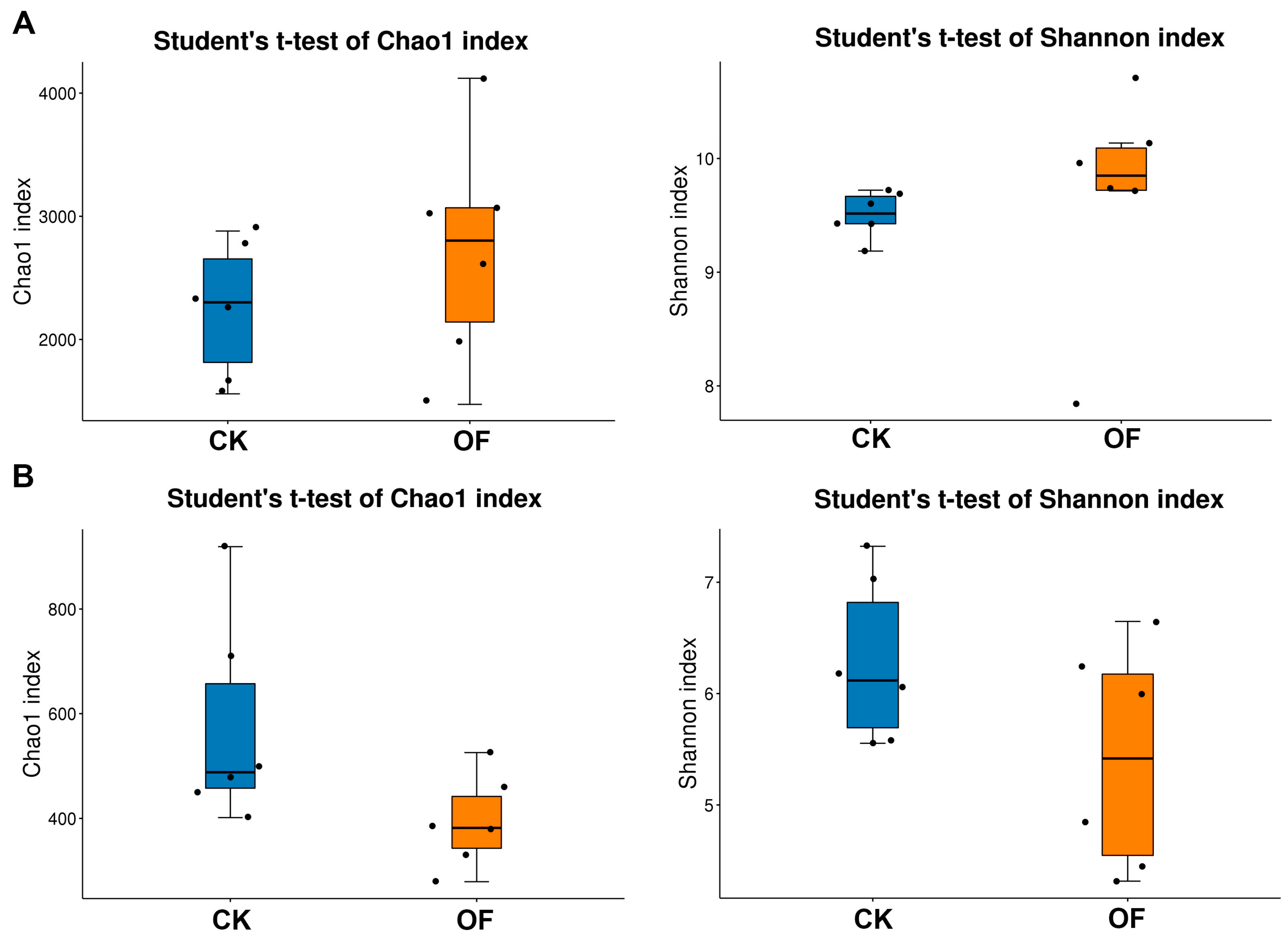
Chao1 and Shannon indices were used to assess the abundance and diversity of rhizosphere bacterial and fungal communities. The Chao1 index of bacteria ranged from 1473.17 to 4119.98, and the Shannon index of bacteria ranged from 7.84 to 10.71 (Figure 1A). For fungal diversity, the Chao1 index ranged from 279.77 to 919.24, while the Shannon index ranged from 4.32 to 7.32 (Figure 1B). The mean values of bacterial Chao1 and Shannon indices in the OF group were higher than those in the CK group. In contrast, for fungal Chao1 and Shannon indices, the mean values in the OF group were lower than those in the CK group. However, no significant difference was identified (Figure 1).
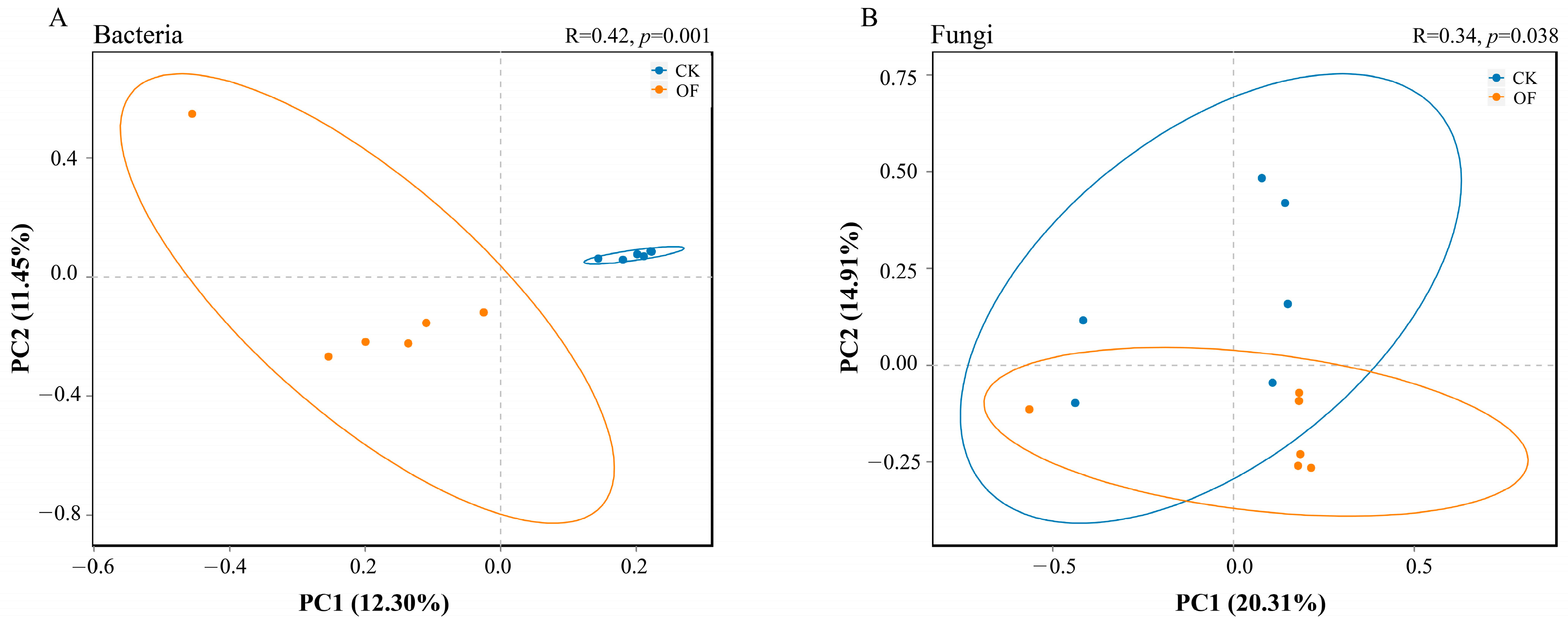
To evaluate the overall similarity of rhizosphere microbial community structures, PCoA was performed in conjunction with a PERMANOVA. The results indicated that the community composition of bacteria (p = 0.001) and fungi (p = 0.038) was significantly separated between the OF and CK groups (Figure 2). The variance contribution of PC1 and PC2 were 12.30% and 11.45% for bacteria, and 20.31% and 14.91% for fungi, respectively.

3.4. The Microbiome Structure of Bacteria and Fungi at the Phylum and Genus Levels

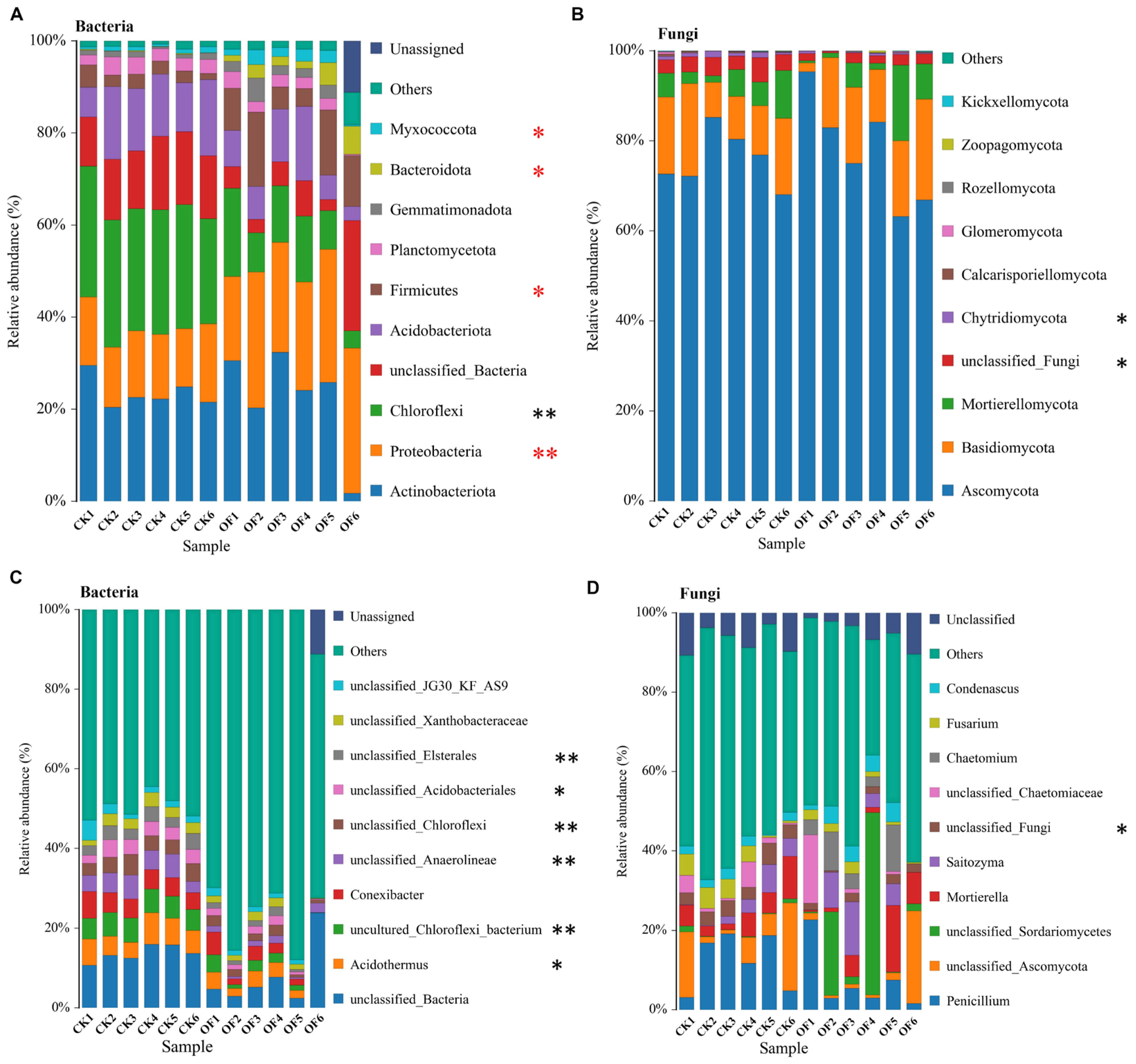
At the phylum level, the top 5 bacterial taxa in rhizosphere soil were Actinobacteriota, Proteobacteria, Chloroflexi, unclassified_Bacteria, and Acidobacteriota, collectively accounting for more than 80% of the sequences. Among the 10 most abundant phyla, the relative abundance of Chloroflexi was significantly lower in the OF group than in the CK group (q value < 0.01), whereas that of Proteobacteria, Firmicutes, Bacteroidota, and Myxococcota were significantly higher (q value < 0.01 or q value < 0.05) in the OF group than in the CK group (Figure 3A). For fungal communities at the phylum level, Ascomycota, Basidiomycota, Mortierellomycota, and unclassified_Fungi were detected as the 4 most abundant phyla, together accounting for ~99% of the reads. The relative abundance of Chytridiomycota and unclassified_Fungi was significantly higher (q value < 0.05) in the CK group compared to the OF group; no other phylum exhibited a significant between-group difference (Figure 3B).
We further analyzed the relative abundance of bacterial and fungal communities between the CK and OF groups at the genus level in rhizosphere soil. For bacterial communities, the 10 most abundant genera accounted for 50.4% and 23.6% of the reads in the CK and OF groups, respectively. Among these 10 genera, the relative abundance of unclassified_Elsterales, unclassified_Acidobacteriales, unclassified_Chloroflexi, unclassified_Anaerolineae, uncultured_Chloroflexi_bacterium, and Acidothermus was significantly lower (q value < 0.01 or q value < 0.05) in the OF group than the CK group (Figure 3C). For fungal communities at the genus level, the 10 most abundant genera accounted for 41.1% and 49.5% of the reads in the CK and OF groups, respectively. Among them, the relative abundance of unclassified_Fungi was significantly lower (q value < 0.05) in the OF group than in the CK group (Figure 3D).

3.5. Functional Annotation of Bacteria and Fungi

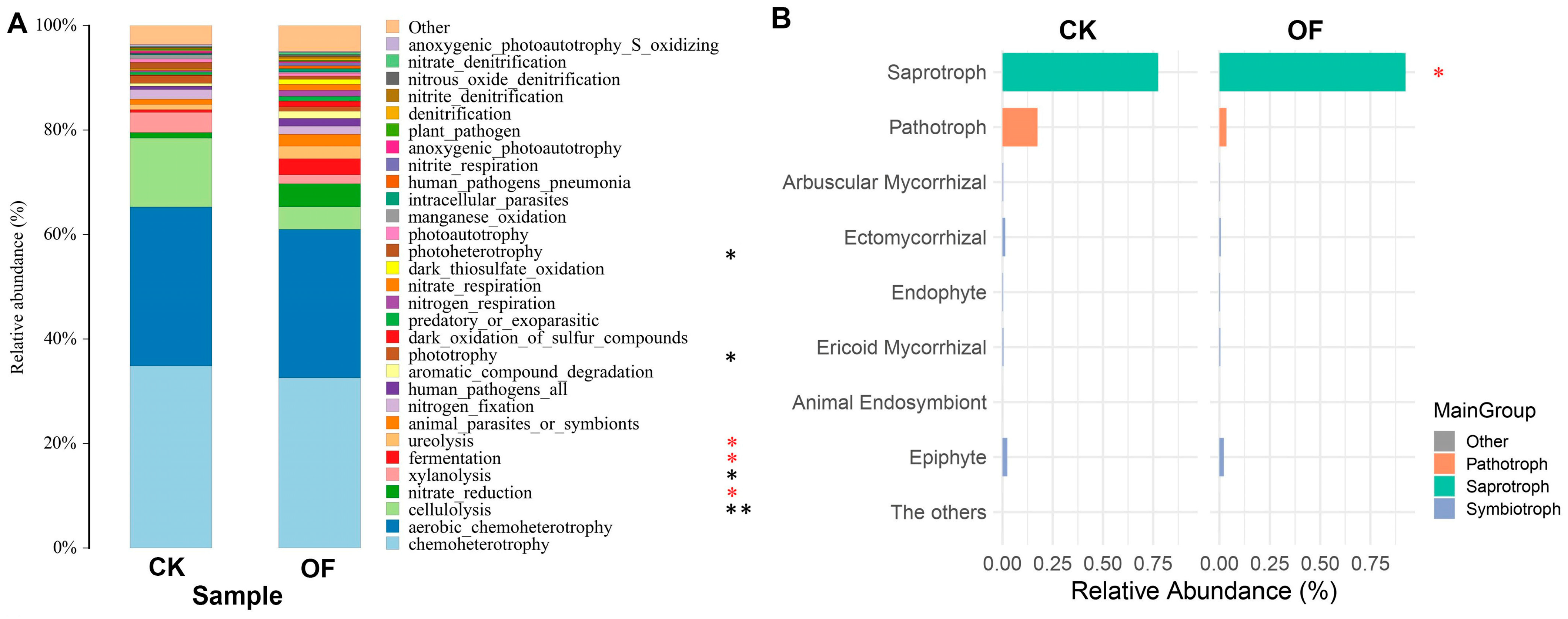
FAPROTAX (bacteria) and FUNGuild (fungi) databases were used to predict the ecological functions of microbial ASVs identified in rhizosphere soil between the OF and CK groups. The top 30 functional groups correlated with the relative abundance are shown in Figure 4 Among these functional groups, chemoheterotrophy, aerobic_chemoheterotrophy, cellulolysis, nitrate_reduction, xylanolysis, ureolysis, and nitrogen_fixation were all among the top 10 in both the OF and CK groups (Figure 4A). Twelve FAPROTAX categories showed probable differences between the OF and CK groups, including cellulolysis, nitrate_reduction, xylanolysis, fermentation, ureolysis, phototrophy, and photoheterotrophy. According to the FunGuild database, the functions of fungi were predicted and classified into 4 trophic modes: saprotroph, pathotroph, symbiotroph and others. The symbiotroph fungi were further subdivided into functional guilds based on their ecological roles (Figure 4B). The data indicated that in rhizosphere soil, the relative abundance of saprotroph fungi was probably higher in the OF group than in the CK group, while the relative abundance of pathotroph fungi was slightly lower in the OF group than in the CK group.

3.6. Relationship Between Soil Properties and Bacterial Structure and Function

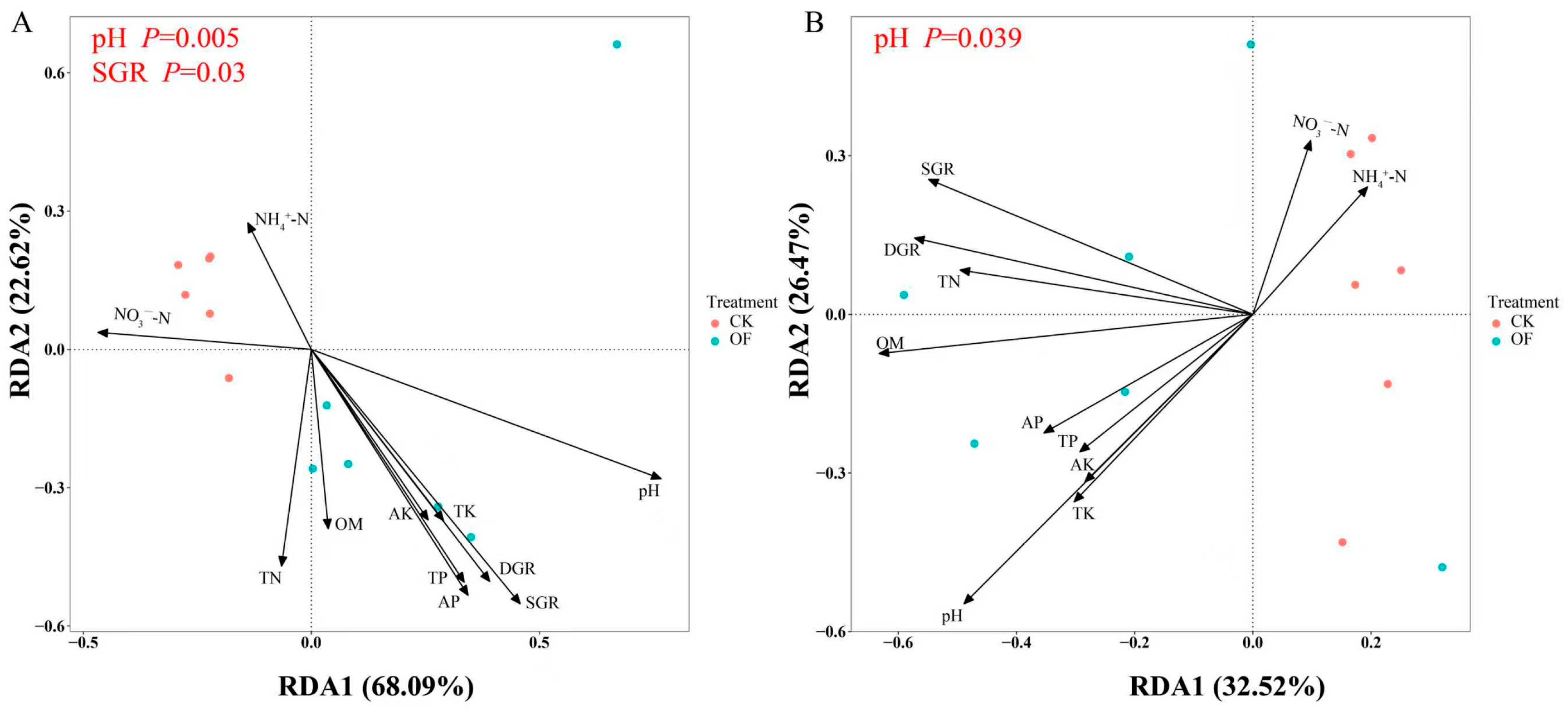
Additionally, RDA was performed to assess the relationship between bacterial and fungal communities and the soil physicochemical properties. The results showed 90.71% of the bacterial community variation in rhizosphere soil was explained by 2 canonical axes, with RDA1 and RDA2 accounting for 68.09% and 22.62% of this variation, respectively. CK samples were primarily located on the negative side of RDA1, positively associated with NH4+-N, NO3-N, and total nitrogen (TN); while OF samples were positioned on the positive side, positively correlated with pH value (r2 = 0.67, p = 0.005), specific growth rate (SGR) (r2 = 0.51, p = 0.033), diameter growth rate (DGR) (r2 = 0.41, p = 0.10), available phosphorus (AP), total potassium (TK), available potassium (AK), total phosphorus (TP), and organic matter (OM) (Figure 5A). For the fungal community composition, the RDA1 and RDA2 axes explained 32.52% and 26.47% of the corresponding variation, respectively. Samples from CK clustered on the positive side of RDA1, positively associated with NH4+-N and NO3-N; whereas OF samples were distributed toward the negative side, positively associated with pH (r2 = 0.54, p = 0.039), OM (r2 = 0.41, p = 0.08), SGR (r2 = 0.37, p = 0.12), DGR (r2 = 0.35, p = 0.15), TN, TP, AP, TK, and AK (Figure 5B).
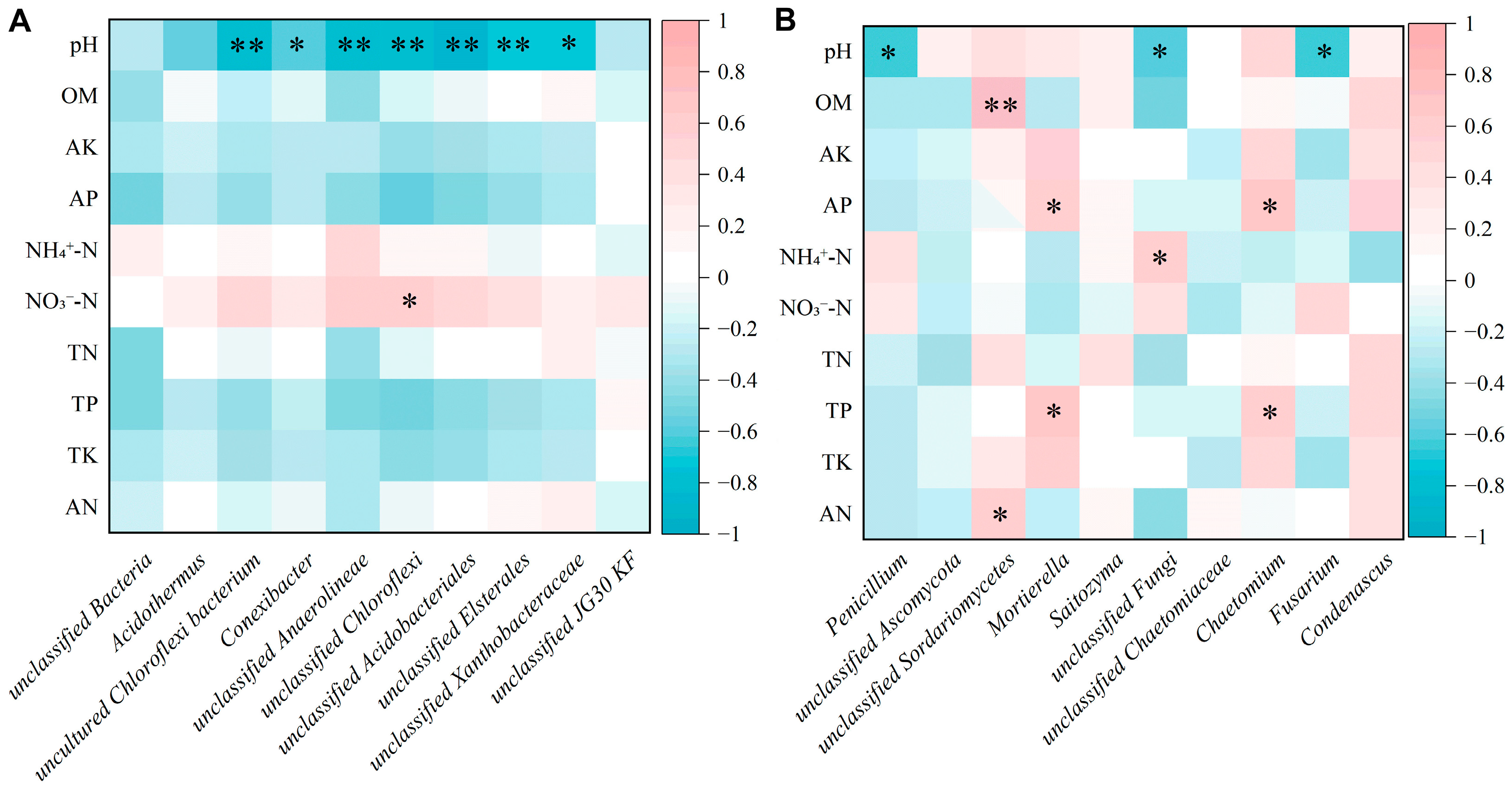
Furthermore, Spearman’s rank correlation analysis was performed to assess the relationships between soil physicochemical parameters and the top 10 most abundant bacterial and fungal taxa. For the rhizosphere bacterial communities, the relative abundances of uncultured_Chloroflexi_bacterium, Conexibacter, unclassified_Anaerolineae, unclassified_Chloroflexi, unclassified_Acidobacteriales, unclassified_Elsterales and unclassified_Xanthobacteraceae all decreased with increasing pH; among them, unclassified_Chloroflexi was also positively correlated with NO3-N (Figure 6A). For the rhizosphere fungal communities, the relative abundances of Penicillium, unclassified_Fungi and Fusarium decreased with increasing pH. Additionally, unclassified_Sordariomycetes was positively correlated with OM and AN; Mortierella and Chaetomium were positively correlated with AP and TP; unclassified_Fungi showed a positive correlation with NH4+-N (Figure 6B).

4. Discussion

4.1. Effects of Short-Term Application of Cow Manure on Soil Properties and Seeding Growth

In this study, cow manure application significantly increased the seedling SGR (p < 0.05) and markedly raised soil pH (p < 0.01), while marginally elevating soil OM content (p = 0.12) and nutrient availability (Table 1). These findings further corroborate earlier reports that organic amendments mitigate soil acidification, increase nutrient retention, and enhance seedling vigor in red soils [44]. Similar improvements in soil fertility and microbial activity were observed when composted cattle manure was applied in rice paddies [45] and in tea plantations, where cow manure significantly improved soil nutrient status [23]. These convergent lines of evidence indicated that cattle-driven improvements in soil chemical and biological properties are robust across contrasting agroecosystems. This could be explained by the fact that cow manure contains abundant mineral elements and rich nutrients, the application of cow manure enables the release of nutrients into the soil, ultimately enhancing the soil’s fertility [46]. The DGR in the OF group was higher than that in the CK group, although the difference did not reach statistical significance (p = 0.11). The combined data suggested that short-term application of cow manure preferentially promoted shoot growth rather than root elongation. Meanwhile, the significant reduction in NO3-N (p < 0.05) observed in our study (Table 1) might reflect the enhanced microbial immobilization and denitrification processes, consistent with ancillary indications of nitrate-reduction activity (Figure 4A). Similar results have been reported in long-term fertilization experiments where organic manure increased microbial-mediated nitrogen transformations in agroforestry soils [24,47]. Interesting, cow manure application could significantly improve the soil pH. As we know, soil pH is one of the core factors regulating the physical and chemical properties of soil, and it profoundly influences the physical structure, chemical characteristics and nutrient availability [7]. Our findings indicate that cow manure might replace some chemical fertilizers to increase soil nutrient levels and provide favorable conditions for plant growth.

4.2. Effects of Cow Manure on Rhizosphere Microbial Diversity and Community Structure

In this study, cow manure application increased bacterial alpha diversity while decreasing fungal alpha diversity, though only a marginal difference was identified for fungal Chao1 index (Figure 1). This is in agreement with a previous global meta-analysis of animal manure application covering > 2000 studies [48]. In comparison, beta diversity analysis (PCoA and PERMANOVA) showed significant differences between OF and CK groups (Figure 2), indicating that community composition was strongly influenced by cow manure addition. These results might support the concept that organic amendments primarily restructure microbial community composition rather than simply increasing diversity. High-throughput sequencing of rhizosphere soil revealed that cow manure induced significant shifts in both bacterial and fungal community structures. At the phylum level, cow manure significantly increased the relative abundance of Proteobacteria, Firmicutes, Bacteroidota, and Myxococcota, while reducing Chloroflexi (q < 0.05 or q < 0.01, Figure 3). These bacterial phyla are generally associated with copiotrophic lifestyles, rapid nutrient cycling, and organic matter degradation [49]. In contrast, Chloroflexi, often linked to oligotrophic conditions [50], declined under manure treatment, suggesting that nutrient enrichment selectively favors fast-growing taxa. For the fungal compositions, cow manure reduced the relative abundance of Chytridiomycota and unclassified_Fungi (q < 0.05), while also tending to increase saprotrophic fungi such as Chaetomium (Figure 3). Previous studies have shown that organic amendments tend to suppress pathogenic or opportunistic fungi while enriching decomposers that contribute to nutrient turnover [49]. This shift may contribute to improved soil health and, in turn, ease pathogen pressure on seedlings. Overall, the compositional dissimilarity between OF and CK was visibly larger in bacterial profiles than in fungal ones (Figure 3), suggesting that bacteria responded more markedly to the short-term amendment. Co-occurrence network analysis further indicated that, although network connectivity increased, microbial assemblages in both treatments were dominated by peripheral taxa and no keystone hubs were identified (Supplementary Figure S2, Supplementary Table S1). This prevalence of peripheral species suggests that short-term fertilization may have enhanced functional redundancy and potential stability, even in the absence of strong keystone interactions. Long-term trials are needed to determine whether persistent application fosters more complex and resilient microbial networks, as observed in forest and cropland systems.
Our findings are consistent with previous studies demonstrating that organic amendments could alter microbial diversity and enrich beneficial microbial taxa [51,52]. Specifically, under organic fertilization, fungal communities shifted toward saprotrophic and mycorrhizal groups. Red soil in subtropical China is typically characterized by low pH, nutrient deficiency, and reduced microbial activity [53], all of which pose critical constraints for seedling establishment and growth. Our data support that cow manure application counteracted the inherent biological limitations of red soil, improving microbial recruitment and fostering a rhizosphere environment more favorable for seedling performance. This highlights the unique potential of organic fertilizer to restore the ecological functionality of degraded red soil beyond the effects reported in neutral or fertile soil. If similar guild shifts occur in forest ecosystems, a single, low-rate manure application could act as an ecological “starter-motor” that re-boots nutrient and C-cycling in degraded forest soils without the long-term eutrophication risk associated with repeated mineral-N fertilization.

4.3. Potential Mechanistic Insights into Microbial Functions and Soil Fertility

Functional predictions revealed that cow manure promoted bacterial functions related to ureolysis, fermentation, and multiple nitrogen cycling pathways (Figure 4A, Supplementary Table S2), consistent with enhanced nutrient turnover and soil fertility. These functional shifts are in line with previous findings that organic amendments stimulate microbial metabolic activity, accelerating the decomposition of organic matter and the cycling of key nutrients such as nitrogen and phosphorus [54,55]. Simultaneously, fungal guild analysis showed increased saprotrophs and decreased pathotrophs (Figure 4B, Supplementary Table S3), suggesting that cow manure could enhance organic matter decomposition and might slow soil-borne disease pressure. Such changes in fungal guilds are consistent with recent reports that manure inputs foster beneficial microbial groups while suppressing pathogenic taxa, thereby improving plant resilience to biotic stress [56,57]. These parallel shifts in bacterial and fungal patterns echo previous research indicating that organic amendments mediate plant–microbe interactions by enriching symbiotic and saprotrophic guilds, ultimately promoting plant health and productivity [58]. Moreover, redundancy analysis of the combined bacterial and fungal communities identified soil pH and organic matter as the primary drivers of microbial community variation (Figure 5 and Figure 6). This finding is in line with global meta-analyses highlighting soil pH as a key determinant of microbial biogeography and functional potential [59,60].
Taken together, our results demonstrate that cow manure exerts a dual role in agroecosystems: (i) enhancing nutrient turnover through microbial functional activation, and (ii) shifting microbial guilds toward beneficial groups that may reduce pathogen prevalence. This dual mechanism provides a plausible explanation for the observed improvements in soil fertility and plant health under organic amendment, underscoring its practical value as a sustainable fertilization strategy. However, our research only addressed the short-term effects of cow manure application on T. fargesii seedlings. Longer-term field trials are needed to evaluate whether these benefits persist and how repeated applications reshape soil microbial networks, enzyme activities, and carbon sequestration in future. It is also worth comparing the long-term combined use of cow manure and inorganic fertilizer. Moreover, future research should elucidate the assembly mechanisms and ecological functions of rhizosphere microbial communities, and unravel how microbe–microbe interactions modulate soil properties and, ultimately, the growth of T. fargesii. However, a further critical concern with cow-manure application is its tight linkage to environmental externalities—elevated risks of nitrate leaching and greenhouse-gas emissions.

5. Conclusions

Our study demonstrated that short-term application of cow manure was associated with higher pH and altered microbiome, and that growth promotion effects coincided with these changes. The manure treatment reshaped the rhizosphere microbial community and promoted functional groups involved in nutrient cycling. These findings underscore the potential of organic amendments as a sustainable strategy to restore red soil fertility and support the fast-growing cultivation of T. fargesii.

Supplementary Materials

The following supporting information can be downloaded at: https://www.mdpi.com/article/10.3390/f16121846/s1, Figure S1: Rarefaction curves of soil samples for bacteria (A) and fungi (B); Figure S2: Co-occurrence network and Zi-Pi plot for the bacteria (A) and fungi (B) communities between the CK and OF groups in rhizosphere soil; Table S1: Summary of network properties of bacteria and fungi genera in rhizosphere soil; Table S2: Functional prediction of soil bacteria community using FAPROTAX; Table S3: Functional prediction of soil fungi community using FUNGuild.

Author Contributions

Conceptualization, L.X. and L.Z.; methodology, X.Y. and G.L.; software, Y.Z., J.T. and L.X.; validation, W.C. and Y.Y.; formal analysis, Y.Z., G.L. and L.X.; resources, L.Z.; data curation, L.X.; writing—original draft preparation, L.X.; writing—review and editing, L.Z.; visualization, L.X.; supervision, L.Z.; funding acquisition, L.Z. All authors have read and agreed to the published version of the manuscript.

Funding

This research was funded by National Natural Science Foundation of China, grant number (32460387).

Data Availability Statement

The sequencing data were deposited in the Genome Sequence Archive (GSA) with the BioProject number CRA031824. Please cite the following required publications: [1] The GSA Family in 2025: A Broadened Sharing Platform for Multi-Omics and Multimodal Data. Genomics, Proteomics & Bioinformatics 2025, 23 (4): qzaf072. https://doi.org/10.1093/gpbjnl/qzaf072 [PMID=40857552] [2] Database Resources of the National Genomics Data Center, China National Center for Bioinformation in 2025. Nucleic Acids Res 2025, 53 (D1): D30–D44. https://doi.org/10.1093/nar/gkae978 [PMID=39530327].

Acknowledgments

We would like to thank Jianmin Shi and Haozhi Long for their valuable suggestions regarding the data analysis in this manuscript.

Conflicts of Interest

The authors declare no conflicts of interest.

References

  1. Zhao, M.Y.; Li, H.T.; Wang, R.S.; Lan, S.Y.; Wang, Y.X.; Zhang, Y.Y.; Sui, H.S.; Li, W.Z. Traditional Uses, Chemical Constituents and Pharmacological Activities of the Toona sinensis Plant. Molecules 2024, 29, 718. [Google Scholar] [CrossRef]
  2. Chen, Y.; Wang, F.; Ji, C.Y.; Liu, D.; Liu, X.X.; Wang, R.S.; Li, W.Z. Chemical Constituents of the Pericarp of Toona sinensis and Their Chemotaxonomic Significance. Biochem. Syst. Ecol. 2022, 104, 104458. [Google Scholar] [CrossRef]
  3. Cheng, Q.Q.; Ma, J.K.; Guo, C.C.; Zhong, Q.W.; Yu, W.W.; Jia, T.; Zhang, L. Insights into the Root Sprouts of Toona fargesii in a Natural Forest: From the Morphology, Physiology, and Transcriptome Levels. Forests 2024, 15, 335. [Google Scholar] [CrossRef]
  4. Jia, T.; Liu, K.F.; Li, Y.N.; Cheng, Q.Q.; Cao, W.; Luo, H.; Ma, J.K.; Zhang, L. Differential Metabolites Regulate the Formation of Chromatic Aberration in Toona fargesii Wood. Ind. Crops Prod. 2024, 219, 119021. [Google Scholar] [CrossRef]
  5. Chokkalingam, U. Learning Lessons from China’s Forest Rehabilitation Efforts: National Level Review and Special Focus on Guangdong Province; Center for International Forestry Research: Bogor, Indonesia, 2006. [Google Scholar]
  6. Wang, Y.; Zhang, H. Physicochemical Properties of a Red Soil Affected by the Longterm Application of Organic and Inorganic Fertilizers. In Organic Fertilizers—From Basic Concepts to Applied Outcomes; Larramendy, M.L., Soloneski, S., Eds.; InTech: London, UK, 2016; ISBN 978-953-51-2449-8. [Google Scholar][Green Version]
  7. Yin, M.Y.; Li, X.; Liu, Q.; Tang, F.Y. Rice Husk Ash Addition to Acid Red Soil Improves the Soil Property and Cotton Seedling Growth. Sci. Rep. 2022, 12, 1704. [Google Scholar] [CrossRef]
  8. Paul Chowdhury, S.; Babin, D.; Sandmann, M.; Jacquiod, S.; Sommermann, L.; Sørensen, S.J.; Fliessbach, A.; Mäder, P.; Geistlinger, J.; Smalla, K.; et al. Effect of Long-term Organic and Mineral Fertilization Strategies on Rhizosphere Microbiota Assemblage and Performance of Lettuce. Environ. Microbiol. 2019, 21, 2426–2439. [Google Scholar] [CrossRef]
  9. BharathKumar, S.; Prasanth, P.; Sreenivas, M.; Gouthami, P.; Sathish, G.; Jnanesha, A.C.; Kumar, S.R.; Gopal, S.V.; Sravya, K.; Kumar, A.; et al. Unveiling the Influence of NPK, Organic Fertilizers, and Plant Growth Enhancers on China Aster (Callistephus chinensis L.) CV. ‘Arka Kamini’ Seed Yield. Ind. Crops Prod. 2025, 227, 120778. [Google Scholar] [CrossRef]
  10. Yu, Y.; Zhang, Q.; Kang, J.; Xu, N.; Zhang, Z.; Deng, Y.; Gillings, M.; Lu, T.; Qian, H. Effects of Organic Fertilizers on Plant Growth and the Rhizosphere Microbiome. Appl. Environ. Microbiol. 2024, 90, e01719-23. [Google Scholar] [CrossRef]
  11. Lee, J.; Jo, N.Y.; Shim, S.Y.; Le, T.Y.L.; Jeong, W.Y.; Kwak, K.W.; Choi, H.S.; Lee, B.O.; Kim, S.R.; Lee, M.G.; et al. Impact of Organic Liquid Fertilizer on Plant Growth of Chinese Cabbage and Soil Bacterial Communities. Sci. Rep. 2025, 15, 10439. [Google Scholar] [CrossRef]
  12. Pan, X.; Yu, H.; Zhang, B.; Guan, Y.; Zhang, N.; Du, H.; Liu, F.; Yu, J.; Wang, Q.; Liu, J. Effects of Organic Fertilizer Replacement on the Microbial Community Structure in the Rhizosphere Soil of Soybeans in Albic Soil. Sci. Rep. 2025, 15, 12271. [Google Scholar] [CrossRef]
  13. Wang, L.X.; Chen, M.X.; Lam, P.Y.; Dini Andreote, F.; Dai, L.; Wei, Z. Multifaceted Roles of Flavonoids Mediating Plant-Microbe Interactions. Microbiome 2022, 10, 233. [Google Scholar] [CrossRef]
  14. Li, J.H.; Muhammad Aslam, M.; Gao, Y.Y.; Dai, L.; Hao, G.F.; Wei, Z.; Chen, M.X.; Dini Andreote, F. Microbiome-Mediated Signal Transduction within the Plant Holobiont. Trends Microbiol. 2023, 31, 616–628. [Google Scholar] [CrossRef]
  15. Phour, M.; Sehrawat, A.; Sindhu, S.S.; Glick, B.R. Interkingdom Signaling in Plant-Rhizomicrobiome Interactions for Sustainable Agriculture. Microbiol. Res. 2020, 241, 126589. [Google Scholar] [CrossRef]
  16. Korenblum, E.; Massalha, H.; Aharoni, A. Plant–Microbe Interactions in the Rhizosphere via a Circular Metabolic Economy. Plant Cell 2022, 34, 3168–3182. [Google Scholar] [CrossRef]
  17. Yu, M.; He, H.; Cheng, L.; Li, S.; Wan, T.; Qin, J.; Li, J. Bio-Organic Fertilizers Enhance Yield in Continuous Cotton Cropping Systems Through Rhizosphere Microbiota Modulation and Soil Nutrient Improvement. Agronomy 2025, 15, 2238. [Google Scholar] [CrossRef]
  18. Qiao, C.; Shao, Q.; Fu, J.; Zheng, X.; Zhao, J.; Ren, L.; Yang, J.; Wu, W.; Wang, J. Bio-Organic Fertilizers Modulate Therhizosphere Bacterial Community to Improve Plant Yield in Reclaimed Soil. Front. Plant Sci. 2025, 16, 1660229. [Google Scholar] [CrossRef]
  19. Lyu, L.; Shi, J.; Gao, P.; Cai, Z.; Li, F. EM Biofertilizer and Organic Fertilizer Co-Application Modulate Vegetation-Soil-Bacteria Interaction Networks in Artificial Grasslands of Alpine Mining Regions. Front. Microbiol. 2025, 16, 1659475. [Google Scholar] [CrossRef]
  20. Semenov, M.V.; Krasnov, G.S.; Semenov, V.M.; Van Bruggen, A.H.C. Long-Term Fertilization Rather than Plant Species Shapes Rhizosphere and Bulk Soil Prokaryotic Communities in Agroecosystems. Appl. Soil Ecol. 2020, 154, 103641. [Google Scholar] [CrossRef]
  21. Zhu, Z.H.; Du, H.; Gao, K.; Fang, Y.T.; Wang, K.L.; Zhu, T.B.; Zhu, J.; Cheng, Y.; Li, D.J. Plant Species Diversity Enhances Soil Gross Nitrogen Transformations in a Subtropical Forest, Southwest China. J. Appl. Ecol. 2023, 60, 1364–1375. [Google Scholar] [CrossRef]
  22. Gupta, K.K.; Aneja, K.R.; Rana, D. Current Status of Cow Dung as a Bioresource for Sustainable Development. Bioresour. Bioprocess. 2016, 3, 28. [Google Scholar] [CrossRef]
  23. Zhang, S.N.; Sun, L.T.; Wang, Y.; Fan, K.; Xu, Q.S.; Li, Y.S.; Ma, Q.P.; Wang, J.G.; Ren, W.M.; Ding, Z.T. Cow Manure Application Effectively Regulates the Soil Bacterial Community in Tea Plantation. BMC Microbiol. 2020, 20, 190. [Google Scholar] [CrossRef]
  24. Lazcano, C.; Zhu Barker, X.; Decock, C. Effects of Organic Fertilizers on the Soil Microorganisms Responsible for N2O Emissions: A Review. Microorganisms 2021, 9, 983. [Google Scholar] [CrossRef]
  25. Sagar, S.; Singh, A.; Bala, J.; Chauhan, R.; Kumar, R.; Badiyal, A.; Walia, A. Plant Growth-Promoting Bacteria from Dung of Indigenous and Exotic Cow Breeds and Their Effect on the Growth of Pea Plant in Sustainable Agriculture. Biotechnol. Environ. 2025, 2, 3. [Google Scholar] [CrossRef]
  26. Lu, R. Analytical Methods for Soil and Agro-Chemistry; China Agricultural Science and Technology Press: Beijing, China, 2000. [Google Scholar]
  27. Allen, S.E. Chemical Analysis of Ecological Materials; Blackwell: Oxford, UK; London, UK, 1974. [Google Scholar]
  28. Sparks, D.L.; Page, A.L.; Helmke, P.A.; Loeppert, R.H. Methods of Soil Analysis, Part 3: Chemical Methods; John Wiley & Sons: Hoboken, NJ, USA, 2020; ISBN 0-89118-825-8. [Google Scholar]
  29. Olsen, S.R. Estimation of Available Phosphorus in Soils by Extraction with Sodium Bicarbonate; US Department of Agriculture Circular: Washington, DC, USA, 1954. [Google Scholar]
  30. Carter, M.R.; Gregorich, E.G. Soil Sampling and Methods of Analysis; CRC Press: Boca Raton, FL, USA, 2007; ISBN 0-429-12622-0. [Google Scholar]
  31. Bolger, A.M.; Lohse, B.M. Usadel Trimmomatic: A Flexible Trimmer for Illumina Sequence Data. Bioinformatics 2014, 30, 2114–2120. [Google Scholar] [CrossRef]
  32. Martin, M. Cutadapt Removes Adapter Sequences from High-Throughput Sequencing Reads. EMBnet J. 2011, 17, 10–12. [Google Scholar] [CrossRef]
  33. Edgar, R.C. UPARSE: Highly Accurate OTU Sequences from Microbial Amplicon Reads. Nat. Methods 2013, 10, 996–998. [Google Scholar] [CrossRef]
  34. Edgar, R.C.; Haas, B.J.; Clemente, J.C.; Quince, C.; Knight, R. UCHIME Improves Sensitivity and Speed of Chimera Detection. Bioinformatics 2011, 27, 2194–2200. [Google Scholar] [CrossRef]
  35. Callahan, B.J.; McMurdie, P.J.; Rosen, M.J.; Han, A.W.; Johnson, A.J.A.; Holmes, S.P. DADA2: High-Resolution Sample Inference from Illumina Amplicon Data. Nat. Methods 2016, 13, 581–583. [Google Scholar] [CrossRef] [PubMed]
  36. Asnicar, F.; Bai, Y.; Bisanz, J.E.; Bittinger, K.; Brejnrod, A.; Brislawn, C.J.; Brown, C.T.; Callahan, B.J.; Caraballo-Rodríguez, A.M.; Chase, J.; et al. Reproducible, Interactive, Scalable and Extensible Microbiome Data Science Using QIIME 2. Nat. Biotechnol. 2019, 37, 852–857. [Google Scholar] [CrossRef]
  37. Quast, C.; Pruesse, E.; Yilmaz, P.; Gerken, J.; Schweer, T.; Yarza, P.; Peplies, J.; Glöckner, F.O. The SILVA Ribosomal RNA Gene Database Project: Improved Data Processing and Web-Based Tools. Nucleic Acids Res. 2012, 41, D590–D596. [Google Scholar] [CrossRef]
  38. Somerfield, P.J.; Clarke, K.R.; Gorley, R.N. A Generalised Analysis of Similarities (ANOSIM) Statistic for Designs with Ordered Factors. Austral Ecol. 2021, 46, 901–910. [Google Scholar] [CrossRef]
  39. Deng, Y.; Jiang, Y.H.; Yang, Y.F.; He, Z.L.; Luo, F.; Zhou, J.Z. Molecular Ecological Network Analyses. BMC Bioinform. 2012, 13, 113. [Google Scholar] [CrossRef]
  40. Louca, S.; Parfrey, L.W.; Doebeli, M. Decoupling Function and Taxonomy in the Global Ocean Microbiome. Science 2016, 353, 1272–1277. [Google Scholar] [CrossRef]
  41. Nguyen, N.H.; Song, Z.W.; Bates, S.T.; Branco, S.; Tedersoo, L.; Menke, J.; Schilling, J.S.; Kennedy, P.G. FUNGuild: An Open Annotation Tool for Parsing Fungal Community Datasets by Ecological Guild. Fungal Ecol. 2016, 20, 241–248. [Google Scholar] [CrossRef]
  42. Paulson, J.N.; Pop, M.; Bravo, H.C. Metastats: An Improved Statistical Method for Analysis of Metagenomic Data. Genome Biol. 2011, 12, P17. [Google Scholar] [CrossRef]
  43. White, J.R.; Nagarajan, N.; Pop, M. Statistical Methods for Detecting Differentially Abundant Features in Clinical Metagenomic Samples. PLoS Comput. Biol. 2009, 5, e1000352. [Google Scholar] [CrossRef]
  44. Xu, J.; Si, L.L.; Zhang, X.; Cao, K.; Wang, J.H. Various Green Manure-Fertilizer Combinations Affect the Soil Microbial Community and Function in Immature Red Soil. Front. Microbiol. 2023, 14, 1255056. [Google Scholar] [CrossRef]
  45. Das, S.; Jeong, S.T.; Das, S.; Kim, P.J. Composted Cattle Manure Increases Microbial Activity and Soil Fertility More Than Composted Swine Manure in a Submerged Rice Paddy. Front. Microbiol. 2017, 8, 1702. [Google Scholar] [CrossRef]
  46. Howe, J.A.; McDonald, M.D.; Burke, J.; Robertson, I.; Coker, H.; Gentry, T.J.; Lewis, K.L. Influence of Fertilizer and Manure Inputs on Soil Health: A Review. Soil Secur. 2024, 16, 100155. [Google Scholar] [CrossRef]
  47. Lyu, H.; Li, Y.; Wang, Y.; Wang, P.; Shang, Y.; Yang, X.; Wang, F.; Yu, A. Drive Soil Nitrogen Transformation and Improve Crop Nitrogen Absorption and Utilization—A Review of Green Manure Applications. Front. Plant Sci. 2024, 14, 1305600. [Google Scholar] [CrossRef]
  48. Guo, Z.H.; Lv, L.; Liu, D.; He, X.M.; Wang, W.T.; Feng, Y.Z.; Islam, M.d.S.; Wang, Q.J.; Chen, W.G.; Liu, Z.G.; et al. A Global Meta-Analysis of Animal Manure Application and Soil Microbial Ecology Based on Random Control Treatments. PLoS ONE 2022, 17, e0262139. [Google Scholar] [CrossRef]
  49. Gao, R.; Duan, Y.; Zhang, J.; Ren, Y.; Li, H.; Liu, X.; Zhao, P.; Jing, Y. Effects of Long-Term Application of Organic Manure and Chemical Fertilizer on Soil Properties and Microbial Communities in the Agro-Pastoral Ecotone of North China. Front. Environ. Sci. 2022, 10, 993973. [Google Scholar] [CrossRef]
  50. Ye, G.P.; Banerjee, S.; He, J.Z.; Fan, J.B.; Wang, Z.H.; Wei, X.Y.; Hu, H.W.; Zheng, Y.; Duan, C.J.; Wan, S.; et al. Manure Application Increases Microbiome Complexity in Soil Aggregate Fractions: Results of an 18-Year Field Experiment. Agric. Ecosyst. Environ. 2021, 307, 107249. [Google Scholar] [CrossRef]
  51. Ma, L.Y.; Zhang, J.J.; Li, H.; Xu, M.W.; Zhao, Y.G.; Shi, X.Y.; Shi, Y.; Wan, S.Q. Key Microbes in Wheat Maize Rotation Present Better Promoting Wheat Yield Effect in a Variety of Crop Rotation Systems. Agric. Ecosyst. Environ. 2025, 379, 109370. [Google Scholar] [CrossRef]
  52. Shu, X.Y.; Xia, L.L.; Hu, Y.; Zhang, Y.L.; Zhang, Y.Y.; Luo, Y.Q.; Chu, H.Y.; Liu, W.J.; Yuan, S.; Gao, X.; et al. Organic Amendments Enhance Soil Microbial Diversity, Microbial Functionality and Crop Yields: A Meta-Analysis. Sci. Total Environ. 2022, 829, 154627. [Google Scholar] [CrossRef]
  53. Si, S.C.; Wu, Y.C.; Li, Y.; Yang, S.; Peng, X.H.; Luo, Y.M. Divergent Soil Health Responses to Long-Term Inorganic and Organic Fertilization Management on Subtropical Upland Red Soil in China. Ecol. Indic. 2023, 154, 110486. [Google Scholar] [CrossRef]
  54. Ling, N.; Zhu, C.; Xue, C.; Chen, H.; Duan, Y.H.; Peng, C.; Guo, S.W.; Shen, Q.R. Insight into How Organic Amendments Can Shape the Soil Microbiome in Long-Term Field Experiments as Revealed by Network Analysis. Soil Biol. Biochem. 2016, 99, 137–149. [Google Scholar] [CrossRef]
  55. Pan, W.K.; Tang, S.; Zhou, J.J.; Wanek, W.; Gregory, A.S.; Ge, T.; Marsden, K.A.; Chadwick, D.R.; Liang, Y.C.; Wu, L.H.; et al. Long-Term Manure and Mineral Fertilisation Drive Distinct Pathways of Soil Organic Nitrogen Decomposition: Insights from a 180-Year-Old Study. Soil Biol. Biochem. 2025, 207, 109840. [Google Scholar] [CrossRef]
  56. Fu, L.; Penton, C.R.; Ruan, Y.Z.; Shen, Z.Z.; Xue, C.; Li, R.; Shen, Q.R. Inducing the Rhizosphere Microbiome by Biofertilizer Application to Suppress Banana Fusarium Wilt Disease. Soil Biol. Biochem. 2017, 104, 39–48. [Google Scholar] [CrossRef]
  57. Wei, B.Q.; Bi, J.J.; Qian, X.Y.; Peng, C.; Sun, M.M.; Wang, E.Z.; Liu, X.Y.; Zeng, X.; Feng, H.Q.; Song, A.L.; et al. Organic Manure Amendment Fortifies Soil Health by Enriching Beneficial Metabolites and Microorganisms and Suppressing Plant Pathogens. Agronomy 2025, 15, 429. [Google Scholar] [CrossRef]
  58. Trivedi, P.; Leach, J.E.; Tringe, S.G.; Sa, T.; Singh, B.K. Plant–Microbiome Interactions: From Community Assembly to Plant Health. Nat. Rev. Microbiol. 2020, 18, 607–621. [Google Scholar] [CrossRef]
  59. Delgado Baquerizo, M.; Oliverio, A.M.; Brewer, T.E.; Benavent González, A.; Eldridge, D.J.; Bardgett, R.D.; Maestre, F.T.; Singh, B.K.; Fierer, N. A Global Atlas of the Dominant Bacteria Found in Soil. Science 2018, 359, 320–325. [Google Scholar] [CrossRef] [PubMed]
  60. Tripathi, B.M.; Stegen, J.C.; Kim, M.; Dong, K.; Adams, J.M.; Lee, Y.K. Soil pH Mediates the Balance between Stochastic and Deterministic Assembly of Bacteria. ISME J. 2018, 12, 1072–1083. [Google Scholar] [CrossRef]
Figure 1. Alpha diversity indices of Chao1 and Shannon of bacterial and fungal communities in rhizosphere soil. (A) Student’s t-test of Chao1 and Shannon indices of bacterial communities. (B) Student’s t-test of Chao1 and Shannon indices of fungal communities.The x-axis represents sample groups, while the y-axis shows the observed values of various indices derived from ASV abundance. Error bars in dicate the standard deviation (±SD), n = 6. CK: the group that received no fertilizer treatment; OF: the group that was treated with cow manure. Color codes: blue = CK group, orange = OF group.
Forests 16 01846 g001
Figure 2. Principal coordinate analysis (PCoA) plots of bacterial (A) and fungal (B) communities in rhizosphere soil of OF and CK groups. The abscissa shows one principal component, and the ordinate shows another; the percentages indicate each component’s contribution to the sample variation. Each point is an individual sample, with samples from the same group sharing the same color. CK: the group that received no fertilizer treatment; OF: the group that was treated with cow manure. Bray–Curtis dissimilarity was assessed with PERMANOVA (999 permutations).
Forests 16 01846 g002
Figure 3. Bacterial and fungal community compositions based on phylum and genus levels in rhizosphere soil. (A,C) Bacterial communities at the phylum and genus levels, respectively. (B,D) Fungal communities at the phylum and genus levels, respectively. CK: the group that received no fertilizer treatment; OF: the group that was treated with cow manure. Significant levels are indicated on the right sides of bar charts. * q value < 0.05, ** q value < 0.01. Differential abundance between the CK and OF groups was determined using MetaStats, with significance corrected by the FDR. Asterisks marked in black indicate that the relative abundance of bacteria or fungi was lower in the OF group than in the CK group, whereas those marked in red indicate the opposite.
Forests 16 01846 g003
Figure 4. Functional annotation of bacteria (A) and fungi (B) of the CK and OF groups in rhizosphere soil. Bacterial ASVs were functionally annotated by FAPROTAX (A), and fungal ASVs by FunGuild (B). CK: the group that received no fertilizer treatment; OF: the group that was treated with cow manure. Significance levels are indicated on the right sides of bar charts. * q value < 0.05, ** q value < 0.01. Values or asterisks marked in red indicate that the relative abundance of bacteria or fungi was higher in the OF group than in the CK group, whereas those marked in black indicate the opposite.
Forests 16 01846 g004
Figure 5. Redundancy analysis (RDA) of soil bacterial (A) and fungal (B) community structures correlated with growth traits and soil properties. The percentages shown alongside axes 1 and 2 indicate the amount of variance explained by the corresponding principal coordinate. CK: the group that received no fertilizer treatment; OF: the group that was treated with cow manure. SGR: specific growth rate; DGR: diameter growth rate; OM: organic matter; AK: available potassium; AP: available phosphorus; TN: total nitrogen; TK: total potassium; TP: total phosphorus.
Forests 16 01846 g005
Figure 6. Relationship between soil properties and the ten most abundant bacterial (A) and fungal (B) genera in rhizosphere soil. Variables: pH, OM, AK, AP, NH4+-N, NO3-N, TN, TP, TK, and AN. Asterisks indicate statistical significance: p < 0.05 (*), p < 0.01 (**).
Forests 16 01846 g006
Table 1. The seedling growth traits and soil properties between OF and CK groups.
SGR
(%)
DGR
(%)
pHOM
(mg kg−1)
AN
(mg kg−1)
AP
(mg kg−1)
AK
(mg kg−1)
NH4+-N
(mg kg−1)
NO3-N
(mg kg−1)
TN
(mg kg−1)
TP
(mg kg−1)
TK
(mg kg−1)
CK34.90 ± 5.4990.88 ± 6.026.22 ± 0.02411.56 ± 0.7464.02 ± 5.2817.02 ± 0.92109.80 ± 32.315.62 ± 1.9022.58 ± 3.49632.98 ± 50.07431.80 ± 22.9919.67 ± 1.65
OF73.51 ± 11.82117.02 ± 12.166.36 ± 0.01315.17 ± 1.7777.73 ± 8.4220.52 ± 2.44182.18 ± 71.144.41 ± 0.4010.60 ± 3.20831.23 ± 121.90507.68 ± 57.9023.73 ± 3.58
relative change (%) a110.6328.762.2531.2321.4220.5665.92−21.53−53.0631.3217.5720.64
p value0.0220.110.000830.120.240.250.420.590.0440.200.290.37
SGR: specific growth rate; DGR: diameter growth rate; OM: organic matter; AN: available nitrogen; AP: available phosphorus; AK: available potassium; TN: total nitrogen; TP: total phosphorus; TK: total potassium. Data on seedling growth traits and soil properties are given as means ± standard errors (n = 6). a Indicate the percentage change in growth traits and soil properties of the OF group relative to the CK group.
Disclaimer/Publisher’s Note: The statements, opinions and data contained in all publications are solely those of the individual author(s) and contributor(s) and not of MDPI and/or the editor(s). MDPI and/or the editor(s) disclaim responsibility for any injury to people or property resulting from any ideas, methods, instructions or products referred to in the content.