You are currently viewing a new version of our website. To view the old version click .
Forests
  • Article
  • Open Access

4 December 2025

Cumulative and Lagged Drought Effects Shape Start and End of Season on the Mongolian Plateau


,
,
,
,
,
,
,
,
and
1
College of Forestry, Beijing Forestry University, Beijing 100083, China
2
State Key Laboratory of Efficient Production of Forest Resources, Beijing 100083, China
3
School of Agroecology, Mongolian University of Life Sciences, Ulaanbaatar 999097, Mongolia
*
Author to whom correspondence should be addressed.
This article belongs to the Section Forest Inventory, Modeling and Remote Sensing

Abstract

Dryland phenology is tightly constrained by water availability, yet the temporal depth of drought influence remains poorly resolved at regional scales. We analyzed the start and end of season across the Mongolian Plateau using 500 m MODIS kNDVI for 2001–2020 and a phenology-anchored framework that linked multi-timescale SPEI directly to the month of each phenological event. By varying accumulation windows and testing month-wise lags up to twelve months, we mapped pixel-level optimal timescales and sensitivities. Phenology exhibits a clear north–south gradient with weak long-term shifts relative to large interannual variability. Drought acts through two pathways. Multi-month winter–spring moisture deficits delay spring green-up, with the strongest SOS sensitivity to antecedent drought about six to nine months prior. Summer–autumn dryness advances dormancy, and EOS is governed mainly by near-term moisture over the previous one to two months. Responses differ among ecoregions, with deserts and desert steppes the most sensitive and forests and alpine meadows less responsive. These asymmetric timescales imply that prolonged deficits can postpone spring emergence into the following year, whereas short deficits truncate the current season, offsetting warming-driven extensions of growing-season length. Incorporating phenology-anchored, multi-timescale drought indicators can improve model forecasts of dryland carbon–water dynamics and inform monitoring and adaptation in the most water-limited ecoregions.

1. Introduction

Vegetation phenology refers to the timing of recurring plant life-cycle events including leaf-out, flowering, and senescence [1] and is an integrative indicator of ecosystem dynamics and climate change [2]. Land-surface phenology (LSP) extends this concept to satellite observations, tracking seasonal patterns in vegetated land surfaces over large areas [3]. Key LSP metrics include the start of season (SOS), peak of greenness (POS), end of season (EOS), and growing-season length (GSL), which are derived from time-series vegetation indices like NDVI by identifying characteristic points on the annual greenness curve [3,4]. For example, SOS and EOS can be estimated as the dates when NDVI rises above or falls below a threshold or inflection point, effectively capturing green-up and dormancy transitions [5,6]. These remote-sensing-based phenology metrics have enabled consistent monitoring of ecosystem phenology across regions and decades [7].
Phenology is both a response to environmental cues and a driver of ecosystem function. When timing changes, the length of the growing season shifts, with consequences for carbon uptake, water and energy exchange, and trophic interactions [8]. For this reason, phenological change is widely recognized as a biological footprint of modern climate change [9]. Evidence from long-term field records and satellites show that recent warming has advanced spring events and delayed autumn events in many temperate and boreal regions, effectively lengthening the growing season [10,11]. Global syntheses, including assessments by the IPCC, conclude with high confidence that warming has measurably altered phenology across taxa and biome [7]. Even so, responses vary by place and period, reflecting different climatic controls and ecosystem traits.
A major source of this variation is the balance between temperature and moisture. In cooler and humid environments, thermal forcing tends to dominate. Accumulated warmth triggers spring growth, and mild autumn conditions can prolong greenness [12,13]. In arid and semi-arid environments, the governing constraint is moisture availability in soils and precipitation regimes [14,15]. Spring green-up may wait until sufficient rainfall has accrued, regardless of temperature, while drought can induce early senescence even when temperatures remain favorable [16,17]. Along climate gradients, the dominant control therefore shifts from temperature in mesic systems to moisture in drylands, with downstream effects on carbon–water exchange, surface energy balance, and land–atmosphere coupling [18,19,20,21]. Projections of more frequent and intense droughts further raise the importance of understanding moisture controls on phenology in water-limited regions [22,23].
Satellite remote-sensing supplies the spatial reach and temporal continuity needed to analyze these controls. Multi-decadal NDVI archives and moderate-resolution products have enabled broad-scale extraction of start and end of season and have revealed not only widespread growing-season extensions but also periods of plateau and reversal in some regions [24,25,26]. Earlier spring trends were strong in the 1980s and 1990s, then weakened in parts of the 2000s at high latitudes, likely due to interacting constraints such as insufficient winter chilling or emerging water stress [26,27]. Across China, analyses for 1982–2020 indicate that spring has advanced on average by about 0.23 days per year and autumn has been delayed by about 0.17 days per year, equivalent to roughly five additional days per decade, though regional differences are pronounced because temperature and precipitation modulate outcomes together [1,28,29].
The Mongolian Plateau is well suited to disentangling temperature and drought controls. Spanning Mongolia and Inner Mongolia, China, it comprises temperate grasslands, steppes, and deserts along a steep aridity gradient. Mean annual precipitation exceeds 400 mm in the northeast and drops below 100 mm in the southwest, and interannual variability is high [30,31,32]. Long-term NDVI studies report relatively subtle phenological trends. Start of season has advanced and end of season has been delayed on the order of a tenth to two tenths of a day per year in recent decades, often without statistical significance and far smaller than changes reported for humid temperate regions [4,32,33]. Warming influences are likely offset by persistent water limitation, episodic droughts, and human pressures such as grazing [34,35]. Some forested or montane subregions show slightly larger extensions of the growing season, while the driest desert steppe exhibits minimal change or even earlier dormancy when rainfall does not keep pace with warming [36,37]. These weak and moisture-limited shifts underscore the need for explicit analysis of drought controls on phenology across the Plateau.
Drought is an intrinsic feature of the Plateau climate. Winters are cold and dry, summer rainfall is highly concentrated, and both instrumental and paleoclimate records indicate multi-year drought episodes [4,23,38]. Droughts can cluster across seasons. Low-snow winters may be followed by spring and summer deficits as soils remain depleted, compounding vegetation stress and leaving legacies that carry into the next year [39,40]. Such memory violates the assumptions of models that use only concurrent climate to predict phenological timing [41,42]. If antecedent deficits drain soil water, reduce carbohydrate reserves, or cause partial mortality, then the timing of green-up and senescence reflects cumulative and lagged climate influences that span months to seasons [17]. Many large-scale phenology analyses still emphasize contemporaneous climate or seasonal means and can therefore underestimate the full impact of drought in drylands [32,37].
Recent work has begun to quantify cumulative drought effects, defined as multi-month moisture deficits up to an event, and lagged effects, in which drought in an earlier period alters later phenology [33,43]. In drylands, vegetation often responds to shorter integration windows, while in mesic systems, longer accumulation periods matter more, implying different sensitivities to water availability through time [44]. Extreme events can delay not only current-year green-up but also the next spring, with legacy effects persisting one to four years in some northern forests [43]. On the Mongolian Plateau, soil moisture memory can bridge the cold season. Winter and early-spring deficits can postpone the start of season even if spring rains improve, and summer drought can advance end of season despite mild autumn conditions [20]. Emerging evidence shows that such lagged responses are widespread across the Northern Hemisphere, including earlier senescence linked to declining precipitation frequency and delayed spring green-up after extreme drought [17].
Despite these advances, the Plateau still lacks an integrated assessment that anchors drought metrics to phenological stages and separates cumulative from lagged influences across timescales and ecoregions [45]. To address this gap, we use twenty years of 500 m MODIS kNDVI to derive annual start and end of season from 2001 to 2020 and characterize drought using the Standardized Precipitation–Evapotranspiration Index across multiple accumulation windows.
Our aims are threefold. First, to describe spatial patterns, temporal variability, and long-term trends of the start and end of season across the Mongolian Plateau and among major ecoregions. Second, to quantify cumulative drought effects with a phenology-anchored SPEI framework and compare the magnitude of responses between stages and vegetation types. Third, to assess lagged effects of antecedent drought, identify the key windows that most strongly affect current timing, and evaluate differences among ecosystem types. By distinguishing cumulative and lagged pathways, the study advances process-level understanding of moisture control on phenological timing in drylands and provides evidence to improve ecosystem and land–atmosphere models as well as guidance for regional management and adaptation under intensifying drought stress.

2. Materials and Methods

2.1. Study Area

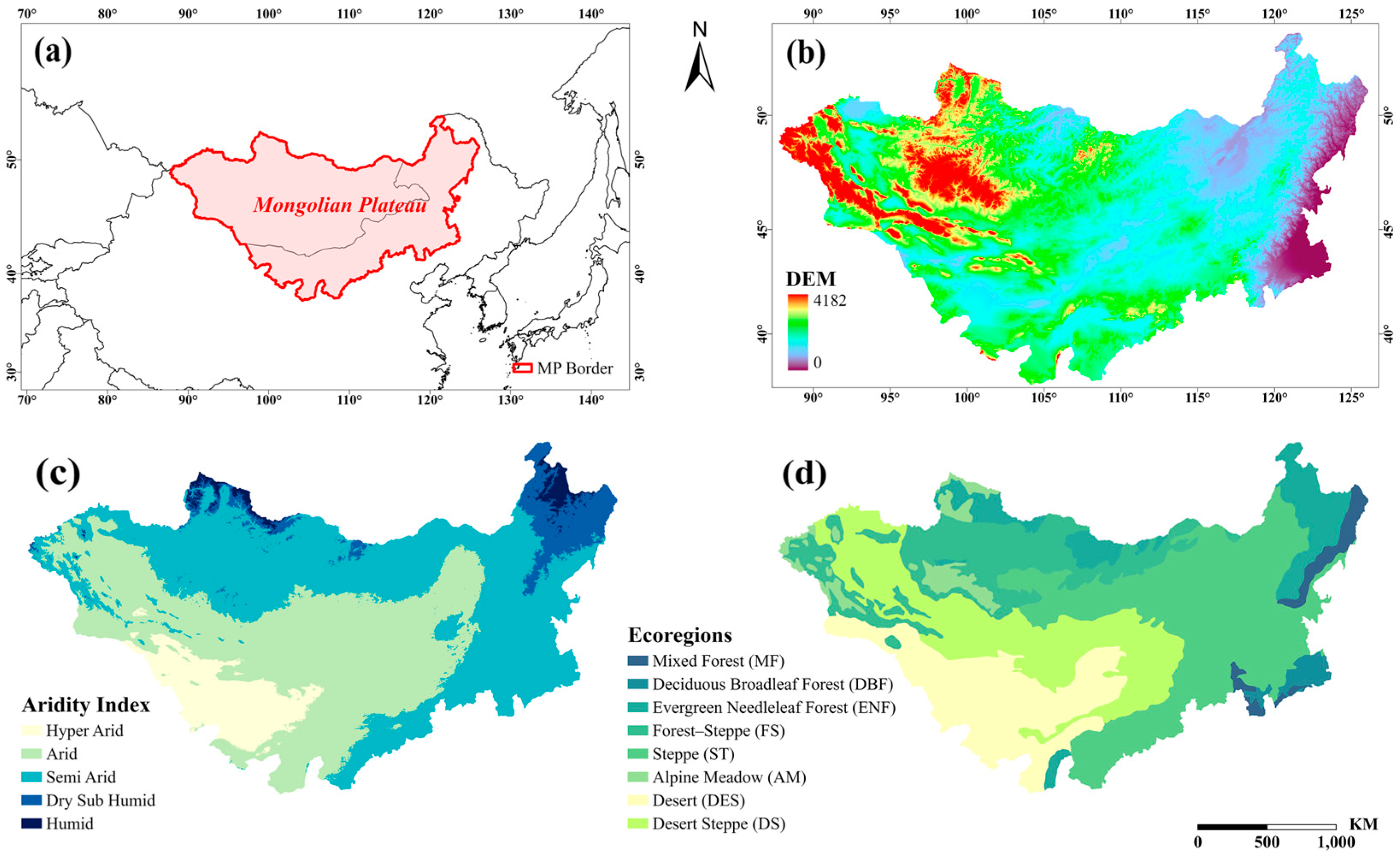
The Mongolian Plateau (37–52 °N, 87–126 °E) spans Mongolia and China’s Inner Mongolia Autonomous Region, covering approximately 3,200,000 km2. The terrain is varied, with extensive highlands and mountains dominating the west and north and often exceeding 1500 m elevation, while the east and south gradually transition into low plains. The region is governed by a continental climate characterized by scarce and unevenly distributed precipitation, resulting in a distinct aridity gradient. According to the UNEP Aridity Index [46], the Plateau can be divided into five dryness levels, with hyper-arid and arid zones concentrated in the central-west and semi-arid to humid areas in the east and north. Eight major ecoregions are represented: mixed forest, deciduous broadleaf forest, evergreen needleleaf forest, forest–steppe, typical steppe, desert steppe, alpine meadow, and desert. An overview of the study area is shown in Figure 1.
Figure 1. Study area of the Mongolian Plateau (MP). (a) Location; (b) digital elevation model (DEM); (c) spatial distribution of aridity index; (d) major ecoregions.

2.2. Datasets

2.2.1. kNDVI Data

To reduce well-known saturation effects of NDVI at high leaf-area index and to enhance sensitivity to changes in sparse vegetation, we used the kernel Normalized Difference Vegetation Index (kNDVI) [47]. Following Camps-Valls et al. (2021) [47], NDVI was first computed from MODIS red and near-infrared reflectance and then transformed using a Gaussian kernel with width σ, after normalizing reflectance to the [0, 1] range. We set σ = 0.5, as recommended by Camps-Valls et al. (2021) [47] based on global evaluations against flux tower GPP and evapotranspiration and as adopted in recent kNDVI applications in semi-arid and high-latitude regions [48,49]. These studies demonstrate that σ ≈ 0.5 provides a robust compromise across vegetation types, alleviates NDVI and EVI saturation, and yields vegetation index trajectories that are more linearly related to carbon and water fluxes. We therefore adopted this default value rather than re-tuning σ for individual ecosystems.
We derived phenological metrics from the kernel Normalized Difference Vegetation Index (kNDVI) [47], calculated from the MODIS MOD13A2 NDVI Collection 6 product (16-day composite, nominal 1 km resolution). On the Google Earth Engine platform (GEE; Google LLC, Mountain View, CA, USA; https://code.earthengine.google.com/, accessed on 20 April 2025), MOD13A2 is provided at its native 1 km resolution; in this study, we used GEE code to resample the product and export it at a spatial scale of 500 m in the native sinusoidal projection. We obtained 506 NDVI scenes spanning 2001–2020. After preprocessing in ArcGIS Pro version 3.6 (Esri, Redlands, CA, USA), NDVI was transformed into kNDVI to enhance sensitivity to sparse vegetation. The resulting 500 m kNDVI time series formed a continuous 20-year record of vegetation dynamics.
To illustrate the quality of the input VI data and the nature of the annual vegetation dynamics, we provide two Supplementary Figures that show the 16-day kNDVI time series from 2001 to 2020 averaged for each ecoregion (Figures S1 and S2). The multi-year kNDVI trajectories exhibit coherent single-peak growing seasons and realistic magnitudes across all ecoregions, supporting the reliability of the input data.

2.2.2. Ecoregion Data

We used the World Wide Fund for Nature’s Terrestrial Ecoregions of the World (TEOW) dataset to delineate ecoregions [50]. Within the Mongolian Plateau, ecoregions were integrated into eight major types: mixed forest (MF), deciduous broadleaf forest (DBF), evergreen needleleaf forest (ENF), forest–steppe (FS), typical steppe (ST), alpine meadow (AM), desert (DES) and desert steppe (DS), as shown in Table 1. For analysis, we grouped ENF–MF–DBF–FS as forest ecosystems, ST–AM as grassland ecosystems, and DS–DES as desert ecosystems. In all subsequent analyses, these eight ecoregions are treated as the primary ecological units. Pixel-level phenological and drought statistics are first calculated for each grid cell and then summarized by ecoregion, whereas Plateau-wide maps and distributions were used only to provide an overview of broad gradients rather than to imply a single homogeneous population.
Table 1. Ecological region codes, types, abbreviations, and their main characteristics across the Mongolian Plateau.

2.2.3. SPEI Data and Processing

We employed the Standardized Precipitation–Evapotranspiration Index (SPEI) to characterize drought severity at multiple timescales (1–12 months) [49]. Monthly SPEI data for 2000–2020 were obtained from the global SPEI base v2.9 dataset with 0.5° resolution provided by the Spanish National Research Council (https://spei.csic.es/spei_database/, accessed on 22 August 2025). These data were used to assess both cumulative and lagged drought effects on phenology (see Section 2.3.4 and Section 2.3.5).
Because the SPEI is designed to represent regional hydroclimatic balance rather than local surface variability, we did not interpolate or statistically downscale the 0.5° fields. Instead, we used a grid-matching (nearest-neighbor assignment) procedure to link the 0.5° SPEI grid to the 500 m kNDVI grid. Each 500 m kNDVI pixel was assigned the monthly SPEI time series of the 0.5° cell containing its center, so that all 500 m pixels within a given SPEI cell shared an identical drought time series while their phenological dynamics were resolved at 500 m. This preserves the native coarse-scale meaning of the SPEI while allowing phenological responses to be analyzed at finer spatial resolution. Similar grid-matching or nearest-neighbor resampling strategies to reconcile coarse-resolution SPEI with finer satellite vegetation products have been widely adopted in large-scale drought–vegetation studies, either by standardizing all datasets to a common coarse grid [51] or by resampling the SPEI to match a finer vegetation grid [52].

2.3. Methods

2.3.1. Extraction of Phenological Metrics

We used the kernel Normalized Difference Vegetation Index (kNDVI) instead of the traditional NDVI to improve sensitivity under sparse vegetation and heterogeneous surface conditions and to reduce saturation at high leaf area index. kNDVI is defined as
k N D V I = t a n h N I R r e d 2 σ 2
where σ is a length-scale parameter that controls the index’s responsiveness in sparse versus dense canopies. Following Camps-Valls et al. (2021) [47], the RBF kernel length-scale is defined as σ =   τ ( N I R   +   r e d ) , and their sensitivity analysis indicated that τ = 0.5 provides a robust, biome-independent configuration. Under this recommended setting, Equation (1) reduces to the closed-form expression in Equation (2),
k N D V I = t a n h ( N D V I ) 2
The kNDVI time series for each pixel was smoothed in TIMESAT version 3.3 (Lund University, Lund, Sweden) software using a Savitzky–Golay filter to remove clouds, aerosols, and other noise while preserving inflection points and seasonal peaks [53]. The filtering can be written as
Y j = i = m m C i Y j = i N
where Y i is the fitted value, C i are the filter coefficients, Y j + i are the original kNDVI values, m is the half-width of the smoothing window, and N is the filter length, equal to the moving window size 2 m + 1 .
Phenological metrics on the Mongolian Plateau were extracted with a dynamic threshold method [50]. For each year, we first normalized the kNDVI curve to the [0, 1] range and then defined SOS as the first date on the rising limb exceeding 30% of the annual amplitude and EOS as the first date on the falling limb dropping below the same threshold.
The dynamic normalization is
k N D V I r a t i o = k N D V I k N D V I m i n k N D V I m a x k N D V I m i n
where k N D V I r a t i o is the normalized value, k N D V I is the kernel NDVI, and k N D V I m a x and k N D V I m i n are the annual maximum and minimum, respectively.
Dynamic amplitude thresholds that define phenological dates as fixed fractions (typically 20%–50%) of the seasonal amplitude are widely used in MODIS-based land-surface phenology, including in semi-arid and high-latitude regions, and have been shown to provide a compromise between robustness to residual noise and sensitivity to interannual variation [54,55]. Here, we adopt a 30% fraction of the seasonal amplitude as a pragmatic intermediate threshold, following these evaluations and our focus on regional-scale patterns rather than exact plot-level dates. Using a relative amplitude threshold on normalized kNDVI also provides a consistent definition of SOS and EOS across forests, steppes, and deserts with very different background reflectance and maximum greenness and is less sensitive than absolute NDVI thresholds or purely inflection-based dates to multi-peaked seasonal trajectories and residual cloud or aerosol contamination, which are common on the Mongolian Plateau. The extracted phenological dates are reported as day of year (DOY).

2.3.2. Coefficient of Variation

The coefficient of variation (CV) is a standardized measure of dispersion commonly used to characterize the temporal or spatial variability of ecological and climatic indicators and to identify areas with elevated variability. It is defined as the ratio of the standard deviation ( σ ) to the mean ( μ ).
C V = σ μ
We computed pixel-level CV values for phenological metrics across the Mongolian Plateau for 2001–2020 to evaluate the long-term stability of phenological timing. Larger CV indicates greater dispersion and thus lower stability, whereas smaller CV indicates lower dispersion and higher stability.
Given the region’s diverse ecosystems and extensive arid and semi-arid zones where phenology detection can be affected by climate fluctuations and sparse vegetation, we filtered the interannual CV calculation to exclude unstable or low-confidence pixels. Specifically, we retained only pixels with at least five valid years and with mean phenological dates later than 20 DOY, and we further required that CV was ≤0.8 for SOS and ≤0.6 for EOS.

2.3.3. Sen’s Slope Analysis and Mann–Kendall Significance Tests

We identified spatiotemporal dynamics in surface phenology using the Theil–Sen slope estimator together with the Mann–Kendall (MK) test. The Theil–Sen median slope provides a robust estimate of a simple linear trend by taking the median of all pairwise slopes in the time series, thereby complementing the nonparametric MK significance test. Statistical significance was defined at p < 0.05 [56]. In this study, we combined the sign and magnitude of the Theil–Sen slope with the MK p -value to classify trends into seven categories; the criteria are summarized in Table 2.
Table 2. Seven-level classification of phenological (DOY) trend direction and statistical significance.

2.3.4. Cumulative Effect Analysis

We assessed the cumulative effect of drought on vegetation phenology by computing Pearson correlation coefficients between phenological metrics and multi-scale accumulated SPEI, which spanned 1–12 months. To quantify cumulative impacts in a physiologically consistent way, we adopted a phenology-anchored approach rather than a fixed calendar-month alignment (see Section 4.4). For year y and accumulation length k , the phenology-anchored drought index is defined as
S P E I k y , m
where m is the month in which the phenological event occurs and serves as the end of the accumulation window. On the Mongolian Plateau, the start of season (SOS) predominantly falls in June, so we set m = 6 ; the end of season (EOS) is concentrated in September, so m = 9 (see Section 3.1.1). Thus, S P E I k y , m represents the k -month accumulated SPEI ending in the phenology month of year y ( k = 1 , 2 , , 12 ). The analysis was performed pixel by pixel, so that each pixel used its own phenology month to define the accumulation window, capturing local sensitivity to the duration of antecedent drought. We then related yearly SOS or EOS date to y , m via Pearson correlation at each pixel:
r k = c o r r P ( y ) , S P E I k y , m ,   k = 1 , , 12
Here, P y denotes the phenological date in year y . We further derived two pixel-wise indicators: (1) the maximum cumulative correlation strength r m a x c u m , defined as the maximum absolute Pearson correlation across all accumulation scales k = 1 , , 12 , which characterizes the strongest coupling between phenology and cumulative drought; and (2) the optimal accumulation scale   k , defined as the timescale at which the absolute correlation attains its maximum, identifying the drought duration to which the pixel is most sensitive. Formally,
r m a x c u m = m a x r k ,   k = 1 , , 12
k = arg max k r k ,   k = 1 , , 12
where r m a x c u m measures the strongest coupling between phenology and cumulative drought, and   k   identifies the most influential accumulation length. To ensure signal quality and reduce chance inflations from multiple windows, we required ∣ r ∣ ≥ 0.35 for EOS and ∣ r ∣ ≥ 0.30 for SOS, thresholds corresponding to a medium effect size with n ≈ 20 years. To avoid sample-set bias from different thresholds, we repeated key statistics on the intersection subset of pixels meeting both criteria; results were consistent with the main analysis.

2.3.5. Lagged Effect Analysis

Lagged effects of drought were tested using Pearson correlations between phenology and 1-month SPEI (SPEI-01) at varying lags. This study extends the conventional framework of lag analysis that aligns monthly NDVI with the SPEI (see Section 4.4 for details). Since phenological metrics are expressed as day of year (DOY) rather than monthly values, it was first necessary to convert each DOY to its corresponding calendar month. Then, for each pixel, we traced back SPEI-01 values for the preceding k months ( k = 1 , 2 , , 12 ) to construct a series of monthly lagged drought indices. The specific definition is as follows:
S P E I k x , y =   S P E I 01 x , y , m y k ,   k = 1 , , 12
Here, x denotes the pixel location, y represents the year, m y is the phenological month of that pixel in year y , and y indicates the year adjusted for cross-year lags. Subsequently, the monthly lagged drought indices were correlated with the phenological time series Q x , y using Pearson correlation analysis.
r k x = c o r r Q x , y ,   S P E I k x , y ,   k = 1 , , 12
On this basis, we extracted, for each pixel, the maximum absolute lag correlation coefficient r m a x l a g x and the corresponding optimal lag month k x .
r m a x l a g x = max r k x ,   k = 1 , , 12
k x = arg max k r k x ,   k = 1 , , 12
Prior to applying Pearson correlations, we conducted exploratory data analysis of the phenology–SPEI relationships (including histograms and Q–Q plots) and confirmed that the distributions did not strongly deviate from normality, supporting the use of Pearson correlation for this 20-year record.

3. Results

3.1. Spatiotemporal Dynamics of Phenology Across the MP

To provide regional context, we first describe Plateau-wide patterns of SOS and EOS and then examine differences among the eight ecoregions. In the following subsections, ecological interpretations focus on contrasts among ecoregions, which are regarded as distinct populations with their own phenological regimes, while Plateau-averaged distributions (like Figure 2, Figure 3 and Figure 4) are used only as descriptive summaries.
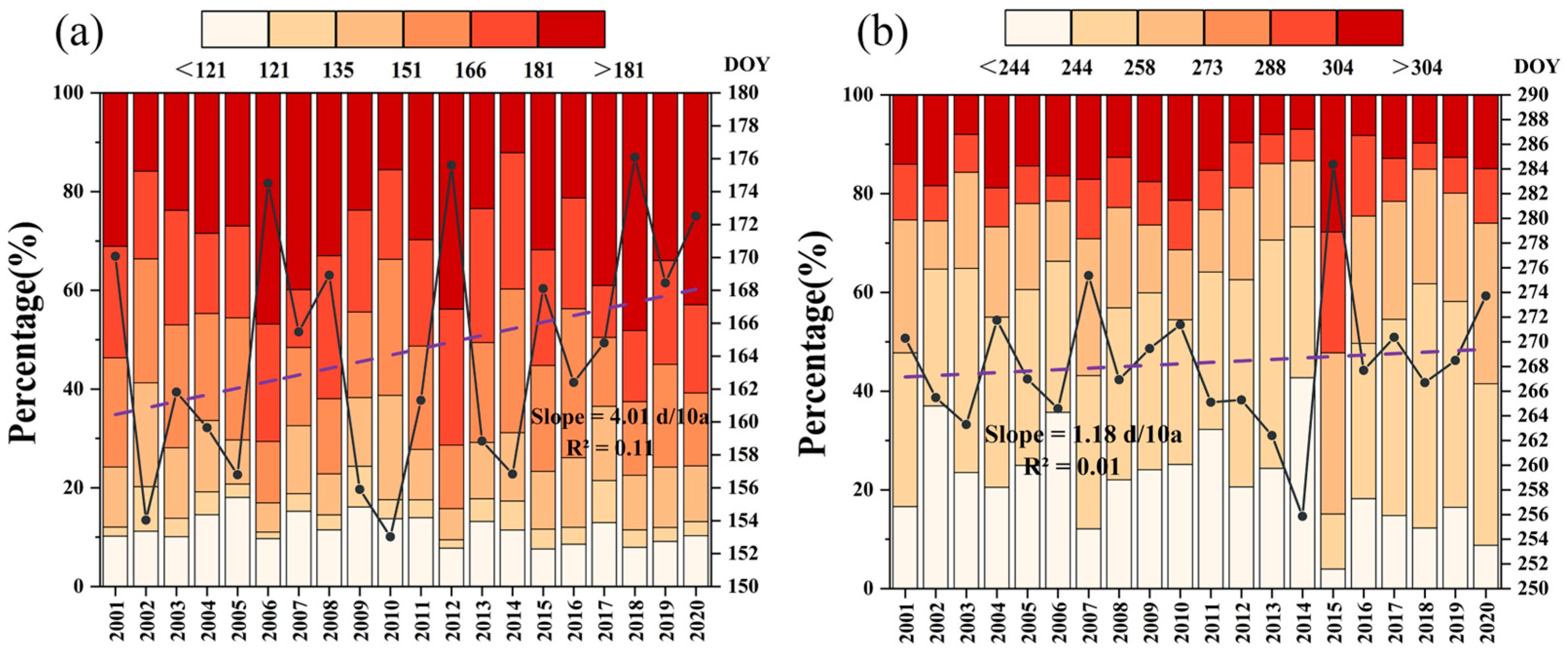
Figure 2. Interannual distribution of phenological metrics on the Mongolian Plateau during 2001–2020. Annual distribution of the (a) start of season (SOS) and (b) end of season (EOS), each shown as stacked percentages across day of year (DOY) intervals with an overlaid trend line.
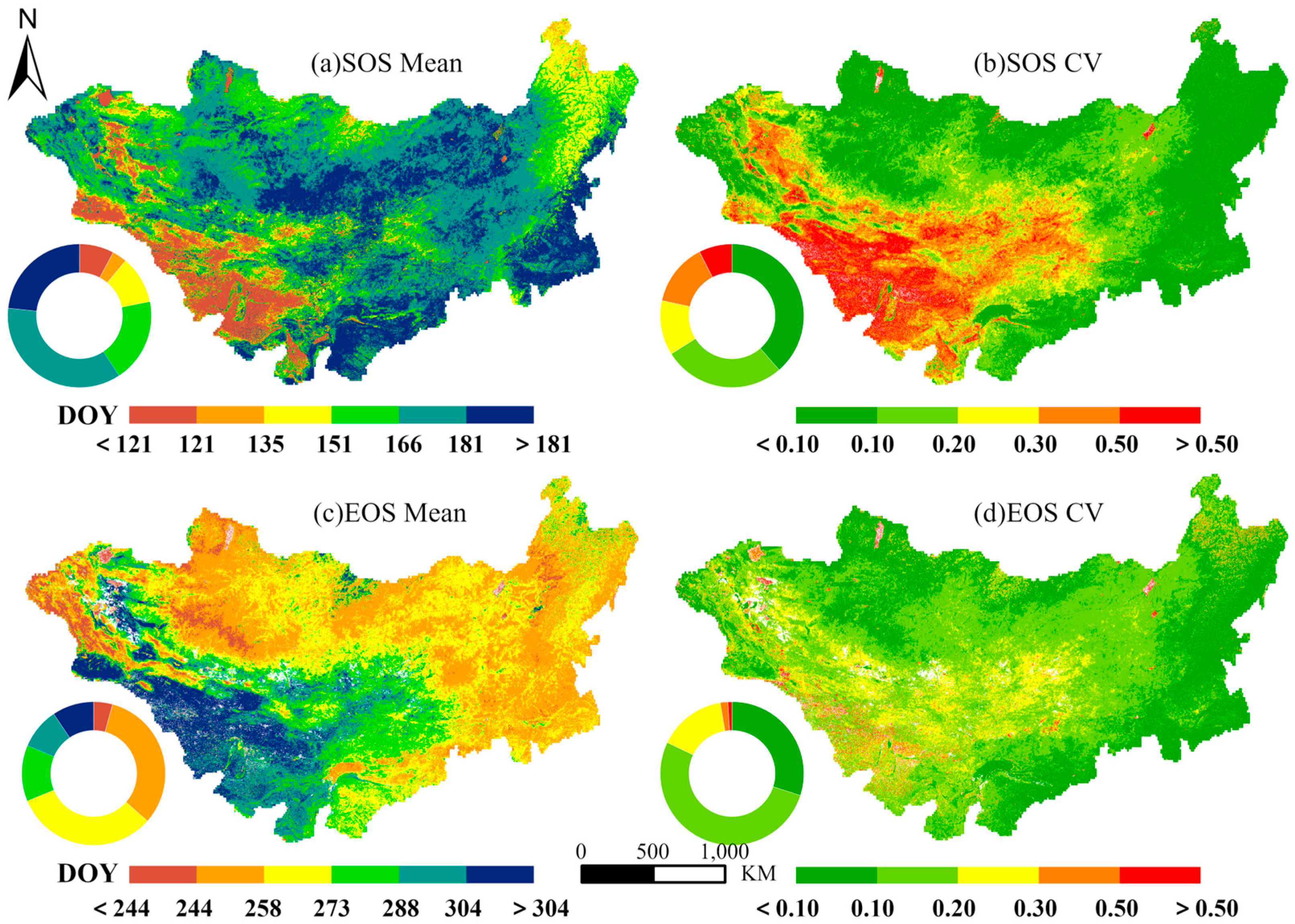
Figure 3. Spatial distribution of phenological metrics on the Mongolian Plateau during 2001–2020. (a) Multi-year mean of SOS; (b) coefficient of variation in SOS; (c) multi-year mean of EOS; (d) coefficient of variation in EOS.
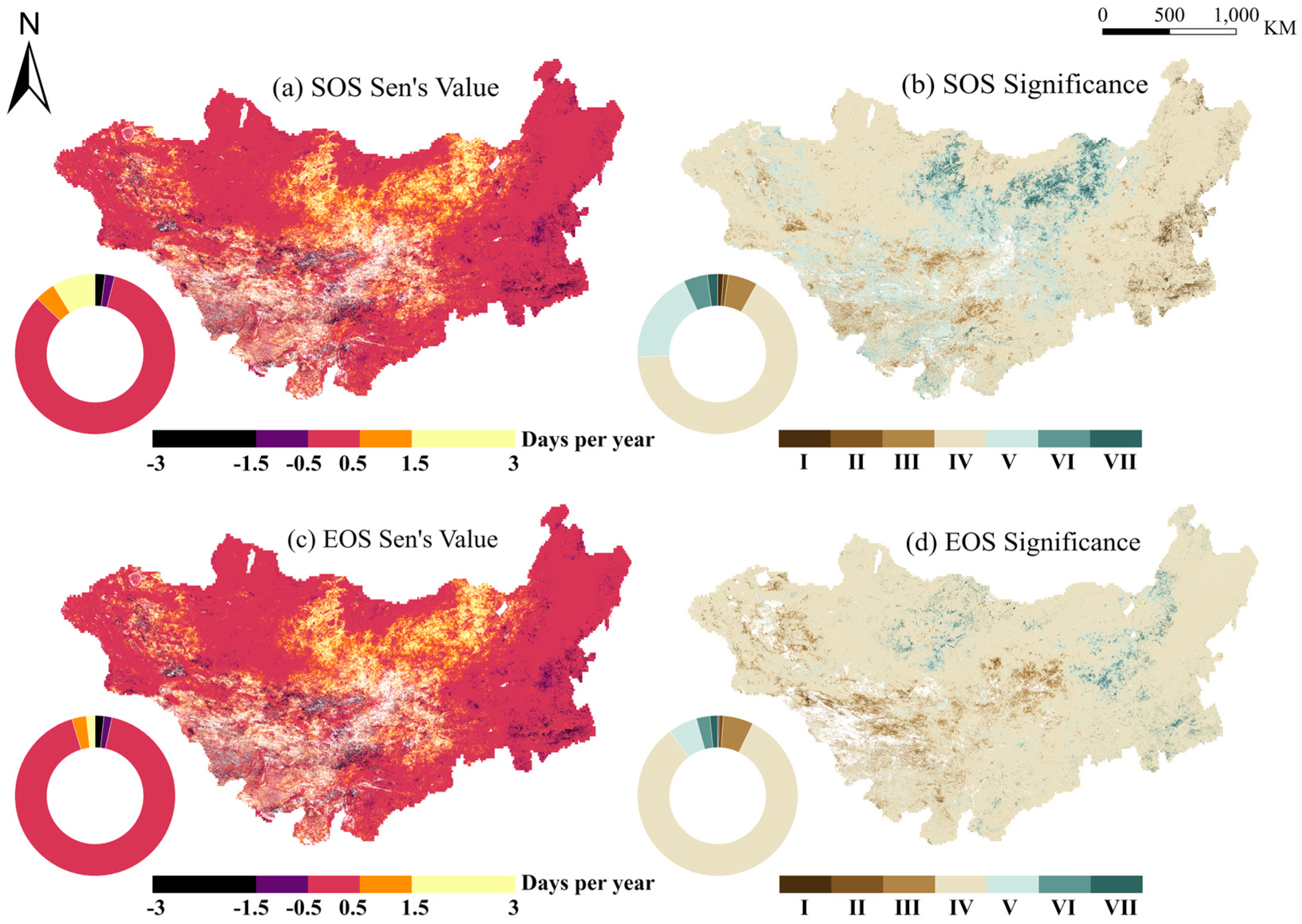
Figure 4. Spatial patterns of phenological trends and their statistical significance on the Mongolian Plateau during 2001–2020. (a) Sen’s slope of SOS; (b) significance classification of SOS trends; (c) Sen’s slope EOS; (d) significance classification of EOS trends. I–II: Significant earlier trends; III–V: non-significant trends; VI–VII: significant later trends.

3.1.1. Spatiotemporal Dynamics of Phenology Across the Whole MP

During 2001–2020, the start of season (SOS) on the Plateau occurred predominantly from late May to June, with more than half of the area greening up within this window in most years, as shown in Figure 2. Approximately 10% to 20% of the region did not initiate growth until July, whereas fewer than 5% greened up before late April. In the time series, SOS exhibited a slight delaying tendency—about four days later per decade—yet strong interannual variability yielded a weak linear fit. The end of season (EOS) clustered between mid-September and mid-October. Under 15% of the area ended by late August, while roughly 10% to 15% extended to late October or early November. The overall EOS trend was near zero, amounting to an insignificant delay of about one day per decade. Notably, widespread early senescence occurred in 2014, whereas 2015 featured broadly delayed senescence. Interannual variability in phenology far exceeded any long-term trend.
The multi-year mean SOS exhibited a pronounced spatial gradient (see Figure 3a). Southern deserts and steppes greened up the earliest, typically from late April to May, whereas northern forests and the western mountains were the latest, often not until July. EOS displayed a complementary pattern (see Figure 3c). Southern deserts tended to end by late August, while northeastern forests frequently persisted into late October or even early November. Variability metrics further accentuated these contrasts (see Figure 3b,d). In the central–southern arid zone, SOS was most volatile, with more than one-third of the area showing a coefficient of variation (CV) of >0.3, indicative of marked year-to-year differences; the northeastern forested region was most stable, generally with CV < 0.1. EOS was, overall, more stable: over 80% of the area had CV < 0.1, and CV > 0.2 occurred only in a few small patches. Interannual variability was greater for SOS than for EOS (Figure 3b,d). Fluctuations in green-up were particularly pronounced across the central steppe and ecotonal zones, where CV commonly exceeded 0.2, whereas EOS variability was comparatively modest, with more than half of the region exhibiting CV between 0.05 and 0.10.
The Theil–Sen slope analysis indicated that SOS changes were minor over most areas (see Figure 4). In more than 80% of the region, the annual rate of change was less than 0.5 days yr−1, totaling about 10 days over two decades. Localized delays exceeding about 1.5 days yr−1 appeared in parts of the central and southwestern Plateau, and scattered advances were observed in the north and west. EOS changes were even weaker, with more than 90% of the area showing less than 0.5 days yr−1. The significance classification confirmed that most trends were not statistically significant. For SOS, about 15% of the area exhibited a significant delay, whereas about 4% showed a significant advance. For EOS, over 90% of the region showed no significant change; significantly delayed EOS occurred in around 6% of the area, and significantly advanced EOS in about 1%.

3.1.2. Spatiotemporal Dynamics of Phenology Across Different Ecoregions of the MP

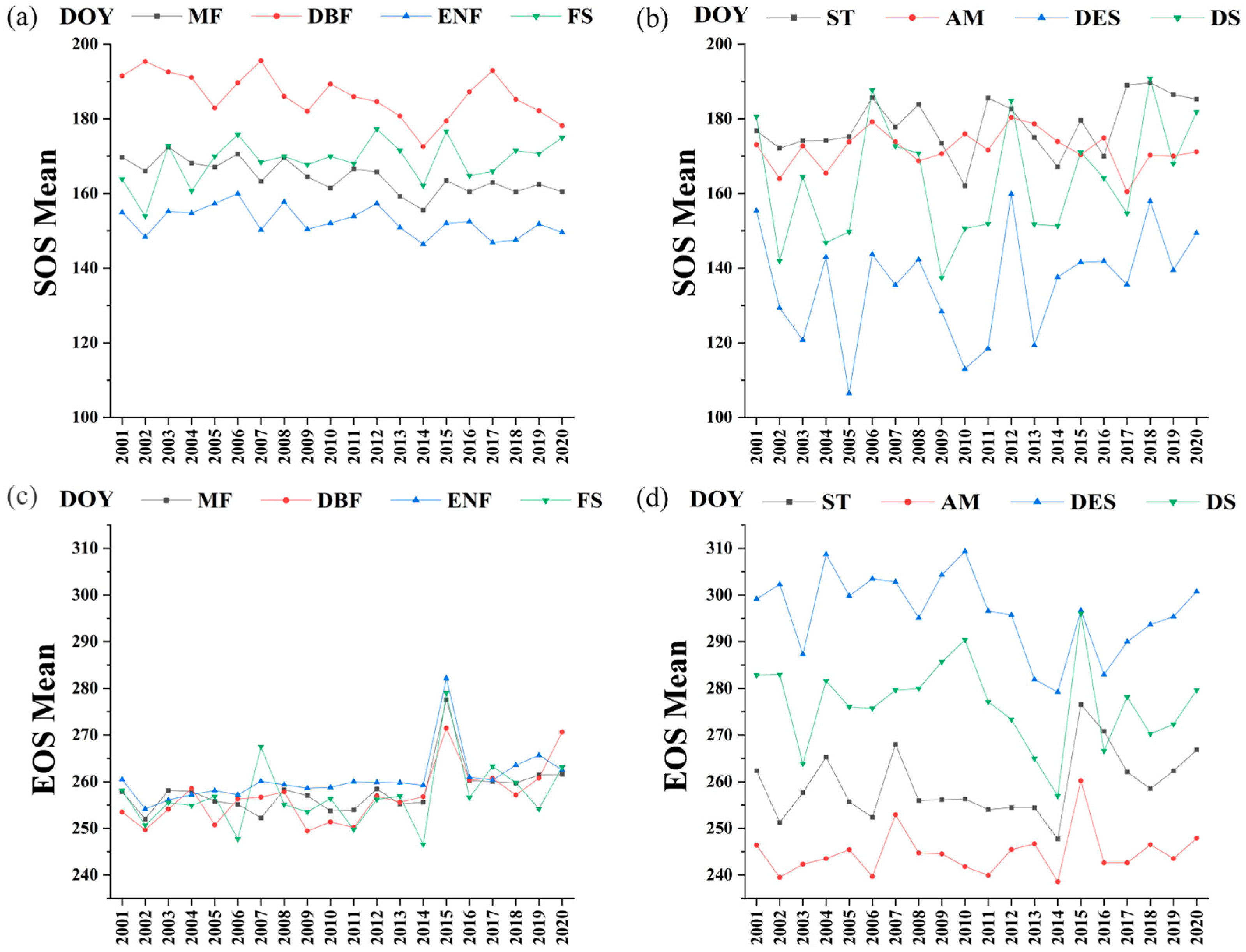
Time-series analyses by ecoregion revealed consistent and distinct differences in phenological behavior (see Figure 5). Within forest ecosystems, deciduous broadleaf forests exhibited the latest SOS, typically in late June, whereas evergreen needleleaf forests greened up earliest, generally in mid- to late May. Mixed forests and forests–steppes showed intermediate timing, with interannual fluctuations usually within ten days. Alpine meadows also greened up in late June and displayed high temporal stability. Typical steppe and desert steppe showed larger fluctuations, while deserts were the least stable. During wet years, green-up occurred as early as early April, whereas in dry years it was delayed until early July. The EOS patterns were similarly differentiated. Evergreen needleleaf forests ended the growing season latest, usually from late September to early October; alpine meadows ended the earliest, around early September; and grasslands and desert steppes typically ended in mid- to late September. Deserts exhibited the greatest variability, ending as early as late August in some years and as late as early November in others. In 2015, EOS was notably delayed across most ecoregions, extending to late October or even early November.
Figure 5. Mean interannual variations in phenology across different ecoregions. (a) Mean SOS for MF, DBF, ENF, and FS; (b) mean SOS for ST, AM, DES, and DS; (c) mean EOS for MF, DBF, ENF, and FS; (d) mean EOS for ST, AM, DES, and DS.
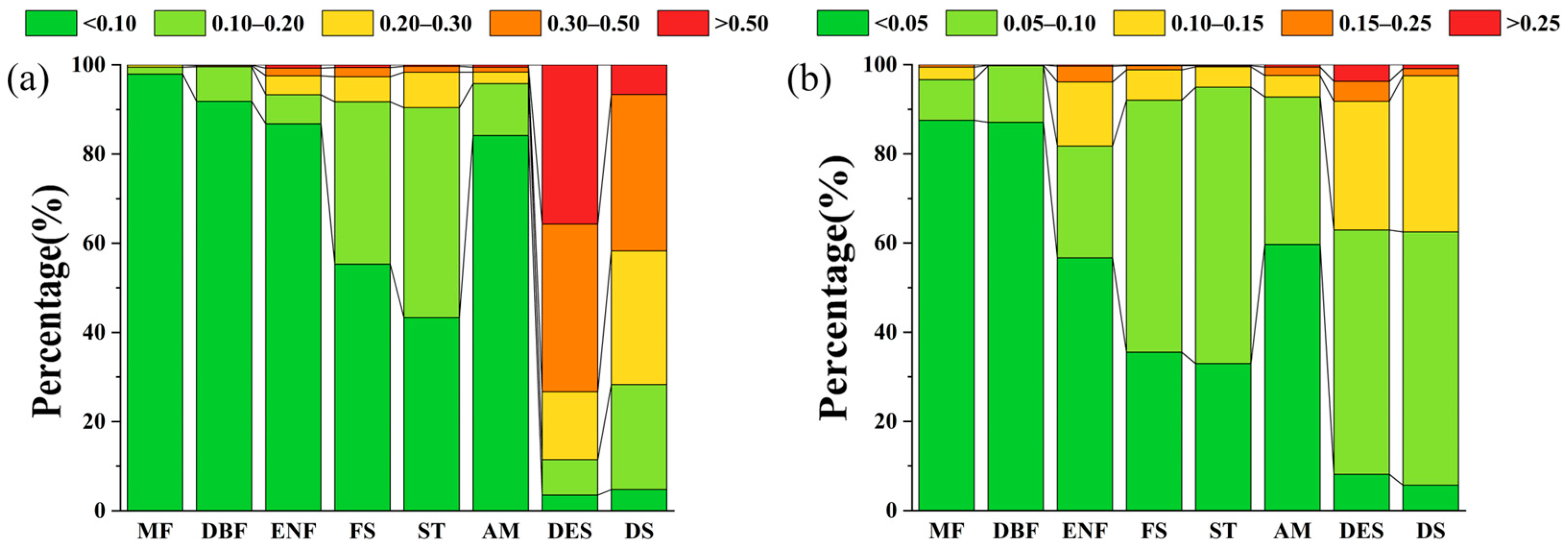
The spatial distribution of the coefficient of variation (CV) highlighted pronounced differences among ecosystems (see Figure 6). Forests and alpine meadows had extremely low SOS variability, with over 80% of their area showing CV < 0.1. Typical steppes exhibited moderate variability, with about half of the area below 0.1 and roughly one-quarter between 0.1 and 0.3. Desert-steppe and desert ecosystems were the most unstable. In deserts, more than two-thirds of the area had CV > 0.2, including about 40% with CV > 0.5. These high SOS CV values in desert and desert-steppe regions mainly reflect genuine year-to-year shifts in the onset of greening under highly variable rainfall and occasionally truncated growing seasons, rather than methodological errors in the phenology extraction. EOS was, overall, more stable across all ecosystems. In forests and alpine meadows, more than 70% of the area had CV < 0.05, and most of the remainder ranged from 0.05 to 0.10. Even in desert regions, the majority of pixels had CV < 0.10, with only a few areas exceeding 0.15. Overall, EOS exhibited substantially higher temporal stability than SOS.
Figure 6. Percentage distribution of the coefficient of variation (CV) of phenology across ecoregions. (a) Proportions of SOS CV values within different ranges; (b) proportions of EOS CV values within different ranges.
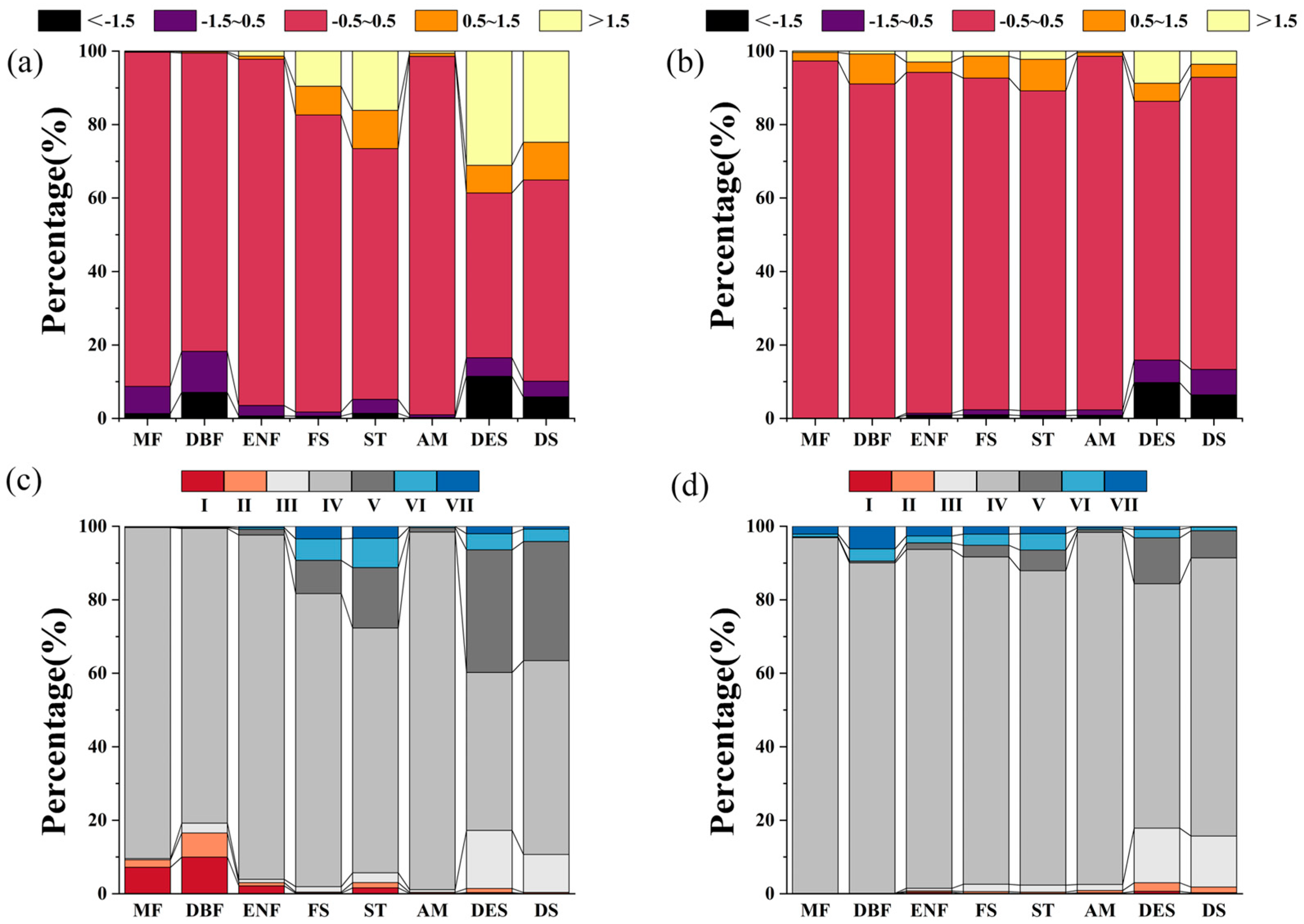
Trend analyses by ecoregion further confirmed the general stability of phenological timing (see Figure 7). In forests and alpine meadows, more than 90% of pixels had SOS trends within ±0.5 days yr−1, with very few significant changes. Typical steppe was similarly stable, with only a few areas showing delayed trends. Desert-steppe and desert ecosystems exhibited larger variability. In deserts, approximately 40% of the area showed evident SOS trends, including about 10% delayed by more than 1.5 days yr−1 and around 5% advanced by more than 1.5 days yr−1; these areas also coincided with most of the statistically significant trends. EOS remained nearly unchanged across all ecoregions, with over 90% of the area showing slopes within ±0.5 days yr−1 and significant results being extremely rare, generally below 5%.
Figure 7. Percentage distribution of Sen’s slope and significance levels of phenology across ecoregions. (a) Proportions of Sen’s slope values for SOS; (b) proportions of Sen’s slope values for EOS; (c) proportions of significance levels (I–VII) for SOS trends; (d) proportions of significance levels (I–VII) for EOS trends.

3.2. Cumulative and Lagged Drought Effects on Phenology Across the MP

3.2.1. Cumulative Effects on Phenology Across Different Ecoregions of the MP

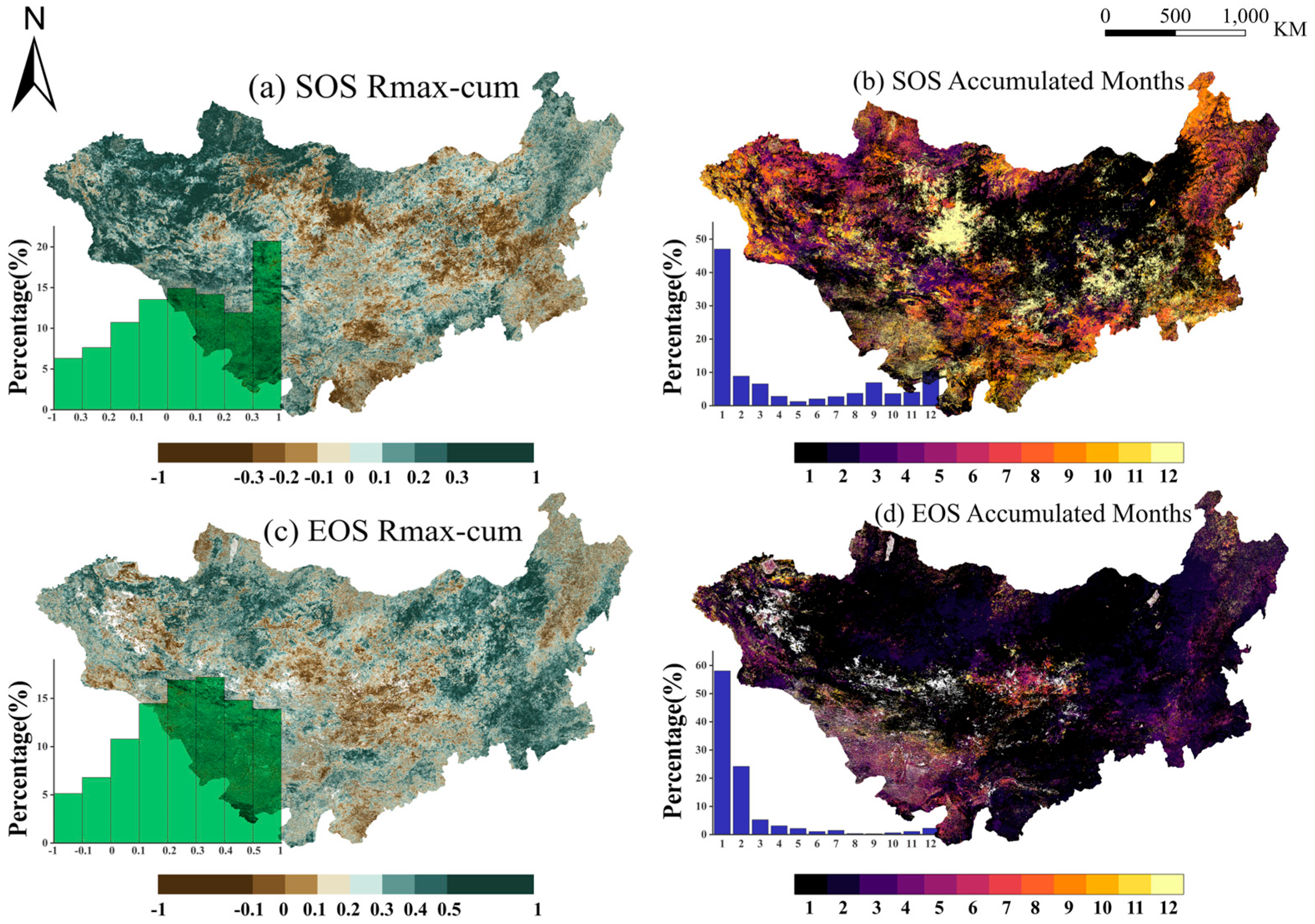
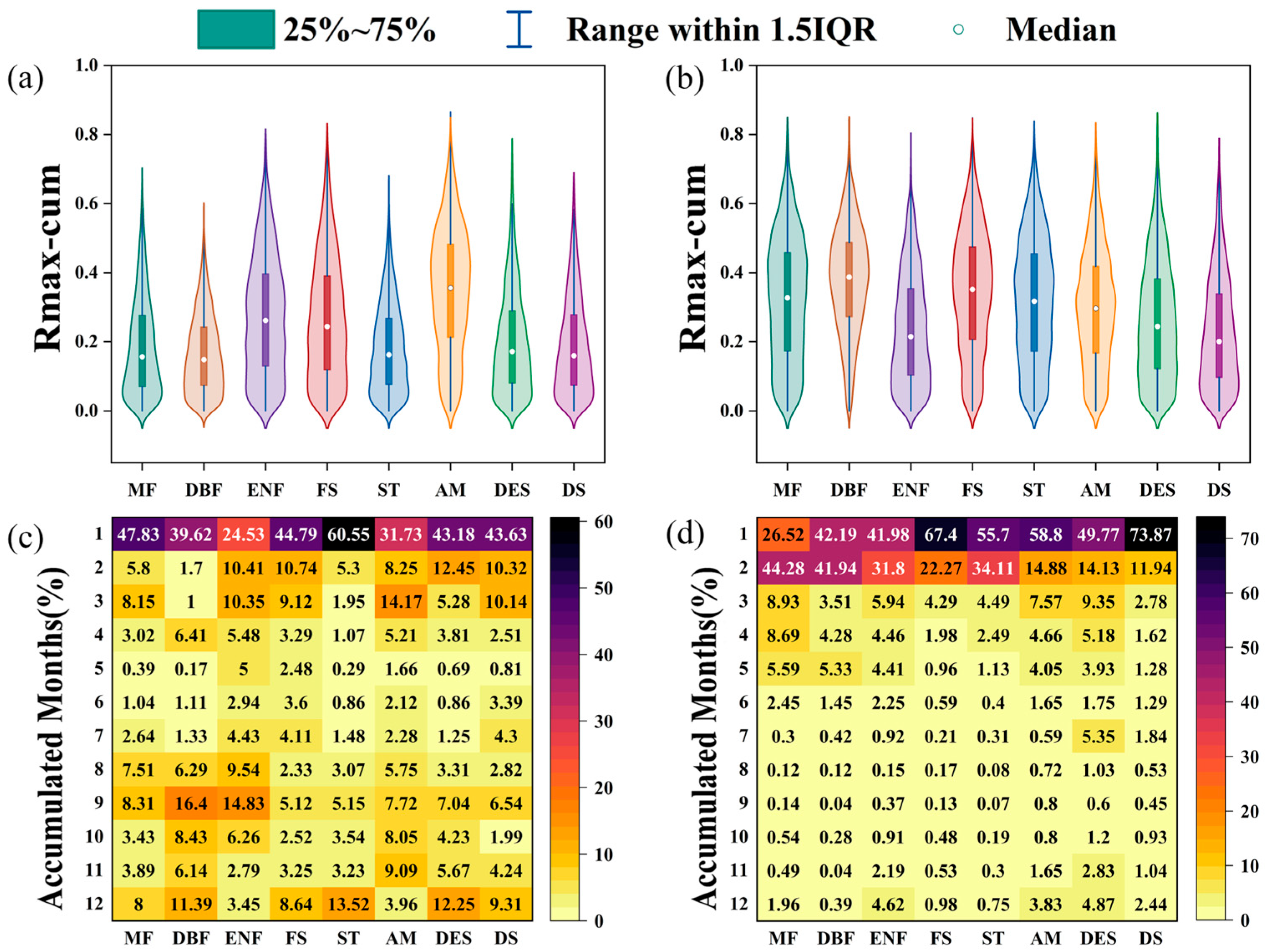
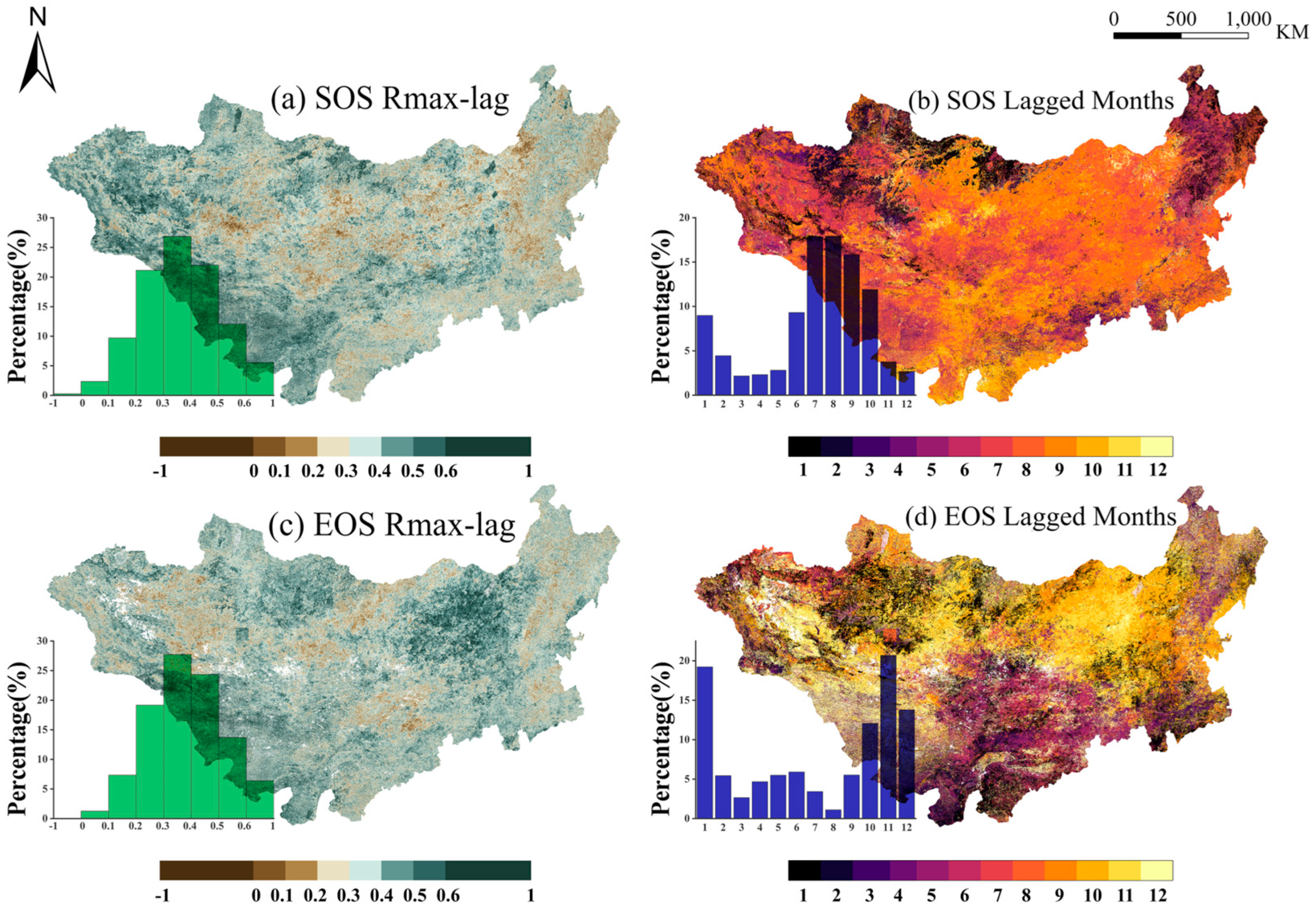
Across the Mongolian Plateau, the spatial distribution of cumulative drought–phenology correlations shows a clear and consistent pattern (see Figure 8a,c). For SOS, positive correlations dominate, generally ranging from 0.10 to 0.30, with distinct high-value corridors in the northeast reaching 0.35 to 0.40. These areas indicate that wetter antecedent conditions tend to promote earlier green-up, while drier conditions delay the onset of vegetation growth. In contrast, weaker or near-zero correlations cluster in the southwest and interior arid zones, where vegetation is sparse and the water–phenology coupling is less stable. The overall histogram exhibits a right-skewed shape, confirming that moderate correlations are widespread, whereas strong positive responses occur mainly in high-latitude or high-elevation regions with greater soil-moisture storage capacity.
Figure 8. Spatial patterns of cumulative effect correlations of phenology. Maximum cumulative correlation coefficient (Rmax-cum) for (a) SOS and (c) EOS with histogram distribution; accumulated months corresponding to (b) SOS and (d) EOS with histogram distribution.
The spatial pattern of optimal accumulation months reveals an evident difference between seasons (see Figure 8b,d). The 1-month window overwhelmingly dominates, with more than 60% of pixels falling within this range. However, in the central and southern Plateau, a secondary mode appears, with preferred windows of 8–12 months, forming continuous long-window belts. These regions are mainly transitional ecosystems or semi-arid grasslands, where vegetation growth depends on the combined effects of multi-month water accumulation and antecedent drought recovery. Such dual-scale control suggests that spring phenology in the Plateau integrates both short-term and long-term hydroclimatic memory.
For EOS, the cumulative control is simpler and generally weaker. Correlations mainly range between 0.10 and 0.25, with only a few patches exceeding 0.30. The 1-month window overwhelmingly dominates, with more than 60% of pixels under this range, while windows longer than 3 months are very limited. Even in regions where SOS shows a strong multi-month memory, EOS tends to revert to a short timescale, indicating that autumn senescence is controlled mainly by near-term water conditions rather than by cumulative drought. Overall, the results show that SOS exhibits strong spatial heterogeneity and a clear dual-scale response, while EOS presents a more uniform short-memory process across the Plateau.
The ecoregion-based statistics further support the spatial findings and highlight systematic differences among vegetation types (see Figure 9). For SOS, nearly all ecoregions show a dominant short-term response, with the 1-month accumulation window accounting for the largest proportion, but the relative strength of this short-term control varies. In forests and alpine meadows, where soil water storage is larger and evapotranspiration is lower, an additional peak appears at 8–9 months, indicating that phenology in these ecosystems is influenced by longer hydroclimatic memory. In contrast, grasslands and deserts rely more heavily on immediate moisture, though some pixels in these arid areas still exhibit 12-month windows, reflecting cross-year effects under strong interannual drought variability.
Figure 9. Statistics of cumulative effect correlations of phenology across ecoregions. Distribution of Rmax-cum for (a) SOS and (b) EOS across ecoregions; percentage distribution of accumulated months corresponding to (c) SOS and (d) EOS across ecoregions.
The magnitude of cumulative correlation also differs among ecoregions. Forests and alpine meadows display the highest median Rmax-cum values, followed by typical steppes and forests–steppes, whereas deserts and desert steppes show the weakest relationships. These gradients suggest that vegetation with deeper roots and greater biomass has a higher capacity to integrate multi-season drought information. For EOS, ecoregional contrasts are much weaker. The 1-month window overwhelmingly dominates in all ecosystems, typically covering 60% to 70% of area, and windows beyond 3 months account for less than 10%. Correspondingly, EOS correlations are generally low, with median values around 0.15 to 0.20, supporting the conclusion that autumn phenology is governed primarily by current water availability.
In summary, ecoregional differences illustrate a transition from strong, dual-scale cumulative effects in forests and alpine systems to short-term and single-scale responses in arid ecosystems. This spatial and functional gradient highlights the role of ecosystem structure and rooting depth in mediating drought memory. The results also explain why SOS exhibits more pronounced variability across ecosystems than EOS, providing a physiological basis for the seasonal asymmetry observed in the Plateau.

3.2.2. Lagged Effects on Phenology Across Different Ecoregions of the MP

Across the Mongolian Plateau, lagged correlations between drought and phenology display clear spatial organization and distinct seasonal contrasts (see Figure 10). For SOS, positive correlations dominate most of the Plateau, generally ranging between 0.20 and 0.40, with widespread moderate-to-strong values in the north and east, while weaker relationships occur in the southwestern arid zones. The histogram shows that most pixels fall between 0.25 and 0.45, suggesting that spring phenology responds significantly to drought conditions several months before the onset of growth. EOS exhibits similar but slightly weaker correlations, mostly 0.15 to 0.35, indicating that senescence also reflects earlier moisture anomalies but to a lesser degree.
Figure 10. Spatial patterns of lag effect correlations of phenology. Maximum lag correlation coefficient (Rmax-lag) for (a) SOS and (c) EOS with histogram distribution; lagged months corresponding to (b) SOS and (d) EOS with histogram distribution.
The optimal lag months reveal different timing sensitivities between the two seasons. For SOS, lag periods concentrate mainly around 6–9 months, accounting for over 60% of all pixels, while shorter lags of 1–3 months appear only sporadically. These results indicate that drought conditions from the previous summer or autumn strongly influence green-up in the following spring through delayed soil-moisture replenishment and physiological memory. For EOS, lag responses are much shorter: more than half of the pixels are associated with 1–2 months, while only limited areas show longer delays of 8–12 months. This means that vegetation senescence is primarily governed by near-term drought events occurring shortly before the end of the growing season.
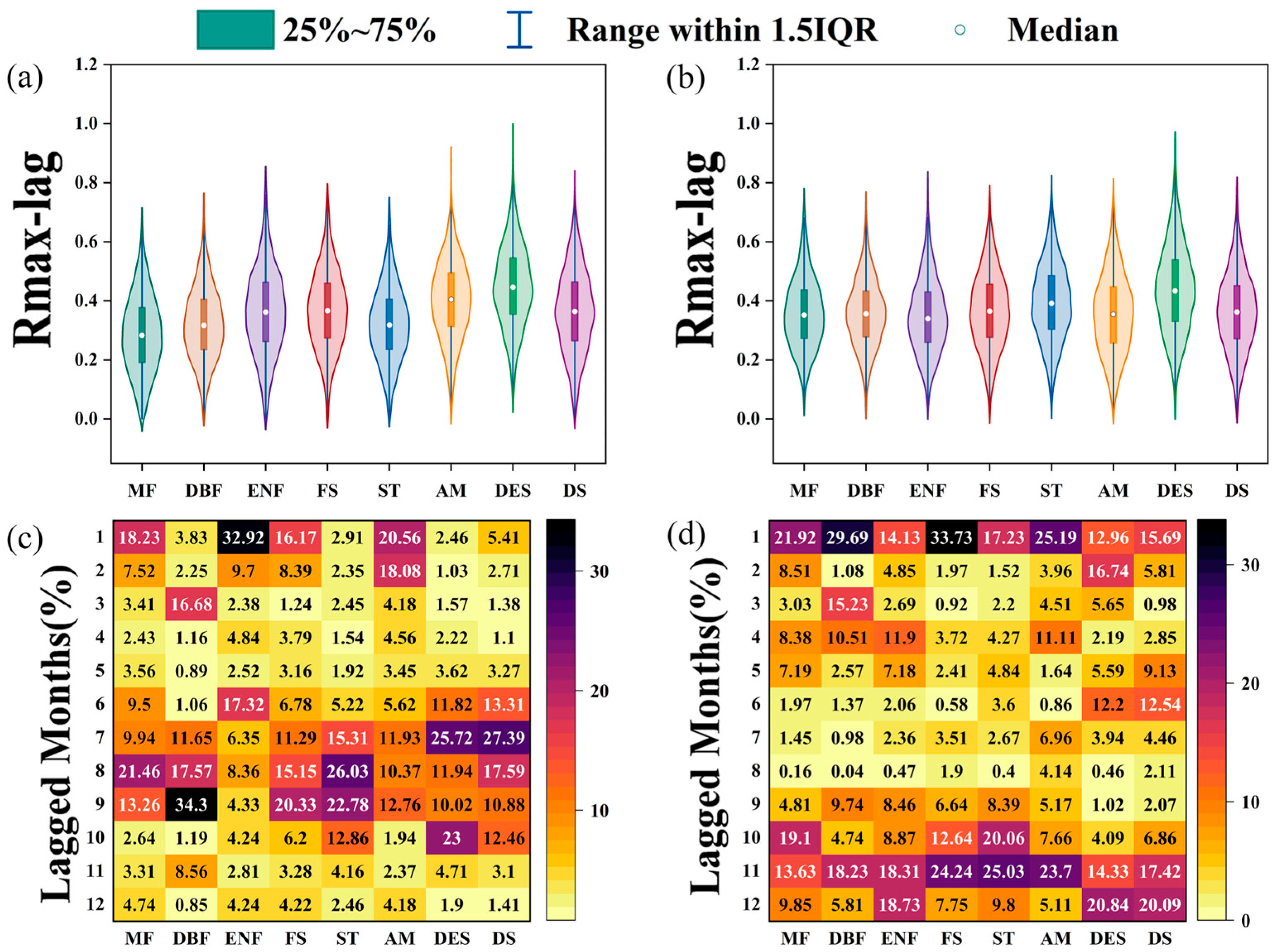
Ecoregion-level analysis further illustrates the variability in lagged drought responses among different vegetation types (see Figure 11). For SOS, median Rmax-lag values are generally higher than for EOS, clustering around 0.30 to 0.45 in forests and alpine meadow and slightly lower in steppe and desert ecosystems, with mostly 0.25 to 0.35. This pattern suggests that ecosystems with deeper rooting and stronger soil-moisture buffering sustain longer drought memory. The violin plots reveal relatively narrow distributions in forests and meadows, indicating stable lag responses, whereas arid systems display broader spreads, reflecting greater heterogeneity in drought timing and vegetation recovery.
Figure 11. Statistics of lag effect correlations of phenology across ecoregions. Distribution of Rmax-lag for (a) SOS and (b) EOS across ecoregions; percentage distribution of lagged months corresponding to (c) SOS and (d) EOS across ecoregions.
The optimal lag months also differ clearly among ecosystems. For SOS, most ecoregions show dominant lags of 6–9 months, together accounting for about 60%–70% of the pixels, with forest–steppe and alpine meadow showing the longest delays, usually up to 10–11 months. These results confirm that pre-season drought, particularly from the previous warm season, has a prolonged influence on spring phenology. For EOS, lag times are much shorter. The 1–2 month range dominates all ecosystems, exceeding 50% in most regions. Longer lags above 6 months occur only occasionally, primarily in forest–steppe and typical steppe. Median correlation strengths are lower, generally around 0.20–0.30, supporting the view that senescence is mainly driven by short-term water deficits.
Overall, lag effects are spatially coherent and seasonally asymmetric. Spring green-up exhibits long-lag responses of up to nearly one year, especially across central and northern grasslands and forest–steppe mosaics, whereas autumn senescence depends mainly on short lags of one to two months. Ecoregion comparisons emphasize a transition from long-lag, high-memory systems like forests and alpine meadows to short-lag, rapid-response systems like grasslands and deserts. The stronger SOS memory reflects delayed soil-moisture recharge and physiological carry-over from the previous year, whereas the short EOS lag indicates quick adjustment to end-of-season conditions. This pattern of contrasting lag scales complements the cumulative effect results, confirming that the two phenological phases differ not only in sensitivity but also in the temporal depth of their drought responses.

4. Discussion

4.1. Phenological Trends on the Mongolian Plateau

We found only modest long-term trends in phenology on the Mongolian Plateau during 2001–2020. SOS advanced by 0.04 days per year, which is approximately 0.4 days/decade, and EOS by 0.12 days per year, which is approximately 1.2 days/decade, both changes being weakly significant. These results echo prior analyses. For example, Miao et al. reported similarly small changes over 1982–2011, which was SOS 0.10 days/yr earlier, EOS around 0.11 days/yr later [4]. Such minor trends are also consistent with global warming patterns. The IPCC notes a 0.85 °C rise in average temperature since 1880, and many studies show that higher spring temperatures advance green-up and warmer autumns delay senescence [57]. Thus, the general expectation is for earlier springs and later falls under climate warming [58]. Our net trends likely reflect the short record and large year-to-year variability. Years like 2005 and 2015 had anomalously early springs or late falls, but these were offset by opposite anomalies in other years.
Clear gradients appear spatially. In spring, vegetation in the warmer, low-elevation south greens up first, often in late April to mid-May, whereas the colder, high-elevation north often starts in late May or June. Conversely, autumn senescence follows the reverse gradient. Northern grasslands and boreal forests begin leaf-drop by late August or early September, while southern steppe and desert vegetation remain green into October. These patterns reflect regional climate gradients. The southern Plateau is generally warmer and drier, with earlier snowmelt and soil thaw [39], promoting early green-up, whereas the north experiences later snowmelt and spring growth. Similarly, northern areas see shorter days and moisture declines earlier, inducing earlier senescence, while arid southern plants extend their season under longer warm conditions. Such climate-driven phenology gradients conform to expectations for continental drylands. Warming promotes earlier springs and later autumns overall, but local climate and ecosystem factors modulate these effects.
Importantly, phenological strategies vary by vegetation type. Forested zones exhibit a strategy of late spring and early autumn. For example, woodlands and alpine meadows tend to green up later and senesce earlier, concentrating growth in midsummer. In contrast, arid ecosystems, including deserts and dry steppes, use a strategy of early spring and late autumn. They initiate growth at the first opportunity of winter to spring moisture and delay senescence into fall to maximize a short growing season. These strategies align with plant traits [43]. Deep-rooted forests can buffer dry spells and rely on stable summer moisture [41], whereas shallow-rooted desert plants must exploit sporadic precipitation whenever it occurs. In total, the plateau’s phenology follows the general global pattern of warming-driven shifts but is modulated by local climate constraints and ecosystem adaptations.
Because long-term in situ phenological observations are sparse on the Mongolian Plateau, the SOS and EOS dates used here represent land-surface phenology derived from MODIS NDVI rather than direct ground measurements, and our interpretations are made at the level of satellite pixels and aggregated ecoregions.
For evergreen needleleaf forests in particular, the relatively weak drought sensitivity that we detect should be interpreted with caution, because NDVI- and kNDVI-based metrics primarily capture canopy greenness and may underestimate seasonal adjustments in photosynthetic activity, as discussed in Section 4.5.2.

4.2. Cumulative Effects of Drought on Vegetation Phenology

Across the Plateau, SOS responded primarily to short (one month) accumulation windows, but forests and alpine meadows also showed a secondary sensitivity to longer windows of about 8–9 months, reflecting the influence of moisture conditions carried over from the previous cold season. In our data, prolonged deficits like multi-month low SPEI before the growing season significantly delayed SOS, whereas drought stress during the season brought forward autumn senescence. Mechanistically, extended moisture deficits deplete soil water and plant reserves [32], delaying green-up until conditions recover, while cumulative stress triggers plants to senesce sooner at season’s end. These findings echo broader evidence. For example, Zhang et al. showed that declining precipitation frequency intensified drought stress and drove earlier leaf senescence [17]. In our study, SOS was most sensitive to drought accumulated in late winter–spring, which was roughly 6–10 months prior, reflecting reliance on stored moisture; severe winter–spring droughts delayed SOS by several days [59]. By contrast, EOS responded strongest to recent summer–autumn moisture, which was 1–3 months prior. This suggests spring phenology depends on long-term soil recharge, whereas autumn phenology reflects short-term resource depletion [60].
Different vegetation types across ecoregions clearly mediates these responses. Forested areas generally showed weaker cumulative effects and more uniform drought timing, reflecting their buffering capacity like deep roots and canopy shading [38]. In contrast, grasslands and especially deserts were highly sensitive: in these zones, SOS was strongly delayed by long drought accumulation, while EOS advanced markedly with recent moisture deficits [33]. This pattern agrees with global biomes’ responses. Water-limited ecosystems often “escape” drought by hastening their life cycles, whereas deep-rooted forests can sustain growth longer [51]. In sum, prolonged drought significantly delays spring green-up and accelerates autumn senescence on the Mongolian Plateau, with stronger effects in dryland ecosystems.

4.3. Lag Effects of Drought on Vegetation Phenology

In addition to concurrent drought, we identified pronounced lag effects. SOS in a given year was significantly correlated with drought conditions in the previous winter and even late prior year. Severe drought occurring in the late growing season of year t − 1 was associated with later SOS in year t, with the strongest correlations corresponding to lags of about 6–9 months. In contrast, EOS had a shorter lag. Drought in the immediately preceding 1–2 months, usually late summer or early autumn, most strongly advanced senescence that year. This cross-season memory arises because drought effects persist. If the preceding year was dry, plants entering dormancy face depleted soil moisture. Our results thus show long drought episodes delay the following spring, whereas short deficits influence the upcoming autumn. These lagged influences are consistent with the recent literature. Li et al. found that more than half of ecosystems did not recover from extreme droughts within one season and that spring phenology was delayed in the subsequent year after such events [19]. Similarly, Liu et al. demonstrated that droughts substantially delayed next-year green-up, especially after prolonged droughts with slow soil moisture recovery [20].
In practical terms, if drought persists into winter or spring, the next spring’s SOS is postponed; by contrast, summer or autumn drought quickly shortens the same year’s growing season. Both lagged and immediate droughts therefore shape phenology. Long episodes, usually 6–12 months, have delayed effects on next spring’s SOS, while short episodes, usually 1–2 months, impact the current autumn. These findings highlight the importance of phenological “memory.” Recent analyses suggest that post-drought environmental conditions, but not plant internal memory, largely drive legacy effects on spring phenology [33]. In summary, vegetation on the Mongolian Plateau shows significant drought lag effects. Past-season water stress can carry over to affect next year’s spring SOS [52], while recent drought affects the current year’s autumn EOS timing.

4.4. Methodological Innovations

Our study introduced several methodological innovations to relate drought and phenology. First, we used a phenology-anchored SPEI approach. Rather than computing the SPEI over fixed calendar windows, we anchored the accumulation windows to each pixel’s phenological event month, for example, the SPEI ending in each year’s SOS month for spring, and in the EOS month for autumn. This ensures the drought index directly corresponds to the period preceding the phenological event, yielding a more meaningful coupling of water deficit to phenology. For example, since most SOS events on the Plateau occur in June, we calculated the SPEI accumulated up to June for each pixel and year; similarly, because EOS usually occurs in September, we anchored the SPEI to September. Thus, each pixel’s most sensitive drought timescale is determined in its own phenological context. This phenology-anchored framework contrasts with conventional fixed-window analyses and enhances detection of relevant drought–phenology linkages.
Second, to quantify lag effects we implemented a day-of-year to month mapping. Phenology metrics are expressed in DOY, so for lag analysis we first convert each SOS or EOS DOY to the corresponding month, then retrospectively extract monthly SPEI up to 12 months prior. This produces a set of lagged monthly SPEI indices (lags 1, 2, …, 12) aligned to the phenology. We then compute pixel-wise correlations between the phenology time series and each lagged SPEI. This extended framework—beyond simply aligning calendar months—allows precise attribution of how far back past drought influences phenology. Third, we applied pixel-level optimization of the drought–phenology correlation. For each pixel we identified the accumulation length or lag month that maximized the absolute SPEI–phenology correlation. This “optimal timescale” mapping reveals spatial patterns in how different regions respond to drought. By optimizing at the pixel level rather than using a uniform timescale, we account for local ecological differences. For example, recent studies highlight that phenology and pre-drought conditions critically affect drought response [61].
These methods build on recent advances in drought analysis. For instance, Peng et al. showed that incorporating vegetation and land-surface characteristics into drought indices significantly improved representation of ecosystem drought stress, and our phenology-anchored SPEI similarly integrated biological timing into the index [21]. By combining phenological and hydrological data at the pixel level, our methodology provides a refined analysis of drought–phenology coupling. These innovations should aid future studies of ecosystem responses to climate extremes.

4.5. Limitations

4.5.1. Lack of In Situ Observations and Uncertainties in Phenology Extraction

First, our analysis relies entirely on satellite-derived land-surface phenology metrics and does not include ground phenological observations from the Mongolian Plateau. As a result, we were not able to calibrate or validate the 30% seasonal-amplitude threshold against in situ data or rigorously benchmark it against alternative extraction methods such as absolute NDVI thresholds or inflection-point algorithms. We adopted the 30% dynamic threshold because it was widely used in MODIS-based phenology studies in semi-arid and high-latitude regions and yielded internally consistent SOS and EOS dates across ecosystems with very different background greenness in our study area.
This choice also falls within the commonly used 20%–50% seasonal-amplitude range, and previous evaluations have shown that thresholds near 30% provide a reasonable compromise between suppressing residual noise and retaining sensitivity to interannual variability [54,55,62]. Comparative studies further indicate that dynamic amplitude thresholds within this range generally yield SOS and EOS dates that are broadly consistent with those from inflection-point or maximum-slope methods when the seasonal curve is well behaved, while being more robust in noisy or multi-peaked time series that are typical of drylands [63].
Nevertheless, different thresholds or curve-fitting schemes can shift the absolute SOS/EOS dates and, in particular, contribute to the well-known larger uncertainty in EOS detection compared with SOS. In addition, the use of 16-day MODIS composites imposes an inherent temporal uncertainty of roughly ±8 days, and all phenological dates are expressed as day of year within each calendar year, so leap-year offsets remain within this temporal resolution [64]. These methodological choices are adequate for the interannual and ecoregion-scale patterns emphasized here but may limit the precision and direct transferability of our SOS and EOS estimates at the plot scale or for short-term operational applications [65].
Thus, we expect that using alternative thresholds within the usual 20%–50% range or applying curvature-based phenology metrics would mainly affect the absolute timing of SOS and EOS by a few days but would not qualitatively alter the large-scale spatial gradients or the relative drought sensitivities highlighted in this study [66,67]. Future work that combines MODIS-based land-surface phenology with emerging ground phenology networks in drylands will help refine and validate these estimates and allow more detailed benchmarking against alternative phenology extraction methods.

4.5.2. Vegetation Index Choice, NDVI Saturation, and Evergreen Conifer Phenology

Second, our use of MODIS-based kNDVI does not fully remove the limitations inherent in NDVI-type greenness indices. kNDVI was chosen because it alleviates NDVI saturation at high leaf area index and improves linearity with gross primary productivity and evapotranspiration across both sparse and dense canopies [47]. Nevertheless, like NDVI, it primarily reflects canopy greenness and structure rather than physiological changes in photosynthetic machinery. These limitations are particularly relevant for evergreen needleleaf forests, where seasonal changes in NDVI/kNDVI are intrinsically small. The apparently weaker drought sensitivity of SOS and EOS that we diagnose in evergreen forests compared with grasslands and deserts may thus partly reflect the limited responsiveness of NDVI/kNDVI to evergreen photosynthetic down-regulation, in addition to genuine ecological buffering by deep roots and stored water.
A second limitation is that NDVI-type indices mainly track canopy structure and overall greenness and are less suited to capturing the photosynthetic phenology of evergreen needleleaf forests. Recent work has shown that pigment-based indices, such as the Photochemical Reflectance Index (PRI) and the Chlorophyll–Carotenoid Index (CCI), are more directly linked to seasonal shifts in photosynthetic efficiency in evergreen conifers, whereas NDVI-type indices may show only subtle changes despite substantial physiological down-regulation. In this context, our SOS and EOS metrics for evergreen needleleaf forests (ENFs) should be interpreted primarily as land-surface greenness or structural phenology, not as detailed photosynthetic phenology. The weaker drought sensitivity of ENFs inferred here may therefore reflect, at least in part, the limited responsiveness of NDVI/kNDVI to changes in evergreen photosynthetic activity, in addition to genuine ecological buffering.
Moreover, long, spatially consistent time series of PRI, CCI, or other less-saturated indices are not yet available over the full extent of the Mongolian Plateau at compatible resolution and length with MODIS kNDVI. For this reason, we adopted kNDVI as a pragmatic compromise that enables a 20-year, Plateau-wide assessment and is consistent with recent large-scale phenology studies. Future work should complement such long-term NDVI/kNDVI archives with PRI/CCI, PPI, NIRv, or similar indices over shorter periods and selected test sites to better resolve evergreen photosynthetic phenology and to test whether the weaker drought sensitivities we observe in forests partly arise from index limitations.
Finally, although this study uses MODIS MOD13A2 data rather than Sentinel-2, our results still depend on the long-term radiometric stability and cross-sensor consistency of the MODIS record. Any multi-decadal satellite-based vegetation index product may be affected by subtle calibration drift, orbital changes, or cross-platform differences, which can introduce small artifacts into NDVI/kNDVI time series. While MODIS calibration has been carefully maintained, such effects may slightly influence the long-term baseline against which phenological shifts and drought sensitivities are estimated, especially in ecosystems with relatively small NDVI/kNDVI seasonal amplitudes.

4.5.3. Data, Scale and Driver-Related Constraints

Finally, several data-, scale- and driver-related limitations should be acknowledged. We rely on 16-day MODIS MOD13A2 composites at 1 km native resolution, resampled to 500 m for phenology extraction. These products are well suited for multi-decadal, continental-scale analyses, but the compositing and smoothing procedures inevitably filter out short-lived greening pulses and extreme events and cannot resolve phenological shifts shorter than the compositing interval. As a consequence, our framework is designed to detect robust, interannual- to decadal-scale patterns rather than fine-scale or event-level phenology.
There is also an inherent scale mismatch between the coarse-resolution drought data and the finer-resolution vegetation index. The SPEI was provided at 0.5° resolution and was linked to the 500 m kNDVI grid through a grid-matching procedure (Section 2.2.3), so that phenological dynamics were resolved at 500 m while drought conditions were represented at a regional scale. More generally, our primary analytical units are the WWF ecoregions, which we treat as distinct ecological populations with their own climatic regimes and vegetation structures. Plateau-wide maps and averaged statistics are used mainly to summarize overall gradients and to facilitate comparison with other large-scale studies and are not interpreted as if the Plateau were a homogeneous population. Aggregation within ecoregions and across the Plateau can nevertheless mask substantial local heterogeneity in phenological timing and drought responses; thus, our conclusions should be understood as characterizing typical ecoregion-scale behavior rather than pixel-level or site-specific dynamics.
In addition, our 20-year record, while sufficient to characterize interannual variability and short-term trends, is relatively short for capturing low-frequency climate oscillations, multi-decadal drying or wetting tendencies, and long-term ecosystem transitions on the Mongolian Plateau. Together with the potential for small residual calibration or orbital artifacts in long satellite records, this temporal limitation may slightly affect the estimated baseline phenology and the stability of detected trends, especially in ecosystems where changes are subtle.
Moreover, other important controls on vegetation phenology—such as soil texture and depth, groundwater availability, snowpack and freeze–thaw dynamics, grazing pressure, irrigation, and land-use change—were not explicitly represented in our framework and may modulate the magnitude or even the direction of drought–phenology relationships at local scales. These simplifications are, to a large extent, inherent to first-generation, Plateau-wide assessments based on pixel-level satellite observations, and they make it possible to reveal robust broad-scale patterns while keeping the analysis tractable. Future work could progressively relax these simplifications by combining higher-temporal-resolution sensors, longer climate and drought records, in situ flux and phenology networks, and spatial data on soils and human activities, thereby improving mechanistic attribution of phenological change across the Mongolian Plateau.

5. Conclusions

This study utilized MODIS kNDVI data from 2001 to 2020 and multi-timescale SPEI drought indices to extract the SOS and EOS phenological metrics across the Mongolian Plateau. We analyzed the spatial and temporal variation characteristics of these phenological indicators and, by incorporating eight major ecoregions of the Plateau, systematically examined the cumulative and lagged effects of drought on vegetation phenology. By coupling phenological metrics with extreme climatic processes at the pixel level, this study revealed the differential sensitivities of various ecosystems to drought. The main conclusions are as follows:
(1) Spatiotemporal patterns and trends. Vegetation phenology exhibited a relatively stable spatial gradient, with earlier green-up in the south and later onset in the north, and an opposite pattern for senescence. Interannual variability was much greater for SOS than for EOS, particularly in the central–southern arid region. The Theil–Sen and Mann–Kendall results indicated weak overall trends during 2001–2020, suggesting that warming-induced advances in phenology were largely offset by moisture limitations.
(2) Cumulative drought effects. The cumulative influence of drought primarily operated through antecedent water balance. SOS was most strongly affected by short accumulation windows, usually about one month, but also showed sensitivity to longer periods of 8–9 months in forests and alpine meadows, indicating the importance of multi-season water storage. EOS was controlled mainly by short accumulations of one to two months, with only weak cross-year signals.
(3) Lag effects. The lagged responses of SOS and EOS differed sharply. SOS was most sensitive to drought events occurring about six to nine months before green-up, reflecting both the legacy of the previous growing season and the overwinter soil-moisture condition. EOS responded mainly to short-term droughts one to two months prior to senescence. Across ecosystems, arid regions such as deserts and desert steppes showed stronger lag correlations, implying that the intensity of water limitation determines the persistence of drought memory.
(4) Ecological implications and management outlook. Under a trend of increasing drought frequency, prolonged winter–spring dryness will likely delay green-up, while sustained summer–autumn drought will advance senescence, potentially offsetting the warming-driven extension of the growing season. For modeling and management, it is recommended to incorporate both long-term (6–9 month) antecedent drought indicators for spring and short-term (1–2 month) moisture indicators for autumn. Drought monitoring and water management should be prioritized in desert and desert-steppe regions, and restoration planning should consider the optimal drought timescales of different ecosystems to enhance adaptive capacity.
The findings provide new evidence for understanding how cumulative and lagged droughts regulate phenological timing in dryland ecosystems and offer a reference for improving vegetation–climate interaction models. Future work should focus on refining spatial resolution, integrating multi-source datasets, and clarifying underlying mechanisms across longer time series.

Supplementary Materials

The following supporting information can be downloaded at: https://www.mdpi.com/article/10.3390/f16121814/s1, Figure S1: 16-day mean kNDVI time series across eight ecoregions (MF, DBF, ENF, FS, ST, AM, DES and DS) on the Mongolian Plateau from 2001–2020; Figure S2: Same as Figure S1 but shown separately for four consecutive 5-year periods to highlight interannual variability in kNDVI dynamics. Panels depict 16-day mean kNDVI for (a) 2001–2005, (b) 2006–2010, (c) 2011–2015 and (d) 2016–2020, averaged within each ecoregion.

Author Contributions

Y.L.: Conceptualization, Methodology, Software, Writing—original draft, Writing—review and editing. Q.Y.: Conceptualization, Methodology. B.A.: Conceptualization, Supervision. Y.W.: Resources, Data curation, Supervision. M.L.: Resources, Data curation, Supervision. Q.S.: Supervision. X.Y.: Supervision. B.C.: Supervision. J.L.: Supervision. O.M.: Supervision. G.B.: Supervision. D.N.: Supervision. All authors have read and agreed to the published version of the manuscript.

Funding

This work was supported by the National Natural Science Foundation of China [42261144747], the Posting and leading project of Inner Mongolia Autonomous Region [2024JBGS0002] and the 5·5 Engineering Research and Innovation Team Project of Beijing Forestry University [BLRC2023B06].

Data Availability Statement

The raw data supporting the conclusions of this article will be made available by the authors on request.

Acknowledgments

Thank you to all the anonymous reviewers who have provided valuable feedback on this article and to the editors responsible for handling this manuscript.

Conflicts of Interest

The authors declare no conflicts of interest.

Abbreviations

The following abbreviations are used in this manuscript:
MPMongolian Plateau
SOSStart of Season
EOSEnd of Season
DOYDay of Year
SPEIStandardized Precipitation–Evapotranspiration Index
CVCoefficient of Variation

References

  1. Zhang, J.; Chen, S.; Wu, Z.; Fu, Y.H. Review of Vegetation Phenology Trends in China in a Changing Climate. Prog. Phys. Geogr. Earth Environ. 2022, 46, 829–845. [Google Scholar] [CrossRef]
  2. Helman, D. Land Surface Phenology: What Do We Really ‘See’ from Space? Sci. Total Environ. 2018, 618, 665–673. [Google Scholar] [CrossRef] [PubMed]
  3. Zhang, X.; Friedl, M.A.; Schaaf, C.B.; Strahler, A.H.; Hodges, J.C.F.; Gao, F.; Reed, B.C.; Huete, A. Monitoring Vegetation Phenology Using MODIS. Remote Sens. Environ. 2003, 84, 471–475. [Google Scholar] [CrossRef]
  4. Miao, L.; Müller, D.; Cui, X.; Ma, M. Changes in Vegetation Phenology on the Mongolian Plateau and Their Climatic Determinants. PLoS ONE 2017, 12, e0190313. [Google Scholar] [CrossRef]
  5. Walther, G.-R.; Post, E.; Convey, P.; Menzel, A.; Parmesan, C.; Beebee, T.J.C.; Fromentin, J.-M.; Hoegh-Guldberg, O.; Bairlein, F. Ecological Responses to Recent Climate Change. Nature 2002, 416, 389–395. [Google Scholar] [CrossRef]
  6. Parmesan, C.; Yohe, G. A Globally Coherent Fingerprint of Climate Change Impacts across Natural Systems. Nature 2003, 421, 37–42. [Google Scholar] [CrossRef] [PubMed]
  7. Stocker, T.F.; Qin, D.; Plattner, G.-K.; Tignor, M.M.B.; Allen, S.K.; Boschung, J.; Nauels, A.; Xia, Y.; Bex, V.; Midgley, P.M. (Eds.) Climate Change 2013—The Physical Science Basis: Working Group I Contribution to the Fifth Assessment Report of the Intergovernmental Panel on Climate Change, 1st ed.; Cambridge University Press: Cambridge, UK, 2014; ISBN 978-1-107-05799-9. [Google Scholar]
  8. Rosenzweig, C.; Karoly, D.; Vicarelli, M.; Neofotis, P.; Wu, Q.; Casassa, G.; Menzel, A.; Root, T.L.; Estrella, N.; Seguin, B.; et al. Attributing Physical and Biological Impacts to Anthropogenic Climate Change. Nature 2008, 453, 353–357. [Google Scholar] [CrossRef] [PubMed]
  9. Parmesan, C. Ecological and Evolutionary Responses to Recent Climate Change. Annu. Rev. Ecol. Evol. Syst. 2006, 37, 637–669. [Google Scholar] [CrossRef]
  10. Menzel, A.; Sparks, T.H.; Estrella, N.; Koch, E.; Aasa, A.; Ahas, R.; Alm-Kübler, K.; Bissolli, P.; Braslavská, O.; Briede, A.; et al. European Phenological Response to Climate Change Matches the Warming Pattern. Glob. Change Biol. 2006, 12, 1969–1976. [Google Scholar] [CrossRef]
  11. Myneni, R.B.; Keeling, C.D.; Tucker, C.J.; Asrar, G.; Nemani, R.R. Increased Plant Growth in the Northern High Latitudes from 1981 to 1991. Nature 1997, 386, 698–702. [Google Scholar] [CrossRef]
  12. Jeong, S.-J.; Ho, C.-H.; Gim, H.-J.; Brown, M.E. Phenology Shifts at Start vs. End of Growing Season in Temperate Vegetation over the Northern Hemisphere for the Period 1982-2008: Phenology shifts at start vs. end of growing season. Glob. Change Biol. 2011, 17, 2385–2399. [Google Scholar] [CrossRef]
  13. Cleland, E.; Chuine, I.; Menzel, A.; Mooney, H.; Schwartz, M. Shifting Plant Phenology in Response to Global Change. Trends Ecol. Evol. 2007, 22, 357–365. [Google Scholar] [CrossRef]
  14. Jolly, W.M.; Nemani, R.; Running, S.W. A Generalized, Bioclimatic Index to Predict Foliar Phenology in Response to Climate. Glob. Change Biol. 2005, 11, 619–632. [Google Scholar] [CrossRef]
  15. Zhang, X.; Friedl, M.A.; Schaaf, C.B.; Strahler, A.H. Climate Controls on Vegetation Phenological Patterns in Northern Mid- and High Latitudes Inferred from MODIS Data. Glob. Change Biol. 2004, 10, 1133–1145. [Google Scholar] [CrossRef]
  16. Hou, X.; Gao, S.; Li, X.; Wang, M.; Zhao, J.; Sui, X.; Liang, S. Responses of Vegetation Phenology to the Asymmetric Changes of Temperature in Daytime and Night-Time in the North of 20°N. Int. J. Climatol. 2022, 42, 8146–8161. [Google Scholar] [CrossRef]
  17. Zhang, X.; Wang, X.; Zohner, C.M.; Peñuelas, J.; Li, Y.; Wu, X.; Zhang, Y.; Liu, H.; Shen, P.; Jia, X.; et al. Declining Precipitation Frequency May Drive Earlier Leaf Senescence by Intensifying Drought Stress and Enhancing Drought Acclimation. Nat. Commun. 2025, 16, 910. [Google Scholar] [CrossRef] [PubMed]
  18. Liu, Q.; Fu, Y.H.; Zhu, Z.; Liu, Y.; Liu, Z.; Huang, M.; Janssens, I.A.; Piao, S. Delayed Autumn Phenology in the Northern Hemisphere Is Related to Change in Both Climate and Spring Phenology. Glob. Change Biol. 2016, 22, 3702–3711. [Google Scholar] [CrossRef] [PubMed]
  19. Li, Y.; Zhang, W.; Schwalm, C.R.; Gentine, P.; Smith, W.K.; Ciais, P.; Kimball, J.S.; Gazol, A.; Kannenberg, S.A.; Chen, A.; et al. Widespread Spring Phenology Effects on Drought Recovery of Northern Hemisphere Ecosystems. Nat. Clim. Change 2023, 13, 182–188. [Google Scholar] [CrossRef]
  20. Liu, Y.; Zhang, Y.; Peñuelas, J.; Kannenberg, S.A.; Gong, H.; Yuan, W.; Wu, C.; Zhou, S.; Piao, S. Drought Legacies Delay Spring Green-up in Northern Ecosystems. Nat. Clim. Change 2025, 15, 444–451. [Google Scholar] [CrossRef]
  21. Peng, L.; Sheffield, J.; Wei, Z.; Ek, M.; Wood, E.F. An Enhanced Standardized Precipitation–Evapotranspiration Index (SPEI) Drought-Monitoring Method Integrating Land Surface Characteristics. Earth Syst. Dynam. 2024, 15, 1277–1300. [Google Scholar] [CrossRef]
  22. Anderegg, W.R.L.; Schwalm, C.; Biondi, F.; Camarero, J.J.; Koch, G.; Litvak, M.; Ogle, K.; Shaw, J.D.; Shevliakova, E.; Williams, A.P.; et al. Pervasive Drought Legacies in Forest Ecosystems and Their Implications for Carbon Cycle Models. Science 2015, 349, 528–532. [Google Scholar] [CrossRef] [PubMed]
  23. Hessl, A.E.; Anchukaitis, K.J.; Jelsema, C.; Cook, B.; Byambasuren, O.; Leland, C.; Nachin, B.; Pederson, N.; Tian, H.; Hayles, L.A. Past and Future Drought in Mongolia. Sci. Adv. 2018, 4, e1701832. [Google Scholar] [CrossRef] [PubMed]
  24. Wu, W.; Sun, Y.; Xiao, K.; Xin, Q. Development of a Global Annual Land Surface Phenology Dataset for 1982–2018 from the AVHRR Data by Implementing Multiple Phenology Retrieving Methods. Int. J. Appl. Earth Obs. Geoinf. 2021, 103, 102487. [Google Scholar] [CrossRef]
  25. Julien, Y.; Sobrino, J.A. Global Land Surface Phenology Trends from GIMMS Database. Int. J. Remote Sens. 2009, 30, 3495–3513. [Google Scholar] [CrossRef]
  26. Wang, X.; Xiao, J.; Li, X.; Cheng, G.; Ma, M.; Zhu, G.; Altaf Arain, M.; Andrew Black, T.; Jassal, R.S. No Trends in Spring and Autumn Phenology during the Global Warming Hiatus. Nat. Commun. 2019, 10, 2389. [Google Scholar] [CrossRef]
  27. Yu, H.; Luedeling, E.; Xu, J. Winter and Spring Warming Result in Delayed Spring Phenology on the Tibetan Plateau. Proc. Natl. Acad. Sci. USA 2010, 107, 22151–22156. [Google Scholar] [CrossRef]
  28. Cui, L.; Shi, J.; Xiao, F. Change and Relationship between Growing Season Metrics and Net Primary Productivity in Forestland and Grassland in China. Carbon Balance Manag. 2023, 18, 26. [Google Scholar] [CrossRef]
  29. Cong, N.; Wang, T.; Nan, H.; Ma, Y.; Wang, X.; Myneni, R.B.; Piao, S. Changes in Satellite-derived Spring Vegetation Green-up Date and Its Linkage to Climate in China from 1982 to 2010: A Multimethod Analysis. Glob. Change Biol. 2013, 19, 881–891. [Google Scholar] [CrossRef]
  30. Chao, L.; Bao, Y.; Zhang, J.; Bao, Y.; Mei, L.; Cha, E. Effects of Vegetation Belt Movement on Wildfire in the Mongolian Plateau over the Past 40 Years. Remote Sens. 2023, 15, 2341. [Google Scholar] [CrossRef]
  31. Wang, L.; Yao, Z.-J.; Jiang, L.-G.; Wang, R.; Wu, S.-S.; Liu, Z.-F. Changes in Climate Extremes and Catastrophic Events in the Mongolian Plateau from 1951 to 2012. J. Appl. Meteorol. Climatol. 2016, 55, 1169–1182. [Google Scholar] [CrossRef]
  32. Deng, K.; Henderson, M.; Liu, B.; Huang, W.; Chen, M.; Zheng, P.; Gu, R. Cumulative and Lagged Effects of Drought on the Phenology of Different Vegetation Types in East Asia, 2001–2020. Remote Sens. 2025, 17, 2700. [Google Scholar] [CrossRef]
  33. Gu, X.; Guo, E.; Yin, S.; Wang, Y.; Mandula, N.; Wan, Z.; Yun, X.; Li, H.; Bao, Y. Differentiating Cumulative and Lagged Effects of Drought on Vegetation Growth over the Mongolian Plateau. Ecosphere 2022, 13, e4289. [Google Scholar] [CrossRef]
  34. Rihan, W.; Zhao, J.; Zhang, H.; Guo, X. Preseason Drought Controls on Patterns of Spring Phenology in Grasslands of the Mongolian Plateau. Sci. Total Environ. 2022, 838, 156018. [Google Scholar] [CrossRef]
  35. Fang, X.; Wu, J. Causes of Overgrazing in Inner Mongolian Grasslands: Searching for Deep Leverage Points of Intervention. Ecol. Soc. 2022, 27, art8. [Google Scholar] [CrossRef]
  36. Miao, L.; Luan, Y.; Luo, X.; Liu, Q.; Moore, J.; Nath, R.; He, B.; Zhu, F.; Cui, X. Analysis of the Phenology in the Mongolian Plateau by Inter-Comparison of Global Vegetation Datasets. Remote Sens. 2013, 5, 5193–5208. [Google Scholar] [CrossRef]
  37. Piao, S.; Liu, Q.; Chen, A.; Janssens, I.A.; Fu, Y.; Dai, J.; Liu, L.; Lian, X.; Shen, M.; Zhu, X. Plant Phenology and Global Climate Change: Current Progresses and Challenges. Glob. Change Biol. 2019, 25, 1922–1940. [Google Scholar] [CrossRef] [PubMed]
  38. Bendix, J.; Homeier, J.; Cueva Ortiz, E.; Emck, P.; Breckle, S.-W.; Richter, M.; Beck, E. Seasonality of Weather and Tree Phenology in a Tropical Evergreen Mountain Rain Forest. Int. J. Biometeorol. 2006, 50, 370–384. [Google Scholar] [CrossRef]
  39. Zhang, X.; Sa, C.; Hai, Q.; Meng, F.; Luo, M.; Gao, H.; Zhang, H.; Yin, C.; Zhang, Y.; Sun, H. Quantifying the Effects of Snow on the Beginning of Vegetation Growth in the Mongolian Plateau. Remote Sens. 2023, 15, 1245. [Google Scholar] [CrossRef]
  40. Pederson, N.; Hessl, A.E.; Baatarbileg, N.; Anchukaitis, K.J.; Di Cosmo, N. Pluvials, Droughts, the Mongol Empire, and Modern Mongolia. Proc. Natl. Acad. Sci. USA 2014, 111, 4375–4379. [Google Scholar] [CrossRef]
  41. Rahmati, M.; Amelung, W.; Brogi, C.; Dari, J.; Flammini, A.; Bogena, H.; Brocca, L.; Chen, H.; Groh, J.; Koster, R.D.; et al. Soil Moisture Memory: State-Of-The-Art and the Way Forward. Rev. Geophys. 2024, 62, e2023RG000828. [Google Scholar] [CrossRef]
  42. Wei, X.; He, W.; Zhou, Y.; Ju, W.; Xiao, J.; Li, X.; Liu, Y.; Xu, S.; Bi, W.; Zhang, X.; et al. Global Assessment of Lagged and Cumulative Effects of Drought on Grassland Gross Primary Production. Ecol. Indic. 2022, 136, 108646. [Google Scholar] [CrossRef]
  43. Chen, L.; Hänninen, H.; Rossi, S.; Smith, N.G.; Pau, S.; Liu, Z.; Feng, G.; Gao, J.; Liu, J. Leaf Senescence Exhibits Stronger Climatic Responses during Warm than during Cold Autumns. Nat. Clim. Change 2020, 10, 777–780. [Google Scholar] [CrossRef]
  44. Vicente-Serrano, S.M.; Gouveia, C.; Camarero, J.J.; Beguería, S.; Trigo, R.; López-Moreno, J.I.; Azorín-Molina, C.; Pasho, E.; Lorenzo-Lacruz, J.; Revuelto, J.; et al. Response of Vegetation to Drought Time-Scales across Global Land Biomes. Proc. Natl. Acad. Sci. USA 2013, 110, 52–57. [Google Scholar] [CrossRef]
  45. Li, B.; Wang, R.; Chen, J.M. Responses of Phenology to Preseason Drought and Soil Temperature for Different Land Cover Types on the Mongolian Plateau. Sci. Total Environ. 2024, 926, 171895. [Google Scholar] [CrossRef]
  46. Zomer, R.J.; Xu, J.; Trabucco, A. Version 3 of the Global Aridity Index and Potential Evapotranspiration Database. Sci. Data 2022, 9, 409. [Google Scholar] [CrossRef] [PubMed]
  47. Camps-Valls, G.; Campos-Taberner, M.; Moreno-Martínez, Á.; Walther, S.; Duveiller, G.; Cescatti, A.; Mahecha, M.D.; Muñoz-Marí, J.; García-Haro, F.J.; Guanter, L.; et al. A Unified Vegetation Index for Quantifying the Terrestrial Biosphere. Sci. Adv. 2021, 7, eabc7447. [Google Scholar] [CrossRef]
  48. Yu, H.; Yang, Q.; Jiang, S.; Zhan, B.; Zhan, C. Detection and Attribution of Vegetation Dynamics in the Yellow River Basin Based on Long-Term Kernel NDVI Data. Remote Sens. 2024, 16, 1280. [Google Scholar] [CrossRef]
  49. He, Q.; Yang, Q.; Jiang, S.; Zhan, C. A Comprehensive Analysis of Vegetation Dynamics and Their Response to Climate Change in the Loess Plateau: Insight from Long-Term Kernel Normalized Difference Vegetation Index Data. Forests 2024, 15, 471. [Google Scholar] [CrossRef]
  50. Olson, D.M.; Dinerstein, E.; Wikramanayake, E.D.; Burgess, N.D.; Powell, G.V.N.; Underwood, E.C.; D’amico, J.A.; Itoua, I.; Strand, H.E.; Morrison, J.C.; et al. Terrestrial Ecoregions of the World: A New Map of Life on Earth: A New Global Map of Terrestrial Ecoregions Provides an Innovative Tool for Conserving Biodiversity. BioScience 2001, 51, 933–938. [Google Scholar] [CrossRef]
  51. Xia, J.; Niu, S.; Ciais, P.; Janssens, I.A.; Chen, J.; Ammann, C.; Arain, A.; Blanken, P.D.; Cescatti, A.; Bonal, D.; et al. Joint Control of Terrestrial Gross Primary Productivity by Plant Phenology and Physiology. Proc. Natl. Acad. Sci. USA 2015, 112, 2788–2793. [Google Scholar] [CrossRef] [PubMed]
  52. Bose, A.K.; Doležal, J.; Scherrer, D.; Altman, J.; Ziche, D.; Martínez-Sancho, E.; Bigler, C.; Bolte, A.; Colangelo, M.; Dorado-Liñán, I.; et al. Revealing Legacy Effects of Extreme Droughts on Tree Growth of Oaks across the Northern Hemisphere. Sci. Total Environ. 2024, 926, 172049. [Google Scholar] [CrossRef] [PubMed]
  53. Chen, J.; Jönsson, P.; Tamura, M.; Gu, Z.; Matsushita, B.; Eklundh, L. A Simple Method for Reconstructing a High-Quality NDVI Time-Series Data Set Based on the Savitzky–Golay Filter. Remote Sens. Environ. 2004, 91, 332–344. [Google Scholar] [CrossRef]
  54. Fu, Y.; He, H.S.; Zhao, J.; Larsen, D.R.; Zhang, H.; Sunde, M.G.; Duan, S. Climate and Spring Phenology Effects on Autumn Phenology in the Greater Khingan Mountains, Northeastern China. Remote Sens. 2018, 10, 449. [Google Scholar] [CrossRef]
  55. Shang, R.; Liu, R.; Xu, M.; Liu, Y.; Dash, J.; Ge, Q. Determining the Start of the Growing Season from MODIS Data in the Indian Monsoon Region: Identifying Available Data in the Rainy Season and Modeling the Varied Vegetation Growth Trajectories. Remote Sens. 2018, 10, 122. [Google Scholar] [CrossRef]
  56. Atta-ur-Rahman; Dawood, M. Spatio-Statistical Analysis of Temperature Fluctuation Using Mann–Kendall and Sen’s Slope Approach. Clim. Dyn. 2017, 48, 783–797. [Google Scholar] [CrossRef]
  57. IPCC Global Warming of 1.5 °C: IPCC Special Report on Impacts of Global Warming of 1.5 °C above Pre-Industrial Levels in Context of Strengthening Response to Climate Change, Sustainable Development, and Efforts to Eradicate Poverty, 1st ed.; Cambridge University Press: Cambridge, UK, 2022; ISBN 978-1-009-15794-0.
  58. Zohner, C.M.; Renner, S.S.; Sebald, V.; Crowther, T.W. How Changes in Spring and Autumn Phenology Translate into Growth-experimental Evidence of Asymmetric Effects. J. Ecol. 2021, 109, 2717–2728. [Google Scholar] [CrossRef]
  59. Wang, Y.; Tian, D.; Xiao, J.; Li, X.; Niu, S. Increasing Drought Sensitivity of Plant Photosynthetic Phenology and Physiology. Ecol. Indic. 2024, 166, 112469. [Google Scholar] [CrossRef]
  60. Han, W.; Guan, J.; Zheng, J.; Liu, Y.; Ju, X.; Liu, L.; Li, J.; Mao, X.; Li, C. Probabilistic Assessment of Drought Stress Vulnerability in Grasslands of Xinjiang, China. Front. Plant Sci. 2023, 14, 1143863. [Google Scholar] [CrossRef]
  61. Yue, Z.; Zhong, S.; Wang, W.; Mei, X.; Huang, Y. Phenology-Optimized Drought Index Reveals the Spatio-Temporal Patterns of Vegetation Health and Its Attribution on the Loess Plateau. Remote Sens. 2025, 17, 891. [Google Scholar] [CrossRef]
  62. Zeng, Z.; Wu, W.; Ge, Q.; Li, Z.; Wang, X.; Zhou, Y.; Zhang, Z.; Li, Y.; Huang, H.; Liu, G.; et al. Legacy Effects of Spring Phenology on Vegetation Growth under Preseason Meteorological Drought in the Northern Hemisphere. Agric. For. Meteorol. 2021, 310, 108630. [Google Scholar] [CrossRef]
  63. Xie, Q.; Moore, C.E.; Cleverly, J.; Hall, C.C.; Ding, Y.; Ma, X.; Leigh, A.; Huete, A. Land Surface Phenology Indicators Retrieved across Diverse Ecosystems Using a Modified Threshold Algorithm. Ecol. Indic. 2023, 147, 110000. [Google Scholar] [CrossRef]
  64. Cai, Z.; Jönsson, P.; Jin, H.; Eklundh, L. Performance of Smoothing Methods for Reconstructing NDVI Time-Series and Estimating Vegetation Phenology from MODIS Data. Remote Sens. 2017, 9, 1271. [Google Scholar] [CrossRef]
  65. Klosterman, S.T.; Hufkens, K.; Gray, J.M.; Melaas, E.; Sonnentag, O.; Lavine, I.; Mitchell, L.; Norman, R.; Friedl, M.A.; Richardson, A.D. Evaluating Remote Sensing of Deciduous Forest Phenology at Multiple Spatial Scales Using PhenoCam Imagery. Biogeosciences 2014, 11, 4305–4320. [Google Scholar] [CrossRef]
  66. Land Processes DAAC. User Guide to Collection 6 MODIS Land Cover Dynamics (MCD12Q2) Product; Land Processes DAAC: Missoula, MT, USA, 2020.
  67. Nguyen, L.H.; Henebry, G.M. Characterizing Land Use/Land Cover Using Multi-Sensor Time Series from the Perspective of Land Surface Phenology. Remote Sens. 2019, 11, 1677. [Google Scholar] [CrossRef]
Disclaimer/Publisher’s Note: The statements, opinions and data contained in all publications are solely those of the individual author(s) and contributor(s) and not of MDPI and/or the editor(s). MDPI and/or the editor(s) disclaim responsibility for any injury to people or property resulting from any ideas, methods, instructions or products referred to in the content.

Article Metrics

Citations

Article Access Statistics

Article metric data becomes available approximately 24 hours after publication online.