1. Introduction
Vast areas of the Russian boreal forest are subject to regular wildfires followed by natural regeneration [
1,
2], as well as the process of secondary forestation on abandoned agricultural lands. In both cases, the resulting young forest significantly influences the regional carbon balance, exhibiting a higher carbon sequestration rate compared to mature forests [
3]. This necessitates the development of methods for estimating the parameters of young forest stands, among which tree height is a key biophysical indicator.
In the context of global monitoring, Polarimetric SAR Interferometry (PolInSAR) methods are considered the most promising, particularly using bistatic data from the TerraSAR-X/TanDEM-X system. Existing studies demonstrate the potential of PolInSAR but also highlight challenges associated with seasonality and the influence of snow cover [
4,
5,
6]. For instance, in Siberian boreal forests during winter, snow can impact interferometric measurements, as shown by Dagurov et al. [
7] for a treeless area in the boreal zone. Consequently, a problem arises in accounting for the snow cover in interferometric estimations of coniferous forest height, primarily for young regrowth following extensive forest fires in Siberia in the 2000s. This young regrowth can be categorized into two main types: (1) areas with full canopy closure of young trees, and (2) sparsely located tree groups with numerous open gaps between them.
To address this problem, we propose the use of PolInSAR, which has demonstrated high accuracy in estimating tree height and biomass. Given that Siberian forests are snow-covered for a significant part of the year, and considering the availability of exclusively winter data, this study focuses on the snow-covered period.
2. Description of the Test Site and Data Used
Several test sites were established for this study, with in situ measurements of tree height and stand density carried out at each. For this purpose, circular sample plots with a radius of 15 m were established, with the center of each plot precisely georeferenced using a PrinCe i30 GPS receiver (manufactured by CHC Navigation, Shanghai, China). Tree height was measured with a clinometer using the trigonometric method. To improve accuracy, each tree was measured 2–3 times from different points, with the results subsequently averaged. Stand density was assessed by conducting a complete tally of all trees within a 20 m × 20 m sample plot and then calculating the number of stems per hectare.
The parameters of the young forest test sites (YSA) are as follows:
YSA1 (S = 8.54 ha): Trees no older than 3–7 years with heights up to 2.5 m (random tree density with treeless patches sized about 30 m × 30 m).
YSA2 (S = 9.49 ha): Trees aged up to 10–12 years with heights up to 3–4 m (random density with about 30 m × 30 m treeless patches).
YSA3 (S = 9.10 ha): Trees aged 12–18 years, heights up to 6 m, with no treeless gaps.
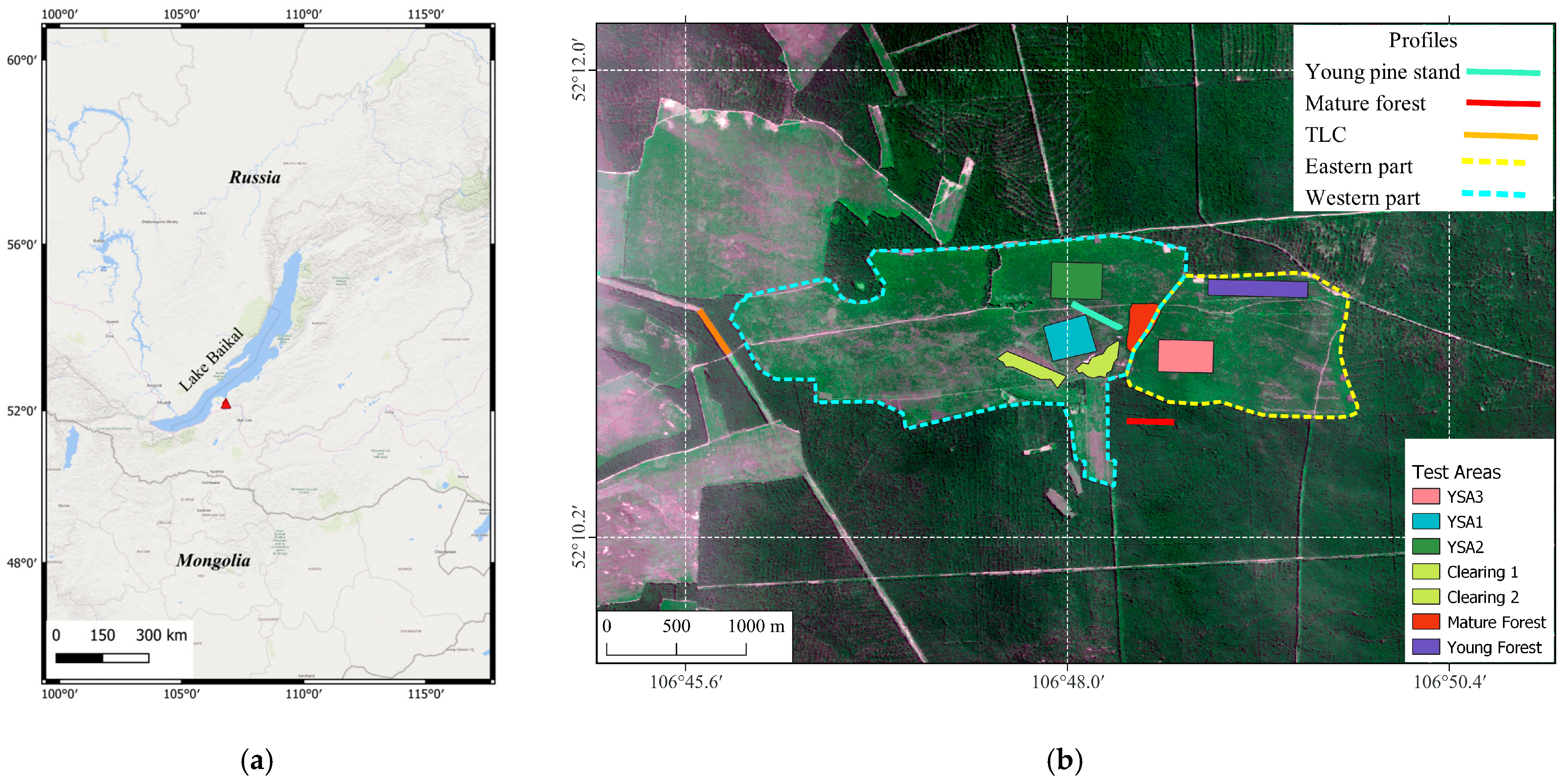
A dense pine young forest over 20 years old with tree heights of 7–12 m is labeled as “Young Forest” (S = 8.23 ha). For comparison, a treeless area (S = 8.26 ha) and a fragment of a mature forest (S = 5.59 ha) were also used. The locations of the test sites are presented in
Figure 1 and the NextGIS web map [
8].
We used fully polarimetric bistatic TerraSAR-X/TanDEM-X data from the winter of 2014–2015 for the analysis (see
Table 1).
3. Assessment of the Forest Height by Optimized Coherence
It is well-established [
4,
9] that the optimized coherences
γd and
γv are used to identify the phase centers of surface and volume scattering, respectively. The height difference between these phase centers allows for the estimation of the mean tree height using the formula:
where:
This formula was applied to estimate the height of the young forest. The processing of fully polarimetric data using the PolInSAR technique was carried out with the Sarmap SARScape (version 5.4.1) software. It is standard practice to perform filtering and averaging/interpolation prior to, or sometimes during, interferometric phase unwrapping to smooth sharp phase gradients between neighboring pixels. However, since these very phase differences were the focus of our investigation, we employed unfiltered and wrapped interferograms. Care was taken to ensure that the expected tree heights did not exceed the height of ambiguity to avoid phase jumps.
Only a multilooking procedure (non-coherent signal averaging) was applied to partially reduce speckle noise. The spatial resolution of the SAR images after multilooking was 5 m. This resolution was sufficient to separate the interferometric phase of radar signals backscattered from the upper layer of branches in small groups of young trees from those backscattered from the ground surface in the gaps between these groups. For topographic correction, the TanDEM-X digital elevation model (DEM) with a spatial resolution of 12 m was used.
The heights of the PolInSAR phase centers (see
Table 2) revealed that the average height difference between the phase centers of volume and surface scattering was approximately 4.2–4.9 m for all test sites. Interestingly, the median values for sites YSA1-3 exceeded those for the Mature and Young Forest sites. However, these estimated values did not align with the in situ measurements conducted in 2015.
We now perform a quantitative assessment of the influence of snow cover on the interferometric measurement results without separating the signal into PolInSAR components, i.e., for conventional DInSAR. For this purpose, we use the following linear approximation [
7]:
where
k is the wavenumber,
d is the snow depth,
ρ is the snow density, and
θi is the incidence angle. For TerraSAR-X/TanDEM-X, the wavelength is λ = 3.1 cm; so, the wavenumber is
k ≈ 2.03 rad/cm, and the incidence angle is
θi = 30°. Snow depth and density values typical for sparse forest are
d = 25–50 cm and
ρ = 0.2–0.3 g/cm
3. Substituting these values into previous formula yields a phase range of
rad. Converting the phase to height results in an additional height range due to snow of
2.8; 7.6] m. For example, for a young forest stand with a true height of 2 m, a snow cover 25–50 cm thick can lead to measured heights ranging from 4.8 m to 9.6 m.
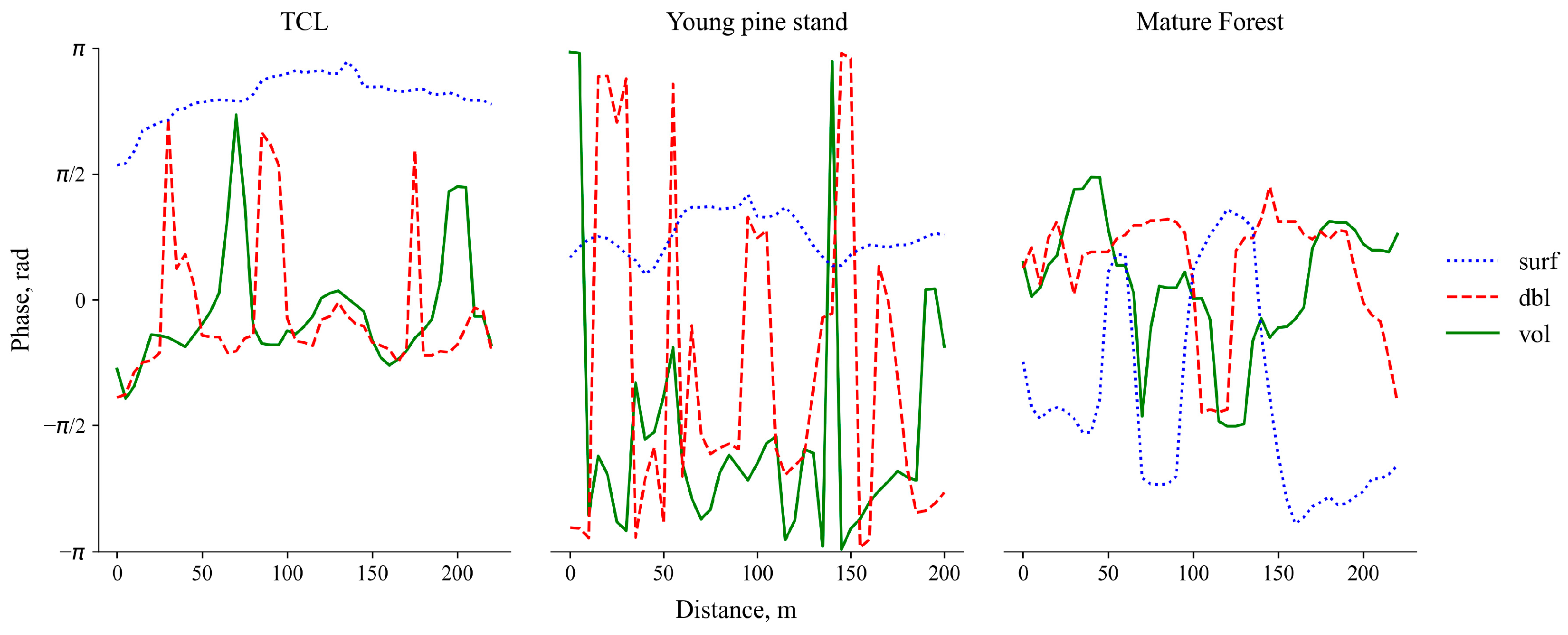
To identify the reasons for this discrepancy, an analysis of the PolInSAR interferometric phase profiles was conducted for the image pair from 19 January 2015 (the location of the profiles is shown in
Figure 1b). The analysis revealed characteristic features for the three test sites (see
Figure 2). The most complex pattern is observed for the mature pine forest: all three scattering components fluctuate chaotically with an amplitude of approximately ±2 radians. This indicates complete shielding of the underlying surface by the dense, snow-covered crowns and makes a reliable estimation of the phase center height difference impossible.
The surface scattering profile for the treeless area exhibits moderate fluctuations (±0.3 radians) and a stable mean phase value, which is explained by the relatively flat terrain and homogeneous snow cover. The double-bounce and volume scattering components show significant chaotic variations. These are caused by the interaction of the 3 cm wavelength with scatterers of comparable size, demonstrating the low information content of these scattering mechanisms for the treeless area.
In the young pine forest, the profiles show some similarity to those of the treeless area. Similarly, chaotic variations are observed in the double-bounce and volume scattering components. The surface scattering profile does not contain significant fluctuations; however, between the 100 and 150 m marks, a phase decrease of approximately 1 radian is observed. This corresponds to the alternation of dense tree groups and the gaps between them.
Thus, the profile analysis revealed a complex, low-information (noise-like) character of the phase center variations for the double-bounce and volume scattering mechanisms across all three types of underlying surface. Nevertheless, a certain correlation was noted between the changes in the surface scattering component and the alternation of tree groups and open gaps. Therefore, it can be hypothesized that in the X-band, the surface scattering is generated not only from the ground surface in the gaps between trees but also from the continuous canopy formed by the upper layer of branches of the young trees.
Based on this hypothesis, it is proposed to focus the subsequent analysis on this particular surface scattering mechanism and its associated optimized coherence, γd. Furthermore, a shift from profile analysis to the study of statistical distributions of PolInSAR images is recommended.
4. Estimation of Bimodal Distributions in PolInSAR Phase Histograms
The analysis then shifted from individual profiles to the statistical distributions of the interferometric phase for treeless areas (clearing), mature pine forest, and young pine stands with different biophysical parameters (see [
8]). As an example,
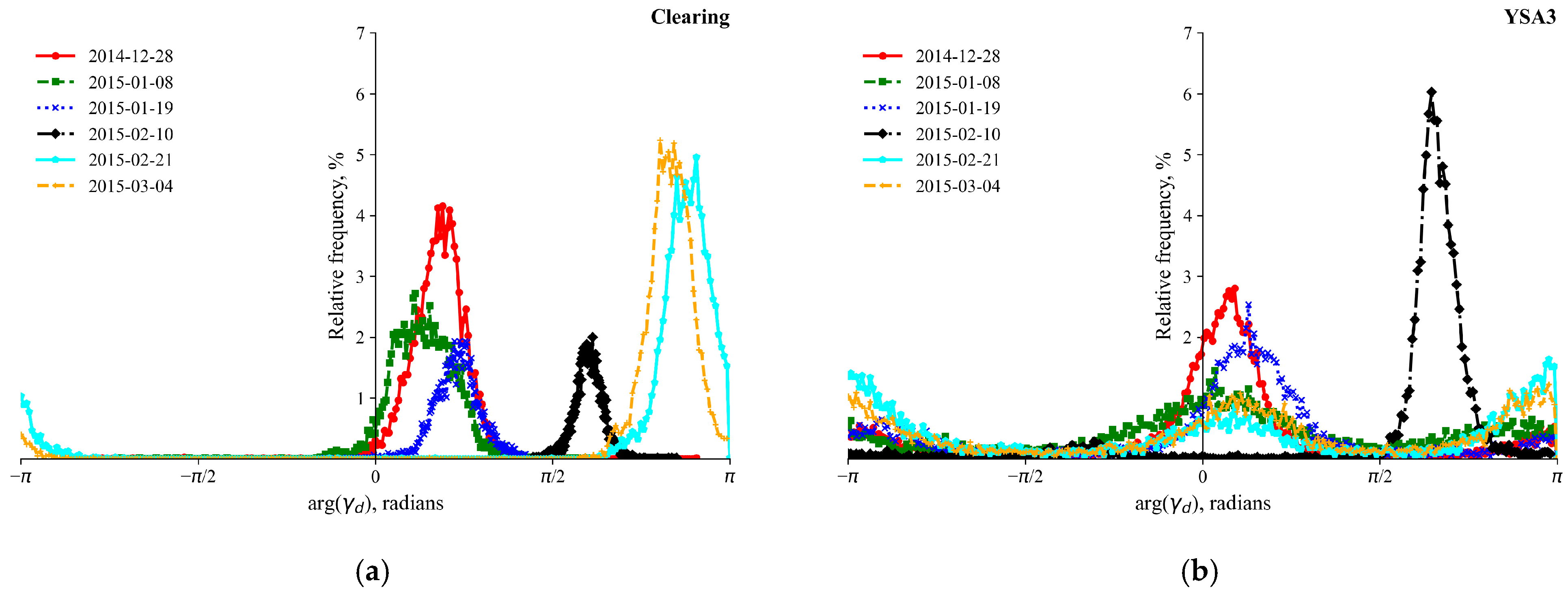
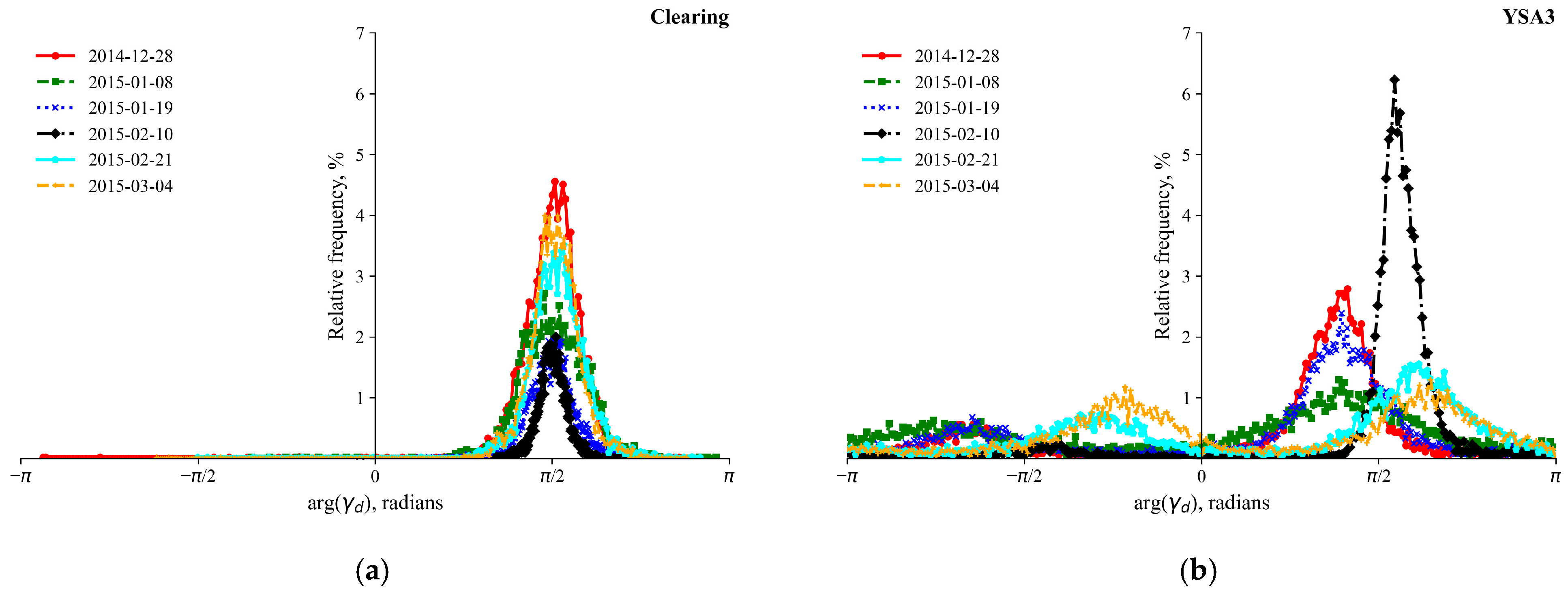
Figure 3a,b shows histograms of the surface scattering phase from six polarimetric-interferometric acquisition dates for two test sites: a Clearing (treeless) in
Figure 3a and YSA3 in
Figure 3b. The x-axis represents phase values in radians, and the y-axis shows the probability density. As seen in
Figure 3a, surface scattering over treeless areas is characterized by a unimodal phase distribution. The width of the modal peak does not exceed 1 radian, which, considering the interferometric height of ambiguity (see
Table 1), corresponds to a height range of approximately 2 m. A phase shift in the modal peaks by 1.5–2 radians is observed in February–March, indicating seasonal changes in the snow cover.
To analyze such temporal shifts in the phase modal peaks, weather data [
10] from the nearest meteorological station (WMO ID: 30729), located in the village of Kabansk about 17 km from the study area, were examined over the entire acquisition period. The analysis of meteorological data revealed that abrupt phase shifts correlate with periods of daytime warming to −7–−9 °C followed by refreezing, which leads to the formation of a dense ice crust within the snowpack. During periods of consistently low temperatures (below −15 °C), the phase remained stable.
At the YSA3 site (
Figure 3b), an expansion in the range of phase values is observed. A second modal peak appears, indicating the distinct height of two phase centers—from the upper layer of branches and from the ground surface in the gaps between tree groups. Accordingly, an approximate estimate of the average young stand height can be obtained based on the phase difference between the surface scattering component from the upper layer of branches and needles (hereafter, the “vegetative” mode) and from the snow-soil layer (hereafter, the “surface” mode). For example, the difference between the modes in March is about 2.7 radians, which, considering the 2π ambiguity height equivalent of 11.7 m, corresponds to an average young stand height of approximately 5 m. Due to fluctuations in the phase distribution density, the mean values of the respective parts of the distribution are used to determine the surface
and vegetative
mode values.
For a more accurate estimation of vegetation heights, the difference between the mean values of the “vegetative” and “surface” modes will be used. However, prior to this, it is necessary to eliminate the discontinuities of the modal peaks (see
Figure 3b) caused by the arbitrary choice of the starting point for the wrapped interferometric phase. This arbitrariness leads to a situation where the same surface scattering mode is artificially split between values of –π and +π (see
Figure 3b). Truncating the left or right part of a modal peak can significantly distort its mean value, the phase difference between the two modes, and, consequently, the vegetation height estimate. To ensure that the modal peak positions are consistent and free of discontinuities across all dates, each histogram will be shifted along the x-axis by a constant value specific to each image. This value is calculated so that the surface mode peak for treeless areas (serving as reference points) has the same fixed phase value
for all acquisition dates. In our case, this value is fixed at π/2. After such a shift, which can be regarded as a calibration based on treeless areas, the histograms become aligned (
Figure 4a). This approach: first, avoids the need for phase unwrapping and associated averaging; and second, ensures correct comparison of vegetative modes between images for precise estimation of height gradients between adjacent pixels.
As a result of this preliminary phase alignment, two distinct peaks become clearly distinguishable in the phase distribution histograms for the YSA3 site: the first corresponds to the underlying ground surface (right modes in
Figure 4b), and the second corresponds to vegetation (left modes in
Figure 4b). This also simplifies the task of determining the modal phase values,
and
, and thereby the difference between them
, which is proportional to the young stand height,
hv. However, due to the 2π ambiguity inherent in interferometric measurements, the measurable phase difference is limited to a maximum value of
. For the TerraSAR-X/TanDEM-X data in the studied 2014–2015 scenes, the height of ambiguity, ranges between 9.42 m and 21.69 m depending on the acquisition date. Accordingly, the maximum measurable forest vegetation height with this method is constrained to approximately 7 m to 16 m.
The relative heights were then derived from the interferometric phase using the following formula:
where
represents the current values of the phase after shifting. The positive direction is defined from the Earth’s surface towards the satellite.
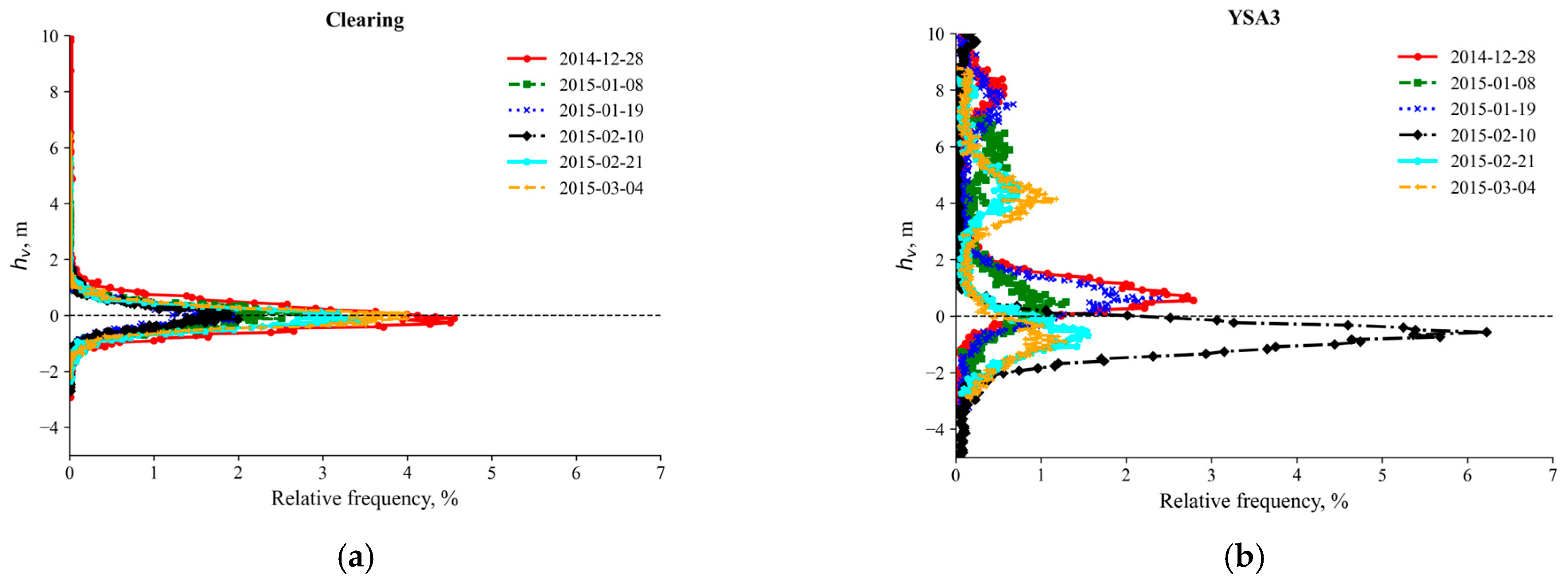
Figure 5a,b show histograms of the distributions of the obtained relative heights,
hv, for the same sites as in
Figure 3a,b. On these graphs, as previously seen in
Figure 3a, a temporal phase shift is noticeable in February–March. As noted above, this is related to changing weather conditions and the formation and densification of the ice crust in the snowpack. Therefore, to reduce random fluctuations caused by such temporal variations in the layered snow-soil structure, it is proposed to use only data from December 2014 to January 2015—i.e., the period during which the phase is relatively stable. This aligns with the earlier assumption that in some cases the influence of snow cover can be neglected. In fact, the method presented above selects a temporal series of PolInSAR pairs for which the influence of snow cover can be disregarded when estimating the height of sparse young pine forests.
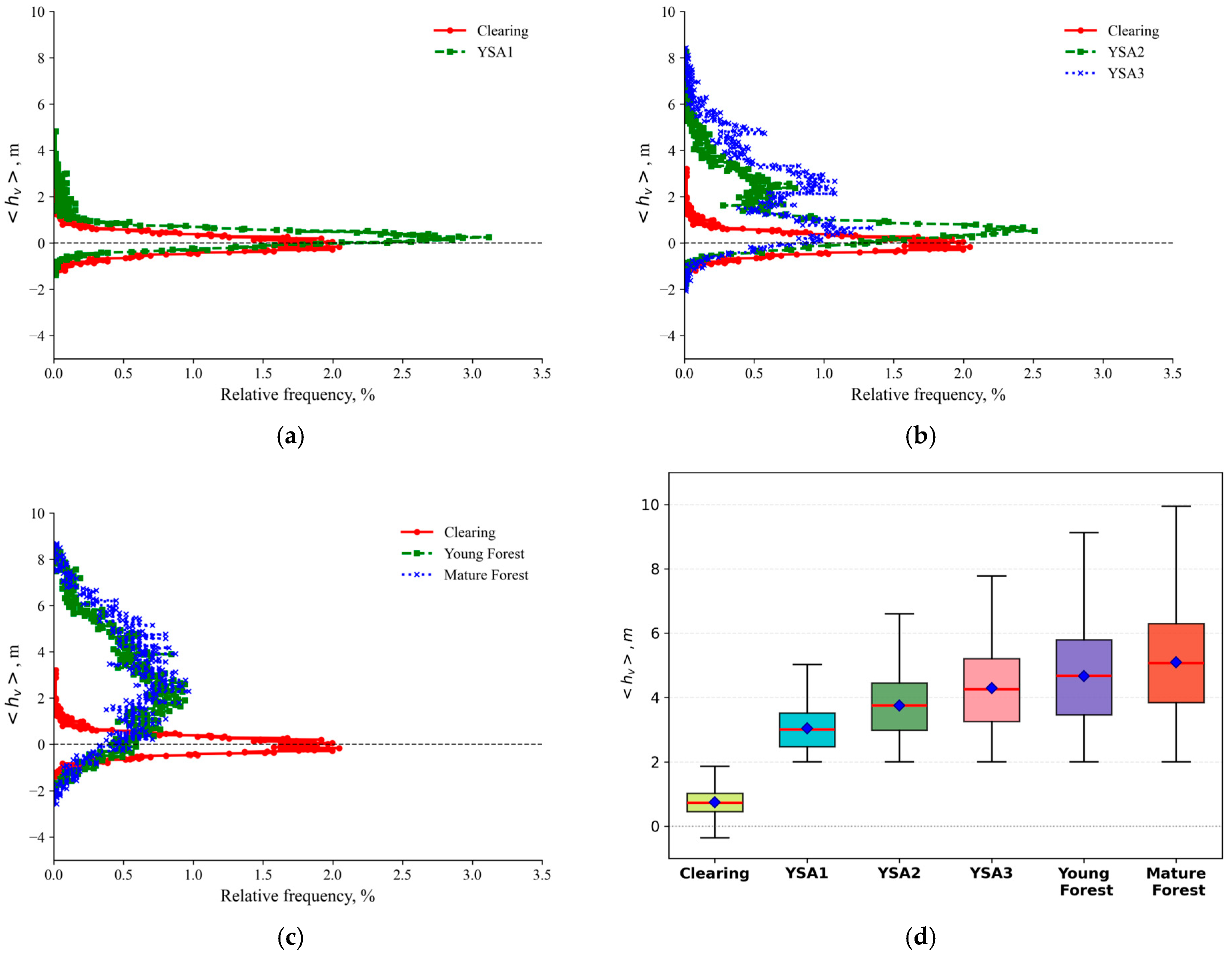
Figure 6a–c shows paired histograms of the averaged height distributions for all test sites (see
Figure 3a) from this period (2014-12-28, 2015-01-08, 2015-01-19). Based on the similarities and differences in these distributions, the entire set of test sites (see
Figure 1b) can be categorized into three main terrain types, which are grouped in the graphs in
Figure 6. The y-axis represents height in meters, and the y-axis shows the probability density function values in percent.
Figure 6d presents statistical characteristics, including minimum heights, height ranges, mean values, and standard deviations.
5. Discussion
Statistical analysis of histograms of relative heights derived from the surface scattering phase confirms the feasibility of land cover classification and quantitative estimation of young forest heights using the proposed method. The histogram for the treeless site (“Clearing”) exhibits a narrow unimodal peak with height values scattered within ±0.5 m. This narrow distribution width corresponds to the expected microwave signal from a flat snow-soil boundary after compensating for topographic effects. The minimal height variation indicates that during the stable winter period (December–January), the influence of snow cover on the surface scattering phase is minimal. In contrast, the histograms for the sparse young stands (“YSA2” and “YSA3”) in
Figure 4b exhibit a distinct bimodal character, which confirms the main hypothesis: the left mode corresponds to the phase center of scattering from the upper canopy layer (the “vegetation” mode), while the right mode corresponds to scattering from the ground in open areas. The height difference between these modes provides an estimate of the mean forest height. The observed increase in estimated height from “YSA1” (~0.5 m) to “YSA3” (~5 m) shows a strong correlation with stand age and field measurement data, demonstrating the sensitivity of the method.
The assessment of snow cover influence demonstrated that under typical winter conditions (snow depth of 25–50 cm, density of 0.2–0.3 g/cm3), the additional phase shift introduced by the snowpack can lead to an overestimation of vegetation height by 2.8 m to 7.6 m. This effect explains the significant discrepancy between the initial estimates derived from the standard PolInSAR formula (up to 5 m) and the in situ data (<3 m). The established temporal correlation between abrupt phase shifts and meteorological events (daytime warming followed by refreezing) is interpreted as the formation of a dense melt-freeze crust, which drastically alters the dielectric properties of the snow. Consequently, the dominant factor limiting the accuracy and stability of the measurements is the state of the snowpack.
It should be noted that this approach is not applicable to forests with a continuous canopy and a height exceeding 7 m (“Young Forest”, “Mature Forest”). For such forests, the X-band under winter conditions does not allow for reliable separation of the surface scattering from the upper layer of branches and the ground surface. Thus, the proposed method is effective only for specific forest regeneration stages characterized by the presence of open gaps, where tree height does not exceed the height of ambiguity (9.4–21.7 m in our data), and snow conditions are stable.
6. Conclusions
This study confirmed the feasibility of estimating the height of sparse young regeneration in the Siberian boreal zone using winter X-band PolInSAR data, but also revealed fundamental limitations and factors that must be considered. The main achievement of the work is the development of a novel approach based on the analysis of the bimodal distribution of surface scattering phase. Unlike classical PolInSAR methods, which focus on separating volume and surface scattering, the proposed technique relies on two distinct phase centers of surface scattering: one from the snow-ground boundary in the gaps between trees, and another from the continuous layer formed by the upper branches of the young trees. This approach enabled the quantitative estimation of height for forest regeneration stages with discontinuous canopy (YSA2, YSA3), where traditional methods, including the RVoG model, showed significant overestimation (up to 6.5 m against actual heights of <3 m) due to the influence of the snow cover.
A key practical conclusion is the critical importance of snowpack stability for interferometric measurements. Theoretical estimation and temporal analysis showed that under typical winter conditions, phase can overestimate height by 2.8–7.6 m, and its sharp shifts correlate with snow metamorphism events (daytime warming followed by freezing, forming an ice crust). Consequently, the method’s applicability is strictly limited to periods with a stable snow cover (December–January) and to regeneration stages where tree height does not exceed the height of ambiguity.
Simultaneously, the study clearly defined the method’s applicability limits: it is ineffective for forests with closed canopies (mature forest, young stands older than 20 years). Under these conditions, the X-band signal does not penetrate to the ground surface, volume scattering within the snow-covered canopy dominates, and the surface scattering phase loses its stable relationship with the stand’s physical parameters.
Thus, this work provides a foundation for developing specialized algorithms for winter monitoring of forest regeneration using X-band data. Future research will be directed towards three main objectives: (1) validation of the height estimation algorithm, (2) the application of the method to a broader variety of young forest stands to define its precise operational limits, and (3) the integration of complementary data, such as L-band SAR, to mitigate the confounding effects of snowpack variability.