


Abstract
Nanocellulose is a nanostructured form of cellulose, which retains valuable properties of cellulose such as renewability, biodegradability, biocompatibility, nontoxicity, and sustainability and, due to its nano-sizes, acquires several useful features, such as low density, high aspect ratio and stiffness, a high specific surface area, easy processing and functionalisation, and good thermal stability. All these make it a highly versatile green nanomaterial for multiple applications, including the conservation of cultural heritage. This review provides the basic characteristics of all nanocellulose forms and their properties and presents the results of recent research on nanocellulose formulations applied for conserving historical artefacts made of wood and paper, discussing their effectiveness, advantages, and disadvantages. Pure nanocellulose proves particularly useful for conserving historical paper since it can form a durable, stable coating that consolidates the surface of a degraded object. However, it is not as effective for wood consolidation treatment due to its poor penetration into the wood structure. The research shows that this disadvantage can be overcome by various chemical modifications of the nanocellulose surface; owing to its specific chemistry, nanocellulose can be easily functionalised and, thus, enriched with the properties required for an effective wood consolidant. Moreover, combining nanocellulose with other agents can also improve its properties, adding new functionalities to the developed supramolecular systems that would address multiple needs of degraded artefacts. Since the broad use of nanocellulose in conservation practice depends on its properties, price, and availability, the development of new, effective, green, and industrial-scale production methods ensuring the manufacture of nanocellulose particles with standardised properties is necessary. Nanocellulose is an interesting and very promising solution for the conservation of cultural heritage artefacts made of paper and wood; however, further thorough interdisciplinary research is still necessary to devise new green methods of its production as well as develop new effective and sustainable nanocellulose-based conservation agents, which would replace synthetic, non-sustainable consolidants and enable proper conservation of historical objects of our cultural heritage.
1. Introduction
The need to remove petrochemical-based materials from our lives is indisputable since they are non-renewable, pollute the environment, and contribute to high carbon dioxide emissions, causing the greenhouse effect and leading to climate change [1,2]. Bio-based materials, including oleo-chemicals derived from plant oils, various biopolymers of plant and animal origin, natural curing agents, or other materials based on agricultural by-products and waste biomass, are sourced from abundant and inexhaustible natural resources and guarantee biodegradability and low environmental impact [1,3,4,5,6]. They have multiple applications in various industries, from chemical production to agriculture, construction, food, pharmaceutical, biomedical, and cosmetic branches, offering a renewable, environmentally friendly, and sustainable alternative to fossil-fuel-based products [7,8,9,10,11,12].
The trend towards replacing petroleum-based products with green solutions has also entered the cultural heritage conservation area [13]. According to the United Nation’s Sustainable Development Goals for 2030, strengthening “efforts to protect and safeguard the world’s cultural and natural heritage” appears to be one of the measures taken to achieve Goal 11—“Make cities and human settlements safe, resilient, inclusive and sustainable” [14]. The Sustainable Development Goals oblige us not only to preserve our cultural heritage for future generations but also to do it sustainably, which forces the development of new, green conservation agents and methods where bio-based polymers play the first fiddle [15,16,17,18,19,20]. Among bio-based polymers of great potential for the conservation of cultural heritage is cellulose, particularly one of its forms, nanocellulose, which has already been tried for various purposes, including cleaning surfaces of stone artefacts and paintings, as protective coatings for historical paper and textiles, stabilisation of damaged painting canvases, consolidation of degraded silk, and deacidification of historical papers [21,22,23,24,25,26,27].
This review aims to present the state of the art of nanocellulose application in the field of cultural heritage conservation, particularly in the conservation of artefacts made of lignocellulosic materials, with a special focus on wooden objects. The first part describes the principal information about nanocellulose types, their properties, and applications. Then, the main wood degradation factors and patterns are presented along with individual needs and conservation problems with degraded historical wooden objects depending on their burial environment and display or storage places. The following review presents the results of recent research on nanocellulose formulations applied for the conservation of historical artefacts made of wood and paper. We highlight the up-to-date solutions based on nanocellulose, discuss their effectiveness, advantages, and disadvantages, address the challenges associated with using nanocellulose in historical wood conservation, and debate prospects of its broader use as a green alternative to petroleum-based conservation materials.
2. Cellulose and Nanocellulose
2.1. Cellulose
Cellulose is the most abundant polymer on Earth and the main structural component of plant cell walls, several algae tissues, and the membrane of epidermal cells of tunicates, where it is present in the form of microfibrils. It can also be synthesised by bacteria as a nanofiber network. Chemically, cellulose is a linear polysaccharide composed of repeated glucose units linked together via an oxygen atom covalently bonded to C1 of one glucose ring and C4 of the adjacent ring (the β-1,4-glycosidic bond) [28,29]. As a widespread, natural, non-toxic, environmentally friendly, biodegradable, and renewable organic material, cellulose has been widely used as a source of energy, clothing, and building material. The excellent properties of cellulose and its derivatives, such as good mechanical properties (mainly high tensile strength), high surface area, low density, high aspect ratio, biocompatibility, adaptable surface characteristics, easy accessibility, and low cost, make it an invaluable material for a successively increasing number of various industrial purposes (Figure 1) [30,31,32,33,34,35,36].
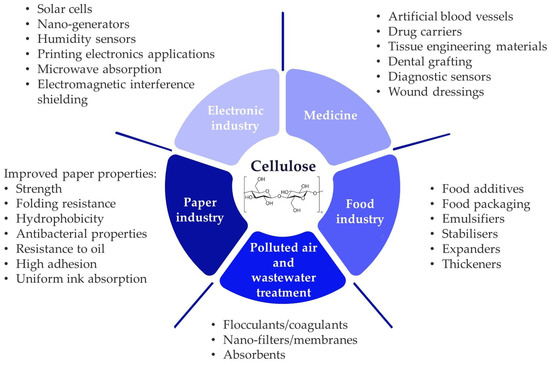
Figure 1.
Examples of industrial applications of cellulose and its derivatives (based on [30,31,32,33,34,35,36]).
2.2. Nanocellulose
Nanocellulose (NC) is a nanostructured form of cellulose, and four of its types are distinguished: cellulose nanocrystals (CNCs), cellulose nanofibrils (CNFs), regenerated nanocellulose (RNC), and bacterial cellulose (BC). The main properties, particle forms and sizes, and production methods of nanocellulose types are summarised in Table 1.

Table 1.
Nanocellulose types and their characteristics.
Nanocellulose not only retains the valuable characteristics of cellulose, such as renewability, biodegradability, biocompatibility, nontoxicity, and sustainability, but, due to its nanometre scale, it has multiple unique features, such as a high specific surface area, easy processing, low density, high aspect ratio and stiffness, and good thermal stability, which make it versatile and one of the most significant green materials for various end uses in recent years [46,47]. Many structures of NC, differing in forms and properties, permit the development of multiple types of materials with improved mechanical, rheological, and optical properties, which may be used in many inventive utilisations in diverse areas. They are applied as components for producing biomedical materials, catalytic membranes, and electronic and sensing devices, as well as in packaging, energy production, water treatment, air filtration, cosmetics, pharmaceutical, and paper and cardboard industries. Due to its low thermal expansion coefficient, high elastic modulus, and stiffness, NC is also an excellent material for polymer reinforcement, which enables the development of novel multipurpose functional materials [41,46,48,49,50,51,52]. Therefore, there is increasing interest in using nanocellulose NC in its crystalline and fibrillated forms as a natural alternative for petrochemical-based materials, and significant efforts are being made in establishing new efficient and cost-effective methods for its isolation from various plants and waste lignocellulosic biomass and synthesis [47,53,54,55].
One of the unique properties of nanocellulose is an abundance of hydroxyl groups on its surface. On the one hand, they make NC highly hydrophilic, which gives nanocellulose great potential for application in aqueous media (e.g., hydrogels, rheology modifiers). However, it can also be considered a huge disadvantage due to swelling and a decrease in the strength of nanocellulose fibres when exposed to high-humidity conditions, hindering its performance for applications where mechanical strength and dimensional stability are key features. High NC hydrophilicity also leads to its poor dispersibility in polymers and non-aqueous media, which makes it inappropriate as a reinforcing agent for hydrophobic polymers [56,57]. On the other hand, the presence of hydroxyl groups on nanocellulose surfaces can be highly beneficial. They have a high surface energy and good binding activity, which enables a wide range of surface modifications (including hydrophobisation) and functionalisation via physical adsorption, chemical modification, or polymer graft copolymerisation, leading to the development of functional materials with customisable properties [41,46,57]. Thus, nanocellulose can be used in various forms (e.g., foams, films, gels, fibrils, crystals) for multiple applications, including adhesives, filers, hierarchical materials, flexible electronics, biomaterials, food stabilizers, dietary fibres, thickeners, flavour and drug carriers, filtering membranes, sensors and detectors, and a variety of papers and packaging materials [48,58,59,60,61]. Due to its versatile and adjustable properties, it has great potential as a green alternative for adhesives, coatings, and additives in the wood and paper industry; thus, it may also be useful for the protection and conservation of wooden artefacts of cultural heritage [62,63,64,65,66,67].
3. Wooden Cultural Heritage—Degradation Factors and Main Conservation Problems
Cultural heritage is an intrinsic part of our lives, of who we are and what we identify with, providing us with a sense of unity and belongingness within individual groups or societies. It is a record of human existence, history, and development that helps us understand our ancestors. It gives us a sense of personal identity and a thread of continuity that connects past, present, and future generations and manifests in our language, traditions, and performance. Through tangible artefacts, we experience intangible values, feelings, and impressions. We are obliged to care about our heritage and preserve it for posterity. Therefore, we are taking all available measures and saving historical artefacts in collections, museums, archives, libraries, monuments, and archaeological sites to preserve them and make them accessible to people. Wooden historical artefacts in the form of architecture, furniture, everyday objects, panel paintings, sculptures, musical instruments, shipwrecks, coffins, and several others are important parts of cultural heritage that require careful, dedicated conservation because of the natural material they are made of.
3.1. Degradation of Wooden Artefacts
Wood is a natural material composed of organic matter. As such, when exposed outdoors, it is susceptible to natural weathering (a complex combination of chemical, mechanical, and light energy abiotic factors) and biodegradation (biotic factors such as fungi, bacteria, and insects) [68,69].
The activity of different abiotic and biotic factors can cause two categories of damage to wooden artefacts:
- -
- chemical, when quantitative and qualitative changes in wood chemical composition occur,
- -
- physical damage to the wood tissue, including swelling, shrinking, cracking, peeling, surface roughening, checking, colour changes, or holes and corridors caused by living organisms boring or gnawing on wood organic matter [70]. Figure 2 shows examples of physical damage caused by various insects to wood.
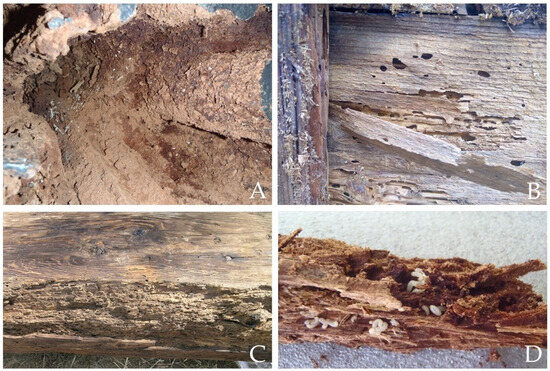 Figure 2. Examples of physical wood damage caused by insects: (A,D)—ants, (B,C)—woodworms.
Chemical decomposition is mainly caused by UV radiation (so-called photo-chemical degradation or photo-oxidation) or microbial and fungal decay. Photo-oxidation occurs on the wood surface since light cannot penetrate deeper than 200 µm and involves a sequence of complex free-radical reactions that lead to wood discolouration, changes in surface texture, and loss of brightness [71]. Chemical changes caused by organisms depend on their type. Among wood-decaying bacteria, divided into three groups based on their degradation pattern, erosion and cavitation bacteria decompose polysaccharides (hemicellulose and cellulose), while tunnelling bacteria degrade both polysaccharides and the lignin-rich primary cell wall and middle lamella [20,72,73,74]. The chemical composition of wood can also be altered by different types of fungi, including wood-decaying fungi (white-rot, brown-rot, soft-rot), mould, and blue-stain fungi [75,76]. White-rot fungi, the most effective lignin degraders on Earth, are equipped with unique extracellular nonspecific ligninolytic systems and intracellular oxidative enzymes. Among them, both selective lignin degraders and all wood polymer decomposers can be found. As a result of their activity, wood becomes soft, stringy or spongy, and white due to the presence of light cellulose which remains, with strength properties decreasing as decay progresses [77,78,79]. Brown-rot decay involves the degradation of carbohydrates and partial modification of lignin by demethylation, which results in wood shrinking and cracking into brown cubical pieces made mainly of lignin remains with decreased mechanical properties. Soft-rot fungi decompose polysaccharides and only partially lignin, causing cracking patterns, discolouration, and deterioration of mechanical strength like brown-rot [80]. Moulds do not alter wood structural polymers but decompose easily available sugars, causing wood discolouration and minor degradation of the wood surface, while blue stain fungi degrade both easily available sugars and proteins present in parenchyma cells, causing discolouration and increased permeation of wood due to the degradation of pit membranes [81]. Biodegradation strongly depends on factors such as water (e.g., fog, rain, snow, or water vapour in humid air), temperature, and oxygen availability [82]. The fungal attack occurs mostly in terrestrial environments where oxygen and enough moisture are present; however, soft-rot fungi can decompose wood also under partially oxygenated waterlogged conditions. The bacterial decomposition of wood in terrestrial environments is negligible, and their contribution is more pronounced by the synergistic or antagonistic effect they have on other microorganisms that inhabit wood. However, bacteria are the main cause of wood biodeterioration in anoxic or nearly anoxic waterlogged conditions [20,83,84].
Chemical changes ultimately lead to changes in the physical properties of wooden tissue, such as density, mechanical performance (compression, stretching, bending, shear strength), and moisture behaviour. They often cause aesthetic alterations of wooden artefacts, including various distortions and changes in surface texture and colour. However, most importantly, degradation processes often cause the disintegration of wooden tissue, which requires thorough consolidation procedures to save the object and keep it in one piece.
Biotic and abiotic damage to wood exposed outdoors affects its suitability for ongoing use, and the damage can alter wood responses to fluctuating relative humidity, even within a single artefact. For example, brown rot fungi cause prismatic cracks in wood, altering mechanical properties compared to non-decayed wood. Further complicating the restoration of wood affected by fungal decay, each prism responds differently to changes in air relative humidity. Wood damage caused by different types of organisms and abiotic factors affects it in unique ways. Moreover, the behaviour of “old” wood in varying environmental conditions, especially air relative humidity, differs from that of “new” wood, often used to fill gaps in the conservation process. This is due to differences in the chemical and physical properties between undegraded and degraded wood [85]. All these make the conservation of wooden artefacts a challenging and complex issue, which requires broad, interdisciplinary knowledge at the border of material science, chemistry, physics, history, conservation, and art.
3.2. Conservation of Degraded Wood—Main Problems and Solutions
Conservation of historical artefacts is guided by several principles, the most difficult of which is that the treatment should be reversible and not affect the original structure of an object. The chemicals used in restoration must ensure maximum durability and chemical inertness while stopping processes that would further degrade an artefact, all without changing the item’s chemical composition and physicochemical and mechanical properties. The substances must be compatible with the artefact’s materials to achieve this effect [86]. All these are not easy, especially since conservation treatment should address the specific needs of an artefact, and those differ depending on the pattern and extent of degradation, the type of an artefact, and the place and conditions of its exposition or storage. Multifarious problems and dilemmas continually confront conservationists in preserving artefacts of cultural significance, creating a need to search for new, more reliable solutions.
One of the most crucial conservation procedures is the structural consolidation of highly degraded wood tissue (where “highly degraded” means that it is completely perforated by insects, its anatomical elements are almost entirely destroyed, or it reaches an almost powdery state). It aims to restore or strengthen the physical and mechanical wood properties to keep an object’s integrity and prolong its life whilst preserving its aesthetic and historical values following conservation ethics. There are plenty of consolidating agents and methods that are useful for different wood types and degrees of degradation. Nowadays, the most common consolidants for dry wood are synthetic resins (e.g., Paraloid B72, Acryloid B72, Butvar B98, AYAT, Regalrez 1126, used with various solvents), which help improve the wood integrity and mechanical properties by fully or partially filling voids in wooden tissue. Although the method is irreversible in a strict sense, some resins can be removed using specific solvents [87,88,89,90,91,92]. In the case of waterlogged artefacts, the consolidation of delicate wood tissue requires simultaneous dimensional stabilisation to prevent wood form shrinkage, cracking, and disintegration during drying after its excavation from a wet environment and exposition to air. To achieve that, water molecules inside the wood structure must be replaced with a proper consolidation agent [20]. Historically, alum was applied for this purpose, and more recently, polyethylene glycol (PEG) and various sugars have mainly been used in conservation practice, but they all have their drawbacks. PEG’s shortcomings include high hygroscopicity and easy leachability from wood under changeable temperature and moisture conditions, which causes dimensional changes leading to permanent wood deformations or even disintegration, dark wood colouration and its heavy weight, waxy finish on the wood surface, plasticising effect on wood decreasing its mechanical properties, and vulnerability to oxidative and iron-catalysed degradation into low-molecular acidic compounds causing further chemical degradation of treated wood [93,94,95]. Therefore, since there is a need for more reliable alternatives, several other consolidants for waterlogged wood have been tried, including cellulose and lignin derivatives [20,96,97,98], chitosan [99], guar [100], oligo- and polyamides [101], and organosilicon compounds [102], as well as combinations of various agents, including Halloysite nanotubes with wax, calcium hydroxide, or esterified colophony [103,104,105], as well as multifunctional complexes that address multiple needs of a treated object [106], and more research is in progress.
Other problems with historical wooden artefacts are gaps and holes in wood tissue formed due to various degradation factors (e.g., insects, fungal decay). When they cause the loss of an object’s aesthetic and historical values that may alter its proper interpretation, then aesthetic concerns are of the utmost importance, and soft, nonstructural fills are used to restore the original artefact’s appearance. However, if multiple or extensive gaps and cracks threaten the wholeness of a wooden item, conservation concerns predominate, and structural fills are needed to reinforce the wooden structure and provide it with integrity [107,108]. In the early days of art restoration, natural materials were used to fill voids and cracks in artefacts, including wooden fills, waxes, bitumen, plaster, chalk, concrete, gesso, or oil-based putties. In time, due to their better performance, they were replaced by synthetic materials such as polyurethane, silicon rubbers, and a variety of acrylic, methacrylic, epoxy, and vinyl resins mixed with natural sawdust or synthetic microballoons. Nowadays, as a general trend towards sustainability and eco-friendliness in all areas of our life occurs, also in conservation, a return to nature can be seen, where natural materials such as minerals and lignocellulosic materials become an increasingly frequent choice alongside natural binders and biocides. Moreover, various mixtures are commonly used, including both commercial ready-mixed pastes consisting of a filler, adhesive, and additional compounds (e.g., emulsifiers, pigments, biocides, thickeners) and home-made compositions of confidential content prepared to address the specific needs of individual artefacts [108,109,110].
Sometimes, only the surface of a wooden object requires protection against water, air pollutants, and biocorrosion. Protective coatings are not permanent and usually require periodic replacement. There are two types of coatings—solutions and suspensions or curable monomers and oligomers, and they can be applied by spraying or paintbrushing. Among commercially available resins, thermoplastics are preferred over thermosetting polymers [111,112].
Conserving wooden objects constantly exposed to weather conditions, e.g., in open-air museums, is particularly challenging. It requires selecting an appropriate biocide and preservatives, identifying a method of impregnation suitable to the condition and state of preservation of the artefact, and choosing a proper filler to seal gaps. Determining appropriate methods that combine modern materials and approaches along with existing methods to preserve wooden objects of cultural value is necessary here, together with interdisciplinary knowledge [108,113].
4. Nanocellulose for the Protection of Cultural Heritage
The durability, sustainability, and excellent mechanical properties of cellulose nanomaterials make them increasingly popular for multiple applications. Nanocellulose is a perfect example of a novel eco-friendly alternative to conventional materials used in many industries (Figure 1). The variety of structures that can be obtained using nanocellulose is extensive and far-reaching [114]. Although using cellulosic materials in nano-size form is a relatively new and rapidly developing area, its effectiveness for conserving wall paintings and paper deacidification provides evidence of the great potential of this emerging technology for cultural heritage conservation [115].
Table 2 summarises recent examples of research on using nanocellulose-based solutions for conserving artefacts of cultural heritage made of lignocellulosic material or natural fibres.
Table 2.
Selected examples of recent research on nanocellulose applications in cultural heritage conservation.
5. Discussion
Nanocellulose has proved useful for various applications in many industrial branches. Being a natural, renewable, and sustainable material, it continuously attracts attention and popularity as a green alternative to petrochemicals for producing modern, often hi-tech, products.
As shown in the previous chapter, a growing interest has recently been observed among conservators in using either pure nanocellulose or supramolecular nanocellulose-based systems to stabilise and preserve historical artefacts made of lignocellulosic materials. It seems a natural and reasonable choice since its chemical structure is identical to cellulose—one of the main structural components of wood and other lignocellulosic biomass—hence, it is compatible with wood or paper structures. Due to the nano-size of NC molecules, they are expected to penetrate well into wood cells and paper fibres, which is necessary for the proper conservation of these materials. The good mechanical properties of nanocellulose (especially in the case of CNC and BNC) should reinforce and strengthen treated objects. All these make NC a potentially useful stabilisation agent for wood and paper. However, since it is susceptible to the same degradation agents as wood and paper, its broad application in conservation raises some concerns [15,42,116].
Regarding the conservation of degraded historical papers of different types, using nanocellulose seems to be a better solution than any other traditional method. It is compatible with the paper structure, improves its mechanical properties, provides protection against moisture, neither thickens the treated paper considerably nor alters the legibility of the characters written on it, and is entirely eco-friendly. By adding specific metal nanoparticles or other chemicals to it, supplementary protection against UV radiation, thermal degradation, or antimicrobial decay with simultaneous deacidification can be obtained that limits further degradation of the treated paper [23,117,125,131].
In general, in the conservation practice, nanocellulose works much better when applied as a coating than a consolidant used for wood impregnation. The experiences so far from the attempts of wood conservation using NC, although they show some benefits, also point out its disadvantages and challenges. First of all, CNC tends to flocculate and, despite the small particle size and low viscosity of a conservation solution, exhibits poor penetration into the wood structure, which probably results from the filtering effect of wood on CNCs. Although the treatment provides some filling of wooden cells by forming an open network structure, it is scarce and rather random, insufficient for effective stabilisation, and highly dependent on the degree of wood degradation and the number of impregnation cycles. CNC has a low affinity for wood surface chemistry and interacts only with the cellulosic component, which in historical wood is usually a highly degraded and minor ingredient [97,106,116,121]. From this point of view, nanocellulose, in its pure form, does not seem sufficiently suitable for conserving wooden artefacts of cultural heritage. However, there are ways to overcome the mentioned deficiencies of nanocellulose. One of them is applying it in a mixture with other compounds that improve nanocellulose performance, e.g., it was shown that the addition of PEG improves NC penetration [116]; a mixture of CNC or CNF with Klucel E has good penetration properties and improves the mechanical strength of treated wood [122,136,137], and the addition of xylitol improves BNC penetration and reinforcing properties when applied to degraded wood [139]. Moreover, as reported, wood coating with a PVB/CNCs/ZnO nanocomposite provides effective surface protection against UV radiation and humidity [134], similar to the coating made of a CNF/CNC/lignin nanoparticles composite [129]. Another method to improve the nanocellulose performance and tailor its properties to the requirements of an effective wood consolidant is its functionalisation. Several studies have shown that the NC surface can be easily hydrophobised via acetylation, amidation, etherification, silylation, and urethanisation or can be enriched with ionic charges by carboxymethylation, oxidation, phosphorylation, and sulphonation. Additionally, various polymers can be grafted on NC, enriching it with new properties, including transparency, mechanical, and water vapour barrier characteristics [140,141].
The general challenge concerning using nanocellulose is directly related to its production. Due to multiple manufacturing methods and various natural sources from which nanocellulose is extracted, NC properties vary greatly, even within its forms (CNC, CNF, BNC). This complicates the applications of nanocellulose and forces us to adjust the application protocols accurately to the type of NC currently in use. Therefore, the unification of the large-scale production of nanocellulose is necessary, along with developing green production methods to make it cost-effective and widely available. This will allow broader sustainable application of NC for various uses, including the conservation of cultural heritage artefacts and replacing petrochemicals with this versatile nanomaterial for the benefit of people and the environment [13,23,41].
6. Conclusions
Nanocellulose, as a natural, renewable, and sustainable material, has drawn the increasing attention of researchers for various applications and seems to be a good alternative to the petrochemicals that have so far been used in the industry. This review describes the basic characteristics of nanocellulose types and their properties and presents the recent research on using nanocellulose for the conservation of historical artefacts made of lignocellulosic materials, showing advantages and discussing challenges and prospects related to the broader use of this nanomaterial in the conservation practice.
The nanocellulose properties, such as high strength and stiffness, surface reactivity derived from a large number of reactive hydroxyl groups, compatibility, and small dimensions, make it a potentially good conservation agent for degraded lignocellulosic materials. In its pure form, nanocellulose has proved particularly useful for conserving historical paper since it can form a durable, stable coating that consolidates the surface of a damaged artefact. However, it is not as effective as a wood consolidant, particularly because of its poor penetration into the wood structure. Owing to its specific chemistry, though, nanocellulose can be easily functionalised and, this way, enriched with various properties required for an effective wood consolidant. Moreover, combining nanocellulose with other agents can improve its properties and add new functionalities to create supramolecular systems that would address multiple needs of degraded paper or a wooden object, including stabilisation, deacidification, and protection against moisture, UV radiation, and other degrading factors.
To broaden the use of nanocellulose in conservation practice and other areas, the development of new, effective, and green large-scale production methods is required to ensure the standardised properties of individual NC forms, increase their availability on the market, and reduce their price.
In conclusion, although nanocellulose is an interesting and very promising solution for the conservation of cultural heritage artefacts made of paper and wood, further thorough interdisciplinary research is necessary to produce cost-effective, industrial-scale NC particles with specific properties and to develop sustainable and effective nanocellulose-based conservation agents, which would replace synthetic, non-sustainable consolidants and enable proper conservation of historical objects. Research on green nanocellulose functionalisation seems particularly needed to transform its particles into effective consolidants fully compatible with lignocellulosic materials.
Author Contributions
Conceptualisation, P.K., M.B. and W.P.; writing—original draft preparation, P.K., W.P., B.M. and M.B.; writing—review and editing, M.B., P.K., W.P. and B.M.; visualisation, P.K. and M.B.; supervision, M.B. All authors have read and agreed to the published version of the manuscript.
Funding
This research received no external funding.
Data Availability Statement
No new data were created.
Conflicts of Interest
The authors declare no conflicts of interest.
References
- Tesser, R.; Vitiello, R.; Russo, V.; Turco, R.; Di Serio, M.; Lin, L.; Li, C. Oleochemistry Products. In Industrial Oil Plant: Application Principles and Green Technologies; Li, C., Xiao, Z., He, L., Serio, M.D., Xie, X., Eds.; Springer: Singapore, 2020; pp. 201–268. ISBN 9789811549205. [Google Scholar]
- Jang, D.; Woo, K.; Shim, B.S. Renewable Materials. In Disposable and Flexible Chemical Sensors and Biosensors Made with Renewable Materials; World Scientific (Europe): London, UK, 2017; pp. 9–45. ISBN 978-1-78634-386-4. [Google Scholar]
- Muneer, F.; Nadeem, H.; Arif, A.; Zaheer, W. Bioplastics from Biopolymers: An Eco-Friendly and Sustainable Solution of Plastic Pollution. Polym. Sci. Ser. C 2021, 63, 47–63. [Google Scholar] [CrossRef]
- Balador, Z.; Gjerde, M.; Isaacs, N.; Imani, M. Thermal and Acoustic Building Insulations from Agricultural Wastes. In Handbook of Ecomaterials; Martínez, L.M.T., Kharissova, O.V., Kharisov, B.I., Eds.; Springer International Publishing: Cham, Switzerland, 2018; pp. 1–20. ISBN 978-3-319-48281-1. [Google Scholar]
- Brito, T.B.N.; Ferreira, M.S.L.; Fai, A.E.C. Utilization of Agricultural By-Products: Bioactive Properties and Technological Applications. Food Rev. Int. 2022, 38, 1305–1329. [Google Scholar] [CrossRef]
- Liu, Y.; Nie, Y.; Lu, X.; Zhang, X.P.; He, H.; Pan, F.; Zhou, L.; Liu, X.; Ji, X.; Zhang, S. Cascade Utilization of Lignocellulosic Biomass to High-Value Products. Green Chem. 2019, 21, 3499–3535. [Google Scholar] [CrossRef]
- Broda, M.; Yelle, D.J.; Serwańska-Leja, K. Biodegradable Polymers in Veterinary Medicine—A Review. Molecules 2024, 29, 883. [Google Scholar] [CrossRef] [PubMed]
- Dingley, C.; Cass, P.; Adhikari, B.; Daver, F. Application of Superabsorbent Natural Polymers in Agriculture. Polym. Renew. Resour. 2024, 15, 210–255. [Google Scholar] [CrossRef]
- Angaria, N.; Saini, S.; Hussain, M.S.; Sharma, S.; Singh, G.; Khurana, N.; Kumar, R. Natural Polymer-Based Hydrogels: Versatile Biomaterials for Biomedical Applications. Int. J. Polym. Mater. Polym. Biomater. 2024. [Google Scholar] [CrossRef]
- Silva, G.; Kim, S.; Aguilar, R.; Nakamatsu, J. Natural Fibers as Reinforcement Additives for Geopolymers—A Review of Potential Eco-Friendly Applications to the Construction Industry. Sustain. Mater. Technol. 2020, 23, e00132. [Google Scholar] [CrossRef]
- Deng, W.; Feng, Y.; Fu, J.; Guo, H.; Guo, Y.; Han, B.; Jiang, Z.; Kong, L.; Li, C.; Liu, H.; et al. Catalytic Conversion of Lignocellulosic Biomass into Chemicals and Fuels. Green Energy Environ. 2023, 8, 10–114. [Google Scholar] [CrossRef]
- Kouhi, M.; Prabhakaran, M.P.; Ramakrishna, S. Edible Polymers: An Insight into Its Application in Food, Biomedicine and Cosmetics. Trends Food Sci. Technol. 2020, 103, 248–263. [Google Scholar] [CrossRef]
- Walsh-Korb, Z. Sustainability in Heritage Wood Conservation: Challenges and Directions for Future Research. Forests 2022, 13, 18. [Google Scholar] [CrossRef]
- Martin The Sustainable Development Agenda. United Nations Sustainable Development. Available online: https://www.un.org/sustainabledevelopment/ (accessed on 10 May 2024).
- Walsh-Korb, Z.; Stelzner, I.; dos Santos Gabriel, J.; Eggert, G.; Avérous, L. Morphological Study of Bio-Based Polymers in the Consolidation of Waterlogged Wooden Objects. Materials 2022, 15, 681. [Google Scholar] [CrossRef] [PubMed]
- Passaretti, A.; Cuvillier, L.; Sciutto, G.; Guilminot, E.; Joseph, E. Biologically Derived Gels for the Cleaning of Historical and Artistic Metal Heritage. Appl. Sci. 2021, 11, 3405. [Google Scholar] [CrossRef]
- Infurna, G.; Cavallaro, G.; Lazzara, G.; Milioto, S.; Dintcheva, N.T. Understanding the Effects of Crosslinking and Reinforcement Agents on the Performance and Durability of Biopolymer Films for Cultural Heritage Protection. Molecules 2021, 26, 3468. [Google Scholar] [CrossRef] [PubMed]
- Caruso, M.R.; D’Agostino, G.; Milioto, S.; Cavallaro, G.; Lazzara, G. A Review on Biopolymer-Based Treatments for Consolidation and Surface Protection of Cultural Heritage Materials. J. Mater. Sci. 2023, 58, 12954–12975. [Google Scholar] [CrossRef]
- Bassi, M.; Sassoni, E.; Franzoni, E. Experimental Study on an Innovative Biopolymeric Treatment Against Salt Deterioration of Materials in Cultural Heritage. Front. Mater. 2021, 8, 583112. [Google Scholar] [CrossRef]
- Broda, M.; Hill, C.A. Conservation of Waterlogged Wood—Past, Present and Future Perspectives. Forests 2021, 12, 1193. [Google Scholar] [CrossRef]
- Sonaglia, E.; Schifano, E.; Sharbaf, M.; Uccelletti, D.; Felici, A.C.; Santarelli, M.L. Bacterial Nanocellulose Hydrogel for the Green Cleaning of Copper Stains from Marble. Gels 2024, 10, 150. [Google Scholar] [CrossRef] [PubMed]
- Spagnuolo, L.; D’Orsi, R.; Operamolla, A. Nanocellulose for Paper and Textile Coating: The Importance of Surface Chemistry. ChemPlusChem 2022, 87, e202200204. [Google Scholar] [CrossRef] [PubMed]
- Fornari, A.; Rossi, M.; Rocco, D.; Mattiello, L. A Review of Applications of Nanocellulose to Preserve and Protect Cultural Heritage Wood, Paintings, and Historical Papers. Appl. Sci. 2022, 12, 12846. [Google Scholar] [CrossRef]
- Cianci, C.; Chelazzi, D.; Poggi, G.; Modi, F.; Giorgi, R.; Laurati, M. Hybrid Fibroin-Nanocellulose Composites for the Consolidation of Aged and Historical Silk. Colloids Surf. A Physicochem. Eng. Asp. 2022, 634, 127944. [Google Scholar] [CrossRef]
- Laserna, O.G.; Zarandona, I.; Romani, M.; Caruso, F.; Nualart-Torroja, A.; Martí, A.P.; Frøysaker, T.; Cutajar, J.D.; Lizundia, E.; Maguregui, M. Nanocellulose Aerogels and Hydrogels as New Generation Materials for The Green Transition in Painting Conservation. In Proceedings of the Chemistry for Cultural Heritage, Bratislava, Slovakia, 2 July 2024; p. 67. [Google Scholar]
- Bridarolli, A.; Nechyporchuk, O.; Odlyha, M.; Oriola, M.; Bordes, R.; Holmberg, K.; Anders, M.; Chevalier, A.; Bozec, L. Nanocellulose-Based Materials for the Reinforcement of Modern Canvas-Supported Paintings. Stud. Conserv. 2018, 63, 332–334. [Google Scholar] [CrossRef]
- Xu, Q.; Poggi, G.; Resta, C.; Baglioni, M.; Baglioni, P. Grafted Nanocellulose and Alkaline Nanoparticles for the Strengthening and Deacidification of Cellulosic Artworks. J. Colloid Interface Sci. 2020, 576, 147–157. [Google Scholar] [CrossRef] [PubMed]
- Farooq, A.; Patoary, M.K.; Zhang, M.; Mussana, H.; Li, M.; Naeem, M.A.; Mushtaq, M.; Farooq, A.; Liu, L. Cellulose from Sources to Nanocellulose and an Overview of Synthesis and Properties of Nanocellulose/Zinc Oxide Nanocomposite Materials. Int. J. Biol. Macromol. 2020, 154, 1050–1073. [Google Scholar] [CrossRef] [PubMed]
- Seddiqi, H.; Oliaei, E.; Honarkar, H.; Jin, J.; Geonzon, L.C.; Bacabac, R.G.; Klein-Nulend, J. Cellulose and Its Derivatives: Towards Biomedical Applications. Cellulose 2021, 28, 1893–1931. [Google Scholar] [CrossRef]
- Jamsheera, C.P.; Pradeep, B.V. Production of Bacterial Cellulose from Acetobacter Species and Its Applications—A Review. J. Pure Appl. Microbiol. 2021, 15, 544–555. [Google Scholar] [CrossRef]
- El-Gendi, H.; Taha, T.H.; Ray, J.B.; Saleh, A.K. Recent Advances in Bacterial Cellulose: A Low-Cost Effective Production Media, Optimization Strategies and Applications. Cellulose 2022, 29, 7495–7533. [Google Scholar] [CrossRef]
- Zhang, M.; Du, H.; Liu, K.; Nie, S.; Xu, T.; Zhang, X.; Si, C. Fabrication and Applications of Cellulose-Based Nanogenerators. Adv. Compos. Hybrid Mater. 2021, 4, 865–884. [Google Scholar] [CrossRef]
- Chen, Z.; Aziz, T.; Sun, H.; Ullah, A.; Ali, A.; Cheng, L.; Ullah, R.; Khan, F.U. Advances and Applications of Cellulose Bio-Composites in Biodegradable Materials. J. Polym. Environ. 2023, 31, 2273–2284. [Google Scholar] [CrossRef]
- Zhang, J.; Qi, Y.; Shen, Y.; Li, H. Research Progress on Chemical Modification and Application of Cellulose: A Review. Mater. Sci. 2022, 28, 60–67. [Google Scholar] [CrossRef]
- Song, S.; Li, H.; Liu, P.; Peng, X. Applications of Cellulose-Based Composites and Their Derivatives for Microwave Absorption and Electromagnetic Shielding. Carbohydr. Polym. 2022, 287, 119347. [Google Scholar] [CrossRef]
- Sepahvand, S.; Ashori, A.; Jonoobi, M. Application of Cellulose Nanofiber as a Promising Air Filter for Adsorbing Particulate Matter and Carbon Dioxide. Int. J. Biol. Macromol. 2023, 244, 125344. [Google Scholar] [CrossRef] [PubMed]
- Courtenay, J.C.; Sharma, R.I.; Scott, J.L. Recent Advances in Modified Cellulose for Tissue Culture Applications. Molecules 2018, 23, 654. [Google Scholar] [CrossRef] [PubMed]
- Tian, W.; Gao, X.; Zhang, J.; Yu, J.; Zhang, J. Cellulose Nanosphere: Preparation and Applications of the Novel Nanocellulose. Carbohydr. Polym. 2022, 277, 118863. [Google Scholar] [CrossRef] [PubMed]
- Trache, D.; Hussin, M.H.; Haafiz, M.K.; Thakur, V. Recent Progress in Cellulose Nanocrystals: Sources and Production. Nanoscale 2017, 9, 1763–1786. [Google Scholar] [CrossRef] [PubMed]
- Shin, E.; Choi, S.; Lee, J. Fabrication of Regenerated Cellulose Nanoparticles/Waterborne Polyurethane Nanocomposites. J. Appl. Polym. Sci. 2018, 135, 46633. [Google Scholar] [CrossRef]
- Qi, Y.; Guo, Y.; Liza, A.A.; Yang, G.; Sipponen, M.H.; Guo, J.; Li, H. Nanocellulose: A Review on Preparation Routes and Applications in Functional Materials. Cellulose 2023, 30, 4115–4147. [Google Scholar] [CrossRef]
- Nicu, R.; Ciolacu, F.; Ciolacu, D.E. Advanced Functional Materials Based on Nanocellulose for Pharmaceutical/Medical Applications. Pharmaceutics 2021, 13, 1125. [Google Scholar] [CrossRef]
- Rahmani, S.; Khoubi-Arani, Z.; Mohammadzadeh-Komuleh, S.; Maroufkhani, M. Electrospinning of Cellulose Nanofibers for Advanced Applications. In Handbook of Nanocelluloses; Springer: Cham, Switzerland, 2022; pp. 263–296. ISBN 978-3-030-89621-8. [Google Scholar]
- Campuzano, F.; Escobar, D.M.; Torres López, A.M. Simple Method for Obtaining Regenerated Cellulose Nanoparticles from Delignified Coffee Parchment, and Their Use in Fabricating Blended Films. Cellulose 2023, 30, 7681–7694. [Google Scholar] [CrossRef]
- Gorgieva, S.; Trček, J. Bacterial Cellulose: Production, Modification and Perspectives in Biomedical Applications. Nanomaterials 2019, 9, 1352. [Google Scholar] [CrossRef]
- Ilyas, R.A.; Hamid, N.H.A.; Ishak, K.A.; Norrrahim, M.N.F.; Thiagamani, S.M.K.; Rangappa, S.M.; Siengchin, S.; Bangar, S.P.; Nurazzi, N.M. 16—Advanced Applications of Biomass Nanocellulose-Reinforced Polymer Composites. In Synthetic and Natural Nanofillers in Polymer Composites; Nurazzi, N.M., Ilyas, R.A., Sapuan, S.M., Khalina, A., Eds.; Woodhead Publishing Series in Composites Science and Engineering; Woodhead Publishing: Cambridge, UK, 2023; pp. 349–385. ISBN 978-0-443-19053-7. [Google Scholar]
- Joshi, G.; Shukla, S.R.; Chauhan, S.S. Nanocellulose Extraction from Lignocellulosic Materials and Its Potential Applications: A Review. J. Indian Acad. Wood Sci. 2023, 21, 1–23. [Google Scholar] [CrossRef]
- Trache, D.; Tarchoun, A.F.; Derradji, M.; Hamidon, T.S.; Masruchin, N.; Brosse, N.; Hussin, M.H. Nanocellulose: From Fundamentals to Advanced Applications. Front. Chem. 2020, 8, 392. [Google Scholar] [CrossRef] [PubMed]
- Yang, H.; Zheng, H.; Duan, Y.; Xu, T.; Xie, H.; Du, H.; Si, C. Nanocellulose-Graphene Composites: Preparation and Applications in Flexible Electronics. Int. J. Biol. Macromol. 2023, 253, 126903. [Google Scholar] [CrossRef] [PubMed]
- Firmanda, A.; Fahma, F.; Warsiki, E.; Syamsu, K.; Arnata, I.W.; Sartika, D.; Suryanegara, L.; Qanytah; Suyanto, A. Antimicrobial Mechanism of Nanocellulose Composite Packaging Incorporated with Essential Oils. Food Control 2023, 147, 109617. [Google Scholar] [CrossRef]
- Yang, J.; Han, X.; Yang, W.; Hu, J.; Zhang, C.; Liu, K.; Jiang, S. Nanocellulose-Based Composite Aerogels toward the Environmental Protection: Preparation, Modification and Applications. Environ. Res. 2023, 236, 116736. [Google Scholar] [CrossRef] [PubMed]
- Seydibeyoğlu, M.Ö.; Dogru, A.; Wang, J.; Rencheck, M.; Han, Y.; Wang, L.; Seydibeyoğlu, E.A.; Zhao, X.; Ong, K.; Shatkin, J.A.; et al. Review on Hybrid Reinforced Polymer Matrix Composites with Nanocellulose, Nanomaterials, and Other Fibers. Polymers 2023, 15, 984. [Google Scholar] [CrossRef] [PubMed]
- Marakana, P.G.; Dey, A.; Saini, B. Isolation of Nanocellulose from Lignocellulosic Biomass: Synthesis, Characterization, Modification, and Potential Applications. J. Environ. Chem. Eng. 2021, 9, 106606. [Google Scholar] [CrossRef]
- Shavyrkina, N.A.; Budaeva, V.V.; Skiba, E.A.; Mironova, G.F.; Bychin, N.V.; Gismatulina, Y.A.; Kashcheyeva, E.I.; Sitnikova, A.E.; Shilov, A.I.; Kuznetsov, P.S.; et al. Scale-Up of Biosynthesis Process of Bacterial Nanocellulose. Polymers 2021, 13, 1920. [Google Scholar] [CrossRef] [PubMed]
- Wu, T.; Zhou, W.; Quan, Y.; Chen, M.; Tian, Q.; Han, X.; Xu, J.; Chen, J. Facile and Green Synthesis of Nanocellulose with the Assistance of Ultraviolet Light Irradiation for High-Performance Quasi-Solid-State Zinc-Ion Batteries. J. Colloid Interface Sci. 2022, 628, 1–9. [Google Scholar] [CrossRef] [PubMed]
- Jing, S.; Wu, L.; Siciliano, A.P.; Chen, C.; Li, T.; Hu, L. The Critical Roles of Water in the Processing, Structure, and Properties of Nanocellulose. ACS Nano 2023, 17, 22196–22226. [Google Scholar] [CrossRef]
- Sun, L.; Zhang, X.; Liu, H.; Liu, K.; Du, H.; Kumar, A.; Sharma, G.; Si, C. Recent Advances in Hydrophobic Modification of Nanocellulose. Curr. Org. Chem. 2021, 25, 417–436. [Google Scholar] [CrossRef]
- Abitbol, T.; Rivkin, A.; Cao, Y.; Nevo, Y.; Abraham, E.; Ben-Shalom, T.; Lapidot, S.; Shoseyov, O. Nanocellulose, a Tiny Fiber with Huge Applications. Curr. Opin. Biotechnol. 2016, 39, 76–88. [Google Scholar] [CrossRef] [PubMed]
- Jorfi, M.; Foster, E.J. Recent Advances in Nanocellulose for Biomedical Applications. J. Appl. Polym. Sci. 2015, 41719. [Google Scholar] [CrossRef]
- Nguyen, L.H.; Naficy, S.; Chandrawati, R.; Dehghani, F. Nanocellulose for Sensing Applications. Adv. Mater. Interfaces 2019, 6, 1900424. [Google Scholar] [CrossRef]
- Perumal, A.B.; Nambiar, R.B.; Moses, J.A.; Anandharamakrishnan, C. Nanocellulose: Recent Trends and Applications in the Food Industry. Food Hydrocoll. 2022, 127, 107484. [Google Scholar] [CrossRef]
- Vineeth, S.K.; Gadhave, R.V.; Gadekar, P.T. Nanocellulose Applications in Wood Adhesives—Review. Open J. Polym. Chem. 2019, 9, 63. [Google Scholar] [CrossRef]
- Chugh, M.; Chandak, T.; Jha, S.; Rawtani, D. Chapter 13—Nanocellulose in Paper and Wood Industry. In Nanocellulose Materials; Oraon, R., Rawtani, D., Singh, P., Hussain, C.M., Eds.; Micro and Nano Technologies; Elsevier: Amsterdam, The Netherlands, 2022; pp. 247–264. ISBN 978-0-12-823963-6. [Google Scholar]
- Jasmani, L.; Rusli, R.; Khadiran, T.; Jalil, R.; Adnan, S. Application of Nanotechnology in Wood-Based Products Industry: A Review. Nanoscale Res. Lett. 2020, 15, 207. [Google Scholar] [CrossRef]
- Lengowski, E.C.; Bonfatti Júnior, E.A.; Kumode, M.M.N.; Carneiro, M.E.; Satyanarayana, K.G. Nanocellulose-Reinforced Adhesives for Wood-Based Panels. In Sustainable Polymer Composites and Nanocomposites; Inamuddin, Thomas, S., Kumar Mishra, R., Asiri, A.M., Eds.; Springer International Publishing: Cham, Switzerland, 2019; pp. 1001–1025. ISBN 978-3-030-05399-4. [Google Scholar]
- Kong, L.; Xu, D.; He, Z.; Wang, F.; Gui, S.; Fan, J.; Pan, X.; Dai, X.; Dong, X.; Liu, B.; et al. Nanocellulose-Reinforced Polyurethane for Waterborne Wood Coating. Molecules 2019, 24, 3151. [Google Scholar] [CrossRef]
- Kluge, M.; Veigel, S.; Pinkl, S.; Henniges, U.; Zollfrank, C.; Rössler, A.; Gindl-Altmutter, W. Nanocellulosic Fillers for Waterborne Wood Coatings: Reinforcement Effect on Free-Standing Coating Films. Wood Sci. Technol. 2017, 51, 601–613. [Google Scholar] [CrossRef]
- Arpaci, S.S.; Tomak, E.D.; Ermeydan, M.A.; Yildirim, I. Natural Weathering of Sixteen Wood Species: Changes on Surface Properties. Polym. Degrad. Stab. 2021, 183, 109415. [Google Scholar] [CrossRef]
- Brischke, C.; Alfredsen, G. Wood-Water Relationships and Their Role for Wood Susceptibility to Fungal Decay. Appl. Microbiol. Biotechnol. 2020, 104, 3781–3795. [Google Scholar] [CrossRef]
- Feist, W.C. Outdoor Wood Weathering and Protection. In Archaeological Wood; Advances in Chemistry; American Chemical Society: Washington, DC, USA, 1989; Volume 225, pp. 263–298. ISBN 978-0-8412-1623-5. [Google Scholar]
- Teacă, C.A.; Roşu, D.; Bodîrlău, R.; Roşu, L. Structural Changes in Wood under Artificial UV Light Irradiation Determined by FTIR Spectroscopy and Color Measurements–A Brief Review. BioResources 2013, 8, 1478–1507. [Google Scholar] [CrossRef]
- Blanchette, R.A. Microbial Degradation of Wood from Aquatic and Terrestrial Environments. In Cultural Heritage Microbiology: Fundamental Studies In Conservation Science; ASM Press: Washington, DC, USA, 2010; pp. 179–218. [Google Scholar]
- Björdal, C.G.; Daniel, G.; Nilsson, T. Depth of Burial, an Important Factor in Controlling Bacterial Decay of Waterlogged Archaeological Poles. Int. Biodeterior. Biodegrad. 2000, 45, 15–26. [Google Scholar] [CrossRef]
- Blanchette, R.A. A Review of Microbial Deterioration Found in Archaeological Wood from Different Environments. Int. Biodeterior. Biodegrad. 2000, 46, 189–204. [Google Scholar] [CrossRef]
- Goodell, B.; Winandy, J.E.; Morrell, J.J. Fungal Degradation of Wood: Emerging Data, New Insights and Changing Perceptions. Coatings 2020, 10, 1210. [Google Scholar] [CrossRef]
- Broda, M. Natural Compounds for Wood Protection against Fungi—A Review. Molecules 2020, 25, 3538. [Google Scholar] [CrossRef] [PubMed]
- Dashtban, M.; Schraft, H.; Syed, T.A.; Qin, W. Fungal Biodegradation and Enzymatic Modification of Lignin. Int. J. Biochem. Mol. Biol. 2010, 1, 36–50. [Google Scholar]
- Abdel-Hamid, A.M.; Solbiati, J.O.; Cann, I.K.O. Chapter One—Insights into Lignin Degradation and Its Potential Industrial Applications. In Advances in Applied Microbiology; Sariaslani, S., Gadd, G.M., Eds.; Academic Press: Cambridge, MA, USA, 2013; Volume 82, pp. 1–28. [Google Scholar]
- Hadar, Y. Biodegradation of Aromatic Toxic Pollutants by White Rot Fungi. In Encyclopedia of Mycology; Zaragoza, Ó., Casadevall, A., Eds.; Elsevier: Oxford, UK, 2021; pp. 197–204. ISBN 978-0-323-85180-0. [Google Scholar]
- Langer, G.J.; Bußkamp, J.; Terhonen, E.; Blumenstein, K. Chapter 10—Fungi Inhabiting Woody Tree Tissues. In Forest Microbiology; Asiegbu, F.O., Kovalchuk, A., Eds.; Forest Microbiology; Academic Press: Cambridge, MA, USA, 2021; pp. 175–205. ISBN 978-0-12-822542-4. [Google Scholar]
- Zabel, R.A.; Morrell, J.J. Chapter Six—The Decay Setting: Some Structural, Chemical, and Moisture Features of Wood Features of Wood in Relation to Decay Development. In Wood Microbiology, 2nd ed.; Zabel, R.A., Morrell, J.J., Eds.; Academic Press: San Diego, CA, USA, 2020; pp. 149–183. ISBN 978-0-12-819465-2. [Google Scholar]
- Krajewski, A.; Witomski, P. Korozja Biologiczna Drewna Materialnych dóbr Kultury: Poradnik Konserwatorski; Wydawnictwo SGGW: Warsaw, Poland, 2012. [Google Scholar]
- Tláskal, V.; Brabcová, V.; Větrovský, T.; Jomura, M.; López-Mondéjar, R.; Oliveira Monteiro, L.M.; Saraiva, J.P.; Human, Z.R.; Cajthaml, T.; Nunes da Rocha, U.; et al. Complementary Roles of Wood-Inhabiting Fungi and Bacteria Facilitate Deadwood Decomposition. mSystems 2021, 6, e01078-20. [Google Scholar] [CrossRef]
- Blanchette, R.A.; Nilsson, T.; Daniel, G.; Abad, A. Biological Degradation of Wood. In Archaeological Wood; Advances in Chemistry; American Chemical Society: Washington, DC, USA, 1989; Volume 225, pp. 141–174. ISBN 978-0-8412-1623-5. [Google Scholar]
- Barclay, R.; Mathias, C. An Epoxy/Microballoon Mixture for Gap Filling in Wooden Objects. J. Am. Inst. Conserv. 1989, 28, 31–42. [Google Scholar] [CrossRef]
- Baglioni, P.; Giorgi, R. Soft and Hard Nanomaterials for Restoration and Conservation of Cultural Heritage. Soft Matter 2006, 2, 293–303. [Google Scholar] [CrossRef]
- Schniewind, A.P. Consolidation of Dry Archaeological Wood by Impregnation with Thermoplastic Resins. In Archaeological Wood; Advances in Chemistry; American Chemical Society: Washington, DC, USA, 1989; Volume 225, pp. 361–371. ISBN 978-0-8412-1623-5. [Google Scholar]
- Wang, Y.; Schniewind, A.P. Consolidation of Deteriorated Wood with Soluble Resins. J. Am. Inst. Conserv. 1985, 24, 77–91. [Google Scholar] [CrossRef]
- Sakuno, T.; Schniewind, A.P. Adhesive Qualities of Consolidants for Deteriorated Wood. J. Am. Inst. Conserv. 1990, 29, 33–44. [Google Scholar] [CrossRef]
- Muhcu, D.; Terzi, E.; Kartal, S.N.; Yoshimura, T. Biological Performance, Water Absorption, and Swelling of Wood Treated with Nano-Particles Combined with the Application of Paraloid B72®. J. For. Res. 2017, 28, 381–394. [Google Scholar] [CrossRef]
- Vasilca, S.; Virgolici, M.; Cutrubinis, M.; Moise, V.; Mereuta, P.; Sirbu, R.; Medvedovici, A.V. Wood Consolidation through an Epoxy-Acrylic Gamma-Crosslinked Three-Dimensional System. Polym. Adv. Technol. 2024, 35, e6381. [Google Scholar] [CrossRef]
- Avram, A.; Ionescu, C.S.; Lunguleasa, A. A Consolidation of Degraded Lime Wooden Support from Heritage Objects Using Two Types of Consolidant. BioResources 2023, 18, 4580–4597. [Google Scholar] [CrossRef]
- Broda, M.; Mazela, B.; Radka, K. Methyltrimethoxysilane as a Stabilising Agent for Archaeological Waterlogged Wood Differing in the Degree of Degradation. J. Cult. Herit. 2019, 35, 129–139. [Google Scholar] [CrossRef]
- Glastrup, J.; Shashoua, Y.; Egsgaard, H.; Mortensen, M.N. Degradation of PEG in the Warship Vasa. Macromol. Symp. 2006, 238, 22–29. [Google Scholar] [CrossRef]
- Hoffmann, P. On the Long-Term Visco-Elastic Behaviour of Polyethylene Glycol (PEG) Impregnated Archaeological Oak Wood. Holzforschung 2010, 64, 725–728. [Google Scholar] [CrossRef]
- Zhang, J.; Li, Y.; Ke, D.; Wang, C.; Pan, H.; Chen, K.; Zhang, H. Modified Lignin Nanoparticles as Potential Conservation Materials for Waterlogged Archaeological Wood. ACS Appl. Nano Mater. 2023, 6, 12351–12363. [Google Scholar] [CrossRef]
- Antonelli, F.; Galotta, G.; Sidoti, G.; Zikeli, F.; Nisi, R.; Petriaggi, B.D.; Romagnoli, M. Cellulose and Lignin Nano-Scale Consolidants for Waterlogged Archaeological Wood. Front. Chem. 2020, 8, 32. [Google Scholar] [CrossRef]
- Cipriani, G.; Salvini, A.; Baglioni, P.; Bucciarelli, E. Cellulose as a Renewable Resource for the Synthesis of Wood Consolidants. J. Appl. Polym. Sci. 2010, 118, 2939–2950. [Google Scholar] [CrossRef]
- Christensen, M.; Larnøy, E.; Kutzke, H.; Hansen, F.K. Treatment of Waterlogged Archaeological Wood Using Chitosan-and Modified Chitosan Solutions. Part 1: Chemical Compatibility and Microstructure. J. Am. Inst. Conserv. 2015, 54, 3–13. [Google Scholar] [CrossRef]
- Walsh, Z.; Janeček, E.-R.; Jones, M.; Scherman, O.A. Natural Polymers as Alternative Consolidants for the Preservation of Waterlogged Archaeological Wood. Stud. Conserv. 2017, 62, 173–183. [Google Scholar] [CrossRef]
- Cipriani, G.; Salvini, A.; Fioravanti, M.; Di Giulio, G.; Malavolti, M. Synthesis of Hydroxylated Oligoamides for Their Use in Wood Conservation. J. Appl. Polym. Sci. 2013, 127, 420–431. [Google Scholar] [CrossRef]
- Broda, M.; Mazela, B.; Dutkiewicz, A. Organosilicon Compounds with Various Active Groups as Consolidants for the Preservation of Waterlogged Archaeological Wood. J. Cult. Herit. 2019, 35, 123–128. [Google Scholar] [CrossRef]
- Lisuzzo, L.; Hueckel, T.; Cavallaro, G.; Sacanna, S.; Lazzara, G. Pickering Emulsions Based on Wax and Halloysite Nanotubes: An Ecofriendly Protocol for the Treatment of Archeological Woods. ACS Appl. Mater. Interfaces 2020, 13, 1651–1661. [Google Scholar] [CrossRef] [PubMed]
- Cavallaro, G.; Milioto, S.; Parisi, F.; Lazzara, G. Halloysite Nanotubes Loaded with Calcium Hydroxide: Alkaline Fillers for the Deacidification of Waterlogged Archeological Woods. ACS Appl. Mater. Interfaces 2018, 10, 27355–27364. [Google Scholar] [CrossRef] [PubMed]
- Cavallaro, G.; Lazzara, G.; Milioto, S.; Parisi, F.; Ruisi, F. Nanocomposites Based on Esterified Colophony and Halloysite Clay Nanotubes as Consolidants for Waterlogged Archaeological Woods. Cellulose 2017, 24, 3367–3376. [Google Scholar] [CrossRef]
- Walsh, Z.; Janeček, E.-R.; Hodgkinson, J.T.; Sedlmair, J.; Koutsioubas, A.; Spring, D.R.; Welch, M.; Hirschmugl, C.J.; Toprakcioglu, C.; Nitschke, J.R. Multifunctional Supramolecular Polymer Networks as Next-Generation Consolidants for Archaeological Wood Conservation. Proc. Natl. Acad. Sci. USA 2014, 111, 17743–17748. [Google Scholar] [CrossRef] [PubMed]
- Podmaniczky, M.S. Structural Fillsfor Large Wood Objects: Contrasting and Complementary Approaches. J. Am. Inst. Conserv. 1998, 37, 111–116. [Google Scholar] [CrossRef]
- Broda, M.; Kryg, P.; Ormondroyd, G.A. Gap-Fillers for Wooden Artefacts Exposed Outdoors—A Review. Forests 2021, 12, 606. [Google Scholar] [CrossRef]
- Grattan, D.W.; Barclay, R.L. A Study of Gap-Fillers for Wooden Objects. Stud. Conserv. 1988, 33, 71–86. [Google Scholar] [CrossRef]
- Montaser, E.M.; El Hadidi, N.M.N.; Abo Elenen Amin, E. Evaluation of Wood Gap Fillers Composed of Microcrystalline Cellulose, Paper Pulp, and Glass Microballoons. Pigment Resin Technol. 2022, 52, 422–430. [Google Scholar] [CrossRef]
- Invernizzi, C.; Fiocco, G.; Iwanicka, M.; Targowski, P.; Piccirillo, A.; Vagnini, M.; Licchelli, M.; Malagodi, M.; Bersani, D. Surface and Interface Treatments on Wooden Artefacts: Potentialities and Limits of a Non-Invasive Multi-Technique Study. Coatings 2021, 11, 29. [Google Scholar] [CrossRef]
- de Ferri, L.; Strojecki, M.; Bertolin, C. Preliminary Results on Surface Treatments on Wood. IOP Conf. Ser. Mater. Sci. Eng. 2020, 949, 012094. [Google Scholar] [CrossRef]
- Kryg, P.; Mazela, B.; Broda, M. Dimensional Stability and Moisture Properties of Gap-Fillers Based on Wood Powder and Glass Microballoons. Stud. Conserv. 2020, 65, 142–151. [Google Scholar] [CrossRef]
- Niinivaara, E.; Cranston, E.D. Bottom-up Assembly of Nanocellulose Structures. Carbohydr. Polym. 2020, 247, 116664. [Google Scholar] [CrossRef] [PubMed]
- Waked, A.M. Nano Materials Applications for Conservation of Cultural Heritage. WIT Trans. Built Environ. 2011, 118, 577–588. [Google Scholar]
- Christensen, M.; Kutzke, H.; Hansen, F.K. New Materials Used for the Consolidation of Archaeological Wood–Past Attempts, Present Struggles, and Future Requirements. J. Cult. Herit. 2012, 13, S183–S190. [Google Scholar] [CrossRef]
- Santos, S.M.; Carbajo, J.M.; Gómez, N.; Quintana, E.; Ladero, M.; Sánchez, A.; Chinga-Carrasco, G.; Villar, J.C. Use of Bacterial Cellulose in Degraded Paper Restoration. Part II: Application on Real Samples. J. Mater. Sci. 2016, 51, 1553–1561. [Google Scholar] [CrossRef]
- Camargos, C.H.M.; Figueiredo, J.C.D.; Pereira, F.V. Cellulose Nanocrystal-Based Composite for Restoration of Lacunae on Damaged Documents and Artworks on Paper. J. Cult. Herit. 2017, 23, 170–175. [Google Scholar] [CrossRef]
- Gregory, D.J.; Shashoua, Y.; Hansen, N.B.; Jensen, P. Anyone for a Nice Cup of Tea?: The Use of Bacterial Cellulose for Conservation of Waterlogged Archaeological Wood. In Proceedings of the ICOM-CC 18th Triennial Conference Preprints, Copenhagen, Denmark, 4–7 September 2017. [Google Scholar]
- Völkel, L.; Ahn, K.; Hähner, U.; Gindl-Altmutter, W.; Potthast, A. Nano Meets the Sheet: Adhesive-Free Application of Nanocellulosic Suspensions in Paper Conservation. Herit. Sci. 2017, 5, 23. [Google Scholar] [CrossRef]
- Basile, R.; Bergamonti, L.; Fernandez, F.; Graiff, C.; Haghighi, A.; Isca, C.; Lottici, P.P.; Pizzo, B.; Predieri, G. Bio-Inspired Consolidants Derived from Crystalline Nanocellulose for Decayed Wood. Carbohydr. Polym. 2018, 202, 164–171. [Google Scholar] [CrossRef]
- Hamed, S.A.A.K.M.; Hassan, M.L. A New Mixture of Hydroxypropyl Cellulose and Nanocellulose for Wood Consolidation. J. Cult. Herit. 2019, 35, 140–144. [Google Scholar] [CrossRef]
- Jia, M.; Zhang, X.; Weng, J.; Zhang, J.; Zhang, M. Protective Coating of Paper Works: ZnO/Cellulose Nanocrystal Composites and Analytical Characterization. J. Cult. Herit. 2019, 38, 64–74. [Google Scholar] [CrossRef]
- Bergamonti, L.; Potenza, M.; Haghighi Poshtiri, A.; Lorenzi, A.; Sanangelantoni, A.M.; Lazzarini, L.; Lottici, P.P.; Graiff, C. Ag-Functionalized Nanocrystalline Cellulose for Paper Preservation and Strengthening. Carbohydr. Polym. 2020, 231, 115773. [Google Scholar] [CrossRef]
- Völkel, L.; Prohaska, T.; Potthast, A. Combining Phytate Treatment and Nanocellulose Stabilization for Mitigating Iron Gall Ink Damage in Historic Papers. Herit. Sci. 2020, 8, 86. [Google Scholar] [CrossRef]
- Ma, X.; Tian, S.; Li, X.; Fan, H.; Fu, S. Combined Polyhexamethylene Guanidine and Nanocellulose for the Conservation and Enhancement of Ancient Paper. Cellulose 2021, 28, 8027–8042. [Google Scholar] [CrossRef]
- Operamolla, A.; Mazzuca, C.; Capodieci, L.; Di Benedetto, F.; Severini, L.; Titubante, M.; Martinelli, A.; Castelvetro, V.; Micheli, L. Toward a Reversible Consolidation of Paper Materials Using Cellulose Nanocrystals. ACS Appl. Mater. Interfaces 2021, 13, 44972–44982. [Google Scholar] [CrossRef]
- Abdel-Hamied, M.; Hassan, R.R.A.; Salem, M.Z.M.; Ashraf, T.; Mohammed, M.; Mahmoud, N.; El-din, Y.S.; Ismail, S.H. Potential Effects of Nano-Cellulose and Nano-Silica/Polyvinyl Alcohol Nanocomposites in the Strengthening of Dyed Paper Manuscripts with Madder: An Experimental Study. Sci. Rep. 2022, 12, 19617. [Google Scholar] [CrossRef]
- Camargos, C.H.M.; Poggi, G.; Chelazzi, D.; Baglioni, P.; Rezende, C.A. Protective Coatings Based on Cellulose Nanofibrils, Cellulose Nanocrystals, and Lignin Nanoparticles for the Conservation of Cellulosic Artifacts. ACS Appl. Nano Mater. 2022, 5, 13245–13259. [Google Scholar] [CrossRef]
- Elmetwaly, T.E.; Darwish, S.S.; Attia, N.F.; Hassan, R.R.A.; El Ebissy, A.A.; Eltaweil, A.S.; Omer, A.M.; El-Seedi, H.R.; Elashery, S.E.A. Cellulose Nanocrystals and Its Hybrid Composite with Inorganic Nanotubes as Green Tool for Historical Paper Conservation. Prog. Org. Coat. 2022, 168, 106890. [Google Scholar] [CrossRef]
- Völkel, L.; Beaumont, M.; Johansson, L.-S.; Czibula, C.; Rusakov, D.; Mautner, A.; Teichert, C.; Kontturi, E.; Rosenau, T.; Potthast, A. Assessing Fire-Damage in Historical Papers and Alleviating Damage with Soft Cellulose Nanofibers. Small 2022, 18, 2105420. [Google Scholar] [CrossRef] [PubMed]
- Bellia, L.; De Natale, A.; Fragliasso, F.; Graiff, C.; Petraretti, M.; Pollio, A.; Potenza, M. Chromatic Alterations Induced by Preservation Treatments on Paper: The Case of Ag-Functionalized Nanocrystalline Cellulose. J. Cult. Herit. 2023, 64, 120–131. [Google Scholar] [CrossRef]
- Chen, X.; Ding, L.; Ma, G.; Yu, H.; Wang, X.; Zhang, N.; Zhong, J. Use of Bacterial Cellulose in the Restoration of Creased Chinese Xuan Paper. J. Cult. Herit. 2023, 59, 23–29. [Google Scholar] [CrossRef]
- Harandi, D.; Moradienayat, M. Multifunctional PVB Nanocomposite Wood Coating by Cellulose Nanocrystal/ZnO Nanofiller: Hydrophobic, Water Uptake, and UV-Resistance Properties. Prog. Org. Coat. 2023, 179, 107546. [Google Scholar] [CrossRef]
- Lisuzzo, L.; Cavallaro, G.; Lazzara, G.; Milioto, S. Supramolecular Systems Based on Chitosan and Chemically Functionalized Nanocelluloses as Protective and Reinforcing Fillers of Paper Structure. Carbohydr. Polym. Technol. Appl. 2023, 6, 100380. [Google Scholar] [CrossRef]
- Younis, O.M.; El Hadidi, N.M.N.; Darwish, S.S.; Mohamed, M.F. Preliminary Study on the Strength Enhancement of Klucel E with Cellulose Nanofibrils (CNFs) for the Conservation of Wooden Artifacts. J. Cult. Herit. 2023, 60, 41–49. [Google Scholar] [CrossRef]
- Younis, O.; El Hadidi, N.; Darwish, S.; Mohamed, M. Enhancing the Mechanical Strength of Klucel E/CNC Composites for the Conservation f Wooden Artifacts. Egypt. J. Archaeol. Restor. Stud. 2023, 13, 13–26. [Google Scholar] [CrossRef]
- Gmelch, L.; D’Emilio, E.M.L.; Geiger, T.; Effner, C. Degraded Paper: Stabilization and Strengthening Through Nanocellulose Application. J. Pap. Conserv. 2024, 25, 6–19. [Google Scholar] [CrossRef]
- Hu, Y.; Wang, X.; Liu, L.; Zhang, B.; Jiang, L. Preparation of Bacterial Cellulose for Xylitol-Reinforced Waterlogged Wood. Archaeometry 2024, 66, 618–632. [Google Scholar] [CrossRef]
- Thakur, V.; Guleria, A.; Kumar, S.; Sharma, S.; Singh, K. Recent Advances in Nanocellulose Processing, Functionalization and Applications: A Review. Mater. Adv. 2021, 2, 1872–1895. [Google Scholar] [CrossRef]
- Tahir, D.; Karim, M.R.A.; Hu, H.; Naseem, S.; Rehan, M.; Ahmad, M.; Zhang, M. Sources, Chemical Functionalization, and Commercial Applications of Nanocellulose and Nanocellulose-Based Composites: A Review. Polymers 2022, 14, 4468. [Google Scholar] [CrossRef] [PubMed]
Disclaimer/Publisher’s Note: The statements, opinions and data contained in all publications are solely those of the individual author(s) and contributor(s) and not of MDPI and/or the editor(s). MDPI and/or the editor(s) disclaim responsibility for any injury to people or property resulting from any ideas, methods, instructions or products referred to in the content. |
© 2024 by the authors. Licensee MDPI, Basel, Switzerland. This article is an open access article distributed under the terms and conditions of the Creative Commons Attribution (CC BY) license (https://creativecommons.org/licenses/by/4.0/).