AWJ Cutting Process Quality Modeling and Optimization Based on Footprint Angle


Highlights
- The cutting process circumstances evaluation by measuring the footprints angle and jet deflection angle.
- Quality control of the AWJ machining process was achieved by measuring the jet deflection angle.
- The possibility of setting cutting parameters for new materials not contained in the implemented model in the AWJ cutting machine.
- Establish the possibility of assessing the jet deflection angle and correcting actual machining conditions at the required efficiency while achieving the assumed surface quality.
Abstract
1. Introduction
2. Materials and Methods
2.1. Cutting Material
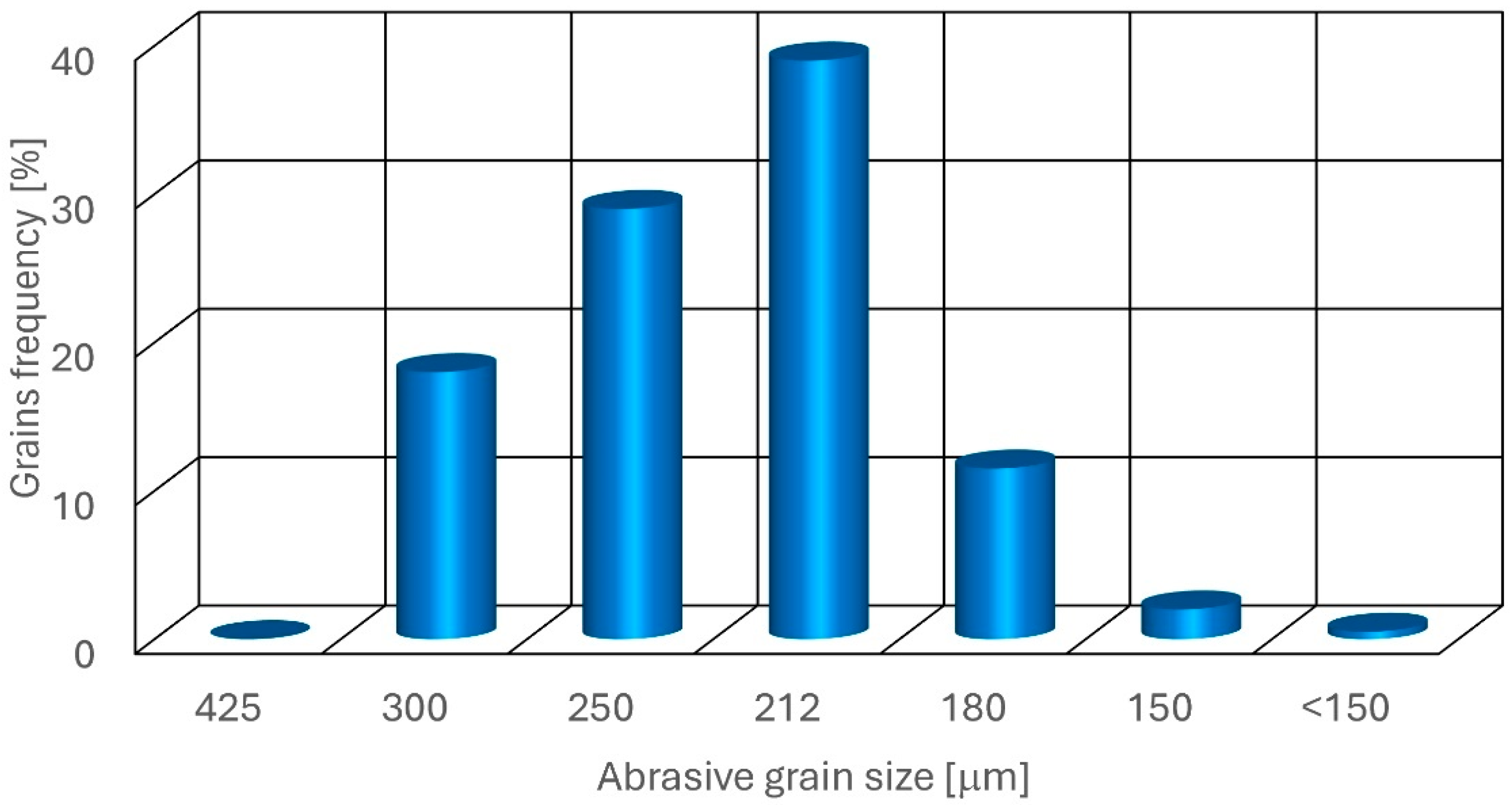
2.2. Abrasive Material
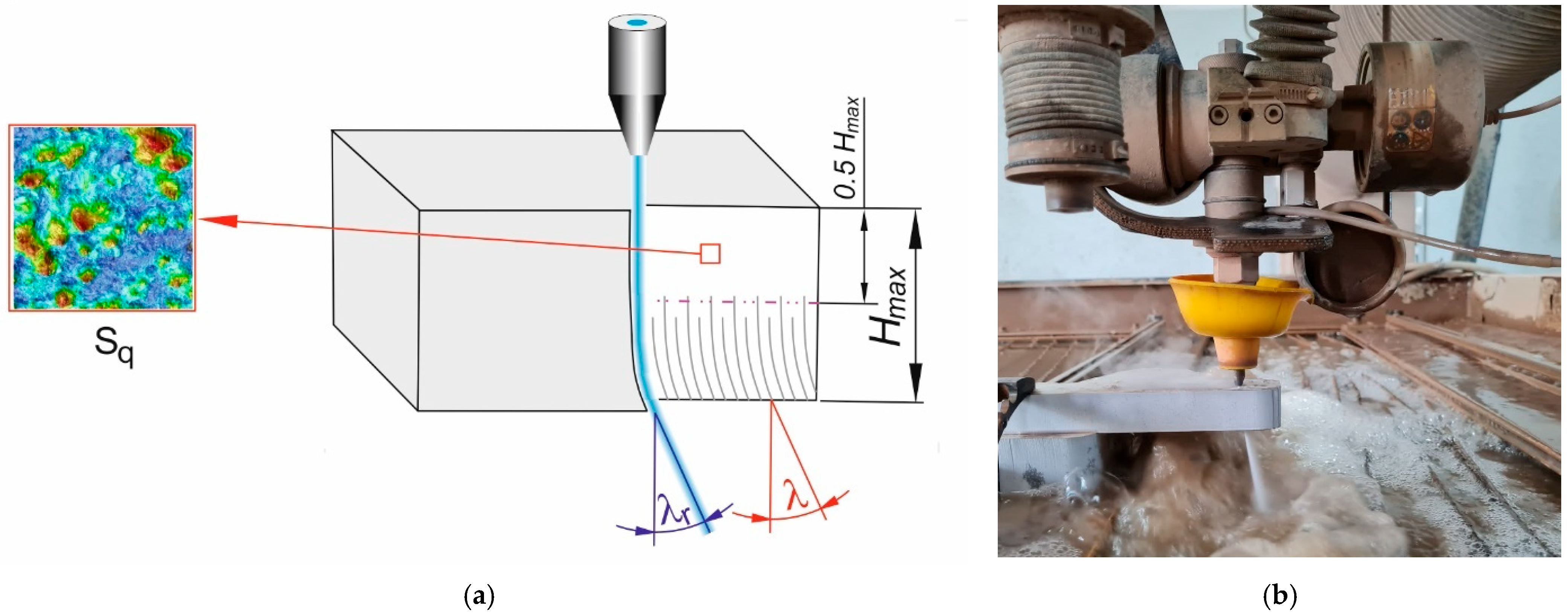
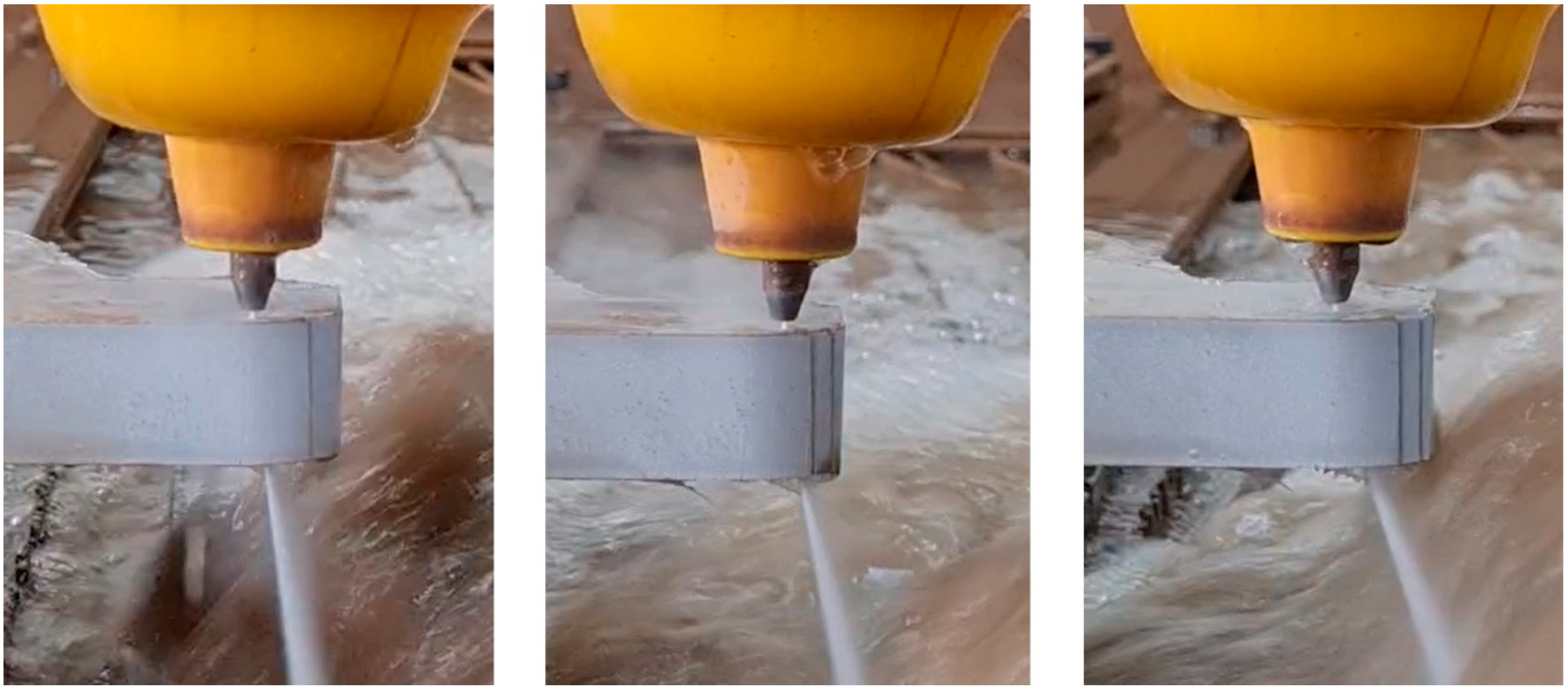
2.3. Test Rig
2.4. Design of Experiment (DoE)
- -
- Cutting depth,
- -
- Roughness of the cut surface Sq,
- -
- Jet deflection angle.
2.5. Measurements
- XY: up to 0.01 μm (subpixel interpolation in PRECiV),
- Z: up to 0.1 μm (in 3D mode with autofocus or scanning).
- A is measuring area,
- x and y are linear dimensions of an area.
3. Results and Discussion
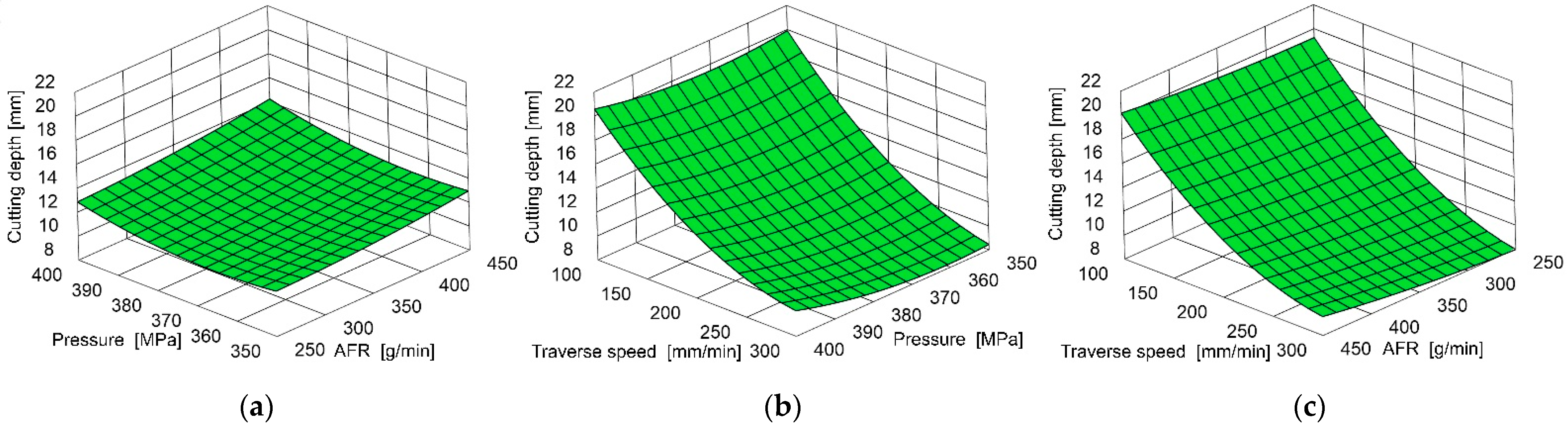
3.1. Cutting Depth
- H is cutting depth [mm],
- x1 is abrasive flow rate [g/min],
- x2 is pressure [MPa],
- x3 is the traverse speed [mm/min].
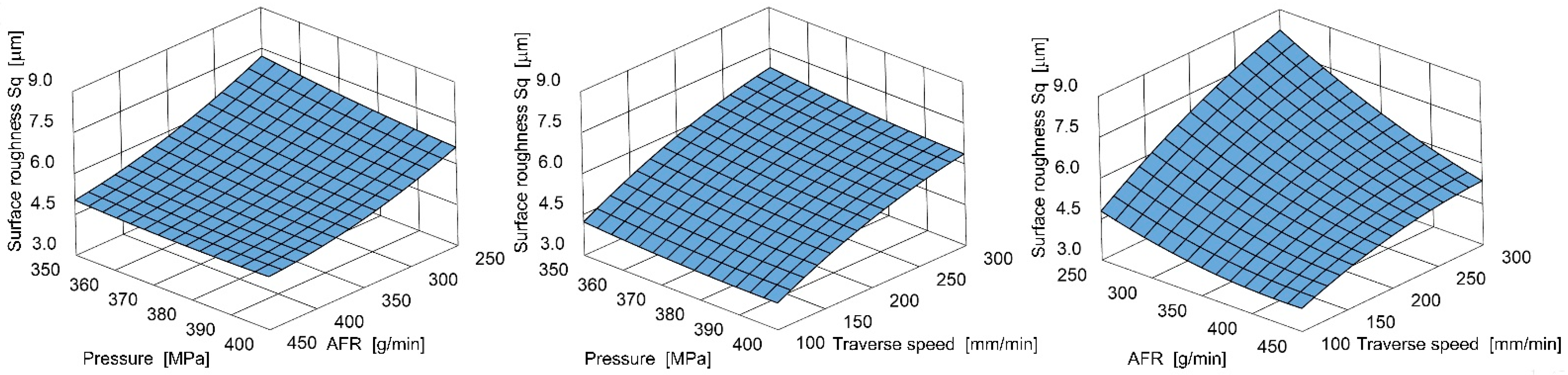
3.2. Surface Roughness
- S is the surface roughness factor Sq [μm],
- x1 is abrasive flow rate [g/min],
- x2 is pressure [MPa],
- x3 is the traverse speed [mm/min].
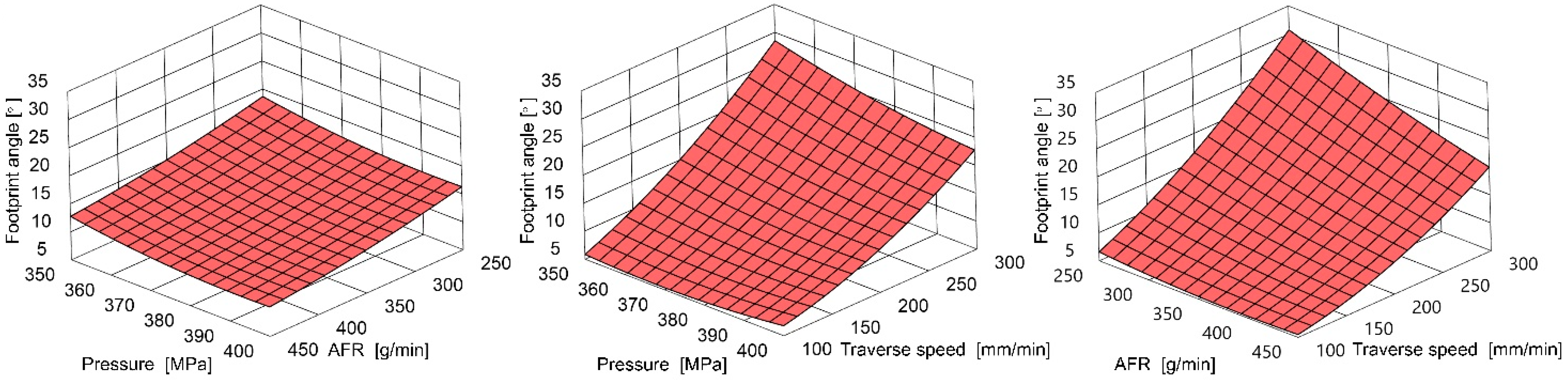
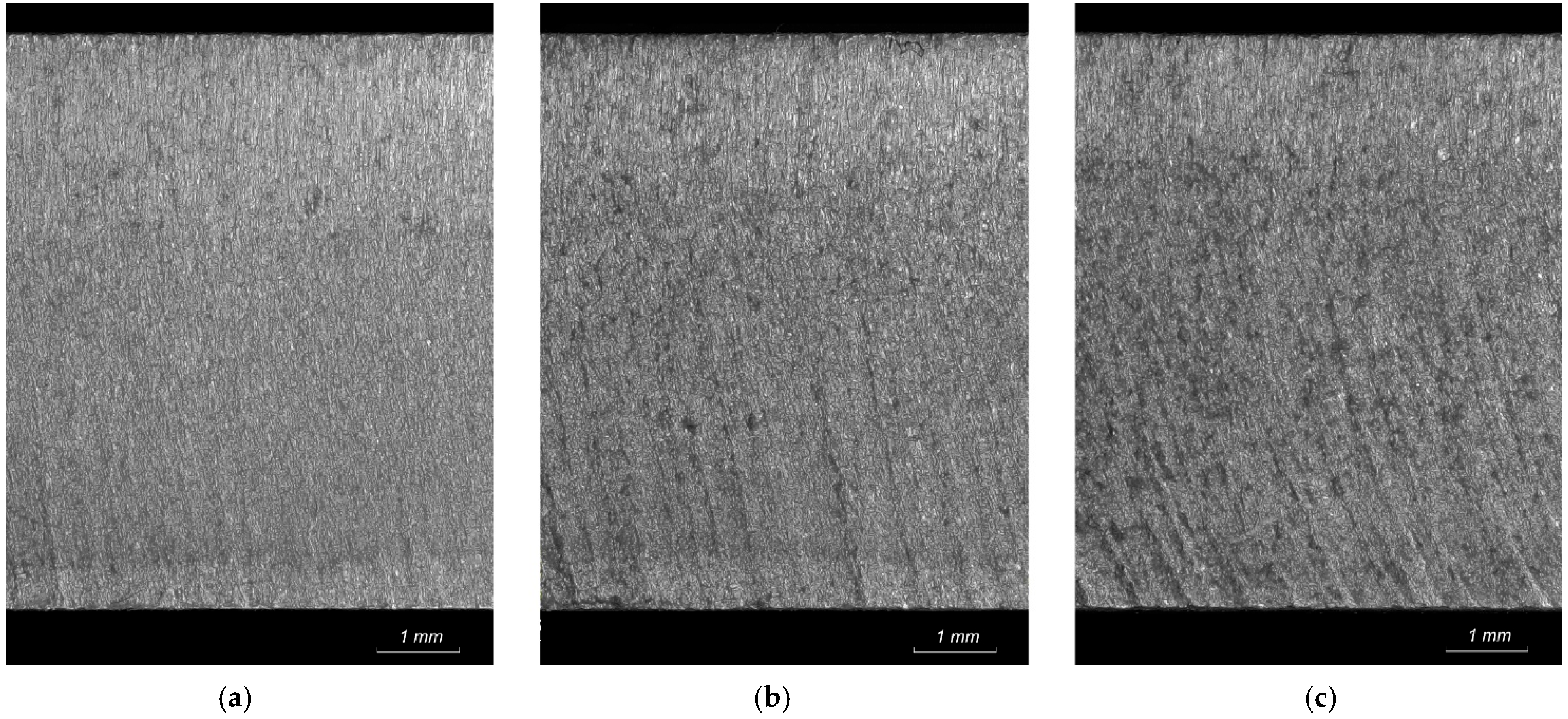
3.3. Footprint Angle
- D is the deflection angle [deg],
- x1 is abrasive flow rate [g/min],
- x2 is pressure [MPa],
- x3 is the traverse speed [mm/min].
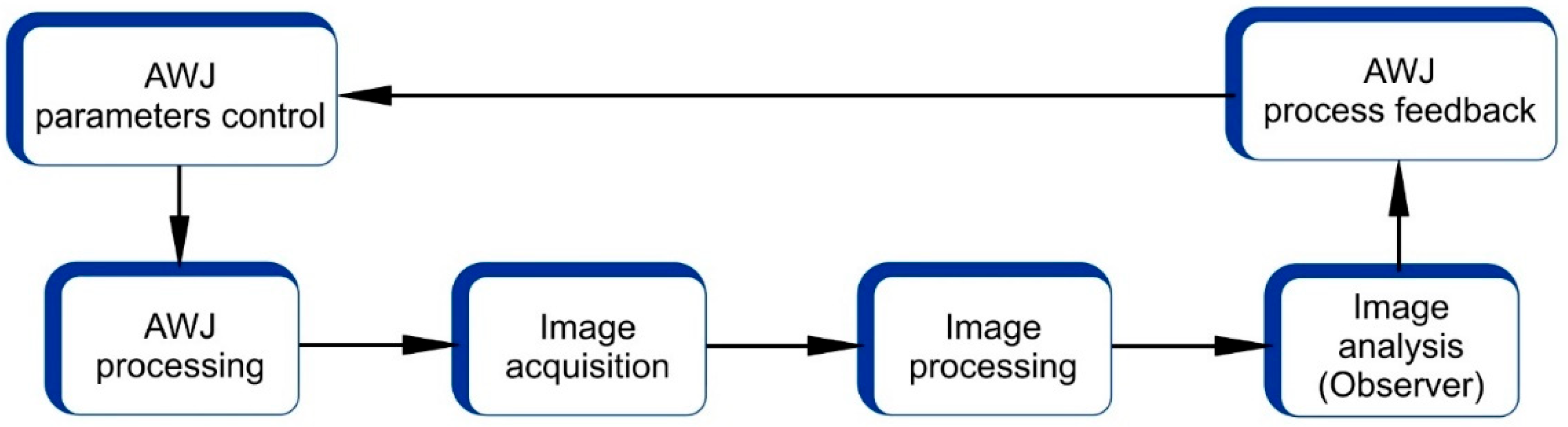
3.4. Image Analysis to Support the AWJ Parameters Optimization
- support in the process of removal of organic coatings with rotating water jets, and the image analysis was applied to identify exposed steel areas [66],
- identification of cutting regions by detecting glass materials in AWJ-based CNC processes [67],
- identification of geometrical features of holes trepanned with AWJ [68] to assess the processing precision,
- identification of AWJ processing burr areas that require additional finishing [69],
- observation of cutting front parameters with thermal or optical cameras [48].
4. Conclusions
Author Contributions
Funding
Institutional Review Board Statement
Informed Consent Statement
Data Availability Statement
Conflicts of Interest
References
- Perec, A. Multiple Response Optimization of Abrasive Water Jet Cutting Process Using Response Surface Methodology (RSM). Procedia Comput. Sci. 2021, 192, 931–940. [Google Scholar] [CrossRef]
- Lehocka, D.; Botko, F.; Klich, J.; Sitek, L.; Hvizdos, P.; Fides, M.; Cep, R. Effect of Pulsating Water Jet Disintegration on Hardness and Elasticity Modulus of Austenitic Stainless Steel AISI 304L. Int. J. Adv. Manuf. Technol. 2020, 107, 2719–2730. [Google Scholar] [CrossRef]
- Poloprudský, J.; Nag, A.; Kruml, T.; Hloch, S. Effects of Liquid Droplet Volume and Impact Frequency on the Integrity of Al Alloy AW2014 Exposed to Subsonic Speeds of Pulsating Water Jets. Wear 2022, 488–489, 204136. [Google Scholar] [CrossRef]
- Perec, A.; Kawecka, E.; Pude, F. Enhancing High-Alloy Steel Cutting with Abrasive Water Injection Jet (AWIJ) Technology: An Approach Using the Response Surface Methodology (RSM). Materials 2024, 17, 4020. [Google Scholar] [CrossRef]
- Perec, A.; Radomska-Zalas, A.; Fajdek-Bieda, A.; Kawecka, E. Efficiency of Tool Steel Cutting by Water Jet with Recycled Abrasive Materials. Materials 2022, 15, 3978. [Google Scholar] [CrossRef]
- Radomska-Zalas, A. Experimental Research on the Use of a Selected Multi-Criteria Method for the Cutting of Titanium Alloy with an Abrasive Water Jet. Materials 2023, 16, 5405. [Google Scholar] [CrossRef] [PubMed]
- Peng, G.; Itou, T.; Oguma, Y.; Shimizu, S. Effect of Ventilation on the Velocity Decay of Cavitating Submerged Water Jet. In Fluid-Structure-Sound Interactions and Control; Zhou, Y., Kimura, M., Peng, G., Lucey, A.D., Huang, L., Eds.; Springer: Singapore, 2019; pp. 93–98. ISBN 978-981-10-7541-4. [Google Scholar]
- Shimizu, S.; Sakuma, M.; Hitomi, K.; Akiyama, K.; Peng, G. Submerged Cutting by Abrasive Suspension Jets. Trans. Jpn. Soc. Mech. Eng. Ser. B 2011, 77, 437–445. [Google Scholar] [CrossRef]
- Doreswamy, D. Machining of D2 Heat Treated Steel Using Abrasive Water Jet: The Effect of Standoff Distance and Feed Rate on Kerf Width and Surface Roughness. Int. J. Res. Eng. Technol. 2014, 3, 417–421. [Google Scholar] [CrossRef]
- Dekster, L.; Karkalos, N.E.; Kudelski, R.; Karmiris-Obratański, P. Experimental Study on Multipass AWJ Performance on Hardox 500 Workpieces. Acta Tech. Napoc.-Ser. Appl. Math. Mech. Eng. 2023, 66, 577–584. [Google Scholar]
- Hloch, S.; Hlaváček, P.; Vasilko, K.; Cárach, J.; Samardžić, I.; Kozak, D.; Hlavatý, I.; Scucka, J.; Klich, J.; Klichova, D. Abrasive Waterjet (AWJ) Titanium Tangential Turning Evaluation. Metalurgija 2014, 53, 537–540. [Google Scholar]
- Hlaváč, L.; Gembalová, L.; Stěpán, P.; Hlaváčová, I. Improvement of Abrasive Water Jet Machining Accuracy for Titanium and TiNb Alloy. Int. J. Adv. Manuf. Technol. 2015, 80, 1733–1740. [Google Scholar] [CrossRef]
- Dekster, L. Influence of AWJ Parameters on Surface Quality and Material Removal in WNiFe Tungsten Alloy. Adv. Sci. Technol. Res. J. 2024, 18, 351–360. [Google Scholar] [CrossRef]
- Szatkiewicz, T.; Laskowska, D.; Bałasz, B.; Mitura, K. The Influence of the Structure Parameters on the Mechanical Properties of Cylindrically Mapped Gyroid TPMS Fabricated by Selective Laser Melting with 316L Stainless Steel Powder. Materials 2022, 15, 4352. [Google Scholar] [CrossRef]
- Nag, A.; Scucka, J.; Hlavacek, P.; Klichova, D.; Srivastava, A.K.; Hloch, S.; Dixit, A.R.; Foldyna, J.; Zelenak, M. Hybrid Aluminium Matrix Composite AWJ Turning Using Olivine and Barton Garnet. Int. J. Adv. Manuf. Technol. 2018, 94, 2293–2300. [Google Scholar] [CrossRef]
- Santhanakumar, M.; Adalarasan, R.; Rajmohan, M. Experimental Modelling and Analysis in Abrasive Waterjet Cutting of Ceramic Tiles Using Grey-Based Response Surface Methodology. Arab. J. Sci. Eng. 2015, 40, 3299–3311. [Google Scholar] [CrossRef]
- Hashish, M. Abrasive Waterjet Machining. Materials 2024, 17, 3273. [Google Scholar] [CrossRef] [PubMed]
- Momber, A.W.; Kovacevic, R. Principles of Abrasive Water Jet Machining; Springer Science & Business Media: Luxembourg, 2012; ISBN 978-1-4471-1572-4. [Google Scholar]
- Finnie, I. Erosion of Surfaces by Solid Particles. Wear 1960, 3, 87–103. [Google Scholar] [CrossRef]
- Bitter, J.G.A. A Study of Erosion Phenomena Part I. Wear 1963, 6, 5–21. [Google Scholar] [CrossRef]
- Hashish, M. A Model for Abrasive-Waterjet (AWJ) Machining. J. Eng. Mater. Technol. 1989, 111, 154–162. [Google Scholar] [CrossRef]
- Folkes, J. Waterjet—An Innovative Tool for Manufacturing. J. Mater. Process. Technol. 2009, 209, 6181–6189. [Google Scholar] [CrossRef]
- Axinte, D.A.; Srinivasu, D.S.; Billingham, J.; Cooper, M. Geometrical Modelling of Abrasive Waterjet Footprints: A Study for 90° Jet Impact Angle. CIRP Ann. 2010, 59, 341–346. [Google Scholar] [CrossRef]
- Liu, P.H.-T.; Schubert, E. Micro Abrasive-Waterjet Technology. In Versatility of Waterjet Technology; Jenny Stanford Publishing: Singapore, 2024. [Google Scholar]
- Hoogstrate, A.M.; Karpuschewski, B.; Van Luttervelt, C.A.; Kals, H.J.J. Modelling of High Velocity, Loose Abrasive Machining Processes. CIRP Ann. 2002, 51, 263–266. [Google Scholar] [CrossRef]
- Kantha Babu, M.; Krishnaiah Chetty, O.V. A Study on Recycling of Abrasives in Abrasive Water Jet Machining. Wear 2003, 254, 763–773. [Google Scholar] [CrossRef]
- Perec, A.; Kawecka, E.; Radomska-Zalas, A.; Pude, F. Optimization of Abrasive Waterjet Cutting by Using the CODAS Method with Regard to Interdependent Processing Parameters. Stroj. Vestn.–J. Mech. Eng. 2023, 69, 367–375. [Google Scholar] [CrossRef]
- Jandačka, P.; Ščučka, J.; Martinec, P.; Lupták, M.; Janeček, I.; Mahdi Niktabar, S.M.; Zeleňák, M.; Hlaváček, P. Optimal Abrasive Mass Flow Rate for Rock Erosion in AWJ Machining. In Advances in Water Jetting; Klichová, D., Sitek, L., Hloch, S., Valentinčič, J., Eds.; Lecture Notes in Mechanical Engineering; Springer International Publishing: Cham, Switzerland, 2021; pp. 81–90. ISBN 978-3-030-53490-5. [Google Scholar]
- ISO/WJ/TC 44 N 1770; Standard Contact Free Cutting. Water Jet Cutting. Geometrical Product Specification and Quality. ISO: Geneva, Switzerland, 2010.
- Jagadish; Gupta, K. Abrasive Water Jet Machining of Engineering Materials; SpringerBriefs in Applied Sciences and Technology; Springer International Publishing: Cham, Switzerland, 2020; ISBN 978-3-030-36000-9. [Google Scholar]
- Ganovska, B.; Molitoris, M.; Hosovsky, A.; Pitel, J.; Krolczyk, J.; Ruggierio, A.; Krolczyk, G.; Hloch, S. Design of the Model for the On-Line Control of the AWJ Technology Based on Neural Networks. Indian J. Eng. Mater. Sci. 2016, 23, 279–287. [Google Scholar]
- Rozanski, R.; Kawecka, E.; Perec, A. Classification of the Cutting Surface Topography Using a Set of Uncorrelated Parameters with High Discriminative Ability. Materials 2025, 18, 3131. [Google Scholar] [CrossRef]
- Perec, A.; Radomska-Zalas, A.; Fajdek-Bieda, A.; Pude, F. Process Optimization by Applying the Response Surface Methodology (RSM) to the Abrasive Suspension Water Jet Cutting of Phenolic Composites. Facta Univ. Ser. Mech. Eng. 2023, 21, 575–589. [Google Scholar] [CrossRef]
- Praźmo, J.; Kawecka, E.; Forysiewicz, M.; Radomska-Zalas, A.; Perec, A. Influence of Abrasive Water Jet Cutting Parameters on the Surface Properties of Modern Plain Bearing Materials. In Advances in Water Jetting II; Sitek, L., Valentinčič, J., Trieb, F.H., Hloch, S., Eds.; Springer Nature: Cham, Switzerland, 2025; pp. 156–168. [Google Scholar]
- Kawecka, E. The Whale Optimization Algorithm in Abrasive Water Jet Machining of Tool Steel. Procedia Comput. Sci. 2023, 225, 1037–1044. [Google Scholar] [CrossRef]
- Perec, A.; Musial, W. Multiple Criteria Optimization of Abrasive Water Jet Cutting Using Entropy-VIKOR Approach. In Advances in Manufacturing Engineering and Materials II; Hloch, S., Klichová, D., Pude, F., Krolczyk, G.M., Chattopadhyaya, S., Eds.; Lecture Notes in Mechanical Engineering; Springer International Publishing: Cham, Switzerland, 2021; pp. 50–62. ISBN 978-3-030-71955-5. [Google Scholar]
- Perec, A.; Kawecka, E.; Radomska-Zalas, A.; Pude, F.; Galecki, G. Multiple-Criteria Optimization of the Water Jet Cutting Process Using WISP Methodology. In Advances in Water Jetting II; Sitek, L., Valentinčič, J., Trieb, F.H., Hloch, S., Eds.; Springer Nature: Cham, Switzerland, 2025; pp. 122–133. [Google Scholar]
- Popan, I.A.; Bocăneț, V.I.; Softic, S.; Popan, A.I.; Panc, N.; Balc, N. Artificial Intelligence Model Used for Optimizing Abrasive Water Jet Machining Parameters to Minimize Delamination in Carbon Fiber-Reinforced Polymer. Appl. Sci. 2024, 14, 8512. [Google Scholar] [CrossRef]
- Perec, A.; Kawecka, E. Modeling of the Abrasive Water Jet Machining by ANN in Uncertainty Conditions. Procedia Comput. Sci. 2024, 246, 2176–2184. [Google Scholar] [CrossRef]
- Ficko, M.; Begic-Hajdarevic, D.; Cohodar Husic, M.; Berus, L.; Cekic, A.; Klancnik, S. Prediction of Surface Roughness of an Abrasive Water Jet Cut Using an Artificial Neural Network. Materials 2021, 14, 3108. [Google Scholar] [CrossRef]
- Szada-Borzyszkowska, M.; Kacalak, W.; Banaszek, K.; Pude, F.; Perec, A.; Wegener, K.; Królczyk, G. Assessment of the Effectiveness of High-Pressure Water Jet Machining Generated Using Self-Excited Pulsating Heads. Int. J. Adv. Manuf. Technol. 2024, 133, 5029–5051. [Google Scholar] [CrossRef]
- Dahil, L.; Dahil, İ.; Karabulut, A. Comparison of Advanced Cutting Techniques on Hardox 500 Steel Material and the Effect of Structural Properties of the Material. Metalurgija 2014, 53, 291–294. [Google Scholar]
- Krenicky, T.; Servatka, M.; Gaspar, S.; Mascenik, J. Abrasive Water Jet Cutting of Hardox Steels—Quality Investigation. Processes 2020, 8, 1652. [Google Scholar] [CrossRef]
- Poloprudský, J.; Chlupová, A.; Šulák, I.; Kruml, T.; Hloch, S. Surface and Subsurface Analysis of Stainless Steel and Titanium Alloys Exposed to Ultrasonic Pulsating Water Jet. Materials 2021, 14, 5212. [Google Scholar] [CrossRef] [PubMed]
- Yuan, Y.; Chen, J.; Gao, H. Surface Profile Evolution Model for Titanium Alloy Machined Using Abrasive Waterjet. Int. J. Mech. Sci. 2023, 240, 107911. [Google Scholar] [CrossRef]
- Wala, T.; Lis, K. The Experimental Method of Determining the Forces Operating During the Abrasive Waterjet Cutting Process—A Mathematical Model of the Jet Deviation Angle. In Industrial Measurements in Machining; Królczyk, G.M., Niesłony, P., Królczyk, J., Eds.; Springer International Publishing: Cham, Switzerland, 2020; pp. 236–245. [Google Scholar]
- Brandstätter, M.; Wöhrle, A.; Kaufeld, M.; Pude, F.; Nag, A.; Hloch, S. The Quantitative Evaluation of the Cutting Surface Quality Levels in Abrasive Water Jet Cutting by Measurement of the Representative Striation Mark Displacement. Int. J. Adv. Manuf. Technol. 2022, 120, 1625–1642. [Google Scholar] [CrossRef]
- Lebar, A.; Jerman, M.; Sabotin, I.; Drešar, P.; Valentinčič, J. AWJ Cutting Process Control by Means of Process Visualisation. Procedia Eng. 2016, 149, 224–228. [Google Scholar] [CrossRef]
- Arola, D.; Ramulu, M. Mechanisms of Material Removal in Abrasive Waterjet Machining of Common Aerospace Materials. In Proceedings of the 7th American Water Jet Conference 1993, Seattle, DC, USA, 28–31 August 1993; WJTA: Seattle, WA, USA, 1993; pp. 43–64. [Google Scholar]
- Hlaváček, P.; Cárach, J.; Hloch, S.; Vasilko, K.; Klichová, D.; Klich, J.; Lehocká, D. Sandstone Turning by Abrasive Waterjet. Rock Mech. Rock Eng. 2015, 48, 2489–2493. [Google Scholar] [CrossRef]
- Martinec, P.; Vašek, J.; Foldyna, J.; Sitek, L. Abrasives for AWJ Cutting; Institute of Geonics, Academy of Sciences of the Czech Republic: Ostrava, Czech Republic, 2002; ISBN 978-80-86407-02-9. [Google Scholar]
- GMA Garnet Group Our Garnet for Future Generations. Available online: https://www.gmagarnet.com/en (accessed on 23 December 2020).
- Prazmo, J.; Sobczak, R.; Perec, A. Abrasive Grain Disintegration during High-Pressure Abrasive Water Jet Cutting in the Abrasive Reuse Aspect. In Proceedings of the Conference on Water Jetting Technology: Water Jet 2017—Research, Development, Application, Lednice, Czech Republic, 13–15 September 2017; Ústav geoniky AV ČR, v. v. i.: Ostrava, Czech Republic, 2017; pp. 137–150, ISBN 978-80-86407-71-5. [Google Scholar]
- China Garnet J80A 50-80mesh. Available online: https://www.abrasivesasia.com/abrasives/garnet-j80a-50-80mesh.html (accessed on 15 April 2025).
- Kawecka, E. The Use of Metaheuristic Optimization Algorithm in Abrasive Water Jet Machining of White Marble. In Proceedings of the XIV International Conference Electromachining 2023, Bydgoszcz, Poland, 9–11 October 2023; AIP Conference Proceedings: Melville, NY, USA, 2024; p. 020015. [Google Scholar] [CrossRef]
- Perec, A.; Kawecka, E.; Podhajecki, J.; Radomska-Zalas, A.; Krakowiak, M.; Nag, A. Comparison of Chosen Metaheuristic Algorithms for the Optimization of the Abrasive Water Jet Treatment Process. MM Sci. J. 2024, 2024, 7678–7686. [Google Scholar] [CrossRef]
- Spadło, S.; Krajcarz, D. Study of the Geometrical Structure of Copper Surface after Abrasive Waterjet Cutting. IOP Conf. Ser. Mater. Sci. Eng. 2018, 461, 012045. [Google Scholar] [CrossRef]
- Radomska-Zalas, A. Multi-Criteria Methods in the Optimization of the Abrasive Waterjet Cutting Process. AIP Conf. Proc. 2024, 3130, 020030. [Google Scholar] [CrossRef]
- ISO 25178-3; Geometrical Product Specifications (GPS)—Surface Texture: Areal. Part 3: Specification Operators. ISO: Geneva, Switzerland, 2012.
- Jerman, M.; Valentinčič, J.; Lebar, A.; Orbanić, H. The Study of Abrasive Water Jet Cutting Front Development Using a Two-Dimensional Cellular Automata Model. Stroj. Vestn.–J. Mech. Eng. 2015, 61, 292–302. [Google Scholar] [CrossRef]
- Chomka, G.; Kasperowicz, M.; Chodór, J.; Chudy, J.; Kukiełka, L. Possibilities of Rock Processing with a High-Pressure Abrasive Waterjet with an Aspect Terms to Minimizing Energy Consumption. Materials 2023, 16, 647. [Google Scholar] [CrossRef]
- Klichova, D.; Nag, A.; Poloprudský, J.; Foldyna, J.; Pude, F.; Sitek, L.; Hloch, S. Utilising of Water Hammer Effect for Surface Roughening of Ti6Al4V. Int. J. Adv. Manuf. Technol. 2023, 126, 5633–5647. [Google Scholar] [CrossRef]
- Carach, J.; Lehocka, D.; Legutko, S.; Hloch, S.; Chattopadhyaya, S.; Dixit, A.R. Surface Roughness of Graphite and Aluminium Alloy After Hydro-Abrasive Machining. In Advances in Manufacturing (Manufacturing 2017); Hamrol, A., Ciszak, O., Legutko, S., Jurczyk, M., Eds.; Springer International Publishing Ag: Cham, Switzerland, 2018; pp. 805–813. ISBN 978-3-319-68619-6. [Google Scholar]
- Yuvaraj, N.; Kumar, M.P. Surface Integrity Studies on Abrasive Water Jet Cutting of AISI D2 Steel. Mater. Manuf. Process. 2017, 32, 162–170. [Google Scholar] [CrossRef]
- Leleń, M.; Ruggiero, A.; Józwik, J. Geometric Features of a Multilayer Surface After Water Jet Cutting in Variable Cutting Conditions. Manuf. Technol. 2023, 22, 713–723. [Google Scholar] [CrossRef]
- Momber, A.W. Image Processing as a Tool for High-Pressure Water Jet Coating Removal Assessment. Int. J. Adv. Manuf. Technol. 2016, 87, 571–578. [Google Scholar] [CrossRef]
- Filho, M.M.D.S.; Cabral, J.D.N.M.; Filho, C.A.D.S. Detection of Glass’ Position Using Computer Vision for the Automation of the Waterjet Cutting Machines. In Proceedings of the 2022 IEEE International Conference on Automation/XXV Congress of the Chilean Association of Automatic Control (ICA-ACCA), Curico, Chile, 24–28 October 2022; pp. 1–6. [Google Scholar]
- Datta, C.; Ravi, R.R.; Srinivasu, D.S. Vision-Based in-Situ Process Monitoring for Increased Productivity in Abrasive Waterjet Trepanning. Procedia Comput. Sci. 2025, 253, 2086–2095. [Google Scholar] [CrossRef]
- Ravi, R.R.; Datta, C.; Srinivasu, D.S. Machine Vision Based Burr Length Measurement in Abrasive Waterjet Trepanning. Manuf. Lett. 2023, 35, 417–422. [Google Scholar] [CrossRef]






| Property | Value |
|---|---|
| Hardness | ~470–530 HBW (Brinell) |
| Yield Strength | ≥1000 MPa |
| Tensile Strength | ~1250 MPa |
| Impact Toughness | 27 J @ −40 °C (typical) |
| Density | 7.85 g/cm3 |
| Thermic Conductivity | ~40 W/m·K |
| Specific Heat | ~480 J/kg·K |
| Element | C | Si | Mn | P | S | Cr | Mo | Ni |
|---|---|---|---|---|---|---|---|---|
| Contents [%] | 0.38 | 0.7 | 1.7 | ≤0.02 | ≤0.01 | 1.2 | 0.65 | 1.0 |
| Crystallographic System | Cubic |
|---|---|
| Unit cell | a = 11.53 Å |
| Break | Conchoidal to uneven |
| Color | Deep red, reddish-brown, brown to black, and deep brown. |
| Density | Hardness | Bulk Density | Melting Point |
|---|---|---|---|
| [kg/m3] | [Mohs] | [kg/m3] | [°C] |
| 4100 | 7.5–8.0 | 1800–2100 | 1300 |
| SiO2 | Al2O3 | FeO | Fe2O3 | MnO | TiO2 | MgO | CaO | Free Silica |
|---|---|---|---|---|---|---|---|---|
| 39.12% | 20.92% | 23.89% | 4.15% | 0.15% | 0.10% | 9.78% | 9.56% | 0% |
| No | AFR [g/s] | Pressure [MPa] | Traverse Speed [mm/min] | Depth of Cut [mm] | Roughness Sq [μm] | Deflection Angle λ [°] |
|---|---|---|---|---|---|---|
| 1 | 250 | 350 | 100 | 20.09 | 4.9430 | 8.58 |
| 2 | 250 | 350 | 200 | 10.74 | 7.1000 | 16.65 |
| 3 | 250 | 350 | 300 | 7.86 | 8.9420 | 36.74 |
| 4 | 250 | 375 | 100 | 19.79 | 4.9920 | 6.36 |
| 5 | 250 | 375 | 200 | 11.63 | 7.0100 | 15.67 |
| 6 | 250 | 375 | 300 | 8.64 | 8.0000 | 29.04 |
| 7 | 250 | 400 | 100 | 20.30 | 4.5270 | 8.52 |
| 8 | 250 | 400 | 200 | 12.89 | 6.7050 | 14.59 |
| 9 | 250 | 400 | 300 | 8.90 | 7.8610 | 30.85 |
| 10 | 350 | 350 | 100 | 20.21 | 4.2300 | 4.80 |
| 11 | 350 | 350 | 200 | 12.87 | 5.7000 | 13.63 |
| 12 | 350 | 350 | 300 | 8.37 | 6.9000 | 28.60 |
| 13 | 350 | 375 | 100 | 17.06 | 4.3470 | 7.32 |
| 14 | 350 | 375 | 200 | 12.30 | 5.3390 | 12.10 |
| 15 | 350 | 375 | 300 | 9.08 | 6.3060 | 27.13 |
| 16 | 350 | 400 | 100 | 21.06 | 3.8820 | 6.83 |
| 17 | 350 | 400 | 200 | 13.75 | 5.3710 | 14.68 |
| 18 | 350 | 400 | 300 | 9.78 | 6.7000 | 19.64 |
| 19 | 450 | 350 | 100 | 20.81 | 3.8140 | 6.33 |
| 20 | 450 | 350 | 200 | 12.76 | 5.2350 | 14.31 |
| 21 | 450 | 350 | 300 | 9.08 | 5.4290 | 22.41 |
| 22 | 450 | 375 | 100 | 20.80 | 3.8630 | 3.57 |
| 23 | 450 | 375 | 200 | 12.07 | 5.0649 | 13.07 |
| 24 | 450 | 375 | 300 | 9.96 | 5.1610 | 18.87 |
| 25 | 450 | 400 | 100 | 21.14 | 3.8770 | 5.56 |
| 26 | 450 | 400 | 200 | 14.53 | 4.8950 | 11.12 |
| 27 | 450 | 400 | 300 | 11.05 | 5.4160 | 18.18 |
| Source | DF | Adj SS | Adj MS | F-Value | p-Value |
|---|---|---|---|---|---|
| Model | 9 | 582.965 | 64.774 | 97.22 | 0.000 |
| Linear | 3 | 552.875 | 184.292 | 276.62 | 0.000 |
| ma | 1 | 7.169 | 7.169 | 10.76 | 0.004 |
| p | 1 | 6.254 | 6.254 | 9.39 | 0.007 |
| vp | 1 | 539.452 | 539.452 | 809.70 | 0.000 |
| Square | 3 | 28.913 | 9.638 | 14.47 | 0.000 |
| ma*ma | 1 | 0.308 | 0.308 | 0.46 | 0.506 |
| p*p | 1 | 3.390 | 3.390 | 5.09 | 0.038 |
| vp*vp | 1 | 25.215 | 25.215 | 37.85 | 0.000 |
| 2-Way Interaction | 3 | 1.177 | 0.392 | 0.59 | 0.631 |
| ma*p | 1 | 0.037 | 0.037 | 0.06 | 0.816 |
| ma*vp | 1 | 0.375 | 0.375 | 0.56 | 0.464 |
| p*vp | 1 | 0.765 | 0.765 | 1.15 | 0.299 |
| Error | 17 | 11.326 | 0.666 | ||
| Total | 26 | 594.291 | |||
| Model summary: | R2 98.09% | R2(adj) 97.09% | R2(pred) 95.99% | ||
| Source | DF | Adj SS | Adj MS | F-Value | p-Value |
|---|---|---|---|---|---|
| Model | 9 | 48.9500 | 5.4389 | 119.74 | 0.000 |
| Linear | 3 | 44.6741 | 14.8914 | 327.84 | 0.000 |
| ma | 1 | 16.6755 | 16.6755 | 367.12 | 0.000 |
| p | 1 | 0.5199 | 0.5199 | 11.44 | 0.004 |
| vp | 1 | 27.4788 | 27.4788 | 604.96 | 0.000 |
| Square | 3 | 1.1427 | 0.3809 | 8.39 | 0.001 |
| ma*ma | 1 | 0.5172 | 0.5172 | 11.39 | 0.004 |
| p*p | 1 | 0.0343 | 0.0343 | 0.76 | 0.397 |
| vp*vp | 1 | 0.5911 | 0.5911 | 13.01 | 0.002 |
| 2-Way Interaction | 3 | 3.1332 | 1.0444 | 22.99 | 0.000 |
| ma*p | 1 | 0.2139 | 0.2139 | 4.71 | 0.044 |
| ma*vp | 1 | 2.8900 | 2.8900 | 63.63 | 0.000 |
| p*vp | 1 | 0.0293 | 0.0293 | 0.65 | 0.433 |
| Error | 17 | 0.7722 | 0.0454 | ||
| Total | 26 | 49.7222 | |||
| Model summary: | R2 98.45% | R2(adj) 97.62% | R2(pred) 96.13% | ||
| Source | DF | Adj SS | Adj MS | F-Value | p-Value |
|---|---|---|---|---|---|
| Model | 9 | 1998.97 | 222.11 | 56.06 | 0.000 |
| Linear | 3 | 1860.66 | 620.22 | 156.55 | 0.000 |
| ma | 1 | 159.49 | 159.49 | 40.26 | 0.000 |
| p | 1 | 27.08 | 27.08 | 6.84 | 0.018 |
| vp | 1 | 1674.08 | 1674.08 | 422.57 | 0.000 |
| Square | 3 | 33.13 | 11.04 | 2.79 | 0.072 |
| ma*ma | 1 | 2.22 | 2.22 | 0.56 | 0.464 |
| p*p | 1 | 4.60 | 4.60 | 1.16 | 0.296 |
| vp*vp | 1 | 26.31 | 26.31 | 6.64 | 0.020 |
| 2-Way Interaction | 3 | 105.18 | 35.06 | 8.85 | 0.001 |
| ma*p | 1 | 0.00 | 0.00 | 0.00 | 0.979 |
| ma*vp | 1 | 70.91 | 70.91 | 17.90 | 0.001 |
| p*vp | 1 | 34.27 | 34.27 | 8.65 | 0.009 |
| Error | 17 | 67.35 | 3.96 | ||
| Total | 26 | 2066.32 | |||
| Model summary: | R2 96.74% | R2(adj) 95.02% | R2(pred) 91.59% | ||
Disclaimer/Publisher’s Note: The statements, opinions and data contained in all publications are solely those of the individual author(s) and contributor(s) and not of MDPI and/or the editor(s). MDPI and/or the editor(s) disclaim responsibility for any injury to people or property resulting from any ideas, methods, instructions or products referred to in the content. |
© 2025 by the authors. Licensee MDPI, Basel, Switzerland. This article is an open access article distributed under the terms and conditions of the Creative Commons Attribution (CC BY) license (https://creativecommons.org/licenses/by/4.0/).
Share and Cite
Perec, A.; Kawecka, E.; Zajac, W. AWJ Cutting Process Quality Modeling and Optimization Based on Footprint Angle. Materials 2025, 18, 5548. https://doi.org/10.3390/ma18245548
Perec A, Kawecka E, Zajac W. AWJ Cutting Process Quality Modeling and Optimization Based on Footprint Angle. Materials. 2025; 18(24):5548. https://doi.org/10.3390/ma18245548
Chicago/Turabian StylePerec, Andrzej, Elzbieta Kawecka, and Wojciech Zajac. 2025. "AWJ Cutting Process Quality Modeling and Optimization Based on Footprint Angle" Materials 18, no. 24: 5548. https://doi.org/10.3390/ma18245548
APA StylePerec, A., Kawecka, E., & Zajac, W. (2025). AWJ Cutting Process Quality Modeling and Optimization Based on Footprint Angle. Materials, 18(24), 5548. https://doi.org/10.3390/ma18245548