Abstract
Prussian blue (PB) and its analogs (PBAs) are interesting materials for electrochemical applications due to their tunable redox chemistry and open framework structure. In this study, hexacyanoferrates (HCF) containing iron (FeHCF), cobalt (CoHCF), and nickel (NiHCF) were synthesized via potentiostatic electrodeposition. Cyclic voltammetry revealed distinct redox behaviors. Morphological characterization (SEM, EDX) demonstrated uniform, pyramidal film growth for FeHCF and CoHCF. Otherwise, NiHCF presented a cracked film with cubic clusters on top due to residual stress. Despite this, homogeneous element distribution was found for all samples. Structural characterization (TEM and XRD) confirmed a cubic lattice crystal structure for all films, with systematic lattice contraction from Fe to Co to Ni due to decreasing atomic radius. Raman and XPS data revealed a shift toward Fe2+ dominant oxidation states and modifications in C≡N bonding, with the influence of K+ and water occupancy in the PBAs framework. These findings illustrate how metal substitution and deposition parameters can tune the structural and electrochemical properties of PBA films, presenting a strategic route to design tailored electrodes.
1. Introduction
Since the first report of Prussian Blue (PB) layer growth using a solid electrode by V. D. Neff in 1978 [1], PB films have been extensively studied and applied in electronic and energy fields such as supercapacitors [2], electrocatalysis [3,4], biosensors [5], electrochromic devices [6,7], hydrogen storage [8], and batteries due to their facile and tunable physical chemical properties [9].
With a general formula described as , Prussian blue materials correspond to the hexacyanoferrate class, where A is an alkali metal cation (e.g., ) and MA/MB denote transition metal elements connected with the cyano groups present in the structure (; ). The crystal structure of PB was first described by Keggin and Miles [10] as a cubic framework composed of chains, with six cyano groups linked to each Fe ion octahedrally coordinated by six cyanide ligands, resulting in a cubic lattice with a parameter of approximately 10.2 Å [11,12,13]. In cases where Fe is partially substituted by another transition metal, so-called Prussian blue analogs (PBAs) are formed. Such substitutions can induce distortions in the cubic structure, leading to lattice parameters of around 10–10.5 Å, depending on the ionic radius of the MB metal, when an Fe atom is substituted by a larger transition metal [10,14].
Numerous synthetic methods have been described over the years for producing PB and PBA materials such as co-precipitation [15,16], hydrothermal synthesis [15], ion exchange [16], microemulsion [17], and electrodeposition [18]. Among these methods, the electrodeposition process offers advances in terms of homogeneity, high crystallinity, and reproducibility [17,18]. Following the initial report in 1978 [1], in which a PB film was deposited on a gold substrate, Itaya et al. [19] introduced a galvanostatic procedure that enabled the fabrication of high-quality PB films on various electrode substrates using acidic solutions and as precursor [6,20,21]. Since then, several research groups have been engaged in the preparation of high-quality PB layers for electronic applications [22,23,24]. However, only a limited number of studies have addressed the electrodeposition of PBAs. These contributions provide important insights into their electrochemical behavior but often lack detailed structural and morphological characterization [25,26,27,28]. For this reason, this work presents a comprehensive structural, morphological, and compositional characterization of different PBA layers, including cobalt- and nickel-based films electrodeposited on gold substrates, with the aim of elucidating the impact of these metals on the Prussian blue crystal structure. The findings reported here might provide insights for the future development and application of Prussian blue analogs in electronic devices.
2. Materials and Methods
2.1. Sample Preparation
Prussian blue analog films were grown until a total deposited charge of 30 mC was reached by applying a constant potential of 0.30 V using an Ivium electrochemical workstation (Ivium CompactStat, Eindhoven, The Netherlands). The potentiostatic fabrication of these Hexacyanoferrate layers (HFC) was carried out with a three-electrode setup (Pt as counter electrode, saturated calomel electrode (SCE) as reference electrode, and 50 nm Au/5 nm Cr on Si (100) as working electrode) at 25 °C. All potentials reported for the electrochemical deposition and cyclic voltammetry experiments are referenced to the SCE. With SCE, high reproducebility of the PBA films was obtained. However, other reference electrodes, e.g., Ag/AgCl-electrodes, have been successfully tested. The deposition of the layers occurred in a circular area of ∼ defined by a mask of adhesive tape on the surface of the working electrode and aqueous solutions containing 1.0 M KCl (ACS, 99–100.5%, Sigma Aldrich, Darmstadt, Germany), 0.25 mM (ACS > 99% Sigma Aldrich, Darmstadt, Germany), 0.25 mM metal chloride salts were used as electrolyte for PBA deposition. The electrolyte solution pH was set to 2 using HCl (ACS, 37%, Sigma Aldrich, Darmstadt, Germany) for all depositions. These procedures were previously published in literature [20,29].
In this work samples were named according to the metal chloride salt use in electrolyte solution, such as FeHCF for iron chloride hexahydrate ( ACS, 98–102%, Sigma Aldrich, Darmstadt, Germany), CoHCF for cobalt chloride hexahydrate ( ACS, 98.0–102.0%, Thermo Scientific Chemicals, Dreieich, Germany) and NiHCF for nickel chloride hexahydrate ( ≥ 99.9%, Sigma-Aldrich, Darmstadt, Germany).
2.2. Material Characterization
Electrodeposited HCF layers were characterized by X-Ray diffraction performed with a X’Pert MRD diffractometer (Panalytical, Almelo, The Netherlands) using Co-K radiation with a wavelength of = 1.78896 Å in Bragg–Brentano geometry with a step-size of 0.005° in the range of 2θ = 10–50°. Morphological and compositional properties were analyzed by field emission scanning electron microscopy (FEG-SEM, TESCAN CLARA, Brno, Czech Republic) equipped with an energy-dispersive X-ray (EDX) detector (Ultim Max 65 SDD, Oxford Instruments, Wiesbaden, Germany) at 20 keV and a Raman system (Witec RISE, Ulm, Germany). Raman measurements were performed with a 532 nm laser at 0.4 mW. In order to conduct cross-sectional transmission electron microscopy (TEM), ca. 50 nm thick lamellae were prepared using focused ion beam (FIB) milling. High-resolution TEM (HRTEM) was conducted on a double-corrected FEI Titan380-300 TEM instrument (Thermo Fisher Scientific, Waltham, MA, USA) operated at 300 keV to investigate the crystal structure of the films at the atomic scale. In bright-field TEM (BFTEM) mode, an objective aperture of diameter was used. Scanning transmission electron microscopy (STEM) and electron energy loss spectroscopy (EELS) were carried out using a Hitachi HF3300 S TEM (Tokyo, Japan) operated at 300 keV, equipped with a CEFID image filter [30] including a TVIPS XF416 detector. The energy dispersion was selected to realize an energy range of 1024 eV and resolution of 1.3 eV. Elemental maps were extracted for Fe, Co, Ni, K, C, N, and O using the background-fitting and core-loss-quantification procedures integrated in Gatan Inc. (Pleasanton, CA, USA) DigitalMicrograph image analysis software (Version 3.61). X-ray photoelectron spectroscopy (XPS, SPECS, Berlin, Germany) was performed using an Al radiation source (photon energy = 1486.7 eV). The size of the investigated area of interest on the surface was ∼1 mm, and before analysis, the samples were sputtered with Argon íons at 3 keV at a pressure of mbar to remove surface contaminants. The removed layer thickness is estimated to be around 10–20 nm and the spectral analysis was performed with Casa (CasaXPS, vs. 2.2.24, New York, NY, USA).
3. Results and Discussion
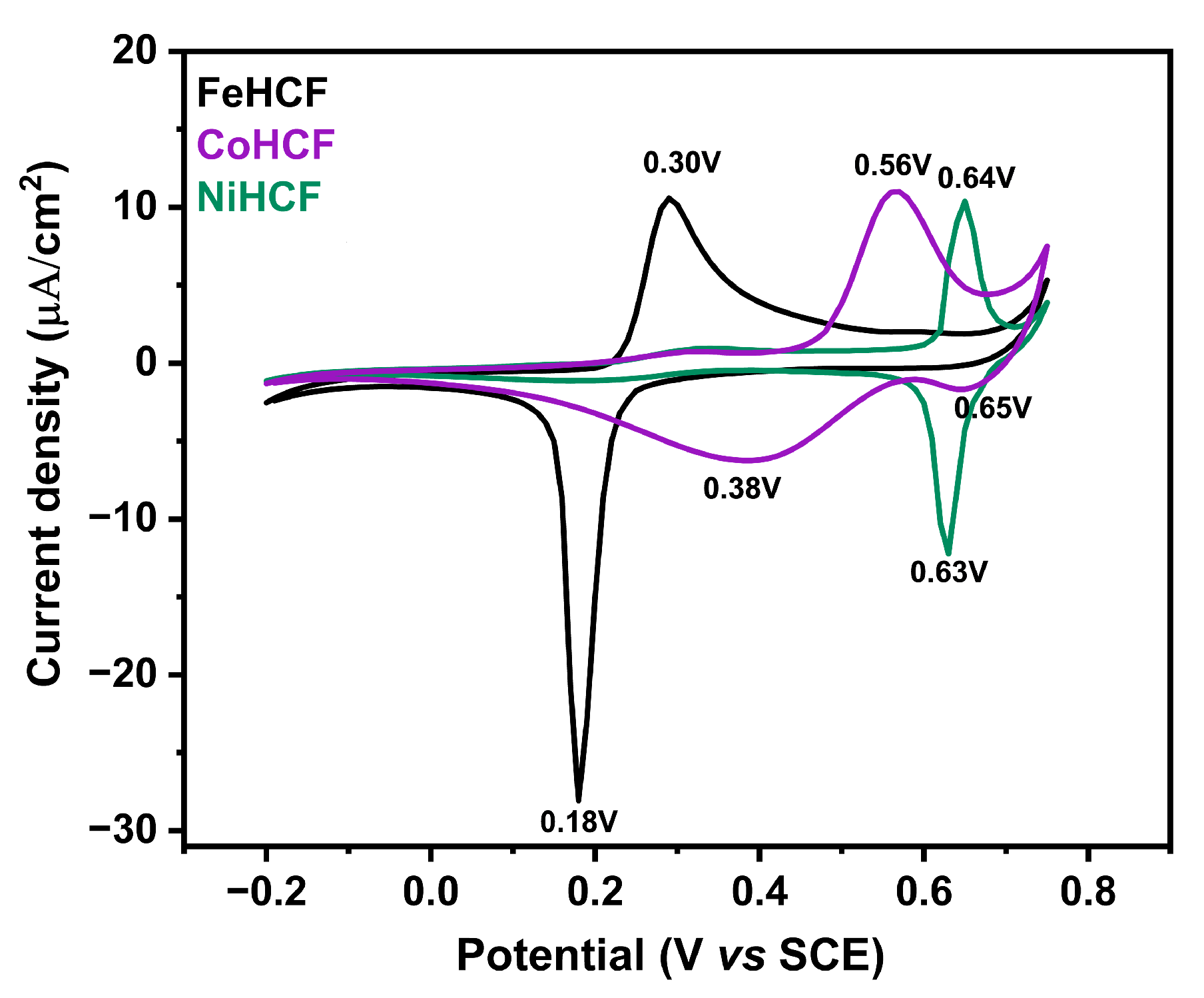
It is well established that the chosen potential for deposition will affect the quality and oxidation state of the Prussian blue films [23]. The optimal electrodeposition conditions for PB analogs containing cobalt and nickel were determined by means of cyclic voltammetry (CV) in the potential window ranging from −0.2 V to 0.8 V at a scan rate of 100 mV/s. The CV obtained for electrolytes containing different transition metals is shown in Figure 1.
Figure 1.
Cyclovoltammetry curves obtained at a scan rate of 100 mV/s for FeHCF, CoHCF, and NiHCF.
FeHCF exhibits the characteristic Fe3+/Fe2+ redox behavior associated with PB formation at approximately 0.30 V (oxidation) and 0.18 V (reduction) [29]. In contrast, CoHCF displays more complex electrochemical behavior, with one oxidation peak at 0.56 V and two reduction peaks at 0.38 V and 0.65 V, suggesting the presence of two electroactive forms. NiHCF, on the other hand, presents a single oxidation and reduction process around 0.64 V and 0.63 V. These processes are attributed to the Fe3+/Fe2+ redox site and are consistent with the negative standard potential of Ni2+ [31,32]. Notably, the Fe3+/Fe2+ redox couple for Co and Ni analogs is shifted with respect to FeHCF, which can be attributed to the influence of K+ ions present in the electrolyte solution. Cations such as K+ can modulate local electronic environments and shift redox potentials as previously demonstrated in related systems by Phadke et al. [33]. Based on these CV observations, a 0.30 V deposition potential was selected for all films to ensure consistency and comparability. Given the variations in redox and crystallization mechanisms observed among Co- and Ni-containing films, we further conducted morphological and structural characterizations to elucidate these effects.
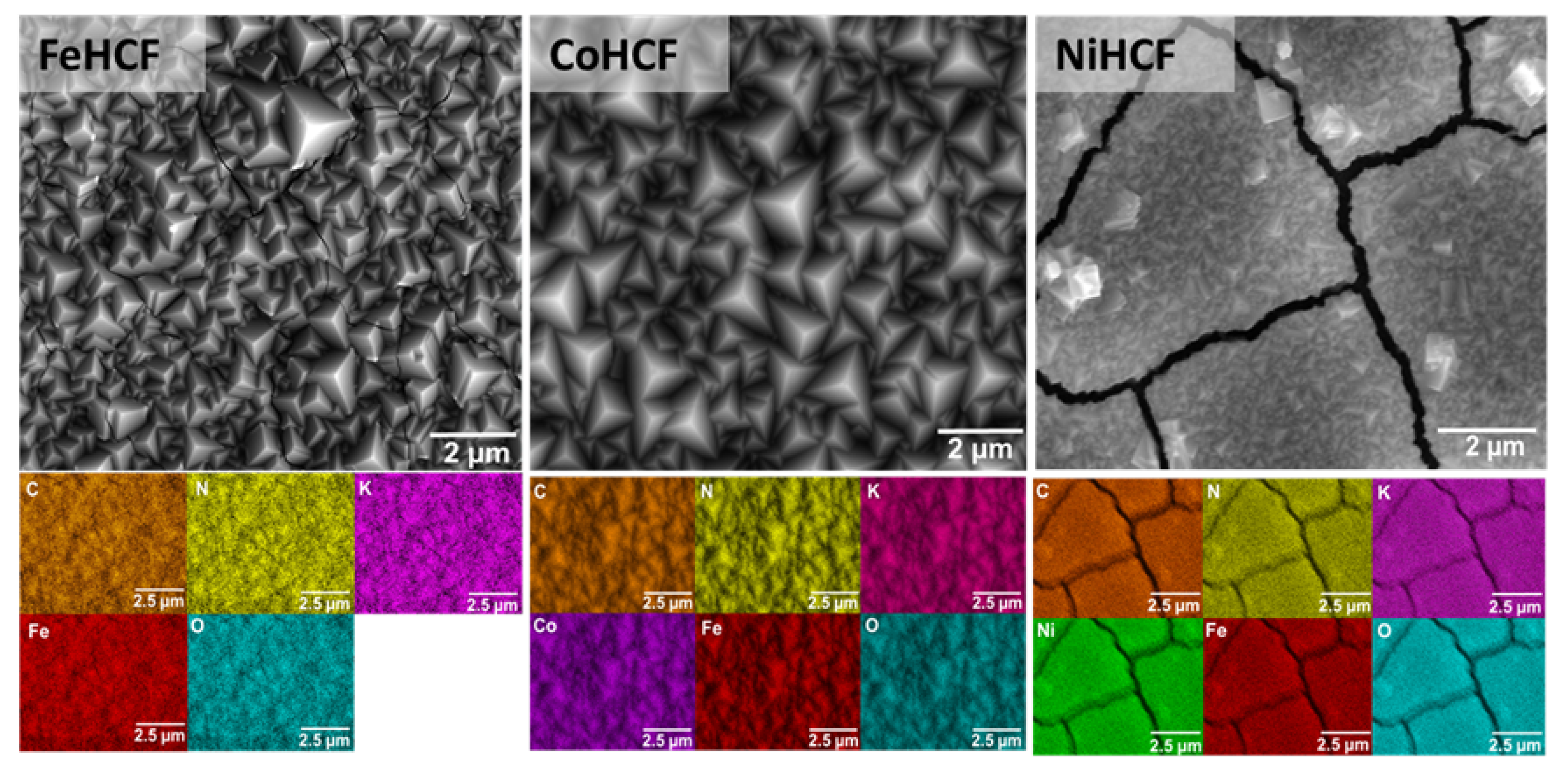
Figure 2 shows SEM top view sections of the layers with elemental distribution for FeHCF, CoHCF, and NiHCF. In terms of crystallization, FeHCF and CoHCF samples present the characteristic pyramidal growth with uniform coverage, as previously described in the literature [27,32]. Small cracks in FeHCF appear under electron beam with acceleration voltages >10 keV due to the rapid volatilization of organic cations and water molecules on the film surface [34]. At lower electron acceleration voltages, no cracks appear.
Figure 2.
SEM surface image from sample top view with elemental mapping composition for FeHCF, CoHCF, and NiHCF.
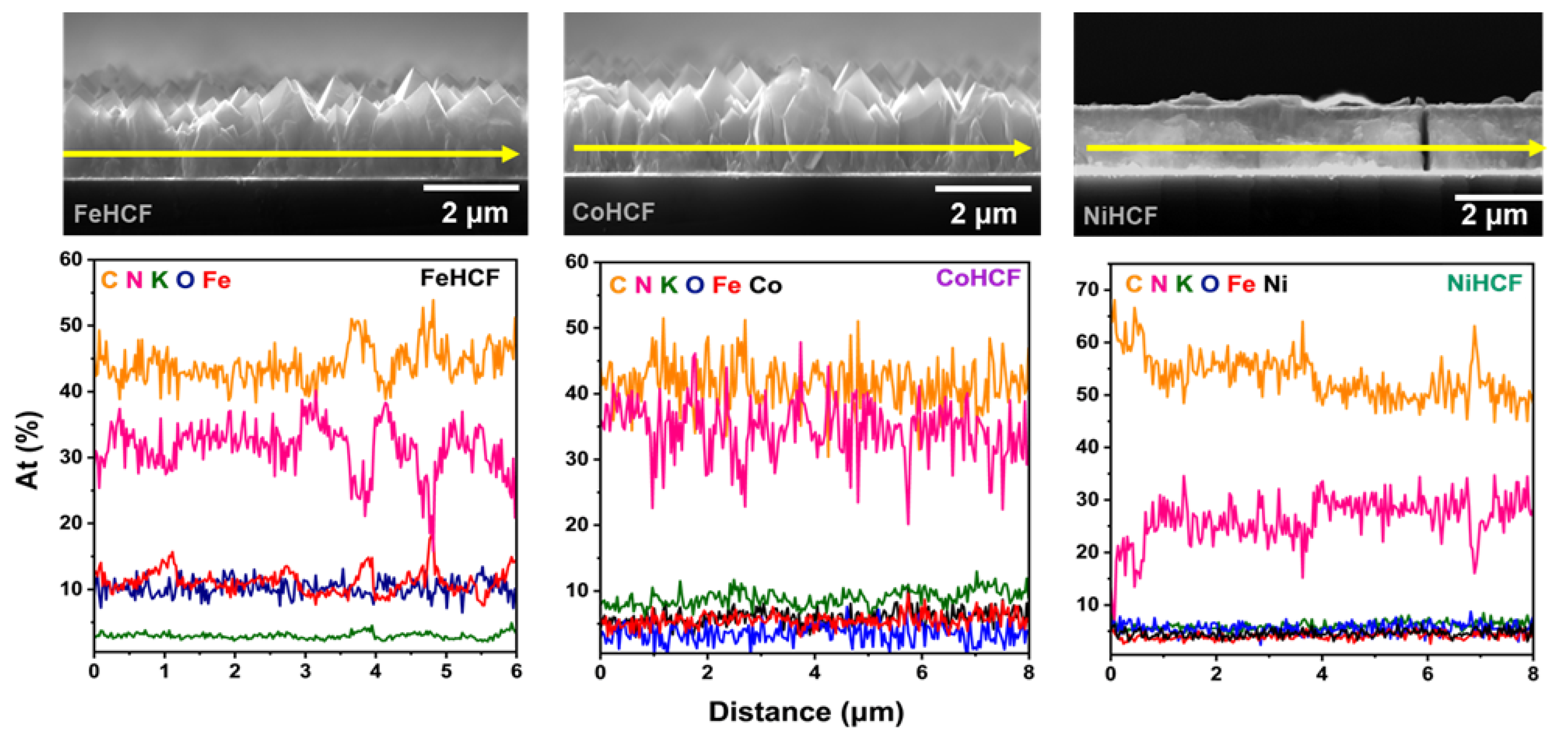
In contrast, the NiHCF sample shows non-uniform growth with formation of clusters on the surface. A previous study published by Malik et al. [35] indicates that the efficiency of NiHCF thin film growth is higher only in the first layer due to the more effective reduction of at the gold surface than at the electrode consisting of gold and a single layer of NiHCF. Decreases in reduction rate and changes in mass transfer during the electrochemical process imply the formation of clusters on the surface and increased residual stress, causing long-term instability and cracks after film deposition and during SEM imaging [36]. Despite these morphological variations, EDX analysis reveals a homogeneous distribution of constituent elements in all three samples, as the atomic compositions shown in Table 1 support. Notably, the CoHCF and NiHCF samples exhibit a significant increase in potassium content compared to FeHCF, which suggests that substitution of the transition metal may favor higher K+ incorporation into the structure. Cross-sectional SEM with EDX line scans (Figure 3) confirms a consistent elemental composition throughout the film. Abrupt variations in the line profiles can be attributed to cracks (NiHCF) and grain boundaries. The higher potassium content in CoHCF and NiHCF suggests a more pronounced presence of interstitial K+ ions, potentially leading to lattice distortion. The ratio between metallic ions and potassium indicates changes in the oxidation state of the samples, as well as the presence of a mixture of Prussian Blue phase with its reduced form, Prussian White [37,38]. In addition to possible changes in oxidation state due to an increase in potassium amount and the presence of interstitial water indicated by oxygen traces, the metallic substitution observed in the EDX analysis could cause distortions in the crystal lattice [39,40,41,42].
Table 1.
Elemental mapping quantification (atomic %) of FeHCF, CoHCF, and NiHCF thin films obtained by EDX.
Figure 3.
Cross-section SEM images of the different HCF complexes with line profiles of the elemental distribution in atomic percentage (At(%)) obtained from EDX spectra. The yellow arrows in the SEM images indicate the line scan positions.
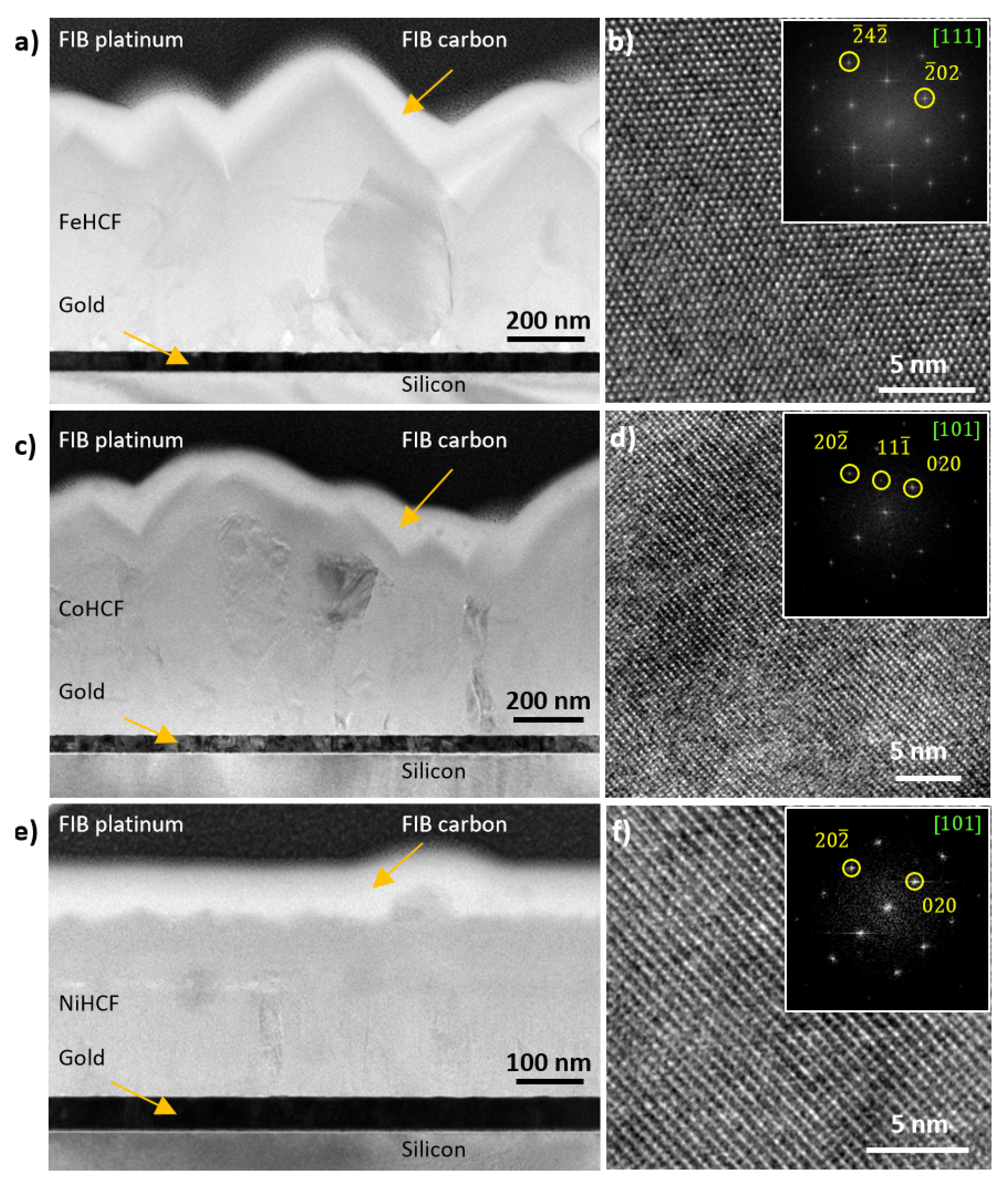
To verify these possible changes in the crystal lattice structure, TEM in bright-field (BFTEM) and high-resolution mode (HRTEM), as well as X-ray diffraction (XRD), were carried out. The main observations of FeHCF, CoHCF, and NiHCF thin films are summarized in Figure 4.
Figure 4.
Cross-sectional TEM of FeHCF, CoHCF, and NiHCF thin films. (a,c,e) Overview BFTEM images of the FIB-prepared lamellas of FeHCF, CoHCF, and NiHCF. The dark areas show grains oriented along a certain low-index zone axis. (b,d,f) HRTEM images of the three samples showing lattice fringes with their Fourier transforms in the insets, oriented along the [111], [101], and [101] zone axes, respectively, confirming their cubic structure.
Figure 4a presents the BFTEM image of a cross-section through the FeHCF layer. The poly-crystalline film appears continuous, with no visible voids or delamination at the Au interface, and has an average thickness of 700 nm. Regions of increased contrast within the film indicate local areas where FeHCF grains are oriented along specific zone axes. The HRTEM image (Figure 4b), acquired along [111] zone axis, reveals uniform and well-resolved lattice fringes within the field of view, confirming the high crystallinity of the film. The corresponding fast Fourier transform (FFT) pattern (inset in Figure 4b) displays distinct reflections indexed to the and planes.
The BFTEM image of the CoHCF cross-section (Figure 4c) shows a poly-crystalline film with a mean thickness of approximately 1 . The HRTEM image (Figure 4d), acquired along the [101] zone axis, exhibits uniform and well-defined lattice fringes within the field of view. The corresponding FFT pattern (inset in Figure 4d) shows reflections indexed to the , (020), and planes.
For NiHCF, the BFTEM image (Figure 4e) also reveals a continuous poly-crystalline film with an estimated mean thickness of 300 nm. The HRTEM image (Figure 4f), recorded along the [101] zone axis, exhibits lattice fringes that correspond in the FFT pattern (inset in Figure 4f) to reflections indexed to the (020) and planes.
Analysis of multiple TEM images of all three films (FeHCF, CoHCF, NiHCF) yielded lattice constants of (10.0–10.5) Å. To this end, first, the reflection distances to the zero beam in the FFTs of the TEM images, which correspond to the reciprocals of the lattice fringe spacings were measured. Then, the relation , where h, k, l represent the Miller indices, was used to determine the lattice parameter a of the cubic crystals. In fact, TEM measurements lacked the precision required to identify significant changes in lattice constant attributable to ionic radius differences.
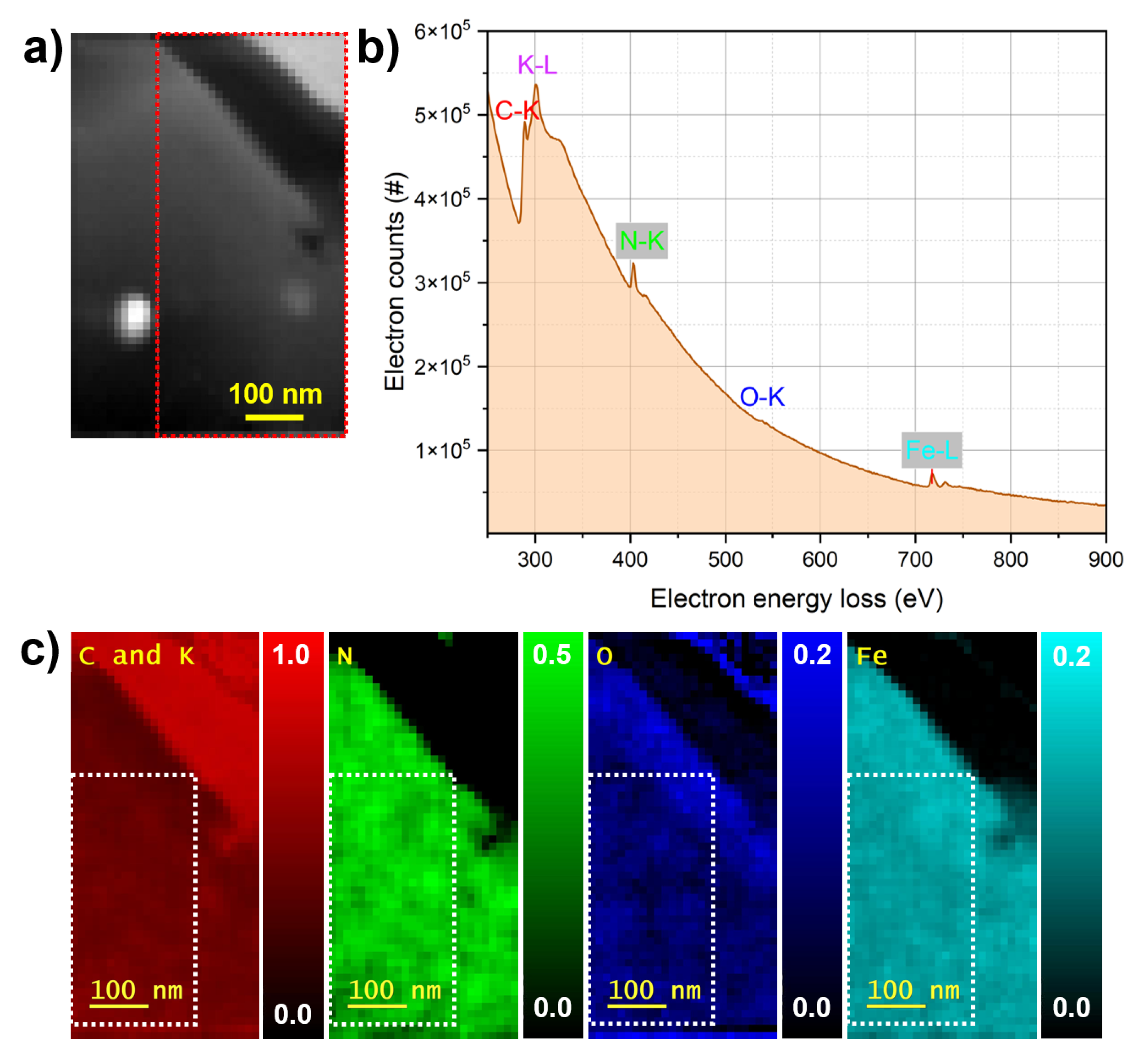
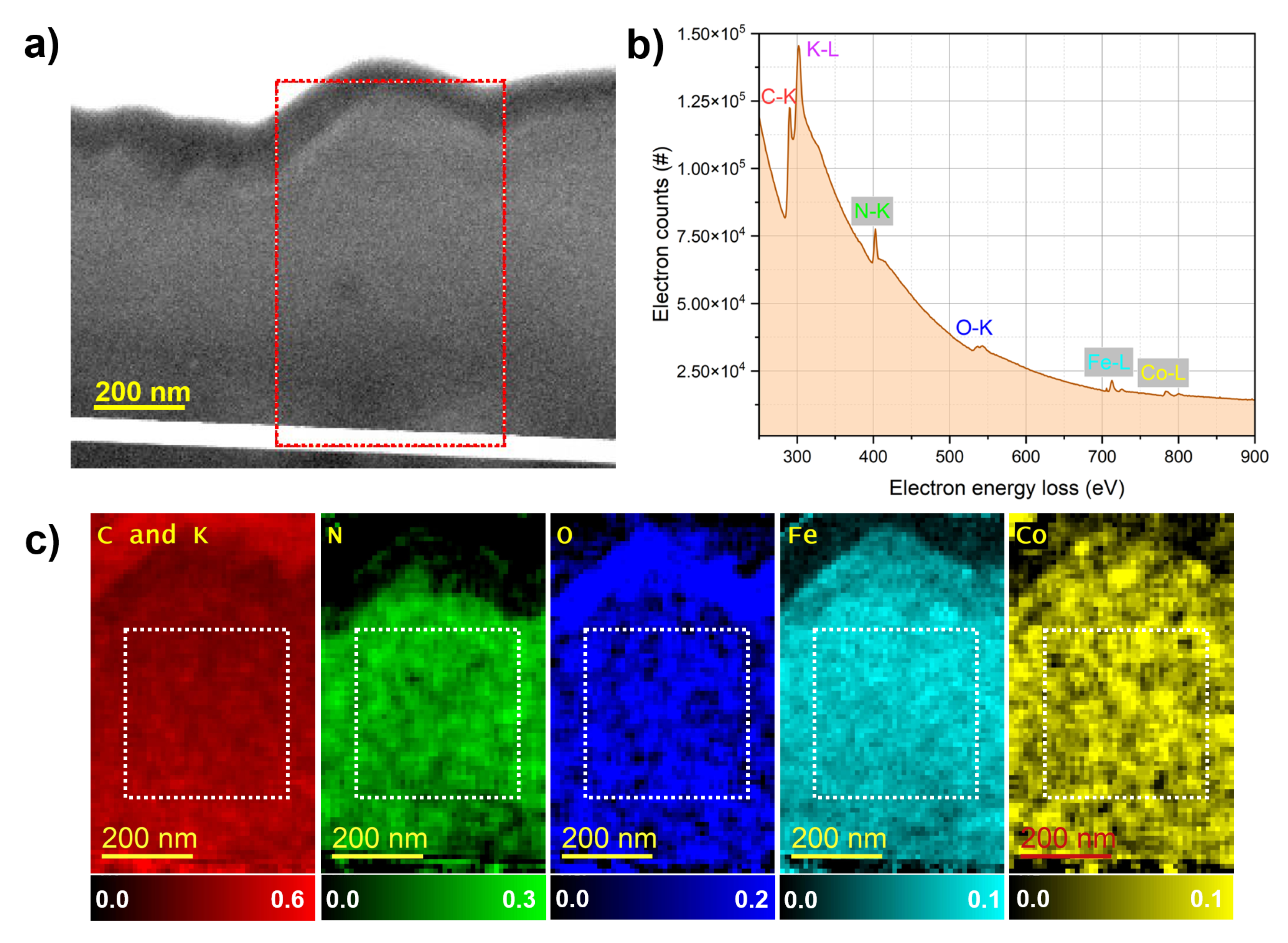
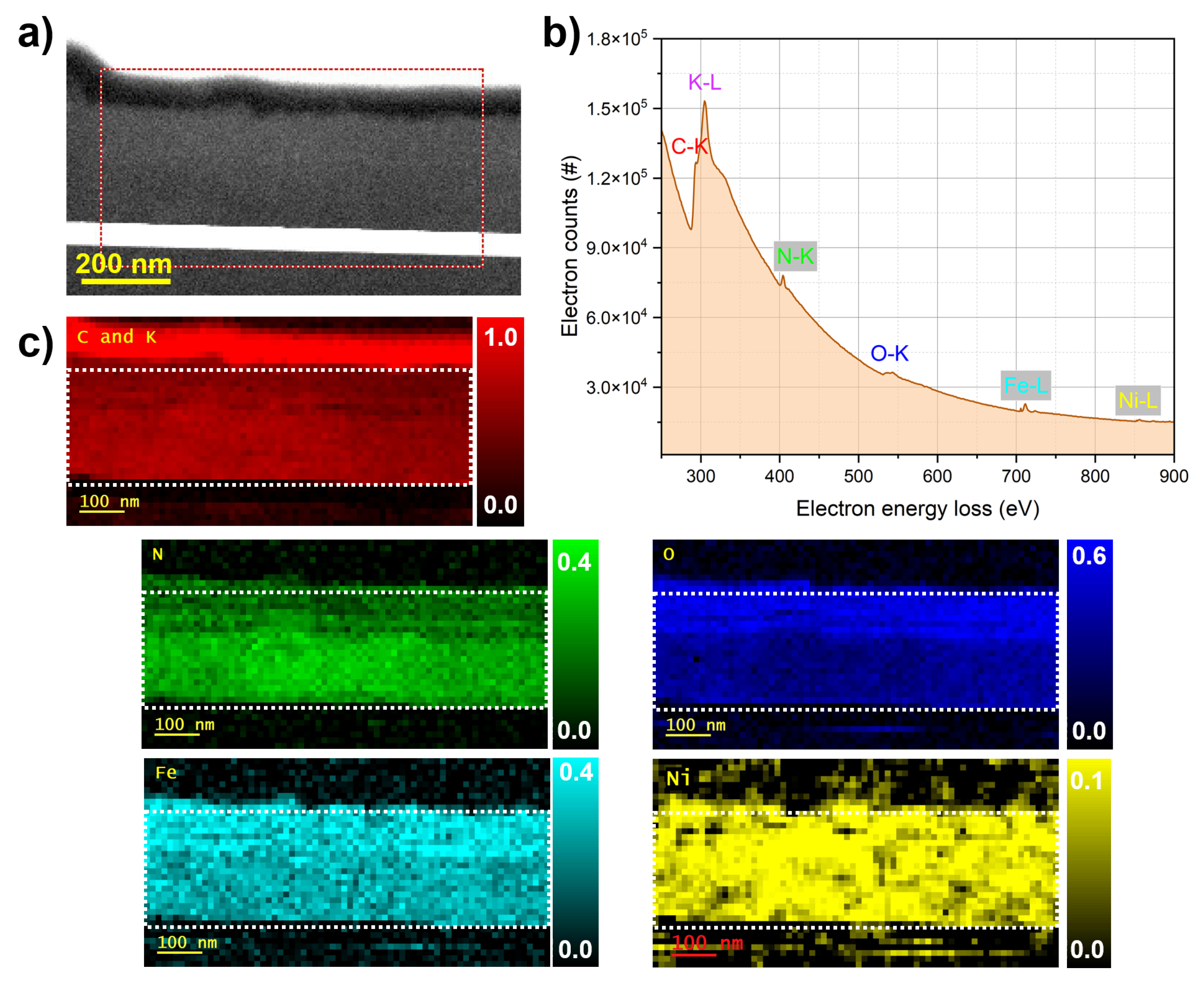
These multi-scale TEM observations confirm that all films have crystalline cubic frameworks. While FeHCF and CoHCF exhibit excellent stability under the electron beam, structural disturbances in the NiHCF film are observed, consistent with the SEM investigations presented earlier. To complement these structural insights, elemental quantification and mapping were performed using STEM-EELS analysis. The results are shown in Figure 5, Figure 6 and Figure 7. The HAADF-STEM image (Figure 5a) shows the FeHCF cross-sectional lamella with its surface covered by FIB platinum at the upper right edge. The red-marked region was selected for EELS analysis. The corresponding EEL spectrum (Figure 5b) exhibits distinct edges for C–K, K–L, N–K, O–K, and Fe–L. However, to generate elemental maps from this spectrum, the significant overlap between the C–K and K–L edges presents a limitation, as these edges are closely spaced. Therefore, for all three films analyzed, the spatial distributions of carbon and potassium are mapped together. The elemental maps (Figure 5c) reveal a uniform spatial distribution of all detected elements within the analyzed area. A slightly higher oxygen concentration is observed near the film surface, which can be attributed to mild surface oxidation upon air exposure. The HAADF-STEM image (Figure 6a) shows the CoHCF cross-sectional sample with the surface oriented at the top. The red rectangle marks the region selected for EELS acquisition. The corresponding EEL spectrum (Figure 6b) exhibits distinct edges for the key elements: C, K, N, O, Fe, and Co. In the elemental maps (Figure 6c), and for CoHCF, an oxide enrichment at the surface, accompanied by a depletion of iron and a significant reduction in nitrogen concentration is observed. Underneath this oxidized surface layer of about 50 nm, a virtually uniform spatial distribution of all six elements within the analyzed region is obtained. This uniformity, together with a quantified Fe:Co atomic ratio of about 1:1 (7 at.% Fe and 7 at.% Co), confirms the chemical homogeneity and near-stoichiometric composition of the film, consistent with previous EDX measurements. For NiHCF, the HAADF-STEM image (Figure 7a) shows the region selected for EELS acquisition, and the corresponding spectrum (Figure 7b) displays distinct edges for all relevant elements. The elemental maps (Figure 7c) reveal spatially resolved distributions of C and K (combined), N, O, Fe, as well as Ni, again with an oxidation layer at the surface The quantified Fe:Ni ratio of approximately 4:3 (4 at.% Fe and 3 at.% Ni) is consistent with the expected 1:1 stoichiometry and aligns with previous EDX measurements. Table 2 summarizes the elemental quantification obtained by STEM-EELS analysis. It should be noted, however, that these results are affected by the critical need for background subtraction, which may introduce variation of up to one percent.
Figure 5.
EELS analysis of FeHCF. (a) HAADF-STEM image of the FeHCF lamella with the red box indicating the region used for EELS analysis. (b) EEL spectrum showing distinct edges for C, K, N, O, and Fe. (c) Elemental maps revealing the spatial distribution of all five elements, in which the white boxes show the regions used for elemental quantification.
Figure 6.
EELS analysis of CoHCF. (a) HAADF-STEM image of the CoHCF lamella with the red box indicating the region used for EELS analysis. (b) EEL spectrum showing distinct edges for C, K, N, O, Fe, and Co. (c) Elemental maps revealing the spatial distribution of all five elements, in which the white boxes show the regions used for elemental quantification.
Figure 7.
EELS analysis of NiHCF. (a) HAADF-STEM image of the NiHCF lamella with the red box indicating the region used for EELS analysis. (b) EEL spectrum showing distinct edges for C, K, N, O, Fe, and Ni. (c) Elemental maps revealing the spatial distribution of all five elements, in which the white boxes show the regions used for elemental quantification.
Table 2.
Elemental quantification (atomic %) of FeHCF, CoHCF, and NiHCF thin films obtained by STEM-EELS analysis.
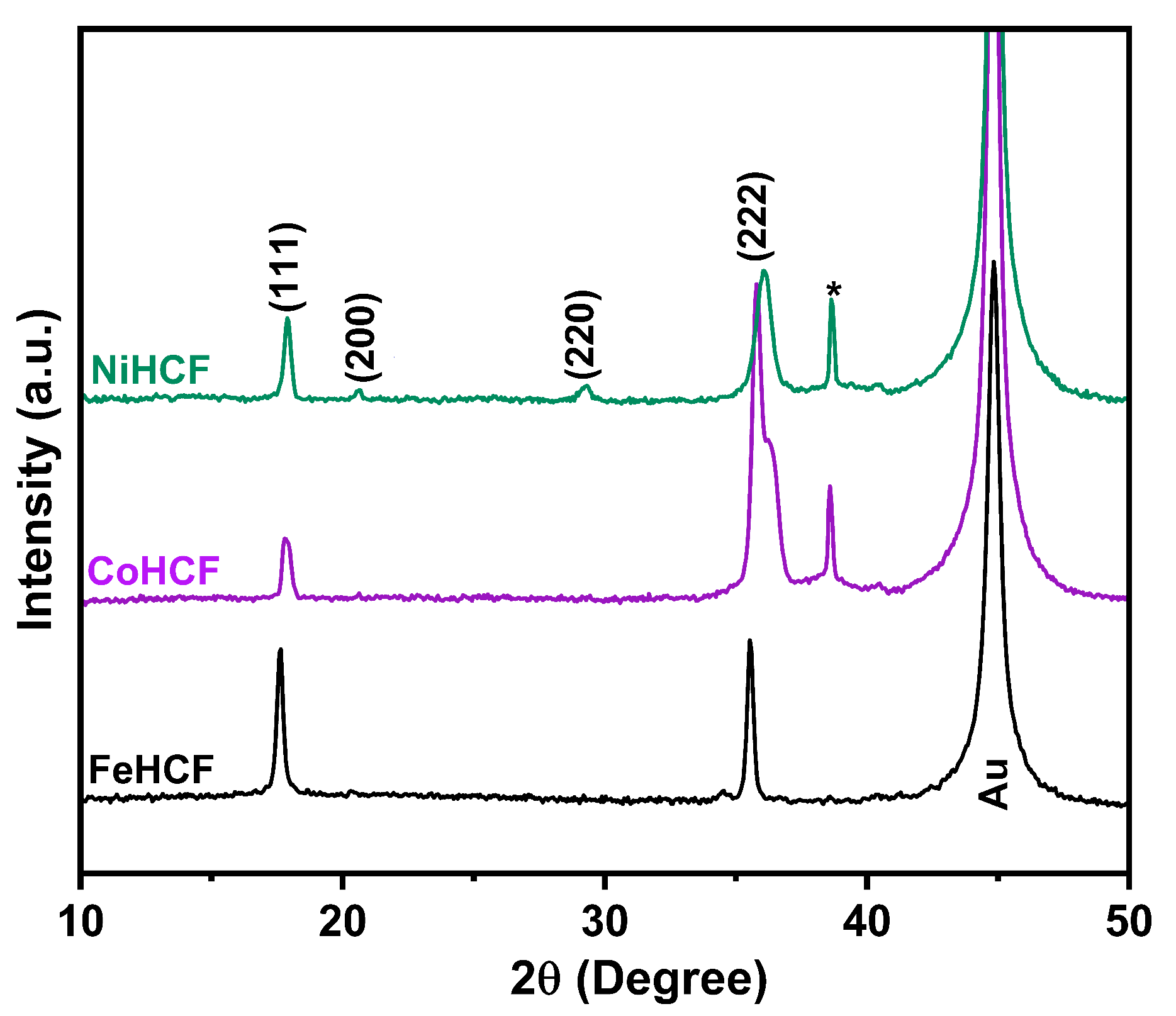
To provide a structural overview, the XRD patterns of FeHCF, CoHCF, and NiHCF are presented in Figure 8. For FeHCF, characteristic reflections were observed at 17.61° and 35.56°, which can be indexed to the (111) and (222) planes of the cubic phase. CoHCF exhibits similar reflections at 17.77° and 35.80°, also corresponding to the (111) and (222) planes. In the case of NiHCF, additional diffraction peaks appeared at 20.56° and 29.28°, together with the reflections at 17.85° and 36.10°, which were indexed to the (111), (200), (220), and (222) planes of the cubic phase. Calculated lattice parameters revealed a gradual contraction from 10.13 Å (FeHCF) to 10.06 Å (CoHCF) to 10.01 Å (NiHCF). This trend is consistent with the decreasing ionic radius from Fe to Ni. The pronounced peak broadening, alongside that attributable to grain size observed in NiHCF and the potential split signal for Co at 35.7° indicate increased microstrain and the presence of point defects [43,44,45].
Figure 8.
X-ray diffraction pattern of films grown at 0.3 V by Potentiostatic deposition.
A weak additional reflection at approximately 38.0° (marked by an asterisk) is observed exclusively in CoHCF and NiHCF samples and may originate from the formation of oxides and hydroxides (e.g., -Fe2O3/Co(OH)2/Ni(OH)2) upon air exposure. We attribute this observation to surface oxidation of the films upon exposure to ambient atmosphere, which we also observed via STEM-EELS-based elemental mapping, as reported previously. A similar mechanism was described in the literature for Prussian white [46,47,48]. Importantly, no clear signatures of such species are detected in Raman or XPS, suggesting that the oxidized phase is only distributed at the surface. This interpretation is consistent with SEM/TEM-EDS observations showing a slight oxygen enrichment near the film surface without alteration of the bulk lattice.
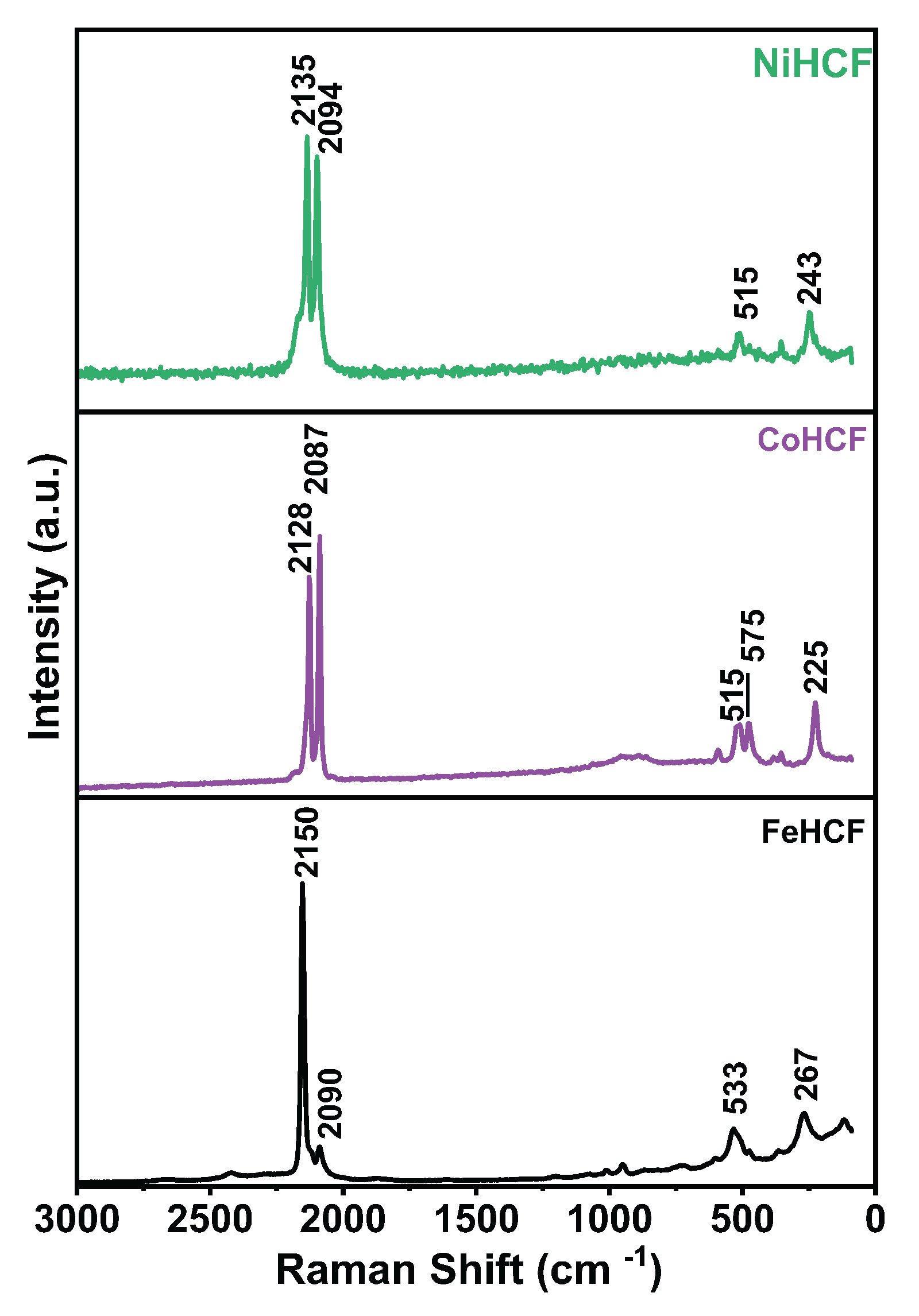
To further investigate the structural framework and possible oxidation effects, Raman spectroscopy was performed on FeHCF, CoHCF, and NiHCF thin films. Figure 9 shows the Raman spectra of HCF samples, which exhibit the characteristic C≡N stretching vibrations of Prussian blue in the range of 2070–2200 cm−1. Incorporation of cobalt or nickel into the structure resulted in a shift of the C≡N peak to lower wavenumbers. These shifts suggest a lengthening or weakening of the C≡N bonds due to changes in the local electron density, influenced by variations in the oxidation state of iron and the electronegativity of the substituting metals, which affect bond lengths and charge transfer inside the cubic lattice [43,49,50]. NiHCF also exhibited broader and less intense Raman signals, indicative of reduced crystallinity, atomic disorder, and the presence of cracks that may cause substrate interference [51]. Lower-wavenumber bands, observed between 190 and 620 cm−1, correspond to metal–CN–Fe bond deformation (190–340 cm−1), metal–C stretching vibrations (450–620 cm−1), and metal–C vibrations around 400 cm−1, metal–O vibrations are also typically found within this region. However, no significant signals were detected, supporting the hypothesis that the oxide formation is restricted to a superficial/protective layer. Shifts and changes in these bands reflect structural distortions and heterogeneity in the local bonding environment caused by metal substitution and lattice strain. Overall, the comparison with pristine Prussian blue indicates that Co and Ni incorporation modify both the electronic structure and the local geometry of the HCF framework [50,52,53].
Figure 9.
Raman spectra for FeHCF, CoHCF, and NiHCF thin films electrodeposit on Si/Au substrate.
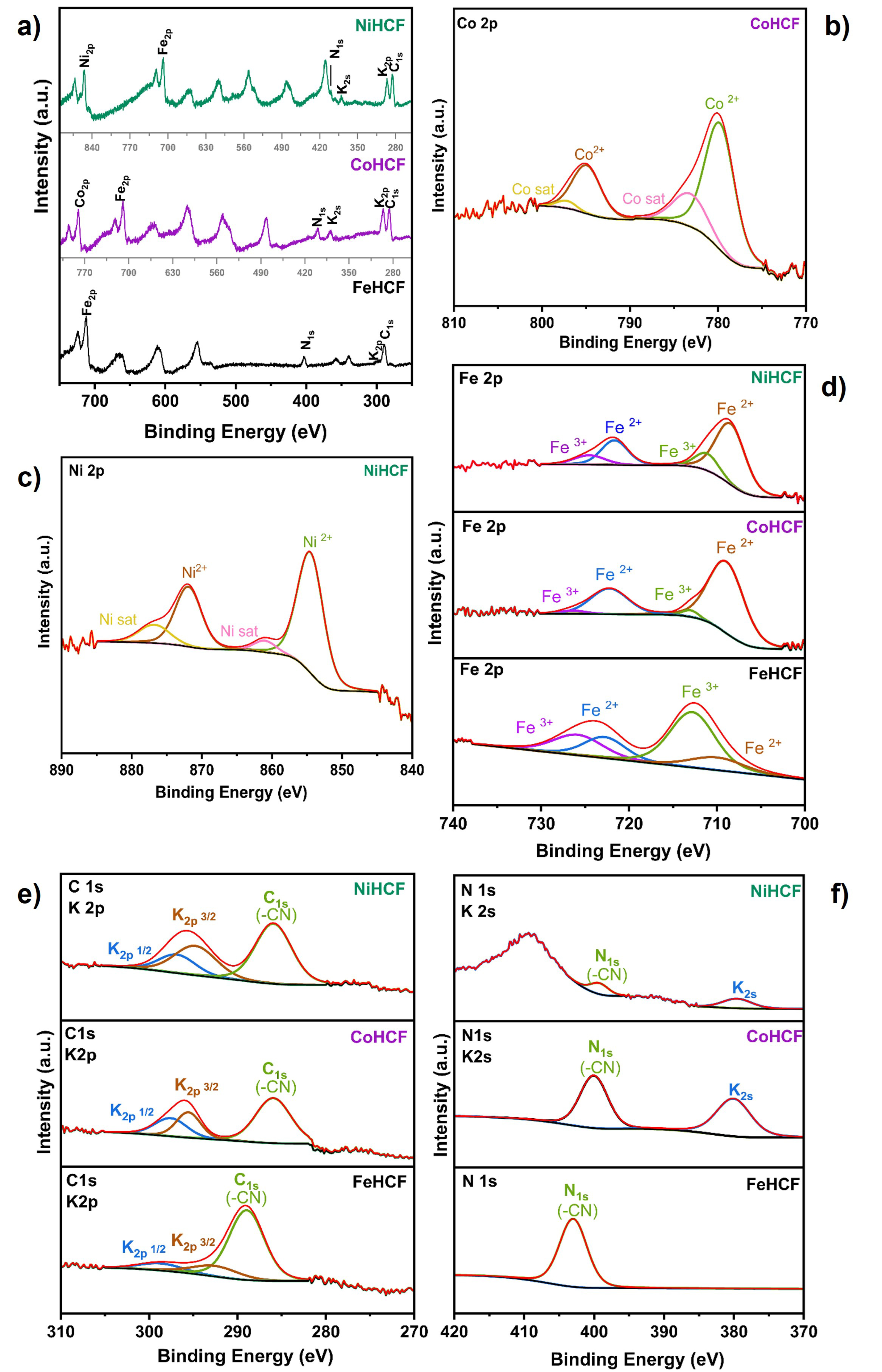
X-ray photoelectron spectroscopy (XPS) measurements were conducted to analyze the valence states of Fe, Co, and Ni in hexacyanoferrate (HCF) samples. A comparison of the XPS wide scan spectrum of FeHCF, CoHCF, and NiHCF is given in Figure 10a. High-resolution XPS spectra of C 1s, K 2p, K 2s, N 1s, Fe 2p, Co 2p, and Ni2p are shown in Figure 10b–f. To further analyze the origins of the acquired spectra, peak deconvolution was carried out to investigate metal valence states in the prepared HCF layers. High-resolution Co 2p and Ni 2p spectra confirmed the presence of Co2+ and Ni2+ via characteristic spin-orbital splitting and satellite peaks. Figure 10b shows the existence of Co2+ at 780.0 and 795.0 eV, assigned to spin orbitals of Co2+ 2p3/2 and Co2+ 2p1/2, respectively. Similarly, Ni 2p (Figure 10c) shows peaks at 854.6 and 872 eV assigned to Ni2+ 2p3/2 and 2p1/2 spin orbitals. The presence of satellite peaks from Ni 2p (861.0 and 876.8 eV) and Co 2p (783.5 and 797.4 eV) can be explained by charge transfer from the CN ligand to the metal [54,55,56]. The characteristic mixture of Fe3+ and Fe2+ is present in FeHCF (Figure 10d) with peak maxima at 712.8 eV 2p3/2/726.0 eV 2p1/2 for Fe3+ and 710.3 eV 2p3/2/722.9 eV 2p1/2 for Fe2+. Otherwise, CoHCF and NiHCF samples are composed mostly of Fe2+ [57,58]. The presence and increase in potassium K 2s in the XPS spectra of Co and NiHCF is attributed to the interstitial occupancy of K+ species in the crystal structure [59], and these results are in agreement with the previous characterization techniques, suggesting that the PBAs are predominantly in the reduced Prussian White state. This reduced state requires a charge neutrality within the framework, which is balanced by an increase of K+ and water species observed in elemental characterization as a consequence of the reduced Fe2+-rich lattice [60]. Table 3 summarizes the XPS binding energy assignments for the FeHCF, CoHCF, and NiHCF films.
Figure 10.
(a) Wide scan spectrum of FeHCF, CoHCF, and NiHCF, high resolution spectra; (b) Co 2p; (c) Ni2p; (d) Fe 2p; (e) C1s, K 2P; (f) K 2S, N 1s.
Table 3.
XPS binding energy assignments for FeHCF, CoHCF, and NiHCF films in eV.
4. Conclusions
Thin films of iron, cobalt, and nickel hexacyanoferrates were successfully electrodeposited under potentiostatic conditions. Structural and compositional analyses revealed that FeHCF and CoHCF formed films with pyramidal crystal morphology at the surface, whereas NiHCF exhibited less-faceted clustered films with cubic morphology at the surface. Nevertheless, all samples displayed a homogeneous elemental distribution under a ca. 50 nm thick oxidized layer. XRD confirmed a cubic lattice framework across all samples, with progressive lattice contraction observed from Fe to Co to Ni, attributed to ionic radius differences. CoHCF and NiHCF showed the formation of a metal oxide layer on top of the films due to exposure to ambient conditions. Raman and XPS analyses further indicated a shift toward Fe2+ dominance and changes in coordination environment in Co- and Ni-substituted films associated with increased interstitial K+, which maintain the charge neutrality and significant presence of water. These findings emphasize the tunability of structural and electrochemical properties via metal substitution in PBAs. Future work will focus on correlating these differences with electrical performance metrics. For instance, the complex electrochemical behavior observed for CoHCF and NiHCF needs to be further elaborated to understand the influence of the deposition potential on the stoichiometry of PBAs and their physical properties. In particular, the role of different ions and ion charges in electrical conduction is within the scope of our research activities.
Author Contributions
Writing—original draft preparation, L.d.O.G., M.P., and M.F.K.; writing—review and editing, L.d.O.G., M.P., M.F.K., D.W., F.R., and C.K.M.; validation, L.d.O.G., M.P., M.F.K., and D.W.; investigation, L.d.O.G., M.P., M.F.K., and F.R.; supervision, C.K.M., D.W., and A.L. All authors have read and agreed to the published version of the manuscript.
Funding
This research was funded by Deutsche Forschungsgemeinschaft (DFG)—Project number 531524052. This research was funded by the European Social Fund (ESF) and the Free State of Saxony within the framework of the Landes innovations promotion program, application number 100670500.
Institutional Review Board Statement
Not applicable.
Data Availability Statement
The original contributions presented in this study are included in the article. Further inquiries can be directed to the corresponding author.
Acknowledgments
Authors would like to thank Birgit Opitz from IFW Dresden for support with XRD measurements and Dirk Hildebrand from WHZ for assistance with XPS measurements.
Conflicts of Interest
The authors declare no conflicts of interest.
Abbreviations
The following abbreviations are used in this manuscript:
| PB | Prussian blue |
| PBA | Prussian blue analog |
| HCF | Hexacyanoferrate |
| CV | Cyclic voltammetry |
| EDX | energy-dispersive X-ray |
| XRD | X-Ray diffraction |
| FIB | Focused ion beam |
| TEM | Transmission electron microscopy |
| EELS | Electron energy loss spectroscopy |
| STEM | Scanning transmission electron microscopy |
| HRTEM | High-resolution transmission electron microscopy |
| BFTEM | Bright-field transmission electron microscopy |
| HAADF | High angle annular dark field |
| FFT | Fast Fourier transform |
| XPS | X-ray photoelectron spectroscopy |
References
- Neff, V.D. Electrochemical Oxidation and Reduction of Thin Films of Prussian Blue. J. Electrochem. Soc. 1978, 125, 886–887. [Google Scholar] [CrossRef]
- Goda, E.S.; Lee, S.; Sohail, M.; Yoon, K.R. Prussian blue and its analogues as advanced supercapacitor electrodes. J. Energy Chem. 2020, 50, 206–229. [Google Scholar] [CrossRef]
- Molina-Maldonado, P.; Ruíz-Guerrero, R.; Hernández-Fuentes, C. Role of the Outer Metal of Double Metal Cyanides on the Catalytic Efficiency in Styrene Oxidation. Catalysts 2019, 9, 905. [Google Scholar] [CrossRef]
- Ulusoy Ghobadi, T.G.; Ozbay, E.; Karadas, F. How to Build Prussian Blue Based Water Oxidation Catalytic Assemblies: Common Trends and Strategies. Chem.–A Eur. J. 2021, 27, 3638–3649. [Google Scholar] [CrossRef]
- Chu, Z.; Liu, Y.; Jin, W. Recent progress in Prussian blue films: Methods used to control regular nanostructures for electrochemical biosensing applications. Biosens. Bioelectron. 2017, 96, 17–25. [Google Scholar] [CrossRef]
- Isfahani, V.B.; Memarian, N.; Dizaji, H.R.; Arab, A.; Silva, M. The physical and electrochromic properties of Prussian Blue thin films electrodeposited on ITO electrodes. Electrochim. Acta 2019, 304, 282–291. [Google Scholar] [CrossRef]
- Kraft, A. Too blue to be good? A critical overview on the electrochromic properties and applications of Prussian blue. Sol. Energy Mater. Sol. Cells 2024, 278, 113195. [Google Scholar] [CrossRef]
- Krap, C.; Balmaseda, J.; Zamora, B.; Reguera, E. Hydrogen storage in the iron series of porous Prussian blue analogues. Int. J. Hydrogen Energy 2010, 35, 10381–10386. [Google Scholar] [CrossRef]
- Hong, P.; Xu, C.; Yan, C.; Dong, Y.; Zhao, H.; Lei, Y. Prussian Blue and Its Analogues for Commercializing Fast-Charging Sodium/Potassium-Ion Batteries. ACS Energy Lett. 2025, 10, 750–778. [Google Scholar] [CrossRef]
- Keggin, J.F.; Miles, F.D. Structures and Formulæ of the Prussian Blues and Related Compounds. Nature 1936, 137, 577–578. [Google Scholar] [CrossRef]
- Wei, Y.; Zheng, M.; Zhu, W.; Pang, H. Hollow structures Prussian blue, its analogs, and their derivatives: Synthesis and electrochemical energy-related applications. Carbon Neutraliz. 2023, 2, 271–299. [Google Scholar] [CrossRef]
- Singh, B.; Indra, A. Prussian blue- and Prussian blue analogue-derived materials: Progress and prospects for electrochemical energy conversion. Mater. Today Energy 2020, 16, 100404. [Google Scholar] [CrossRef]
- Agrisuelas, J.; García-Jareño, J.; Moreno-Guerrero, C.; Roig, A.; Vicente, F. Identification of electroactive sites in Prussian Yellow films. Electrochim. Acta 2013, 113, 825–833. [Google Scholar] [CrossRef]
- Huang, Y.; Mu, W.; Bi, X.; Hou, Z.; Lei, X.; Wang, Q.; Luo, S. Progress in defect engineering of high-performance Prussian blue analogues as cathode materials for sodium-ion batteries. J. Energy Storage 2025, 111, 115435. [Google Scholar] [CrossRef]
- Liu, Y.; Chu, W.; Xu, Y.; Yuan, Z.; Liu, J.; Zhao, H.; Liu, Q.; Zhang, W. The effect of coprecipitation and heating temperature on structural evolution and electrochemical performance of iron-based prussian blue analogs. J. Solid State Electrochem. 2024, 28, 4105–4118. [Google Scholar] [CrossRef]
- Zhang, R.; Liu, Y.; Liu, H.; Zhong, Y.; Zhang, Y.; Wu, Z.; Wang, X. Y-tube assisted coprecipitation synthesis of iron-based Prussian blue analogues cathode materials for sodium-ion batteries. RSC Adv. 2024, 14, 12096–12106. [Google Scholar] [CrossRef]
- Wang, Q.; Yuan, R.; Yang, M.; Gao, W.; Jiao, S.; Tian, D.; Jiao, H.; Yu, H.; Sun, D. Exploring coating electrodeposition protocols from a cross-electrolyte and cross-metal perspective. J. Mater. Sci. Technol. 2025, 226, 122–134. [Google Scholar] [CrossRef]
- Sreekumar, R.; Nair, A.S. Recent trends and developments in two-dimensional materials based electrodeposited nickel nanocomposite coatings. FlatChem 2022, 36, 100434. [Google Scholar] [CrossRef]
- Itaya, K.; Akahoshi, H.; Toshima, S. Electrochemistry of Prussian Blue Modified Electrodes: An Electrochemical Preparation Method. J. Electrochem. Soc. 1982, 129, 1498–1500. [Google Scholar] [CrossRef]
- Avila, L.B.; Müller, C.K.; Hildebrand, D.; Faita, F.L.; Baggio, B.F.; Cid, C.C.P.; Pasa, A.A. Resistive Switching in Electrodeposited Prussian Blue Layers. Materials 2020, 13, 5618. [Google Scholar] [CrossRef] [PubMed]
- Faita, F.; Avila, L.; Silva, J.; Boratto, M.; Cid, C.P.; Graeff, C.; Gomes, M.; Müller, C.; Pasa, A. Abnormal resistive switching in electrodeposited Prussian White thin films. J. Alloys Compd. 2022, 896, 162971. [Google Scholar] [CrossRef]
- Baggio, B.F.; Vicente, C.; Pelegrini, S.; Plá Cid, C.C.; Brandt, I.S.; Tumelero, M.A.; Pasa, A.A. Morphology and Structure of Electrodeposited Prussian Blue and Prussian White Thin Films. Materials 2019, 12, 1103. [Google Scholar] [CrossRef]
- Agnihotry, S.; Singh, P.; Joshi, A.G.; Singh, D.; Sood, K.; Shivaprasad, S. Electrodeposited Prussian blue films: Annealing effect. Electrochim. Acta 2006, 51, 4291–4301. [Google Scholar] [CrossRef]
- Husmann, S.; Orth, E.S.; Zarbin, A.J. A multi-technique approach towards the mechanistic investigation of the electrodeposition of Prussian blue over carbon nanotubes film. Electrochim. Acta 2019, 312, 380–391. [Google Scholar] [CrossRef]
- Liu, S.; Li, H.; Jiang, M.; Li, P. Platinum hexacyanoferrate: A novel Prussian Blue analogue with stable electroactive properties. J. Electroanal. Chem. 1997, 426, 27–30. [Google Scholar] [CrossRef]
- Kulesza, P.J.; Malik, M.A.; Schmidt, R.; Smolinska, A.; Miecznikowski, K.; Zamponi, S.; Czerwinski, A.; Berrettoni, M.; Marassi, R. Electrochemical preparation and characterization of electrodes modified with mixed hexacyanoferrates of nickel and palladium. J. Electroanal. Chem. 2000, 487, 57–65. [Google Scholar] [CrossRef]
- Chen, S.M. Preparation, characterization, and electrocatalytic oxidation properties of iron, cobalt, nickel, and indium hexacyanoferrate. J. Electroanal. Chem. 2002, 521, 29–52. [Google Scholar] [CrossRef]
- Wang, Y.; Rui, Y.; Li, F.; Li, M. Electrodeposition of nickel hexacyanoferrate/layered double hydroxide hybrid film on the gold electrode and its application in the electroanalysis of ascorbic acid. Electrochim. Acta 2014, 117, 398–404. [Google Scholar] [CrossRef]
- Pohlitz, M.; Müller, C.K. Study of Growth and Properties of Electrodeposited Sodium Iron Hexacyanoferrate Films. Materials 2022, 15, 7491. [Google Scholar] [CrossRef]
- Kahl, F.; Gerheim, V.; Linck, M.; Müller, H.; Schillinger, R.; Uhlemann, S. Test and characterization of a new post-column imaging energy filter. In Advances in Imaging and Electron Physics Including Proceedings CPO-10; Elsevier: Amsterdam, The Netherlands, 2019; pp. 35–70. [Google Scholar] [CrossRef]
- Kamlesh; Aggarwal, P.; Mudgal, M.; Srivastava, A.K.; Raizada, P.; Singh, P.; Paul, A.; Singh, A. Electrochemistry of Nickelocene-Ferrocene Organometallic Complexes for Electrodeposition of Nickel–Iron–Based Nanostructured Film under Ambient Conditions for Oxygen Evolution Reaction. ACS Appl. Nano Mater. 2024, 7, 24455–24468. [Google Scholar] [CrossRef]
- Diao, T.; Lin, Q.; Dawson, G. Experimental Electrochemical Potentials of Nickel Complexes. Synlett 2021, 32, 1606–1620. [Google Scholar] [CrossRef]
- Phadke, S.; Mysyk, R.; Anouti, M. Effect of cation (Li+, Na+, K+, Rb+, Cs+) in aqueous electrolyte on the electrochemical redox of Prussian blue analogue (PBA) cathodes. J. Energy Chem. 2020, 40, 31–38. [Google Scholar] [CrossRef]
- Li, Z.; Jia, C.; Wan, Z.; Cao, J.; Shi, J.; Xue, J.; Liu, X.; Wu, H.; Xiao, C.; Li, C.; et al. Boosting mechanical durability under high humidity by bioinspired multisite polymer for high-efficiency flexible perovskite solar cells. Nat. Commun. 2025, 16, 1771. [Google Scholar] [CrossRef]
- Malik, M.A.; Kulesza, P.J.; Marassi, R.; Nobili, F.; Miecznikowski, K.; Zamponi, S. Countercation intercalation and kinetics of charge transport during redox reactions of nickel hexacyanoferrate. Electrochim. Acta 2004, 49, 4253–4258. [Google Scholar] [CrossRef]
- Huff, M. Review Paper: Residual Stresses in Deposited Thin-Film Material Layers for Micro- and Nano-Systems Manufacturing. Micromachines 2022, 13, 2084. [Google Scholar] [CrossRef] [PubMed]
- Ma, R.; Wang, Z.; Fu, Q.; Zhou, W.; Mo, Y.; Tu, J.; Wang, Z.; Gao, P.; Fan, C.; Liu, J. Dual-salt assisted synergistic synthesis of Prussian white cathode towards high-capacity and long cycle potassium ion battery. J. Energy Chem. 2023, 83, 16–23. [Google Scholar] [CrossRef]
- Zi, S.; Wang, Z.; Ke, J.; Mo, Y.; Wang, K.; Chen, S.; Tang, R.; Li, Y.; Gao, P.; Liu, J. FeHS vacancies in a Prussian white cathode leads to enhanced FeLS activity and electrode kinetics for boosted K+ storage. J. Mater. Chem. A 2024, 12, 10403–10411. [Google Scholar] [CrossRef]
- Zhou, A.; Cheng, W.; Wang, W.; Zhao, Q.; Xie, J.; Zhang, W.; Gao, H.; Xue, L.; Li, J. Hexacyanoferrate-Type Prussian Blue Analogs: Principles and Advances Toward High-Performance Sodium and Potassium Ion Batteries. Adv. Energy Mater. 2020, 11, 2000943. [Google Scholar] [CrossRef]
- Xiao, Y.; Xiao, J.; Zhao, H.; Li, J.; Zhang, G.; Zhang, D.; Guo, X.; Gao, H.; Wang, Y.; Chen, J.; et al. Prussian Blue Analogues for Sodium-Ion Battery Cathodes: A Review of Mechanistic Insights, Current Challenges, and Future Pathways. Small 2024, 20, 2401957. [Google Scholar] [CrossRef]
- Cattermull, J.; Roth, N.; Cassidy, S.J.; Pasta, M.; Goodwin, A.L. K-Ion Slides in Prussian Blue Analogues. J. Am. Chem. Soc. 2023, 145, 24249–24259. [Google Scholar] [CrossRef]
- Lee, J.H.; Bae, J.G.; Kim, M.S.; Heo, J.Y.; Lee, H.J.; Lee, J.H. Effect of the Interaction between Transition Metal Redox Center and Cyanide Ligand on Structural Evolution in Prussian White Cathodes. ACS Nano 2024, 18, 1995–2005. [Google Scholar] [CrossRef] [PubMed]
- Steen, W.A.; Jeerage, K.M.; Schwartz, D.T. Raman Spectroscopy of Redox Activity in Cathodically Electrodeposited Nickel Hexacyanoferrate Thin Films. Appl. Spectrosc. 2002, 56, 1021–1029. [Google Scholar] [CrossRef]
- Adak, S.; Daemen, L.L.; Hartl, M.; Williams, D.; Summerhill, J.; Nakotte, H. Thermal expansion in 3d-metal Prussian Blue Analogs—A survey study. J. Solid State Chem. 2011, 184, 2854–2861. [Google Scholar] [CrossRef]
- Le, L.H.T.; Nguyen, S.A.; Nguyen, T.D.; Le, V.C.T.; Van Cao, H.; Nguyen, N.B.; Le, T.P.T. Prussian Blue Analogues of A2[Fe(CN)6] (A: Cu2+, Co2+, and Ni2+) and Their Composition-Dependent Sorption Performances towards Cs+, Sr2+, and Co2+. J. Nanomater. 2021, 2021, 5533620. [Google Scholar] [CrossRef]
- Ojwang, D.O.; Svensson, M.; Njel, C.; Mogensen, R.; Menon, A.S.; Ericsson, T.; Häggström, L.; Maibach, J.; Brant, W.R. Moisture-Driven Degradation Pathways in Prussian White Cathode Material for Sodium-Ion Batteries. ACS Appl. Mater. Interfaces 2021, 13, 10054–10063. [Google Scholar] [CrossRef]
- Rahman, M.A.; Cai, Z.; Moushumy, Z.M.; Tagawa, R.; Hidaka, Y.; Nakano, C.; Islam, M.S.; Sekine, Y.; Nishina, Y.; Ida, S.; et al. Engineering Zeolitic-Imidazolate-Framework-Derived Mo-Doped Cobalt Phosphide for Efficient OER Catalysts. ACS Omega 2024, 9, 36114–36121. [Google Scholar] [CrossRef]
- Deabate, S.; Fourgeot, F.; Henn, F. X-ray diffraction and micro-Raman spectroscopy analysis of new nickel hydroxide obtained by electrodialysis. J. Power Sources 2000, 87, 125–136. [Google Scholar] [CrossRef]
- Penche, G.; González-Marcos, M.P.; González-Velasco, J.R. Transition Metal Hexacyanoferrate(II) Complexes as Catalysts in the Ring-Opening Copolymerization of CO2 and Propylene Oxide. Top. Catal. 2022, 65, 1541–1555. [Google Scholar] [CrossRef]
- Moretti, G.; Gervais, C. Raman spectroscopy of the photosensitive pigment Prussian blue. J. Raman Spectrosc. 2018, 49, 1198–1204. [Google Scholar] [CrossRef]
- Elsayed, A.A.; Othman, A.M.; Sabry, Y.M.; Marty, F.; Omran, H.; Khalil, D.; Liu, A.Q.; Bourouina, T. Substrate Signal Inhibition in Raman Analysis of Microplastic Particles. ACS Omega 2023, 8, 9854–9860. [Google Scholar] [CrossRef]
- Vančo, Ľ.; Kotlár, M.; Vretenár, V.; Kadlečíková, M.; Vojs, M.; Vogrinčič, P. Correlated reflectance and Raman spectroscopy in substrates with coherent transparent layers. Surfaces Interfaces 2022, 34, 102309. [Google Scholar] [CrossRef]
- Sada, K.; Nanda, S.; Khani, H.; Manthiram, A. Deciphering the local structure of Prussian blue analogue cathodes with Raman spectroscopy for sodium-ion batteries. J. Mater. Chem. A 2025, 13, 22903–22914. [Google Scholar] [CrossRef]
- Gerber, S.J.; Erasmus, E. Electronic effects of metal hexacyanoferrates: An XPS and FTIR study. Mater. Chem. Phys. 2018, 203, 73–81. [Google Scholar] [CrossRef]
- Zhu, Y.; Chen, P.; Zhou, Y.; Nie, W.; Xu, Y. The pursuit of optimal sodium ions prestoring in potassium–sodium–cobalt hexacyanoferrate: Toward high discharge performance supercapacitors. J. Mater. Sci. 2018, 53, 12467–12476. [Google Scholar] [CrossRef]
- Park, J.S.; Yang, S.; Kang, Y.C. Prussian blue analogue nanocubes with hollow interior and porous walls encapsulated within reduced graphene oxide nanosheets and their sodium-ion storage performances. Chem. Eng. J. 2020, 393, 124606. [Google Scholar] [CrossRef]
- Yang, J.; Hou, W.; Ye, L.; Hou, G.; Yan, C.; Zhang, Y. Vanadium Hexacyanoferrate Prussian Blue Analogs for Aqueous Proton Storage: Excellent Electrochemical Properties and Mechanism Insights. Small 2023, 20, 2305386. [Google Scholar] [CrossRef]
- Zhang, Y.; Jin, F.; Liu, H.; Jin, Z. In-situ XPS monitoring bimetallic Prussian blue analogs and metal oxides heterojunction for photocatalytic hydrogen production. Fuel 2024, 361, 130655. [Google Scholar] [CrossRef]
- Martins, J.B.; Husmann, S.; da Veiga, A.G.; Zarbin, A.J.G.; Rocco, M.L.M. Probing the Electronic Structure of Prussian Blue and Analog Films by Photoemission and Electron Energy Loss Spectroscopies. ChemPhysChem 2024, 25, e202300590. [Google Scholar] [CrossRef]
- Cheng, L.; Luo, Y.; Wang, H.; Zhou, Z.; Yang, M.; Li, C.; Zheng, Y.; Li, M.; Wang, L.; Sun, K. Optimized synthesis and electrochemical behaviors of Prussian blue analogues cathodes for potassium-ion batteries. Mater. Rep. Energy 2025, 5, 100331. [Google Scholar] [CrossRef]
Disclaimer/Publisher’s Note: The statements, opinions and data contained in all publications are solely those of the individual author(s) and contributor(s) and not of MDPI and/or the editor(s). MDPI and/or the editor(s) disclaim responsibility for any injury to people or property resulting from any ideas, methods, instructions or products referred to in the content. |
© 2025 by the authors. Licensee MDPI, Basel, Switzerland. This article is an open access article distributed under the terms and conditions of the Creative Commons Attribution (CC BY) license (https://creativecommons.org/licenses/by/4.0/).