

Pattern Pick and Place Method for Twisted Bi- and Multi-Layer Graphene

Abstract
1. Introduction
2. Materials and Methods
2.1. Preparation of the Pattern on as-Grown Graphene
2.2. Production of the Stamp
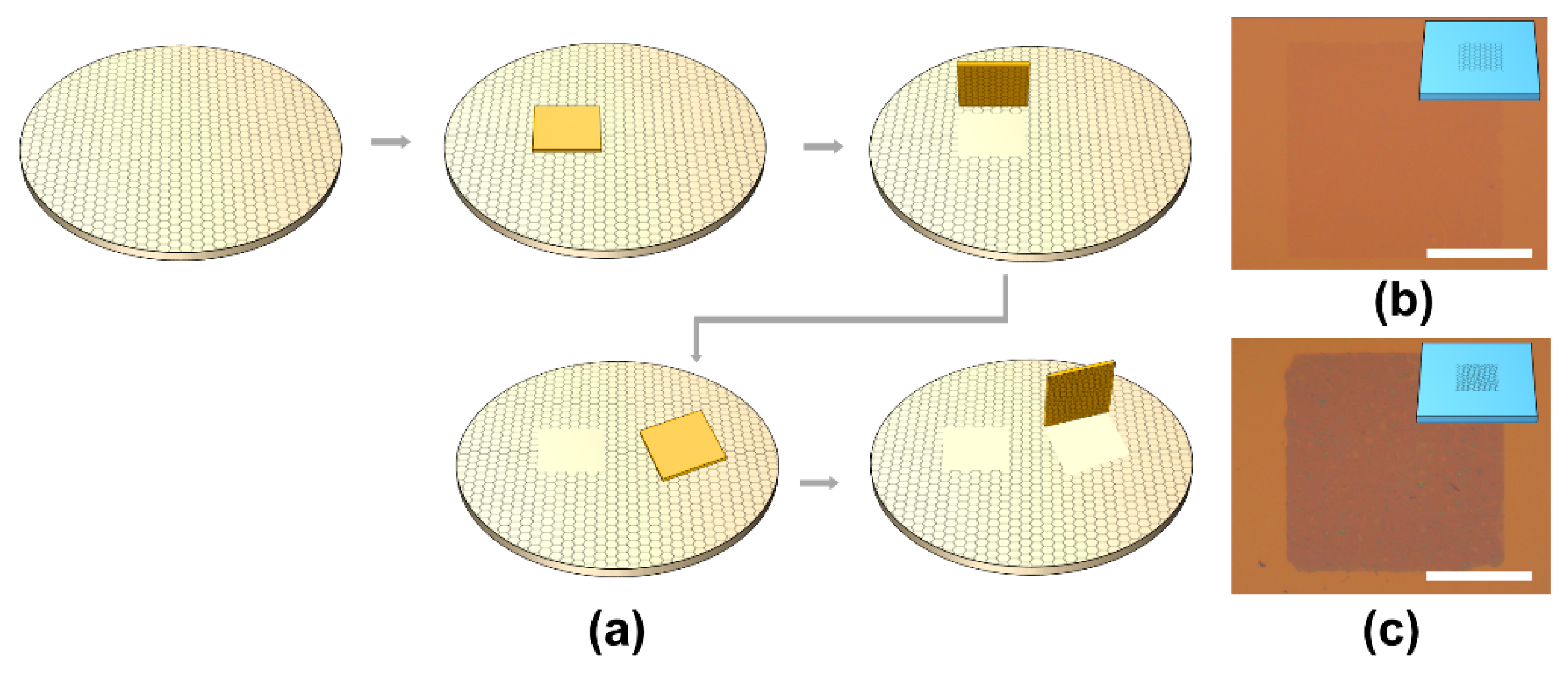
2.3. Pick and Place Process
2.4. Transmission Electron Microscopy (TEM) Specimens Preparation
2.5. Device Fabrication
2.6. Characterizations
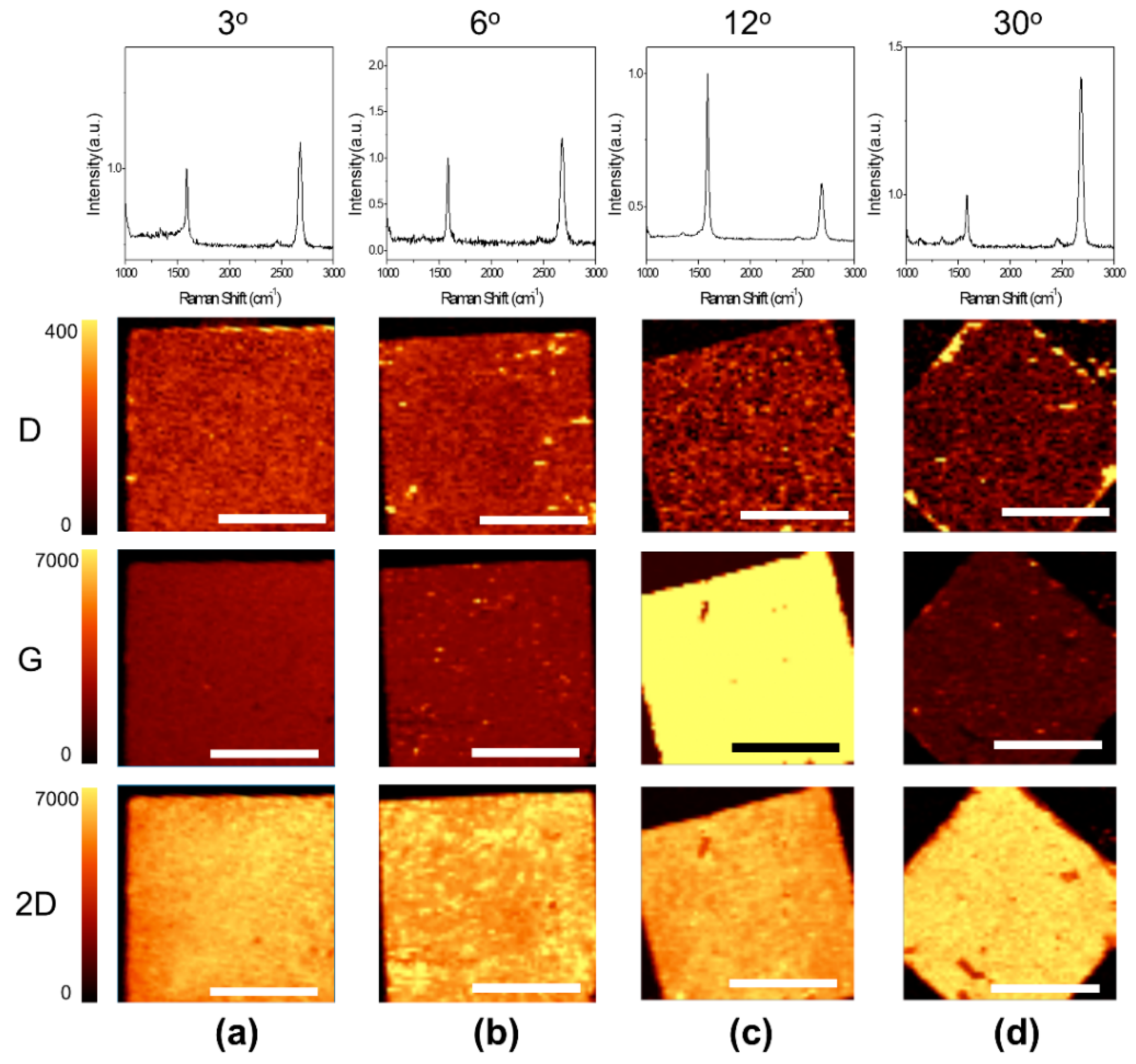
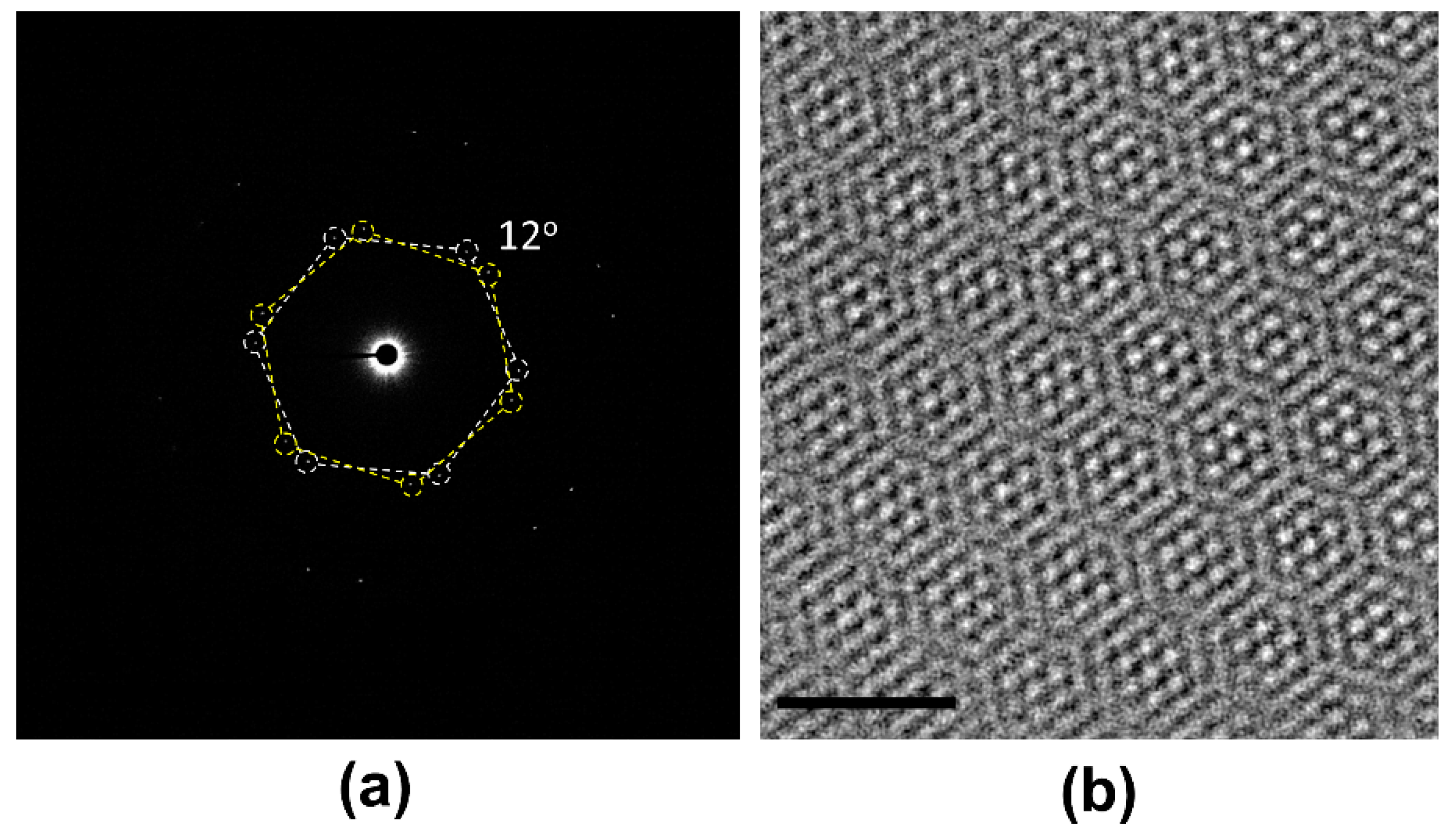
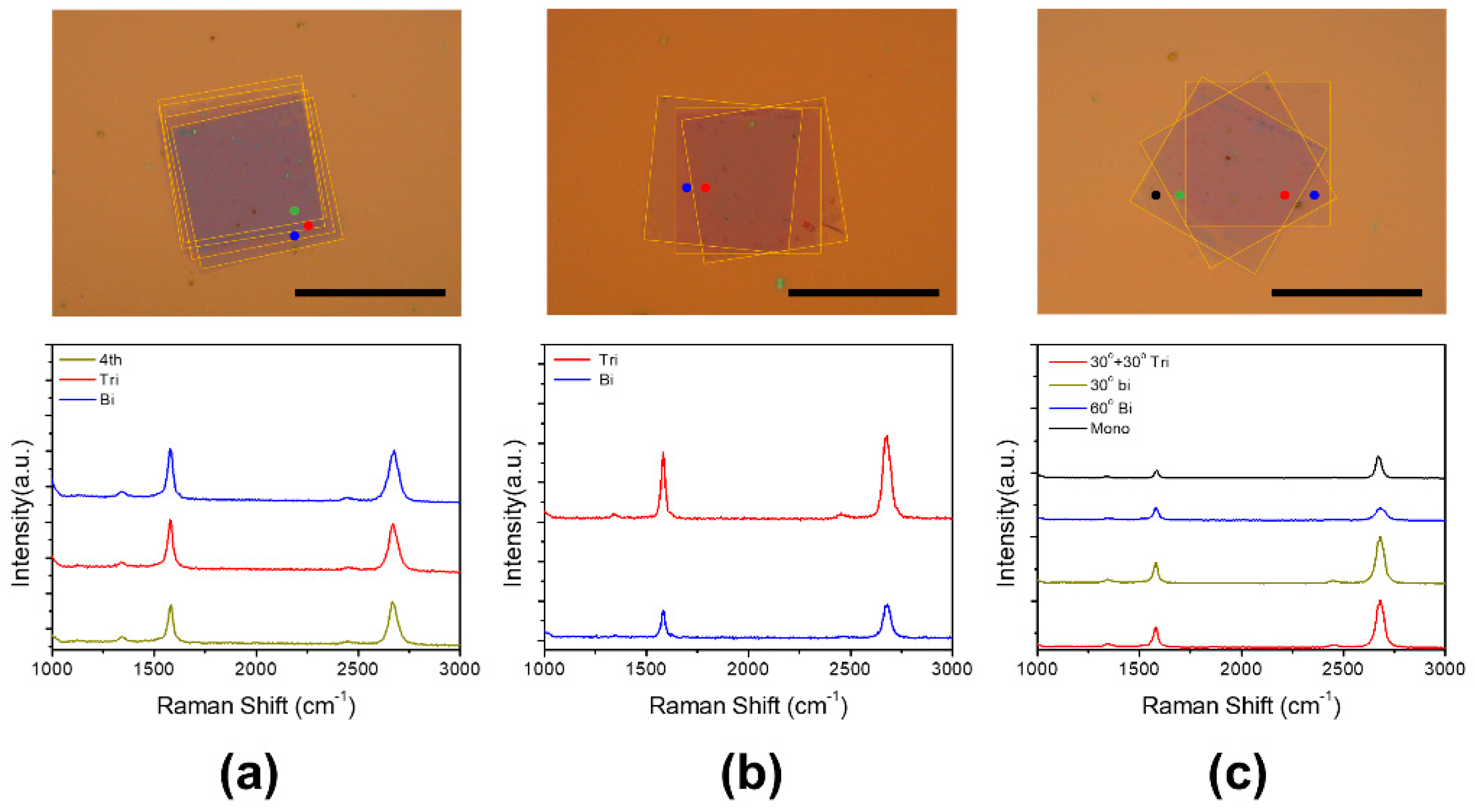
3. Results and Discussions
4. Conclusions
Supplementary Materials
Author Contributions
Funding
Conflicts of Interest
References
- Novoselov, K.S.; Geim, A.K.; Morozov, S.V.; Jiang, D.; Zhang, Y.; Dubonos, S.V.; Grigorieva, I.V.; Firsov, A.A. Electric field effect in atomically thin carbon films. Science 2004, 306, 666–669. [Google Scholar] [CrossRef] [Scilit] [PubMed]
- Rozhkov, A.V.; Sboychakov, A.O.; Rakhmanov, A.L.; Nori, F. Electronic properties of graphene-based bilayer systems. Phys. Rep. 2016, 648, 1–104. [Google Scholar] [CrossRef] [Scilit]
- Zhang, Y.; Tang, T.T.; Girit, C.; Hao, Z.; Martin, M.C.; Zettl, A.; Crommie, M.F.; Shen, Y.R.; Wang, F. Direct observation of a widely tunable bandgap in bilayer graphene. Nature 2009, 459, 820–823. [Google Scholar] [CrossRef] [Scilit] [PubMed]
- Nguyen, V.L.; Perello, D.J.; Lee, S.; Nai, C.T.; Shin, B.G.; Kim, J.G.; Park, H.Y.; Jeong, H.Y.; Zhao, J.; Vu, Q.A.; et al. Wafer-Scale Single-Crystalline AB-Stacked Bilayer Graphene. Adv. Mater. 2016, 28, 8177–8183. [Google Scholar] [CrossRef] [Scilit]
- Yin, J.; Wang, H.; Peng, H.; Tan, Z.; Liao, L.; Lin, L.; Sun, X.; Koh, A.L.; Chen, Y.; Peng, H.; et al. Selectively enhanced photocurrent generation in twisted bilayer graphene with van Hove singularity. Nat. Commun. 2016, 7, 10699. [Google Scholar] [CrossRef] [Scilit]
- Wang, Y.; Ni, Z.; Liu, L.; Liu, Y.; Cong, C.; Yu, T.; Wang, X.; Shen, D.; Shen, Z. Stacking-dependent optical conductivity of bilayer graphene. ACS Nano 2010, 4, 4074–4080. [Google Scholar] [CrossRef] [Scilit]
- Luican, A.; Li, G.; Reina, A.; Kong, J.; Nair, R.R.; Novoselov, K.S.; Geim, A.K.; Andrei, E.Y. Single-layer behavior and its breakdown in twisted graphene layers. Phys. Rev. Lett. 2011, 106, 126802. [Google Scholar] [CrossRef] [Scilit]
- Trambly de Laissardiere, G.; Mayou, D.; Magaud, L. Localization of dirac electrons in rotated graphene bilayers. Nano Lett. 2010, 10, 804–808. [Google Scholar] [CrossRef] [Scilit]
- Cao, Y.; Fatemi, V.; Fang, S.; Watanabe, K.; Taniguchi, T.; Kaxiras, E.; Jarillo-Herrero, P. Unconventional superconductivity in magic-angle graphene superlattices. Nature 2018, 556, 43–50. [Google Scholar] [CrossRef] [Scilit]
- Yao, W.; Wang, E.; Bao, C.; Zhang, Y.; Zhang, K.; Bao, K.; Chan, C.K.; Chen, C.; Avila, J.; Asensio, M.C.; et al. Quasicrystalline 30 degrees twisted bilayer graphene as an incommensurate superlattice with strong interlayer coupling. Proc. Natl. Acad. Sci. USA 2018, 115, 6928–6933. [Google Scholar] [CrossRef] [Scilit]
- Schmidt, H.; Rode, J.C.; Smirnov, D.; Haug, R.J. Superlattice structures in twisted bilayers of folded graphene. Nat. Commun. 2014, 5, 5742. [Google Scholar] [CrossRef] [Scilit] [PubMed]
- Chen, X.D.; Xin, W.; Jiang, W.S.; Liu, Z.B.; Chen, Y.; Tian, J.G. High-Precision Twist-Controlled Bilayer and Trilayer Graphene. Adv. Mater. 2016, 28, 2563–2570. [Google Scholar] [CrossRef] [Scilit] [PubMed]
- Dean, C.R.; Young, A.F.; Meric, I.; Lee, C.; Wang, L.; Sorgenfrei, S.; Watanabe, K.; Taniguchi, T.; Kim, P.; Shepard, K.L.; et al. Boron nitride substrates for high-quality graphene electronics. Nat. Nanotechnol. 2010, 5, 722–726. [Google Scholar] [CrossRef] [Scilit] [PubMed]
- Frisenda, R.; Navarro-Moratalla, E.; Gant, P.; Perez De Lara, D.; Jarillo-Herrero, P.; Gorbachev, R.V.; Castellanos-Gomez, A. Recent progress in the assembly of nanodevices and van der Waals heterostructures by deterministic placement of 2D materials. Chem. Soc. Rev. 2018, 47, 53–68. [Google Scholar] [CrossRef] [Scilit] [PubMed]
- Havener, R.W.; Zhuang, H.; Brown, L.; Hennig, R.G.; Park, J. Angle-resolved Raman imaging of interlayer rotations and interactions in twisted bilayer graphene. Nano Lett. 2012, 12, 3162–3167. [Google Scholar] [CrossRef] [Scilit]
- Gao, Z.; Zhang, Q.; Naylor, C.H.; Kim, Y.; Abidi, I.H.; Ping, J.; Ducos, P.; Zauberman, J.; Zhao, M.Q.; Rappe, A.M.; et al. Crystalline Bilayer Graphene with Preferential Stacking from Ni-Cu Gradient Alloy. ACS Nano 2018, 12, 2275–2282. [Google Scholar] [CrossRef] [Scilit]
- Robinson, J.T.; Schmucker, S.W.; Diaconescu, C.B.; Long, J.P.; Culbertson, J.C.; Ohta, T.; Friedman, A.L.; Beechem, T.E. Electronic hybridization of large-area stacked graphene films. ACS Nano 2013, 7, 637–644. [Google Scholar] [CrossRef] [Scilit]
- Tan, Z.; Yin, J.; Chen, C.; Wang, H.; Lin, L.; Sun, L.; Wu, J.; Sun, X.; Yang, H.; Chen, Y.; et al. Building Large-Domain Twisted Bilayer Graphene with van Hove Singularity. ACS Nano 2016, 10, 6725–6730. [Google Scholar] [CrossRef] [Scilit]
- Wang, L.; Meric, I.; Huang, P.; Gao, Q.; Gao, Y.; Tran, H.; Taniguchi, T.; Watanabe, K.; Campos, L.; Muller, D. One-dimensional electrical contact to a two-dimensional material. Science 2013, 342, 614–617. [Google Scholar] [CrossRef] [Scilit]
- Banszerus, L.; Schmitz, M.; Engels, S.; Dauber, J.; Oellers, M.; Haupt, F.; Watanabe, K.; Taniguchi, T.; Beschoten, B.; Stampfer, C. Ultrahigh-mobility graphene devices from chemical vapor deposition on reusable copper. Sci. Adv. 2015, 1, e1500222. [Google Scholar] [CrossRef] [Scilit]
- Chen, G.R.; Jiang, L.L.; Wu, S.; Lyu, B.; Li, H.Y.; Chittari, B.L.; Watanabe, K.; Taniguchi, T.; Shi, Z.W.; Jung, J.; et al. Evidence of a gate-tunable Mott insulator in a trilayer graphene moire superlattice. Nat. Phys. 2019, 15, 237–241. [Google Scholar] [CrossRef] [Scilit]
- Xu, C.; Balents, L. Topological superconductivity in twisted multilayer graphene. Phys. Rev. Lett. 2018, 121, 087001. [Google Scholar] [CrossRef] [Scilit] [PubMed]
- Liu, J.P.; Ma, Z.; Gao, J.H.; Dai, X. Quantum Valley Hall Effect, Orbital Magnetism, and Anomalous Hall Effect in Twisted Multilayer Graphene Systems. Phys. Rev. X 2019, 9, 031021. [Google Scholar] [CrossRef] [Scilit]
- Lee, J.H.; Lee, E.K.; Joo, W.J.; Jang, Y.; Kim, B.S.; Lim, J.Y.; Choi, S.H.; Ahn, S.J.; Ahn, J.R.; Park, M.H.; et al. Wafer-scale growth of single-crystal monolayer graphene on reusable hydrogen-terminated germanium. Science 2014, 344, 286–289. [Google Scholar] [CrossRef] [Scilit] [PubMed]
- Pizzocchero, F.; Gammelgaard, L.; Jessen, B.S.; Caridad, J.M.; Wang, L.; Hone, J.; Boggild, P.; Booth, T.J. The hot pick-up technique for batch assembly of van der Waals heterostructures. Nat. Commun. 2016, 7, 11894. [Google Scholar] [CrossRef] [Scilit] [PubMed]
- Zhou, D.; Niu, Z.; Niu, T. Surface Reconstruction of Germanium: Hydrogen Intercalation and Graphene Protection. J. Phys. Chem. C 2018, 122, 21874–21882. [Google Scholar] [CrossRef] [Scilit]
- Kiraly, B.; Jacobberger, R.M.; Mannix, A.J.; Campbell, G.P.; Bedzyk, M.J.; Arnold, M.S.; Hersam, M.C.; Guisinger, N.P. Electronic and Mechanical Properties of Graphene-Germanium Interfaces Grown by Chemical Vapor Deposition. Nano Lett. 2015, 15, 7414–7420. [Google Scholar] [CrossRef] [Scilit]
- Yang, S.J.; Choi, S.; Odongo Ngome, F.O.; Kim, K.J.; Choi, S.Y.; Kim, C.J. All-Dry Transfer of Graphene Film by van der Waals Interactions. Nano Lett. 2019, 19, 3590–3596. [Google Scholar] [CrossRef] [Scilit]
- Lim, J.Y.; Lee, J.H.; Jang, H.S.; Joo, W.J.; Hwang, S.; Whang, D. Selective exfoliation of single-layer graphene from non-uniform graphene grown on Cu. Nanotechnology 2015, 26, 455304. [Google Scholar] [CrossRef] [Scilit]
- Johra, F.T.; Lee, J.-W.; Jung, W.-G. Facile and safe graphene preparation on solution based platform. J. Ind. Eng. Chem. 2014, 20, 2883–2887. [Google Scholar] [CrossRef] [Scilit]
- Wu, J.B.; Lin, M.L.; Cong, X.; Liu, H.N.; Tan, P.H. Raman spectroscopy of graphene-based materials and its applications in related devices. Chem. Soc. Rev. 2018, 47, 1822–1873. [Google Scholar] [CrossRef] [Scilit] [PubMed]
- Ni, Z.; Liu, L.; Wang, Y.; Zheng, Z.; Li, L.-J.; Yu, T.; Shen, Z. G-band Raman double resonance in twisted bilayer graphene: Evidence of band splitting and folding. Phys. Rev. B 2009, 80, 125404. [Google Scholar] [CrossRef] [Scilit]
- Schmucker, S.W.; Cress, C.D.; Culbertson, J.C.; Beeman, J.W.; Dubon, O.D.; Robinson, J.T. Raman signature of defected twisted bilayer graphene. Carbon 2015, 93, 250–257. [Google Scholar] [CrossRef] [Scilit]
- Bistritzer, R.; MacDonald, A.H. Moire butterflies in twisted bilayer graphene. Phys. Rev. B 2011, 84, 035440. [Google Scholar] [CrossRef] [Scilit]
- Wu, X.Y.; Chuang, Y.T.; Contino, A.; Soree, B.; Brems, S.; Tokei, Z.; Heyns, M.; Huyghebaert, C.; Asselberghs, I. Boosting Carrier Mobility of Synthetic Few Layer Graphene on SiO2 by Interlayer Rotation and Decoupling. Adv. Mater. Interfaces 2018, 5, 1800454. [Google Scholar] [CrossRef] [Scilit]
- McCann, E.; Fal’ko, V.I. Landau-level degeneracy and quantum Hall effect in a graphite bilayer. Phys. Rev. Lett. 2006, 96, 086805. [Google Scholar] [CrossRef] [Scilit]
- Ni, Z.H.; Wang, Y.Y.; Yu, T.; You, Y.M.; Shen, Z.X. Reduction of Fermi velocity in folded graphene observed by resonance Raman spectroscopy. Phys. Rev. B 2008, 77, 235403. [Google Scholar] [CrossRef] [Scilit]
- Lu, C.P.; Rodriguez-Vega, M.; Li, G.; Luican-Mayer, A.; Watanabe, K.; Taniguchi, T.; Rossi, E.; Andrei, E.Y. Local, global, and nonlinear screening in twisted double-layer graphene. Proc. Natl. Acad. Sci. USA 2016, 113, 6623–6628. [Google Scholar] [CrossRef] [Scilit]
© 2019 by the authors. Licensee MDPI, Basel, Switzerland. This article is an open access article distributed under the terms and conditions of the Creative Commons Attribution (CC BY) license (http://creativecommons.org/licenses/by/4.0/).
Share and Cite
Lim, J.-Y.; Jang, H.-S.; Yoo, H.-J.; Kim, S.-i.; Whang, D. Pattern Pick and Place Method for Twisted Bi- and Multi-Layer Graphene. Materials 2019, 12, 3740. https://doi.org/10.3390/ma12223740
Lim J-Y, Jang H-S, Yoo H-J, Kim S-i, Whang D. Pattern Pick and Place Method for Twisted Bi- and Multi-Layer Graphene. Materials. 2019; 12(22):3740. https://doi.org/10.3390/ma12223740
Chicago/Turabian StyleLim, Jae-Young, Hyeon-Sik Jang, Hyun-Jae Yoo, Seung-il Kim, and Dongmok Whang. 2019. "Pattern Pick and Place Method for Twisted Bi- and Multi-Layer Graphene" Materials 12, no. 22: 3740. https://doi.org/10.3390/ma12223740
APA StyleLim, J.-Y., Jang, H.-S., Yoo, H.-J., Kim, S.-i., & Whang, D. (2019). Pattern Pick and Place Method for Twisted Bi- and Multi-Layer Graphene. Materials, 12(22), 3740. https://doi.org/10.3390/ma12223740

