Carbon Footprint Analysis of Residential Buildings in Japan

Abstract
1. Introduction
2. Literature Review
2.1. Previous Studies Using Process-Based LCA
2.2. Previous Studies Using EEIOA
2.3. Contributions of This Study
3. Methodology
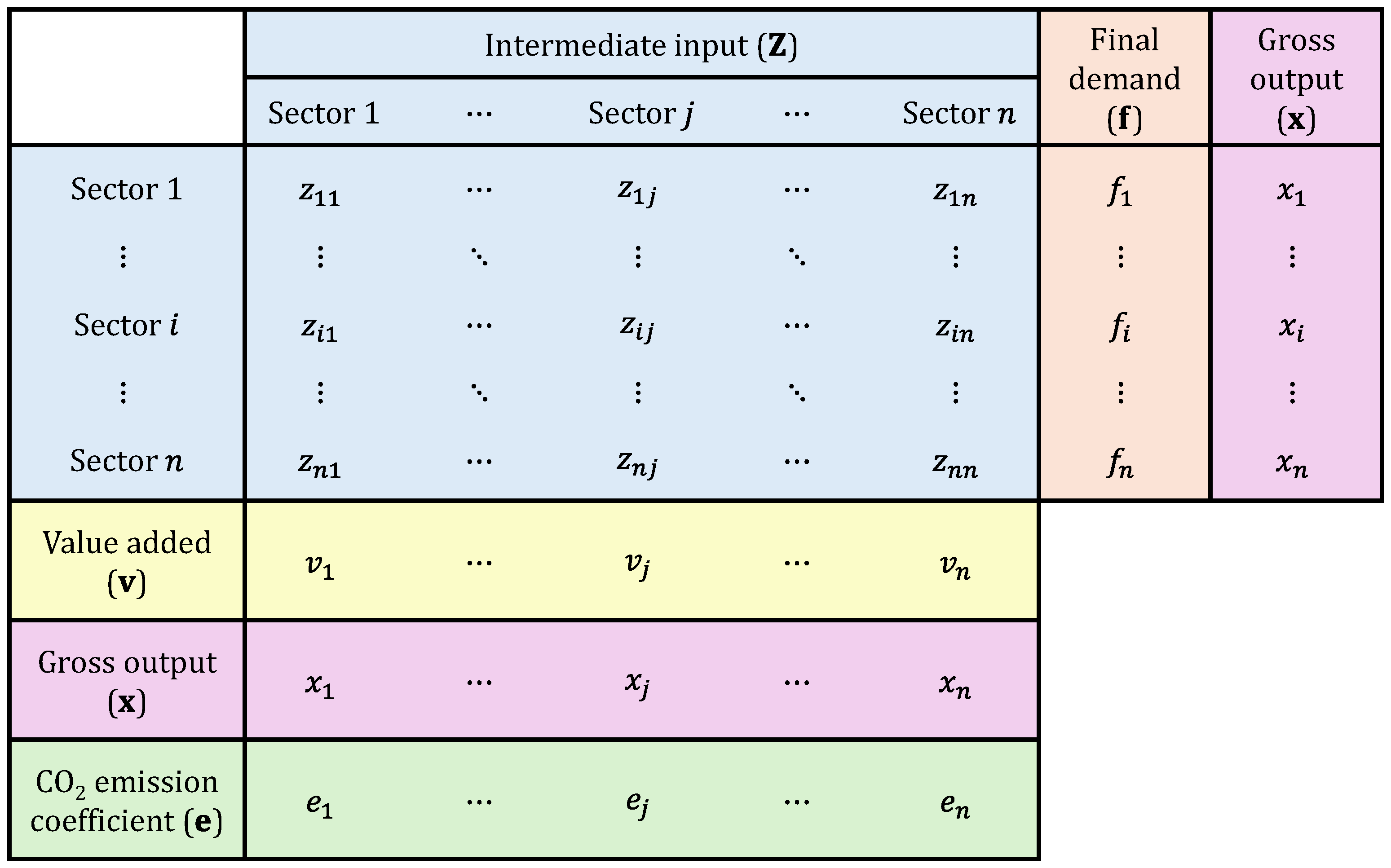
3.1. Overview of the Input–Output Framework
3.2. Estimation of Carbon Footprint
3.3. Estimation of Carbon Storage
4. Data
5. Results
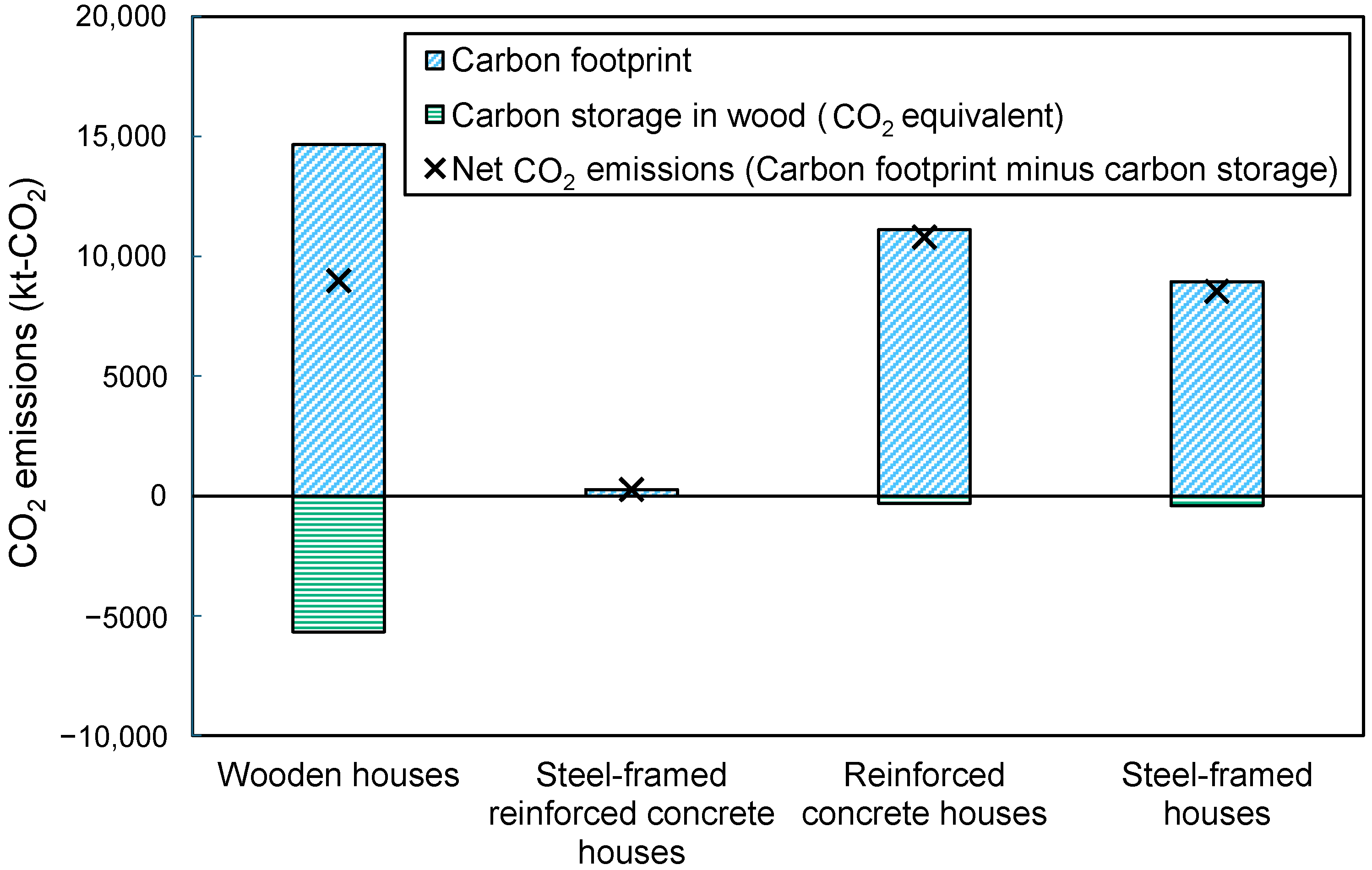
5.1. CO2 Emissions by Construction Method
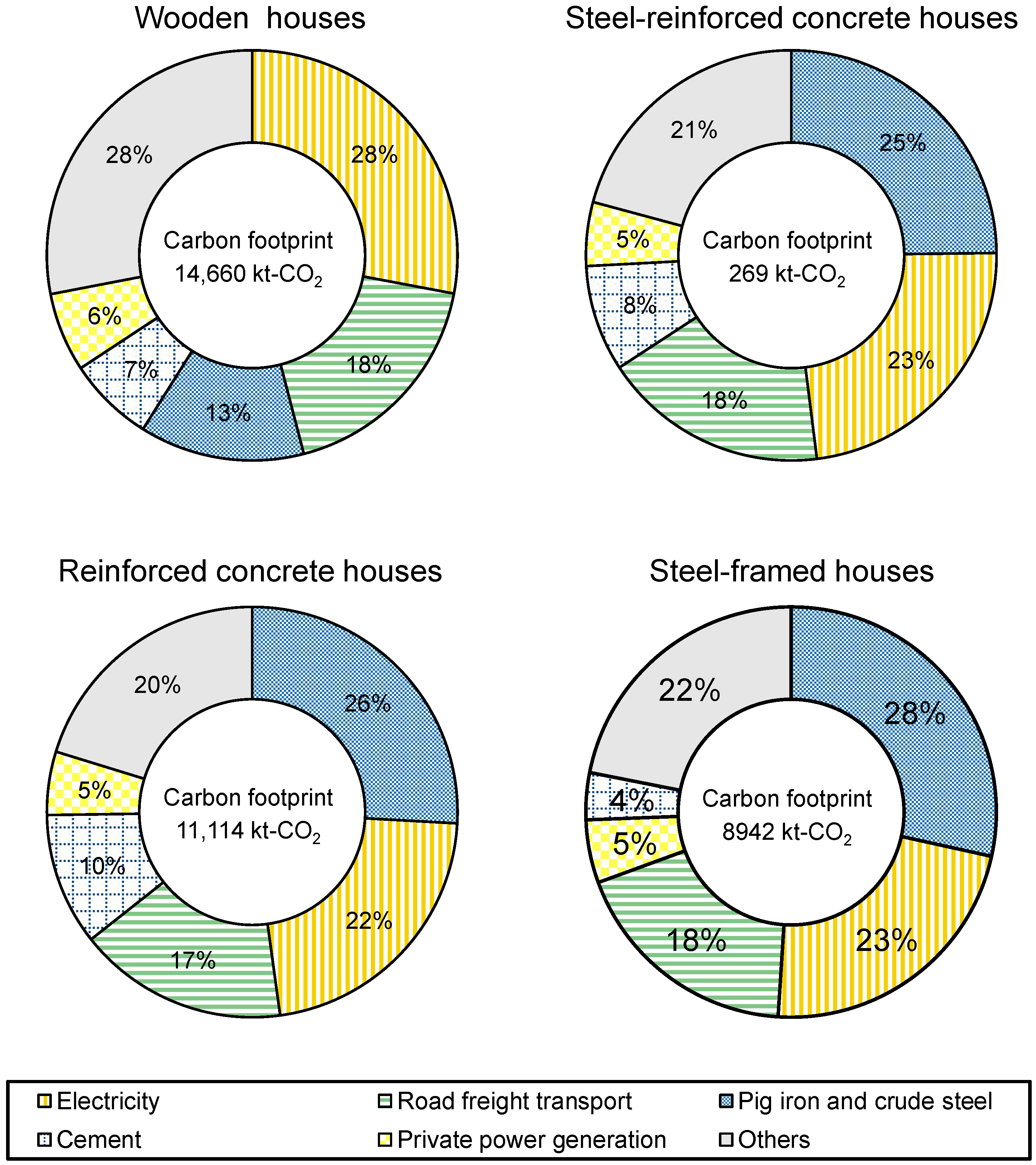
5.2. Breakdown of CO2 Emissions by Construction Method
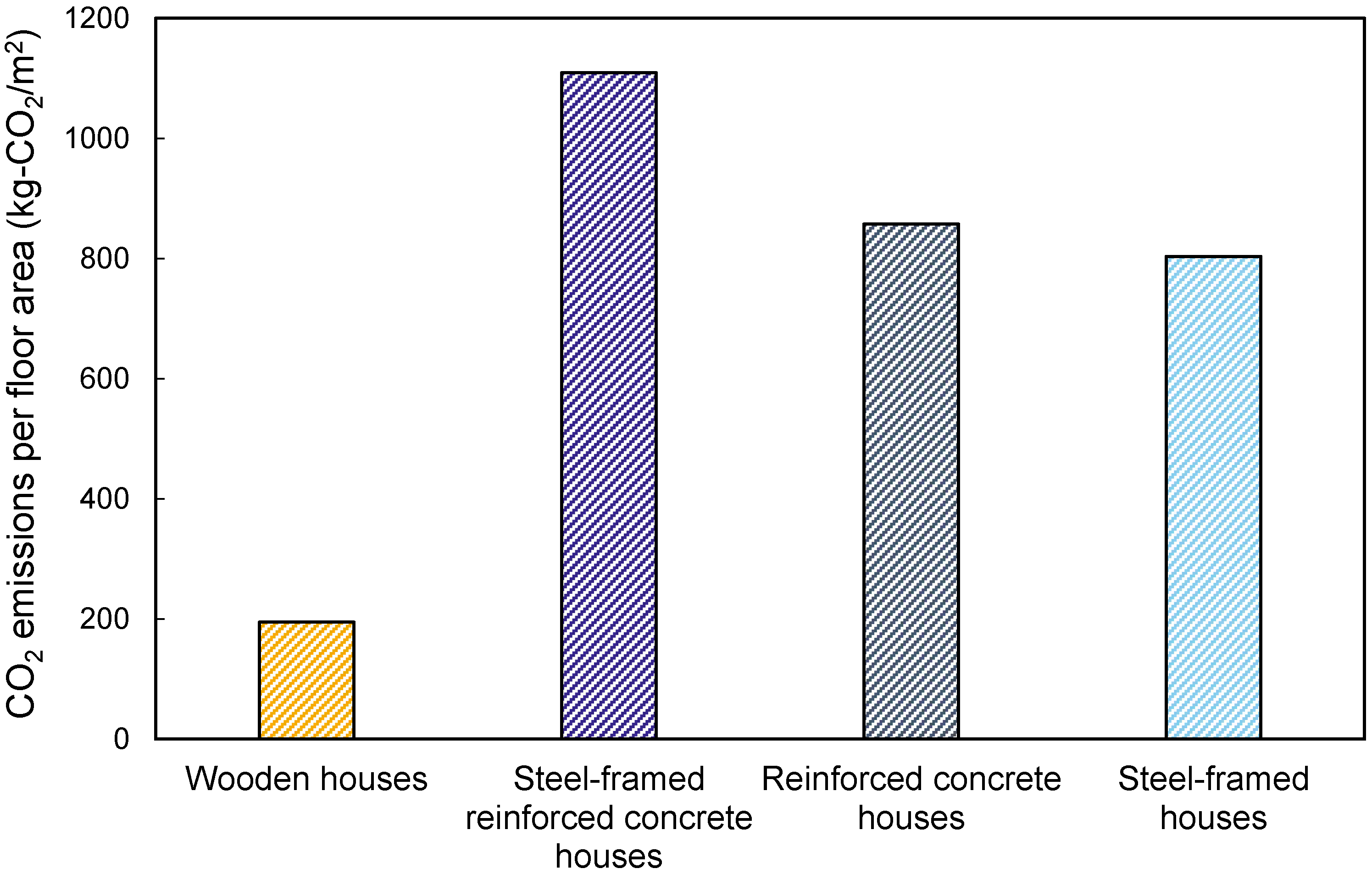
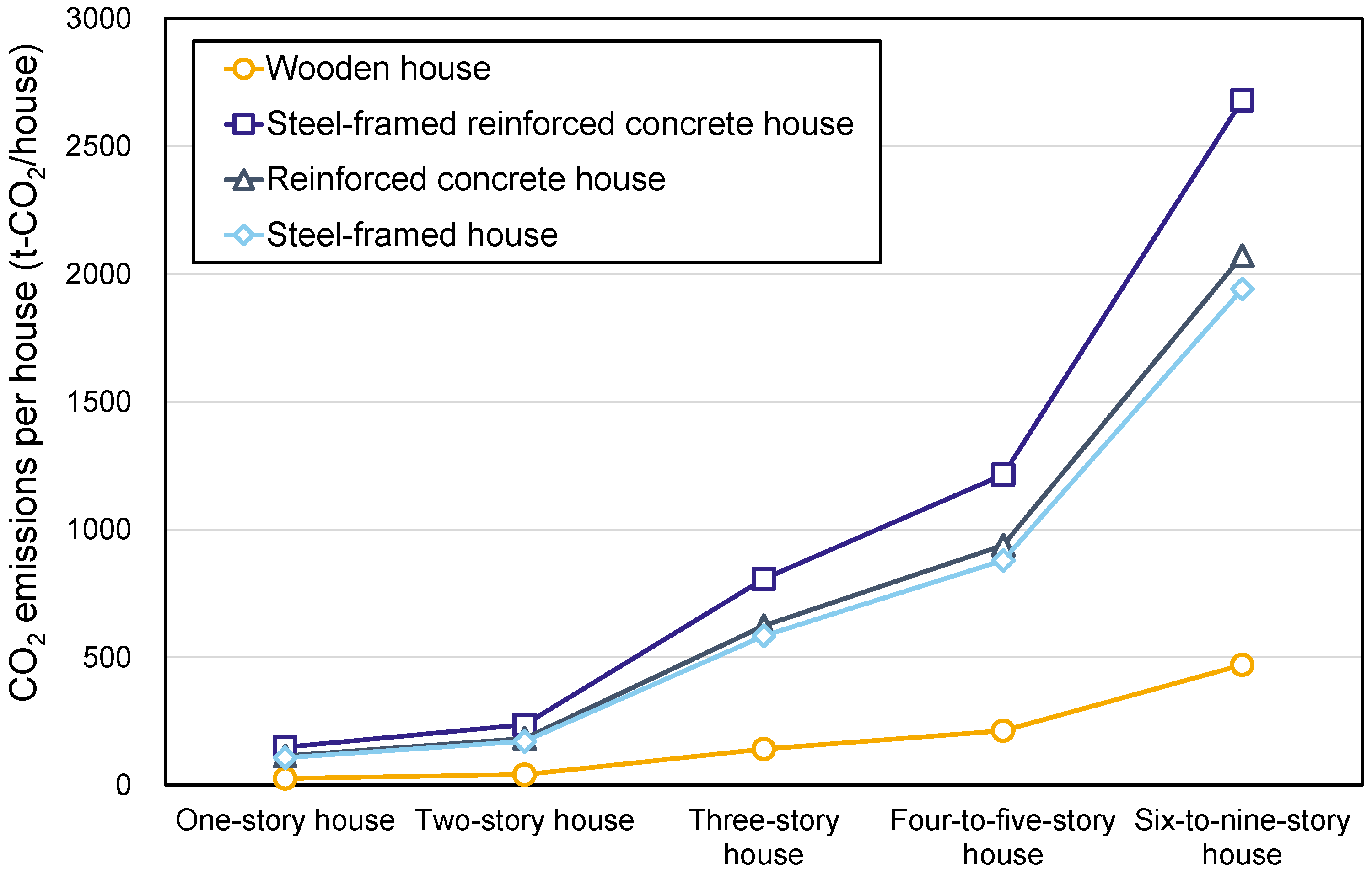
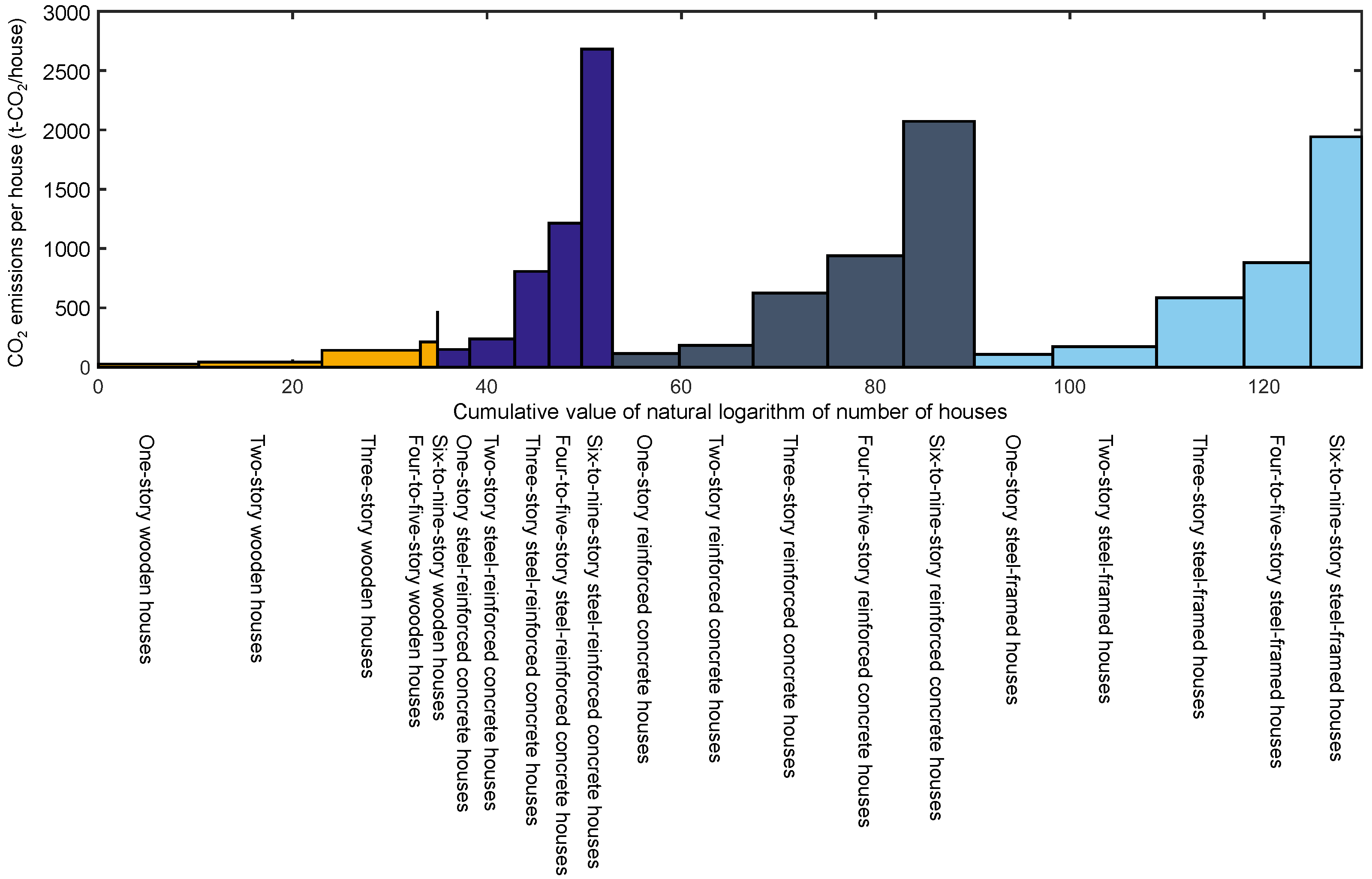
5.3. Analysis of CO2 Emissions by Construction Method and Number of Floors
6. Discussion
6.1. Policy Implications
6.2. Limitations and Future Research
7. Conclusions
Author Contributions
Funding
Data Availability Statement
Conflicts of Interest
References
- IEA. Net Zero by 2050; IEA: Paris, France, 2021. [Google Scholar]
- Ministry of Land, Infrastructure, Transport and Tourism. Overview of the FY2022 Revised Energy Conservation Act for Buildings. 2023. Available online: https://www.mlit.go.jp/jutakukentiku/house/shouenehou_r4.html (accessed on 24 November 2024). (In Japanese)
- Ibn-Mohammed, T.; Greenough, R.; Taylor, S.; Ozawa-Meida, L.; Acquaye, A. Operational vs. embodied emissions in buildings—A review of current trends. Energy Build. 2013, 66, 232–245. [Google Scholar] [CrossRef] [Scilit]
- Röck, M.; Saade, M.R.M.; Balouktsi, M.; Rasmussen, F.N.; Birgisdottir, H.; Frischknecht, R.; Habert, G.; Lützkendorf, T.; Passer, A. Embodied GHG emissions of buildings—The hidden challenge for effective climate change mitigation. Appl. Energy 2020, 258, 114107. [Google Scholar] [CrossRef] [Scilit]
- Forestry Agency. Act for Promotion of Use of Wood in Buildings to Contribute to the Realization of a Carbon-Neutral Society. 2026. Available online: https://www.rinya.maff.go.jp/j/riyou/koukyou/ (accessed on 24 January 2026). (In Japanese)
- Ministry of Land, Infrastructure, Transport and Tourism. Statistics on Building Construction Started in 2023. 2024. Available online: https://www.e-stat.go.jp/stat-search/files?page=1&layout=datalist&toukei=00600120&tstat=000001016965&cycle=7&year=20230&month=0&result_back=1&tclass1val=0 (accessed on 28 January 2026). (In Japanese)
- Onat, N.C.; Kucukvar, M.; Tatari, O. Scope-based carbon footprint analysis of U.S. residential and commercial buildings: An input-output hybrid life cycle assessment approach. Build. Environ. 2014, 72, 53–62. [Google Scholar] [CrossRef] [Scilit]
- Zhang, X.; Wang, F. Hybrid input-output analysis for life-cycle energy consumption and carbon emissions of China’s building sector. Build. Environ. 2016, 104, 188–197. [Google Scholar] [CrossRef] [Scilit]
- Bahramian, M.; Yetilmezsoy, K. Life cycle assessment of the building industry: An overview of two decades of research (1995–2018). Energy Build. 2020, 219, 109917. [Google Scholar] [CrossRef] [Scilit]
- Onat, N.C.; Kucukvar, M. Carbon footprint of construction industry: A global review and supply chain analysis. Renew. Sustain. Energy Rev. 2020, 124, 109783. [Google Scholar] [CrossRef] [Scilit]
- Mithraratne, N.; Vale, B. Life cycle analysis model for New Zealand houses. Build. Environ. 2004, 39, 483–492. [Google Scholar] [CrossRef] [Scilit]
- Gustavsson, L.; Joelsson, A. Life cycle primary energy analysis of residential buildings. Energy Build. 2010, 42, 210–220. [Google Scholar] [CrossRef] [Scilit]
- Gustavsson, L.; Joelsson, A.; Sathre, R. Life cycle primary energy use and carbon emission of an eight-storey wood-framed apartment building. Energy Build. 2010, 42, 230–242. [Google Scholar] [CrossRef] [Scilit]
- Monahan, J.; Powell, J.C. An embodied carbon and energy analysis of modern methods of construction in housing: A case study using a lifecycle assessment framework. Energy Build. 2011, 43, 179–188. [Google Scholar] [CrossRef] [Scilit]
- Passer, A.; Kreiner, H.; Maydl, P. Assessment of the environmental performance of buildings: A critical evaluation of the influence of technical building equipment on residential buildings. Int. J. Life Cycle Assess. 2012, 17, 1116–1130. [Google Scholar] [CrossRef] [Scilit]
- Petrovic, B.; Myhren, J.A.; Zhang, X.; Wallhagen, M.; Eriksson, O. Life cycle assessment of a wooden single-family house in Sweden. Appl. Energy 2019, 251, 113253. [Google Scholar] [CrossRef] [Scilit]
- Upton, B.; Miner, R.; Spinney, M.; Heath, L.S. The greenhouse gas and energy impacts of using wood instead of alternatives in residential construction in the United States. Biomass Bioenergy 2008, 32, 1–10. [Google Scholar] [CrossRef] [Scilit]
- Salazar, J.; Meil, J. Prospects for carbon-neutral housing: The influence of greater wood use on the carbon footprint of a single-family residence. J. Clean. Prod. 2009, 17, 1563–1571. [Google Scholar] [CrossRef] [Scilit]
- Bolin, C.A.; Smith, S.T. Life cycle assessment of borate-treated lumber with comparison to galvanized steel framing. J. Clean. Prod. 2011, 19, 630–639. [Google Scholar] [CrossRef] [Scilit]
- Gustavsson, L.; Sathre, R. Energy and CO2 analysis of wood substitution in construction. Clim. Change 2011, 105, 129–153. [Google Scholar] [CrossRef] [Scilit]
- Pierobon, F.; Huang, M.; Simonen, K.; Ganguly, I. Environmental benefits of using hybrid CLT structure in midrise non-residential construction: An LCA based comparative case study in the U.S. J. Build. Eng. 2019, 26, 100862. [Google Scholar] [CrossRef] [Scilit]
- Jayalath, A.; Navaratnam, S.; Ngo, T.; Mendis, P.; Hewson, N.; Aye, L. Life cycle performance of Cross Laminated Timber mid-rise residential buildings in Australia. Energy Build. 2020, 223, 110091. [Google Scholar] [CrossRef] [Scilit]
- Nakano, K.; Koide, M.; Yamada, Y.; Ogawa, T.; Hattori, N. Environmental impacts of structural lumber production in Japan. J. Wood Sci. 2024, 70, 4. [Google Scholar] [CrossRef] [Scilit]
- Crawford, R.H.; Bontinck, P.A.; Stephan, A.; Wiedmann, T.; Yu, M. Hybrid life cycle inventory methods—A review. J. Clean. Prod. 2018, 172, 1273–1288. [Google Scholar] [CrossRef] [Scilit]
- Dixit, M.K.; Culp, C.H.; Fernandez-Solis, J.L. System boundary for embodied energy in buildings: A conceptual model for definition. Renew. Sustain. Energy Rev. 2013, 21, 153–164. [Google Scholar] [CrossRef] [Scilit]
- Gerilla, G.P.; Teknomo, K.; Hokao, K. An environmental assessment of wood and steel reinforced concrete housing construction. Build. Environ. 2007, 42, 2778–2784. [Google Scholar] [CrossRef] [Scilit]
- Stephan, A.; Crawford, R.H.; De Myttenaere, K. Towards a comprehensive life cycle energy analysis framework for residential buildings. Energy Build. 2012, 55, 592–600. [Google Scholar] [CrossRef] [Scilit]
- Suzuki, M.; Oka, T.; Okada, K. The estimation of energy consumption and CO2 emission due to housing construction in Japan. Energy Build. 1995, 22, 165–169. [Google Scholar] [CrossRef] [Scilit]
- Imada, S.; Maeno, K.; Kagawa, S. CO2 emission hotspots analysis on supply chains for wooden houses in Japan. J. Environ. Manage. 2024, 353, 120151. [Google Scholar] [CrossRef] [Scilit] [PubMed]
- Hou, H.; Feng, X.; Zhang, Y.; Bai, H.; Ji, Y.; Xu, H. Energy-related carbon emissions mitigation potential for the construction sector in China. Environ. Impact Assess. Rev. 2021, 89, 106599. [Google Scholar] [CrossRef] [Scilit]
- Kucukvar, M.; Tatari, O. Towards a triple bottom-line sustainability assessment of the U.S. construction industry. Int. J. Life Cycle Assess. 2013, 18, 958–972. [Google Scholar] [CrossRef] [Scilit]
- Man, Y.; Thomas, W.; Robert, C.; Catriona, T. The carbon footprint of Australia’s construction sector. Procedia Eng. 2017, 180, 211–220. [Google Scholar]
- Nässén, J.; Holmberg, J.; Wadeskog, A.; Nyman, M. Direct and indirect energy use and carbon emissions in the production phase of buildings: An input–output analysis. Energy 2007, 32, 1593–1602. [Google Scholar] [CrossRef] [Scilit]
- Acquaye, A.A.; Duffy, A.P. Input–output analysis of Irish construction sector greenhouse gas emissions. Build. Environ. 2010, 45, 784–791. [Google Scholar] [CrossRef] [Scilit]
- Hung, C.C.W.; Hsu, S.; Cheng, K. Quantifying city-scale carbon emissions of the construction sector based on multi-regional input-output analysis. Resour. Conserv. Recycl. 2019, 149, 75–85. [Google Scholar] [CrossRef] [Scilit]
- Huang, L.; Krigsvoll, G.; Johansen, F.; Liu, Y.; Zhang, X. Carbon emission of global construction sector. Renew. Sustain. Energy Rev. 2018, 81, 1906–1916. [Google Scholar] [CrossRef] [Scilit]
- Miller, R.E.; Blair, P.D. Input–Output Analysis: Foundations and Extensions; Cambridge University Press: Cambridge, UK, 2009. [Google Scholar]
- Leontief, W. Input-Output Economics; Oxford University Press: Oxford, UK, 1986. [Google Scholar]
- Suh, S. Handbook of Input-Output Economics in Industrial Ecology (Eco-Efficiency in Industry and Science, 23); Springer: Berlin/Heidelberg, Germany, 2010. [Google Scholar]
- Ministry of Agriculture, Forestry and Fisheries. Guidelines for Carbon Storage Labeling in Wood Utilized for Building Construction. 2021. Available online: https://www.rinya.maff.go.jp/j/mokusan/mieruka.html (accessed on 24 November 2024). (In Japanese)
- Ministry of Internal Affairs and Communications. Input-Output Table in 2015. 2019. Available online: https://www.soumu.go.jp/toukei_toukatsu/data/io/ (accessed on 24 November 2024). (In Japanese)
- Ministry of Land, Infrastructure, Transport and Tourism. Input-Output Table for Analysis of Construction Sectors in 2015. 2020. Available online: https://www.mlit.go.jp/sogoseisaku/jouhouka/sosei_jouhouka_tk4_000020.html (accessed on 24 November 2024). (In Japanese)
- Ministry of Land, Infrastructure, Transport and Tourism. Standards for Planning and Design in Wood Construction. 2017. Available online: https://www.mlit.go.jp/gobuild/mokuzai_torikumi/dounyuu4-2.pdf (accessed on 24 November 2024). (In Japanese)
- Martin, R.A.; Doraisami, M.; Thomas, C.S. Global patterns in wood carbon concentration across the world’s trees and forests. Nat. Geosci. 2018, 11, 915–920. [Google Scholar] [CrossRef] [Scilit]
- Matsushima, S.; Kagawa, S.; Nansai, K.; Xue, J. A comparison of deflation methods for carbon footprint calculations using Japanese data. Econ. Syst. Res. 2024, 36, 337–352. [Google Scholar] [CrossRef] [Scilit]
- Nansai, K. Embodied Energy and Emission Intensity Data for Japan Using Input–Output Tables (3EID), National Institute for Environmental Studies, Japan, 2019. Available online: http://www.cger.nies.go.jp/publications/report/d031/index.html (accessed on 24 November 2024).
- Nansai, K.; Fry, J.; Malik, A.; Kondo, N. Carbon footprint of Japanese health care services from 2011 to 2015. Resour. Conserv. Recycl. 2020, 152, 104525. [Google Scholar] [CrossRef] [Scilit]
- Ministry of Land, Infrastructure, Transport and Tourism. Statistics on Building Construction Started in 2015. 2016. Available online: https://www.e-stat.go.jp/stat-search/files?page=1&layout=datalist&toukei=00600120&tstat=000001016965&cycle=7&year=20150&month=0&result_back=1&tclass1val=0 (accessed on 28 January 2026). (In Japanese)
- Mitsui Fudosan. Sustainability Report 2024; Mitsui Fudosan: Tokyo, Japan, 2024; Available online: https://www.mitsuifudosan.co.jp/english/esg_csr/backnumber/ (accessed on 11 December 2024).
- Obayashi Corporation. Obayashi Corporate Report 2022. 2022. Available online: https://ir.obayashi.co.jp/en/ir/data/report.html (accessed on 11 December 2024).
- Lukić, N.; Jurišević, N.; Nikolić, N.; Gordić, D. Specific heating consumption in the residential sector of Serbia—Example of the city of Kragujevac. Energy Build. 2015, 107, 163–171. [Google Scholar] [CrossRef] [Scilit]


Disclaimer/Publisher’s Note: The statements, opinions and data contained in all publications are solely those of the individual author(s) and contributor(s) and not of MDPI and/or the editor(s). MDPI and/or the editor(s) disclaim responsibility for any injury to people or property resulting from any ideas, methods, instructions or products referred to in the content. |
© 2026 by the authors. Licensee MDPI, Basel, Switzerland. This article is an open access article distributed under the terms and conditions of the Creative Commons Attribution (CC BY) license.
Share and Cite
Nagata, A.; Matsushima, S.; Kagawa, S. Carbon Footprint Analysis of Residential Buildings in Japan. Energies 2026, 19, 783. https://doi.org/10.3390/en19030783
Nagata A, Matsushima S, Kagawa S. Carbon Footprint Analysis of Residential Buildings in Japan. Energies. 2026; 19(3):783. https://doi.org/10.3390/en19030783
Chicago/Turabian StyleNagata, Ai, Sora Matsushima, and Shigemi Kagawa. 2026. "Carbon Footprint Analysis of Residential Buildings in Japan" Energies 19, no. 3: 783. https://doi.org/10.3390/en19030783
APA StyleNagata, A., Matsushima, S., & Kagawa, S. (2026). Carbon Footprint Analysis of Residential Buildings in Japan. Energies, 19(3), 783. https://doi.org/10.3390/en19030783