Article

Robust Control of an Electrical Drive with a Flexible Joint Using PI Controllers Based on Torsional Torque Derivative Feedback


by
Amanuel Haftu Kahsay
1,
Piotr Derugo
1,
Kosuke Shikata
2,
Seiichiro Katsura
2 and
Krzysztof Szabat
1,2,*
1
Faculty of Electrical Engineering, Wrocław University of Science and Technology, PL50370 Wroclaw, Poland
2
Department of System Design Engineering, Keio University, Yokohama 223-8522, Japan
*
Author to whom correspondence should be addressed.
Energies 2026, 19(1), 32; https://doi.org/10.3390/en19010032
Submission received: 2 November 2025 / Revised: 26 November 2025 / Accepted: 16 December 2025 / Published: 20 December 2025
(This article belongs to the Special Issue Drive System and Control Strategy of Electric Vehicle)

Abstract

Electric drives are responsible for torque generation in most industrial processes and devices, including electromobility. The operational performance of industrial drives is often limited by torsional vibrations and time-varying load inertia. To address these challenges, this paper proposes and compares three robust control structures based on PI controllers augmented with additional feedback from the first and second derivatives of torsional torque. A higher-order integral disturbance observer (IDO) is employed to estimate the unmeasurable derivatives of torsional torque, enabling accurate compensation. Furthermore, a bio-inspired optimization algorithm (Britch-inspired Optimization Algorithm, BiOA) is utilized to determine the optimal gain coefficients for the PI controller and the additional feedback loops. The proposed methodologies are validated through simulations and experimental testing on a physical setup, demonstrating improved reference-trajectory tracking and enhanced torsional vibration suppression under varying load conditions.

1. Introduction

Electrical drives with flexible joints, such as two-mass configurations, are increasingly employed in modern industrial applications, including wind turbines, electric vehicles (EVs), rolling mills, robotic manipulators, CNC machines, and elevator systems [1,2,3,4].
A crucial problem in such systems is the mechanical resonance. Ref. [5] proposes a Robust On-Line Adaptive Notch Filter to overcome this issue, and shows that after appropriate adjustments, robust and effective resonance damping is achieved. Similarly, ref. [6] proposes a modified sliding mode speed controller in order to improve the load speed control performance of an elastic motor drive system with internal and external disturbances. The problem is also visible in the robotic arm. Ref. [7] proposes that the DOB control strategy proposed in this paper can effectively reduce the vibration of the dual-flexible manipulator with an axially translating arm to improve the movement accuracy of the end-effector. Some positions propose less complicated solutions, such as [8], where the PI-based control structure is widened by additional feedback from torsional torque and its derivative. Paper [9] describes the parameters matching and designing method for multi-stage torsional stiffness DMF for the vehicle drivetrain. The proposed numerical model, which has been confirmed by road experiment for a practical vehicle, is adequate for the subsequent investigation.
There are also many review works on the topic of torsional vibrations. Among them, one study [7] looks into the topic of vibration in high-speed machining. Related studies on system modeling, parameter identification, and vibration control technologies are classified and summarized. The advantages and disadvantages of different methods are discussed and compared. Similarly, refs. [9,10,11] reviews the recent works on methods of analyzing and controlling vibration for dual-driven feed systems. The research on vibration control technologies, parameter identification, and system modeling is identified and summarized; the merits and drawbacks of various methods are discussed for comparative purposes.
Consequently, two key performance objectives dominate the design of high-performance drive systems: accurate reference-speed or position tracking and the effective suppression of torsional vibrations.
To address these objectives, researchers from industry and academia frequently employed closed–loop proportional–integral (PI) controllers with feedback from motor or load speed [2]. While PI controllers remain attractive due to their simplicity and ease of implementation, achieving high-performance operation typically requires high–gain coefficients [1]. However, such aggressive tuning inevitably excites torsional vibrations, particularly in systems incorporating flexible shafts, belts, or gear joints. As a result, the classical PI controller exhibits limited applicability in high-performance electric drives. The root of this limitation lies in its inability to independently regulate system damping and resonance frequency.
Several enhanced PI-based structures incorporating additional feedback variables have been proposed to overcome these shortcomings. One approach introduces a single additional feedback from speed difference, torsional torque, or its derivative, which provides an additional degree of freedom to improve vibration damping [1,12,13,14,15]. Although this strategy improves dynamic performance, its effectiveness is restricted to damping enhancement alone, with no independent influence over the resonance frequency. Moreover, the requirement to measure or estimate load speed, torsional torque, and the torsional torque derivative introduces practical challenges, particularly because derivative-based feedback is inherently sensitive to noise [8].
An advanced control approach integrates feedback from the torsional torque together with the difference between motor and load speeds. This dual-feedback PI control structure enables independent tuning of both the damping and the resonance frequency, thereby enhancing stability margins and overall system robustness [1,16]. Despite these advantages, practical implementation remains challenging due to the requirement for accurate measurement or estimation of mechanical state variables, particularly the load speed. Employing an additional encoder to measure load speed increases the cost, size, and susceptibility to measurement noise. Moreover, in specific applications, such as deep drilling machines, the inclusion of a load-side encoder significantly complicates practical implementation.
To address this challenge, a variety of estimators and observers have been developed. Disturbance Observers (DOBs) provide robustness to load variations and are simple to implement. Ref. [17] deals with the problem of designing a robust controller for a two-inertia system by introducing a partial disturbance observer (DOB) into the inner-loop controller. The proposed controller makes tracking error and vibration of the system suppressed within an arbitrarily small bound during operation time when full states are measured.
Paper [18] proposes a gear impact suppression method based on the impact torque suppressor (ITS), which consists of scheduled torque-derivative-feedback directly to the joint torsional dynamics. The mentioned torque derivative is obtained using Force-Position-Integrated DOB. Similarly, in [19], a paper proposes a novel controller design method for a servomechanism with elasticity to guarantee the position and speed response damping as well as dynamic. The disturbance observer (DOB), offering extra torque shaft feedback, promotes the natural frequency of the speed loop to attain the anti-resonant frequency. In [20], the authors propose a torque DOB to realize the suppression of mechanical resonance with limiting control for shaft torque amplitude. Paper [21] proposes a controller that consists of three elements: the DOB, the imperfect derivative filter, and the feedback gain. Similarly, in this paper, IDO (DOB) is used to obtain information about torsional torque and its derivative in order to improve control quality. In paper [22], the authors use DOB to feed signals into the variable inertia estimator, and prove improvement in the quality of the control structure.
Luenberger observers (LOs) are computationally efficient but depend on model parameters such as load inertia or load time constant, limiting their applicability to systems with time-varying inertia [23,24]. Advanced techniques including Sliding-Mode Observers (SMOs) in [16,25,26], Neural Networks (NNs) in [27,28,29,30], Fuzzy Logic (FL) in [31], Kalman Filters (KF) in [32], and Multilayer Observers in [33] have also been explored. While these estimators improve performance under parameter uncertainty, their numerical complexity hinders real-time implementation.
Recently, integral disturbance observers (IDOs) have been proposed to estimate torsional torque and its derivatives. These observers are simple, inherently robust, independent of load-side parameters, and capable of delivering accurate estimates with minimal delay and reduced noise amplification [11,34].
Building upon these advancements, this paper presents the following novel contributions aimed at enhancing the robust control of dual-mass drive systems under varying load inertia conditions:
  • Development of Three Robust Control Structures: all proposed structures are based on PI controllers expanded with two additional feedbacks. The design of the proposed control structures is independent of the working machine or load parameters.
    • Structure 1: Integrates feedback from both the first and second derivative of the torsional torque to the electromagnetic torque node.
    • Structure 2: Incorporates feedback from the first derivative of the torsional torque to the speed node, along with feedback from the torsional torque derivative to the electromagnetic torque node.
    • Structure 3: Utilizes feedback from the first derivative of the torsional torque, including a time delay to the speed node, and feedback from the torsional torque derivative to the electromagnetic torque node.
  • Design of a Higher-Order Integral Disturbance Observer (IDO): the observer is developed to estimate torsional torque derivatives with minimal phase lag and reduced noise amplification. The design includes stability and robustness analysis for different bandwidth frequencies.
  • Optimization of Controller Parameters: a bio-inspired optimization algorithm is employed to determine the optimal gain coefficients for the PI controller and the additional feedback loops.
  • Stability Analysis and Comparative Evaluation: a detailed stability analysis and performance comparison of the proposed control structures are conducted to assess their effectiveness and robustness.

2. Mathematical Modeling of the Two-Mass System

In this study, a two-mass drive system is employed. The two-mass drive is characterized by two inertial masses connected with a flexible joint. The first mass represents the motor, while the second mass represents the load. These two masses are mechanically linked via a flexible joint that transmits torque between them. Various mathematical modeling approaches have been explored in the literature to describe two-mass drive dynamics. Among them, the inertia-free model is the most widely adopted approach [11]; therefore, it is used in this paper. The corresponding mathematical formulation of the adopted model is presented below.
d d t ω 1 t ω 2 t m s t = 0 0 1 T 1 0 0 1 T 2 1 T c 1 T c 0 ω 1 t ω 2 t m s t + 1 T 1 0 0 m e + 0 1 T 2 0 m L
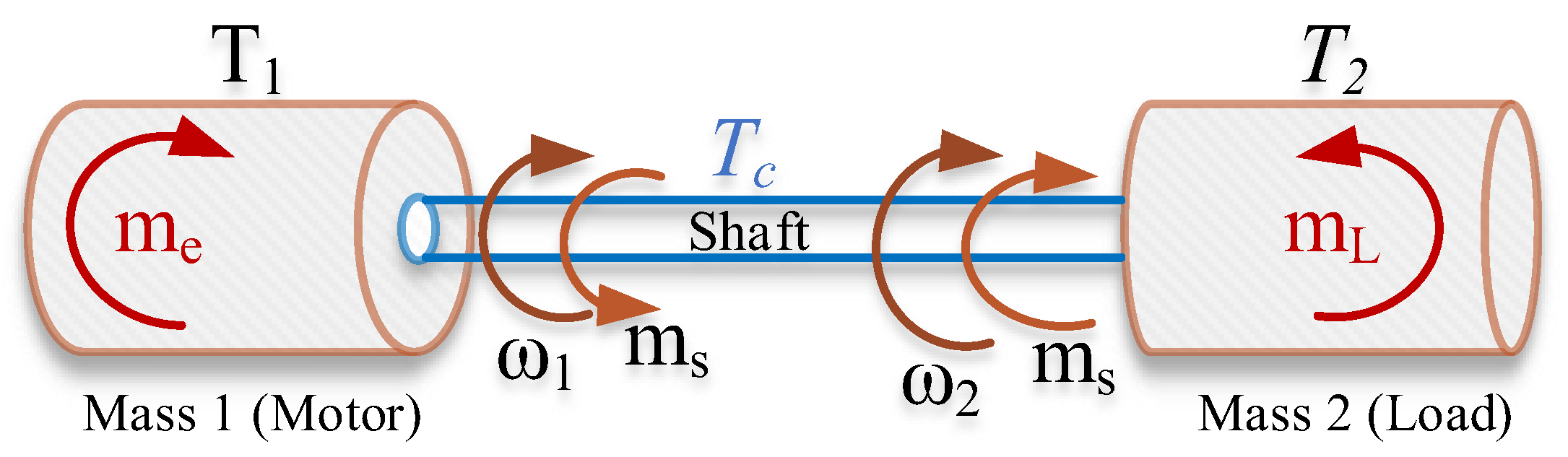
where ω1 and ω2 denote the speeds of the motor and load, respectively; me, ms, and mL represent the motor, shaft, and load torques; and T1, T2, and Tc correspond to the mechanical time constants of the motor, load, and shaft, respectively.
A schematic diagram of the considered dual-mass system is presented in Figure 1.
The system under analysis is defined by the following parameters: T1 = 203 ms, T2 = 285 ms, and Tc = 2.6 ms. In this work, the nonlinear torsional torque is considered as a disturbance. The motor torque (me) serves as the input control of the system, whereas the motor speed (ω1) is treated as the system output. This configuration ensures the results are relevant to various electric drives with high-performance torque. For simulation purposes, nonlinear phenomena such as backlash, mechanical hysteresis, and friction are disregarded.

3. Proposed Control Structure

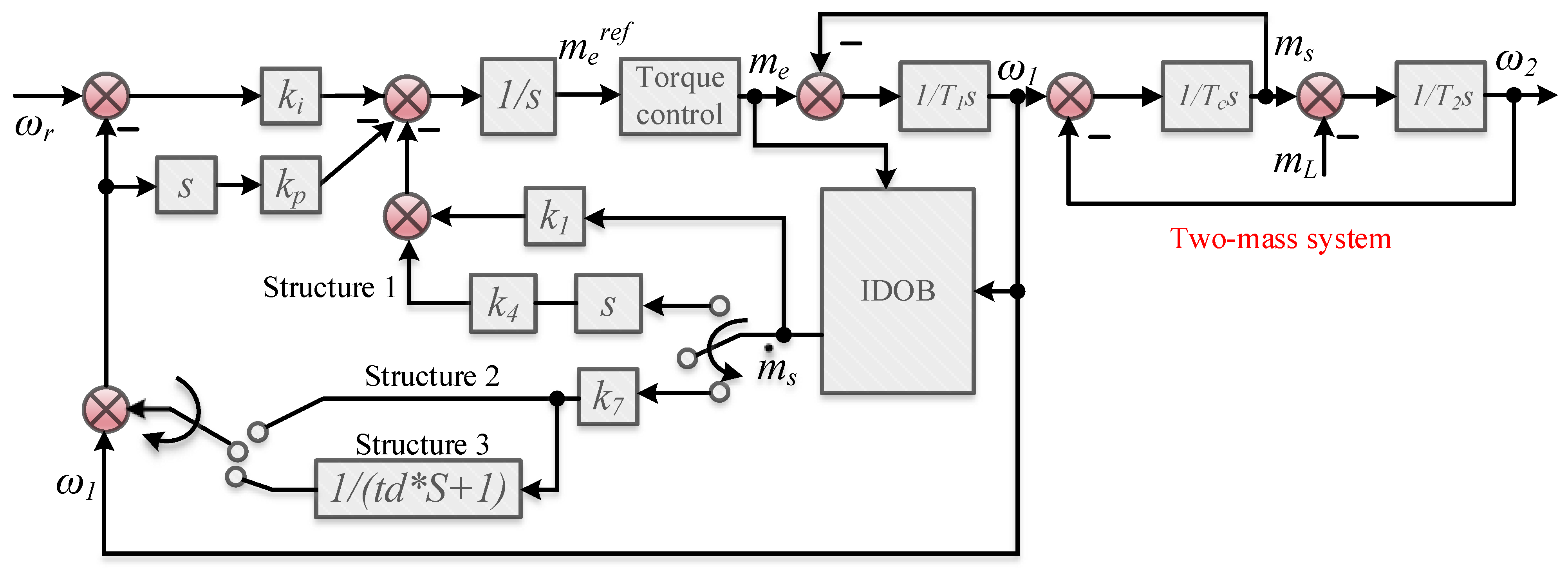
This paper proposes three different control structures based on PI controllers, incorporating additional feedback from the first and second derivatives of the torsional torque. These additional feedback signals, together with their gain coefficients, help maintain a stable control system with damped oscillations by regulating the driving or reference electromagnetic torque (meref). The overall control structure is shown in Figure 2.
To determine the reference electromagnetic torque (meref), three different structures are developed and presented in this paper, as follows.

3.1. Structure 1

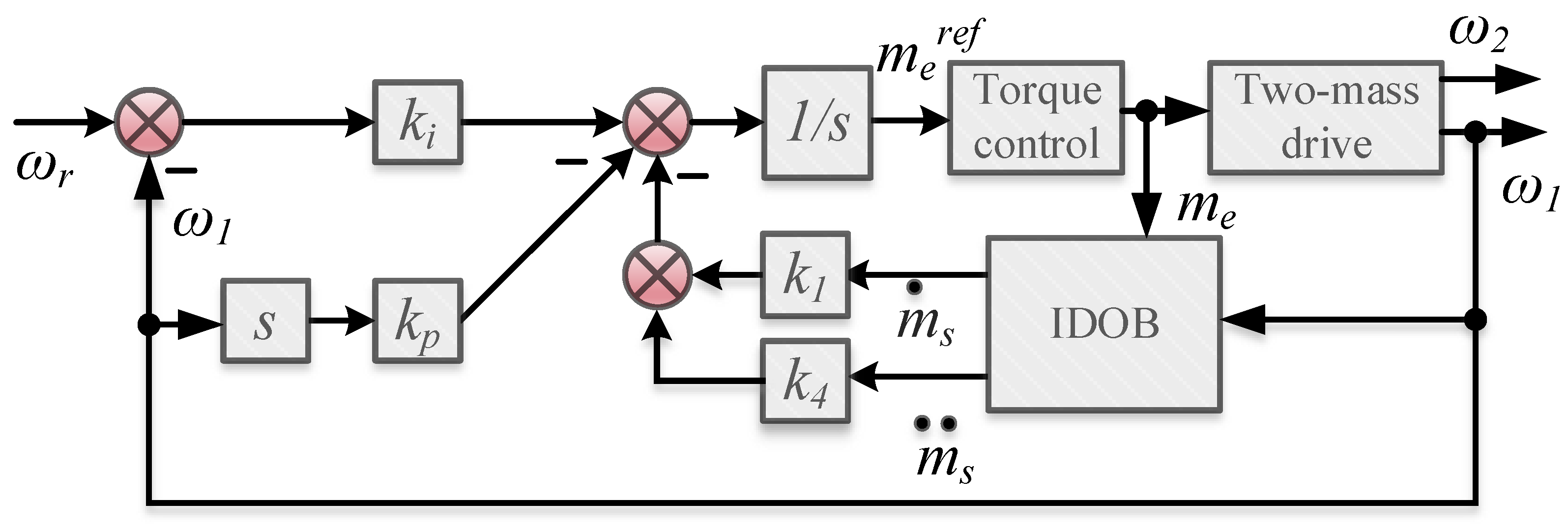
In this control structure, a PI controller with additional feedback from the first and second derivative of the torsional torque, with gain coefficients k1 and k4, respectively, is used to control meref. The design concept is based on subtracting the combined effect of the additional feedback, along with their gain coefficients, from the PI controller output. Based on the error between the reference and the motor speed, the additional feedback helps maintain an appropriate meref, ensuring a stable control system with damped oscillations. The mathematical formulation and the block diagram of the proposed control structure are presented in Equation (2) and Figure 3.
m e r e f = ω r ω 1 k i s k p ω 1 m ˙ s k 1 m ¨ s k 4 1 s

3.2. Structure 2 and 3

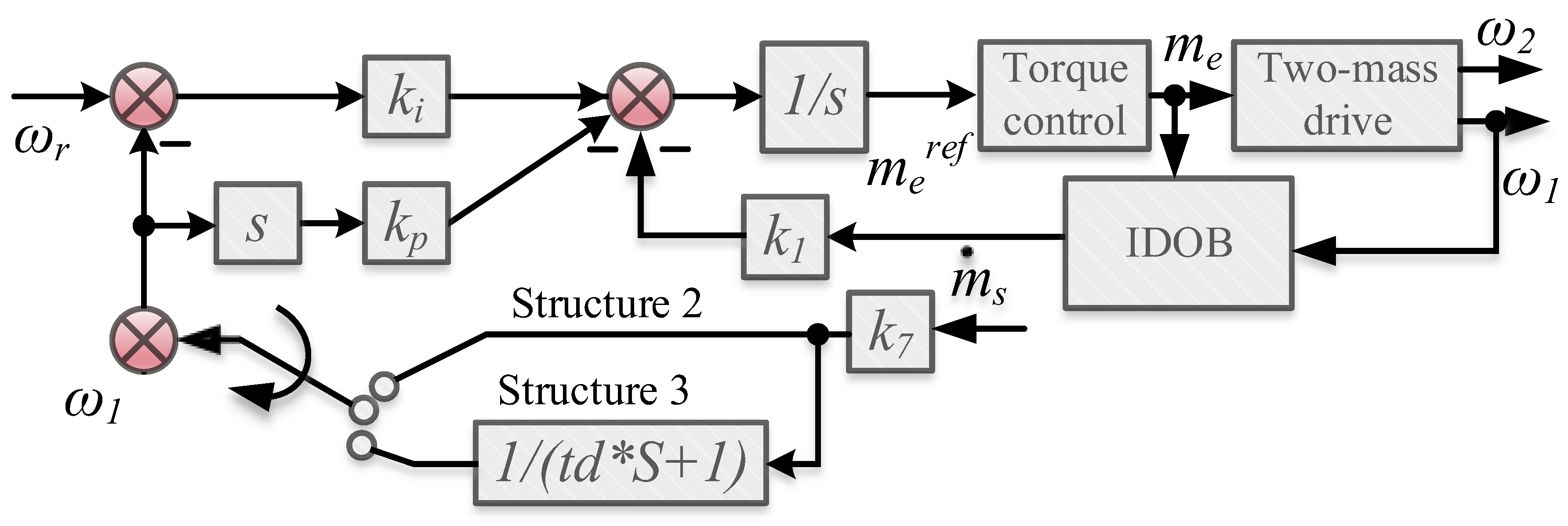
In this control structure, the system includes additional couplings from the first derivative of the torsional torque. The meref of the system is determined by coupling the additional feedback from the first derivative of the torsional torque to the output of the PI controller with gain coefficient k1, and to the speed node with gain coefficient k7. Based on the configuration of the k7 coupling, this control structure has two arrangements, and in this paper, these arrangements are represented as structures 2 and 3:

3.2.1. Structure 2

This arrangement includes additional feedback from the first derivative of the torsional torque, with a gain coefficient k7, which is coupled to the speed node without any time delay.

3.2.2. Structure 3

In this arrangement, the additional feedback from the first derivative of the torsional torque, with gain coefficient k7, is coupled to the speed node with a time delay. Mathematical and block diagram representations of the proposed control structures are shown in Equation (3) and Figure 4.
m e r e f = ω r ( ω 1 + m ˙ s k 7 ) k i s k p ( ω 1 + m ˙ s k 7 ) m ˙ s k 1 1 s
The pole placement methodology is applied to determine the parameters of the control structures. The main transfer function of the system, incorporating all three feedbacks, is presented below:
G ω 2 s = ω 2 s ω r s = G r s s 2 T 2 T c + 1 s 3 T 2 T c T 1 + s 2 T 2 T c + k 7 G r s + k 4 + s T 1 + T 2 1 + k 1 + G r s
The transmittance of the PI controller is described as follows:
G r s = k p + k i 1 s
where k1, k4, and k7 are additional feedback gain coefficients, and ki and kp are PI controller gains.
From this, the characteristic equations of the proposed control structures are presented in Equations (6) and (7).
p s S t r u c t u r e   1 = s 4 + s 3 k p T 2 T c + T 2 k 4 T 1 T 2 T c + s 2 k i T 2 T c + T 1 + T 2 + T 2 k 1 T 1 T 2 T c + s k p T 1 T 2 T c + k i T 1 T 2 T c
p s S t r u c t u r e   2   a n d   3 = s 4 + s 3 k p T 2 ( T c + k 7 ) T 1 T 2 T c + s 2 k i T 2 ( T c + k 7 ) + T 1 + T 2 + T 2 k 1 T 1 T 2 T c + s k p T 1 T 2 T c + k i T 1 T 2 T c
The desired polynomial for the characteristic equation of the proposed control structures is presented in Equation (8).
s 4 + s 3 ( 4 ξ r ω r f ) + s 2 2 ω r f 2 + 4 ξ r 2 ω r f 2 + s 4 ξ r ω r f 3 + ω r f 4 = 0
where ξr—damping coefficient, and ωrf—resonant frequency of the closed-loop system.
The controller gains for structure 1 can be determined by equating coefficients of Equations (6) and (8), as illustrated below in Equations (9)–(12).
k p = 4 ξ r ω r f 3 T 1 T 2 T c
k i = ω r f 4 T 1 T 2 T c
k 4 = 4 ξ r ω r f T 1 T c k p T c
k 1 = 2 ω r f 2 + 4 ξ r 2 ω r f 2 T 1 T c k i T c T 1 T 2 1
Similarly, the controller gains for structures 2 and 3 can be determined by equating the coefficients of Equations (7) and (8), as shown below in Equations (13)–(16). To avoid complexity, the time delay is not included in the characteristic equation.
k p = 4 ξ r ω r f 3 T 1 T 2 T c
k i = ω r f 4 T 1 T 2 T c
k 1 = ω r f 2 + 4 ξ r 2 ω r f 2 T 1 T c T 1 T 2 1
k 7 = 1 ω r f 2 T 2 T c

3.3. Observer Design

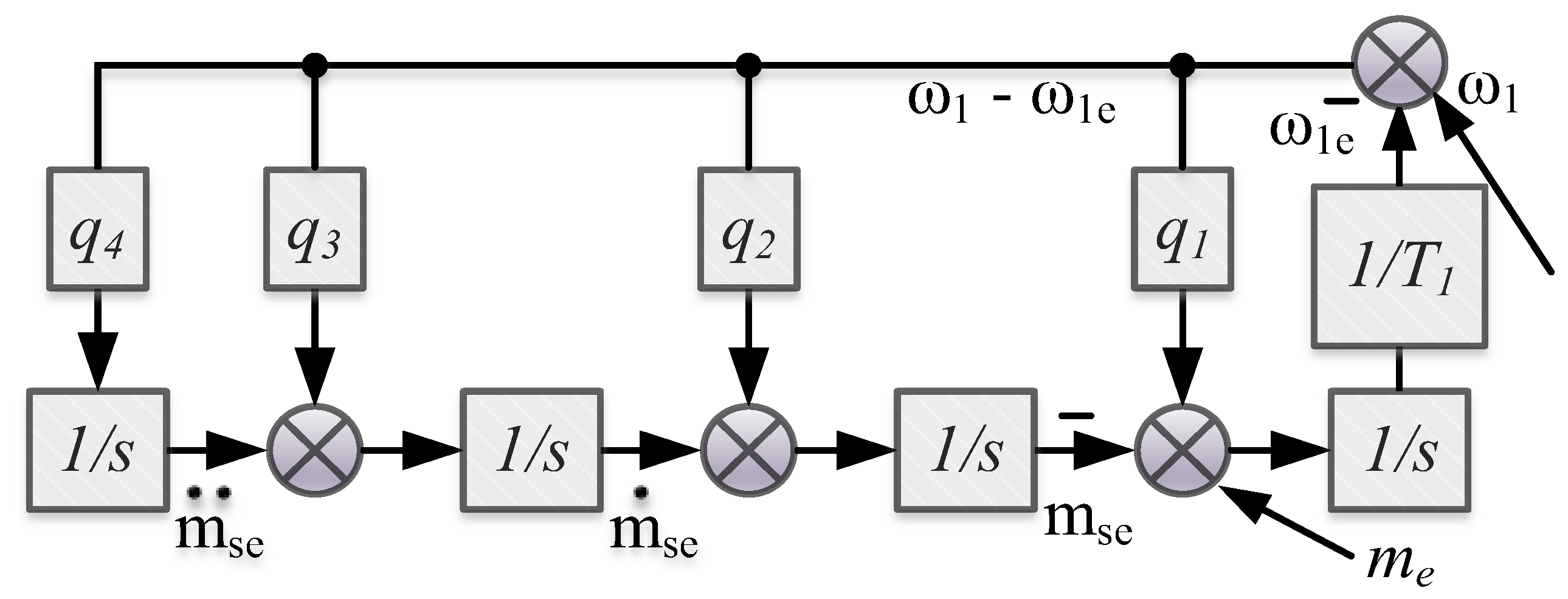
The proposed control structures rely on the parameters of the first and second torsional torque derivatives. Direct measurement of these parameters is always difficult, costly, or sometimes even impossible. As a result, in this paper, a simple observer with minimal error and phase lag based on a higher-order integral disturbance observer (IDO) is used. The accuracy, noise resistance, and simplicity of this observer are discussed in [11,34]. The proposed observer is presented in Figure 5.
The transfer function and the correcting coefficients of the proposed observer are determined as follows.
p ( s ) = s 4 + s 3 q 1 T 1 s 2 q 2 T 1 s q 3 T 1 q 4 T 1
p ( s ) = s 2 + 2 ξ r o ω r o s + ω r o 2 s 2 + 2 ξ r o ω r o s + ω r o 2
q 1 = 4 T 1 ξ r o ω r o
q 2 = T 1 4 ξ r o ω r o 2 + 2 ω r o 2
q 3 = 4 T 1 4 ξ r o ω r o 3
q 4 = T 1 ω r o 4
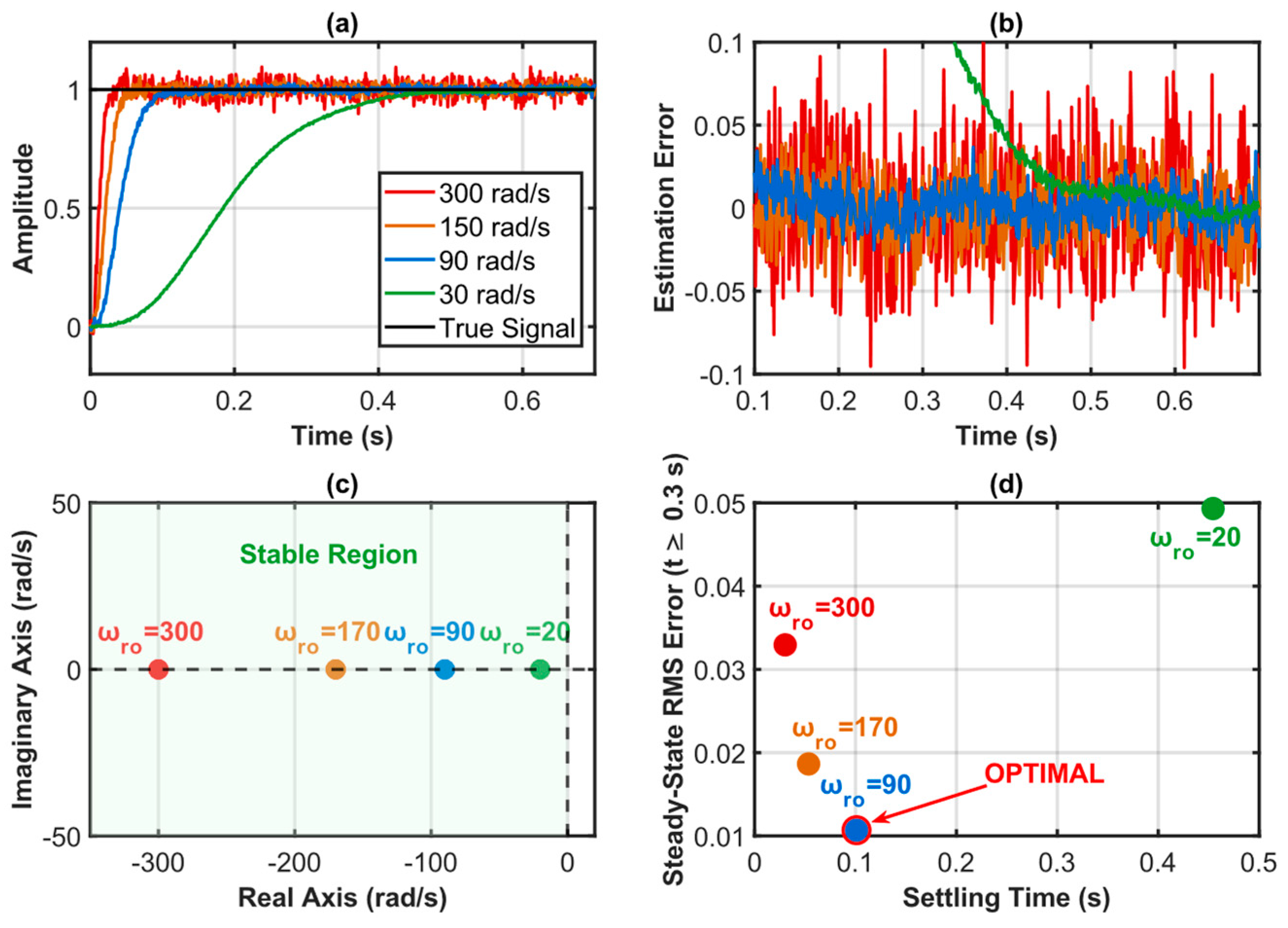
where ξro and ωro are the damping coefficient and bandwidth frequency of the observer, and their value is set to 1 and 90 s−1 arbitrarily after performing several simulation tests, which will be discussed below.

Stability Analysis of the Proposed Observer

The stability of the proposed fourth-order IDO depends on the values of ξro and ωro. All coefficients of Equation (18) are positive for ξro > 0 and ωro > 0, ensuring that the polynomial is a Hurwitz stable polynomial. Therefore, all poles of the observer lie in the open left-half plane, guaranteeing exponential stability. The designed observer is tested for different values of ωro, considering the observer is critically damped (ξro = 1). The observer pole location, robustness to noise, and optimal selection plots are depicted in Figure 6.
From Figure 6, it can be concluded that for all positive ωro at ξro = 1, all poles lie in the left half-plane with repeated roots at negative ωro. As the value of ωro increases, the system appears to settle faster; however, this also amplifies measurement noise. Hence, it is important to find a balance between settling time and noise amplification. Therefore, as indicated in Figure 6d, the optimal value of ωro selected for this paper is 90 s−1.
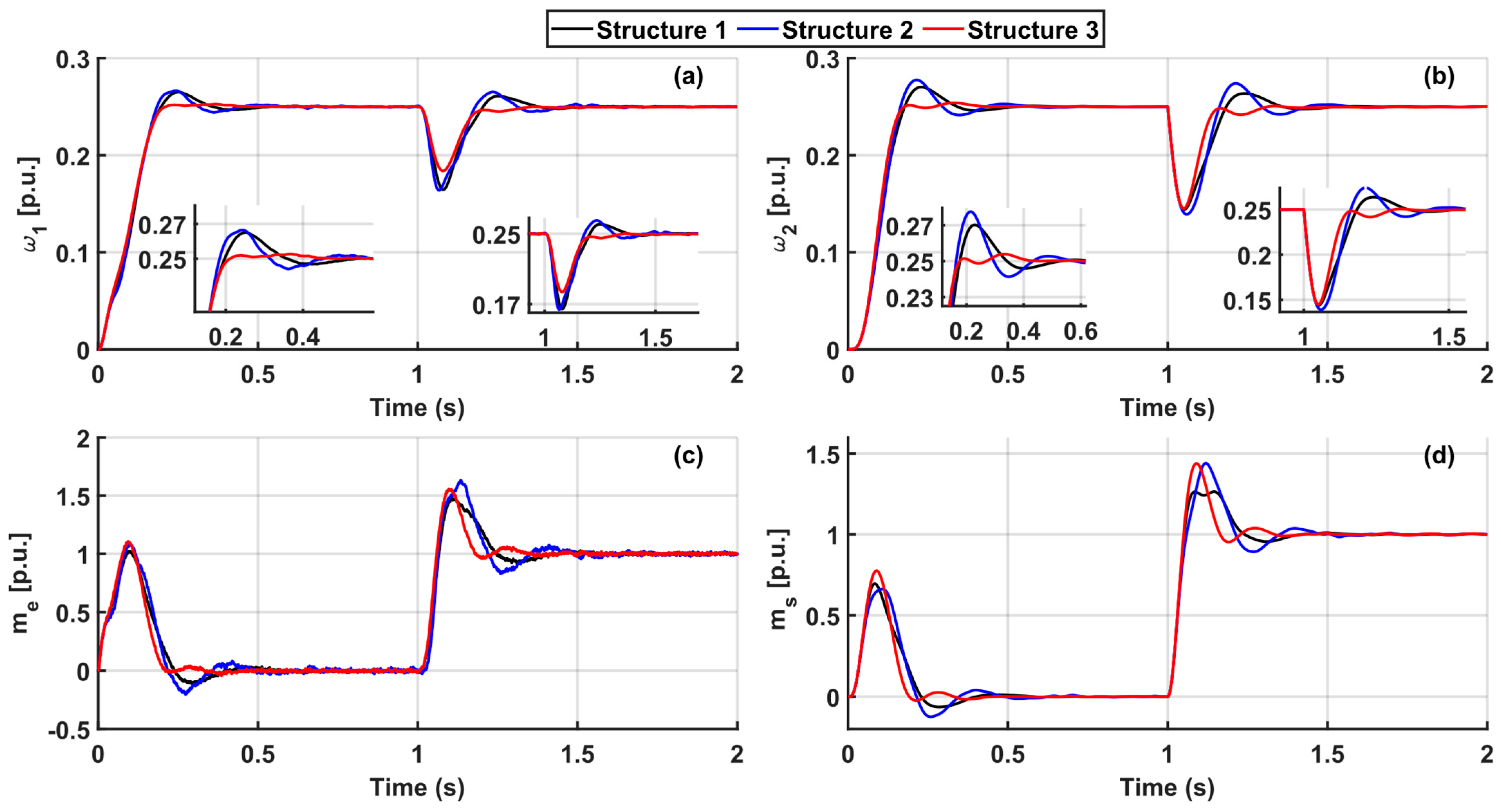
For the proposed control structures, with the proposed observer, the speed and torque waveforms are presented in Figure 7. From Figure 7, the following conclusions can be drawn. The proposed control structures work correctly. As can be shown from Figure 7a,b, structure 3 works better compared to the other proposed control structures. Structure 3 appears to have a fast response with no overshoot, while maintaining good damping. Structures 1 and 2 appear to perform similarly. From this, it can be concluded that the introduction of a time delay to structure 3 improves system performance. Depending on the results obtained, for the rest of this paper, structures 1 and 3 are evaluated.
The results discussed in Figure 7 are based on nominal values, considering a constant model with no load parameter variation. Although the proposed observer is inherently robust to changes in load parameters, the calculation of the gain coefficients depends on the shaft and load time constant parameters. These parameters vary depending on the operation of the working machine or load variations. Therefore, it is important to optimize the gain coefficients to achieve a robust system to load-inertia variation. In this paper, a Birch-inspired Optimization Algorithm (BiOA) is used to optimize the gain coefficients.

3.4. Optimized Control Structure

3.4.1. Birch-Inspired Optimization Algorithm (BiOA)

A BiOA is an optimization algorithm designed by imitating the natural process of seed transportation and growth of a birch tree. The full details of this optimization algorithm, including its working approach and stability analysis, can be found in [34,35]. According to [35], the BiOA shows superiority over Grey Wolf Optimizer (GWO), Flower Pollination Algorithm (FPA), Particle Swarm Optimizer (PSO), Chameleon Swarm Algorithm (CSA), Artificial Bee Colony (ABC), and Jellyfish Search Optimizer (JSO), therefore for this paper, the BiOA is used to optimize the PI and the additional feedback gain coefficients. The pseudocode for the proposed algorithm is given in Algorithm 1 below. Algorithm 1 show Pseudocode for the proposed algorithm BiOA [34]; to fully understand the algorithm, refer to [34].
Algorithm 1: BiOA Pseudocode
  • Initialization
  • Define optimization problem: optimize f(X), X = [x (1), x (2), …, x(D)] ϵ [Lower bound (Lbd), Upper bound (Ubd)]
  • Define the fitness function f,
  • Set Task dimensions D
  • Define search space lower and upper boundaries [Lbd, Ubd]
  • Set maximum number of iteration Imax
  • Set population size P
  • Set seed weight parameter w
  • Draw seed production rate sr
  • Generate an initial random population within the boundaries:
  • Xi,d = rand (0,1) × (Ubd − Lbd) + Lbd, , i = 1, …, P; d = 1, …, D
  • Compute initial fitness values: Fi = f (Xi), i = 1, …, P
  • Identify and store best solution: Fbest = min (F), Xbest = Xibest
  • Main loop (for n = 1 to Imax do:)
  • Seed Propagation (for each specimen Xi in population do:)
  • Apply levy flight for seed propagation
  • Generate new candidate or position (Xi(n+1)) corresponding to new solution:
  • Boundary check: Xi(n+1) = max (min (Xi(n+1), Ubd), Lbd)
  • Compute fitness Fi(n+1) = f (Xi(n+1))
  • if  f (Xi(n+1)) < f (Xi(n)), classify as tree; else classify as bush; end
  • end for
  • Sprouting and growth
  • Compute Euclidean distance between solutions
  • Apply weather adaption P1
  • Update position based on growth factor: Xi(n+1) = Xi(n) + P1·|l·XbestXi(n)|
  • Compute new fitness value and update Xbest
  • if Imax is reached or convergence criteria is met: exit loop
  • end for
  • Return best solution Xbest and its fitness function f(Xbest)
The objective function for the BiOA is based on minimizing the trajectory tracking error and torsional error of the proposed control structures for variations in load-inertia. The proposed objective function is presented in Equation (23), and the selection of the objective function is according to [34].
j = 0.8 × n = 1 N ω r ω 2 u 1 N + n = 1 N ω 1 u 1 ω 2 u 1 N + n = 1 N ω 1 u 1 ω 1 u 3 N + n = 1 N ω 2 u 1 ω 2 u 3 N + 0.2 × n = 1 N m e u 1 m L N + n = 1 N m e u 3 m L N
where N is the number of samples; ωr is the reference speed; ω1(u1) and ω2(u1) are motor and load speeds; me(u1) is the electromagnetic torque; and mL is the load torque. At T2 = u1 = ω1(u3) and ω2(u3) are motor and load speeds, and me(u3) is the electromagnetic torque at T2 = u3 = 3.6 × T2n. T2n is the nominal load time constant, and its value is 0.285 s.
As the BiOA uses random initialization, it is important to perform multiple simulation runs to find the optimal parameters. Therefore, in this paper, 12 repeated simulation runs were made, and the obtained optimized parameters are presented in Table 1.
To select the best simulation run that provides an optimal value of the gain coefficients, a performance evaluation-based Root Mean Square Error (RMSE) and Time Integral Absolute Error (ITAE) for trajectory tracking and torsional error is performed. The performance evaluation was made for different load inertia variations. The RMSE and ITAE are based on the following mathematical Equations (24) and (25).
R M S E T r a c k = n = 1 N ( ω r ω 2 ) 2 N   ,   a n d       R M S E T o r s = n = 1 N ( ω 1 ω 2 ) 2 N
I T A E T r a c k = 0 t t ( ω r ( t ) ω 2 ( t ) )   d t   ,   a n d     I T A E T o r s = 0 t t ( ω 1 ( t ) ω 2 ( t ) )   d t
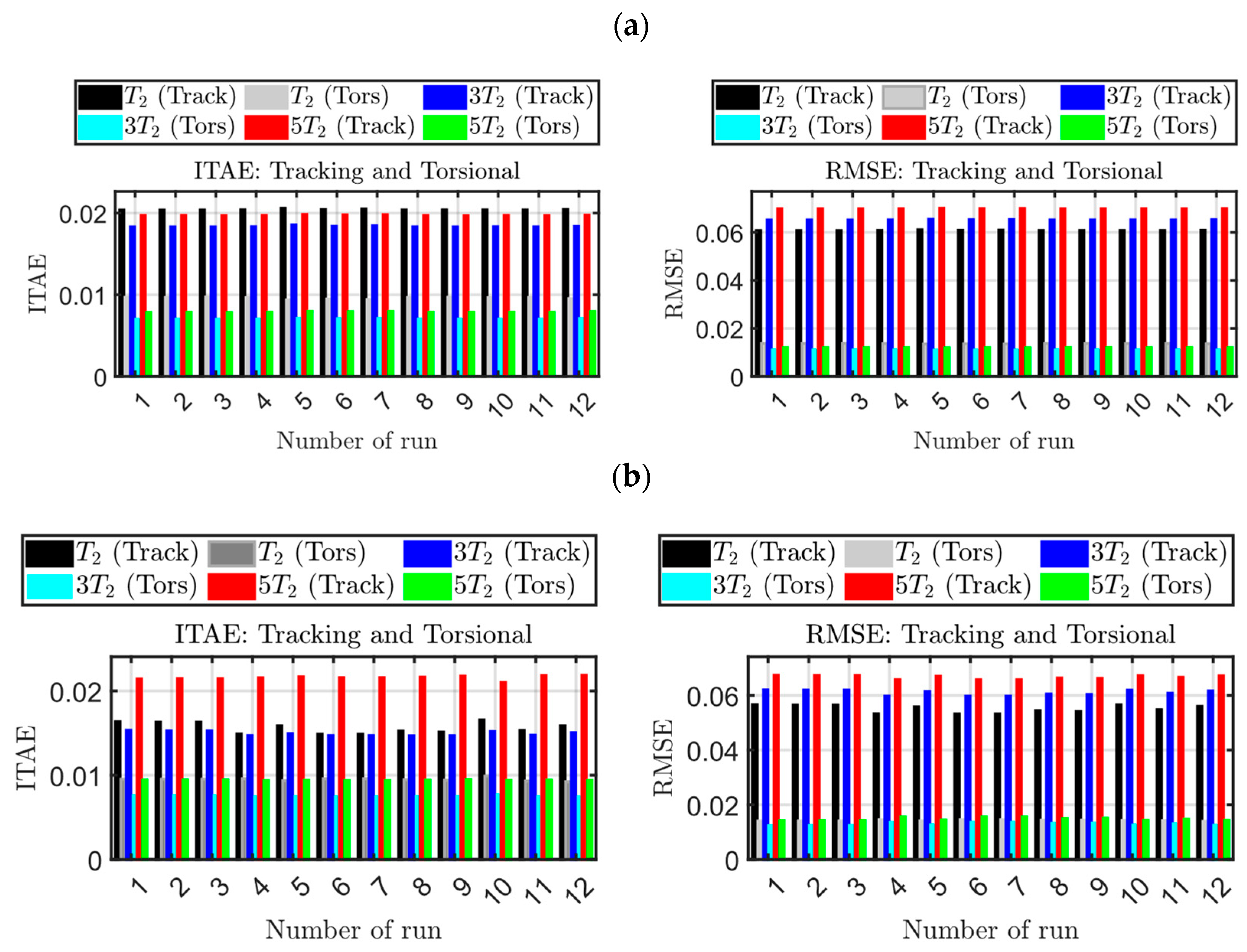
The obtained results are presented in the form of a bar graph in Figure 8.
Where Track is the trajectory tracking error, Tors is the torsional torque error, and the terms T2, 3T2, and 5T2 represent the nominal load time constant, three times the load time constant, and five times the load time constant, respectively.
From Figure 8, the RMSE and ITAE for all simulation runs are small and similar. This confirms the accuracy and stability of the BiOA. Although the errors are similar for all simulation runs, the optimized parameter values for each simulation run are different (see Algorithm 1). These values are very important, especially for the additional feedback gain coefficients (k1, k4, k7). As these gain coefficients are multiplied by the first and second derivatives of the torsional torque, their values can minimize or amplify noise. So, the smallest value of these gain coefficients is a favorable solution.
Given the noise-minimization benefits and the minimal trajectory tracking and torsional errors, simulation run 5 (Algorithm 1) is selected as the preferred solution.

3.4.2. Stability Analysis of the Optimized Control Structure

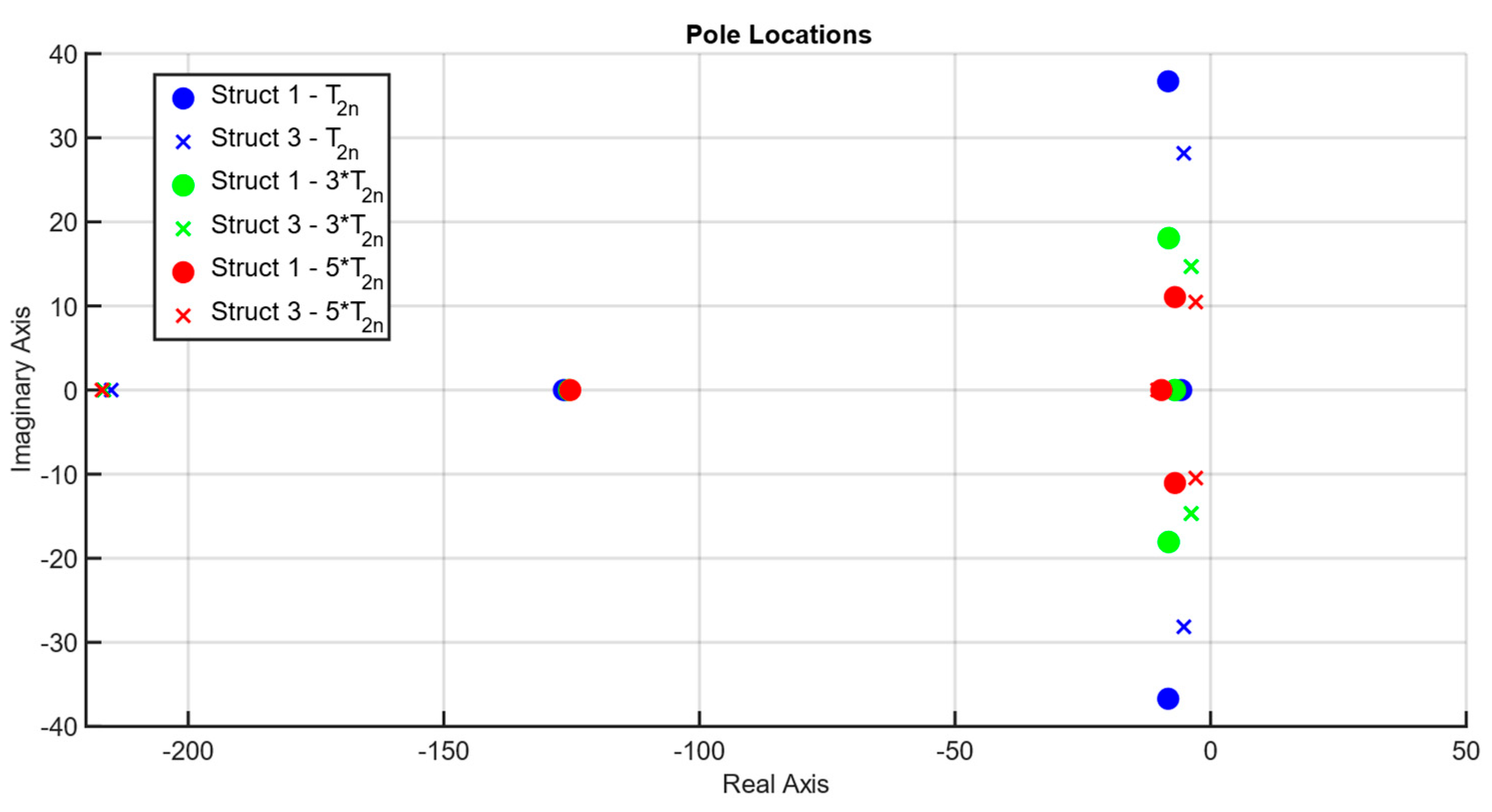
Substituting the optimized gain coefficients into Equations (6) and (7) results in the optimized transfer functions of the proposed control structures, Structure 1 and Structure 3. The pole location plot for the optimized transfer functions is shown in Figure 9. This plot is generated for T2 variations ranging from the nominal value of T2 to five times T2.
From the pole location plot presented in Figure 9, it is shown that the poles of the transfer function for both control structures, under variation in the load time constant, lie in the left half-plane. This indicates that the proposed control structures remain stable under variations in the load time constant. Furthermore, the poles of Structure 1 are positioned relatively farther to the left, indicating a slightly faster response. Structure 3 exhibits poles that are closer to the imaginary axis, suggesting a slightly slower but more stable behavior. Under T2, the pole locations of both structures shift moderately without crossing into instability, demonstrating the robustness of the proposed methods under parameter uncertainty. With the addition of a time delay, Structure 3 can be further improved as discussed earlier in this paper.

4. Results

4.1. Simulation Results

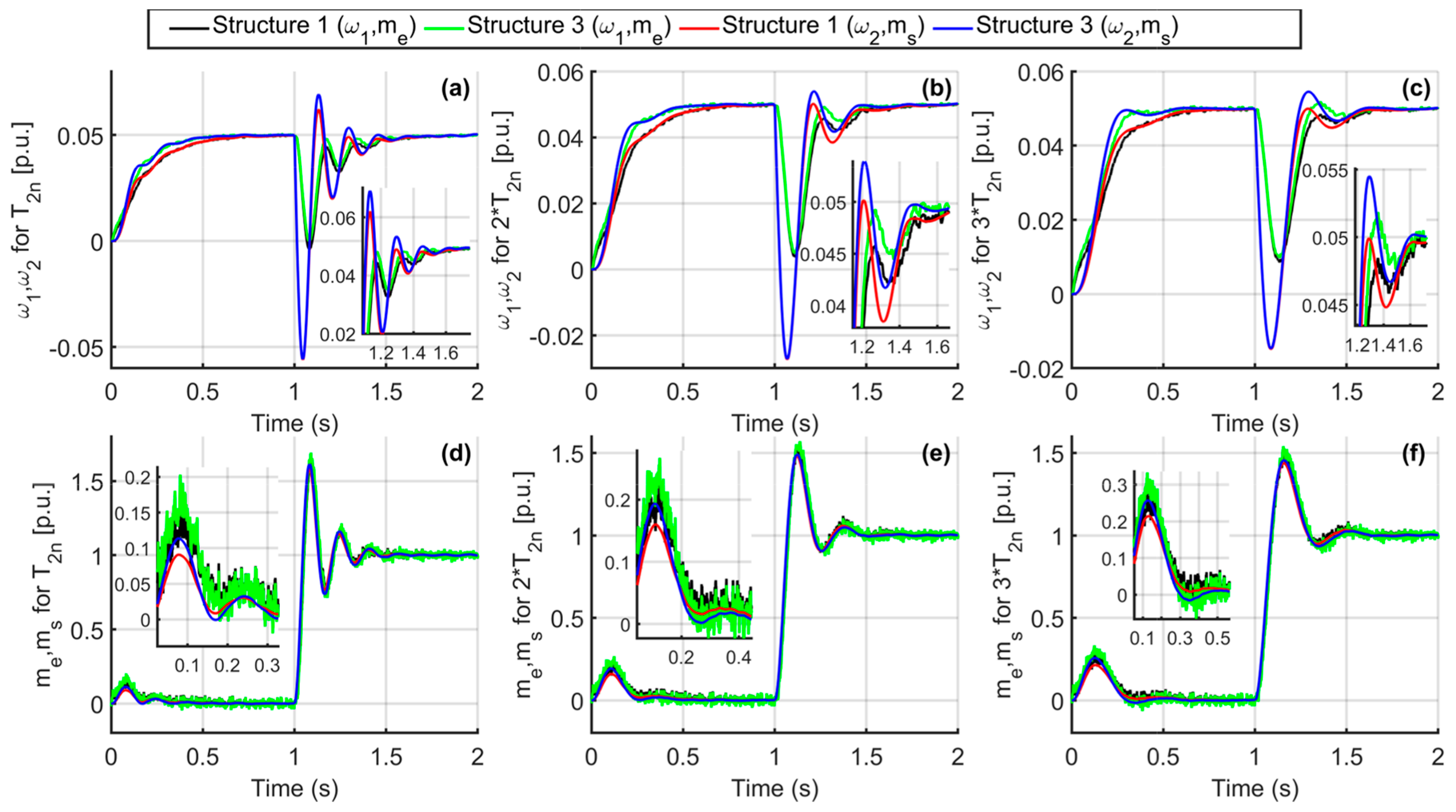
In this study, simulation results for a two-mass drive system with an elastic joint and the proposed control structures are analyzed and compared. The performance of the proposed robust controllers, which include additional feedback from the first and second torsional torque derivatives, is evaluated for tracking trajectory, robustness against changes in T2, and vibration damping capability. The robustness assessment is performed under T2 variation: the nominal value (T2n), two times the nominal value (2 × T2n), and three times the nominal value (3 × T2n). The nominal value is set to 0.285 s. For the mentioned load time constant variation, simulation tests were performed for 5%, 25%, 50%, and 100% of the rated speed. The simulations are executed in the MATLAB 2024a/Simulink environment. The first test was conducted for a very low speed value (5% of the rated speed or 0.05 p.u.); the obtained speed and torque transients are presented in Figure 10. The simulation was carried out with no load for t < 1 s and with load for t > 1 s. To represent the measurement noises, Gaussian noise was added during the simulation. From the presented speed waveforms (Figure 10a–c), it can be shown that structure 3 shows a faster damping of overshoot and faster response, while structure 1 exhibits slightly higher overshoot. As the load inertia increases, the torque spike also increases (Figure 10e,f); this is even higher for structure 3 compared to structure 1.
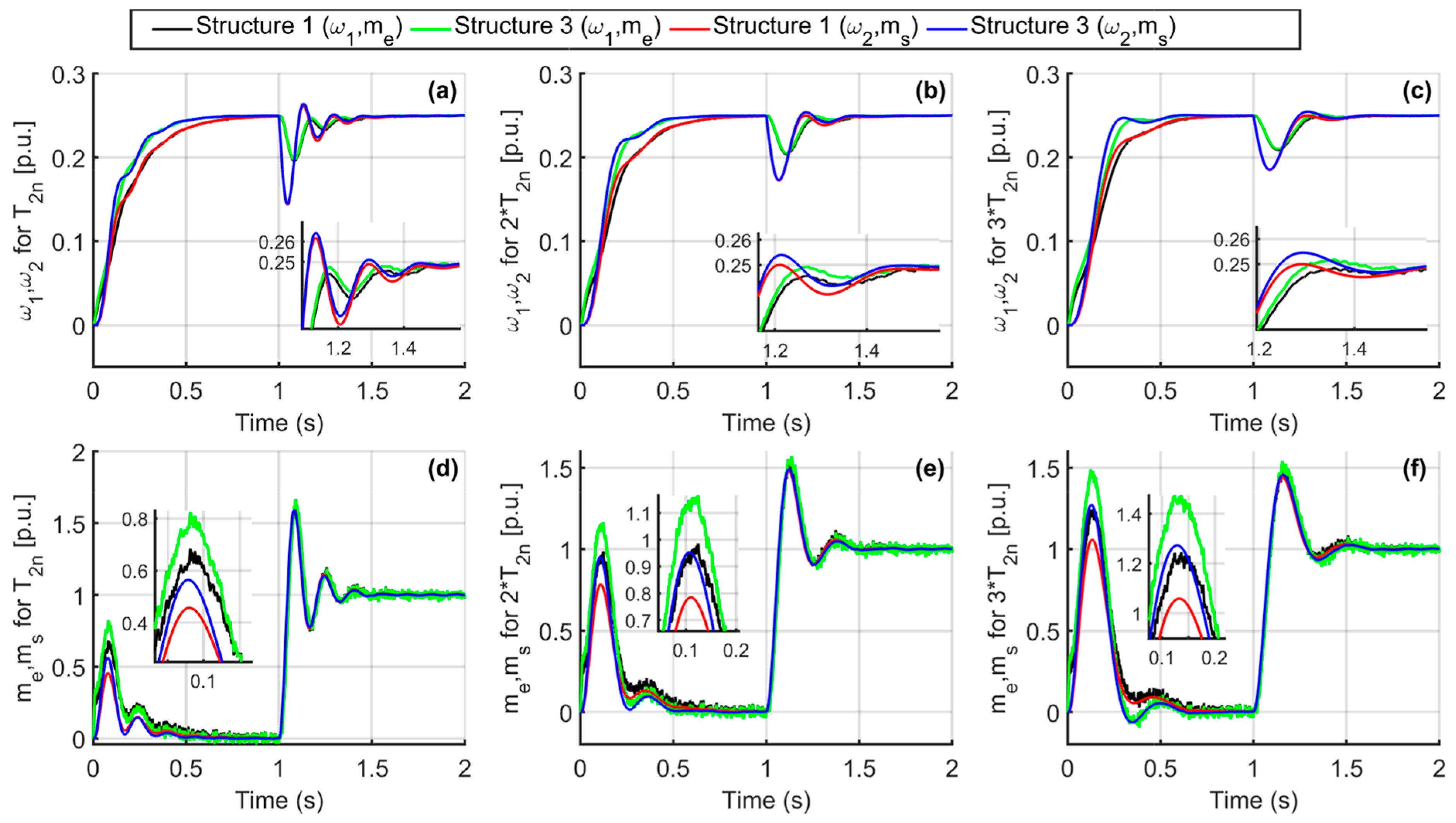
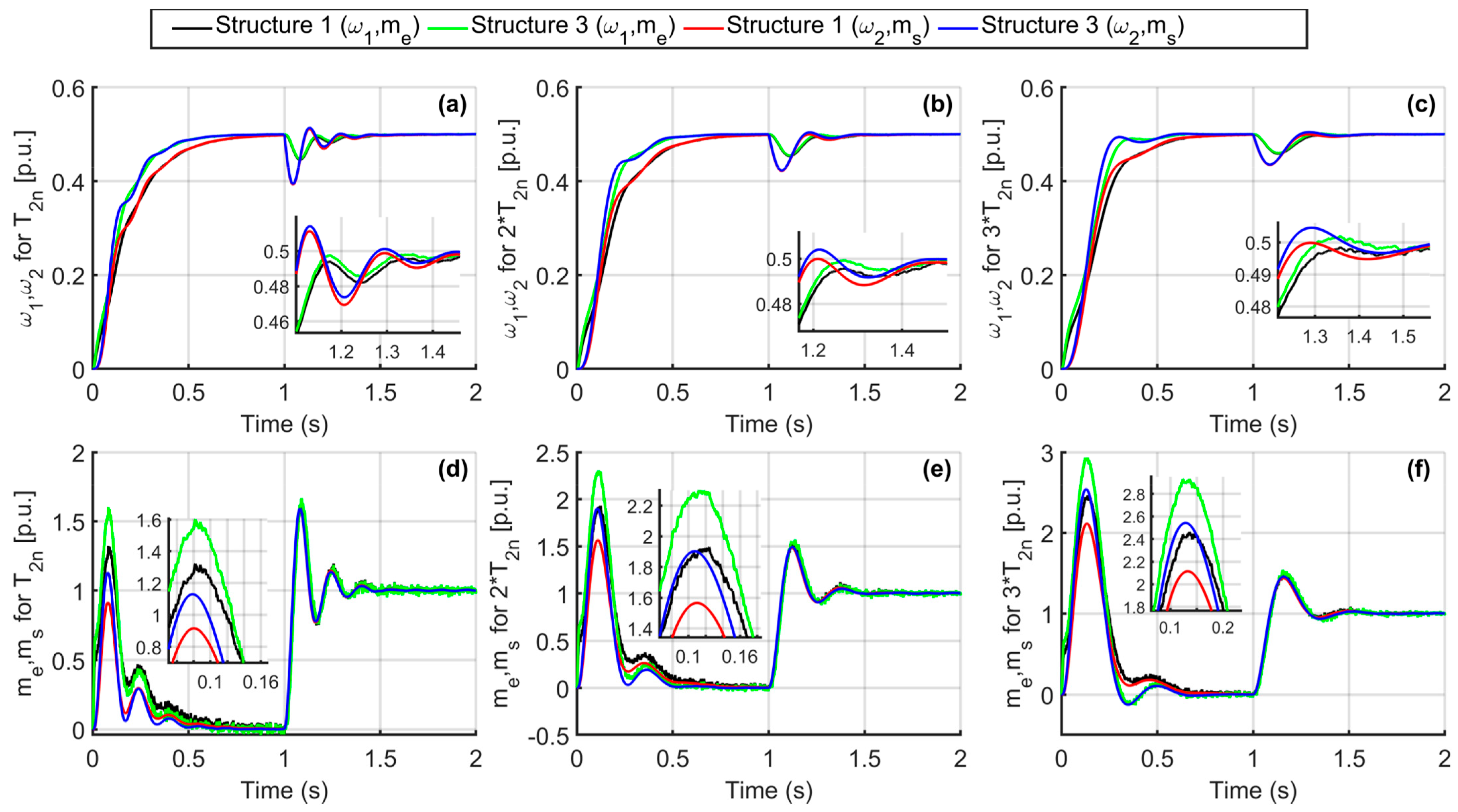
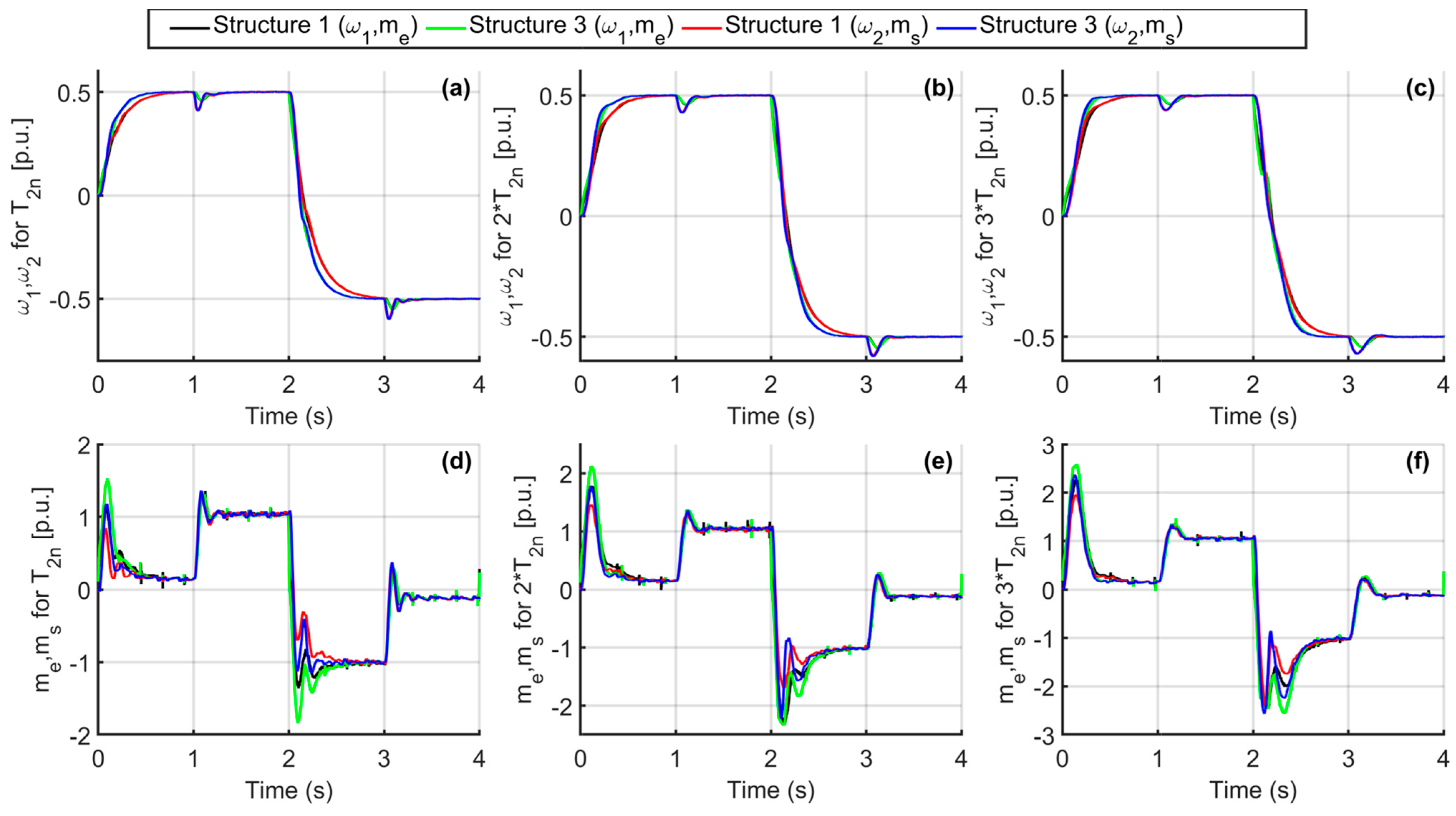
The second and the third tests were performed for low (25% of rated speed or 0.25 p.u.) and moderate (50% of rated speed or 0.5 p.u.) speeds. The test was carried out for the same parameters as test 1. The obtained waveforms are shown in Figure 11 and Figure 12.
For the speed transients, a similar trend to test 1 can be observed from Figure 11a–c and Figure 12a–c; structure 3 provides faster response and fast oscillation damping compared to structure 1. As indicated in Figure 11d–f and Figure 12d–f during the motor start and after the load was applied, the torque spikes are higher for structure 3 compared to structure 1.
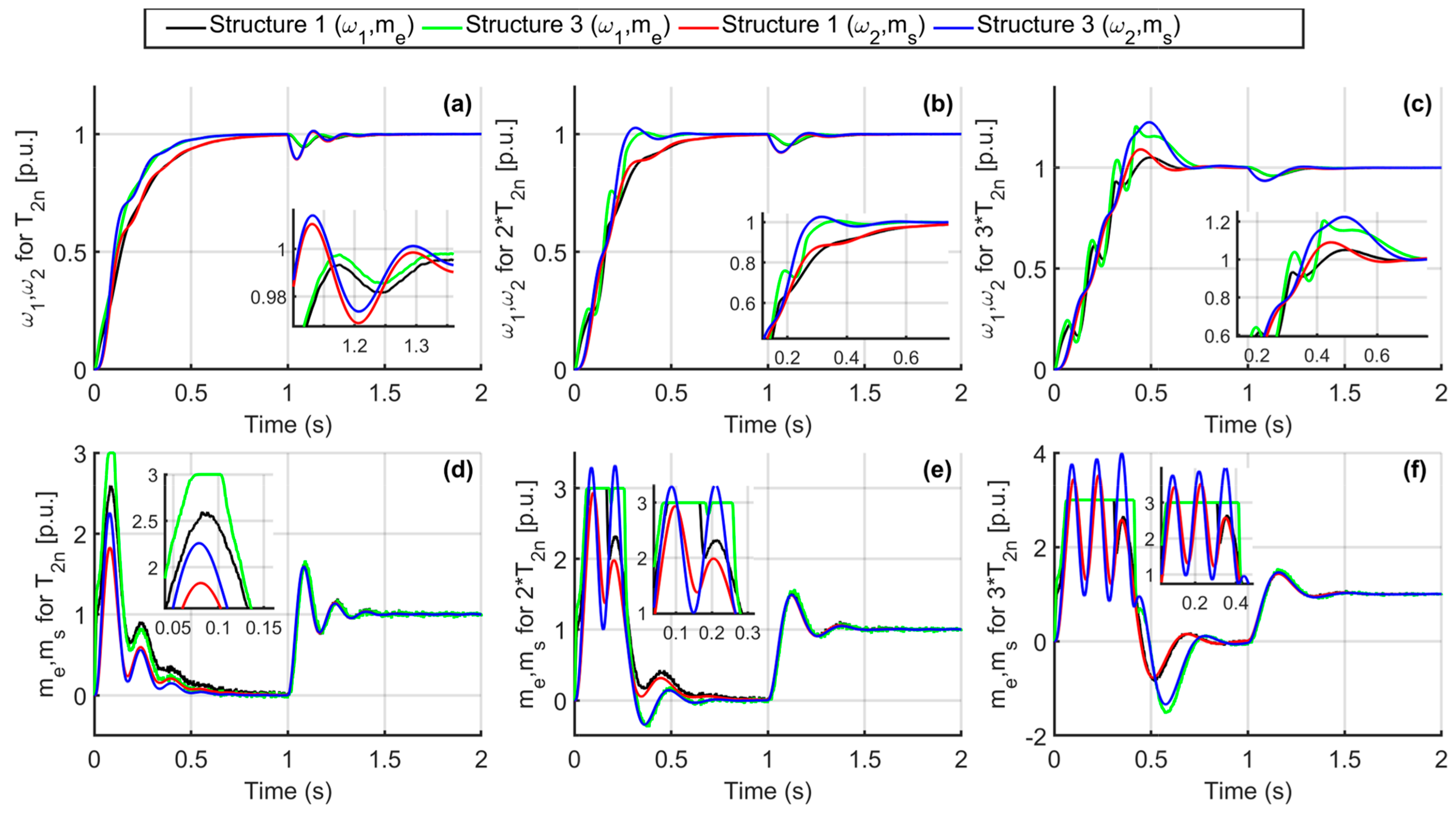
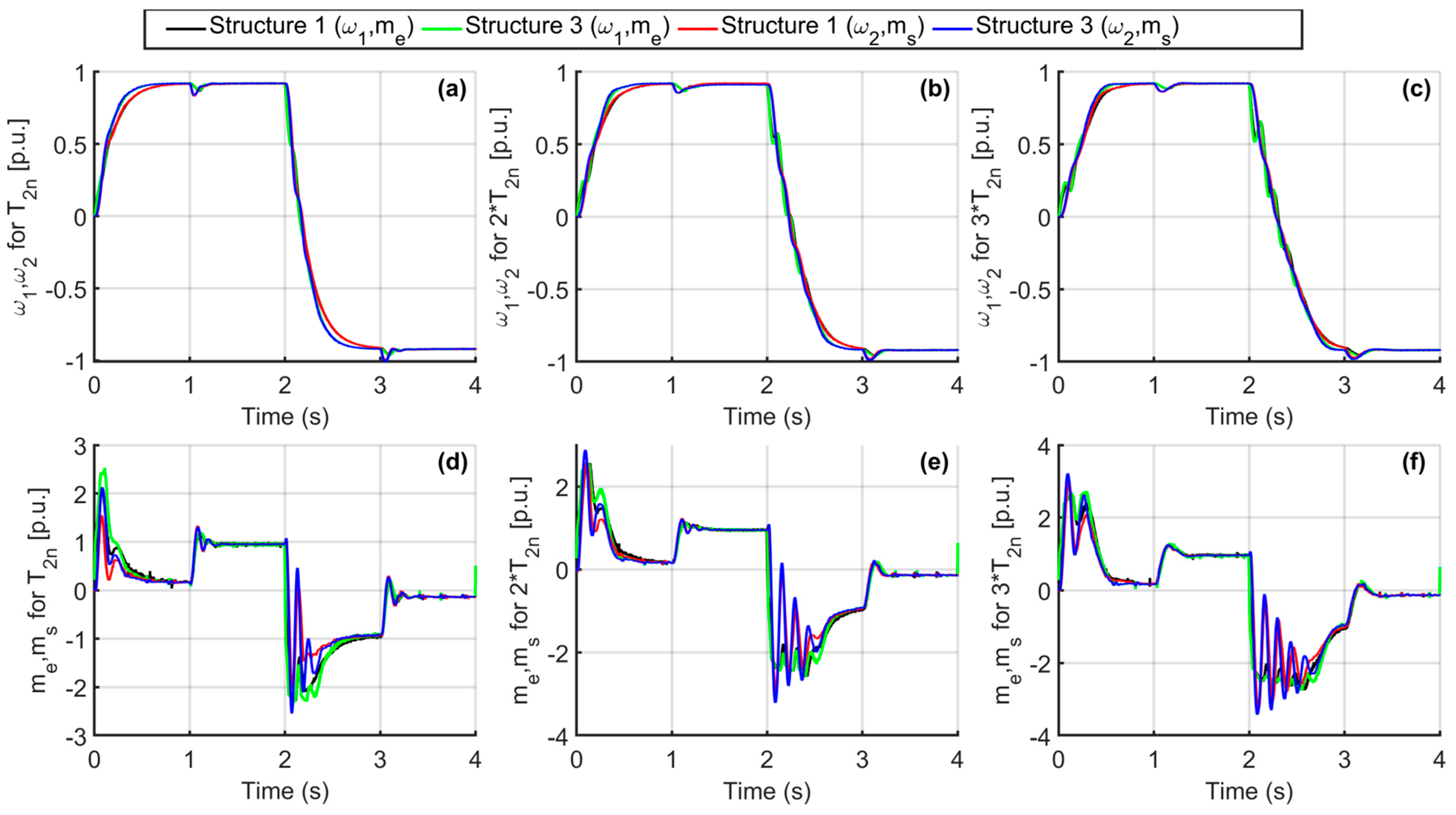
In Figure 13a, waveforms for test 4 are presented. In this test, the simulation was performed for 100% of the rated speed. For the nominal load time constant, structure 3 shows faster response and faster oscillation damping compared to structure 1. However, from the torque transients (Figure 13d–f), it is indicated that for structure 3, the torque peak reaches the saturation limit (3 p.u) while the structure one is about 2.5 p.u (Figure 13d). This shows that structure 1 has better torque control. When the load time constant varies to two and three times the load time constant, the peak torque for both structures reaches the saturation limit (Figure 13e,f). Furthermore, it is shown that structure 3 introduces larger speed overshoot for three times the load time constant and 100% of the rated speed (Figure 13c), while structure 1 introduces minimal overshoot.
From the above tests, it can be concluded that both control schemes operate correctly and maintain effectiveness despite variations in load parameters, thereby highlighting their robustness. As illustrated in Figure 10a, Figure 11a, Figure 12a and Figure 13a, the speed response indicates that structure 3 exhibits a faster dynamic response and improved vibration damping compared to structure 1 at the nominal load time constant. To further assess their performance, the load time constant was increased to two times its nominal value, with results shown in Figure 10b, Figure 11b, Figure 12b and Figure 13b. Under this condition, Structure 3 again demonstrates superior dynamic behavior. When the load time constant is extended to three times the nominal value (Figure 10c, Figure 11c, Figure 12c and Figure 13c), structure 3 again shows dominance over structure 1. However, for the full rated speed, structure 3 introduces a large overshoot, whereas structure 1 exhibited a smaller overshoot. Overall, these results indicate that structure 3 provides improved speed response and damping for low (25% of the rated speed) to moderate (50% of the rated speed) speed ranges, and moderate load inertia variations, while structure 1 exhibits superior robustness and reduced overshoot for high speed ranges (near 100% of the rated speed), and higher inertia variations.
In Figure 10, Figure 11, Figure 12 and Figure 13, the torque responses of the two control structures under varying load time constants are depicted. Both approaches achieve the same steady-state torque of 1 p.u.; however, their transient characteristics differ significantly. Structure 3 exhibits a faster, more aggressive response, whereas Structure 1 produces smoother, more heavily damped dynamics. At the nominal load time constant (Figure 10d and Figure 11d), both controllers deliver comparable results, although Structure 3 presents slightly larger transient peaks. When the reference speed increases, structure 3 exhibits more torque spikes compared to structure 1 (Figure 12d and Figure 13d). As the load time constant increases to two times and three times the nominal value (Figure 10e,f, Figure 11e,f, Figure 12e,f and Figure 13e,f), the distinctions between the two structures become more evident. Specifically, structure 3 generates larger electromagnetic and torsional torque peaks, including deeper negative excursions at 3 × T2n, while Structure 1 maintains lower peak amplitudes and superior damping. In summary, Structure 3 provides faster responses with higher transient magnitudes, making it advantageous when rapid torque dynamics are acceptable; however, this comes at the cost of overshoot and reduced damping for higher inertia and speeds dynamics. Conversely, Structure 1 demonstrates greater robustness under increased load inertia and higher speed dynamics, delivering steadier, oscillation-free performance. Furthermore, application-wise, structure 3 is simpler, as it only incorporates the first derivative of torsional torque, while structure 1 includes the second derivative of torsional torque.

4.2. Experimental Results

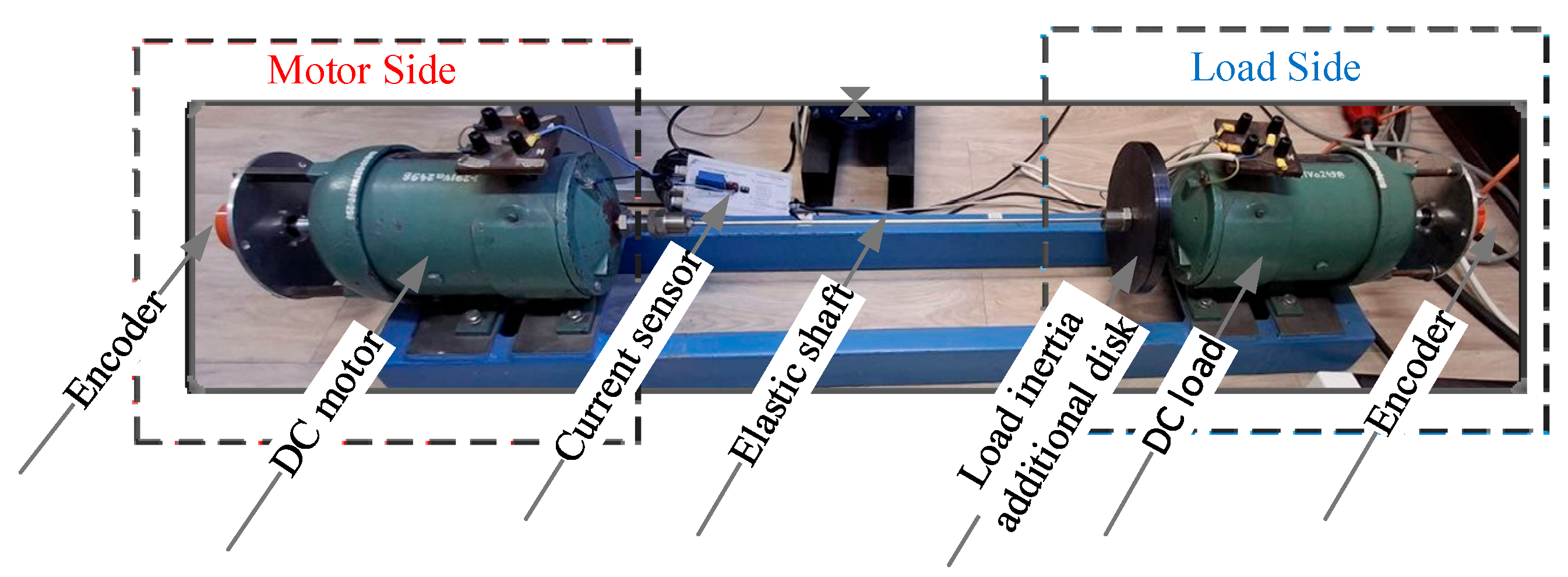
The simulation results were validated through laboratory experiments conducted on a testbench comprising two DC machines coupled via an elastic shaft. In this setup, the first DC machine operates as the driving motor, while the second functions as a DC generator, dissipating its generated power through a braking resistor, thereby serving as the mechanical load. The driving motor is supplied by an H-bridge power converter, while excitation for both machines is provided through a diode rectifier. Each machine is equipped with an incremental encoder that generates 36,000 pulses per revolution. The encoder attached to the driving motor is integrated into the control system, whereas the encoder on the load machine is used exclusively for data acquisition to evaluate system estimation performance. Current measurements are obtained using a LEM transducer, and hardware-in-the-loop testing is carried out via the dSPACE 1103 platform.
The experimental setup and corresponding parameters are summarized in Figure 14 and Table 2. Changing the load inertia is achieved by adding disks to the load side.
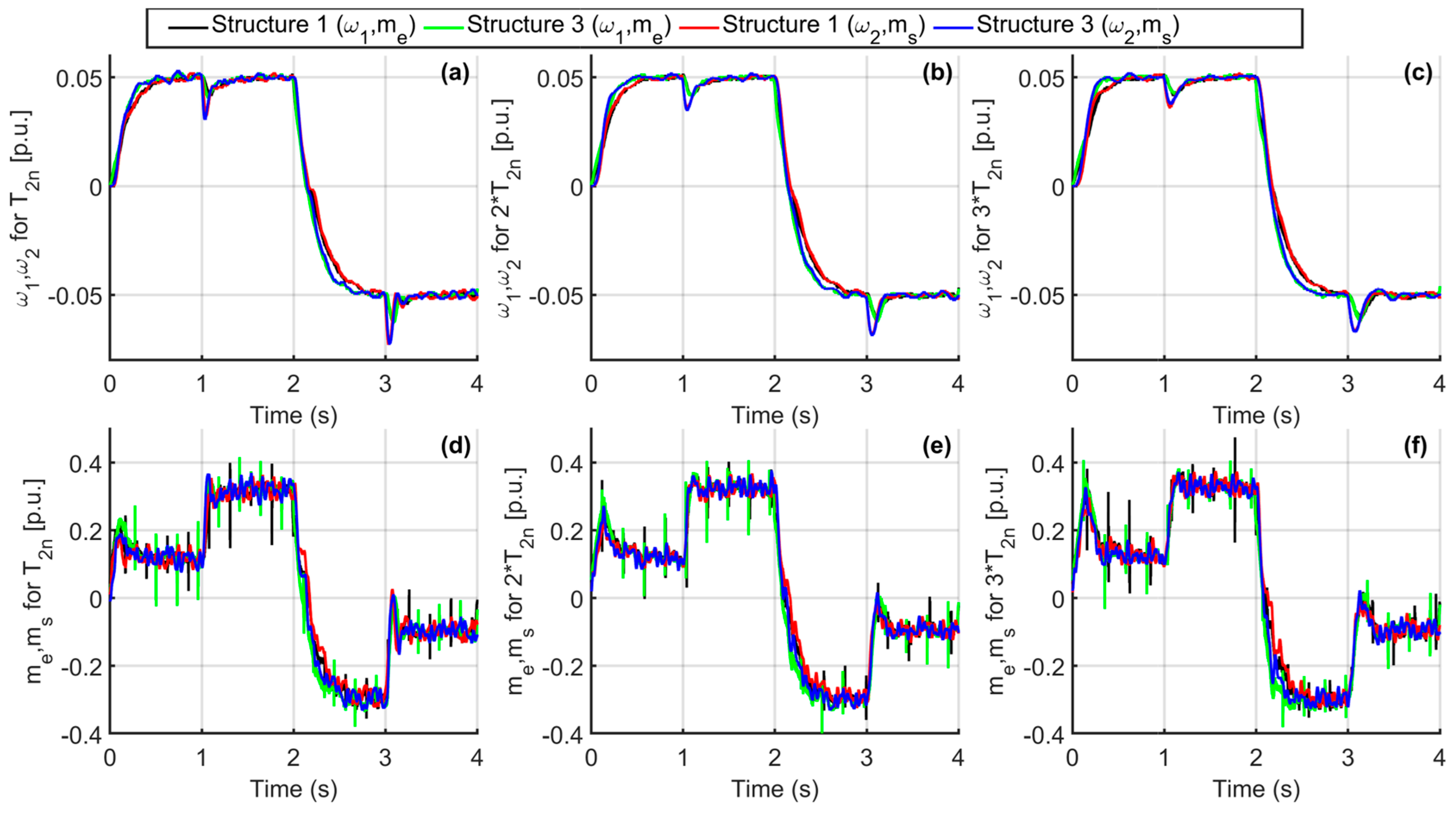
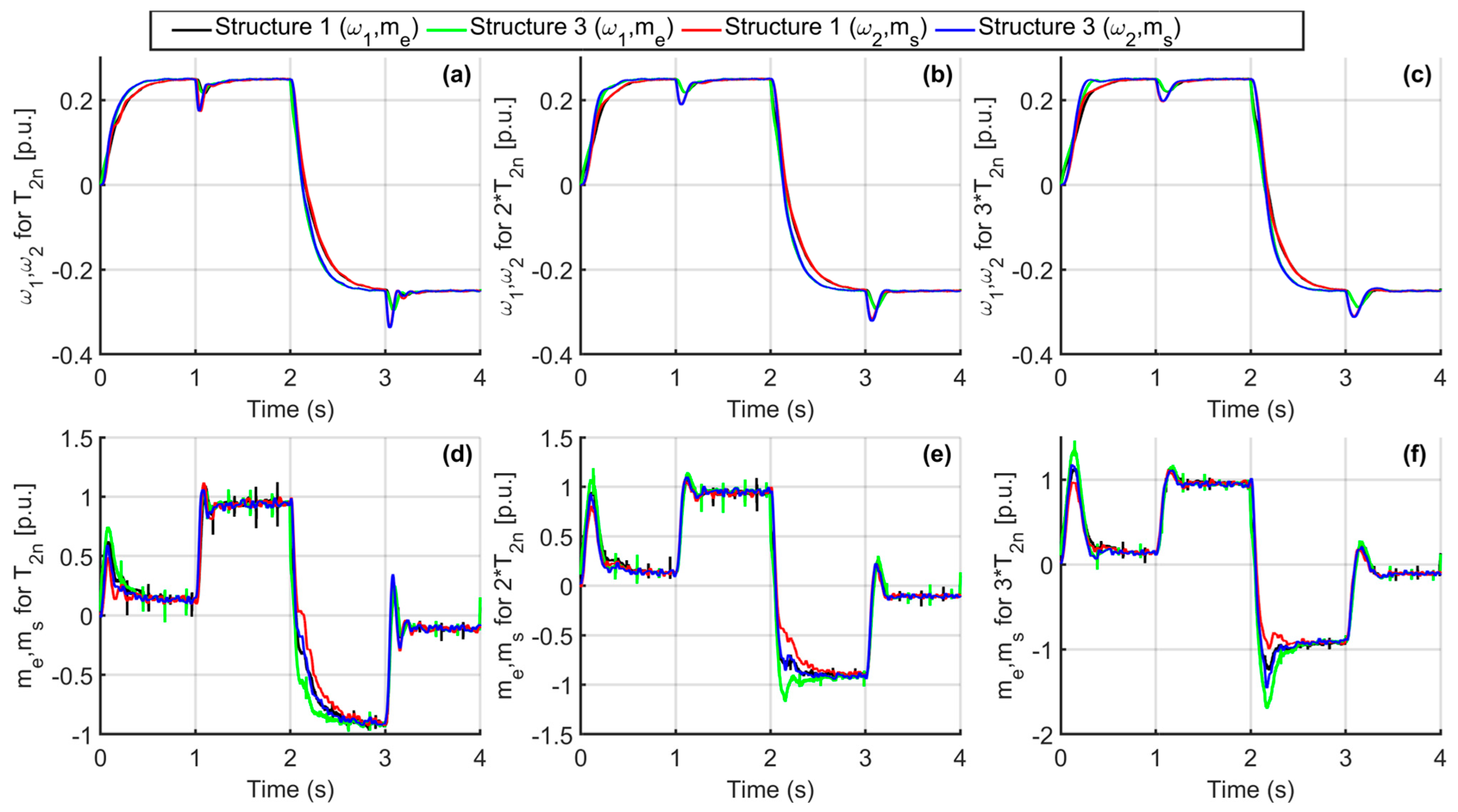
The experimental waveforms obtained on the two–mass testbench (Figure 15, Figure 16, Figure 17 and Figure 18) corroborate the principal behaviors observed in the simulation: both control structures converge to the same steady-state operating point, Structure 3 exhibits a faster transient response, and Structure 1 displays smoother, more heavily damped dynamics. Under nominal load inertia, Structure 3 achieves marginally faster settling and slightly higher transient peaks in both speed and torque (Figure 15a,d, Figure 16a,d, Figure 17a,d and Figure 18a,d); structure 1 attenuates oscillatory content more effectively. As the load time constant is increased to 2 × T2n and 3 × T2n, the same qualitative trends seen in the simulation persist; Structure 3 produces larger torque excursions and more pronounced oscillations (including negative excursions at high inertia and high speed dynamics), while Structure 1 maintains reduced peak amplitudes and improved damping.
Furthermore, for the full rated speed (1 p.u), structure 3 shows degradation in control quality across all load time constants, and this shows that the practical application of this controller is limited to low to moderate speed ranges. In conclusion, the control speed range of the proposed control structures is identified as follows.
  • Structure 3 is effective for 25% to 50% of the rated speed.
  • Structure 1 is effective for 25% to near-full-rated (100%) of the rated speed.
Quantitatively, the experimental response differs from the MATLAB/Simulink results in two predictable ways. First, the hardware traces contain greater measurement noise and higher-frequency ripple (visible on the torque traces), due to current sensing, encoder quantization, and power-electronics switching; this produces small, high-frequency fluctuations that are absent in the idealized simulation. Second, the experimental transients are slightly slower and exhibit modest amplitude attenuation relative to simulation for some cases, reflecting unmodelled losses and dynamics (electrical and mechanical time delays, viscous and Coulomb friction, converter dead-time, non-ideal rectifier/excitation behavior, and parameter uncertainty in shaft stiffness and damping). Despite these differences, the relative performance ordering of the controllers is preserved across all tested inertias, which confirms the controllers’ robustness and validates the primary simulation conclusions.

5. Conclusions

This work presented the design, simulation, and experimental validation of three robust control structures for a two-mass drive system operating under varying load inertias. The proposed controllers demonstrated stable operation and accurate torque regulation, confirming their robustness against parameter variations. Comparative analysis highlights a clear trade-off between two specific approaches: Structure 3 consistently provides faster dynamic response and improved vibration damping, particularly under nominal and moderately increased load time constants and dynamics, while Structure 1 offers superior robustness at higher inertias by producing smoother responses with reduced overshoot and oscillations.
The results indicate that the selection of the control strategy should be guided by application requirements. For systems prioritizing agility and rapid torque response, and low to moderate speed dynamics (25% to 50% of rated speed), Structure 3 is advantageous. Conversely, in applications where overshoot suppression, stability, robustness under significant load inertia variations, and higher speed dynamics (near 100% of rated speed) are critical, Structure 1 is the preferred choice. Overall, we provide a simple, effective solution to a classic industrial problem. Structure 3 with delayed feedback is optimal for applications prioritizing speed and precision for low to moderate speed dynamics, while Structure 1 guarantees safety for fragile mechanics and can operate safely near full rated speed.

Author Contributions

Conceptualization, A.H.K., P.D., K.S. (Kosuke Shikata), S.K. and K.S. (Krzysztof Szabat); methodology, A.H.K., P.D., K.S. (Kosuke Shikata), S.K. and K.S. (Krzysztof Szabat); software, A.H.K. and P.D.; validation, A.H.K. and P.D.; formal analysis, A.H.K., P.D., K.S. (Kosuke Shikata), S.K. and K.S. (Krzysztof Szabat); investigation, A.H.K. and P.D.; resources, A.H.K., P.D. and K.S. (Krzysztof Szabat); data curation, A.H.K. and P.D.; writing—original draft preparation, A.H.K. and P.D., writing—review and editing, A.H.K., P.D., K.S. (Kosuke Shikata), S.K. and K.S. (Krzysztof Szabat); visualization, A.H.K. and P.D.; supervision, S.K. and K.S. (Krzysztof Szabat); project administration, S.K. and K.S. (Krzysztof Szabat); funding acquisition, K.S. (Krzysztof Szabat). All authors have read and agreed to the published version of the manuscript.

Funding

This research received no external funding.

Data Availability Statement

The original contributions presented in the study are included in the article, further inquiries can be directed to the corresponding author.

Acknowledgments

During the preparation of this manuscript, the authors used Grammarly v.1.2.155.1657 for language check. The authors have reviewed and edited the output and take full responsibility for the content of this publication.

Conflicts of Interest

The authors declare no conflicts of interest.

Abbreviations and Symbols Used in the Paper

BiOABritch-inspired Optimization Algorithm
DOBDisturbance OBserver
IDOIntegral Disturbance Observer
ITAETime Integral Absolute Error
RMSERoot Mean Square Error
memotor torque
msshaft torque
mLload torque
T1mechanical time constant of the motor
T2mechanical time constant of the load
Tcmechanical time constants of the shaft
ωrreference speed
ω1reference speed
ω2reference speed

References

  1. Szabat, K.; Orlowska-Kowalska, T. Vibration suppression in a two-mass drive system using PI speed controller and additional feedbacks—Comparative study. IEEE Trans. Ind. Electron. 2007, 54, 1193–1206. [Google Scholar] [CrossRef]
  2. Brock, S.; Łuczak, D.; Nowopolski, K.; Pajchrowski, T.; Zawirski, K. Two Approaches to Speed Control for Multi-Mass System with Variable Mechanical Parameters. IEEE Trans. Ind. Electron. 2017, 64, 3338–3347. [Google Scholar] [CrossRef]
  3. Kabziński, J.; Mosiołek, P. Integrated, Multi-Approach, Adaptive Control of Two-Mass Drive with Nonlinear Damping and Stiffness. Energies 2021, 14, 5475. [Google Scholar] [CrossRef]
  4. Ke, C.; Wu, A.; Bing, C. Mechanical parameter identification of two-mass drive system based on variable forgetting factor recursive least squares method. Trans. Inst. Meas. Control 2019, 41, 494–503. [Google Scholar] [CrossRef]
  5. Chen, Y.; Yang, M.; Long, J.; Hu, K.; Xu, D.; Blaabjerg, F. Analysis of oscillation frequency deviation in elastic coupling digital drive system and robust notch filter strategy. IEEE Trans. Ind. Electron. 2018, 66, 90–101. [Google Scholar] [CrossRef]
  6. Wang, C.; Liu, F.; Xu, J.; Pan, J. An SMC-based accurate and robust load speed control method for elastic servo system. IEEE Trans. Ind. Electron. 2023, 71, 2300–2308. [Google Scholar] [CrossRef]
  7. Shang, D.; Li, X.; Yin, M.; Li, F. Vibration suppression method based on PI fuzzy controller containing disturbance observe for dual-flexible manipulator with an axially translating arm. Int. J. Control. Autom. Syst. 2022, 20, 1682–1694. [Google Scholar] [CrossRef]
  8. Derugo, P.; Kahsay, A.H.; Szabat, K.; Shikata, K.; Katsura, S. A Novel PI-Based Control Structure with Additional Feedback from Torsional Torque and Its Derivative for Damping Torsional Vibrations. Energies 2024, 17, 4786. [Google Scholar] [CrossRef]
  9. Wang, Y.; Qin, X.; Huang, S.; Deng, S. Design and analysis of a multi-stage torsional stiffness dual mass flywheel based on vibration control. Appl. Acoust. 2016, 104, 172–181. [Google Scholar] [CrossRef]
  10. Yang, H.; Wang, Z.; Zhang, T.; Du, F. A review on vibration analysis and control of machine tool feed drive systems. Int. J. Adv. Manuf. Technol. 2020, 107, 503–525. [Google Scholar] [CrossRef]
  11. Chantal, U.M.; Lu, H.; Liu, Q.; Jiang, T.; Hu, M.; Gaspard, G. Analysis of dual-driven feed system vibration characteristics based on CNC machine tools: A systematic review. Symmetry 2023, 15, 2012. [Google Scholar] [CrossRef]
  12. Liu, X.; Qi, Y.; Tang, Y.; Guan, Y.; Wang, P.; Blaabjerg, F. Unified active damping control algorithm of inverter for LCL resonance and mechanical torsional vibration suppression. IEEE Trans. Ind. Electron. 2021, 69, 6611–6623. [Google Scholar] [CrossRef]
  13. Kaminski, M.; Malarczyk, M. Hardware implementation of neural shaft torque estimator using low-cost microcontroller board. In Proceedings of the 2021 25th International Conference on Methods and Models in Automation and Robotics (MMAR), Międzyzdroje, Poland, 23–26 August 2021; pp. 372–377. [Google Scholar]
  14. Saarakkala, S.E.; Hinkkanen, M. State-space speed control of two-mass mechanical systems: Analytical tuning and experimental evaluation. IEEE Trans. Ind. Appl. 2014, 50, 3428–3437. [Google Scholar] [CrossRef]
  15. Li, W.; Hori, Y. Vibration suppression using single neuron-based PI fuzzy controller and fractional-order disturbance observer. IEEE Trans. Ind. Electron. 2007, 54, 117–126. [Google Scholar] [CrossRef]
  16. Chang, H.; Lu, S.; Huang, G.; Zheng, S.; Song, B. An extended active resonance suppression scheme based on a dual-layer network for high-performance double-inertia drive system. IEEE Trans. Power Electron. 2023, 38, 13717–13729. [Google Scholar] [CrossRef]
  17. Bang, J.S.; Shim, H.; Park, S.K.; Seo, J.H. Robust tracking and vibration suppression for a two-inertia system by combining backstepping approach with disturbance observer. IEEE Trans. Ind. Electron. 2009, 57, 3197–3206. [Google Scholar] [CrossRef]
  18. Padron, J.; Kawai, Y.; Yokokura, Y.; Ohishi, K.; Miyazaki, T. A Method for Gear Impact Suppression in Torsion Torque Control of Two-Inertia Systems with Backlash. In Proceedings of the 2021 IEEE 30th International Symposium on Industrial Electronics (ISIE), Kyoto, Japan, 20–23 June 2021; pp. 1–6. [Google Scholar]
  19. Niu, Z.; Huang, W.; Zhu, S.; Jia, B.; Zhu, Q.; Lu, X. Controller design and shaft torque vibration suppression for servomechanism with elasticity. IEEE Trans. Ind. Appl. 2024, 60, 8833–8844. [Google Scholar] [CrossRef]
  20. Yang, M.; Zheng, W.; Yang, K.; Xu, D. Suppression of mechanical resonance using torque disturbance observer for two-inertia system with backlash. In Proceedings of the 2015 9th International Conference on Power Electronics and ECCE Asia (ICPE-ECCE Asia), Seoul, Republic of Korea, 1–5 June 2015; pp. 1860–1866. [Google Scholar]
  21. Sugiura, K.; Hori, Y. Vibration suppression in 2-and 3-mass system based on the feedback of imperfect derivative of the estimated torsional torque. IEEE Trans. Ind. Electron. 2002, 43, 56–64. [Google Scholar] [CrossRef]
  22. Li, S.; Liu, Z. Adaptive speed control for permanent-magnet synchronous motor system with variations of load inertia. IEEE Trans. Ind. Electron. 2009, 56, 3050–3059. [Google Scholar] [CrossRef]
  23. Wang, C.; Liu, J.; Xin, L.; Li, G.; Pan, J. Design of full-order state observer for two-mass joint servo system based on the fixed gain filter. IEEE Trans. Power Electron. 2022, 37, 10466–10475. [Google Scholar] [CrossRef]
  24. Wang, C.; Yang, M.; Zheng, W.; Long, J.; Xu, D. Vibration suppression with shaft torque limitation using explicit MPC-PI switching control in elastic drive systems. IEEE Trans. Ind. Electron. 2015, 62, 6855–6867. [Google Scholar] [CrossRef]
  25. Zhang, Z.; Wollherr, D. Disturbance Estimation for High-Degree-of-Freedom Systems Using Sliding Mode Observer. arXiv 2023, arXiv:2303.04008. [Google Scholar]
  26. Huang, H.; Yu, C.; Sun, Z.; Zhang, Y.; Zhao, Z. Sliding mode control strategy based on disturbance observer for permanent magnet in-wheel motor. Sci. Rep. 2024, 14, 16151. [Google Scholar] [CrossRef]
  27. Stanislawski, R.; Tapamo, J.-R.; Kaminski, M. Virtual Signal Calculation Using Radial Neural Model Applied in a State Controller of a Two-Mass System. Energies 2023, 16, 5629. [Google Scholar] [CrossRef]
  28. Shang, D.; Li, X.; Yin, M.; Li, F. Dynamic modeling and control for dual-flexible servo system considering two-dimensional deformation based on neural network compensation. Mech. Mach. Theory 2022, 175, 104954. [Google Scholar] [CrossRef]
  29. Kaczmarczyk, G.; Stanislawski, R.; Kaminski, M. Deep-Learning Techniques Applied for State-Variables Estimation of Two-Mass System. Energies 2025, 18, 19961073. [Google Scholar] [CrossRef]
  30. Kamiński, M. Neural estimators of two-mass system optimized using the Levenberg-Marquardt training and genetic algorithm. In Proceedings of the 2016 21st International Conference on Methods and Models in Automation and Robotics (MMAR), Miedzyzdroje, Poland, 29 August–1 September 2016; pp. 559–564. [Google Scholar]
  31. Kaczmarczyk, G.; Stanislawski, R.; Szrek, J.; Kaminski, M. Adaptive Sliding Mode Control Based on a Radial Neural Model Applied for an Electric Drive with an Elastic Shaft. Energies 2024, 17, 833. [Google Scholar] [CrossRef]
  32. Mahapatra, S.; Shrivastava, A.; Sahoo, B.; Mohanty, A.R. Estimation of torque variation due to torsional vibration in a rotating system using a kalman filter-based approach. J. Vib. Eng. Technol. 2023, 11, 1939–1950. [Google Scholar] [CrossRef]
  33. Szabat, K.; Wróbel, K.; Katsura, S. Application of multilayer Kalman filter to a flexible drive system. IEEJ J. Ind. Appl. 2022, 11, 483–493. [Google Scholar] [CrossRef]
  34. Kahsay, A.H.; Derugo, P.; Szabat, K.; Katsura, S. Design of Disturbance Observer-Based Robust Speed Control for Elastic-Coupled Drives. Energies 2025, 18, 1914. [Google Scholar] [CrossRef]
  35. Malarczyk, M.; Katsura, S.; Kaminski, M.; Szabat, K. A Novel Meta-Heuristic Algorithm Based on Birch Succession in the Optimization of an Electric Drive with a Flexible Shaft. Energies 2024, 17, 4104. [Google Scholar] [CrossRef]
Figure 1. Schematic diagram of the two-mass drive system.
Energies 19 00032 g001
Figure 2. Block diagram of the proposed control structure.
Energies 19 00032 g002
Figure 3. Block diagram of the proposed control structure (Structure 1).
Energies 19 00032 g003
Figure 4. Block diagram of the proposed control structures (based on the switch selection, the block diagram represents structure 2 or 3).
Energies 19 00032 g004
Figure 5. Block diagram of the proposed observer.
Energies 19 00032 g005
Figure 6. Waveforms and pole locations of IDO for different values of ωro (a) estimated signals with 2% Gaussian noise and true signal, (b) estimation errors, (c) pole-locations, and (d) steady state RMS error vs. settling time.
Energies 19 00032 g006
Figure 7. Transients of the two-mass system: (a,b) motor and load speed, and (c,d) electromagnetic and torsional torque for tested structures for ωrf = 30 and damping coefficient 0.7. Black—structure 1, blue—structure 2, and red—structure 3.
Energies 19 00032 g007
Figure 8. Bar graph for trajectory tracking and torsional RMSE and ITAE. (a) Structure 1 and (b) Structure 3.
Energies 19 00032 g008
Figure 9. Pole locations for the transfer function of the proposed control structures under T2 variation.
Energies 19 00032 g009
Figure 10. Transients of the two-mass system: motor (black and green) and load (red and blue) speeds (ac), electromagnetic (black and green) and torsional (red and blue) torques (df), nominal value of T2 (a,d), two times the nominal value of T2 (b,e), and three times the nominal value of T2 (c,f). Structure 1 (black and red), structure 3 (green and blue)—simulation results are for reference speed 0.05 p.u and rated load torque.
Energies 19 00032 g010
Figure 11. Transients of the two-mass system: motor (black and green) and load (red and blue) speeds (ac), electromagnetic (black and green) and torsional (red and blue) torques (df), nominal value of T2 (a,d), two times the nominal value of T2 (b,e), and three times the nominal value of T2 (c,f). Structure 1 (black and red), structure 3 (green and blue)—simulation results are for reference speed 0.25 p.u and rated load torque.
Energies 19 00032 g011
Figure 12. Transients of the two-mass system: motor(black and green) and load (red and blue) speeds (ac), electromagnetic (black and green) and torsional (red and blue) torques (df), nominal value of T2 (a,d), two times the nominal value of T2 (b,e), and three times the nominal value of T2 (c,f). Structure 1 (black and red), structure 3 (green and blue)—simulation results are for reference speed 0.5 p.u and rated load torque.
Energies 19 00032 g012
Figure 13. Transients of the two-mass system: motor (black and green) and load (red and blue) speeds (ac), electromagnetic (black and green) and torsional (red and blue) torques (df), nominal value of T2 (a,d), two the times nominal value of T2 (b,e), and three times the nominal value of T2 (c,f). Structure 1 (black and red), structure 3 (green and blue)—simulation results are for reference speed 1 p.u and rated load torque.
Energies 19 00032 g013
Figure 14. Schematic diagram of the experimental setup.
Energies 19 00032 g014
Figure 15. Transients of the two-mass system: motor (black and green) and load (red and blue) speeds (ac), electromagnetic (black and green) and torsional (red and blue) torques (df), nominal value of T2 (a,d), two times the nominal value of T2 (b,e), and three times the nominal value of T2 (c,f). Structure 1 (black and red), structure 3 (green and blue)—experimental results are for reference speed 0.05 p.u.
Energies 19 00032 g015
Figure 16. Transients of the two-mass system: motor (balck and green) and load (red and blue) speeds (ac), electromagnetic (black and green) and torsional (red and blue) torques (df), nominal value of T2 (a,d), two times the nominal value of T2 (b,e), and three times the nominal value of T2 (c,f). Structure 1 (black and red), structure 3 (green and blue)—experimental results are for reference speed 0.25 p.u.
Energies 19 00032 g016
Figure 17. Transients of the two-mass system: motor (balck and green) and load (red and blue) speeds (ac), electromagnetic (black and green) and torsional (red and blue) torques (df), nominal value of T2 (a,d), two times the nominal value of T2 (b,e), and three times the nominal value of T2 (c,f). Structure 1 (black and red), structure 3 (green and blue)—experimental results are for reference speed 0.5 p.u.
Energies 19 00032 g017
Figure 18. Transients of the two-mass system: motor (balck and green) and load (red and blue) speeds (ac), electromagnetic (balck and green) and torsional (red and blue) torques (df), nominal value of T2 (a,d), two times the nominal value of T2 (b,e), and three times the nominal value of T2 (c,f). Structure 1 (black and red), structure 3 (green and blue)—experimental results are for reference speed near 1 p.u.
Energies 19 00032 g018
Table 1. BiOA-based optimized gain coefficients for the proposed control structure for 12 simulation runs.
RunStructure 1Structure 3
kpkik1k4kpkik1k7td
130157.43360.1997−0.001930190.84250.16927.0 × 10−50.203
230157.34250.1970−0.001730191.89860.15090.00020.202
330157.48280.2004−0.002030230.5964−0.50.00470.203
430157.12560.1944−0.001530232.0167−0.50.00470.203
530155.10820.17480.0005730199.5612−0.01450.00150.203
630156.44310.1848−0.000430232.4546−0.49990.00480.203
730155.85590.17940.000130212.0125−0.21250.00280.203
830157.21450.1950−0.001630215.9078−0.30.00340.203
930157.24820.1946−0.001730218.7638−0.30.00340.203
1030157.14940.1950−0.001530191.16660.2−0.00010.08
1130157.230.1949−0.001630211.5261−0.20.00280.203
1230156.37990.1818−0.000430197.73190.06430.0010.203
Table 2. Experimental setup parameters.
ParametersNominal Value
Hardware-in-Loop test softwaredSPACE1103
dSPACE processor 7 kHz
Power of motor (Pm)500 W
Power of load machine (PL)500 W
Motor time constant (T1)0.203 s
Load time constant (T2)0.285 s
Shaft time constant (Tc)0.0026 s
Shaft length (ls)600 mm
Shaft diameter (Φs)5 mm
Sampling frequency (fs)2 kHz
Disclaimer/Publisher’s Note: The statements, opinions and data contained in all publications are solely those of the individual author(s) and contributor(s) and not of MDPI and/or the editor(s). MDPI and/or the editor(s) disclaim responsibility for any injury to people or property resulting from any ideas, methods, instructions or products referred to in the content.