Article

A Unified Optimization Approach for Heat Transfer Systems Using the BxR and MO-BxR Algorithms

by
Ravipudi Venkata Rao
1,*,
Jan Taler
2,
Dawid Taler
3 and
Jaya Lakshmi
4
1
Department of Mechanical Engineering, Sardar Vallabhbhai National Institute of Technology, Surat 395007, India
2
Department of Energy, Cracow University of Technology, Al Jana Pawla II 37, 31-864 Cracow, Poland
3
Department of Thermal Processes, Air Protection, and Waste Utilization, Cracow University of Technology, Ul. Warszawska 24, 31-155 Cracow, Poland
4
Department of Electrical and Computer Engineering, University of Virginia, 351 McCormick Road, Charlottesville, VA 22904, USA
*
Author to whom correspondence should be addressed.
Energies 2026, 19(1), 34; https://doi.org/10.3390/en19010034 (registering DOI)
Submission received: 22 November 2025 / Revised: 14 December 2025 / Accepted: 18 December 2025 / Published: 20 December 2025
(This article belongs to the Section J1: Heat and Mass Transfer)

Abstract

In this work, three novel optimization algorithms—collectively referred to as the BxR algorithms—and their multi-objective versions, referred to as the MO-BxR algorithms, are applied to diverse heat transfer systems. Five representative case studies are presented: two single-objective problems involving a heat exchanger network and a jet-plate solar air heater; a two-objective optimization of Y-type fins in phase-change thermal energy storage units; and two three-objective problems involving TPMS–fin three-fluid heat exchangers and Tesla-valve evaporative cold plates for LiFePO4 battery modules. The proposed algorithms are compared with leading evolutionary optimizers, including IUDE, εMAgES, iL-SHADEε, COLSHADE, and EnMODE, as well as NSGA-II, NSGA-III, and NSWOA. The results demonstrated improved convergence characteristics, better Pareto front diversity, and reduced computational burden. A decision-making framework is also incorporated to identify balanced, practically feasible, and engineering-preferred solutions from the Pareto sets. Overall, the results demonstrated that the BxR and MO-BxR algorithms are capable of effectively handling diverse thermal system designs and enhancing heat transfer performance.

1. Introduction

Heat transfer is fundamental to many industrial and societal applications, underpinning energy management, process efficiency, and environmental sustainability. It is critical in systems such as chemical reactors, heat exchangers, power plants, metallurgical processes, and electronic cooling. Efficient thermal management improves product quality, reduces energy consumption, enhances safety, and extends equipment life by controlling temperatures, reaction rates, and material properties, while preventing overheating and thermal damage.
Heat transfer optimization in industrial and societal applications aims to improve energy efficiency, reduce operational cost and environmental impact, enhance thermal uniformity and reliability, and increase productivity without compromising safety or quality. Heat transfer systems—such as heat exchangers, microchannel heat sinks, thermal energy storage units, and solar air heaters—are fundamental to energy conversion and thermal management but inherently involve conflicting performance requirements. For example, enhanced heat transfer often leads to higher pressure drop, while improved thermal stability or efficiency may increase frictional or pumping losses. As a result, single-objective optimization is inadequate, necessitating multi-objective optimization to simultaneously balance competing goals such as maximizing heat transfer performance and efficiency while minimizing pressure drop, pumping power, entropy generation, and cost.
Recent studies have employed CFD, RSM, and advanced multi-objective optimization methods to enhance the performance of heat exchangers and thermal systems. Rinik et al. [1] showed that nonuniform twist in elliptical tubes improves heat transfer and lowers entropy generation, while Wei et al. [2] demonstrated that TPMS–fin three-fluid exchangers optimized using RSM–NSGA-III achieve higher heat duty with reduced pressure drop. Lv et al. [3] and Hadibafekr et al. [4] reported that geometric parameters, such as hydraulic diameter, etching depth, lobe height, and wave amplitude, strongly govern the thermo-hydraulic and entropic behavior. Furthermore, gyroid-fin exchangers [5], optimized vortex generators [6], hydrogen-conversion plate-fin systems [7], porous baffles [8], and solar-salt twisted tubes [9] all demonstrate that tailored geometry and entropy-based optimization significantly enhance heat transfer while minimizing losses.
Microchannel heat-sink research emphasizes geometric innovation supported by multi-objective algorithms. Studies on triangular wave fins [10], manifold configurations [11], convergent–divergent channels [12], Fibonacci-inspired layouts [13], hollow twisted tapes [14], hybrid microchannel–pin-fin systems [15], and curved-corner boiling channels [16] consistently show that fin/wave frequency, manifold type, divergence ratio, and bio-inspired structures enhance flow uniformity and heat removal. Additional advances include spider-web microchannels [17], nanoporous membranes [18], optimized wavy channels [19], hierarchical branching [20], and PV-module microchannel cooling [21], all of which demonstrate lower thermal resistance and improved spreading performance.
In thermal energy storage using PCMs, optimization of biomimetic fins, nanomaterial-enhanced PCMs, and complex internal structures has led to better charging–discharging efficiency. Leaf-vein fins with CNT-PCM [22], cobblestone–fin composites [23], hybrid HVAC–PCM systems [24], Y-type fin branching [25], periodic fin structures [26], PVT–PCM solar dryers [27], and antenna-shaped fins in triplex units [28] collectively reveal that fin topology and conductive enhancement markedly accelerate melting and solidification.
For solar air heaters (SAHs), research trends focus on innovations in absorber surfaces, protrusion geometries, and hybrid machine-learning and metaheuristic optimization. Studies on inclined fins [29], dimpled plates optimized by PSO/FA/DE/TLBO [30], V-notch hemispherical protrusions [31], corrugated absorber jet collectors [32], and ML-assisted fin pattern optimization [33] demonstrate that fin/pitch geometry critically impacts thermal–hydraulic performance. Work on frustum protrusions [34], jet-SAHs using CRITIC–COPRAS [35], integrated solar systems for zero-energy buildings [36], jet-plate SAHs [37], helically corrugated tubes for hydrogen production [38], and Tesla-valve cold plates [39] further confirms that strategically tuned geometry and algorithm-driven design significantly improve heat transfer uniformity, system efficiency, and stability.
Across the reviewed studies, a wide variety of optimization methods have been used to improve the thermal, hydraulic, and exergetic performance of heat exchangers, microchannel heat sinks, PCM-based thermal storage units, solar air heaters, and integrated solar systems. Response Surface Methodology (RSM) is one of the most frequently used surrogate tools for exploring design spaces and reducing computational cost, often combined with evolutionary algorithms—especially NSGA-II, the most common multi-objective optimizer for balancing heat transfer and pressure drop. More complex applications use NSGA-III for many-objective optimization, such as in TPMS–fin heat exchanger designs. Other studies have adopted GA, PSO, DE, FA, and hybrid approaches that integrate surrogate models or neural networks, including PSO/GA-assisted ANNs and newer optimizers like MOCryStAl. Machine-learning-supported strategies using ANNs, NSGA-II, and TOPSIS also appear, along with MADM methods such as CRITIC–COPRAS for choosing optimal solar air heater configurations. Overall, the dominant trend favors evolutionary algorithms (especially NSGA-II), surrogate models (RSMs), hybrid schemes (GA, PSO, ANN), and decision-making tools (TOPSIS, COPRAS), reflecting a shift toward flexible, data-driven optimization frameworks in modern heat transfer research.
Most of the existing metaheuristic algorithms are metaphor-based and depend on multiple tunable parameters, which reduces reproducibility and complicates practical use. Algorithms such as GA, NSGA-II/III, PSO, DE, FA, and MOCryStAl require problem-specific parameter tuning, often through trial and error, making their performance sensitive to parameter choices and prone to premature convergence or poor Pareto diversity. These limitations motivate the development of simple, robust, and parameter-free optimization methods.
To address this, Rao and Davim [40,41] proposed the best–worst–random (BWR), best–mean–random (BMR), and best–mean–worst–random (BMWR) algorithms, along with their multi-objective counterparts (MO-BxR), which are metaphor-free and require no algorithm-specific control parameters. These algorithms have demonstrated fast convergence, high-quality Pareto fronts, and strong robustness in multi-objective manufacturing and metal-casting problems.
It is worth mentioning that, just like all other population-based algorithms, the BxR algorithms also require tuning of common control parameters, such as population size and the number of iterations, to achieve better results. However, these algorithms do not have any algorithm-specific parameters that require tuning. Hence, in the present work, these algorithms are attempted to check whether they are well-suited for diverse heat transfer applications such as optimization of a heat exchanger network [HEN], a jet-plate solar air heater, Y-type fins in phase-change thermal energy storage units, TPMS–fin three-fluid heat exchangers, and Tesla-valve direct-evaporative cold plates for LiFePO4 battery modules in battery thermal management systems (BTMSs). The selected applications span different heat transfer mechanisms, levels of nonlinearity, and optimization complexities, including single-, two-, and three-objective formulations.
The objectives of this study are as follows:
(1)
Extend BxR and MO-BxR algorithms for the optimization of representative heat transfer systems.
(2)
Evaluate their ability to generate high-quality Pareto-optimal solutions for multi-objective heat transfer problems.
(3)
Use surrogate models like RSM together with a robust, parameter-free optimization framework to cut computational cost, simplify design, and support practical engineering decisions in thermal and energy systems.
(4)
Use a simple decision-making method after optimization to select the most balanced compromise solution from the Pareto front.
The following section provides a brief overview of the BxR and MO-BxR algorithms, along with their underlying working principles.

2. Materials and Methods: Description of the BxR and MO-BxR Algorithms for Optimization

Recently, Rao and Davim [40,41] proposed the BxR and MO-BxR algorithms. These are briefly described below.

2.1. Description of the BxR Algorithms for Single-Objective Optimization

Let the optimization problem involve m decision variables:
x = (x1, x2, …, xm)
Each variable lies within bounds LxxHx. A population of s candidate solutions is initialized randomly, and any variable violating its bounds is initialized into range. The objective function f(x) may be minimized or maximized. Constraint violations gj(x) are penalized using pj(x) = gj(x)2, or |gj(x)|, or a user-defined stronger penalty. The penalized objective F(x) is as follows:
Minimization: F(x) = f(x) + Σ pj(x)
Maximization: F(x) = f(x) − Σ pj(x)
At iteration i, for each variable v, the values are as follows:
  • X{v,b,i}: best value Xb
  • X{v,w,i}: worst value Xw
  • X{v,m,i}: mean value Xm
  • X{v,r,i}: random value Xr
For the k-th candidate, X{x,k,i} is the current variable value, and X′ is the updated one with random numbers r1, r2, r3, r4∼U(0, 1). A random factor F takes the value 1 or 2.
Fallback update (for r4 ≤ 0.5):
X′ = Hx − (HxLx) * r3

2.1.1. Best–Worst–Random (BWR) Algorithm

For r4 > 0.5,
X′ = X + r1 (XbF * Xr) − r2 (XwXr)
Otherwise, use Equation (3). Penalties are applied, and F(x) determines replacement. The process iterates until the maximum iteration count is reached.

2.1.2. Best–Mean–Random (BMR) Algorithm

For r4 > 0.5,
X′ = X + r1 (XbF * Xm) + r2 (XbXr)
For r4 ≤ 0.5, use Equation (3). All other steps match the BWR algorithm.

2.1.3. Best–Mean–Worst–Random (BMWR) Algorithm

For r4 > 0.5,
X′ = X + r1 (XbF * Xm) − r2 (XwXr)
For r4 ≤ 0.5, use Equation (3). Constraint handling and selection are identical to the BWR method.

2.2. Description of the MO-BxR Algorithms for Multi-Objective Optimization

The multi-objective versions of the BWR, BMR, and BMWR algorithms are referred to as MO-BWR, MO-BMR, and MO-BMWR, respectively. These can be referred to as MO-BxR algorithms. These extensions integrate several advanced mechanisms—such as elite initialization, fast non-dominated sorting, constraint-repair strategies, penalty enforcement when repair is unsuccessful, local search refinement, and edge-boosting operations—to manage multi-criteria optimization effectively. A step-by-step procedure for these algorithms is given below.
  • Start—Initialize the optimization procedure.
  • Generate Initial Population—Create the initial population of candidate solutions randomly within the prescribed variable bounds.
  • Elite Seeding—Incorporate high-quality or previously identified strong solutions to enrich the starting population.
  • Fast Non-dominated Sorting—Organize solutions into Pareto fronts and compute their crowding distances.
  • Constraint Checking and Repair—Detect and correct constraint violations whenever feasible.
  • Penalty Application—Apply penalty functions to any solution with unrepairable constraint violations to steer the search appropriately.
  • Objective Evaluation—Evaluate all objective functions for every solution in the population.
  • Edge Boosting—Enhance exploration near extreme regions of the Pareto front to improve boundary diversity.
  • Local Exploration—Perform localized search around elite or promising solutions to refine solution quality.
  • MO-BWR/MO-BMR/MO-BMWR Update—Generate updated solutions using the specific update rule.
  • Termination Check—Assess whether the stopping criterion (e.g., maximum iterations) has been satisfied.
  • Search Continuation—If the termination condition is not met, return to the constraint-handling stage and continue the evolutionary process.
  • Output Pareto Front—Produce the final set of non-dominated solutions representing the approximated Pareto front.
Rao and Davim [40,41] validated the BxR and MO-BxR algorithms using standard benchmark functions and optimization problems of various manufacturing processes. The readers may refer to [40,41] for more details and the codes. The primary objective of this work is to apply these algorithms to single- and multi-objective optimization problems in heat transfer systems.
Pareto-optimal solutions are non-dominated, meaning no solution is superior in all objectives, and each is acceptable from an optimization perspective. When decision-maker preferences must be incorporated, a multi-attribute decision-making (MADM) method is required. In this work, the BHARAT method [42] is used due to its simplicity and logical consistency in ranking Pareto solutions.
The subsequent sections describe the application of the BxR algorithms for single-objective optimization, followed by the deployment of MO-BxR for multi-objective optimization. Finally, the BHARAT method is employed to select the most preferred solution from the set of Pareto-optimal alternatives obtained.

3. Case Studies, Results and Discussion on Applying the BxR and MO-BxR Algorithms for Optimizing Different Heat Transfer Systems

Rao and Shah [43] evaluated the BWR and BMR algorithms using 26 real-life, non-convex constrained optimization problems from the CEC 2020 test suite. They compared the performance with several prominent algorithms, including IUDE [44,45], εMAgES [44,46], iL-SHADEε [44,47], COLSHADE [48], and EnMODE [49]. These problems vary in size, with some—such as RC26 and RC33—having 22 and 30 variables, respectively, while most contain fewer than 20 variables [44]. The BWR and BMR algorithms were also tested on 12 constrained engineering design problems, with comparisons made against numerous recent methods (in some cases, more than 30 algorithms). In addition, Rao and Shah [43] assessed their effectiveness on 25 unconstrained benchmark functions with diverse characteristics, including multimodal and non-separable problems with up to 30 variables. The overall findings demonstrated the firm competitiveness and clear superiority of the BWR and BMR algorithms. Recently, Rao and Davim [41] further confirmed the effectiveness of BWR, BMR, and BMWR for optimizing selected casting processes. Building on these findings, the present work extends the applicability of the BxR and MO-BxR algorithms to the optimization of selected heat transfer problems through five representative case studies, which are described in the following sections.

3.1. Design Optimization of a Heat Exchanger Network

This problem focuses on determining the optimal configuration of the heat exchanger network. It involves using three hot streams to heat a single cold stream, to minimize the total heat exchange surface area required for the process. The mathematical model is presented below [44,50].
Minimize the total cost, f (x) = 35x10.6 + 35x20.6
The variables are x1, x2, x3, x4, x5, x6, x7, x8, and x9.
  • x1 = Heat exchanger area for heat exchanger #1
  • x2 = Heat exchanger area for heat exchanger #2
  • x3 = Heat flow rate or heat duty
  • x4 = Flow rate factor for the first heat exchanger/fluid stream
  • x5 = Heat flow or energy transfer requirement (large scale)
  • x6 = Flow rate factor for the second exchanger/fluid stream
  • x7, x8, and x9 are temperatures at different nodes
The bounds of the variables are as follows:
0 ≤ x1 ≤ 10, 0 ≤ x2 ≤ 200, 0 ≤ x3 ≤ 100, 0 ≤ x4 ≤ 200, 1000 ≤ x5 ≤ 2,000,000, 0 ≤ x6 ≤ 600,
100 ≤ x7 ≤ 600, 100 ≤ x8 ≤ 600, and 100 ≤ x9 ≤ 900
The constraints capture the essential physical and thermodynamic principles governing the heat exchanger network (HEN). They enforce critical requirements such as energy balance, consistent material flow, and valid temperature relationships across the system.
The constraints are presented below.
g1(x) = 200x1x4x3 = 0
g2(x) = 200x2x6x5 = 0
g3(x) = x3 − 10,000(x7 − 100) = 0
g4(x) = x5 − 10,000(300 − x7) = 0
g5(x) = x3 − 10,000(600 − x8) = 0
g6(x) = x5 − 10,000(900 − x9) = 0
g7(x) = x4ln(x8 − 100) − x4ln(600 − x7) − x8 + x7 + 500 = 0
g8(x) = x6ln(x9x7) − x6ln(600) − x9 + x7 + 600 = 0
  • g1(x): Ensures heat duty x3 matches exchanger #1 capacity (area x1 and flow x4).
  • g2(x): Ensures heat load x5 matches exchanger #2 capacity (area x2 and flow x6).
  • g3(x): Energy balance linking x3 to temperature rise up to node x7.
  • g4(x): Energy balance linking x5 to temperature drop from 300 °C to x7.
  • g5(x): Relates heat duty x3 to temperature drop involving node x8.
  • g6(x): Relates heat load x5 to the temperature change up to node x9.
  • g7(x): LMTD-based constraint using temperatures x7, x8, and flow x4.
  • g8(x): LMTD-based constraint using temperatures x7, x9, and flow x6.
The BxR algorithms are now applied to the optimization of the heat exchanger network. A population size of 100 and a number of iterations of 1000 are considered with 30 runs. The best (as well as mean) optimum value of f(x) obtained is f(x) = 189.31162966 with the optimal values of x1 = 0.0, x2 = 16.666667, x3 = x4 = 0.0, x5 = 2,000,000, x6 = 600, x7 = 100, x8 = 600, and x9 = 700. The optimal values obtained are the global optimal values, as can be mathematically proven.
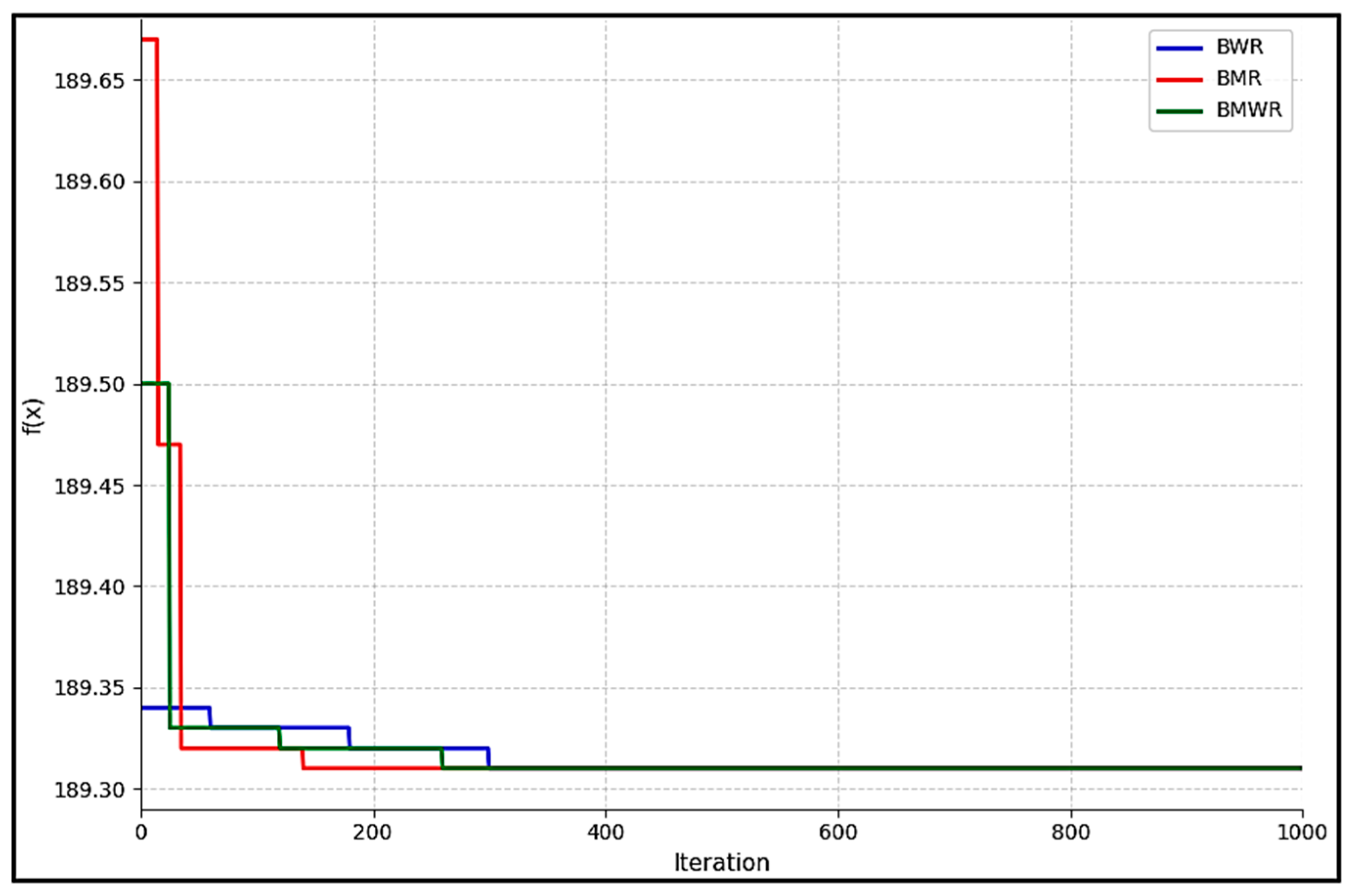
Figure 1 shows the convergence curve of BxR algorithms. The convergence is faster (≈150 iterations for BMR, ≈260 for BMWR, and ≈300 iterations for BWR), and the global optimum value of f(x) = 189.31162966 is achieved. The same problem was reported by Kumar et al. [44] using 100,000 function evaluations and reporting the best value of f(x) as 189 by algorithms named as IUDE [45], ϵMAgES) [46], and f(x) = 190 by iL-SHADEϵ algorithm [47]. Javier et al. [48] gave an f(x) value of 189.48406 using the COLSHADE algorithm, and Sallam et al. [49] showed an f(x) value of 189.31 using EnMODE algorithm.
Even though Kumar et al. [44] presented the results of f(x) = 189 by IUDE and ϵMAgES, these results are, in fact, approximate. It is because the global optimum value of f(x) = 189.31162966 for x1 = 0.0 and x2 = 16.666667, and substituting these values in the objective function f(x) leads to the global optimum value of f(x) = 189.31162966. Thus, the BxR algorithms have actually provided the global optimum value.
Table 1 summarizes the statistical performance of this heat exchanger network problem which contains nine variables and eight constraints. The results are reported using standard metrics suggested by Kumar et al. [44], such as “Best,” “Median,” “Mean,” “Worst,” “Standard Deviation,” “Feasibility Rate (FR),” “Mean Constraint Violation (MV),” and “Success Rate (SR)”. The Feasibility Rate (FR) is defined as the proportion of total algorithm runs that identified at least one feasible solution within the allowed number of function evaluations. The Success Rate (SR) quantifies the proportion of runs that successfully produced a solution x satisfying the convergence criterion f(x) − f (x*) ≤ 10−8 within the evaluation limit. The formula for calculating Mean Constraint Violation (MV) is available in [44]. It can be observed that the proposed BxR algorithms have produced very good results and are highly competitive with the other algorithms.
It is worth noting that the algorithms IUDE, εMAgES, iLSHADEε, COLSHADE, and EnMODE are not parameter-free algorithms. Although they employ adaptive or self-adaptive mechanisms, they still depend on internal, algorithm-specific control parameters that must be defined or that implicitly govern their search behavior. For example, SHADE, LSHADE, iLSHADEε, and COLSHADE rely on memory sizes, mutation strategies, and adaptation rules for DE parameters such as F and CR; IUDE requires strategy parameters for mutation and crossover adaptation; εMAgES includes ε-level control rules and adaptive search parameters; and EnMODE depends on ensemble mutation strategies and weighting parameters. Since these algorithms require algorithm-specific settings that influence exploration and exploitation, they cannot be classified as parameter-free in the strict sense, unlike methods like BxR algorithms, which operate solely with population size and number of iterations and introduce no tunable algorithm-specific parameters. The other algorithms also require the population size and number of iterations in addition to their specific control parameters.
After demonstrating the effectiveness of the BxR algorithms for the HEN benchmark function, a real case study of design and operating parameter optimization of a jet-plate solar air heater is presented.

3.2. Single-Objective Optimization of Design and Operating Parameters of Jet-Plate Solar Air Heater (JPSAH)

A solar air heater is a widely used device that converts solar energy into thermal energy. Its performance is strongly influenced by the convective heat transfer coefficient between the absorber plate and the flowing air, that can be improved by introducing artificial roughness, adding packed beds, attaching fins to the absorber plate, or using jet impingement techniques.
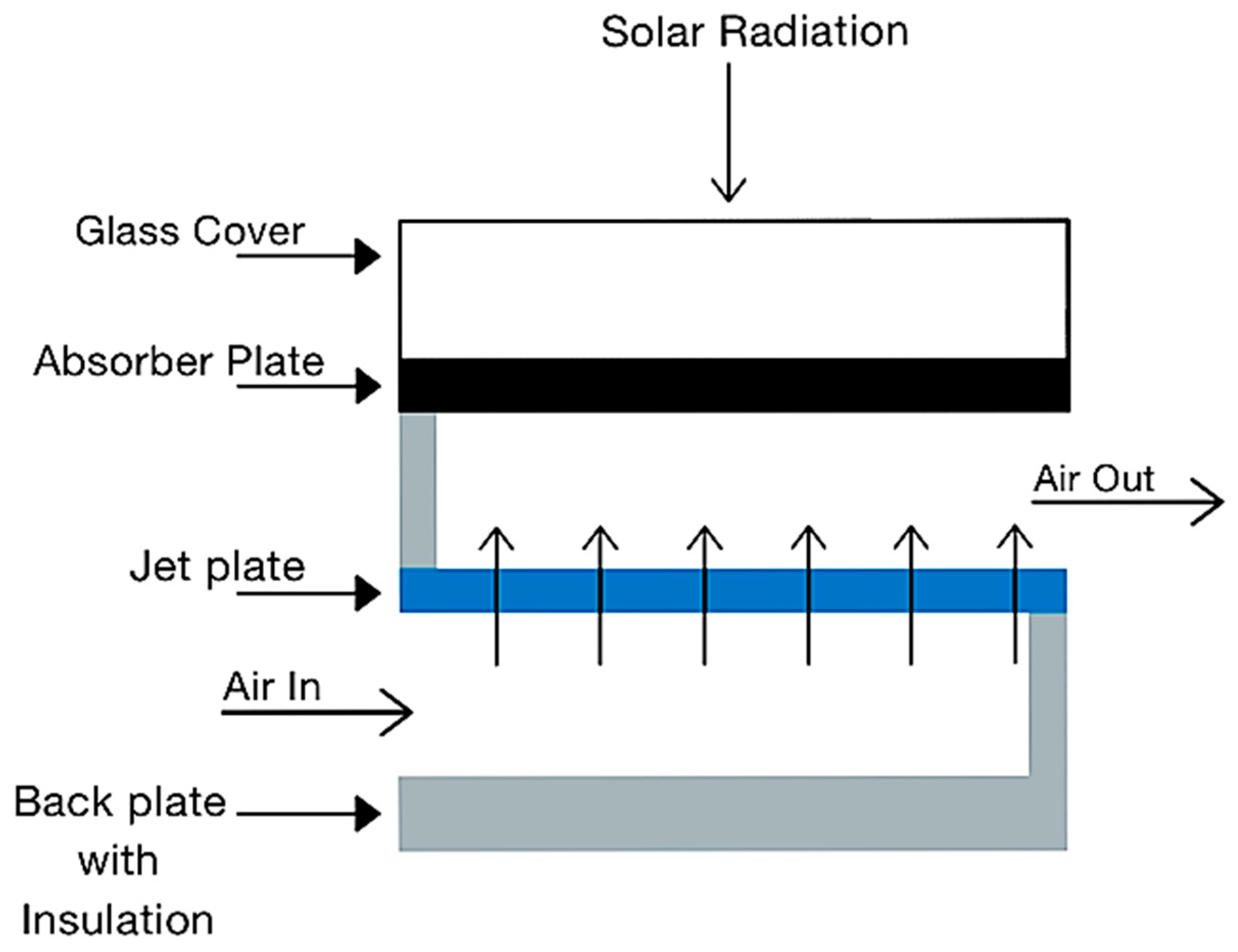
Matheswaran et al. [37] presented an in-depth experimental and statistical investigation aimed at improving the efficiency of solar air heating systems through jet impingement technology. A multi-hole jet impingement technique was employed to improve the performance of a jet-plate solar air heater by enhancing the convective heat transfer coefficient between the absorber plate and the impinging air. Matheswaran et al. [37] analyzed the system’s performance analytically, and the influences of airflow rate, collector length, jet diameter, stream-wise pitch, and span-wise pitch on thermo-hydraulic efficiency were examined using Response Surface Methodology (RSM). Figure 2 shows the schematic of the jet-plate solar air heater (JPSAH).
The air heater comprised the following:
  • Glass cover (single transparent sheet): Allows solar radiation to enter while reducing convective heat loss to the ambient environment.
  • Absorber plate (black-coated): Converts incident solar irradiance into heat. Its upper surface loses heat to the glass cover and ambient air, while the lower surface transfers heat to the impinging jet flow.
  • Jet-plate: A thin plate containing uniformly sized holes/nozzles that accelerate the incoming air into high-velocity jets.
  • Air channel: The region between the jet-plate and absorber plate (and between the jet-plate and back plate) where the jets impinge, mix, and flow toward the outlet.
  • Back plate with insulation: Reduces heat losses from the rear side of the system.
  • Inlet/Outlet: Ambient or process air enters through the inlet, is heated by the absorber via jet impingement, and is discharged through the outlet.
The width (W) and thickness (H) of the JPSAH were 290 mm and 5 mm, respectively. Operating wind velocity over JPSAH was 1.5 m/s, ambient temperature was 27 °C, solar radiation was 1000 W/m2, and the thickness of insulation was 0.034 m.
Five key parameters—collector length (A), flow rate of air (B), stream-wise pitch (C), span-wise pitch (D), and jet diameter (E)—were optimized. Matheswaran et al. [37] varied each parameter at three levels (i.e., 1.5 m, 2 m, and 2.5 m for A; 0.005 kg/s, 0.01 kg/s, and 0.015 kg/s for B; 0.04 m, 0.06 m, and 0.08 m for C; 0.03 m, 0.04 m, and 0.05 m for D, and 0.003 m, 0.004 m, and 0.005 m for E). Applying the face-centered design matrix RSM, 53 experiments were conducted with different combinations of the parameters A, B, C, D, and E.
A quadratic model was developed using RSM to predict the thermo-hydraulic efficiency η, based on the input parameters, as presented in Equation (17).
Thermo-hydraulic efficiency (η) = 0.41153 − 0.11269 * A + 64.61649 * B + 1.16381 * C +
1.89810 * D − 15.63062 * E + 0.59211 * A * B − 0.25318 * A * C − 0.43423 * A * D + 4.10535 * A * E
67.91390 * B * C − 125.66138 * B * D + 952.90466 * B * E − 4.93038 * C * D − 2348.28454 * B2
The R2 (predicted) and R2 (adjusted) values of the above polynomial model were reported as 0.9975 and 0.9987, respectively [37]. The root mean square error (RMSE), calculated by comparing the predicted and actual values, was reported as 0.0025. Thus, the polynomial model given by Equation (17) is considered as an accurate model.
Matheswaran et al. [37] reported the optimal design parameters as an airflow rate of 0.01386 kg/s, a collector length of 1.5108 m, a jet diameter of 0.0046 m, a stream-wise pitch of 0.05108 m, and a span-wise pitch of 0.03414 m. The RSM predictions were validated by Matheswaran et al. [37] by comparing them with the results obtained from the analytical model.
To explore the possibility of further improving the optimal values of parameters A-E, along with the corresponding thermo-hydraulic efficiency, the proposed BxR algorithms are applied to the same regression model using the same input parameter bounds. The objective function considered is the same as that of Matheswaran et al. [37], and it is the thermo-hydraulic efficiency given by Equation (17). The parameter bounds are taken as the lower and upper limits of the parameters and are specified in Equation (18).
1.5 m ≤ A ≤ 2.5 m; 0.005 kg/s ≤ B ≤ 0.015 kg/s; 0.04 m ≤ C ≤ 0.08 m; 0.03 m ≤ D ≤ 0.05 m;
and 0.003 m ≤ E ≤ 0.005 m.
A population size of 50 and 100 iterations were used, yielding a total of 5000 function evaluations. The results are presented in Table 2, with the highest thermo-hydraulic efficiency value highlighted in bold.
Table 2 shows that the BWR, BMR, and BMWR algorithms yield a best highest thermo-hydraulic efficiency of 69.10879%, which is higher than the 68.12% (RSM) and 68.30% (analytical) efficiencies reported by Matheswaran et al. [37].
To check the robustness of the BxR algorithms, 10 runs are conducted for each algorithm. Table 3 shows the best and mean thermo-hydraulic efficiency of JPSAH obtained by the BxR algorithms and the corresponding standard deviation values.
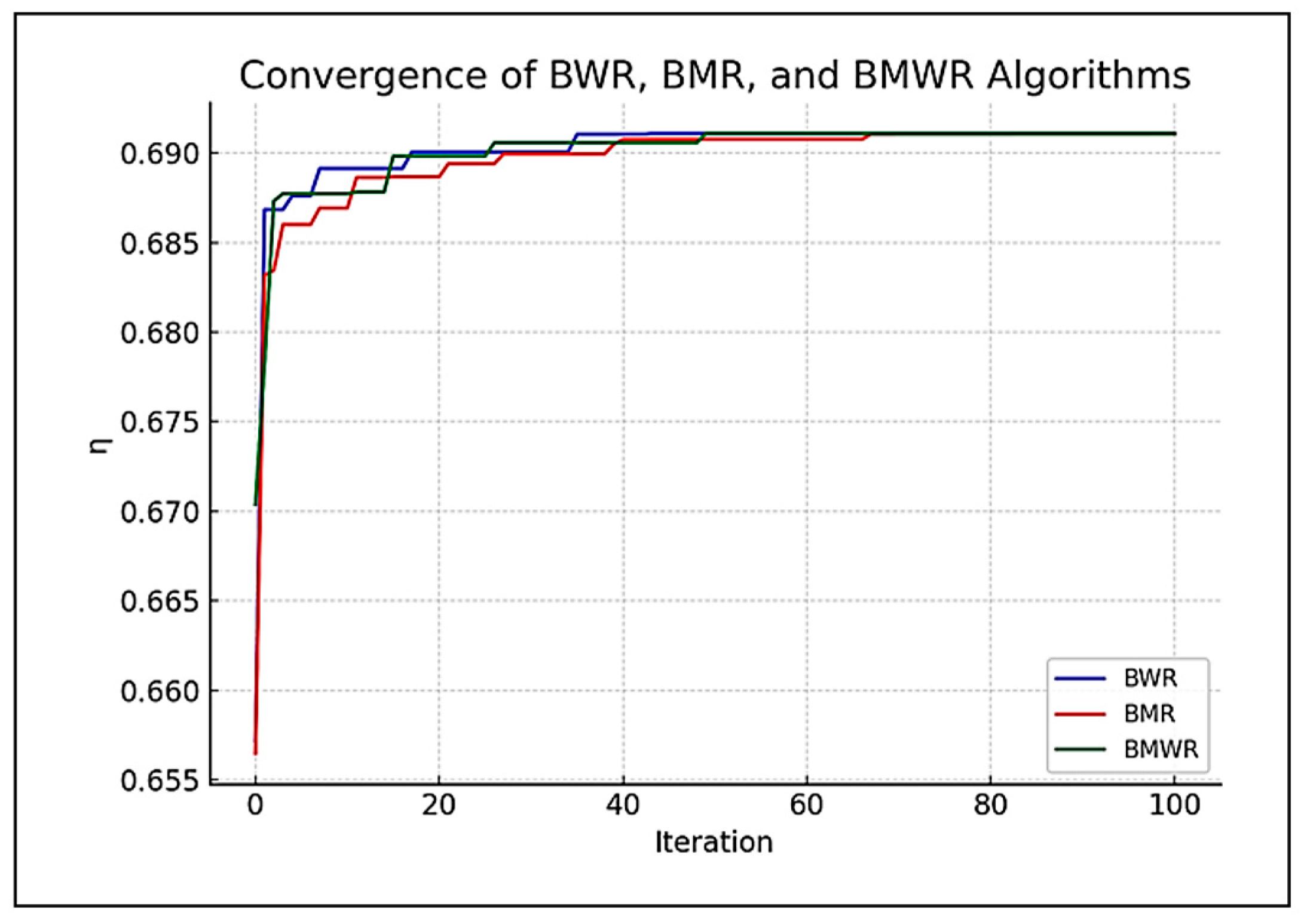
Figure 3 presents the convergence plots of the BxR algorithms for the best highest thermo-hydraulic efficiency of 69.10879%. Among them, the BWR algorithm exhibits the fastest convergence, although all three algorithms ultimately reach the global optimum thermo-hydraulic efficiency of 0.6910879. The BMWR algorithm converges more quickly than the BMR algorithm. Specifically, BWR converged by the 35th iteration, BMWR by the 48th iteration, and BMR by the 67th iteration.
Overall, the system achieves maximum η under conditions of low collector length, high mass flow rate, smaller stream-wise pitch, and span-wise pitch, as well as a larger jet diameter. All three BxR algorithms converged to the same thermo-hydraulic efficiency (η = 0.6910879), confirming that this is the global optimum of the response surface. The minimal standard deviation values demonstrate strong robustness and repeatability. The optimal solution corresponds to a physically meaningful combination of collector length, flow rate, jet diameter, and jet pitches where the positive aerodynamic–thermal interactions of the jet field are maximized. This provides clear and practically valuable guidance for designing and operating high-performance jet-plate solar air heaters.
The computational cost of the JPSAH optimization is evaluated on a standard desktop equipped with an Intel Core i7-10510U CPU at 1.80 GHz and 16 GB RAM. The Python version used is 3.11. For the problem of optimization of design parameters of JPSAH, the time complexity is O(i·s·m) per run and the memory complexity is O(s·m) per run, where i is the number of iterations, s is the population size, and m is the number of variables. For a population of 50 and 100 iterations, all three BxR algorithms (BWR, BMR, BMWR) demonstrated exceptionally stable performance, achieving the same best thermo-hydraulic efficiency (η = 0.6910879). The mean values differed from the best by only 2–2.5 × 10⁻⁵, and the standard deviations (3.3–3.7 × 10⁻⁵) indicate very low variation, confirming highly consistent convergence.
With a population of 50, iterations of 100, and five design variables, each BxR run performs about 25,000 variable updates, requiring roughly 4.25 × 10⁵ operations. Thermo-hydraulic efficiency is evaluated 5050 times, adding another 1.41 × 10⁵ operations, for a total of about 5.65 × 10⁵ floating-point operations per run. Ten runs of one algorithm require 5.65 × 10⁶ operations, and all three BxR variants together need about 1.70 × 10⁷ operations. Memory usage is minimal—approximately 2.5 kB for the population and auxiliary data, with the entire footprint remaining below 10 kB. On the laptop used, one algorithm completed 10 runs in ~2 s, and all three finished in ~6 s, showing that the BxR methods are speedy, lightweight, and well-suited for the JPSAH optimization problem.
The following section presents the optimization of design parameters for a rectangular phase-change energy storage unit with two objectives.

3.3. Design Parameters Optimization of Y-Type Fin Structure in Rectangular Phase-Change Energy Storage Units for Thermal Energy Storage (2-Objectives)

Efficient thermal regulation and improved energy utilization have made thermal energy storage (TES) technologies essential, especially in renewable energy systems. TES can be classified into sensible, latent, and thermochemical storage, with latent heat storage using phase-change materials (PCMs) being particularly popular due to its simplicity and high energy density. Incorporating PCM into latent heat thermal energy storage (LHTES) systems helps reduce spatial and temporal mismatches between energy supply and demand, thereby improving overall energy utilization. The low thermal conductivity of PCM limits its heat transfer performance. To address this, both passive and active enhancement techniques have been explored. Passive methods—such as adding fins or high-conductivity materials like metal foams, nanoparticles, expanded graphite, or graphene—require no external energy. Active methods rely on external input to boost heat transfer. Among these approaches, fin integration is widely used in LHTES systems due to its simplicity, low cost, and ease of fabrication. Fin geometry, size, material, and number strongly influence the PCM melting rate, with standard designs including pin, rectangular, tree-shaped, snowflake, and mesh fins.
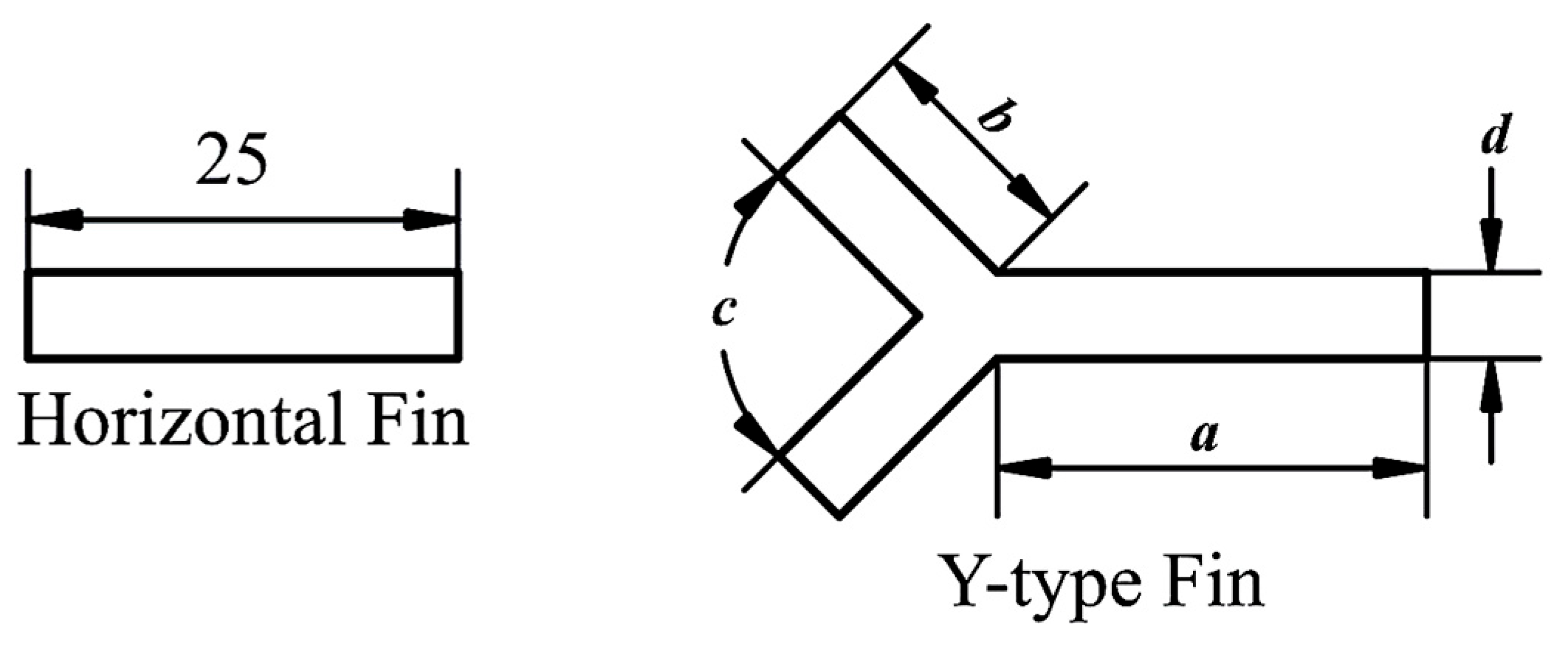
Sun et al. [25] optimized Y-type fins in a rectangular phase-change energy storage unit to accelerate PCM melting and enhance overall system performance. Figure 4 depicts the horizontal and Y-type fins.
The walls and fins were made of commercial aluminum, while the enclosure was filled with lauric acid. Lauric acid is well-suited for practical thermal applications. Its integration into LHTES systems shows strong potential for building energy conservation, solar thermal systems, and battery thermal management.
The design variables included the main segment length (a), branch segment length (b), branch angle (c), and fin thickness (d). CFD simulations combined with RSM were used to evaluate the effects of these fin parameters on the energy storage per unit mass (Em) and the mean power (Pt). Parameter a was varied between 25 and 34 mm, b between 8 and 16 mm, d between 2 and 6 mm, and c between 90° and 180°. Using different combinations of these design variables, 27 experiments were conducted using Box–Behnken experimental design, and the responses Em and Pt were noted. The quadratic models developed via RSM to predict the Em and Pt based on the input parameters are presented in Equations (19) and (20), respectively. The bounds of the parameters ad are given by Equation (21).
Em = 336.36531 − 1.43103 * a − 1.03743 * b − 0.128673 * c − 9.29861 * d + 0.003605 * a * b +
0.004025 * a * c − 0.72222 * a * d + 0.000569 * b * c − 0.355625 * b * d − 0.012361 * c * d +
0.005761 * a2 + 0.020182 * b2 + 0.000047 * c2 + 0.746979 * d2
Pt = 328.24354 − 13.65835 * a − 11.75889 * b − 0.304642 * c − 17.70333 * d + 0.233472 * a * b +
0.008012 * a * c + 0.335833 * a * d − 0.018736 * b * c + 0.4225 * b * d − 0.012889 * c * d +
0.175041 * a2 + 0.277708 * b2 + 0.000986 * c2 + 1.114890 * d2
25 mm ≤ a ≤ 34 mm; 8 mm ≤ b ≤ 16 mm; 90° ≤ c ≤ 180°; 2 mm ≤ d ≤ 6 mm
The R2 (predicted) and R2 (adjusted) values of the above polynomial models for Em and Pt were reported as greater than 0.95 [25]; hence, these models are considered accurate.
Multi-objective optimization was performed by Sun et al. [25] using the NSGA-II algorithm, while decision-making was carried out with the TOPSIS method incorporating entropy weighting to select the best design. Results showed that variations in fin geometry significantly affect both Pt and Em. The TOPSIS-based decision solution indicated the optimal system performance when Em and Pt are weighted at 56.38% and 43.62%, respectively, yielding a 4.2-fold increase in Pt with only a 14.89% reduction in Em compared to the horizontal fin structure.
To explore the possibility of further improving the optimal values of parameters a–d, along with the corresponding Em and Pt, the proposed BxR algorithms are applied to the same regression models using the same input parameter bounds. The objective functions considered are the same as those of Sun et al. [25], which are Em and Pt given by Equations (9) and (10). Both these objective functions are to be maximized.
First, the individual optimal values of Em and Pt are determined using a population size of 10 and 500 iterations, resulting in 5000 function evaluations. To check the robustness of the BxR algorithms, 10 runs are conducted. The results are summarized in Table 4 which shows the best and mean optimal Em and Pt values when each objective is optimized independently along with the standard deviation (std) values.
Across all experiments for both Em and Pt with the corrected bounds, the BxR algorithms exhibited zero variability in performance: the mean values are identical to the best values, and the standard deviations are precisely zero. This shows that all 10 independent runs of each algorithm consistently converged to the exact global optimum. Such deterministic behavior strongly suggests that the optimization landscapes of both Em and Pt are effectively unimodal within the specified bounds, and that the BxR algorithms possess high robustness, repeatability, and reliable global convergence under the chosen settings (pop = 10, iter = 500).
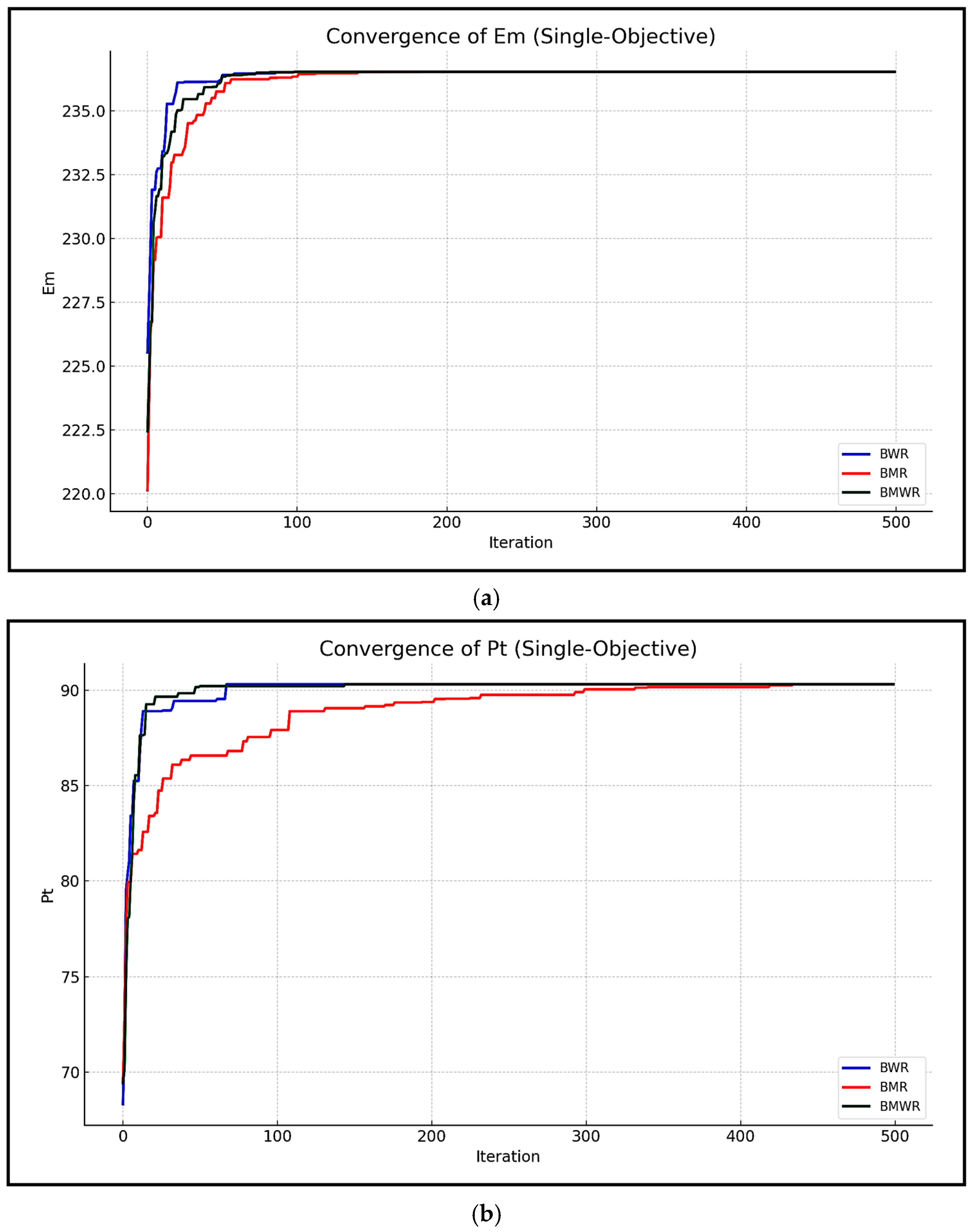
It can be seen from Table 4 that the maximum value of Em is 236.5342 kJ/kg when solved independently as a single-objective function with optimal values of a = 25 mm, b = 8 mm, c = 90°, and d = 2 mm. For the same values of the parameters, the value of Pt is 41.9724 W. Similarly, when Pt is solved independently, the maximum value is 90.29844 W with optimal values of a = 34 mm, b = 16 mm, c = 90°, and d = 6 m. For the same values of the parameters, the value of Em is 69.7866 kJ/kg. The best values are highlighted in bold. Figure 5 shows the convergence graphs.
It can be observed that in the case of Em, the BWR converged after 98th iteration, the BMWR after 100th iteration. BMR is slower and stabilized only at the 200th iteration, consistent with its slower learning behavior. In the case of Pt, the BWR converged after 67th iteration, BMWR after the 144th iteration, and BMR after the 434th iteration. In this case study, the BWR worked fastest due to strong directional movement (best–worst difference). The BMWR worked moderately, and benefited from combining the mean and worst information. The BMR is slower as mean-based guidance delays movement toward optimal boundary regions. However, the final optimum values obtained by all three algorithms are the same, only the convergence behavior is different.
For the single-objective optimization of Em and Pt using the BxR algorithms with a population size of 10, iterations of 500, and four design variables, the computational cost per run is 20,000 variable-update steps, each requiring 17 arithmetic operations, resulting in 3.40 × 10⁵ update-related floating-point operations. Each run also performs 5000 objective evaluations, contributing an additional 1.50 × 10⁵ operations. Thus, the total computational cost is approximately 4.9 × 10⁵ operations per run and 4.9 × 10⁶ operations over 10 runs. The memory requirement consists of fewer than 100 double-precision values (<1 kB), remaining well below 5 kB. A single run required approximately 0.2–0.3 s, and 10 runs are completed in about 2–3 s. These results demonstrated that single-objective BxR algorithms are extremely lightweight and efficient for the Em and Pt optimization problems.
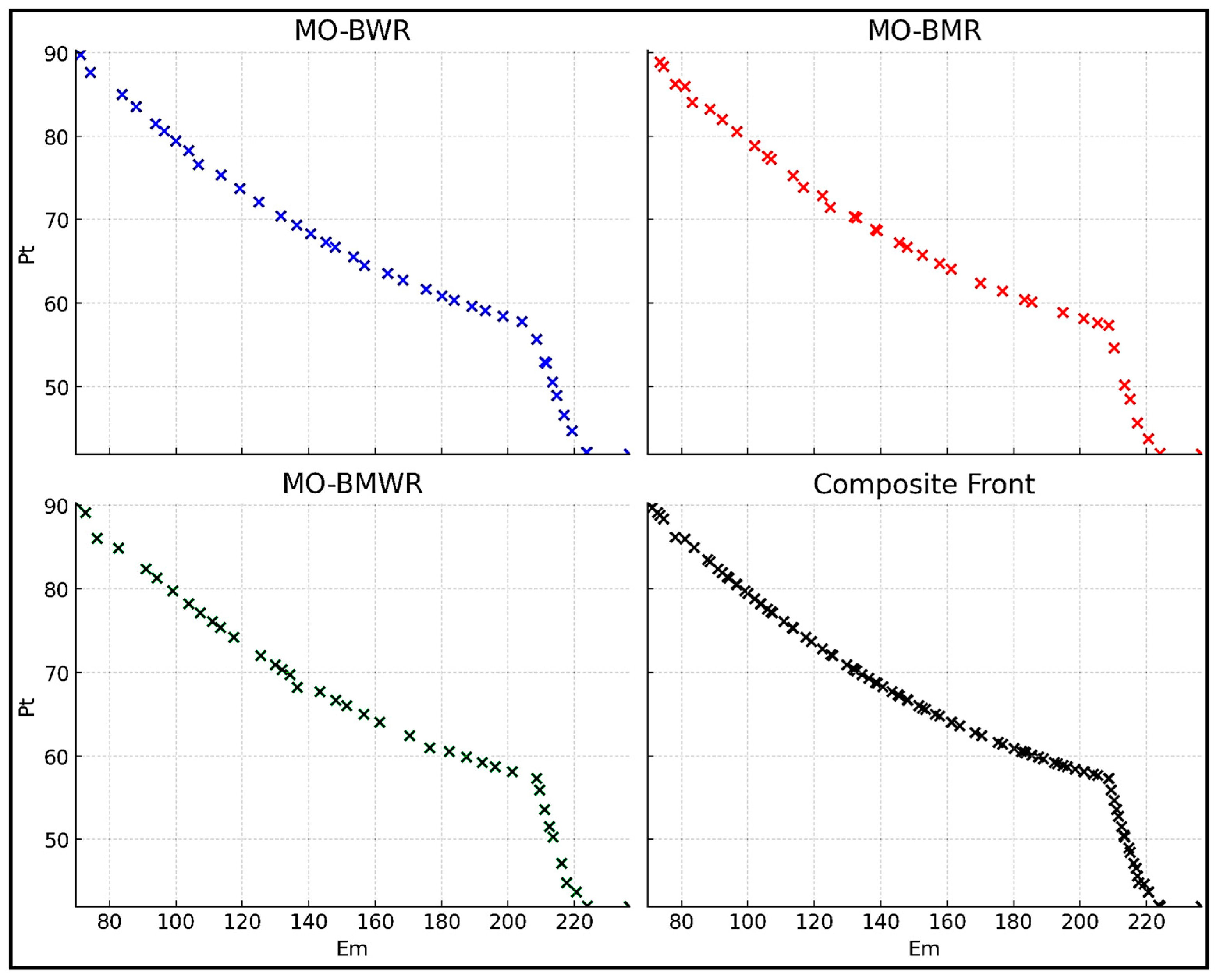
To determine the actual optimal values of the variables, both objective functions, Em and Pt, must be optimized simultaneously. For this purpose, the MO-BxR algorithms are employed to identify the optimal values of parameters a through d. Sun et al. [25] used the NSGA-II algorithm with a crossover rate of 0.8, a mutation rate of 0.1, a population of 90, and iterations of 100, resulting in function evaluations of 9000. However, to demonstrate that the MO-BxR algorithms require fewer function evaluations, this case study executed the proposed three algorithms with a population size of 40 and 125 iterations, resulting in a total of 5000 function evaluations. The MO-BWR, MO-BMR, and MO-BMWR produced 39 non-dominated solutions each.
The non-dominated solutions obtained from all three algorithms are combined to generate a composite Pareto front, which includes 102 unique, non-repeating, non-dominated solutions. Figure 6 presents the Pareto fronts obtained by the MO-BxR algorithms and the composite front.
The composite front represents the union of the best solutions found by all algorithms, giving the maximum coverage of the trade-off space, better diversity, and a stronger, more representative Pareto set than any single algorithm alone.
It is worth noting that the user does not need to run all three algorithms every time. If computational effort is a concern, the recommended approach is first to run any one of the MO-BxR algorithms (MO-BWR, MO-BMR, or MO-BMWR). If this algorithm already produces a well-spread, stable, and converged Pareto front for the problem, then its results alone are sufficient, and no additional algorithms need to be executed. The combined composite front is primarily useful when the user seeks maximum diversity or the highest possible confidence that no suitable solutions have been overlooked. Thus, users can start with one algorithm, evaluate its Pareto quality, and run the others only if extra diversity or validation is required—this avoids unnecessary computation while still preserving the option of improved coverage when needed.
The Pareto front shown in Figure 6 clearly demonstrates a bi-objective conflict: When Em increases, Pt decreases. When Pt increases, Em decreases. This inverse trend is typical in thermal–mechanical or structural optimization problems, where improving one performance metric often degrades the other. The smooth, continuous spread of points indicates a well-defined, convex-like trade-off region rather than a sharply discontinuous one. The Pareto front empowers decision-makers to choose solutions based on priority: If Em is prioritized, choose near the right boundary. If Pt is prioritized, choose near the left boundary. If neither objective can be compromised severely, choose solutions in the smooth central band, where moderate Em and Pt coexist. Solutions in the middle region offer balanced trade-offs and are typically the most practical for engineering decision-making. Such solutions are typically the most stable and robust in real-world applications.
Table 5 presents the composite front solutions, which combines the performances of the three algorithms.
Sun et al. [25] used the TOPSIS method to determine which Pareto solution is better, assigning weights of 0.5638 to Em and 0.4362 to Pt. Therefore, to ensure a fair comparison, the same weightages are used in the present work. The objectives Em and Pt have different units and hence they are normalized. As these two objectives require higher values, following the methodology given in the BHARAT method [42], the values of Em and Pt given in Table 5 are divided by 236.534 and 90.282, respectively (as these are the higher values in Table 5). The normalized values of Em and Pt are also given in Table 3. For example, the normalized value of 1 for Em in Solution 1 is obtained by dividing 236.534 by 236.534. Similarly, the normalized value of 0.464816 for Pt in Solution 1 is obtained by dividing 41.372 by 90.282. The score of Solution 1 is calculated as 0.5638 × 0.996842 + 0.4362 × 0.446072 = 0.756596. The scores of other solutions are computed in a similar way and given in the last column of Table 5.
The scores of solutions reveal that Solution 35 has the highest score with Em = 208.51 kJ/kg and Pt = 57.362 W. This solution is highlighted in bold in Table 5. Table 6 compares the solutions obtained by Sun et al. [25] using NSGA-II and the TOPSIS method and the present work.
It can be observed that Sun et al. [25] reported incorrect values for the objective functions Em and Pt (marked with an asterisk in Table 6). The corrected values presented in Table 6 are recalculated in the present work by substituting the Y-fin design parameters obtained by Sun et al. [25] using the NSGA-II algorithm in the corresponding regression equations for Em and Pt.
After observing the values of the design variables and the objectives, it can be said that the BxR and MO-BxR algorithms have provided the correct optimal solutions with fewer function evaluations of 5000. Furthermore, the BxR and MO-BxR algorithms do not require the tuning of the algorithm-specific control parameters, unlike those of NSGA-II.
Taking the composite front as a reference, performance metrics such as generational distance (GD), inverted generational distance (IGD), spacing, and spread as well as hypervolume are computed based on the normalized values of the objectives. It is known that lower GD, IGD, spacing, spread, and higher hypervolume are desirable. Table 7 presents the values of the metrics for the MO-BxR algorithms in optimizing a rectangular phase-change energy storage unit.
The performance metrics reveal distinct strengths among the three MO-BxR variants. MO-BWR achieves the lowest GD, indicating that its solutions lie closest to the composite Pareto front and exhibits the strongest convergence behavior. However, its IGD and spacing values indicate that coverage across the entire objective space is somewhat narrower than that of the other variants. In contrast, MO-BMWR attains the lowest IGD and best spacing, demonstrating superior coverage and a more uniformly distributed set of solutions along the front. This highlights the benefit of incorporating both mean and worst guidance in maintaining diversity. Meanwhile, MO-BMR provides the most balanced overall performance, achieving the best spread value and the highest hypervolume, which indicates an effective combination of convergence and diversity. Taken together, the results show that each algorithm contributes complementary strengths: MO-BWR excels in convergence accuracy, MO-BMWR in coverage and uniformity, and MO-BMR in achieving the best trade-off between convergence and diversity. This justifies using the composite front as the reference, as it captures the collective best behavior of all three algorithms. Therefore, these solutions can be considered near-globally optimal for the given design bounds and surrogate models.
The practical guiding significance is that the composite Pareto front acts as a design map for selecting the geometry of the PCM unit. Each point gives a feasible combination of (a, b, c, d) that achieves a specific trade-off between energy storage performance (Em) and thermal power (Pt). Designers can choose the following:
  • High-Em designs when maximizing stored energy or charging performance, which is critical;
  • High-Pt designs when heat transfer capability, which is the priority;
  • Compromise designs that balance both objectives efficiently.
Thus, the Pareto front provides clear, implementable guidance on how the geometric parameters should be selected to meet different operational requirements of the rectangular phase-change energy storage unit.
For the EmPt problem with four variables and two objectives, the computational cost of the MO-BxR algorithms arises from BxR updates, objective evaluations, and fast non-dominated sorting. For population size s, variables m, objectives M, iterations I, and runs R, the time complexity of each algorithm is O(R.i.(M.s2 + s.m)). For the tested configuration (population = 40, iterations = 125, variables = 4), each run performs 125 × 40 = 5000 objective evaluation steps and 125 × 40 × 4 = 20,000 variable-update operations. This corresponds to approximately 1 × 10⁶ floating-point operations per run, including sorting, objective computation, and MO-BxR updates.
Regarding the memory requirement, the population matrix, objective values, and auxiliary ranking and crowding arrays require fewer than 500 double-precision values in this case (well below 10 kB), and are completed in approximately 0.3 s. All three MO-BxR algorithms together completed in well under one second. These results indicate that the MO-BxR algorithms are computationally light, memory-efficient, and highly suitable for real-time or rapid multi-objective optimization of the EmPt problem.
The following section presents the optimization of the three objectives of a TPMS–fin- based three-fluid heat exchanger.

3.4. Design and Performance Optimization of a Triply Periodic Minimal Surface (TPMS)–Fin-Based Three-Fluid Heat Exchanger (3-Objectives)

To meet the growing thermal management demands of hybrid electric vehicles, researchers have examined various heat exchanger configurations—such as series, parallel, and integrated designs—to improve cooling efficiency and system compactness. However, these layouts can present drawbacks related to reliability and safety. Three-fluid heat exchangers offer a promising alternative by handling thermal loads from multiple sources, including engines and electric motors, within a single compact unit. With proper structural optimization, they can reduce thermal interference between heat sources while enhancing overall heat transfer performance and system integration.
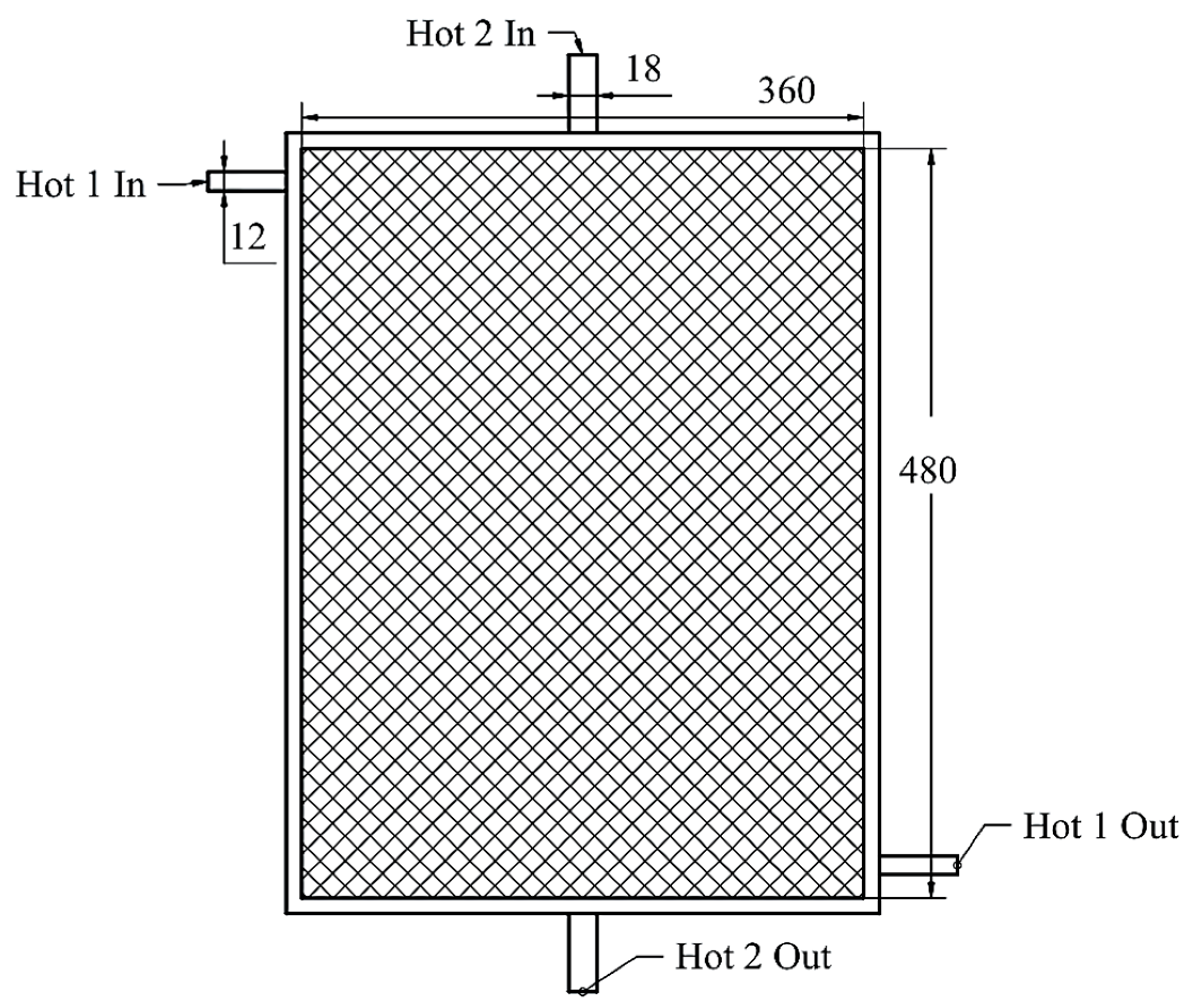
Wei et al. [2] investigated the design and performance optimization of a triply periodic minimal surface (TPMS)–fin-based three-fluid heat exchanger used in automotive applications. The TPMS core provided three isolated flow passages, enabling simultaneous heat exchange between air and two liquid streams, while the fins enhanced air-side heat transfer. Figure 7 shows the TPMS–fin three-fluid heat exchanger. The dimensions are in mm.
The heat exchanger was 3D-printed and experimentally validated, with key manufacturing parameters—such as a 1400 mm/s scanning speed and a 0.13 mm fill-area offset—identified. A verified CFD model and 46 Box–Behnken RSM experiments were used to study five design variables: hydraulic diameter (D), volume fraction (V), fin area ratio (Fs), fin pitch ratio (w), and inlet velocity (u). The objectives were pressure drop per unit length (ΔP/L, to be minimized), volumetric heat transfer rate (Qv) reflecting the overall thermal effectiveness of the heat exchanger and the j/f criterion that captures the balance between heat transfer enhancement and flow resistance (both Qv and j/f are to be maximized). Results showed strong nonlinear and synergistic interactions among the variables affecting flow and thermal performance.
Using RSM, the objective functions of pressure loss per unit length ΔP/L, volumetric heat transfer rate (Qv), and the j/f ratio are given by Equations (22)–(24), respectively. The bounds of the design variables are given in Equation (25).
ΔD/L = −39.9898 + 5.4653 * D − 0.2043 * V + 0.8958 * Fs − 0.4882 * w + 0.2575 * u + 0.0403 * D * V
0.0468 * D * Fs + 0.3552 * D * w + 0.2444 * D * u + 0.0077 * V * Fs + 0.0725 * V * w + 0.0005 * V * u
0.0345 * Fs * w + 0.0132 * Fs * u + 0.2226 * w * u − 0.5868 * D2 − 0.0130 * V2 − 0.0048 * Fs2
1.8653 * w2 − 0.1095 * u2
Vv = −841.4575 − 28.4020 * D + 163.8386 * V − 19.3778 * Fs + 253.5030 * w − 1.3322 * u
6.3099 * D * V + 4.0928 * D * Fs + 9.8830 * D * w + 2.4911 * D * u − 1.0088 * V * Fs +
17.7390 * V * w + 1.9293 * V * u − 9.3141 * Fs * w − 0.9787 * Fs * u + 11.5879 * w * u +
6.7370 * D2 − 0.2754 * V2 + 0.6284 * Fs2 + 1.0416 * w2 + 0.3242 * u2
j/f = 0.7545 − 0.1596 * D − 0.0105 * V − 0.0033 * Fs − 0.0724 * w − 0.0167 * u + 0.0013 * D * V +
0.0001 * D * Fs − 0.0080 * D * w + 0.0009 * D * u − 0.0011 * V * u + 0.0019 * Fs * w
0.0001 * Fs * u + 0.0022 * w * u + 0.0124 * D2 + 0.0002 * V2 + 0.009 * w2 + 0.0018 * u2
5.2 mm ≤ D ≤ 6.2 mm; 10% ≤ V ≤ 16%; 50% ≤ Fs ≤ 60%; 0% ≤ w ≤ 0.25%; 4 m/s ≤ u ≤ 6 m/s
The R2 (predicted) and R2 (adjusted) values of the polynomial model for ΔP/L reported are 0.9696 and 0.9843, respectively [2]. Similarly, the R2 (predicted) and R2 (adjusted) values for the Qv model were reported as 0.9863 and 0.9938, respectively. The R2 (predicted) and R2 (adjusted) values for the j/f model were reported as 0.8223 and 0.9156, respectively. Hence, the above models can be considered as accurate models.
The individual optimization of all three BxR algorithms converged reliably with pop = 40, iter = 125, and runs = 10 to the same global optimum in every run with zero standard deviation for the objectives (i.e., ΔP/L = 0.625188, Qv = 2791.855880, and j/f = 0.087876), demonstrating the stability of the BxR search dynamics.
To obtain the true optimal design through multi-objective optimization, the three objectives—ΔP/L, Qv, and j/f—must be optimized simultaneously. Wei et al. [2] used NSGA-III with a population of 90, iterations of 100 iterations, a crossover rate of 0.8, and a mutation rate of 0.1 (i.e., 9000 evaluations). With NSGA-III and TOPSIS, the optimal solution achieved ΔP/L = 2.038 kPa/m, Qv = 2271 kW/m3, and j/f = 0.1032 at D = 6.11 mm, V = 11.16%, Fs = 51.06%, w = 0.16, and u = 4.04 m/s. Compared with the original design, Qv and j/f improved by 7.4% and 6%, respectively. These findings provided valuable insights into variable interactions and support the advancement of next-generation multi-fluid heat exchanger designs.
Now, the MO-BxR algorithms are employed to identify the optimal values of parameters P through T for simultaneous optimization of ΔP/L, Qv, and j/f. Wei et al. [2] used NSGA-III algorithm with function evaluations of 9000. However, to prove that the MO-BxR algorithms need less function evaluations, in this case study, the proposed three algorithms are executed with a population size of 40 and 125 iterations resulting in function evaluations of 5000.
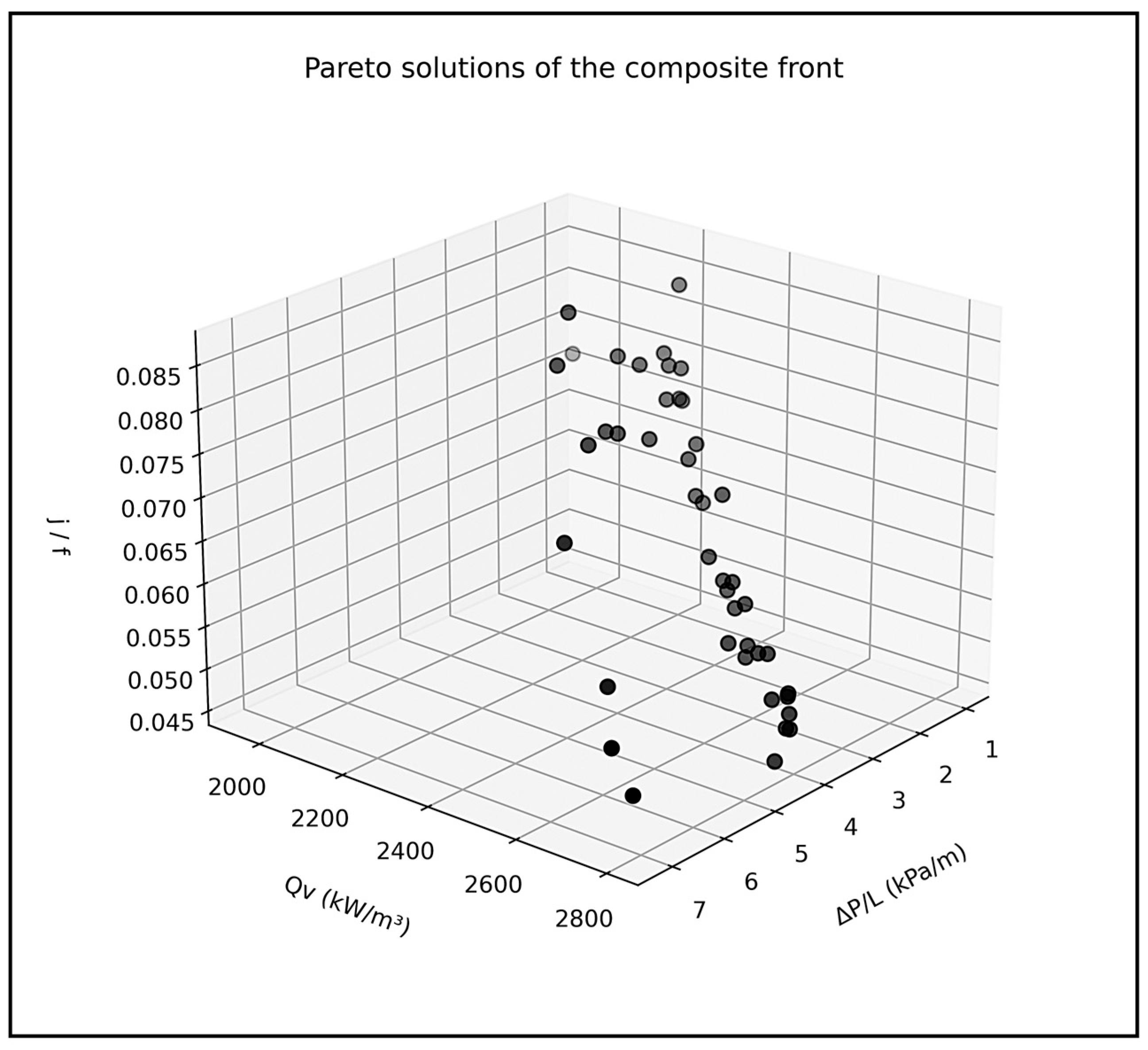
The non-dominated solutions obtained from all three algorithms are combined to generate a composite Pareto front, which includes 43 unique, non-repeating, non-dominated solutions. Of these, 13 solutions are contributed by MO-BWR, 12 by MO-BMR, and 18 by MO-BMWR. Figure 8 shows the composite Pareto front.
Table 8 shows the unique and non-dominated Pareto-optimal solutions of the composite front. Wei et al. [2] used the TOPSIS method to determine which Pareto solution is better, assigning equal weights of 1/3 to ΔP/L, Qv, and j/f. Hence, for fair comparison, the same equal weights are used in the present work. However, the objectives ΔP/L and Qv have different units, and thus they are normalized. As ΔP/L is required to have the smaller values, and Qv and j/f are required to have the higher values, following the methodology given in the BHARAT method [42], the values of Qv and j/f given in Table 5 are divided by 2804.768 and 0.085982, respectively (as these are the higher values in Table 5). The values of ΔP/L are normalized by dividing the lower value, 0.968757, in Table 5 by the ΔP/L values of that column. The normalized values of ΔP/L, Qv, and j/f are also given in Table 4. For example, the normalized value of 0.287441 of ΔP/L for Solution 1 is obtained by dividing the lower value 0.968757 by 3.370284. Similarly, the normalized value of 0.933739 of Qv for Solution 1 is obtained by dividing 2618.922 by 2804.768. Similarly, the normalized value of 0.6772 of j/f for Solution 1 is obtained by dividing 0.058227 by 0.085982. The score of Solution 1 is calculated as (1/3)*0.287441 + (1/3)*0.933739 + (1/3)*0.6772 = 0.632793. The scores of other solutions are computed similarly and given in the last column of Table 8.
The scores of solutions reveal that Solution 17 is having the higher score with ΔP/L = 0.192548, Qv = 2219.604, and j/f = 0.084116. This solution is highlighted in bold in Table 8. The following Table 9 compares the solutions obtained by Wei et al. [2] using NSGA-III and TOPSIS method with the present work.
It can be seen that Wei et al. [2] reported the values of the objective functions ΔP/L, Qv, and j/f incorrectly. The corrected values shown in Table 6 are obtained by substituting the values obtained from the NSGA-III algorithm of Wei et al. [2] into the regression equations of with ΔP/L, Qv, and j/f. The corrected values presented in Table 9 are recalculated in the present work by substituting the design variables obtained by Wei et al. [2] using the NSGA-III algorithm in the corresponding regression equations for ΔP/L, Qv, and j/f.
Table 10 shows the performance metrics of MO-BxR algorithms for the optimization of TPMS–fin-based three-fluid heat exchanger
The performance metrics indicate that MO-BWR delivers the best overall optimization quality, achieving the lowest GD and a high hypervolume, which suggests strong convergence and domination capabilities. MO-BMR provides the best IGD, demonstrating superior coverage of the Pareto front, though its lower hypervolume suggests fewer highly competitive trade-off solutions. As expected, the composite front attains zero GD and IGD and the highest hypervolume, confirming that combining non-dominated solutions from all algorithms yields the most comprehensive and well-distributed approximation of the true Pareto front.
Based on the obtained design variables and objective values, it is evident that the BxR and MO-BxR algorithms successfully produced correct optimal solutions using the small computational budget of 5000 function evaluations. In addition, unlike NSGA-III, the BxR and MO-BxR methods do not require tuning of algorithm-specific control parameters.
The optimized solutions represent a physical trade-off between heat transfer enhancement and flow resistance in the TPMS–fin heat exchanger. Increasing surface complexity improves heat transfer but also raises pressure losses, so the Pareto-optimal designs correspond to configurations where further thermal gains would require disproportionately higher pumping power. These solutions efficiently exploit TPMS geometry to enhance convective interaction without excessive pressure penalties. Practically, the composite Pareto front guides designers in selecting fin geometries and operating conditions based on specific priorities—minimizing ΔP/L, maximizing Qv, or improving overall performance j/f—thereby providing clear and actionable design insight.
For the present problem with five design variables (AE) and three objectives (ΔP/L, Qv, and j/f), each MO-BxR algorithm (pop = 40, iter = 125) is completed in under 1 s. Each MO-BxR algorithm required on the order of 108 flops and less than 10 kB of memory for 10 runs (pop = 40, iter = 125), making the computations extremely lightweight.

3.5. Multi-Objective Optimization of a Tesla-Valve Direct-Evaporative Cold Plate for LiFePO4 Modules (3-Objectives)

Lithium-ion batteries (LIBs) are among the most advanced energy storage technologies, offering high energy density, long cycle life, strong safety, and good charge–discharge performance, making them essential for stationary storage and electric vehicles. However, proper thermal management is crucial, as high temperatures degrade performance, accelerate aging, and can trigger thermal runaway. Effective temperature control is therefore vital for ensuring safety and extending battery life.
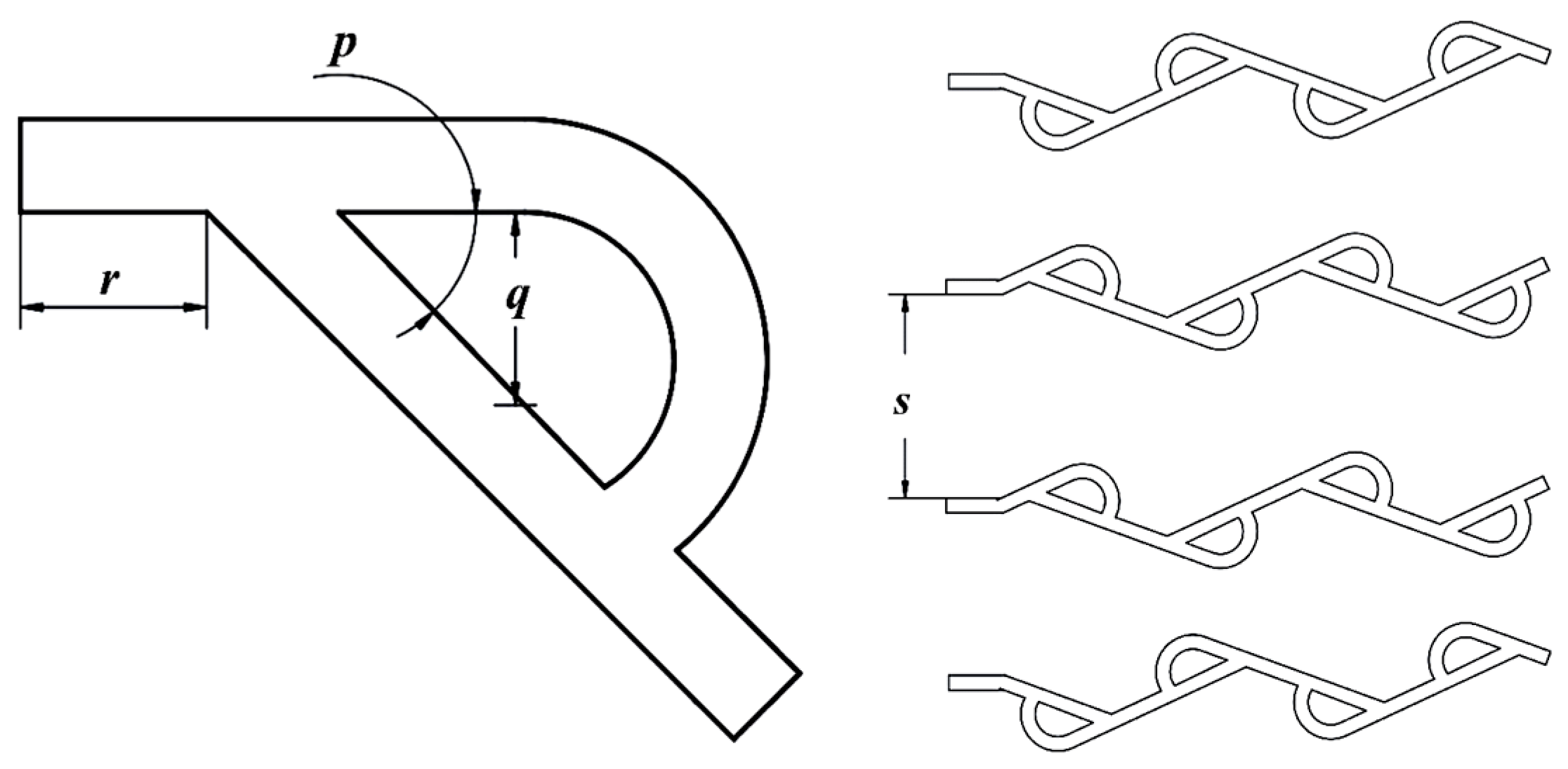
Zhang et al. [39] developed a refrigerant-based direct-evaporative cold plate with Tesla-valve geometries for prismatic LiFePO4 modules and established a 3D two-phase R134a model. Figure 9 shows a Tesla-valve and its geometry.
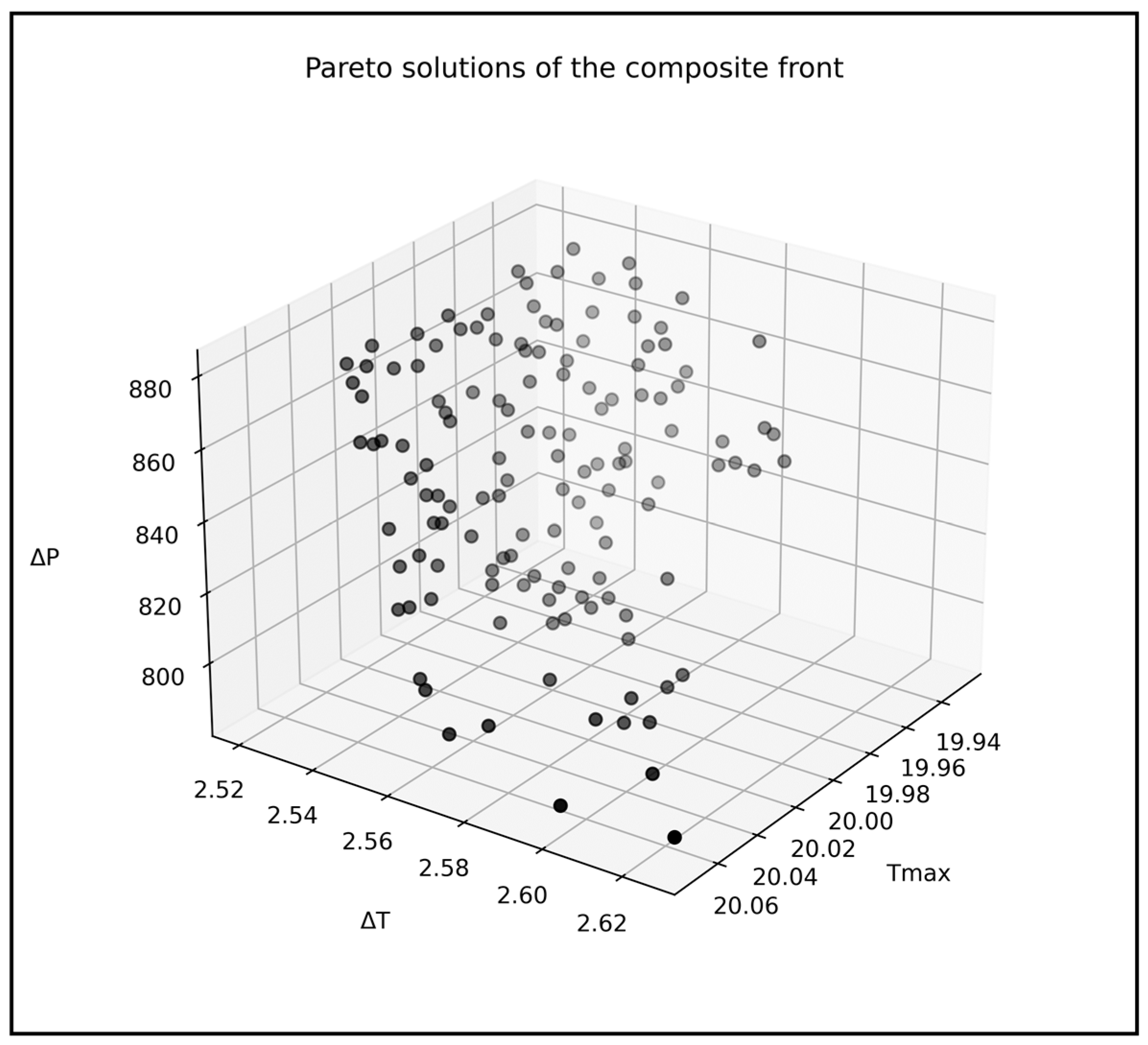
Four geometric parameters such as valve angle (p), diversion length (q), valve spacing (r), and channel spacing (s) as shown in Figure 9 were linked to the three performance measures such as maximum temperature (Tmax), temperature difference (ΔT), and channel pressure drop (ΔP). Using Optimal Latin Hypercube Design (OLHD) and RSM, the following regression models were developed by Zhang et al. [39].
Tmax = 22.568417 − 0.0165478 * p − 0.18529 * q − 0.0332448 * r − 0.1295685 * s + 0.00023698 * p2 +
0.01892391 * q2 − 0.00056089 * r2 + 0.00265559 * s2 − 0.0033455 * p * q + 0.00021796 * p * r +
0.0001149 * p * s + 0.0057255 * q * r + 0.0007003 * q * s − 0.00058177 * r * s
ΔT = 4.054839 + 0.021165 * p − 0.30525 * q − 0.187519 * r − 0.068608 * s + 0.00005783668 * p2 +
0.0118352 * q2 + 0.0173193 * r2 + 0.00151787 * s2 + 0.00094303 * p * q − 0.00282608 * p * r
0.00064754 * p * s + 0.02815675 * q * r + 0.00199447 * q * s + 0.00133136 * r * s
ΔP = 1296.1434 − 17.3663 * p − 38.3501 * q − 37.5323 * r − 13.2368 * s + 0.24516 * p2 − 0.163838 * q2 +
2.142945 * r2 − 0.117625 * s2 − 0.453103 * p * q + 0.05122 * p * r + 0.206428 * p * s + 4.593471 * q * r +
1.654882 * q * s + 0.617446 * r * s
The bounds of the parameters are given by Equation (29).
43 ≤ p ≤ 49; 2.33 ≤ q ≤ 2.83; 4 ≤ r ≤ 7; 18 ≤ s ≤ 24
The R2 (predicted) and R2 (adjusted) values of the polynomial model for Tmax were reported as 0.99 each [39]. Similarly, the R2 (predicted) and R2 (adjusted) values for the ΔT model were reported as 0.98 each. The R2 (predicted) and R2 (adjusted) values for the ΔP model were reported as 0.94 and 0.95, respectively. The RMSE values for Tmax, ΔT, and ΔP models were reported as 0.043, 0.04, and 0.041, respectively [39]. Hence, the above models can be considered as accurate.
Using the non-dominated sorting whale optimization algorithm (NSWOA), Zhang et al. [39] identified the Pareto-optimal designs. Under 2C discharge at 40 °C, the Pareto set spanned 19.76–20.06 °C (Tmax), 2.52–2.64 °C (ΔT), and 781.12–895.68 Pa (ΔP). The selected design by Zhang et al. [39] achieved Tmax = 19.81 °C, ΔT = 2.57 °C, and ΔP = 789.62 Pa, improving temperature and pressure performance by 5.0% and 0.54%, respectively.
Now, the BxR and MO-BxR algorithms are applied to see if there can be any improvement in the optimum values of the Tmax, ΔT, and ΔP. Zhang et al. [39] used a population of 800 and 100 iterations resulting in 80,000 function evaluations. However, to verify whether the BxR and MO-BxR algorithms can perform with a significantly reduced number of function evaluations, a population of 50 and 100 iterations (5000 function evaluations only) are used in the present work.
First, the BxR algorithms are used to determine the optimal values of Tmax, ΔT, and ΔP, as summarized in Table 11. The individually optimized best objective values after conducting 10 runs are 19.756 °C for Tmax, 2.5159 °C for ΔT, and 781.1174 Pa for ΔP. The three BxR algorithms have obtained the same results with p = 430, q = 3.83 mm, r = 4 mm, and s = 24 mm.
The application of MO-BxR algorithms led to 129 solutions of the composite front. The values of the objective functions Tmax, ∆T, and ∆P given by the composite front are given in Table 11. The values of Tmax, ∆T, and ∆P are normalized and the scores are computed. However, due to space constraints, not all 129 non-dominated solutions are shown in Table 11.
Figure 10 shows the 3D plot of the composite front for the objectives Tmax, ∆T, and ∆P.
Zhang et al. [39] used CFD for simulations and developed the RSM models. The NSWOA was applied to obtain the Pareto solutions. TOPSIS and LINMAP (Linear Programming Technique for Multidimensional Analysis of Preference) methods were then employed to determine the best compromise solution, considering equal importance of the three objectives (i.e., wTmax = w∆T = w∆P = 1/3). Using the BHARAT method [42], the present work has computed the scores of the Pareto solutions in the composite front obtained from MO-BxR algorithms. The comparison of results is given in Table 12.
It is very clear from Table 12 that the MO-BxR algorithm, combined with the BHARAT method, has provided better performance results compared to the NSWOA and the TOPSIS and LINMAP results. It is worth noting that Zhang et al. [39] employed a fixed parameter setting—population size of 800, 100 iterations, and a crossover rate of 0.8—while other important algorithm-specific parameters such as the mutation rate and selection strategy were not reported. Had Zhang et al. [39] explored different combinations of population size, iteration count, and algorithm-specific parameters, their results might have approached those obtained by the MO-BxR methods. However, it appears that Zhang et al. [39] did not investigate such parameter variations. Moreover, in the present work, we are unable to perform a detailed evaluation of NSWOA under different parameter settings because the full algorithmic details and source code are not available to us.
The MO-BxR algorithms effectively identify optimized Tesla-valve geometries that enhance evaporative cooling while balancing thermal safety, temperature uniformity, and hydraulic losses. The optimization results are practically significant because they reveal efficient valve configurations that jointly minimize maximum temperature, temperature non-uniformity, and pressure drop in LiFePO4 battery modules. The resulting Pareto-optimal designs achieve strong heat removal without excessive pumping requirements providing clear guidance for selecting valve angles, diversion lengths, and channel spacings. Consequently, the optimized cold plate designs improve thermal stability, enhance battery safety and lifetime, and reduce energy consumption in electric and stationary vehicle energy storage systems.
With settings s = 50, m = 4, M = 3, i = 100, each run performs 100 × 50 × 4 = 20,000 variable updates and 15,000 objective evaluations (plus 50 initial evaluations). This corresponded to execution times well under one second per algorithm, making the study computationally very light. The memory requirement is well under 10 kB of working memory per MO-BxR algorithm.
In this study, the optimization is performed strictly within the experimental domain of the RSM models, and no decision variable is allowed to exceed the upper or lower bounds used during the original design of experiments. Therefore, the optimized solutions do not involve extrapolation beyond the valid region of the RSM models. The BxR and MO-BxR algorithms explored the design space more thoroughly than the conventional methods and identified improved solutions inside the same feasible region defined by the DOE. Hence, the improvements are not artifacts of extrapolation but arise from a more efficient search of the existing RSM landscape.
Although the physical validation is ideal—as with most RSM-based optimization studies in the literature, including those by Sun et al. [25], Wei et al. [2], and Zhang et al. [39]—conducting new physical experiments is beyond the scope of the current work. The purpose of this paper is to evaluate optimization algorithms on established RSM surrogates, not to redesign or re-perform the experiments. As long as the optimization remains within the experimentally supported domain, the improved results are consistent with standard RSM practice and are considered physically plausible.
To further strengthen the reliability of the findings, we ensured the following:
  • All variables strictly adhered to the original bounds of the DOE;
  • No solution is allowed to enter unexplored or extrapolated regions;
  • The surrogate models are used precisely in the same manner as in earlier publications.
Thus, while physical re-testing is outside the present scope, the obtained optima remain valid, realizable predictions of the RSM models and represent the best possible solutions within the experimentally established design domain. The improved optima arise because the BxR and MO-BxR algorithms performed a more effective search of the same regression equations and therefore identified better solutions within the valid design domain.
In the case of the results of Sun et al. [25] and Zhang et al. [39], the computational issue we noted relates to the objective function values reported by the previous authors, not to the quality of their optima. When we substituted the design variables published in their work into the same regression equations, the resulting objective values did not match those reported in their tables. This discrepancy suggests an error in their numerical evaluation of the objective functions, not in their optimization procedure.
The Python source codes for the BWR, BMR, BMWR, MO-BWR, MO-BMR, and MO-BMWR algorithms are publicly accessible at https://sites.google.com/d/1qNsqo0kHkQD9Bhi4-prZlxo5K7QuntgI/p/1OeRlPp5dhwkqfeNvLP4CtHqFhwk74DqB/edit (accessed on 15 December 2025).

4. Conclusions

In this work, three efficient optimization algorithms—Best–Worst–Random (BWR), Best–Mean–Random (BMR), and Best–Mean–Worst–Random (BMWR), collectively referred to as the BxR and their multi-objective versions as the MO-BxR family—are introduced and validated across a diverse set of heat transfer system optimization problems. These algorithms are developed for simplicity, robustness, and computational efficiency, avoiding metaphor-based inspirations and eliminating the algorithm-specific control parameters typically required in conventional metaheuristics.
The BxR and MO-BxR algorithms are applied to several heat transfer case studies, including (i) single-objective optimization of a heat exchanger network to minimize the cost, (ii) single-objective optimization of a jet-plate solar air heater to maximize thermal–hydraulic efficiency, (iii) enhancement of thermal performance in Y-type fin phase-change thermal energy storage units, (iv) optimization of thermo-hydraulic characteristics in TPMS–fin three-fluid heat exchangers, and (v) multi-objective optimization of a Tesla-valve direct-evaporative cold plate for LiFePO4 battery modules. Comparisons are made with results obtained using established methods such as NSGA-II, NSGA-III, NSWOA, and high-fidelity CFD numerical simulations reported in the literature. The BxR and the MO-BxR algorithms demonstrate stronger convergence behavior, better Pareto front quality, and more accurate optimal solutions. Their algorithm-specific control-parameter-free structure and reduced computational burden make them especially effective for complex thermo-fluid optimization tasks.
This study incorporated the BHARAT method to identify the most balanced compromise solution from Pareto-optimal sets, particularly in complex multi-objective thermal problems where graphical interpretation alone is insufficient. This method offers a simpler and computationally lighter alternative to conventional decision-making techniques such as TOPSIS and LINMAP.
The findings indicate that the BWR, BMR, and BMWR algorithms possess strong potential for a broad spectrum of real-world heat- and mass-transfer optimization challenges, spanning constrained/unconstrained problem settings. Their applicability may be extended to systems such as advanced heat exchangers, phase-change thermal energy storage units, convective cooling devices, evaporative and boiling heat transfer configurations, porous media transport systems, and coupled thermal–fluid–mass diffusion processes. Moreover, these algorithms may be integrated with machine-learning-based surrogate models to enable data-driven optimization of complex thermal systems. The present work has considered the low-dimensional problems. The future work will explore problems involving high-dimensional decision spaces, discrete variables, expensive black-box models, and dynamically varying operating conditions in thermal and energy systems.

Author Contributions

Conceptualization, R.V.R.; methodology, R.V.R.; validation, J.L.; formal analysis, writing—original draft preparation, R.V.R.; writing—review and editing, J.T. and D.T.; All authors have read and agreed to the published version of the manuscript.

Funding

This research received no external funding to meet the APC.

Data Availability Statement

All original contributions from this study are contained within the article; further inquiries may be addressed to the corresponding author.

Acknowledgments

Support from the Anusandhan National Research Foundation, DST, Government of India (MTR/2023/000071) is gratefully acknowledged by the first author. Certain figures and interpretations are prepared with the assistance of ChatGPT-5.1. The authors have reviewed and edited the output and take full responsibility for the content of this publication.

Conflicts of Interest

The authors declare no conflicts of interest.

References

  1. Rinik, R.A.; Bhuiyan, A.A.; Karim, M.R. Performance enhancement of double-tube heat exchangers using nonuniformly twisted elliptical tubes: A CFD-based multi-objective optimization approach via RSM and NSGA-II. Therm. Sci. Eng. Prog. 2025, 69, 104322. [Google Scholar] [CrossRef]
  2. Wei, X.; Qian, Y.; Gong, Z. Multi-objective optimization of the TPMS-fin three-fluid heat exchanger for vehicles using RSM–NSGA-III. Energy 2025, 328, 136462. [Google Scholar] [CrossRef]
  3. Lv, J.; Sun, Y.; Li, P. Multi-objective optimization research of printed circuit heat exchanger based on RSM and NSGA-II. Appl. Therm. Eng. 2024, 254, 123925. [Google Scholar] [CrossRef]
  4. Hadibafekr, S.; Mirzaee, I.; Shirvani, H. Thermo-entropic analysis and multi-objective optimization of wavy lobed heat exchanger tube using DOE, RSM, and NSGA-II algorithm. Int. J. Therm. Sci. 2023, 184, 107921. [Google Scholar] [CrossRef]
  5. Wei, X.; Qian, Y.; Qian, D. Optimization and performance analysis of a gyroid-fin-based three-fluid heat exchanger using advanced multi-objective optimization techniques. Int. Commun. Heat Mass Transf. 2025, 166, 109220. [Google Scholar] [CrossRef]
  6. Liang, X.; Xu, J.; Cheng, J. Multi-objective optimization of vortex generators for enhanced thermal–fluid performance in finned-tube heat exchangers. Appl. Therm. Eng. 2026, 283, 128946. [Google Scholar] [CrossRef]
  7. Tao, X.; Jiang, Q.; Feng, H. Multi-objective optimization of the plate-fin heat exchanger coupled with ortho–para hydrogen conversion for hydrogen liquefaction. Int. J. Refrig. 2025, 175, 47–62. [Google Scholar] [CrossRef]
  8. Tian, B.; Wang, N.; Shao, S. A comprehensive investigation of shell-and-tube heat exchangers based on porous baffle design and multi-objective parameter optimization. Int. J. Therm. Sci. 2026, 221, 110463. [Google Scholar] [CrossRef]
  9. Han, Y.; Wu, Y.-G.; Jin, T.-X. Multi-objective optimization study on heat transfer performance of solar salt in non-circular twisted tube heat exchanger based on entropy generation number and NSGA-II. Int. J. Therm. Sci. 2025, 211, 109681. [Google Scholar] [CrossRef]
  10. Abouzied, A.S.; Basem, A.; Babiker, S.G. Thermal performance optimization of microchannel heat sinks with triangle wave fin designs and various heat transfer fluids using GA/RSM/TOPSIS. Case Stud. Therm. Eng. 2025, 72, 106407. [Google Scholar] [CrossRef]
  11. Shanmugam, M.; Maganti, L.S. Multi-objective optimization of parallel microchannel heat sink with u-, i-, and z-type manifold configurations by RSM and NSGA-II. Int. J. Heat Mass Transf. 2023, 201, 123641. [Google Scholar] [CrossRef]
  12. Kumar, R.; Zunaid, M.; Mishra, R.S. Multi-objective optimization of the hydrothermal and exergetic performance of a convergent–divergent microchannel heat sink using ANN, NSGA-II, and TOPSIS algorithms. Therm. Sci. Eng. Prog. 2025, 67, 104228. [Google Scholar] [CrossRef]
  13. Liu, S.; Chen, M.; Li, J. Multi-objective optimization of a bionic microchannel heat sink based on fibonacci spiral for electronic components. Int. J. Heat Mass Transf. 2025, 253, 127544. [Google Scholar] [CrossRef]
  14. Yuan, Y.; Liu, W.; Li, C. Thermal–hydraulic performance and multi-objective design optimization of a microchannel heat sink with hollow twisted tapes. Int. J. Heat Fluid Flow 2025, 116, 109993. [Google Scholar] [CrossRef]
  15. Fu, L.; Zhao, M.; Wang, L. Geometric multi-objective optimization of a microchannel–pin-fin hybrid heat sink. Int. J. Therm. Sci. 2025, 221, 109711. [Google Scholar] [CrossRef]
  16. Tang, Z.; Sun, R.; Zhou, P. Multi-objective optimization of flow boiling heat transfer in a manifold microchannel heat sink with curved corners. Int. J. Heat Mass Transf. 2025, 247, 127182. [Google Scholar] [CrossRef]
  17. Chen, P.; Chen, C.; Wang, L. Enhanced cooling performance of reflective high-concentration photovoltaic cells using optimized double-layer spider web microchannel heat sinks. Appl. Therm. Eng. 2025, 279, 127610. [Google Scholar] [CrossRef]
  18. Zhang, Y.; Du, M.; Chen, L. Design and optimization of a novel microchannel heat sink integrated with nanoporous membrane for ultra-high-heat-flux thermal management. Int. J. Heat Mass Transf. 2025, 253, 127538. [Google Scholar] [CrossRef]
  19. Li, Z.; Han, H.; Shao, S. Multi-objective optimization of wavy microchannel heat sinks with symmetric configurations generated by interpolation curves. Results Eng. 2025, 26, 105500. [Google Scholar] [CrossRef]
  20. Wang, Y.; Qi, C. Multi-objective optimization on thermal–hydraulic performance of symmetrical hierarchical microchannel heat sinks. Appl. Therm. Eng. 2025, 271, 126309. [Google Scholar] [CrossRef]
  21. Haridy, S.; Radwan, A.; Abdelrehim, O. Thermal management of high-concentrator photovoltaic modules using an optimized microchannel heat sink. Energy Nexus 2025, 17, 100376. [Google Scholar] [CrossRef]
  22. Khan, S.A.; Abdellatif, H.E.; Alhushaybari, A. Investigation and optimization of shell-and-tube thermal energy storage unit with biomimetic leaf-vein fins and carbon nanotubes for superior PCM efficiency. Int. Commun. Heat Mass Transf. 2025, 167, 109250. [Google Scholar] [CrossRef]
  23. Ren, F.; Li, Q.; Xue, C. Enhanced casing molten salt thermal energy storage through cobblestone-fin composite: Multi-objective optimization with RSM and NSGA-II. J. Energy Storage 2025, 105, 114575. [Google Scholar] [CrossRef]
  24. Vedrtnam, A.; Kalauni, K.; Soares, N. Hybrid optimization of phase change material-based thermal storage for hvac efficiency in commercial buildings. Appl. Therm. Eng. 2025, 279, 128143. [Google Scholar] [CrossRef]
  25. Sun, P.; Wang, X.; Zhang, L. Multi-objective optimization of y-type fin structure in rectangular phase change energy storage units. Appl. Therm. Eng. 2025, 276, 126899. [Google Scholar] [CrossRef]
  26. Wang, X.; Chen, X.; Cui, L. Optimization of a novel fin structure and heat transfer characteristics of a phase change thermal energy storage unit. Appl. Therm. Eng. 2025, 279, 127549. [Google Scholar] [CrossRef]
  27. Chouchane, H.; Mekhilef, S.; Tey, K.S. Maximizing energy efficiency and drying quality in pvt-pcm solar dryers through multi-objective optimization and nocturnal heat release analysis. Appl. Therm. Eng. 2026, 282, 128774. [Google Scholar] [CrossRef]
  28. Hosseinzadeh, K.; Mahboobtosi, M.; Ganji, D.D. Optimization of antenna-shaped fins configuration for enhanced solidification in triplex thermal energy storage systems with radiative heat transfer. Case Stud. Therm. Eng. 2024, 64, 105488. [Google Scholar] [CrossRef]
  29. Qader, B.S.; Supeni, E.E.; Abu Talib, A.R. RSM approach for modeling and optimization of designing parameters for inclined fins of solar air heater. Renew. Energy 2019, 139, 1275–1287. [Google Scholar] [CrossRef]
  30. Mahto, P.K.; Das, P.P.; Kundu, B. Parametric optimization of solar air heaters with dimples on absorber plates using metaheuristic approaches. Appl. Therm. Eng. 2024, 233, 121242. [Google Scholar] [CrossRef]
  31. Mahto, P.K.; Kundu, B. Experimental and meta-heuristic optimization for the highest thermo-hydraulic performance of a solar air heater with a v-notch pattern of hemispherical protrusions on absorber surfaces. Int. Commun. Heat Mass Transf. 2024, 156, 107624. [Google Scholar] [CrossRef]
  32. Wang, Y.; Wang, J.; Feng, B. Multi-parameters optimization design of downward jet solar air collector with corrugated absorber plate structure. Int. Commun. Heat Mass Transf. 2025, 164, 108223. [Google Scholar] [CrossRef]
  33. Ben Hamida, M.B.; Rasheed, R.H.; Chamkha, A. Intelligent design framework for finned solar air heaters: A synergy between pso/ga-tuned mlpnn and multi-objective crystal structure algorithm (MOCryStAl). Int. Commun. Heat Mass Transf. 2025, 170, 108560. [Google Scholar] [CrossRef]
  34. Wang, Y.; Ma, J.; Xiao, Q. Multi-objective optimization design of solar air collector with a frustum-shaped protrusion. Sol. Energy 2024, 262, 112558. [Google Scholar] [CrossRef]
  35. Kumar, R.; Kumar, S.; Lee, D. Parametric optimization of an impingement jet solar air heater for active green heating in buildings using hybrid CRITIC–COPRAS approach. Int. J. Therm. Sci. 2024, 198, 108256. [Google Scholar] [CrossRef]
  36. Mobayen, S.; Assareh, E.; Garcia, D.A. Dynamic analysis and multi-objective optimization of an integrated solar energy system for zero-energy residential complexes. Energy Convers. Manag. 2025, 305, 118480. [Google Scholar] [CrossRef]
  37. Matheswaran, M.M.; Arjunan, T.V.; Muthusamy, S.; Natrayan, L.; Panchal, H.; Subramaniam, S.; Khedkar, N.K.; El-Shafay, A.S.; Sonawane, C. A case study on thermo-hydraulic performance of jet plate solar air heater using response surface methodology. Case Stud. Therm. Eng. 2022, 34, 101983. [Google Scholar] [CrossRef]
  38. Hu, Q.; Yuan, K.; Peng, W.; He, S.; Zhao, G.; Wang, J. Flow pattern analysis and multi-objective optimization of helically corrugated tubes used in the intermediate heat exchanger for nuclear hydrogen production. Int. J. Hydrogen Energy 2022, 47, 4885–4902. [Google Scholar] [CrossRef]
  39. Zhang, Y.; Song, J.; He, L.; Deng, X.; Zhao, Z.; Wu, L. Multi-objective optimization of a tesla-valve direct-evaporative cold plate for prismatic LiFePO4 modules using RSM–NSWOA. Appl. Therm. Eng. 2026, 282, 128848. [Google Scholar] [CrossRef]
  40. Rao, R.V.; Davim, J.P. Single, Multi-, and many-objective optimization of manufacturing processes using two novel and efficient algorithms with integrated decision-making. J. Manuf. Mater. Process. 2025, 9, 137. [Google Scholar] [CrossRef]
  41. Rao, R.V.; Davim, J.P. Optimization of different metal casting processes using three simple and efficient advanced algorithms. Metals 2025, 15, 1057. [Google Scholar] [CrossRef]
  42. Rao, R.V. BHARAT: A simple and effective multi-criteria decision-making method that does not need fuzzy logic. Part 1: Multi-attribute decision-making applications in the industrial environment. Int. J. Ind. Eng. Comput. 2024, 15, 13–40. [Google Scholar] [CrossRef]
  43. Rao, R.V.; Shah, R. BMR and BWR: Two simple metaphor-free optimization algorithms for solving real-life non-convex constrained and unconstrained problems. arXiv 2024, arXiv:2407.11149v2. [Google Scholar]
  44. Kumar, G.; Wu, M.Z.; Ali, R.; Mallipeddi, P.N.; Suganthan, S.; Das, S. A test-suite of non-convex constrained optimization problems from the real-world and some baseline results. Swarm Evol. Comput. 2020, 56, 100693. [Google Scholar] [CrossRef]
  45. Trivedi, D.; Srinivasan, N.; Biswas, N. An improved unified differential evolution algorithm for constrained optimization problems. In Proceedings of the IEEE Congress on Evolutionary Computation (CEC), San Sebastián, Spain, 5–8 June 2017; IEEE: New York, NY, USA, 2018; pp. 1231–1238. [Google Scholar]
  46. Hellwig, M.; Beyer, H.-G. A matrix adaptation evolution strategy for constrained real-parameter optimization. In Proceedings of the IEEE Congress on Evolutionary Computation (CEC), San Sebastián, Spain, 5–8 June 2017; IEEE: New York, NY, USA, 2018; pp. 11–18. [Google Scholar]
  47. Fan, Z.; Fang, Y.; Li, W.; Yuan, Y.; Wang, Z.; Bian, X. LSHADE44 with an improved ε constraint-handling method for solving constrained single-objective optimization problems. In Proceedings of the IEEE Congress on Evolutionary Computation (CEC), San Sebastián, Spain, 5–8 June 2017; IEEE: New York, NY, USA, 2018; pp. 1–8. [Google Scholar]
  48. Javier, G.R.; Aguirre, A.H.; Cedeño, O.D. COLSHADE for real-world single-objective constrained optimization problems. In Proceedings of the IEEE Congress on Evolutionary Computation (CEC), San Sebastián, Spain, 5–8 June 2017; IEEE: New York, NY, USA, 2020; pp. 1–8. [Google Scholar]
  49. Sallam, K.M.; Elsayed, S.M.; Chakrabortty, R.K.; Ryan, M.J. Multioperator differential evolution algorithm for solving real-world constrained optimization problems. In Proceedings of the IEEE Congress on Evolutionary Computation (CEC), San Sebastián, Spain, 5–8 June 2017; IEEE: New York, NY, USA, 2020; pp. 1–8. [Google Scholar]
  50. Floudas, C.A.; Ciric, A.R.; Grossmann, J.E. Automatic synthesis of optimum heat exchanger network configurations. AIChE J. 1986, 32, 276–290. [Google Scholar] [CrossRef]
Figure 1. Convergence of BxR algorithms for HEN design.
Energies 19 00034 g001
Figure 2. Schematic diagram of JPSAH.
Energies 19 00034 g002
Figure 3. Convergence of the BxR algorithms for JPSAH.
Energies 19 00034 g003
Figure 4. Horizontal and Y-type fins.
Energies 19 00034 g004
Figure 5. Convergence graphs for (a). Em and (b). Pt.
Energies 19 00034 g005
Figure 6. Pareto fronts generated by MO-BxR algorithms and the composite front for the optimization of a rectangular phase-change energy storage unit.
Energies 19 00034 g006
Figure 7. TPMS–fin-based three-fluid heat exchanger.
Energies 19 00034 g007
Figure 8. Composite Pareto front for the TPMS–fin-based three-fluid heat exchanger.
Energies 19 00034 g008
Figure 9. Geometry of the Tesla-valve.
Energies 19 00034 g009
Figure 10. Three-dimensional plot of the Pareto front of the MO-BxR algorithms and the composite front for the objectives Tmax, ∆T, and ∆P.
Energies 19 00034 g010
Table 1. Comparison of the best f(x) of the heat exchanger network problem.
AlgorithmBestMedianMeanWorstStd. Dev.FRMVSR
IUDE [44]18926022928580.6240.00001124
εMAgES [44]189492455437223840.00014720
iLSHADEε [44]19019420622919.3280.01364
COLSHADE [48]189.48406209.452210.4055217.274325.451688--
EnMODE [49]189.31189.31189.31189.310100--
BWR189.31162966189.31162966189.31162966189.3116296601000100
BMR189.31162966189.31163566189.31163566189.311721330.000015641000100
BMWR189.31162966189.31163254189.31163254189.3117423220.000020041000100
Table 2. Comparison of highest thermo-hydraulic efficiency of JPSAH obtained by the BxR algorithms and the RSM.
MethodJPSAH Input ParametersThermo-Hydraulic Efficiency
Collector Length (A) mFlow Rate of Air (B) kg/sStream-Wise Pitch (C) mSpan-Wise Pitch (D) mJet Diameter (E) m
RSM [37]1.51080.013860.051080.034140.00460.6812
Analytical [37]NPNPNPNPNP0.6830
BWR1.50000.013576780.04000.03000.00500.6910879
BMR1.50000.013576780.04000.03000.00500.6910879
BMWR1.50000.013576780.04000.03000.00500.6910879
NP: Not provided by [37].
Table 3. Best and mean thermo-hydraulic efficiency of JPSAH obtained by the BxR algorithms and the corresponding standard deviation values.
AlgorithmBest ηMean ηStd. Dev. of η
BWR0.69108790.6910634650.00003696
BMR0.69108790.6910700890.00003301
BMWR0.69108790.6910715200.00003546
Table 4. Individual best and mean optimal values of Em and Pt, and the corresponding standard deviation values for the Y-type fin structure.
AlgorithmY-Fin Design ParametersBest Em (kJ/kg)Best Pt (W)Mean Em (kJ/kg)Mean Pt (W)Std. Dev. of Em (kJ/kg)Std. Dev. of Pt (W)
Main Segment Length (a) mmBranch Segment Length (b) mmBranch Angle (c) °Fin Thickness (d) mm
BWR258902236.534241.9724236.534241.972400
BMR258902236.534241.9724236.534241.972400
BMWR258902236.534241.9724236.534241.972400
BWR341690669.786690.2984469.786690.2984400
BMR341690669.786690.2984469.786690.2984400
BMWR341690669.786690.2984469.786690.2984400
Table 5. Optimal values of Em and Pt, their normalized values, and the scores in multi-objective optimization.
SolutionY-Fin Design ParametersEm (kJ/kg)Pt (W)AlgorithmNormalized EmNormalized PtScore
Main Segment Length (a) mmBranch Segment Length (b) mmBranch Angle (c) °Fin Thickness (d) mm
1258902236.53441.972All algorithms10.4648160.766553
226.62716902224.0442.01MO-BWR0.9471790.4652370.736956
326.63316902224.02542.015MO-BMR0.9471150.4652930.736944
426.68916902223.90742.06MO-BMWR0.9466170.4657910.73688
527.32316902222.54642.646MO-BWR0.9408630.4722810.736467
628.24415.997902220.58243.74MO-BWR0.9325590.4843960.737071
728.24916902220.5743.754MO-BMWR0.9325090.4845510.73711
828.26116902220.54343.771MO-BMR0.9323940.4847390.737127
929.06416902218.83744.979MO-BWR0.9251820.4981170.738896
1030.08916902216.66946.849MO-BWR0.9160160.5188270.742762
1130.39615.919902216.09947.208MO-BMWR0.9136070.5228020.743138
1230.81216902215.14748.389MO-BWR0.9095820.5358810.746574
1330.86516902215.03748.508MO-BMR0.9091170.5371990.746886
1431.48516902213.73649.987MO-BWR0.9036160.5535780.75093
1531.62716902213.4450.344MO-BMWR0.9023650.5575320.751949
1632.10416902212.44351.597MO-BMWR0.898150.5714080.755625
1732.63815.996902211.33453.079MO-BWR0.8934610.587820.760141
1832.81816902210.95653.621MO-BMWR0.8918630.5938230.761858
1933.1716902210.22854.682MO-BMR0.8887860.6055730.765248
2033.32716902209.90155.171MO-BWR0.8874030.6109880.766831
2133.57516902209.38755.961MO-BMWR0.885230.6197370.769422
2233.74615.971905.7878.09286.22MO-BMR0.3301510.9548380.60264
2333.85215.965905.73479.06386.113MO-BWR0.3342560.9536530.604437
2433.99615.974902.41193.23958.966MO-BWR0.8169610.6530160.745448
2533.99816904.546117.43974.195MO-BMWR0.4964990.8216680.638338
26348173.4432217.26645.666MO-BMR0.918540.5057250.73847
273415.909905.60482.65384.926MO-BMWR0.3494340.9405080.60726
283415.94902.939173.85861.616MO-BWR0.7350230.6823630.712053
293415.94903.189164.86663.143MO-BWR0.6970080.6992740.697996
303415.957904.736111.10675.81MO-BWR0.4697250.8395530.631044
313415.974903.834141.97167.906MO-BWR0.6002140.7520210.666432
323415.99790669.79390.282MO-BWR0.2950650.9998230.602481
333415.998905.11698.40179.936MO-BWR0.4160120.8852470.620692
343415.999904.239127.92471.396MO-BWR0.5408270.7906710.649809
353416902208.5157.362MO-BMR, MO-BMWR0.8815220.6352520.774099
363416902.085205.31557.691MO-BMR0.8680150.6388960.768073
373416902.118204.05857.825MO-BWR0.86270.640380.765724
383416902.195201.19258.141MO-BMWR0.8505840.6438790.760419
393416902.2200.98858.163MO-BMR0.8497210.6441230.760039
403416902.247199.2658.361MO-BWR0.8424160.6463160.756877
413416902.331196.13358.732MO-BMWR0.8291960.6504240.751216
423416902.366194.83458.892MO-BMR0.8237040.6521960.748892
433416902.437192.20759.222MO-BMWR0.8125980.6558510.744225
443416902.439192.10859.235MO-BWR0.8121790.6559950.744051
453416902.568187.37159.863MO-BMWR0.7921530.6629490.735794
463416902.598186.25960.017MO-BWR0.7874510.6646550.733887
473416902.618185.50360.122MO-BMR0.7842550.6658180.732593
483416902.682183.17260.454MO-BMR0.77440.6694940.72864
493416902.707182.2660.587MO-BMWR0.7705450.6709670.727109
503416902.787179.31361.025MO-BWR0.7580860.6758180.7222
513416902.86176.66261.434MO-BMR0.7468780.6803470.717857
523416903.033170.37862.454MO-BMWR0.7203110.6916430.707806
533416903.065169.22662.649MO-BWR0.715440.6938030.706002
543416903.288161.2464.072MO-BMWR0.6816780.7095620.693841
553416903.292161.07564.102MO-BMR0.680980.7098940.693592
563416903.39157.59864.762MO-BMR0.6662810.7172030.688493
573416903.423156.42964.989MO-BMWR0.6613380.7197170.686803
583416903.532152.54165.764MO-BMR0.6449010.72830.681279
593416903.546152.07265.86MO-BWR0.6429180.7293630.680625
603416903.567151.32566.013MO-BMWR0.639760.7310570.679584
613416903.657148.14166.678MO-BMWR0.6262990.7384220.675207
623416903.663147.93366.722MO-BMR0.625420.7389090.674924
633416903.689147.00366.921MO-BWR0.6214880.7411130.673668
643416903.731145.52967.24MO-BMR0.6152560.7446460.671696
653416903.796143.26567.738MO-BMWR0.6056850.7501610.668705
663416903.921138.90968.726MO-BMR0.5872690.7611020.663095
673416903.935138.43168.837MO-BMR0.5852480.7623310.662492
683416903.95137.89268.963MO-BWR0.5829690.7637270.661816
693416904.053134.33969.807MO-BMWR0.5679480.7730740.657424
703416904.104132.57870.235MO-BMR0.5605030.7778130.655294
713416904.121131.96370.386MO-BMWR0.5579030.7794860.654557
723416904.124131.85670.413MO-BMR0.5574510.7797850.654433
733416904.185129.78170.929MO-BMWR0.5486780.7854990.651979
743416904.31125.4972.028MO-BMWR0.5305370.797670.64706
753416904.363123.65972.509MO-BWR0.5227960.8029970.645019
763416904.487119.43373.649MO-BWR0.504930.8156220.640453
773416904.661113.56875.299MO-BMR0.4801340.8338940.634444
783416904.669113.30275.376MO-BMWR0.4790090.8347470.634182
793416904.742110.82976.097MO-BMWR0.4685540.8427320.63177
803416904.848107.28477.156MO-BMWR0.4535670.854460.628436
813416904.86106.90177.272MO-BMR0.4519480.8557440.628084
823416904.894105.76477.619MO-BMR0.4471410.8595870.62705
833416904.956103.69778.259MO-BMWR0.4384020.8666750.625215
843416905.005102.07578.767MO-BWR0.4315450.8723010.623802
853416905.011101.87178.832MO-BMR0.4306820.873020.62363
863416905.09998.93479.771MO-BMWR0.4182650.8834190.621166
873416905.17196.56280.545MO-BMR0.4082370.8919910.619251
883416905.18396.17980.672MO-BWR0.4066180.8933970.618951
893416905.24194.26781.308MO-BMWR0.3985350.9004410.617466
903416905.30292.25981.986MO-BMR0.3900450.9079490.615955
913416905.34490.91482.446MO-BMWR0.3843590.9130430.614971
923416905.41688.54983.266MO-BMR0.3743610.9221250.613295
933416905.4948684.166MO-BWR0.3635840.9320920.611567
943416905.55484.05884.863MO-BWR0.3553740.939810.610305
953416905.64980.99685.983MO-BMR0.3424290.9522140.608417
963416905.84374.78688.331MO-BWR0.3161740.9782170.604957
973416905.84874.61888.396MO-BMR0.3154640.9789360.604871
983416905.88873.3688.885MO-BMR0.3101460.9843520.604234
993416905.91172.61189.178MO-BMWR0.3069790.9875970.603864
100341690669.78790.298MO-BMWR0.2950410.602544
101341690.1374.403122.31372.838MO-BMR0.5171050.806640.6434
102341698.1185.82375.05886.284MO-BWR0.3173240.9555470.595717
Table 6. Comparison of solutions obtained by Sun et al. [25] and the present work.
MethodY-Fin Design ParametersEm (kJ/kg)Pt (W)Remarks
Main Segment Length (a) mmBranch Segment Length (b) mmBranch Angle (c) °Fin Thickness (d) mm
No fin [25]------------290.3313.48The values of the design parameters are not provided. The Pt value is very low.
Horizontal fin [25]------------278.5221.23The values of the design parameters are not provided. The Pt value is low.
Y-fin with NSGA [25] considering only Em258902265.18 * (236.5342)41.97* The value of Em shown as 265.18 was incorrectly computed by Sun et al. [25]. The corrected value is now shown in brackets.
Y-fin with NSGA [25] considering only Pt3416906187.87 * (69.7866)90.30 * (90.29844)* The value of Em shown as 187.87 was incorrectly computed by Sun et al. [25]. The corrected value is now shown in brackets.
Y-fin with NSGA [25] considering both Em and Pt with wEm = 0.5638 and wPt = 0.436233.9715.94902247.1 * (208.62)57.02 * (57.009)* The value of Em shown as 247.1 was incorrectly computed by Sun et al. [25]. The corrected value is now shown in brackets.
Y-fin with BxR algorithms considering only Em258902236.534241.9724BxR algorithms have given the highest Em and a reasonable Pt.
Y-fin with BxR algorithms considering only Pt341690669.786690.29844BxR algorithms have given the highest Pt and a reasonable Em.
Y-fin with the MO- BxR algorithms with wEm = 0.5638 and wPt = 0.43623416902208.5157.36204The solution given by MO-BxR algorithms is a logical compromise solution, giving highly reasonable Em and Pt values.
Table 7. Performance metrics of MO-BxR algorithms for the optimization of the phase-change energy storage unit.
AlgorithmGDIGDSpacingSpreadHypervolume
MO-BWR0.0011910.0078340.0141580.5055660.485711
MO-BMR0.0011410.0079390.0142920.5028470.486531
MO-BMWR0.0011160.0071150.0105230.5096290.486008
Composite000.006690.50.494054
Table 8. Optimal values of ΔP/L, Qv, and j/f, their normalized values, and the scores in multi-objective optimization.
SolutionDesign Variables of TPMS–Fin-Based Three-Fluid Heat ExchangerΔP/L
(kPa/m)
Qv
(kW/m3)
j/fMO- AlgorithmNormalized ΔP/LNormalized QvNormalized j/fScore
D (mm)V (%)Fs (%)w (%)u (m/s)
16.21657.077530.19892343.3702842618.9220.058227BWR0.2874410.9337390.67720.632793
26.1899431655.599470.38187743.1907412559.1810.058363BWR0.3036150.912440.6787820.631612
36.0923021653.91996042.5864862400.6570.069607BWR0.3745460.855920.8095530.680006
46.1923716500.156915.70493.8913462248.1480.081427BWR0.2489520.8015450.9470240.66584
56.1810991655.528970.33405943.1732192547.6430.05924BWR0.3052920.9083260.6889810.6342
66.171981651.328360.08060141.8046652294.0720.076765BWR0.5368070.8179190.8928030.749176
76.0989181650.7076804.6278652.5862172235.8370.079203BWR0.3745850.7971560.9211580.697633
86.16202216600.54.1234224.43642804.7680.046226BWR0.21836610.5376240.58533
96.21659.43620.544.0021032781.8140.048367BWR0.2420620.9918160.5625250.598801
106.1617051656.718830.11741343.2954742581.8910.059968BWR0.2939660.9205360.6974480.637317
116.16591415.7911958.107350.1071835.7541286.1911572632.6090.05695BWR0.1564740.9386190.6623480.585814
126.1727861657.008770.543.5758512644.1160.052995BWR0.2709160.9427220.616350.609996
136.18325916600.06375743.8790212772.2390.051882BWR0.2497430.9884020.6034050.61385
146.1835541652.9090905.0667743.6544212359.7010.074655BMR0.2650920.8413180.8682630.658224
156.1207221650.278660.11837741.6848522240.6520.077492BMR0.574980.7988720.9012580.75837
166.0666161658.098120.0449714.0374233.832682633.3140.055199BMR0.2527620.9388710.6419830.611205
176.21650041.1925482219.6040.084116BMR0.8123420.7913680.9782980.860669
186.1901541652.857420.16068542.3045692386.8860.070446BMR0.4203640.851010.8193110.696895
196.21653.155720.0103025.5630214.3632952375.3740.075342BMR0.2220240.8469060.8762530.648394
206.2165005.6024783.4188842218.2580.085982BMR0.2833550.79088810.691414
216.215.9932152.142510.49922842.3326682406.2450.063897BMR0.41530.8579120.7431440.672119
226.216600.21261644.0048912788.6190.050151BMR0.2418930.9942420.5832730.60647
236.215.95752600.0402344.2301064.1766772768.560.051978BMR0.2319440.987090.6045220.607852
246.1675571653.148920.30135942.5899852418.7370.065566BMR0.374040.8623660.7625550.66632
256.1885641655.230670.02133142.7093572492.5680.067186BMR0.357560.8886890.7813960.675882
266.21654.463560.19908165.6427622471.7690.069029BMWR0.1716810.8812740.8028310.618595
276.12041653.0427704.4731473.0004782357.3970.072335BMWR0.3228680.8404960.8412810.668215
286.215.6784551.3817704.5197562.3832092263.4530.078128BMWR0.4064930.8070020.9086550.707383
296.216500.3566141.6826212283.6590.072494BMWR0.5757430.8142060.843130.74436
306.21659.017390.37159867.0019832735.6680.05424BMWR0.1383550.9753630.630830.581516
316.18841316500.34146541.6992692278.9390.072701BMWR0.5701020.8125230.8455370.742721
326.21655.070580.2793674.146333.2194512519.6330.061694BMWR0.3009080.8983390.7175220.638923
336.212.18347500.01661140.9687571938.1470.071393BMWR10.6910180.8303250.840448
346.1522571651.278140.0496994.1079131.9555452282.7560.077288BMWR0.495390.8138840.8988860.736053
356.21655.60610.543.1894062576.6070.056525BMWR0.3037420.9186520.6574050.6266
366.21652.256190.0878035.177793.7557072344.2120.074902BMWR0.2579430.8357950.8711360.654958
376.216600.088654.0435143.9389872777.4660.051791BMWR0.2459410.9902660.6023470.612851
386.21658.715480.0956554.1399443.8420492700.6630.055216BMWR0.2521460.9628830.6421810.61907
396.216600.55.9313027.1933642804.4490.050751BMWR0.1346740.9998860.5902510.574937
406.216600.32557844.0828972798.4090.0488BMWR0.2372720.9977330.5675610.600855
416.215.5812958.043610.19005543.5348362643.8060.054232BMWR0.274060.9426110.6307370.615803
426.059611652.188640.00285242.192992305.010.074194BMWR0.4417520.8218180.8629020.708824
436.1646051658.977480.04557143.6916732705.2670.054793BMWR0.2624170.9645240.6372610.621401
Table 9. Comparison of solutions obtained by Wei et al. [2] and the present work.
MethodDesign Variables of TPMS–Fin-Based Three-Fluid Heat ExchangerΔP/L
(kPa/m)
Qv
(kW/m3)
j/fRemarks
D (mm)V (%)Fs (%)w (%)u (m/s)
Simulation by Wei et al. [2] using NSGA-III + TOPSIS6.1111.1651.060.164.042.038 *
(1.6024)
2271 *
(1911.11)
0.1032 * (0.06064)* The values of ΔP/L, Qv, and j/f were incorrectly reported by Wei et al. [2]. The corrected values are shown in brackets.
Composite front + BHARAT6.21650041.1925482219.6040.084116All the objectives have achieved much better values compared to that of Wei et al. [2].
Table 10. Performance metrics of MO-BxR algorithms for the optimization of TPMS–fin-based three-fluid heat exchanger.
AlgorithmGDIGDSpacingSpreadHypervolume
MO-BWR0.0295570.0522890.0703160.3795710.540129
MO-BMR0.0548140.0481870.0783480.4000440.522067
MO-BMWR0.0634970.0819450.0714030.53550.536269
Composite000.0429840.5291440.576298
Table 11. Optimal values of Tmax, ΔT, and ΔP, normalized values, and the scores in multi-objective optimization.
SolutionDesign VariablesTmax (°C)ΔT (°C)ΔP (Pa)Normalized TmaxNormalized ΔTNormalized ΔPScore
Valve Angle (p), (°)Diversion Length (q) (mm)Valve Spacing (r), (mm)Channel Spacing (s), (mm)
148.814733.836.96699422.8700919.758512.619805890.663510.9611710.8770060.946059
247.956113.836.94543223.4667719.759532.61471882.86120.9999480.9630430.8847570.949249
347.718383.836.85828923.6429919.762012.608944878.56410.9998230.9651720.8890840.95136
446.138993.836.97684722.8313719.765712.632205866.09930.9996360.9566430.901880.952719
547.219463.8078186.8851323.4451219.765992.613263874.06570.9996220.9635770.893660.952286
647.201093.836.72022623.8166619.76662.602004870.33270.9995910.9677460.8974930.954943
748.814733.836.96699422.8700919.758512.619805890.66350.999560.9603950.9070490.955668
------------
------------
129432.335.34051223.9876620.061752.555032795.96390.9848850.9855370.9813480.983923
Table 12. Comparison of solutions obtained by the present work and the NSWOA, TOPSIS, and LINMAP methods of Zhang et al. [39].
MethodDesign VariablesTmax (°C)ΔT (°C)ΔP (Pa)Remarks
Valve Angle (p), (°)Diversion Length (q) (mm)Valve Spacing (r), (mm)Channel Spacing (s), (mm)
NSWOA using TOPSIS and LINMAP [39]43.0173.834.42419.832.57787.30MO-BxR performed better compared to NSWOA in Tmax and ΔP and equal in performance with respect to ΔT
MO-BxR with BHARAT433.8342419.822.57781.11
Disclaimer/Publisher’s Note: The statements, opinions and data contained in all publications are solely those of the individual author(s) and contributor(s) and not of MDPI and/or the editor(s). MDPI and/or the editor(s) disclaim responsibility for any injury to people or property resulting from any ideas, methods, instructions or products referred to in the content.