Future Directions of Hybrid Off-Grid Renewable Energy Systems for Remote Islands



Abstract
1. Introduction
2. Current Architectures of Hybrid Off-Grid Systems
2.1. Methodology: Literature Scanning, Case Selection and Data Extraction
2.2. Baseline Architectures and Operating Logic
3. Evidence from Published Island Case Studies (Narrative Synthesis of Real-World Reports)
3.1. Case Study: Tumbatu Island, Zanzibar (East Africa)
- System optimization and mixed resource integration can significantly improve cost-effectiveness compared to fossil-based baselines.
- Institutional and financial constraints often determine the pace of renewable transition as much as technical feasibility, emphasizing the importance of supportive policy frameworks and financing mechanisms.
3.2. Case Study: Koh Samui, Thailand (Southeast Asia)
- Tourism-driven demand variability requires advanced forecasting and predictive energy management to optimize resource use.
- Although the original study did not examine hydrogen storage, the incorporation of long-term storage technologies (such as green hydrogen) or demand-side flexibility could, in principle, mitigate seasonal imbalances and reduce diesel reliance in similar island contexts.
3.3. Case Study: Pulau Perhentian, Malaysia (Southeast Asia)
- Advanced control strategies (e.g., fuzzy logic, predictive optimization) can significantly reduce curtailment and improve system resilience.
- Without such strategies, even large-scale storage oversizing cannot ensure autonomy, reinforcing the need for next-generation architectures that integrate smart energy management.
3.4. Case Study: Galápagos Islands, Ecuador (Latin America)
3.5. Case Study: Graciosa Island, Azores (Europe)
- Even with high renewable penetration, prolonged low-resource periods can make firm backup capacity indispensable unless longer-duration storage and more advanced dispatch strategies are deployed.
- Incremental expansion planning—supported by targeted policy measures and investment in storage and optimization—remains a pragmatic pathway to progressively reduce diesel reliance while maintaining stability.
3.6. Case Study: Nisyros Island, Aegean Sea (Greece)
- Fully autonomous PV–wind–BESS configurations can be techno-economically feasible under favorable resource–demand conditions, but results are sensitive to operational assumptions (forecasting, component aging and maintenance).
- Translating modeled autonomy into robust real-world deployment requires not only technical design optimization but also participatory planning and supportive policy/financing frameworks to secure durable acceptance and operational reliability.
4. Future Directions of Hybrid Off-Grid Systems for Remote Islands
4.1. Green Hydrogen as Seasonal Storage
4.2. Advanced Energy Management and AI
- Demand-side integration—Smart appliances and flexible loads can be dynamically adjusted based on system conditions, aligning demand with renewable availability [35].
4.3. Sector Coupling and Integrated Resource Use
- Intentional renewable oversizing for sector coupling: In some island systems, limited RES oversizing can be a deliberate design choice when surplus electricity is routed to other sectors—most notably transportation via EV charging (and V2G where feasible)—turning potential curtailment into useful energy services and improving overall system utilization.
- Desalination and water management: Many islands rely on an energy-intensive desalination plants for freshwater. Scheduling desalination during periods of renewable surplus can balance demand and reduce curtailment. This scheduling can be further improved through AI-enabled forecasting and predictive control that aligns desalination operation with expected renewable surplus and grid constraints. In this way, freshwater storage (tanks/reservoirs) can function as a practical ‘operational energy buffer’, converting surplus electricity into stored water and shifting an energy-intensive production away from scarce-generation periods.
- Heating and cooling: Electrification of heating and cooling through heat pumps can align with renewable output, especially when combined with thermal storage.
4.4. Governance, Financing and Social Dimensions
4.5. Research and Deployment Priorities for Next-Generation Island HRES
- Seasonal adequacy and least-regret storage portfolios: quantify when batteries alone are sufficient versus when long-duration storage (e.g., hydrogen) is justified under multi-year weather variability and tourism-driven demand swings.
- Control architectures that reduce curtailment without oversizing: benchmark AI-enabled forecasting and predictive dispatch against robust optimization baselines using common metrics (renewable fraction, unserved energy, curtailment rate, diesel runtime and lifecycle cost).
- Sector coupling with island constraints: evaluate electricity–heat–mobility coupling options under realistic infrastructure limits (space, water, port logistics) and local acceptance considerations.
- Governance and participation as performance enablers: assess how ownership models, tariff design and participatory planning affect project timelines, acceptance and operational outcomes, particularly where external funding and technical capacity are limited.
4.6. Actionable Policy and Financing Implementation Pathways
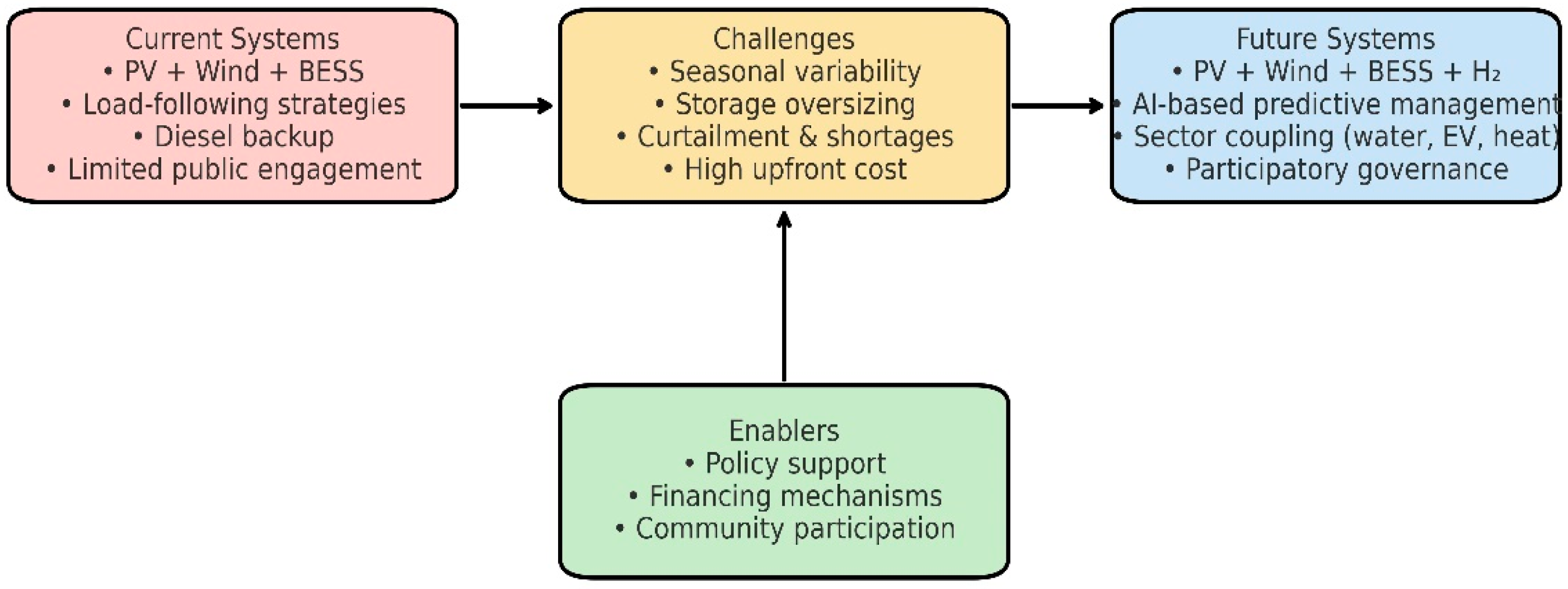
4.7. Synthesis
5. Social Acceptance and Participatory Planning
6. Discussion and Synthesis
6.1. Key Insights from Technical Perspectives
6.2. Comparative Lessons from Case Studies
6.3. Integration of Technological and Social Dimensions
6.4. Policy and Governance Implications
6.5. Outlook: Scientific Contributions, Research Gaps and a Roadmap
6.5.1. Scientific Contributions and Research Gaps
- AI-enabled energy management: Although simulation studies show substantial potential for predictive optimization [16], real-world pilot projects remain limited.
- Environmental trade-offs: Life cycle assessments of storage technologies (batteries, hydrogen systems) must be systematically integrated into techno-economic analyses to avoid unintended consequences. In the case of hydrogen, such evaluations should also account for specific technological constraints, including high-pressure or cryogenic storage requirements, energy losses in conversion cycles and potential safety and material handling challenges.
6.5.2. Toward a Roadmap for Resilient Island Transitions
- Technological innovation—scaling up hybrid systems with long-term storage, AI-enabled optimization and sector coupling.
- Institutional reform—adapting regulatory and financial frameworks to support decentralized and participatory models.
- Social engagement—embedding communities in the planning and governance of energy projects to ensure legitimacy and long-term viability.
7. Conclusions
Author Contributions
Funding
Institutional Review Board Statement
Informed Consent Statement
Data Availability Statement
Conflicts of Interest
References
- Ochoa-Correa, D.; Arévalo, P.; Martinez, S. Pathways to 100% renewable energy in island systems: A systematic review of challenges, solutions strategies and success cases. Technologies 2025, 13, 180. [Google Scholar] [CrossRef] [Scilit]
- Pires, V.F.; Pires, A.; Cordeiro, A. DC microgrids: Benefits, architectures, perspectives and challenges. Energies 2023, 16, 1217. [Google Scholar] [CrossRef] [Scilit]
- Giedraityte, A.; Rimkus, A.; Kliaugaite, D. Hybrid renewable energy systems: A review of optimization approaches and future challenges. Appl. Sci. 2025, 15, 1744. [Google Scholar] [CrossRef] [Scilit]
- Mehallou, A.; M’hamdi, B.; Amari, A.; Teguar, M.; Rabehi, A.; Guermoui, M.; Alharbi, A.H.; El-kenawy, E.-S.M.; Khafaga, D.S. Optimal multiobjective design of an autonomous hybrid renewable energy system in the Adrar Region, Algeria. Sci. Rep. 2025, 15, 4173. [Google Scholar] [CrossRef] [Scilit]
- Mishra, J.; Shankar, A. Optimizing wind-PV-battery microgrids for sustainable and resilient residential communities. Sci. Rep. 2025, 15, 24339. [Google Scholar] [CrossRef] [Scilit] [PubMed]
- Punitha, S.; Subramaniam, N.P.; Vimal Raj, P.A.D. A comprehensive review of microgrid challenges in architectures, mitigation approaches and future directions. J. Electr. Syst. Inf. Technol. 2024, 11, 60. [Google Scholar] [CrossRef] [Scilit]
- Guo, Z.; Wei, W.; Bai, J.; Mei, S. Long-term operation of isolated microgrids with renewables and hybrid seasonal-battery storage. Appl. Energy 2023, 349, 121628. [Google Scholar] [CrossRef] [Scilit]
- Ellis, G.; Schneider, N.; Wüstenhagen, R. Dynamics of social acceptance of renewable energy: An introduction to the concept. Energy Policy 2023, 181, 113706. [Google Scholar] [CrossRef] [Scilit]
- Menegatto, M.; Bobbio, A.; Freschi, G.; Zamperini, A. The social acceptance of renewable energy communities: The role of socio-political control and impure altruism. Climate 2025, 13, 55. [Google Scholar] [CrossRef] [Scilit]
- Chen, H.-C.; Liu, C.-W.; Hsu, Y.-C. Assessing the public’s social acceptance of renewable energy management in Taiwan. Land 2025, 14, 121. [Google Scholar] [CrossRef] [Scilit]
- Wang, Y.; Zhang, Z.; Liu, Y. Multi-objective optimal scheduling of islands considering offshore hydrogen production. Sci. Rep. 2025, 15, 5313. [Google Scholar] [CrossRef] [Scilit]
- Alturki, A.A.; Khosravi, A.; Alqahtani, A.; Alshammari, F. Optimal design for a hybrid microgrid–hydrogen storage facility in Saudi Arabia. Energy Sustain. Soc. 2022, 12, 31. [Google Scholar] [CrossRef] [Scilit]
- Khawaja, Y.; Qiqieh, I.; Alzubi, J.; Alzubi, O.; Allahham, A.; Giaouris, D. Design of cost-based sizing and energy management framework for standalone microgrid using reinforcement learning. Sol. Energy 2023, 251, 249–260. [Google Scholar] [CrossRef] [Scilit]
- Dbouk, H.M.; Chehimi, M.; Khalaf, A. Photovoltaic sizing using machine learning. Energy Rep. 2023, 9, 512–518. [Google Scholar] [CrossRef] [Scilit]
- Lyu, C.; Zhang, Y.; Bai, Y.; Yang, K.; Song, Z.; Ma, Y.; Meng, J. Inner-outer layer co-optimization of sizing and energy management for renewable energy microgrid with storage. Appl. Energy 2024, 363, 123066. [Google Scholar] [CrossRef] [Scilit]
- Durán, F.; Pavón, W.; Minchala, L.I. Forecast-Based Energy Management for Optimal Energy Dispatch in a Microgrid. Energies 2024, 17, 486. [Google Scholar] [CrossRef] [Scilit]
- Son, M.; Kim, M.; Kim, H. Sector Coupling and Migration towards Carbon-Neutral Power Systems. Energies 2023, 16, 1897. [Google Scholar] [CrossRef] [Scilit]
- Arévalo, P.; Benavides, D.; Ochoa-Correa, D.; Ríos, A.; Torres, D.; Villanueva-Machado, C.W. Smart Microgrid Management and Optimization: A Systematic Review Towards the Proposal of Smart Management Models. Algorithms 2025, 18, 429. [Google Scholar] [CrossRef] [Scilit]
- Skopetou, N.; Zestanakis, P.A.; Rotas, R.; Iliadis, P.; Papadopoulos, C.; Nikolopoulos, N.; Sfakianakis, A.; Koroneos, C. Energy analysis and environmental impact assessment for self-sufficient non-interconnected islands: The case of Nisyros Island. J. Clean. Prod. 2024, 447, 141647. [Google Scholar] [CrossRef] [Scilit]
- Tsiaras, E.; Andreosatou, Z.; Kouveli, A.; Tampekis, S.; Coutelieris, F.A. Off-Grid methodology for sustainable electricity in medium-sized settlements: The case of Nisyros Island. Clean Technol. 2025, 7, 16. [Google Scholar] [CrossRef] [Scilit]
- Meschede, H.; Bertheau, P.; Khalili, S.; Breyer, C. A review of 100% renewable energy scenarios on islands. WIREs Energy Environ. 2022, 11, e450. [Google Scholar] [CrossRef] [Scilit]
- Ouederni, R.; Davidson, I.E. Co-Optimized Design of Islanded Hybrid Microgrids Using Synergistic AI Techniques: A Case Study for Remote Electrification. Energies 2025, 18, 3456. [Google Scholar] [CrossRef] [Scilit]
- Said, T.R.; Kichonge, B.; Kivevele, T. Optimal design and analysis of a grid-connected hybrid renewable energy system using HOMER Pro: A case study of Tumbatu Island, Zanzibar. Energy Sci. Eng. 2024, 12, 1735. [Google Scholar] [CrossRef] [Scilit]
- Khamharnphol, R.; Kamdar, I.; Waewsak, J.; Chaichan, W.; Khunpetch, S.; Chiwamongkhonkarn, S.; Kongruang, C.; Gagnon, Y. Microgrid hybrid solar/wind/diesel and battery energy storage power generation system: Application to Koh Samui, Southern Thailand. Int. J. Renew. Energy Dev. 2023, 12, 216–226. [Google Scholar] [CrossRef] [Scilit]
- Thaler, B.; Posch, S.; Wimmer, A.; Pirker, G. Hybrid model predictive control of renewable microgrids and seasonal hydrogen storage. Int. J. Hydrogen Energy 2023, 48, 31677–31692. [Google Scholar] [CrossRef] [Scilit]
- Shezan Sk, A.; Ishraque, M.F.; Shafiullah, G.M.; Kamwa, I.; Paul, L.C.; Muyeen, S.M.; Nss, R.; Saleheen, M.Z.; Kumar, P.P. Optimization and Control of Solar–Wind Islanded Hybrid Microgrid Using Heuristic and Deterministic Optimization Algorithms and a Fuzzy Logic Controller. Energy Rep. 2023, 10, 3272–3288. [Google Scholar] [CrossRef] [Scilit]
- Barreto-Cuesta, A.; Zakaria, A.; Herrera-Perez, V.; Djokic, S.Z. Transition to a 100% renewable power supply in Galápagos Islands: Long-term and short-term analysis for optimal operation and sizing of grid upgrades. Renew. Energy 2024, 234, 121207. [Google Scholar] [CrossRef] [Scilit]
- Nogueira, T.; Jesus, J.; Magano, J. Graciosa Island’s hybrid energy system expansion scenarios: A technical and economic analysis. J. Sustain. Res. 2024, 6, 1574. [Google Scholar] [CrossRef] [Scilit]
- Superchi, F.; Bianchini, A.; Moustakis, A.; Pechlivanoglou, G. Toward sustainable energy independence: A case study of green hydrogen as seasonal storage integration in a small island. Renew. Energy 2025, 245, 122813. [Google Scholar] [CrossRef] [Scilit]
- Trapani, D.; Heggedal, A.M.; Løvås, T. The potential of hydrogen–battery storage systems for a sustainable renewable-based electrification of remote islands in Norway. J. Energy Storage 2024, 75, 109482. [Google Scholar] [CrossRef] [Scilit]
- Kwon, K.; Lee, H.-B.; Kim, N.; Park, S.; Joshua, S.R. Integrated battery and hydrogen energy storage for enhanced grid power savings and green hydrogen utilization. Appl. Sci. 2024, 14, 7631. [Google Scholar] [CrossRef] [Scilit]
- Singh, A.R.; Kumar, R.S.; Bajaj, M.; Khadse, C.B.; Zaitsev, I. Machine learning-based energy management and power forecasting in grid-connected microgrids with multiple distributed energy sources. Sci. Rep. 2024, 14, 19207. [Google Scholar] [CrossRef] [Scilit] [PubMed]
- Lim, S.; Lee, J.; Lee, S. Model predictive control-based energy management system for cooperative optimization of grid-connected microgrids. Energies 2025, 18, 1696. [Google Scholar] [CrossRef] [Scilit]
- Ahmad, S.; Al-Fuqaha, A.; Khan, M.; Rehman, S. A review of hybrid renewable and sustainable power systems: Sizing, optimization, control and energy management. Energies 2024, 17, 6027. [Google Scholar] [CrossRef] [Scilit]
- Hasani, A.; Rezaei, M. Enhancing microgrid performance with AI-based predictive control. IET Gener. Transm. Distrib. 2024, 18, 451–462. [Google Scholar] [CrossRef] [Scilit]
- Alotaibi, M.A.; Eltamaly, A.M. Upgrading Conventional Power System for Accommodating Electric Vehicle through Demand Side Management and V2G Concepts. Energies 2022, 15, 6541. [Google Scholar] [CrossRef] [Scilit]
- Eltamaly, A.M. Optimal Dispatch Strategy for Electric Vehicles in V2G Applications. Smart Cities 2023, 6, 3161–3191. [Google Scholar] [CrossRef] [Scilit]
- Cholidis, D.; Sifakis, N.; Chachalis, A.; Savvakis, N.; Arampatzis, G. Energy transition framework for nearly zero-energy ports: HRES planning, storage integration and implementation roadmap. Sustainability 2025, 17, 5971. [Google Scholar] [CrossRef] [Scilit]
- Saadha, A.; Ishihara, K.N.; Ogawa, T.; Basu, S.; Okumura, H. Techno-Economic Analysis of Combined Onshore Ocean Thermal Energy Conversion Technology and Seawater Air Conditioning in Small Island Developing States. Sustainability 2025, 17, 4724. [Google Scholar] [CrossRef] [Scilit]
- Stuhm, P.; Baumann, M.J.; Weil, M. Approaching social acceptance of energy technologies: Ten European papers showcasing statistical analyses—A targeted review. Energy Sustain. Soc. 2025, 15, 17. [Google Scholar] [CrossRef] [Scilit]
- De Simone, E.; Rochira, A.; Procentese, F. Psychological and social factors driving citizen involvement in Renewable Energy Communities: A systematic review. Energy Res. Soc. Sci. 2025; Advance online publication. [CrossRef] [Scilit]
- Holdmann, G.; Pride, D.; Poelzer, G.; Noble, B.; Walker, C. Critical Pathways to Renewable Energy in Remote Communities: A Comparative Analysis of Renewable Energy Transitions in Alaska. Energy Res. Soc. Sci. 2022, 90, 102712. [Google Scholar] [CrossRef] [Scilit]
- Hu, J.-L.; Yang, P.-S. Interactive cycles between energy education and energy preferences: A literature review on empirical evidence. Energies 2024, 17, 5092. [Google Scholar] [CrossRef] [Scilit]



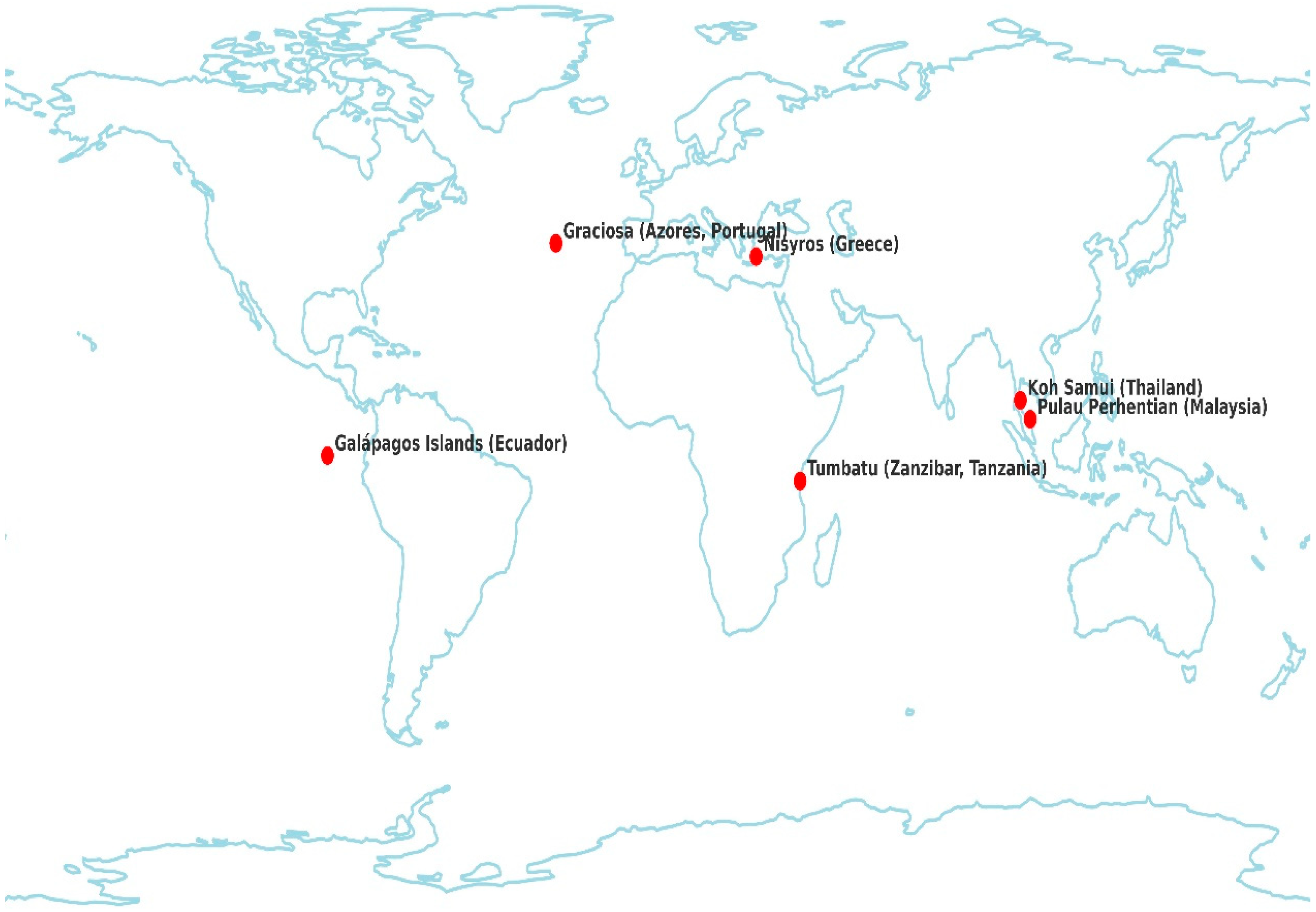
| Island Case (Ref) | Region | System/Grid Status | Population | Demand Context |
|---|---|---|---|---|
| Nisyros, Greece [19,20] | Europe (Aegean) | Non-interconnected/autonomous | NR (not quantified) | NR (not quantified) |
| Tumbatu, Zanzibar [23] | East Africa | Grid-connected | NR (not quantified) | NR (not quantified) |
| Koh Samui, Thailand [24] | SE Asia | Island system (diesel-hybrid) | NR (not quantified) | Tourism-driven seasonality (qualitative) |
| Pulau Perhentian, Malaysia [26] | SE Asia | Islanded microgrid | NR (not quantified) | NR (not quantified) |
| Galápagos (Baltra–Santa Cruz), Ecuador [27] | Latin America | Grid-connected island system | NR (not quantified) | NR (not quantified) |
| Graciosa, Azores [28] | Europe (Azores) | Island hybrid system | NR (not quantified) | NR (not quantified) |
| Aspect/Component | Current Systems (2022–2025) | Future Systems (Next-Generation) |
|---|---|---|
| Core renewable generation mix | PV + Wind | PV + Wind (enhanced) |
| Energy storage | BESS | BESS + Green Hydrogen (seasonal storage via electrolysis & fuel cells) |
| Operational horizon | Short-term balancing (daily–weekly) | Long-term balancing (seasonal–annual) |
| Energy management | Basic load-following and curtailment strategies | AI-based forecasting, predictive dispatch, real-time optimization |
| Resilience to variability | Moderate (weather-dependent, battery-limited) | High (multi-layered storage: batteries + hydrogen buffer) |
| Grid architecture | Simple microgrid/islanded | Smart microgrid with sector coupling (electricity–heat–mobility) |
| Social dimension | Limited public engagement | Participatory planning, co-ownership, improved social acceptance |
| Main challenges | Cost of storage, intermittency, space constraints | Hydrogen infrastructure, safety protocols, policy support |
| Technology maturity (indicative) | PV/Wind/BESS: mature | Hydrogen chain & advanced AI control: emerging-to-maturing (context-dependent) |
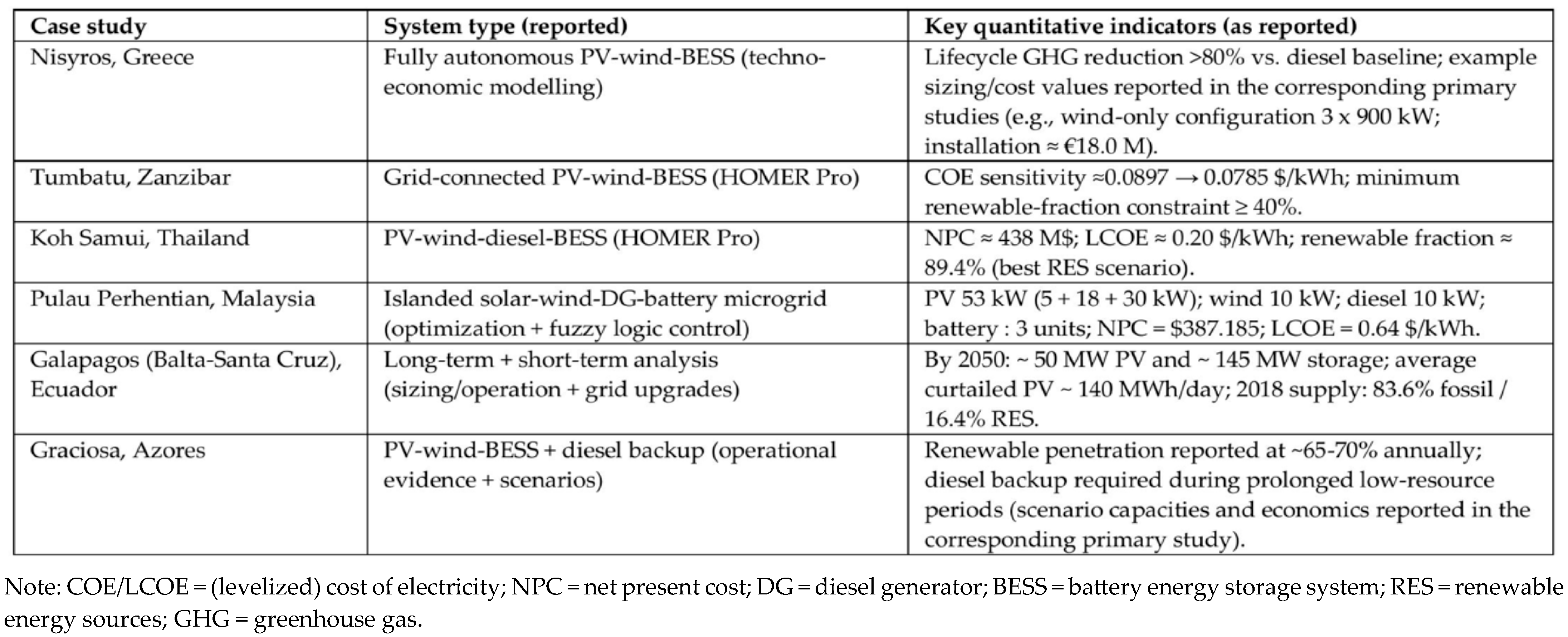
| Case Study (Ref) | System Type (Reported) | Key Reported Quantitative Indicators (Examples) |
|---|---|---|
| Nisyros, Greece [19,20] | Fully autonomous PV–wind–BESS (techno-economic modeling) | Example sizing/cost reported (e.g., wind-only: 3 × 900 kW; installation ≈ €18.0 M; overall lifecycle costs reported); lifecycle GHG reduction > 80% vs. diesel baseline (reported). |
| Tumbatu, Zanzibar [23] | Grid-connected PV–wind–BESS (HOMER Pro) | COE sensitivity ≈ 0.0897 → 0.0785 $/kWh; minimum renewable-fraction constraint ≥ 40%. |
| Koh Samui, Thailand [24] | PV–wind–diesel–BESS (HOMER Pro) | NPC ≈ 438 M$; LCOE ≈ 0.20 $/kWh; renewable fraction ≈ 89.4% (best RES scenario). |
| Pulau Perhentian, Malaysia [26] | Islanded solar–wind–DG–battery microgrid (optimization + fuzzy logic control) | PV 53 kW (5 + 18 + 30 kW); wind 10 kW; diesel 10 kW; battery 3 units; NPC = $387,185; LCOE = 0.64 $/kWh. |
| Galápagos (Baltra–Santa Cruz), Ecuador [27] | Long-term + short-term analysis for sizing/operation (grid upgrades) | By 2050: ~50 MW PV and ~145 MW storage; average curtailed PV~140 MWh/day; 2018 supply: 83.6% fossil/16.4% RES, LCOE/COE not reported |
| Graciosa, Azores [28] | PV–wind–BESS + diesel backup (operational + scenarios) | Key quantitative indicators (e.g., RES share, LCOE/NPC, capacities not reported. |
| Governance Risk/Conflict Source | Typical Manifestation in Island Contexts | Mitigation/Operational Implication |
|---|---|---|
| Representation & legitimacy | Competing claims about “who represents the community”; exclusion of less vocal groups; consultation perceived as symbolic | Formal governance structure (statutes, voting rules), documented consultation, grievance mechanism; improves procedural legitimacy and reduces delays |
| Benefit-sharing disputes | Disputes over bill-credit allocation, local jobs, land rents, or priority connection; perceptions of unfairness | Transparent benefit-sharing rules, local reinvestment fund, clear eligibility criteria; reduces opposition and strengthens long-term acceptance |
| Incumbent interests/lock-in | Resistance from actors benefiting from diesel supply chains, existing contracts, or local patronage networks | Transition plan with staged hybridization, local procurement and reskilling; reduces political blockage and improves implementation feasibility |
| Permitting & land-use politics | Siting decisions become politically contested; informal veto points emerge late in the process | Early stakeholder mapping, transparent siting criteria, conflict-sensitive engagement; avoids late-stage stoppages/cost overruns |
| Tariffs, settlement & grid-rule uncertainty | Unclear REC revenue model; changing net-metering/settlement rules; disputes with the system operator | Early regulator engagement, standardized contracts, clear settlement rules; increases bankability and reduces regulatory risk |
| O&M responsibility ambiguity | Unclear “who maintains what” (BESS, inverters, meters); delays in repairs due to logistics | Explicit O&M responsibilities (SLA), spare-part strategy, local technician training; improves uptime and reliability |
| Data transparency & trust | Mistrust regarding metering, curtailment decisions, or dispatch priorities; accusations of manipulation | Monitoring transparency (dashboard), independent auditing, clear curtailment rules; reduces conflict during operation |
| Distributional impacts | Concentration of benefits to certain villages/landowners; perceived winners/losers | Equity screening, targeted compensatory measures, inclusive co-ownership options; improves distributional justice and social stability |
| Participation fatigue & timeline mismatch | Repeated meetings without real influence; community disengagement and backlash | Co-design with decision power, realistic timelines, feedback loops (“you said—we did”); sustains engagement and improves acceptance |
| External developer dependence | Reliance on external EPC/consultants; limited local capacity; vulnerability after commissioning | Capacity-building plan, local governance support, knowledge transfer; strengthens institutional capacity and long-term operability |
| Feasibility Lens | What to Specify/Check (Island Constraints & Barriers) | Decision-Relevant Metrics to Report/Benchmark |
|---|---|---|
| Adequacy problem definition | Identify whether the main challenge is multi-day vs. multi-week/seasonal deficits; account for tourism-driven peaks, critical loads (hospital, water, telecom) and minimum reliability targets. | Peak-to-average demand ratio; demand seasonality index; loss-of-load expectation (LOLE)/unserved energy (EENS); reserve margin; critical-load coverage (%) |
| Core benchmarking framework | Ensure cross-study comparability by reporting the same set of performance/cost indicators across scenarios and islands. | Renewable fraction/renewable share (%); curtailment rate (% or MWh); diesel runtime (h/yr) and starts (#/yr); NPC; LCOE/COE; lifecycle emissions (tCO2e/yr or tCO2e/kWh) |
| Hydrogen (H2) boundary conditions | Assess minimum viable scale, siting and logistics; verify safety/permitting, required setbacks and technical capacity for O&M; check water availability/treatment; plan staged deployment with BESS (short-term) + H2 (long-duration). | Long-duration storage need (days of autonomy); electrolyser/fuel-cell utilization (%); H2 round-trip efficiency (%); storage capacity (kg or MWh-equivalent); delivered cost sensitivity (CAPEX/OPEX scenario ranges); safety compliance readiness (qualitative checklist) |
| AI-enabled EMS prerequisites | Confirm enabling infrastructure: metering/SCADA coverage, data resolution, communications reliability, cybersecurity and operator training; define fallback dispatch if AI fails; benchmark against robust baselines (rule-based/MPC). | Data granularity (min); sensor coverage (% assets metered); communication uptime (%); cyber-resilience controls (checklist); forecasting error (MAPE/RMSE); improvement vs. baseline (Δcurtailment, Δdiesel runtime, ΔLCOE, ΔEENS) |
| Sector coupling constraints (e-heat–mobility–water) | Evaluate grid hosting capacity, space constraints, port/charging infrastructure, desalination scheduling feasibility, tariff design and social acceptance of flexible demand; ensure governance alignment (ownership, permits). | Hosting capacity (kW/MW); flexible load potential (kWh/day); EV penetration and controllable charging (%); V2G availability (% EVs, hours); desalination load shift (kWh shifted); acceptance indicators (stakeholder readiness/participation model) |
| Policy Archetype (Typical Context) | Regulatory Actions (Implementation Steps and Sequencing) | Financing Pathway (Instruments + Sequencing) |
|---|---|---|
| A. Regulated utility-led island system (single utility/DSO; vertically integrated) | (1) Clarify legal status of microgrids/HRES and islanded operation; define technical codes and responsibilities. (2) Establish transparent dispatch and curtailment rules and settlement for distributed assets. (3) Standardize procurement templates (PPA/availability contracts) and O&M service-level agreements. (4) Where relevant, adopt EV charging/V2G rules and cybersecurity/data requirements for EMS/SCADA. | (1) Utility-led procurement with performance-based requirements (targets for curtailment, diesel runtime, reliability). (2) Layer capex support (grants/concessional loans) for first deployments. (3) Use guarantees/risk-sharing for storage and long-duration assets. (4) Include lifecycle budgeting (replacement reserve/spares/training) in tariffs/contracts. |
| B. Liberalized/market-based setting (IPPs; competitive procurement; clearer market signals) | (1) Define routes for procuring flexibility/ancillary services from storage and demand response. (2) Enable aggregators for controllable EV charging and flexible loads. (3) Implement connect-and-manage/hosting-capacity rules to streamline grid integration. (4) Set minimum requirements for metering, data access and cyber resilience for EMS. | (1) Competitive tenders/auctions for HRES capacity plus flexibility (e.g., CfD/availability payments). (2) Blended finance targeted to first-of-a-kind pilots (hydrogen, advanced EMS) rather than mature components. (3) Results-based payments tied to verified diesel displacement/reliability (where feasible). |
| C. Capacity-constrained context (SIDS/emerging systems; limited institutions and fiscal space) | (1) “Minimum viable regulation”: allow microgrids, clarify ownership/REC rights, adopt basic safety and permitting rules. (2) One-stop permitting and transparent siting criteria to cut transaction costs. (3) Auditable metering and transparency rules to build trust and reduce operational disputes. | (1) Blended finance stack (grant + concessional debt + guarantees) for capex-heavy assets. (2) Revolving/community funds or on-bill mechanisms to enable participation and reduce upfront barriers. (3) Staged sequencing: BESS + monitoring → EMS upgrades → sector coupling → hydrogen only when seasonal adequacy evidence justifies it. |
| Cross-cutting (all archetypes) | Streamlined permitting, standardized contracts, clear O&M responsibilities, transparency for curtailment/dispatch decisions and social-acceptance/benefit-sharing requirements embedded in procurement. | Pair capex support with performance-linked OPEX incentives; require lifecycle provisions (replacement/spares/training) and governance readiness (REC rules, dispute resolution). |
Disclaimer/Publisher’s Note: The statements, opinions and data contained in all publications are solely those of the individual author(s) and contributor(s) and not of MDPI and/or the editor(s). MDPI and/or the editor(s) disclaim responsibility for any injury to people or property resulting from any ideas, methods, instructions or products referred to in the content. |
© 2025 by the authors. Licensee MDPI, Basel, Switzerland. This article is an open access article distributed under the terms and conditions of the Creative Commons Attribution (CC BY) license (https://creativecommons.org/licenses/by/4.0/).
Share and Cite
Tsiaras, E.; Coutelieris, F.A. Future Directions of Hybrid Off-Grid Renewable Energy Systems for Remote Islands. Energies 2025, 18, 6524. https://doi.org/10.3390/en18246524
Tsiaras E, Coutelieris FA. Future Directions of Hybrid Off-Grid Renewable Energy Systems for Remote Islands. Energies. 2025; 18(24):6524. https://doi.org/10.3390/en18246524
Chicago/Turabian StyleTsiaras, Evangelos, and Frank A. Coutelieris. 2025. "Future Directions of Hybrid Off-Grid Renewable Energy Systems for Remote Islands" Energies 18, no. 24: 6524. https://doi.org/10.3390/en18246524
APA StyleTsiaras, E., & Coutelieris, F. A. (2025). Future Directions of Hybrid Off-Grid Renewable Energy Systems for Remote Islands. Energies, 18(24), 6524. https://doi.org/10.3390/en18246524