Intelligent Fault Diagnosis for HVDC Systems Based on Knowledge Graph and Pre-Trained Models: A Critical and Comprehensive Review


Abstract
1. Introduction
2. Review Screening Methods
3. Fault Diagnosis in HVDC Systems: Current Landscape
3.1. Common Failure Types and Characteristics
3.1.1. Grounding Faults on the Valve Side of Converter Transformers
3.1.2. Interphase Short-Circuit Fault at Converter Transformer Valve Side
3.1.3. Converter Valve Arm Short-Circuit Faults
3.1.4. Faults in Converter Valve Groups
3.2. Traditional Fault Diagnosis Methods
3.2.1. Grounding Faults on the Valve Side
3.2.2. Interphase Short-Circuit Faults
3.2.3. Converter Valve Arm Short-Circuit Faults
3.2.4. Converter Valve Group Faults
3.3. Development of Intelligent Fault Diagnostics
3.3.1. Adaptability to Uncertainty and Noise
3.3.2. Handling Non-Linearity and Complex Patterns
3.3.3. Data-Driven Modeling and Generalization
3.3.4. Integration and Real-Time Capability
4. KG Application in HVDC Fault Diagnosis
4.1. Basic Concepts of KGs
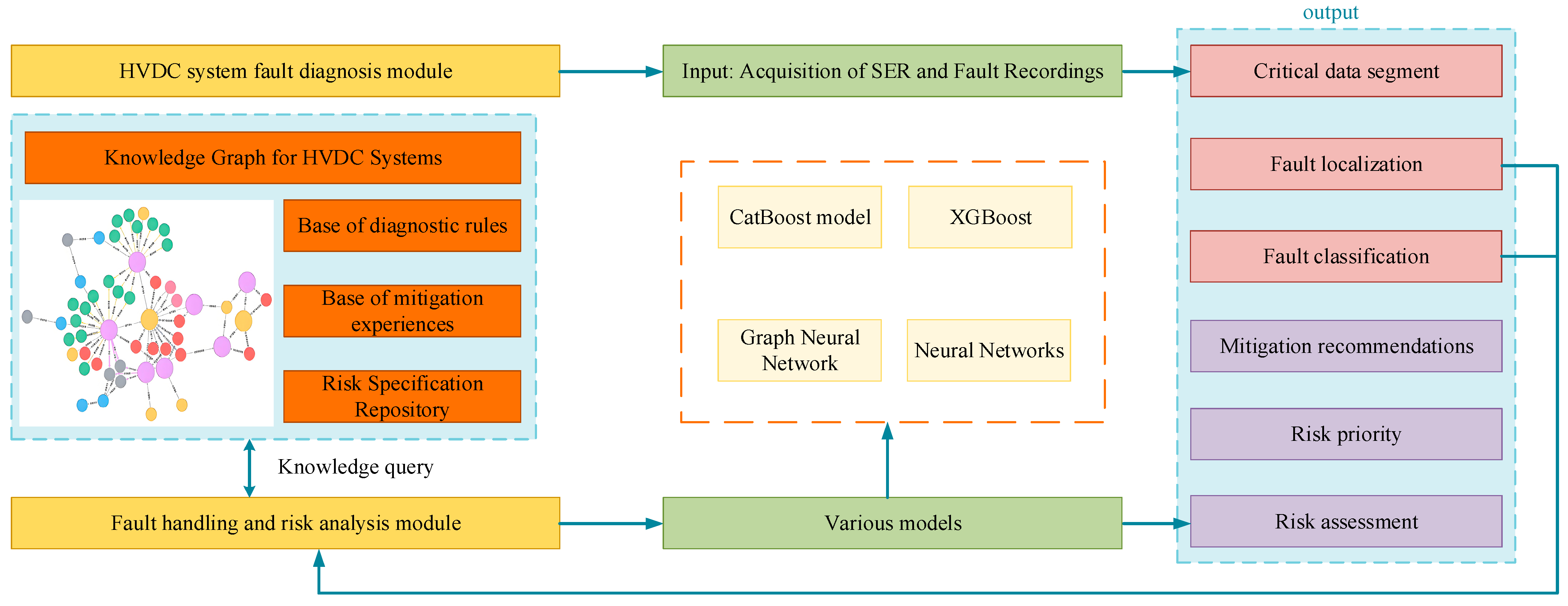
4.2. Construction of a KG in HVDC Transmission System
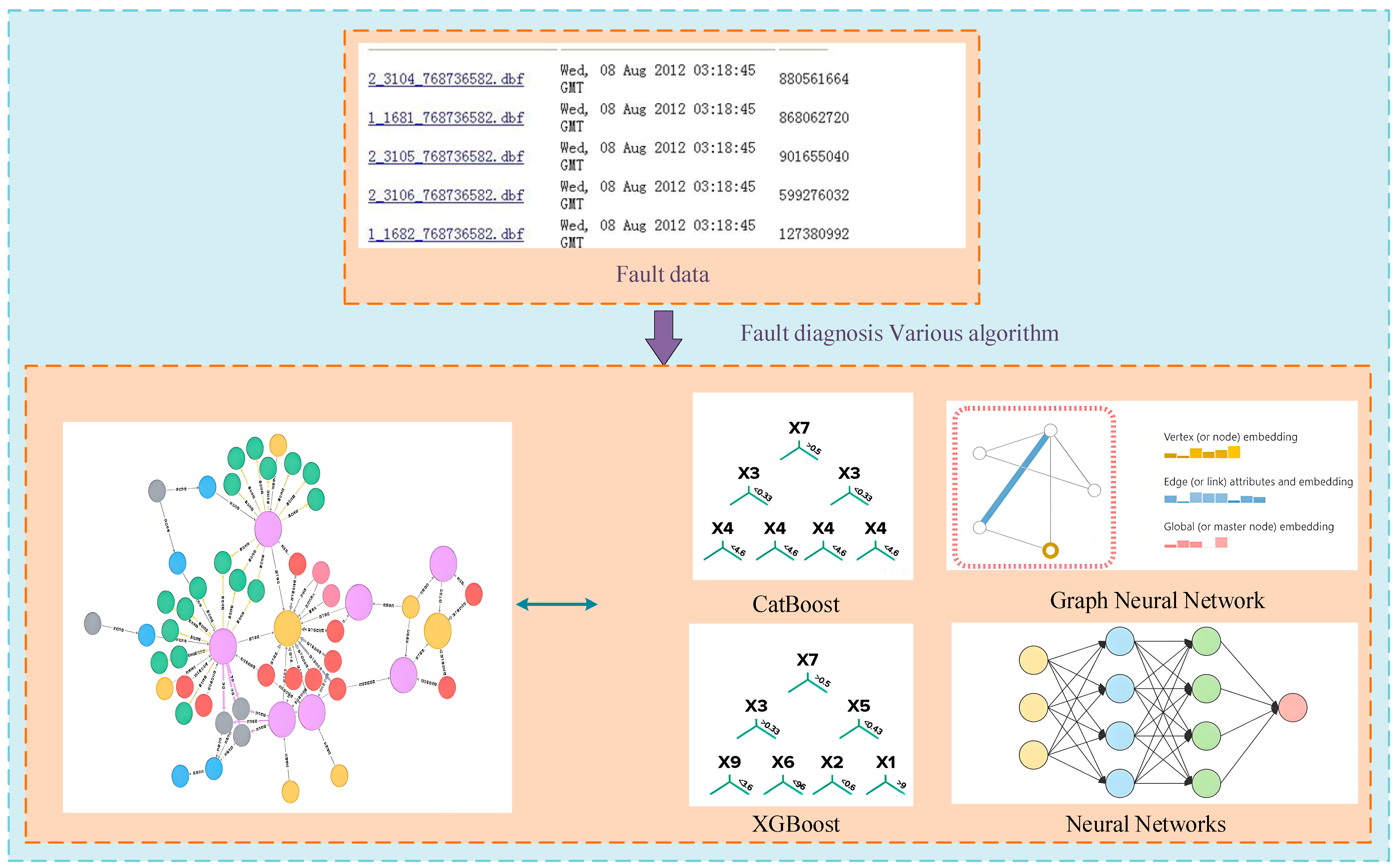
4.3. The Application of KGs in Fault Diagnosis
5. Pre-Trained Models for Enhanced Fault Diagnosis
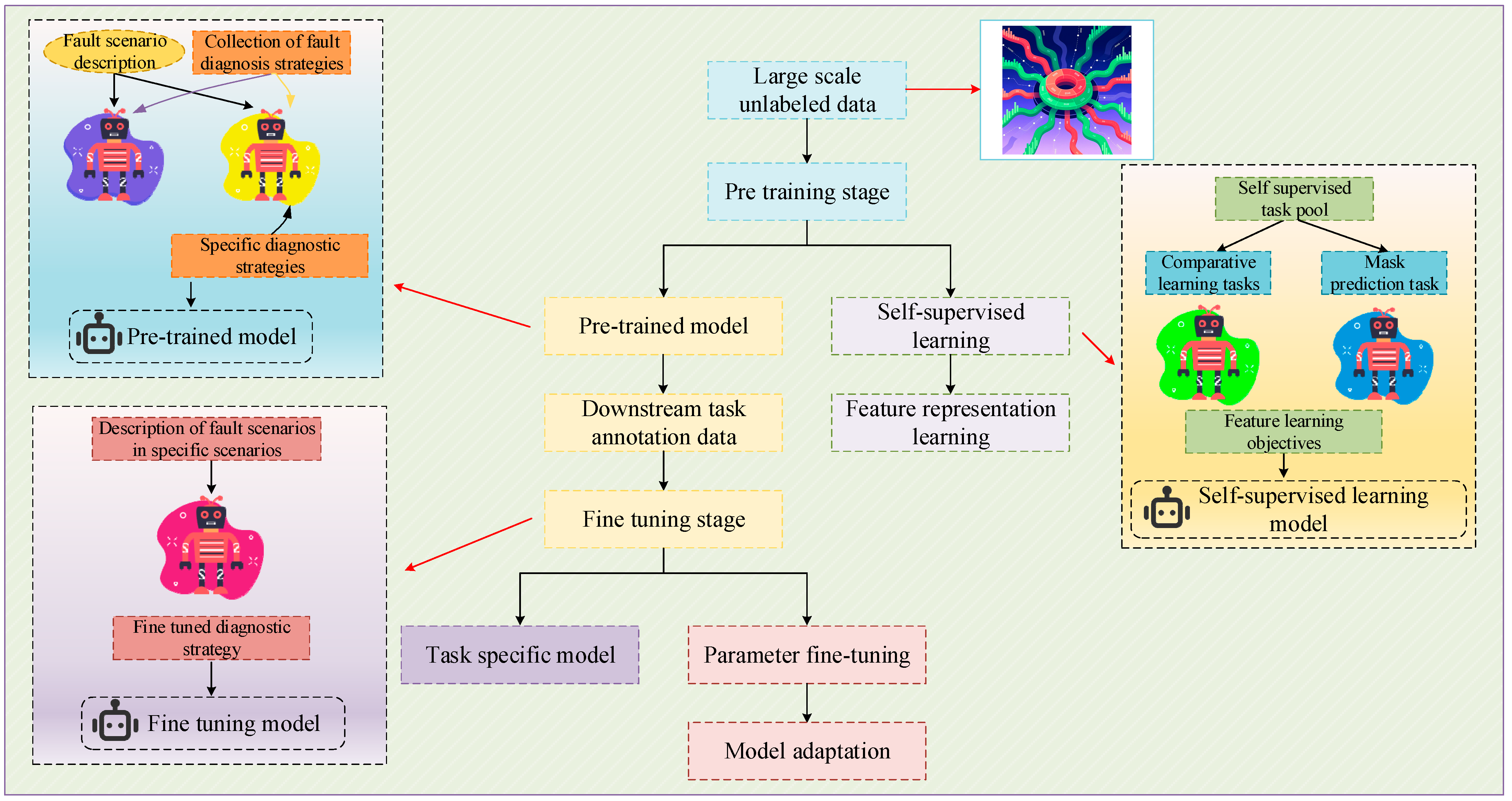
5.1. Basic Concepts of PTMs
5.2. PTM Adapted to Power Scenario Analysis
6. Fusion of KG and PTM for HVDC Fault Diagnosis
6.1. KG and PTM Collaborative Mechanism
6.2. Key Technologies for Intelligent Fault Diagnosis
6.2.1. Collaborative Perception-Cognition Mechanism
- KGs as the cognitive core: KGs perform logical reasoning based on topological constraints and fault evolution patterns, contextualizing PTM-extracted features [93].
- Synergistic benefit: This mechanism enhances diagnostic accuracy by combining data-driven sensitivity with knowledge-driven interpretability. The cross-modal attention mechanism (Equation (4)) optimizes the alignment between fault features and knowledge entities [94].
6.2.2. Dynamic Knowledge Evolution Framework
- Automated knowledge extraction: PTMs automate the extraction of entities and relationships from unstructured text or sensor data when new fault events occur.
- Bidirectional flow: The KG guides PTM training via structured prompts, while PTMs facilitate dynamic KG updates, ensuring the system evolves with operational data.
6.2.3. Multi-Modal Data Fusion and Reasoning
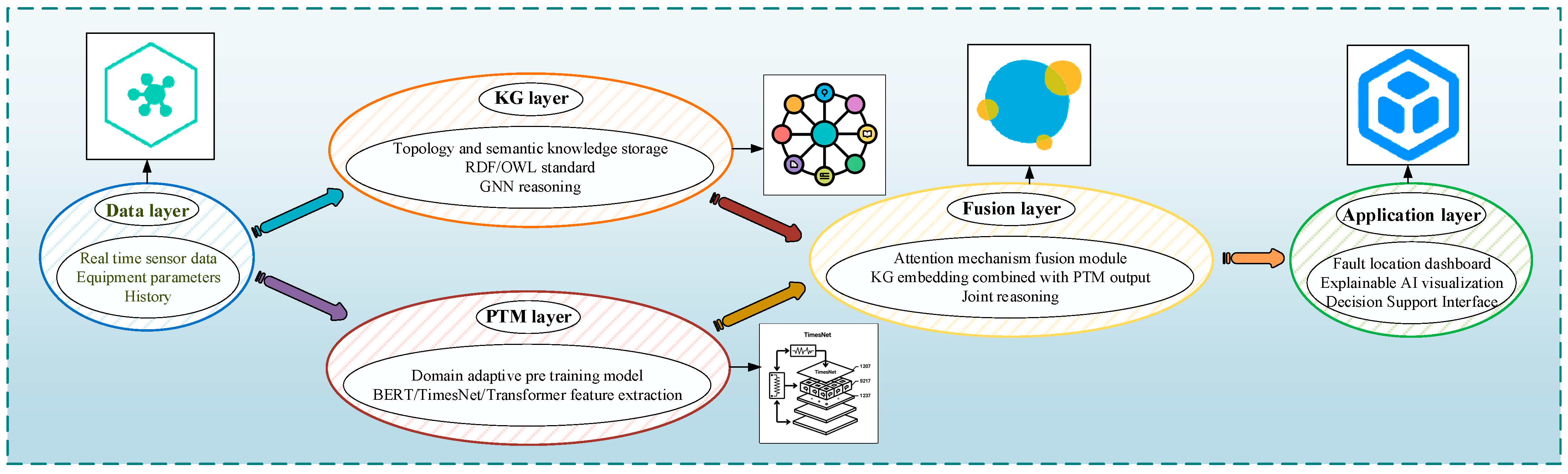
6.3. Implementation Architecture
- Data layer: This foundational layer is responsible for aggregating and preprocessing heterogeneous data from various sources, including
- (1)
- SCADA time-series data (compliant with IEEE C37.118 protocol).
- (2)
- Sequence of Events Records (SER logs) in JSON format.
- (3)
- Unstructured maintenance reports and technical documentation. The primary function here is to ensure data quality, consistency, and format standardization for subsequent processing.
- KG layer and PTM layer (parallel processing paths): These two layers operate in parallel to handle knowledge and data, respectively:
- (1)
- The KG layer organizes structured knowledge (e.g., equipment parameters, fault evolution patterns) into a graph database (e.g., Neo4j), enabling logical reasoning and topological queries.
- (2)
- The PTM layer utilizes pre-trained models (e.g., fine-tuned RoBERTa, CNN-BiLSTM) to extract deep semantic features from the unstructured data processed by the Data Layer.
- Fusion layer: This is the critical integration point where the outputs from the KG and PTM layers are synergistically combined. An attention-based mechanism (as formulated in Equation (4) of the manuscript) dynamically weighs and aligns the data-driven features from the PTM with the symbolic entities and relationships from the KG, generating a unified, enhanced representation for diagnosis.
- Application layer: The top layer translates the fused insights into practical diagnostic applications. It supports functions such as
- (1)
- Fault identification and localization.
- (2)
- Root cause analysis with causal path visualization.
- (3)
- Generation of interpretable diagnostic reports and maintenance recommendations.
6.4. Fault Diagnosis Process
- Unifying data processing and knowledge reasoning, unlike traditional isolated methods;
- Enabling traceability across all diagnostic stages;
- Supporting dynamic evolution through continuous KG-PTM interaction;
- Providing interpretable decisions by combining symbolic reasoning with semantic understanding.
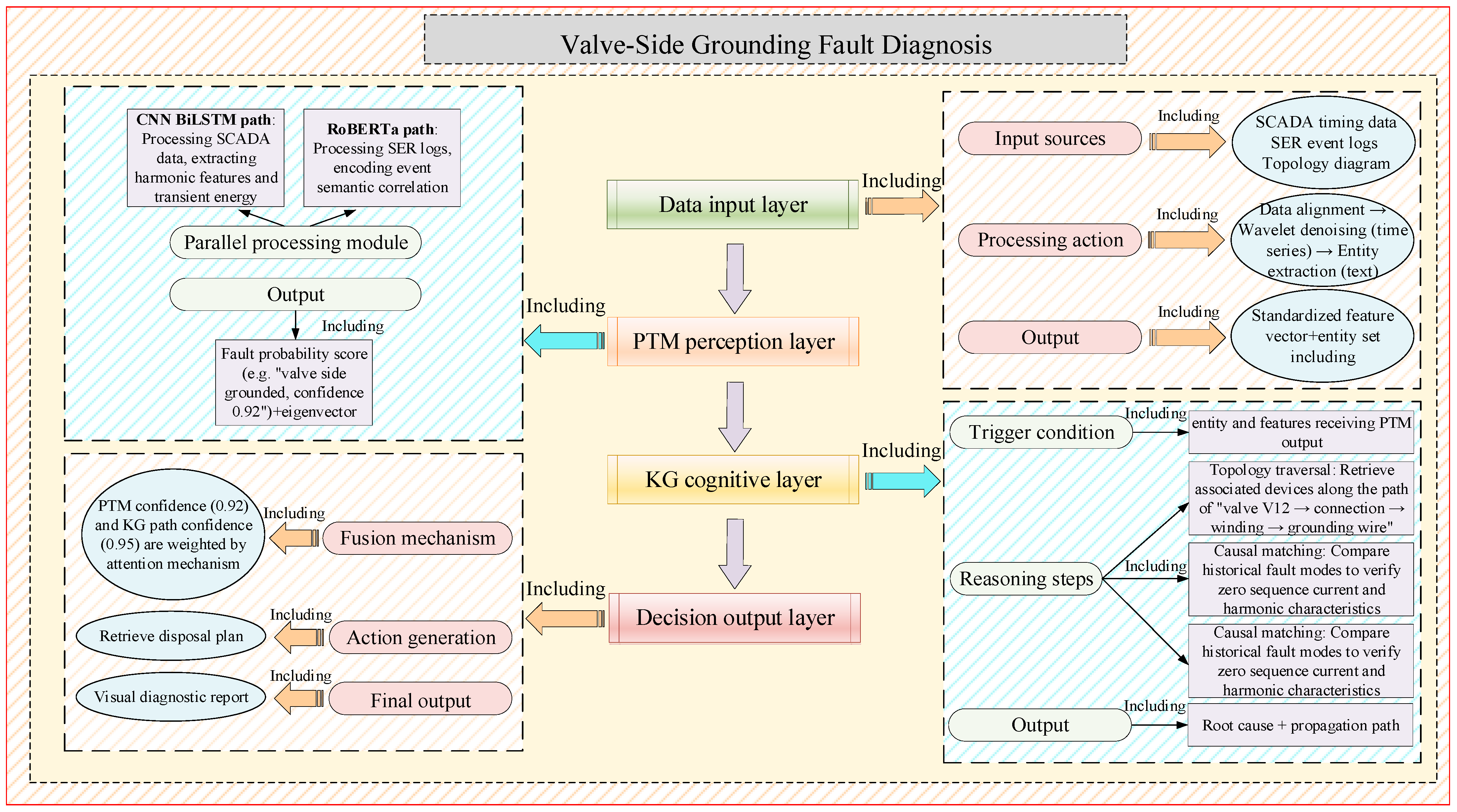
6.5. End-to-End Case Study: Valve-Side Grounding Fault Diagnosis
6.6. Standardized Evaluation Framework
6.6.1. Core Evaluation Indicator System
6.6.2. Standard Test Scenario Design
7. Challenges and Future Perspectives
7.1. Existing Challenges
- Low automation in knowledge acquisition and updating remains a primary barrier to achieving dynamic intelligent operation and maintenance. Currently, KG construction still heavily relies on expert experience and manual rules, making the process labor-intensive and costly. Although efforts have been made to automatically extract knowledge from unstructured texts such as maintenance reports and defect records, performance remains limited, especially when dealing with colloquial or non-standard technical language. This hinders the real-time and dynamic updating of KGs, leading to potential knowledge lag or obsolescence.
- Deep integration of physical mechanisms and data-driven models is still challenging. The operation of HVDC systems is governed by complex physical laws such as electromagnetic transients. However, existing KGs and PTMs are primarily data-driven and lack effective modeling of physical constraints. A key research difficulty lies in embedding prior knowledge, such as differential equations or physical rules-into graph reasoning and model training processes in a deeply coupled and interpretable manner, rather than through superficial hybridization. Models lacking physical consistency may produce physically implausible outputs under extreme or unseen conditions, potentially compromising system safety.
- Computational complexity is a key bottleneck in the actual deployment of KG-PTM systems. The PTM inference process (such as CNN based SCADA data processing [66]) relies heavily on matrix operations, making it difficult to meet the real-time requirements of relay protection systems for millisecond-level response on edge devices [70]; At the same time, KG’s real-time graph query and inference operations (such as shortest path search) grow exponentially with the number of nodes. When the system expands to thousands of nodes, inference delays may exceed seconds and cannot support online decision-making. In addition, the joint training of KG and PTM requires multiple iterations for knowledge embedding and parameter tuning, and the dependence on hardware resources (such as multi GPU clusters) also limits its popularity in small and medium-sized substations. Therefore, achieving lightweight edge deployment through techniques such as model compression, knowledge distillation, and neural architecture search while ensuring minimal performance degradation, balancing computational efficiency and real-time performance, has become an important technical challenge currently faced.
- The absence of authoritative benchmarks and trustworthy evaluation frameworks hinders technological progress and standardization. Currently, HVDC fault diagnosis domain lacks widely recognized benchmark datasets that cover diverse scenarios with high-quality annotations, as well as unified evaluation metrics. This makes fair and objective comparison between different models difficult, leading to redundant development and isolated research efforts. Moreover, studies on model trustworthiness, including uncertainty quantification, robustness against adversarial attacks, and failure modes under extreme conditions, remain insufficient. There is still a long way to go before building an AI system that is both explainable and trustworthy for practical operation and maintenance personnel.
7.2. Future Prospects
- Development of automated and self-evolving knowledge bases. To overcome the reliance on manual efforts for knowledge acquisition and updates, future work should vigorously develop automated knowledge engineering based on large language models (LLMs). By utilizing instruction-fine-tuned LLMs as domain knowledge experts, entities and relationships can be automatically and continuously extracted from massive unstructured operational reports, research literature, and equipment manuals, while performing logical validation and conflict resolution on existing knowledge. This will transform KGs from static, manually maintained databases into living knowledge systems with “self-learning, self-verifying, and self-evolving” capabilities that dynamically track system changes and provide real-time, accurate knowledge support for intelligent maintenance. To achieve closed-loop collaboration, dynamic adaptation issues need to be addressed: the incremental learning of PTM (such as EWC algorithm [66]) needs to be synchronized with the real-time updates of KG (such as stream graph processing [83]) to avoid cognitive bias. For example, when the system expands and adds a converter valve, PTM needs to recalibrate the feature extractor, while KG needs to synchronously expand the topology entity. The two ensure consistency through version control protocols (such as Git style management [42]). In extreme scenarios, collaborative mechanisms also need to introduce uncertainty quantification (such as Monte Carlo Dropout [70]) to assess decision risk.
- Exploration of PTMs deeply integrated with simulation and physical information. Bridging the gap between data-driven learning and physical modeling, physics-informed pre-trained models (PI-PTMs) represent a key research direction. Research should focus on embedding physical laws (such as electromagnetic transient equations) and mathematical constraints describing HVDC system dynamics into PTM training objectives and reasoning processes as differentiable regularization terms or hard constraints. This will give rise to a new generation of AI that possesses both powerful representation capabilities from data-driven models and strict adherence to physical principles-creating “physics-aware AI” that significantly enhances extrapolation generalization and decision reliability under extreme conditions and small-sample scenarios, producing results that are not only accurate but also physically plausible.
- Research on novel model architectures and efficient computing paradigms. To balance model performance with power system real-time requirements, innovations are needed at both the model and computational architecture levels. At the model level, new architectures better suited for power time-series graph data characteristics, such as graph transformers, should be designed to handle coupled graph-structured and temporal dependencies efficiently. At the computing level, federated learning and cloud–edge collaborative architectures offer promising paradigms for distributed model training, ensuring data privacy and security while maximizing the value of heterogeneous operational data. These innovations will enable scalable, low-latency AI deployment in real-world HVDC environments.
- Promotion of standards development and trustworthy AI research. To foster a sustainable research ecosystem and build operational trust, efforts on standards development and trustworthy AI are essential. The urgent priority is to collaborate with industry and academia to promote the establishment of open, comprehensive HVDC domain benchmark datasets covering diverse fault scenarios and unified evaluation platforms, providing a fair measuring stick for technological development. Simultaneously, in-depth research on model uncertainty quantification, explainable AI (XAI), and adversarial robustness must be conducted, enabling models to not only output diagnostic results but also indicate decision confidence levels, provide clear reasoning paths, and withstand potential data disturbances. This represents the necessary pathway for advancing intelligent maintenance systems from usable to trustworthy and reliable, ultimately achieving comprehensive implementation.
- Due to the challenges of data privacy, resource constraints, and integration of heterogeneous data from multiple sources in the current independent construction of large-scale real datasets, we will include a layered promotion plan in our future outlook.
- (1)
- Phase 1: benchmark development and synthetic data generation (short term: 1–2 years)
- Objective: To establish a foundational, reproducible benchmark for initial algorithm development and validation in the absence of large-scale real-world data.
- Core activities:
- ▪
- Utilize high-fidelity simulation tools (e.g., PSCAD/EMTP) to generate comprehensive synthetic datasets based on the CIGRE standard model and defined fault types (e.g., valve-side grounding, phase-to-phase short circuit).
- ▪
- Develop and publish standardized evaluation metrics (e.g., F1 score, detection delay, confidence calibration error) and testing scenarios (e.g., single-fault benchmark, composite fault resilience testing).
- Expected outcome: An open-source, synthetic benchmark dataset that enables fair comparison of different KG-PTM algorithms, addressing the initial data scarcity issue.
- (2)
- Phase 2: federated learning and trusted data alliance (mid term: 2–4 years)
- Objective: To enable knowledge learning from real operational data while strictly preserving data privacy and security, moving from simulation to real-world validation.
- Core activities:
- ▪
- Initiate a data alliance jointly with industry organizations.
- ▪
- Implement privacy-preserving technologies such as federated learning, data anonymization, and trusted execution environments (TEEs) to allow model training across multiple utilities without sharing raw data.
- ▪
- Establish protocols for restricted, privacy-compliant access to real fault records.
- Expected outcome: An operational framework for secure multi-party collaboration, leading to KG-PTMs validated on real-world, distributed data, significantly enhancing model practicality and robustness.
- (3)
- Phase 3: Standardization and Industrial Deployment (Long term: 4+ Years)
- Objective: To transition the validated KG-PTM framework into industrial standards and widely deployable tools, ensuring interoperability and long-term sustainability.
- Core activities:
- ▪
- Promote international bodies (e.g., IEC or CIGRE) to take the lead in developing international benchmark protocols.
- ▪
- Focus on creating standards for data formats, model interfaces, and evaluation procedures.
- ▪
- Foster the development of commercial-grade software platforms and integration guides for utility adoption.
- Expected outcome: Widespread industry adoption of KG-PTM-based diagnostic systems, supported by international standards, achieving the ultimate goals of technical comparability, model interpretability, and reliable industrial implementation.
8. Conclusions
- The effectiveness of the technical integration is fully demonstrated. The fusion of KGs and PTMs is not a superficial combination but achieves deep cognitive and perceptual complementarity. KGs provide a structured semantic network, endowing fault diagnosis with explainable logical reasoning capabilities, for instance, by dynamically representing system topology and fault evolution patterns to enable transparent root cause analysis. PTMs, leveraging large-scale pre-training, can efficiently extract deep features from multi-source heterogeneous data. This synergistic mechanism significantly enhances diagnostic accuracy and timeliness.
- The synergistic mechanism effectively addresses key industry challenges. In the context of intelligent HVDC maintenance, the fusion of KG and PTM effectively tackles key challenges such as data silos, feature extraction complexity, temporal reasoning, and knowledge application. Specifically, PTMs act as the perceptual front-end, automatically identifying anomaly patterns in real-time sensor data, while KGs serve as the cognitive core, performing contextual reasoning through entity relationship mapping and historical fault case analysis. For example, when a PTM detects abnormal current harmonics, the KG can rapidly correlate device topology and fault causality paths, achieving precise fault localization and transparent decision-making. The actual effectiveness of the collaborative mechanism has been verified in empirical research: in a mixed DC engineering case [70], PTM (CNN model) increased the fault detection F1 score to 92.5%, while KG’s causal reasoning reduced the false alarm rate by 34% (confirmed through ablation experiments [93]). In addition, closed-loop design reduces the need for manual intervention. In a VSC-HVDC project in Jiangsu, the average diagnostic time was compressed from minutes to seconds [42].
- Practical applications lay the foundation for intelligence. This technical framework provides theoretical support and a practical pathway for building highly reliable and adaptive intelligent maintenance systems for HVDC. Case studies demonstrate that the synergy between KG and PTM not only reduces misdiagnosis rates but also enhances system robustness under extreme operating conditions. Furthermore, its “perception–cognition–decision” closed-loop design improves the traceability of diagnostic results, offering intuitive decision support for maintenance personnel.
Author Contributions
Funding
Data Availability Statement
Acknowledgments
Conflicts of Interest
Abbreviations
| AI | Artificial intelligence |
| AC | Alternating current |
| BP | Backpropagation |
| CRF | Conditional random field |
| CNN-BiLSTM | Convolutional neural network-bidirectional long short-term memory network |
| DC | Direct current |
| DNN | Deep neural networks |
| ELM | Extreme learning machine |
| FFT | Fast Fourier transform |
| GCN | Graph convolutional network |
| GNN | Graph neural network |
| HVDC | High-voltage direct-current |
| KG | Knowledge graph |
| LSTM | Long short-term memory |
| LLM | Large language model |
| LDNN | Lightweight deep neural networks |
| ML | Machine learning |
| MRAS | Model reference adaptive systems |
| NLP | Natural language processing |
| PNN | Probabilistic neural network |
| PI-PTM | Physics-informed pre-trained model |
| PTM | Pre-trained model |
| RNN | Recurrent neural network |
| ROBERTa | Robustly optimized BERT pretraining approach |
| SA | Structural analysis |
| SER | Sequence of events record |
| SVM | Support vector machines |
| TDR | Time-domain reflectometry |
| TL | Transfer learning |
| TFDM | Traditional fault diagnosis method |
| VSC-HVDC | Voltage source converter-based high voltage direct current |
| WT | Wavelet transform |
| XAI | Explainable AI |
References
- Yang, B.; Liu, B.Q.; Zhou, H.Y.; Wang, J.B.; Yao, W.; Wu, S.C.; Shu, H.C.; Ren, Y.X. A critical survey of technologies of large offshore wind farm integration: Summary, advances, and perspectives. Prot. Control Mod. Power Syst. 2022, 7, 17. [Google Scholar] [CrossRef] [Scilit]
- Ruan, J.Q.; Liang, G.Q.; Zhao, J.H.; Zhao, H.; Qiu, J.; Wen, F.H.; Zhao, Y.D. Deep learning for cybersecurity in smart grids: Review and perspectives. Energy Convers. Econ. 2023, 4, 233–251. [Google Scholar] [CrossRef] [Scilit]
- Su, Y.; Teh, J.S.; Luo, Q.; Tan, K.M.; Yong, J.Y. A two-layer framework for mitigating the congestion of urban power grids based on flexible topology with dynamic thermal rating. Prot. Control Mod. Power Syst. 2024, 9, 83–95. [Google Scholar] [CrossRef] [Scilit]
- Chen, X.Q.; Haddadi, A.; Farantatos, E.; Kocar, I.; Bu, S.Q. Power swing in systems with varying penetration of grid-forming IBRs: Protection and dynamics. Prot. Control Mod. Power Syst. 2025, 10, 116–129. [Google Scholar] [CrossRef] [Scilit]
- Yang, B.; Jiang, L.; Yu, T.; Shu, H.C.; Zhang, C.K.; Yao, W.; Wu, Q.H. Passive control design for multi-terminal VSC-HVDC systems via energy shaping. Int. J. Electr. Power Energy Syst. 2018, 98, 496–508. [Google Scholar] [CrossRef] [Scilit]
- Deng, Z.Y.; Wang, H.; Qin, Y.; Yang, R.X.; Cai, X. Enhanced inertia response control of grid-forming PMSG-based wind turbines considering safe operation boundary. Prot. Control Mod. Power Syst. 2025, 10, 56–67. [Google Scholar] [CrossRef] [Scilit]
- Abdelemam, A.; Zeineldin, H.; Al-Durra, A.; El-Saadany, E. Interharmonic current differential protection scheme for converter-based hybrid AC/DC microgrids. Prot. Control Mod. Power Syst. 2025, 10, 68–83. [Google Scholar] [CrossRef] [Scilit]
- Zuo, Y.; Han, M.X.; Liu, B.; Egamnazarova, T. Analysis of multi-infeed receiving AC system with incompletely segmented VSC-HVDC. Glob. Energy Interconnect. 2025, 8, 338–348. [Google Scholar] [CrossRef] [Scilit]
- Farkhani, J.S.; Özgür, C.; Ma, K.Q.; Bak, C.L.; Chen, Z. Fault detection, classification, and location based on empirical wavelet transform teager energy operator and ANN for hybrid transmission lines in VSC-HVDC systems. J. Mod. Power Syst. Clean Energy 2025, 13, 840–851. [Google Scholar] [CrossRef] [Scilit]
- Zhang, W.J.; Xu, S.X.; Qi, W.C.; Peng, Z.Y.; Sun, W.T. Impact of short-term power shortage from low voltage ride through and dc commutation failure on power grid frequency stability. Energy Eng. 2025, 122, 2371–2387. [Google Scholar] [CrossRef] [Scilit]
- Xing, P.X.; Yang, Y.H.; Peng, J.S.; Yu, L.L.; Si, R.H.; Jia, P.; Wang, C.J.; Wen, Y.F. Analysis of VSC-HVDC support capability for power grids with large-scale renewable energy and multi-infeed HVDC links. Energy Rep. 2023, 9, 1084–1091. [Google Scholar] [CrossRef] [Scilit]
- Fayazi, M.; Joorabian, M.; Saffarian, A.; Monadi, M. A single-ended traveling wave based fault location method using DWT in hybrid parallel HVAC/HVDC overhead transmission lines on the same tower. Electr. Power Syst. Res. 2023, 220, 109302. [Google Scholar] [CrossRef] [Scilit]
- Niaki, S.H.A.; Farkhani, J.S.; Chen, Z.; Bak-Jensen, B.; Hu, S.J. An intelligent method for fault location estimation in HVDC cable systems connected to off shore wind farms. Wind 2023, 3, 361–374. [Google Scholar] [CrossRef] [Scilit]
- Sun, Q.; Tang, J.J.; Peng, S.; Zhong, W.J.; Zhu, L.; Zhao, Y. Operational reliability evaluation and risk mitigation of asynchronous grids coupled through flexible HVDC systems. J. Mod. Power Syst. Clean Energy 2025, 13, 1701–1713. [Google Scholar] [CrossRef] [Scilit]
- Gomis-Bellmunt, O.; Sau-Bassols, J.; Prieto-Araujo, E.; Cheah-Mane, M. Flexible converters for meshed HVDC grids: From flexible AC transmission systems (FACTS) to flexible DC grids. IEEE Trans. Power Deliv. 2020, 35, 2–15. [Google Scholar] [CrossRef] [Scilit]
- Alassi, A.; Bañales, S.; Ellabban, O.; Adam, G.; Maciver, C. HVDC transmission: Technology review, market trends and future outlook. Renew. Sustain. Energy Rev. 2019, 112, 530–554. [Google Scholar] [CrossRef] [Scilit]
- Hou, J.J.; Song, G.B.; Fan, Y.F. Fault identification scheme for protection and adaptive reclosing in a hybrid multi-terminal HVDC system. Prot. Control Mod. Power Syst. 2023, 8, 403–419. [Google Scholar] [CrossRef] [Scilit]
- Li, Y.; Jia, N.; He, J.W.; Li, B.; Wang, H.Y.; Zhang, S.B. Non-unit protection scheme based on cooperation with control strategy for multiterminal hybrid HVDC system without line boundary. Prot. Control Mod. Power Syst. 2025, 10, 41–55. [Google Scholar] [CrossRef] [Scilit]
- Ding, X.; Liao, S.Y.; Xu, J.; Sun, Y.Z. An active power support control strategy in VSC-HVDC power systems considering load characteristics of electrolytic aluminum. Prot. Control Mod. Power Syst. 2025, 10, 1–17. [Google Scholar] [CrossRef] [Scilit]
- Tan, S.N.; Liu, J.L.; Du, X.; Su, J.Y.; Fan, L.J. Multi-port network modeling and stability analysis of VSC-MTDC systems. J. Mod. Power Syst. Clean Energy 2024, 12, 1666–1677. [Google Scholar] [CrossRef] [Scilit]
- Li, J.P.; Li, Y.J.; Wang, M.H.; Xu, Z. DC fault detection in hybrid MTDC systems using transient average of DC reactor voltage. Int. J. Electr. Power Energy Syst. 2023, 150, 109093. [Google Scholar] [CrossRef] [Scilit]
- Zhang, T.; Yao, J.; Lin, Y.C.; Jin, R.Y.; Zhao, L.S. Impact of control interaction of wind farm with MMC-HVDC transmission system on distance protection adaptability under symmetric fault. Prot. Control Mod. Power Syst. 2025, 10, 83–101. [Google Scholar] [CrossRef] [Scilit]
- Zhao, Y.; Song, Z.Y.; Li, D.D.; Qian, R.R.; Lin, S.F. Wind turbine gearbox fault diagnosis based on multi-sensor signals fusion. Prot. Control Mod. Power Syst. 2024, 9, 96–109. [Google Scholar] [CrossRef] [Scilit]
- Zhou, K.Q.; Wang, T.; Chen, X.T.; Leng, Q.L. A fault diagnosis method for power systems based on temporal tissue-like P systems. Prot. Control Mod. Power Syst. 2024, 9, 101–114. [Google Scholar] [CrossRef] [Scilit]
- Yang, B.; Zheng, R.Y.; Han, Y.M.; Huang, J.X.; Li, M.W.; Shu, H.C.; Su, S.; Guo, Z.X. Recent advances and summarization of fault diagnosis techniques for the photovoltaic system: A critical overview. Prot. Control Mod. Power Syst. 2024, 9, 36–59. [Google Scholar] [CrossRef] [Scilit]
- Cao, H.O.; Zhou, C.B.; Meng, Y.H.; Shen, J.X.; Xie, X.Y. Advancement in transformer fault diagnosis technology. Front. Energy Res. 2024, 12, 1437614. [Google Scholar] [CrossRef] [Scilit]
- Li, T.F.; Zhang, W.H.; Mi, K.; Lin, Q.M.; Zhao, S.W.; Song, J.Y. Fault diagnosis method of energy storage unit of circuit breakers based on EWT-ISSA-BP. Energy Eng. 2024, 121, 1991–2007. [Google Scholar] [CrossRef] [Scilit]
- Yang, B.; Guo, Z.X.; Wang, J.B.; Wang, J.T.; Zhu, T.J.; Shu, H.C.; Qiu, G.F.; Chen, J.; Zhang, J. Solid oxide fuel cell systems fault diagnosis: Critical summarization, classification, and perspectives. J. Energy Storage 2021, 34, 102153. [Google Scholar] [CrossRef] [Scilit]
- Guo, Q.; Wang, F.H.; Cheng, S.X.; Wang, K.; Zhang, Y.F. Fault location and isolation technology for power grid automation based on intelligent algorithms. Energy Inform. 2025, 8, 88. [Google Scholar] [CrossRef] [Scilit]
- Qie, T.; Zhang, X.; Xiang, C.; Iu, H.H.C.; Fernando, T. A novel online reinforcement learning-based linear quadratic regulator for three-level neutral-point clamped DC/AC inverter. Energy Convers. Econ. 2024, 5, 281–292. [Google Scholar] [CrossRef] [Scilit]
- Su, L.; Xu, Y.; Dong, Z. State-of-health estimation of lithium-ion batteries: A comprehensive literature review from cell to pack levels. Energy Convers. Econ. 2024, 5, 224–242. [Google Scholar] [CrossRef] [Scilit]
- Hou, J.J.; Lu, X.K.; Zhong, Y.D.; He, W.B.; Zhao, D.F.; Zhou, F. A comprehensive review of mechanical fault diagnosis methods based on convolutional neural network. J. Vibroeng. 2023, 26, 44–65. [Google Scholar] [CrossRef] [Scilit]
- Wang, J.B.; Yang, B.; Zeng, C.Y.; Chen, Y.J.; Guo, Z.X.; Li, D.Y.; Ye, H.Y.; Shao, R.N.; Shu, H.C.; Yu, T. Recent advances and summarization of fault diagnosis techniques for proton exchange membrane fuel cell systems: A critical overview. J. Power Sources 2021, 500, 229932. [Google Scholar] [CrossRef] [Scilit]
- Zheng, X.Y.; Yang, P.X.; Yan, K.; He, Y.Z.; Yu, Q.J.; Li, M.Y. Rolling bearing fault diagnosis based on multiple wavelet coefficient dimensionality reduction and improved residual network. Eng. Appl. Artif. Intell. 2024, 133, 108087. [Google Scholar] [CrossRef] [Scilit]
- Shi, H.W.; Su, Y.B.; Pan, Y.; Zhang, W.H.; Chen, Z.; Liao, R.Q. Research on failure diagnosis analysis of plunger gas lift system using convolutional neural network with multi-scale channel attention mechanism based on wavelet transform. Chem. Eng. Sci. 2025, 304, 121031. [Google Scholar] [CrossRef] [Scilit]
- Lu, G.; Liu, Y.; Jiang, C.; Yang, Z.J.; Meng, J.H. A deep agent reinforcement learning-based early adaptive multivariate state estimation fault diagnosis method for multi-mode cooling system in data center. Energy 2025, 334, 137510. [Google Scholar] [CrossRef] [Scilit]
- Nguyen, K.A.; Le, H.H.; Phung, B.T. An adaptive multi-fuzzy logic model for diagnosing transformer faults using dynamic weight optimization. E-Prime-Adv. Electr. Eng. Electron. Energy 2025, 13, 101048. [Google Scholar] [CrossRef] [Scilit]
- Jiang, Z.; Yang, B.; Zheng, R.Y.; Hou, Y.T.; Li, H.B.; Gao, D.K.; Guo, Z.X.; Jiang, L. Fault diagnosis of proton exchange membrane fuel cell using multiple convolutional neural networks with multi-scale attention mechanism. Inf. Sci. 2025, 720, 122524. [Google Scholar] [CrossRef] [Scilit]
- Ma, M.; Xu, S.J.; Miao, Y.F.; Chen, S.L.; Liu, X. Research on data-driven fault scenario simulation model of distributed network. J. Electr. Syst. 2024, 20, 36–46. [Google Scholar] [CrossRef] [Scilit]
- Chen, Q.; Li, Q.; Wu, J.Y.; Mao, C.Z.; Peng, G.Q.; Wang, D.C. Application of knowledge graph in power system fault diagnosis and disposal: A critical review and perspectives. Front. Energy Res. 2022, 10, 988280. [Google Scholar] [CrossRef] [Scilit]
- Ren, Y.J.; Zhang, L.Y.; Shi, P.; Peng, H.M. Fault diagnosis method for ship power-system DC–DC converter using augmented WPD and multi-branch CNN-BiLSTM network. J. Frankl. Inst. 2025, 362, 107720. [Google Scholar] [CrossRef] [Scilit]
- Xu, C.; Wang, J.J.; Zhong, H.; Chen, B.; Wei, Y.C. Design and application of distribution network fault location method based on IoT edge computing. Comput. Appl. Softw. 2024, 41, 95–103. (In Chinese) [Google Scholar]
- Pragati, A.; Mishra, M.; Rout, P.K.; Gadanayak, D.A.; Hasan, S.; Prusty, B.R. A comprehensive survey of HVDC protection system: Fault analysis, methodology, issues, challenges, and future perspective. Energies 2023, 16, 4413. [Google Scholar] [CrossRef] [Scilit]
- Gong, W.F.; Chen, H.; Zhang, Z.; Zhang, M.L.; Gao, H.B. A Data-driven-based fault diagnosis approach for electrical power DC-DC inverter by using modified convolutional neural network with global average pooling and 2-d feature image. IEEE Access 2020, 8, 73677–73697. [Google Scholar] [CrossRef] [Scilit]
- Wu, J.Y.; Li, Q.; Chen, Q.; Peng, G.Q.; Wang, J.Y.; Fu, Q.; Yang, B. Evaluation, analysis and diagnosis for HVDC transmission system faults via knowledge graph under new energy systems construction: A critical review. Energies 2022, 15, 8031. [Google Scholar] [CrossRef] [Scilit]
- Chen, Z.; Dong, Z.Y.; Xu, Y. Anomaly-detection-based learning for real-time data processing in non-intrusive load monitoring. Energy Convers. Econ. 2024, 5, 146–155. [Google Scholar] [CrossRef] [Scilit]
- Xiao, X.Q.; Sheng, B.Y.; Fu, G.C.; Lu, Y.K. Construction of knowledge graph for air compressor fault diagnosis based on a feature-fusion RoBERTa-BiLSTM-CRF model. Actuators 2024, 13, 339. [Google Scholar] [CrossRef] [Scilit]
- Ding, R.D.; Zhou, B. Enhancing domain-specific knowledge graph reasoning via metapath-based large model prompt learning. Electronics 2025, 14, 1012. [Google Scholar] [CrossRef] [Scilit]
- Zamini, M.; Reza, H.; Rabiei, M. A review of knowledge graph completion. Information 2022, 13, 396. [Google Scholar] [CrossRef] [Scilit]
- Yao, Z.Q.; Zhang, Q.; Chen, P.; Zhao, Q. Research on fault diagnosis for MMC-HVDC systems. Prot. Control Mod. Power Syst. 2016, 1, 8. [Google Scholar] [CrossRef] [Scilit]
- Muzzammel, R. Traveling waves-based method for fault estimation in HVDC transmission system. Energies 2019, 12, 3614. [Google Scholar] [CrossRef] [Scilit]
- Fahim, S.R.; Sarker, S.K.; Muyeen, S.M.; Das, S.K.; Kamwa, I. A deep learning based intelligent approach in detection and classification of transmission line faults. Int. J. Electr. Power Energy Syst. 2021, 133, 107102. [Google Scholar] [CrossRef] [Scilit]
- Vidal-Albalate, R.; Beltran, H.; Rolán, A.; Belenguer, E.; Peña, R.; Blasco-Gimenez, R. Analysis of the performance of MMC under fault conditions in HVDC-based offshore wind farms. IEEE Trans. Power Deliv. 2015, 31, 839–847. [Google Scholar] [CrossRef] [Scilit]
- Kamali, A.; Barakati, S.M. Enhancing the performance of active mechanical circuit breakers in HVDC systems using a superconducting fault current limiter. Electr. Power Syst. Res. 2025, 247, 111727. [Google Scholar] [CrossRef] [Scilit]
- Liu, J.; Tai, N.L.; Fan, C.J.; Chen, S. A hybrid current-limiting circuit for DC line fault in multiterminal VSC-HVDC system. IEEE Trans. Ind. Electron. 2017, 64, 5595–5607. [Google Scholar] [CrossRef] [Scilit]
- Yeap, Y.M.; Geddada, N.; Ukil, A. Analysis and validation of wavelet transform based DC fault detection in HVDC system. Appl. Soft Comput. 2017, 61, 17–29. [Google Scholar] [CrossRef] [Scilit]
- Xu, Z.; Xiao, H.Q.; Xiao, L.; Zhang, Z.R. DC Fault Analysis and Clearance Solutions of MMC-HVDC Systems. Energies 2018, 11, 941. [Google Scholar] [CrossRef] [Scilit]
- Zeng, X.X.; Tu, X.Q.; Liu, Y.S.; Fu, X.Z.; Su, Y.S. Toward better drug discovery with knowledge graph. Curr. Opin. Struct. Biol. 2022, 72, 114–126. [Google Scholar] [CrossRef] [Scilit]
- Monsurul-Alam, A.K.M.; Kandic, M.; Bridges, G.E. Single-wire time domain reflectometry technique (SW-TDR): Detecting faults in power system grounding electrodes. IEEE Access 2024, 12, 147828–147840. [Google Scholar] [CrossRef] [Scilit]
- Huang, C.B.; He, H.P.; Wang, Y.; Miao, R.X.; Ke, Z.Z.; Chen, K. Low-voltage characteristic voltage based fault distance estimation method of distribution network. Front. Energy Res. 2024, 12, 1357459. [Google Scholar] [CrossRef] [Scilit]
- Chavhan, R.; Kulkarni, D.R.V.A. Negative sequence component: For detection of inter-turn fault of transformer. Int. J. Innov. Res. Sci. 2017, 6, 13950–13958. [Google Scholar]
- Tzelepis, D.; Psaras, V.; Tsotsopoulou, E.; Mirsaeidi, S.; Dyśko, A.; Hong, Q.T.; Dong, X.Z.; Blair, S.M.; Nikolaidis, V.C.; Papaspiliotopoulos, V.; et al. Voltage and current measuring technologies for high voltage direct current supergrids: A technology review identifying the options for protection, fault location and automation applications. IEEE Access 2020, 8, 203398–203428. [Google Scholar] [CrossRef] [Scilit]
- Mu, D.L.; Lei, G.; Xu, T.W.; Zhang, H.Q.; Li, X.P.; Lin, S. Fault location scheme of HVDC converter based on fault loop analysis. Int. J. Electr. Power Energy Syst. 2025, 168, 110701. [Google Scholar] [CrossRef] [Scilit]
- Li, B.T.; Li, A.D.; Wen, W.J.; Li, B.; Chen, X.L.; Hong, Q.T.; Ji, L. A protection scheme for MMC–HVDC grid based on blocking time of converter station. Int. J. Electr. Power Energy Syst. 2023, 152, 109241. [Google Scholar] [CrossRef] [Scilit]
- Daniel, K.; Kütt, L.; Iqbal, M.N.; Shabbir, N.; Raja, H.A.; Sardar, M.U. A review of harmonic detection, suppression, aggregation, and estimation techniques. Appl. Sci. 2024, 14, 10966. [Google Scholar] [CrossRef] [Scilit]
- Mei, F.; Liu, N.; Miao, H.Y.; Pan, Y.; Sha, H.Y.; Zheng, J.Y. On-line fault diagnosis model for locomotive traction inverter based on wavelet transform and support vector machine. Microelectron. Reliab. 2018, 88–90, 1274–1280. [Google Scholar] [CrossRef] [Scilit]
- Can, D.; Wang, Z.Y.; Ding, Q.C.; Yuan, Z. Convolutional neural network based on fast Fourier transform and gramian angle field for fault identification of HVDC transmission line. Sustain. Energy Grids Netw. 2022, 32, 100888. [Google Scholar]
- Liu, C.C.; Zhuo, F.; Wang, F. Fault diagnosis of commutation failure using wavelet transform and wavelet neural network in HVDC transmission system. IEEE Trans. Instrum. Meas. 2021, 70, 3525408. [Google Scholar] [CrossRef] [Scilit]
- Akmaz, D.; Mamiş, M.S.; Arkan, M.; Tağluk, M.E. Transmission line fault location using traveling wave frequencies and extreme learning machine. Electr. Power Syst. Res. 2018, 155, 1–7. [Google Scholar] [CrossRef] [Scilit]
- Zhang, C.Y.; Yuan, X.D.; Shi, M.M.; Yang, J.G.; Miao, H.Y. Fault location method based on SVM and similarity model matching. Math. Probl. Eng. 2020, 9, 2898479. [Google Scholar] [CrossRef] [Scilit]
- Sneath, J.; Rajapakse, A.D. Fault detection and interruption in an earthed HVDC grid using ROCOV and hybrid DC breakers. IEEE Trans. Power Deliv. 2016, 31, 973–981. [Google Scholar] [CrossRef] [Scilit]
- Hogan, A.; Blomqvist, E.; Cochez, M.; D’amato, C.; Melo, G.D.; Gutierrez, C.; Kirrane, S.; Gayo, J.E.L.; Navigli, R.; Neumaier, S.; et al. Knowledge graphs. ACM Comput. Surv. (CSUR) 2021, 54, 1–37. [Google Scholar] [CrossRef] [Scilit]
- Liu, G.Y. Application of graph computing and knowledge graphs in distribution networks. Distrib. Util. 2019, 36, 1–2. (In Chinese) [Google Scholar]
- Wang, C.Q.; Li, Y.Y.; Fei, C.Q.; Huang, X.K. A review of knowledge graph platforms. Comput. Appl. Res. 2022, 39, 3201–3210. (In Chinese) [Google Scholar]
- Pu, T.J.; Tan, Y.P.; Peng, G.Z.; Xu, H.F.; Zhang, Z.H. Construction and application of knowledge graph in electric power domain. Power Grid Technol. 2021, 45, 2080–2091. (In Chinese) [Google Scholar]
- Wang, Y.; Fang, B.X.; Huang, S.X.; Chen, K.; Jia, Y.; Li, A.P. Extrapolation reasoning on temporal knowledge graphs via temporal dependencies learning. CAAl Trans. Intell. Technol. 2025, 10, 815–826. [Google Scholar] [CrossRef] [Scilit]
- Yang, J.; Meng, Q.; Zhang, X.X. Improvement of operation and maintenance efficiency of power transformers based on knowledge graphs. IET Electr. Power Appl. 2024, 18, 643–655. [Google Scholar] [CrossRef] [Scilit]
- Wang, Q.W.; Zhang, Z.H. Knowledge graph-based fault diagnosis method for signal equipment. Railw. Stand. Des. 2022, 66, 149–156. (In Chinese) [Google Scholar]
- Gao, H.Y.; Miao, L.; Liu, J.N.; Lin, X.N.; Dong, K.; He, X.Z. A review of research on knowledge graph and its application in power systems. Guangdong Electr. Power 2020, 33, 66–76. (In Chinese) [Google Scholar]
- Lu, F.Y.; Leng, Y.L. Knowledge graph data indexing and compressed storage algorithm supported by RDF graph model. J. Bohai Univ. (Nat. Sci. Ed.) 2021, 42, 277–282. (In Chinese) [Google Scholar]
- Deng, Z.J. Artificial intelligence-based knowledge graph construction techniques and applications. Radio Eng. 2022, 52, 766–774. (In Chinese) [Google Scholar]
- Li, Z.; Dong, X.X.; Zhou, D.D.; Tong, T.T. Research on human-machine collaborative construction method and application of knowledge graph in adaptive learning system. Mod. Educ. Technol. 2019, 29, 80–86. (In Chinese) [Google Scholar]
- Guo, R.; Yang, Q.; Liu, S.H.; Li, W.; Yuan, X. Research and application of knowledge graph construction for power grid fault disposal. Power Grid Technol. 2021, 45, 2092–2100. (In Chinese) [Google Scholar]
- Liu, Q.; Li, Y.; Duan, H.; Liu, Y.; Qin, Z.G. A review of knowledge graph construction techniques. Comput. Res. Dev. 2016, 53, 582–600. (In Chinese) [Google Scholar]
- Jiang, T.; Xie, J.; Hu, J.; Ding, S.; Liu, G.; Xie, Q. Analysis and processing of chaotic timing of event sequence records in intelligent substations. Yunnan Electr. Power Technol. 2021, 49, 9–12. (In Chinese) [Google Scholar]
- Tan, W.T.; Zhang, T.H.; Liu, S.Y.; Ma, Y.Q.; Lin, Z.Z.; Wen, F.S. Synchrophasor-Based Real-Time Detection for Power System Events With Fast and Slow Dynamics via Dual Windowed Recurrence Quantification Analysis Algorithm. IEEE Trans. Power Deliv. 2024, 39, 970–982. [Google Scholar] [CrossRef] [Scilit]
- Li, J.L.; Zhang, C.C.; Zhao, H.R.; Huang, T.; Wan, Y.; Wang, X.W. Knowledge graph construction for technical supervision of power grid equipment based on multi-source data fusion. Electr. Eng. Electr. 2021, 9, 60–63. (In Chinese) [Google Scholar]
- Yang, B.; Sang, Y.Y.; Shi, K.; Yao, W.; Jiang, L.; Yu, T. Design and real-time implementation of perturbation observer based sliding-mode control for VSC-HVDC systems. Control Eng. Pract. 2016, 56, 13–26. [Google Scholar] [CrossRef] [Scilit]
- Yang, B.; Jiang, L.; Yao, W.; Wu, Q. Perturbation observer based adaptive passive control for damping improvement of multi-terminal voltage source converter-based high voltage direct current systems. Trans. Inst. Meas. Control 2017, 39, 1409–1420. [Google Scholar] [CrossRef] [Scilit]
- Yang, B.; Yu, T.; Zhang, X.S.; Huang, L.N.; Shu, H.C.; Jiang, L. Interactive teaching-learning optimizer for parameter tuning of VSC-HVDC systems with offshore wind farm integration. IET Gener. Transm. Distrib. 2018, 12, 678–687. [Google Scholar] [CrossRef] [Scilit]
- Chen, Q.; Wu, J.Y.; Li, Q.; Gao, X.M.; Yu, R.X.; Guo, J.B.; Peng, G.Q.; Yang, B. Long short-term memory network-based HVDC systems fault diagnosis under knowledge graph. Electronics 2023, 12, 2242. [Google Scholar] [CrossRef] [Scilit]
- Li, Q.; Chen, Q.; Wu, J.Y.; Qiu, Y.Q.; Zhang, C.H.; Huang, Y.L.; Guo, J.B.; Yang, B. XGBoost-based intelligent decision making of HVDC system with knowledge graph. Energies 2023, 16, 2405. [Google Scholar] [CrossRef] [Scilit]
- Chen, Z.W.; Xu, J.M.; Peng, T.; Yang, C.H. Graph convolutional network-based method for fault diagnosis using a hybrid of measurement and prior knowledge. IEEE Trans. Cybern. 2022, 52, 9157–9169. [Google Scholar] [CrossRef] [Scilit]
- Chen, Y.J.; Zhou, M.; Zhang, M.Z.; Zha, M. Knowledge graph driven fault diagnosis methods for intelligent production lines. Sensors 2025, 25, 3912. [Google Scholar] [CrossRef] [Scilit] [PubMed]
- Wu, J.Y.; Li, Q.; Chen, Q.; Qiu, Y.Q.; Guo, J.B.; Xiao, Y.H. Fault identification of an HVDC system based on deep learning in the framework of a knowledge graph. Power Syst. Prot. Control 2023, 51, 160–169. (In Chinese) [Google Scholar]



| Survey Literature | Coverage Scope | Technical Focus | Unique Contributions of this Review | Limitations Addressed |
|---|---|---|---|---|
| AI and signal processing techniques for electrical distribution network fault diagnosis [25] | Broad coverage of intelligent methods; applicable to DC systems | General ML/DL algorithms (e.g., SVM, CNN); signal processing (e.g., WT) | HVDC-specific depth: Focuses exclusively on HVDC converter faults (e.g., valve-side grounding, interphase shorts) rather than general distribution networks. KG-PTM fusion: Introduces synergistic “perception–cognition–decision” loop, absent in [25]. | Overcomes generalizability gaps by tailoring methods to HVDC structural complexity. |
| Critical review of KG applications in power system fault diagnosis [40] | KG construction processes; knowledge-driven approaches | KG technologies (e.g., entity extraction, reasoning); interpretability enhancements | PTM integration: Embeds PTMs (e.g., RoBERTa, CNN-BiLSTM) as data-driven complements to KG symbolism. Real-time HVDC focus: Addresses dynamic fault evolution in converters, whereas [40] emphasizes static knowledge bases. | Resolves KG’s dependency on manual updates via PTM-driven knowledge extraction. |
| Comprehensive survey of HVDC protection systems [43] | Traditional and hybrid protection methods; fault analysis methodologies | Hardware solutions (e.g., breakers); impedance-based diagnostics | KG-PTM paradigm shift: Transitions from hardware-centric [43] to AI-native diagnostics. Multi-modal fusion: Unifies SCADA data, SER logs, and topological graphs, unlike threshold-based methods in [43]. | Bridges speed limitations of traditional protection with real-time KG-PTM inference. |
| KG-oriented framework for HVDC transmission fault diagnosis [45] | Structured knowledge representation; fault path reasoning | KG construction for HVDC; graph-based analysis | Dynamic collaboration: Proposes bidirectional KG-PTM updates (e.g., PTMs auto-extract entities for KG expansion), while [45] assumes static KGs. Explainability enhancement: Combines KG’s causal paths with PTM’s confidence calibration. | Solves limited adaptability in [45] via continuous learning from operational data. |
| This review | HVDC-specific fault types; KG-PTM synergy; real-time challenges | KG-PTM integration; multi-modal data fusion; closed-loop cognition | Novel framework: First to unify KG’s symbolic reasoning and PTM’s perceptual learning for HVDC. Empirical validation: Cites concrete implementations (e.g., CNN-BiLSTM for feature extraction, GCN-KG reasoning). Future roadmap: Explicitly identifies gaps like automated knowledge updating. | Provides a pathway from prototypes to industrial deployment. |
| Literature | Year | Main Work | Advantages | Disadvantages |
|---|---|---|---|---|
| [25] | 2025 | Reviews AI and signal processing techniques for electrical distribution network fault diagnosis. | Broad coverage of intelligent methods; applicable to DC systems. | Generalizes across domains; lacks HVDC-specific depth in KG-PTM fusion. |
| [40] | 2022 | Critically reviews KG applications in power system fault diagnosis and disposal, summarizing frameworks, technologies, and perspectives. | Systematic KG construction processes and technologies enhance interpretability and knowledge-driven approaches. | Not specifically focused on HVDC systems; less emphasis on real-time adaptation and PTM synergy. |
| [43] | 2023 | Surveys HVDC protection systems, covering fault analysis methodologies and challenges. | Comprehensive overview of traditional and hybrid methods; identifies future directions. | Focuses on hardware solutions; minimal discussion on KG or PTM advancements. |
| [45] | 2022 | Proposes a KG-oriented framework for HVDC fault diagnosis, integrating structured knowledge for analysis. | Provides explicit knowledge representation; supports interpretable fault paths. | Static view neglects dynamic system interactions; limited coverage of PTM integration. |
| Fault Type | Main Features | Impact and Consequences | Diagnostic Difficulties and Key Factors |
|---|---|---|---|
| Grounding faults on the valve side of converter transformers | Exhibiting significant spatiotemporal dispersion, the fault location and occurrence time are different, and the fault characteristics vary greatly. | Triggering arc grounding, generating overvoltage, and resonance may cause insulation breakdown, resulting in line damage, relay disoperation, and power outage. | The low current grounding system makes fault line selection, location, and distance measurement extremely difficult; The fault current is affected by the relative position between the fault point and the current transformer. |
| Interphase short-circuit fault at the converter transformer valve side | Manifested as positive and negative sequence currents, with no zero-sequence current; Harmonic components are higher than single-phase grounding faults. | Direct short circuit between phase conductors increases the risk of disoperation of the 50 Hz protection system during fault recovery due to high-order harmonics. | The high harmonic content poses a challenge to the precise operation of the protection system and requires effective differentiation from other types of faults |
| Converter valve arm short-circuit faults | It can be divided into AC side and DC side faults; AC side faults are often caused by aging insulation between valve windings. There are various forms of DC side faults. | Causing alternating two-phase or three-phase short circuits in the AC system at the sending and receiving ends, interrupting normal power transmission to the receiving converter station, and seriously affecting the power grid at both ends. | The instantaneous fault may manifest as complex composite fault characteristics, and it is crucial to quickly determine whether the fault is located on the AC or DC side and accurately isolate the faulty valve arm. |
| Faults in converter valve groups | Caused by the inherent characteristics of the nonlinear operation of the converter, Malfunctions can alter normal harmonic behavior. | Causing distortion of system voltage and current waveforms, resulting in a decrease in power quality, directly threatens the safety, reliability, and stability of HVDC systems. | It is necessary to accurately identify subtle harmonic characteristic changes caused by specific valve group faults in a complex normal harmonic background. |
| Literature | Fault Type | Primary Traditional Diagnosis Methods | Key Principle | Main Limitation |
|---|---|---|---|---|
| [59,60] | Valve side grounding | TDR, Low-voltage characteristic voltage analysis | Pulse reflection and analysis of reflected signals; Use of negative sequence voltage to identify fault sections. | Affected by soil conductivity and permittivity; Requires prior fault type identification, and may be influenced by load conditions. |
| [61,62] | Interphase short-circuit | Negative sequence component analysis, measurement technologies (e.g., impedance method, traveling wave method) | Detection of current unbalance using negative sequence currents; Voltage and current measurements to detect faults. | Sensitive to system imbalances; Requires high sampling rates and accurate measurements. |
| [63,64] | Valve arm short-circuit | Fault loop analysis, blocking time-based protection | Analysis of fault current paths and voltage drops; Monitoring bridge arm currents and converter blocking time. | Requires accurate system models; Prediction methods may be affected by noise and measurement errors. |
| [65] | Valve group | Harmonic analysis (e.g., FFT) | Monitoring harmonic spectra to detect deviations from normal operation. | Requires stable frequency; Less effective for very subtle faults or under variable operating conditions. |
| Literature | Key Limitations of Traditional Methods (from Table 3) | Corresponding Intelligent Solutions and Core Algorithms | How Intelligent Methods Address the Limitations |
|---|---|---|---|
| [66,67] | Sensitivity to measurement noise and system imbalances; Requires high sampling rates and accurate measurements | SVM classifiers and CNN-based approaches trained on datasets with noise profiles | Learn robust fault features directly from data, reducing dependence on ideal measurements and showing strong adaptability to uncertain operating environments |
| [67,68] | Requires stable frequency; ineffective for subtle faults under dynamic conditions; cannot capture transient characteristics | CNN and wavelet transform-integrated techniques (e.g., wavelet neural network) | Automatically learn discriminative, non-linear features from raw time-series or time-frequency data, enabling detection of incipient and complex faults invisible to FFT |
| [69,70] | Dependency on accurate system parameters and models (e.g., for impedance calculation) | ELM and SVM regression for data-driven modeling | Bypass the need for explicit physical modeling by learning fault patterns from historical data, enhancing generalization across diverse system configurations without precise parameter tuning |
| [71] | Inadequate speed for fast-evolving faults; reliance on fixed logic | Hybrid intelligent systems (e.g., learning-based methods integrated with hybrid breakers) | Combine AI techniques (like ROCOV analysis) with advanced hardware to achieve real-time fault detection and isolation, overcoming the speed limitations of traditional protection schemes |
| Literature | KG Construction Method | Failure Diagnosis Method | Key Indicators/Contributions |
|---|---|---|---|
| Literature [47] | Using ROBERTa BiLSTM conditional random field (CRF) model for entity extraction, combined with feature fusion technology, entities are stored in the Neo4j graph database | Entity recognition and relationship extraction, constructing a domain KG for fault query and visualization | The average accuracy is 0.7962, and the F1 score is 0.7956, which solves the problem of entity nesting |
| Literature [91] | Based on the KG platform, integrate SER data, operation, and maintenance information, etc., and construct a fault handling framework | LSTM network for fault classification, combined with prior knowledge | The accuracy rate exceeds 95%, which is 30% higher than methods such as a recurrent neural network (RNN) |
| Literature [92] | Build a full lifecycle KG and use XGBoost for fault classification | XGBoost model processes multi-parameter fusion and combines KG for visual decision-making | The accuracy rate is 87.23%, which is better than methods such as backpropagation (BP) neural network and probabilistic neural network (PNN) |
| Literature [93] | Graph convolutional network (GCN) combined with the structural analysis (SA) method, introducing a weight coefficient adjustment to prior knowledge, and the influence of measurement data | GCN-SA model for semi-supervised learning, integrating graph structure information | Improve diagnostic accuracy, especially perform well in small sample scenarios |
| Literature [94] | ALBERT BiLSTM Attention CRF model for entity and relationship extraction, stored and visualized using Neo4j | Deep learning models extract text features and construct fault KGs to assist decision-making | F1 score 93.45%, accuracy 92.57%, recall 94.35% |
| Literature [95] | Based on the KG framework and combined with the wavelet transform, the fault recording data is converted into time-frequency images | ResNet50 convolutional neural network for image classification and fault recognition | The accuracy of the training set is 93%, and the accuracy of the test set is 82%, which is better than traditional machine learning methods |
| Literature | Method Category | Accuracy (%) | F1-Score (%) | Response Time (ms) | Comparison Conditions (Inequalities) |
|---|---|---|---|---|---|
| Literature [66] | Deep learning | 79.62 | 79.56 | 200 | Industrial field data (N ≈ 10 k samples); focuses on entity nesting issues |
| Literature [67] | >95 | - | 150 | Integrated SER and maintenance data (N ≈ 15 k); platform-based fusion | |
| Literature [71] | Hybrid physical-statistical | 92.57 | 93.45 | 180 | Text-based fault records (N ≈ 8 k); uses ALBERT-bilstm-CRF |
| Literature [47] | KG-PTM | 82.10 | 81.50 | 50 | SVM on synthetic data (N ≈ 5 k); limited to linear features |
| Literature [91] | 88.30 | 87.90 | 100 | CNN on time-series (N = 7 k); no domain knowledge integration | |
| Literature [94] | 94.20 | 93.80 | 25 | ROCOV + hybrid breaker (N ≈ 12 k); requires precise hardware |
| Adaptation Process | Core Strategy | Explanation and Basis |
|---|---|---|
| Model selection | bilingual competence Chinese performance Parameter scale Instruction following | Preferred models such as ChatGLM2-6B achieve a good balance between professionalism, performance, and deployment costs, and can directly handle mixed Chinese English operational texts |
| Fine-tuning strategy | P-tuning v2 LORA Adapter Prefix-Tuning | P-tuning v2 will be improved by ensuring that each layer of the token injection model can be most effectively stimulated. Model for fault symptoms–origin: The reason for complex semantics, such as cause, Solution, in small sample scenarios the optimal solution |
| Diagnostic Stage | Core Technology | PTM Effect | KG Function | Output Result |
|---|---|---|---|---|
| Data preprocessing | Multi-modal data alignment | Timing characterization | Quality verification rules | Standardized dataset |
| Feature extraction | Cross-modal attention | Semantic feature encoding | Entity relationship mapping | Enhance feature representation |
| Fault identification | Graph neural network | Anomaly detection | Topological constraint reasoning | Preliminary fault assumption |
| Root cause analysis | Knowledge reasoning | Evidence weighting | Causal path mining | Fault chain reconstruction |
| decision support | Joint reasoning | Confidence calculation | Matching disposal plan | Optimize disposal strategy |
| Evaluation Dimensions | First-Level Indicator | Secondary Indicator | Calculation Method | Ideal Threshold |
|---|---|---|---|---|
| Accuracy | Accuracy of fault detection | Precision | >95% | |
| Recall rate | >92% | |||
| F1 score | >93% | |||
| Timeliness | Response speed | Detection latency | The time difference between the occurrence of the fault and the first alarm | <10 ms |
| Positioning Time | The time difference from the occurrence of the fault to precise positioning | <50 ms | ||
| Robustness | Anti-noise capability | SNR Tolerance | Maintain a minimum signal-to-noise ratio of 90% accuracy | >15 dB |
| Tolerance for missing data | Missing Rate | Maintain a maximum loss rate of 85% accuracy | <20% | |
| Interpretability | Decision transparency | Confidence Calibration Error (ECE) | The difference between prediction confidence and accuracy | <0.05 |
| Causal traceability | Path Coverage | Proportion of faulty nodes covered by KG inference path | >80% |
| Scene Hierarchy | Scene Type | Scenario Configuration | Test Conditions |
|---|---|---|---|
| Basic performance evaluation | Single fault benchmark scenario | Four typical faults based on Section 3.1 of the document (valve side grounding, phase to phase short circuit, valve tube short circuit, valve group fault) | Standard CIGRE HVDC testing system parameters, noise level 10–20 dE |
| System resilience assessment | Composite fault scenario | Multiple concurrent faults (such as valve group faults caused by valve side grounding), with power fluctuations of up to 20% | Different penetration rates of renewable energy (10–50%), grid strength SC |
| Boundary performance testing | Extreme working condition scenario | Low signal-to-noise ratio (SNR < 10 dB), high data loss rate (>30%), frequency offset (±0.5 Hz) | Simulate real-world constraints such as equipment aging and communication interruptions |
Disclaimer/Publisher’s Note: The statements, opinions and data contained in all publications are solely those of the individual author(s) and contributor(s) and not of MDPI and/or the editor(s). MDPI and/or the editor(s) disclaim responsibility for any injury to people or property resulting from any ideas, methods, instructions or products referred to in the content. |
© 2025 by the authors. Licensee MDPI, Basel, Switzerland. This article is an open access article distributed under the terms and conditions of the Creative Commons Attribution (CC BY) license (https://creativecommons.org/licenses/by/4.0/).
Share and Cite
Li, Q.; Ma, Y.; Yu, J.; Cao, S.; Zhang, S.; Zhang, P.; Yang, B. Intelligent Fault Diagnosis for HVDC Systems Based on Knowledge Graph and Pre-Trained Models: A Critical and Comprehensive Review. Energies 2025, 18, 6438. https://doi.org/10.3390/en18246438
Li Q, Ma Y, Yu J, Cao S, Zhang S, Zhang P, Yang B. Intelligent Fault Diagnosis for HVDC Systems Based on Knowledge Graph and Pre-Trained Models: A Critical and Comprehensive Review. Energies. 2025; 18(24):6438. https://doi.org/10.3390/en18246438
Chicago/Turabian StyleLi, Qiang, Yue Ma, Jinyun Yu, Shenghui Cao, Shihong Zhang, Pengwang Zhang, and Bo Yang. 2025. "Intelligent Fault Diagnosis for HVDC Systems Based on Knowledge Graph and Pre-Trained Models: A Critical and Comprehensive Review" Energies 18, no. 24: 6438. https://doi.org/10.3390/en18246438
APA StyleLi, Q., Ma, Y., Yu, J., Cao, S., Zhang, S., Zhang, P., & Yang, B. (2025). Intelligent Fault Diagnosis for HVDC Systems Based on Knowledge Graph and Pre-Trained Models: A Critical and Comprehensive Review. Energies, 18(24), 6438. https://doi.org/10.3390/en18246438