


Closing the Loop on Solar: A Sustainability Assessment of Photovoltaic Recycling in Greece



Abstract
1. Introduction
2. Methodology
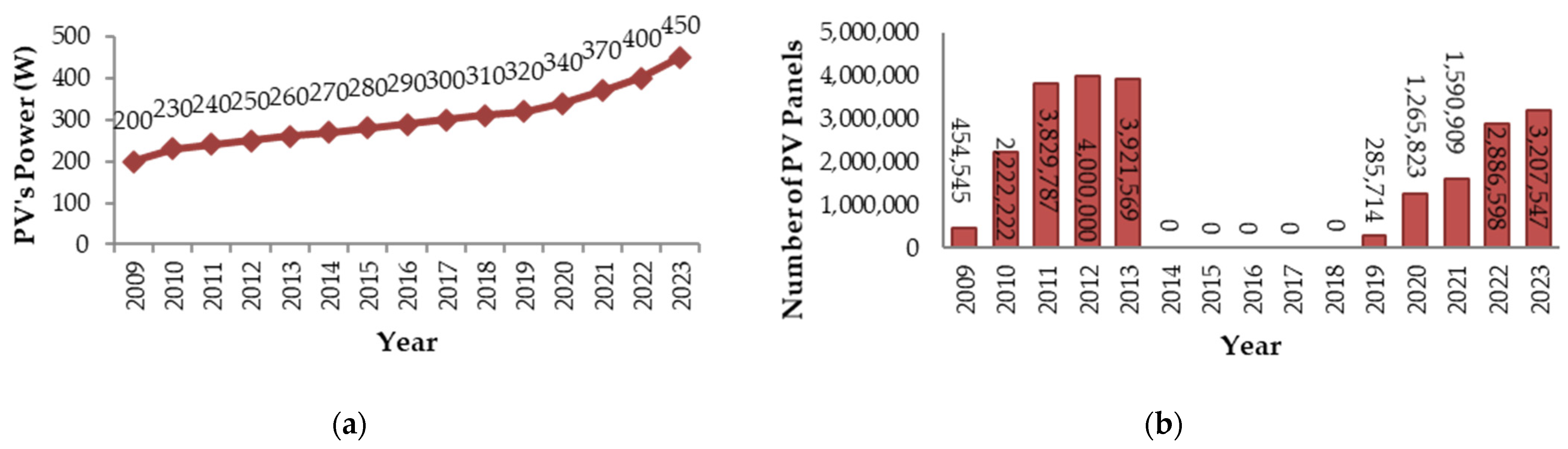
- Identification of annual installed capacity: The total PV capacity installed each year in Greece was collected from CRES records and verified with data from national and European statistical sources.
- Determination of the average panel power per year: For each year, the typical power rating of the most widely used PV modules was identified to reflect prevailing market technologies and efficiency levels. The annual values of average panel power were obtained directly from the CRES database, which documents the PV modules most commonly installed in Greece each year, and were cross-checked using manufacturer datasheets. This approach ensures that the selected values represent actual market conditions and the dominant technologies used during 2009–2023.
- Estimation of the number of panels installed annually: The annual installed capacity (MW) was divided by the average power output per module (kW) to calculate the number of panels installed each year.
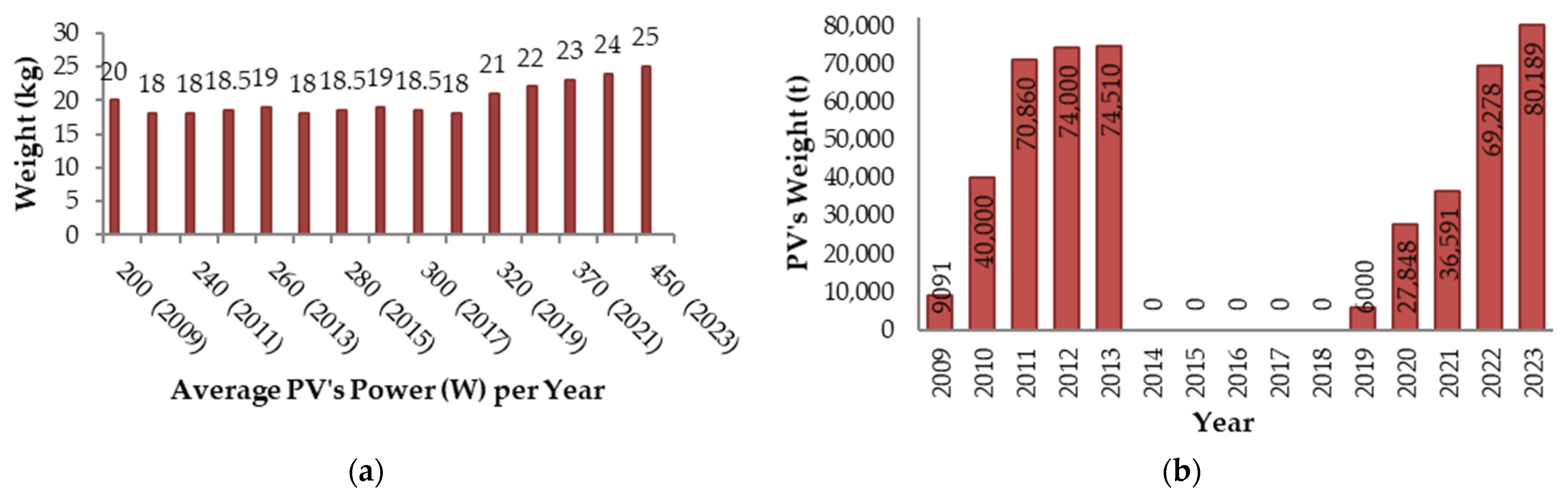
- Establishment of the weight-to-power ratio: The ratio of panel weight to power rating (kg/kW) was determined for each year to represent technological evolution and improvements in design efficiency. These ratios were derived using CRES market data and corresponding datasheets of the most widely deployed panels each year, ensuring consistency with real-world module characteristics.
- Calculation of the total mass of PV panels installed annually: The number of panels was multiplied by the average panel weight to estimate the total mass of PV panels (in tons) installed each year in Greece.
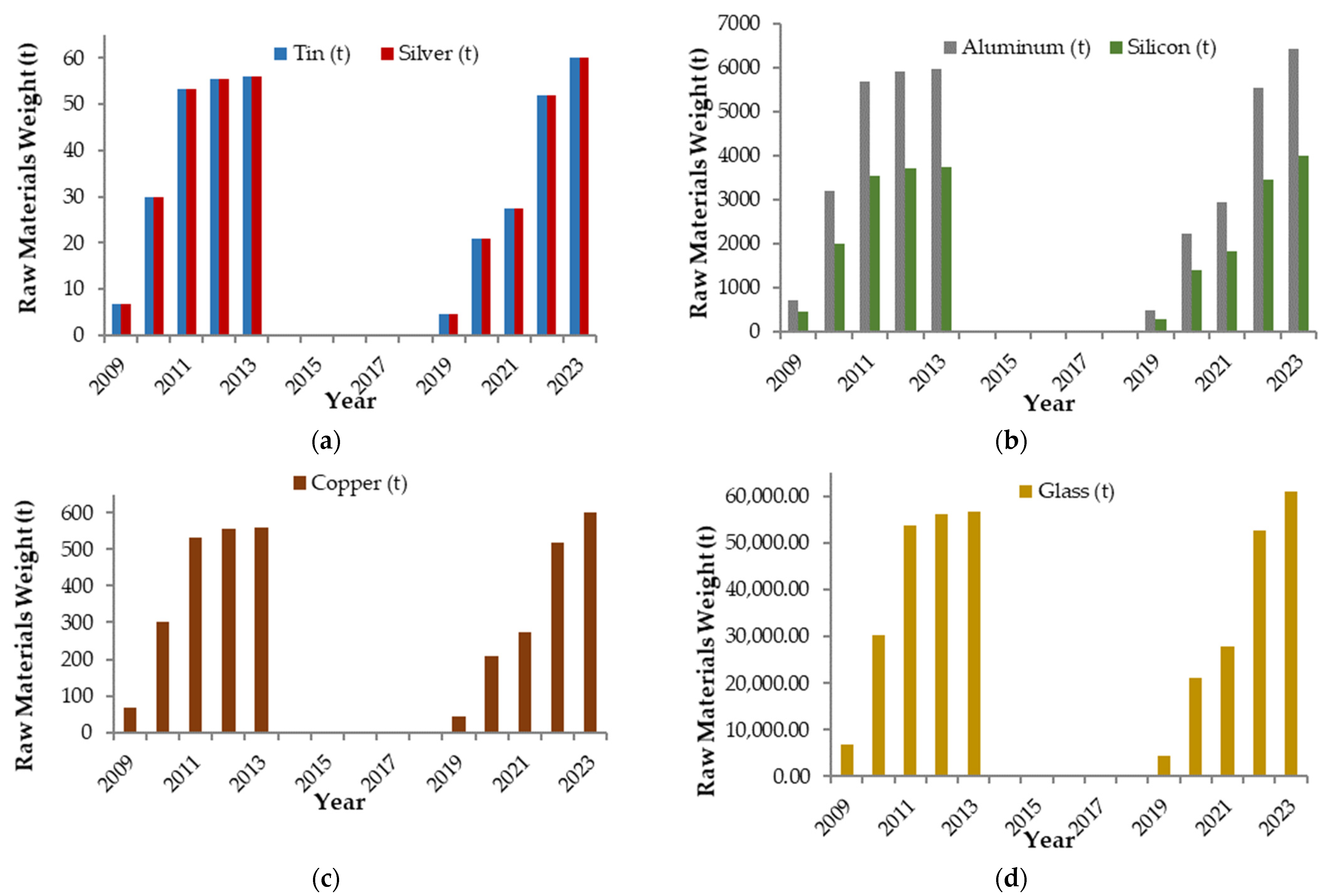
- Determination of raw-material composition: Based on the typical composition of crystalline-silicon PV modules, approximately 76% glass, 10% plastic (mainly EVA), 8% aluminum, 5% silicon, and 1% other metals (silver, copper, tin, etc.), the corresponding mass fraction of each material per ton of PV waste was calculated. The composition percentages of silver, copper, and tin were based on published characterizations of crystalline-silicon modules [3,6,10], which consistently report small but significant fractions of these metals in PV panels.
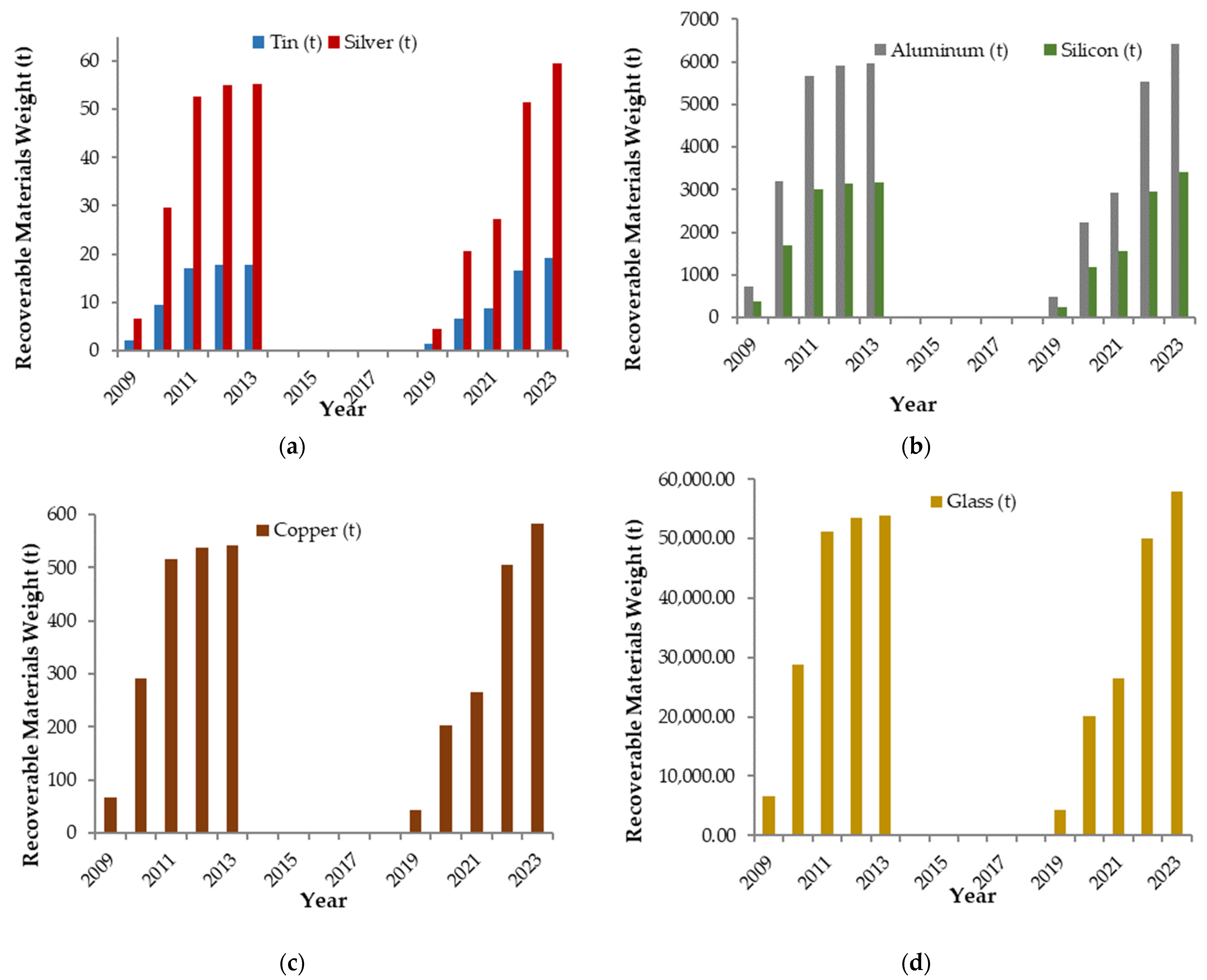
- Estimation of recoverable materials: Recognized recovery efficiencies were applied to each material: aluminum (100%), glass (95%), silicon (85%), copper (97%), silver (98–100%), and tin (32%). The annual quantities of recoverable materials were obtained by multiplying these recovery factors by the material content of the installed panels.
3. Results
4. Discussion
4.1. Environmental and Technological Implications
4.2. Policy and Economic Perspectives
4.3. Social and Health Dimensions
4.4. Toward a Circular-Economy Framework
4.5. Future Outlook
5. Conclusions
Author Contributions
Funding
Data Availability Statement
Acknowledgments
Conflicts of Interest
Abbreviations
| a-Si | Amorphous Silicon |
| BES | Bioelectrochemical Systems |
| CdTe | Cadmium Telluride |
| CIGS | Copper Indium Gallium Selenide |
| CRES | Center for Renewable Energy Sources |
| EoL | End of Life |
| EU | European Union |
| EVA | Ethylene-Vinyl Acetate |
| GHG | Greenhouse Gas |
| IEA | International Energy Agency |
| IRENA | International Renewable Energy Agency |
| LCA | Life Cycle Assessment |
| MFC | Microbial Fuel Cell |
| Mono-Si | Monocrystalline |
| NECP | National energy and climate plan |
| Poly-Si | polycrystalline (Poly-Si); |
| PV | Photovoltaic |
| RES | Renewable energy sources |
| SSTD | Solvothermal Swelling with Thermal Decomposition |
| TCLP | Toxicity Characteristic Leaching Procedure |
| WEEE | Waste from Electrical and Electronic Equipment |
References
- Psomopoulos, C.S.; Kalkanis, K.; Chatzistamou, E.D.; Kiskira, K.; Ioannidis, G.C.; Kaminaris, S.D. End-of-Life Treatment of Photovoltaic Panels: Expected Volumes up to 2045 in the EU. AIP Conf. Proc. 2022, 2437, 020084. [Google Scholar] [CrossRef]
- Kanellos, G.; Tremouli, A.; Tsakiridis, P.; Kakosimos, K.; Vakros, J.; Tekerlekopoulou, A.; Vayenas, D. Silver Recovery from End-of-Life Photovoltaic Panels Based on Microbial Fuel Cell Technology. Waste Biomass Valor. 2024, 15, 75–86. [Google Scholar] [CrossRef]
- Savvilotidou, V.; Antoniou, A.; Gidarakos, E. Toxicity Assessment and Feasible Recycling Process for Amorphous Silicon and CIS Waste Photovoltaic Panels. Waste Manag. 2017, 59, 394–402. [Google Scholar] [CrossRef]
- SolarPower Europe. EU Market Outlook for Solar Power 2023–2027. 12 December 2023. Available online: https://www.solarpowereurope.org/insights/outlooks/eu-market-outlook-for-solar-power-2023-2027/detail (accessed on 15 September 2025).
- Kastanaki, E.; Giannis, A. Energy Decarbonisation in the European Union: Assessment of Photovoltaic Waste Recycling Potential. Renew. Energy 2022, 192, 1–13. [Google Scholar] [CrossRef]
- Deng, R.; Zhuo, Y.; Shen, Y. Recent Progress in Silicon Photovoltaic Module Recycling Processes. Resour. Conserv. Recycl. 2022, 185, 106612. [Google Scholar] [CrossRef]
- Divya, A.; Adish, T.; Kaustubh, P.; Zade, P.S. Review on Recycling of Solar Modules/Panels. Sol. Energy Mater. Sol. Cells 2023, 253, 112151. [Google Scholar] [CrossRef]
- The Energy Institute. Solar PV Recycling Market to be Worth $2.7 bn by 2030. New Energy World. 13 July 2022. Available online: https://knowledge.energyinst.org/new-energy-world/article?id=127142 (accessed on 10 October 2025).
- Diez-Suárez, A.-M.; Martínez-Benavides, M.; Manteca Donado, C.; Blanes-Peiró, J.-J.; Martínez Torres, E.J. Recycling of Silicon-Based Photovoltaic Modules: Mediterranean Region Insight. Energies 2024, 17, 6015. [Google Scholar] [CrossRef]
- Papamichael, I.; Voukkali, I.; Jeguirim, M.; Argirusis, N.; Jellali, S.; Sourkouni, G.; Argirusis, C.; Zorpas, A.A. End-of-Life Management and Recycling on PV Solar Energy Production. Energies 2022, 15, 6430. [Google Scholar] [CrossRef]
- Sagani, A.; Mihelis, J.; Dedoussis, V. Techno-Economic Analysis and Life-Cycle Environmental Impacts of Small-Scale Building-Integrated PV Systems in Greece. Energy Build. 2017, 139, 277–290. [Google Scholar] [CrossRef]
- Kiskira, K.; Kalkanis, K.; Coelho, F.; Plakantonaki, S.; D’onofrio, C.; Psomopoulos, C.S.; Priniotakis, G.; Ioannidis, G.C. Life Cycle Assessment of Organic Solar Cells: Structure, Analytical Framework, and Future Product Concepts. Electronics 2025, 14, 2426. [Google Scholar] [CrossRef]
- Chen, P.-H.; Chen, W.-S.; Lee, C.-H.; Wu, J.-Y. Comprehensive Review of Crystalline Silicon Solar Panel Recycling: From Historical Context to Advanced Techniques. Sustainability 2024, 16, 60. [Google Scholar] [CrossRef]
- Whitfield, J. Degradation Processes and Mechanisms of PV System Adhesives/Sealants and Junction Boxes. In Durability and Reliability of Polymers and Other Materials in Photovoltaic Modules; Yang, H.E., French, R.H., Bruckman, L.S., Eds.; Plastics Design Library, William Andrew Publishing: Oxford, UK, 2019; pp. 235–254. [Google Scholar] [CrossRef]
- Athanailidis, V.I.; Rentoumis, G.M.; Katsigiannis, A.Y.; Bilalis, N. Integration and Assessment of Recycling into c-Si Photovoltaic Module’s Life Cycle. Int. J. Sustain. Eng. 2018, 11, 186–195. [Google Scholar] [CrossRef]
- Pavlopoulos, C.; Kelesi, M.; Michopoulos, D.; Papadopoulou, K.; Lymperopoulou, T.; Skaropoulou, A.; Tsivilis, S.; Lyberatos, G. Management of End-of-Life Photovoltaic Panels Based on Stabilization Using Portland Cement. Sustain. Chem. Pharm. 2022, 27, 100687. [Google Scholar] [CrossRef]
- Xu, X.; Lai, D.; Wang, G.; Wang, Y. Nondestructive Silicon Wafer Recovery by a Novel Method of Solvothermal Swelling Coupled with Thermal Decomposition. Chem. Eng. J. 2021, 418, 129457. [Google Scholar] [CrossRef]
- Bourtsalas, A.C.; Papadatos, P.E.; Kiskira, K.; Kalkanis, K.; Psomopoulos, C.S. Ecodesign for Industrial Furnaces and Ovens: A Review of the Current Environmental Legislation. Sustainability 2023, 15, 9436. [Google Scholar] [CrossRef]
- Plakantonaki, S.; Stergiou, M.; Panagiotatos, G.; Kiskira, K.; Priniotakis, G. Regenerated Cellulosic Fibers from Agricultural Waste. AIP Conf. Proc. 2022, 2430, 080006. [Google Scholar] [CrossRef]
- Kalkanis, K.; Vokas, G.; Kiskira, K.; Ioannidis, G.C.; Psomopoulos, C.S. Investigating the Sustainability of Wind Turbine Recycling: A Case Study—Greece. Mater. Circ. Econ. 2024, 6, 52. [Google Scholar] [CrossRef]
- Rao, H.K.R.; Gemechu, E.; Thakur, U.; Shankar, K.; Kumar, A. Life Cycle Assessment of High-Performance Monocrystalline Titanium Dioxide Nanorod-Based Perovskite Solar Cells. Sol. Energy Mater. Sol. Cells 2021, 230, 111288. [Google Scholar] [CrossRef]
- Kalkanis, K.; Kiskira, K.; Papageorgas, P.; Kaminaris, S.D.; Piromalis, D.; Banis, G.; Mpelesis, D.; Batagiannis, A. Advanced Manufacturing Design of an Emergency Mechanical Ventilator via 3D Printing—Effective Crisis Response. Sustainability 2023, 15, 2857. [Google Scholar] [CrossRef]
- Theocharis, M.; Pavlopoulos, C.; Kousi, P.; Hatzikioseyian, A.; Zarkadas, I.; Tsakiridis, P.E.; Remoundaki, E.; Zoumboulakis, L.; Lyberatos, G. An Integrated Thermal and Hydrometallurgical Process for the Recovery of Silicon and Silver from End-of-Life Crystalline Si Photovoltaic Panels. Waste Biomass Valor. 2022, 13, 4027–4041. [Google Scholar] [CrossRef]
- Bošnjaković, M.; Galović, M.; Kuprešak, J.; Bošnjaković, T. The End of Life of PV Systems: Is Europe Ready for It? Sustainability 2023, 15, 16466. [Google Scholar] [CrossRef]
- Iseri, F.; Iseri, H.; Iakovou, E.; Pistikopoulos, E.N. A Circular Economy Systems Engineering Framework for Waste Management of Photovoltaic Panels. Ind. Eng. Chem. Res. 2025, 64, 14986–14997. [Google Scholar] [CrossRef]
- Mahmoudi, S.; Huda, N.; Behnia, M. Critical assessment of renewable energy waste generation in OECD countries: Decommissioned PV panels. Resour. Conserv. Recycl. 2021, 164, 105145. [Google Scholar] [CrossRef]
- Dobra, T.; Wellacher, M.; Pomberger, R. End-of-life management of photovoltaic panels in Austria: Current situation and outlook. Detritus 2020, 10, 75–81. [Google Scholar] [CrossRef]
- Paiano, A. Photovoltaic waste assessment in Italy. Renew. Sustain. Energy Rev. 2015, 41, 99–112. [Google Scholar] [CrossRef]
- Santos, J.D.; Alonso-García, M.C. Projection of the photovoltaic waste in Spain until 2050. J. Clean. Prod. 2018, 196, 1613–1628. [Google Scholar] [CrossRef]
- Kastanaki, E.; Giannis, A. Dynamic estimation of future obsolete laptop flows and embedded critical raw materials: The case study of Greece. Waste Manag. 2021, 132, 74–85. [Google Scholar] [CrossRef]
- Alevizos, V.; Gerolimos, N.; Leligkou, E.A.; Hompis, G.; Priniotakis, G.; Papakostas, G.A. Sustainable Swarm Intelligence: Assessing Carbon-Aware Optimization in High-Performance AI Systems. Technologies 2025, 13, 477. [Google Scholar] [CrossRef]
- Tsanakas, J.A.; van der Heide, A.; Radavičius, T.; Denafas, J.; Lemaire, E.; Wang, K.; Poortmans, J.; Voroshazi, E. Towards a circular supply chain for PV modules: Review of today’s challenges in PV recycling, refurbishment and recertification. Prog. Photovolt. Res. Appl. 2020, 28, 454–464. [Google Scholar] [CrossRef]
- Iakovou, E.; Pistikopoulos, E.N.; Walzberg, J.; Iseri, F.; Iseri, H.; Chrisandina, N.J.; Vedant, S.; Nkoutche, C. Next-generation reverse logistics networks of photovoltaic recycling: Perspectives and challenges. Sol. Energy 2024, 271, 112329. [Google Scholar] [CrossRef]

| Recycled Material | Value (USD/t) |
|---|---|
| Silicon | 2000 |
| Aluminum | 661.39 |
| Silver | 551,156.11 |
| Glass | 10 |
| Copper | 6702.06 |
| Tin | 132.28 |
Disclaimer/Publisher’s Note: The statements, opinions and data contained in all publications are solely those of the individual author(s) and contributor(s) and not of MDPI and/or the editor(s). MDPI and/or the editor(s) disclaim responsibility for any injury to people or property resulting from any ideas, methods, instructions or products referred to in the content. |
© 2025 by the authors. Licensee MDPI, Basel, Switzerland. This article is an open access article distributed under the terms and conditions of the Creative Commons Attribution (CC BY) license (https://creativecommons.org/licenses/by/4.0/).
Share and Cite
Kiskira, K.; Lalopoulou, A.; Kalkanis, K.; Vokas, G. Closing the Loop on Solar: A Sustainability Assessment of Photovoltaic Recycling in Greece. Energies 2025, 18, 6314. https://doi.org/10.3390/en18236314
Kiskira K, Lalopoulou A, Kalkanis K, Vokas G. Closing the Loop on Solar: A Sustainability Assessment of Photovoltaic Recycling in Greece. Energies. 2025; 18(23):6314. https://doi.org/10.3390/en18236314
Chicago/Turabian StyleKiskira, Kyriaki, Angeliki Lalopoulou, Konstantinos Kalkanis, and George Vokas. 2025. "Closing the Loop on Solar: A Sustainability Assessment of Photovoltaic Recycling in Greece" Energies 18, no. 23: 6314. https://doi.org/10.3390/en18236314
APA StyleKiskira, K., Lalopoulou, A., Kalkanis, K., & Vokas, G. (2025). Closing the Loop on Solar: A Sustainability Assessment of Photovoltaic Recycling in Greece. Energies, 18(23), 6314. https://doi.org/10.3390/en18236314

