1. Introduction
Distribution network reconfiguration (DNR) is a critical operational strategy utilized to enhance system performance (e.g., reducing power losses, alleviating line overloads and bus voltage violations, and improving overall transmission capacity) by strategically altering the status of existing sectionalizing and tie switches without the need for additional infrastructure investments [
1,
2,
3]. Tie switches primarily interconnect the ends of adjacent radial feeders or establish connections to alternative supply points, whereas sectionalizing switches segment the main branches or sections of a single radial feeder [
4]. However, DNR poses significant computational challenges due to its formulation as a complex NP-hard combinatorial optimization problem. This intractability stems from the coupling of nonconvex power flow equations with discrete (binary) switching actions, all constrained by the stringent requirement of maintaining a radial network topology. Furthermore, the pervasive uncertainty inherent in integrating high levels of renewable energy sources escalates the complexity of the DNR problem, particularly as operational decisions must span multiple interdependent timescales, and different timescale control devices must be coordinated.
To manage these uncertainties, various uncertainty optimization frameworks have been proposed, primarily encompassing stochastic, robust, and distributionally robust optimization techniques. Robust DNR approaches aim to minimize operational costs in the worst-case scenarios involving uncertain renewable outputs and loads [
1]. However, this methodology can be overly conservative, potentially leading to economic inefficiency [
5]. To alleviate this conservatism and prevent unnecessary losses, stochastic DNR (SDNR) incorporates statistical properties of uncertain variables and seeks to minimize the expected costs across all possible scenarios [
6]. In contrast, distributionally robust DNR endeavors to minimize operational costs for the most adverse probability distributions of uncertain quantities, thereby balancing the conservativeness of robust DNR and the robustness of SDNR [
2]. Despite its advantages, distributionally robust DNR incurs significantly higher computational complexity compared with SDNR, motivating our focus on the SDNR framework.
Existing methods for solving SDNR can be broadly classified into three categories: mathematical programming, heuristics/metaheuristics, and machine learning approaches. Mathematical programming methods typically transform SDNR into mixed-integer linear programs via linearization or into mixed-integer convex programs through convex relaxation techniques, such as quadratic, quadratically constrained, or conic relaxations [
7]. Despite their rigor, they face scalability issues in large-scale systems, and their approximations often compromise solution accuracy and optimality guarantees. Heuristic methods exploit the topological features of distribution networks to reduce computational complexity, employing strategies such as switch opening and exchanging [
8], and sequential switch opening or successive branch reduction [
6,
9,
10]. Metaheuristic algorithms are inspired by biological or physical processes, including approaches such as hybrid particle swarm optimization [
11], shuffled frog leaping [
12], and hybrid simulated annealing with minimum-spanning tree algorithms [
13]. Although these methods are computationally efficient, they have the disadvantages of high computational cost for evaluation, parameter dependency and tuning, and sensitivity to problem formulation and randomness. Machine learning techniques (e.g., double deep Q-learning [
14] and deep reinforcement learning [
15]) bypass explicit physical modeling by extracting optimal operational knowledge from historical data. However, offline training risks sub-optimal generalization, while online deployment raises safety concerns.
A notable limitation across these approaches is the limited consideration of varying timescales among different devices. Due to concerns about switch longevity and practical constraints, frequently altering switch statuses to accommodate rapid fluctuations from renewable energy sources is impractical. Conversely, distributed generators and energy storage devices can respond swiftly to maintain system power balance. To coordinate diverse scheduling resources across different timescales, a multi-timescale co-optimization framework is proposed in [
16]. This framework schedules on-load tap changers on an hourly basis, dispatches the fast-acting battery energy storage system and photovoltaic inverters every 20 min, and executes DNR daily. However, this approach relies on solving the multi-timescale MISOCP problem using GAMS/Cplex, which can be computationally intensive for large-scale systems. Another study in [
17] develops a bi-level Rainbow-safeDDPG algorithm, where the upper-layer Rainbow algorithm determines network topology and switching gears for on-load tap changers and switched capacitors on a slow timescale. Concurrently, the lower-layer continuous safeDDPG algorithm schedules distributed photovoltaic inverters on a fast timescale. Nonetheless, the feasibility of solutions cannot be assured due to the inherent security issues associated with deep reinforcement learning. Furthermore, both multi-timescale methods overlook the uncertainties in renewables and loads, as well as time-coupling devices such as energy storage systems.
To address these challenges, we extend our previous work on the SDNR problem by introducing a stochastic multi-timescale DNR (SMTDNR) framework and developing an efficient heuristic algorithm for medium- and high-voltage distribution networks. Model predictive control (MPC) is strategically applied to handle the uncertainties associated with loads and renewables more effectively. While prior work [
18] introduced a stochastic MPC approach for dynamic and adaptive distribution network reconfiguration, it primarily addresses hourly switch operations, neglecting the coordinated control of multi-timescale devices and time-coupling devices such as the energy storage system and the ramping rate constraint of fuel generators. The primary contributions of this work are as follows:
We design a stochastic multi-timescale rolling optimization framework that coordinates the control of various devices operating on different timescales. This framework integrates stochastic optimization with the MPC approach to effectively address uncertainties in renewables and loads and considers energy reserves to tackle these uncertainties better.
We develop a novel heuristic algorithm to solve the SMTDNR problem with high efficiency while ensuring solution feasibility. Initially, we introduce a one-stage multi-timescale successive branch reduction (MTSBR) algorithm tailored for distribution networks with a single redundant branch. This is subsequently extended to a two-stage MTSBR algorithm applicable to general networks with multiple redundant branches through iterative application of the one-stage MTSBR method.
We validate the optimality, feasibility, and computational efficiency of the proposed MTSBR algorithm on IEEE 33-bus and 123-bus distribution networks, considering different penetration levels of renewable generation and numbers of uncertainty scenarios.
The development of the presented algorithms stems from an extension of the SBR methodologies initially proposed in [
6,
19]. The SBR algorithm introduced in [
19] was designed to address a deterministic DNR problem in systems without considering renewable energy sources. This was subsequently enhanced in [
6] to handle a stochastic DNR problem in distribution networks characterized by high renewable energy penetration. This study further advances the framework, extending it into one-stage and two-stage MTSBR algorithms. This novel structure enables the coordinated control of energy devices operating over multiple distinct timescales within the distribution network, which is more practical for real-world applications.
The remainder of this paper is organized as follows:
Section 2 presents the SMTDNR model and problem formulation.
Section 3 details the one-stage and two-stage MTSBR algorithms.
Section 4 provides numerical case studies, and
Section 5 concludes the paper.
2. Model and Problem Formulation
2.1. Stochastic Multi-Timescale Distribution Network Reconfiguration Based on Model Predictive Control
The SMTDNR problem seeks to optimally coordinate slow-acting DNR operations with fast-acting energy resources (e.g., distributed generators and battery energy storage systems) to minimize the expected operational cost across various uncertain generation and load scenarios over a specified planning horizon. To effectively manage these uncertainties, a model predictive control framework is integrated, enabling the system to anticipate variations in renewable energy generation and loads, thereby facilitating the determination of optimal control actions for all controllable devices.
Consider a total operational period denoted by
, which is examined through a sliding time window
, which refers to the finite and fixed-length prediction horizon (i.e., the time steps) over which the optimal control actions are determined by MPC at each reconfiguration interval. For each time step
, the following definitions apply:
where
denotes the number of time intervals within the window
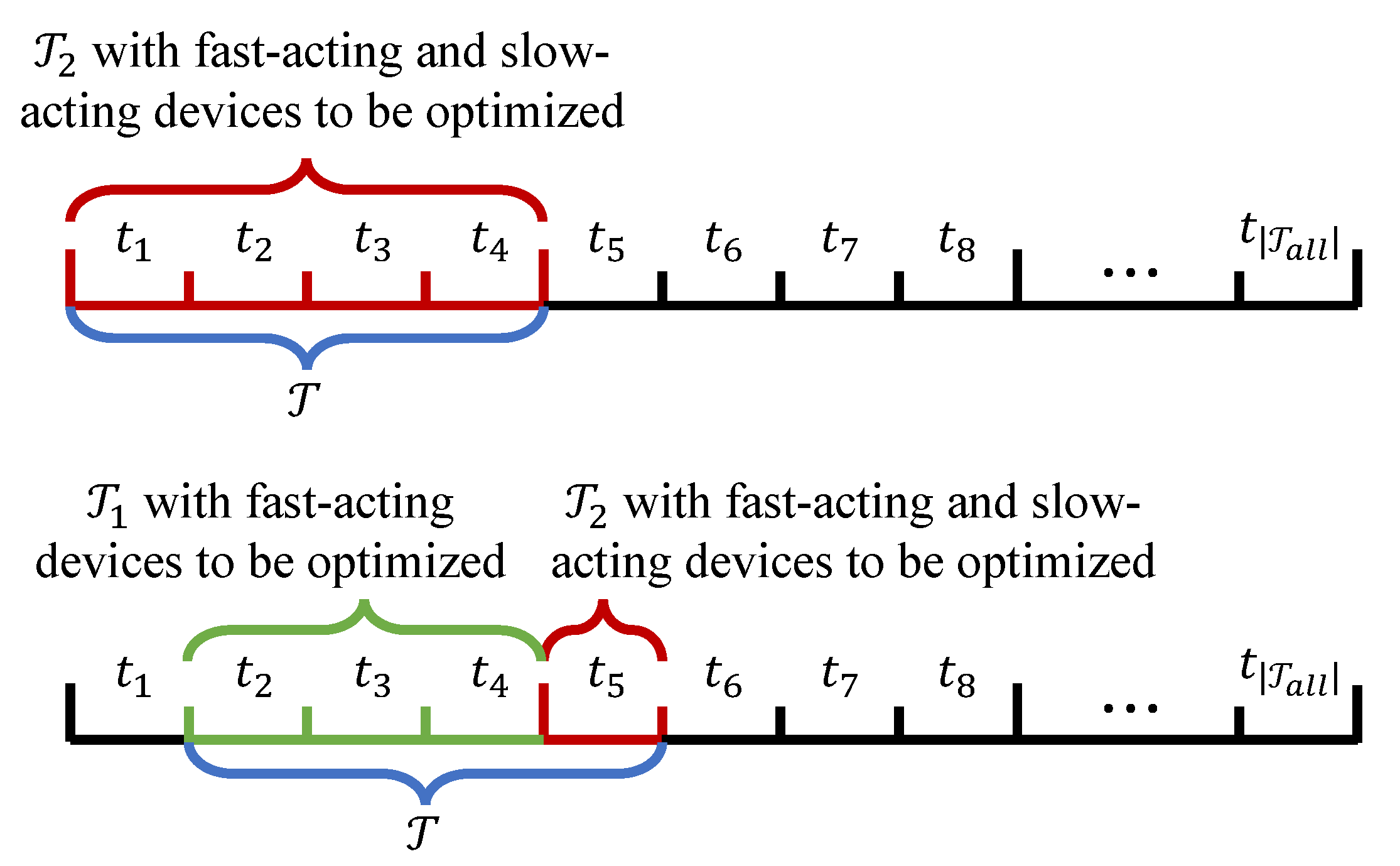
. As depicted in
Figure 1, control actions for fast-acting devices are optimized at every time step, whereas the distribution network topology (i.e., slow-acting device branch switches) is reconfigured every
intervals. Consequently, the network topology remains fixed and radial during
and is subsequently re-optimized for
, balancing operational flexibility with practical constraints on switch operations. The mathematical formulation of the SMTDNR problem for each sliding time window is detailed below.
Consider a distribution network comprising a set of buses and a set of branches . To define the system model, we consider a distribution network characterized by a collection of nodes and the paths that link them, which form the set of connections . For any specific connection or , we assign a consistent flow direction (for instance, always from node i to node j). The sets of substation, fuel generator, energy storage, controllable load, and non-controllable load buses are denoted by , , , , and , respectively. The substation buses interface with the external utility or bulk power system, while the non-substation buses are interfaced with local demands and various distributed energy assets.
All branches are considered switchable, encompassing both tie-line and sectionalizing switches without loss of generality. The operational condition of a switch on branch at any time is captured by the Boolean decision variable . The switch is considered open if and closed if . The underlying uncertainty in the system, primarily arising from fluctuating renewable power output and unpredictable customer loads, is quantified by the joint probability distribution , defined across a finite collection of stochastic scenarios . Based on these defined components, the SMTDNR problem is constructed for optimization across each consecutive sliding time window in the operation horizon.
2.2. Objective
The objective is to minimize the expected total operational cost over all possible scenarios
and within the sliding time window
. This cost encompasses fuel generator expenses, penalties for load curtailment, costs associated with energy purchases from the main grid, and benefits from energy reserves provided by fuel generators and controllable loads, as defined below:
where
is the power purchased from the main grid;
denotes active power generation;
represent active and reactive controllable loads;
and
are upward and downward reserves of the fuel generator;
and
denote upward and downward reserves of the controllable load;
,
,
,
, and
are energy pricing parameters; and
and
represent decision variables for slow-acting and fast-acting devices, respectively.
The generation cost for distributed generators, denoted by
, is modeled as a quadratic function:
where
,
, and
are predefined cost coefficients.
The cost associated with load curtailment,
, is defined as
where
is the unit cost of load curtailment.
The third and fourth terms in the objective function account for the benefits derived from energy reserves provided by fuel generators and controllable loads, respectively.
2.2.1. Network Constraints
The following constraints apply to all buses
and all branches
, for every scenario
at all time instances
:
where
and
are the voltage magnitude and angle at bus
i, respectively;
is the voltage angle difference across branch
;
represent the active and reactive net power injections at bus
i;
denote the active and reactive branch power flows on branch
; and
and
are the series conductance and susceptance of branch
. Equations (
5) and (
6) define the active and reactive power flows on branch
, while Equations (
7) and (
8) ensure active and reactive power balance at bus
i.
2.2.2. Fuel Generator Constraints
For each fuel generator located at bus
, across all scenarios
and time instances
, the following constraints are enforced:
where
and
represent the upper and lower bounds of active and reactive power generation of the fuel generator at bus
i and
denote the maximal downward and upward ramp rates of the fuel generator. Constraint (
9)–(
11) limit the capacity of the fuel generator. Constraint (
12) restricts its reactive power output, while constraint (
13) restricts the ramp rates of the fuel generator.
2.2.3. Energy Storage Constraints
For each energy storage unit at bus
, in all scenarios
and time instances
, the following constraints apply:
where
and
represent the active power output and state of charge of the energy storage at bus
i, respectively;
is the leakage rate accounting for energy loss over time; and
and
are the upper and lower limits of the energy storage capacity. Equation (
14) establishes the relationship between the state of charge and the total active power output of the energy storage. Constraint (
15) and (
16) set the limits on the active power output and state of charge, respectively.
2.2.4. Controllable Load Constraints
For each aggregate controllable load at bus
, across all scenarios
and time instances
, the following constraints are enforced:
where
are the active and reactive power outputs for the controllable load;
denote the upward and downward energy reserves for the controllable load;
are the forecasted active and reactive power demands; and
is the minimum active power demand. Constraint (
17)–(
19) limit the capacity of the controllable load, while constraint (
20) sets the bounds for its reactive power demand.
2.2.5. Net Power Injection Constraints
For each bus
, in all scenarios
and time instances
, the net active and reactive power injections are defined as
where
and
denote the active and reactive power consumption of the aggregate non-controllable load, respectively, and
and
are the active and reactive power outputs of the aggregate renewable energy source, respectively. Both
and
are uncertain parameters with a probability distribution
over scenarios
. Equations (
21) and (
22) restrict the active and reactive net power injections at each bus.
2.2.6. Branch Thermal Limits
For each branch
, in all scenarios
and time instances
, the apparent power flow must respect the thermal limit:
where
is the branch transmission capacity of branch
. To enhance computational efficiency, the nonlinear constraint in (
23) can be linearized using the circular constraint linearization method [
20] as follows:
2.2.7. Voltage Limits
For each bus
and all branches
across all scenarios
and time instances
, voltage magnitudes and angles are bounded as
where
represent the lower and upper bounds for voltage magnitude at bus
i and
represent the lower and upper bounds for voltage angle difference across branch
.
2.2.8. Network Topology Constraints
Let the network graph with switch statuses
be denoted by
. The feasible set of
, denoted by
, can be defined to ensure a radial topology [
6]:
A network graph is radial if and only if .
2.3. SMTDNR Problem Formulation
Combining the objective and all constraints, the SMTDNR problem for each sliding time window
is formulated as a mixed-integer nonlinear and nonconvex optimization problem:
To efficiently solve this intricate problem, relaxation techniques and a simplified power flow model are introduced in subsequent subsections.
2.4. Jabr Relaxation
To expedite computation, Jabr relaxation is employed to obtain a second-order cone (SOC) relaxation of the
SMTDNR problem. For every bus
, an auxiliary variable
is introduced. For every branch
, auxiliary variables
and
are defined. With these auxiliary variables, the branch flow equations in (
5) and (
6) can be reformulated as follows for
,
,
, and
:
The nonconvex definitions of variables
,
, and
are relaxed by adding the following rotated cone constraints:
Thus, the
SMTDNR problem with Jabr relaxation, denoted by
SMTDNR-J, is formulated as
2.5. DistFlow Model for Radial Topology
For a radial power network with fixed switch statuses
, the network constraints in (
5) and (
6) can be equivalently represented using the DistFlow model. For all
,
,
, and
,
where
and
are the resistance and reactance of branch
, respectively;
denotes the squared current of branch
; and
M is a sufficiently large positive constant used in the big-M formulation. Constraint (
35) and (
36) enforce the voltage drop across branch
when
. The big-M formulation relaxes the voltage coupling between buses
i and
j when
(i.e., the line is disconnected). Constraint (
33) and (
34) ensure active and reactive power balance at each bus, respectively. Quadratic constraint (
37) introduces nonconvexity, which is convexified via the SOC relaxation below:
Additionally, the voltage constraint in (
28) is replaced by
2.6. Multi-Timescale Optimal Power Flow Model
For a given and fixed network topology with switch statuses
, the
SMTDNR problem reduces to a stochastic multi-timescale optimal power flow (SMTOPF) problem as follows:
For a radial network, the SMTOPF problem can be further simplified by employing the DistFlow model, resulting in
Since only the network topology during
needs optimization, the SMTOPF problem can be formulated as a mixed model to improve computational efficiency, referred to as
SMTOPF-Mix:
In this mixed formulation, DistFlow model (
33)–(
37) is applied to the radial network topology for time intervals
, while the more general Jabr relaxation in (
30)–(
32) is employed for
, where the topology is being optimized. Notably, when
, the problem
is equivalent to
.
4. Results
4.1. Experimental Setup
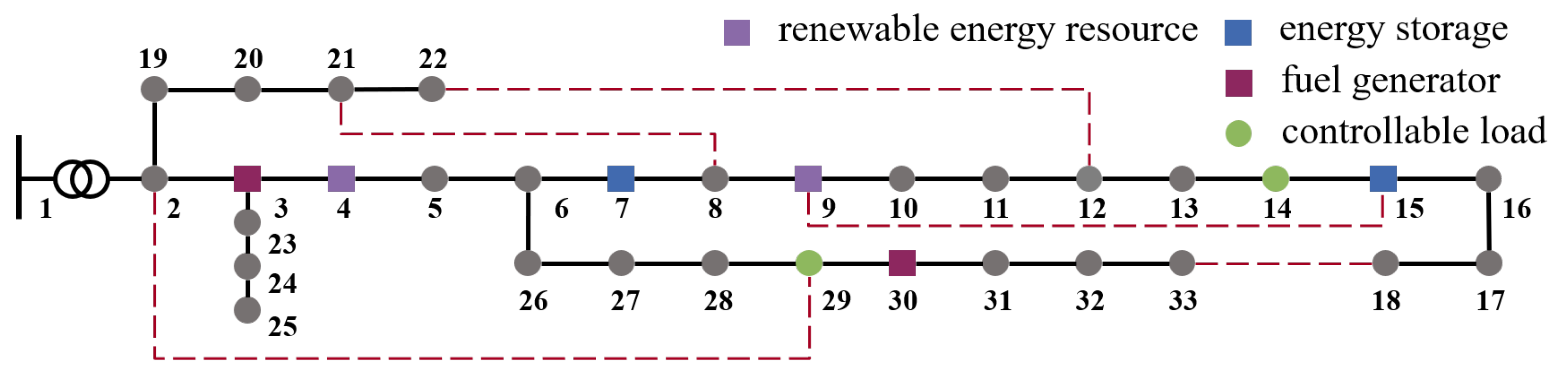
To validate the proposed approach, numerical experiments were conducted on modified IEEE 33-bus and 123-bus distribution networks. The modified IEEE 33-bus system, depicted in
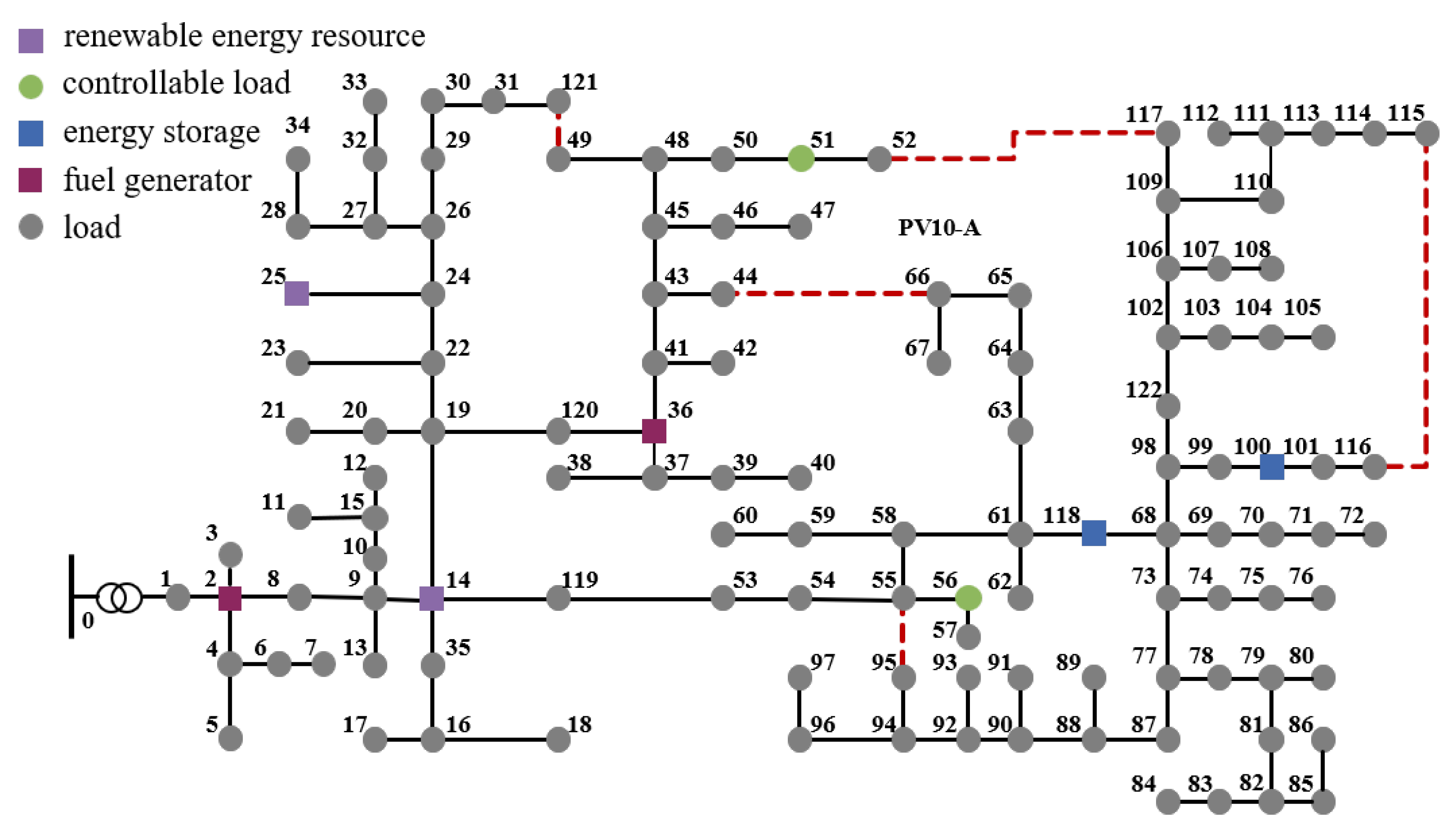
Figure 2, includes a substation with two fuel generators (Buses 3 and 30, marked by dark purple squares), two renewable energy resource buses (Buses 4 and 9, each with a small wind turbine and solar panel, marked by light purple squares), two energy storage buses (Buses 7 and 15, marked by blue squares), two aggregated controllable load buses (Buses 14 and 29, marked by green circles), and non-controllable load buses. For the modified IEEE 123-bus system (
Figure 3), fuel generators are at Buses 2 and 36, renewable resources at Buses 14 and 25, energy storage at Buses 100 and 118, and aggregated controllable loads at Buses 51 and 65, with other buses being non-controllable loads. The black lines represent the initially closed branches, while the red dashed lines represent the redundant branches of the test systems in
Figure 2 and
Figure 3.
Uncertainty scenarios were generated using hourly load, wind, and solar generation data from Germany in 2019 [
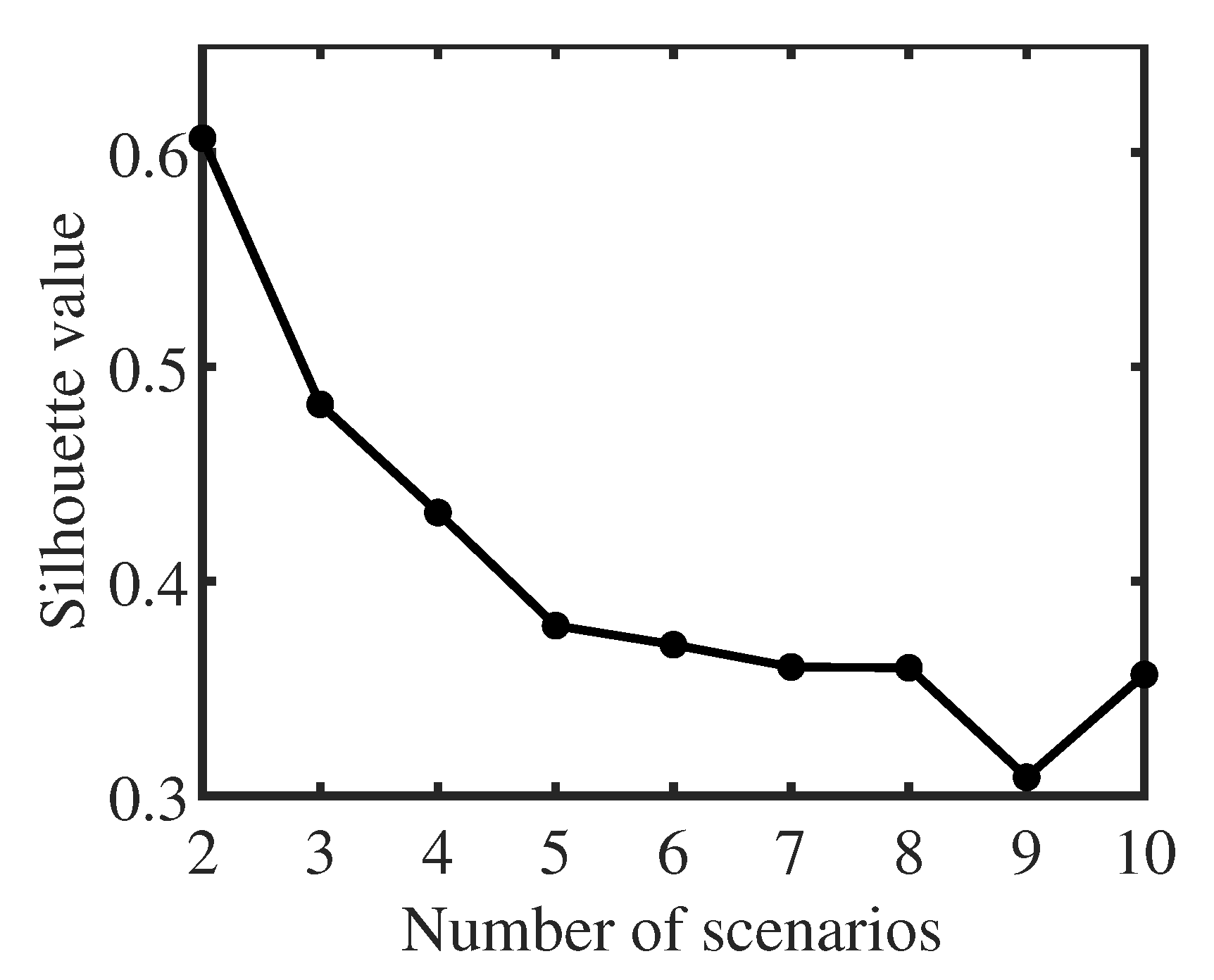
21]. Note that the algorithmic efficiency and convergence of the proposed heuristic are independent of the specific input data set. Twenty-four-hour daily vectors for these parameters were concatenated into 365 daily vectors. These vectors were then scaled to match IEEE network capacities and then clustered using the classical k-medoids method. This widely adopted technique derives the probability distribution of generation and loads, and the choice of clustering method does not affect the algorithm’s applicability. The optimal number of scenarios was determined using the Silhouette criterion clustering evaluation method, with
Figure 4 showing that two clusters yielded the highest silhouette value, indicating optimal clustering at two scenarios. Reactive power for renewable generation was determined using fixed power factors [
8].
Key simulation parameters were configured as follows: bus voltage limits p.u. and p.u.; branch thermal limit ; time horizon with total period h; fuel generator ramp rates and ; energy storage efficiency , leakage rate , maximum power p.u., minimum power p.u., maximum capacity , and initial state of charge p.u.; and reserve prices . All experiments were conducted on a Windows 64-bit system equipped with an Intel Core i7-10875H 8-core CPU and 16 GB of RAM from LENOVO, Beijing, China. The commercial solver Gurobi was utilized to solve the optimization problems.
The proposed method was benchmarked against two alternative approaches to assess its optimality and computational efficiency:
Due to the highly nonconvex nature and the large-scale, combined combinatorial and continuous structure of the proposed stochastic multi-timescale rolling reconfiguration model, deriving a non-trivial and generalizable theoretical optimality gap guarantee is currently mathematically intractable. To provide a quantitative validation of the proposed algorithms, we adopt the standard practice for complex power system heuristics, i.e., rigorous empirical analysis against proven high-quality benchmarks. Method 1, using a convexified DistFlow model, served as the benchmark for defining the relative errors (optimality gap) of the other comparison methods.
4.2. Optimality of One-Stage Multi-Timescale Successive Branch Reduction Algorithm
Experiments were first performed using the one-stage MTSBR algorithm (Algorithm 1) on the modified IEEE 33-bus distribution network, where each initial redundant branch shown in
Figure 2 is individually closed to create a single-redundant-branch network scenario.
Table 1 presents the mean and maximum relative errors of the objective function for Algorithm 1 (proposed) and Method 2 in different scenarios. As observed in
Table 1, Algorithm 1 consistently exhibited a negligible relative error, with a maximum observed error of only 0.261%. In contrast, for initial redundant branches (8, 21), (12, 22), (18, 33), and (2, 29), Method 2 frequently yielded solutions infeasible for the original SMTDNR problem, which incorporates nonconvex power flow Equations (
6)–(
8). These infeasible instances are denoted by “*” in
Table 1 and marked by red stars in
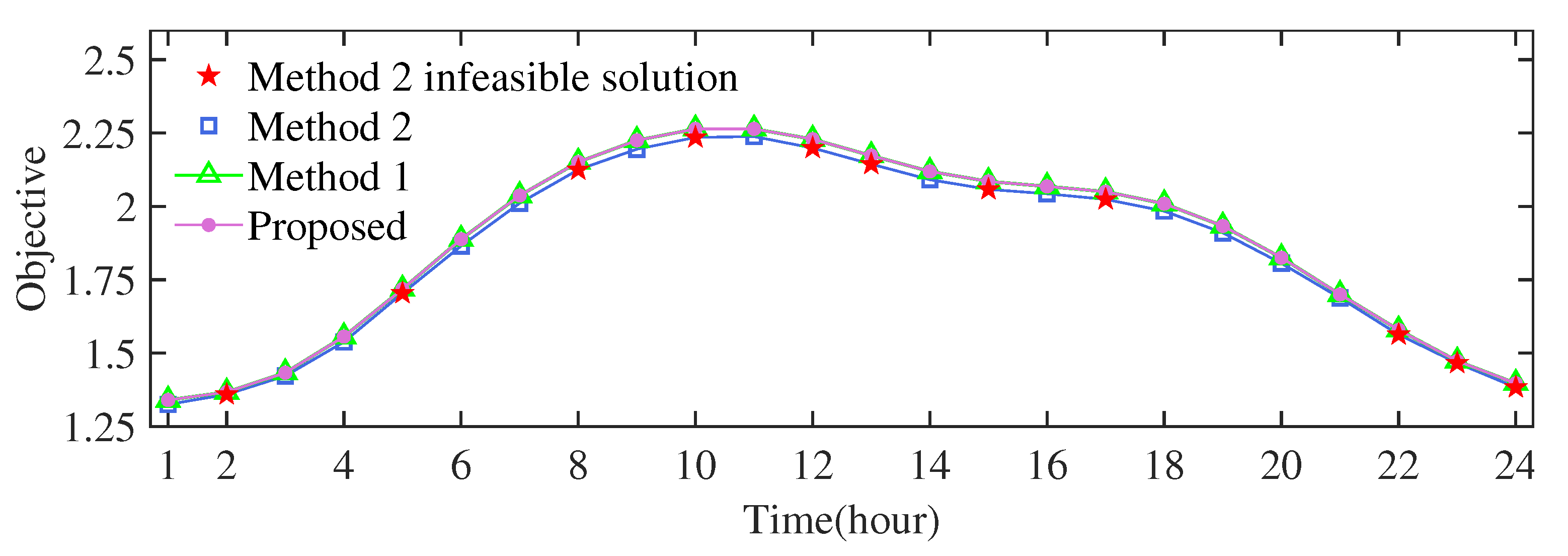
Figure 5.
Figure 5 further illustrates the objective values over a 24 h period, specifically for the (2, 29) scenario as an example, clearly showing the infeasible solutions of Method 2. In summary, Algorithm 1 demonstrates competitive optimality compared with benchmark Method 1, which uses the SOC-relaxed DistFlow model, and significantly superior feasibility compared with Method 2, which uses the linearized DistFlow model.
4.3. Optimality of Two-Stage Multi-Timescale Successive Branch Reduction Algorithm
The effectiveness of the proposed two-stage SBR algorithm (Algorithm 2) was evaluated on the IEEE 33-bus network, augmented with five redundant branches, two fuel generators, two energy storage systems, and two controllable loads (
Figure 2).
4.3.1. Impact of Renewable Penetration Levels
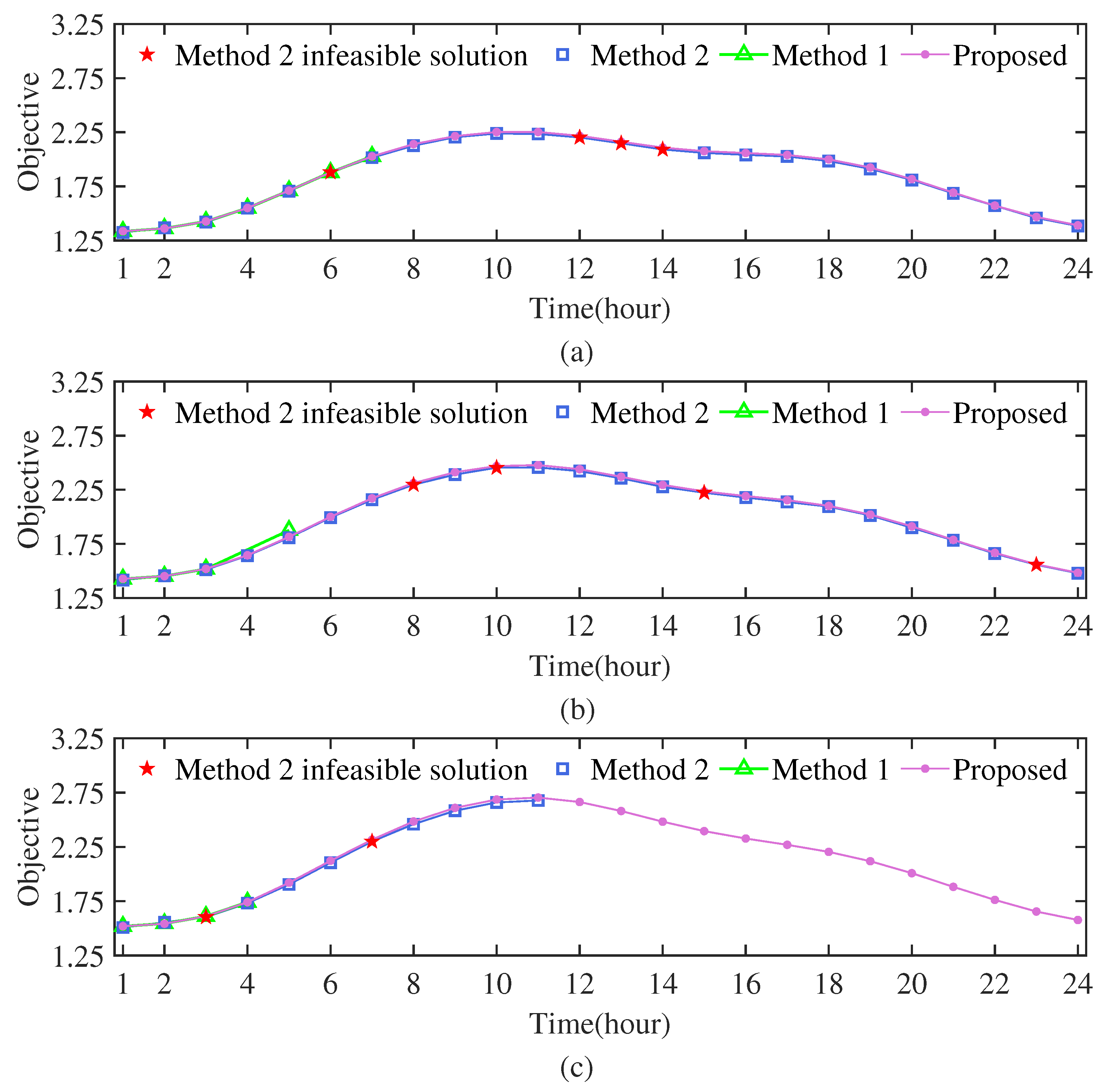
Figure 6 illustrates the temporal evolution of the objective value over a 24 h horizon under different renewable energy resource penetration levels, where the penetration coefficient
uniformly scales the power output of renewable energy resources. As
increases, Method 2 (with linearization) exhibits noticeable performance degradation, frequently producing solutions that violate the original network constraints in (
5)–(
8). Method 1 performs the worst, often failing to converge to a feasible configuration across the majority of the time series. In contrast, the proposed method, Algorithm 2, consistently delivers feasible, high-quality solutions throughout the simulation, outperforming both benchmarks in optimality and feasibility.
4.3.2. Impact of Number of Scenarios
The influence of the number of uncertainty scenarios,
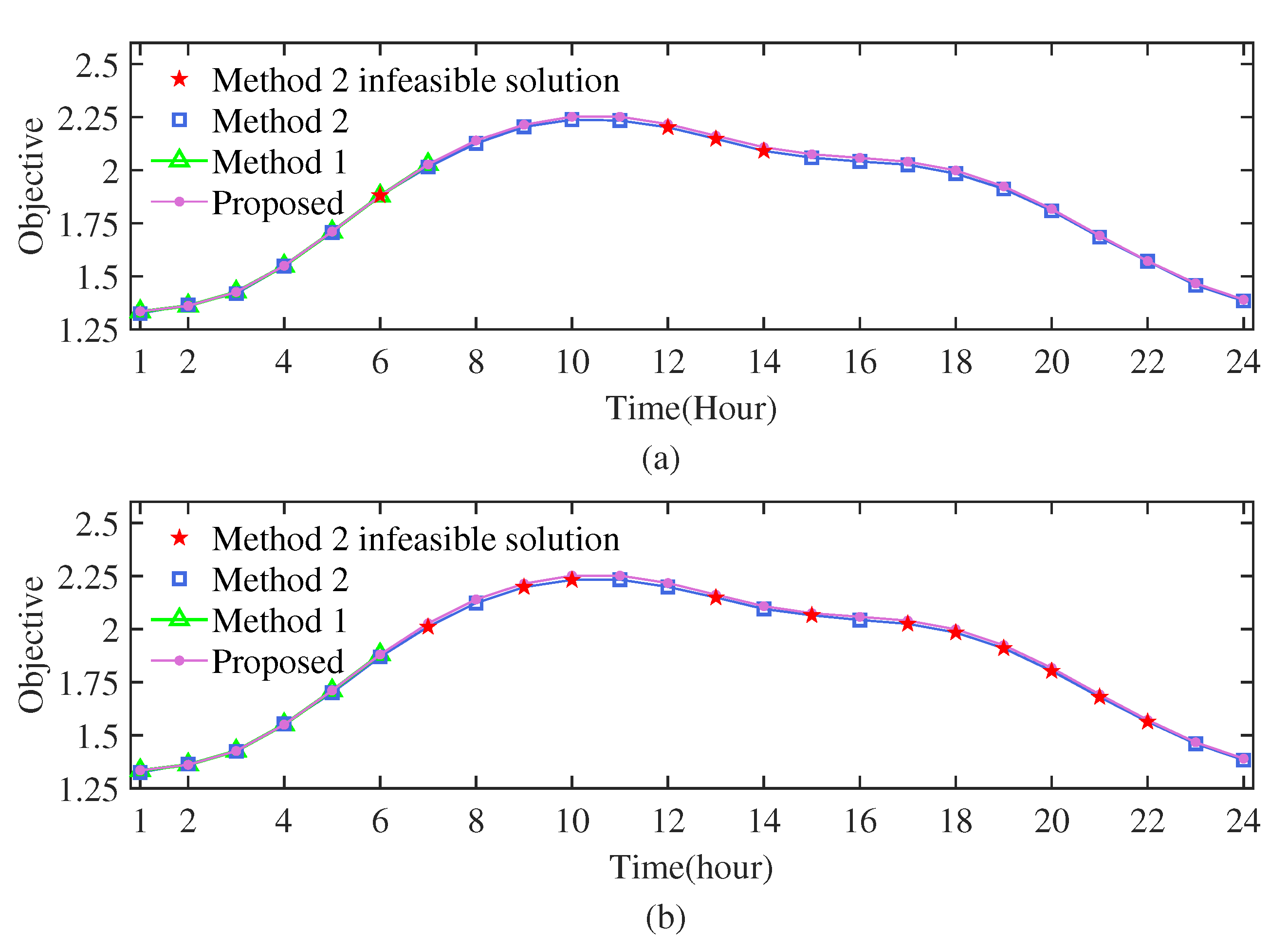
, on the optimization methods is illustrated in
Figure 7. As
increases, both Method 1 and Method 2 increasingly struggle to achieve feasible solutions or generate solutions violating the nonconvex network constraints in (
5)–(
8). Conversely, the proposed method, Algorithm 2, maintains robust feasibility, with only marginal degradation in objective values as the number of scenarios increases. A consistent trend is observed across all test cases: the advantages of the proposed method, Algorithm 2, become more pronounced with more redundant branches, higher renewable penetration levels, and increased uncertainty dimensionality. This is attributed to the escalating number of binary switching decisions and nonconvex and nonlinear network constraints in (
5)–(
8), which substantially amplify the computational burden and sub-optimality risk for conventional mixed-integer nonlinear programming solvers. By transforming the SMTDNR problem into multiple SMTOPF problems, Algorithm 2 effectively mitigates these challenges, leading to superior solution quality and computational reliability.
4.4. Scalability of Two-Stage MTSBR
To further demonstrate the scalability of the proposed two-stage MTSBR algorithm (Algorithm 2), experiments were conducted on the IEEE 123-bus network, specifically augmented to include five redundant branches, two fuel generators, two energy storage systems, and two controllable loads (see
Figure 3). Similar to
Section 4.2, Method 1 is used as a trustworthy benchmark for relative error assessment.
Table 2 presents the relative errors in the objective function (compared with Method 1) under different renewable penetration levels, where
proportionally scales the power output of renewable power sources. Infeasible instances are marked with an asterisk (“*”) in
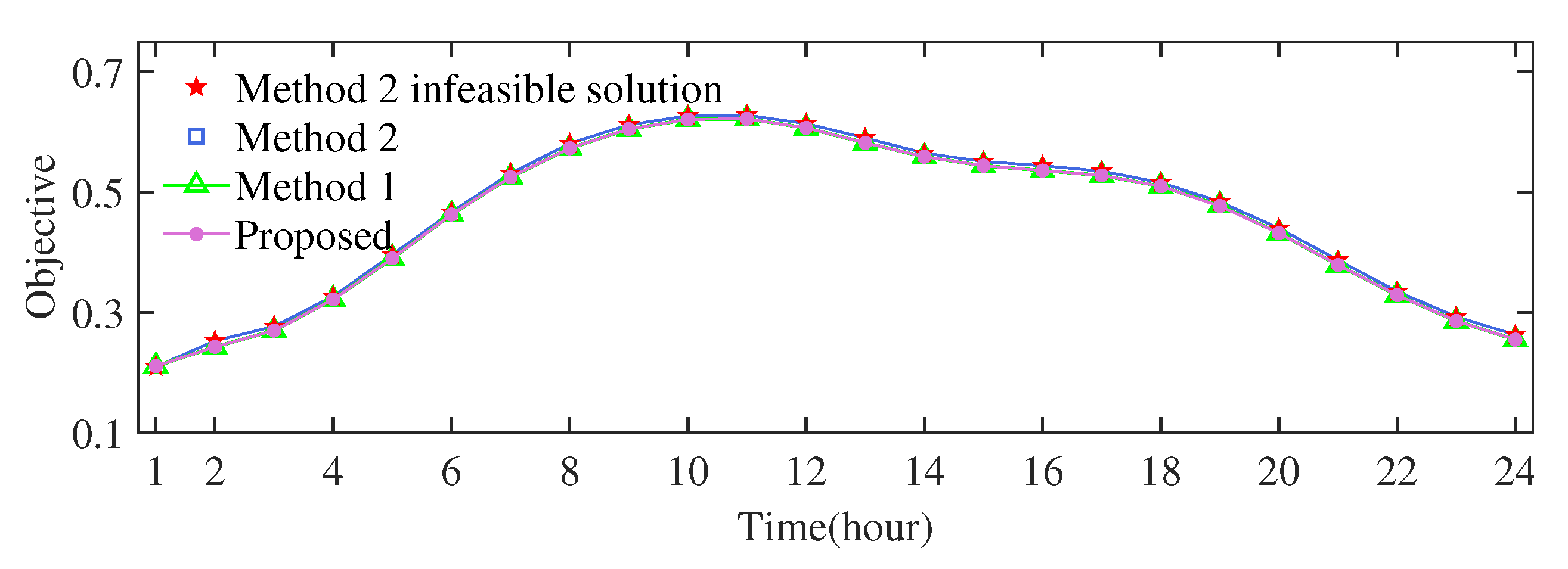
Table 2 and red stars in
Figure 8. The results indicate that the proposed algorithm consistently exhibits minor relative errors in the objective, specifically less than 0.025%. In contrast, Method 2 exhibits significantly larger relative errors, ranging from over 1.5% to 4.5%. Crucially, all solutions from Method 2 were found to be infeasible for the original nonconvex power flow constraints in (
5)–(
8), whereas all solutions generated by the proposed algorithm remained feasible. These findings are further corroborated by
Figure 8, which illustrates objective value distribution over a 24 h period for
. This comprehensive analysis underscores the superior scalability, robustness, and solution quality of the proposed two-stage MTSBR algorithm.
4.5. Computational Efficiency
The computational efficiency of the proposed two-stage MTSBR algorithm (Algorithm 2) is verified by comparing its Gurobi “solvertime” with that of Method 1 and Method 2.
Table 3 presents the mean computation time of all three methods over a 24 h period under different renewable penetration levels (
) in the modified IEEE 33-bus and 123-bus systems. Across all penetration levels, the proposed method, Algorithm 2, consistently outperforms Method 1 in computational speed and achieves performance comparable to that of Method 2. Although Method 2 generally exhibits the shortest computation times, its solutions may violate the nonconvex and nonlinear power flow constraints in (
5)–(
8), as evidenced in
Figure 6 and
Figure 8.
Table 4 further illustrates the computational efficiency advantage of the proposed algorithm by comparing its solution time with Methods 1 and 2 in the modified IEEE 33-bus network under different numbers of scenarios (
). As
increases, the solvertime of the proposed method remains relatively stable, whereas that of Method 1 and Method 2 increases significantly. This is primarily because the proposed method decomposes the SMTDNR problem into multiple SMTOPF problems that can be solved in parallel, whereas Methods 1 and 2 solve the SMTDNR problem in a centralized manner. This highlights the superior scalability and efficiency of the proposed method in large-scenario settings.
5. Discussion
The proposed stochastic multi-timescale rolling optimization framework presents a significant conceptual and practical advancement over existing DNR schemes by coordinating slow-timescale DNR decisions with fast-timescale distributed energy resource (DER) scheduling, which is the strength of the framework. This integrated structure inherently provides superior management of renewable and load uncertainties, yielding solutions that are more robust and stable than conventional sequential or single-timescale methods. More importantly, an efficient heuristic algorithm is developed to solve this challenging NP-hard problem. The numerical test results presented in
Section 4 also verify the superior optimality, feasibility, and computational efficiency of the proposed algorithm when benchmarked against conventional mathematical programming methods that utilize convexified and linearized DistFlow models. This computational efficiency is vital, as it enables the application of the algorithm to coordinate DNR and optimal DER scheduling at the speed necessary for near-real-time integration into a utility’s distribution management system.
Practical implementation requires a sophisticated distribution automation infrastructure. The algorithm’s functionality and system security depend on the deployment of state-of-the-art sensors (intelligent electronic devices [
22], remote terminal units [
23], advanced metering infrastructure [
24], micro-PMUs [
25], etc.) and control devices (distribution management systems [
26], distributed energy resource management systems [
27], automated switches [
28], demand response controllers [
29], etc.) to enable reliable data exchange. While this infrastructure is mandatory for system operation, the separate and complex problem of optimal installation of these sensors, controllers, and communication channels remains outside the scope of the present work. Additionally, as the current work is validated through rigorous simulation, information regarding pilot projects at real facilities is not available.
Future research will focus on two strategic areas: quantifying the optimality gap of the proposed heuristic to establish reliable performance bounds for practical applications, and extending the framework to include the installation of energy storage systems and soft open points, as well as leveraging the advanced reinforcement learning techniques.