Impacts on Regional Growth and “Resource Curse” of China’s Energy Consumption “Dual Control” Policy

Abstract
1. Introduction
2. Related Literature Review
3. The Dynamic CGE Model
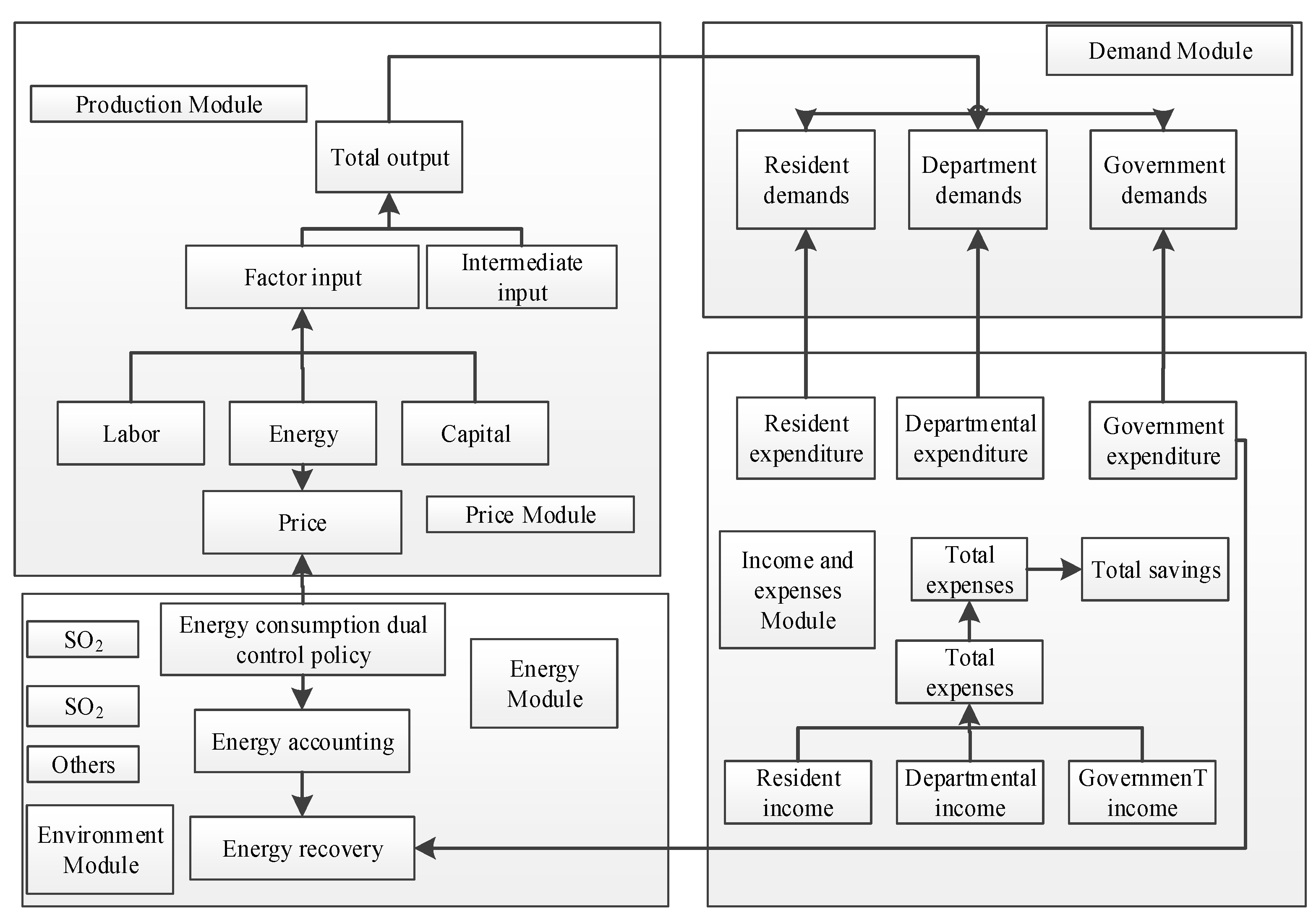
3.1. Overview of the Dynamic CGE Model
3.2. The Main Modules of the Dynamic CGE Model
- (1)
- Production Module
- (2)
- Consumption Module
- (3)
- Price Module
- (4)
- Income–Expenditure Module
- (5)
- Energy Module
- (6)
- Environmental Module
3.3. Basic Data and Key Parameter of the Dynamic CGE Model
4. Simulated Results
4.1. Policy Scenario Setting
- (1)
- The “resource curse” regional division of China
- (2)
- Energy consumption “dual control” policy scenarios
- (3)
- Initial policy scenario setting
4.2. The Simulated Results by Energy Consumption “Dual Control” Policy
- (1)
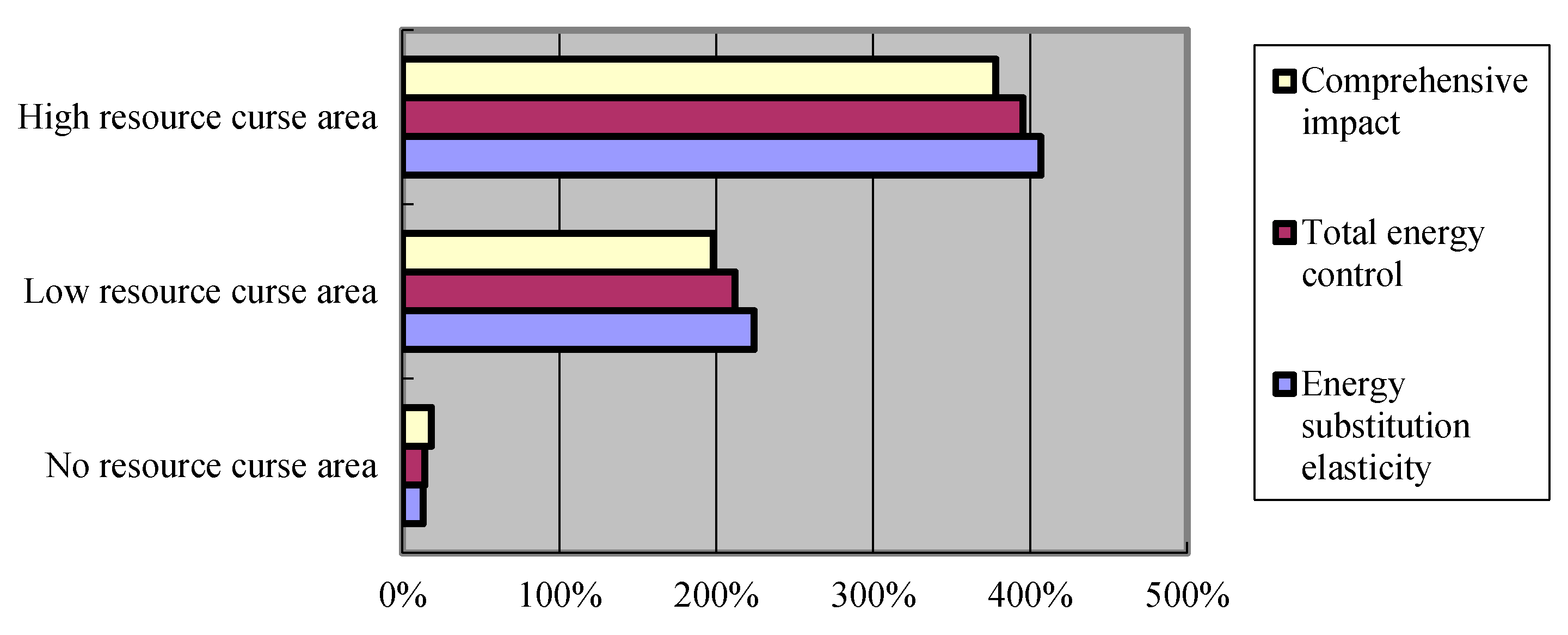
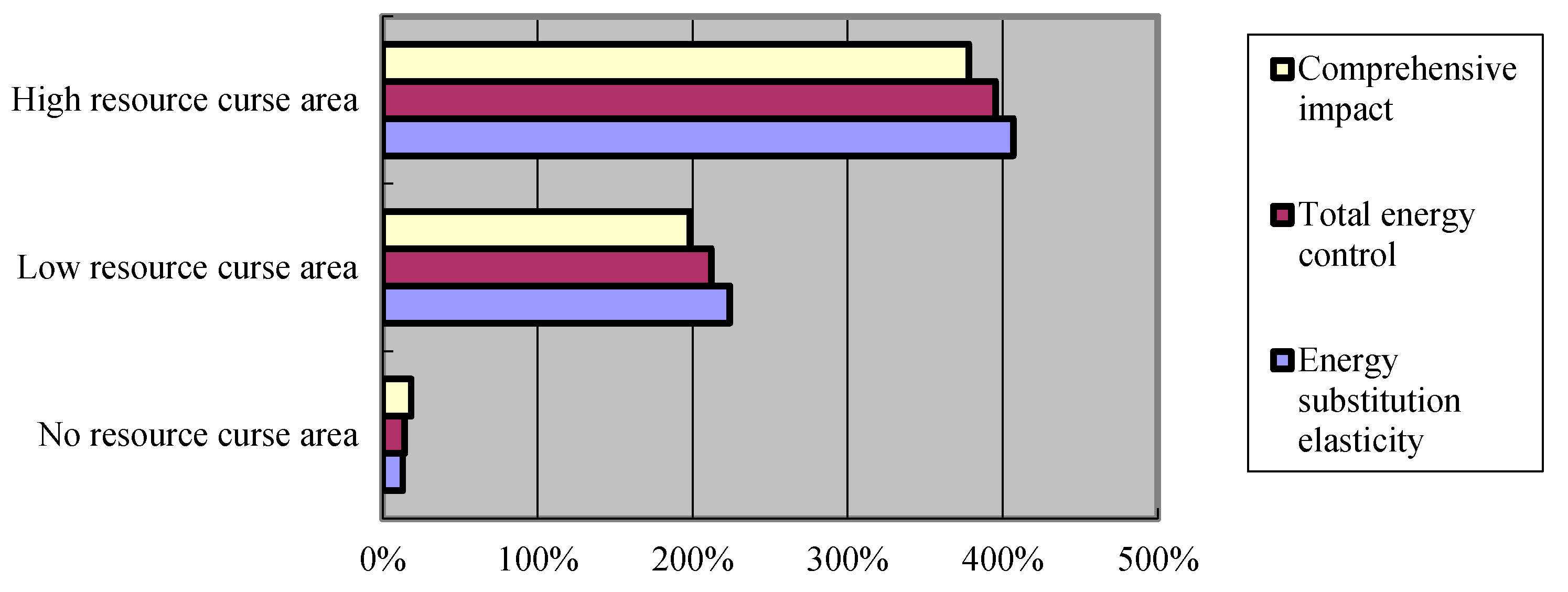
- Impacts on elasticity of substitution and energy supply and demand
- (2)
- Impact on regional economic development
- (3)
- Impact on environmental pollution
- (4)
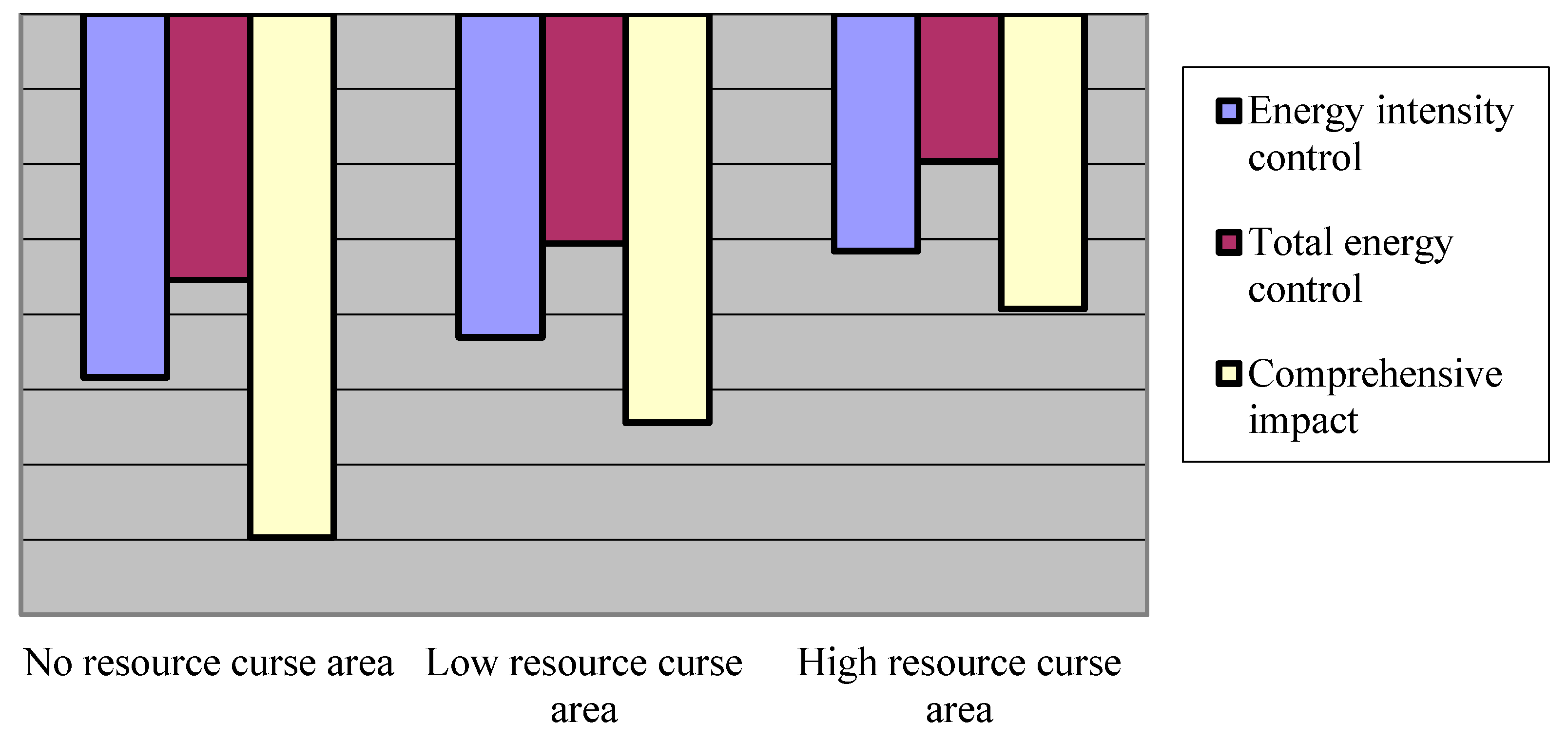
- Changes in regional “Resource Curse”
5. Conclusions
Funding
Data Availability Statement
Conflicts of Interest
References
- Mignone, B.K.; Clarke, L.; Edmonds, J.A.; Gurgel, A.; Herzog, H.; Johnson, J.X.; Mallapragada, D.S.; McJeon, H.; Morris, J.; O’Rourke, P.R.; et al. Drivers and implications of alternative routes to fuels decarbonization in net-zero energy systems. Nat. Commun. 2024, 15, 3938. [Google Scholar] [CrossRef] [Scilit] [PubMed]
- Li, Y.; Sun, L.; Zhang, H.; Liu, T.; Fang, K. Does industrial transfer within urban agglomerations promote dual control of total energy consumption and energy intensity? J. Clean. Prod. 2018, 204, 607–617. [Google Scholar] [CrossRef] [Scilit]
- Hashemizadeh, A.; Ju, Y.; Abadi, F.Z.B. Policy design for renewable energy development based on government support: A system dynamics model. Appl. Energy 2024, 376, 124331. [Google Scholar] [CrossRef] [Scilit]
- Xu, A.; Song, M.; Wu, Y.; Luo, Y.; Zhu, Y.; Qiu, K. Effects of new urbanization on China’s carbon emissions: A quasi-natural experiment based on the improved PSM-DID model. Technol. Forecast. Soc. Chang. 2024, 200, 123164. [Google Scholar] [CrossRef] [Scilit]
- Zhen, W.; Yupeng, T.; Shuang, W.; Hong, C. Does green finance expand China’s green development space? Evidence from the ecological environment improvement perspective. Systems 2023, 11, 369. [Google Scholar] [CrossRef] [Scilit]
- Zhu, H.; Cao, S.; Su, Z.; Zhuang, Y. China’s future energy vision: Multi-scenario simulation based on energy consumption structure under dual carbon targets. Energy 2024, 301, 131751. [Google Scholar] [CrossRef] [Scilit]
- Zou, T.; Li, F.; Guo, P. Advancing effective energy transition: The effects and mechanisms of China’s dual-pilot energy policies. Energy 2024, 307, 132538. [Google Scholar] [CrossRef] [Scilit]
- Du, H.; Chen, Z.; Zhang, Z.; Southworth, F. The rebound effect on energy efficiency improvements in China’s transportation sector: A CGE analysis. J. Manag. Sci. Eng. 2020, 5, 249–263. [Google Scholar] [CrossRef] [Scilit]
- Pradhan, B.K.; Ghosh, J. A computable general equilibrium (CGE) assessment of technological progress and carbon pricing in India’s green energy transition via furthering its renewable capacity. Energy Econ. 2022, 106, 105788. [Google Scholar] [CrossRef] [Scilit]
- Zhao, X.; Hu, S.; Wang, H.; Chen, H.; Zhang, W.; Lu, W. Energy, economic, and environmental impacts of electricity market-oriented reform and the carbon emissions trading: A recursive dynamic CGE model in China. Energy 2024, 298, 131416. [Google Scholar]
- Mardones, C. Contribution of the carbon tax, phase-out of thermoelectric power plants, and renewable energy subsidies for the decarbonization of Chile—A CGE model and microsimulations approach. J. Environ. Manag. 2024, 352, 120017. [Google Scholar] [CrossRef] [Scilit] [PubMed]
- Gao, Z.; Zhao, Y.; Li, L.; Hao, Y. Economic effects of sustainable energy technology progress under carbon reduction targets: An analysis based on a dynamic multi-regional CGE model. Appl. Energy 2024, 363, 123071. [Google Scholar] [CrossRef] [Scilit]
- Sachs, J.D.; Warner, A.M. Natural Resource Abundance and Economic Growth; Center for International Development and Harvard Institute for International Development, Harvard University: Cambridge, MA, USA, 1997. [Google Scholar]
- Auty, R.M. Resource Abundance and Economic Development; Oxford University Press: Oxford, UK, 2001. [Google Scholar]
- Funk, C.; Treviño, L.J.; Oriaifo, J. Resource curse impacts on the co-evolution of emerging economy institutions and firm internationalization. Int. Bus. Rev. 2020, 30, 101753. [Google Scholar] [CrossRef] [Scilit]
- Bonet-Morón, J.; Pérez-Valbuena, G.J.; Marín-Llanes, L. Oil shocks and subnational public investment: The role of institutions in regional resource curse. Energy Econ. 2020, 92, 105002. [Google Scholar] [CrossRef] [Scilit]
- Wei, H.; Rizvi, S.K.A.; Ahmad, F.; Zhang, Y. Resource cursed or resource blessed? The role of investment and energy prices in G7 countries. Resour. Policy 2020, 67, 101663. [Google Scholar] [CrossRef] [Scilit]
- Wong, C.-S. Science mapping: A scientometric review on resource curses, Dutch diseases, and conflict resources during 1993–2020. Energies 2021, 14, 4573. [Google Scholar] [CrossRef] [Scilit]
- Leonard, A.; Ahsan, A.; Charbonnier, F.; Hirmer, S. The resource curse in renewable energy: A framework for risk assessment. Energy Strategy Rev. 2022, 41, 100841. [Google Scholar] [CrossRef] [Scilit]
- Ajide, K.B. Is natural resource curse thesis an empirical regularity for economic complexity in Africa? Resour. Policy 2022, 76, 102755. [Google Scholar] [CrossRef] [Scilit]
- Sun, X.; Ren, J.; Wang, Y. The impact of resource taxation on resource curse: Evidence from Chinese resource tax policy. Resour. Policy 2022, 78, 102883. [Google Scholar] [CrossRef] [Scilit]
- Xu, K.; Wang, J. Research on the relationship between the abundance of natural resources and the level of economic development. Econ. Res. 2006, 41, 78–89. [Google Scholar]
- Shao, S.; Yang, L. Natural resource development, endogenous technological progress and regional economic growth. Econ. Res. 2011, 46, 112–123. [Google Scholar]
- Yu, X.; Li, Y.; Chen, H.; Li, C. The impact of environmental regulation and energy endowment on regional carbon emissions from the perspective of “resource curse”. China Popul. Resour. Environ. 2019, 29, 52–60. [Google Scholar]
- Xue, Y.; Zhang, J.; Yun, L. Resource industry research on spatial agglomeration, extraction of conducting elements and the mediating effect of “resource curse”. China Manag. Sci. 2019, 27, 179–190. [Google Scholar]
- Zhao, W.; Bai, X.; Zheng, J. Is there a “resource curse” effect in R&D investment? Sci. Res. 2019, 37, 2176–2193+2304. [Google Scholar]
- Huang, Q.; Ma, L. Heterogeneous effects of environmental regulation in breaking the resource curse. China Environ. Sci. 2021, 41, 3453–3462. [Google Scholar]
- Xiong, R.; Wu, J. Has the government provided public services under the curse of resources? Financ. Trade Econ. 2020, 41, 19–34. [Google Scholar]
- Liang, Z.; Li, Z. Resource endowment and social intergenerational mobility: An empirical test of the resource curse hypothesis. China Popul. Resour. Environ. 2019, 29, 158–166. [Google Scholar]
- Ang, B.W. Is the energy intensity a less useful indicator than the carbon factor in the study of climate change? Energy Policy 1999, 27, 943–946. [Google Scholar] [CrossRef] [Scilit]
- Shen, X.; Chen, Y.; Lin, B. The impact of technological progress and industrial structure distortion on China’s energy intensity. Econ. Res. 2021, 56, 157–173. [Google Scholar]
- Bella, G.; Massidda, C.; Mattana, P. The relationship among CO2 emissions, electricity power consumption and GDP in OECD countries. Energy Policy 2014, 36, 970–985. [Google Scholar] [CrossRef] [Scilit]
- Cang, D.; Wei, X.; Cao, M.; Tan, L. Research on two-stage economic growth path based on energy substitution and environmental pollution control. China Manag. Sci. 2020, 28, 146–153. [Google Scholar]
- Ma, L.; Zhang, X. Spatial effect of haze pollution in China and its impact on economy and energy structure. China Ind. Econ. 2014, 4, 19–31. [Google Scholar]
- Zhou, P.; Ang, B.W.; Han, J. Total factor carbon emission performance: A Malmquist index analysis. Energy Econ. 2010, 32, 194–201. [Google Scholar] [CrossRef] [Scilit]
- Dai, Y.; Lu, B.; Feng, C. “Thirteenth Five-Year Plan”: China’s total energy consumption control and energy conservation. J. Beijing Inst. Technol. (Soc. Sci. Ed.) 2015, 7, 1–7. [Google Scholar]
- Wei, Y.; Liao, H. “Twelfth Five-Year” China’s energy and carbon emissions forecast and development. Proc. Chin. Acad. Sci. 2011, 26, 150–153. [Google Scholar]
- Zhang, W.; Zhu, Q.; Gao, H. Industrial structure upgrading, energy structure optimization and low-carbon development of industrial system. Econ. Res. 2016, 51, 62–75. [Google Scholar]
- Fan, Y.; Yi, B. Laws of energy transformation, driving mechanisms and China’s path. Manag. World 2021, 37, 95–105. [Google Scholar]
- Zheng, X.; Wu, S.; Li, F. Changes in economic structure and the future trend of China’s energy demand. Chin. Soc. Sci. 2019, 3, 92–112+206. [Google Scholar]
- Yang, M.; Xu, J.; Yang, F. Energy price fluctuation, dynamic accumulation of energy-efficient capital and capital-energy substitution relationship. Syst. Eng. Theory Pract. 2021, 41, 2284–2299. [Google Scholar]
- Li, H.; Xiong, Z. Ecological occupation, green development and environmental tax reform. Econ. Res. 2017, 52, 124–138. [Google Scholar]
- Liu, Z.; Ling, Y. Structural transformation, total factor productivity and high-quality development. Manag. World 2020, 36, 15–29. [Google Scholar]
- Xu, S.; Zhang, W. Impact of carbon tax on China’s economy and emission reduction effect under different rebate scenarios: Simulation analysis based on dynamic CGE. China Popul. Resour. Environ. 2016, 26, 46–54. [Google Scholar]
- Shi, M. The realization path and mechanism design of ecological product value. Environ. Econ. Res. 2021, 6, 1–6. [Google Scholar]
- Zhang, Z.; Zhang, G. The evolutionary logic of cooperation between local governments to control haze—A case study based on the joint prevention and control mechanism of air pollution. Environ. Econ. Res. 2021, 6, 97–114. [Google Scholar]
- Wen, W.; Yang, S.; Tang, Y.; Zhang, X.; Hu, Y.; Ben, Y.; Shen, Q. Evaluating carbon emissions reduction compliance based on ‘dual control’ policies of energy consumption and carbon emissions in China. J. Environ. Manag. 2024, 367, 121990. [Google Scholar] [CrossRef] [Scilit]
- Shen, J.; Zhang, Y.; Chen, X. Environmental regulation and energy consumption transition of rural residents: A case of China. Energy 2024, 310, 133195. [Google Scholar] [CrossRef] [Scilit]
- Lange, F.; Van Asbroeck, R.; Van Baelen, D.; Dewitte, S. For cash, the planet, or for both: Evaluating an informational intervention for energy consumption reduction. Energy Policy 2024, 194, 114314. [Google Scholar] [CrossRef] [Scilit]


| Data | Data Source |
|---|---|
| Total output | China Statistical Yearbook (2007–2022) |
| Resident consumption | China Statistical Yearbook (2007–2022) |
| Sector consumption | China Statistical Yearbook, Government gazette (2007–2022) |
| Government consumption | China input-output table (2020), Government gazette (2007–2022) |
| Labor input | China Input–output table (2020) |
| Capital input | China Input–output table (2020) |
| Energy input | China Input–output table (2020) |
| Gross capital formation | China Input–output table (2020), China Statistical Yearbook (2007–2022) |
| Energy compensation | China Input–output table (2020), China Statistical Yearbook (2007–2022) |
| Labor compensation | China Input–output table (2020), China Statistical Yearbook (2007–2022) |
| Total profit | China Input–output table (2020), China Statistical Yearbook (2007–2022) |
| Income | China Input–output table (2020), China Statistical Yearbook (2007–2022) |
| Tax | China Tax Yearbook, Government gazette (2007–2022) |
| Household savings | China Statistical Yearbook, Government gazette (2007–2022) |
| Sector savings | China Statistical Yearbook, Government gazette (2007–2022) |
| Government savings | China Statistical Yearbook, Government gazette (2007–2022) |
| Environment control | China Statistical Yearbook, Government gazette (2007–2022) |
| Fiscal revenue | Government gazette (2007–2022) |
| Key Parameter | Meaning |
|---|---|
| the scale parameter | |
| the output elasticity for capital | |
| the output elasticity for labor | |
| the output elasticity for energy | |
| the substitution elasticity | |
| the output elasticity of the household consumption | |
| the substitution elasticity of the household consumption | |
| the share of goods in the household consumption | |
| the share of good in sector production | |
| the share of goods in the sector production | |
| the share of services in the government expenditure | |
| the share of goods in the government expenditure | |
| the wage rate | |
| the return of capita | |
| the comprehensive technical level of energy | |
| the technical coefficient of different energy |
| “Resource Curse” | “Resource Curse” Coefficient | Regions |
|---|---|---|
| No | 0 ≤ Rci < 1 | Shanghai, Zhejiang, Jiangsu, Hainan, Beijing, Guangdong, Hubei, Fujian, Shandong, Tianjin, Hubei |
| Low | 1 ≤ Rci < 3 | Liaoning, Henna, Anhui, Sichuan, Chongqing, Yunnan, Gansu, Heilongjiang, Qinghai |
| High | 3 ≤ Rci | Jilin, Xinxiang, Ningxia, Huizhou, Inner Mongolia, Shanxi, Shaanxi |
| Policy Scenarios | Key Indicators | Total Control | Average |
|---|---|---|---|
| Total energy control | Decline in total energy consumption | 11.3% | 2.26% |
| Energy intensity control | Decrease in energy consumption per unit of GDP | 13.5% | 2.7% |
| Total Investment Growth | Total Consumption Growth | GDP Growth | |
|---|---|---|---|
| 2007 | 24.8 | 19.4 | 11.9 |
| 2008 | 25.9 | 14.4 | 9.0 |
| 2009 | 30.1 | 9.8 | 9.2 |
| 2010 | 23.8 | 15.5 | 10.3 |
| 2011 | 23.8 | 21.4 | 9.5 |
| 2012 | 20.6 | 12.5 | 7.9 |
| 2013 | 19.6 | 11.4 | 7.8 |
| 2014 | 15.7 | 10.2 | 7.3 |
| 2015 | 10.0 | 10.0 | 6.9 |
| 2016 | 8.1 | 10.5 | 6.7 |
| 2017 | 7.2 | 11.1 | 6.8 |
| 2018 | 5.9 | 10.9 | 6.6 |
| 2019 | 5.4 | 9.0 | 6.1 |
| 2020 | 2.9 | - | 2.3 |
| Average | 10.8 | 12.3 | 10.7 |
| Energy Production Elasticity Coefficient | Energy Consumption Elasticity Coefficient | Energy Total Consumption | Coal Total Consumption | Oil Total Consumption | Natural Gas Total Consumption | Clean Energy Total Consumption | Energy Consumption per Unit of GDP | |
|---|---|---|---|---|---|---|---|---|
| 2007 | 0.56 | 0.61 | 311,442 | 225,792 | 52,945 | 9343 | 23,358 | 1.29 |
| 2008 | 0.52 | 0.44 | 320,611 | 229,237 | 53,542 | 9618 | 28,214 | 1.21 |
| 2009 | 0.34 | 0.57 | 336,126 | 240,666 | 55,125 | 11,764 | 28,571 | 1.16 |
| 2010 | 0.86 | 0.58 | 360,648 | 249,568 | 62,753 | 14,426 | 33,901 | 0.88 |
| 2011 | 0.95 | 0.76 | 387,043 | 271,704 | 65,023 | 17,804 | 32,512 | 0.86 |
| 2012 | 0.41 | 0.51 | 402,138 | 275,464 | 68,363 | 19,303 | 39,008 | 0.83 |
| 2013 | 0.29 | 0.48 | 416,913 | 280,999 | 71,292 | 22,096 | 42,526 | 0.79 |
| 2014 | 0.12 | 0.30 | 425,806 | 279,329 | 74,090 | 24,270 | 48,117 | 0.76 |
| 2015 | - | 0.13 | 429,905 | 273,849 | 78,673 | 25,364 | 52,019 | 0.63 |
| 2016 | - | 0.21 | 435,819 | 270,208 | 80,627 | 27,021 | 57,963 | 0.60 |
| 2017 | 0.54 | 0.42 | 448,529 | 270,912 | 85,323 | 31,397 | 60,897 | 0.58 |
| 2018 | 0.84 | 0.52 | 464,000 | 273,760 | 87,696 | 36,192 | 66,352 | 0.56 |
| 2019 | 0.84 | 0.54 | 487,000 | 280,999 | 92,043 | 39,447 | 74,511 | 0.55 |
| Average | -- | - | 3.8 | 1.9 | 4.7 | 12.7 | 10.1 | - |
| Total Exhaust Emissions (10,000 Tons) | SO2 (10,000 Tons) | Industrial Waste (100 Million Tons) | Industrial Solid Waste Discharge (10,000 Tons) | Pollutant Control Investment (100 Million Yuan) | |
|---|---|---|---|---|---|
| 2007 | 388,169 | 2468 | 247 | 175,632 | 3387 |
| 2008 | 403,866 | 2321 | 242 | 190,127 | 4937 |
| 2009 | 436,064 | 2214 | 235 | 203,943 | 5258 |
| 2010 | 519,168 | 2185 | 238 | 240,944 | 7612 |
| 2011 | 674,509 | 2218 | 231 | 322,772 | 7114 |
| 2012 | 635,519 | 2118 | 222 | 329,044 | 8253 |
| 2013 | 669,361 | 2044 | 210 | 327,702 | 9037 |
| 2014 | 694,190 | 1974 | 205 | 325,620 | 9575 |
| 2015 | 629,700 | 1859 | 200 | 327,079 | 8806 |
| 2016 | - | 855 | 207 | 309,210 | 9219 |
| 2017 | - | 611 | 158 | 331,592 | 9539 |
| 2018 | - | 516 | 378 | 408,000 | 8988 |
| 2019 | - | 457 | 252 | 441,000 | 9152 |
| Average | 6.5% | −13.1% | 0.2% | 7.9% | 8.6% |
| Energy Substitution Elasticity | Total Energy Control | Energy Intensity Control | Comprehensive Impact | |
|---|---|---|---|---|
| 2025 | Coal—petroleum | 0.6246 | 0.6138 | 0.6217 |
| Coal—clean energy | 1.6176 | 1.6149 | 1.6168 | |
| Oil—clean energy | 1.5335 | 1.5297 | 1.5329 | |
| 2030 | Coal—petroleum | 0.6243 | 0.6135 | 0.6213 |
| Coal—clean energy | 1.6156 | 1.6122 | 1.6135 | |
| Oil—clean energy | 1.5317 | 1.5276 | 1.5302 | |
| 2035 | Coal—petroleum | 0.6239 | 0.6132 | 0.6211 |
| Coal—clean energy | 1.6144 | 1.6107 | 1.6122 | |
| Oil—clean energy | 1.5302 | 1.5249 | 1.5286 |
| Resource Curse | 2025 | 2026 | 2027 | 2028 | 2029 | 2030 | 2031 | 2032 | 2033 | 2034 | 2035 | |
|---|---|---|---|---|---|---|---|---|---|---|---|---|
| Energy intensity control | Without | −3.88 | −3.83 | −3.79 | −3.76 | −3.72 | −3.68 | −3.64 | −3.59 | −3.55 | −3.52 | −3.49 |
| Low | −2.86 | −2.84 | −2.78 | −2.75 | −2.72 | −2.69 | −2.67 | −2.65 | −2.63 | −2.61 | −2.58 | |
| High | −0.96 | −0.93 | −0.92 | −0.91 | −0.89 | −0.87 | −0.86 | −0.85 | −0.83 | −0.81 | −0.80 | |
| Total energy control | Without | −2.09 | −2.14 | −2.28 | −2.39 | −2.57 | −2.59 | −2.64 | −2.75 | −2.82 | −2.86 | −2.91 |
| Low | −1.65 | −1.72 | −1.85 | −1.92 | −2.06 | −2.08 | −2.15 | −2.28 | −2.36 | −2.42 | −2.45 | |
| High | −1.12 | −1.18 | −1.29 | −1.38 | −1.46 | −1.48 | −1.53 | −1.67 | −1.78 | −1.89 | −1.96 | |
| Comprehensive Influences | Without | −4.36 | −4.42 | −4.45 | −4.53 | −4.62 | −4.65 | −4.69 | −4.76 | −4.85 | −4.91 | −4.96 |
| Low | −2.19 | −2.23 | −2.29 | −2.38 | −2.45 | −2.49 | −2.58 | −2.69 | −2.77 | −2.82 | −2.89 | |
| High | −1.57 | −1.59 | −1.66 | −1.73 | −1.78 | −1.82 | −1.86 | −1.89 | −1.91 | −1.95 | −1.98 |
| Resource Curse | Energy Intensity Control | Total Energy Control | Comprehensive Impact | ||||||
|---|---|---|---|---|---|---|---|---|---|
| 2025 | 2030 | 2035 | 2025 | 2030 | 2035 | 2025 | 2030 | 2035 | |
| Without | 117.25 | 116.72 | 115.89 | 114.66 | 113.72 | 113.48 | 112.58 | 111.98 | 111.27 |
| Low | 96.24 | 95.23 | 93.91 | 97.69 | 97.02 | 96.55 | 95.62 | 94.82 | 94.59 |
| High | 77.62 | 81.92 | 83.25 | 75.19 | 77.46 | 79.74 | 74.16 | 76.47 | 78.79 |
| Time | Resource Curse | Total Energy Control | Energy Intensity Control | Comprehensive Impact | ||||||
|---|---|---|---|---|---|---|---|---|---|---|
| GDP Growth | Total Investment | Total Output | GDP Growth | Total Investment | Total Output | GDP Growth | Total Investment | Total Output | ||
| 2025 | none | −1.01 | −2.06 | −2.35 | −1.25 | −2.46 | −2.35 | −1.15 | −2.26 | −2.01 |
| Low | −0.98 | −1.98 | −2.12 | −1.18 | −1.91 | −2.12 | −1.08 | −1.82 | −1.92 | |
| high | 0.57 | 0.53 | 0.81 | 0.77 | 0.59 | 0.81 | 0.69 | 0.56 | 0.81 | |
| 2030 | none | −0.94 | −1.84 | −2.19 | −1.10 | −2.26 | −2.22 | −1.01 | −2.07 | −1.81 |
| Low | −0.85 | −1.76 | −2.03 | −1.06 | −1.76 | −2.06 | −0.88 | −1.62 | −1.60 | |
| high | 0.49 | 0.47 | 0.71 | 0.69 | 0.52 | 0.74 | 0.55 | 0.41 | 0.62 | |
| 2035 | none | −0.85 | −1.64 | −1.82 | −0.97 | −2.05 | −2.07 | −0.88 | −1.56 | −1.78 |
| Low | −0.70 | −1.46 | −1.65 | −0.93 | −1.62 | −1.85 | −0.71 | −1.24 | −1.38 | |
| high | 0.33 | 0.33 | 0.54 | 0.54 | 0.42 | 0.61 | 0.42 | 0.27 | 0.45 | |
| Area | Energy Intensity Control | Total Energy Control | Comprehensive Impact | Area | Energy Intensity Control | Total Energy Control | Comprehensive Impact |
|---|---|---|---|---|---|---|---|
| Shanxi | 0.85 | 0.61 | 0.76 | Gansu | 0.55 | 0.48 | 0.51 |
| Inner Mongolia | 0.77 | 0.71 | 0.73 | Jiangsu | −1.41 | −1.75 | −1.66 |
| Liaoning | −0.86 | −0.92 | −0.90 | Shanghai | −1.63 | −1.93 | −1.85 |
| Heilongjiang | −0.28 | −0.25 | −0.26 | Beijing | −0.91 | −0.96 | −0.95 |
| Jilin | −0.69 | −0.61 | −0.66 | Zhejiang | −1.60 | −1.80 | −1.77 |
| Guizhou | 0.17 | 0.11 | 0.15 | Fujian | −1.15 | −1.35 | −1.37 |
| Shaanxi | 0.67 | 0.51 | 0.60 | Guangdong | −2.19 | −2.26 | −2.21 |
| Henan | −0.84 | −0.89 | −0.88 | Qinghai | 0.15 | 0.18 | 0.17 |
| Hebei | −1.89 | −1.99 | −1.92 | Xinjiang | 0.32 | 0.28 | 0.30 |
| Ningxia | 0.41 | 0.37 | 0.38 | Anhui | −1.11 | −0.92 | −0.99 |
| Shandong | −2.09 | −2.24 | −2.20 | Jiangxi | −1.25 | −1.02 | −1.14 |
| Major Pollutants | Energy Intensity Control | Total Energy Control | Comprehensive Impact | |||||||
|---|---|---|---|---|---|---|---|---|---|---|
| 2025 | 2030 | 2035 | 2025 | 2030 | 2035 | 2025 | 2030 | 2035 | ||
| No resource curse area | Waste water disposal | −5.44 | 6.46 | −6.95 | −3.13 | 3.75 | −4.02 | −7.18 | 8.25 | −8.92 |
| SO2 emissions | −7.73 | −8.65 | −9.25 | −5.26 | −5.88 | −6.13 | −9.22 | −9.69 | −10.36 | |
| CO2 emissions | −8.14 | −9.16 | −9.68 | −6.32 | −6.73 | −7.09 | −12.45 | −13.28 | −13.95 | |
| Industrial solid waste discharge | −3.66 | −4.12 | −4.86 | −2.15 | −2.75 | −2.97 | −4.86 | −5.65 | −5.92 | |
| Low resource curse area | Waste water disposal | −3.14 | 4.42 | −4.84 | −2.06 | 2.38 | −2.63 | −4.78 | −5.69 | −6.11 |
| SO2 emissions | −5.71 | −6.94 | −7.16 | −4.09 | −4.38 | −4.77 | −8.06 | −8.67 | −8.96 | |
| CO2 emissions | −7.13 | −8.12 | −8.62 | −5.19 | −5.68 | −6.12 | −10.18 | −10.62 | −10.89 | |
| Industrial solid waste discharge | −2.13 | −2.82 | −3.22 | −1.72 | −1.89 | −1.96 | −3.03 | −3.50 | −3.82 | |
| High resource curse area | Waste water disposal | −2.03 | −2.26 | −2.69 | −1.56 | 1.69 | −1.88 | −2.86 | −3.05 | −3.41 |
| SO2 emissions | −3.77 | −4.25 | −4.68 | −2.36 | −2.58 | −2.86 | −6.17 | −6.58 | −6.92 | |
| CO2 emissions | −5.16 | −5.89 | −6.32 | −3.46 | −3.79 | −3.92 | −7.06 | −7.48 | −7.86 | |
| Industrial solid waste discharge | −2.08 | −2.35 | −2.69 | −1.85 | −1.96 | −2.05 | −2.59 | −2.84 | −3.11 | |
| Provinces | Shanghai | Zhejiang | Jiangsu | Hainan | Beijing | Guangdong | Hubei | Fujian | Guangxi | Jiangxi |
| Rci | 0.05 | 0.09 | 0.16 | 0.15 | 0.18 | 0.23 | 0.27 | 0.68 | 1.32 | 1.06 |
| Provinces | Liaoning | Henan | Anhui | Sichuan | Chongqing | Yunnan | Gansu | Heilongjiang | Shaanxi | Qinghai |
| Rci | 1.95 | 1.15 | 0.98 | 1.24 | 0.97 | 1.48 | 1.83 | 2.18 | 3.86 | 2.69 |
| Provinces | Tianjin | Hebei | Hunan | Shandong | Jilin | Xinjiang | Ningxia | Guizhou | Inner Mongolia | Shanxi |
| Rci | 0.65 | 0.73 | 0.79 | 0.81 | 2.96 | 5.48 | 2.98 | 4. 05 | 5.11 | 6.32 |
Disclaimer/Publisher’s Note: The statements, opinions and data contained in all publications are solely those of the individual author(s) and contributor(s) and not of MDPI and/or the editor(s). MDPI and/or the editor(s) disclaim responsibility for any injury to people or property resulting from any ideas, methods, instructions or products referred to in the content. |
© 2024 by the author. Licensee MDPI, Basel, Switzerland. This article is an open access article distributed under the terms and conditions of the Creative Commons Attribution (CC BY) license (https://creativecommons.org/licenses/by/4.0/).
Share and Cite
Xu, X. Impacts on Regional Growth and “Resource Curse” of China’s Energy Consumption “Dual Control” Policy. Energies 2024, 17, 5345. https://doi.org/10.3390/en17215345
Xu X. Impacts on Regional Growth and “Resource Curse” of China’s Energy Consumption “Dual Control” Policy. Energies. 2024; 17(21):5345. https://doi.org/10.3390/en17215345
Chicago/Turabian StyleXu, Xiaoliang. 2024. "Impacts on Regional Growth and “Resource Curse” of China’s Energy Consumption “Dual Control” Policy" Energies 17, no. 21: 5345. https://doi.org/10.3390/en17215345
APA StyleXu, X. (2024). Impacts on Regional Growth and “Resource Curse” of China’s Energy Consumption “Dual Control” Policy. Energies, 17(21), 5345. https://doi.org/10.3390/en17215345