Pythagorean Fuzzy Storage Capacity with Controllable Carbon Emission Incorporating Green Technology Investment on a Two-Depository System


 , and
, and 
Abstract
1. Introduction
1.1. Literature Review
1.1.1. Inventory Models under a Two-Warehouse Environment
1.1.2. Inventory Models under Preservation Technology
1.1.3. Inventory Models under Various Demands
1.1.4. Study under Various Uncertain Environments
1.1.5. Research under Green Warehouse, Carbon Tax, and Green Technology
1.2. Motivation and Research Questions
1.3. Research Contributions
- This study considers a hybrid environment consisting of interval-valued emission and triangular Pythagorean fuzzy storage capacity. According to the author’s knowledge, this is the first study in which a hybrid environment system is incorporated into two-warehouse inventory systems.
- This study considers the storage capacity of the OW is a TPFN, and provided a novel ranking method for defuzzifying TPFN. According to the authors’ knowledge, this is the first paper that considers storage capacity as TPFN.
- This research considers the demand rate of this study depending on price, the impact of advertisement, herbal or natural ingredients, and chemical ingredients.
- Environmental emission is a major problem now facing society. This model consider emissions reduction by investing in green technology in both OW and RW.
- Cost parameters, storage capacity, and emission parameters are imprecise. To relieve this situation, this research considers the cost and emission parameters are interval-valued numbers and the storage capacity of OW as TPFN.
2. Formulation of Proposed Warehouse Inventory Model
2.1. Problem Definition
2.2. Certain Assumptions of Two-Warehouse Inventory System
- The demand rate is changing with usage percentage of herbal and chemical ingredients [70], this research has developed the same concept and implemented a demand function based on natural market conditions. The demand of the product in the two-warehouse inventory system decreases with the price and usage percentage of chemical ingredients and increases with the impact of advertisement and usage percentage of herbal or natural ingredients in the product i.e., = where , , , , , and
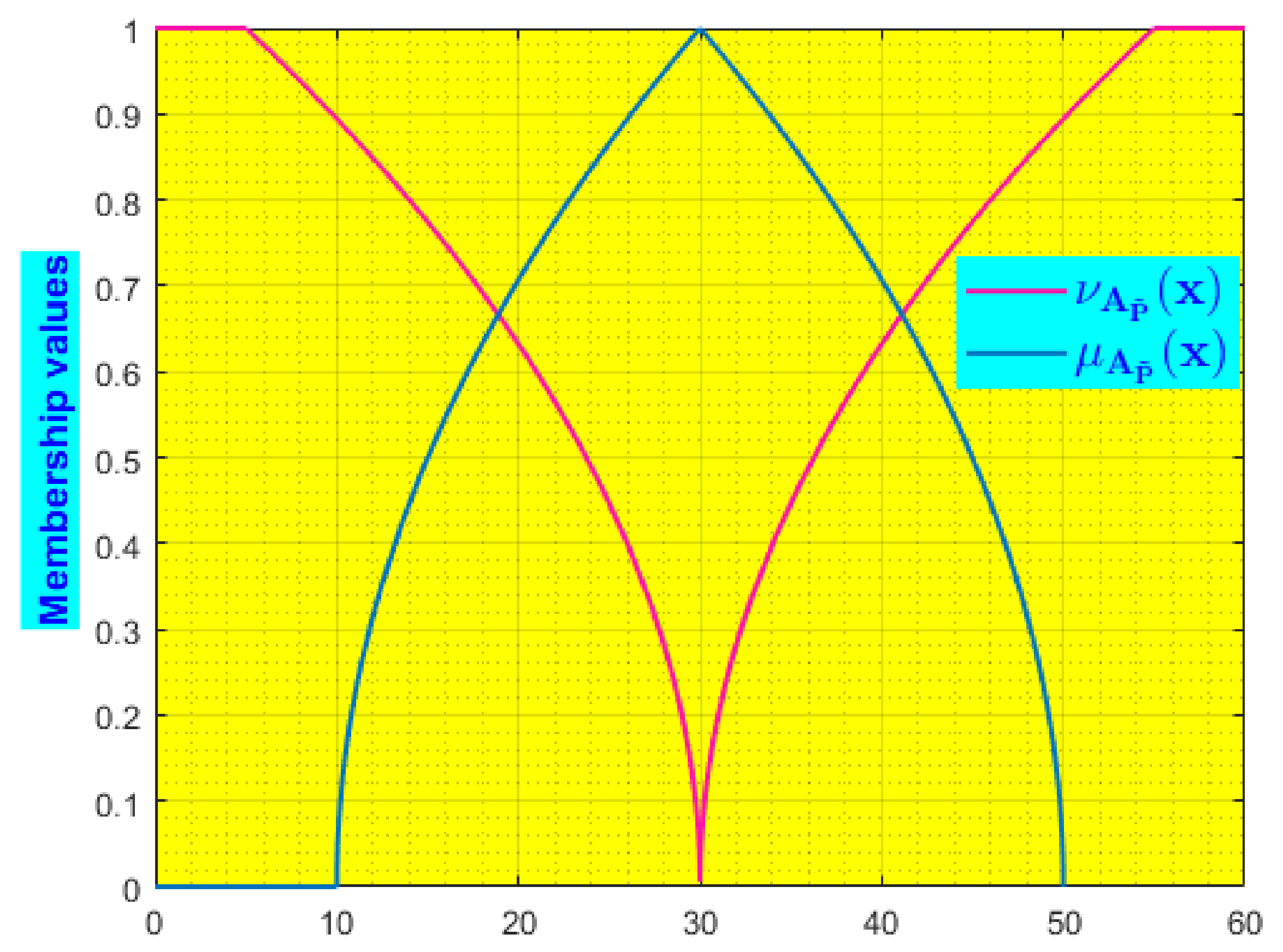
- The storage capacity of OW is considered as TPFN, i.e., .
- To reduce the deterioration rate of an item by incorporating preservation technology (PT) in both OW and RW, so deterioration rate under PT in OW is , and reducing the deterioration rate under PT in RW is , where .
- The OW’s capacity is represented by a triangular Pythagorean fuzzy measure of units, whereas the capacity of the RW, is limitless.
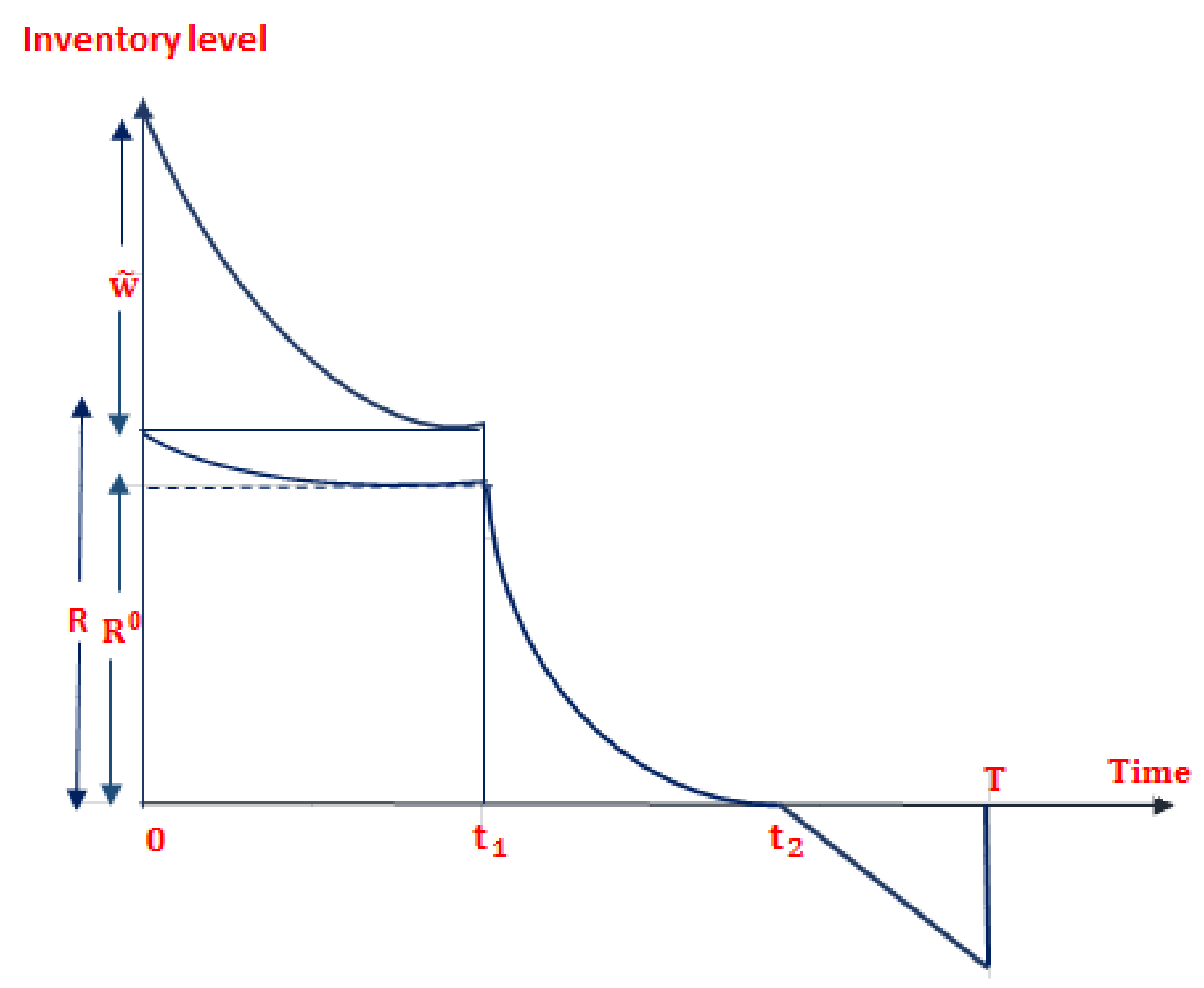
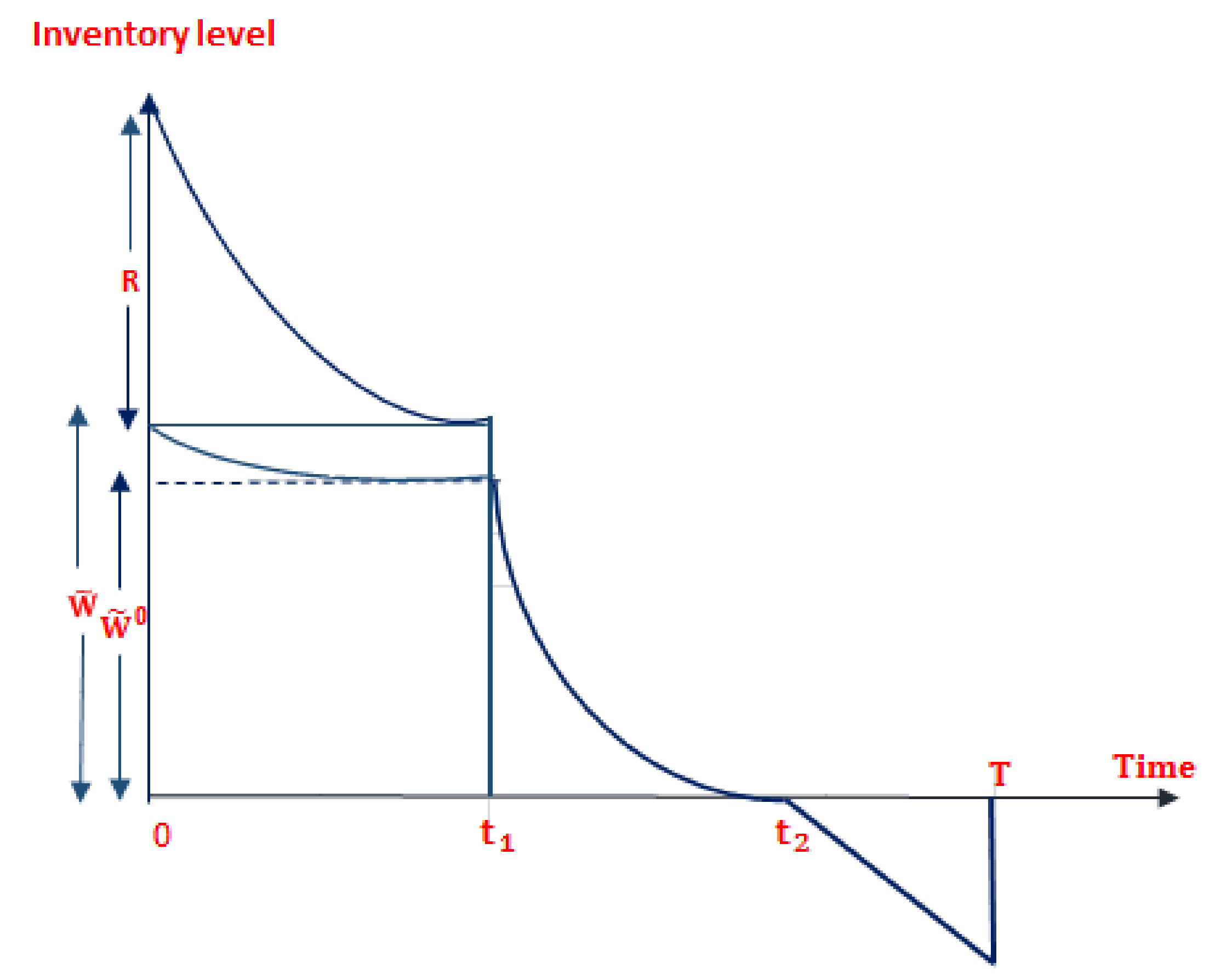
- The items in RW are stored only after entirely utilizing OW’s availability.
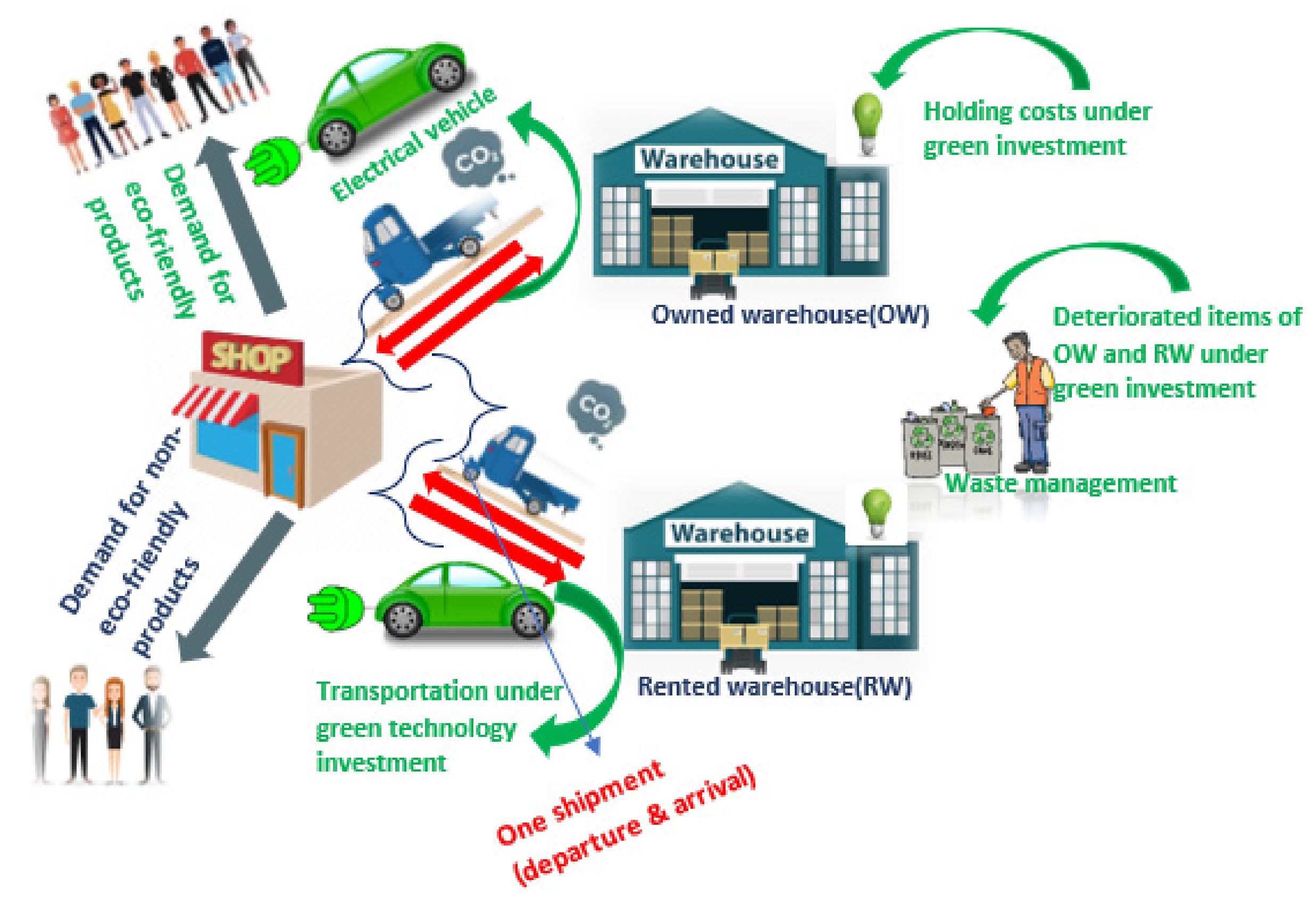
- This study considered two functions for a fraction of emission-reducing green technology ():
- Function-I: [36] The fraction of emission lessening due to green technology investment (G) in both OW and RW is because is the amount of carbon emission when green technology is invested in, and alerts the ability of green technology to decrease emission. becomes zero when means that without green investment, the fraction emission is zero and inclines toward when . With an investment , the retailer can reduce emissions, while the investment function is continuously differentiable with the conditions , .
- Function-II: [70] The fraction of emission lessening due to green technology investment(G) in both OW and RW is because is the amount of carbon emission incorporating investment in green technology and alerts the ability or efficiency of green technology to decrease emission. becomes zero when means that without green investment, the fraction emission is zero and inclines toward when . The retailer may cut emissions with an investment of , whereas the investment function is continuously differentiable under the criteria and .
- The emissions are released from two warehouses due to holding, deteriorating, and transporting items.
- The truck travels from the depository to the shop with a load and returns back with an empty load, considered one shipment.
- Emission cost of the items considered under simple carbon tax policy. In this case, the agency in charge of regulating carbon emissions imposes a tax on each unit of carbon discharged into the atmosphere, regardless of how much carbon is released into the atmosphere overall. Although there are numerous other tax schedules, such as convex, concave, piece-wise linear, non-linear, etc., the linear tax schedule is the most straightforward and simple, which is determined by the formula “tax amount = tax per unit emission multiplied by total emission amount”. Therefore, the cost to the inventory incurred as a result of carbon emissions is referred to as the emission cost (EC), which is represented by a linear form equation .
- Shortages are allowed and entirely backlogged.
2.3. Developing Preliminary Concept and Capturing Fuzzy Environment Model
2.4. Warehouse Model Formulation of FIFO
2.5. LIFO Warehouse Inventory Model Formulation
3. Analysis of Green Warehouse Inventory System
3.1. Model Formulation of FIFO
3.2. Cost Associated with Carbon Emission in FIFO Policy
3.3. LIFO Model Formulation
3.4. Cost Associated with Carbon Emission in LIFO Policy
4. Optimization of Inventory System in Pythagorean Fuzziness
- =, for
- =, for
- Second and higher order terms of , are negligible as , , so
- = for
- = for
4.1. Procedure for Optimal Solution of FIFO Model
4.2. Procedure for Optimal Solution of LIFO Model
5. Numerical Solution
6. Sensitivity Analysis
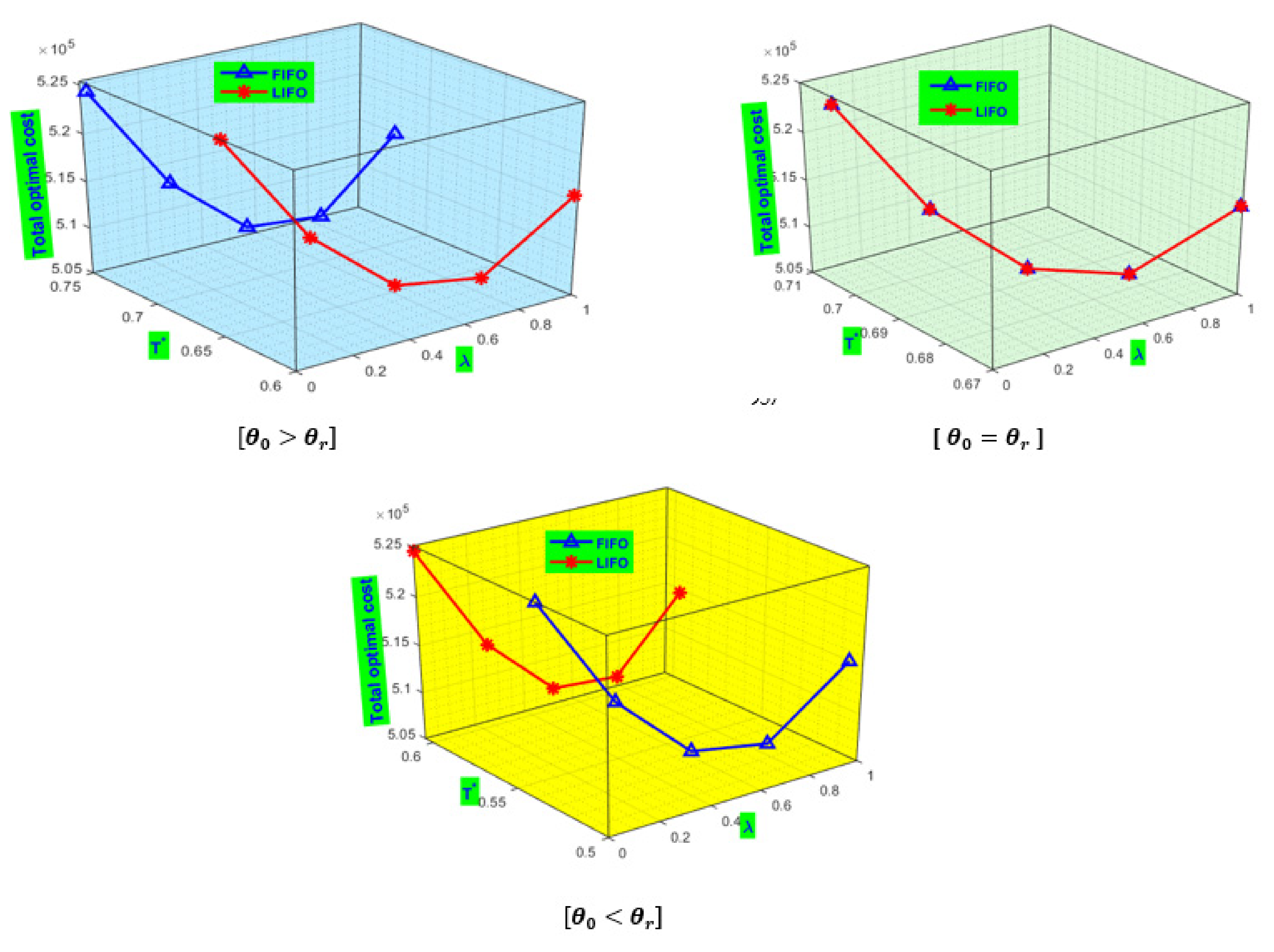
- If , i.e., the rate of degradation of OW is lower than the rate of deterioration of RW, the total average cost of FIFO policy is lower than the total average cost of LIFO policy. Therefore, the managerial decision suggests the FIFO policy. However, the LIFO policy has a lower overall average cost than the FIFO approach if , so the recommended policy is LIFO.
- If , i.e., the rate of degradation of OW and RW is the same, then the total cost of the FIFO policy is less than the total cost of the LIFO policy; hence, FIFO is recommended in this scenario.
- If , i.e., the OW degradation rate is higher, the advised policy is FIFO because the FIFO policy’s total average cost is lower than the LIFO policy’s total average cost.
- The following observations are made when the holding costs of RW and OW are the same, i.e., :
- If , i.e., the rate of deterioration of OW is lower than RW and the overall average cost is lower for LIFO, this strategy is recommended.
- If , i.e., the rate of deterioration of OW is the same as the rate of decay of RW, the total average cost of FIFO and LIFO policies is the same; thus, either LIFO or FIFO is suggested.
- If , i.e., the rate of degradation of OW exceeds the rate of deterioration of RW, the overall average cost of the FIFO policy is lowest, and hence, in this case, the suggested policy is FIFO.
- For , the LIFO policy’s total average cost is lower than the FIFO policy’s total average cost, hence the suggested policy is LIFO.
- For , here also, LIFO policy is suggested since the total average cost of LIFO policy is the lowest.
- If , i.e., the pace of degradation of OW exceeds the rate of deterioration of RW, the total average cost of the LIFO policy is initially lower, but if the deterioration of OW goes very high, then the suggested policy, in this case, is FIFO.
- If , , i.e., the product is made with 20 percent chemical ingredients and no herbal ingredients, in this case, the demand rate reduces, then the total cost of the inventory system reduces, and the product is stored in the depository for a longer duration so that the replenishment cycle length increases.
- If , i.e., the product is made with half of the chemical and herbal ingredients. In this case, the demand rate decrease is small. The total cost of the inventory system reduces, and due to less demand for the product, it stays for a long time in the depository. Hence, the replenishment cycle length increases moderately in this case.
- For the special case , customers are not known about the ingredients, which means they would not consider the ingredients percentage of the product buying time. In that scenario, the chemical and herbal ingredients do not affect demand.
- If , , i.e., the product is made with only herbal ingredients, no chemical ingredients, then this type of product is called an eco-friendly product. In this case, the demand rate increases high, then the total cost of the inventory system also increases and due to high demand, the replenishment cycle length decreases. and .
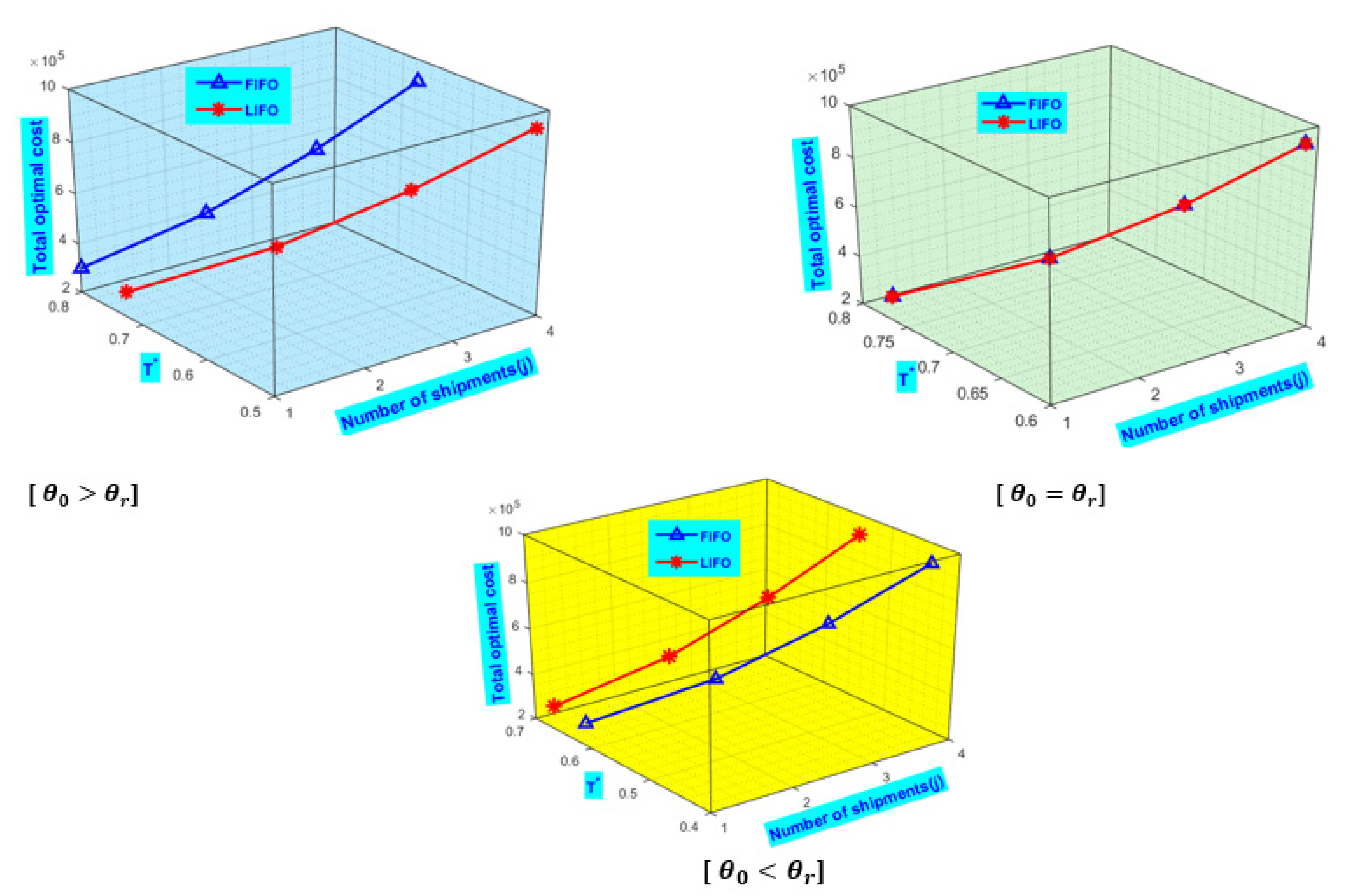
- If the rate of deterioration of OW is greater than RW, then if the retailer increases the number of shipments, then the total cost increases and the total cost decreases if the retailer decreases the number of shipments, and the policy suggested is FIFO.
- If the degradation rate in OW is equal to the rate in RW and if the retailer increases the number of shipments, then the overall cost will rise significantly. And if the retailer increases the number of shipments, then the total cost decreases more and in this situation, suggests FIFO or LIFO as the appropriate policy.
- If the retailer increases the number of shipments and the rate of degradation of OW is lower than that of RW, in this situation, the overall cost will increase. And suppose the retailer reduces the number of shipments. In that case, the overall cost of the inventory system falls even further, and the suggested policy, in this case, is LIFO, as shown in Figure 7.
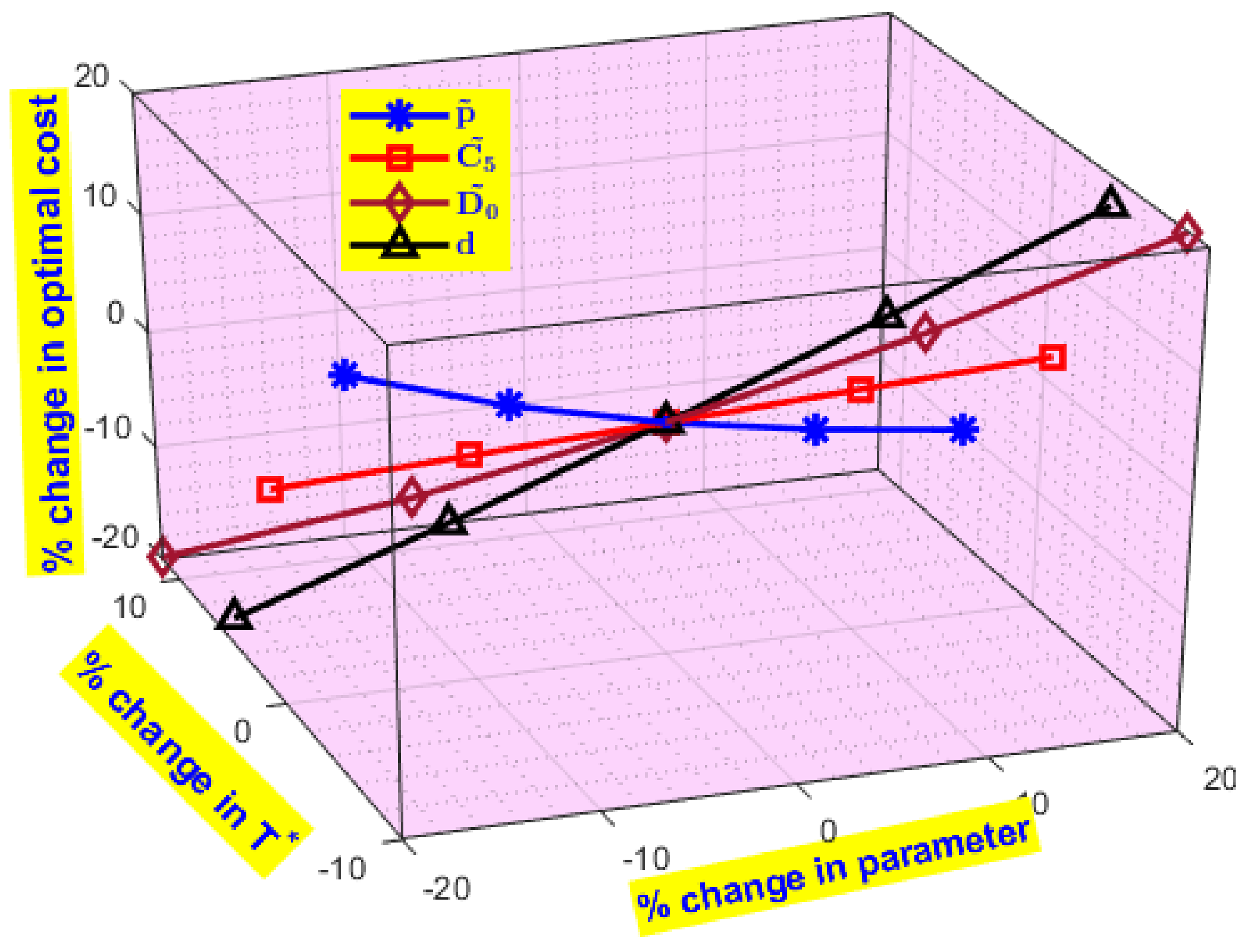
- Suppose the selling price ( rises by 20%. The optimal total average cost of the warehouse inventory system decreases moderately due to increasing the selling price, and sales of the product reduce moderately. Consequently, the optimal cycle length increases because the demand for this warehouse inventory system depends on the selling price. Similarly, if the retailer decreases the selling price, then the optimal cost increases and the optimal cycle length decreases (Figure 9).
- The presented inventory model is less sensitive to purchasing cost . It shows that if the purchasing cost of the item increases (decreases), then the total cost increases (decreases) but a very less amount. Increasing or decreasing the purchasing cost shows negligible changes in the replenishment cycle and optimal quantity.
- Suppose transportation distance increases, then the transportation cost increases so that the optimal cost of the inventory system increases highly. The cycle length and ideal amount are substantially reduced with an increase in the transportation distance. In the same way, the transportation distance decreases, and then the transportation cost decreases so that the total cost decreases.
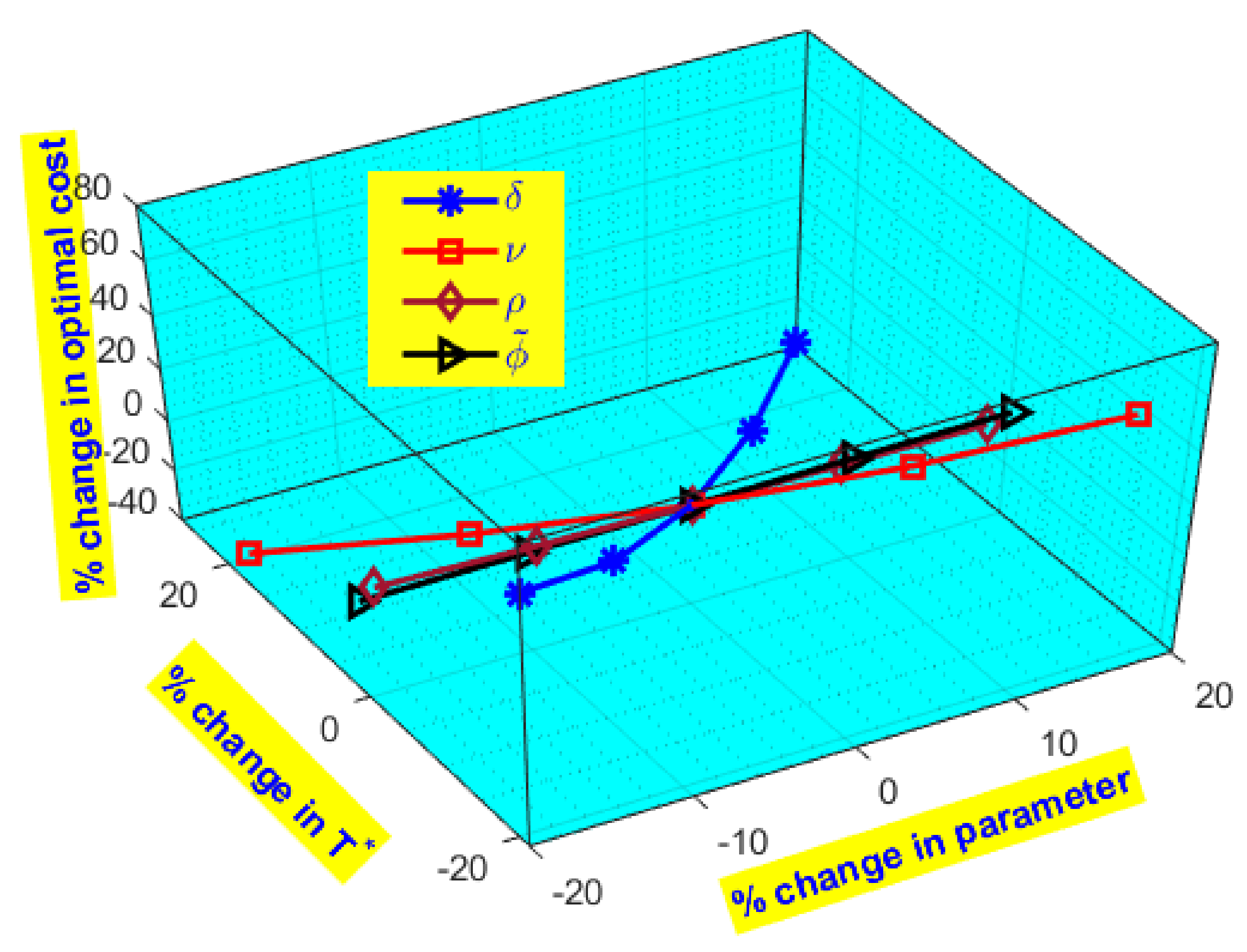
- If the tax () for emitted carbon increases, then the optimal cost of the inventory system increases in lesser quantity, as shown in Figure 10.
- The proposed two-warehouse inventory system’s demand depends on the price-sensitive parameter. From Table 9, we can observe that the optimal total cost is highly sensitive to the price-sensitive parameter . This study shows that when a commodity’s price sensitivity rises, demand for the commodity declines rapidly, which lowers order quantities and the inventory system’s optimal total cost while lengthening the replenishment cycle.
- The amount of carbon emission due to green technology () increases, then the total cost of the inventory system decreases moderately but cycle length and optimal quantity increase, but the increasing rate is less. If the impact of advertisement () increases, then the sales of the product increase so that the total inventory cost and optimal quantity increase is high, but the cycle length decreases due to the rise in sales of the product as well as emptying the warehouse quickly as shown in Figure 10.
- If controlling parameter of preservation technology () in both OW and RW increases, then the cycle length and optimal quantity increase greatly because under controlling parameter, the deterioration reduces so that the cycle length and quantity increase greatly and total cost decreases.
- If the efficiency of greener technology (b) increases, then the total cost decreases but optimal cycle length and quantity increase.
- If the product’s initial demand increases, then the optimal total cost of the warehouse inventory system increases and optimal quantity also increases, but the replenishment cycle length decreases moderately. Since sales have increased, the inventory has been holding less time in the warehouses, so cycle length decreases automatically. If the demand decreases, then the sales of the product reduce so that automatically total cost and quantity reduce greatly, but the cycle length increases moderately due to less demand; the product stays for a prolonged period in the warehouses so that the total cycle length increases gradually.
Managerial Implications
7. Conclusions
Author Contributions
Funding
Data Availability Statement
Conflicts of Interest
Appendix A
Notations
| Parameters: | ||
| Symbol | Description | Units |
| The capacity of storage of OW | units | |
| Percentage of usage of herbal or natural ingredients in the product | % | |
| Percentage of usage of chemical ingredients in the product | % | |
| Initial demand for the product. | units | |
| Number and Impact of advertisements, respectively | -- | |
| Total preservation investment per unit time in both OW and RW | $/unit time | |
| Time to reach zero inventory level in OW for FIFO and RW for LIFO model. | time(years) | |
| Time to reach zero inventory level in RW for FIFO and OW for LIFO model. | time(years) | |
| Fuel price | $/liter | |
| Consumption of fuel when the truck is empty | liter/km | |
| Extra fuel consumption per ton when the truck is loaded | liter/km/ton of payload | |
| Product weight | kg/unit | |
| Distance travelled from OW and RW to customer | kilometers | |
| Number of shipments | -- | |
| Controlling parameter of the preservation investment | -- | |
| The shortage level at the time | units per unit time | |
| Interval-valued selling price per unit item | $/unit item | |
| Interval-valued minimum ordering cost for ordering products | $/shipment | |
| Interval-valued shortage cost per unit time | $/unit item/unit time | |
| Interval-valued deterioration cost of the unit item per unit time | $/unit item/unit time | |
| Interval-valued purchasing cost per unit item. | $/unit item | |
| Interval-valued holding costs of each item per unit time in OW | $/unit item/unit time | |
| Interval-valued holding costs of each item per unit time in RW | $/unit item/unit time | |
| , | The quantity for each replenishment in FIFO and LIFO, respectively. | units |
| , ) | Initial deterioration rates of OW and RW, respectively | units per unit time |
| , | The inventory level at time in OW and RW, respectively. | units per unit time |
| The demand rate of the item | units per unit time | |
| Green and emission parameters: | ||
| Interval-valued carbon tax cost per unit of carbon emitted | $/kg emission | |
| Interval-valued carbon emission produced by the empty truck | kg/km | |
| Interval-valued extra carbon emission produced by the truck due to load | kg/unit/km | |
| Carbon emission releases per holding unit items in OW per unit time | kg/unit item/unit time | |
| Carbon emission releases per holding unit items in RW per unit time | kg/unit item/unit time | |
| Carbon emission releases per unit deteriorating items per unit time | kg/unit item/unit time | |
| Total green investment per unit time in both OW and RW | $/unit time | |
| Controlling parameter of the green investment | -- | |
| Emission cost | $ | |
| Total carbon emission per cycle | kilograms | |
| Decision variables: | ||
| , | Initial inventory for the period in FIFO and LIFO policies, respectively. | units |
| Length of the replenishment cycle | time(years) | |
References
- Ishii, H.; Nose, T. Perishable inventory control with two types of customers and different selling prices under the warehouse capacity constraint. Int. J. Prod. Econ. 1996, 44, 167–176. [Google Scholar] [CrossRef] [Scilit]
- Dye, C.Y.; Ouyang, L.Y.; Hsieh, T.P. Deterministic inventory model for deteriorating items with capacity constraint and time proportional backlogging rate. Eur. J. Oper. Res. 2007, 178, 789–807. [Google Scholar] [CrossRef] [Scilit]
- Das, B.; Maity, K.; Maiti, M. A Two Warehouse Supply-Chain Model under Possibility/Necessity/Credibility Measures. Math. Comput. Model. 2007, 46, 398–409. [Google Scholar] [CrossRef] [Scilit]
- Liang, Y.; Zhou, F. A two-warehouse inventory model for deteriorating items under conditionally permissible delay in payment. Appl. Math. Model. 2011, 35, 2221–2231. [Google Scholar] [CrossRef] [Scilit]
- Bhunia, A.K.; Jaggi, C.K.; Sharma, A.; Sharma, R. A two-warehouse inventory model for deteriorating items under permissible delay in payment with partial backlogging. Appl. Math. Comput. 2014, 232, 1125–1137. [Google Scholar] [CrossRef] [Scilit]
- Pasandideh, S.H.R.; Niaki, S.T.A.; Nobil, A.H.; Cárdenas-Barrón, L.E. A multi product single machine economic production quantity model for an imperfect production system under warehouse construction cost. Int. J. Prod. Econ. 2015, 169, 203–214. [Google Scholar] [CrossRef] [Scilit]
- Zhou, J.R.; Zhang, H.J.; Zhou, H.L. Localization of pallets in warehouses using passive RFID system. J. Cent. South Univ. 2015, 22, 3017–3025. [Google Scholar] [CrossRef] [Scilit]
- Chakraborty, D.; Jana, D.K.; Roy, T.K. Two-warehouse partial backlogging inventory model with ramp type demand rate, three-parameter Weibull distribution deterioration under inflation and permissible delay in payments. Comput. Ind. Eng. 2018, 123, 157–179. [Google Scholar] [CrossRef] [Scilit]
- Jaggi, C.K.; Verma, P.; Gupta, M. Ordering policy for non-instantaneous deteriorating items in two warehouse environment with shortages. Int. J. Logist. Syst. Manag. 2015, 22, 103–124. [Google Scholar] [CrossRef] [Scilit]
- Tsao, Y.C. Designing a supply chain network for deteriorating inventory under preservation effort and trade credits. Int. J. Prod. Res. 2016, 54, 3837–3851. [Google Scholar] [CrossRef] [Scilit]
- Giri, B.; Pal, H.; Maiti, T. A vendor-buyer supply chain model for time-dependent deteriorating item with preservation technology investment. Int. J. Math. Oper. Res. 2017, 10, 431–449. [Google Scholar] [CrossRef] [Scilit]
- Rong, M.; Mahapatra, N.K.; Maiti, M. A two warehouse inventory model for a deteriorating item with partially/fully backlogged shortage and fuzzy lead time. Eur. J. Oper. Res. 2008, 189, 59–75. [Google Scholar] [CrossRef] [Scilit]
- Lee, C.C.; Hsu, S.L. A two-warehouse production model for deteriorating inventory items with time-dependent demands. Eur. J. Oper. Res. 2009, 194, 700–710. [Google Scholar] [CrossRef] [Scilit]
- Bhavani, G.D.; Georgise, F.B.; Mahapatra, G.; Maneckshaw, B. Neutrosophic Cost Pattern of Inventory System with Novel Demand Incorporating Deterioration and Discount on Defective Items Using Particle Swarm Algorithm. Comput. Intell. Neurosci. 2022, 2022, 7683417. [Google Scholar] [CrossRef] [Scilit]
- Govindan, K.; Khodaverdi, R.; Vafadarnikjoo, A. Intuitionistic fuzzy based DEMATEL method for developing green practices and performances in a green supply chain. Expert Syst. Appl. 2015, 42, 7207–7220. [Google Scholar] [CrossRef] [Scilit]
- Mahapatra, G.S.; Adak, S.; Kaladhar, K. A fuzzy inventory model with three parameter Weibull deterioration with reliant holding cost and demand incorporating reliability. J. Intell. Fuzzy Syst. 2019, 36, 5731–5744. [Google Scholar] [CrossRef] [Scilit]
- Wu, K.S.; Ouyang, L.Y.; Yang, C.T. An optimal replenishment policy for non-instantaneous deteriorating items with stock dependent demand and partial backlogging. Int. J. Prod. Econ. 2006, 101, 369–384. [Google Scholar] [CrossRef] [Scilit]
- Das, S.K.; Pervin, M.; Roy, S.K.; Weber, G.W. Multi-objective solid transportation-location problem with variable carbon emission in inventory management: A hybrid approach. Ann. Oper. Res. 2021. [Google Scholar] [CrossRef] [Scilit]
- Taleizadeh, A.A.; Hazarkhani, B.; Moon, I. Joint pricing and inventory decisions with carbon emission considerations, partial backordering and planned discounts. Ann. Oper. Res. 2020, 290, 95–113. [Google Scholar] [CrossRef] [Scilit]
- Murmu, V.; Kumar, D.; Sarkar, B.; Mor, R.S.; Jha, A.K. Sustainable inventory management based on environmental policies for the perishable products under first or last in and first out policy. J. Ind. Manag. Optim. 2022. [Google Scholar] [CrossRef] [Scilit]
- Milewska, B.; Milewski, D. Implications of Increasing Fuel Costs for Supply Chain Strategy. Energies 2022, 15, 6934. [Google Scholar] [CrossRef] [Scilit]
- Jaggi, C.; Tiwari, S.; Shafi, A. Effect of deterioration on two-warehouse inventory model with imperfect quality. Comput. Ind. Eng. 2015, 88, 378–385. [Google Scholar] [CrossRef] [Scilit]
- Sanni, S.; Chukwu, W. An Economic order quantity model for Items with Three-parameter Weibull distribution Deterioration, Ramp-type Demand and Shortages. Appl. Math. Model. 2013, 37, 9698–9706. [Google Scholar] [CrossRef] [Scilit]
- Kumar, A.; Chanda, U. Two-warehouse inventory model for deteriorating items with demand influenced by innovation criterion in growing technology market. J. Manag. Anal. 2018, 5, 198–212. [Google Scholar] [CrossRef] [Scilit]
- Jaggi, C.K.; Verma, P. A deterministic order level inventory model for deteriorating items with two storage facilities under FIFO dispatching policy. Int. J. Procure. Manag. 2010, 3, 265–278. [Google Scholar] [CrossRef] [Scilit]
- Ouyang, L.Y.; Ho, C.H.; Su, C.H.; Yang, C.T. An integrated inventory model with capacity constraint and order-size dependent trade credit. Comput. Ind. Eng. 2015, 84, 133–143. [Google Scholar] [CrossRef] [Scilit]
- Howard, C.; Marklund, J.; Tan, T.; Reijnen, I. Inventory control in a spare parts distribution system with emergency stocks and pipeline information. Manuf. Serv. Oper. Manag. 2015, 17, 142–156. [Google Scholar] [CrossRef] [Scilit]
- Gong, F.; Wei, Z. Warehouse goods inventory optimization based on the improved adaptive genetic algorithm. J. Comput. Inf. Syst. 2015, 11, 5293–5306. [Google Scholar] [CrossRef]
- Budiawan, R.; Simanjuntak, J.; Rosely, E. Inventory management application of drug using FIFO method. Test Eng. Manag. 2020, 83, 7785–7791. [Google Scholar]
- Shu, J.; Wu, T.; Zhang, K. Warehouse location and two-echelon inventory management with concave operating cost. Int. J. Prod. Res. 2015, 53, 2718–2729. [Google Scholar] [CrossRef] [Scilit]
- Diabat, A.; Theodorou, E. A location-inventory supply chain problem: Reformulation and piecewise linearization. Comput. Ind. Eng. 2015, 90, 381–389. [Google Scholar] [CrossRef] [Scilit]
- Huang, H.; He, Y.; Li, D. Pricing and inventory decisions in the food supply chain with production disruption and controllable deterioration. J. Clean. Prod. 2018, 180, 280–296. [Google Scholar] [CrossRef] [Scilit]
- Yang, C.T.; Dye, C.Y.; Ding, J.F. Optimal dynamic trade credit and preservation technology allocation for a deteriorating inventory model. Comput. Ind. Eng. 2015, 87, 356–369. [Google Scholar] [CrossRef] [Scilit]
- Yadav, D.; Kumari, R.; Kumar, N.; Sarkar, B. Reduction of waste and carbon emission through the selection of items with cross-price elasticity of demand to form a sustainable supply chain with preservation technology. J. Clean. Prod. 2021, 297, 126298. [Google Scholar] [CrossRef] [Scilit]
- Sepehri, A.; Mishra, U.; Sarkar, B. A sustainable production-inventory model with imperfect quality under preservation technology and quality improvement investment. J. Clean. Prod. 2021, 310, 127332. [Google Scholar] [CrossRef] [Scilit]
- Mishra, U.; Wu, J.Z.; Tsao, Y.C.; Tseng, M.L. Sustainable inventory system with controllable non-instantaneous deterioration and environmental emission rates. J. Clean. Prod. 2020, 244, 118807. [Google Scholar] [CrossRef] [Scilit]
- Jaggi, C.K.; Khanna, A.; Verma, P. Two-warehouse partial backlogging inventory model for deteriorating items with linear trend in demand under inflationary conditions. Int. J. Syst. Sci. 2011, 42, 1185–1196. [Google Scholar] [CrossRef] [Scilit]
- Singh, T.; Pattnayak, H. A two-warehouse inventory model for deteriorating items with linear demand under conditionally permissible delay in payment. Int. J. Manag. Sci. Eng. Manag. 2014, 9, 104–113. [Google Scholar] [CrossRef] [Scilit]
- Lee, Y.P.; Dye, C.Y. An inventory model for deteriorating items under stock-dependent demand and controllable deterioration rate. Comput. Ind. Eng. 2012, 63, 474–482. [Google Scholar] [CrossRef] [Scilit]
- Jaggi, C.K.; Pareek, S.; Verma, P.; Sharma, R. Ordering policy for deteriorating items in a two-warehouse environment with partial backlogging. Int. J. Logist. Syst. Manag. 2013, 16, 16–40. [Google Scholar] [CrossRef] [Scilit]
- Shastri, A.; Singh, S.; Yadav, D.; Gupta, S. Supply chain management for two-level trade credit financing with selling price dependent demand under the effect of preservation technology. Int. J. Procure. Manag. 2014, 7, 695–718. [Google Scholar] [CrossRef] [Scilit]
- Sanni, S.S.; Chukwu, W.I.E. An Inventory Model with Three-Parameter Weibull Deterioration, Quadratic Demand Rate and Shortages. Am. J. Math. Manag. Sci. 2016, 35, 159–170. [Google Scholar] [CrossRef] [Scilit]
- Jaggi, C.K.; Goel, S.K.; Tiwari, S. Two-warehouse inventory model for non-instantaneous deteriorating items under different dispatch policies. Investig. Oper. 2017, 38, 343–365. [Google Scholar]
- Dye, C.Y.; Yang, C.T.; Wu, C.C. Joint dynamic pricing and preservation technology investment for an integrated supply chain with reference price effects. J. Oper. Res. Soc. 2018, 69, 811–824. [Google Scholar] [CrossRef] [Scilit]
- Shaikh, A.; Cárdenas-Barrón, L.; Tiwari, S. A two-warehouse inventory model for non-instantaneous deteriorating items with interval-valued inventory costs and stock-dependent demand under inflationary conditions. Neural Comput. Appl. 2019, 31, 1931–1948. [Google Scholar] [CrossRef] [Scilit]
- Xu, C.; Zhao, D.; Min, J.; Hao, J. An inventory model for nonperishable items with warehouse mode selection and partial backlogging under trapezoidal-type demand. J. Oper. Res. Soc. 2021, 72, 744–763. [Google Scholar] [CrossRef] [Scilit]
- Sarkar, B.; Dey, B.K.; Sarkar, M.; Kim, S.J. A smart production system with an autonomation technology and dual channel retailing. Comput. Ind. Eng. 2022, 173, 108607. [Google Scholar] [CrossRef] [Scilit]
- Maiti, M.K.; Maiti, M. Fuzzy inventory model with two warehouses under possibility constraints. Fuzzy Sets Syst. 2006, 157, 52–73. [Google Scholar] [CrossRef] [Scilit]
- Panda, D.; Maiti, M.K.; Maiti, M. Two warehouse inventory models for single vendor multiple retailers with price and stock dependent demand. Appl. Math. Model. 2010, 34, 3571–3585. [Google Scholar] [CrossRef] [Scilit]
- Guchhait, P.; Maiti, M.K.; Maiti, M. Two storage inventory model of a deteriorating item with variable demand under partial credit period. Appl. Soft Comput. 2013, 13, 428–448. [Google Scholar] [CrossRef] [Scilit]
- Shabani, S.; Mirzazadeh, A.; Sharifi, E. A two-warehouse inventory model with fuzzy deterioration rate and fuzzy demand rate under conditionally permissible delay in payment. J. Ind. Prod. Eng. 2016, 33, 134–142. [Google Scholar] [CrossRef] [Scilit]
- Wang, H.; Zhang, F.; Ullah, K. Waste Clothing Recycling Channel Selection Using a CoCoSo-D Method Based on Sine Trigonometric Interaction Operational Laws with Pythagorean Fuzzy Information. Energies 2022, 15, 2010. [Google Scholar] [CrossRef] [Scilit]
- Dorfeshan, Y.; Allah Taleizadeh, A.; Toloo, M. Assessment of risk-sharing ratio with considering budget constraint and disruption risk under a triangular Pythagorean fuzzy environment in public–private partnership projects. Expert Syst. Appl. 2022, 203, 117245. [Google Scholar] [CrossRef] [Scilit]
- Paul, A.; Pervin, M.; Roy, S.K.; Maculan, N.; Weber, G.W. A green inventory model with the effect of carbon taxation. Ann. Oper. Res. 2022, 309, 233–248. [Google Scholar] [CrossRef] [Scilit]
- Pan, J.L.; Chiu, C.Y.; Wu, K.S.; Yang, C.T.; Wang, Y.W. Optimal Pricing, Advertising, Production, Inventory and Investing Policies in a Multi-Stage Sustainable Supply Chain. Energies 2021, 14, 7544. [Google Scholar] [CrossRef] [Scilit]
- Sarkar, B.; Kar, S.; Basu, K.; Guchhait, R. A sustainable managerial decision-making problem for a substitutable product in a dual-channel under carbon tax policy. Comput. Ind. Eng. 2022, 172, 108635. [Google Scholar] [CrossRef] [Scilit]
- Daryanto, Y.; Wee, H.M.; Wu, K.H. Revisiting sustainable EOQ model considering carbon emission. Int. J. Manuf. Technol. Manag. 2021, 35, 1–11. [Google Scholar] [CrossRef] [Scilit]
- Li, Z.; Hai, J. Inventory management for one warehouse multi-retailer systems with carbon emission costs. Comput. Ind. Eng. 2019, 130, 565–574. [Google Scholar] [CrossRef] [Scilit]
- Che, C.; Zheng, H.; Geng, X.; Chen, Y.; Zhang, X. Research on Carbon Emission Reduction Investment Decision of Power Energy Supply Chain—Based on the Analysis of Carbon Trading and Carbon Subsidy Policies. Energies 2022, 15, 6151. [Google Scholar] [CrossRef] [Scilit]
- Shen, L.; Olfat, L.; Govindan, K.; Khodaverdi, R.; Diabat, A. A fuzzy multi criteria approach for evaluating green supplier’s performance in green supply chain with linguistic preferences. Resour. Conserv. Recycl. 2013, 74, 170–179. [Google Scholar] [CrossRef] [Scilit]
- Jaggi, C.K.; Pareek, S.; Khanna, A.; Sharma, R. Credit financing in a two-warehouse environment for deteriorating items with price-sensitive demand and fully backlogged shortages. Appl. Math. Model. 2014, 38, 5315–5333. [Google Scholar] [CrossRef] [Scilit]
- Cheng, C.; Qi, M.; Wang, X.; Zhang, Y. Multi-period inventory routing problem under carbon emission regulations. Int. J. Prod. Econ. 2016, 182, 263–275. [Google Scholar] [CrossRef] [Scilit]
- Xu, X.; Bai, Q.; Chen, M. A comparison of different dispatching policies in two-warehouse inventory systems for deteriorating items over a finite time horizon. Appl. Math. Model. 2017, 41, 359–374. [Google Scholar] [CrossRef] [Scilit]
- Huang, Y.S.; Fang, C.C.; Lin, Y.A. Inventory management in supply chains with consideration of Logistics, green investment and different carbon emissions policies. Comput. Ind. Eng. 2020, 139, 106207. [Google Scholar] [CrossRef] [Scilit]
- San-José, L.A.; Sicilia, J.; Abdul-Jalbar, B. Optimal policy for an inventory system with demand dependent on price, time and frequency of advertisement. Comput. Oper. Res. 2021, 128, 105169. [Google Scholar] [CrossRef] [Scilit]
- Rana, R.; Kumar, D.; Prasad, K. Two warehouse dispatching policies for perishable items with freshness efforts, inflationary conditions and partial backlogging. Oper. Manag. Res. 2021, 15, 28–45. [Google Scholar] [CrossRef] [Scilit]
- Khara, B.; Dey, J.; Mondal, S. An integrated imperfect production system with advertisement dependent demand using branch and bound technique. Flex. Serv. Manuf. J. 2021, 33, 508–546. [Google Scholar] [CrossRef] [Scilit]
- Hasan, M.R.; Roy, T.C.; Daryanto, Y.; Wee, H.M. Optimizing inventory level and technology investment under a carbon tax, cap-and-trade and strict carbon limit regulations. Sustain. Prod. Consum. 2021, 25, 604–621. [Google Scholar] [CrossRef] [Scilit]
- Ruidas, S.; Seikh, M.R.; Nayak, P.K. A production inventory model with interval-valued carbon emission parameters under price-sensitive demand. Comput. Ind. Eng. 2021, 154, 107154. [Google Scholar] [CrossRef] [Scilit]
- Bhavani, G.D.; Meidute-Kavaliauskiene, I.; Mahapatra, G.S.; Činčikaitė, R. A Sustainable Green Inventory System with Novel Eco-Friendly Demand Incorporating Partial Backlogging under Fuzziness. Sustainability 2022, 14, 9155. [Google Scholar] [CrossRef] [Scilit]
- Yager, R.R. Pythagorean Membership Grades in Multicriteria Decision Making. IEEE Trans. Fuzzy Syst. 2014, 22, 958–965. [Google Scholar] [CrossRef] [Scilit]
- Umer, R.; Touqeer, M.; Omar, A.; Ahmadian, A.; Salahshour, S.; Ferrara, M. Selection of solar tracking system using extended TOPSIS technique with interval type-2 pythagorean fuzzy numbers. Optim. Eng. 2021, 22, 2205–2231. [Google Scholar] [CrossRef] [Scilit]
- Roubens, M. Inequality Constraints between Fuzzy Numbers and Their Use in Mathematical Programming. In Stochastic versus Fuzzy Approaches to Multiobjective Mathematical Programming under Uncertainty; Springer: Dordrecht, The Netherlands, 1990; pp. 321–330. [Google Scholar] [CrossRef] [Scilit]
- Mahapatra, G.S.; Mandal, T.K. Posynomial Parametric Geometric Programming with Interval Valued Coefficient. J. Optim. Theory Appl. 2012, 154, 120–132. [Google Scholar] [CrossRef] [Scilit]
- Cambini, A.; Martein, L. Generalized Convexity and Optimization: Theory and Applications; Springer: Berlin/Heidelberg, Germany, 2009. [Google Scholar]




| FIFO and LIFO Policies | Price Reliant Demand | Advertisement Dependent Demand | % of Herbal and Chemical Ingredients Reliant Demand | Preservation Investment | Green Investment | Carbon Emission | Imprecise Parameter | Nature of Uncertainty | Reference |
|---|---|---|---|---|---|---|---|---|---|
| C | C | NC | NC | NC | NC | NC | NC | NC | Jaggi et al. [61] |
| NC | NC | NC | NC | NC | NC | C | NC | NC | Cheng et al. [62] |
| C | NC | NC | NC | NC | NC | NC | NC | NC | Xu et al. [63] |
| NC | C | C | NC | NC | NC | NC | Cost parameter | Triangular fuzzy | Mahapatra et al. [16] |
| NC | NC | NC | NC | NC | C | C | NC | NC | Huang et al. [64] |
| NC | C | NC | NC | C | C | C | NC | NC | Mishra et al. [36] |
| NC | C | C | NC | NC | NC | NC | NC | NC | Sanjose et al. [65] |
| C | C | NC | NC | NC | NC | NC | NC | NC | Rana et al. [66] |
| NC | NC | C | NC | NC | NC | NC | NC | NC | Barun et al. [67] |
| NC | NC | NC | NC | NC | C | C | NC | NC | Hasan et al. [68] |
| NC | C | NC | NC | NC | NC | C | Emission& cost parameters | Interval | Ruidas et al. [69] |
| NC | C | C | C | C | C | C | Cost parameters | Triangular Pythagorean fuzzy | Bhavani et al. [70] |
| C | C | C | C | C | C | C | Storage capacity, emission & Cost parameters | Interval & triangular Pythagorean fuzzy | This paper |
| Parameter | Value |
|---|---|
| 80% | |
| 20% | |
| 360 units | |
| 50, 0.4 | |
| $5/unit time | |
| $0.2/L | |
| 0.375 L/100 km | |
| 0.9 L/100 km/ton of payload | |
| 5 kg/unit | |
| 100 km | |
| /unit item | |
| /shipment | |
| /unit item/unit time | |
| /unit item/unit time | |
| /unit item | |
| /unit item/unit time | |
| /unit item/unit time | |
| 0.2 0.1 | |
| /kg emission | |
| kg/km | |
| kg/unit/km kg per unit kg per unit kg per unit | |
| 2 $5/unit time $36 |
| Green Environment | ||||||||||||
|---|---|---|---|---|---|---|---|---|---|---|---|---|
| With | 0.286347 | 0.592897 | 0.736153 | 1347.32 | 507257 | 1671.25 | 0.183826 | 0.468740 | 0.628792 | 1066.17 | 507992 | 1428.08 |
| Without | 0.286347 | 0.510707 | 0.696300 | 1160.68 | 773889 | 1579.73 | 0.077260 | 0.363006 | 0.565506 | 824.788 | 774629 | 1282.67 |
| FIFO Policy | LIFO Policy | Suggested Policy | ||||||||||||
|---|---|---|---|---|---|---|---|---|---|---|---|---|---|---|
| Environment | Deterioration | (year) | CE | CE (Green Investment) | Reduction | (year) | CE | CE (Green Investment) | Reduction | Policy | ||||
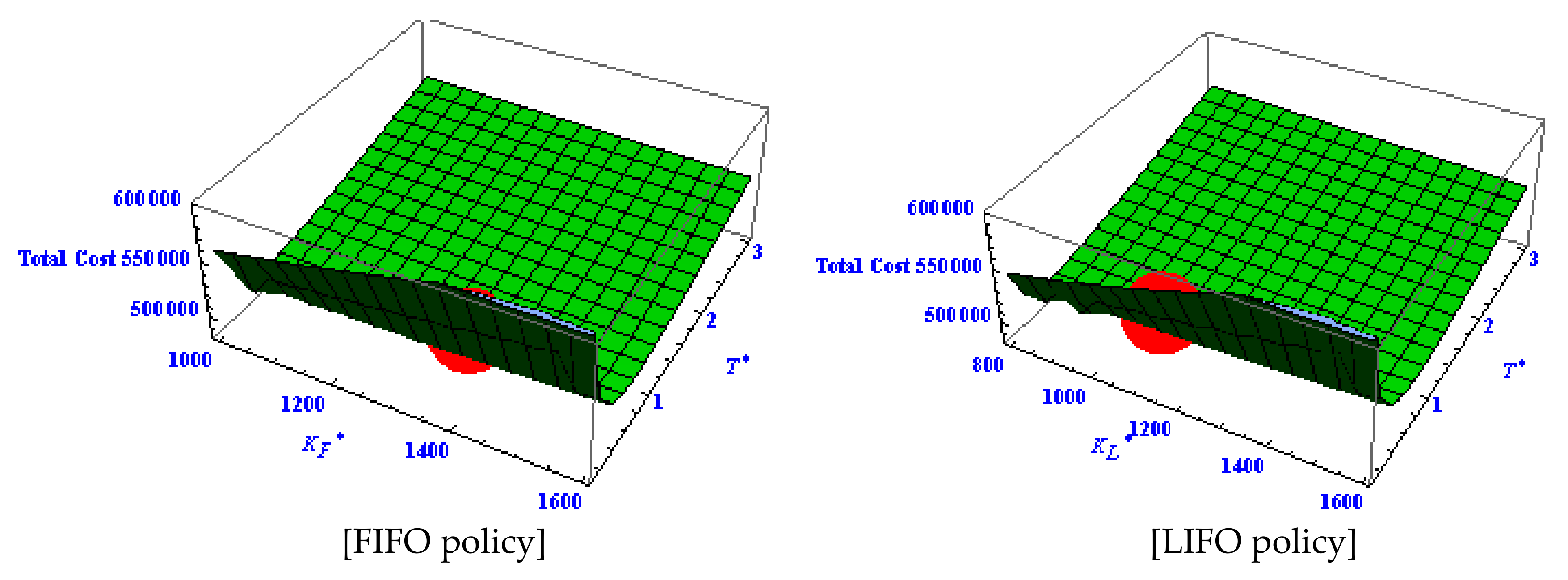
| Emission | 1160.08 1066.09 684.051 | 0.696300 0.640437 0.485351 | 773889 773226 773797 | 868038 797649 604037 | - - - | - - - | 824.788 1066.09 914.135 | 0.565506 0.640437 0.577859 | 774629 773226 773415 | 704819 797649 719535 | - - - | - - - | FIFO Either LIFO | |
| Emission and Green technology for function-I | 1347.32 1259.77 846.659 | 0.736153 0.688915 0.523788 | 507257 506846 507582 | 918531 858778 652654 | 116817 109217 83002.9 | 87 87 87 | 1066.17 1259.77 1047.65 | 0.628792 0.688915 0.601486 | 507992 506846 507106 | 784820 858778 749576 | 99811.6 109217 95329.3 | 57 57 57 | FIFO Either LIFO | |
| Emission and Green technology for function-II | 1300.37 1211.06 805.639 | 0.724381 0.675218 0.512934 | 560071 559611 560321 | 903652 841523 638934 | 271096 252457 191680 | 70 70 70 | 1006.92 1211.06 1013.56 | 0.611978 0.675218 0.593880 | 560820 559611 559856 | 763572 841523 739944 | 229071 252457 221983 | 70 70 70 | FIFO Either LIFO | |
| FIFO Policy | LIFO Policy | Suggested | ||||||
|---|---|---|---|---|---|---|---|---|
| Environment | (Year) | (Year) | Policy | |||||
| 0.25 0.5 1 2 4 | 1251.11 1273.70 1317.71 1401.64 1556.08 | 0.684607 0.696797 0.720548 0.765801 0.848963 | 560,805 506,911 507,118 507,512 508,238 | 1276.47 1232.08 1137.21 918.682 273.551 | 0.694802 0.681810 0.652626 0.579076 0.320964 | 506,729 507,033 507,613 508,643 509,733 | LIFO FIFO FIFO FIFO FIFO | |
| 0.25 0.5 1 2 4 | 1189.93 1213.65 1259.77 1656.87 1984.58 | 0.651197 0.664012 0.688915 0.847415 0.980343 | 506,519 506,630 506,846 506,096 505,554 | 1384.22 1344.51 1259.77 1491.43 1697.70 | 0.723131 0.712651 0.688915 0.785490 0.872264 | 505,893 506,219 506,846 506,605 506,421 | LIFO LIFO Either FIFO FIFO | |
| 0.25 0.5 1 2 4 | 899.411 919.483 958.384 1173.62 1319.40 | 0.534824 0.546603 0.569422 0.655565 0.713728 | 507,014 507,149 507,411 507,014 506,729 | 1199.14 1167.78 1101.47 1212.76 1293.07 | 0.647761 0.640431 0.623744 0.669721 0.703089 | 506,160 506,460 507,036 506,900 506,809 | LIFO LIFO LIFO LIFO FIFO | |
| FIFO Policy | LIFO Policy | Suggested | ||||||
|---|---|---|---|---|---|---|---|---|
| Deterioration | (Year) | (Year) | Policy | |||||
| (µ = 0, ν = 0.4) | 1316.83 1227.11 820.920 | 0.758036 0.707051 0.535170 | 481,593 481,172 481,859 | 1030.01 1227.11 1025.32 | 0.641885 0.707051 0.619213 | 482,303 481,172 481,410 | FIFO Either LIFO | |
| (µ = 0, ν = 0.2) | 1328.35 1239.46 830.665 | 0.749607 0.700083 0.530820 | 491,217 490,800 491,506 | 1043.89 1239.46 1033.75 | 0.636889 0.700083 0.612386 | 491,937 490,800 491,047 | FIFO Either LIFO | |
| (µ = 0 = ν) | 1339.77 1251.69 840.298 | 0.741448 0.693318 0.526569 | 500,841 500,428 501,152 | 1057.31 1251.69 1042.11 | 0.631997 0.693318 0.605776 | 501,570 500,428 500,682 | FIFO Either LIFO | |
| (µ = 0.5 = ν) | 1323.08 1233.82 826.213 | 0.753436 0.703251 0.532801 | 486,806 486,387 487,805 | 1037.69 1233.82 1029.90 | 0.639166 0.703251 0.615487 | 487,522 486,387 486,630 | FIFO Either LIFO | |
| (µ = 1, ν = 0) | 1363.24 1276.78 860.022 | 0.725262 0.679832 0.518015 | 520,889 520,484 521,245 | 1084.78 1276.78 1059.31 | 0.622129 0.679832 0.592659 | 521,637 520,484 520,756 | FIFO Either LIFO | |
| FIFO Policy | LIFO Policy | Suggested | ||||||
|---|---|---|---|---|---|---|---|---|
| Shipments | Deterioration | (Year) | (Year) | Policy | ||||
| 1 | 1556.46 1492.79 1104.70 | 0.802442 0.770235 0.614932 | 283,351 283,138 283,841 | 1367.74 1492.79 1251.01 | 0.730958 0.770235 0.670078 | 283,897 283,138 283,417 | FIFO Either LIFO | |
| 2 | 1347.32 1259.77 846.659 | 0.736153 0.688915 0.523788 | 507,257 506,846 507,582 | 1066.17 1259.77 1047.65 | 0.628792 0.688915 0.601486 | 507,992 506,846 507,106 | FIFO Either LIFO | |
| 3 | 1213.36 1110.17 694.525 | 0.700233 0.641251 0.472479 | 731,052 730,429 731,048 | 858.444 1110.17 933.816 | 0.561856 0.641251 0.568503 | 731,839 730,429 730,642 | FIFO Either LIFO | |
| 4 | 1117.78 1003.73 591.739 | 0.679356 0.610577 0.438922 | 954,769 953,928 954,347 | 701.093 1003.73 859.770 | 0.512607 0.610577 0.550954 | 955,497 953,928 954,092 | FIFO Either LIFO | |
| Deterioration | Policy Suggested | |||||||
|---|---|---|---|---|---|---|---|---|
| 0 | 1487.52 1402.32 925.376 | 0.748099 0.705743 0.537326 | 521,374 521,037 521,853 | 1194.36 1401.10 1128.34 | 0.650779 0.705353 0.605140 | 522,121 521,041 521,358 | FIFO Either LIFO | |
| 0.25 | 1419.96 1333.48 885.381 | 0.742951 0.698246 0.530991 | 511,191 510,822 511,603 | 1132.82 1332.41 1089.70 | 0.640643 0.697877 0.603392 | 511,935 510,825 511,115 | FIFO Either LIFO | |
| 0.5 | 1347.32 1259.77 846.659 | 0.736153 0.688915 0.523788 | 507,257 506,846 507,582 | 1066.17 1259.77 1047.65 | 0.628792 0.688915 0.601486 | 507,992 506,846 507,106 | FIFO Either LIFO | |
| 0.75 | 1269.72 1181.45 800.333 | 0.727912 0.6779600.515958 | 512,342 511,876 512,556 | 996.072 1184.67 1003.14 | 0.616104 0.679244 0.600098 | 513,059 511,866 512,095 | FIFO Either LIFO | |
| 1 | 1187.90 1099.57 750.394 | 0.719202 0.666433 0.508592 | 530,806 530,263 530,874 | 926.441 1110.46 958.499 | 0.605131 0.671070 0.601070 | 531,490 530,230 530,429 | FIFO Either LIFO |
| Parameter | % Change | ||||||
|---|---|---|---|---|---|---|---|
| −20 −10 10 20 | 1346.30 1299.90 1224.56 1193.30 | 6.87 3.19 −2.79 −5.28 | 0.645072 0.667866 0.708509 0.726866 | −6.36 −3.06 2.84 5.51 | 578,102 539,307 479,193 455,288 | 14.06 6.40 −5.46 −10.17 | |
| −20 −10 10 20 | 1270.63 1265.17 1254.43 1249.14 | 0.86 0.43 −0.42 −0.84 | 0.692906 0.690899 0.686953 0.685014 | 0.60 0.29 −0.28 −0.57 | 495,735 501,290 512,401 517,957 | −2.19 −1.00 1.10 2.19 | |
| −20 −10 10 20 | 1348.69 1302.22 1220.80 11184.85 | 7.06 3.37 −3.09 −5.95 | 0.720896 0.704096 0.675125 0.662541 | 4.64 2.20 −2.00 −3.82 | 417,420 462,136 551,550 596,249 | −17.64 −8.82 8.82 17.64 | |
| −20 −10 10 20 | 1267.56 1263.65 1255.94 1252.15 | 0.62 0.31 −0.30 −0.60 | 0.691181 0.690039 0.687808 0.686718 | 0.33 0.16 −0.16 −0.32 | 499,079 502,963 510,729 514,612 | −1.53 −0.77 0.77 1.53 | |
| −20 −10 10 20 | 1606.80 1422.57 1115.95 988.955 | 27.55 12.92 −11.42 −21.50 | 0.541359 0.610811 0.776645 0.875043 | −21.42 −11.34 12.73 27.02 | 820,890 644,791 398,780 314,115 | 61.96 27.22 −21.32 −38.03 | |
| −20 −10 10 20 | 1210.61 1234.30 1287.26 1317.055 | −3.90 −2.02 2.18 4.55 | 0.675093 0.681648 0.696995 0.706007 | −2.01 −1.05 1.17 2.48 | 560,142 533,496 480,193 453,537 | 10.52 5.26 −5.26 −10.52 | |
| −20 −10 10 20 | 1079.00 1165.80 1361.50 1471.59 | −14.35 −7.46 8.08 18.90 | 0.802917 0.743816 0.637946 0.590650 | 16.55 7.97 −7.40 −14.26 | 373,103 434,769 591,094 689,572 | −26.39 −14.22 16.62 36.05 | |
| −20 −10 10 20 | 1057.91 1158.34 1360.89 1460.35 | −16.02 −8.05 8.03 15.92 | 0.615433 0.651613 0.726790 0.764641 | −10.67 −5.41 5.50 11.00 | 507,542 507,180 506,542 506,268 | 0.12 0.07 −0.06 −0.11 | |
| −20 −10 10 20 | 1255.75 1257.95 1261.27 1262.50 | −0.32 −0.14 0.12 0.22 | 0.687752 0.688389 0.689348 0.689705 | −0.17 −0.08 0.06 0.11 | 510,927 508,683 505,342 504,110 | 0.8 0.36 −0.30 −0.54 | |
| −20 −10 10 20 | 1126.17 1194.83 1321.54 1380.55 | −18.90 −9.45 9.45 18.89 | 0.769678 0.725941 0.657041 0.629224 | 11.72 5.37 −4.63 −8.67 | 406,034 456,449 557,228 607,598 | −19.89 −9.94 9.9419.88 |
Publisher’s Note: MDPI stays neutral with regard to jurisdictional claims in published maps and institutional affiliations. |
© 2022 by the authors. Licensee MDPI, Basel, Switzerland. This article is an open access article distributed under the terms and conditions of the Creative Commons Attribution (CC BY) license (https://creativecommons.org/licenses/by/4.0/).
Share and Cite
Bhavani, G.D.; Meidute-Kavaliauskiene, I.; Mahapatra, G.S.; Činčikaitė, R. Pythagorean Fuzzy Storage Capacity with Controllable Carbon Emission Incorporating Green Technology Investment on a Two-Depository System. Energies 2022, 15, 9087. https://doi.org/10.3390/en15239087
Bhavani GD, Meidute-Kavaliauskiene I, Mahapatra GS, Činčikaitė R. Pythagorean Fuzzy Storage Capacity with Controllable Carbon Emission Incorporating Green Technology Investment on a Two-Depository System. Energies. 2022; 15(23):9087. https://doi.org/10.3390/en15239087
Chicago/Turabian StyleBhavani, Gudivada Durga, Ieva Meidute-Kavaliauskiene, Ghanshaym S. Mahapatra, and Renata Činčikaitė. 2022. "Pythagorean Fuzzy Storage Capacity with Controllable Carbon Emission Incorporating Green Technology Investment on a Two-Depository System" Energies 15, no. 23: 9087. https://doi.org/10.3390/en15239087
APA StyleBhavani, G. D., Meidute-Kavaliauskiene, I., Mahapatra, G. S., & Činčikaitė, R. (2022). Pythagorean Fuzzy Storage Capacity with Controllable Carbon Emission Incorporating Green Technology Investment on a Two-Depository System. Energies, 15(23), 9087. https://doi.org/10.3390/en15239087